年全国硕士研究生招生考试英语(一)试题
2026
Section I Use of English
Directions: Read the following text. Choose the best
word (s) for each numbered blank and mark A, B, C or D on
the ANSWER SHEET. (10 points)
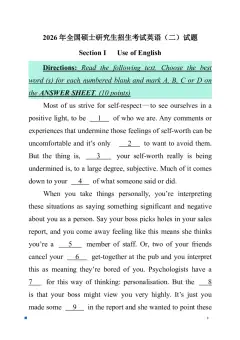
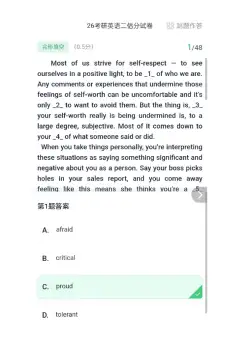
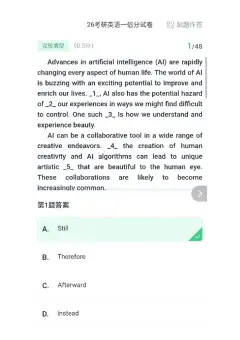
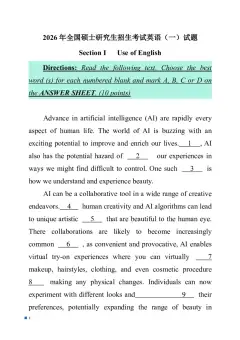
Advance in artificial intelligence (AI) are rapidly every
aspect of human life. The world of AI is buzzing with an
exciting potential to improve and enrich our lives. 1 , AI
also has the potential hazard of 2 our experiences in
ways we might find difficult to control. One such 3 is
how we understand and experience beauty.
AI can be a collaborative tool in a wide range of creative
endeavors. 4 human creativity and AI algorithms can lead
to unique artistic 5 that are beautiful to the human eye.
There collaborations are likely to become increasingly
common 6 , as convenient and provocative, AI enables
virtual try-on experiences where you can virtually 7
makeup, hairstyles, clothing, and even cosmetic procedure
8 making any physical changes. Individuals can now
experiment with different looks and 9 their
preferences, potentially expanding the range of beauty in
1deals.
AI algorithms can 10 financial features and skin
conditions to provide personalized beauty recommendations.
This 11 approach aims to cater to individual preferences
and enhance the concept of beauty tailored to each person’s
unique characteristics. 12 , AI can be a fun vehicle for
self-discovery.
While AI offers exciting possibilities, it also raises ethical
13 . There is a risk of deepening societal beauty 14
and perpetuating unattainable beauty standards 15 .
AI-powered beauty filters and editing tools can lead to
distorted self-perception and 16 body dissatisfaction. As
summarized in a recent post on “The Hidden Dangers of
Online Beauty Filters”, on this technology for social
presentation can cause harm 17 body image issues,
18 lower self-esteem, and social anxiety.
It's important to note that while AI can enhance our 19
of beauty, it should not 20 the genuine human
experience and the emotional connections we derive from
seeing the beauty in each other.
1. [A] Still [B] Therefore [C]Afterward [D] Instead
22. [A] reviewing [B] narrating [C] ignoring [D] dominating
3. [A] reason [B] area [C] clue [D] belief
4. [A] Balancing [B] Distinguishing [C] Combining [D] Introducing
5. [A] prospect [B] outcomes[C] ambitions[D] sentiments
6. [A]At first [B] By comparison [C] For instance [D] In general
7. [A] test [B] copy [C] link [D] save
8. [A] upon [B] beyond [C] through [D] before
9. [A] explore [B] recall [C] simplify [D] cherish
10. [A] recover [B] arrange [C] reserve [D] analyze
11. [A] localized [B] normalized [C] randomized [D] customized
12. [A]At best [B] To the contrary [C] By definition [D] In this way
13. [A] divisions [B] expectations [C] concerns[D] values
14. [A] pressures [B] mysteries [C] understandings [D] suspicions
15. [A]Approximately [B]Additionally[C]Alternatively[D]Accidentally
16. [A] deal with [B] result from [C] contribute to [D] focus on
17. [A] starting [B] checking [C] relying [D] working
18. [A] apart from [B] such as [C] regardless of [D] prior to
19. [A] imitation [B] appreciation [C] preservation [D] consumption
20. [A] replace [B] seize [C] share [D] reflect
Section II Reading Comprehension
Part A
3Directions: Read the following four texts. Answer the
questions below each text by choosing A, B, C or D. Mark
your answers on the ANSWER SHEET. (40 points)
Text 1
For thousands of years, donkeys have been critical for
propelling human civilizations forward. They’ve helped pull
wheeled vehicles, carry travelers and move goods across the
world. But where and when these animals first became
intertwined with humans has been a mystery. Now, researchers
have used genomes of over 200 donkeys to trace their
domestication back to a single event around 7,000 years ago in
East Africa - about 3,000 years before humans tamed horses.
The team published their findings in the journal Science this
month.
“Through their DNA, the animals are telling their history
themselves,” co-author Samantha Brooks, an equine
researcher at the University of Florida, says in a statement.
“We usually only get the human’s side of history through
written accounts, but of course written history does not always
record exactly how something happened. Looking at these
DNA sequences, we get a biological testimony to the
environment these animals lived in and the experiences they
4survived.”
The researchers examined 207 genomes from modern
donkeys living in 31 countries across the globe. They also
looked at genomes from 15 wild equids and 31 earlier donkeys
that lived between about 4,000 and 100 years ago. The team
reconstructed the animals’ evolutionary tree and used
computer models to pinpoint the domestication event: when
herders in Kenya and the Horn of Africa tamed wild asses.
They then traced how the animals spread across the rest of the
continent into Europe and Asia about 2,500 years later.
Though it’s still unclear why the original domestication
happened, Science News’ Freda Kreier reports that the event
coincided with the Sahara growing larger and drier. “Donkeys
are champions when it comes to carrying stuff and are good at
going at Paul Sabin deserts,” co-author Ludovic Orlando, an
evolutionary biologist at Paul Sabin University in France, tells
the publication. Prehistoric humans may have tamed donkeys’
help navigate the expanding Sahara.
Researchers say these findings could help put donkeys in
the spotlight. The animals could benefit from more research:
Currently, there are no published genomes from donkeys
located south of the Equator in Africa. But understanding
5where the animals were first domesticated could guide
archaeologists to a narrow region to search for insights about
the original tamed donkeys.
Not only does human-understanding the equines’ genetic
makeup help reveal their contribution to human history, but
it also might improve their management in the future, as
climate change alters the planet’s environment, write the
authors.
21. What can be learned about donkeys from paragraph 1?
[A]They seemed mysterious to human ancestors.
[B]They underwent multiple domestication events.
[C]They were vividly portrayed by ancient travelers.
[D]They were vividly portrayed by ancient travelers.
22.What message is conveyed in Brooks’ statement?
[A]The earliest habitats of donkeys are hardly traceable.
[B]It is increasingly easy to read donkeys’ DNA
sequences.
[C]Written accounts contain vital dues for donkey
research.
[D]Genetic analysis offers insight into the history of
donkeys.
23. In their study, the researchers investigated how
6donkeys?
[A]dispersed widely in the world.
[B]survived with the help of herders.
[C]developed certain behavioral traits.
[D]adapted to the changing environment.
24. As to why the original domestication of donkeys
happened, Orlando?
[A]challenges conventional ideas.
[B]provides a possible explanation.
[C]calls for evidence from the Sahara.
[D]holds a different view from Kreier.
25.The authors think that their research could help with __.
[A]greater protection of wildlife.
[B]better management of donkeys.
[C]recovering early types of donkeys.
[D]raising awareness of climate change.
Text 2
There's no business like show business – but in Los
Angeles, it feels like there's no business at all.
If that sounds melodramatic, consider this: The Art
7Directors Guild, a labor union representing about 3,000 film
workers, has suspended a training program and issued a
statement explaining that "we cannot in good conscience
encourage you to pursue our profession is a reaction to
Hollywood’s decline, which is reaching a critical point for the
industry and Southern California.
Production has been slipping away from Hollywood since
the 1950s, but the effects have never been more apparent than
at present. Other regions in the United States, Canada and
Europe have steadily increased incentives to attract TV shows
and movies, leaving California in the dust. Georgia offers up
to 30% in transferable tax credits on film and TV production
costs, plus an additional 10% increase on the base tax credit if
the project includes a Georgia promotional logo.
Even as California lost a huge volume of production to
other locations, there was still plenty of film production taking
place in Los Angeles before this year. We were kept afloat by
"peak TV", the glut of content that was required by the
explosion of streaming services.
If productions in Southern California dip below a critical
level for too long, the industry’s essential talent will drift
away along with enormous sums of revenue. Persuading
8studios to film here would become much more challenging if
we couldn ’ t after a deep bench of local film workers,
on-screen talent and local businesses that support the
entertainment industry.
That's why the California Film Commission and its Los
Angeles counterpart, Film LA, now should act now, before it's
too late. These agencies and other government bodies should
dramatically improve incentives to keep our current shows and
attract new productions to Los Angeles. Let’s go on with the
show ... and make sure the show doesn’t go on without us.
26. The Art Directors Guild’s statement reveals________.
[A] people’s reduced interest in film.
[B] film workers’ nostalgia for the past.
[C] the appeal of Southern California.
[D] the gloomy situation of Hollywood.
27. The example of Georgia is used to illustrate the efforts
to________.
[A] lure production with tax incentives.
[B] drive improvements in film facilities.
[C] stimulate competition among states.
[D] collect funds for film and TV making.
28. Peak TV passed its peak as ________.
9[A] streamers lost their technical advantages.
[B] Streamers changed their strategic priorities.
[C] Subscribers grew wary of large platforms.
[D] subscribers were unhappy with new shows.
29. According to paragraph 6, California ’ s entertainment
industry might face ________.
[A] a decline in product quality.
[B] a demand for foreign talent.
[C] a brain drain to other places.
[D] a dramatic rise in labor costs.
30.The author concludes the text by emphasizing that
California should strive to________.
[A] maintain its position in the industry.
[B] attract more investment than it had.
[C] pursue a higher standard of production.
[D] strengthen coordination with other states.
Text 3
The pioneers of wireless saw it as a gift to all the people.
Sir John Reith said that it would end “isolation of the spirit”
and rejoiced: “It does not matter how many thousand may be
10listening, there is always enough for others… the genius and
the fool, the wealthy and the poor listen simultaneously.”
Between two great wars this technological innovation
built a new kind of national consciousness. Opening this week,
a book and exhibition curated by Beatty Rubens at the
Bodleian in Oxford records how radio changed everyday life
from 1922 to 1939. She draws on letters, diaries and fiction,
and a 1939 field notebook of verbatim audience research by
Winifred Gill.
There’s fun in testimonies of people enjoying the sheer
newness.A cartoon mocks a group failing to converse because
they’re all in headphones. People report that broad music
made workmen whistle new tunes. A woman says there have
been fewer street fights since the arrival of the wireless but
also less stopping and“talking on the brush handle”.
By and large the wireless was welcome. I loved the man
from the Thirties research who found that wireless suddenly
offered “ a lot of variety … things I thought I’d never be
interested in…ice hockey,perhaps”. True: for more than 80
pre-digital years, linear speech broadcasting brought the gift of
serendipity, random enlivening of a car journey or dull manual
task. In my own book about radio I recorded how, on one
11drive: “I caught up with the news,learnt some 17th-century
history, and was startlingly educated by an unpretentious
programme on the history of the stethoscope."
But radio ’ s enriching serendipity is ebbing. With
multiple networks and countless podcasts, a smartphone user
selects what to hear and when. And while it is wonderful to
take a walk with anything in your headphones, infinite choice
encourages us to shrink into niche interests and sympathetic
beliefs.
31. What can be learnt about wireless from Reith?
________.
[A] It was accessible to everyone.
[B] It improved interpersonal relations.
[C] It was a miracle of human ingenuity.
[D] It led to a new era of isolating culture.
32. What is the theme of the exhibition at the Bodleian in
Oxford? ________.
[A] The impact of radio on its early audience.
[B] The role of radio in public music education.
[C] The innovation process of radio technology.
[D] The eminent pioneers in radio broadcasting.
33. It is indicated in Paragraph 4 that ________.
12[A] the research on radio used to be inadequate.
[B] the charm of radio remains in the digital age.
[C] radio listeners could make unexpected gains.
[D] radio shows have changed little over the years.
34. The expression “talking on the brush handle” in
Paragraphs 3 and 6 refers to the act of________.
[A] making a loud noise.
[B] having a casual chat.
[C] starting a trivial quarrel.
[D] humming a popular song.
35. In the last paragraph, the author intends to express the
opinion that________.
[A] technology should be aimed at benefiting humans.
[B] actions should be taken to revive the art of listening.
[C] adolescents should form healthy social media habits.
[D] people should adopt a sensible attitude to
innovations.
Text 4
When Tom Swetnam joined the U.S. Forest Service in the
1970s, his mandate was to “put everything out,” he recalled.
But when Swetnam enrolled in graduate school at the
University of Arizona’s Laboratory of Tree-Ring Research, he
13was surprised to find a record of repeated blazes dating back
hundreds of years before European colonists arrived on the
continent. Some of the trees he analyzed bore more than 20
fire scars among their rings.
The fact that fires happened so often meant they couldn’t
have been severe enough to kill most trees. Instead, a growing
body of research showed that frequent, low-severity fires
made many ecosystems healthier. They rid the forest of dead
and sick trees, reducing competition and curbing the spread of
disease. Because flammable material couldn’t build up on the
landscape, blazes tended to move slowly and peter out when
they reached the footprints of previous burns.
In 2022, Swetnam and other scientists teamed up to
compile a database of fire-scarred trees from across the
continent. Their North American tree-ring fire-scar network
(NAFSN) provided the basis for a study published last month.
In the study, the researchers compared the historical fire
cadence with the wildfires recorded over the past few decades,
and uncovered a striking shortfall. The NAFSN sites
experienced less than a quarter of the number of fires that
would have been expected without fire suppression.
This deficit is a testament to the effectiveness of modern
14firefighting, said Kelly Martin, a past president of the
International Association of Wildland Fire.“Yet the combined
consequences of suppression and climate change have eroded
humanity’s ability to suppress fires, particularly those that
ignite under the most dangerous weather conditions.
To prevent entire ecosystems from going up in smoke,
Martin said, people must bring healthy fire back to places that
need it. At Yosemite National Park, Martin oversaw the use of
what is known as prescribed burns to make the landscape
more resilient. These fires were carefully planned and
intentionally ignited during periods when weather kept the
blazes easy to control, and helped eliminate some of the fuel
that had build up around the important park’s facilities.
Research shows that these prescribed burns make subsequent
wildfires less severe, even if later fires happen under the most
dangerous weather conditions.
Yet even as scientists and public officials increasingly
agree on the need for more fires in our forests, climate change
is making this tactic more challenging, experts said. “It’s a
double-edged sword because wildfires are getting more severe
and larger under climate change and we need this work even
more, but then the work gets more challenging,” said Susan
15Prichard, a fire ecologist at the University of Washington. and
larger under climate change and we need this work even more,
but then the work gets more challenging, ” said Susan
Prichard, a fire ecologist at the University of Washington.
36. According to Paragraph 1, Swetnam was surprised by
________.
[A] the scarcity of tree-ring research in the U.S.
[B] the firefighting measures in ancient Europe.
[C] the forest management practices in the 1970s.
[D] the number of wildfires in precolonial times.
37. Paragraph 2 mainly focuses on ________.
[A] the causes of previous burns.
[B] the treatment of diseased trees.
[C] the benefits of low-severity fires.
[D] the importance of forest ecosystems.
38. What did the study find about the wildfires over the
past few decades? ________.
[A] Their intensity has vastly fluctuated.
[B] Their frequency has markedly decreased.
[C] Their threats have been underestimated.
[D] Their records have been misinterpreted.
1639.What can be inferred about modern firefighting?
________.
[A] Its workforce needs more training.
[B] Its effectiveness is questioned by the public.
[C] It may render traditional tactics useless.
[D] It may make severe fires harder to put out.
40.Both Martin and Prichard would agree that________.
[A] it is challenging to predict large wildfires
[B] it is urgent to assess the use of planned fires.
[C] it is necessary to introduce prescribed burns.
[D] it is rewarding to double fire detection efforts.
Part B
Directions: In the following text, some segments have
been removed. For Questions 41-45, choose the most suitable
one from the list A-G to fit into each of the numbered blanks.
There are two extra choices, which do not fit in any of the
blanks. Mark your answers on the ANSWER SHEET. (10
points)
[A] And just read a single poem. In his Oxford lectures,
Seamus Heaney argued that a poem draws a picture of reality,
a “glimpsed alternative” that sets up a contradiction with your
17own, in ways little and large. The negotiation, between you
and it, is the heart of the matter. What does the poet see that
you don’t? What does the difference mean? It could be one of
the best conversations you ever have. Forget self-help books;
reading is self-help in action.
[B] But for the most part, this isn’t what the business
community does. I have yet to meet a chief executive who
reads regularly. Many skip newspapers, and magazines are a
stretch. They don’t have time, they say. It’s inefficient; they
can get the information they need from those around them. At
a pinch, they might pick up a business book before a long
flight, in the hope that, like a cookbook, it will provide a
foolproof recipe. Some are drawn to what I think of as
“business car crash” books – the stories of Theranos, Purdue,
or WeWork. But outside those narrow pools of interest, a vast
ocean awaits, bountiful with simmering ideas, mental
adventure and imaginative refreshment.
[C] Neuroscientists have been at pains to demonstrate that
the pleasure a book provides isn’t indulgence; it’s good for
you. Reading will keep you better informed about the world
but it can also improve our tech-shattered ability to
concentrate. Standing in the shoes of others fine tunes our
18social understanding, useful as we struggle to understand
friends, neighbours, customers and co-workers. Different
parts of our brain engage as we simulate scenes, characters
and mental states. Our imagination – remember that? – is
rekindled.
[D] It is undoubtedly true that all work and no play really
does make Jack, or Jill, dull. The cure is right at hand, reading
is cheap, easy and, most important, it’s fun. Liberate your
imagination this year.
[E] We are living through a golden age of science writing.
So lucid and accessible that even lay readers can relish the
unpredictability of discovery. Daunted by uncertainty? Stand
in the shoes of scientists and witness the degree to which
breakthroughs emerge from accidents, conflict and sheer
mental stamina. "We are never sure of anything," says the
physicist (and writer) Carlo Rovelli.
[F] You don't need to get out more. If, like most business
people, you spend your life dashing from office to plane, train
to home, boardroom to washroom, what you really need to do
is stay in more. Sit down – and read a book.
[G] Reading has also been found to make us more helpful,
to reduce bias, and even to increase longevity – something we
19will enjoy all the more if we have a good book in our hands.
(And yes, all these benefits are more closely associated with
physical books than digital ones.)
[H] Read fiction. Any fiction. Free yourself from algorithms
and choose-anything you don’t need technology for an
immersive experience just surrender to narratives across time
and place. Modern (Sebastian Barry or Olga To karczuk),
classic (Virginia Woolfor James Baldwin) or genre (Stephen
King, Margaret Atwood, Georges Simenon) – it doesn’t
matter. Fiction invites you to loiter the unseen. Inthe lives of
others. We are living through a golden age of translation too,
so you can go anywhere in time or place.
F→ 41. → 42. →H→43. →C→44. → 45.
Part C
Directions: Read the following text carefully and then
translate the underlined segments into Chinese. Write your
answers on the ANSWER SHEET. (10 points)
Science education today revolves around the idea of
20scientific literacy – the base-level knowledge about science
that nonscientists require to effectively get on in the world.
This concept has served as a central goal for curriculum
developers, local school boards, business and community
leaders, and policymakers ever since its introduction nearly 80
years ago.
(46) Tracing the history of the term, we can see how the
definition of scientific literacy has shifted over time,
muddying the waters when it comes to determining the goals
of science education. And that’s a shame, because there is
much to recommend in the idea of scientific literacy as it was
originally articulated in 1945, a time when science appeared to
be the key to progress and scientists seemingly held the fate of
the world in their hands. (47) A return to that version of
scientific literacy, which focused more on teaching what
science is and how it works and less on memorizing scientific
facts, seems like something society today desperately needs.
In the United States, the desire to provide the public with a
general, nontechnical education in science originated as far
back as the late 1800s. (48) Educators advanced the idea of
having students complete detailed laboratory exercises in high
schools in the belief that such work was beneficial primarily
21as a way to enhance logical reasoning and observational skills.
The development in 1915 of the popular new subject“general
science ” was another effort to train students to apply the
principles of science to everyday, nonscience problems.
Although these efforts were aimed at the nonscience-bound
student, they never really made their way into mainstream
thought and public discourse as a means to rally widespread
support for the importance of science teaching in schools. (49)
It wasn't until the phrase "scientific literacy" came along in the
1940s that science had the formidable slogan it needed to
command public attention and make improving science
education an important national goal.
(50) The intense focus on scientific literacy in the United
States originally grew out of the critical role of science and
technology during World War II, as well as the perceived
deficiencies of American soldiers. As the war unfolded,
science rapidly assumed a central role. Battles increasingly
depended on new military technologies such as radar and the
proximity fuze. Science-based analytical approaches proved
remarkably successful in the hunt for German submarines in
the Atlantic Ocean. And there was the (then-secret) work
building the world's first atomic bomb. As a result,
22scientists-physicists in particular-found themselves in high
demand.
Section III Writing
Part A
:
51. Directions
Read the following email from your friend paul and write
him a reply.
Hi Li Ming
I was really moved by the Chinese families’ handwritten
letters you posted yesterday. They are priceless!Could you
please tell me a bit more about them? And are they currently
on public display somewhere? I’m very keen to see them in
person. Thanks.
You should write about 100 words on the ANSWER
SHEET.
Do not use your own name in the email; use “Li Ming”
instead. (10 points)
Part B
52. Directions:
Write an essay of based on the charts below. In your essay you
should
231) describe the drawing briefly,
2) interpret the charts, and
3) give your comments.
Write your answers in 160-200 words on the ANSWER
SHEET. (20 points)
一项关于养老机器人的消费者接受度和首要关注点调查
24