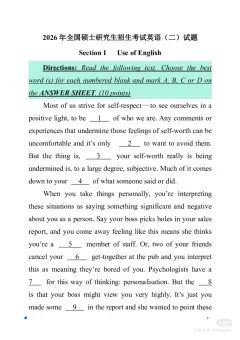
年全国硕士研究生招生考试英语(二)试题
2026
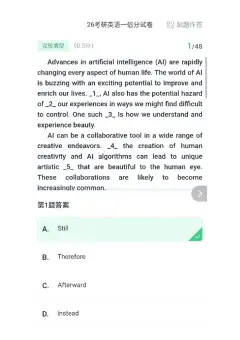
Section I Use of English
Directions: Read the following text. Choose the best
word (s) for each numbered blank and mark A, B, C or D on
the ANSWER SHEET. (10 points)
Most of us strive for self-respect—to see ourselves in a
positive light, to be 1 of who we are. Any comments or
experiences that undermine those feelings of self-worth can be
uncomfortable and it’s only 2 to want to avoid them.
But the thing is, 3 your self-worth really is being
undermined is, to a large degree, subjective. Much of it comes
down to your 4 of what someone said or did.
When you take things personally, you’re interpreting
these situations as saying something significant and negative
about you as a person. Say your boss picks holes in your sales
report, and you come away feeling like this means she thinks
you’re a 5 member of staff. Or, two of your friends
cancel your 6 get-together at the pub and you interpret
this as meaning they’re bored of you. Psychologists have a
7 for this way of thinking: personalisation. But the 8
is that your boss might view you very highly. It’s just you
made some 9 in the report and she wanted to point these
1out so that you do better next time. 10 , in the case of
your friends cancelling, perhaps the both felt unwell that
weekend or they just 11 their minds.
In both 12 —and others that we all experience—
there’s another 13 at work that psychologists call mind
reading. This is when you assume to know what other people
are thinking about you, when you can’t really know without
14 them directly.
One simple way to avoid 15 personalisation and
mind reading is to challenge your negative assumptions of
what’s 16 . When you find yourself taking a situation
personally, try to think of other interpretations that are less
focused on you—especially in the sense of saying anything
deep or 17 about you.
When you do this, it might help to try to put yourself in
other people’s shoes. The fact your boss took the time to give
you 18 at all means they care enough to want to help
you 19 . When it comes to your friends — maybe it’s
because your friendship is so 20 that they felt able to
cancel at late notice.
1. [A] afraid [B] critical [C] proud [D] tolerant
2. [A] risky [B] natural [C] admirable[D] foolish
23. [A] whether [B] where [C] why [D] how
4. [A] citation [B] imitation [C] perception [D] introduction
5. [A] poor [B] loyal [C] creative [D] shy
6. [A] sponsored [B] crowded[C] disputed [D] planned
7. [A] method [B] term [C] design [D] goal
8. [A] evidence [B] theory[C] condition [D] reality
9. [A] complaints [B] choices [C] mistakes [D] suggestions
10. [A] Similarly [B] Relatively [C]Accordingly [D] Contrarily
11. [A] opened [B] changed [C] trained [D] cleared
12. [A] quotations [B] experiments [C]questions [D] examples
13. [A] process [B] objective [C] outcome [D] background
14. [A] blaming [B] warning [C] teaching [D] asking
15. [A] arguing about [B] accounting for
[C] engaging in[D] interfering with
16. [A] happened [B] continued [C] returned [D] disappeared
17. [A] casual [B] obvious [C] familiar [D] fundamental
18. [A] reward [B] feedback [C] trust [D] proof
19. [A] innovate [B] concentrate [C] improve [D] relax
20. [A] strange [B] strong [C] vulnerable [D] valuable
3Section II Reading Comprehension
Part A
Directions: Read the following four texts. Answer the
questions below each text by choosing A, B, C or D. Mark
your answers on the ANSWER SHEET. (40 points)
Text 1
Ask people about public libraries and a certain image
springs to mind: dusty, old-fashioned, the sort of place you
enjoyed as a child but, rather like a British seaside town,
would you go there now? And anyway-aren’t they all closing?
The reality is startlingly different, as I discovered when
the culture department commissioned me to conduct an
independent review of English public libraries, published
yesterday. As I visited libraries up and down the country, I was
surprised to learn there are more than twice the number of
libraries (2,892) as there are branches of McDonald’s.
Enter any one of them and you will find a hive of activity,
while books are, and should always be, at the heart of any
library, a multitude of other services are offered: employment
advice, language classes or digital access and support.
4There are libraries with business and intellectual property
centres, which can help business owners and entrepreneurs.
Many have nurses on site to carry out basic health checks,
with a link to the GP’s surgery, there are libraries where young
people can borrow a Fifa-standard football free.
In return for all of this, you’ll be asked for precisely
nothing. There will be no charge and you will never be asked
to justify or explain yourself, you will simply be welcomed in,
offered help if you need it, and left alone if you do not. There
is no other institution, public or private, that can say the same.
Yet still our libraries are often overlooked and
underappreciated. There is an overall decline in visits and
many are struggling as local authorities come under continued
financial pressure.
The number of libraries that have closed since 2010 is
disputed. An annual survey by the Chartered Institute of
Public Finance and Accountancy puts it at nearly 800 across
the UK; official statistics held by the Arts Council record 230
in England. It is, of course, 230 libraries too many. So if we
are to protect our libraries for future generations, we must
raise awareness of them and the work they do.
The review recommends a national branding campaign to
5give libraries a stronger physical presence, the reintroduction
of a scheme to enable members to use their card in any library
in the country, and automatic memberships for children. If we
don’t use them, we will end up losing them. And for those
who haven’t been to a library for some time, they may be
surprised by what they find.
21.What was the author commissioned to do about English
public libraries?
[A] Document their valuable traditions.
[B] Make a plan for their expansions.
[C] Obtain reader opinions on them.
[D] Look into their current situation.
22. According to Para.3&4 , the author finds that
libraries______.
[A] boast desirable book collections.
[B] keep detailed visitor records.
[C] preform diversified functions.
[D] attract mostly young readers.
23. It is implied in Para. 5 that libraries should ________.
[A] be given greater attention.
[B] impose stricter visit limits.
6[C] work with private institutions.
[D] get their equipment upgraded.
24. The statistics mentioned in P6 show________.
[A] the crisis faced by libraries.
[B] the advancement of libraries.
[C] the contributions of libraries.
[D] the flaws existing in libraries
25. Which of the following is suggested for libraries in the
last paragraph?
[A] Inviting public feedback.
[B] Seeking adequate funding.
[C] Improving user convenience.
[D] Offering lifetime memberships.
Text 2
According to our research, around one in five workers in
the UK talk to AI like a friend, looking for guidance on
personal and professional problems. Our data shows that
engaging with AI like this can leave us feeling heard and less
isolated. But, with this newfound connection, many of us
share sensitive, sometimes highly confidential informational,
even though over a third of people don’t realise that AI
7platforms may not be very good at keeping our secrets…
secrets.
For business, the implications are worrying. Consider
Microsoft Copilot, for example. It gains Microsoft broad
rights to the data inputted or outputted by any user – rights to
use this data in any way it sees fit; it can even share it with
third parties. This means that any way it sees fit, it can even
share it with third parties. This means that any sensitive
business information could potentially be exposed to the world.
Employers are taking note and taking action. According to our
research, 25% have decided to either outright ban AI or
regulate its use within their organisations. But even with these
policies in place, some employees choose to break the rules.
They have their reasons – around 63% of them report that
using AI increases their productivity, and some even feel AI
offers more help than their human colleagues.
The situation presents a delicate balance between
leveraging AI for its productivity gains and risking
confidential data exposure. Employers need to manage AI
tools with the same level of care as any other form of data
sharing or storage. There's also a knowledge gap that needs to
be addressed — 40% of individuals surveyed are unsure about
8who retains ownership over the content produced by AI. By
instilling best practices in AI engagement and creating policies
that evolve with the technology, business can positively shift
the AI landscape.
With AI's potential to simplify our professional lives, do
the admin and enhance the work experience. It's up to us to
navigate its usage cautiously so it supports us without
compromising our privacy. There's no need to back away from
progress, as long as we're equipped with the knowledge and
tools to make sure AI remains a friend. And this is where the
challenge lies. There are so many products out there, being
promoted with huge advertising and marketing budgets, that
it's easy to fall victim. But by building a culture of digital
responsibility within our business, we can create a future
where AI can help us without spilling the beans.
26. According to Paragraph 1, workers’ engagement with
AI can ________.
[A] facilitate their career progress
[B] give them emotional support
[C] help maintain their motivation
[D] improve workplace communication
27. Microsoft Copilot is cited to show that the use of AI
9may ________.
[A] pose a threat to businesses
[B] generate unnecessary data
[C] promote business cooperation
[D] encourage information sharing
28. Some employees choose to break the rules on AI due to
________.
[A] easy access to AI products
[B] the desire to stay well-informed
[C] its significant role in their work
[D] the need to compete with others
29. To positively shift the AI landscape, businesses
should________.
[A] increase the transparency of their data sources
[B] prioritise the quality of AI-produced content
[C] include employee perspectives in their rules
[D] adjust their management to AI development
30. According to the last paragraph, we may easily fall victim
to AI as we________.
[A] have a limited understanding of it
[B] underestimate its economic costs
[C] tend to overemphasise its power
10[D] are excessively exposed to it
Text 3
Since the 2008 launch of the high-speed rail network
between Rome and Milan, trains have become the preferred
means of travel across Italy for locals and tourists alike. Fast
trains can cover the 500km between the two cities in three
hours. The network also connects Naples, Bologna, Florence
and Turin. In many cases, it is the best option— in terms of
travel time and cost— for both leisure and business travellers.
This is why the recent severe delays caused by numerous
maintenance works have thrown the rail industry into chaos at
a time when most people
Head on holiday, which matters for business in a country
where tourism accounts for 10 percent of GDP.
Disruptions have become increasingly frequent with train
delays now a fixture in Italian media coverage. Ferrovie dello
Stato Italiane, the publicly controlled group that owns train
operator Trenitalia and the national train network RFI, said 23
percent of all high-speed trains it operated were late in 2023.
The huge improvements in Italy's obsolete infrastructure
partly explained the disruption, said Ferrovie. RFI, the
network operator, is the single largest European recovery fund
11beneficiary with planned investments of €24bn by 2026.
Ferrovie will invest a total of €124bn in infrastructure over the
next 10 years.
But lack of capacity is another problem. Transport
economist Andrea Giuricin said the planned investments
would bring improvements but disruptions in the meantime
were inevitable. “We have a mixed system, there is no spare
capacity and as soon as there’s a hiccup on the line, the
situation becomes highly complex,” he said. A mixed system
means that high-speed trains must travel on the regular tracks
on certain routes or when passing through large cities. If
there’s congestion or, for example, a local train breaks down,
the entire high-speed network is affected.
One of the most important changes the upgrades will
bring is the segregation of the high-speed line from the regular
one in certain urban centres through the construction of
underground rail links.
Improvements will also come from the high-density
technology and satellite signalling that RFI has been investing
in for years, say experts. It will allow for a reduction of the
distance between high-speed trains travelling on the same line
at any given time, which should mean a significant increase in
12capacity and traffic fluidity, according to Giuricin.
31. According to the first two paragraphs, the high-speed
rail network in Italy ________.
[A] is seen by tourists as outdated
[B] is a popular option for travelling
[C] is inadequately utilised by locals
[D] is an example of good maintenance
32. Ferrovie is quoted in Paragraph 3 to show ________.
[A] the common occurrence of train delays
[B] the value of the Italian train network
[C] the wide media coverage of trains
[D] the high efficiency of Trenitalia
33. Which of the following is one cause of the disruptions
in the network?
[A] Complex train schedules.
[B] Shortage of investments.
[C] Its limited capacity.
[D] Its massive scale.
34. It can be learned that the mixed system________.
[A] provides a wide choice of routes
[B] requires extra operational spending
13[C] increases the level of travel comfort
[D] puts the high-speed network in trouble
35. Improvements to the Italian train network will
include________.
[A] reconstructing the regular train lines
[B] shortening high-speed train intervals
[C] building more stations in urban centres
[D] enhancing the safety of high-speed trains
Text 4
In 2023, Chicago lost one of its most beloved street
festivals. The Silver Room Block Party, staged by Hyde Park
community leader Eric Williams, announced it would not
return in 2024. What began as a small neighborhood gathering
blossomed into a massive cultural event welcoming tens of
thousands of people each year over nearly two decades before
abruptly shutting down.
Williams pointed to rising production costs and declining
attendee donations as primary reasons the Silver Room Block
Party could not continue, highlighting a reality that all street
festival organizers face right now. The cost of producing a
street festival in Chicago has skyrocketed. Security,
entertainment, portable restrooms, insurance and even basics
14such as fencing and staffing have all become significantly
more expensive. At the same time, donations at festival gates
have dropped dramatically.
Chicago’s summer festivals are about more than just
entertainment; they are economic engines that directly benefit
the neighborhoods they’re in and the city of Chicago as whole.
Street festivals drive foot traffic to local businesses and foster
the kind of cultural vibrancy that makes our city special.
We often hear people ask why we solicit donations at our
entry points, especially when the city’s largest festivals like
the Chicago Jazz Festival do not request donations. The fact is,
unlike those large, city-produced music festivals, your
neighborhood street festivals receive no city funding and rely
on a combination of sponsorships, vendor fees and gate
donations to cover their costs.
Wicker Park Fest has long been one of Chicago’s most
anticipated summer festivals, drawing upward of 70,000
attendees for a full weekend of live indie music, local art,
small business vendors and, most importantly, community
connection. In 2024, Wicker Park Fest saw record-breaking
attendance. Despite the turnout, gate donations reached their
lowest point in our history. This year, we’ve been forced to
15scale back the footprint of the fest. We are eliminating a stage,
booking fewer performers and making additional cuts to
reduce our costs, all while striving to keep the festival as
vibrant as ever, as supportive of local artists and businesses,
and as true to Wicker Park’s unique spirit and reputation as
festgoers have come to expect.
This summer, as you enjoy your favorite neighborhood
street festival, I hope you’ll remember that they exist because
of community support. A thriving summer festival season
doesn’t happen by accident; It happens when we all chip in.
36. It can be learned from Paragraph 1 that the Silver
Room Block Party
________.
[A] has been replaced by other festivals.
[B] has gained great international fame.
[C] was held in various neighborhoods.
[D] was an appealing cultural gathering.
37. One reality street festival organizers face is that
________.
[A] they are unable to use the donations wisely.
[B] they are unable to get sufficient facilities.
16[C] they have to tackle financial difficulties.
[D] they have to step up security measures.
38. According to Paragraphs 3 and 4 Chicago's street
festivals ________.
[A] relieve typical urban lifestyles.
[B] are funded by the government.
[C] contribute to the local economy.
[D] are famous for their music shows.
39.It is implied that the organizers of Wicker Park Fest have to
________.
[A] count on amateur artists’ participation.
[B] reduce the number of performances.
[C] give up its most prominent feature.
[D] collaborate with large businesses.
40.The author holds that the future of street festivals depends
on________.
[A] the variety of activities.
[B] the generosity of attendants.
[C] the reputation of neighborhoods.
[D] the management of expenditures.
17Part B
Directions: Read the following text and answer the
questions by choosing the most suitable subheading from the
list A-G for each numbered paragraphs (41-45). There are two
extra subheadings which you do need to use. Mark your
answers on the ANSWER SHEET. (10 points)
① In an effort to support restoration programmes,
specialists are developing supplies of seeds and seedlings,
maintaining gene banks and sequencing the genomes of
indigenous trees and other crops. Their work deals with one of
the problems that could block major restoration efforts in
different parts of the world.
② “Where’s the planting material going to come from?
That’s one big bottleneck,” says genetic-resources specialist
Rami Jamnadass.
③ Asia is arguably the region most neglected by global
efforts to increase diversity in restoration and to study native
species. Christopher Kettle, Bioversity International’s director
for forest genetic resources and restoration in Rome, says that
the need for infrastructure — things such as mechanisms for
collecting and storing seeds, and nurseries to raise seedings
18— might be most desperate here because many trees are
‘mastiy’ species, which don’t produce seeds every year. People
need to be ready. “Otherwise, you miss the boat, you lose all
the seed you’re got to wait another seven years,”says Kettle.
“ This is a really, really critical issue for restoration in
Southeast Asia, because many of the most important timber
species and tree species — the ones that will lock up the
most carbon — they’re all masty species.”
⑤ With so much reason left to do, leaders in the field
have been doing some soul-searchy and although that
restoration can be mothurted by – and designed to meet –
different needs. When you talk about conservation or
restoration, the first question has to be restoration by whom,
for whom? says Dansel Sanzen, a biologist at the University of
Pennsylvansa.
41. Ramni Jamnadass
42. Christopher Kettle
43. John Stanturf
44. Pedro Brancalion
45. Robin Chazdon
[A] People must pay attention to the fact that some kinds of
19trees do not produce seeds annually.
[B] Soil is an important element to be taken into account in
forest restoration.
[C] The purpose of restoration efforts may be different from
the real needs of the people involved.
[D] Human factors, as well as trees planted, should be
emphasized in forest restoration.
[E] The supply of seeds is a tough problem that has to be dealt
with.
[F] When it comes to restoration, we have to stay with an
awareness of whose interests to serve.
[G] Some creatures in the forest that multiply fear can become
a great threat to forest restoration.
Section III Translation
46. Directions: Translate the following text into Chinese.
Write your translation on the ANSWER SHEET. (15 points)
The influence of wearables on psychology refers to how the
clothes we wear affect our thoughts, feelings, and behaviors.
Clothing is not just about covering our bodies; it plays a
significant role in shaping our self-perception and interactions
with others.
One aspect of this influence is self-expression. The clothes
20we choose can reflect our personality, mood, and identity.
Whether we opt for bold, colorful outfits or prefer more
understated styles, our dress choices convey messages about
who we are and how we want to be perceived.
Additionally, clothing can impact our confidence levels.
When we wear
clothes that make us feel comfortable and confident, it can
positively affect our self-esteem and overall mood.
Moreover, cultural and societal influences play a significant
role in shaping our dress choices. Different cultures have their
norms and expectations regarding dress, which can influence
the types of clothing people wear and the meanings attributed
to them.
Section IV Writing
Part A
:
47. Directions
Suppose your friend Jack has shared with you a video of
his family’s travel in China. Write an email to tell him
(1) how you feel about the video, and
(2) your wish to learn more about their travel.
Write you answer in about 100 words on the ANSWER
SHEET.
21Do not use your own name in your email; Use “Li Ming”
instead.(10 points)
Part B
48. Directions:
Write an essay based on the chart below. In your essay,
you should
1) describe and interpret the chart, and
2) give your comments.
You answer in about 150 words on the ANSWER
SHEET. (15 points)
某项关于儿童户外活动看法的调查
22