2008 年 12 月大学英语六级(CET-6)真题试卷
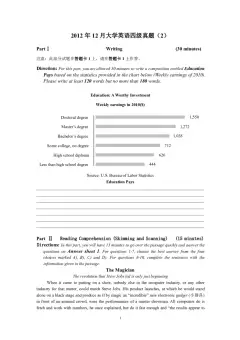
PartⅠ Writing (30minutes)
Directions: Directions: For this part, you are allowed 30 minutes to write a short essay entitled
How To Improve Student's Mental Health?. You should write at least 150 words
followingthe outlinegivenbelow.
1.大学生的心理健康十分重要
2.因此,学校可以……
3.我们自己应当……
HowToImproveStudent's MentalHealth?
PartII Reading Comprehension(Skimming andScanning) (15minutes)
Directions: In this part, you will have 15 minutes to go over the passage quickly and answer the
questions on Answer Sheet 1.For questions 1-7, choose the best answer from the four
choices marked [A], [B], [C] and [D]. For questions 8 -10, complete the sentences
withtheinformation giveninthepassage.
Directions: In this part, you will have 15 minutes to go over the passage quickly and answer the
questions on Answer Sheet 1. For questions 1-7, choose the best answer from the four choices
marked [A], [B], [C] and [D]. For questions 8-10, complete the sentences with the information
givenin thepassage.
SupersizeSurprise
Ask anyone why there is an obesity epidemic and they will tell you that it’s al down to eating
too much and burning too few calories. That explanation appeals to common sense and has
dominated efforts to get to the root of the obesity epidemic and reverse it. Yet obesity researchers
are increasingly dissatisfied with it. Many now believe that something else must have changed in
our environment to precipitate(促成) such dramatic rises in obesity over the past 40 years or so.
Nobody is saying that the “big two” – reduced physical activity and increased availability of food –
arenot importantcontributors totheepidemic,buttheycannotexplainitall.
Earlier this year a review paper by 20obesity experts set out the 7 most plausible alternative
explanations forthe epidemic.Heretheyare.
1.Not enoughsleep
It is widely believed that sleep is for the brain, not the body. Could a shortage of shut-eye also
behelpingtomakeus fat?
Several large-scale studies suggest there may be a link. People who sleep less than 7 hours a
night tend to have a higher body mass index than people who sleep more, according to data
gathered by the US National Health and Nutrition Examination Survey. Similarly, the US Nurses’
1/23Health Study, which tracked 68,000 women for 16 years, found that those who sleptan average of 5
hours a night gained more weight during the study period than women who slept 6 hours, who in
turngained more thanwhose who slept7.
It’s well known that obesity impairs sleep, so perhaps people get fat first and sleep less
afterwards. But the nurses’study suggests that it can work in the other direction too: sleep loss may
precipitateweightgain.
Although getting figures is difficult, it appears that we really are sleeping less. In 1960 people
in the US slept an average of 8.5 hours per night. A 2002 poll by the National Sleep Foundation
suggests that the average has fallen to under 7 hours, and the decline is mirrored by the increase in
obesity.
2.Climate control
We humans, like all warm-blooded animals, can keep our core body temperatures pretty much
constant regardless of what’s going on in the world around us. We do this by altering our
metabolic(新陈代谢的) rate, shivering or sweating. Keeping warm and staying cool take energy
unless we are in the “thermo-neutral zone”, which is increasingly where we choose to live and
work.
There is no denying that ambient temperatures(环境温度) have changed in the past few
decades. Between 1970 and 2000, the average British home warmed from a chilly 13C to 18C. In
the US, the changes have been at the other end of the thermometer as the proportion of homes with
air conditioning rose from 23% to 47% between 1978 and 1997. In the southern states – where
obesity rates tend to be highest – the number of houses with air conditioning has shot up to 71%
from 37% in1978.
Could air conditioning in summer and heating in winter really make a difference to our
weight?
Sadly,there is some evidence that it does-at least with regard to heating. Studies show that in
comfortable temperatureswe use lessenergy.
3.Lesssmoking
Bad news: smokers really do tend to be thinner than the rest of us, and quitting really does
pack on the pounds, though no one is sure why. It probably has something to do with the fact that
nicotineisanappetite suppressantandappearstoupyour metabolicrate.
Katherine Flegal and colleagues at the US National Center for Health Statistics in Hyattsville,
Maryland, have calculated that people kicking the habit have been responsible for a small but
significant portion of the US epidemic of fatness. From data collected around 1991 by the US
National Health and Nutrition Examination Survey,they worked out that people who had quit in the
previous decade were much more likely to be overweight than smokers and people who had never
smoked .Among men, for example, nearly half of quitters were overweight compared with 37% of
non-smokersandonly28%ofsmokers.
4.Geneticeffects
Yours chances of becoming fat may be set, at least in part, before you were even born.
Children of obese mothers are much more likely to become obese themselves later in life. Offspring
of mice fed a high-fat diet during pregnancy are much more likely to become fat than the offspring
of identical mice fed a normal diet. Intriguingly, the effect persists for two or three generations.
Grandchildren of mice fed a high-fat diet grow up fat even if their own mother is fed normally-so
youfatemayhave beensealedevenbefore youwere conceived.
5.Alittle older…
2/23Some groups of people just happen to be fatter than others. Surveys carried out by the US
national center for health statistics found that adults aged 40 to 79 were around three times as likely
to be obese as younger people. Non-white females also tend to fall at the fatter end of the spectrum:
Mexican-American women are 30% more likely than white women to be obsess, and black women
havetwicetherisk.
In the US, these groups account for an increasing percentage of the population. Between 1970
and 2000 the US population aged 35 to 44 grew by43%.the proportion of Hispanic-Americans also
grew, from under 5% to 12.5% of the population, while the proportion of black Americans
increased from 11% to12.3%.these changes may account in part for the increased prevalence of
obesity.
6.Maturemums
Mothers around the world are getting older. in the UK, the mean age for having a first child is
27.3,compared with 23.7 in 1970 .mean age at first birth in the US has also increased, rising from
21.4 in1970to24.9in2000.
This would be neither here nor there if it weren’t for the observation that having an older
mother seems to be an independent risk factor for obesity. Results from the US national heart, lung
and blood institute’s study found that the odds of a child being obese increase 14% for every five
extrayearsoftheir mother’sage,thoughwhythisshouldbe soisnot entirelyclear.
Michael Symonds at the University of Nottingham, UK, found that first-born children have
more fat than younger ones. As family size decreases, firstborns account for a greater share of the
population. In 1964, British women gave birth to an average of 2.95 children; by 2005 that figure
had fallen to 1.79. In the US in1976, 9.6% of woman in their 40s had only one child; in 2004 it was
17.4%. this combination of older mothers and more single children could be contributing to the
obesityepidemic.
7.Likemarryinglike
Just as people pair off according to looks, so they do for size. Lean people are more likely to
marry lean and fat more likely to marry fat. On its own, like marrying like cannot account for any
increase in obesity. But combined with others—particularly the fact that obesity is partly genetic,
andthatheavierpeople havemore children—it amplifiestheincreaseformothercauses.
1.What isthepassagemainlyabout?
A) Effectsof obesityonpeople’s health
B)The link betweenlifestyleandobesity
C) Newexplanationsfor the obesityepidemic
D) Possiblewaysto combattheobesity epidemic
2.Inthe USNurse’HealthStudy,womenwho sleptanaverageof 7hours anight_______.
A) gainedtheleast weight B) wereinclinedtoeatless
C) foundtheirvigor enhanced D) werelesssusceptibletoillness
3.The popularbeliefaboutobesityisthat___________.
A) itmakes us sleepy B) itcausessleeploss
C) itincreasesour appetite D) itresults fromlackofsleep
4.Howdoes indoorheatingaffectour life?
A) itmakes us stayindoorsmore B) itacceleratesour metabolicrate
C) itmakesus feel more energetic D) itcontributes toourweightgain
5.What does theauthorsayaboutthe effectof nicotineonsmokers?
A) itthreatenstheir health B) itheightenstheirspirits
3/23C) itsuppressestheirappetite D) itslows downtheir metabolism
6.Who aremostlikelytobeoverweightaccordingtoKatherine Fergal’s study?
A) heavysmokers B) passivesmokers
C) thosewho neversmoke D) thosewhoquitsmoking
7. According to the US National Center for Health Statistics, the increased obesity in the US is a
resultof_______.
A) thegrowingnumber of smokers amongyoungpeople
B) therisingproportion of minorities inits population
C) theincreasingconsumptionof high-caloriefoods
D) theimproving livingstandardsofthe poorpeople
8. According to the US National Heart, Lung and Blood Institute, the reason why older mothers’
childrentendtobeobeseremains__________.
9. According to Michael Symonds, one factor contributing to the obesity epidemic is decrease of
___________.
10. When two heavy people get married, chances of their children getting fat increase, because
obesityis _____________.
PartIII ListeningComprehension (35minutes)
SectionA
Directions: In this section, you will hear 8 short conversations and 2 long conversations. At the
end of each conversation, one or more questions will be asked about what was said.
Both the conversation and the questions will be spoken only once. After each question
there will be a pause. During the pause, you must read the four choices marked [A],
[B], [C] and [D], and decide which is the best answer. Then mark the corresponding
letteronAnswerSheet2withasinglelinethroughthecentre.
11.A) Heis quiteeasytorecognize B) Heis anoutstandingspeaker
C) Helooks like a movie star D) He looksyoungfor hisage
12.A) consultherdancingteacher B) takea more interestingclass
C) continueherdancingclass D) improve herdancingskills
13.A) themandidnotbelievewhat thewomansaid
B) themanaccompaniedthewomantothe hospital
C) thewomanmaybe sufferingfrom repetitivestraininjury
D) thewomanmay notfollowedthe doctor’s instructions
14.A) theyarenotinstyleany more B) theyhavecosthim fartoomuch
C) theynolongersuithiseyesight D) theyshouldbe cleanedregularly
15.A) hespilledhis drinkontothe floor
B) hehas justfinishedwipingthefloor
C) hewascaughtinashower onhiswayhome
D) herushedout of thebathtoanswerthe phone
16.A) fixingsomefurniture B) repairingthe toytrain
C) readingtheinstructions D) assemblingthebookcase
17.A) urgeJennytospendmore time onstudy
B) helpJennytoprepare for thecomingexams
C) acttowards Jennyinamore sensibleway
D) sendJennytoa volleyballtrainingcenter
18.A)The building of thedam needsa largebudget
4/23B)The proposedsiteis nearthe residentialarea
C)The local peoplefeel insecureaboutthedam
D)The damposesa threattothe localenvironment
Questions19to21 arebasedonthe conversationyouhave just heard.
19.A. Itsawthe endof its boomingyears worldwide
B.Itsproductionandsalesreachedrecordlevels.
C.Itbecame popularinsomeforeigncountries
D.Itsdomesticmarketstartedtoshrinkrapidly.
20.A.Theycostless. C.Theywere infashion.
B.Theytastedbetter. D.Theywere widelyadvertised.
21.A. Itissuretofluctuate. C.Itwillremainbasicallystable.
B.Itisboundtorevive. D.Itwillseenomore monopoly
Questions22to25 arebasedonthe conversationyouhave just heard.
22.A. Organisingprotests C.Actingasitsspokesman.
B.Recruitingmembers D.Savingendangeredanimals.
23.A.Anti-animal-abuse demonstrations B.Anti-nuclearcampaigns
C.SurveyingtheAtlanticOceanfloor D.Removingindustrialwaste.
24.A. Byharassingthem. C.Bytakinglegalaction.
B.Byappealingtothepublic D.Byresortingtoforce.
25.A. Doubtful C.Indifferent.
B.Reserved D.Supportive
SectionB
Directions: In this section, you will hear 3 short passages. At the end of each passage, you will
hear some questions. Both the passage and the questions will be spoken only once.
After you hear a question, you must choose the best answer from the four choices
marked [A], [B], [C] and [D]. Then mark the corresponding letter on Answer Sheet 2
witha singleline throughthecentre.
PassageOne
Questions26to28arebasedonthe passage youhave just heard.
26.A.The airbecomes still. C.The cloudsblockthe sun.
B.The airpressure is low. D.The skyappears brighter.
27.A.Ancient peoplewerebetterat foretellingtheweather.
B.Sailors’sayingaboutthe weather areunreliable.
C.Peopleknewlongagohowtopredicttheweather.
D.Itwas easiertoforecastthe weatherintheolddays.
28.A.Weatherforecastisgettingmore accuratetoday.
B.Peoplecanpredicttheweatherbytheir senses
C.Who aretherealexperts inweatherforecast.
D.Weatherchanges affectpeople’slife remarkably
PassageTwo
Questions29to31arebasedonthe passage youhave just heard.
29.A.Theyoftenfeel insecureabouttheir jobs.
B.Theyareunabletodecidewhat todofirst.
C.Theyfeel burdenedwithnumeroustaskseveryday.
Dtheyfeel burdenedwithnumerous taskseveryday
5/2330.A.Analyze themrationally. C.Turntoothers forhelp.
B.Drawa detailedto-dolist. D.Handlethemone byone.
31.A.Theyhaveaccomplishedlittle. C.Theyhaveworkedout away torelax.
B.Theyfeel utterlyexhausted. D.Theynolongerfeelany senseof guilt.
PassageThree
Questions32to35arebasedonthe passage youhave just heard.
32.A.Theirperformance mayimprove.
B.Theirimmune systemmaybe reinforced
C.Theirbloodpressuremay rise allof asudden.
D.Theirphysicaldevelopment maybe enhanced.
33.A. Improvedmentalfunctioning C.Speedingupof bloodcirculation
B.Increasedsusceptibilitytodisease D.Reductionofstress-relatedhormones
34.A. Pretendtobe inbettershape. C.Turnmore often tofriends for help
B.Havemore physicalexercise. D.Paymore attentiontobodilysensations.
35.A. Differentapproachestocopingwithstress.
B.Variouscausesfor serioushealthproblems.
C.The relationshipbetweenstressandillness.
D.Newfinding of medicalresearchonstress.
SectionC
Directions: In this section, you will hear a passage three times. When the passage is read for the
first time, you should listen carefully for its general idea. When the passage is read for the second
time, you are required to fill in the blanks numbered from 36 to 43 with the exact words you have
just heard. For blanks numbered from 44 to 46 you are required to fill in the missing information.
For these blanks, you can either use the exact words you have just heard or write down the main
points in your own words. Finally, when the passage is read for the third time, you should check
whatyouhavewritten.
Oneof themostcommonimagesof anadvanced,Western-style culture isthatof abusy,
traffic-filledcity.Sincetheir first (36) onAmericanroadways,automobileshave
become a (37) of progress,a sourceof thousandsofjobs andanalmost inalienableright
forcitizens’personal freedomof movement.Inrecent (38) our “love affair” with
thecarisbeing(39) directlytothe developingworld,anditisincreasingly
(40)____ __ thatthistransfer is leadingtodisaster.
American’s almost completedependenceonautomobiles has beena terriblemistake.Aslate
asthe 1950s,a large(41) of theAmericanpublic usedmass transit.A(42)
ofpublic policydecisionsandcorporateschemingsawtoitthatcountless(43)
andefficienturbanstreetcarandintra-cityrailsystems were dismantled.(44)
___________________________________________________.Our liveshave beenplannedalong
aroadgrid—homes far from work,shoppingfar from everything,withuglystretches ofconcrete
andblacktopinbetween.
Developingcountries arecopyingWestern-styletransportationsystemsdown tothe lastdetail.
(45)
Pollutioncontrol measuresareeithernotstrictor nonexistent,leadingto
chokingcloudsofsmog.Gasolinestill containslead,which isextremelypoisonous tohumans.(46)
___________________________________________________________________.
Inadditiontopollutionandtrafficjams,autosafetyis a criticalissueindevelopingnations.
6/23PartIV Reading Comprehension (Reading inDepth) (25minutes)
SectionA
Directions: In this section, there is a short passage with 5 questions or incomplete statements.
Read the passage carefully. Then answer the questions or complete the statements in the fewest
possiblewords.Please writeyouranswersonAnswer sheet2.
Questions47to51arebasedonthe following passage.
One of the major producers of athletic footwear, with 2002 sales of over $10 billion, is a
company called Nike, with corporate headquarters in Beaverton, Oregon. Forbes magazine
identified Nike’s president, Philip Knight, as the 53rd-richestman in the world in 2004. But Nike
has not always been a large multimillion-dollar organization. In fact, Knight started the company by
sellingshoesfrom the backofhis carattrackmeets.
In the late1950s Philip Knight was a middle-distance runner on the University of Oregon
track team, coached by Bill Bowerman. One of the top track coaches in the U.S., Bowerman was
also known for experimenting with the design of running shoes in an attempt to make them lighter
and more shock-absorbent. After attending Oregon, Knight moved on to do graduate work at
Stanford University; his MBAthesis was on marketing athletic shoes. Once he received his degree,
Knight traveled to Japan to contact the Onitsuka Tiger Company, a manufacturer of athletic shoes.
Knight convinced the company’s officials of the potential for its product in the U.S. In 1963 he
receivedhis firstshipment ofTiger shoes,200pairs intotal.
In 1964, Knight and Bowerman contributed $500 each to from Blue Ribbon Sports, the
predecessor of Nike. In the first few years, Knight distributed shoes out of his car at local track
meets. The first employees hired by Knight were former college athletes. The company did not
have the money to hire “experts”, and there was no established athletic footwear industry in North
America from which to recruit those knowledgeable in the field. In its early years the organization
operated in an unconventional manner that characterized its innovative and entrepreneurial
approach to the industry. Communication was informal; people discussed ideas and issues in the
hallways, on a run, or over a beer. There was little task differentiation. There were no job
descriptions, rigid reporting systems, or detailed rules and regulations. The team spirit and shared
values of the athletes on Bowerman’s teams carried over and provided the basis for the collegial
styleof managementthatcharacterizedthe earlyyears of Nikes.
47. While serving as a track coach, Bowerman tried to design running shoes that were
_____________________.
48. During his visit to Japan, Knight convinced the officials of the Onitsuka Tiger Company that its
productwouldhave____________________________________.
49. Blue Ribbon Sports as unable to hire experts due to the absence of____________________ in
NorthAmerica.
50. In the early years of Nike, communication within the company was usually carried
out____________.
51.What qualitiesof Bowerman’s teams formed thebasisof Nike’s earlymanagementstyle?
_______________________________________________________________.
SectionB
Directions: There are 2 passages in this section. Each passage is followed by some questions or
unfinished statements. For each of them there are four choices marked [A], [B], [C] and [D]. You
should decide on the best choice and mark the corresponding letter onAnswer Sheet 2 with a single
7/23linethrough thecentre.
PassageOne
Questions52to56arebasedonthe following passage.
Sustainable development is applied to just about everything from energy to clean water and
economic growth, and as a result it has become difficult to question either the basic assumptions
behind it or the way the concept is put to use. This is especially true in agriculture, where
sustainable development is often taken as the sole measure of progress without a proper
appreciationofhistorical andculturalperspectives.
To start with, it is important to remember that the nature of agriculture has changed markedly
throughout history, and will continue to do so .medieval agriculture in northern Europe fed, clothed
and sheltered a predominantly rural society with a much lower population density than it is today. It
had minimal effect on biodiversity, and any pollution it caused was typically localized. In terms of
energyuseand thenutrients(营养成分)capturedintheproductitwas relativelyinefficient.
Contrast this with farming since the start of the industrial revolution. Competition from
overseas led farmers to specialize and increase yields.Throughout this period food became cheaper,
safe and more reliable. However, these changes have also led to habitat(栖息地)loss and to
diminishingbiodiversity.
What’s more, demand for animal products in developing countries is growing so fast that
meeting it will require an extra 300 million tons of grain a year by 2050.yet the growth of cities and
industryisreducingtheamountof wateravailablefor agricultureinmanyregions.
All this means that agriculture in the 21stcentury will have to be very different from how it
was in the 20th.thiswill require radical thinking. For example, we need to move away from the idea
that traditional practices are inevitably more sustainable than new ones. We also need to abandon
the notion that agriculture can be “zero impact”. The key will be to abandon the rather simple and
static measures of sustainability, which centre on the need to maintain production without
increasingdamage.
Instead we need a more dynamic interpretation, one that looks at the pros and cons(正反两
方面)of all the various way land is used. There are many different ways to measure agricultural
performance besides food yield: energy use, environmental costs, water purity, carbon footprint and
biodiversity. It is clear, for example, that the carbon of transporting tomatoes from Spain to the UK
is less than that of producing them in the UK with additional heating and lighting. But we do not
knowwhetherlowercarbonfootprints willalwaysbe betterfor biodiversity.
What is crucial is recognizing that sustainable agriculture is not just about sustainable food
production.
52.Howdopeopleoftenmeasureprogressinagriculture?
A) By itsproductivity C) Byitsimpact onthe environment
B) By itssustainability D) Byitscontributiontoeconomic growth
53.Specialisationandthe efforttoincrease yieldshave resulted in________.
A) Localisedpollution C) competitionfrom overseas
B) theshrinkingof farmland D) thedecreaseof biodiversity
54.What does theauthorthinkoftraditional farming practices?
A)Theyhave remainedthesame overthecenturies
B)Theyhave not keptpace withpopulationgrowth
C)Theyare notnecessarilysustainable
D)They areenvironmentallyfriendly
8/2355.What willagriculture be like inthe21stcentury
A) Itwillgothroughradicalchanges
B) Itwillsupplymore animalproducts
C) Itwillabandontraditionalfarming practices
D) Itwill causezerodamagetotheenvironment
56What istheauthor’spurposeinwritingthis passage?
A)Toremind peopleofthe needof sustainabledevelopment
B)Tosuggestways ofensuring sustainablefood production
C)Toadvancenewcriteriafor measuringfarming progress
D)Tourgepeople torethinkwhatsustainableagriculture is
PassageTwo
Questions57to61arebasedonthe following passage.
The percentage of immigrants (including those unlawfully present) in the United states has
been creeping upward for years. At 12.6 percent, it is now higher than at any point since the
mid1920s.
We are not about to go back to the days when Congress openly worried about inferior races
polluting America’s bloodstream. But once again we are wondering whether we have too many of
the wrong sort newcomers. Their loudest critics argue that the new wave of immigrants cannot, and
indeeddo not wantto,fit inasprevious generationsdid.
We now know that these racist views were wrong. In time, Italians, Romanians and members
of other so-called inferior races became exemplaryAmericans and contributed greatly, in ways too
numerous to detail, to the building of this magnificent nation. There is no reason why these new
immigrants shouldnot havethesame success.
Although children of Mexican immigrants do better, in terms of educational and professional
attainment, than their parents UCLA sociologist Edward Telles has found that the gains don’t
continue. Indeed, the fouth generation is marginally worse off than the third James Jackson, of the
University of Michigan, has found a similar trend among black Caribbean immigrants, Tells fears
that Mexican-Americans may be fated to follow in the footsteps ofAmerican blacks-that large parts
of the community may become mired(陷入)in a seemingly permanent state of poverty and
Underachievement. Like African-Americans, Mexican-Americans are increasingly relegated to (降
入)segregated, substandard schools, and their dropout rate is the highest for any ethnic group in
thecountry.
We have learned much about the foolish idea of excluding people on the presumption of the
ethnic/racial inferiority. But what we have not yet learned is how to make the process of
Americanization work for all. I am not talking about requiring people to learn English or to adopt
American ways; those things happen pretty much on their own, but as arguments about immigration
hear up the campaign trail, we also ought to ask some broader question about assimilation, about
howtoensurethatpeople,once outsiders,don’tforever remain marginalizedwithintheseshores.
That is a much larger question than what should happen with undocumented workers, or how
best to secure the border, and it is one that affects not only newcomers but groups that have been
here for generations. It will have more impact on our future than where we decide to set the
admissions bar for the latest ware of would-be Americans. And it would be nice if we finally got
theanswerright.
57.Howwereimmigrants viewedbyU.S.Congress inearlydays?
A)Theywere ofinferiorraces.
9/23B)Theywere aSource ofpoliticalcorruption.
C)Theywere athreattothenation’ssecurity.
D)They werepartof thenation’sbloodstream.
58.What does theauthorthinkofthe newimmigrants?
A)Theywill bea dynamicworkforce inthe U.S.
B)Theycandojustas wellas theirpredecessors.
C)Theywill beverydisappointedonthenewland.
D)They mayfindit hardtofit intothe mainstream.
59.What does EdwardTelles’researchsayaboutMexican-Americans?
A)Theymay slowlyimprove from generationtogeneration.
B)Theywill dobetterinterms of educationalattainment.
C)Theywill meltintotheAfrican-Americancommunity.
D)They mayforever remainpoorandunderachieving.
60.What shouldbe done tohelpthenewimmigrants?
A) Ridthemof theirinferiority complex.
B) UrgethemtoadoptAmericancustoms.
C) Preventthemfrom beingmarginalized.
D)TeachthemstandardAmericanEnglish.
61.Accordingtotheauthor,theburningissueconcerning immigrationis_______.
A) Howto dealwithpeople enteringtheU.S. withoutdocuments
B) Howtohelpimmigrantstobetterfit intoAmericansociety
C) Howtostopillegalimmigrantsfromcrossingthe border
D) Howtolimitthe numberof immigrants toentertheU.S.
PartV Cloze (15minutes)
Directions: There are 20 blanks in the following passage. For each blank there are four choices
marked [A], [B], [C]and [D] on the right side of the paper. You should choose the ONE that best
fits into the passage. Then mark the corresponding letter on Answer Sheet 2 with a single line
throughthecentre.
Individuals and businesses have legal 62.[A]retrieves [B]deviates
protection for intellectual property they create [C]results [D]departs
and own. Intellectual proper__62__from creative 63.[A]services [B]reserves
thinking and may include products, __63__, [C]assumptions [D]motions
processes, and ideas. Intellectual property is 64.[A]for [B] with
protected__64__ misappropriation( 盗 [C]by [D]from
用 ).Misappropriation is taking the Intellectual 65.[A]sound [B] partial
property of others with our__65__ compensation [C] due [D]random
andusingitfor monetarygain. 66.[A]users [B] owners
Legal protection is provided for the [C] masters [D] executives
__66__of intellectual property. The three 67.[A]affords [B] affiliates
common types of legal protection are patents, [C] funds [D] grants
copyrights,andtrademarks. 68.[A]solemn [B] sober
Patents provide exclusive use of inventions. [C] unique [D] universal
If the US patent office __67__ a patent, it is 69.[A]perspective [B] permission
confirming that the intellectual property is [C] conformity [D]consensus
10/23__68__. The patent prevents others from 70.[A]except [B] besides
making, using, or selling the invention without [C] beyond [D]despite
theowner’s__69__for a periodof 20years. 71.[A]absolute [B] alternative
Copyrights are similar to patents __70__that [C] original [D] orthodox
they are applied to artistic works. A copyright 72.[A]presume [B] stimulate
protects the creator of an __72__artisitic or [C] nominate [D] distribute
intellectual work, such as a song or a novel. A 73.[A]range [B] length
copyright gives the owner exclusive rights to [C] scale [D] extent
copy, __72__ display, or perform the work.. The 74.[A]plus [B] versus
copyright prevents others from using and selling [C] via [D] until
the work, the __73__ of a copyright is typically 75.[A]distract [B] differ
the lifetime of the author__74__an additional 70 [C] distinguish [D] disconnect
years. 76.[A]or [B] but
Trademarks are words, names, or symbols [C] so [D] whereas
that identify the manufacturer of 77.[A]identical [B] analogical
a product and__75__it from similar [C] literal [D] parallel
goods of others. A service mark is 78.[A]ambiguity [B] utility
similar to a trademark__76__is used to identify [C] popularity [D] proximity
services.Atrademark prevents others from using 79.[A]from [B] over
the__77__or a similar word, name, or symbol to [C] before [D] upon
take advantage of the recognition and__78__of 80.[A]recurred [B] renewed
the brand or to create [C] recalled [D] recovered
confusion in the market place. 81.[A]long [B] soon
__79__registration, a trademark is usually [C] far [D] well
granted for a period of ten years. It can
be__80__for additional
ten-year periods indefinitely as__81__as
themark’susecontinues.
PartVI Translation (5minutes)
Directions:Completethe sentencesby translating intoEnglish the Chinesegiveninbrackets.
82. He designed the first suspension bridge, which_______________________(把美观与功能完
美地结合起来)。
83.It was very dark, but Mary seemed to __________________________________ (本能地知道
该走哪条路)
84. I don’t think it advisable that parents__________________________ (剥夺孩子们的自由) to
spendtheirsparetime astheywish.
85. Older adults who have a high level of daily activities have more energy
and____________________________
(与不那么活跃的人相比死亡率要低)。
86. Your resume should attract a would-be boss’s attention by
demonstrating______________________________
(为什么你是某个特定职位的最佳人选)。
11/232008 年 12 月大学英语六级(CET-6)参考答案
范文:
Students’ mental health has been playing an increasingly important role in our day-to-day
life. Indeed, it is widely accepted that it has gained growing popularity among persons in all
walks of life.There is a general discussiontoday about the issue of disorder in brains. Obviously,
it is necessary that effective actions should be taken to prevent problems. Authorities in
universities play a critical role in the situation. To begin with, schools, such as colleges or
universities, can provide chances for the young men to ease their attention. What’s more, some
are physically strong, but psychological problems are able to bring potential threats. Teaches
may have a chance to find them in advance. Besides, specialists in this field are to be required to
make full preparation for cases in time. Facing the crisis, experts can deal with it in a
professional way, which means they have more or better opportunities to save us than others.
(学校)
From the factors mentioned above, we may safely draw the conclusion that we can free
ourselves from mental illness by taking certain precautions. For example, if you have pains or
puzzles in mind, finding a friend to express these is a good way to release pressure. Certainly,
thereis little doubt thatfurtherattentionwillbe paidtotheissue.(我们)
快速阅读:
1.D) Possiblewaystocombattheobesity epidemic
2.A. gainedthe leastweight
3.B. itcausessleeploss
4.D. Itcontributes toourweight gain.
5.C.Itsuppresses theirappetite.
6.D.Those whoquit smoking.
7.B.therisingproportionof minorities initspopulation
8.notentirelyclear
9.familysize
10.partlygenetic
12/23听力
11.A) Heis quiteeasytorecognize.
12. C) Continueherdancingclass.
13.D)The womanmay nothave followedthedoctor’s instructions.
14.C)Theynolongersuithis eyesight.
15. D) He rushedout of thebathtoanswerthephone.
16. D)Assemblingthebookcase.
17.A) UrgeJennytospendmore time onstudy.
18.C)The local peoplefeel insecureaboutthedam.
19.B) Its productionandsalesreachedrecordlevels.
20.A)Theycost less.
21. C) Itis boundtorevive.
22.A) Organisingprotests.
23.C)Anti-nuclearcampaigns.
13/2324.A) Byharassingthem.
25.D) Supportive.
26.B)The airpressureislow.
27.C) Peopleknewlongagohow topredictthe weather.
28.B) Peoplecanpredictthe weather bytheir senses.
29. D)They feelburdenedwithnumerous tasks everyday.
30.B) Drawadetailedto-dolist.
31.A)Theyhave accomplishedlittle.
32.A)Their performancemay improve.
33. B) Increasedsusceptibilitytodisease.
34.D) Pay more attentiontobodily sensations.
35.C)The relationshipbetweenstressand illness.
36.appearance
37.symbol
38.decades
39.exported
40.apparent
41.percentage
42.combination
43.convenient
44.Our airqualitynow suffers from theeffectsof pollutants emitteddirectlyfrom our cars.
45.The problems caused by motorized vehicles in the West are often magnified in developing
nations.
46.Movement in some cities comes to a virtual standstill as motorized traffic competes with
bicyclesandpedestrians.
仔细阅读
47.lighterand more shock-absorbent
48.thepotentialintheU.S.
49.establishedathleticfootwear industry
50.informally
51.The team spiritand sharedvaluesof theathletes
52.B.Byits sustainability
53.D.thedecreaseof biodiversity
54.C.Theyarenot necessarilysustainable.
55.A. Itwillgothroughradicalchanges.
56.D.Tourgepeopletorethinkwhatsustainableagricultureis.
57.A.Theywere of inferior races.
58.B.Theycandojustas wellastheir predecessors.
59.D.Theymay foreverremainpoor andunderachieving.
60.C.Preventthemfrombeingmarginalized.
61.B.howtohelpimmigrantstobetterfitintoAmerican society.
14/2315/23完形
62Cresults
63Aservices
64Dfrom
65Cdue
66Bowners
67Dgrants
68Cunique
69Bpermission
70Aexcept
71 Coriginal
72Ddistribute
73 Blength
74Aplus
75 Cdistinguish
76Bbut
77Aidentical
78Cpopularity
79DUpon
80Brenewed
81Along
16/2317/23翻译
82whichcombinedbeautyandfunctionperfectly
83knowwhichway totake byinstinct.
84deprivetheir childrenoffreedom
85alowerdeathrate comparedwiththosewhodon't
86whyyouarethebestcandidatefor acertainposition
18/232008年12月英语六级真题听力原文
PartIII ListeningComprehension (35 minutes)
SectionA
Directions:Inthissection,youwill hear8shortconversations and2longconversations.At the
endof eachconversation,one or more questionswillbe askedabout whatwas said.Both the
conversationandthequestions willbe spokenonly once.Aftereachquestiontherewillbeapause.
Duringthepause,youmustreadthe fourchoicesmarkedA),B), C) andD), anddecidewhichis
thebestanswer.Thenmarkthecorrespondingletter on Answer Sheet2 withasinglelinethrough
thecentre.
Nowlet’s beginwiththe eightshortconversations:
11.M:I’maskedtopickupthe guestspeakerBobRusselatthe airportthisafternoon, doyouknow
whathe looks like?
W: Well,he’s inhis sixties,he stands out,he’sbald,tall andthin andhas a beard.
Q: Whatdowe concludefrom the woman’s remarks aboutBobRussel?
12.M:I amconsideringdropping my dancingclass.I amnot makinganyprogress.
W: IfIwere you,I stickwithit.It’s definitelyworth time andeffort.
Q: Whatdoestheman suggestthewomando?
13.W: YouseeI still havethispaininmy back,this medicinethe doctorgaveme was supposedto
makeme feel betterbynow.
M:Maybeyoushould’ve takenitthree times a dayas youwere told.
Q: Whatdowe learnfrom theconversation?
14.M:Frankly,whenI satthebackof theclassroom,Ican’t seethewords ontheboardclearly.
W: Well,you’ve beenwearingthosesame glassesas longas I’ve knownyou.Why not getanew
pair?Itwouldn’tcostyoutoomuch.
Q: Whatdoesthewomanimplyabouttheman’s glasses?
15.W: Howcome thefloor issowet?I almostslipped,what happened?
M:Oh,sorry!The phone rangthemoment Igot intotheshower,anyway,I’llwipe itupright now.
Q: Whywasthefloor wetaccordingtothe man?
16.M:The instructionsonthepackagesaythatyouneedtosome assemblyyourself. I’ve spentall
afternoontryinginvaintoput thisbookcasetogether.
W: I knowwhatyoumean,lasttime Itried toassemblea toytrainfor mysonandI almost gave up.
Q: Whatdoestheman finddifficult?
17.M:I’mgettingworriedaboutJenny’s schoolwork.All shetalksaboutthese daysis volleyball
games andallshe doesis practice,trainingandthingslikethat.
W: Hergrades onthecomingexams willfall for sure.It’s hightime we talk(ed)some sensetoher.
Q: Whatarethe speakers probablygoingtodo?
19/2318.W: Doyouunderstandwhythe localpeopleare opposedtothe newdam uptheriver?
M:Theyareworriedaboutthepotentialdangerif thedamshouldbreak.The river isverywide
abovetheproposedsite.
Q: Whatdowe learnfrom theconversation?
Nowyou’llhear the two longconversations:
ConversationOne
W: Mr.White,what changes haveyouseeninthechampagnemarketinthelasttentofifteen
years?
M:Wellthe biggest changehasbeenthedecreaseinsalessincethe greatboomyearsof the 1980s
whenchampagneproductionandsalesreachedrecordlevels.
W: Whichwas thebestyear?
M:Wellthe recordwas in1989when249million bottlesof champagnewas sold.The highest
productionlevel was reachedin1990witha totalof 293millionbottles.Ofcoursesincethose
boomyears saleshavefallen.
W: Has themarketbeenbadlyhitbytherecession?
M:Ohcertainly,the economic problems inchampagnes’ exportmarketsthat’s Europe,theUnited
States,Japan,andof coursethedomesticmarketin France,the economic problems havecertainly
beenone reasonfor thedecreaseinchampagnesales.
W: Andtheotherreasons?
M:Anotherimportantfactorhasbeenprice.Inthe early90s, champagnewasveryoverpriced,so
manypeoplestop buyingit.Insteadtheyboughtsparklingwines from othercountries, inparticular
from AustraliaandSpain.Andthenthere was another problemfor champagneintheearly90s.
W: Whatwas that?
M:Therewas a lotofrather badchampagne onthemarket.Thismeantthe popularityof good
sparklingwines increasedevenmore.Peoplewassurprisedbytheir qualityandof coursetheywere
alotcheaperthanchampagne.
W: Doyouthinkthe champagnemarket willrecoverinthefuture?
M:Oh,I’msureit will.When theeconomic situationimproves,I believethemarketwill recover.
Questions19to21arebasedonthe conversationyouhave justheard.
19.Whatdoestheman sayabout champagneinthe1980s?
20.Whydidsparklingwines become more popularthanchampagneintheearly90s?
21.Whatdoestheman thinkof thechampagne marketinthe future?
ConversationTwo
W: Right,well,inthestudiothis morning,for our interviewspotis PeterWilson.Peterworksfor
GreenPeace.So, Peter,welcome.
M:Thanksa lot.It’sgoodtobehere.
W: Great!Now,Peter,perhapsyoucantellus somethingaboutGreenPeaceandyour jobthere.
M:Sure.Well,I’llstartbytelling youroughlywhat GreenPeaceisallabout.I actuallyworkin
Londonfor theGreenPeaceorganization.We’vebeengoingfor afew decadesandwe’rea
non-violent,non-political organization.We’reinvolvedinanti-nuclearactivity,conservationand
20/23protectionofanimals andprotectionandsupportof our eco-system.I’m theactionorganizerand
arrangeanyprotests.
W: Right!Aprettyimportant role,Peter. Whatsortof protestwouldyouorganize?
M:Well,recentlywe’vebeeninvolvedinanti-nuclearcampaigns.I,personallyarrangedfor the
demonstrationagainstradioactivewastedumpingintheAtlanticOcean.We’ve gota few small
GreenPeaceboatsthatwe harassthe dumpingshipwith.
W: Say?Holdon,Peter.I thoughtyousaidyour organizationwas non-violent. What doyoumean
by"harass"?
M:Well,we circleroundandroundtheshipsandgetinthewaywhentheytrytodumpthedrums
ofnuclear wastein thesea.We talktothemenand try tochange,youknow,yellatthemtostop.
We generallymake ourselves asmuch ofa nuisance aspossible.
M:Well,people maythinkdifferently of yourmethods,but there’s nodoubt you’redoingagreat
job.Keepitupandgoodluck.And thanksfor talkingwithus.
Questions22to25arebasedonthe conversationsyou have justheard.
22.Whatis the man’s chiefresponsibilityintheGreenPeaceorganization?
23.WhathasGreenPeacebeeninvolvedinrecently?
24.Howdoes GreenPeacetrytostoppeoplefrom dumpingnuclearwaste?
25.Whatis the woman’sattitudetowardsthe GreenPeace’s campaigns?
SectionB
Directions:Inthissection,youwill hear3shortpassages.At theendofeachpassage,youwill
hearsome questions.Both thepassageandthequestionswillbe spokenonlyonce.After youhear a
question,youmust choosethebestanswerfromthe fourchoicesmarkedA), B), C) andD). Then
mark thecorrespondingletteronAnswer Sheet2 withasingle linethroughthecentre.
PassageOne
Tofind outwhat theweatherisgoingto be,mostpeople gostraighttothe radio,television,or
newspapertoget anexpertweatherforecast.But ifyouknowwhat tolookfor,youcanuseyour
ownsensestomakeweatherpredictions.There are manysignsthatcanhelpyou.For example,in
fairweathertheairpressure is generally high,theairisstillandoftenfull ofdust,andfaraway
objectsmay lookvague.Butwhenthestorm isbrewing,thepressuredrops,andyouareoftenable
tosee thingsmore clearly.Sailors tooknoteofthis longago,andcame upwiththesaying,“The
fartherthesight, thenearer therain.”Your senseofsmellcanalsohelpyoudetect theweather
changes.Justbefore itrains, odors become stronger,thisis becauseodorsare repressedina fair
highpressure center.Whena badweatherlowmoves in,airpressure lessensandodorsarereleased.
Youcanalsohearanapproachingstorm. Sounds bounceoff heavystormclouds andreturntoearth
withincreasedforce.Anoldsayingdescribesitthisway,“Sounds travelingfar andwide astormy
daywillbe tied”.And don’tlaughatyour grandmother ifshesaysshe canfeela stormcoming.It is
commonlyknownthatmanypeoplefeel painsintheir bonesor jointswhilethe humidityrises, the
pressure drops,andbadweatherisontheway.
Questions26to28arebasedonthe passage youhave justheard:
26.Whydoes thespeakersaywe canseefar awayobjects more clearlyas astorm isapproaching?
27.Whatdoesthespeakerwant toshowbyquotinga coupleof oldsayings?
21/2328.Whatdoesthepassagemainlytalkabout?
PassageTwo
Manydaysseemtobringnumerous tasksandresponsibilities.All ofwhichapparentlymust be
tackledright away.You spenda dayputtingout files,but bytheend oftheday,youhaven’t
accomplishedanyofthe reallyimportantthings yousetouttodo.Indesperation,youdraft a
“to-do”list, butmost days,youcanmake little progress withit.When youlookatthelisteach
morning,a bigfat cloudof doom isrightatthe top.Those difficult,complex,important tasks,that
aresocrucial toget done,andsoeasytoavoid.Plenty of uscreate a“to-do”listtoaddress feelings
ofbeingoverwhelmed,butwe rarelyuse these tools totheirbesteffect.Theywindoutbeing
guilt-provokingreminders ofthe factthatwillover-committed andlosingcontrol of ourpriorities.
AccordingtoTimothy Pikle,a professorof psychologyatCarltonUniversityinOttawa,people
oftendrawupa “to-do” list,andthenthat’s it.The list itselfbecomestheday’s achievement,
allowingus tofeelwe’ve done somethingusefulwithout takingonanyrealwork.Infact,drawing
upthelist becomesaway ofavoidingthe workitself. Too often,thelist isseenasthe
accomplishmentfor theday,reducingthe immediateguiltof notworkingonthe tasksathandby
investingenergyinthelist, says Pikle.When a listis usedlikethis,it’s simplyanotherway in
whichwe lie toourselves.
Questions29to31arebasedonthe passage youhave heard.
29.Whatis the problemthattroubles many peoplenowadaysaccordingtothespeaker?
30.Accordingtothespeaker,what toomany peopledotocope withtheirdailytasks?
31.AccordingtopsychologistTimothy Pikle,whatdopeoplefindbythe endof theday?
PassageThree
Inmany stressfulsituations,thebody’sresponsescanimprove our performance.We become
more energetic,more alert,better abletotakeeffective action.Butwhenstress is encountered
continually,thebody’s reactionsaremore likelytobe harmful thanhelpful tous.The continual
speedingupofbodilyreactionsandproductionofstress relatedhormonesseemtomake people
more susceptibleto heartdisease.And stress reactionscanreduce thediseasefightingeffectiveness
ofthe body’s immune system,therebyincreasingsusceptibilitytoillnessesrangingfrom coldsto
cancer. Stress may also contribute to disease in less direct ways by influencing moods and behavior.
People under stress may become anxious or depressed,andas a result may eat too much or too little,
havesleepdifficultiesor failtoexercise.These behavioralchangesmayinturnbe harmfultothe
health.Inaddition,peoplearemore likelytopayattentiontocertainbodilysensationssuchas
achesandpains whentheyareunderstress andtothinkthatthey’resick.Ifthepersonwerenot
understress,thesame bodilysensationsmight notbe perceivedassymptoms andthepersonmight
continuetofeelwell.Some researchershavesuggestedthatassumingthe roleofa sickpersonis
onewayinwhichcertainpeopletrytocopewithstress.Insteadofdealingwiththe stressful
situationdirectly,thesepeoplefall sick.After all,itisoftenmore acceptablyinoursocietytobe
sickand toseekmedicalhelpthanitistoadmitthatone cannot copewiththestressesof life.
Questions32to35arebasedonthe passage youhave justheard.
22/2332.Whatdoesthespeakersayaboutpeoplewhoencounterstress onceinawhile?
33.Whatdoesthespeakersayfrequentstressreactionsmay leadto?
34.Whatarepeople more likelytodowhen theyareunder stress?
35.Whatdoesthepassagemainlytalkabout?
SectionC
Directions:In thissection,youwill hearapassagethreetimes.Whenthe passage isreadforthe
firsttime,youshouldlistencarefullyfor its generalidea.Whenthepassageisreadforthe second
time,youarerequiredtofill inthe blanksnumberedfrom36to43withtheexactwords youhave
justheard.For blanksnumberedfrom44to46youare requiredtofillinthemissinginformation.
For theseblanks,youcaneitheruse theexactwordsyouhavejustheardorwritedownthe main
pointsinyour ownwords.Finally,when thepassageis readfor thethird time,youshouldcheck
whatyouhavewritten.
Nowlisten tothe passage:
Oneof themostcommonimagesof anadvanced,Western-styleculture isthatofa busy,
traffic-filledcity.Since theirfirst(36)appearanceonAmericanroadways,automobiles have
become a(37)symbolof progress,a sourceof thousandsofjobs andanalmost inalienableright for
citizens’personal freedom ofmovement.In recent(38)decades,our“loveaffair” withthe caris
being(39)exporteddirectlytothedeveloping world,anditis increasingly(40)apparentthatthis
transferisleadingtodisaster.
American’salmost complete dependenceonautomobiles hasbeena terriblemistake.As late
asthe 1950s,a large(41)percentageof the Americanpublicusedmasstransit.A(42)combination
ofpublic policydecisionsandcorporateschemingsawtoitthatcountless(43)convenientand
efficienturbanstreetcarandintra-cityrailsystems weredismantled(拆除).(44)Ourairquality
nowsuffersfromthe effects of pollutants emitteddirectlyfrom our cars.Our liveshave been
plannedalonga roadgrid —homes farfrom work,shoppingfarfrom everything,withugly
stretchesof concreteandblacktop inbetween.
Developingcountries arecopyingWestern-styletransportationsystemsdowntothelastdetail.
(45)The problems causedbymotorizedvehiclesintheWestareoftenmagnifiedindeveloping
nations.Pollutioncontrolmeasuresare eithernotstrictor nonexistent,leadingtochokingclouds of
smog.Gasolinestillcontains lead,whichis extremelypoisonoustohumans.(46)Movementin
somecities comes toa virtualstandstillas motorizedtraffic competes withbicycles and
pedestrians.
Inadditiontopollutionandtraffic jams, autosafetyis acriticalissueindevelopingnations.
23/23