2014 年 12 月大学英语六级考试真题(一)
PartI Writing (30 minutes)
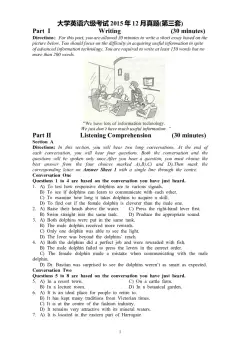
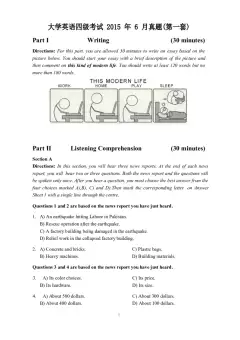
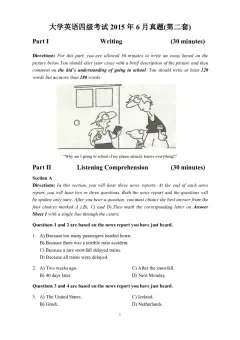
Directions:Forthispart,youareallowed30minutestowriteanessaybasedonthepicturebelow.Youshouldstart
youressaywithabriefdescriptionofthepictureandthendiscusswhethertechnologyisindispensableineducation.
Youshouldgivesoundargumentstosupportyourviewsandwriteatleast150wordsbutnomorethan200words
注意:此部分试题请在答题卡1上作答。
PartⅡ ListeningComprehension (30minutes)
SectionA
Directions: In this section, you will hear 8 short conversations and 2 long conversations. At the end of each
conversation, one or more questions will be asked about what was said. Both the conversation and the questions
will be spoken only once. After each question there will be a pause • During the pause,you must read the four
choices marked A) B), C) and D), and decide which is the best answer. Then mark the corresponding letter on
9
Answer Sheet 1withasinglelinethroughthecentre.
注意:此部分试题请在答题卡1上作答:
1.A)Theman’stennisracketisgoodenough.
B)Themanshouldgetapairofnewshoes.
C)Shecanwaitforthemanforalittlewhile.
D)Physicalexercisehelpsherstayinshape.
2.A)ThewomanwillskipDr.Smithslecturetohelptheman.
B)KathyisverypleasedtoattendthelecturebyDr.Smith.
C)Thewomanisgoodatdoinglabdemonstrations.
D)Themanwilldoallhecantoassistthewoman.
3.A)Thewomanaskedthemantoaccompanyhertotheparty.
B)Stevebecamerichsoonaftergraduationfromcollege.
C)Steveinvitedhisclassmatestovisithisbigcottage.
D)ThespeakersandSteveusedtobeclassmates.
4.A)Inabus. C)Inaboat.
B)Inaclinic. D)Inaplane.
5.A)10:10. B)9:50. C)9:40. D)9:10.
6.A)ShedoesnotlikeJohnatall.
B)Johnhasgotmanyadmirers.
C)ShedoesnotthinkJohnishandsome.
D)Johnhasjustgotabachelor’sdegree.
7.A)Hehasbeenbumpingalongforhours.
B)Hehasgotasharppainintheneck.
C)Heisinvolvedinaseriousaccident.
D)Heistrappedinaterribletrafficjam.
8.A)Sheisgoodatrepairingthings.
B)Sheisaprofessionalmechanic.
C)Sheshouldimproveherphysicalcondition.
D)Shecannotgowithoutawashingmachine.
Questions9to11arebasedontheconversationyouhavejustheard.
9.A)Somewitnessesfailedtoappearincourt.
B)Thecasecauseddebateamongthepublic.
C)Theaccusedwasfoundguiltyofstealing.
D)Theaccusedrefusedtopleadguiltyincourt.
10.A)Hewasoutofhismind. C) Hiswifedesertedhim.2014年12月大学英语六级考试真题(一)
B) Hewasunemployed. D)Hischildrenweresick.
11.A)Hehadbeeninjailbefore. C)Hewasunlikelytogetemployed.
B)Hewasunworthyofsympathy. D)Hehadcommittedthesamesortofcrime.
Questions12to15arebasedontheconversationyouhavejustheard.
12.A)Irresponsible. C)Aggressive
B)Unsatisfactory. D)Conservative.
13. A)Internalcommunication. C)Publicrelations.
B)Distributionofbrochures. D)Productdesign
14. A)Placingadvertisementsinthetradepress. C)Advertisinginthenationalpress.
B)Drawingsketchesforadvertisements. D)Makingtelevisioncommercials.
15. A)Shehasthemotivationtodothejob. C)Sheisnotsoeasytogetalongwith.
B)Sheknowsthetricksofadvertising. D)Sheisnotsuitablefortheposition.
SectionB
Directions:Inthissection,youwillhear3shortpassages.Attheendofeachpassage,youwillhearsomequestions.
Boththepassageandthequestionswill bespokenonlyonce.After youhearaquestion,youmustchoosethe best
answerfromthefourchoicesmarkedA),B),C)andD).ThenmarkthecorrespondingletteronAnswerSheet 1
withasinglelinethroughthecentre.
注意:此部分试题请在答题卡1上作答。
PassageOne
Questions16to19arebasedonthepassageyouhavejustheard.
16.A)Thecozycommunallife. C)Innovativeacademicprograms.
B)Theculturaldiversity. D)Impressiveschoolbuildings.
17.A)Itisverybeneficialtotheiracademicprogress.
B)Ithelpsthemsoakupthesurroundingculture.
C)Itisasimportantastheirlearningexperience.
D)Itensurestheirphysicalandmentalhealth.
18.A) Itoffersthemostchallengingacademicprograms.
B)Ithastheworld5sbest-knownmilitaryacademies.
C)Itprovidesnumerousoptionsforstudents.
D)Itdrawsfacultyfromallaroundtheworld.
19.A)Theytrytogivestudentsopportunitiesforexperimentation.
B)TheyareresponsiblemerelytotheirMinistryofEducation.
C)Theystrivetodevelopeverystudent’sacademicpotential.
D)Theyensurethatallstudentsgetroughlyequalattention.
PassageTwo
Questions20to22arebasedonthepassageyouhavejustheard.
20. A)ItwillarriveatBoulogneathalfpasttwo.
B)ItcrossestheEnglishChanneltwiceaday.
C)ItisnowabouthalfwaytotheFrenchcoast.
D)ItisleavingFolkestoneinaboutfiveminutes.
21.A)Oppositetheship’soffice. C)AttherearofBdeck.
B)Nexttotheduty-freeshop. D)InthefrontofAdeck.
22.A)Itisforthesoleuseofpassengerstravellingwithcars.
B)ItismuchmorespaciousthantheloungeonCdeck.
C)Itisfortheuseofpassengerstravellingwithchildren.
D)ItisforseniorpassengersandpeoplewithVIPcards.
PassageThree
Questions23to25arebasedonthepassageyouhavejustheard.
23.A)Itwasnamedafteritslocation.
B)Itwasnamedafteritsdiscoverer.
C)Itwasnamedafteracaveartexpert.
D)Itwasnamedafteroneofitspainters.
24.A)Animalpaintingwaspartofthespirituallifeofthetime.
B)DeerwereworshipedbytheancientCro-Magnonpeople.
C)Cro-Magnonpeoplepaintedanimalstheyhuntedandate.
D)Theywerebelievedtokeepevilsawayfromcavedwellers.
25.A)Theyknowlittleaboutwhythepaintingswerecreated.
B)Theyhavedifficultytellingwhenthepaintingsweredone.
C)Theyareunabletodrawsuchinterestingandfinepaintings.
D)Theyhavemisinterpretedthemeaningofthecavepaintings.
2SectionC
Directions: Inthis section,youwill hearapassagethreetimes. Whenthepassageis readfor thefirsttime you
9
shouldlistencarefullyforitsgeneralidea.Whenthepassageisreadforthesecondtime,youarerequiredtofillin
the blanks with the exact words you have just heard. Finally, when the passage is read for the third time ? you
shouldcheckwhatyouhavewritten.
注意:此部分试题请在答题卡1上作答。
If you are attending a local college, especially one without residence halls, youll probably live at home and
commute to classes. This arrangement has a lot of 26 It’s cheaper. It provides a comfortable and familiar
setting,anditmeansyoullgetthekindofhomecookingyou’reusedtoinsteadofthemonotony(单调)that 27
eventhebestinstitutionalfood.
However, commuting students need to 28 to become involved in the life of their college and to take
specialstepstomeettheirfellowstudents.Often,thismeansacertainamountofinitiativeonyourpartin 29 and
talkingtopeopleinyourclasseswhomyouthinkyoumightlike.
Oneproblemthatcommutingstudentssometimesfaceistheirparents‘unwillingnesstorecognizethatthey’re
adults.The 30 fromhighschooltocollegeisabigone,andifyouliveathomeyouneedtodevelopthesame
kindofindependenceyou’dhaveifyouwerelivingaway.Homerulesthatmighthavebeen 31 whenyouwere
inhighschooldon'tapply.Ifyourparentsare 32 torenegotiate,youcanspeedtheprocessalongbylettingyour
behavior show that you have the responsibility that goes with maturity. Parents are more willing to 33 their
children as adults when they behave like adults. If, however, there’s so much friction at home that it 34 your
academic work, you might want to consider sharing an apartment with one or more friends. Sometimes this is a
happysolutionwhenfamily 35 makeeveryonemiserable.
PartⅢ ReadingComprehension (40minutes)
SectionA
Directions:Inthissection,thereisapassagewithtenblanks.Youarerequiredtoselectonewordforeachblank
from a list of choices given in a word bank following the passage. Read the passage through carefully before
makingyourchoices.Eachchoiceinthebankisidentifiedbyaletter.Pleasemarkthecorrespondingletterforeach
itemonAnswerSheet2withasinglelinethroughthecentre.Youmaynotuseanyofthewordsinthebankmore
thanonce.
Questions36to45arebasedonthefollowingpassage.
childrenarenatural-bornscientists.Theyhave 36 minds,andtheyaren’tafraidtoadmittheydon’tknow
something.Mostofthem, 37 ,losethisastheygetolder.Theybecomeself-conscious anddon’twanttoappear
stupid.Insteadoffindingthingsoutforthemselvestheymake 38 thatoftenturnouttobewrong.
Soit’snotacaseofgettingkidsinterestedinscience.Youjusthavetoavoidkillingthe 39 forlearning
thattheywerebornwith.It’snocoincidencethatkidsstartdesertingscienceonceitbecomesformalised.Children
naturallyhaveablurredapproachto 40 knowledge.Theyseelearningaboutscienceorbiologyorcookingasall
part of the same act—it’s all learning. It’s only because of the practicalities of education that you have to start
breakingdownthecurriculumintospecialistsubjects.Youneedtohavespecialistteacherswho 41 whatthey
know. Thus once they enter school, children begin to define subjects and erect boundaries that needn’t otherwise
exist.
Dividingsubjectsintoscience,maths,English,etc.issomethingwedofor 42 Intheendit’salllearning,
butmany children today 43 themselves from a scientific education. They think scienceis for scientists, notfor
them.
Of course we need to specialise 44 Each of us has only so much time on Earth,so we can’t study
everything.At5yearsold,ourfieldofknowledgeand 45 isbroad,coveringanythingfromlearningtowalk
tolearningtocount.Graduallyitnarrowsdownsothatbythetimeweare 45 ,itmightbeonetinylittlecorner
withinscience.
注意:此部分试题请在答题卡2上作答。
A)accidentally F)exclude K)impart
B)acquiring G)exertion L)inquiring
C)assumptions H)exploration M)passion
D)convenience I)formulas N)provoking
E)eventually J)ignite O)unfortunately
SectionB
Directions: In this section^ you are going to read a passage with ten statements attached to it. Each statement2014年12月大学英语六级考试真题(一)
containsinformationgiveninoneoftheparagraphs.Identifytheparagraphfromwhichtheinformationisderived.
You may choose a paragraph more than once. Each paragraph is marked with a letter. Answer the questions by
markingthecorrespondingletteronAnswerSheet 2.
MeaningIsHealthierThanHappiness
[A]Foratleastthelastdecade,thehappinesscrazehasbeenbuilding.Inthelastthreemonthsalone,over1000books
onhappinesswerereleasedonAmazon, includingHappyMoney, Happy-People-PillsFor All, and,forthosejust
startingout,HappinessforBeginners.
[B]Oneoftheconsistentclaimsofbooksliketheseisthathappinessisassociatedwithallsortsofgoodlifeoutcomes,
including—mostpromisingly—goodhealth.Manystudieshavenotedtheconnectionbetweenahappymindanda
healthybody—thehappierweare,thebetterhealthoutcomesweseemtohave.Inanoverviewof150studieson
this topic, researchers put it like this: “Inductions of well-being lead to healthy functioning, and inductions of
ill-beingleadtocompromisedhealth.”
[C]Butanewstudy,justpublishedintheProceedingsoftheNationalAcademyofSciences(PNAS)challengestherosy
picture.Happinessmaynotbeasgoodforthebodyasresearchersthought.Itmightevenbebad.
[D] Ofcourse,it’simportanttofirstdefineHappiness.Afewmonthsago,Iwroteapiececalled“There’sMoretoLife
Than BeingHappy”aboutapsychologystudythatdugintowhathappinessreallymeanstopeople.Itspecifically
exploredthedifferencebetweenameaningfullifeandahappylife.
[E]Itseemsstrangethattherewouldbeadifferenceatall.Buttheresearchers,wholookedatalargesampleofpeople
overamonth-longperiod,foundthathappinessisassociatedwithselfish“taking”behaviorandthathavingasense
ofmeaninginlifeisassociatedwithselfless“giving”behavior.
[F]“Happinesswithoutmeaningcharacterizesarelativelyshallow,self-absorbedorevenselfishlife,inwhichthingsgo
well, needs and desires are easily satisfied, and complicated relationships are avoided”, the authors of the study
wrote. “If anything, pure happiness is linked to not helping others in need.” While being happy is about feeling
good,meaningisderivedfromcontributingtoothersortosocietyinabiggerway.AsRoyBaumeister, oneofthe
researchers, told me, “Partly what we do as human beings is to take care of others and contribute to others. This
makeslifemeaningfulbutitdoesnotnecessarilymakeushappy.”
[G]ThenewPNASstudyalsoshedslightonthedifferencebetweenmeaningandhappiness,butonthebiologicallevel.
BarbaraFredrickson,apsychologicalresearcherattheUniversityofNorthCarolina-ChapelHill,andSteveCole,
ageneticsandpsychiatry(精神病学) researcheratUCLA,examinedtheself-reportedlevelsof
happinessandmeaningin80researchsubjects.
[H] Happiness was defined, as in the earlier study, by feeling good. The researchers measured happiness by asking
subjects questionslike“Howoftendidyoufeelhappy?'“Howoftendidyoufeelinterestedinlife?”and“How
often did you feel satisfied?” The more strongly people endorsed these measures of “hedonic (享乐主义的)
well-being,”orpleasure,thehighertheyscoredonhappiness.
[I] Meaning was defined as an orientation to something bigger than the self. They measured meaning by asking
questionslike “Howoftendidyoufeelthatyourlifehasasenseofdirectionormeaningtoit?”and“Howoftendid
you feel that you had something to contribute to society?” The more people endorsed these measures of
“eudaimonic(幸福论的)well-being”-or,simplyput,virtue—themoremeaningtheyfeltinlife.
[J] After noting the sense of meaning and happiness that each subject had, Fredrickson and Cole, with their research
colleagues,lookedatthewayscertaingenesexpressedthemselvesineachoftheparticipants.Likeneuroscientists
whouse fMRI(功育磁共振成像)scanning to determine how
regionsinthebrainrespondtodifferentstimuli,ColeandFredricksonareinterestedinhowthebody,atthegenetic
level,respondstofeelingsofhappinessandmeaning.
[K] Cole’spastworkhaslinkedvariouskindsofchronicadversitytoaparticulargeneexpressionpattern.Whenpeople
feel lonely, are grieving the loss of a loved one, or are struggling to make ends meet, their bodies go into threat
mode.Thistriggerstheactivationofastress-relatedgenepatternthathastwofeatures:anincreaseintheactivity
ofpro-inflammatory(促炎症的)genesandadecreaseintheactivityofgenesinvolvedinanti-viralresponses.
[L]ColeandFredricksonfoundthatpeoplewhoarehappybuthavelittletonosenseofmeaningintheirliveshavethe
same geneexpressionpatternsaspeoplewhoarerespondingtoandenduringchronicadversity.Thatis,thebodies
of these happy people are preparing them for bacterial threats by activating the pro-inflammatory response.
Chronicinflammationis,ofcourse,associatedwithmajorillnesseslikeheartdiseaseandvariouscancers.
[M]“Emptypositiveemotions”-likethekindpeopleexperienceduringmanic(狂喜的)episodesorartificiallyinduced
euphoria(欣快)fromalcoholanddrugs—“areaboutasgoodforyouasadversity,”saysFredrickson.
[N]It’simportanttounderstandthatformanypeople,asenseofmeaningandhappinessinlifeoverlap;manypeople
scorejointlyhigh(orjointlylow)onthehappinessandmeaningmeasuresinthestudy.Butformanyothers,there
isadissonance(不一致)-theyfeelthattheyarelowonhappinessandhighonmeaningorthattheirlivesarevery
high in happiness, but low in meaning. This last group, which has the gene expression pattern associated with
adversity, formed 75 percent of study participants. Only one quarter of the study participants had what the
researcherscall“eudaimonicpredominance”-thatis,theirsenseofmeaningoutpacedtheirfeelingsofhappiness.
4[O] This is too bad given the more beneficial gene expression pattern associated with meaningfulness. People whose
levels of happiness and meaning line up, and people who have a strong sense of meaning butare notnecessarily
happy, showed a de-activation of the adversity stress response. Their bodies were not preparing them for the
bacterialinfectionsthatwegetwhenwearealoneorintrouble,butfortheviralinfectionswegetwhensurrounded
byalotofotherpeople.
[P]Fredrickson’spastresearch,describedinhertwobooks,PositivityandLove2.0,hasmappedthebenefitsofpositive
emotions in individuals. She has found that positive emotions broaden a person’s perspective and help protect
people against adversity. So it was surprising to her that hedonic wellbeing, which is associated with positive
emotionsandpleasure,didsobadlyinthisstudycomparedwitheudaimonicwell-being.
[Q] “It’s not the amount of hedonic happiness that’s a problem.” Fredrickson tells me, “It’s that it’s not matched by
eudaimonic well-being. It’s great whenboth are in step. But if you have more hedonic well-being thanwould be
expected,that’swhenthis[gene]patternthat’ssimilartoadversityemerged.”
[R] The terms hedonism and eudaimonism bring to mind the great philosophical debate, which has shaped Western
civilizationforover2000years,aboutthenatureofthegoodlife.Doeshappinesslieinfeelinggood,ashedonists
think,orindoingandbeinggood,asAristotleandhisintellectualdescendants,theethicists(伦理学家),think?
From the evidence of this study, it seems that feeling good is not enough. People need meaning to thrive. In the
wordsofCarlJung,“Theleastofthingswithameaningisworthmoreinlifethanthegreatestofthingswithoutit.”
Jung’swisdomcertainlyseemstoapplytoourbodies,ifnotalsotoourheartsandourminds.
注意:此部分试题请在答题卡2上作答。
46.Theauthor’srecentarticleexaminedhowameaningfullifeisdifferentfromahappylife.
47.Itshouldbenotedthatmanypeoplefeeltheirlifeisbothhappyandmeaningful.
48. According to one survey, there is a close relationship between hedonic well-being measures and high scores on
happiness.
49.Accordingtooneoftheauthorsofanewstudy,whatmakeslifemeaningfulmaynotmakepeoplehappy.
50.Experimentswerecarriedouttodetermineourbody’sgeneticexpressionoffeelingsofhappinessandmeaning.
51.Anewstudyclaimshappinessmaynotcontributetohealth.
52.Accordingtotheresearchers,takingmakesforhappinesswhilegivingaddsmeaningtolife.
53.Evidencefromresearchshowsthatittakesmeaningforpeopletothrive.
54. With regard to gene expression patterns, happy people with little or no sense of meaning in life are found to be
similartothosesufferingfromchronicadversity.
55.Mostbooksonhappinesstodayassertthathappinessisbeneficialtohealth.
SectionC
Directions:Thereare2passagesinthissection.Eachpassageisfollowedbysomequestionsorunfinished
statements.ForeachofthemtherearefourchoicesmarkedA),B),C)andD).Youshoulddecideonthebestchoice
andmarkthecorrespondingletteronAnswer Sheet 2withasinglelinethroughthecentre.
PassageOne
Questions56to60arebasedonthefollowingpassage.
Nothingsucceedsinbusinessbookslikethestudyofsuccess.Thecurrentbusiness-bookboomwaslaunched
in 1982 by Tom Peters and Robert Waterman with In Search of Excellence. The trend has continued with a
succession of experts and would-be experts who promise to distil the essence of excellence into three (or five or
seven)simplerules.
The Three Rules is a self-conscious contribution to this type of writing; it even includes a bibliography of
“successstudies”.MichaelRaynorandMumtazAhmedworkforaconsultancy,Deloitte,thatisdeterminedtoturn
itselfintomoreofathought-leaderandlessacorporaterepairman.Theyemployallthetricksofthesuccessbooks.
They insist that their conclusions are “measurable and actionable”-guides to behaviour rather thananalysis for its
own sake. Success authors usually serve up vivid stories about how exceptional businesspeople stamped their
personalities on a company or rescued it from a life-threatening crisis. Messrs Raynor and Ahmed are happier
chewingthenumbers:theyprovidedetailedappendiceson“calculatingtheelementsofadvantage”and“detailed
analysis”.
Theauthorsspentfiveyearsstudyingthebehaviouroftheir344“exceptionalcompanies”onlytocomeupat
firstwithnothing.Everyhunch(直觉)ledtoablindalleyandeveryhypothesistoadeadend.Itwasonlywhenthey
shifted their attention from how companies behave to how they think that they began to make sense of their
voluminousmaterial.
Management is all about making difficult tradeoffs in conditions that are always uncertain and often
fast-changing. But exceptional companies approach these tradeoffs with two simple rules in mind, sometimes
consciously,sometimesunconsciously.First:betterbeforecheaper.Companiesaremorelikelytosucceedinthe
longruniftheycompeteonqualityorperformancethanonprice.Second:revenuebeforecost.Companieshave
moretogaininthelongrunfromdrivinguprevenuethanbydrivingdowncosts.
Most success studies suffer from two faults. There is “the halo (光环)effect”, whereby good performance
leadscommentators toattribute allmannerofvirtuestoanything andeverythingthecompanydoes.Thesevirtues2014年12月大学英语六级考试真题(一)
thensuddenlybecomeviceswhenthecompanyfails.MessrsRaynorandAhmedworkhardtoavoidthesemistakes
by studying large bodies of data over several decades. But they end up embracing a different error: stating the
obvious.Mostbusinesspeoplewillnotbesurprisedtolearnthatitisbettertofindaprofitable niche(隙缝市场)
andfocusonboostingyourrevenuesthantocompeteon
priceandcutyour way tosuccess.The difficultquestionis how tofind thatprofitable nicheandprotectit. There,
TheThreeRulesislessuseful.
注意:此部分试题请在答题卡2上作答。
56.Whatkindofbusinessbooksaremostlikelytosellwell?
A) Booksonexcellence. C)Booksonbusinessrules.
B)Guidestomanagement. D)Analysesofmarkettrends.
57.Whatdoestheauthorimplyaboutbooksonsuccesssofar?
A)Theyhelpbusinessmenonewayoranother.
B)Theyarewrittenbywell-recognisedexperts.
C)Theymoreorlessfallintothesamestereotype.
D)Theyarebasedonanalysesofcorporateleaders.
58.HowdoesTheThreeRulesdifferfromothersuccessbooksaccordingtothepassage?
A)Itfocusesonthebehaviourofexceptionalbusinessmen.
B)Itbasesitsdetailedanalysisonlargeamountsofdata.
C)Itofferspracticableadvicetobusinessmen.
D)Itdrawsconclusionsfromvividexamples.
59.Whatdoesthepassagesaycontributestothesuccessofexceptionalcompanies?
A)Focusonqualityandrevenue.
B)Managementandsalespromotion.
C)Lowerproductioncostsandcompetitiveprices.
D)Emphasisonafter-saleserviceandmaintenance.
60.Whatistheauthor’scommentonTheThreeRules!
A)Itcanhelptolocateprofitableniches. C)Itisnotedforitsdetaileddataanalysis.
B)Ithaslittletooffertobusinesspeople. D)Itfailstoidentifythekeystosuccess.
PassageTwo
Questions61to65arebasedonthefollowingpassage.
Until recently, the University of Kent prided itself on its friendly image. Not any more. Over the past few
monthsithasbeenworkinghard,withthehelpofmediaconsultants,toplaydownitscosyreputationinfavourof
somethingmoreacademicandserious.
Kentisnotaloneinconsideringanimagerevamp(翻新),Changestonextyear’sfundingregimeareforcing
universitiestojustifychargingstudentsupto£9000infees.
Nowadaysuniversitiesareputtingmuchmoreofafocusontheirbrandsandwhattheirvaluepropositionsare.
While in the past universities have often focused on student social life and attractions of the university town in
recruitment campaigns, they are now concentrating on moretangible(实在的) attractions, such as employment
prospects, engagement with industry, and lecturer contact hours, making clear exactly what students are going to
getfortheirmoney.
The problem for universities is that if those benefits fail to materialise, students notice. That worries Rob
Behrens,whodealswithstudentcomplaints.“Universitiesneedtobeextremelycarefulindescribingwhat’sgoing
to happen to students,” he says. “As competition is going to get greater for attracting gifted students, there is a
dangerthatuniversitieswillgotheextramile.
Oneuniversity told prospectiveengineering studentstheywould beableto design acar andraceit atBrands
Hatch,whichneverhappened,hesays.Othershavepromiseduseofsophisticatedequipmentthatturnedouttobe
broken or unavailable. “If universities spent as much money on handling complaints and appeals appropriately as
theyspendonmarketing,theywoulddobetteratkeepingstudents,andintheNationalStudentSurveyreturns,”he
says.
Ongoing research tracking prospective 2012 students suggests that they are not only becoming more
sophisticated in thinking about what they want from a university, but are also spending more time researching
evidencetobackupinstitutionalclaims.
Hence the growing importance of the student survey. From next September, all institutions will also be
expected to publish on their websites key information sets, allowing easier comparison between institutions,
betweenpromisesandreality,andthetypesofjobsandsalariesgraduatesgoonto.
As a result, it is hardly surprising that universities are beginning to change the way they market themselves.
Whilethebestformofmarketingforinstitutionsistobegoodatwhattheydo,theyalsoneedtobeclearabouthow
theyaredifferentfromothers.
And it is vital that once an institution claims to be particularly good at something, it must live up to it. The
momentyoupositionyourself,youbecomeexposed,andifyoufailinthatyouareintrouble.
6注意:此部分试题请在答题卡2上作答。
61.WhatwastheUniversityofKentfamousfor?
A)Itscomfortablecampuslife. C)Itsdistinguishedteachingstaff.
C)Itsup-to-datecourseofferings. D)Itsdiverseacademicprogrammes.
62.Whatareuniversitiestryingtodotoattractstudents?
A)Improvetheirlearningenvironment. C)Upgradetheircampusfacilities.
B)Offermorescholarshipstothegifted. D)Presentabetteracademicimage.
63.WhatdoesRobBehrenssuggestuniversitiesdoinmarketingthemselves?
A)Publicisetheachievementsoftheirgraduates.
B)Gotoextralengthstocatertostudents’needs.
C)Refrainfrommakingpromisestheycannothonour.
D)Surveytheexpectationsoftheirprospectivestudents.
64.Whatisstudents’chiefconsiderationinchoosingauniversity?
A)Whetheritpromisesthebestjobprospects.
B)Whetheritisabletodeliverwhattheywant.
C)Whetheritrankshighamongsimilarinstitutions.
D)Whetheritoffersopportunitiesforpracticaltraining.
65.Whatmustuniversitiesshowtowinrecruitmentcampaigns?
A)Theyarepositionedtomeetthefutureneedsofsociety.
B)Theyareresponsibletostudentsfortheirgrowth.
C)Theyareeverreadytoimprovethemselves.
D)Theyareuniqueonewayoranother.
PartⅣ Translation (30minutes)
Directions:Forthispart,youareallowed30minutestotranslateapassagefromChineseintoEnglish.Youshould
writeyouransweronAnswer Sheet2.
反映在艺术和文学中的乡村生活理想是中国文明的重要特征。这在很大程度上归功于道家(Taoist)对
自然的情感。传统中国画有两个最受青睐的主题,一是家庭生活的各种幸福场景,画中往往有老人在饮茶
下棋,男人在耕耘收割,妇女在织布缝衣,小孩在户外玩耍。另一个则是乡村生活的种种乐趣,画有渔夫
在湖上打渔,农夫在山上欲柴采药,或是书生坐在松树下呤诗作画。这两个主题可以分别代表儒家
(Confucian)和道家的生活理想。
注意:此部分试题请在答题卡2上作答。