2014年12月大学英语六级考试真题(一)
2014 年 12 月大学英语六级考试真题(一)
PartI Writing (30minutes)
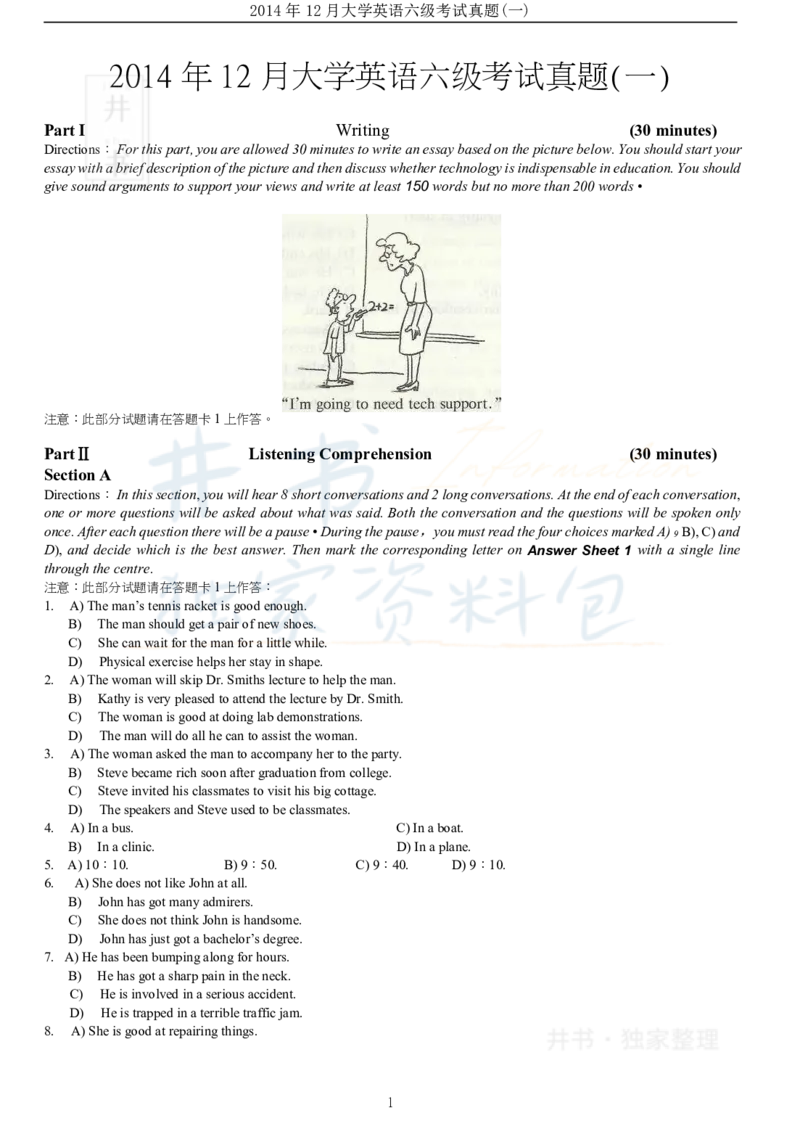
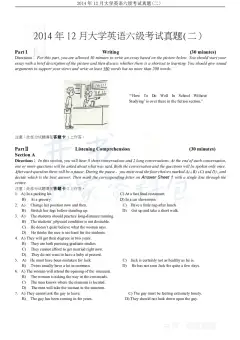
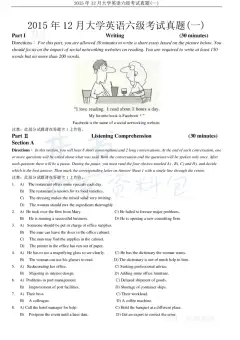
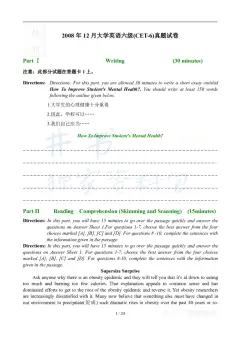
Directions:Forthispart,youareallowed30minutestowriteanessaybasedonthepicturebelow.Youshouldstartyour
essaywithabriefdescriptionofthepictureandthendiscusswhethertechnologyisindispensableineducation.Youshould
givesoundargumentstosupportyourviewsandwriteatleast150wordsbutnomorethan200words•
注意:此部分试题请在答题卡1上作答。
PartⅡ ListeningComprehension (30minutes)
SectionA
Directions:Inthissection,youwillhear8shortconversationsand2longconversations.Attheendofeachconversation,
oneormorequestionswillbeasked about whatwassaid.Both theconversationandthequestionswill bespoken only
once.Aftereachquestiontherewillbeapause•Duringthepause,youmustreadthefourchoicesmarkedA) 9B),C)and
D), and decide which is the best answer. Then mark the corresponding letter on Answer Sheet 1 with a single line
throughthecentre.
注意:此部分试题请在答题卡1上作答:
1. A)Theman’stennisracketisgoodenough.
B) Themanshouldgetapairofnewshoes.
C) Shecanwaitforthemanforalittlewhile.
D) Physicalexercisehelpsherstayinshape.
2. A)ThewomanwillskipDr.Smithslecturetohelptheman.
B) KathyisverypleasedtoattendthelecturebyDr.Smith.
C) Thewomanisgoodatdoinglabdemonstrations.
D) Themanwilldoallhecantoassistthewoman.
3. A)Thewomanaskedthemantoaccompanyhertotheparty.
B) Stevebecamerichsoonaftergraduationfromcollege.
C) Steveinvitedhisclassmatestovisithisbigcottage.
D) ThespeakersandSteveusedtobeclassmates.
4. A)Inabus. C)Inaboat.
B) Inaclinic. D)Inaplane.
5. A)10:10. B)9:50. C)9:40. D)9:10.
6. A)ShedoesnotlikeJohnatall.
B) Johnhasgotmanyadmirers.
C) ShedoesnotthinkJohnishandsome.
D) Johnhasjustgotabachelor’sdegree.
7. A)Hehasbeenbumpingalongforhours.
B) Hehasgotasharppainintheneck.
C) Heisinvolvedinaseriousaccident.
D) Heistrappedinaterribletrafficjam.
8. A)Sheisgoodatrepairingthings.
12014年12月大学英语六级考试真题(一)
B) Sheisaprofessionalmechanic.
C) Sheshouldimproveherphysicalcondition.
D) Shecannotgowithoutawashingmachine.
Questions9to11arebasedontheconversationyouhavejustheard.
9. A)Somewitnessesfailedtoappearincourt.
B) Thecasecauseddebateamongthepublic.
C) Theaccusedwasfoundguiltyofstealing.
D) Theaccusedrefusedtopleadguiltyincourt.
10.A)Hewasoutofhismind. C) Hiswifedesertedhim.
B) Hewasunemployed. D)Hischildrenweresick.
11.A)Hehadbeeninjailbefore. C)Hewasunlikelytogetemployed.
B) Hewasunworthyofsympathy. D)Hehadcommittedthesamesortofcrime.
Questions12to15arebasedontheconversationyouhavejustheard.
12.A)Irresponsible. C)Aggressive
B) Unsatisfactory. D)Conservative.
13. A)Internalcommunication. C)Publicrelations.
B) Distributionofbrochures. D)Productdesign
14. A)Placingadvertisementsinthetradepress. C)Advertisinginthenationalpress.
B) Drawingsketchesforadvertisements. D)Makingtelevisioncommercials.
15. A)Shehasthemotivationtodothejob. C)Sheisnotsoeasytogetalongwith.
B) Sheknowsthetricksofadvertising. D)Sheisnotsuitablefortheposition.
SectionB
Directions:Inthissection,youwillhear3shortpassages.Attheendofeachpassage,youwillhearsomequestions.Both
thepassageandthequestionswillbespokenonlyonce.Afteryouhearaquestion,youmustchoosethebestanswerfrom
, ,
thefourchoicesmarkedA) B) C)andD).ThenmarkthecorrespondingletteronAnswerSheet1withasingleline
throughthecentre.
注意:此部分试题请在答题卡1上作答。
PassageOne
Questions16to19arebasedonthepassageyouhavejustheard.
16.A)Thecozycommunallife. C)Innovativeacademicprograms.
B) Theculturaldiversity. D)Impressiveschoolbuildings.
17. A)Itisverybeneficialtotheiracademicprogress.
B) Ithelpsthemsoakupthesurroundingculture.
C) Itisasimportantastheirlearningexperience.
D) Itensurestheirphysicalandmentalhealth.
18. A) Itoffersthemostchallengingacademicprograms.
B) Ithastheworld5sbest-knownmilitaryacademies.
C) Itprovidesnumerousoptionsforstudents.
D) Itdrawsfacultyfromallaroundtheworld.
19. A) Theytrytogivestudentsopportunitiesforexperimentation.
B) TheyareresponsiblemerelytotheirMinistryofEducation.
C) Theystrivetodevelopeverystudent’sacademicpotential.
D) Theyensurethatallstudentsgetroughlyequalattention.
PassageTwo
Questions20to22arebasedonthepassageyouhavejustheard.
20. A)ItwillarriveatBoulogneathalfpasttwo.
B) ItcrossestheEnglishChanneltwiceaday.
C) ItisnowabouthalfwaytotheFrenchcoast.
D) ItisleavingFolkestoneinaboutfiveminutes.
21.A)Oppositetheship’soffice. C)AttherearofBdeck.
B) Nexttotheduty-freeshop. D)InthefrontofAdeck.
22、A)Itisforthesoleuseofpassengerstravellingwithcars.
22014年12月大学英语六级考试真题(一)
B) ItismuchmorespaciousthantheloungeonCdeck.
C) Itisfortheuseofpassengerstravellingwithchildren.
D) ItisforseniorpassengersandpeoplewithVIPcards.
PassageThree
Questions23to25arebasedonthepassageyouhavejustheard.
23、A)Itwasnamedafteritslocation.
B) Itwasnamedafteritsdiscoverer.
C) Itwasnamedafteracaveartexpert.
D) Itwasnamedafteroneofitspainters.
24、A)Animalpaintingwaspartofthespirituallifeofthetime.
B) DeerwereworshipedbytheancientCro-Magnonpeople.
C) Cro-Magnonpeoplepaintedanimalstheyhuntedandate.
D) Theywerebelievedtokeepevilsawayfromcavedwellers.
25、A)Theyknowlittleaboutwhythepaintingswerecreated.
B) Theyhavedifficultytellingwhenthepaintingsweredone.
C) Theyareunabletodrawsuchinterestingandfinepaintings.
D) Theyhavemisinterpretedthemeaningofthecavepaintings.
SectionC
Directions:Inthissection,youwillhearapassagethreetimes.Whenthepassageisreadforthefirsttime
9
youshould
listencarefullyforitsgeneralidea.Whenthepassageisreadforthesecondtime,youarerequiredtofillintheblanks
withtheexactwordsyouhavejustheard.Finally,whenthepassageisreadforthethirdtime?youshouldcheckwhatyou
havewritten.
注意:此部分试题请在答题卡1上作答。
Ifyouareattendingalocalcollege,especiallyonewithoutresidencehalls,youllprobablyliveathomeandcommuteto
classes.Thisarrangementhasalotof 26 It’scheaper.Itprovidesacomfortableandfamiliarsetting,anditmeansyoullget
thekindofhomecookingyou’reusedtoinsteadofthemonotony(单调)that 27 eventhebestinstitutionalfood.
However,commutingstudentsneedto 28 tobecomeinvolvedinthelifeoftheircollegeandtotakespecialstepsto
meettheirfellowstudents.Often,thismeansacertainamountofinitiativeonyourpartin 29 andtalkingtopeopleinyour
classeswhomyouthinkyoumightlike.
Oneproblemthatcommutingstudentssometimesfaceistheirparents‘unwillingnesstorecognizethatthey’readults.The
30 fromhighschooltocollegeisabigone,andifyouliveathomeyouneedtodevelopthesamekindofindependenceyou’d
haveifyouwerelivingaway.Homerulesthatmighthavebeen 31 whenyouwereinhighschooldon'tapply.Ifyourparents
are 32 torenegotiate,youcanspeedtheprocessalongbylettingyourbehaviorshowthatyouhavetheresponsibilitythatgoes
withmaturity.Parentsaremorewillingto 33 theirchildrenasadultswhentheybehavelikeadults.If,however,there’sso
muchfrictionathomethatit 34 youracademicwork,youmightwanttoconsidersharinganapartmentwithoneormore
friends.Sometimesthisisahappysolutionwhenfamily 35 makeeveryonemiserable.
PartⅢ ReadingComprehension (40minutes)
SectionA
Directions:Inthissection,thereisapassagewithtenblanks.Youarerequiredtoselectonewordforeachblankfroma
listofchoicesgiveninawordbankfollowingthepassage.Readthepassagethroughcarefullybeforemakingyourchoices.
Eachchoiceinthebankisidentifiedbyaletter.PleasemarkthecorrespondingletterforeachitemonAnswerSheet2
withasinglelinethroughthecentre.Youmaynotuseanyofthewordsinthebankmorethanonce.
Questions36to45arebasedonthefollowingpassage.
childrenarenatural-bornscientists.Theyhave 36 minds,andtheyaren’tafraidtoadmittheydon’tknowsomething.
Mostofthem, 37 ,losethisastheygetolder.Theybecomeself-conscious anddon’twanttoappearstupid.Insteadoffinding
thingsoutforthemselvestheymake 38 thatoftenturnouttobewrong.
Soit’snotacaseofgettingkidsinterestedinscience.Youjusthavetoavoidkillingthe 39 forlearningthattheywere
bornwith. It’snocoincidencethatkidsstart desertingscienceonce itbecomes formalised.Childrennaturallyhavea blurred
approachto 40 knowledge.Theyseelearningaboutscienceorbiologyorcookingasallpartofthesameact—it’salllearning.
It’sonlybecauseofthepracticalitiesofeducationthatyouhavetostartbreakingdownthecurriculumintospecialistsubjects.
32014年12月大学英语六级考试真题(一)
Youneedtohavespecialistteacherswho 41 whattheyknow.Thusoncetheyenterschool,childrenbegintodefinesubjects
anderectboundariesthatneedn’totherwiseexist.
Dividingsubjectsintoscience,maths,English,etc.issomethingwedofor 42 Intheendit’salllearning,butmany
childrentoday 43 themselvesfromascientificeducation.Theythinkscienceisforscientists,notforthem.
Ofcourseweneedtospecialise 44 EachofushasonlysomuchtimeonEarth,sowecan’tstudyeverything.At
5yearsold,ourfieldofknowledgeand 45 is broad, covering anything from learning to walk to learning to count.
Graduallyitnarrowsdownsothatbythetimeweare 45 ,itmightbeonetinylittlecornerwithinscience.
注意:此部分试题请在答题卡2上作答。
A)accidentally
F)exclude K)impart
B)acquiring G)exertion L)inquiring
C)assumptions H)exploration M)passion
D)convenience I)formulas N)provoking
E)eventually J)ignite O)unfortunately
SectionB
Directions: In this section^ you are going to read a passage with ten statements attached to it. Each statement
containsinformationgiveninoneoftheparagraphs.Identifytheparagraphfromwhichtheinformationisderived.
You may choose a paragraph more than once. Each paragraph is marked with a letter. Answer the questions by
markingthecorrespondingletteronAnswerSheet2.
MeaningIsHealthierThanHappiness
A) Forat least thelast decade, thehappinesscraze hasbeenbuilding. Inthelast threemonthsalone, over 1000 bookson
happinesswerereleasedonAmazon,includingHappyMoney,Happy-People-PillsForAll,and,forthosejuststartingout,
HappinessforBeginners.
B) One of the consistent claims of books like these is that happiness is associated with all sorts of good life outcomes,
including—mostpromisingly—goodhealth.Manystudieshavenotedtheconnectionbetweenahappymindandahealthy
body —the happier we are, the better health outcomes we seem to have. In an overview of 150 studies on this topic,
researchers put it like this: “Inductions of well-being lead to healthy functioning, and inductions of ill-being lead to
compromisedhealth.”
C) Butanewstudy,justpublishedintheProceedings of theNational Academyof Sciences(PNAS)challengestherosy
picture.Happinessmaynotbeasgoodforthebodyasresearchersthought.Itmightevenbebad.
D) D) Ofcourse,it’simportanttofirst defineHappiness.Afewmonthsago,Iwroteapiececalled“There’sMoretoLife
Than BeingHappy”aboutapsychologystudythatdugintowhathappinessreallymeanstopeople.Itspecificallyexplored
thedifferencebetweenameaningfullifeandahappylife.
E) Itseemsstrangethattherewouldbeadifferenceatall.Buttheresearchers,wholookedatalargesampleofpeopleovera
month-longperiod,foundthathappinessisassociatedwithselfish“taking”behaviorandthathavingasenseofmeaningin
lifeisassociatedwithselfless“giving”behavior.
F) “Happinesswithoutmeaningcharacterizesarelativelyshallow,self-absorbedorevenselfishlife,inwhichthingsgowell,
needs and desires are easily satisfied, and complicated relationships are avoided”, the authors of the study wrote. “If
anything, pure happinessis linked to not helpingothers in need.” Whilebeinghappy is about feelinggood, meaning is
derived from contributingto othersor to society in a bigger way. As Roy Baumeister, one ofthe researchers, toldme,
“Partlywhatwedoashumanbeingsistotakecareofothersandcontributetoothers.Thismakeslifemeaningfulbutitdoes
notnecessarilymakeushappy.”
G) ThenewPNASstudyalsoshedslightonthedifferencebetweenmeaningandhappiness,butonthebiologicallevel.Barbara
Fredrickson,apsychologicalresearcherattheUniversityofNorthCarolina-ChapelHill,andSteveCole,ageneticsand
psychiatry(精神病学) researcher at UCLA, examined theself-reportedlevels of happiness and meaningin 80 research
subjects.
H) Happinesswasdefined,asintheearlier study,byfeeling good.Theresearchersmeasuredhappinessbyaskingsubjects
questionslike“Howoftendidyoufeelhappy?'“Howoftendidyoufeelinterestedinlife?”and“Howoftendidyoufeel
42014年12月大学英语六级考试真题(一)
satisfied?”Themorestronglypeopleendorsedthesemeasuresof“hedonic(享乐主义的)well-being,”orpleasure,the
highertheyscoredonhappiness.
I) Meaningwasdefinedasanorientationtosomethingbiggerthantheself.Theymeasuredmeaningbyaskingquestionslike
“Howoftendidyoufeelthatyourlifehasasenseofdirectionormeaningtoit?”and“Howoftendidyoufeelthatyouhad
somethingtocontributetosociety?”Themorepeopleendorsedthesemeasuresof“eudaimonic(幸福论的)well-being”-or,
simplyput,virtue—themoremeaningtheyfeltinlife.
J) Afternotingthesenseofmeaningandhappinessthateachsubjecthad,FredricksonandCole,withtheirresearchcolleagues,
lookedatthewayscertaingenesexpressedthemselvesineachoftheparticipants.LikeneuroscientistswhousefMRI(功育
磁共振成像)scanning to determine how regions in the brain respond to different stimuli, Cole and Fredrickson are
interestedinhowthebody,atthegeneticlevel,respondstofeelingsofhappinessandmeaning.
K) Cole’spastworkhaslinkedvariouskindsofchronicadversitytoaparticulargeneexpressionpattern.Whenpeoplefeel
lonely,are grievingthelossofaloved one, orarestrugglingtomakeendsmeet, theirbodiesgo intothreat mode.This
triggers the activation of a stress-related gene pattern that has two features : an increase in the activity of
pro-inflammatory(促炎症的)genesandadecreaseintheactivityofgenesinvolvedinanti-viralresponses.
L) ColeandFredricksonfoundthatpeoplewhoarehappybuthavelittletonosenseofmeaningintheirliveshavethesame
geneexpressionpatternsaspeoplewhoarerespondingtoandenduringchronicadversity.Thatis,thebodiesofthesehappy
peoplearepreparingthemforbacterialthreatsbyactivatingthepro-inflammatoryresponse.Chronicinflammationis,of
course,associatedwithmajorillnesseslikeheartdiseaseandvariouscancers.
M) “Emptypositiveemotions”-likethekindpeopleexperienceduringmanic(狂喜的)episodesorartificiallyinducedeuphoria
(欣快)fromalcoholanddrugs—“areaboutasgoodforyouasadversity,”saysFredrickson.
N) It’simportanttounderstandthatformanypeople,asenseofmeaningandhappinessinlifeoverlap; manypeoplescore
jointlyhigh(orjointlylow)onthehappinessandmeaningmeasuresinthestudy.Butformanyothers,thereisadissonance
(不一致)-theyfeelthattheyarelowonhappinessandhighonmeaningorthattheirlivesareveryhighinhappiness,butlow
inmeaning.Thislastgroup,whichhasthegeneexpressionpatternassociatedwithadversity,formed75percentofstudy
participants.Onlyonequarterofthestudyparticipantshadwhattheresearcherscall“eudaimonicpredominance”-thatis,
theirsenseofmeaningoutpacedtheirfeelingsofhappiness.
O) Thisistoobadgiventhemorebeneficialgeneexpressionpatternassociatedwithmeaningfulness.Peoplewhoselevelsof
happinessandmeaninglineup,andpeoplewhohaveastrongsenseofmeaningbutarenotnecessarilyhappy,showeda
de-activationoftheadversitystressresponse.Theirbodieswerenotpreparingthemforthebacterialinfectionsthatweget
whenwearealoneorintrouble,butfortheviralinfectionswegetwhensurroundedbyalotofotherpeople.
P) Fredrickson’s past research, described in her two books, Positivity and Love 2.0, has mapped the benefits of positive
emotions in individuals. She has found that positive emotions broaden a person’s perspective and help protect people
against adversity. So it was surprising to her that hedonic wellbeing, which is associated with positive emotions and
pleasure,didsobadlyinthisstudycomparedwitheudaimonicwell-being.
Q) “It’snottheamountofhedonichappinessthat’saproblem.”Fredricksontellsme,“It’sthatit’snotmatchedbyeudaimonic
well-being.It’sgreatwhenbothareinstep.Butifyouhavemorehedonicwell-beingthanwouldbeexpected,that’swhen
this[gene]patternthat’ssimilartoadversityemerged.”
R) Thetermshedonismandeudaimonismbringtomindthegreatphilosophicaldebate,whichhasshapedWesterncivilization
forover2000years,aboutthenatureofthegoodlife.Doeshappinesslieinfeelinggood,ashedoniststhink,orindoingand
beinggood,asAristotleandhisintellectualdescendants,theethicists(伦理学家),think?Fromtheevidenceofthisstudy,
itseemsthatfeelinggoodisnotenough.Peopleneedmeaningtothrive.InthewordsofCarlJung,“Theleastofthingswith
ameaningisworthmoreinlifethanthegreatestofthingswithoutit.”Jung’swisdomcertainlyseemstoapplytoourbodies,
ifnotalsotoourheartsandourminds.
注意:此部分试题请在答题卡2上作答。
46. Theauthor’srecentarticleexaminedhowameaningfullifeisdifferentfromahappylife.
47. Itshouldbenotedthatmanypeoplefeeltheirlifeisbothhappyandmeaningful.
48. Accordingtoonesurvey,thereisacloserelationshipbetweenhedonicwell-beingmeasuresandhighscoresonhappiness.
49. Accordingtooneoftheauthorsofanewstudy,whatmakeslifemeaningfulmaynotmakepeoplehappy.
50. Experimentswerecarriedouttodetermineourbody’sgeneticexpressionoffeelingsofhappinessandmeaning.
51. Anewstudyclaimshappinessmaynotcontributetohealth.
52. Accordingtotheresearchers,takingmakesforhappinesswhilegivingaddsmeaningtolife.
52014年12月大学英语六级考试真题(一)
53. Evidencefromresearchshowsthatittakesmeaningforpeopletothrive.
54. Withregardtogeneexpressionpatterns,happypeoplewithlittleornosenseofmeaninginlifearefoundtobesimilarto
thosesufferingfromchronicadversity.
55. Mostbooksonhappinesstodayassertthathappinessisbeneficialtohealth.
SectionC
Directions:Thereare2passagesinthissection.Eachpassageisfollowedbysomequestionsorunfinishedstatements.For
eachofthemtherearefourchoicesmarkedA),B),C)andD).Youshoulddecideonthebestchoiceandmarkthe
correspondingletteronAnswerSheet2withasinglelinethroughthecentre.
PassageOne
Questions56to60arebasedonthefollowingpassage.
Nothingsucceedsinbusinessbookslikethestudyofsuccess.Thecurrentbusiness-bookboomwaslaunchedin1982by
Tom Peters and Robert Waterman with In Search of Excellence. The trend has continued with a succession of experts and
would-beexpertswhopromisetodistiltheessenceofexcellenceintothree(orfiveorseven)simplerules.
The Three Rules is a self-conscious contribution to this type of writing; it even includes a bibliography of “success
studies”.MichaelRaynorandMumtazAhmedworkforaconsultancy,Deloitte,thatisdeterminedtoturnitselfintomoreofa
thought-leaderandlessacorporaterepairman.Theyemployallthetricksofthesuccessbooks.Theyinsistthattheirconclusions
are“measurableandactionable”-guidestobehaviourratherthananalysisforitsownsake.Successauthorsusuallyserveupvivid
stories about how exceptional businesspeople stamped their personalities on a company or rescued it from a life-threatening
crisis. Messrs Raynor and Ahmed are happier chewing the numbers: they provide detailed appendices on “calculating the
elementsofadvantage”and“detailedanalysis”.
Theauthorsspentfiveyearsstudyingthebehaviouroftheir344“exceptionalcompanies”onlytocomeupatfirstwith
nothing.Everyhunch(直觉)ledtoablindalleyandeveryhypothesistoadeadend.Itwasonlywhentheyshiftedtheirattention
fromhowcompaniesbehavetohowtheythinkthattheybegantomakesenseoftheirvoluminousmaterial.
Managementisall aboutmakingdifficult tradeoffsinconditionsthatarealways uncertain andoften fast-changing.But
exceptional companies approach these tradeoffs with two simple rules in mind, sometimes consciously, sometimes
unconsciously.First:betterbeforecheaper.Companiesaremorelikelytosucceedinthelongruniftheycompeteonqualityor
performancethanonprice.Second:revenuebeforecost.Companieshavemoretogaininthelongrunfromdrivinguprevenue
thanbydrivingdowncosts.
Most success studies suffer from two faults. There is “the halo (光环)effect”, whereby good performance leads
commentators to attribute all manner of virtues to anything and everything the company does. These virtues then suddenly
becomeviceswhenthecompanyfails.MessrsRaynorandAhmedworkhardtoavoidthesemistakesbystudyinglargebodiesof
dataoverseveraldecades.Buttheyendupembracingadifferenterror: statingtheobvious.Mostbusinesspeoplewillnotbe
surprisedtolearnthatitisbettertofindaprofitable niche(隙缝市场)andfocusonboostingyourrevenuesthantocompeteon
priceandcutyourwaytosuccess.Thedifficultquestionishowtofindthatprofitablenicheandprotectit.There,TheThree
Rulesislessuseful.
注意:此部分试题请在答题卡2上作答。
56. Whatkindofbusinessbooksaremostlikelytosellwell?
A) Booksonexcellence. C)Booksonbusinessrules.
B)Guidestomanagement. D)Analysesofmarkettrends.
57. Whatdoestheauthorimplyaboutbooksonsuccesssofar?
A) Theyhelpbusinessmenonewayoranother.
B) Theyarewrittenbywell-recognisedexperts.
C) Theymoreorlessfallintothesamestereotype.
D) Theyarebasedonanalysesofcorporateleaders.
58. HowdoesTheThreeRulesdifferfromothersuccessbooksaccordingtothepassage?
A) Itfocusesonthebehaviourofexceptionalbusinessmen.
B) Itbasesitsdetailedanalysisonlargeamountsofdata.
C) Itofferspracticableadvicetobusinessmen.
D) Itdrawsconclusionsfromvividexamples.
59. Whatdoesthepassagesaycontributestothesuccessofexceptionalcompanies?
A) Focusonqualityandrevenue.
62014年12月大学英语六级考试真题(一)
B) Managementandsalespromotion.
C) Lowerproductioncostsandcompetitiveprices.
D) Emphasisonafter-saleserviceandmaintenance.
60. Whatistheauthor’scommentonTheThreeRules!
A)Itcanhelptolocateprofitableniches. C)Itisnotedforitsdetaileddataanalysis.
B)Ithaslittletooffertobusinesspeople. D)Itfailstoidentifythekeystosuccess.
PassageTwo
Questions61to65arebasedonthefollowingpassage.
Untilrecently,theUniversityofKentprideditselfonitsfriendlyimage.Notanymore.Overthepastfewmonthsithas
beenworkinghard,withthehelpofmediaconsultants,toplaydownitscosyreputationinfavourofsomethingmoreacademic
andserious.
Kentisnotaloneinconsideringanimagerevamp(翻新),Changestonextyear’sfundingregimeareforcinguniversitiesto
justifychargingstudentsupto£9000infees.
Nowadaysuniversitiesareputtingmuchmoreofafocusontheirbrandsandwhattheirvaluepropositionsare.Whileinthe
pastuniversitieshaveoftenfocusedonstudentsociallifeandattractionsoftheuniversitytowninrecruitmentcampaigns,they
arenowconcentratingonmoretangible(实在的) attractions,suchasemploymentprospects,engagementwithindustry,and
lecturercontacthours,makingclearexactlywhatstudentsaregoingtogetfortheirmoney.
Theproblemfor universitiesisthatifthosebenefitsfailtomaterialise,studentsnotice.ThatworriesRobBehrens,who
dealswithstudentcomplaints.“Universitiesneedtobeextremelycarefulindescribingwhat’sgoingtohappentostudents,”he
says.“Ascompetitionisgoingtogetgreaterforattractinggiftedstudents,thereisadangerthatuniversitieswillgotheextramile.
OneuniversitytoldprospectiveengineeringstudentstheywouldbeabletodesignacarandraceitatBrandsHatch,which
neverhappened,hesays.Othershavepromiseduseofsophisticatedequipmentthatturnedouttobebrokenorunavailable.“If
universitiesspentasmuchmoneyonhandlingcomplaintsandappealsappropriatelyastheyspendonmarketing,theywoulddo
betteratkeepingstudents,andintheNationalStudentSurveyreturns,”hesays.
Ongoing research tracking prospective 2012 students suggests that they are not only becoming more sophisticated in
thinkingaboutwhattheywantfromauniversity,butarealsospendingmoretimeresearchingevidencetobackupinstitutional
claims.
Hencethegrowingimportanceofthestudentsurvey.FromnextSeptember,allinstitutionswillalsobeexpectedtopublish
ontheirwebsiteskeyinformationsets,allowingeasiercomparisonbetweeninstitutions,betweenpromisesandreality,andthe
typesofjobsandsalariesgraduatesgoonto.
Asaresult,itishardlysurprisingthatuniversitiesarebeginningtochangethewaytheymarketthemselves.Whilethebest
formofmarketingforinstitutionsistobegoodatwhattheydo,theyalsoneedtobeclearabouthowtheyaredifferentfrom
others.
Anditisvitalthatonceaninstitutionclaimstobeparticularlygoodatsomething,itmustliveuptoit.Themomentyou
positionyourself,youbecomeexposed,andifyoufailinthatyouareintrouble.
注意:此部分试题请在答题卡2上作答。
61. WhatwastheUniversityofKentfamousfor?
A)Itscomfortablecampuslife. C)Itsdistinguishedteachingstaff.
C)Itsup-to-datecourseofferings. D)Itsdiverseacademicprogrammes.
62. Whatareuniversitiestryingtodotoattractstudents?
A) Improvetheirlearningenvironment. C)Upgradetheircampusfacilities.
B) Offermorescholarshipstothegifted. D)Presentabetteracademicimage.
63. WhatdoesRobBehrenssuggestuniversitiesdoinmarketingthemselves?
A) Publicisetheachievementsoftheirgraduates.
B) Gotoextralengthstocatertostudents’needs.
C) Refrainfrommakingpromisestheycannothonour.
D) Surveytheexpectationsoftheirprospectivestudents.
64. Whatisstudents’chiefconsiderationinchoosingauniversity?
A) Whetheritpromisesthebestjobprospects.
B) Whetheritisabletodeliverwhattheywant.
C) Whetheritrankshighamongsimilarinstitutions.
72014年12月大学英语六级考试真题(一)
D) Whetheritoffersopportunitiesforpracticaltraining.
65. Whatmustuniversitiesshowtowinrecruitmentcampaigns?
A) Theyarepositionedtomeetthefutureneedsofsociety.
B) Theyareresponsibletostudentsfortheirgrowth.
C) Theyareeverreadytoimprovethemselves.
D) Theyareuniqueonewayoranother.
PartⅣ Translation (30minutes)
Directions:Forthispart,youareallowed30minutestotranslateapassagefromChineseintoEnglish.Youshouldwrite
youransweronAnswerSheet2.
反映在艺术和文学中的乡村生活理想是中国文明的重要特征。这在很大程度上归功于道家(Taoist) 对自然的情
感。传统中国画有两个最受青睐的主题,一是家庭生活的各种幸福场景,画中往往有老人在饮茶下棋,男人在耕耘收
割,妇女在织布缝衣,小孩在户外玩耍。另一个则是乡村生活的种种乐趣,画有渔夫 在湖上打渔,农夫在山上欲柴
采药,或是书生坐在松树下呤诗作画。这两个主题可以分别代表儒家 (Confucian)和道家的生活理想。
注意:此部分试题请在答题卡2上作答。
8