大学英语四级考试 2015 年 6 月真题(第二套)
Part I Writing (30 minutes)
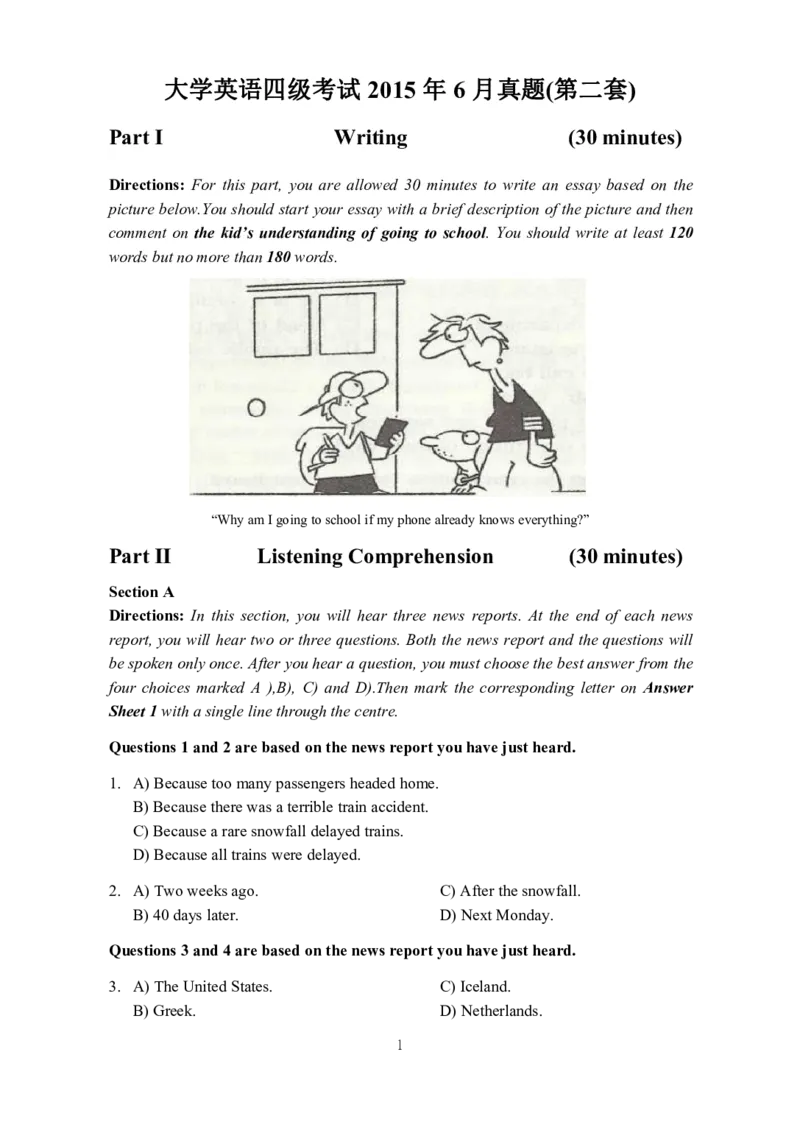
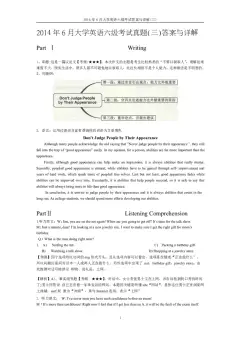
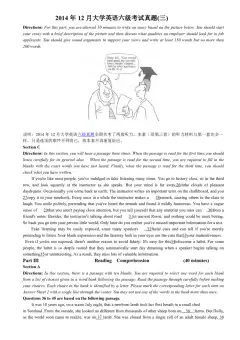
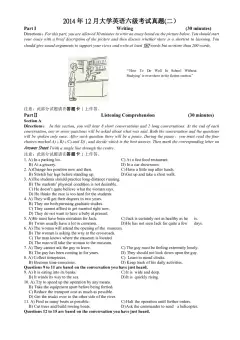
Directions: For this part, you are allowed 30 minutes to write an essay based on the
picture below.Youshould start youressay with a brief description ofthe picture andthen
comment on the kid’s understanding of going to school. You should write at least 120
wordsbutnomorethan180words.
“WhyamIgoingtoschoolifmyphonealreadyknowseverything?”
Part II Listening Comprehension (30 minutes)
SectionA
Directions: In this section, you will hear three news reports. At the end of each news
report, you will hear two or three questions. Both the news report and the questions will
bespokenonlyonce.Afteryouhearaquestion,youmustchoosethebestanswerfromthe
four choices marked A ),B), C) and D).Then mark the corresponding letter on Answer
Sheet1withasinglelinethroughthecentre.
Questions1and2arebasedonthenewsreportyouhavejustheard.
1. A)Becausetoomanypassengersheadedhome.
B)Becausetherewasaterribletrainaccident.
C)Becauseararesnowfalldelayedtrains.
D)Becausealltrainsweredelayed.
2. A)Twoweeksago. C)Afterthesnowfall.
B)40dayslater. D)NextMonday.
Questions3and4arebasedonthenewsreportyouhavejustheard.
3. A)TheUnitedStates. C)Iceland.
B)Greek. D)Netherlands.
14. A)ThedeclineofhappinessintheU.s..
B)TheoptimisticfutureofAsiansandAfricans.
C)Thelifesatisfactionindifferentcountries
D)Thedrivingfactorstohappiness.
Questions5to7arebasedonthenewsreportyouhavejustheard.
5. A)Thetypesofgasesreleasedintotheair.
B)Thefast-risingsealevel.
C)Thecausesofbreaking-offoftheglaciers.
D)Climateimpactonthetemperature.
6. A)StefanRahmstorffromtheClimateImpactResearchCenter.
B)StefanRahmstorffromthePotsdamInstitute.
C)RobertKoppfromNationalAcademyofSciences.
D)RobertKoppfromRutgersUniversity.
7. A)Sincetwodecadesago. C)Since1880.
B)Since20thcentury. D)Since2800yearsago.
SectionB
Directions: In this section, you will hear two long conversations. At the end of each
conversation, you will hear four questions. Both the conversation and the questions will
bespokenonlyonce.Afteryouhearaquestion,youmustchoosethebestanswerfromthe
four choices marked A),B),C) and D).Then mark the corresponding letter on Answer
Sheet1withasinglelinethroughthecentre.
Questions8to11arebasedontheconversationyouhavejustheard.
8. A)Theypollutethesoilusedtocoverthem.
B)Theyareharmfultonearbyneighborhoods.
C)Therubbishinthemtakeslongtodissolve.
D)Thegastheyemitisextremelypoisonous.
9. A)Growingpopulation. C)Changedeatinghabits.
B)Packagingmaterials. D)Lowerproductioncost.
10.A)Bysavingenergy. C)Byreducingpoisonouswastes.
B)Byusinglessaluminum. D)Bymakingthemostofmaterials.
11.A)Wearerunningoutofnaturalresourcessoon.
B)Onlycombinedeffortscanmakeadifference.
C)Thewasteproblemwilleventuallyhurtallofus.
D)Allofuscanactuallybenefitfromrecycling.
Questions12to15arebasedontheconversationyouhavejustheard.
212.A)Miami. C)Bellingham.
B)Vancouver. D)Boston.
13.A)Togetinformationonone-wayticketstoCanada.
B)Toinquireaboutthepriceof“SuperSaver"seats.
C)Togetadviceonhowtoflyascheaplyaspossible.
D)Toinquireabouttheshortestroutetodrivehome.
14.A)Joinatouristgroup. C)Avoidtripsinpublicholidays.
B)Chooseamajorairline. D)Bookticketsasearlyaspossible.
15.A)Bycoach. C)Bybike.
B)Bycar. D)Bytrain.
Section C
Directions: In this section, you will hear 3 short passages. At the end of each passage,
you will hear three or four questions. Both the passage and the questions will be spoken
only once. After you hear a question, you must choose the best answer from the four
choices marked A), B),C) and D).Then mark the corresponding letter on Answer Sheet 1
withasinglelinethroughthecentre.
Questions16to18arebasedonthepassageyouhavejustheard.
16.A)Therearemysteriousstoriesbehindhisworks.
B)Therearemanymisunderstandingsabouthim.
C) Hisworkshavenomatchworldwide.
D)Hispersonalhistoryislittleknown.
17.A)HemovedtoStratford-on-Avoninhischildhood.
B)Hefailedtogobeyondgrammarschool.
C)Hewasamemberofthetowncouncil.
D)Heonceworkedinawell-knownactingcompany.
18.A)Writersofhistimehadnomeanstoprotecttheirworks.
B)Possiblesourcesofcluesabouthimwerelostinafire.
C)Hisworkswereadaptedbeyondrecognition.
D)Peopleofhistimehadlittleinterestinhim.
Questions19to21arebasedonthepassageyouhavejustheard.
19.A)Itshowsyouhavebeenignoringyourhealth.
B)Itcanseriouslyaffectyourthinkingprocess.
C)Itisanearlywarningofsomeillness.
D)Itisasymptomoftoomuchpressure.
20.A)Reduceourworkload. C)Usepainkillersforrelief.
3B)Controlourtemper. D)Avoidmaskingsymptoms.
20.A)Lyingdownandhavingsomesleep. C)Goingoutforawalk.
B) Rubbingandpressingone'sback. D)Listeningtolightmusic.
Questions22to25arebasedonthepassageyouhavejustheard.
21.A)Dependingheavilyonloans. C)Spendingbeyondone'smeans.
B)Havingnobudgetplansatall. D)Leavingnoroomforlargebills.
23.A)Manyofthemcanbecut. C)Theirpaymentcannotbedelayed.
B)Allofthemhavetobecovered. D)Theyeatupmostofthefamilyincome.
24.A)Rentahouseinsteadofbuyingone. C)Makeaconservationplan.
B)Discusstheprobleminthefamily. D)Movetoacheaperplace.
25.A)Financialissuesplaguingafamily. C)Familybudgetproblemsandsolutions.
B)Difficultyinmakingbothendsmeet. D)Newwaystoboostfamilyincome.
Part III Reading Comprehension (40 minutes)
SectionA
Directions: In this section, there is a passage with ten blanks. You are required to select
onewordforeachblankfromalistofchoicesgiveninawordbankfollowingthepassage.
Read the passage through carefully before making your choices. Each choice in the bank
is identified by a letter. Please mark the corresponding letter for each item on Answer
Sheet 2 with a single line through the centre. You may not use any of the words in the
bankmorethanonce.
Question26to35arebasedonthefollowingpassage.
It’s our guilty pleasure: Watching TV is the most common everyday activity, after
work and sleep, in many parts of the world. Americans view five hours of TV each day,
andwhileweknowthatspendingsomuchtimesitting 26 canleadtoobesity(肥胖
症)andotherdiseases,researchershavenowquantifiedjusthow 27 beingacouch
potatocanbe.
In an analysis of data from eight large 28 published studies, a Harvard-led
groupreportedinthethatfor everytwohoursperdayspentchannel 29 ,therisk of
developing Type 2 diabetes Journalofthe American Medical Association (糖尿病)rose
20% over 8.5years, the risk of heartdiseaseincreased 15%over a 30 , and the odds
of dying prematurely 31 13% during a seven-year follow-up. All of these 32
are linked to a lack of physical exercise. But compared with other sedentary (久坐的)
activities, like knitting, viewing TV may be especially 33 at promoting unhealthy
4habits. For one, the sheer number of hours we pass watching TV dwarfs the time we
spend on anything else. And other studies have found that watching ads for beer and
popcornmaymakeyoumorelikelyto 34 them.
Even so, the authors admit that they didn’t compare different sedentary activities
to 35 whetherTVwatchingwaslinked toagreater riskofdiabetes,heartdiseaseor
earlydeathcomparedwith,say,reading.
A)climbed I)previously
B)consume J)resume
C)decade K)suffered
D)determine L)surfing
E)effective M)term
F)harmful N)terminals
G)outcomes O)twisting
H)passively
SectionB
Directions: In this section, you are going to read a passage with ten statements attached
to it. Each statement contains information given in one of the paragraphs. Identify the
paragraph from which the information is derived. You may choose a paragraph more
than once. Each paragraph is marked with a letter. Answer the questions by marking the
correspondingletteronAnswerSheet2.
TheChangesFacingFastFood
A) Fast-food firms have to be a thick-skinned bunch. Health experts regularly criticise
them severely for selling food that makes people fat. Critics even complain that
McDonald’s, whose logo symbolises calorie excess, should not have been allowed to
sponsorthe World Cup.These arethings fast-foodfirms have learntto copewith. But
notperhapsformuchlonger. Theburgerbusinessfacesmorepressurefromregulators
at a time when it is already adapting strategies in response to shifts in the global
economy.
B) Fast food was once thought to be recession-proof. When consumers need to cut
spending, the logic goes, cheap meals like Big Macs and Whoppers become even
more attractive. Such “trading down” proved true for much of the latest recession,
when fast-food companies picked up customers who could no longer afford to eat at
casual restaurants. Traffic was boosted in America, the home of fast food, with
discountsandpromotions,suchas$1menusandcheapcombinationmeals.
C) As a result, fast-food chains have weathered the recession better than their more
expensive competitors. In 2009 sales at full-service restaurants in America fell by
5more than 6%, but total sales remained about the same at fast-food chains. In some
markets, such as Japan, France and Britain, total spending on fast food increased.
Same-store sales in America at McDonald’s, the world’s largest fast-food company,
did not decline throughout the downturn. Panera Bread, an American fast-food chain
known for its fresh ingredients, performed well, too, because it offers higher-quality
foodatlowerpricesthanrestaurants.
D) But not all fast-food companies have been as fortunate. Many, such as Burger King,
have seensales fall. In a severe recession,while some people trade down to fastfood,
many others eat at home more frequently to save money. David Palmer, an analyst at
UBS, a bank, says smaller fast-food chains in America, such as Jack in the Box and
Carl’sJr.,havebeenhitparticularlyhardinthisdownturnbecausetheyarecompeting
with the global giant McDonald, which increased spending on advertising by more
than7%lastyearasotherscutback.
E) Some fast-food companies also sacrificed their own profits by trying to give
customers better value. During the recession companies set prices low, hoping that
once they had tempted customers through the door they would be persuaded to order
more expensive items. But in many cases thatstrategy did notwork. Last year Burger
franchisees(特许经营人)sued(起诉) thecompanyoveritsdouble-cheeseburger
promotion, claiming it was unfair for them to be required to sell these for $ 1 when
theycost$1.10tomake.InMayajudgeruledinfavourofBurgerKing.Nevertheless,
the company may still be cursing its decision to promote cheap choices over more
expensive onesbecauseitems on its “value menu”now accountfor around20%ofall
sales,upfrom12%lastOctober.
F) Analysts expectthefast-foodindustryto grow modestly thisyear. Butthedownturnis
making companies rethink their strategies. Many are now introducing higher-priced
itemstoentice (引诱) consumersawayfrom$1specials.RFC,adivisionofYum!
Brands, which also owns Taco Bell and Pizza Hut, has launched a chicken sandwich
thatcostsaround$5.AndinMayBurgerKingintroducedbarbecue(烧烤)porkribs
at$7foreight.
G) Companies are also trying to get customers to buy new and more items, including
drinks. McDonald’s started selling better coffee as a challenge to Starbucks. Its
“McCafe” line now accounts for an estimated 6% of sales in America. Starbucks has
sold rights to its Seattle’s Best coffee brand to Burger King, which will start selling it
laterthisyear.
H) As fast-food companies shift from “super-size” to “more buys”, they need to keep
customertraffichighthroughouttheday.Manyseebreakfastasabigopportunity,and
not just for fatty food. McDonald’s will start selling porridge(粥)in America next
year.Breakfasthasthepotentialtobeveryprofitable,saysSaraSenatoreofBernstein,
6aresearchfirm,becausethemarginscanbehigh.Fast-foodcompaniesarealsoadding
midday and late-night snacks, such as blended drinks and wraps. The idea is that by
havingagreaterrangeofthings onthemenu,“wecanselltoconsumersproductsthey
wantallday,”saysRickCarucci,thechieffinancialofficerofYum!Brands.
I) Butwhataboutthosegrowingwaistlines?Sofar,fast-foodfirms havecleverlyavoided
government regulation. By providing healthy options, like salads and low-calorie
sandwiches, theyhave at leastgiven the impression of doingsomething abouthelping
to fight obesity (肥胖症). These offerings are not necessarily loss-leaders, as they
broaden the appeal of outlets to groups of diners that include some people who don’t
wanttoeataburger.Butcustomerscannotbeforcedtoordersaladsinsteadoffries.
J) In the future, simply offering a healthy option may not be good enough. “Every
packaged-food and restaurant company I know is concerned about regulation right
now,” says Mr. Palmer of UBS. America’s health-reform bill, which Congress passed
this year, requires restaurant chains with 20 or more outlets to put the calorie-content
of items they serve on the menu. A study by the National Bureau of Economic
Research, which tracked the effects on Starbucks of a similar calorie-posting law in
New York City in 2007, found that the average calorie-count per transaction fell 6%
and revenue increased 3% at Starbucks stores where a Dunkin Donuts outlet was
nearby—a sign, it is said, that menu-labelling could favour chains that have more
healthyofferings.
K) Inordertoavoid otherlegislationinAmericaandelsewhere,fast-foodcompanieswill
have to continue innovating (创新). Walt Riker of McDonald’s claims the change it
has made in its menu means it offers more healthy items than it did a few years ago.
“We probably sell more vegetables, more milk, more salads, more apples than any
restaurant business in the world,” he says. But the recent proposal by a county in
California to ban McDonald’s from including toys in its high-calorie “Happy Meals”,
becauselegislators believe itattracts childrentounhealthyfood,suggests thereisalot
morelefttodo.
36.SomepeopleproposelawsbemadetostopMcDonald’sfromattachingtoystoits food
specialsforchildren.
37.Fast-foodfirmsmaynotbeabletocopewithpressuresfromfoodregulationinthenear
future.
38.BurgerKingwillstarttosellSeattle’sBestcoffeetoincreasesales.
39. Some fast-food firms provide healthy food to give the impression they are helping to
tackletheobesityproblem.
40.Duringtherecession,manycustomersturnedtofastfoodtosavemoney.
741.Manypeopleeatoutlessoftentosavemoneyintimesofrecession.
42.Duringtherecession,BurgerKing’spromotionalstrategyofofferinglow-priceditems
oftenprovedineffective.
43.Fast-foodrestaurantscanmakealotofmoneybysellingbreakfast.
44. Many fast-food companies now expect to increase their revenue by introducing
higher-priceditems.
45.Anewly-passedlawasksbigfast-foodchainstospecifythecaloriecountofwhatthey
serveonthemenu.
SectionC
Directions: There are 2 passages in this section. Each passage is followed by some
questionsorunfinishedstatements.ForeachofthemtherearefourchoicesmarkedA),B),
C) and D). You should decide on the best choice and mark the corresponding letter on
AnswerSheet2withasinglelinethroughthecentre.
PassageOne
Questions46to50arebasedonthefollowingpassage.
Ifyou thinkahigh-factorsunscreen(防晒霜)keeps yousafefromharmful rays,you
may be wrong. Research in this week Nature shows that while factor 50 reduces the
number of melanomas (黑瘤)and delays their occurrence, it can’t prevent them.
Melanomas are the most aggressive skin cancers. You have a higher risk if you have red
orblondhair,fair skin,blueorgreeneyes, orsunburneasily, orifacloserelativehashad
one. Melanomas are more common if you have periodic intense exposure to the sun.
Otherskincancersareincreasinglylikelywithlong-termexposure.
There is continuing debate as to how effective sunscreen is in reducing
melanomas—theevidenceisweaker thanitisforpreventingothertypesofskincancer.A
2011 Australian study of 1,621 people found that people randomly selected to apply
sunscreen daily had half the rate of melanomas of people who used cream as needed. A
second study, comparing 1,167 people with melanomas to 1,101 who didn’t have the
cancer,foundthatusingsunscreenroutinely, alongside otherprotection suchashats, long
sleeves or staying in the shade, did give some protection. This study said other forms of
sun protection—not sunscreen—seemed most beneficial. The study relied on people
remembering what they had done over each decade of their lives, so it’s not entirely
reliable. But it seems reasonable to think sunscreen gives people a false sense of security
inthesun.
Many people also don’t use sunscreen properly—applying insufficient amounts,
failingtoreapplyafter acoupleofhoursandstayinginthesuntoolong.Itis sunburnthat
8is most worrying—recent research shows five episodes of sunburn in the teenage years
increasestheriskofallskincancers.
The good news is that a combination of sunscreen and covering up can reduce
melanoma rates, as shown by Australian figures from their slip-slop-slap campaign. So if
there is a heat wave this summer, it would be best for us, too, to slip on a shirt, slop on
(补上)sunscreenandslaponahat.
46. Whatispeopledcommonexpectationofahigh-factorsunscreen?
A)Itwilldelaytheoccurrenceofskincancer.
B)Itwillprotectthemfromsunburn.
C)Itwillkeeptheirskinsmoothandfair.
D)Itwillworkforpeopleofanyskincolor.
47.WhatdoestheresearchinNaturesayaboutahigh-factorsunscreen?
A)Itisineffectiveinpreventingmelanomas.
B)Itisineffectiveincaseofintensesunlight.
C)Itisineffectivewithlong-termexposure.
D)Itisineffectiveforpeoplewithfairskin.
48.Whatdowelearnfromthe2011Australianstudyof1,621people?
A)Sunscreenshouldbeappliedalongsideotherprotectionmeasures.
B)High-riskpeoplebenefitthemostfromtheapplicationofsunscreen.
C)Irregularapplicationofsunscreendoeswomenmoreharmthangood.
D)Dailyapplicationofsunscreenhelpsreducetheincidenceofmelanomas.
49.WhatdoestheauthorsayaboutthesecondAustralianstudy?
A)Itmisleadspeopletorelyonsunscreenforprotection.
B)Ithelpspeopletoselectthemosteffectivesunscreen.
C)Itisnotbasedondirectobservationofthesubjects.
D)ItconfirmstheresultsofthefirstAustralianstudy.
50.Whatdoestheauthorsuggesttoreducemelanomarates?
A)Usingbothcoveringupandsunscreen.
B)Stayingintheshadewheneverpossible.
C)Usingcoveringupinsteadofsunscreen.
D)Applyingtherightamountofsunscreen.
PassageTwo
Questions51to55arebasedonthefollowingpassage.
Across the rich world, well-educated people increasingly work longer than the
9less-skilled.Some65%ofAmericanmenaged62-74withaprofessionaldegreeareinthe
workforce, compared with 32% of men with only a high-school certificate. This gap is
part of a deepening divide between the well-educated well-off and the unskilled poor.
Rapid technological advance has raised the incomes of the highly skilled while squeezing
thoseoftheunskilled.Theconsequences,forindividualsandsociety,areprofound.
The world is facing an astonishing rise in the number of old people, and they will
live longer than ever before. Over the next 20 years the global population of those aged
65 or more will almost double, from 600 million to 1. 1 billion. The experience of the
20thcentury,whengreaterlongevity(长寿)translatedintomoreyearsinretirementrather
than more years at work, has persuaded many observers that this shift will lead to slower
economic growth, while the swelling ranks of pensioners will create government budget
problems.
Butthenotionofasharpdivisionbetweentheworkingyoungandtheidleoldmisses
anewtrend,thegrowinggapbetweentheskilledandtheunskilled.Employmentrates are
falling among younger unskilled people, whereas older skilled folk are working longer.
Thedivideis mostextremeinAmerica,wherewell-educatedbaby-boomers (二战后生育
高峰期出生的美国人)areputtingoffretirementwhilemanyless-skilledyoungerpeople
havedroppedoutoftheworkforce.
Policy is partly responsible. Many European governments have abandoned policies
that used to encourage people to retire early. Rising life expectancy (预期寿命),
combined with the replacement of generous defined-benefit pension plans with less
generous defined-contribution ones, means that even the better-off must work longer to
have a comfortable retirement. But the changing natureof work also plays a big role. Pay
has risen sharply for the highly educated, and those people continue to reap rich rewards
into old age because these days the educated elderly are more productive than the
preceding generation. Technological change may well reinforce that shift: the skills that
complement computers, from management know-how to creativity, do not necessarily
declinewithage.
51.Whatishappeningintheworkforceinrichcountries?
A) Youngerpeoplearereplacingtheelderly.
B) Well-educatedpeopletendtoworklonger.
C) Unemploymentratesarerisingyearafteryear.
D) Peoplewithnocollegedegreedonoteasilyfindwork.
52.Whathashelpeddeepenthedividebetweenthewell-offandthepoor?
A) Longerlifeexpectancies.
B) Arapidtechnologicaladvance.
C)Profoundchangesintheworkforce.
10D)Agrowingnumberofthewell-educated.
53.Whatdomanyobserverspredictinviewoftheexperienceofthe20thcentury?
A)Economicgrowthwillslowdown.
B)Governmentbudgetswillincrease.
C)Morepeoplewilltrytopursuehighereducation.
D)Therewillbemorecompetitioninthejobmarket.
54.WhatistheresultofpolicychangesinEuropeancountries?
A)Unskilledworkersmaychoosetoretireearly.
B)Morepeoplehavetoreceivein-servicetraining.
C)Evenwealthypeoplemustworklongertolivecomfortablyinretirement.
D)Peoplemaybeabletoenjoygenerousdefined-benefitsfrompensionplans.
55.Whatischaracteristicofworkinthe21stcentury?
A)Computerswilldomorecomplicatedwork.
B)Morewillbetakenbytheeducatedyoung.
C)Mostjobstobedonewillbethecreativeones.
D)Skillsarehighlyvaluedregardlessofage.
Part IV Translation (30 minutes)
SectionA
Directions: For this part, you are allowed 30 minutes to translate a passage from
ChineseintoEnglish.YoushouldwriteyouransweronAnswerSheet2.
据报道,今年中国快递服务(courierservices)将递送大约120亿件包裹。这将使
中国有可能超越美国成为世界上最大的快递市场。大多数包裹里装着网上订购的物
品。中国给数百万在线零售商以极具竞争力的价格销售商品的机会。仅在11月11
日,中国消费者就从国内最大的购物平台购买了价值90亿美元的商品。中国有不少
这样的特殊购物日。因此,快递业在中国扩展就不足为奇了。
11