淘宝店铺【光速考研工作室】温馨提示:
word版真题仅校对内容,因格式不无法固定,未精美排版,仅供自行复制粘贴
使用,若打印或用于电子笔记,请务必使用PDF版本真题!!!
本店PDF版真题打印无乱码,用于电子版笔记支持取词翻译,为优质版PDF。
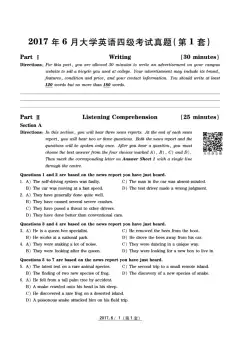
2019 年 6 月大学英语四级考试真题(第一套)
Part I Writing (30 minutes)
Directions: For this part, you are allowed 30 minutes to write a news report to your campus
newspaper on a visit to a local farm organized by your Student Union. You should
write at least 120 words but no more than 180 words.
Part Ⅱ Listening Comprehension (25 minutes)
Section A
Directions: In this section, you will hear three news reports. At the end of each news report, you
will hear two or three questions. Both the news report and the questions will be spoken only once.
After you hear a question, you must choose the best answer from the four choices marked A), B),
C) and D).Then mark the corresponding letter on Answer Sheet 1 with a single line through the
centre.
Questions 1 and 2 are based on the news report you have just heard.
1. A) He set a record by swimming to and from an island.
B) He celebrated his ninth birthday on a small island.
C) He visited a prison located on a faraway island.
D) He swam around an island near San Francisco.
2. A) He doubled the reward.
B) He set him an example.
C) He cheered him on all the way.
D) He had the event covered on TV.
Questions 3 and 4 are based on the news report you have just heard.
3. A) To end the one-child policy. C) To increase working efficiency.
B) To encourage late marriage. D) To give people more time to travel.
4. A) They will not be welcomed by young people.
B) They will help to popularize early marriage.
C) They will boost China’s economic growth.
D) They will not come into immediate effect.Questions 5 to 7 are based on the news report you have just heard.
5. A) Cleaning service in great demand all over the world.
B) Two ladies giving up well-paid jobs to do cleaning.
C) A new company to clean up the mess after parties.
D) Cleaners gainfully employed at nights and weekends.
6. A) It takes a lot of time to prepare. C) It makes party goers exhausted.
B) It leaves the house in a mess. D) It creates noise and misconduct.
7. A) Hire an Australian lawyer. C) Settle a legal dispute.
B) Visit the U.S. and Canada. D) Expand their business.
Section B
Directions: In this section, you will hear two long conversations. At the end of each conversation,
you will hear four questions. Both the conversation and the questions will be spoken only once.
After you hear a question, you must choose the best answer from the four choices marked A), B),
C) and D). Then mark the corresponding letter on Answer Sheet 1 with a single line through
the centre.
Questions 8 to 11 are based on the conversation you have just heard.
8. A) He had a driving lesson. C)He took the driver’s theory exam.
B) He got his driver’s license. D)He passed the driver’s road test.
9. A) He was not well prepared. C)He was not used to the test format.
B) He did not get to the exam in time. D)He did not follow the test procedure.
10. A) They are tough. C)They are helpful.
B) They are costly. D)They are too short.
11. A) Pass his road test the first time. C) Find an experienced driving instructor.
B) Test-drive a few times on highways. D)Earn enough money for driving lessons.
Questions 12 to 15 are based on the conversation you have just heard.
12. A) Where the woman studies. C) Leeds’ tuition for international students.
B) The acceptance rate at Leeds. D) How to apply for studies at a university.
13. A) Apply to an American university. C)Perform in a famous musical.
B) Do research on higher education. D)Pursue postgraduate studies.
14. A) His favorable recommendations. C)His academic excellence.
B) His outstanding musical talent. D)His unique experience.
15. A) Do a master’s degree. C) Travel widely.
B) Settle down in England. D) Teach overseas.
Section CDirections: In this section, you will hear three passages. At the end of each passage, you will hear
three or four questions. Both the passage and the questions will be spoken only once. After you hear
a question, you must choose the best answer from the four choices marked A), B), C) and D). Then
mark the corresponding letter on Answer Sheet 1 with a single line through the centre.
Questions 16 to 18 are based on the passage you have just heard.
16. A) They help farmers keep diseases in check.
B) Many species remain unknown to scientists.
C) Only a few species cause trouble to humans.
D) They live in incredibly well-organized colonies.
17. A) They are larger than many other species.
B) They can cause damage to people’s homes.
C) They can survive a long time without water.
D) They like to form colonies in electrical units.
18. A) Deny them access to any food. C) Destroy their colonies close by.
B) Keep doors and windows shut. D) Refrain from eating sugary food.
Questions 19 to 21 are based on the passage you have just heard.
19. A) The function of the human immune system.
B) The cause of various auto-immune diseases.
C) The viruses that may infect the human immune system.
D) The change in people’s immune system as they get older.
20. A) Report their illnesses. C) Act as research assistants.
B) Offer blood samples. D) Help to interview patients.
21. A) Strengthening people’s immunity to infection.
B) Better understanding patients’ immune system.
C) Helping improve old people’s health conditions.
D) Further reducing old patients’ medical expenses.
Questions 22 to 25 are based on the passage you have just heard.
22. A) His students had trouble getting on with each other.
B) A lot of kids stayed at school to do their homework.
C) His students were struggling to follow his lessons.
D) A group of kids were playing chess after school.
23. A) Visit a chess team in Nashville. C) Participate in a national chess competition.
B) Join the school’s chess team. D) Receive training for a chess competition.
24. A) Most of them come from low-income families.
B) Many have become national chess champions.
C) A couple of them have got involved in crimes.D) Many became chess coaches after graduation.
25. A) Actions speak louder than words. C) Translate their words into action.
B) Think twice before taking action. D) Take action before it gets too late.
Part III Reading Comprehension (40 minutes)
Section A
Directions: In this section, there is a passage with ten blanks. You are required to select one word
for each blank from a list of choices given in a word bank following the passage. Read the passage
through carefully before making your choices. Each choice in the bank is identified by a letter.
Please mark the corresponding letter for each item on Answer Sheet 2 with a single line through
the centre. You may not use any of the words in the bank more than once.
Questions 26 to 35 are based on the following passage.
The center of American automobile innovation has in the past decade moved 2,000 miles away.
It has 26 from Detroit to Silicon Valley, where self-driving vehicles are coming into life.
In a 27 to take production back to Detroit, Michigan lawmakers have introduced 28 that
could make their state the best place in the country, if not the world, to develop self-driving vehicles
and put them on the road.
“Michigan’s 29 in auto research and development is under attack from several states and
countries which desire to 30 our leadership in transportation. We can’t let that happen,” says
Senator Mike Kowall, the lead 31 of four bills recently introduced.
If all four bills pass as written, they would 32 a substantial update of Michigan’s 2013 law that
allowed the testing of self-driving vehicles in limited conditions. Manufacturer would have nearly
total freedom to test their self-driving technology on public roads. They would be allowed to send
groups of self-driving cars on cross-state road trips, and even set up on-demand 33 of self-
driving cars, like the one General Motors and Lyft are building.
Lawmakers in Michigan clearly want to make the state ready for the commercial application of self-
driving technology. In 34 , California, home of Silicon Valley, recently proposed far more 35 rules
that would require human drivers be ready to take the wheel, and ban commercial use of self driving
technology.
A) bid I) replace
B) contrast J) represent
C) deputy k) restrictive
D) dominance L) reward
E) fleets M) significant
F) knots N) sponsorG) legislation O) transmitted
H) migrated
Section B
Directions: In this section, you are going to read a passage with ten statements attached to it.
Each statement contains information given in one of the paragraphs. Identify the paragraph from
which the information is derived. You may choose a paragraph more than once. Each paragraph is
marked with a letter. Answer the questions by marking the corresponding letter on Answer Sheet 2.
How Work Will Change When Most of Us Live to 100
A. Today in the United States there are 72,000 centenarians(百岁老人).Worldwide, Probably
450,000. If current trends continue, then by 2050 there will be more than a million in the US
alone. According to the work of Professor James Vaupel and his co-researchers, 50% of babies
born in the US in 2007 have a life expectancy of 104 or more. Broadly the same holds for the
UK, Germany, France, Italy and Canada, and for Japan 50% of 2007 babies can expect to live
to 107.
B. Understandably, there are concerns about what this means for public finances given the associated
health and pension challenges. These challenges are real, and society urgently needs to address
them. But it is also important to look at the wider picture of what happens when so many people
live for 100 years. It is a mistake to simply equate longevity (长寿) with issues of old age.
Longer lives have implications for all of life, not just the end of it.
C. Our view is that if many people are living for longer, and are healthier for longer, then this will
result in an inevitable redesign of work and life. When people live longer, they are not only older
for longer, but also younger for longer. There is some truth in the saying that “70 is the new 60”
or “40 the new 30.” If you age more slowly over a longer time period, then you are in some
sense younger for longer.
D. But the changes go further than that. Take, for instance, the age at which people make commitments
such as buying a house, getting married, having children, or starting a career. These are all
fundamental commitments that are now occurring later in life. In 1962, 50% of Americans were
married by age 21. By 2014, that milestone(里程碑)had shifted to age 29.
E. While there are numerous factors behind these shifts, one factor is surely a growing realization
for the young that they are going to live longer. Options are more valuable the longer they can
be held. So if you believe you will live longer, then options become more valuable, and early
commitment becomes less attractive. The result is that the commitments that previously
characterized the beginning of adulthood are now being delayed, and new patterns of behaviorand a new stage of life are emerging for those in their twenties.
F. Longevity also pushes back the age of retirement, and not only for financial reasons. Yes, unless
people are prepared to save a lot more, our calculations suggest that if you are now in your
mid-40s, then you are likely to work until your early 70s; and if you are in your early 20s, there is
a real chance you will need to work until your late 70s or possibly even into your 80s. But even if
people are able to economically support a retirement at 65, over thirty years of potential inactivity
is harmful to cognitive(认知的) and emotional vitality. Many people may simply not want to do it.
G. And yet that does not mean that simply extending our careers is appealing. Just lengthening that
second stage of full-time work may secure the financial assets needed for a 100-year life, but
such persistent work will inevitably exhaust precious intangible assets such as productive skills,
vitality, happiness, and friendship.
H. The same is true for education. It is impossible that a single shot of education, administered in
childhood and early adulthood, will be able to support a sustained, 60-year career. If you factor
in the projected rates of technological change, either your skills will become unnecessary, or
your industry outdated. That means that everyone will, at some point in their life, have to make a
number of major reinvestments in their skills.
I. It seems likely, then, that the traditional three-stage life will evolve into multiple stages containing
two, three, or even more different careers. Each of these stages could potentially be different.
In one the focus could be on building financial success and personal achievement, in another on
creating a better work/life balance, still another on exploring and understanding options more
fully, or becoming an independent producer, yet another on making a social contribution. These
stages will span sectors, take people to different cities, and provide foundation for building a
wide variety of skills.
J. Transitions between stages could be marked with sabbaticals (休假) as people find time rest and
recharge their health, re-invest in their relationships, or improve their skills. At times, these
breaks and transitions will be self-determined, at others they will be forced as existing roles,
firms, or industries cease to exist.
K. A multi-stage life will have profound changes not just in how you manage your career, but also
in your approach to life. An increasingly important skill will be your ability to deal with change
and even welcome it. A three-stage life has few transitions, while a multi-stage life has many.
That is why being self-aware, investing in broader networks of friends, and being open to new
ideas will become even more crucial skills.
L. These multi-stage lives will create extraordinary variety across groups of people simply because
there are so many ways of sequencing the stages. More stages mean more possible sequences.
M. With this variety will come the end of the close association of age and stage. I n a three-stagelife, people leave university at the same time and the same age, they tend to start their careers
and family at the same age, they proceed through middle management all roughly the same time,
and then move into retirement within a few years of each other. In a multi-stage life, you could
be an undergraduate at 20, 40, or 60; a manager at 30, 50, or 70; and become an independent
producer at any age.
N. Current life structures, career paths, educational choices, and social norms are out of tune with
the emerging reality of longer lifespans. The three-stage life of full-time education, followed by
continuous work, and then complete retirement may have worked for our parents or even
grandparents, but it is not relevant today. We believe that to focus on longevity as primarily an
issue of aging is to miss its full implications. Longevity is not necessarily about being older for
longer. It is about living longer, being older later, and being younger longer.
36. An extended lifespan in the future will allow people to have more careers than now.
37. Just extending one’s career may have both positive and negative effects.
38. Nowadays, many Americans have on average delayed their marriage by some eight years.
39. Because of their longer lifespan, young people today no longer follow the pattern of life of their
parents or grandparents.
40. More people will be expected to live over 100 by the mid-21st century.
41. A longer life will cause radical changes in people’s approach to life.
42. Fast technological change makes it necessary for one to constantly upgrade their skills.
43. Many people may not want to retire early because it would do harm to their mental and emotional
well-being.
44. The close link between age and stage may cease to exist in a multi-stage life.
45. People living a longer and healthier life will have to rearrange their work and life.
Section C
Directions: There are 2 passages in this section. Each passage is followed by some questions or
unfinished statements. For each of them there are four choices marked A), B), C) and D). You should
decide on the best choice and mark the corresponding letter on Answer Sheet 2 with a single
line through the centre.
Passage One
Questions 46 to 50 are based on the following passage.
In the classic marriage vow(誓约), couples promise to stay together in sickness and in
health. But a new study finds that the risk of divorce among older couples rises when the wife-notthe husband—becomes seriously ill.
“Married women diagnosed with a serious health condition may find themselves struggling
with the impact of their disease while also experiencing the stress of divorce,” said researcher Amelia
Karraker.
Karraker and co-author Kenzie Latham analyzed 20 years of data on 2,717 marriages from a
study conducted by Indiana University since 1992. At the time of the first interview, at least one of
the partners was over the age of 50.
The researchers examined how the onset(发生)of four serious physical illnesses affected
marriages. They found that, overall, 31% of marriages ended in divorce over the period studied. The
incidence of new chronic(慢性的)illness onset increased over time as well, with more husbands
than wives developing serious health problems.
“We found that women are doubly vulnerable to marital break-up in the face of illness,”
Karraker said. “They’re more likely to be widowed, and if they’re the ones who become ill, they’re
more likely to get divorced.”
While the study didn’t assess why divorce is more likely when wives but not husbands become
seriously ill, Karraker offers a few possible reasons. “Gender norms and social expectations about
caregiving may make it more difficult for men to provide care to sick spouses,” Karraker said. “And
because of the imbalance in marriage markets, especially in older ages, divorced men have more
choices among prospective partners than divorced women.”
Given the increasing concern about health care costs for the aging population, Karraker believes
policymakers should be aware of the relationship between disease and risk of divorce.
“Offering support services to spouses caring for their other halves may reduce marital stress
and prevent divorce at older ages,” she said. “But it’s also important to recognize that the pressure
to divorce may be health-related and that sick ex-wives may need additional care and services to
prevent worsening health and increased health costs.”
46. What can we learn about marriage vows from the passage?
A) They may not guarantee a lasting marriage.
B) They are as binding as they used to be.
C) They are not taken seriously any more.
D) They may help couples tide over hard times.
47. What did Karraker and co-author Kenzie Latham find about elderly husbands?
A) They are generally not good at taking care of themselves.
B) They can become increasingly vulnerable to serious illnesses.
C) They can develop different kinds of illnesses just like their wives.D) They are more likely to contract serious illnesses than their wives.
48. What does Karraker say about women who fall ill?
A) They are more likely to be widowed.
B) They are more likely to get divorced.
C) They are less likely to receive good care.
D) They are less likely to bother their spouses.
49. Why is it more difficult for men to take care of their sick spouses according to Karraker?
A) They are more accustomed to receiving care.
B) They find it more important to make money for the family.
C) They think it more urgent to fulfill their social obligations.
D) They expect society to do more of the job.
50. What does Karraker think is also important?
A) Reducing marital stress on wives.
B) Stabilizing old couples’ relations.
C) Providing extra care for divorced women.
D) Making men pay for their wives’ health costs.
Passage Two
Questions 51 to 55 are based on the following passage.
If you were like most children, you probably got upset when your mother called you by a
sibling’s(兄弟姐妹的)name. How could she not know you? Did it mean she loved you less?
Probably not. According to the first research to tackle this topic head-on, misnaming the most
familiar people in our life is a common cognitive (认知的)error that has to do with how our memories
classify and store familiar names.
The study, published online in April in the journal Memory and Cognition, found that the
“wrong” name is not random but is invariably fished out from the same relationship pond: children,
siblings, friends. The study did not examine the possibility of deep psychological significance to the
mistake, says psychologist David Rubin, “but it does tell us who’s in and who’s out of the group.”
The study also found that within that group, misnamings occurred where the names shared
initial or internal sounds, like Jimmy and Joanie or John and Bob. Physical resemblance between
people was not a factor. Nor was gender.
The researchers conducted five separate surveys of more than 1,700 people. Some of the
surveys included only college students; others were done with a mixed-age population. Some asked
subjects about incidents where someone close to them—family or friend—had called them by
another person’s name. The other surveys asked about times when subjects had themselves calledsomeone close to them by the wrong name. All the surveys found that people mixed up names within
relationship groups such as grandchildren, friends and siblings but hardly ever crossed these
boundaries.
In general, the study found that undergraduates were almost as likely as old people to make
this mistake and men as likely as women. Older people and women made this mistake and men as
likely as women. Older people and women made the mistake slightly more often, but that may be
because grandparents have more grandchildren to mix up than parents have children. Also, mothers
may call on their children more often than fathers, given traditional gender norms. There was no
evidence that errors occurred more when the misnamer was frustrated, tired or angry.
51.How might people often feel when they were misnamed?
A) Unwanted.
B) Unhappy.
C) Confused.
D) Indifferent.
52.What did David Rubin’s research find about misnaming?
A) It is related to the way our memories work.
B) It is a possible indicator of a faulty memory.
C) It occurs mostly between kids and their friends.
D) It often causes misunderstandings among people.
53. What is most likely the cause of misnaming?
A) Similar personality traits.
B) Similar spellings of names.
C) Similar physical appearance.
D) Similar pronunciation of names.
54. What did the surveys of more than 1,700 subjects find about misnaming?
A) It more often than not hurts relationships.
B) It hardly occurs across gender boundaries.
C) It is most frequently found in extended families.
D) It most often occurs within a relationship group.
55. Why do mothers misname their children more often than fathers?
A) They suffer more frustrations.
B) They become worn out more often.
C) They communicate more with their children.
D) They generally take on more work at home.Part Ⅳ Translation (30 minutes)
Directions: For this part, you are allowed 30 minutes to translate a passage from Chinese into
English. You should write your answer on Answer Sheet 2.
灯笼起源于东汉,最初主要用于照明。在唐代,人们用红灯笼来庆祝安定的生活。从
那时起,灯笼在中国的许多地方流行起来。灯笼通常用色彩鲜艳的薄纸制作,形状和尺寸
各异。在中国传统文化中,红灯笼象征生活美满和生意兴隆,通常在春节、元宵节和国庆
等节日期间悬挂。如今,世界上许多其他地方也能看到红灯笼。
2019 年 6 月大学英语四级考试真题(第二套)
Part I Writing (30 minutes)
Directions: For this part, you are allowed 30 minutes to write a news report to your campus
newspaper on a visit to a Hope elementary school organized by your Student
Union. You should write at least 120 words but no more than 180 words.
Part Ⅱ Listening Comprehension (25 minutes)
Section A
Directions: In this section, you will hear three news reports. At the end of each news report, you
will hear two or three questions. Both the news report and the questions will be spoken only once.
After you hear a question, you must choose the best answer from the four choices marked A), B),
C) and D).Then mark the corresponding letter on Answer Sheet 1 with a single line through the
centre.
Questions 1 and 2 are based on the news report you have just heard.
1. A)Heavy floods. C)Bad economy.
B)Safety concerns. D)Workers’ strikes.
2. A)It is competitive with its numerous tourist destinations.
B)It provides many job opportunities for French people.
C)It is the biggest concern of the French government.D)It plays an important role in the nation’s economy.
Questions 3 and 4 are based on the news report you have just heard.
3. A)To carry out a scientific survey. C)To rescue two sick American workers.
B)To establish a new research station. D)To deliver urgent medical supplies.
4. A)The darkness and cold. C)The biting winds.
B)The heavy snow and fog. D)The ice all around.
Questions 5 to 7 are based on the news report you have just heard.
5. A)By tying it to a door handle. C)With a remote control craft.
B)By shaking it back and forth. D)With a full-sized helicopter.
6. A)He has lots of fans on Facebook. C)He often suffers from toothaches.
B)He has rich experience in flying. D)He has learned to pull teeth from a video.
7. A)Spend more time together. C)Do something fun and creative.
B)Tell them adventure stories. D)Play with them in a safe place.
Section B
Directions: In this section, you will hear two long conversations. At the end of each conversation,
you will hear four questions. Both the conversation and the questions will be spoken only once.
After you hear a question, you must choose the best answer from the four choices marked A) , B),
C) and D). Then mark the corresponding letter on Answer Sheet 1 with a single line through
the centre.
Questions 8 to 11 are based on the news report you have just heard.
8. A) To confirm an urgent appointment. C) To ask the woman to sign a document.
B) To collect a package from the woman. D) To arrange the delivery of a package.
9. A)She is doing shopping. C)She is not at home.
B)She is visiting a friend. D)She is not feeling well.
10. A)He will be off duty the whole day. C)He will have to have his car repaired.
B)He will be working somewhere else. D)He will be too busy to spare any time.
11. A)Sign her name. C)Pay a small fee.
B)Confirm online. D)Show up in person.
Questions 12 to 15 are based on the conversation you have just heard.
12. A)Vacation in Italy. C)Throw a farewell party.
B)Study abroad. D)Go to a fashion show in Milan.
13. A)Quite sleepy. C)Rather depressed.
B)Very excited. D)Nearly exhausted.
14. A)He has to attend a party. C)He has to make a presentation.
B)He has to meet a friend. D)He has to finish an assignment.15. A)Say goodbye to the woman at the airport. C)Drive the Woman to the airport.
B)Meet the woman at the Black Cat Cafe. D)Have lunch with the woman.
Section C
Directions: In this section, you will hear three passages. At the end of each passage, you will hear
three or four questions. Both the passage and the questions will be spoken only once. After you hear
a question, you must choose the best answer from the four choices marked A), B), C) and D). Then
mark the corresponding letter on Answer Sheet 1 with a single line through the centre.
Questions 16 to 18 are based on the passage you have just heard.
16. A) It has kept growing over the centuries.
B) Its top is hidden in clouds of volcanic smoke.
C) Its height changes with each volcanic eruption.
D) It has a recorded history of 1500 years.
17. A) They are now a tourist destination.
B) They attract a lot of migrating birds.
C) They provide shelter for the farmers.
D) They make good fields for farming.
18. A) They nest on the volcano’s slopes.
B) They feed on certain small mammals.
C) They compete with each other for food.
D) They match large mammals in strength.
Questions 19 to 21 are based on the passage you have just heard.
19. A) He is self-employed. C) He studies talent.
B) He is a career advisor. D) He owns a magazine.
20. A) Doing what they like best. C) Making no excuses for failures.
B) Loving the work they do. D) Following their natural instinct.
21. A) It does not come to anything without hard work.
B) It may prove to be quite different from hard work.
C) It is a natural gift only some special people can possess.
D) It does not come to you until something special happens.
Questions 22 to 25 are based on the passage you have just heard.
22. A) It is a bit difficult to learn. C) It is a traditional type of ballet.
B) It was popular in New Zealand. D) It evolved in the mid-1970s.
23. A) She wanted her to be a ballet dancer. C) She hated to see her idling about.
B) She used to be a ballet dancer herself. D) She was too busy to look after her.
24. A) After she started teaching English. C) When she moved to New York city.B) Before she left for New Zealand. D) Once she began to live on her own.
25. A) It has renewed her passion for life. C) It has helped her make new friends.
B) It has made her happy and energetic. D) It has enabled her to start a new career.
Part III Reading Comprehension (40 minutes)
Section A
Directions: In this section, there is a passage with ten blanks. You are required to select one word
for each blank from a list of choices given in a word bank following the passage. Read the passage
through carefully before making your choices. Each choice in the bank is identified by a letter.
Please mark the corresponding letter for each item on Answer Sheet 2 with a single line through
the centre. You may not use any of the words in the bank more than once.
Questions 26 to 35 are based on the following passage.
Just because they can’t sing opera or ride a bicycle doesn’t mean that animals don’t have
culture. There’s no better example of this than killer whales. As one of the most __26__ predators(食
肉动物),killer whales may not fit the __27__ of a cultured creature. However, these beasts of
the sea do display a vast range of highly __28__ behaviors that appear to be driving their genetic
development.
The word “culture” comes from the Latin “colere,” which __29__ means “to cultivate.” In
other words, it refers to anything that is __30__ or learnt, rather than instinctive or natural. Among
human populations, culture not only affects the way we live, but also writes itself into our genes,
affecting who we are. For instance, having spent many generations hunting the fat marine mammals
of the Arctic, the Eskimos of Greenland have developed certain genetic __31__ that help them digest
and utilize this fat-rich diet, thereby allowing them to __32__ in their cold climate.
Like humans, killer whales have colonized a range of different __33__ across the globe,
occupying every ocean basin on the planet, with an empire that __34__ from pole to pole. As such,
different populations of killer whales have had to learn different hunting techniques in order to gain
the upper hand over their local prey(猎物). This, in turn, has a major effect on their diet, leading
scientists to __35__ that the ability to learn population-specific hunting methods could be driving
the animals’ genetic development.
A) acquired I) image
B) adaptations J) literally
C) brutal K) refined
D) deliberately L) revolves
E) expressed M) speculate
F) extends N) structureG) habitats O) thrive
H) humble
Section B
Directions: In this section, you are going to read a passage with ten statements attached to each
statement contains information given in one of the paragraphs. Identify the paragraph from which
the information is derived. You may choose a paragraph more than once. Each paragraph is marked
with a letter. Answer the questions by marking the corresponding letter on Answer Sheet 2.
Living with parents edges out other living arrangements for 18-to 34-year-olds
A) Broad demographic (人口的) shifts in marital status, educational attainment and employment
have transformed the way young adults in the U.S. are living, and a new Pew Research Center
analysis highlights the implications of these changes for the most basic element of their lives—
where they call home. In 2014, for the first time in more than 130 years, adults aged 18 to 34
were slightly more likely to be living in their parents’ home than they were to be living with a
spouse or partner in their own household.
B) This turn of events is fueled primarily by the dramatic drop in the share of young Americans
who are choosing to settle down romantically before age 35. Dating back to 1880, the most
common living arrangement among young adults has been living with a romantic partner,
whether a spouse or a significant other. This type of arrangement peaked around 1960, when
62% of the nation’s 18-to 34-year-olds were living with a spouse or partner in their own
household, and only one-in-five were living with their parents.
C) By 2014, 31.6% of young adults were living with a spouse or partner in their own household,
below the share living in the home of their parent(s) (32.1%). Some 14% of young adults lived
alone, were a single parent or lived with one or more roommates. The remaining 22% lived in
the home of another family member (such as a grandparent, in-law or sibling (兄弟姐妹) , a
non-relative, or in group quarters like college dormitories.
D) It’s worth noting that the overall share of young adults living with their parents was not at
a record high in 2014. This arrangement peaked around 1940, when about 35% of the nation’s
18-to 34-year-olds lived with mom and/or dad (compared with 32% in 2014). What has changed,
instead, is the relative share adopting different ways of living in early adulthood, with the decline
of romantic coupling pushing living at home to the top of a much less uniform list of living
arrangements.
E) Among young adults, living arrangements differ significantly by gender. For men aged 18 to
34, living at home with mom and/or dad has been the dominant living arrangement since 2009,In 2014, 28% of young men were living with a spouse of partner in their own home, while 35%
were living in the home of their parent(s). Young women, however, are still more likely to be
living with a spouse of romantic partner (35%) than they are to be living with their parent (s)
(29%).
F) In 2014, more young women (16%) than young men (13%) were heading up a household
without a spouse or parther. This is mainly because women are more likely than men to be single
parents living with their children. For their part, young men (25%) are more likely than young
women (19%) to be living in the home of another family member, a non-relative or in some type
of group quarters.
G) A variety of factors contribute to the long-run increase in the share of young adults living with
their parents. The first is the postponement of, if not retreat from, marriage. The average age
of first marriage has risen steadily for decades. In addition, a growing share of young adults may
be avoiding marriage altogether. A previous Pew Research Center analysis projected that as
many as one-in-four of today’s young adults may never marry. While cohabitation(同居)has b
een on the rise, the overall share of young adults either married or living with an unmarried partner
has substantially fallen since 1990.
H) In addition, trends in both employment status and wages have likely contributed to the growing
share of young adults who are living in the home of their parent(s), and this is especially true of
young men. Employed young men are much less likely to live at home than young men
without a job, and employment among young men has fallen significantly in recent decades. The
share of young men with jobs peaked around 1960 at 84%. In 2014, only 71% of 18-to 34-
year-old men were employed. Similarly with earnings, young men’s wages (after adjusting for
inflation) have been on a downward trajectory (轨迹) since 1970 and fell significantly from
2000 to 2010. As wages have fallen, the share of young men living in the home of their parent(s)
has risen.
I) Economic factors seem to explain less of why young adult women are increasingly likely to live
at home. Generally, young women have had growing success in the paid labor market since
1960 and hence might increasingly be expected to be able to afford to afford to live independently
of their parents. For women, delayed marriage—which is related, in part, to labor market
outcomes for men—may explain more of the increase in their living in the family home.
G) The Great Recession (and modest recovery) has also been associated with an increase in young
adults living at home. Initially in the wake of the recession, college enrollments expanded,
boosting the ranks of young adults living at home. And given the weak job opportunities facing
young adults, living at home was part of the private safety net helping young adults to weatherthe economic storm.
J) Beyond gender, young adult’s living arrangements differ considerably by education—which is
tied to financial means. For young adults without a bachelor’s degree, as of 2008 living at home
with their parents was more prevalent than living with a romantic partner. By 2014, 36% of 18-to
34-year-olds who had not completed a bachelor’s degree were living with their parent(s) while
27% were living with a spouse or partner. Among college graduates, in 2014 46% were married
or living with a partner, and only 19% were living with their parent(s). Young adults with a
college degree have fared much better in the labor market than their less-educated counterparts,
which has in turn made it easier to establish their own households.
36.Unemployed young men are more likely to live with their parents than the employed.
37.In 2014, the percentage of men aged 18 to 34 living with their parents was greater than that of
their female counterparts.
38.The percentage of young people who are married or live with a partner has greatly decreased in
the past three decades or so.
39.Around the mid-20th century, only 20 percent of 18- to 34-year-old lived in their parents’
home.
40.Young adults with a college degree found it easier to live independently of their parents.
41.Young men are less likely to end up as single parents than young women.
42.More young adult women live with their parents than before due to delayed marriage.
43.The percentage of young men who live with their parents has grown due to their decreased pay
in recent decades.
44.The rise in the number of college students made more young adults live with their parents.
45.One reason for young adults to live with their parents is that get married late or stay single all
their lives.
Section C
Directions: There are 2 passages in this section. Each passage is followed by some questions or
unfinished statements. For each of them there are four choices marked A), B), C) and D). You should
decide on the best choice and mark the corresponding letter on Answer Sheet 2 with a single
line through the centre.
Passage One
Questions 46 to 50 are based on the following passage.
According to the majority of Americans, women are every bit as capable of being good politicalleaders as men. The same can be said of their ability to dominate the corporate boardroom. And
according to a new Pew Research Center survey on women and leadership, most Americans find
women indistinguishable from men on key leadership traits such as intelligence and capacity for
innovation, with many saying they’re stronger than men in terms of being passionate and organized
leaders.
So why, then, are women in short supply at the top of government and business in the United
States? According to the public, at least, it’s not that they lack toughness, management talent or
proper skill sets.
It’s also not all about work-life balance. Although economic research and previous survey
findings have shown that career interruptions related to motherhood may make it harder for women
to advance in their careers and compete for top executive jobs, relatively few adults in the recent
survey point to this as a key barrier for women seeking leadership roles. Only about one-in-five say
women’s family responsibilities are a major reason why there aren’t more females in top leadership
positions in business and politics.
Instead, topping the list of reasons, about four-in-ten Americans point to a double standard for
women seeking to climb to the highest levels of either politics or business, where they have to do
more than their male counterparts to prove themselves. Similar shares say the electorate(选民)and
corporate America are just not ready to put more women in top leadership positions.
As a result, the public is divided about whether the imbalance in corporate America will change
in the foreseeable future, even though women have made major advances in the workplace. While
53% believe men will continue to hold more top executive positions in business in the future, 44%
say it’s only a matter of time before as many women are in top executive positions as men. Americans
are less doubtful when it comes to politics: 73% expect to see a female president in their lifetime.
46.What do most Americans think of women leaders according to a new Pew Research Center
survey?
A) They have to do more to distinguish themselves.
B) They have to strive harder to win their positions.
C) They are stronger than men in terms of willpower.
D) They are just as intelligent and innovative as men.
47.What do we learn from previous survey findings about women seeking leadership roles?
A) They have unconquerable difficulties on their way to success.
B) They are lacking in confidence when competing with men.
C) Their failures may have something to do with family duties.
D) Relatively few are hindered in their career advancement.48.What is the primary factor keeping women from taking top leadership positions according to the
recent survey?
A) Personality traits.
B) Family responsibilities.
C) Gender bias.
D) Lack of vacancies.
49.What does the passage say about corporate America in the near future?
A) More and more women will sit in the boardroom.
B) Gender imbalance in leadership is likely to change.
C) The public is undecided about whether women will make good leaders.
D) People have opposing opinions as to whether it will have more women leaders.
50.What do most Americans expect to see soon on America’s political stage?
A) A woman in the highest position of government.
B) More and more women actively engaged in politics.
C) A majority of women voting for a female president.
D) As many women in top government positions as men.
Passage Two
Questions 51 to 55 are based on the following passage.
People have grown taller over the last century, with South Korean women shooting up by more
than 20cm on average, and Iranian men gaining 16.5cm. A global study looked at the average height
of 18-year-olds in 200 countries between 1914 and 2014.
The results reveal that while Swedes were the tallest people in the world in 1914, Dutch men
have risen from 12th place to claim top spot with an average height of 182.5cm. Latvian women,
meanwhile, rose from 28th place in 1914 to become the tallest in the world a century later, with an
average height of 169.8cm.
James Bentham, a co-author of the research from Imperial College, London, says the global
trend is likely to be due primarily to improvements in nutrition and healthcare. “An individual’s
genetics has a big influence on their height, but once you average over whole populations, genetics
plays a less key role,” he added.
A little extra height brings a number of advantages, says Elio Riboli of Imperial College. “Being
taller is associated with longer life expectancy,” he said. “This is largely due to a lower risk of dying
of cardiovascular(心血管的)disease among taller people.”
But while height has increased around the world, the trend in many countries of north and sub-
Saharan Africa causes concern, says Riboli. While height increased in Uganda and Niger during theearly 20th century, the trend has reversed in recent years, with height decreasing among 18-year-
olds.
“One reason for these decreases in height is the economic situation in the 1980s,” said Alexander
Moradi of the University of Sussex. The nutritional and health crises that followed the policy of
structural adjustment, he says, led to many children and teenagers failing to reach their full potential
in terms of height.
Bentham believes the global trend of increasing height has important implications. “How tall
we are now is strongly influenced by the environment we grew up in,” he said. “If we give children
the best possible start in life now, they will be healthier and more productive for decades to
come.”
51. What does the global study tell us about people’s height in the last hundred years?
A)There is a remarkable difference across continents.
B)There has been a marked increase in most countries.
C)The increase in people’s height has been quickening.
D)The increase in women’s height is bigger than in men’s.
52. What does James Bentham say about genetics in the increase of people’s height?
A)It counts less than generally thought.
B)It outweighs nutrition and healthcare.
C)It impacts more on an individual than on a population.
D)It plays a more significant role in females than in males.
53. What does Elio Riboli say about taller people?
A)They tend to live longer.
B)They enjoy an easier life.
C)They generally risk fewer fatal diseases.
D)They have greater expectations in life.
54. What do we learn about 18-year-olds in Uganda and Niger?
A) They grow up slower than their peers in other countries.
B) They are actually shorter than their earlier generations.
C) They find it hard to bring their potential into full play.
D) They have experienced many changes of government.
55. What does James Bentham suggest we do?
A) Watch closely the global trend in children’s development.
B) Make sure that our children grow up to their full height.
C) Try every means possible to improve our environment.
D) Ensure our children grow up in an ideal environment.Part Ⅳ Translation (30 minutes)
Directions: For this part, you are allowed 30 minutes to translate a passage from Chinese into
English. You should write your answer on Answer Sheet 2.
舞狮作为中国传统民间表演已有 2 000多年历史。在狮子舞中,两位表演者同披一件
狮子服,一个舞动头部,另一个舞动身体和尾巴。他们熟练配合,模仿狮子的各种动作。
狮子是兽中之王,象征幸福和好运,所以人们通常在春节和其他节日期间表演狮子舞。狮
子舞也可能出现在其他重要场合,如商店开业和结婚典礼,往往吸引许多人观赏。2019 年 6 月大学英语四级考试真题(第三套)
Part I Writing (30 minutes)
Directions: For this part, you are allowed 30 minutes to write a news report to your campus
newspaper on a volunteer activity organized by your Student Union to assist elderly
people in the neighborhood. You should write at least 120 words but no more than 180
words.
Part Ⅱ Listening Comprehension (25 minutes)
说明:由于2019年6月四级考试全国共考了2套听力,本套真题听力与前2套内容完全一
样,只是顺序不一样,因此在本套真题中不再重复出现。
Part III Reading Comprehension (40 minutes)
Section A
Directions: In this section, there is a passage with ten blanks. You are required to select one word
for each blank from a list of choices given in a word bank following the passage. Read the passage
through carefully before making your choices. Each choice in the bank is identified by a letter.
Please mark the corresponding letter for each item on Answer Sheet 2 with a single line through
the centre. You may not use any of the words in the bank more than once.
Questions 26 to 35 are based on the following passage.
Ships are often sunk in order to create underwater reefs (暗礁)perfect for scuba diving (水肺
式潜泳)and preserving marine 26 Turkish authorities have just sunk something a little different
than a ship, and it wouldn’t normally ever touch water, an Airbus A300. The hollowed-out A300
was 27 of everything potentially harmful to the environment and sunk off the Aegean coast
today. Not only will the sunken plane 28 the perfect skeleton for artificial reef growth, but
authorities hope this new underwater attraction will bring tourists to the area.
The plane 29 a total length of 54 meters, where experienced scuba divers will 30
be able to venture through the cabin and around the plane’s 31 . Aydin Municipality bought
the plane from a private company for just under US$100,000, but they hope to see a return on that
32 through the tourism industry. Tourism throughout Turkey is expected to fall this year as the
country has been the 33 of several deadly terrorist attacks. As far as sunken planes go, this
Airbus A300 is the largest 34 sunk aircraft ever.
Taking a trip underwater and 35 the inside of a sunken A 300 would be quite anadventure, and that is exactly what Turkish authorities are hoping this attraction will make people
think. Drawing in adventure seekers and experienced divers, this new artificial Airbus reef will be
a scuba diver’s paradise (天堂).
A) create I) intentionally
B) depressed J) investment
C) eventually K) revealing
D) experiences L) stretches
E) exploring M) stripped
F) exterior N) territory
G) habitats O) victim
H) innovate
Section B
Directions: In this section, you are going to read a passage with ten statements attached to each
statement contains information given in one of the paragraphs. Identify the paragraph from which
the information is derived. You may choose a paragraph more than once. Each paragraph is marked
with a letter. Answer the questions by marking the corresponding letter on Answer Sheet 2.
Make Stuff, Fail, And Learn While You’re At It
A) We’ve always been a hands-on, do-it-yourself kind of nation. Ben Franklin, one of America’s
founding fathers, didn’t just invent the lightning rod. His creations include glasses, innovative
stoves and more.
B) Franklin, who was largely self-taught, may have been a genius, but he wasn’t really an exception
when it comes to American making and creativity.
C) The personal computing revolution and philosophy of disruptive innovation of Silicon Valley
grew, in part, out of the creations of the Homebrew Computer Club, Which was founded in a
garage in Menlo Park, California, in the mid-1970s. Members — including guys named Jobs
and Wozniak — started making and inventing things they couldn’t buy.
D) So it’s no surprise that the Maker Movement today is thriving in communities and some schools
across America. Making is available to ordinary people who aren’t tied to big companies, big
defense labs or research universities. The maker philosophy echoes old ideas advocated by John
Dewey, Montessori, and even ancient Greek philosophers, as we pointed out recently.
E) These maker spaces are often outside of classrooms, and are serving an important educational
function. The Maker Movement is rediscovering learning by doing, which is Dewey’s phrase
from 100 years ago. We are rediscovering Dewey and Montessori and a lot of the practices thatthey pioneered that have been forgotten or at least put aside. A maker space is a place which can
be in a school, but it doesn’t look like a classroom. It can be in a library. It can be out in the
community. It has tools and materials. It’s a place where you get to make things based on your
interest and on what you’re learning to do.
F) Ideas about learning by doing have struggled to become mainstream educationally, despite
being old concepts from Dewey and Montessori, Plato and Aristotle, and in the American
Contcxt, Ralph Emerson, on the value of experience and self-reliance. It’s not necessarily an
efficient way to learn. We learn, in a sense, by trial and error. Learning from experience is
something that takes time and patience. It’s very individualized. If your goal is to have
standardized approaches to learning, where everybody learns the same thing at the same time in
the same way, then learning by doing doesn’t really fit that mold anymore. It’s not the world of
textbooks. It’s not the world of testing.
G) Learning by doing may not be efficient, but it is effective. Project-based learning has grown in
popularity with teachers and administrators. However, project-based learning is not making.
Although there is a connection, there is also a distinction. The difference lies in whether the project
is in a sense defined and developed by the student or whether it’s assigned by a teacher. We’ll all
get the kids to build a small boat. We are all going to learn about X, Y, and Z. That tends to be one
form of project-based learning.
H) I really believe the core idea of making is to have an idea within your head — or you just
borrow it from someone—and begin to develop it , repeat it and improve it. Then, realize that
idea somehow. That thing that you make is valuable to you and you can share it with others. I’m
interested in how these things are expressions of that person, their ideas, and their interactions
with the world.
I) In some ways, a lot of forms of making in school trivialize(使变得无足轻重)making. The
thing that you make has no value to you. Once you are done demonstrating whatever concept
was in the textbook, you throw away the pipe cleaners, the straws, the cardboard tubes.
J) Making should be student-directed and student-led, otherwise it’s boring. It doesn’t have the
motivation of the student. I’m not saying that students should not learn concepts or not learn
skills. They do. But to really harness their motivation is to build upon their interest. It’s to let
them be in control and to drive the car.
K) Teachers should aim to build a supportive, creative environment for students to do this work. A very
social environment, where they are learning from each other. When they have a problem, it isn’t
the teacher necessarily coming in to solve it. They are responsible for working through that
problem. It might be they have to talk to other students in the class to help get an answer.L) The teacher’s role is more of a coach or observer. Sometimes, to people, it sounds like this is a
diminished role for teachers. I think it’s a heightened role. You’re ereating this environment, like
a maker space. You have 20 kids doing different things. You are watching them and really it’s
the human behaviors you’re looking at. Are they engaged? Are they developing and repeating
their project? Are they stumbling (受挫)? Do they need something that they don’t have? Can
you help them be aware of where they are?
M)My belief is that the goal of making is not to get every kid to be hands-on, but it enables us to
be good learners. It’s not the knowledge that is valuable; it’s the practice of learning new things
and understanding how things work. These are processes that you are developing so that you are
able, over time, to tackle more interesting problems, more challenging problems—problems that
require many people instead of one person, and many skills instead of one.
N) If teachers keep it form-free and student-led, it can still be tied to a curriculum and an
educational plan. I think a maker space is more like a library in that there are multiple subjects
and multiple things that you can learn. What seems to be missing in school is how these subjects
integrate, how they fit together in any meaningful way. Rather than saying, ‘This is science, over
here is history,” I see schools taking this idea of projects and looking at: How do they support
children in higher level learning?
O) I feel like this is a shift away from a subject matter-based curriculum to a more experiential
curriculum or learning. It’s still in its early stages, but I think it’s shifting around not what kids
learn but how they learn.
36.A maker space is where people make things according to their personal interests.
37.The teachers’ role is enhanced in a maker space as they have to monitor and facilitate during the
process.
38.Coming up with an idea of one’s own or improving one from others is key to the concept of
making.
39.Contrary to structured learning, learning by doing is highly individualized.
40.America is a nation known for the idea of making things by oneself.
41.Making will be boring unless students are able to take charge.
42.Making can be related to a project, but it is created and carried out by students themselves.
43.The author suggests incorporating the idea of a maker space into a school curriculum.
44.The maker concept is a modern version of some ancient philosophical ideas.
45.Making is not taken seriously in school when students are asked to make something meaningless
to them based on textbooks.Section C
Directions: There are 2 passages in this section. Each passage is followed by some questions or
unfinished statements. For each of them there are four choices marked A), B), C) and D). You should
decide on the best choice and mark the corresponding letter on Answer Sheet 2 with a single
line through the centre.
Passage One
Questions 46 to 50 are based on the following passage.
Most kids grow up learning they cannot draw on the walls. But it might be time to unlearn that
training—this summer, a group of culture addicts, artists and community organizers are inviting
New Yorkers to write all over the walls of an old house on Governor’s Island.
The project is called Writing On It All, and it’s a participatory writing project and artistic
experiment that has happened on Governor’s Island every summer since 2013.
“Most of the participants are people who are just walking by or are on the island for other
reasons, or they just kind of happen to be there,” Alexandra Chasin, artistic director of Writing On
It All, tells Smithsonian.com.
The 2016 season runs through June 26 and features sessions facilitated by everyone from
dancers to domestic workers. Each session has a theme, and participants are given a variety of
materials and prompts and asked to cover surfaces with their thoughts and art. This year, the programs
range from one that turns the house into a collaborative essay to one that explores the meaning of
exile.
Governor’s Island is a national historic landmark district long used for military purposes. Now
known as “New York’s shared space for art and play,” the island, which lies between Manhattan and
Brooklyn in Upper New York Bay, is closed to cars but open to summer tourists who flock for
festivals, picnics, adventures, as well as these “legal graffiti(涂鸦)” Sessions.
The notes and art scribbled(涂画) on the walls are an experiment in self-expression. So far,
participants have ranged in age from 2 to 85. Though Chasin says the focus of the work is on the
activity of writing, rather than the text that ends up getting written, some of the work that comes out
of the sessions has stuck with her.
“One of the sessions that moved me the most was state violence on black women and black
girls,” says Chasin, explaining that in one room, people wrote down the names of those killed
because of it. “People do beautiful work and leave beautiful messages.”
46.What does the project Writing On It All invite people to do?
A) Unlearn their training in drawing.B) Participate in a state graffiti show.
C) Cover the walls of an old house with graffiti.
D) Exhibit their artistic creations in an old house.
47.What do we learn about the participants in the project?
A) They are just culture addicts.
B) They are graffiti enthusiasts.
C) They are writers and artists.
D) They are mostly passers-by.
48.What did the project participants do during the 2016 season?
A) They were free to scribble on the walls whatever came to their mind.
B) They expressed their thoughts in graffiti on the theme of each session.
C) They learned the techniques of collaborative writing.
D) They were required to cooperate with other creators.
49.What kind of place is Governor’s Island?
A) It is a historic site that attracts tourists and artists.
B) It is an area now accessible only to tourist vehicles.
C) It is a place in Upper New York Bay formerly used for exiles.
D) It is an open area for tourists to enjoy themselves year round.
50.What does Chasin say about the project?
A) It just focused on the sufferings of black females.
B) It helped expand the influence of graffiti art.
C) It has started the career of many creative artists.
D) It has created some meaningful artistic works.
Passage Two
Questions 51 to 55 are based on the following passage.
Online programs to fight depression are already commercially available. While they sound
efficient and cost-saving, a recent study reports that they are not effective, primarily because
depressed patients are not likely to engage with them or stick with them.
The study looked at computer-assisted cognitive(认知的) behavioral therapy(CBT) and found
that it was no more effective in treating depression than the usual care patients receive from a
primary care doctor.
Traditional CBT is considered an effective form of talk therapy for depression, helping people
challenge negative thoughts and change the way they think in order to change their mood and
behaviors. However, online CBT programs have been gaining popularity, with the attraction of
providing low-cost help wherever someone has access to a computer.A team of researchers from the University of Y ork conducted a randomized(随机的) control
trial with 691 depressed patients from 83 physician practices across England. The patients were split
into three groups: one group received only usual care from a physician while the other two groups
received usual care from a physician plus one of two computerized CBT programs. Participants
were balanced across the three groups for age, sex, educational background, severity and duration
of depression, and use of antidepressants(抗抑郁药).
After four months, the patients using the computerized CBT programs had no improvement in
depression levels over the patients who were only getting usual care from their doctors.
“It’s an important, cautionary note that we shouldn’t get too carried away with the idea that a
computer system can replace doctors and therapists,” says Christopher Dowrick, a professor of
primary medical care at the University of Liverpool. “We do still need the human touch or the human
interaction, particularly when people are depressed.”
Being depressed can mean feeling “lost in your own small, negative, dark world,” Dowrick
says. Having a person, instead of a computer, reach out to you is particularly important in combating
that sense of isolation. “When you’re emotionally vulnerable, you’re even more in need of a caring
human being ,” he says.
51.What does the recent study say about online CBT programs?
A) Patients may not be able to carry them through for effective cure.
B) Patients cannot engage with them without the use of a computer.
C)They can save patients trouble visiting physicians.
D)They have been well received by a lot of patients.
52.What has made online CBT programs increasingly popular?
A) Their effectiveness in combating depression.
B) The low efficiency of traditional talk therapy.
C)Their easy and inexpensive access by patients.
D)The recommendation by primary care doctors.
53. What is the major finding by researchers at the University of York?
A) Online CBT programs are no more effective than regular care from physicians.
B) The process of treating depression is often more complicated than anticipated.
C) The combination of traditional CBT and computerized CBT is most effective.
C) Depression is a mental condition which is to be treated with extreme caution.
54. What is Professor Dowrick’s advice concerning online CBT programs?
A) They should not be neglected in primary care.
B) Their effectiveness should not be overestimated.C) They should be used by strictly following instructions.
D) Their use should be encouraged by doctors and therapists.
55. What is more important to an emotionally vulnerable person?
A) A positive state of mind.
B) Appropriate medication.
C) Timely encouragement.
D) Human interaction.
Part Ⅳ Translation (30 minutes)
Directions: For this part, you are allowed 30 minutes to translate a passage from Chinese into
English. You should write your answer on Answer Sheet 2.
剪纸是中国民间艺术的一种独特形式,已有2000多年历史。剪纸很可能源于汉代,继
纸张发明之后。从此,它在中国的许多地方得到了普及。剪纸用的材料和工具很简单:纸
和剪刀。剪纸作品通常是用红纸做成的,因为红色在中国传统文化中与幸福相联。因此,
在婚礼、春节等喜庆场合,红颜色的剪纸是门窗装饰的首选。