淘宝店铺:光速考研工作室
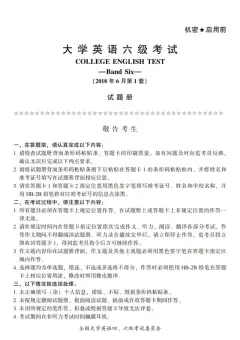
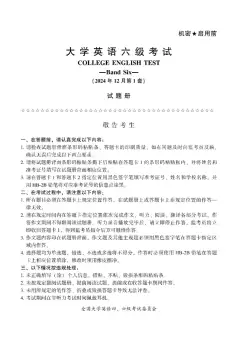
机密*启用前
大 学 英 语 六 级 考 试
COLLEGE ENGLISH TEST
—Band Six—
(2019 年 6 月第 1 套)
试 题 册
敬 告 考 生
一、在答题前,请认真完成以下内容:
1. 请检查试题册背面条形码粘贴条、答题卡的印刷质量,如有问题及时向监考员反映,确
认无误后完成以下两点要求。
2. 请将试题册背面条形码粘贴条揭下后粘贴在答题卡1的条形码粘贴框内,并将姓名和准
考证号填写在试题册背面相应位置。
3. 请在答题卡1和答题卡2指定位置用黑色签字笔填写准考证号、姓名和学校名称,并用
HB-2B铅笔将对应准考证号的信息点涂黑。
二、在考试过程中,请注意以下内容:
1. 所有题目必须在答题卡上规定位置作答,在试题册上或答题卡上非规定位置的作答一律
无效。
2. 请在规定时间内在答题卡指定位置依次完成作文、听力、阅读、翻译各部分考试,作答
作文期间不得翻阅该试题册。听力录音播放完毕后,请立即停止作答,监考员将立即收回答
题卡1,得到监考员指令后方可继续作答。
3. 作文题内容印在试题册背面,作文题及其他主观题必须用黑色签字笔在答题卡指定区域
内作答。
4. 选择题均为单选题,错选、不选或多选将不得分,作答时必须使用HB-2B铅笔在答题卡
上相应位置填涂,修改时须用橡皮擦净。
三、以下情况按违规处理:
1. 未正确填写(涂)个人信息,错贴、不贴、毁损条形码粘贴条。
2. 未按规定翻阅试题册、提前阅读试题、提前或在收答题卡期间作答。
3. 未用所规定的笔作答、折叠成毁损答题卡导致无法评卷。
4. 考试期间在非听力考试时间佩戴耳机。
1淘宝店铺:光速考研工作室
全国大学英语四、六级考试委员会
2淘宝店铺:光速考研工作室
淘宝店铺【光速考研工作室】温馨提示:
word版真题仅校对内容,因格式不无法固定,未精美排版,仅供自行复制粘贴使用,若打
印或用于电子笔记,请务必使用PDF版本真题!!!
本店PDF版真题打印无乱码,用于电子版笔记支持取词翻译,为优质版PDF。
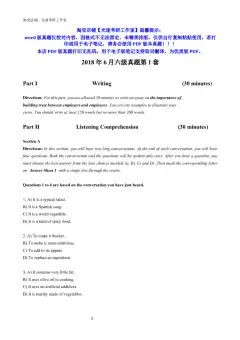
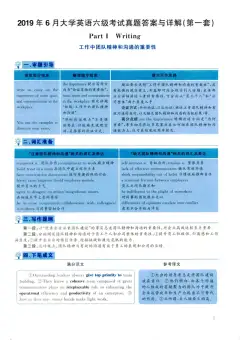
Part I Writing (30 minutes)
Directions: For this part, you are allowed 30 minutes to write an essay on the importance of team spirit and
communication in the workplace. You should write at least 150 words but no more than 200 words.
Part II Listening Comprehension (30 minutes)
Section A
Directions: In this section, you will hear two long conversations. At the end of each conversation, you will hear
four questions. Both the conversation and the questions will be spoken only once. After you hear a question, you
must choose the best answer from the four choices marked A), B), C) and D). Then mark the corresponding letter
on Answer Sheet 1 with a single line through the center.
Questions 1 and 4 are based on the conversation you have just heard.
1. A) A six- month-long negotiation. C) A project with a troublesome client.
B) Preparations for the party. D) Gift wrapping for the colleagues.
2. A) Take wedding photos. C) Start a small business.
B) Advertise her company. D) Throw a celebration party.
3. A) Hesitant. C) Flattered.
B) Nervous. D) Surprised.
4. A) Start her own bakery. C) Share her cooking experience.
B) Improve her baking skill. D) Prepare for the wedding
Questions 5 to 8 are based on the conversation you have just heard.
5. A) They have to spend more time studying.
B) They have to participate in club activities.
3淘宝店铺:光速考研工作室
C) They have to be more responsible for what they do.
D) They have to choose a specific academic discipline.
6. A) Get ready for a career. C) Set a long-term goal.
B) Make a lot of friends. D) Behave like adults.
7. A) Those who share her academic interests.
B) Those who respect her student commitments.
C) Those who can help her when she is in need.
D) Those who go to the same clubs as she does.
8. A) Those helpful for tapping their potential.
B) Those conducive to improving their social skills.
C) Those helpful for cultivating individual interests.
D) Those conducive to their academic studies.
Section B
Directions: In this section, you will hear two passages. At the end of each passage, you will hear three or four
questions. Both the passage and the questions will be spoken only once. After you hear a question, you must
choose the best answer from the four choices marked A), B), C) and D). Then mark the corresponding letter on
Answer Sheet 1 with a single line through the center.
Questions 9 to 11 are based on the passage you have just heard.
9. A) They break away from traditional ways of thinking.
B) They are prepared to work harder than anyone else.
C) They are good at refining old formulas.
D) They bring their potential into full play.
10. A) They contributed to the popularity of skiing worldwide.
B) They resulted in a brand-new style of skiing techniques.
C) They promoted the scientific use of skiing poles.
D) They made explosive news in the sports world.
11. A) He was recognized as a genius in the world of sports.
B) He competed in all major skiing events in the world.
C) He won three gold medals in one Winter Olympics.
D) He broke three world skiing records in three years
4淘宝店铺:光速考研工作室
Questions 12 to 15 are based on the passage you have just heard.
12. A) They appear restless. C) They become upset.
B) They lose consciousness. D) They die almost instantly.
13. A) It has an instant effect on your body chemistry.
B) It keeps returning to you every now and then.
C) It leaves you with a long lasting impression.
D) It contributes to the shaping of you mind.
14. A) To succeed while feeling irritated.
B) To feel happy without good health.
C) To be free from frustration and failure.
D) To enjoy good health while in dark moods.
15. A) They are closely connected.
B) They function in a similar way.
C) They are too complex to understand.
D) They reinforce each other constantly.
Section C
Directions: In this section, you will hear three recordings of lectures or talks followed by three or four questions.
The recordings will be played only once. After you hear a question, you must choose the best answer from the four
choices marked A), B), C) and D). Then mark the corresponding letter on Answer Sheet 1 with a single line
through the center.
Questions 16 to 18 are based on the recording you have just heard.
16. A) They differ in their appreciation of music.
B) They focus their attention on different things.
C) They finger the piano keys in different ways.
D) They choose different pieces of music to play.
17. A) They manage to cooperate well with their teammates.
B) They use effective tactics to defeat their competitors.
C) They try hard to meet the spectators’ expectations.
D) They attach great importance to high performance.
18. A) It marks a breakthrough in behavioral science.
5淘宝店铺:光速考研工作室
B) It adopts a conventional approach to research.
C) It supports a piece of conventional wisdom.
D) It gives rise to controversy among experts.
Questions 19 to 21 are based on the recording you have just heard.
19. A) People’s envy of slim models. C) The increasing range of fancy products.
B) People’s craze for good health. D) The great variety of slimming products.
20. A) They appear vigorous. C) They look charming.
B) They appear strange. D) They look unhealthy.
21. A) Culture and upbringing. C) Peer pressure.
B) Wealth and social status. D) Media influence.
Questions 22 to 25 are based on the recording you have just heard.
22. A) The relation between hair and skin. C) The color of human skin.
B) The growing interest in skin studies. D) The need of skin protection.
23. A) The necessity to save energy. C) The need to breathe with ease.
B) Adaptation to the hot environment. D) Dramatic climate changes on earth.
24. A) Leaves and grass. C) Their skin coloring.
B) Man-made shelter. D) Hair on their skin.
25. A) Their genetic makeup began to change.
B) Their communities began to grow steadily.
C) Their children began to mix with each other.
D) Their pace of evolution began to quicken
Part III Reading Comprehension (40 minutes)
Section A
Directions: In this section, there is a passage with ten blanks. You are required to select one word for each blank
from a list of choices given in a word bank following the passage. Read the passage through carefully before
making your choices. Each choice in the bank is identified by a letter. Please mark the corresponding letter for
each item on Answer Sheet 2 with a single line through the centre. You may not use any of the words in the bank
6淘宝店铺:光速考研工作室
more than once.
Questions 26 to 35 are based on the following passage.
Pasta is no longer off the menu, after a new review of studies suggested that the carbohydrate can form part
of a healthy diet, and even help people lose weight. For years, nutritionists have recommended that pasta be kept
to a 26, to cut calories, prevent fat build-up and stop blood sugar 27 up.
The low-carbohydrate food movement gave birth to such diets as the Atkins, Paleo and Keto, which advised
swapping foods like bread, pasta and potatoes for vegetables, fish and meat. More recently the trend of swapping
spaghetti for vegetables has been 28 by clean-eating experts.
But now a 29 review and analysis of 30 studies by Canadian researchers found that not only does pasta not
cause weight gain, but three meals a week can help people drop more than half a kilogram over four months. The
reviewers found that pasta had been unfairly demonized (妖魔化) because it had been 30 in with other, more ft-
promoting carbohydrates.
“The study found that pasta didn’t 31 to weight gain or increase in body fat,” said lead author Dr. John
Sievenpiper. “In 32 the evidence, we can now say with some confidence that pasta does not have an 33 effect on
body weigh outcomes when it is consumed as part of a healthy dietary pattern.” In fact, analysis actually showed a
small weigh loss 34 to concerns. Perhaps pasta can be part of a healthy diet.
Those involved in the 35 trials on average ate 3.3 servings of pasta a week instead of other carbohydrates,
one serving equaling around half a cup. They lost around half a kilogram over an average follow-up of 12 weeks.
A) adverse B) championed C) clinical D) contrary E) contribute F) intimate
G) lumped H) magnified I) minimum J) radiating K) rationL) shooting
M) subscribe N) systematicO) weighing
Section B
Directions: In this section, you are going to read a passage with ten statements attached to it. Each statement
contains information given in one of the paragraphs. Identify the paragraph from which the information is
derived. You may choose a paragraph more than once. Each paragraph is marked with a letter. Answer the
questions by marking the corresponding letter on Answer Sheet 2.
The Best Retailers Combine Bricks and Clicks
A) Retail profits are falling sharply. Stores are closing. Malls are emptying. The depressing stories just keep
7淘宝店铺:光速考研工作室
coming. Reading the earnings announcements of large retail stores like Macy’s, Nordstrom, and Target is about
as uplifting as a tour of an intensive care unit. The interact is apparently taking down yet another industry. Brick
and mortar stores (实体店) seem to be going the way of the yellow pages. Sure enough, the Census Bureau just
released data showing that online retail sales surged 15.2 percent between the first quarter of 2015 and the first
quarter of 2016.
B) But before you dump all of your retail stocks, there are more facts you should consider. Looking only at that
15.2 percent “surge” would be misleading. It was an increase that was on a small base of 6.9 percent. Even when
a tiny number grows by a large percentage terms, it is often still tiny.
C) More than 20 years after the internet was opened to commerce, the Census Bureau tells us that brick and
mortar sales accounted for 92.3 percent of retail sales in the first quarter of 2016. Their data show that only 0.8
percent of retail sales shifted from offline to online between the beginning of 2015 and 2016.
D) So, despite all the talk about drone (无人机) deliveries to your doorstep, all the retail executives expressing
anxiety over consumers going online, and even a Presidential candidate exclaiming that Amazon has a “huge
antitrust problem,” the Census data suggest that physical retail is thriving. Of course, the closed stores, depressed
executives, and sinking stocks suggest otherwise. What’s the real story?
E) Many firms operating brick and mortar stores are in trouble. The retail industry is getting reinvented, as we
describe in our new book Matchmakers. It’s standing in the Path of what Schumpeter called a gale (大风) of
creative destruction. That storm has been brewing for some time, and as it has reached gale force, most large
retailers are searching for a response. As the CFO of Macy’s put it recently, “We’re frankly scratching our
heads.”
F) But it’s not happening as experts predicted. In the peak of the dot. com bubble, brick and mortar retail was
one of those industries the internet was going to kill-and quickly. The dot.com bust discredited most predictions
of that sort and in the years that followed, conventional retailers’ confidence in the future increased as Census
continued to report weak online sales. And then the gale hit.
8淘宝店铺:光速考研工作室
G) It is becoming increasingly clear that retail reinvention isn’t a simple battle to the death between bricks and
clicks. It is about devising retail models that work for people who are making increasing use of a growing array
of internet-connected tools to change how they search, shop, and buy. Creative retailers are using the new
technologies to innovate just about everything stores do from managing inventory, to marketing, to getting paid.
H) More than drones dropping a new supply of underwear on your doorstep, Apple’s massively successful brick-
and-mortar-and-glass retail stores and Amazon’s small steps in the same direction are what should keep old-
fashioned retailers awake at night. Not to mention the large number of creative new retailers, like Bonobos, that
are blending online and offline experiences in creative ways.
I) Retail reinvention is not a simple process, and it’s also not happening on what used to be called “Internet
Time.” Some internet-driven changes have happened quickly, of course. Craigslist quickly overtook newspaper
classified ads and turned newspaper economics upside down. But many widely anticipated changes weren’t
quick, and some haven’t really started. With the benefit of hindsight (后见之明), it looks like the interact will
transform the economy at something like the pace of other great inventions like electricity. B2B commerce, for
example, didn’t move mainly online by 2005 as many had predicted in 2000, nor even by 2016, but that doesn’t
mean it won’t do so over the next few decades.
J) But the gale is still blowing. The sudden decline in foot traffic in recent years, even though it hasn’t been
accompanied by a massive decline in physical sales, is a critical warning. People can shop more efficiently online
and therefore don’t need to go to as many stores to find what they want. There’s a surplus of physical shopping
space for the crowds, which is one reason why stores are downsizing and closing.
K) The rise of the mobile phone has recently added a new level of complexity to the process of retail reinvention.
Even five years ago most people faced a choice. Sit at your computer, probably at home or at the office, search
and browse, and buy. Or head out to the mall, or Main Street, look and shop, and buy. Now, just about everyone
has a smartphone, connected to the internet almost everywhere almost all the time. Even when a retailer gets a
customer to walk in the store, she can easily see if there’s a better deal online or at another store nearby.
9淘宝店铺:光速考研工作室
L) So far, the main thing many large retailers have done in response to all this is to open online stores, so people
will come to them directly rather than to Amazon and its smaller online rivals. Many are having the same
problem that newspapers have. Even if they get online traffic, they struggle to make enough money online to
compensate for what they are losing offline.
M) A few seem to be making this work. Among large traditional retailers, Walmart recently reported the best
results, leading its stock price to surge, while Macy’s, Target, and Nordstrom’s dropped. Yet Walmart’s year-
over-year online sales only grew 7 percent, leading its CEO to lament (哀叹), “Growth here is too slow.” Part of
the problem is that almost two decades after Amazon filed the one. Click patent, the online retail shopping and
buying experience is filled with frictions. A recent study graded more than 600 internet retailers on how easy it
was for consumers to shop, buy, and pay. Almost half of the sites didn’t get a passing grade and only 18 percent
got an A or B.
N) The turmoil on the ground in physical retail is hard to square with the Census data. Unfortunately, part of the
explanation is that the Census retail data are unreliable. Our deep 100k into those data and their preparation
revealed serious problems. It seems likely that Census simply misclassifies a large chunk of online sales. It is
certain that the Census procedures, which lump the online sales of major traditional retailers like Walmart with
“non-store retailers” 1ike food trucks can mask major changes in individual retail categories. The bureau could
easily present their data in more useful ways. But they have chosen not to.
O) Despite the turmoil, brick and mortar won’t disappear any time soon. The big questions are which, if any, of
the large traditional retailers will still be on the scene in a decade or two because they have successfully
reinvented themselves, which new players will operate busy stores on Main Streets and maybe even in shopping
malls, and how the shopping and buying experience will have changed in each retail category. Investors
shouldn’t write off brick and mortar. Whether they should bet on the traditional players who run those stores
now is another matter.
36. Although online retailing has existed for some twenty years, nearly half of the internet retailers still fail to
10淘宝店铺:光速考研工作室
receive satisfactory feedback from consumers, according to a recent survey.
37. Innovative retailers integrate internet technologies with conventional retailing to create new retail models.
38. Despite what the Census data suggest, the value of physical retail’s stocks has been dropping.
39. Innovative—driven changes in the retail industry didn’t take place as quickly as widely anticipated.
40. Statistics indicate that brick and mortar sales still made up the lion’s share of the retail business.
41. Companies that successfully combine online and offline business models may prove to be a big concern for
traditional retailers.
42. Brick and mortar retailers’ faith in their business was strengthened when the dot com bubble burst.
43. Despite the tremendous challenges from online retailing, traditional retailing will be here to stay for quite
some time.
44. With the rise of online commerce, physical retail stores are likely to suffer the same fate as the yellow pages.
45. The wide use of smartphones has made it more complex for traditional retailers to reinvent their business.
Section C
Directions: There are 2 passages in this section. Each passage is followed by some questions or unfinished
statements. For each of them there are four choices marked A), B), C) and D). You should decide on the best
choice and mark the corresponding letter on Answer Sheet 2 with a single line through the centre.
Passage One
Questions 46 to 50 are based on the following passage.
Professor Stephen Hawking has warned that the creation of powerful artificial intelligence (AI) will be
“either the best, or the worst thing, ever to happen to humanity”, and praised the creation of an academic institute
11淘宝店铺:光速考研工作室
dedicated to researching the future of intelligence as “ crucial to the future of our civilisation and our species”.
Hawking was speaking at the opening of the Leverhulme Centre for the Future of Intelligence (LCFI) at
Cambridge University, a multi-disciplinary institute that will attempt to tackle some of the open-ended questions
raised by the rapid pace of development in AI research. “We spend a great deal of time study in history,” Hawking
said, “which, let’s face it, is mostly the history of stupidity. So it’s a welcome change that people are studying
instead the future of intelligence.”
While the world-renowned physicist has often been cautious about AI, raising concerns that humanity could
be the architect of its own destruction if it creates a super-intelligence with a will of its own, he was also quick to
highlight the positives that AI research can bring. “The potential benefits of creating intelligence are huge,” he
said. “We cannot predict what we might achieve when our own minds are amplified by AI. Perhaps with the tools
of this new technological revolution, we will be able to undo some of the damage done to the natural world by the
last one —industrialisation. And surely we will aim to finally eradicate disease and poverty. And every aspect of
our lives will be transformed. In short, success in creating AI could be the biggest event in the history of our
civilisation.”
Huw Price, the centre’s academic director and the Bertrand Russell professor of philosophy at Cambridge
University, where Hawking is also an academic, said that the centre came about partially as a result of the
university’s Centre for Existential Risk. That institute examined a wider range of potential problems for humanity,
while the LCFI has a narrow focus.
AI pioneer Margaret Boden, professor of cognitive science at the University of Sussex, praised the progress
of such discussions. As recently as 2009, she said, the topic wasn’t taken seriously, even among AI researchers.
“AI is hugely exciting,” she said, “but it has limitations, which present grave dangers given uncritical use.”
The academic community is not alone in warning about the potential dangers of AI as well as the potential
benefits. A number of pioneers from the technology industry, most famously the entrepreneur Elon Musk, have
12淘宝店铺:光速考研工作室
also expressed their concerns about the damage that a super-intelligent AI could do to humanity.
46. What did Stephen Hawking think of artificial intelligence?
A) It would be vital to the progress of human civilisation.
B) It might be a blessing or a disaster in the making.
C) It might present challenges as well as opportunities.
D) It would be a significant expansion of human intelligence.
47. What did Hawking say about the creation of the LCFI?
A) It would accelerate the progress of AI research.
B) It would mark a step forward in the AI industry.
C) It was extremely important to the destiny of humankind.
D) It was an achievement of multi-disciplinary collaboration.
48. What did Hawking say was a welcome change in AI research?
A) The shift of research focus from the past to the future.
B) The shift of research from theory to implementation.
C) The greater emphasis on the negative impact of AI.
D) The increasing awareness of mankind’s past stupidity.
49. What concerns did Hawking raise about AI?
A) It may exceed human intelligence sooner or later.
B) It may ultimately over-amplify the human mind.
C) Super-intelligence may cause its own destruction.
D) Super-intelligence may eventually ruin mankind.
13淘宝店铺:光速考研工作室
50. What do we learn about some entrepreneurs from the technology industry?
A) They are much influenced by the academic community.
B) They are most likely to benefit from AI development.
C) They share the same concerns about AI as academics.
D) They believe they can keep AI under human control.
Passage Two
Questions 51 to 55 are based on the following passage.
The market for products designed specifically for older adults could reach $30 billion by next year, and
startups (初创公司) want in on the action. What they sometimes lack is feedback from the people who they hope
will use their products. So Brookdale, the country’s largest owner of retirement communities, has been inviting a
few select entrepreneurs just to move in for a few days, show off their products and hear what the residents have
to say.
That’s what brought Dayle Rodriguez, 28, all the way from England to the dining room of Brookdale South
Bay in Torrance, California. Rodriguez is the community and marketing manager for a company called Sentab.
The startup’s product, SentabTV, enables older adults who may not be comfortable with computers to access
email, video chat and social media using just their televisions and a remote control.
“It’s nothing new, it’s nothing too complicated and it’s natural because lots of people haveTV remotes,”
says Rodriguez.
But none of that is the topic of conversation in the Brookdale dining room. Instead, Rodriguez solicits
residents’ advice on what he should get on his cheeseburger and how he should spend the afternoon. Playing cards
was on the agenda, as well as learning to play mahjong (麻将).
14淘宝店铺:光速考研工作室
Rodriguez says it’s important that residents here don’t feel like he’s selling them something. “I’ve had more
feedback in a passive approach,” he says. “Playing pool, playing cards, having dinner, having lunch,” all work
better “than going through a survey of questions. When they get to know me and to trust me, knowing for sure
I’m not selling them something—there’ll be more honest feedback from them.”
Rodriguez is just the seventh entrepreneur to move into one of Brookdale’s 1,100 senior living communities.
Other new products in the program have included a kind of full-body blow dryer and specially designed clothing
that allows people with disabilities to dress and undress themselves.
Mary Lou Busch, 93, agreed to try the Sentab system. She tells Rodriguez that it might be good for
someone, but not for her. “I have the computer and FaceTime, which I talk with my family on, ”she explains.
She also has an iPad and a smartphone. “So I do pretty much everything I need to do.”
To be fair, if Rodriguez had wanted feedback from some more technophobic (害怕技术的) seniors, he
might have ended up in the wrong Brookdale community. This one is located in the heart of Southern
California’s aerospace corridor. Many residents have backgrounds in engineering, business and academic circles.
But Rodriguez says he’s still learning something important by moving into this Brookdale community:
“People are more tech-proficient than we thought.”
And besides, where else would he learn to play mahjong?
51. What does the passage say about the startups?
A) They never lose time in upgrading products for seniors.
B) They want to have a share of the seniors’ goods market.
C) They invite seniors to their companies to try their products.
D) They try to profit from promoting digital products to seniors.
52. Some entrepreneurs have been invited to Brookdale to
15淘宝店铺:光速考研工作室
A) have an interview with potential customers
B) conduct a survey of retirement communities
C) collect residents’ feedback on their products
D) show senior residents how to use IT products
53. What do we know about SentabTV?
A) It is a TV program catering to the interest of the elderly.
B) It is a digital TV which enjoys popularity among seniors.
C) It is a TV specially designed for seniors to view programs.
D) It is a communication system via TV instead of a computer.
54. What does Rodriguez say is important in promoting products?
A) Winning trust from prospective customers.
B) Knowing the likes and dislikes of customers.
C) Demonstrating their superiority on the spot.
D) Responding promptly to customer feedback.
55. What do we learn about the seniors in the Brookdale community?
A) Most of them are interested in using the Sentab.
B) They are quite at ease with high-tech products.
C) They have much in common with seniors elsewhere.
D) Most of them enjoy a longer life than average people.
Part IV Translation (30 minutes)
Directions: For this part, you are allowed 30 minutes to translate a passage from Chinese into English. You
16淘宝店铺:光速考研工作室
should write your answer on Answer Sheet 2.
成语(Chinese idioms)是汉语中的一种独特的表达方式,大多由四个汉字组成。它们高度简练且形
式固定,但通常能形象地表达深刻的含义。成语大多数来源于中国古代的文学作品,通常与某些神话、
传说或者历史事件有关。如果不知道某个成语的出处,就很难理解其确切含义。因为,学习成语有助于
人们更好地理解中国传统文化。成语在日常会话和文学创作中广泛使用。恰当使用成语可以使一个人的
语言更具表现力,交流更有效。
17淘宝店铺:光速考研工作室
机密*启用前
大 学 英 语 六 级 考 试
COLLEGE ENGLISH TEST
—Band Six—
(2019 年 6 月第 2 套)
试 题 册
敬 告 考 生
一、在答题前,请认真完成以下内容:
1. 请检查试题册背面条形码粘贴条、答题卡的印刷质量,如有问题及时向监考员反映,确
认无误后完成以下两点要求。
2. 请将试题册背面条形码粘贴条揭下后粘贴在答题卡1的条形码粘贴框内,并将姓名和准
考证号填写在试题册背面相应位置。
3. 请在答题卡1和答题卡2指定位置用黑色签字笔填写准考证号、姓名和学校名称,并用
HB-2B铅笔将对应准考证号的信息点涂黑。
二、在考试过程中,请注意以下内容:
1. 所有题目必须在答题卡上规定位置作答,在试题册上或答题卡上非规定位置的作答一律
无效。
2. 请在规定时间内在答题卡指定位置依次完成作文、听力、阅读、翻译各部分考试,作答
作文期间不得翻阅该试题册。听力录音播放完毕后,请立即停止作答,监考员将立即收回答
题卡1,得到监考员指令后方可继续作答。
3. 作文题内容印在试题册背面,作文题及其他主观题必须用黑色签字笔在答题卡指定区域
内作答。
4. 选择题均为单选题,错选、不选或多选将不得分,作答时必须使用HB-2B铅笔在答题卡
上相应位置填涂,修改时须用橡皮擦净。
三、以下情况按违规处理:
1. 未正确填写(涂)个人信息,错贴、不贴、毁损条形码粘贴条。
2. 未按规定翻阅试题册、提前阅读试题、提前或在收答题卡期间作答。
3. 未用所规定的笔作答、折叠成毁损答题卡导致无法评卷。
4. 考试期间在非听力考试时间佩戴耳机。
18淘宝店铺:光速考研工作室
全国大学英语四、六级考试委员会
19淘宝店铺:光速考研工作室
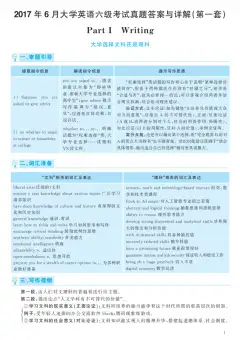
Part I Writing (30 minutes)
Directions: For this part, you are allowed 30 minutes to write an essay on the importance of mutual understanding and
respect in interpersonal relationships. You should write at least 150 words but no more than 200 words.
Part II Listening Comprehension (30 minutes)
Section A
Directions: In this section, you will hear two long conversations. At the end of each conversation, you will hear
four questions. Both the conversation and the questions will be spoken only once. After you hear a question, you
must choose the best answer from the four choices marked A), B), C) and D). Then mark the corresponding letter
on Answer Sheet 1 with a single line through the center.
Questions 1 and 4 are based on the conversation you have just heard.
1. A) Why Roman Holiday was more famous than Breakfast at Tiffany’s.
B) Why Audrey Hepburn had more female fans than male ones.
C) Why the woman wanted to be like Audrey Hepburn.
D) Why so many girls adored Audrey Hepburn.
2. A) Her unique personality.
B) Her physical condition.
C) Her shift of interest to performing arts.
D) Her family’s suspension of financial aid.
3. A) She was not an outgoing person.
B) She was modest and hardworking
C) She was easy-going on the whole.
D) She was usually not very optimistic.
4. A) She was influenced by the roles she played in the films.
B) Her parents taught her to symbolize with the needy.
C) She learned to volunteer when she was a child.
D) Her family benefited from other people’s help.
20淘宝店铺:光速考研工作室
Questions 5 to 8 are based on the conversation you have just heard.
5. A) Give a presentation.
B) Rise some questions.
C) Start a new company.
D) Attend a board meeting.
6. A) It will cut production costs.
B) It will raise productivity.
C) No staff will be dismissed.
D) No new staff will be hired.
7. A) The timeline of restructuring.
B) The reasons for restructuring.
C) The communication channels.
D) The company’s new missions.
8. A) By consulting their own department managers.
B) By emailing questions to the man or the woman.
C) By exploring various channels of communication.
D) By visiting the company’s own computer network.
Section B
Directions: In this section, you will hear two passages. At the end of each passage, you will hear three or four
questions. Both the passage and the questions will be spoken only once. After you hear a question, you must
choose the best answer from the four choices marked A), B), C) and D). Then mark the corresponding letter on
Answer Sheet 1 with a single line through the center.
Questions 9 to 11 are based on the passage you have just heard.
9. A) It helps passengers to take care of their pet animals.
B) It has animals to help passengers carry their language.
C) It uses therapy animals to soothe nervous passengers.
D) It allows passengers to have animal travel with them.
10. A) Avoiding possible dangers.
B) Finding their way around.
C) Identifying drug smugglers.
D) Looking after sick passengers.
21淘宝店铺:光速考研工作室
11. A) Schedule their flights around the animal visits.
B) Photograph the therapy animals at the airport.
C) Keep some animals for therapeutic purposes.
D) Bring their animals on board their plane.
Questions 12 to 15 are based on the passage you have just heard.
12. A) Beside a beautifully painted wall in Arles.
B) Beside the gate of an ancient Roman city.
C) At the site of an ancient Roman mansion.
D) At the entrance to a reception hall in Rome.
13. A) A number of different images.
B) A number of mythological heroes.
C) Various musical instruments.
D) Paintings by famous French artists.
14.A) The originality and expertise shown.
B) The worldly sophistication displayed.
C) The stunning images vividly depicted.
D) The impressive skills and costly dyes.
15.A) His artistic taste is superb.
B) His identity remains unclear.
C) He was a collector of antiques.
D) He was a rich Italian merchant.
Section C
Directions: In this section, you will hear three recordings of lectures or talks followed by three or four questions.
The recordings will be played only once. After you hear a question, you must choose the best answer from the four
choices marked A), B), C) and D). Then mark the corresponding letter on Answer Sheet 1 with a single line
through the center.
Questions 16 to 18 are based on the recording you have just heard.
16.A) They encourage international cooperation.
B) They lay stress on basic scientific research.
C) They place great emphasis on empirical studies.
22淘宝店铺:光速考研工作室
D) They favour scientists from its member countries.
17.A) Many of them wish to win international recognition.
B) They believe that more hands will make light work.
C) They want to follow closely the international trend.
D) Many of their projects have become complicated.
18.A) It requires mathematicians to work independently.
B) It is faced with many unprecedented challenges.
C) It lags behind other disciplines in collaboration.
D) It calls for more research funding to catch up.
Questions 19 to 21 are based on the recording you have just heard.
19.A) Scientists tried to send a balloon to Venus.
B) Scientists discovered water on Venus.
C) Scientists found Venus had atmosphere.
D) Scientists observed Venus from a space vehicle.
20.A) It resembles Earth in many aspects.
B) It is the same as fiction has portrayed.
C) It is a paradise of romance for alien life.
D) It undergoes geological changes like Earth.
21.A) It might have been hotter than it is today.
B) It might have been a cozy habitat for life.
C) It used to have more water than Earth.
D) It used to be covered with rainforests.
Questions 22 to 25 are based on the recording you have just heard.
22.A) Causes of sleeplessness.
B) Cross-cultural communication.
C) Cultural psychology.
D) Motivation and positive feelings.
23.A) They attach great importance to sleep.
B) They often have trouble falling asleep.
C) They pay more attention to sleep efficiency.
23淘宝店铺:光速考研工作室
D) They generally sleep longer than East Asians.
24.A) By asking people to report their sleep habits.
B) By observing people’s sleep patterns in labs.
C) By having people wear motion-detecting watches.
D) By videotaping people’s daily sleeping processes.
25.A) It has made remarkable progress in the past few decades.
B) It has not yet explored the cross-cultural aspect of sleep.
C) It has not yet produced anything conclusive.
D) It has attached attention all over the world.
Part III Reading Comprehension (40 minutes)
Section A
Directions: In this section, there is a passage with ten blanks. You are required to select one word for each blank
from a list of choices given in a word bank following the passage. Read the passage through carefully before
making your choices. Each choice in the bank is identified by a letter. Please mark the corresponding letter for
each item on Answer Sheet 2 with a single line through the centre. You may not use any of the words in the bank
more than once.
Questions 26 to 35 are based on the following passage.
The dream of personalised flight is still vivid in the minds of many inventors, some developing cycle-
powered craft, others 26 money into jetpacks (喷气飞行背包). However, the flying car has always remained the
27 symbol of personal transport freedom.
Several companies around the world have produced 28 that can drive on roads and fly. Airbus has a
futuristic modular (组件式的) concept involving a passenger capsule that can be 29 from the road-going chassis
(底盘) and picked up by a helicopter-type machine.
But all these concepts are massively expensive, require safety certification standards for road and air, need
30 controls, involve complex folding wings and propellers, and have to be flown from air-strips. So they are likely
to remain rich people’s playthings rather than practical transport solutions for the masses.
“A car that takes off from some London street and lands in another 31 street is unlikely to happen,” says
Prof. Gray, a leading aeronautical engineer. “Sky taxis are much more likely.” But that won’t stop inventors from
dreaming up new ways to fly and trying to persuade investors to back their sometimes 32 schemes.
Civilian aviation is being disrupted, not by the age-old desires for speed, romanticism and 33, but by the
pressing need to respond to a changing climate. New electric engines coupled with artificial intelligence and 34
systems will contribute to a more efficient, integrated transport system that is less polluting and less noisy. That
24淘宝店铺:光速考研工作室
may sound simple, but as Prof. Gray says, “When I travel somewhere I like this notion that when I finish my
journey I feel better than when I started it. That’s completely at 35 with how I feel today.” Now that would be
progress.
A) autonomous B) detached C) dual D) glamour E) imminent F) odds G) opposites H)
outrageous
I) pouring J) prototypes K) random L) repressing M) segmented N) spectrum O) ultimate
Section B
Directions: In this section, you are going to read a passage with ten statements attached to it. Each statement
contains information given in one of the paragraphs. Identify the paragraph from which the information is
derived. You may choose a paragraph more than once. Each paragraph is marked with a letter. Answer the
questions by marking the corresponding letter on Answer Sheet 2.
Companies Are Working with Consumers to Reduce Waste
A) As consumers, we are very wasteful. Annually, the world generates 1.3 billion tons of solid waste. This is
expected to go up to 2.2 billion by 2025. The developed countries are responsible for 44% of waste, and in the
U.S. alone, the average person throws away their body weight in rubbish every month.
B) Conventional wisdom would seem to suggest that companies have no incentive to lengthen the life cycle of
their products and reduce the revenue they would get from selling new goods. Yet, more and more businesses are
thinking about how to reduce consumer waste. This is partly driven by the rising price of raw materials and
metals. It is also partly due to both consumers and companies becoming more aware of the need to protect our
environment.
C) When choosing what products to buy and which brands to buy from, more and more consumers are looking
into sustainability. This is opposed to just price and performance they were concerned about in the past. In a
survey of 54 of the world’s leading brands, almost all of them reported that consumers are showing increasing
care about sustainable lifestyles. At the same time, surveys on consumers in the U.S. and the U.K. show that they
also care about minimizing energy use and reducing waste.
D) For the most part, consumers control what happens to a product. But some companies are realizing that
placing the burden of recycling entirely on the consumer is not an effective strategy, especially when tossing
something away seems like the easiest and most convenient option.
E) Some retailers and manufacturers in the clothing, footwear, and electronics industries have launched
environmental programs. They want to make their customers interested in preserving their products and
25淘宝店铺:光速考研工作室
preventing things that still have value from going to the garbage dump. By offering services to help expand the
longevity of their products, they’re promising quality and durability to consumers, and receiving the reputational
gains for being environmentally friendly.
F) For example, the Swedish jeans company Nudie Jeans offers free repair at twenty of their shops. Instead of
discarding their old worn-out jeans, customers bring them in to be renewed. The company even provides mail-
order repair kits and online videos, so that customers can learn how to fix a pair of jeans at home. Their
philosophy is that extending the life of a pair of jeans is not only great for the environment, but allows the
consumer to get more value out of their product. When customers do want to toss their pair, they can give them
back to the store, which will repurpose and resell them. Another clothing company, Patagonia, a high-end
outdoor clothing store, follows the same principle. It has partnered with DIY website iFixit to teach consumers
how to repair their clothing, such as waterproof outerwear, at home. The company also offers a repair program
for their customers for a modest fee. Currently, Patagonia repairs about 40,000 garments a year in their Reno,
Nevada, service center. According to the company’s CEO, Rose Marcario, this is about building a company that
cares about the environment. At the same time, offering repair supports the perceived quality of its products.
G) In Brazil, the multinational corporation Adidas has been running a shoe-recycling program called
“Sustainable Footprint” since 2012. Customers can bring shoes of any brand into an Adidas store to be shredded
and turned into alternative fuels for energy creation instead of being burned as trash. They are used to fuel cement
ovens. To motivate visitors to bring in more old shoes, Adidas Brazil promotes the program in stores by showing
videos to educate customers, and it even offers a discount each time a customer brings in an old pair of shoes.
This boosts the reputation and image of Adidas by making people more aware of the company’s values.
H) Enormous opportunities also lie with e-waste. It is estimated that in 2014 the world produced some 42 million
metric tons of e-waste (discarded electrical and electronic equipment and its parts) with North America and
Europe accounting for 8 and 12 million metric tons respectively. The materials from e-waste include iron, copper,
gold, silver, and aluminum materials that could be reused, resold, salvaged, or recycled. Together, the value of
these metals is estimated to be about $52 billion. Electronics giants like Best Buy and Samsung have provided e-
waste take-back programs over the past few years, which aim to refurbish (翻新) old electronic components and
parts into new products.
I) For other companies interested in reducing waste, helping the environment, and providing the sustainable
lifestyles that consumers seek, here are some first steps for building a relationship with customers that focuses on
recycling and restoring value to products.
J) Find partners. If you are a manufacturer who relies on outside distributors, then retailers are the ideal partner
for collecting old products. Power tool maker DeWalt partners with companies, such as Lowes and Napa Auto
Parts, to collect old tools at their stores for recycling. The partnership benefits both sides by allowing
unconventional partners (for example, two companies from two different industries) to work together on a
26淘宝店铺:光速考研工作室
specific aspect of the value chain, like, in this example, an engine firm with an accessory one.
K) Create incentives. Environmental conscientiousness isn’t always enough to make customers recycle old goods.
For instance, DeWalt discovered that many contractors were holding on to their old tools, even if they no longer
worked, because they were expensive purchases and it was hard to justify bringing them in to recycle. By
offering instant discounts worth as much as $100, DeWalt launched a trade-in program to encourage people to
bring back tools. As a result, DeWalt now reuses those materials to create new products.
L) Start with a trial program, and expect to change the details as you go. Any take-back program will likely
change over time, depending on what works for your customers and company goals. Maybe you see low
customer participation at first, or conversely, so much success that the cost of recycling becomes too high. Best
Buy, for instance, has been bearing the lion’s share of e-waste volume since two of its largest competitors,
Amazon and Wal-mart, do not have their own recycling programs. Since the launch of its program, Best Buy
changed its policy to add a $25 fee for recycling old televisions in order to keep the program going.
M) Build a culture of collective values with customers. A stronger relationship between the retailer/producer and
the consumer isn’t just about financial incentives. By creating more awareness around your efforts to reduce
waste, and by developing a culture of responsibility, repair, and reuse, you can build customer loyalty based on
shared values and responsibilities.
N) These examples are just the tip of the iceberg, but they demonstrate how helping customers get more use of
their materials can transform value chains and operations. Reducing waste by incorporating used materials into
production can cut costs and decrease the price of procurement (采购): less to be procured from the outside and
more to be re-utilized from the inside.
O) Companies play a big role in creating a circular economy, in which value is generating less from extracting
new resources and more from getting better use out of the resources we already have--but they must also get
customers engaged in the process.
36. Some companies believe that products’ prolonged lifespan benefits both the environment and customers.
37. A survey shows shoppers today are getting more concerned about energy conservation and environmental
protection when deciding what to buy.
38. Companies can build customer loyalty by creating a positive culture of environmental awareness.
39. When companies launch environmental programs, they will have their brand reputation enhanced.
40. One multinational company offers discounts to customers who bring in old footwear to be used as fuel.
27淘宝店铺:光速考研工作室
41. Recycling used products can help manufacturers reduce production costs.
42. Electronic products contain valuable metals that could be recovered.
43. It seems commonly believed that companies are not motivated to prolong their products’ lifespan.
44. It is advisable for companies to partner with each other in product recycling.
45. Some businesses have begun to realize it may not be effective to let consumers take full responsibility for
recycling.
Section C
Directions: There are 2 passages in this section. Each passage is followed by some questions or unfinished
statements. For each of them there are four choices marked A), B), C) and D). You should decide on the best
choice and mark the corresponding letter on Answer Sheet 2 with a single line through the centre.
Passage One
Questions 46 to 50 are based on the following passage.
Effective Friday, Screen Actors Guild-American Federation of Television and Radio Artists (SAG-AFTRA)
has declared a strike against 11 video game publishers over games that went into production after Feb. 17, 2015.
The companies include some of the heavyweights of the industry, like Electronic Arts Productions, Insomniac
Games, Activision and Disney.
The strike comes in light of an unsuccessful 19 months of negotiations after the existing labor contract
known as the Interactive Media Agreement expired in late 2014. overall, the strike is an effort to provide more
secondary compensation along with other concerns, such as transparency upon hiring talent and on-set (制作中)
safety precautions.
The video gaming industry has ballooned in recent years. The Los Angeles Times reports that the industry is
in the midst of an intense increase in cash flow. In 2015, gaming produced $23.5 billion in domestic revenue.
But SAG-AFTRA says voice actors don’t receive residuals (追加酬金) for their gaming work. Instead, they
receive a fixed rate, which is typically about $825 for a standard four-hour vocal session. So the voice actors are
pushing for the idea of secondary compensation—a performance bonus every time a game sells 2 million copies
or downloads, or reaches 2 million subscribers, with a cap at 8 million.
“It’s a very small number of games that would trigger this secondary compensation issue,”said voice actor
Crispin Freeman, who’s a member of the union’s negotiating committee. “This is an important aspect of what it
means to be a freelance (从事自由职业的) performer, who isn’t regularly employed every single day working on
projects.”
Another major complaint from the actors is the secrecy of the industry. “I can’t imagine if there’s any other
28淘宝店铺:光速考研工作室
acting job in the world where you don’t know what show you’re in, when you’re hired,” says voice actor Keythe
Farley, who chairs the SAG-AFTRA negotiating committee.
“And yet that happens every day in the video game world,” Farley told reporters during a press conference
Friday. “I was a main character in Fallout 4, a character by the name of Kellogg, and I never knew that I was
doing vocal recording for that game throughout the year and a half.”
Scott Witlin, the lawyer representing the video game companies, says voice actors “represent less than one
tenth of 1 percent of the work that goes into making a video game.” So “even though they’re the top craftsmen in
their field,” Witlin says, “if we pay them under a vastly different system than the people who do the 99.9 percent
of the work, that’s going to create far more problems for the video game companies.”
46. Why did SAG-AFTRA declare a strike against some video game publishers?
A) The labor contract between them had been violated.
B) Its appeal to renegotiate the contract had been rejected.
C) It had been cheated repeatedly in the 19 months of talks.
D) The negotiations between them had broken down.
47. What do we learn from the passage about the video gaming industry?
A) It has reaped huge profits in recent years.
B) It has become more open and transparent.
C) It has attracted many famous voice actors.
D) It has invested a lot in its domestic market.
48. What are the voice actors demanding?
A) More regular employment.
B) A non-discriminatory contract.
C) Extra pay based on sales revenues.
D) A limit on the maximum work hours.
49. What does Keythe Farley say about voice actors?
A) They are kept in the dark about many details of their job.
B) They are discriminated against in the gaming industry.
C) They are not paid on a regular basis.
D) They are not employed full-time.
50. What is the argument of lawyer Scott Witlin?
A) Voice actors should have a pay raise if they prove to be top craftsmen.
B) Changing the pay system would cause the industry more problems.
C) Voice actors are mere craftsmen, not professional performers.
D) Paying voice actors on an hourly basis is in line with the law.
29淘宝店铺:光速考研工作室
Passage Two
Questions 51 to 55 are based on the following passage.
Officials at the White House announced a new space policy focused on managing the increasing number of
satellites that companies and governments are launching into space. Space Policy Directive-3 lays out general
guidelines for the United States to mitigate (缓解) the effects of space debris and track and manage traffic in
space.
This policy sets the stage for the Department of Commerce to take over the management of traffic in space.
The department will make sure that newly launched satellites don’t use radio frequencies that would interfere with
existing satellites, and schedule when such new satellites can be launched. This only applies to American space
activities, but the hope is that it will help standardize a set of norms in the dawning commercial spaceflight
industry throughout the world.
Space, especially the space directly around our planet, is getting more crowded as more governments and
companies launch satellites. One impetus for the policy is that companies are already starting to build massive
constellations ( 星 座 ), comprising hundreds or thousands of satellites with many moving parts among them.
With so much stuff in space, and a limited area around our planet, the government wants to reduce the chances of
a collision. Two or more satellites slamming into each other could create many more out-of-control bits that
would pose even more hazards to the growing collection of satellites in space.
And it’s not like this hasn’t happened before. In 2009 an old Russian craft slammed into a communications
satellite, creating a cloud of hundreds of pieces of debris and putting other hardware at risk. Journalist Sarah
Scoles reports that NASA currently tracks about 24,000 objects in space, and in 2016 the Air Force had to issue
3,995,874 warnings to satellite owners alerting them to a potential nearby threat from another satellite or bit of
debris.
That’s why this new policy also includes directions to update the current U.S. Government Orbital Debris
Mitigation Standard Practices, which already require any entity that launches a satellite or spacecraft to vigorously
analyze the likelihood that any of their actions, from an unexpected failure or normal operations, will create more
space debris. It includes accounting for any piece of debris they plan to release over 5mm that might stay in orbit
for 25 years or more. It might seem surprising to think about an item staying in space for that long, but the oldest
satellite still in orbit-Vanguard 1-turned 60 in 2018.
Agencies and companies throughout the world are working on developing technology that would dispose of
or capture space debris before it causes serious damage. But for now, the U.S. government is more focused on
preventing new debris from forming than taking the trash out of orbit.
51. What is the purpose of the new U.S. space policy?
A) To lay out general guidelines for space exploration.
B) To encourage companies to join in space programs.
C) To make the best use of satellites in space.
D) To improve traffic conditions in space.
30淘宝店铺:光速考研工作室
52. What is the Department of Commerce expected to do under the new policy?
A) Reduce debris in space.
B) Monitor satellite operations.
C) Regulate the launching of new satellites.
D) Update satellite communications technology.
53. What does the U.S. government hope to do with the new space policy?
A) Set international standards for the space flight industry.
B) Monopolize space industry by developing a set of norms.
C) Facilitate commercial space flights throughout the world.
D) Promote international collaboration in space exploration.
54. What is a space vehicle launching entity required to do according to the current U.S.
Government Orbital Debris Mitigation Standard Practices?
A) Give an estimate of how long its debris will stay in space.
B) Account for the debris it has released into space at any time.
C) Provide a detailed plan for managing the space debris it creates.
D) Make a thorough analysis of any possible addition to space debris.
55. What are space agencies and companies aiming to do at present?
A) Recycle used space vehicles before they turn into debris.
B) Develop technology to address the space debris problem.
C) Limit the amount of debris entering space.
D) Cooperate closely to retrieve space debris.
Part IV Translation (30 minutes)
Directions: For this part, you are allowed 30 minutes to translate a passage from Chinese into English. You
should write your answer on Answer Sheet 2.
中国幅员辽阔,人口众多,很多地方人们都说自己的方言。方言在发音上差别很大,词汇和语法差
别较小。有些方言,特别是北方和南方的方言,差异很大,以致于说不同方言的人常常很难听懂彼此的
讲话。方言被认为是当地文化的一个组成部分,但近年来能说方言的人数不断减少。为了鼓励人们更多
说本地语言,一些地方政府已经采取措施,如在学校开设方言课,在广播和电视上播放方言节目,以期
保存本地的文化遗产。
机密*启用前
31淘宝店铺:光速考研工作室
大 学 英 语 六 级 考 试
COLLEGE ENGLISH TEST
—Band Six—
(2019 年 6 月第 3 套)
试 题 册
敬 告 考 生
一、在答题前,请认真完成以下内容:
1. 请检查试题册背面条形码粘贴条、答题卡的印刷质量,如有问题及时向监考员反映,确
认无误后完成以下两点要求。
2. 请将试题册背面条形码粘贴条揭下后粘贴在答题卡1的条形码粘贴框内,并将姓名和准
考证号填写在试题册背面相应位置。
3. 请在答题卡1和答题卡2指定位置用黑色签字笔填写准考证号、姓名和学校名称,并用
HB-2B铅笔将对应准考证号的信息点涂黑。
二、在考试过程中,请注意以下内容:
1. 所有题目必须在答题卡上规定位置作答,在试题册上或答题卡上非规定位置的作答一律
无效。
2. 请在规定时间内在答题卡指定位置依次完成作文、听力、阅读、翻译各部分考试,作答
作文期间不得翻阅该试题册。听力录音播放完毕后,请立即停止作答,监考员将立即收回答
题卡1,得到监考员指令后方可继续作答。
3. 作文题内容印在试题册背面,作文题及其他主观题必须用黑色签字笔在答题卡指定区域
内作答。
4. 选择题均为单选题,错选、不选或多选将不得分,作答时必须使用HB-2B铅笔在答题卡
上相应位置填涂,修改时须用橡皮擦净。
三、以下情况按违规处理:
1. 未正确填写(涂)个人信息,错贴、不贴、毁损条形码粘贴条。
2. 未按规定翻阅试题册、提前阅读试题、提前或在收答题卡期间作答。
3. 未用所规定的笔作答、折叠成毁损答题卡导致无法评卷。
4. 考试期间在非听力考试时间佩戴耳机。
32淘宝店铺:光速考研工作室
全国大学英语四、六级考试委员会
33淘宝店铺:光速考研工作室
Part I Writing (30 minutes)
Directions: For this part, you are allowed 30 minutes to write an essay on the importance of motivation and methods in
learning. You should write at least 150 words but no more than 200 words.
Part II Listening Comprehension (30 minutes)
特别说明:由于 2019 年 6 月六级考试全国共考了 2 套听力,第三套真题听力试题与第 1 套或第 2
套内容一致,因此在本套真题中不再重复出现。
Part III Reading Comprehension (40 minutes)
Section A
Directions: In this section, there is a passage with ten blanks. You are required to select one word for each blank
from a list of choices given in a word bank following the passage. Read the passage through carefully before
making your choices. Each choice in the bank is identified by a letter. Please mark the corresponding letter for
each item on Answer Sheet 2 with a single line through the centre. You may not use any of the words in the bank
more than once.
Questions 26 to 35 are based on the following passage.
Steel is valued for its reliability, but not when it gets cold. Most forms of steel 26 become brittle (脆的) at
temperatures below about -25℃ unless they are mixed with other metals. Now, though, a novel type of steel has
been developed that resists 27 at much lower temperatures, while retaining its strength and toughness—without
the need for expensive 28.
Steel’s fragility at low temperatures first became a major concern during the Second World War. After
German U-boats torpedoed (用鱼雷攻击) numerous British ships, a 2700-strong fleet of cheap-and-cheerful
“Liberty ships” was introduced to replace the lost vessels, providing a lifeline for the 29 British. But the steel
shells of hundreds of the ships 30 in the icy north Atlantic, and 12 broke in half and sank.
Brittleness remains a problem when building steel structures in cold conditions, such as oil rigs in the Arctic.
So scientists have 31 to find a solution by mixing it with expensive metals such as nickel.
Yuuji Kimura and colleagues in Japan tried a more physical 32 . Rather than adding other metals, they
developed a complex mechanical process involving repeated heating and very severe mechanical deformation,
known as temp forming.
34淘宝店铺:光速考研工作室
The resulting steel appears to achieve a combination of strength and toughness that is 33 to that of modem
steels that are very rich in alloy content and, therefore, very expensive.
Kimura’s team intends to use its tempformed steel to make ultra-high strength parts, such as bolts. They
hope to reduce both the number of 34 needed in a construction job and their weight—by replacing solid supports
with 35 tubes, for example. This could reduce the amount of steel needed to make everything from automobiles
to buildings and bridges.
A) abruptly B) additives C) approach D) ardently E) besieged F) channel G) comparable
H) components I) cracked J) fractures K) hollow L) relevant M) reshuffled N) strived
O) violent
Section B
Directions: In this section, you are going to read a passage with ten statements attached to it. Each statement
contains information given in one of the paragraphs. Identify the paragraph from which the information is
derived. You may choose a paragraph more than once. Each paragraph is marked with a letter. Answer the
questions by marking the corresponding letter on Answer Sheet 2.
The future of personal satellite technology is here—are we ready for it?
A) Satellites used to be the exclusive playthings of rich governments and wealthy corporations. But increasingly,
as space becomes more democratized, they are coming within reach of ordinary people. Just like drones (无人机)
before them, miniature satellites are beginning to fundamentally transform our conceptions of who gets to do
what up above our heads.
B) As a recent report from the National Academy of Sciences highlights, these satellites hold tremendous
potential for making satellite-based science more accessible than ever before. However, as the cost of getting
your own satellite in orbit drops sharply, the risks of irresponsible use grow. The question here is no longer “Can
we?” but “Should we?” What are the potential downsides of having a slice of space densely populated by
equipment built by people not traditionally labeled as “professionals”? And what would the responsible and
beneficial development and use of this technology actually look like? Some of the answers may come from a
nonprofit organization that has been building and launching amateur satellites for nearly 50 years.
C) Having your personal satellite launched into orbit might sound like an idea straight out of science fiction. But
over the past few decades a unique class of satellites has been created that fits the bill: CubeSats. The “Cube”
here simply refers to the satellite’s shape. The most common CubeSat is a 10cm cube, so small that a single
CubeSat could easily be mistaken for a paperweight on your desk. These mini-satellites can fit in a launch
vehicle’s formerly “wasted space.” Multiples can be deployed in combination for more complex missions than
35淘宝店铺:光速考研工作室
could be achieved by one CubeSat alone.
D) Within their compact bodies these minute satellites are able to house sensors and communications
receivers/transmitters that enable operators to study Earth from space, as well as space around Earth. They're
primarily designed for Low Earth Orbit (LEO) - an easily accessible region of space from around 200 to 800
miles above Earth, where human-tended missions like the Hubble Space Telescope and the International Space
Station (ISS) hang out. But they can attain more distant orbits; NASA plans for most of its future Earth-escaping
payloads (to the moon and
Mars especially) to carry CubeSats.
E) Because they’re so small and light, it costs much less to get a CubeSat into Earth’s orbit than a traditional
communications or GPS satellite. For instance, a research group here at Arizona State University recently
claimed their developmental small CubeSats could cost as little as $3,000 to put in orbit. This decrease in cost
a11ows researchers, hobbyists and even elementary school groups to put simple instruments into LEO or even
having them deployed from the ISS.
F) The first CubeSat was created in the early 2000s, as a way of enabling Stanford graduate students to design,
build, test and operate a spacecraft with similar capabilities to the USSR’s Sputnik (前苏联的人造卫星). Since
then, NASA, the National Reconnaissance Office and even Boeing have all launched and operated CubeSats.
There are more than 130 currently in operation. The NASA Educational Launch of Nano Satellite program,
which offers free launches for educational groups and science missions, is now open to U.S. nonprofit
corporations as well. Clearly, satellites are not just for rocket scientists anymore.
G) The National Academy of Sciences report emphasizes CubeSats’ importance in scientific discovery and the
training of future space scientists and engineers. Yet it also acknowledges that widespread deployment of LEO
CubeSats isn’t risk-flee. The greatest concern the authors raise is space debris - pieces of “junk” that orbit the
earth, with the potential to cause serious damage if they collide with operational units, including the ISS.
H) Currently, there aren’t many CubeSats and they’re tracked closely. Yet as LEO opens up to more amateur
satellites, they may pose an increasing threat. As the report authors point out, even near-misses might lead to the
“creation of a burdensome regulatory framework and affect the future disposition of science CubeSats.”
I) CubeSat researchers suggest that now’s the time to ponder unexpected and unintended possible consequences
of more people than ever having access to their own small slice of space. In an era when you can simply buy a
CubeSat kit off the shelf, how can we trust the satellites over our heads were developed with good intentions by
people who knew what they were doing? Some “expert amateurs” in the satellite game could provide some
inspiration for how to proceed responsibly.
J) In 1969, the Radio Amateur Satellite Corporation (AMSAT) was created in order to foster ham radio
36淘宝店铺:光速考研工作室
enthusiasts’ (业余无线电爱好者) participation in space research and communication. It continued the efforts,
begun in 1961, by Project OSCAR- a U.S.-based group that built and launched the very first nongovernmental
satellite just four years after Sputnik. As an organization of volunteers, AMSAT was putting “amateur” satellites
in orbit decades before the current CubeSat craze. And over time, its members have learned a thing or two about
responsibility. Here, open. source development has been a central principle, Within the organization, AMSAT has
a philosophy of open sourcing everything making technical data on all aspects of their satellites fully available to
everyone in the organization, and when possible, the public. According to a member of the team responsible for
FOX 1-A, AMSAT’s first CubeSat, this means that there’s no way to sneak something like explosives or an
energy emitter into an amateur satellite when everyone has access to the designs and implementation.
K) However, they’re more cautious about sharing information with nonmembers, as the organization guards
against others developing the ability to hijack and take control of their satellites. This form of “self-governance”
is possible within long-standing amateur organizations that, over time, are able to build a sense of responsibility to
community members, as well as society in general. But what happens when new players emerge, who don’t have
deep roots within the existing culture?
L) Hobbyists and students are gaining access to technologies without being part of a long-standing amateur
establishment. They’re still constrained by funders, launch providers and a series of regulations - all of which rein
in what CubeSat developers can and cannot do. But there’s a danger they’re ill-equipped to think through
potential unintended consequences. What these unintended consequences might be is admittedly far from clear.
Yet we know innovators can be remarkably creative with taking technologies in unexpected directions. Think of
something as seemingly benign as the cellphone - we have microfinance and text-based social networking at one
end of the spectrum, and improvised (临时制作的) explosive devices at the other.
M) This is where a culture of social responsibility around CubeSats becomes important – not simply to ensure
that physical risks are minimized, but to engage with a much larger community in anticipating and managing less
obvious consequences of the technology. This is not an easy task. Yet the evidence from AMSAT and other areas
of technology development suggests that responsible amateur communities can and do emerge around novel
technologies. The challenge here, of course, is ensuring that what an amateur communities considers to be
responsible, actually is. Here’s where there needs to be a much wider public conversation that extends beyond
government agencies and scientific communities to include students, hobbyists, and anyone who may potentially
stand to be affected by the use of CubeSat technology.
36. Given the easier accessibility to space, it is time to think about how to prevent misuse of satellites.
37. A group of mini-satellites can work together to accomplish more complex tasks.
38. The greater accessibility of mini-satellites increases the risks of their irresponsible use.
37淘宝店铺:光速考研工作室
39. Even school pupils can have their CubeSats put in orbit owing to the lowered launching cost.
40. AMSAT is careful about sharing information with outsiders to prevent hijacking of their satellites.
41. NASA offers to launch CubeSats free of charge for educational and research purposes.
42. Even with constraints, it is possible for some creative developers to take the CubeSat technology in directions
that result in harmful outcomes.
43. While making significant contributions to space science, CubeSats may pose hazards to other space vehicles.
44. Mini-satellites enable operators to study Earth from LEO and space around it.
45. AMSAT operates on the principle of having all its technical data accessible to its members, preventing the
abuse of amateur satellites.
Section C
Directions: There are 2 passages in this section. Each passage is followed by some questions or unfinished
statements. For each of them there are four choices marked A), B), C) and D). You should decide on the best
choice and mark the corresponding letter on Answer Sheet 2 with a single line through the centre.
Passage One
Questions 46 to 50 are based on the following passage.
When I re-entered the full-time workforce a few years ago after a decade of solitary self-employment, there
was one thing I was looking forward to the most: the opportunity to have work friends once again. It wasn’t until
I entered the corporate world that I realized, for me at least, being friends with colleagues didn’t emerge as a
priority at all. This is surprising when you consider the prevailing emphasis by scholars and trainers and
managers on the importance of cultivating close interpersonal relationships at work. So much research has
explored the way in which collegial ( 同 事 的 ) ties can help overcome a range of workplace issues affecting
productivity and the quality of work output such as team-based conflict, jealousy, undermining, anger, and more.
Perhaps my expectations of lunches, water-cooler gossip and caring, deep-and-meaningful conversations
were a legacy of the last time I was in that kind of office environment. Whereas now, as I near the end of my
fourth decade, I realize work can be fully functional and entirely fulfilling without needing to be best mates with
the people sitting next to you.
In an academic analysis just published in the profoundly-respected Journal of Management, researchers have
looked at the concept of “indifferent relationships”. It’s a simple term that encapsulates (概括) the fact that
relationships at work can reasonably be non-intimate, inconsequential, unimportant and even, dare I say it,
disposable or substitutable.
38淘宝店铺:光速考研工作室
Indifferent relationships are neither positive nor negative. The limited research conducted thus far indicates
they’re especially dominant among those who value independence over cooperation, and harmony over
confrontation. Indifference is also the preferred option among those who are socially lazy. Maintaining
relationships over the long term takes effort. For some of us, too much effort.
As noted above, indifferent relationships may not always be the most helpful approach in resolving some of
the issues that pop up at work. But there are nonetheless several empirically proven benefits. One of those is
efficiency. Less time chatting and socializing means more time working and churning (产出).
The other is self-esteem. As human beings, we’re primed to compare ourselves to each other in what is an
anxiety-inducing phenomenon. Apparently, we look down on acquaintances more so than friends. Since the
former is most common among those inclined towards indifferent relationships, their predominance can bolster
individuals’ sense of self-worth.
Ego aside, a third advantage is that the emotional neutrality of indifferent relationships has been found to
enhance critical evaluation, to strengthen one’s focus on task resolution, and to gain greater access to valuable
information. None of that might be as fun as after-work socializing but, hey, I’ll take it anyway.
46. What did the author realize when he re-entered the corporate world?
A) Making new friends with his workmates was not as easy as he had anticipated.
B) Cultivating positive interpersonal relationships helped him expel solitary feelings.
C) Working in the corporate world requires more interpersonal skills than self-employment.
D) Building close relationships with his colleagues was not as important as he had expected.
47. What do we learn from many studies about collegial relationships?
A) Inharmonious relationships have an adverse effect on productivity.
B) Harmonious relationships are what many companies aim to cultivate.
C) Close collegial relationships contribute very little to product quality.
D) Conflicting relationships in the workplace exist almost everywhere.
48. What can be inferred about relationships at work from an academic analysis?
A) They should be cultivated.
B) They are virtually irrelevant.
C) They are vital to corporate culture.
D) They should be reasonably intimate.
49. What does the author say about people who are socially lazy?
A) They feel Uncomfortable when engaging in social interactions.
B) They often find themselves in confrontation with their colleagues.
C) They are Unwilling to make efforts to maintain Workplace relationships.
D) They lack basic communication skills in dealing with interpersonal issues.
39淘宝店铺:光速考研工作室
50. What is one of the benefits of indifferent relationships?
A) They provide fun at Work.
B) They help control emotions.
C) They help resolve differences.
D) They improve Work efficiency.
Passage Two
Questions 51 to 55 are based on the following passage.
In a few decades, artificial intelligence (AI) will surpass many of the abilities that we believe make us
special. This is a grand challenge for our age and it may require an “irrational” response.
One of the most significant pieces of news from the US in early 2017 was the efforts of Google to make
autonomous driving a reality. According to a report, Google’s self-driving cars clocked 1,023,330 km, and
required human intervention 124 times. That is one intervention about every 8,047 km of autonomous driving. But
even more impressive is the progress in just a single year: human interventions fell from 0.8 times per thousand
miles to 0.2, a 400% improvement. With such progress, Google’s cars will easily surpass my own driving ability
later this year.
Driving once seemed to be a very human skill. But we said that about chess, too. Then a computer beat the
human world champion, repeatedly. The board game Go (围棋) took over from chess as a new test for human
thinking in 2016, when a computer beat one of the world’s leading professional Go players. With computers
conquering what used to be deeply human tasks, what will it mean in the future to be human? I worry about my
six-year-old son. What will his place be in a world where machines beat us in one area after another? He’ll never
calculate faster, never drive better, or even fly more safely. Actually, it all comes down to a fairly simple question:
What’s so special about us? It can’t be skills like arithmetic, which machines already excel in. So far, machines
have a pretty hard time emulating creativity, arbitrary enough not to be predicted by a computer, and yet more
than simple randomness.
Perhaps, if we continue to improve information-processing machines, we’ll soon have helpful rational
assistants. So we must aim to complement the rationality of the machine, rather than to compete with it. If I'm
right, we should foster a creative spirit because a dose of illogical creativity will complement the rationality of the
machine. Unfortunately, however, our education system has not caught up to the approaching reality. Indeed, our
schools and universities are structured to mould pupils to be mostly obedient servants of rationality, and to
develop outdated skills in interacting with outdated machines. We need to help our children learn how to best
work with smart computers to improve human decision-making. But most of all we need to keep the long-term
perspective in mind: that even if computers will outsmart us, we can still be the most creative. Because if we
aren’t, we won’t be providing much value in future ecosystems, and that may put in question the foundation for
our existence.
51. What is the author’s greatest concern about the use of AI?
A) Computers are performing lots of creative tasks.
40淘宝店铺:光速考研工作室
B) Many abilities will cease to be unique to human beings.
C) Computers may become more rational than humans.
D) Many human skills are fast becoming outdated.
52. What impresses the author most in the field of AI?
A) Google’s experimental driverless cars require little human intervention.
B) Google’s cars have surpassed his driving ability in just a single year.
C) Google has made huge progress in autonomous driving in a short time.
D) Google has become a world leader in the field of autonomous driving.
53. What do we learn from the passage about creativity?
A) It is rational.
B) It is predictable.
C) It is human specific.
D) It is yet to be emulated by AI.
54. What should schools help children do in the era of AI?
A) Cultivate original thinking.
B) Learn to work independently.
C) Compete with smart machines.
D) Understand how AI works.
55. How can we humans justify our future existence?
A) By constantly outsmarting computers.
B) By adopting a long-term perspective.
C) By rationally compromising with AI.
D) By providing value with our creativity.
Part IV Translation (30 minutes)
Directions: For this part, you are allowed 30 minutes to translate a passage from Chinese into English. You
should write your answer on Answer Sheet 2.
汉语现在是世界上用作本族语人数最多的语言。汉语与西方语言的一个重要区别在于它是以方块字
(character)而不是以字母构成的。目前仍在使用的书写系统中,汉语是最古老的。在中国,来自不同地
区的人可能听不懂对方的方言,但由于汉子有统一的书写形式,他们交流起来几乎没有任何困难。汉语
历史上对团结中华民族发挥了重要作用。今天,随着中国经济的快速增长和全球影响力的增强,越来越
多其他国家的人也开始学习汉语。
41淘宝店铺:光速考研工作室
42