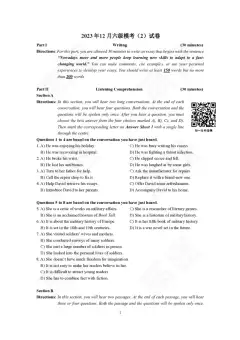
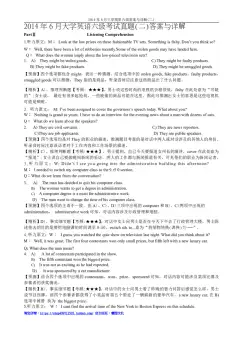
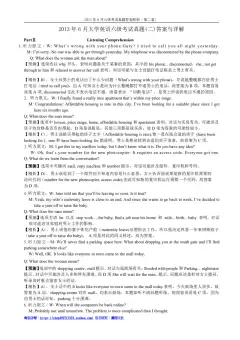
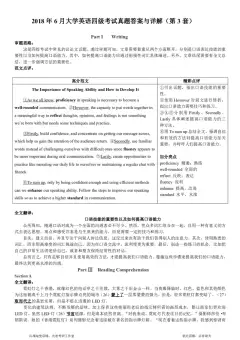
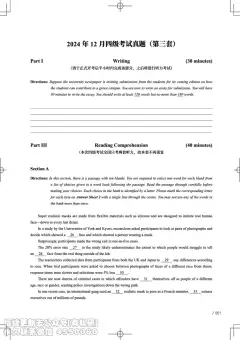
2023 年12 月四级模考(2)试卷
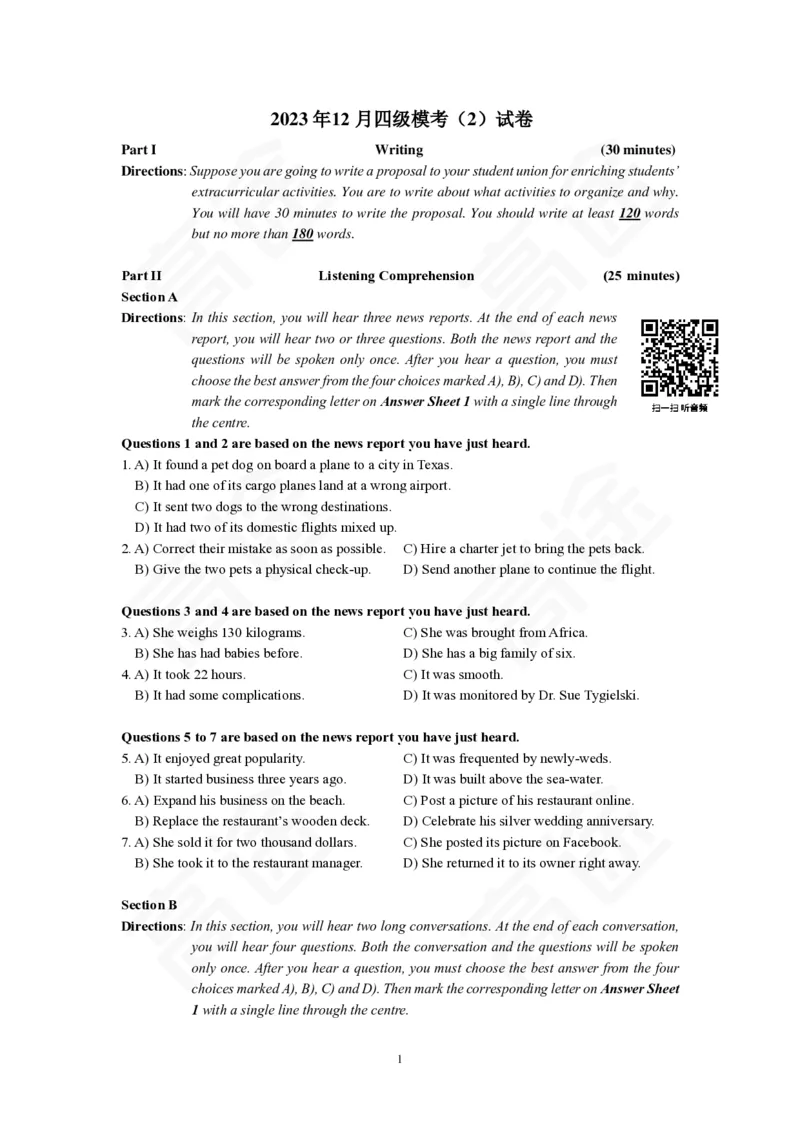
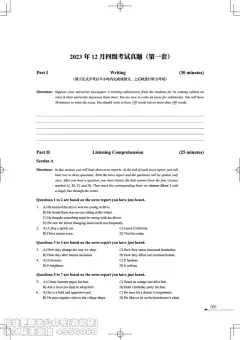
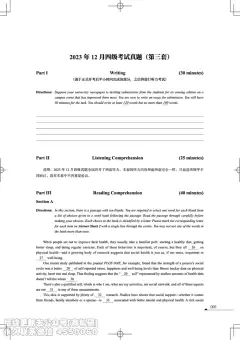
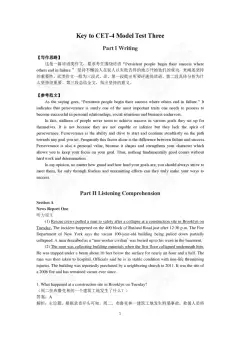
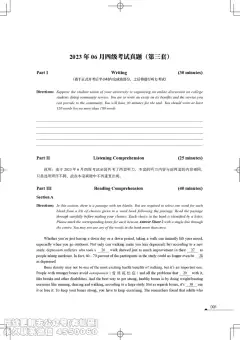
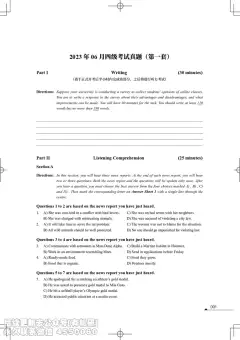
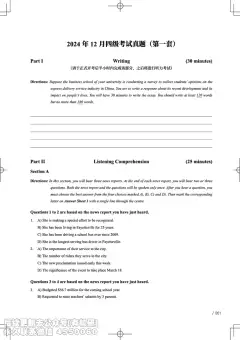
Part I Writing (30 minutes)
Directions: Suppose you are going to write a proposal to your student union for enriching students’
extracurricular activities. You are to write about what activities to organize and why.
You will have 30 minutes to write the proposal. You should write at least 120 words
but no more than 180 words.
Part II Listening Comprehension (25 minutes)
Section A
Directions: In this section, you will hear three news reports. At the end of each news
report, you will hear two or three questions. Both the news report and the
questions will be spoken only once. After you hear a question, you must
choose the best answer from the four choices marked A), B), C) and D). Then
mark the corresponding letter on Answer Sheet 1 with a single line through
the centre.
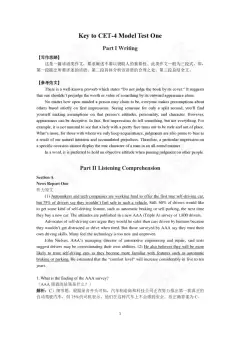
Questions 1 and 2 are based on the news report you have just heard.
1. A) It found a pet dog on board a plane to a city in Texas.
B)It had one of its cargo planes land at a wrong airport.
C)It sent two dogs to the wrong destinations.
D)It had two of its domestic flights mixed up.
2. A) Correct their mistake as soon as possible. C) Hire a charter jet to bring the pets back.
B)Give the two pets a physical check-up. D)Send another plane to continue the flight.
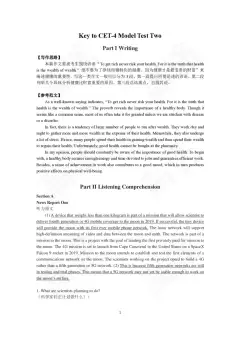
Questions 3 and 4 are based on the news report you have just heard.
3. A) She weighs 130 kilograms. C)She was brought from Africa.
B)She has had babies before. D)She has a big family of six.
4. A) It took 22 hours. C)It was smooth.
B)It had some complications. D)It was monitored by Dr. Sue Tygielski.
Questions 5 to 7 are based on the news report you have just heard.
5. A) It enjoyed great popularity. C)It was frequented by newly-weds.
B)It started business three years ago. D)It was built above the sea-water.
6. A) Expand his business on the beach. C)Post a picture of his restaurant online.
B)Replace the restaurant’s wooden deck. D)Celebrate his silver wedding anniversary.
7. A) She sold it for two thousand dollars. C)She posted its picture on Facebook.
B)She took it to the restaurant manager. D)She returned it to its owner right away.
Section B
Directions: In this section, you will hear two long conversations. At the end of each conversation,
you will hear four questions. Both the conversation and the questions will be spoken
only once. After you hear a question, you must choose the best answer from the four
choices marked A), B), C) and D). Then mark the corresponding letter on Answer Sheet
1 with a single line through the centre.
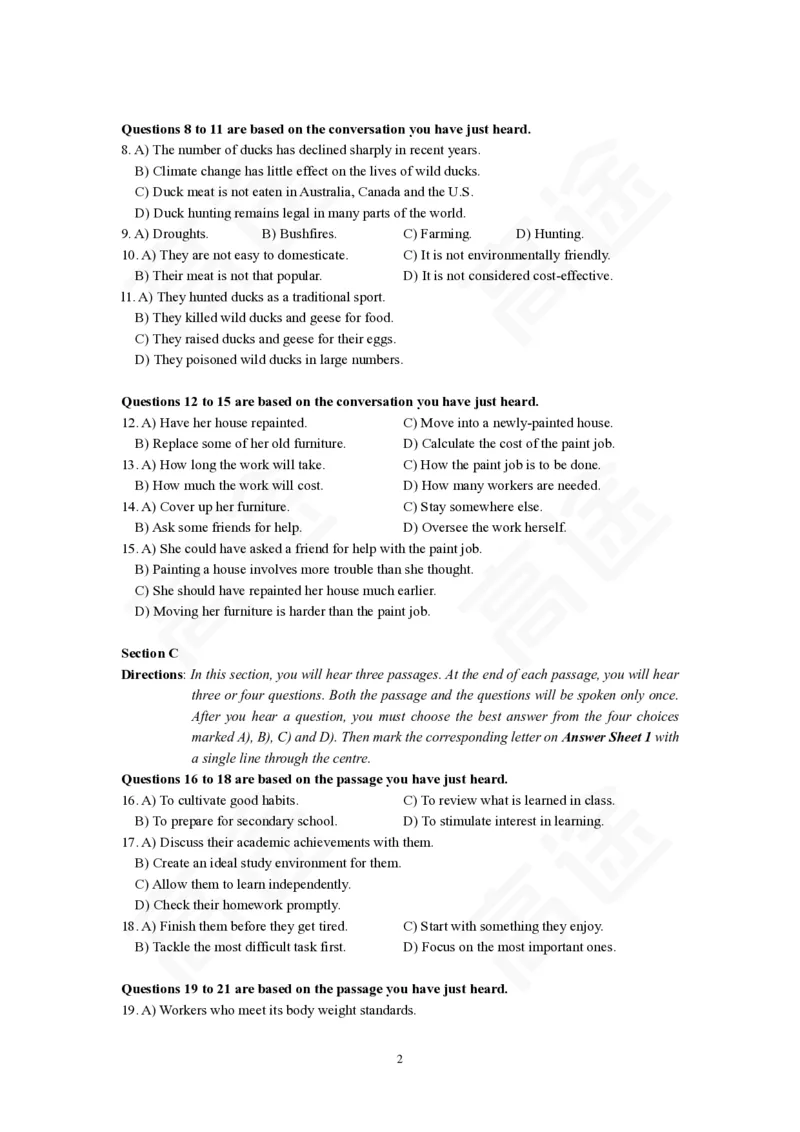
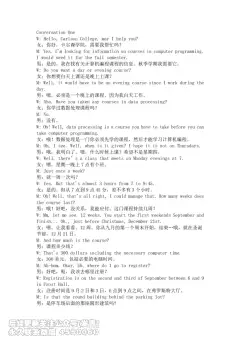
1Questions 8 to 11 are based on the conversation you have just heard.
8. A) The number of ducks has declined sharply in recent years.
B) Climate change has little effect on the lives of wild ducks.
C) Duck meat is not eaten in Australia, Canada and the U.S.
D) Duck hunting remains legal in many parts of the world.
9. A) Droughts. B) Bushfires. C) Farming. D) Hunting.
10. A) They are not easy to domesticate. C) It is not environmentally friendly.
B) Their meat is not that popular. D) It is not considered cost-effective.
l1. A) They hunted ducks as a traditional sport.
B) They killed wild ducks and geese for food.
C) They raised ducks and geese for their eggs.
D) They poisoned wild ducks in large numbers.
Questions 12 to 15 are based on the conversation you have just heard.
12. A) Have her house repainted. C) Move into a newly-painted house.
B) Replace some of her old furniture. D) Calculate the cost of the paint job.
13. A) How long the work will take. C) How the paint job is to be done.
B) How much the work will cost. D) How many workers are needed.
14. A) Cover up her furniture. C) Stay somewhere else.
B) Ask some friends for help. D) Oversee the work herself.
15. A) She could have asked a friend for help with the paint job.
B) Painting a house involves more trouble than she thought.
C) She should have repainted her house much earlier.
D) Moving her furniture is harder than the paint job.
Section C
Directions: In this section, you will hear three passages. At the end of each passage, you will hear
three or four questions. Both the passage and the questions will be spoken only once.
After you hear a question, you must choose the best answer from the four choices
marked A), B), C) and D). Then mark the corresponding letter on Answer Sheet 1 with
a single line through the centre.
Questions 16 to 18 are based on the passage you have just heard.
16. A) To cultivate good habits. C) To review what is learned in class.
B) To prepare for secondary school. D) To stimulate interest in learning.
17. A) Discuss their academic achievements with them.
B) Create an ideal study environment for them.
C) Allow them to learn independently.
D) Check their homework promptly.
18. A) Finish them before they get tired. C) Start with something they enjoy.
B) Tackle the most difficult task first. D) Focus on the most important ones.
Questions 19 to 21 are based on the passage you have just heard.
19. A) Workers who meet its body weight standards.
2B) Workers who can lose 30 pounds in a year.
C) Workers who try the hardest to lose weight.
D) Workers who are in the top 10% of the slimmest.
20. A) Impractical. B) Inconsistent. C) Unmanageable. D) Unfair.
21. A) Offer them much fatter bonuses. C) Encourage healthy behaviors.
B) Improve working environment. D) Provide free lunch and snacks.
Questions 22 to 25 are based on the passage you have just heard.
22. A) It has not done enough to help left-handed children.
B) It has treated left-handed children as being disabled.
C) It has not built facilities specially for the left-handed.
D) It has ignored campaigns on behalf of the left-handed.
23. A) They are as intelligent as other children.
B) They have a distinctive style of handwriting.
C) They sometimes have psychological problems.
D) They tend to have more difficulties in learning.
24. A) Punish teachers discriminating against left-handed students.
B) Lay more emphasis on improving children’s mental health.
C) Encourage students to develop various professional skills.
D) Keep track of left-handed children’s school performance.
25. A) How they can be reduced in number. C) What percentage they account for.
B) Why their numbers are so high. D) If their percentage keeps increasing.
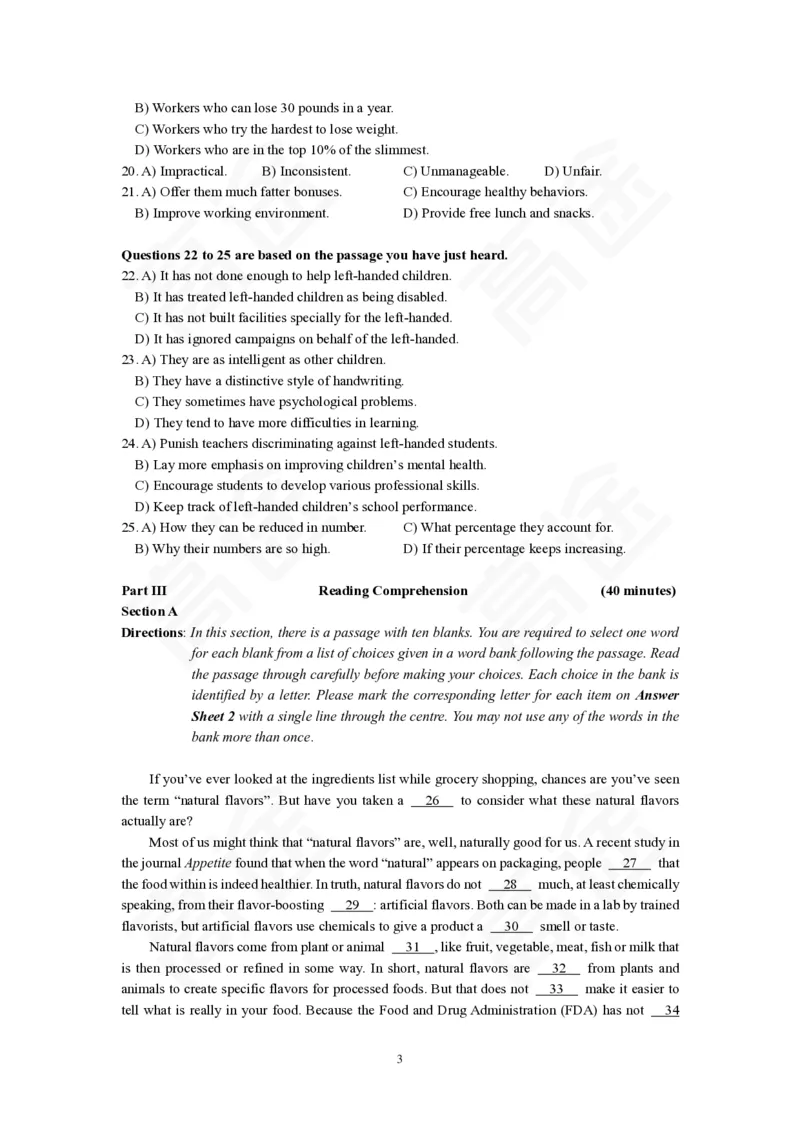
Part Ⅲ Reading Comprehension (40 minutes)
Section A
Directions: In this section, there is a passage with ten blanks. You are required to select one word
for each blank from a list of choices given in a word bank following the passage. Read
the passage through carefully before making your choices. Each choice in the bank is
identified by a letter. Please mark the corresponding letter for each item on Answer
Sheet 2 with a single line through the centre. You may not use any of the words in the
bank more than once.
If you’ve ever looked at the ingredients list while grocery shopping, chances are you’ve seen
the term “natural flavors”. But have you taken a 26 to consider what these natural flavors
actually are?
Most of us might think that “natural flavors” are, well, naturally good for us. A recent study in
the journal Appetite found that when the word “natural” appears on packaging, people 27 that
the food within is indeed healthier. In truth, natural flavors do not 28 much, at least chemically
speaking, from their flavor-boosting 29 : artificial flavors. Both can be made in a lab by trained
flavorists, but artificial flavors use chemicals to give a product a 30 smell or taste.
Natural flavors come from plant or animal 31 , like fruit, vegetable, meat, fish or milk that
is then processed or refined in some way. In short, natural flavors are 32 from plants and
animals to create specific flavors for processed foods. But that does not 33 make it easier to
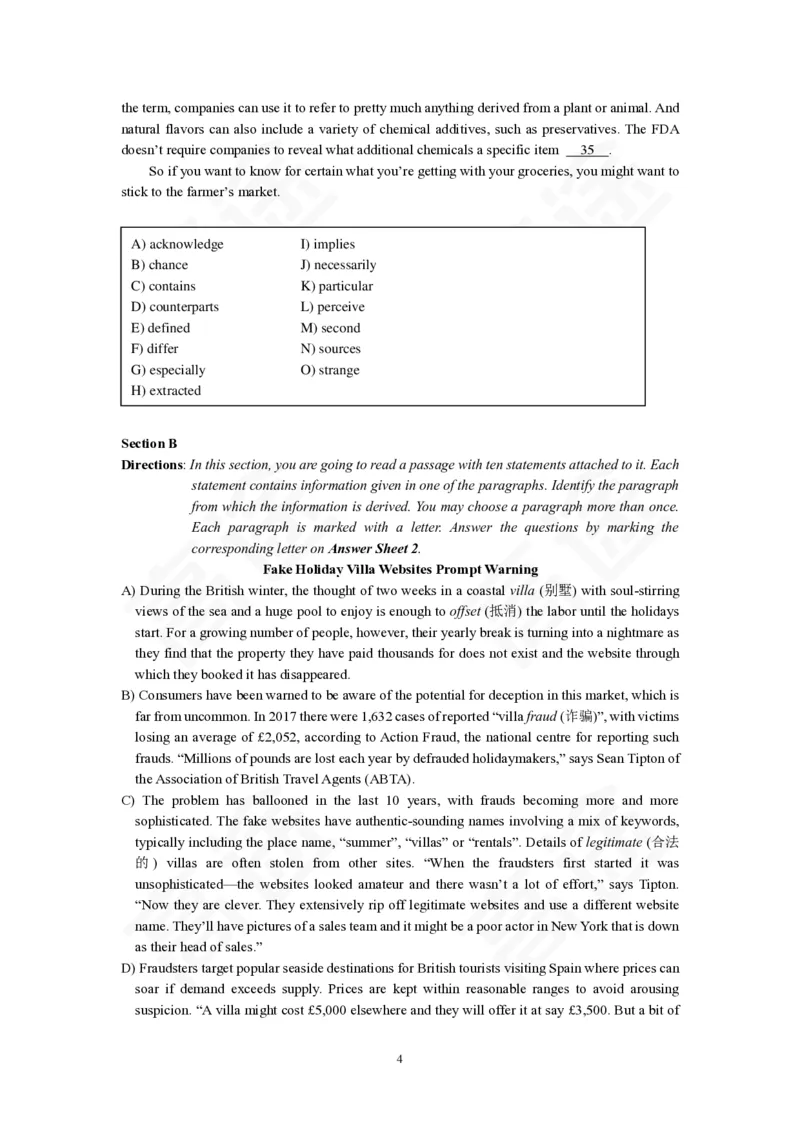
tell what is really in your food. Because the Food and Drug Administration (FDA) has not 34
3the term, companies can use it to refer to pretty much anything derived from a plant or animal. And
natural flavors can also include a variety of chemical additives, such as preservatives. The FDA
doesn’t require companies to reveal what additional chemicals a specific item 35 .
So if you want to know for certain what you’re getting with your groceries, you might want to
stick to the farmer’s market.
A) acknowledge I) implies
B) chance J) necessarily
C) contains K) particular
D) counterparts L) perceive
E) defined M) second
F) differ N) sources
G) especially O) strange
H) extracted
Section B
Directions: In this section, you are going to read a passage with ten statements attached to it. Each
statement contains information given in one of the paragraphs. Identify the paragraph
from which the information is derived. You may choose a paragraph more than once.
Each paragraph is marked with a letter. Answer the questions by marking the
corresponding letter on Answer Sheet 2.
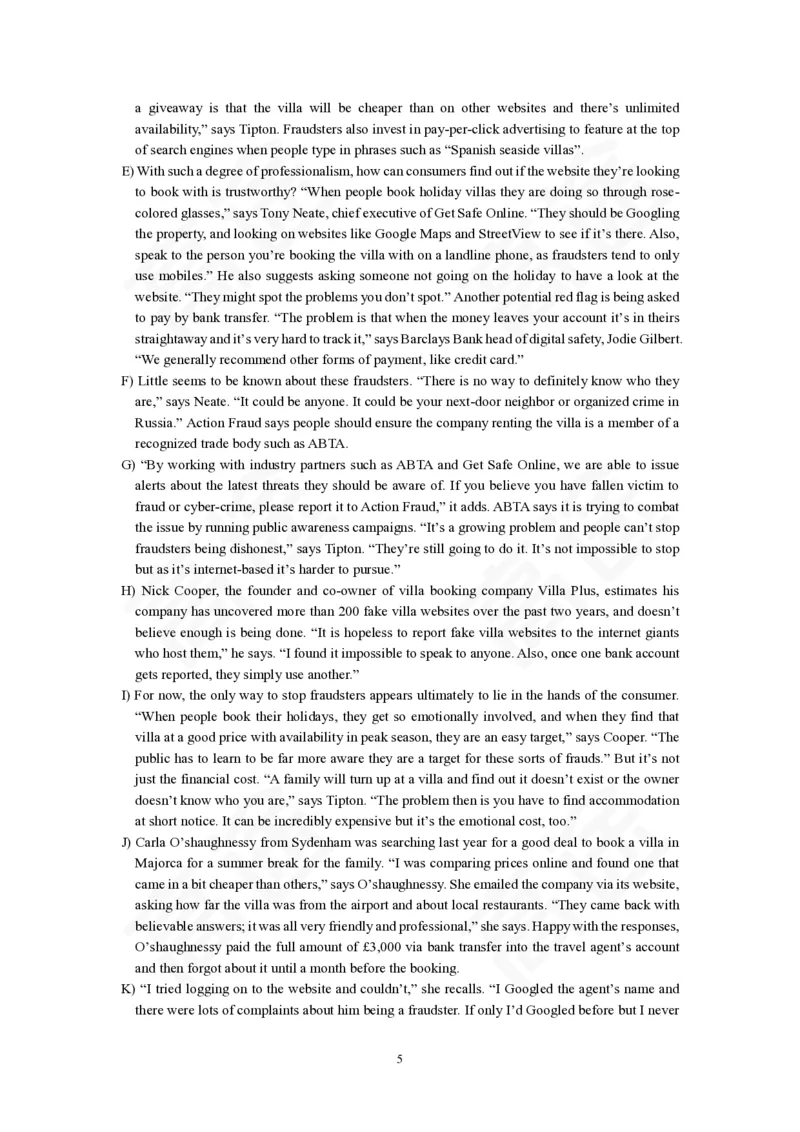
Fake Holiday Villa Websites Prompt Warning
A) During the British winter, the thought of two weeks in a coastal villa (别墅) with soul-stirring
views of the sea and a huge pool to enjoy is enough to offset (抵消) the labor until the holidays
start. For a growing number of people, however, their yearly break is turning into a nightmare as
they find that the property they have paid thousands for does not exist and the website through
which they booked it has disappeared.
B) Consumers have been warned to be aware of the potential for deception in this market, which is
far from uncommon. In 2017 there were 1,632 cases of reported “villa fraud (诈骗)”, with victims
losing an average of £2,052, according to Action Fraud, the national centre for reporting such
frauds. “Millions of pounds are lost each year by defrauded holidaymakers,” says Sean Tipton of
the Association of British Travel Agents (ABTA).
C) The problem has ballooned in the last 10 years, with frauds becoming more and more
sophisticated. The fake websites have authentic-sounding names involving a mix of keywords,
typically including the place name, “summer”, “villas” or “rentals”. Details of legitimate (合法
的) villas are often stolen from other sites. “When the fraudsters first started it was
unsophisticated—the websites looked amateur and there wasn’t a lot of effort,” says Tipton.
“Now they are clever. They extensively rip off legitimate websites and use a different website
name. They’ll have pictures of a sales team and it might be a poor actor in New York that is down
as their head of sales.”
D) Fraudsters target popular seaside destinations for British tourists visiting Spain where prices can
soar if demand exceeds supply. Prices are kept within reasonable ranges to avoid arousing
suspicion. “A villa might cost £5,000 elsewhere and they will offer it at say £3,500. But a bit of
4a giveaway is that the villa will be cheaper than on other websites and there’s unlimited
availability,” says Tipton. Fraudsters also invest in pay-per-click advertising to feature at the top
of search engines when people type in phrases such as “Spanish seaside villas”.
E) With such a degree of professionalism, how can consumers find out if the website they’re looking
to book with is trustworthy? “When people book holiday villas they are doing so through rose-
colored glasses,” says Tony Neate, chief executive of Get Safe Online. “They should be Googling
the property, and looking on websites like Google Maps and StreetView to see if it’s there. Also,
speak to the person you’re booking the villa with on a landline phone, as fraudsters tend to only
use mobiles.” He also suggests asking someone not going on the holiday to have a look at the
website. “They might spot the problems you don’t spot.” Another potential red flag is being asked
to pay by bank transfer. “The problem is that when the money leaves your account it’s in theirs
straightaway and it’s very hard to track it,” says Barclays Bank head of digital safety, Jodie Gilbert.
“We generally recommend other forms of payment, like credit card.”
F) Little seems to be known about these fraudsters. “There is no way to definitely know who they
are,” says Neate. “It could be anyone. It could be your next-door neighbor or organized crime in
Russia.” Action Fraud says people should ensure the company renting the villa is a member of a
recognized trade body such as ABTA.
G) “By working with industry partners such as ABTA and Get Safe Online, we are able to issue
alerts about the latest threats they should be aware of. If you believe you have fallen victim to
fraud or cyber-crime, please report it to Action Fraud,” it adds. ABTA says it is trying to combat
the issue by running public awareness campaigns. “It’s a growing problem and people can’t stop
fraudsters being dishonest,” says Tipton. “They’re still going to do it. It’s not impossible to stop
but as it’s internet-based it’s harder to pursue.”
H) Nick Cooper, the founder and co-owner of villa booking company Villa Plus, estimates his
company has uncovered more than 200 fake villa websites over the past two years, and doesn’t
believe enough is being done. “It is hopeless to report fake villa websites to the internet giants
who host them,” he says. “I found it impossible to speak to anyone. Also, once one bank account
gets reported, they simply use another.”
I) For now, the only way to stop fraudsters appears ultimately to lie in the hands of the consumer.
“When people book their holidays, they get so emotionally involved, and when they find that
villa at a good price with availability in peak season, they are an easy target,” says Cooper. “The
public has to learn to be far more aware they are a target for these sorts of frauds.” But it’s not
just the financial cost. “A family will turn up at a villa and find out it doesn’t exist or the owner
doesn’t know who you are,” says Tipton. “The problem then is you have to find accommodation
at short notice. It can be incredibly expensive but it’s the emotional cost, too.”
J) Carla O’shaughnessy from Sydenham was searching last year for a good deal to book a villa in
Majorca for a summer break for the family. “I was comparing prices online and found one that
came in a bit cheaper than others,” says O’shaughnessy. She emailed the company via its website,
asking how far the villa was from the airport and about local restaurants. “They came back with
believable answers; it was all very friendly and professional,” she says. Happy with the responses,
O’shaughnessy paid the full amount of £3,000 via bank transfer into the travel agent’s account
and then forgot about it until a month before the booking.
K) “I tried logging on to the website and couldn’t,” she recalls. “I Googled the agent’s name and
there were lots of complaints about him being a fraudster. If only I’d Googled before but I never
5thought of it.” Although she found another villa in time for their holiday, she admits she was
much more cautious. “I paid through a secure third-party site and I had phone conversations with
the agent. But I wasn’t able to relax until we turned up and I had the keys.”
36. Fraudsters often steal villa-booking information from authentic holiday websites.
37. Fraudsters keep changing their bank accounts to avoid being tracked.
38. It is suggested that people not going on the holiday might help detect website frauds.
39. More and more British holidaymakers find the seaside villas they booked online actually
nonexistent.
40. By checking an agent’s name online before booking a villa, holidaymakers can avoid falling
into traps.
41. Fraudsters are difficult to identify, according to an online safety expert.
42. Holidaymakers have been alerted to the frequent occurrence of online villa-booking frauds.
43. It is holidaymakers that can protect themselves from falling victim to frauds.
44. Holidaymakers are advised not to make payments by bank transfer.
45. Fraudsters advertise their villas at reasonable prices so as not to be suspected.
Section C
Directions: There are 2 passages in this section. Each passage is followed by some questions or
unfinished statements. For each of them there are four choices marked A), B), C) and
D). You should decide on the best choice and mark the corresponding letter on Answer
Sheet 2 with a single line through the centre.
Passage One
Questions 46 to 50 are based on the following passage.
Social media can be a powerful communication tool for employees, helping them to collaborate,
share ideas and solve problems. Research has shown that 82% of employees think social media can
improve work relationships and 60% believe it can support decision-making processes. These
beliefs contribute to a majority of workers connecting with colleagues on social media, even during
work hours.
Employers typically worry that social media is a productivity killer; more than half of U.S.
employers reportedly block access to social media at work. In my research with 277 employees of
a healthcare organization I found these concerns to be misguided. Social media doesn’t reduce
productivity nearly as much as it kills employee retention.
In the first part of the study I surveyed the employees about why and how they used platforms
like Facebook, Twitter, or LinkedIn. Respondents were then asked about their work behaviors,
including whether they felt motivated in their jobs and showed initiative at work. I found employees
who engage in online social interactions with co-workers through social media blogs tend to be
more motivated and come up with innovative ideas. But when employees interact with individuals
outside the organization, they are less motivated and show less initiative.
In the second part of the study I found 76% of employees using social media for work took an
interest in other organizations they found on social media. When I examined how respondents
expressed openness to new careers and employers, I found that they engaged in some key activities
including researching new organizations and making new work connections.
These findings present a dilemma for managers: employees using social media at work are
6more engaged and more productive, but they are also more likely to leave your company. Managers
should implement solutions that neutralize the retention risk caused by social media.
They can create social media groups in which employees will be more likely to collaborate and
less likely to share withdrawal intentions or discussions about external job opportunities. Managers
can also use social media to directly reduce turnover (跳槽) intentions, by recognizing employees’
accomplishments and giving visibility to employees’ success stories.
46. What does previous research about social media reveal?
A) Most employees think positively of it.
B) It improves employees’ work efficiency.
C) It enables employees to form connections.
D) Employees spend much of their work time on it.
47. What did the author’s own research find about social media?
A) It influences employees’ work negatively.
B) It does much harm to employee loyalty.
C) It kills employees’ motivation for work.
D) It affects employers’ decision-making.
48. What did the author find in his study about the effect of online social interactions?
A) It differs from employee to employee.
B) It tends to vary with the platform used.
C) It has much to do with whom employees interact with.
D) It is hard to measure when employees interact with outsiders.
49. What problem was found with employees using social media for work?
A) They seldom expressed their inner thoughts.
B) Most of them explored new job opportunities.
C) They were reluctant to collaborate with others.
D) Many of them ended with lower productivity.
50. What does the author suggest managers do to neutralize the retention risk?
A) Give promotions to employees for their accomplishments.
B) Create opportunities for employees to share success stories.
C) Acknowledge employees’ achievements through social media.
D) Encourage employees to increase their visibility on social media.
Passage Two
Questions 51 to 55 are based on the following passage.
In the coming era of budget cuts to education, distance learning could become the norm.
The temptation for those in charge of education budgets to trade teachers for technology could
be so strong that they ignore the disadvantages of distance learning. School facilities are expensive
to build and maintain, and teachers are expensive to employ. Online classes do not require buildings
and each class can host hundreds of people simultaneously, resulting in greater savings, thus
increasing the temptation of distance education for those concerned more about budgets than
learning. But moving away from a traditional classroom in which a living, breathing human being
teaches and interacts with students daily would be a disaster. Physically attending school has hidden
benefits: getting up every morning, interacting with peers, and building relationships with teachers
7are essential skills to cultivate in young people. Moreover, schools should be more than simple
institutions of traditional learning. They are now places that provide meals. They are places where
students receive counseling and other support.
Those policy-makers are often fascinated by the latest technology in education and its potential
to “transform” education overnight. But online education does not allow a teacher to keep a
struggling student after class and offer help. Educational videos may deliver academic content, but
they are unable to make eye contact or assess a student’s level of engagement. Distance education
will never match the personal teaching in a traditional classroom. In their first 18 years of life,
American children spend only 9% of their time in school. Yet teachers are expected to prepare them
to be responsible citizens, cultivate their social skills, encourage successful time management, and
enhance their capacity to flourish in an increasingly harsh labor market. Given these expectations,
schools should not become permanently “remote”.
The power of the classroom is rooted in the humanity of the people gathered in the same place,
at the same time. Personal teaching is about teachers showing students a higher path, and about
young people going through the process together. Technology, no matter how advanced, should
simply be a tool of a good teacher.
51. What mainly accounts for the possibility that distance learning could become the norm?
A) Advances in education technology.
B) Shrinking financial resources.
C) Shortage of school facilities.
D) Lack of qualified teachers.
52. What does the author say is one possible benefit of students attending school physically?
A) Developing the habit of getting up early.
B) Eating nutritionally well-balanced meals.
C) Growing into living and breathing human beings.
D) Cultivating relationships with peers and teachers.
53. What does the author think of the latest technology in education?
A) It may have potential disadvantages.
B) It may render many teachers jobless.
C) It may add to students’ financial burden.
D) It may revolutionize classroom teaching.
54. What does the author say teachers are expected to do?
A) Enhance students’ leadership capacity.
B) Elevate students to managerial positions.
C) Enable students to adapt to the changes in life.
D) Prepare students to be competitive in the future.
55. Why couldn’t technology replace a good teacher?
A) It lacks humanity.
B) It is still immature.
C) It cannot track students’ growth.
D) It cannot cater to personal needs.
8Part IV Translation (30 minutes)
Directions: For this part, you are allowed 30 minutes to translate a passage from Chinese into
English. You should write your answer on Answer Sheet 2.
戏曲是一种中国传统的艺术形式,可以追溯到唐朝。中国戏曲吸引观众的一大特色是其
独具风格的脸谱(facial painting)。脸谱代表不同角色的性格和命运。观众通过观察脸谱能够
更好地理解这些角色的故事。欣赏戏曲是中国人特别是老年人的一大乐趣。为了吸引更多的
年轻观众,传统戏曲正在不断地发展和创新。如今,越来越多的外国观众也喜欢中国戏曲。
9