2023 年12 月六级模考(2)试卷
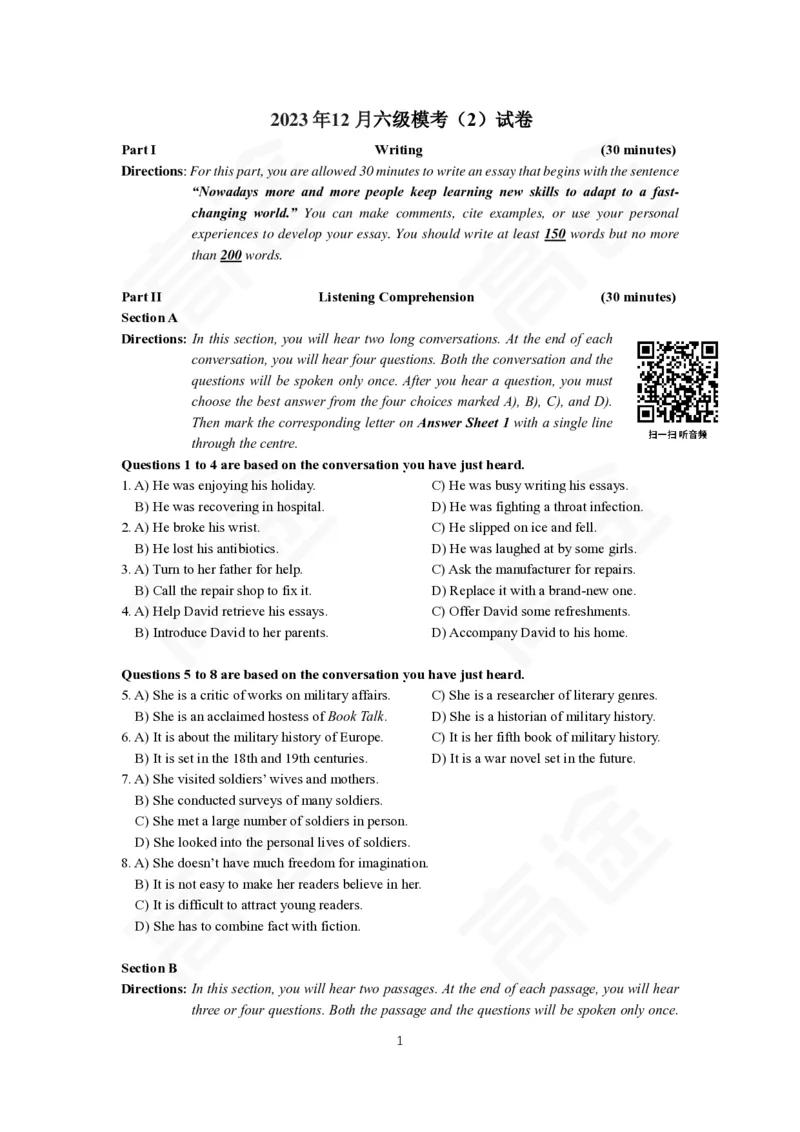
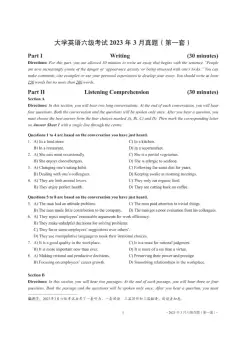
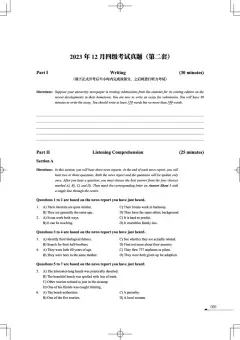
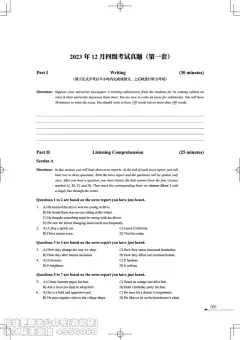
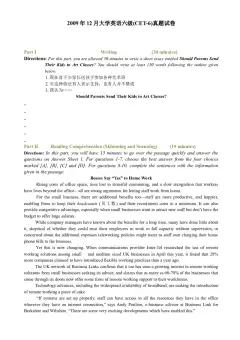
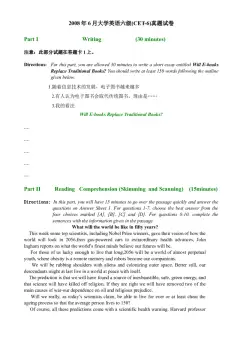
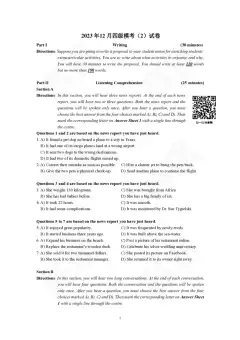
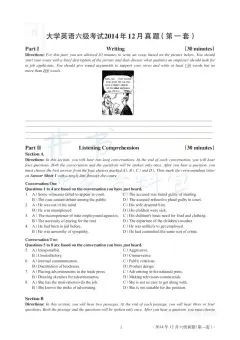
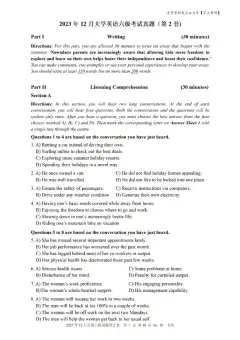
Part I Writing (30 minutes)
Directions: For this part, you are allowed 30 minutes to write an essay that begins with the sentence
“Nowadays more and more people keep learning new skills to adapt to a fast-
changing world.” You can make comments, cite examples, or use your personal
experiences to develop your essay. You should write at least 150 words but no more
than 200 words.
Part II Listening Comprehension (30 minutes)
Section A
Directions: In this section, you will hear two long conversations. At the end of each
conversation, you will hear four questions. Both the conversation and the
questions will be spoken only once. After you hear a question, you must
choose the best answer from the four choices marked A), B), C), and D).
Then mark the corresponding letter on Answer Sheet 1 with a single line
through the centre.
Questions 1 to 4 are based on the conversation you have just heard.
1. A) He was enjoying his holiday. C)He was busy writing his essays.
B)He was recovering in hospital. D)He was fighting a throat infection.
2. A) He broke his wrist. C)He slipped on ice and fell.
B)He lost his antibiotics. D)He was laughed at by some girls.
3. A) Turn to her father for help. C)Ask the manufacturer for repairs.
B)Call the repair shop to fix it. D)Replace it with a brand-new one.
4. A) Help David retrieve his essays. C)Offer David some refreshments.
B)Introduce David to her parents. D)Accompany David to his home.
Questions 5 to 8 are based on the conversation you have just heard.
5. A) She is a critic of works on military affairs. C)She is a researcher of literary genres.
B)She is an acclaimed hostess of Book Talk. D)She is a historian of military history.
6. A) It is about the military history of Europe. C)It is her fifth book of military history.
B)It is set in the 18th and 19th centuries. D)It is a war novel set in the future.
7. A) She visited soldiers’ wives and mothers.
B)She conducted surveys of many soldiers.
C)She met a large number of soldiers in person.
D)She looked into the personal lives of soldiers.
8. A) She doesn’t have much freedom for imagination.
B)It is not easy to make her readers believe in her.
C)It is difficult to attract young readers.
D)She has to combine fact with fiction.
Section B
Directions: In this section, you will hear two passages. At the end of each passage, you will hear
three or four questions. Both the passage and the questions will be spoken only once.
1After you hear a question, you must choose the best answer from the four choices
marked A), B), C) and D). Then mark the corresponding letter on Answer Sheet 1 with
a single line through the centre.
Questions 9 to 11 are based on the passage you have just heard.
9. A) Santa Claus. C) Cocoa Seeds.
B) A polar bear. D) A glass bottle.
10. A) To attract customer attention. C) To combat counterfeits.
B) To keep up with the times. D) To promote its sales.
11. A) It resembles a picture in the encyclopedia. C) It has the drink’s logo in the middle.
B) It appears in the shape of a cocoa seed. D) It displays the image of Santa Claus.
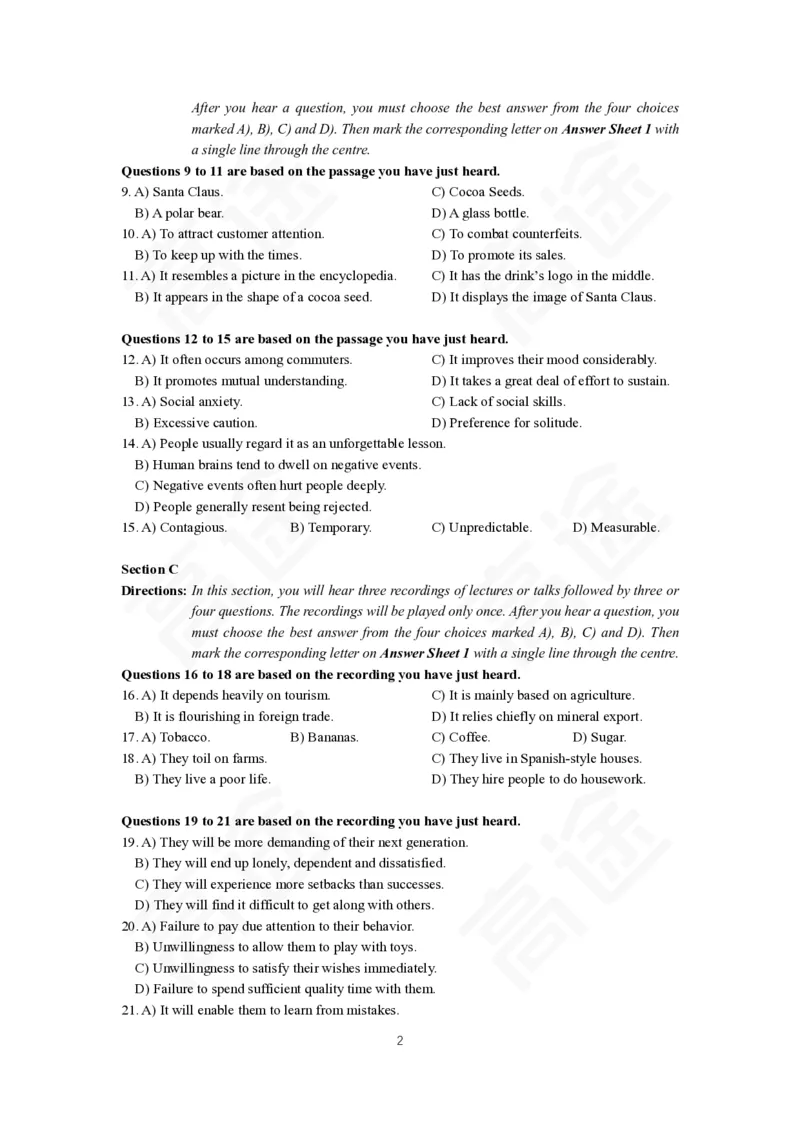
Questions 12 to 15 are based on the passage you have just heard.
12. A) It often occurs among commuters. C) It improves their mood considerably.
B) It promotes mutual understanding. D) It takes a great deal of effort to sustain.
13. A) Social anxiety. C) Lack of social skills.
B) Excessive caution. D) Preference for solitude.
14. A) People usually regard it as an unforgettable lesson.
B) Human brains tend to dwell on negative events.
C) Negative events often hurt people deeply.
D) People generally resent being rejected.
15. A) Contagious. B) Temporary. C) Unpredictable. D) Measurable.
Section C
Directions: In this section, you will hear three recordings of lectures or talks followed by three or
four questions. The recordings will be played only once. After you hear a question, you
must choose the best answer from the four choices marked A), B), C) and D). Then
mark the corresponding letter on Answer Sheet 1 with a single line through the centre.
Questions 16 to 18 are based on the recording you have just heard.
16. A) It depends heavily on tourism. C) It is mainly based on agriculture.
B) It is flourishing in foreign trade. D) It relies chiefly on mineral export.
17. A) Tobacco. B) Bananas. C) Coffee. D) Sugar.
18. A) They toil on farms. C) They live in Spanish-style houses.
B) They live a poor life. D) They hire people to do housework.
Questions 19 to 21 are based on the recording you have just heard.
19. A) They will be more demanding of their next generation.
B) They will end up lonely, dependent and dissatisfied.
C) They will experience more setbacks than successes.
D) They will find it difficult to get along with others.
20. A) Failure to pay due attention to their behavior.
B) Unwillingness to allow them to play with toys.
C) Unwillingness to satisfy their wishes immediately.
D) Failure to spend sufficient quality time with them.
21. A) It will enable them to learn from mistakes.
2B) It will help them to handle disappointment.
C) It will do much good to their mental health.
D) It will build their ability to endure hardships.
Questions 22 to 25 are based on the recording you have just heard.
22. A) Failing to make sufficient preparations.
B) Looking away from the hiring manager.
C) Saying the wrong thing at the wrong time.
D) Making a wrong judgment of the interview.
23. A) Complaining about their previous job.
B) Inquiring about their salary to be paid.
C) Exaggerating their academic background.
D) Understanding their previous achievements.
24. A) Those who have both skill and experience.
B) Those who get along well with colleagues.
C) Those who take initiative in their work.
D) Those who are loyal to their managers.
25. A) Ability to shoulder new responsibilities.
B) Experience of performing multiple roles.
C) Readiness to work to flexible schedules.
D) Skills to communicate with colleagues.
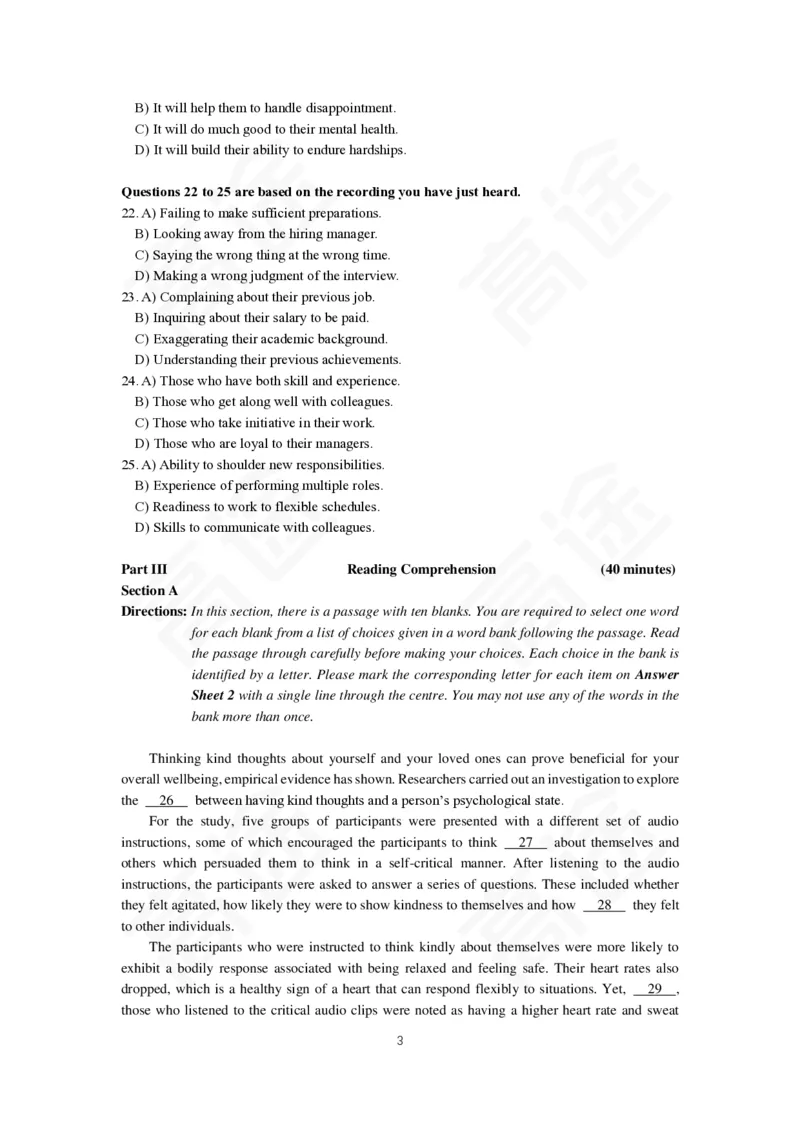
Part III Reading Comprehension (40 minutes)
Section A
Directions: In this section, there is a passage with ten blanks. You are required to select one word
for each blank from a list of choices given in a word bank following the passage. Read
the passage through carefully before making your choices. Each choice in the bank is
identified by a letter. Please mark the corresponding letter for each item on Answer
Sheet 2 with a single line through the centre. You may not use any of the words in the
bank more than once.
Thinking kind thoughts about yourself and your loved ones can prove beneficial for your
overall wellbeing, empirical evidence has shown. Researchers carried out an investigation to explore
the 26 between having kind thoughts and a person’s psychological state.
For the study, five groups of participants were presented with a different set of audio
instructions, some of which encouraged the participants to think 27 about themselves and
others which persuaded them to think in a self-critical manner. After listening to the audio
instructions, the participants were asked to answer a series of questions. These included whether
they felt agitated, how likely they were to show kindness to themselves and how 28 they felt
to other individuals.
The participants who were instructed to think kindly about themselves were more likely to
exhibit a bodily response associated with being relaxed and feeling safe. Their heart rates also
dropped, which is a healthy sign of a heart that can respond flexibly to situations. Yet, 29 ,
those who listened to the critical audio clips were noted as having a higher heart rate and sweat
3response afterwards, both of which 30 feelings of threat and distress.
Having the ability to switch off the body’s natural threat response can 31 a person’s
immune system. This, in turn, gives them a greater likelihood of recovering quickly from illness.
These findings help us to further understand some of our clinical trials research findings, where we
show that individuals with 32 depression benefit particularly from self-awareness-based
33 therapy. They essentially learn to become more sympathetic to themselves.
The sense is that for people 34 to depression, meeting their negative thoughts and
feelings with 35 is a radically different way; that these thoughts are not facts. It introduces a
different way of being and knowing that is quite transformative for many people.
A) adversely I) indignantly
B) amiably J) insulation
C) boost K) lavish
D) cognitive L) prone
E) compassion M) recurrent
F) connected N) signify
G) correlation O) surpass
H) fascinated
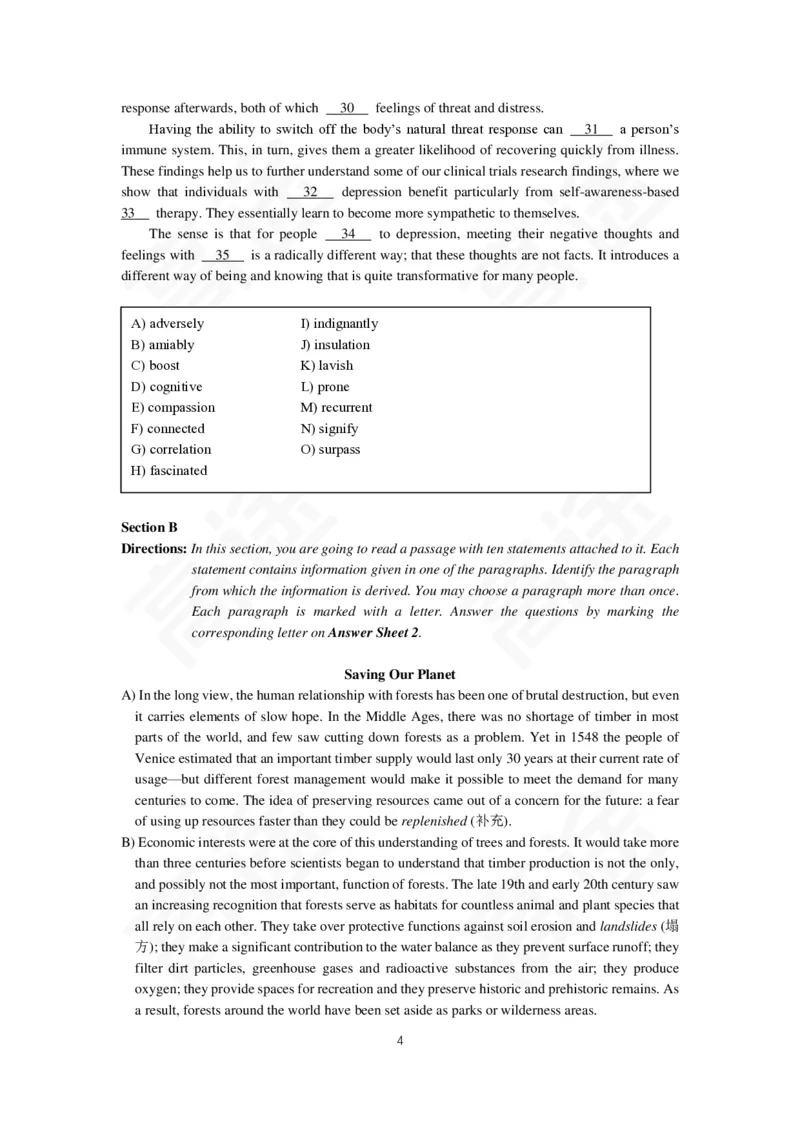
Section B
Directions: In this section, you are going to read a passage with ten statements attached to it. Each
statement contains information given in one of the paragraphs. Identify the paragraph
from which the information is derived. You may choose a paragraph more than once.
Each paragraph is marked with a letter. Answer the questions by marking the
corresponding letter on Answer Sheet 2.
Saving Our Planet
A) In the long view, the human relationship with forests has been one of brutal destruction, but even
it carries elements of slow hope. In the Middle Ages, there was no shortage of timber in most
parts of the world, and few saw cutting down forests as a problem. Yet in 1548 the people of
Venice estimated that an important timber supply would last only 30 years at their current rate of
usage—but different forest management would make it possible to meet the demand for many
centuries to come. The idea of preserving resources came out of a concern for the future: a fear
of using up resources faster than they could be replenished (补充).
B) Economic interests were at the core of this understanding of trees and forests. It would take more
than three centuries before scientists began to understand that timber production is not the only,
and possibly not the most important, function of forests. The late 19th and early 20th century saw
an increasing recognition that forests serve as habitats for countless animal and plant species that
all rely on each other. They take over protective functions against soil erosion and landslides (塌
方); they make a significant contribution to the water balance as they prevent surface runoff; they
filter dirt particles, greenhouse gases and radioactive substances from the air; they produce
oxygen; they provide spaces for recreation and they preserve historic and prehistoric remains. As
a result, forests around the world have been set aside as parks or wilderness areas.
4C) Recent years have seen a big change in our view of forests. Peter Wohlleben’s book The Hidden
Life of Trees (2015), an international bestseller, suggests that trees can warn each other of danger
through a “wood wide web” of roots and fungi (真菌). They support each other through sharing
of nutrients and information, and they even keep ancient stumps alive by feeding them solutions
of sugars. Such insights have made us aware of deep ecological relationships between humans
and the more-than-human world.
D) Awareness of ecologies is a recent phenomenon. It was not until the 1940s that the concept of
the “environment” embracing all living and nonliving things developed. In the 1970s, the term
“environment” gained currency, becoming widely adopted in the English and Romance languages,
and as “Umwelt” (“surrounding world”) in German. The emergence of the idea led to the rise of
environmental agencies, regulations and environmental studies, and to environmental science as
new, integrated academic disciplines. It was in 1956 that the very first bachelor of science in
environmental studies was awarded, at the State University of New York College of Forestry at
Syracuse. Since the 1970s—with the rise of “environmentalism”—environmental studies
programmes have sprung up at hundreds of universities. There is (slow) hope in the fact that
scholars from many different disciplines have adopted the term “environment” over the past
decades. They are exploring intricate connections within and between complex ecologies, as well
as the impact that human environment-making (through techno-industrial, economic and other
manipulative developments) has had on the biosphere.
E) The rise of the idea of the environment and a scholarly understanding of ecological processes has
influenced new technologies and also politics. We have come to ask questions about vulnerability
and risk, world ecologies, and the relationship between nature and power. The search for an
adequate response to climate change occupies centre stage in international diplomacy.
F) Social and environmental activists, scientists and indigenous groups have called the Paris
Agreement of the United Nations Climate Change Conference in December 2015 insufficient,
weak, or compromised. To some extent, they are right: climate change has already destroyed tens
of thousands of livelihoods, and the situation will worsen in the near future for millions of mostly
poorer people, who will join the ranks of those who have already been displaced by climate
change and extreme weather events. But the Paris Conference nevertheless marked a historic step
toward the recognition of the need for action on climate change, the cutting of carbon emissions,
and world cooperation. There were 195 nations that came to the table in Paris and agreed to limits
on emissions. Historically, nothing comparable had happened prior to this. Before the 20th
century, a handful of scientists had been interested in the theoretical relationship between
greenhouse gases and climate change, but only the empirical evidence accumulated since the late
20th century established a clear connection between the burning of fossil fuels and a vastly
accelerated rise in global temperatures.
G) The current crisis is not the first that humans have encountered, and a look at the struggles with
pollution in recent history reveals transformations that once seemed unimaginable. The “London
fog” that came to define the capital through British novels and thrillers is in reality smog or smoke,
a legacy of industrialisation. After a century of ignorance, London was hit by the Great Smog of
December 1952—the worst air-pollution event in the history of the United Kingdom which
caused the deaths of approximately 12,000 people. Shortly thereafter, public initiatives and
political campaigns led to strict regulations and new laws, including the Clean Air Act (1956).
Today, London has effectively reduced traffic emissions through the introduction of a Congestion
5Charge Zone in 2003, and an Ultra Low Emission Zone in 2019.
H) Scientific evidence that we are living in an era of climate change, resource exhaustion and
potential ecological disaster is overwhelming. How do we motivate a public exhausted by never-
ending scenarios of doom and disaster, when the challenges seem so huge and so impossible to
solve? Statistics about extinction and the gloom of decline will not in themselves get us out of
our often self-created ecological traps: instead, they are more likely to result in paralysis and
inaction.
I) We need stories and histories of change and transformation: ecological stories that make us
confront the fact that human power is potentially destructive, and that the survival of our species
on this planet depends on the preservation of soil and water, and the habitats and ecological
systems.
J) It is time that we showed successes and accelerations in ecological awareness, action and
restoration: stories that include past success and future visions about the rise of urban gardening
and of renaturalised riverscapes, of successful protests against polluted air and water, of the rise
of regional markets and slow food, and the planting of trees around the globe, of initiatives and
enterprises that work towards ecological restoration. The reality of ecological curses seems far
greater than the power of the hopes left at the bottom of Pandora’s box. But if we believe that
nothing can be changed, then we are giving up our opportunity to act.
K) Today’s saving powers will not come from a deus ex machina (解围之神). In an ever-more
complex and synthetic world, our saving powers won’t come from a single source, and certainly
not from a too-big-to-fail approach or from those who have been drawn into the whirlpool of our
age of speed. Hope can work as a wakeup call. It acknowledges setbacks. The concept of slow
hope suggests that we can’t expect things to change overnight. If the ever-faster exhaustion of
natural resources (in ecological terms) and the “shrinking of the present” (in social terms) are
urgent problems of humans, then cutting down on exhaustive practices and working towards a
“stretching of the present” will be ways to move forward.
36. Climate change has wrought havoc on the lives of tens of thousands of people.
37. It took scientists a long time to realise that the function of forests goes far beyond providing
humans with timber.
38. There is abundant evidence that we are now facing a possible ecological disaster.
39. Environmental science became academic disciplines only some sixty years ago.
40. Things cannot change overnight, but reducing the consumption of natural resources will help
solve the ecological crisis.
41. Human perception of forests has undergone a tremendous change in the past years.
42. Recent history shows reduction of pollution, once seemingly impossible, can actually be
accomplished.
43. People began to consider preserving natural resources when they feared they would have nothing
to use in the future.
44. If we doubt our ability to reverse ecological deterioration, we are throwing away the chance to
take action.
45. How to respond effectively to climate change has become the focus of international diplomacy.
Section C
6Directions: There are 2 passages in this section. Each passage is followed by some questions or
unfinished statements. For each of them there are four choices marked A), B), C) and
D). You should decide on the best choice and mark the corresponding letter on Answer
Sheet 2 with a single line through the centre.
Passage One
Questions 46 to 50 are based on the following passage.
Since American idol star Taryn Southern started composing music with AI in 2017, musicians
all over the world have begun wondering about the implications of AI and modern technology where
music production is concerned. Using AI in the creation of music is perceived by some as a helpful
tool and by others as almost “the beginning of the end”.
In Taryn’s case, AI software enabled her to communicate melodies and chords that she didn’t
know how to put together herself. The end product was therefore a collaborative effort, rather than
a piece entirely produced by technology. Taryn’s story has a distinctly positive feel that highlights
the advantages of using AI in music production. It can serve as a source of inspiration, and as an
ideal jumping-off point should a musician be hit with writer’s block (文思枯竭).
Contrary to seeing AI as a tool, some musicians consider it to be hugely detrimental to the
music scene. At the moment, because such technology is still so young, the music it’s producing is
not necessarily what we want to hear. In short, it’s not of great quality. Those who have produced
their own music, or even fans of authentic, artistic music, will also argue that a computer could
never emulate the work (and human touch) of a true musician.
Music has been an integral part of the story of humans for ages; in fact, the first known piece
of music is believed to be around 3,400 years old. Songs have long been used as a means of
communicating messages and folk stories, covering everything from societal ethics to world history.
Since many people see music as such an inherently human expression, it is often considered as too
precious to impart to technology. The thought of a computer generating a “random” piece of music
that hasn’t been painstakingly created by an artist is almost seen as sacrilegious (亵渎神圣的).
Regardless of which side of the argument you fall on, it seems likely that the use of AI in music
production will only become more frequent. Our modern world is preoccupied with technological
advancements. Instead of shying away from the idea of this bleak future, the best approach to take
is one of optimism and curiosity. While there are always bound to be stubborn old-school musicians
who refuse to use tech, music producers should consider AI as something to be embraced. AI music
software is still very much in its infancy, but with more investors interested in the development and
outcomes of such technology, and considering the rapid growth rate of other tech advances in recent
years, it’s only a matter of time before AI-produced music is seen as the new norm.
46. How do some musicians perceive using AI in creating music?
A) It would help to produce more music idols.
B) It would be detrimental to music production.
C) It would hinder the understanding of authentic music.
D) It would be the beginning of a new era in music creation.
47. What does Taryn Southern’s story illustrate?
A) AI technology is conducive to music composition.
B) Musicians will be unable to create music without high tech.
C) Musicians are often at their wits’ end in their creative effort.
7D) AI technology is indispensable to creating melodies and chords.
48. Why are some musicians opposed to the use of AI in creating music?
A) Music produced with AI technology lacks humanness.
B) Music created with AI technology is easily emulated.
C) It will depreciate humans’ role in music composition.
D) It will deplete young musicians’ creative inspiration.
49. Why do many people think music is too precious to impart to AI technology?
A) It cannot be created without pains.
B) It cannot be produced at random.
C) It is part of human life.
D) It is human specific.
50. What does the author think of the future of AI music?
A) It will continue to arouse the interest of music investors.
B) It has the prospect of becoming the norm in the future.
C) It will be gradually accepted by old-school musicians.
D) It may eventually lose its freshness and appeal.
Passage Two
Questions 51 to 55 are based on the following passage.
A few weeks ago, a well-meaning professor tried to explain the physiological process behind
viruses and the human body in a tweet and was immediately criticized for a mistake in his
information. He then issued an apology and deleted his erroneous tweet.
Communicating science beyond the academic bubble is necessary to augmenting public
understanding of health and environmental issues and helping individuals make well-informed
personal decisions.
However, scientists who engage in science communication must acknowledge that even in
their area, their expertise is deep but narrow. They need to recognize the constraints in their own
knowledge. That is not to suggest that they only write or present on their own research, but rather,
that they consult with an expert if the topic is outside of their discipline. Fact-checking with a
scientist who works in the specialty will prevent the unintentional spread of misinformation, and
the process of doing so may yield tiny pieces of interesting new information that can be incorporated.
Some have argued that the public is not educated enough to understand scientific information,
especially for any complex phenomena, but this is absurd. Science instruction can be found at all
levels of public education with most secondary schools offering classes on biology, physics, and
chemistry. If anything, social media has shown that the public craves knowledge based on a solid
scientific foundation. Even the public discourse that follows most scientific articles shows that
online readers can understand even the most baffling of scientific principles.
It is equally imperative to emphasize that being an expert on a topic does not automatically
make a scholar qualified to communicate it to a nonscientific audience. A number of scientists
recently have been offering public-aimed explanations of scientific phenomena. Even though they
have appropriate credentials, they often do very little in the way of explaining. One biologist shared
an intricate analogy involving a library, books, paper, a recipe, ingredients, and a cake to explain
the process behind vaccines. Any explanation that requires a written key to keep track of what each
item represents is not a clear example for public consumption.
8Science communication is a science in and of itself. It requires rigorous training and instruction.
A scientist should take communication courses that can teach a person how to identify and eliminate
jargon and how to develop effective analogies to explain complex concepts. One cannot assume
communication expertise—imagine if someone just decided that they were a physicist and started
trying to contribute to the field without the necessary background. Doing a poor job communicating
science to the public will only create confusion and widen the gap between science and society, a
gap that scientists are trying to close.
51. What does the author say about communicating science to the general public?
A) It will help them to keep abreast of the latest scientific developments.
B) It is a necessary means to improve their understanding of scientific issues.
C) It will get them more involved in academic debates on environmental problems.
D) It is an effective way to augment scientists’ influence beyond the academic circle.
52.What does the author advise scientists do to deal with topics outside of their specialty?
A) Write or present on them from new angles.
B) Utilize information from diverse sources.
C) Turn to a specialist for professional help.
D) Fact-check with colleagues in their field.
53. What does the author say we can learn from social media?
A) A solid academic foundation is essential to understanding baffling scientific principles.
B) Modern technology has facilitated communication between scientists and the public.
C) Scientific articles have gained increasing popularity among the general public.
D) The public’s understanding of science is much better than some have claimed.
54. What does the example of the biologist who shared an intricate analogy show?
A) It is helpful to use illustrations in explaining scientific phenomena.
B) It is imperative to have appropriate titles to explain scientific issues.
C) A learned scholar is not necessarily a qualified science communicator.
D) A nonscientific audience cannot duly understand principles of science.
55.What does the author suggest scientists do to close the gap between science and society?
A) Explain complex concepts scientifically.
B) Make appropriate use of scientific terms.
C) Take courses in public speaking.
D) Develop communication skills.
Part IV Translation (30 minutes)
Directions: For this part, you are allowed 30 minutes to translate a passage from Chinese into
English. You should write your answer on Answer Sheet 2.
南京长江大桥是长江上首座由中国设计、采用国产材料建造的铁路、公路两用桥,上层
的4车道公路桥长4589米,下层的双轨道铁路桥长6772米。铁路桥连接原来的天津—浦口
和上海—南京两条铁路线,使火车过江从过去一个半小时缩短为现在的2分钟。大桥是南北
交通的重要枢纽,也是南京的著名景点之一。
南京长江大桥的建成标志着中国桥梁建设的一个飞跃,大大方便了长江两岸的物资交流
和人员来往,对促进经济发展和改善人民生活起到了巨大作用。
9