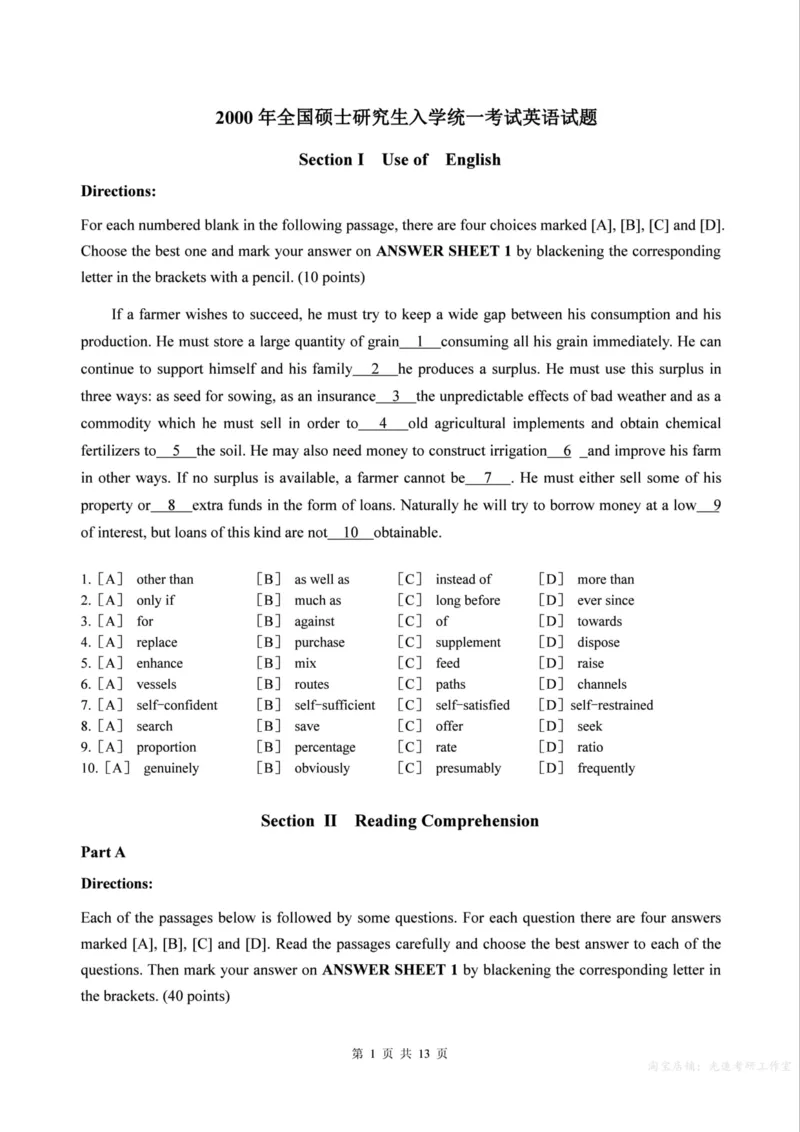
2000 年全国硕士研究生入学考试英语试题
PartⅠ Structure and Vocabulary
(略)
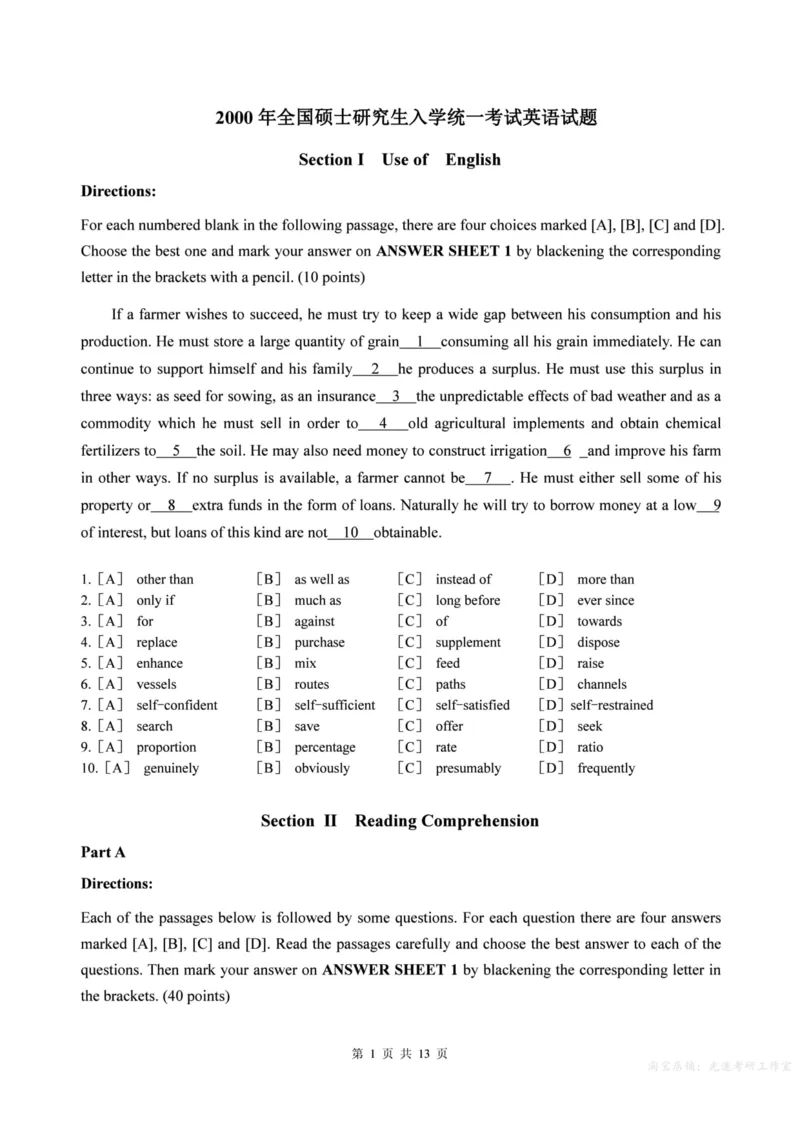
Part ⅡCloze Test
Directions:
For each numbered blank in the following passage, there are four choices marked [A],
[B], [C] and [D].Choose the best one and mark your answer on ANSWER SHEET 1 by
blackening the corresponding letter in the brackets with a pencil. (10 points)
① If a farmer wishes to succeed, he must try to keep a wide gap between his
consumption
and his production. ②He must store a large quantity of grain 41 consuming all
his grain immediately.③He can continue to support himself and his family 42 he
produces a surplus.④He must use this surplus in three ways: as seed for sowing, as an
insurance 43 the unpredictable effects of bad weather and as a
commodity which he must sell in order to 44 old agricultural implements and
obtain chemical fertilizers to 45 the soil.⑤He may also need money to construct
irrigation 46 and improve his farm in other ways.⑥If no surplus is available, a
farmer cannot be 47 . ⑦ He must either sell some of his property or 48
extra funds in the form of loans.⑧Naturally he will try to borrow money at a low 4 9
of interest, but loans of this kind are not 5 0 obtainable.(172 words)
41.[A]other than [B]as well as [C] instead of [D] more than
42.[A]onlyif [B]muchas [C]longbefore [D]eversince
43.[A]for [B]against [C]of [D]towards
44.[A]replace [B]purchase [C]supplement [D]dispose
45.[A]enhance [B]mix [C]feed [D]raise
46.[A]vessels [B]routes [C]paths [D]channels
47.[A]self-confident [B]self-sufficient [C]self-satisfied [D]self-restrained
48.[A]search [B]save [C]offer [D]seek
49.[A]proportion [B]percentage [C]rate [D]ratio
50.[A]genuinely [B]obviously [C]presumably [D]frequently
PartⅢ Reading Comprehension
Directions:
Each of the passage below is followed by some questions. For each question there are for answers
marked[A], [B], [C] and[D].Read the passage carefully and choose the best answer to each of
the question. Then mark your answer on ANSWER SHEET 1 by blackening the corresponding
letter in the brackets with a pencil. (40 points)
1/10Passage 1
① A history of long and effortless success can be a dreadful handicap, but, if
properly handled, it may become a driving force.② When the United States entered just
such a glowing period after the end of the Second World War, it had a market eight
times larger than any competitor, giving its industries unparalleled economies of scale.
③ Its scientists were the world’s best, its workers the most skilled.④ America and
Americans were prosperous beyond the dreams of the Europeans and Asians whose
economies the war had destroyed.
① It was inevitable that this primacy should have narrowed as other countries grew
richer.② Just as inevitably, the retreat from predominance proved painful.③ By the
mid-1980s Americans had found themselves at a loss over their fading industrial
competitiveness.④ Some huge American industries, such as consumer electronics, had
shrunk or vanished in the face of foreign competition. ⑤ By 1987 there was only one
American television maker left, Zenith.⑥(Now there is none: Zenith was bought by
South Korea’s LG Electronics in July.)⑦ Foreign-made cars and textiles were sweeping
into the domestic market.⑧ America’s machine-tool industry was on the ropes.⑨ For a
while it looked as though the making of semiconductors, which America had invented and
which sat at the heart of the new computer age, was going to be the next casualty.
①All of this caused a crisis of confidence.②Americans stopped taking prosperity for
granted.③ They began to believe that their way of doing business was failing, and that
their incomes would therefore shortly begin to fall as well.④The mid-1980s brought one
inquiry after another into the causes of America’s industrial decline.⑤ Their sometimes
sensational findings were filled with warnings about the growing competition from
overseas.
① How things have changed!② In 1995 the United States can look back on five
years of solid growth while Japan has been struggling.③ Few Americans attribute this
solely to such obvious causes as a devalued dollar or the turning of the business cycle.
④ Self-doubt has yielded to blind pride.⑤“American industry has changed its structure,
has gone on a diet, has learnt to be more quick-witted,” according to Richard
Cavanaugh, executive dean of Harvard’s Kennedy School of Government.⑥“It makes me
proud to be an American just to see how our businesses are improving their
productivity,” says Stephen Moore of the Cato Institute, a think-tank in Washington, D.C.
⑦ And William Sahlman of the Harvard Business School believes that people will look
back on this period as “ a golden age of business management in the United
States.”(420 words)
51. The U.S. achieved its predominance after World War Ⅱ because __________.
[A] it had made painstaking efforts towards this goal
[B] its domestic market was eight times larger than before
[C] the war had destroyed the economies of most potential competitors
[D] the unparalleled size of its workforce had given an impetus to its economy
52.The loss of U.S. predominance in the world economy in the 1980s is manifested in the fact that
the American __________.
2/10[A] TV industry had withdrawn to its domestic market
[B] semiconductor industry had been taken over by foreign enterprises
[C] machine-tool industry had collapsed after suicidal actions
[D] auto industry had lost part of its domestic market
53. What can be inferred from the passage?
[A] It is human nature to shift between self-doubt and blind pride.
[B] Intense competition may contribute to economic progress.
[C] The revival of the economy depends on international cooperation.
[D] A long history of success may pave the way for further development
54. The author seems to believe the revival of the U.S. economy in the 1990s can be attributed to
the__________.
[A] turning of the business cycle [B] restructuring of industry
[C] improved business management [D] success in education
Passage 2
①Being a man has always been dangerous. ②There are about 105 males born for
every 100 females, but this ratio drops to near balance at the age of maturity, and among
70-year-olds there are twice as many women as men.③ But the great universal of male
mortality is being changed. ④ Now, boy babies survive almost as well as girls do.
⑤ This means that, for the first time, there will be an excess of boys in those crucial
years when they are searching for a mate. ⑥More important, another chance for natural
selection has been removed. ⑦Fifty years ago, the chance of a baby (particularly a boy
baby) surviving depended on its weight. ⑧ A kilogram too light or too heavy meant
almost certain death. ⑨ Today it makes almost no difference. ⑩ Since much of the
variation is due to genes ,one more agent of evolution has gone.
① There is another way to commit evolutionary suicide: stay alive, but have fewer
children. ② Few people are as fertile as in the past. ③ Except in some religious
communities, very few women have 15 children. ④Nowadays the number of births, like
the age of death, has become average. ⑤Most of us have roughly the same number of
offspring. ⑥Again, differences between people and the opportunity for natural selection to
take advantage of it have diminished. ⑦ India shows what is happening. ⑧ The country
offers wealth for a few in the great cities and poverty for the remaining tribal peoples. ⑨
The grand mediocrity of today—everyone being the same in survival and number of
offspring—means that natural selection has lost 80% of its power in upper-middle-class
India compared to the tribes.
① For us, this means that evolution is over; the biological Utopia has arrived.
② Strangely, it has involved little physical change. ③ No other species fills so many
places in nature. ④ But in the past 100,000 years—even the past 100 years—our lives
have been transformed but our bodies have not. ⑤We did not evolve, because machines
and society did it for us. ⑥Darwin had a phrase to describe those ignorant of evolution:
they “look at an organic being as a savage looks at a ship, as at something wholly
beyond his comprehension.”⑦ No doubt we will remember a 20th century way of life
beyond comprehension for its ugliness. ⑧But however amazed our descendants may be at
how far from Utopia we were, they will look just like us.(402 words)
3/1055. What used to be the danger in being a man according to the first paragraph?
[A] A lack of mates. [B] A fierce competition.
[C] A lower survival rate. [D] A defective gene.
56. What does the example of India illustrate?
[A] Wealthy people tend to have fewer children than poor people.
[B] Natural selection hardly works among the rich and the poor.
[C] The middle class population is 80% smaller than that of the tribes.
[D] India is one of the countries with a very high birth rate.
57. The author argues that our bodies have stopped evolving because __________.
[A] life has been improved by technological advance
[B] the number of female babies has been declining
[C] our species has reached the highest stage of evolution
[D] the difference between wealth and poverty is disappearing
58. Which of the following would be the best title for the passage?
[A] Sex Ratio Changes in Human Evolution
[B] Ways of Continuing Man’s Evolution
[C] The Evolutionary Future of Nature
[D] Human Evolution Going Nowhere
Passage 3
①When a new movement in art attains a certain fashion, it is advisable to find out
what its advocates are aiming at, for, however farfetched and unreasonable their principles
may seem today, it is possible that in years to come they may be regarded as normal.
② With regard to Futurist poetry, however, the case is rather difficult, for whatever
Futurist poetry may be—even admitting that the theory on which it is based may be right
—it can hardly be classed as Literature.
①This, in brief, is what the Futurist says: for a century, past conditions of life have
been conditionally speeding up, till now we live in a world of noise and violence and
speed. ② Consequently, our feelings, thoughts and emotions have undergone a
corresponding change. ③This speeding up of life, says the Futurist, requires a new form
of expression. ④ We must speed up our literature too, if we want to interpret modern
stress. ⑤ We must pour out a large stream of essential words, unhampered by stops, or
qualifying adjectives, or finite verbs. ⑥ Instead of describing sounds we must make up
words that imitate them; we must use many sizes of type and different colored inks on
the same page, and shorten or lengthen words at will.
①Certainly their descriptions of battles are confused. ②But it is a little upsetting to
read in the explanatory notes that a certain line describes a fight between a Turkish and a
Bulgarian officer on a bridge off which they both fall into the river—and then to find
that the line consists of the noise of their falling and the weights of the officers: “Pluff!
Pluff! A hundred and eighty-five kilograms.”
①This, though it fulfills the laws and requirements of Futurist poetry, can hardly be
classed as Literature. ② All the same, no thinking man can refuse to accept their first
proposition: that a great change in our emotional life calls for a change of expression.
③The whole question is really this: have we essentially changed? (333 words)
4/1059. This passage is mainly__________.
[A] a survey of new approaches to art
[B] a review of Futurist poetry
[C] about merits of the Futurist movement
[D] about laws and requirements of literature
60. When a novel literary idea appears, people should try to__________.
[A] determine its purposes [B] ignore its flaws
[C] follow the new fashions [D] accept the principles
61. Futurists claim that we must__________.
[A] increase the production of literature[B] use poetry to relieve modern stress
[C] develop new modes of expression [D] avoid using adjectives and verbs
62. The author believes that Futurist poetry is__________.
[A] based on reasonable principles
[B] new and acceptable to ordinary people
[C] indicative of basic change in human nature
[D] more of a transient phenomenon than literature
Passage 4
①Aimlessness has hardly been typical of the postwar Japan whose productivity and
social harmony are the envy of the United States and Europe. ② But increasingly the
Japanese are seeing a decline of the traditional work-moral values. ③ Ten years ago
young people were hardworking and saw their jobs as their primary reason for being, but
now Japan has largely fulfilled its economic needs, and young people don’t know where
they should go next.
① The coming of age of the postwar baby boom and an entry of women into the
male-dominated job market have limited the opportunities of teenagers who are already
questioning the heavy personal sacrifices involved in climbing Japan’s rigid social ladder
to good schools and jobs.② In a recent survey, it was found that only 24.5 percent of
Japanese students were fully satisfied with school life, compared with 67.2 percent of
students in the United States. ③ In addition, far more Japanese workers expressed
dissatisfaction with their jobs than did their counterparts in the 10 other countries surveyed.
① While often praised by foreigners for its emphasis on the basics, Japanese
education tends to stress test taking and mechanical learning over creativity and self-
expression. ②“Those things that do not show up in the test scores—personality, ability,
courage or humanity—are completely ignored,” says ToshikiKaifu, chairman of the ruling
Liberal Democratic Party’s education committee. ③“Frustration against this kind of thing
leads kids to drop out and run wild.”④Last year Japan experienced 2,125 incidents of
school violence, including 929 assaults on teachers. ⑤Amid the outcry, many conservative
leaders are seeking a return to the prewar emphasis on moral education. ⑥ Last year
MitsuoSetoyama, who was then education minister, raised eyebrows when he argued that
liberal reforms introduced by the American occupation authorities after World War Ⅱ had
weakened the “Japanese morality of respect for parents”.
① But that may have more to do with Japanese life-styles. ②“In Japan,” says
educator Yoko Muro, “it’s never a question of whether you enjoy your job and your life,
5/10but only how much you can endure.”③ With economic growth has come centralization;
fully 76 percent of Japan’s 119 million citizens live in cities where community and the
extended family have been abandoned in favor of isolated, two-generation households.
④ Urban Japanese have long endured lengthy commutes (travels to and from work)
and crowded living conditions, but as the old group and family values weaken, the
discomfort is beginning to tell.⑤In the past decade, the Japanese divorce rate, while still
well below that of the United States, has increased by more than 50 percent, and suicides
have increased by nearly one-quarter. (437 words)
63. In the Westerner's eyes, the postwar Japan was __________.
[A] under aimless development
[B] a positive example
[C] a rival to the West
[D] on the decline
64. According to the author, what may chiefly be responsible for the moral decline of Japanese
society?
[A] Women's participation in social activities is limited.
[B] More workers are dissatisfied with their jobs.
[C] Excessive emphasis has been placed on the basics.
[D]The life-style has been influenced by Western values.
65. Which of the following is true according to the author?
[A] Japanese education is praised for helping the young climb the social ladder.
[B] Japanese education is characterized by mechanical learning as well as creativity.
[C] More stress should be placed on the cultivation of creativity.
[D] Dropping out leads to frustration against test taking.
66. The change in Japanese Life-style is revealed in the fact that .
[A] the young are less tolerant of discomforts in life
[B] the divorce rate in Japan exceeds that in the US
[C] the Japanese endure more than ever before
[D] the Japanese appreciate their present life
Passage 5
① If ambition is to be well regarded, the rewards of ambition—wealth, distinction,
control over one’s destiny—must be deemed worthy of the sacrifices made on ambition’s
behalf. ②If the tradition of ambition is to have vitality, it must be widely shared; and it
especially must be highly regarded by people who are themselves admired, the educated
not least among them. ③In an odd way, however, it is the educated who have claimed
to have given up on ambition as an ideal. ④What is odd is that they have perhaps most
benefited from ambition— if not always their own then that of their parents and
grandparents. ⑤ There is a heavy note of hypocrisy in this, a case of closing the barn
door after the horses have escaped—with the educated themselves riding on them.
① Certainly people do not seem less interested in success and its signs now than
formerly. ② Summer homes, European travel, BMWs—the locations, place names and
6/10name brands may change, but such items do not seem less in demand today than a
decade or two years ago. ③ What has happened is that people cannot confess fully to
their dreams, as easily and openly as once they could, lest they be thought pushing,
acquisitive and vulgar. ④Instead, we are treated to fine hypocritical spectacles, which now
more than ever seem in ample supply: the critic of American materialism with a
Southampton summer home; the publisher of radical books who takes his meals in three-
star restaurants; the journalist advocating participatory democracy in all phases of life,
whose own children are enrolled in private schools. ⑤ For such people and many more
perhaps not so exceptional, the proper formulation is, “Succeed at all costs but avoid
appearing ambitious.”
① The attacks on ambition are many and come from various angles; its public
defenders are few and unimpressive, where they are not extremely unattractive. ② As a
result, the support for ambition as a healthy impulse, a quality to be admired and fixed in
the mind of the young, is probably lower than it has ever been in the United States.
③This does not mean that ambition is at an end, that people no longer feel its stirrings
and promptings, but only that, no longer openly honored, it is less openly professed.
④ Consequences follow from this, of course, some of which are that ambition is driven
underground, or made sly. ⑤Such, then, is the way things stand: on the left angry critics,
on the right stupid supporters, and in the middle, as usual, the majority of earnest people
trying to get on in life. (430 words)
67. It is generally believed that ambition may be well regarded if __________.
[A] its returns well compensate for the sacrifices
[B] it is rewarded with money, fame and power
[C] its goals are spiritual rather than material
[D] it is shared by the rich and the famous
68. The last sentence of the first paragraph most probably implies that it is __________.
[A] customary of the educated to discard ambition in words
[B] too late to check ambition once it has been let out
[C] dishonest to deny ambition after the fulfillment of the goal
[D] impractical for the educated to enjoy benefits from ambition
69. Some people do not openly admit they have ambition because __________.
[A] they think of it as immoral
[B] their pursuits are not fame or wealth
[C] ambition is not closely related to material benefits
[D] they do not want to appear greedy and contemptible
70. From the last paragraph the conclusion can be drawn that ambition should be maintained
__________.
[A] secretly and vigorously [B] openly and enthusiastically
[C] easily and momentarily [D] verbally and spiritually
PartⅣEnglish-Chinese Translation
Directions:
7/10Read the following passage carefully and then translate the underlined sentences into Chinese.
Your translation must be written clearly on ANSWER SHEET 2. (15 points)
Governments throughout the world act on the assumption that the welfare of their
people depends largely on the economic strength and wealth of the community. (71)
Under modern conditions, this requires varying measures of centralized control and hence
the help of specialized scientists such as economists and operational research experts. (72)
Furthermore, it is obvious that the strength of a country’s economy is directly bound up
with the efficiency of its agriculture and industry, and that this in turn rests upon the
efforts of scientists and technologists of all kinds. It also means that governments are increasingly
compelled to interfere in these sectors in order to step up production and ensure that it is utilized
to the best advantage. For example, they may encourage research in various ways, including the
setting up of their own research centers; they may alter the structure of education, or interfere in
order to reduce the wastage of natural resources or tap resources hitherto unexploited; or they may
co-operate directly in the growing number of international projects related to science,
economics and industry. In any case, all such interventions are heavily dependent on
scientific advance and also scientific and technological manpower of all kinds.
(73) Owing to the remarkable development in mass-communications, people
everywhere are feeling new wants and are being exposed to new customs and ideas, while
governments are often forced to introduce still further innovations for the reasons given
above. At the same time, the normal rate of social change throughout the world is taking
place at a vastly accelerated speed compared with the past. For example, (74) in the early
industrialized countries of Europe the process of industrialization—with all the far-reaching
changes in social patterns that followed—was spread over nearly a century, whereas
nowadays a developing nation may undergo the same process in a decade or so. All this
has the effect of building up unusual pressures and tensions within the community and
consequently presents serious problems for the governments concerned. (75) Additional
social stresses may also occur because of the population explosion or problems arising
from mass migration movements—themselves made relatively easy nowadays by modern
means of transport. As a result of all these factors, governments are becoming increasingly
dependent on biologists and social scientists for planning the appropriate programs and
putting them into effect.(385 words)
PartⅤ Writing
76.Directions:
A. Study the following two pictures carefully and write an essay of at least 150 words.
B. Your essay must be written neatly on ANSWER SHEET 2. (20 points)
C. Your essay should meet the requirements below:
1. Describe the pictures.
2. Deduce the purpose of the drawer in the pictures.
3. Suggest counter measures.
8/109/10答案速查表
PartⅠ Structure and Vocabulary(15 points)
(略)
Part ⅡCloze Test(10 points)
41.C42.A43.B44.A45.C46.D47.B48.D49.C50.D
PartⅢ Reading Comprehension (40 points)
51.C 52.D 53.B 54.A 55.C 56.B 57.A 58.D 59.B 60.A
61.C 62.D63.B64.D65.C66.A67.A68.C69.D70.B
PartⅣEnglish-Chinese Translation(15 points)
71.在现代条件下,这需要各种中央调控措施,因此也需要诸如经济学家以及运筹
学专家等各领域科学家的帮助。
72.此外,显而易见的是,一个国家的经济实力与其工农业效率息息相关,而工农
业效率反过来又依赖于各领域科学家以及技术人员的努力。
73.由于大众传媒的飞速发展,世界各国人民正感受着新的需求,接触着新的习俗
与思想。基于上述原因,政府不得不经常引进更多的新事物。
74.在欧洲老牌工业国家,工业化进程——以及随之而来的、所有影响深远的社会
结构的变化——延续了将近一个世纪,而如今一个发展中国家能在十年左右
完成同样的进程。
75.人口膨胀以及大规模移民运动(其本身也因为现代交通工具而变得相对容易)
引起的问题,也可能产生其他的社会压力。
10/10