2003 年全国硕士研究生入学考试英语试题
Section I Listening Comprehension
(略)
SectionⅡUse of English
Directions:
Read the following text. Choose the best word(s) for each numbered blank and mark A, B, C or D
on ANSWER SHEET 1. (10 points)
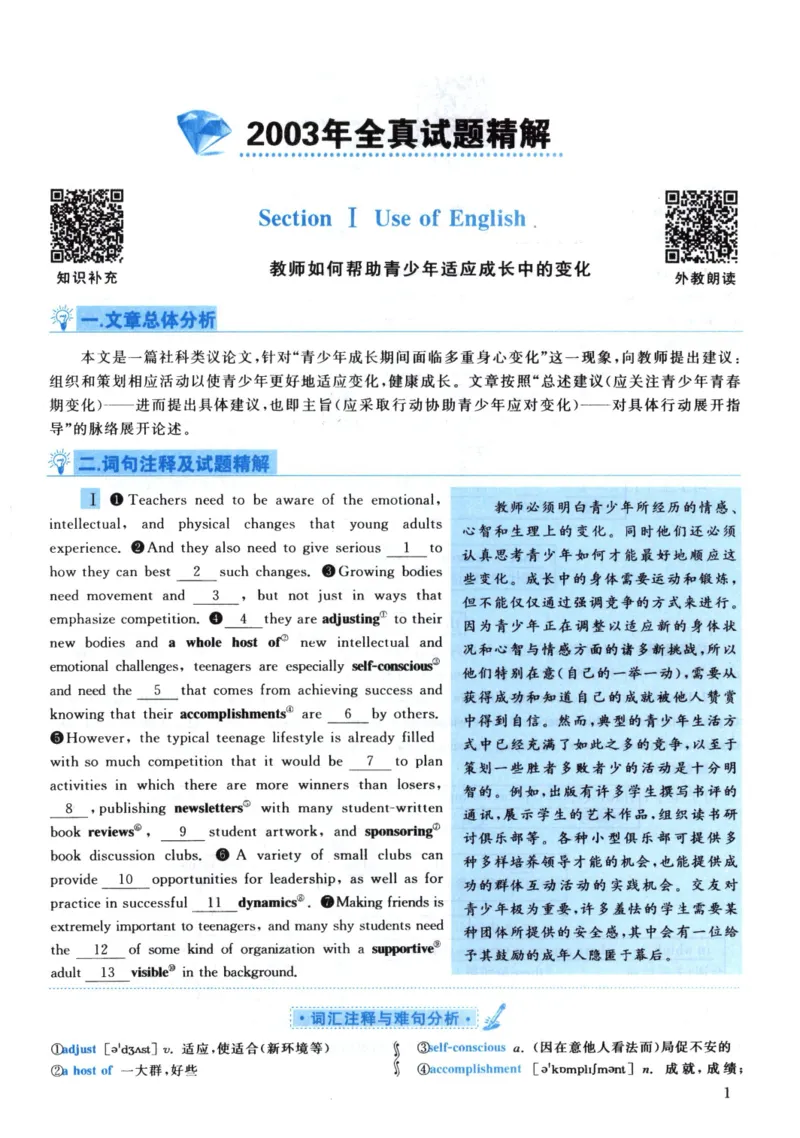
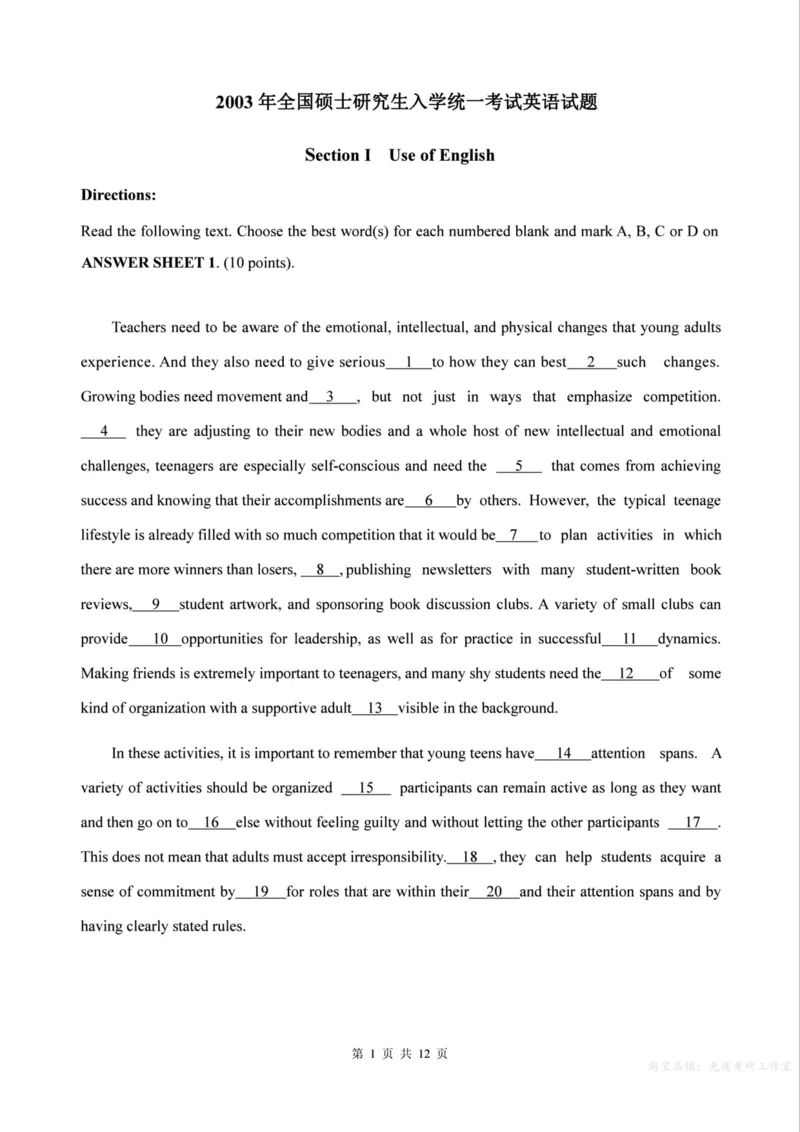
①Teachers need to be aware of the emotional, intellectual, and physical changes that young
adults experience. ②And they also need to give serious21to how they can best22 such changes.
③Growing bodies need movement and 23 , but not just in ways that emphasize competition.
④24 they are adjusting to their new bodies and a whole host of new intellectual and emotional
challenges, teenagers are especially self-conscious and need the25 that comes from achieving
success and knowing that their accomplishments are 26 by others. ⑤ However, the typical
teenage lifestyle is already filled with so much competition that it would be 27 to plan activities
in which there are more winners than losers, 28 , publishing newsletters with many student-
written book reviews,29 student artwork, and sponsoring book discussion clubs. ⑥A variety of
small clubs can provide 30 opportunities for leadership, as well as for practice in successful 31
dynamics. ⑦ Making friends is extremely important to teenagers, and many shy students need
the32 of some kind of organization with a supportive adult 3 3 visible in the background.
① In these activities, it is important to remember that the young teens have34 attention
spans. ②A variety of activities should be organized 35 participants can remain active as long
as they want and then go on to 36 else without feeling guilty and without letting the other
participants37 . ③ This does not mean that adults must accept irresponsibility.④ 38 , they
can help students acquire a sense of commitment by 39 for roles that are within their 40
and their attention spans and by having clearly stated rules. (294 words)
21. [A] thought [B] idea [C] opinion [D] advice
22. [A] strengthen [B] accommodate [C] stimulate [D] enhance
23. [A] care [B] nutrition [C] exercise [D] leisure
24. [A] If [B] Although [C] Whereas [D] Because
25. [A] assistance [B] guidance [C] confidence [D] tolerance
26. [A] claimed [B] admired [C] ignored [D] surpassed
27. [A] improper [B] risky [C] fair [D] wise
28. [A] in effect [B] as a result [C] for example [D] in a sense
29. [A] displaying [B] describing [C] creating [D] exchanging
30. [A] durable [B] excessive [C] surplus [D] multiple
1/1131. [A] group [B] individual [C] personnel [D] corporation
32. [A] consent [B] insurance [C] admission [D] security
33. [A] particularly [B] barely [C] definitely [D] rarely
34. [A] similar [B] long [C] different [D] short
35. [A] if only [B] now that [C] so that [D] even if
36. [A] everything [B] anything [C] nothing [D] something
37. [A] off [B] down [C] out [D] alone
38. [A] On the contrary [B] On the average
[C] On the whole [D] On the other hand
39. [A] making [B] standing [C] planning [D] taking
40. [A] capabilities [B] responsibilities [C] proficiency [D] efficiency
SectionIIIReading Comprehension
Part A
Directions:
Read the following four texts. Answer the questions below each text by choosing A, B, C or D.
Mark your answers on ANSWER SHEET 1. (40 points)
Text 1
①Wild Bill Donovan would have loved the Internet. ②The American spymaster who built
the Office of Strategic Services in the World War II and later laid the roots for the CIA was
fascinated with information. ③ Donovan believed in using whatever tools came to hand in the
“great game” of espionage—spying as a “profession”. ④These days the Net, which has already
re-made sucheveryday pastimes as buying books and sending mail, is reshaping Donovan’s
vocation as well.
①The last revolution isn’t simply a matter of gentlemen reading other gentlemen’s e-
mail. ② That kind of electronic spying has been going on for decades. ③ In the past
three or four years, the World Wide Web has given birth to a whole industry of point-
and-click spying.④ The spooks call it “open source intelligence”, and as the Net grows, it is
becoming increasingly influential. ⑤In 1995 the CIA held a contest to see who could compile the
most data about Burundi. ⑥The winner, by a large margin, was a tiny Virginia company called
Open-Source Solutions, whose clear advantage was its mastery of the electronic world.
①Among the firms making the biggest splash in the new world is Straitford, Inc., a private
intelligence-analysis firm based in Austin, Texas.②Straitford makes money by selling the results
of spying (covering nations from Chile to Russia) to corporations like energy-services firm
McDermott International. ③Many of its predictions are available online at www.straitford.com.
①Straiford president George Friedman says he sees the online world as a kind of mutually
reinforcing tool for both information collection and distribution, a spymaster’s dream. ② Last
2/11week his firm was busy vacuuming up data bits from the far corners of the world and predicting a
crisis in Ukraine. ③“As soon as that report runs, we'll suddenly get 500 new internet sign-ups
from Ukraine,”says Friedman, a former political science professor.④“And we’ll hear back from
some of them.”⑤Open-source spying does have its risks, of course, since it can be difficult to tell
good information from bad. ⑥That’s where Straitford earns its keep.
① Friedman relies on a lean staff of 20 in Austin. ② Several of his staff members have
military-intelligence backgrounds. ③He sees the firm’s outsider status as the key to its success.
④Straitford’s briefs don’t sound like the usual Washington back-and-forthing, whereby agencies
avoid dramatic declarations on the chance they might be wrong. ⑤ Straitford, says Friedman,
takes pride in its independent voice.
41. The emergence of the Net has______.
[A] received support from fans like Donovan
[B] remolded the intelligence services
[C] restored many common pastimes
[D] revived spying as a profession
42. Donovan’s story is mentioned in the text to______.
[A] introduce the topic of online spying
[B] show how he fought for the US
[C] give an episode of the information war
[D] honor his unique services to the CIA
43. The phrase “making the biggest splash” (Line 1, Paragraph 3) most probably means______.
[A] causing the biggest trouble
[B] exerting the greatest effort
[C] achieving the greatest success
[D] enjoying the widest popularity
44. It can be learned from paragraph 4 that______.
[A] Straitford’s prediction about Ukraine has proved true
[B] Straitford guarantees the truthfulness of its information
[C] Straitford’s business is characterized by unpredictability
[D] Straitford is able to provide fairly reliable information
45. Straitford is most proud of its______.
[A] official status [B] nonconformist image
[C] efficient staff [D] military background
Text 2
①To paraphrase 18th-century statesman Edmund Burke, “all that is needed for the triumph
3/11of a misguided cause is that good people do nothing.” ② One such cause now seeks to end
biomedical research because of the theory that animals have rights ruling out their use in research.
③ Scientists need to respond forcefully to animal rights advocates, whose arguments are
confusing the public and thereby threatening advances in health knowledge and care. ④Leaders
of the animal rights movement target biomedical research because it depends on public funding,
and few people understand the process of health care research. ⑤Hearing allegations of cruelty
to animals in research settings, many are perplexed that anyone would deliberately harm an
animal.
①For example, a grandmotherly woman staffing an animal rights booth at a recent street fair
was distributing a brochure that encouraged readers not to use anything that comes from or is
tested in animal—no meat, no fur, no medicines. ② Asked if she opposed immunizations, she
wanted to know if vaccines come from animal research. ③ When assured that they do, she
replied, “Then I would have to say yes.” ④Asked what will happen when epidemics return, she
said, “Don’t worry, scientists will find some way of using computers.” ⑤ Such well-meaning
people just don’t understand.
① Scientists must communicate their message to the public in a compassionate,
understandable way—in human terms, not in the language of molecular biology. ②We need to
make clear the connection between animal research and a grandmother’s hip replacement, a
father’s bypass operation, a baby’s vaccinations, and even a pet’s shots. ③ To those who are
unaware that animal research was needed to produce these treatments, as well as new treatments
and vaccines, animal research seems wasteful at best and cruel at worst.
① Much can be done. ② Scientists could “adopt” middle school classes and present their
own research. ③ They should be quick to respond to letters to the editor, lest animal rights
misinformation go unchallenged and acquire a deceptive appearance of truth. ④ Research
institutions could be opened to tours, to show that laboratory animals receive humane care.
⑤ Finally, because the ultimate stakeholders are patients, the health research community should
actively recruit to its cause not only well-known personalities such as Stephen Cooper, who has
made courageous statements about the value of animal research, but all who receive medical
treatment. ⑥If good people do nothing there is a real possibility that an uninformed citizenry will
extinguish the precious embers of medical progress.
46. The author begins his article with Edmund Burke’s words to_______.
[A] call on scientists to take some actions
[B] criticize the misguided cause of animal rights
[C] warn of the doom of biomedical research
[D] show the triumph of the animal rights movement
47. Misled people tend to think that using an animal in research is_______.
[A] cruel but natural [B] inhuman and unacceptable
[C] inevitable but vicious [D] pointless and wasteful
48. The example of the grandmotherly woman is used to show the public’s_______.
[A] discontent with animal research [B] ignorance about medical science
4/11[C] indifference to epidemics [D] anxiety about animal rights
49. The author believes that, in face of the challenge from animal rights advocates, scientists
should_______.
[A] communicate more with the public
[B] employ hi-tech means in research
[C] feel no shame for their cause
[D] strive to develop new cures
50. From the text we learn that Stephen Cooper is_______.
[A] a well-known humanist
[B] a medical practitioner
[C] an enthusiast in animal rights
[D] a supporter of animal research
Text 3
① In recent years, railroads have been combining with each other, merging into super
systems, causing heightened concerns about monopoly. ② As recently as 1995, the top four
railroads accounted for under 70 percent of the total ton-miles moved by rails. ③Next year, after
a series of mergers is completed, just four railroads will control well over 90 percent of all the
freight moved by major rail carriers.
① Supporters of the new super systems argue that these mergers will allow for substantial
cost reductions and better coordinated service. ②Any threat of monopoly, they argue, is removed
by fierce competition from trucks. ③ But many shippers complain that for heavy bulk
commodities traveling long distances, such as coal, chemicals, and grain, trucking is too costly
and the railroads therefore have them by the throat.
① The vast consolidation within the rail industry means that most shippers are served by
only one rail company. ② Railroads typically charge such “captive” shippers 20 to 30 percent
more than they do when another railroad is competing for the business. ③Shippers who feel they
are being overcharged have the right to appeal to the federal government’s Surface Transportation
Board for rate relief, but the process is expensive, time consuming, and will work only in truly
extreme cases.
① Railroads justify rate discrimination against captive shippers on the grounds that in the
long run it reduces everyone’s cost. ②If railroads charged all customers the same average rate,
they argue, shippers who have the option of switching to trucks or other forms of transportation
would do so, leaving remaining customers to shoulder the cost of keeping up the line. ③ It’s
theory to which many economists subscribe, but in practice it often leaves railroads in the position
of determining which companies will flourish and which will fail. ④“Do we really want
railroads to be the arbiters of who wins and who loses in the marketplace?” asks Martin Bercovici,
a Washington lawyer who frequently represents shipper.
5/11① Many captive shippers also worry they will soon be hit with a round of huge rate
increases. ②The railroad industry as a whole, despite its brightening fortunes, still does not earn
enough to cover the cost of the capital it must invest to keep up with its surging traffic. ③ Yet
railroads continue to borrow billions to acquire one another, with Wall Street cheering them on.
④ Consider the $10.2 billion bid by Norfolk Southern and CSX to acquire Conrail this year.
⑤ Conrail’s net railway operating income in 1996 was just $427 million, less than half of the
carrying costs of the transaction. ⑥Who’s going to pay for the rest of the bill? ⑦Many captive
shippers fear that they will, as Norfolk Southern and CSX increase their grip on the market.
51. According to those who support mergers, railway monopoly is unlikely because______.
[A] cost reduction is based on competition
[B] services call for cross-trade coordination
[C] outside competitors will continue to exist
[D] shippers will have the railway by the throat
52. What is many captive shippers’ attitude towards the consolidation in the rail industry?
[A] Indifferent. [B] Supportive. [C] Indignant. [D] Apprehensive.
53. It can be inferred from Paragraph 3 that______.
[A] shippers will be charged less without a rival railroad
[B] there will soon be only one railroad company nationwide
[C] overcharged shippers are unlikely to appeal for rate relief
[D] a government board ensures fair play in railway business
54. The word “arbiters” (Line 7, Paragraph 4) most probably refers to those______.
[A] who work as coordinators [B] who function as judges
[C] who supervise transactions [D] who determine the price
55. According to the text, the cost increase in the rail industry is mainly caused by______.
[A] the continuing acquisition [B] the growing traffic
[C] the cheering Wall Street [D] the shrinking market
Text 4
①It is said that in England death is pressing, in Canada inevitable and in California optional.
② Small wonder. ③ Americans’ life expectancy has nearly doubled over the past century.
④Failing hips can be replaced, clinical depression controlled, cataracts removed in a 30-minute
surgical procedure. ⑤ Such advances offer the aging population a quality of life that was
unimaginable when I entered medicine 50 years ago. ⑥But not even a great health-care system
can cure death—and our failure to confront that reality now threatens this greatness of ours.
① Death is normal; we are genetically programmed to disintegrate and perish, even under
ideal conditions. ②We all understand that at some level, yet as medical consumers we treat death
6/11as a problem to be solved. ③Shielded by third-party payers from the cost of our care, we demand
everything that can possibly be done for us, even if it’s useless. ④The most obvious example is
late-stage cancer care. ⑤Physicians—frustrated by their inability to cure the disease and fearing
loss of hope in the patient—too often offer aggressive treatment far beyond what is scientifically
justified.
① In 1950, the US spent $12.7 billion on health care. ② In 2002, the cost will be $1540
billion. ③Anyone can see this trend is unsustainable. ④Yet few seem willing to try to reverse it.
⑤Some scholars conclude that a government with finite resources should simply stop paying for
medical care that sustains life beyond a certain age—say 83 or so. ⑥Former Colorado governor
Richard Lamm has been quoted as saying that the old and infirm “have a duty to die and get out of
the way”, so that younger, healthier people can realize their potential.
① I would not go that far. ② Energetic people now routinely work through their 60s and
beyond, and remain dazzlingly productive. ③At 78, Viacom chairman Sumner Redstone jokingly
claims to be 53. ④ Supreme Court Justice Sandra Day O’Connor is in her 70s, and former
surgeon general C. Everett Koop chairs an Internet start-up in his 80s. ⑤These leaders are living
proof that prevention works and that we can manage the health problems that come naturally with
age. ⑥As a mere 68-year-old, I wish to age as productively as they have.
①Yet there are limits to what a society can spend in this pursuit. ②As a physician, I know
the most costly and dramatic measures may be ineffective and painful. ③I also know that people
in Japan and Sweden, countries that spend far less on medical care, have achieved longer,
healthier lives than we have. ④As a nation, we may be over-funding the quest for unlikely cures
while under-funding research on humbler therapies that could improve people’s lives.
56. What is implied in the first sentence?
[A] Americans are better prepared for death than other people
[B] Americans enjoy a higher life quality than ever before
[C] Americans are over-confident of their medical technology
[D] Americans take a vain pride in their long life expectancy
57. The author uses the example of cancer patients to show that______.
[A] medical resources are often wasted
[B] doctors are helpless against fatal diseases
[C] some treatments are too aggressive
[D] medical costs are becoming unaffordable
58. The author's attitude toward Richard Lamm’s remark is one of______.
[A] strong disapproval [B] reserved consent
[C] slight contempt [D] enthusiastic support
59. In contrast to the US, Japan and Sweden are funding their medical care______.
[A] more flexibly [B] more extravagantly
[C] more cautiously [D] more reasonably
7/1160. The text intends to express the idea that______.
[A] medicine will further prolong people’s lives
[B] life beyond a certain limit is not worth living
[C] death should be accepted as a fact of life
[D] excessive demands increase the cost of health care
Part B
Directions:
Read the following text carefully and then translate the underlined segments into Chinese. Your
translation should be written carefully on ANSWER SHEET 2. (10 points)
Human beings in all times and places think about their world and wonder at their place in it.
Humans are thoughtful and creative, possessed of insatiable curiosity. (61) Furthermore, humans
have the ability to modify the environment in which they live, thus subjecting all other life forms
to their own peculiar ideas and fancies. Therefore, it is important to study humans in all their
richness and diversity in a calm and systematic manner, with the hope that the knowledge
resulting from such studies can lead humans to a more harmonious way of living with themselves
and with all other life forms on this planet Earth.
"Anthropology" derives from the Greek words anthropos "human" and logos "the study
of". By its very name, anthropology encompasses the study of all humankind.
Anthropology is one of the social sciences. (62) Social science is that branch of intellectual
enquiry which seeks to study humans and their endeavors in the same reasoned, orderly,
systematic, and dispassioned manner that natural scientists use for the study of natural
phenomena.
Social science disciplines include geography, economics, political science, psychology, and
sociology. Each of these social sciences has a subfield or specialization which lies particularly
close to anthropology.
All the social sciences focus upon the study of humanity. Anthropology is a field-study
oriented discipline which makes extensive use of the comparative method in analysis. (63) The
emphasis on data gathered first-hand, combined with a cross-cultural perspective brought to the
analysis of cultures past and present, makes this study a unique and distinctly important social
science.
Anthropological analyses rest heavily upon the concept of culture. Sir Edward Tylor's
formulation of the concept of culture was one of the great intellectual achievements of 19th
century science. (64) Tylor defined culture as ". . . that complex whole which includes belief, art,
morals, law, custom, and any other capabilities and habits acquired by man as a member of
society."This insight, so profound in its simplicity, opened up an entirely new way of perceiving
and understanding human life. Implicit within Tylor's definition is the concept that culture is
learned, shared, and patterned behavior.
(65) Thus, the anthropological concept of "culture", like the concept of "set" in mathematics,
8/11is an abstract concept which makes possible immense amounts of concrete research and
understanding.
Section IV Writing
Directions:
Study the following set of drawings carefully and write an essay in which you should
1) describe the set of drawings, interpret its meaning, and
2) point out its implications in our life.
You should write about 200 words neatly on ANSWER SHEET 2. (20 points)
9/11答案速查表
Section** 错误的表达式 **Listening Comprehension (20 points)
(略)
SectioⅡ Use of English (10 points)
21. A 22. B 23. C 24. D 25. C 26. B 27. D 28. C 29. A 30. D
31. A 32. D 33. B 34. D 35. C 36. D 37. B 38. A 39. C 40. A
Section Ⅲ Reading Comprehension (50 points)
Part A (40 points)
41. B 42. A 43. C 44. D 45. B 46. A 47. B 48. B 49. A 50. D
51. C 52. D 53. C 54. B 55. A 56. C 57. A 58. B 59. D 60. C
Part B(10 points)
61. 而且,人类有能力改变自己的生存环境,从而使所有其他生命形态服从于人类
自己独特的想法和想象。
62.社会科学是知识探索的一个分支,它力图像自然科学家研究自然现象那样,用理
性、有序、系统和冷静的方式去研究人类及其活动。
63.强调直接收集资料,加上在分析过去和现在的文化时所采用的跨文化视角,使得
这一研究成为一门独特并且非常重要的社会科学。
64.泰勒把文化定义为“……一个复合整体,包括信仰、艺术、道德、法律、风俗以
及人作为社会成员所获得的其他能力和习惯。”
65.因此,像数学中“集合”的概念一样,人类学中的“文化”概念是一个抽象概
念,这个抽象概念使大量的具体研究和认识成为可能。
10/11