松江区2012~2013 年第二学期初三年级学业质量调研
英语学科试卷 2013.4
(满分150分,考试时间:100分钟)
考生注意:本卷有7大题,共94小题。试题均采用连续编号,所有答案务必按照规定在答题
纸上完成,做在试卷上不给分。
Part 1 Listening (第一部分 听力)
I. Listening Comprehension (听力理解): (共30分)
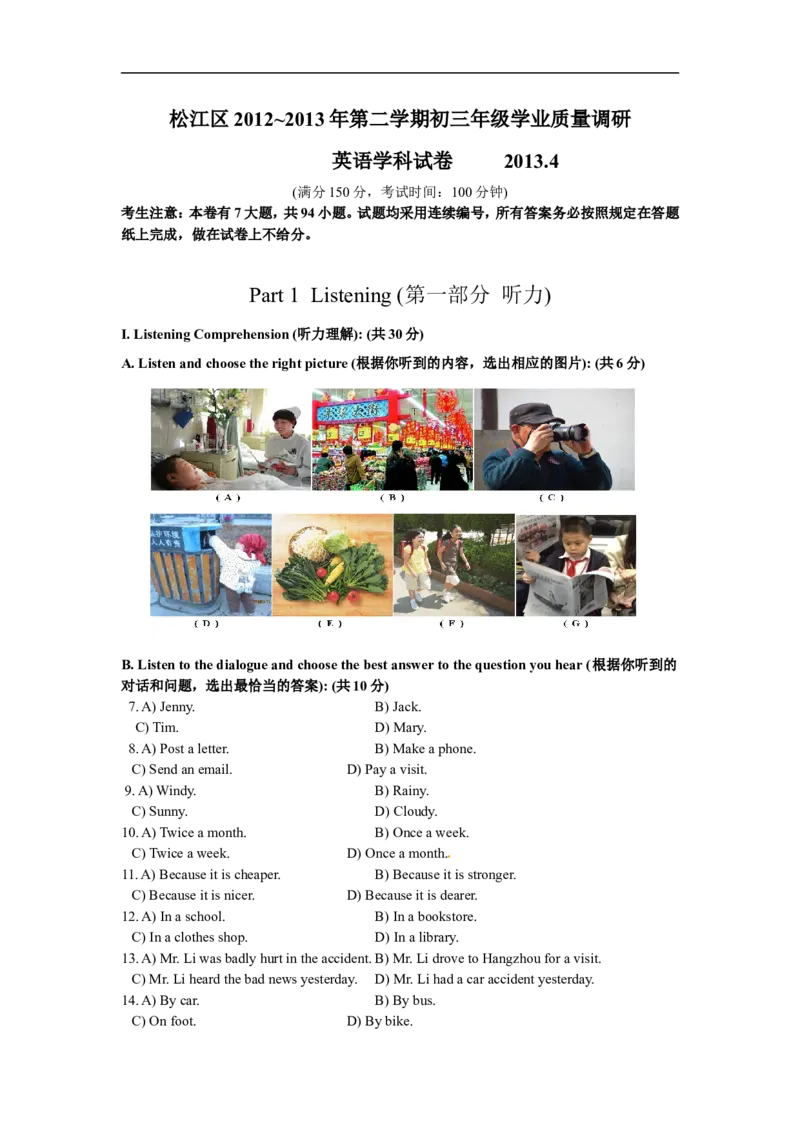
A. Listen and choose the right picture (根据你听到的内容,选出相应的图片): (共6分)
B. Listen to the dialogue and choose the best answer to the question you hear (根据你听到的
对话和问题,选出最恰当的答案): (共10分)
7. A) Jenny. B) Jack.
C) Tim. D) Mary.
8. A) Post a letter. B) Make a phone.
C) Send an email. D) Pay a visit.
9. A) Windy. B) Rainy.
C) Sunny. D) Cloudy.
10. A) Twice a month. B) Once a week.
C) Twice a week. D) Once a month.
11. A) Because it is cheaper. B) Because it is stronger.
C) Because it is nicer. D) Because it is dearer.
12. A) In a school. B) In a bookstore.
C) In a clothes shop. D) In a library.
13. A) Mr. Li was badly hurt in the accident.B) Mr. Li drove to Hangzhou for a visit.
C) Mr. Li heard the bad news yesterday. D) Mr. Li had a car accident yesterday.
14. A) By car. B) By bus.
C) On foot. D) By bike.15. A) Wife and husband. B) Shop-assistant and customer.
C) Teacher and student. D) Boss and secretary.
16. A) Their hometown. B) Their parents.
C) Their Favourite place. D) Their holiday plan.
C. Listen to the passage and tell whether the following statements are true or false (判断下
列句子是否符合你听到的短文内容,符合的用“T”表示,不符合的用“F”表示): (共7分)
17. When we have success in a school play, we may feel excited.
[来源:Zxxk.Com]
18. Miss Wang’s good way of remembering things is to write down stories.
19. According to the passage, a yearbook is made to remember English words.
20. Before making a yearbook, we should first take some photos of our own.
21. Usually a yearbook is made in December every year.
22. We made our first yearbook with the help of our teachers and parents.
23. With the yearbook, we will remember some special time for ever.
D. Listen to the passage and complete the following sentences (听短文,完成下列内容。每空
格限填一词) : (共7分)
24. If you want to do well in , you also need some good strategies(策略).
25. If you feel a little before you answer the questions, take a few deep breaths to help you
relax
26. Always read the question and make sure that you understand it.
27. Find out how much each question is worth or how many you need.
28. If there is a difficult question, don’t worry. Go on to the next question and come back to it if
you have time .
29. Try not to questions unanswered when you finish the test.
30. When you finish, go back and your answers.
Part 2 Vocabulary and Grammar (第二部分 词汇和语法)
II. Choose the best answer (选择最恰当的答案): (共20分)
31. Mr. Silver didn’t go shopping as usual _______ last night.
A) in B) on C) at D) /
32. Mike is my net pal. I often help him with _______ Chinese on the Internet.
A) he B) his C) him D) himself
33. We were asked to check the answers _______ discussing with each other.
[来源:学科网ZXXK]
A) by B) in C) of D) with
34. Though it was raining hard outside, yet we could see _______ people in the street.
A) few B) a few C) a little D) little
35. The plan about going camping during the summer holiday sounds _______.
A) excited B) exciting C) excitedly D) excitement
36. The hail (冰雹) storm which hit this area last night was _______ in recent years.
A) heavy B) heavier C) heaviest D. the heaviest37. How terrible it is that the water still can’t be drunk ______ it has been given medical
treatment!
A) although B) because C) when D) if
38. _______ of them knows Japanese, so I’ll have to ask another person for help.
A) Neither B) Either C) Both D) Each
39. _______ nice flowers! Where did you get them?
A) How B) What C) What a D) What an
40. Please never lie to others, _______ no one will be your friends.
A) as B) and C) either D) or
41. You have already tried your best, so you _______ worry too much about the exams.
A) can’t B) needn’t C) mustn’t D) shouldn’t
42. Our outdoor activity will continue _______ it rains this afternoon.
A) if B) since C) as soon as D) unless
43. Newspapers say that so far H7N9(禽流感) has caused several people _______.
A) die B) to die C) dying D) died
44. Mike _______ in his bedroom when his mother came back home.
A) sings B) sang C) is singing D) was singing
45. --- _______ time does your father spend watching TV every day?
--- About two hours.
A) How much B) How many C) How long D) How often
46. I’m glad to know that I _______ with my best friend in the same university in future.
A) study B) will study C) have studied D) studied
47. I won’t go to the movies this weekend because I ______ the film twice before.
A) see B) had seen C) have seen D) saw
48. That ancient tower is part of our city’s history. It _______ many years ago.
A) builds B) built C) was built D) is built
49. --- Would you like me to bring you a cup of tea?
--- _______
A) Yes, I’d like to. B) My pleasure. C) Yes, please. D) It doesn’t matter.
50. --- I’m terribly sorry. I left your notebook at home.
--- _______.
A) Certainly not B) You are welcome
C) Sorry to hear that. D) That’s all right.
III. Complete the following passage with the words or phrases in the box. Each word can
only be used once (将下列单词或词组填入空格。每空格限填一词,每词只能填一次): (共8
分)
A) harder B) such a C) yourself D) choices
E) care about F) others G) find out H) much I) serious
Everyone worries. It’s okay to worry sometimes. For example, if you haven’t studied and it’s
time for a test, you will be worried about how you’ll do it.With worrying, the important thing is to 51 if you can do something to make yourself
worry less. For example, you might want to study hard for the test next time! Try to do something
about what is causing your worries. Don’t keep your worries to 52 .
Other worries are 53 to solve. You might worry about problems at home, such as a
divorce(离婚) in your family. You might not be able to solve 54 problem. But you can talk
about your worries with people who 55 you. You don’t have to tell everyone everything, but if
you have 56 worries, it’s usually best to reach out to someone who can help. Parents and
friends are the best 57 . Teachers, doctors and nurses are helpful, too. You can also turn to the
Internet when you are worried. You might want to use it as a starting point and then talk to
someone about what you have learned on the Internet.
Sometimes worries can be too 58 . It can make small problems seem bigger than they are.
Worrying can even make it hard to sleep and keep you from having fun and doing your best.
IV. Complete the sentences with the given words in their suitable forms (用括号中所给单词
的适当形式完成下列句子。每空格限填一词) : (共8分)
59. Nowadays there are many taxi _________ in our city. (driver)
60. My son visits the National Museum in Beijing _________ a month. (one)
61. We are going to travel with some friends of _________ during this summer holiday. (our)
62. They finally made a _________ to build a new school in that area. (decide)
63. Xiao Li has many friends here because he often speaks ________ to others. (polite)
64. For the time being, Cathy’s job is to ________ the customers food at the restaurant. (service)
65. It’s ________ to lose your weight if you don’t keep on diet and do exercise regularly.
(possible)
66. It’s too ________ here. How can we have the discussion for our project? (noise)
V. Rewrite the following sentences as required (根据所给要求,改写下列句子。每空格限填一
词): (共14分)
67. Jenny goes to see films with her parents twice a month. (改为一般疑问句)
_______ Jenny _______ to see films with her parents twice a month?
68. The owner of the hotel has put some pictures on the walls of each room. (改为否定句)
The owner of the hotel _______ _______ any pictures on the walls of each room.
69. Several years ago, few girls in our group liked swimming in winter. (改为反意疑问句)
Several years ago, few girls in our group liked swimming in winter, _______ _______?
70. Mary sent the old man to hospital because he fell down in the street and broke his leg.
(对划线部分提问)
_______ _______ Mary send the old man to hospital?
71. They didn’t go to the museum last Monday. It rained hard. (保持句意基本意思)
They didn’t go to the museum last Monday _______ _______ the heavy rain.
72. Our teacher asked us to meet some of our new friends from other cities at the gate.
(改为被动语态)
We _______ _______ to meet some of our new friends from other cities at the gate.
73. “We will go for a picnic this weekend,” Tim said to us. (改为宾语从句)
Tim told us that _______ _______ go for a picnic that weekend.Part 3 Reading and Writing (第三部分 读写)
VI. Reading comprehension (阅读理解): (共50分)
A. Choose the best answer(根据短文内容,选择最恰当的答案): ( 12分)
One day, many years ago, when I was working as a psychologist(心理学家) in England,
David was brought into my office. His face was pale and he stared at his feet.
David had lost his father when he was two years old and had lived with his mother and
grandfather ever since. But the year before he turned 13, his grandfather died and his mother was
killed in a car accident. His teacher told me that he refused to talk to others from then on.
How could I help him?
David didn’t say a word. As he was about to leave, I put my hand on his shoulder. “Come
back next week if you like,” I said.
He came, and I suggested we play a game of chess. He nodded. After that we played chess
every Wednesday afternoon --- in complete silence. Usually, he arrived earlier than agreed. It
seemed as if he enjoyed my company. But why didn’t he ever look at me?
“Perhaps he simply needs someone to share his pain with,” I thought.
Months later, when I was staring at his head, he suddenly looked up at me. “It’s your turn,”
he said. After that day, David started talking. He finally got friends in school and he even joined a
bicycle club. He wrote to me a few times. Now he has really started to live his life.
Maybe I gave David something. But I learned a lot from him. I learned how time makes it
possible to overcome (克服) what seems to be so painful. David showed me how one--- without a
word --- can reach out to another person. All it takes is a shoulder to cry on, a friendly touch and
an ear that listens.
74. David refused to talk to others _________.
A) after his father had died B) before he was twelve
C) after his grandfather had died D) when he became an orphan(孤儿)
75.Which of the following is true according to the passage?
A) David played chess with the writer when they met for the first time.
B) David kept silent when he met the writer for the first time.
C) David began to talk with the writer a month later.
D) The writer was David’s private doctor.
76.The writer felt that David seemed to enjoy playing chess with him because David _________.
A) played chess with him every Wednesday afternoon.
B) began to talk to the writer after they played chess
C) usually arrived at the writer’s office earlier than agreed.
D) began to look at the writer when they played chess
77.David _________ after he started talking.
A) began to enjoy a newer and better life. B) was still very sad
C) made friends with the writer D) became a member of a bicycle club
78.The underlined word “company” in Paragraph 3 probably means “_________”.
A) way of running a business B) way of being together with him
C) way of playing chess D) way of speaking to him
79.What can we learn from the story?
A) We should always help each other and play together.B) We need to play chess with those silent boys.
C) We should pay more attention to help those who are painful.
D) Time can change a person into another one with many words.
B. Choose the words or expressions and complete the passage (选择最恰当的单词或词语完
成短文): (12分)
You either have it, or you don’t --- a sense of direction, that is. But why is it that some people
could find their way across the Sahara without a map, while others can lose themselves in the next
street?
Scientists say we’re all born with a sense of direction, 80 it is not properly understood
how it works. One idea is that people with a good sense of direction have worked hard at
developing it. Research being carried out at Liverpool University supports this idea and suggests
that if we don’t use it, we lose it.
“Children as young as seven have the ability to find their way around,” says Jim Martland,
Research Director of the project. “However, if they are not allowed out alone or are taken
everywhere by car, they will 81 develop the skills.”
Jim Martland also says that young people should be taught certain 82 to improve their
sense of direction. He makes the following suggestions:
If you are using a map, turn it so it helps you to find the way you are facing.
If you leave your bike in a strange place, put it near 83 like a big stone or a tree.
Note landmarks on the route as you go away from your bike. When you return, go back
along 84 route.
Simplify(简化) the way of finding your direction by using lines such as streets in a
town, streams, or walls in the countryside to guide you. Count your steps 85 you
know how far you have gone and note any landmarks such as tower blocks or hills
which can help to find out where you are.
Now you will never get lost again!
80. A) or B) as C) but D) so
81. A) never B) always C) possibly D) almost
82. A) programs B) skills C) reasons D) advice
83. A) anything B) everything C) nothing D) something
84. A) the opposite B) the same C) the other D) the next
85. A) though B) since C) so that D) when
C. Read the passage and fill in the blanks with proper words (在短文的空格内填入适当的词,
使其内容通顺,每空格限填一词,首字母已给): (14分)
Have you ever noticed the black and white bars on a book? Do you know what they are used
for?
They are barcodes(条形码) used in most products. If you go to a supermarket, you can see
almost every product with a barcode o 86 it. Barcodes contain information about the product,
such as name and production date. It’s an e 87 and convenient way to know about the products.
Just scan(扫描) the bars with a barcode reader and everything is c 88 .
The first use of a barcode in a supermarket checkout system was on a pack of American
Wrigley Company chewing gum(口香糖) in 1974. Beyond supermarkets, barcodes are n 89
everywhere: for renting cars, for luggage checks on a plane, for parcels you send; life would berather difficult w 90 barcodes. Most of our things would get lost in the post.
Barcodes change as well. Barcodes in the past were 1-D, but now there are 2-D barcodes,
such as QR code. Since 2009, QR has been used on Chinese train tickets. People can enter
stadiums, cinemas and theaters by h 91 certain types of barcodes.
If you find these barcode things boring, a barcode building might be more up your street. In
St Petersburg, Russia, there is a building designed like a barcode. It l 92 strange, but it’s
actually a shopping mall. There are games too. Barcode Monsters is a mobile phone game. You
have to scan barcodes and find the monsters!
D. Answer the questions (根据短文内容回答下列问题): (12分)
Two years ago, my parents died in a car accident. Ever since then, my elder brother and I have
had to work part-time to make a living. I have been working as a part-time waiter in a restaurant
for six months, and now I’ve just got my salary.
I was walking back to school and saw the notice board in the hall. There was a notice asking for
donations(捐赠) for the earthquake. A girl called Amanda was reading the same notice. She came
from a very wealthy family. You could see that easily from her nice clothes and gadgets(小玩意
儿).
“Aren’t you going to donate?” I asked, “People there must be having a really hard time. All
their houses have been destroyed by the earthquake. They’ve got nothing left, no place to live,
nothing to eat or…”
“Sorry, I don’t have money to spend on that!” she laughed. “I have 10 new dresses to buy. I
need to get a new phone. And then I’m planning to fly to Paris for the weekend.” With these
words, she walked away.
I took the money from my pocket and walked to Mrs Tawreen’s office.
“Excuse me, ma’am,” I said. ‘I don’t have too much for a donation, just 300 yuan. Could I just
donate this?”
Mrs Tawreen smiled, “Wow, 300 yuan, my dear? Well, I have to tell you that, of all the
donations we’ve received from our students so far, it’s the largest amount. And yes, you may
donate right now.”
I put the notes into the donation box. Maybe my brother and I would have to miss a few meals
this month, but it would make a difference to the lives of those less fortunate than us.
93. What happened to the boy’s parents two years ago?
94. Why did the brothers have to get part-time jobs?
95. Amanda wasn’t a warm-hearted and helpful girl, was she?
[来源:学科网]
96. What did the boy decide to do after he read the notice asking for donations?
97. Who donated the largest amount of money among the students of that school?
98. Why would the boy and his brother have to miss a few meals after donating the money?VII. Writing (作文): (共20分)
99. Write a passage in at least 60 words according to the given situation (根据所给情景写一段不
少于60词的短文,标点符号不占格。)
In March, 2013, it was reported that thousands of dead pigs were seen floating on the Huangpu
River in Shanghai. What do you think of it? How should we develop our good habits to protect the
environment? (今年3月,上海黄浦江上漂浮着许多死猪。你是如何看待这种现象的?我们应
该如何养成习惯去保护环境?至少举1-2个例子)
(注意:文中不得出现任何姓名、校名及其它相关信息,否则不予评分。)松江区2012~2013 年第二学期初三年级学业质量调研
英语学科试卷
2013.4
(满分150分,完卷时间100分钟)
Part 1 Listening
I. Listening Comprehension (听力理解): (共30分)
A. Listen and choose the right picture (根据你听到的内容,选出相应的图片): (共6分)
1. Grandma Li buys a lot of vegetables for several days every Sunday. (E)
2. Jane has to stay in hospital for another couple of days because she is still weak. (A)
[来源:学&科&网]
3. It’s hard for the little girl to get to school by herself every day. (F)
4. It is important to put rubbish in different litter bins in modern cities. (D)
5. The students in our class often read English newspapers after school. (G)
6. We often use this camera to take photos when travelling around. (C)
B. Listen to the dialogue and choose the best answer to the question you hear (根据你听到的
对话和问题,选出最恰当的答案): (共10分)
7. W: Have you received Jenny’s invitation, Jack?
M: Yes, she also invited Tim and Mary.
W: Let’s buy some small presents for her birthday party, shall we?
M: Yes. And I want to draw a card for her.
Q: Who will hold a birthday party? (A)
8. W: What are you doing, Tom?
M: I’m writing a letter to email my father. I have something important to ask him.
W: Why not phone him at once? It’s much more convenient.
M: But he is now having a meeting.
[来源:Zxxk.Com]
Q: What will the boy probably do? (C)
9. W: What was the weather like when you were on holiday in Beijing?
M: Fine, it was sunny every day until Friday.
W: Really? What happened then?
M: It was sunny in the morning, but it rained heavily in the afternoon.
Q: What was the weather like on Friday morning? (C)
10. M: Hi, Jane, where are you going?
W: I’m going to see a new film
M: Do you often go to movies?
W: Well, I used to see films twice a month, but now only once a month.
Q: How often does Jane go to movies now? (D)
11. W: Which suitcase do you prefer, Sir?
M: Well, the red one is cheaper, but I still want to take the black one.
W: You’re quite right. Although it’s a bit dearer, it’s much stronger.
Q: Why did the man want to buy the black suitcase? (B)
12. M: Look, how beautiful the skirt is, Monica!
W: Well, I like the colour of it and the style as well.M: You can get it if you like it though it’s a bit more expensive.
Q: Where does the dialogue probably take place? (C)
13. W: Have you heard the bad news, Daniel?
M: What happened?
W: Mr. Lin had a car accident yesterday when he drove to Hangzhou.
M: I’m sorry to hear that. How is he now?
W: Nothing serious.
Q: What can we learn from the dialogue? (D)
14. M: Mary, let’s go home by bus together, shall we?
W: I’m sorry. I want to finish my homework here.
M: But it’s already half past four.
W: Well, my father will come and pick me up at five.
Q: How is Mary going to go home? (A)
15. M: What’s the problem, Madam?
W: I remember I put my wallet in the bag, but now…
M: I’m sorry about that. But we can keep the watch for you for several days.
Q: What’s the probable relationship between the two speakers? (B)
16. W. I am going to spend my holiday in Yunnan. There are so many places of interest there.
What about you, Jim?
M: I’m going to Chongqing with my parents. It’s my hometown.
W. Really?
Q. What are they talking about? (D)
C. Listen to the passage and tell whether the following statements are true or false (判断下列
句子是否符合你听到的短文内容,符合的用“T”表示,不符合的用“F”表示): (共7分)
At school many things happen to us. We may feel excited when we have success in a school
play. We may feel sorry if we lose an important game. We want to keep the memories for the rest
of our lives.
How to keep the memories? Our English teacher, Miss Wang, has taught us a good way of
remembering things--- to make our own yearbook. What is a yearbook? A yearbook is a kind of
book which is used to keep the memories of exciting moments. It’s usually made at the end of the
year.
Last December, we began to make our yearbook. First we chose the people who had done
something special, then some students interviewed them. Some wrote down their stories, others
took photos of them. Everyone in our class had something to do. Finally our teacher helped us to
put the things together. We had our first yearbook.
All of us put a lot of love into making the yearbook. It is so wonderful that not only the
students but also our parents and teachers will remember the special time for ever.
17. T 18. F 19. F 20. F 21. T 22. F 23. T
D. Listen to the passage and complete the following sentences (听短文,完成下列内容。每空
格限填一词): (共7分)
Do you want to do well in exams? Sometimes your knowledge is not enough, you also need
some good strategies. Here are some for you: Before you answer the questions, if you feel a little nervous, take a few deep breaths to
help you relax.
Always read the question carefully and make sure that you understand it. Read it a few
times if possible.
Find out how much each question is worth or how many points you need.
If it asks to give one answer, only write one.
If there is a difficult question, don’t worry. Go on to the next question and come back to
it if you have time later.
Try not to leave questions unanswered when you finish the test. Sometimes a guess may
get you points.
When you finish, go back and check your answers. You will need to check your writing
for spelling mistakes.
24. exams 25. nervous 26. carefully 27. points 28. later 29. leave 30. check
Part 2 Vocabulary and Grammar
II. 31. D 32. B 33. A 34. B 35. B. 36. D 37. A 38. A 39. B 40. D
41. B 42. D 43. B 44. D 45. A 46. B 47. C 48. C 49. C 50. D
III. 51. G 52. C 53. A 54. B 55. E 56. I 57. D 58. H
IV. 59. drivers 60. once 61. ours 62. decision
63. politely 64. serve 65. impossible 66. noisy
V. 67. Does, go 68. hasn’t, put 69. did, they 70. Why, did
71. because, of 72. were, asked 73. they, would
Part 3 Reading and Writing
VI.
(A) 74. D 75. B 76. C 77. A 78. B 79. C
(B) 80. C 81. A 82. B 83. D 84. B 85. C
(C) 86. on 87. easy 88. clear 89. needed 90. without 91. holding 92. looks
(D) 93. His parents died in a car accident.
94. Because they had to make a living by themselves.
95. No, she wasn’t.
96. He wanted to donate some money.
97. The boy did./The boy./The writer.
98. Because they didn’t have enough money for themselves./They were poor themselves.
IX. Writing (作文): (共20分)
写话评分标准:作文共20分,其中内容为8分,语言为8分,组织结构分为4分。
(一) 内容:
8分 内容切题,意思连贯,表达清楚、完整。6-7分 内容基本切题,意思大致连贯,表达基本清楚,但不够完整。
4-5分 内容不够切题,意思不够连贯,表达不够清楚,离题目要求较远。
3分 内容基本不切题,表达不清, 但属于考场作文。
1-2分 文不对题,表达不清,字数严重缺少。
和本题目无关,但不抄本试卷上的阅读文章。
(二) 语言:
① 拼写:每错扣0.5分,同一错误不重复计数。
② 语法:同①
③ 标点符号、大小写:每两处错误扣0.5分,但标点符号和大小写的扣分总和均不得超
过一分。
④ 语言分最多扣8分。
(三) 词数:
① 词数不足30词者,得分最多不得超过8分;
② 词数不足40词者,得分最多不得超过12分;
③ 词数不足50词者,得分最多不得超过15分;
④ 词数在50-59词之间者,每少5个词扣0.5分;
⑤ 只写出个别单词、词不成句不给分。
(四) 组织结构:
① 内容充实,不写废话;上下文连贯、用语规范、表达正确、无或少见语法错误;词汇和
句型句式运用恰当,多见好句型和习惯表达用语者,可给4分。
② 一般情况下,内容和语言积累得分在14-15分以上者(含),方可得到2-3分组织结构
分。
③ 内容和语言在15分以下者,如文中有值得肯定的好的句型和表达,可酌情考虑给1
分组织结构分。
④ 通篇句型、句式单一。词汇贫乏者,即使无语法错误,一般不给组织结构分。