松江区2011~2012年第二学期初三年级学业质量调研
英语学科试卷 2012.4
(满分150分,考试时间:100分钟)
考生注意:本卷有7大题,共94小题。试题均采用连续编号,所有答案务必按照规定在答题纸上
完成,做在试卷上不给分。
Part I Listening(第一部分 听力)
I. Listening Comprehension (听力理解): (共30分)
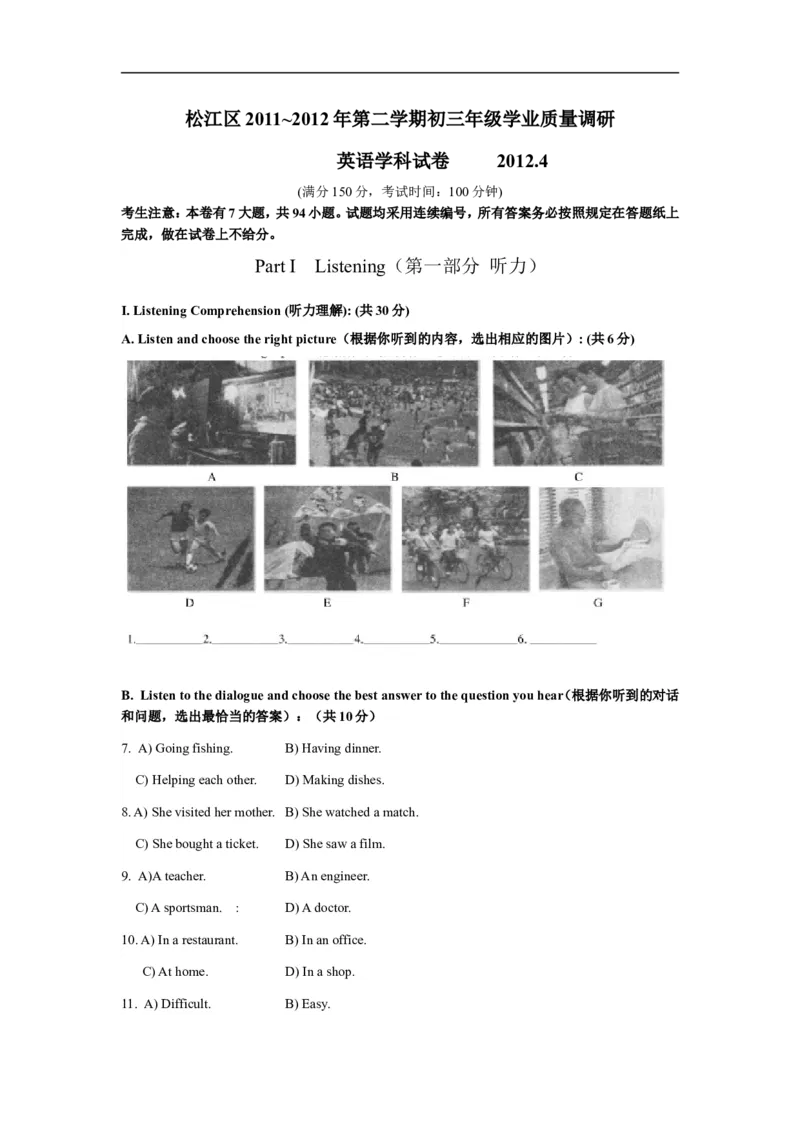
A. Listen and choose the right picture(根据你听到的内容,选出相应的图片): (共6分)
B. Listen to the dialogue and choose the best answer to the question you hear(根据你听到的对话
和问题,选出最恰当的答案):(共10分)
7. A) Going fishing. B) Having dinner.
C) Helping each other. D) Making dishes.
8. A) She visited her mother. B) She watched a match.
C) She bought a ticket. D) She saw a film.
9. A)A teacher. B) An engineer.
C) A sportsman. : D) A doctor.
10. A) In a restaurant. B) In an office.
C) At home. D) In a shop.
11. A) Difficult. B) Easy.C) Interesting. D) Boring.
12. A) He wanted to eat ice-cream. B) He wanted to feel it.
C) He was not well. D) He was hungry.
13. A) At 8:10. B) At 8:20.
C) At 8:30. D) At 8:00.
14. A) Once a month. B) Once a year.
C) Once a week. D) Once a day.
15. A) By bus. B) By bike.
C) By car. D) By underground.
16. A) Because of the style. B) Because of the colour.
C) Because of the size. D) Because of the material.
C. Listen to the passage and tell whether the following statements are true or false (判断下列句
子是否符合你听到的短文内容,符合的用“T”表示,不符合的用“F”表示):(共7分)
17. Robert was hurt in an accident while driving his car in the country.
18. Unfortunately, Robert's car broke down because of the heavy rain.
19. The villagers helped Robert to pull his car out of the water.
20. Robert was lucky enough not to pay the villagers for their help.
21. It was difficult to find a good restaurant in that small town.
22. The town was still busy when Robert arrived in the evening.
23. Though he was really hungry, Robert didn't enjoy his dinner that night.
D. Listen to the passage and complete the following sentences(听短文,完成下列内容。每空
格限填一词):(共7分)
24. Collecting telephone cards is becoming a popular in Britain.
25. Collectors have their magazine called International Telephone Cards.
26. People in can put their design onto a blank telephone card.
27. The first telephone cards were produced in and they were Italian.
28. People enjoy collecting telephone cards because they are attractive, small and .
29. Telephone cards don't need much space and are also for beginners.
30. There is a in Paris and you can buy only telephone cards in it.
Part 2 Vocabulary and Grammar(第二部分 词汇和语法)
II. Choose the best answer (选择最恰当的答案): (共20分)
31. There will be exhibition in that museum next week.
A) the B)/ C)an D) a
32. It is not mobile phone. I put mine in that small bag.
A) my B) his C) her D) their
33._______________ the help of the teacher, my son has made great progress in English.
A) By B) Under. C) On D) With
34. Who is the man talking to your father? I know_________________about him.
A) everything B) nothing C) anything D) something
35. There is still milk in the bottle. We can buy it tomorrow.
A) little B) a little C)a few D) few
36. of the students in that class usually have lunch at school.
A) The fourteen B) The fourteenth C) Fourteenth D) Fourteen
37. The twins and their mother were very tired, but of them would stop for a rest.
A) both B) neither C) none D) either
38. Tom, you mustn't play with fire. You hurt yourself if you don't stop.
A) may B) can C) should D) need to
39. Jim felt very when he saw his favourite film star.
A) happier B) happily C) the happiest D) happy
40. It's not easy to live in a foreign country you don't know the language.
A) though B) if C) but D)so
41. The firemen can't go into the room because the door by someone.
A) locks B) was locked C)has locked D) locked
42. When you phoned me yesterday afternoon, I table tennis with my son.
A) had played B) played C) was playing D) has played
43. Johnson works than his father did at his age.
A) even harder B) the harder C) even more harder D) even more hard
44. You don't have to go there yourself. I my parents everything about it already.
A) will tell B)told C) had told D) have told
45. My friend told me that he to visit his old grandpa the next week.
A) went B)will go C) would go D) had gone
46. 46. we are to have such a good chance to visit the Science Museum.
A) How lucky B) What lucky C) How luckily D) What luckily
47. The father said nothing but looked at his son's school report.
A) anger B) angrier C) angrily D) more angry
48. Lucy ill for two days, so she cannot go to school today.
A) has been B) had been C) will be D) is
49. — May help you with the suitcase?
—
A)Of course you may. B) Thanks for your help.
C) Yes, you will. D) Sure.
50. — Our class will go out for a picnic next Saturday.—
A) You're welcome. B) Good idea. C) That's OK. D) Enjoy your time.
[来源:学科网]
III. Complete the following passage with the words or phrases in the box. Each word can only be
used once(将下列单词或词组填入空格。每格只能填一次):(共8分)
A) get ready for B) because C) anything D) different E) go
out
F) danger G) nature's H) became I) studying
Secrets are everywhere in the world outdoors. Quite a lot of people are busy studying them 51
they are so interesting. All around us are birds, animals, trees and flowers. The facts about how they
live and grow are as interesting as 52 could be.
Do you know that one of the great presidents of the U.S.A. spent hours and hours 53 birds? A
businessman who lives near New York City 54 so interested in insects that he began to collect them.
He now has over one thousand different kinds carefully kept in glass boxes.
Come with me, and I will help you find some of 55 secrets. Let's go quickly through the woods
and fields. Here we shall find how a rabbit tells the other rabbits that there is 56 .We shall follow a
mother bear and her young ones as they search for food and 57 their long winter sleep. We shall
watch bees dancing in air to let the other bees know where they can find food. I will show you many
other interesting things, but the best thing that I can teach you is to keep eyes open when you 58 .
Nature tells her secrets only to people who look and listen carefully.
IV. Complete the sentences with the given words in their suitable forms(用括号中所
给单词的适当形式完成下列句子。每空格限填一词):(共8分)
59. There were many in the Science Museum last Sunday. (visit)
60. A friend of is waiting for the manager at the gate of the company. (they)
61. "Turn down the radio, Jim. It's too ." said his grandfather. (noise)j
62. All of us should obey traffic rules in order to keep ourselves .(save)
63. Can you tell me who will at the class meeting next Monday? (speech)
64. He did the work as as he could so as to go back home early. (quick)
65. Nobody would like to make friends with those person. (honest)
66. All the guests are pleased with the restaurant for its excellent . (serve)
V. Rewrite the following sentences as required (根据所给要求,改写下列句子。每空格限填一词):
(共14分)
67. My daughter has lunch at home on weekdays. ( 改为否定句)
My daughter lunch at home on weekdays.
68. His grandma's told us a very interesting story.(改为感叹句)
interesting story His grandma's told us!
69. The new English dictionary cost him a lot of money. ( 改为反义疑问句)
The new English dictionary cost him a lot of money, ?
70. More than eighty students took part in the reading competition last week.(对划线部分提问)
students took part in the reading competition last week?
71. They will repair my newly-bought camera in four days.(改为被动语态)
My newly-bought camera repaired in four days.72. Miss Li is not only our English teacher but also our good friend.(保持句意基本不变)
Miss Li is our English teacher and our good friend .
73. Does Jane often go to school by bike? Please tell me.(合并为一句)
Please tell me Jane often to school by bike.
I
Part 3 Reading and Writing (第三部分 读写)
VI. Reading comprehension (阅读理解): (共50分)
A. Choose the best answer (根据短文内容, 选择最恰当的答案): (共12分)
On Nov. 18", 1908. three men went up in a balloon. They started early in London. The headman
was Augusta Gaudron; and the other two men were Tannar and Maitland. They had a big balloon and
they were ready for a long way.
Soon they heard the sea. They were carrying the usual rope, and it was hanging down from the
basket of the balloon. At the end of the rope they had tied a metal box. This could hold water, or it
could be empty. So they were able to change its weight. It was for use over the sea. They were also
carrying some bags of sand.
After the sun rose, the balloon went higher. It went up to 3,000 metres, and the air was very cold.
The water in the balloon became ice. Snow fell past the men's basket, and they could see more snow on
the ground. The men tried to throw out some more sand, but it was hard. They tried to break the icy
sand with their knives, but it was not easy. The work was slow and they were still falling, so they had to
drop some whole bags of sand. One of them fell on an icy lake and made a black hole in the ice.
At last they pulled the box into the basket. It was still snowing, so they climbed to get away from
the snow. They rose to 5,100 metres! Everything became icy. They were so cold that they decided to
land. They came down in Poland heavily but safely. They had travelled 1,797 kilometers from
London!
74. Three men flew in a balloon_____________.
A) for nearly 1,800 kilometers B) to another city
C) to visit Poland D) to see more snow
75. The metal box was used for_____________.
A) carrying the bags of sand B) keeping drinking-water
C) carrying ropes of the basket D) changing weight
76. When the balloon went up higher .
A) the temperature of the balloon began to fall
B) the men saw the sun go down slowly
C) the men made a hole in the basket with their knives
[来源:学,科,网]
D)the men could see a black hole on the ground
77. The balloon landed .
A) in London B) on the sea
C) on a lake D) in a foreign country
78. Which of the following is NOT true?__________________
A) The three men started their journey before the sun rose.
B) The balloon began to go up when the three men threw bags of sand out of the basket.
C) When the three men pulled the box into the basket, the balloon began to climb up. .
D)The three men had to land because they felt cold.79. The passage is mainly about_______________.
A) how the men succeeded in throwing sand into the sea
B) the changing of the temperature over the sea
C) the men's hard but unusual traveling in a balloon
D) what the men heard and saw in a balloon
B. Choose the words or expressions and complete the passage (选择最恰当的单词或词语完成短
文:12分)
The other day, I happened to meet someone I hadn't seen for many years. I couldn't believe
the change in him. In fact, he didn't even seem like the same person.
When I first knew Bill, back in 80 he was one of the most carefree people I had ever met. He
was always ready to have a party. He thought nothing of going out for beer at three o'clock in the
morning or driving 50 miles to see an old movie he really liked. Bill and I were in the same class in
college, and 81 was never dull when he was around. With him there was one wild adventure after
another. Sometimes I wondered how we 82 to study for our exams.
Last week I was in Houston on business and I ran into Bill in the bar at the hotel. 83 , I wasn't
even sure it was him. Was this short-haired businessman really the same person? I wasn't really sure
until I came near him but it indeed was Bill. Now he works for a bank. He talked most of the evening
about his job, his new car and his house. How he had changed! Back when we were in college, the last
thing Bill cared about was possessions. Now they seamed to be his main 84 . Although I have changed
quite a bit myself, somehow, I never imagined Bill changing so much. My image of him remained the
one I had formed at the time when we were college students together.
I suppose it's foolish to expect people to remain the same, especially 85 I have changed so much
myself. But 1 must say that I enjoyed the old Bill much more than the new Bill. Maybe he fell the same
way about me.
80. A) college B) childhood C) bank D) party
81. A) learning B) life C) work D) homework
82. A) decided B) intended C) managed D) hoped
83. A) First of all B) At first C) Now and then D) All the time
84. A) interest B) event C) subject D) problem
85. A) because B) that C) how D) when
[来源:学#科#网]
C. Read the passage and fill in the blanks with proper words (在短文的空格内填入适当
的词,使其内容通顺,每空格限填一词,首字母已给):(14分)
Have you ever noticed an advertisement which says "Learn a foreign language in six weeks, or
your money back! From the first day your pronunciation will be excellent. Just send ..." and so on? Of
course, it n 86 happens quite like that. The only language that is easy to learn is the mother tongue.
And think how much practice that gets! Before the Second World War people usually learned a foreign
language in order to read the literature of the country. Now speaking the foreign language is w 87
most people want.
Every year millions of people start learning one. How do they do it? Some people try at home,
with books and tapes; some u 88 radio or television programs; others go to evening classes. If they
use the language only two or three times a week, learning it will t 89 a long time, like language
learning at school. A few people try to learn a language f 90 by studying for six or more hours a day.
It is clearly easier to learn the language in the country where it is s 9l . However, most people cannotafford this, and for many it is not necessary. They need the language in order to do their work b 92 .
For example, scientists and doctors mainly need to be able to read books and reports in the foreign
language. Whether the language is learned quickly or slowly, it is hard work. Machines and good books
will help, but they cannot do the students' work.
D. Answer the questions (根据短文内容回答下列问题): (12分)
If you lose 12 times in a row(连续地), will you just give up? Dale Carnegie, a pioneer in public
speaking and self-development, kept trying. And he became famous by showing people how to be
successful.
Carnegie was born in 1888 in a poor farming family in the central United States. The boy didn't
see a train until he was 12 years old. In his teens, he had to get up at 3 a.m. every day to milk the cows
in his family.
When Carnegie first entered college, he fell hopeless because of his clothes and ordinary looks.
His mother encouraged him. "Why not try to be better in other things instead of just dress and good
looks?"
Carnegie tried to be more active in college. He joined the debate team(辩论队). But one after
another, he lost 12 meets. The young man was very disappointed in himself. He said later that he
thought of killing himself after so many failures.
But soon Carnegie was seen practicing public speaking on the riverside. His hard work paid off at
last. In 1906. Carnegie won a famous speech contest and became widely known.
The young man made his own words come true. "Believe that you will succeed, and you will." In
order to share his success, Carnegie opened schools and wrote books. His best-sellers include How to
Win Friends and Influence People and How to Stop Worrying and Start Living. More than 50 million
copies of his books have been printed in 38 languages. They are still helping people on the road to
success.
93. Did Carnegie live a hard life when he was a little boy?
94. Why did Carnegie feel hopeless when he first entered college?
95. What did he try to do after his mother encouraged him?
96. Why did he once thought of killing himself?
97. What did he do to show people how to be successful?
98.What was the key to his success?
VII. Writing (作文): (共20分)
99. Write at least 60 words about the topic "Try my best to__________" (以“尽我所能……”
为题写一篇不少于60个词的短文,标点符号不占格。)
Use the following points as a reference. (一下问题仅供参考)
1. What do you try your best to do/be?
2.Give at least two reasons.
3.What should you do to make your wish come true?松江区2011~2012年第二学期初三年级学业质量调研
英语学科试卷
1. Listening Comprehension
A. Listen and choose the right picture
1. My friends often do shopping during the weekends. (C)
2. My uncle is used to reading English newspapers before supper. (G)
3. It is not good for children to watch TV for too long. (A)
4. Mike prefers riding a bike to taking a bus to school every day. (F)
5. My hobby is to play football with my classmates every Sunday. (D)
6. Visitors to Hainan Island enjoy relaxing themselves on the beach. (B)
B. Listen to the dialogue and choose the best answer to the question you hear
7. M: Help yourself to some fish, Jane.
W: Thank you very much. It's very nice.
Q: What are they doing now? (B)
8. M: Did you watch the basketball match yesterday evening?
W: No, I didn't. I went to the movies with my mother.
Q: What did the girl do yesterday evening? (D)
9. W. Danny, do you want to be an engineer or a teacher like your parents in the future?
M: Neither. I'm fond of sports and good at playing football. I want to be a sportsman.
Q: What does Danny want to be when he grows up? (C)
10. W: What do you think of the dishes?
M. Delicious! I think we will come again next week.
[来源:学。科。网Z。X。X。K]
Q: Where did the dialogue probably take place? (A)
11. W. How about your English test today, Jim?
M. I only spent half an hour doing it. Arid I got a full mark.
Q. What does Jim think of the English test? (B)
12. W. What's the matter, young man?
M: I don't feel well. I ate too much ice-cream yesterday.
Q. What does the man mean? (C)
13. W: Tony, you were late again this morning. Don't you know class begins at eight'?
M. I'm so sorry. The bus was late for twenty minutes. And I was ten minutes late for class.
Q. What time did the boy get to scho61 this morning? (A)
[来源:学,科,网Z,X,X,K][来源:学§科§网]
14. W. I've read your school newspaper. It's quite attractive.
M. It's very kind of you to say so. I'm the editor of news section.
W.Do you publish it weekly or monthly?
M. We publish it every Monday.
Q. How often is the school newspaper published? (C)
15. M. Sudan, may I borrow your bike? I want to go to the new supermarket.
W. Well, it's too far to go by bike. Why not take an underground or a bus?
M. Good idea. And my home is not far from the underground.
Q. How will the boy probably go to the new supermarket? (D)
16. W. What can I do for you, sir?M. I am looking for a skirt for my daughter.
[来源:Zxxk.Com]
W. How about this one? It's nice and cheaper because it is on sale these days.
M. The style is ok. But I'm afraid my daughter might not like the colour.
Q. Why doesn't the man buy the skirt? (B)
C. Listen to the passage and tell whether the following statements are true or false
Robert was out of luck this afternoon. He was going to travel in the country in a car. A
traffic accident happened and he had to wait for three hours. Before he started again, it rained.
It was wet on the country roads. He had to drive slowly. The bridge over the river was broken.
His car broke down in the water and he had to ask the villagers to pull it out of the water. Of
course, he had to pay for it. When he got to a small town, night fell. He stopped his car near a
small restaurant, being wet and hungry.
There were few people in it. In the poor light, he found everything was dirty. He knew it
was difficult to find a clean restaurant. He had to sit down and ask the waiter to bring some
food to him. About fifty minutes later, the waiter brought a fried chicken to him. He had a
look at it and found it had only one leg.
"Why does this chicken have a leg missing?" Robert called out angrily.
"It was missing in a fight." the waiter answered.
(17. F 18. F 19. T 20. F 21. T 22. F 23. T)
D. Listen to the passage and complete the following sentences
Telephone Card collecting is becoming a popular hobby in Britain and collectors even
have their own magazine, -International Telephone .Cards. One reason for their interest is that
cards from around the world come in different kinds and often have very attractive designs.
There are 100,000 different cards in Japan alone, and there you can put your own design onto
a blank card simply by using a photograph or a business card.
The first telephone cards, produced in 1976, were Italian. Five years later, the first British
card appeared, and now you can buy cards in more than a hundred countries. People usually
start collecting cards because they are attractive, small and light, and they don't need much
space. It is also a cheap hobby for beginners, although for some people it becomes a serious
business.
In Paris, for example, there is a market where you can buy only telephone cards, and some
French cards cost up to 4,000 pounds. Most people only see cards with prices like these in the
magazine for collector.
(24. hobby 25. own 26. Japan 27. 1976 28. light 29. cheap 30. market)Part 2
[来源:学.科.网]
II. 31. C 32. A 33. D 34. B 35. B 36. D 37. C '38. A 39. D 40. B 41. B
42. C 43. A
[来源:Zxxk.Com]
44. D 45. C 46. A 47. C 48. A 49. B 50. D
III. 51. B 52. C 53. I 54. H 55. G 56. F 57. A 58. E
IV. 59. visitors 60. theirs 61. noisy 62. safe 63. speak 64. quickly 65. dishonest 66.
service(s)
V. 67. doesn't, have 68. What, an 69. didn't, it 70. How, many 71. will, be 72. as, well
73. whether/if, goes
Part 3
VI. (A)74. A 75. D 76. A 77. D 78. B 79. C
(B) 80. A 81. B 82. C 83. B 84. A 85. D
(C) 86. never 87. what 88. use 89. take 90. fast 91. spoken 92. better
(D) 93. Yes, he did.
94. Because he didn't have good clothes and looks./Because of his clothes and ordinary
looks.
95. He tried to be more active./He joined the debate team in a college.
96. Because he failed many times./Because he had so many failures./Because he was very
disappointed in himself.
97. He opened schools and wrote books.
98. He thought, "Believe that you will succeed, and you will."
His believing in himself and never giving up/ his hard work.