宝山、嘉定区2011~2012 年第二学期初三年级学业质量调研
英语学科试卷 2012.4
(满分150分,考试时间:100分钟)
考生注意:本卷有7大题,共94小题。试题均采用连续编号,所有答案务必按照规定在答题
纸上完成,做在试卷上不给分。
Part 1 Listening (第一部分 听力)
I. Listening Comprehension (听力理解): (共30分)
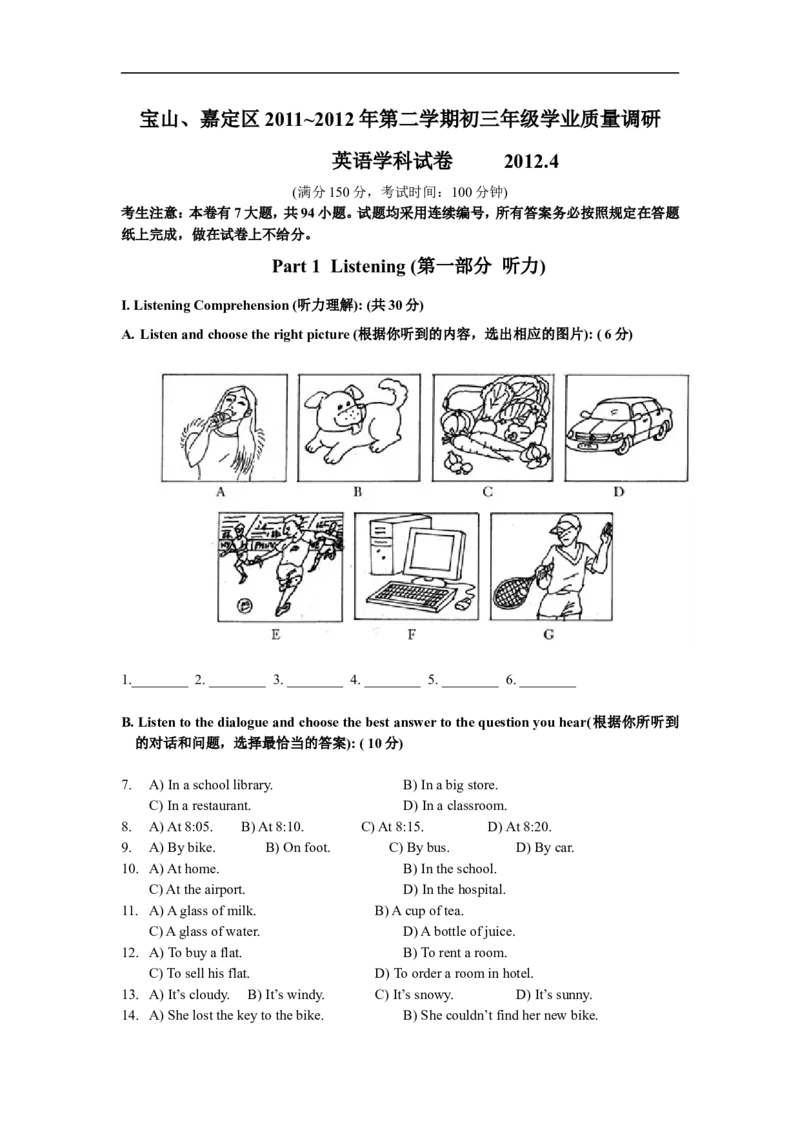
A. Listen and choose the right picture (根据你听到的内容,选出相应的图片): ( 6分)
1.________ 2. ________ 3. ________ 4. ________ 5. ________ 6. ________
B. Listen to the dialogue and choose the best answer to the question you hear(根据你所听到
的对话和问题,选择最恰当的答案): ( 10分)
7. A) In a school library. B) In a big store.
C) In a restaurant. D) In a classroom.
8. A) At 8:05. B) At 8:10. C) At 8:15. D) At 8:20.
9. A) By bike. B) On foot. C) By bus. D) By car.
10. A) At home. B) In the school.
C) At the airport. D) In the hospital.
11. A) A glass of milk. B) A cup of tea.
C) A glass of water. D) A bottle of juice.
12. A) To buy a flat. B) To rent a room.
C) To sell his flat. D) To order a room in hotel.
13. A) It’s cloudy. B) It’s windy. C) It’s snowy. D) It’s sunny.
14. A) She lost the key to the bike. B) She couldn’t find her new bike.C) She lost her handbag. D) She hadn’t enough money to buy food.
15. A) She will continue working hard. B) She will take an exam.
C) She will go over her lessons. D) She will have a rest.
16. A) Monday. B) Wednesday. C) Thursday. D) Tuesday.
C. Listen to the passage and tell whether the following statements are true or false (判断下列
句子是否符合你听到的短文内容, 符合的用“T”表示,不符合的用“F”表示): ( 7分)
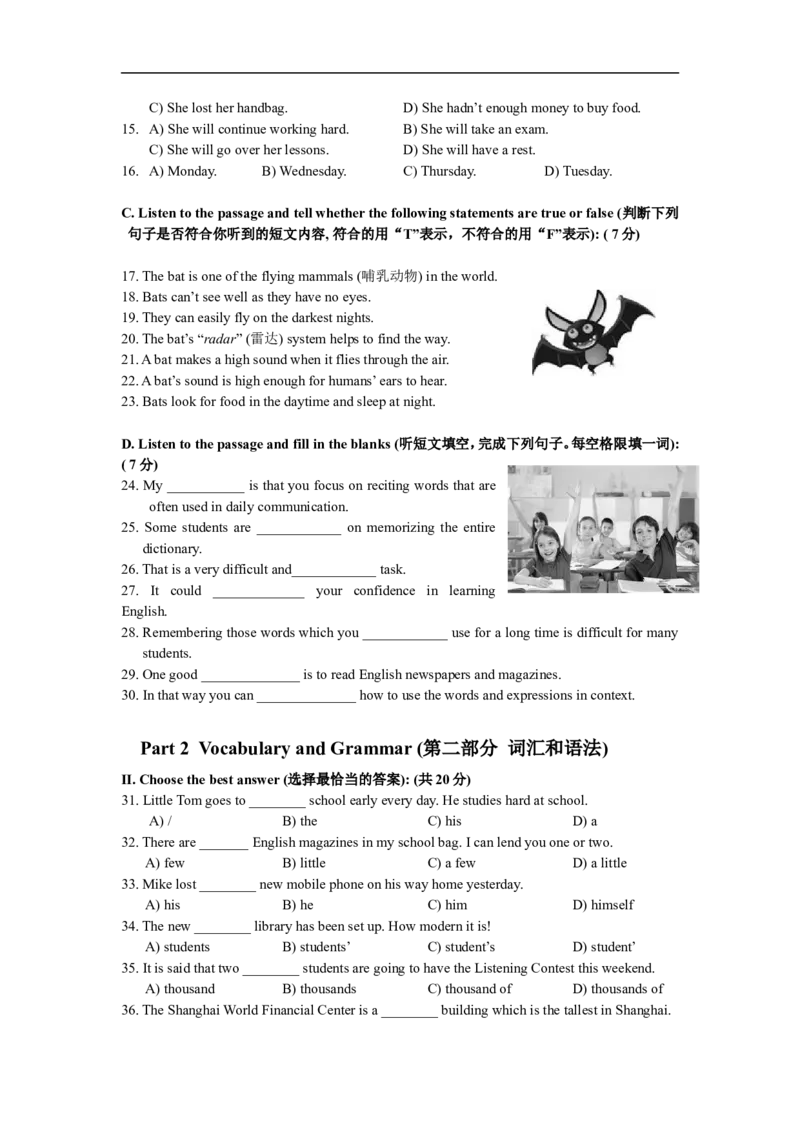
17. The bat is one of the flying mammals (哺乳动物) in the world.
18. Bats can’t see well as they have no eyes.
19. They can easily fly on the darkest nights.
20. The bat’s “radar” (雷达) system helps to find the way.
21. A bat makes a high sound when it flies through the air.
22. A bat’s sound is high enough for humans’ ears to hear.
23. Bats look for food in the daytime and sleep at night.
D. Listen to the passage and fill in the blanks (听短文填空,完成下列句子。每空格限填一词):
( 7分)
24. My ___________ is that you focus on reciting words that are
often used in daily communication.
25. Some students are ____________ on memorizing the entire
dictionary.
26. That is a very difficult and____________ task.
27. It could _____________ your confidence in learning
English.
28. Remembering those words which you ____________ use for a long time is difficult for many
students.
29. One good ______________ is to read English newspapers and magazines.
30. In that way you can ______________ how to use the words and expressions in context.
Part 2 Vocabulary and Grammar (第二部分 词汇和语法)
II. Choose the best answer (选择最恰当的答案): (共20分)
31. Little Tom goes to ________ school early every day. He studies hard at school.
A) / B) the C) his D) a
32. There are _______ English magazines in my school bag. I can lend you one or two.
A) few B) little C) a few D) a little
33. Mike lost ________ new mobile phone on his way home yesterday.
A) his B) he C) him D) himself
34. The new ________ library has been set up. How modern it is!
A) students B) students’ C) student’s D) student’
35. It is said that two ________ students are going to have the Listening Contest this weekend.
A) thousand B) thousands C) thousand of D) thousands of
36. The Shanghai World Financial Center is a ________ building which is the tallest in Shanghai.A) 492-meters tall B) 492-meter-tall C) 492-meters-tall D) 492 meters tall
37. My grandma felt ________ worse after taking such medicine.
A) much more B) even C) even more D) more
38. I ______ in London for many years, but I’ve never regretted my final decision to move back to
China.
A) lived B) was living C) have lived D) am living
39. Nobody ________ in our school reading room.
A) are allowed to speak loudly B) is allowed to speak loudly
C) allow to speak loudly D) allows to speak loudly
40. Remember ________ the new textbook here when you come next time.
A) to bring B) taking C) to take D) bringing
41. More and more people enjoy ______ NBA these days.
A) watch B) to watch C) watching D) watched
42. I was so sleepy that I could hardly keep my eyes ________.
A) opened B) to open C) open D) opening
43. Tim is always trying to ________ his wisdom in front of others.
A) show off B) put off C) set off D) turn off
44. My uncle had to sell his house even though it was ________ his own wishes.
A) for B) against C) with D) on
45. Mary had ________ a raincoat ________ an umbrella. So she had to wait until the rain
stopped yesterday.
A) neither… nor B) either… or
C) not only… but also D) both… and
46. A: What would some students like to do after finishing their education?
B: They would like to start to work ________ they needn’t depend on their parents.
A) as soon as B) so that C) if D) although
47. He didn’t tell us ______.
A) if he will give us a lecture B) whether he would go with you
C) when would he start D) when he will arrive
48. ________ useful the information they’ve given to us is!
A) What B) What a C) How the D) How
49. Kitty is not the same as her sister. The underlined part means “_______________”.
A) doesn’t agree with B) is different from
C) doesn’t like D) is similar to
50. A: Long time no see. What’s new?
B: _________
A) How do you do! B) How are you?
C) Nice to meet you! D) Hi, I’ve bought a new house.
III. Complete the following passage with the words or phrases in the box. Each one can only
be used once(将下列单词或词组填入空格。每空格限填一词,每词或词组只能填一次):
(共8分)A. laughs B. old C. driver’s D. hardly E. nothing
F. joy G. trouble H. hard I. succeeds
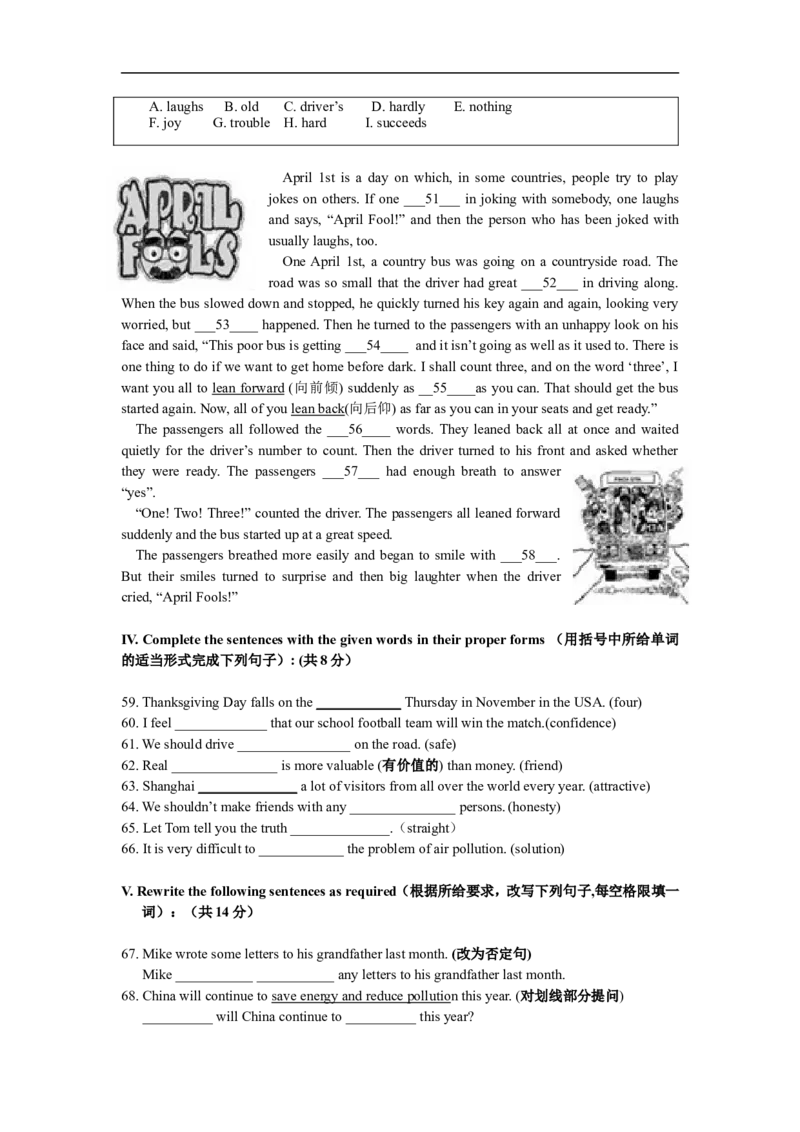
April 1st is a day on which, in some countries, people try to play
jokes on others. If one ___51___ in joking with somebody, one laughs
and says, “April Fool!” and then the person who has been joked with
usually laughs, too.
One April 1st, a country bus was going on a countryside road. The
road was so small that the driver had great ___52___ in driving along.
When the bus slowed down and stopped, he quickly turned his key again and again, looking very
worried, but ___53____ happened. Then he turned to the passengers with an unhappy look on his
face and said, “This poor bus is getting ___54____ and it isn’t going as well as it used to. There is
one thing to do if we want to get home before dark. I shall count three, and on the word ‘three’, I
want you all to lean forward (向前倾) suddenly as __55____as you can. That should get the bus
started again. Now, all of you lean back(向后仰) as far as you can in your seats and get ready.”
The passengers all followed the ___56____ words. They leaned back all at once and waited
quietly for the driver’s number to count. Then the driver turned to his front and asked whether
they were ready. The passengers ___57___ had enough breath to answer
“yes”.
“One! Two! Three!” counted the driver. The passengers all leaned forward
suddenly and the bus started up at a great speed.
The passengers breathed more easily and began to smile with ___58___.
But their smiles turned to surprise and then big laughter when the driver
cried, “April Fools!”
IV. Complete the sentences with the given words in their proper forms (用括号中所给单词
的适当形式完成下列句子): (共8分)
59. Thanksgiving Day falls on the ____________ Thursday in November in the USA. (four)
60. I feel _____________ that our school football team will win the match.(confidence)
61. We should drive ________________ on the road. (safe)
62. Real _______________ is more valuable (有价值的) than money. (friend)
63. Shanghai ______________ a lot of visitors from all over the world every year. (attractive)
64. We shouldn’t make friends with any _______________ persons.(honesty)
65. Let Tom tell you the truth ______________.(straight)
66. It is very difficult to ____________ the problem of air pollution. (solution)
V. Rewrite the following sentences as required(根据所给要求,改写下列句子,每空格限填一
词):(共14分)
67. Mike wrote some letters to his grandfather last month. (改为否定句)
Mike ___________ ___________ any letters to his grandfather last month.
68. China will continue to save energy and reduce pollution this year. (对划线部分提问)
__________ will China continue to __________ this year?69. Uncle Tom grows tomatoes in the field every year.(改为被动语态)
Tomatoes __________ __________ by Uncle Tom in the field every year.
70. Jane didn’t tell me where we should meet tomorrow. (改为简单句)
Jane didn’t tell me __________ __________ meet tomorrow.
71. “Do you prefer the red skirt to the blue one, Mary?” asked her mother. (改为宾语从句)
Mary’s mother asked Mary ____________ she ____________ the red skirt to the blue one.
72. The milk will go bad, so you’d better put it into the fridge. (保持原句意思)
The milk will go bad __________ you __________ put it into the fridge.
73.The mountain is 5,300 metres high. (保持原句意思)
The mountain is 5,300 metres ___________ _____________.
Part 3 Reading and Writing ( 第三部分 读与写 )
VI. Reading Comprehension (阅读理解):(共50分)
A)Choose the best answer(根据短文内容,选择最恰当的答案): ( 12分)
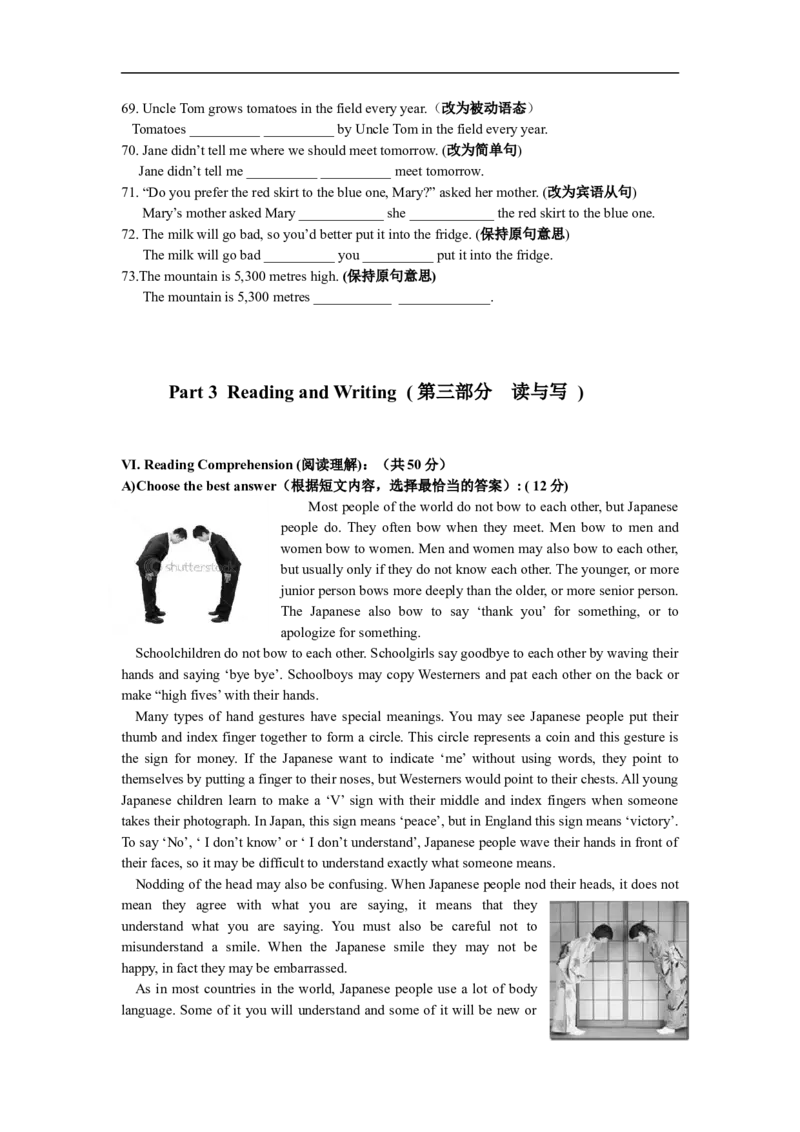
Most people of the world do not bow to each other, but Japanese
people do. They often bow when they meet. Men bow to men and
women bow to women. Men and women may also bow to each other,
but usually only if they do not know each other. The younger, or more
junior person bows more deeply than the older, or more senior person.
The Japanese also bow to say ‘thank you’ for something, or to
apologize for something.
Schoolchildren do not bow to each other. Schoolgirls say goodbye to each other by waving their
hands and saying ‘bye bye’. Schoolboys may copy Westerners and pat each other on the back or
make “high fives’ with their hands.
Many types of hand gestures have special meanings. You may see Japanese people put their
thumb and index finger together to form a circle. This circle represents a coin and this gesture is
the sign for money. If the Japanese want to indicate ‘me’ without using words, they point to
themselves by putting a finger to their noses, but Westerners would point to their chests. All young
Japanese children learn to make a ‘V’ sign with their middle and index fingers when someone
takes their photograph. In Japan, this sign means ‘peace’, but in England this sign means ‘victory’.
To say ‘No’, ‘ I don’t know’ or ‘ I don’t understand’, Japanese people wave their hands in front of
their faces, so it may be difficult to understand exactly what someone means.
Nodding of the head may also be confusing. When Japanese people nod their heads, it does not
mean they agree with what you are saying, it means that they
understand what you are saying. You must also be careful not to
misunderstand a smile. When the Japanese smile they may not be
happy, in fact they may be embarrassed.
As in most countries in the world, Japanese people use a lot of body
language. Some of it you will understand and some of it will be new orconfusing to you.
74.Japanese people bow ___________
A) occasionally B) sometimes C) often D) never
75.Japanese men and women __________bow to each other___________.
A) usually… when they know each other B) always… when they first meet each other
C) usually… when they first meet each other D) always… when they know each other
76.When Japanese people point to their noses it means____________.
A) they need to blow their noses B) there is a bad smell
C) they are lying D) they are talking about themselves
77.When a Japanese person nods, it may mean____________.
A) ‘I am happy’ B) ‘I agree’ C) ‘I understand’ D) ‘I disagree’
78.Some body language used in Japan is___________.
A) international B) Italian C) childish D) only used at home
79. The Japanese_____________.
A) don’t like using body language B) don’t use much body language
C) only use Western body language D) use a lot of body language
B) Choose the words or expressions to complete the passage(选择最恰当的单词或词语,完成
短文): (12分)
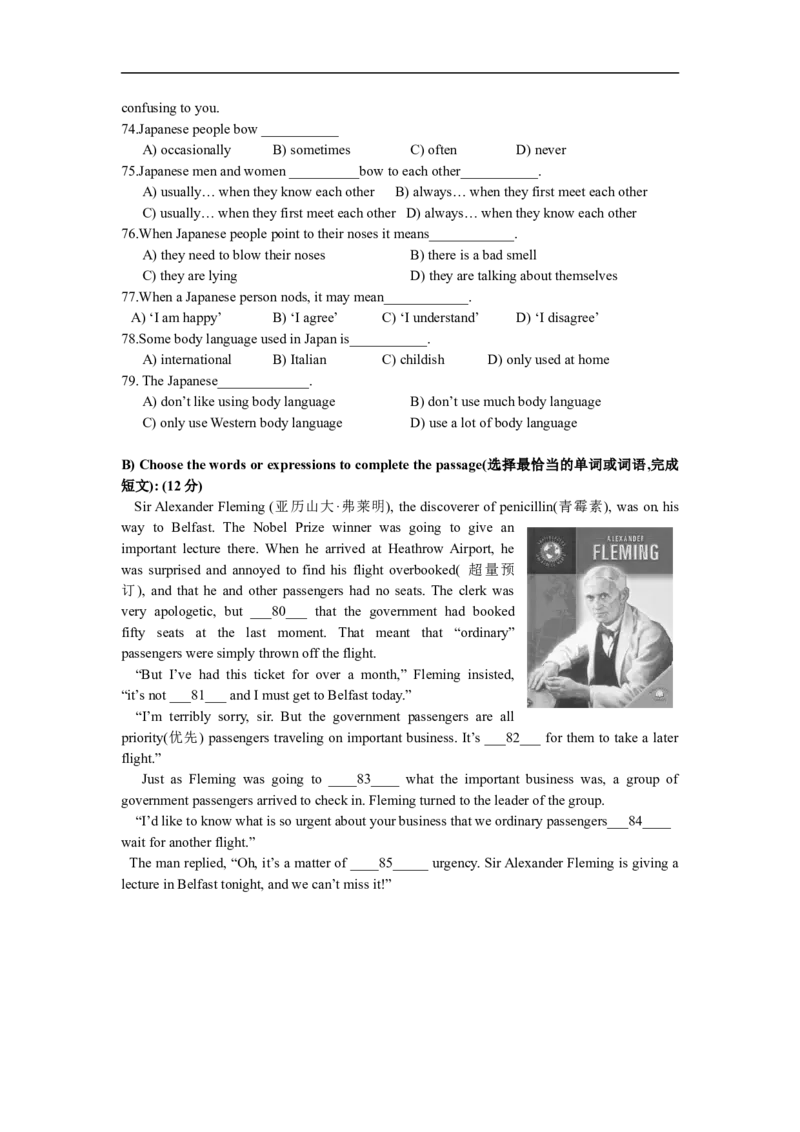
Sir Alexander Fleming (亚历山大·弗莱明), the discoverer of penicillin(青霉素), was on his
way to Belfast. The Nobel Prize winner was going to give an
important lecture there. When he arrived at Heathrow Airport, he
was surprised and annoyed to find his flight overbooked( 超量预
订), and that he and other passengers had no seats. The clerk was
very apologetic, but ___80___ that the government had booked
fifty seats at the last moment. That meant that “ordinary”
passengers were simply thrown off the flight.
“But I’ve had this ticket for over a month,” Fleming insisted,
“it’s not ___81___ and I must get to Belfast today.”
“I’m terribly sorry, sir. But the government passengers are all
priority(优先) passengers traveling on important business. It’s ___82___ for them to take a later
flight.”
Just as Fleming was going to ____83____ what the important business was, a group of
government passengers arrived to check in. Fleming turned to the leader of the group.
“I’d like to know what is so urgent about your business that we ordinary passengers___84____
wait for another flight.”
The man replied, “Oh, it’s a matter of ____85_____ urgency. Sir Alexander Fleming is giving a
lecture in Belfast tonight, and we can’t miss it!”80. A) insisted B) spoke C) told D) explained
81. A) fair B) right C) true D) real
82 A) reasonable B) funny C) impossible D) unnecessary
83.A) know B) discuss C) require D) asked
84.A) must B) should C) ought D) have to
85.A) little B) great C) some D) bit
C) Read the passage and fill in the blanks with proper words (在短文的空格内填入适当的词,
使内容通顺, 每空格限填一词,首字母已给): (14分)
Sleep is not the same every night. We experience some deep sleep
and some active sleep(积极睡眠), which is when dreams happen. You
might think sleepwalking(梦游) would happen in active sleep, but a
person isn't physically active d_____86____ active sleep. Sleepwalking
usually happens in the first few hours of sleep in the stage called slow-
wave(慢波) or deep sleep. Not all sleepwalkers a____87_____ walk.
Some simply sit up or stand in bed or act like they're awake when, in
fact, they're asleep! Most, however, do get up and move around for a
few seconds or for as long as half an hour.
Sleepwalkers' e____88____ are open, but they don't see the same way they do when they're
awake and often think they're in different rooms of the house or different places altogether.
Sleepwalkers tend (往往会) to go back to bed on their own and they won't r____89_____ it in the
morning. Doctors say sleepwalking sometimes occurs when a person is sick, has a fever, is not
getting e____90____ sleep, or is stressed. If sleepwalking occurs frequently, every night or so, it's
a good idea for your mom or dad to take you to see your doctor. But occasional(偶然的)
sleepwalking generally isn't something to worry about, a___91___ it may look funny or even
scary(惊恐的)for the people who see a sleepwalker in action.
It's important, of course, that the person is kept safe. Precautions(预防措施) should be
t____92_____ so the person is less likely to fall down, run into something, or walk out the front
door while sleepwalking.
D) Answer the questions (根据短文内容回答下列问题):(12分)
The Japanese are well known to have some of the longest life
expectancies(长寿) in the world. They also enjoy the lowest
obesity(肥胖症)rate in the developed countries. What’s their
secret? Their healthy diet contributes a lot.
“Eating” with your eyes
An important feature of the Japanese diet is the visual appeal(视
觉吸引) of food. Food with attractive appearance is presented
on pretty little dishes and plates. This way of dining encourages you to “eat” with your eyes, by
enjoying the beauty of the food. The result is that you slow down to savor(品尝)every bite,
which means eating less, because it gives your brain time to realize you’re full.
Smaller portions(量)
In Japan, food is served on separate small plates and in bowls instead of on one big plate.
Diners take turns having a little taste of everything. Serving smaller portions may be one of thebest secrets for healthy eating and weight loss. Research shows that when we’re served more, we
tend to eat it—whether we are hungry or not.
Vegetable craze
Japanese prefer fresh vegetables and fruits. Lots of fresh vegetables and fruits are eaten daily in
the Japanese diet. Japan is kind of a “vegetable-crazed”(嗜蔬菜如命的)nation. When Japanese
women were asked which home-cooked meals they most loved to prepare for their families“mixed
vegetable simmered(炖)in soup” came out on top. Green beans, onions, tomatoes, green peppers,
cabbage, broccoli, cauliflower, sweet potatoes all have a place in the Japanese diet. Vegetables are
served simmered in soup, stir—fried(炒)in a small bit of canola oil(菜油)or lightly steamed(清
蒸). All these methods keep a maximum amount of nutrients(营养成分).
Plenty of fish
Japanese eat a lot of fish. Japan account fo(r 占…比例)only 2% of the world’s population,but
its people eat 10% of the world’s fish. Fish, especially fatty fish, for example, salmon(三文鱼)
and tuna(金枪鱼)are Japanese favorites. Eating a lot of fish help them to reduce the risk of heart
disease.
93. What lowest rate do Japanese have in the developed countries?
94. What is an important feature of the Japanese diet?
95. How many special points about the Japanese diet are mentioned in the passage?
96. Food is not served on one big plate in Japan, is it?
97. Why do Japanese eat a lot of fish?
98. What is your view on the Japanese diet?
VII. Writing (作文): (共20分)
99.Write a passage of at least 60 words on the topic “What’s Your View on Fast Food?”.
( 以“你对快餐的看法”为题写一篇不少于60个词的短文,标点符
号不占格。)
Use the following points as a reference. (以下问题仅供参考)
1)Why is fast food so popular in China?
2)What do you think of fast food?
(注意:短文中不得出现任何人名、校名及其它相关信息,否则不予评分。)宝山、嘉定区2011~2012 年第二学期初三年级学业质量调研
英语学科试卷
Part 1 Listening (第一部分 听力)
I. Listening Comprehension (听力理解): (共30分)
A. Listen and choose the right picture (根据你听到的内容,选出相应的图片): ( 6分)
1. Playing tennis is my favorite sport. (G)
2. How much did you pay for the computer? (F)
3. Dogs are man’s best friends. (B)
4. Owning a private car is expensive. (D)
5. My sister is good at singing. (A)
6. People should have more fruit and vegetables to keep fit. (C)
B. Listen to the dialogue and choose the best answer to the question you hear(根据你所听到
的对话和问题,选择最恰当的答案): ( 10分)
7. M: Can I have some salt in my soup?
W: Yes, of course. It is on the shelf. I’ll get it for you. Help yourself.
Q: Where does the dialogue most probably take place? (C)
8. M: I’m sorry, Miss Li. I’m late.
W: What’s wrong, John? It’s a quarter past eight. You are ten minutes late for class.
M: I failed to catch the underground I usually take.
Q: What time did the class begin? (A)
9. M: Hi, Alice. You came to work by car today, didn’t you?
W: Yes, I did. I got up late this morning.
M: I had to walk all the way here today.
W: You usually come to work by bike, right?
M: Yes, but my bike is broken now.
Q: How did the man go to work today? (B)
10. M: Hi, mother, I am here. You have waited for me for hours, haven’t you?
W: Yes. I’ve been here at the airport for almost two hours. Your plane is an hour late.
M: Sorry for keeping you waiting for a long time.
Q: Where are they? (C)
11. W: Hi, Mike. Which would you like, a cup of tea or a glass of milk?
M: Neither, thanks.
W: Then would you like a glass of water?
M: Yes, please.
Q: Which would Mike like to drink? (C)
12. M: I’ve been told that you might have a spare room.
W: Yes, I have two empty rooms to rent.
M: How much is the rent for one room?
W: Nine hundred yuan a month, not including water and electricity.
M: May I come in and have a look?
Q: What does the man want to do? (B)13. M: It’s cloudy outside.
W: What’s the weather report for tomorrow?
M: The temperature is going to drop to below zero, and it’ll snow.
W: Any idea when the weather will improve?
M: It might be fine by this weekend.
Q: How is the weather today? (A)
14. W: Excuse me, sir. I can’t find my bike now. I put it in front of a food shop before I went in.
M: No hurry! Would you please tell me a little more about it?
W: OK. It’s a new bike. It’s red. It’s only for women.
M: Don’t worry too much! I’ll try to find it for you as soon as possible.
Q: What happened to the girl? (B)
15. M: You must have a rest, Lucy. You really have worked too hard these days.
W: But how can I? The exam is coming next Monday.
M: Oh, don’t worry. Couldn’t you rest just this afternoon?
W: All right, if you really think so.
Q: What does Lucy mean by the last sentence?(D)
16. W: Why not go to visit the Science Museum today, David?
M: I’m afraid we can’t. It opens only from 2:00 to 5:00 on Wednesday afternoon.
W: You mean we have to wait until the day after tomorrow.
Q: What day is it today?(A)
C. Listen to the passage and tell whether the following statements are true or false (判断下列
句子是否符合你听到的短文内容, 符合的用“T”表示,不符合的用“F”表示): ( 7分)
Bats are the only flying mammals in the world. They can't see very well. It was long believed
that all bats are blind, and still in many places, we can often say "as blind as a bat".
Yet they have no trouble flying on the darkest nights and finding their way home very well.
How can bats fly and see at night? They fly by radar.
The bat's radar system works the same way as the one that ships and planes use. When a bat
flies through the air, he makes a high sound. It is too high for our ears to hear. If the sound hits
things, it comes back. The bat's ears receive the sound. In this way they are able to tell where the
things are.
Bats go out to look for food at night. During the day-time they hang in some dark places. Some
people don’t think the bats are good animals. In fact, they are useful animals.
17. F 18. F 19. T 20. T 21. T 22. F 23. F
D. Listen to the passage and fill in the blanks (听短文填空,完成下列句子。每空格限填一词):
( 7分)
Students often complain about the difficulty of remembering English vocabulary. My
suggestion is that you focus on reciting words that are often used in daily communication. Some
students are working on memorizing the entire dictionary. That is a very difficult and boring task.
It could reduce your confidence in learning English and take the fun out of it.
Another point is that memorizing vocabulary should be related with daily reading.
Remembering those words which you seldom use for a long time is difficult for many students. It
is better to read some articles and books in English to enlarge your vocabulary and make it solid.
One good choice is to read English newspapers and magazines, such as Times, China Daily, and21st Century. In that way you can understand how to use the words and expressions in context.
My final suggestion is to choose your own way of memorizing vocabulary. No matter which
method you use, it helps if you keep in mind the important prefixes and suffixes.
24.suggestion 25.working 26.boring 27.reduce 28.seldom 29.choice 30. understand
Part 2 Vocabulary and Grammar (第二部分 词汇和语法)
II. Choose the best answer (选择最恰当的答案): (共20分)
31. A 32. C 33.A 34. B 35. A 36. B 37. B 38.A 39. B 40. A 41. C
42. C 43. A 44.B 45. A 46. B 47. B 48. D 49.B 50. D
III. Complete the following passage with the words or phrases in the box. Each one can only
be used once(将下列单词或词组填入空格。每空格限填一词,每词或词组只能填一次)(: 共8
分)
51. I 52. G 53. E 54.B 55.H 56.C 57. D 58.F
IV. Complete the sentences with the given words in their proper forms (用括号中所给单词
的适当形式完成下列句子): (共8分)
59. fourth 60. confident 61. safely 62. friendship
63. attracts 64. dishonest 65.straight 66.solve
V. Rewrite the following sentences as required(根据所给要求,改写下列句子,每空格限填一
词):(共12分)
67. didn’t write 68. What…do 69. are grown 70. where to
71. if/whether… preferred 72. if…don’t 73. in height
Part 3 Reading and Writing ( 第三部分 读与写 )
VI. Reading Comprehension (阅读理解):(共50分)
A)Choose the best answer(根据短文内容,选择最恰当的答案): ( 12分)
74. C 75. C 76. D 77. C 78. A 79. D
B) Choose the words or expressions to complete the passage(选择最恰当的单词或词语,完成
短文): (12分)
80. D 81. A 82. C 83. C 84. D 85. B
C) Read the passage and fill in the blanks with proper words (在短文的空格内填入适当的词,
使内容通顺, 每空格限填一词,首字母已给): (14分)
86. during 87.actually 88.eyes 89.remember 90.enough 91. although 92.taken
D) Answer the questions (根据短文内容回答下列问题):(12分)
93.The lowest obesity.
94.The visual appeal of food.
95.Four.
96.No, it isn’t.
97.Because it can help them to reduce the risk of heart disease.
98.I think that the Japanese diet is both balanced and healthy./It does much good to our health.
VII. Writing (作文): (共20分)
99.Write a passage of at least 60 words on the topic “What’s Your View on Fast Food?”.
( 以“你对快餐的看法”为题写一篇不少于60个词的短文,标点符号不占格。)
参考范文
What’s Your View on Fast Food?Fast food is becoming more and more popular in China, especially among children and teenagers.
There are several reasons for its popularity. First, it is very convenient and saves a lot of time.
Second, you can either eat it there or take it away. Third, the environment of fast food restaurants
is both clean and comfortable. However, fast food is usually not a balanced diet and low in
nutritional value. In my opinion, fast food is only a good choice when you are in a hurry and turn
to it once in a while. It’s good for people, especially children, to eat as little fast food as possible.
附写作评分标准:
作文共20分,其中内容8分,语言8分,组织结构分4分。
(一) 内容:
8分 内容切题,意思连贯,表达清楚、完整。
5-7分 内容基本切题,意思大致连贯,表达基本清楚,但不够完整。
3-4分 内容不够切题,意思不够连贯,表达不够清楚、离题目要求较远。
0-2分 文不对题,表达不清。
(二) 语言:
1) 拼写:每错扣0.5分,同一错误不重复计数。
2) 语法:同1)
3) 标点符号,大小写:每两处错误扣0.5分,但标点符号和大小写的扣分总和均不得超
过一分。
4) 语言分最多扣8分。
(三) 组织结构:
1) 内容充实、不写废话;上下文连贯、用语规范、表达准确、无或少见语法错误;词汇
和句型句式运用恰当,多见好句型和习惯表达用语者,可给4分。
2) 一般情况下,内容和语言累积得分在14分以上者(含),方可得到4分组织结构分。
3) 内容和语言累积不足14分者,如文中有值得肯定的好的句型和表达,可酌情考虑
给1-3分组织结构分。
4) 通篇句型、句式单一,词汇贫乏者,即使无语法错误,一般亦不给组织结构分。
(四) 词数
1) 词数不足30者,得分最多不得超过9分;
2) 词数不足40者,得分最多不得超过12分;
3) 词数不足50者,得分最多不得超过15分;
4) 词数在50-59词之间者,每少5个词扣0.5分。
5) 只写出个别单词、词不成句不给分。