宝山、嘉定区2013~2014年第二学期初三年级学业质量调研
英语学科试卷 2014.4
(满分150分,考试时间:100分钟)
考生注意:本卷有7大题,共94小题。试题均采用连续编号,所有答案务必按照规定在答题
纸上完成,做在试卷上不给分。
Part 1 Listening (第一部分 听力)
I. Listening comprehension (听力理解) (共30 分)
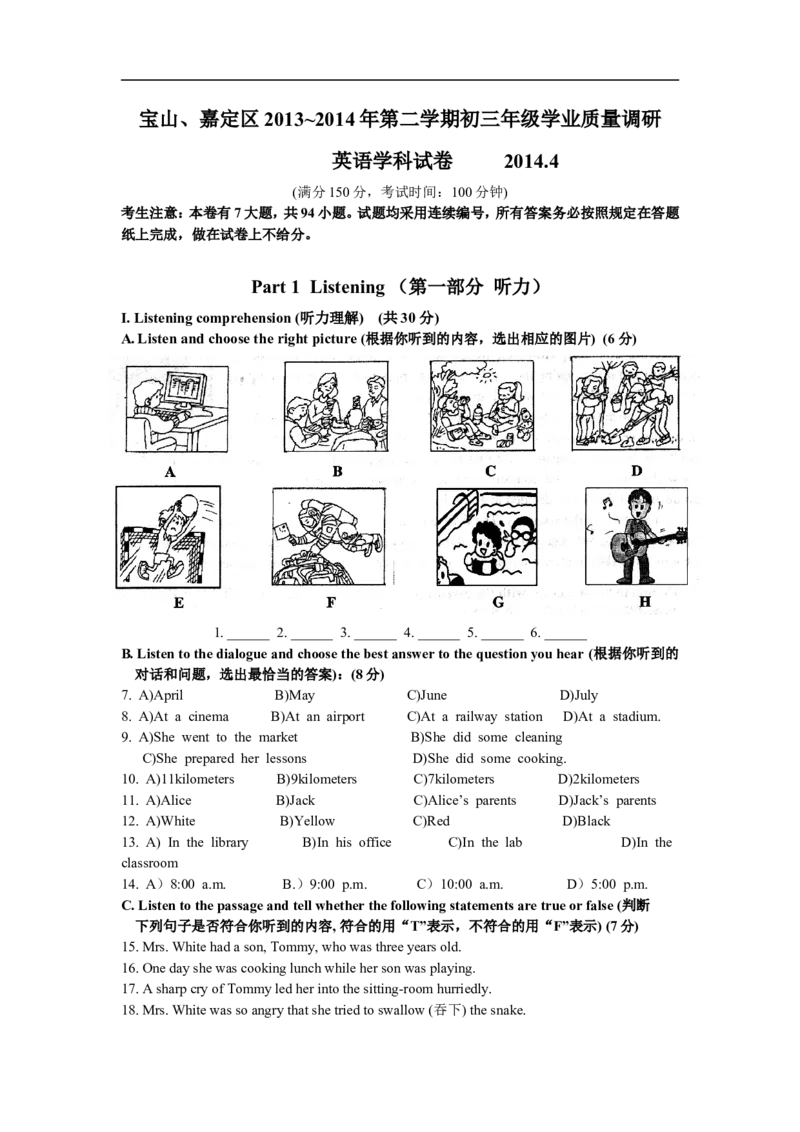
A. Listen and choose the right picture (根据你听到的内容,选出相应的图片) (6 分)
1. ______ 2. ______ 3. ______ 4. ______ 5. ______ 6. ______
B. Listen to the dialogue and choose the best answer to the question you hear (根据你听到的
对话和问题,选出最恰当的答案):(8分)
7. A)April B)May C)June D)July
8. A)At a cinema B)At an airport C)At a railway station D)At a stadium.
9. A)She went to the market B)She did some cleaning
C)She prepared her lessons D)She did some cooking.
10. A)11kilometers B)9kilometers C)7kilometers D)2kilometers
11. A)Alice B)Jack C)Alice’s parents D)Jack’s parents
12. A)White B)Yellow C)Red D)Black
13. A) In the library B)In his office C)In the lab D)In the
classroom
14. A)8:00 a.m. B.)9:00 p.m. C)10:00 a.m. D)5:00 p.m.
C. Listen to the passage and tell whether the following statements are true or false (判断
下列句子是否符合你听到的内容, 符合的用“T”表示,不符合的用“F”表示) (7分)
15. Mrs. White had a son, Tommy, who was three years old.
16. One day she was cooking lunch while her son was playing.
17. A sharp cry of Tommy led her into the sitting-room hurriedly.
18. Mrs. White was so angry that she tried to swallow (吞下) the snake.19. Mrs. White hit the snake at its head with a big stone madly.
20. In the end the boy was saved and the snake was killed.
D. Listen to the passage and complete the following sentences(听短文,完成下列内容。每空
格限填一词)(7分)
21. Even as a child, Hans Christian Andersen always loved the arts, and he __________
__________ when he was 14 years old in 1819 to make his fortune.
22. Hans Christian Andersen was an artist, a singer, and an actor, but he was not __________
__________ at first until he found his talent in writing fairy tales.
23. Hans Christian Andersen's first book of fairy tales was published in 1835, and he
__________ __________ with many other volumes of children's stories, almost one a year,
right up till 1872.
24. In his lifetime, Hans Christian Andersen wrote more than one hundred and fifty fairy tales, and
his stories have been __________ into over 100 __________!
25. Hans Christian Andersen's stories teach us that appearances can tell __________, and that
there is a magical beauty even __________ the most ugly people.
Part 2 Phonetics, Vocabulary and Grammar
(第二部分 语音,词汇和语法)
II.Choose the best answer (选择最恰当的答案) :(共20分)
26. When I was young, I always read books at night. Which of the following is correct for the
underlined word in the sentence?
27. Which of the following underlined parts is different in pronunciation from others?
A) He acts as a killer in the film. B) When did you arrive at the airport?
C) Can you help me fix the chair? D) What did you think of the final exam?
28. ______ man with black glasses is my host father in Britain.
A) An B) A C) The D) /
29. In our English class, the English teacher asked us to stand up and introduce ______.
A) we B) us C) our D) ourselves
30. Helen was too angry to say ______.
A) nothing B) something C) anything D) everything
31. We'll have a ______ holiday. Let's go to the beach, shall we?
A) three-day B) three days C) three-days D) three-days'
32. An e-mail address consists ______ letters and dots and the symbol '@'.
A) in B) of C) for D) with
33. We felt very ______ after we watched the ______ football matches in FIFA.
A) exciting...excited B) exciting...exciting
C) excited...exciting D) excited...excited
34. It's ______ to send an e-mail than a regular mail.
A) more quickly B) much quickly C) much quicker D) quick
35. A lot of people will help you, so you ______ worry about the money.A) can't B) needn't C) mustn't D) couldn't
36. - Why do Chinese people like red?
- Because they think it can ______ them good luck.
A) carry B) bring C) take D) fetch
37. I'm glad you've come back from the United States. Please tell me how long you ______ there.
A) have stayed B) had stayed C) have been staying D) stayed
38. Some questions ______ at their class meeting last Week.
A) raised B) rose C) were risen D) were raised
39. My cousin was born in China, but ______ in Australia.
A) picked up B) gave up C) grew up D ) took up
40. What are you going to do when you finish ______ the room?
A) to clean B) cleaning C) clean D) cleaned
41. We'll make laws ______ our environment.
A) protected B) protecting C) to protect D) protect
42. He didn't tell us ______.
A) if he will give us a lecture B) whether he would go with you
C) when he has started D) when he will arrive
43. ______ important computers are to everybody in a modern city!
A) What B) How C) What an D) How an
44. The weather there isn't nice, ______?
A) is there B) is it C) isn't there D) isn't it
45. - Would you mind waiting outside for a moment?
- ______
A) Never mind B) So do I C) Certainly not D) You are welcome
III. Complete the following passage with the words or phrases in the box. Each can only be
used once. (将下列单词或词组填入空格。每空限填一词,每词只能填一次) (共8分)
A. reader B. used to C. sitting D. who E. reporter
A young woman got on a bus, carrying her three-year-old baby. The conductor hurried to
give her a warm welcome and then kindly asked the other passengers to make room for the
woman and her child. On seeing this, people began to talk.
"You know this conductor 46 be very rude. Now suddenly he has changed his bad behavior,"
said a middle-aged man.
"Yes, he should be praised and we must write a letter to the company," said a second passenger.
"That's right," another lady said. "If a newspaper 47 is here, more people can learn from him.'
Just then a gentleman 48 looked like a teacher turned to the conductor and said, "Excuse me,
but can I know your name, please? Your excellent service should be praised..."
Before he could open his mouth, the three-year-old child 49 on the young woman's lap
interrupted, "I know his name. I call him Dad."
A. as usual B. difficult C. well D. properly E. out of
I had to make a big decision. Five years ago, I was working for a small engineering company.
However, things were not going very well for the company and it was losing money. One day the
boss told us that the company was 50 business. We were all unemployed.
That lunch time we went to the pub 51 . We were all very sad. Well, of course we talked
about the problem. Then the landlord of the pub heard the news. He said: "Why don't you buy the
company?" At first we all laughed, but then we started to discuss it 52 . We knew the problems.The company had lost a lot of customers because it hadn't developed new products. But finally we
decided to go for it.
So we bought the company. The first few years were very 53 . But we worked hard and we
had a bit of luck. We began to improve three years ago. Since then we have done pretty well. Last
year we took on (招聘) four new people and so far this year we have taken on another ten.
IV. Complete the sentences with the given words in their proper forms(用括号中所给单词
的适当形式完成下列句子) (共8分)
54. The film on detectives is so interesting that Tim has already seen it __________. (two)
55. I am sure George is able to make a real car by __________. (he)
56. If you want to keep __________, you should do some exercise every day. (health)
57. "Take care of yourself," my mother said __________ to me. (gentle)
58. Shanghai is now very modern. Many foreigners will become the __________ of Shanghai in
the future. (city)
59. The soup is good for you. It is a __________ of different kinds of vegetables. (mix)
60. Please __________ the milk in the microwave before you drink it. (heat)
61. They won't publish Johnson's report unless he __________ it. (write)
V. Rewrite the following sentences as required(根据所给要求,改写下列句子。每空格限填一
词) (共14分)
62. Mr. Brown wants to buy a new car. (改为一般疑问句)
__________ Mr. Brown __________ to buy a new car?
63. The members of the film club meet once every month. (对划线部分提问)
__________ __________ do the members of the film club meet?
64. They sent the children a lot of presents on Children's Day. (改为被动语态)
A lot of presents __________ __________ to the children on Children's Day.
65. There is no juice in the fridge. (改为反意疑问句)
There is no juice in the fridge, __________ __________?
66. Could you show me how I should operate the machine? (改为简单句)
Could you show me __________ __________ operate the machine?
67. In order to earn enough money, Mr. Smith worked late into the night. (保持句意基本不变)
Mr. Smith worked late into the night __________ __________ he could earn enough money.
68. interesting, seen, he, just, very, film, a, has (连词成句)
________________________________________________________________________
Part 3 Reading and Writing
(第三部分 读与写)
IX. Reading Comprehension (阅读理解):(共50分)
A. Choose the best answer (根据文章内容,选择最恰当的答案):(12分)
Pubs are an important part of British life. Pubs, formally public houses, are common in towns
and villages in England. People usually talk, eat, drink, meet their Mends and relax there. You can
order soft drinks like orange juice, cola or coffee, but many people go to pubs to have an alcoholic
drink. Many types of alcoholic drinks are available, but the most popular drink is beer.Traditional English beer comes in a variety of local flavours and is called "draught Deer. All
draught beers are served from a hand pump on the bar rather than in bottles or cans. Unlike
American or other European beers, it is served cool but not cold. Nowadays, a lot of English
people enjoy a European beer called lager (淡味啤酒). This is lighter, more refreshing (清新的)
and is served cold. Beer is sold in pint or half-pint glasses (a pint is just over half a litre ). When
you order a drink, ask for a 'pint' or a 'half' of the beer you want to try.
There is no waiter service in an English pub. You go to the bar and place your order to the bar
staff. They will pour your drinks and pass them to you. They will then tell you how much to pay.
You have to pay for your drinks there and then. After receiving your change, you can carry your
drinks back to a table to enjoy. It is usual for friends to take turns buying drinks for each other.
This is known as 'buying a round'.
Pubs sell cheap food too. The choice of food ranges (设计) from small bar snacks such as crisps
and peanuts, to three-course meals. A popular meal during the summer months is a 'ploughman's
lunch'. This is a dish of bread, cheese or ham, and salad which is served cold. You will often find
a pub's menu written on a blackboard. There may even be daily specials for you to try.
You must be at least 18 years old to buy alcohol (含酒精的饮料) in England. Children under
14 years old are not usually allowed inside a pub, but families with children can sit outside in the
garden, known as the beer garden, when the weather is warm. Parents are allowed to buy soft
drinks for their children.
Pubs are places where people go to enjoy themselves. People like to drink, eat, talk with friends
and have a good time. If you go to an English pub, you will get a true taste of English life.
69. Traditional English beer is ______.
A) served slightly cold B) served in pint glasses only
C) served by waiters D) called lager
70. The bar staff ______.
A) are called waiters B) expect you to tip them
C) pour your drinks before you pay D) pour your drinks after you pay.
71. If you 'buy a round', you ______.
A) pay for your drinks at the end of a meal B) taste a variety of beers
C) share the cost of drinking with friends C) pay for your own drinks
72. Pub food ______.
A) is cheese or ham B) doesn't cost much money
C) is called a 'bar snack' D) is special English meal
73. Children ______.
A) are allowed in pubs B) cannot drink alcohol
C) must not eat pub food D) must buy rounds of drinks
74. English pubs ______.
A) serve only alcoholic drinks B) are for families only
C) serve both food and drink D) are no longer common in England
B. Choose the words or expressions and complete the passage(选择最恰当的单词或词语完
成短文)(12分)
"Uncle Sam" is usually used to refer to the United States or the US government. It is the
nickname of the country. It is hard to believe that this nickname became known quite by accident
and there was a man 75 "Uncle Sam." However, not many people have ever heard of such aman. Not even most young Americans.
The man was called Samuel Wilson. He was born in Arlington, Massachusetts, September 13,
1776. At the age of 14 Sam joined the American Revolutionary (美国革命) War, and 76 in the
army under George Washington until the end of the war. He then moved to Troy, New York State,
and began a meatpacking business. He earned a reputation (赢得了声誉) for being honest and
hard working. He was locally respected and admired, thus greeted as Uncle Sam.
One day in 1812, a group of visitors came to Sam's meatpacking plant (肉类加工厂). Among
them was Government official. He 77 the capitalized letters (大写字母) EAUS on the packages
of meat and asked what they stood for. A worker replied that EA stood for Elbert Anderson, the
businessman for whom Sam was working. And he added 78 that US (actually it was the short
form for United States) stood for Uncle Sam Wilson. Soon soldiers were saying all army supplies
were from "Uncle Sam".
In May 1813, this story appeared in a newspaper published in New York. Since Uncle Sam was
an example of a hard-working man and a lover of America, the idea of "Uncle Sam" as the name
of this kind of man became well-known rapidly. Uncle Sam was ready to help 79 and place the
interest of the nation (国家利益) above all - this is in line with (与……相符) the American spirit.
This makes the Americans consider Uncle Sam 80 the symbol of the USA. In 1961 the US
Congress made a decision that "Uncle Sam" is the America's national symbol.
75. A) was B) named C) asked D) was called
76. A) served B) stayed C) joined D) entered
77. A) saw B) observed C) studied D) noticed
78. A) surprisingly B) seriously C) jokingly D) carefully
79. A) other B) others C) everyone D) another
80. A) to B) for C) like D) as
C) Read the passage and fill in the blanks with proper words(在短文的空格内填入适当的词,
使其内容通顺,每空格限填一词,首字母已给):(14分)
We are now living in the modern society. Most of the energy which we are using for heating,
lighting, transportation and manufacturing (工业生产) is from fossil fuels (化石燃料) . These are
carbon-based fuels (碳基燃料 from oil, coal and natural gas. When we burn these fuels we
release (释放) heat which p 81 the energy.
There are three major disadvantages to using these fuels. Firstly, they are causing climate
problems because of the g 82 effect. When we burn fossil fuels they produce carbon dioxide
(二氧化碳) which causes global warming. Secondly, when we have used up all our coal, oil and
natural gas, we will have n 83 left to burn. Thirdly, they are not very efficient. The internal
combustion engine (内燃发动机)that we use in most cars, trucks and buses, for example, is only
about 14% efficient.
Scientists are working on an alternative (替代的) fuel - hydrogen (氢) . There are a number of
advantages to using hydrogen as a fuel. Firstly, because two thirds of the e 84 surface is water
and water is made of hydrogen and oxygen There is an almost unlimited (无限的) supply of
hydrogen. Secondly, burning hydrogen does not cause global warming. Thirdly it is much more
efficient than carbon-based fuels.
Unfortunately there are problems with hydrogen at the present time: there is the problem of
separating it from water c 85 , if it is too expensive, we cannot afford to use it; and there is the
difficulty of storing it. It can be stored under pressure but high pressure tanks are far from safe. Itcan also be stored as a liquid but only at extremely (非常) low temperatures. It seems likely,
therefore, that there will have to be completely new technologies before hydrogen replaces fossil
fuels. S 86 these problems is an urgent matter. Although China, India and Australia have huge
quantities (大量) of cheap coal, and there are still 1 87 oil and gas reserves (储备) elsewhere,
the effects on the planet's climate will be catastrophic (灾难性的) if they are used.
D.Answer the questions(根据短文内容回答下列问题)(12分)
Uniforms, used for identifying people, are seen almost everywhere in the world. They are a
part of everyday life. Let's look at some of the reasons why people wear uniforms and the types of
people that wear uniforms.
Many children have to wear a uniform at school. Boys and girls must wear the same coloured
clothes and a school tie. There is often a school badge on the jacket or shirt. There are many
reasons for having a school uniform, Firstly, the uniform shows that the children attend the same
school. It is important for children to feel they belong to a school and that they identify with their
school. Secondly, the uniform makes it easy for other people to tell which school the children go
to. They know they must be on their best behaviour because people know which school they go to
and the children are proud of their school. Thirdly, school uniforms are comfortable, smart
clothing. Finally, it is cheaper for parents to buy one set of clothes for their child. Most parents
cannot afford to buy lots of expensive, fashionable clothes for their children.
It is not only children who wear uniforms. Think about police officers, bus drivers, security
guards, chefs, waiters, and bank clerks. They all wear special clothes for their jobs. These clothes
are comfortable and practical for their daily work. Their uniforms also allow the public to
recognize them at once.
Many other people wear uniforms too. A business person usually wears a dark suit, a white
shirt, a tie, and carries a briefcase to the office. A builder wears jeans, strong shoes and a T-shirt.
The clothes a person wears tell other people the kind of job the person does.
Go to a shopping mall at the weekend. You will see groups of teenagers wearing blue jeans,
colourful T-shirts and baseball caps. These clothes say, ‘We are young and free. We do not need
to work.’ But they are all wearing the same clothes as part of the same group. Although they may
not like the uniform they have to wear at school, they like to have a group identity. At the
weekend, they have a group identity by wearing the same styles of clothes as their friends. This is
also a uniform-----the uniform of youth.
Clothes communicate many thing about the wearers: their jobs, their social groups, even their
attitudes. What do you want to tell people through the clothes you wear?
88. Are children the only people who ware uniforms?
_____________________________________________________________________.
89. Why are children on their best behaviour when they wear their school uniforms ?
_________, ___________________________________________________________.
90. Why do police officers wear uniforms?
_____________________________________________________________________.
91. Can you describe a teenager’s weekend ’uniform’?
_____________________________________________________________________.
92. What do teenagers’ clothes tell you about them?
_____________________________________________________________________.
93.What do you want to tell people through the clothes you wear?_____________________________________________________________________.
VII. Writing: (20分)
94. Write at least 60 words about the topic “My opinion on copying others’ homework”(以
“我对抄袭他们人作业的看法”为题写一篇不少于60个词的短文,标点符号不占格。)
注意: 1) 短文必须包含下列三大点;
2) 第一至第三要点必须包含1--2个列表中所给词语,但第三点要适当发挥;
3) 短文标题与开头已为你写好,不计入总词数。
1) The main reason a large amount of homework, difficult to work out, lazy
(主要原因)
2) The harms a bad habit, be against the rules of the school
(危害)
3) Your views be honest, work hard
(你的看法)
(注意:短文中不得出现考生的姓名、校名及其他相关信息,否则不予评分。)
My opinion on copying other’s homework
It is known to us all that some students copy other’s homework.....宝山、嘉定区2013~2014年第二学期初三年级学业质量调研
英语学科试卷
听力原文和参考答案
Part 1
A.
1. My friend and I enjoy having a picnic in the park together at weekends. (C)
2. Spring is the best season for us to plant more trees. (D)
3. Tom shouldn't spend too much time on the Internet. (A)
4. The Smiths like to enjoy dinner in a restaurant once a month. (B)
5. Some children are swimming happily in the swimming pool. (G)
6. Mike likes playing football and he works as a goalkeeper. (E)
B.
7. M: I’m looking forward to Children’s Day.
W: But it is still two months away.
Q: What month is it now? (A)
8. W: Is this the Eastern Airline check-in?
M: Yes, can I see your ticket, please
Q: Where does the conversation probably take place? (B)
9. M: You look tired, Linda. Didn’t you have a good rest yesterday?
W: No, John. It was Sunday yesterday but I was a busy as a bee. In the morning I did some
cleaning in the house. In the afternoon I went to the market, and in the evening I prepared the
lessons.
M: Poor Linda.
Q: What did Linda do yesterday morning? (B)
10. W: The highest mountain is about 9 kilometers high.
M: But do you know if we put the mountain in to the deepest place in the sea, there is still about
2 kilometers of water above it.
W: Yes, the magazine I’m reading now says so, too.
Q: How deep is the deepest place in the sea? (A)
11. W:Would you like some coffee, Jack?
M: No, thank you, Alive. I prefer green to coffee.
W: Oh, then when are you going to set out?
M: My parents like green tea, too. But I like coffer better.
Q: Who likes coffee better? (A)
12. M: Mary looks beautiful today.
W: Really? What is she wearing?
M: She is wearing a white T-shirt with some yellow flowers, a red skirt and a pair of black
shoes.
Q: What colour is Mary’s T-shirt? (A)
13. M: Hi, Susan. Have you seen our physics teacher? I’m looking for him.
W: Oh, he was in the office a moment ago.M:Have he gone to the lab?
W: No. I saw him going towards the library just now.
Q: Where is the physics teacher probably> (A)
14. W: When is the library open on weekdays?
M: From 8:00 a.m. to 9:00 p.m.
W: What about weekends.
M: On Saturdays it is open from 10:00 a.m. to 5:00 p.m. It is usually closed on Sunday.
Q: When does the library open on Staurday? (C)
C.
Mrs. White went to cook the lunch, leaving her 3-year old son, Tommy, playing alone in the
garden. Suddenly, she heard a sharp cry of Tommy. Mrs. White rushed into the garden and found
a big snake rolling the little child with its body and trying to swallow the boy. Mrs. White was
frightened and quite angry. She made up her mind to save her son from the snake's mouth.
It was a fearless mother's love that made Mrs. White forget what danger she was facing. When
she heard the boy's voice and breath become weaker, her heart was broken and she nearly went
mad.
Without thinking, she threw herself onto the snake, opened her mouth and bit into the snake's
back. But it was useless. The boy's voice became much weaker now. Mrs. White was really mad.
She picked up a big stone and hit it at the head of the snake madly. Blood was running out of
the snake's body. The snake was badly hurt. It let go off the boy and moved back into the woods.
(15. T 16. T 17. F 18. F 19. T 20. F)
D.
Hans Christian Andersen was born in Denmark, on April 2, 1805. His father was a shoemaker,
and his mother was a washerwoman.
Even as a child he always loved the arts, and he left home at age 14 in 1819 to make his fortune.
He was an artist, a singer, and an actor, but he was not a success at first until he found his talent in
writing fairy tales. His first book of fairy tales was published in 1835, and he followed it with
many other volumes of children's stories, almost one a year, right up till 1872. Because of his
wonderful fairy tales, Andersen became one of the most beloved children's writers in the world. In
his lifetime, he wrote more than one hundred and fifty fairy tales, and his stories have been
translated into over 100 language!
Hans Christian Andersen was tall and thin with a big nose. He always thought that he was very
ugly. But his stories teach us that appearances can tell lies, and that there is a magical beauty even
within the most ugly people.
(21. left home 22. a success 23. followed it 24. translated… languages 25. lies… within)
Part 2
26. B 27. B 28. C 29. D 30. C 31. A 32. B 33. C 34. C 35. B
36. B 37. D 38. D 39. C 40. B 41. C 42. B 43. B 44. B 45. C
46. B 47. E 48. D 49. C 50. E 51. A 52. D 53. B
54. twice 55. himself 56. healthy 57. gently
58. citizens 59. mixture 60. heat 61. rewrites
62. Does...want 63. How often 64.were sent 65. is there
66. how to 67. so that 68. He has just seen a very interesting film.(A) 69.A 70.C 71. C 72.B 73. B 74.C
(B) 75.B 76. A 77. D 78.C 79. B 80.D
(C) 81. provides/produces 82. greenhouse 83. nothing
84. earth's 85. cheaply 86. Solving 87. large
(D) 88. No, they aren't. /No, adults wear uniforms too.
89. Because people know which school they go to/and the children are proud of their school.
90. They wear uniforms so that people can recognize them.
/ These clothes are comfortable and practical for their daily work.
/ Because they think people can recognize them easily.
91. (Their weekend 'uniform' is) a pair of jeans, a colourful T-shirt and a baseball cap.
92. (They tell us that) they are young and free,/that they don't need to work
/ that they are all part of the same group.
93. I want to tell people that I am a shiny, healthy and active young boy through the clothes I
wear.