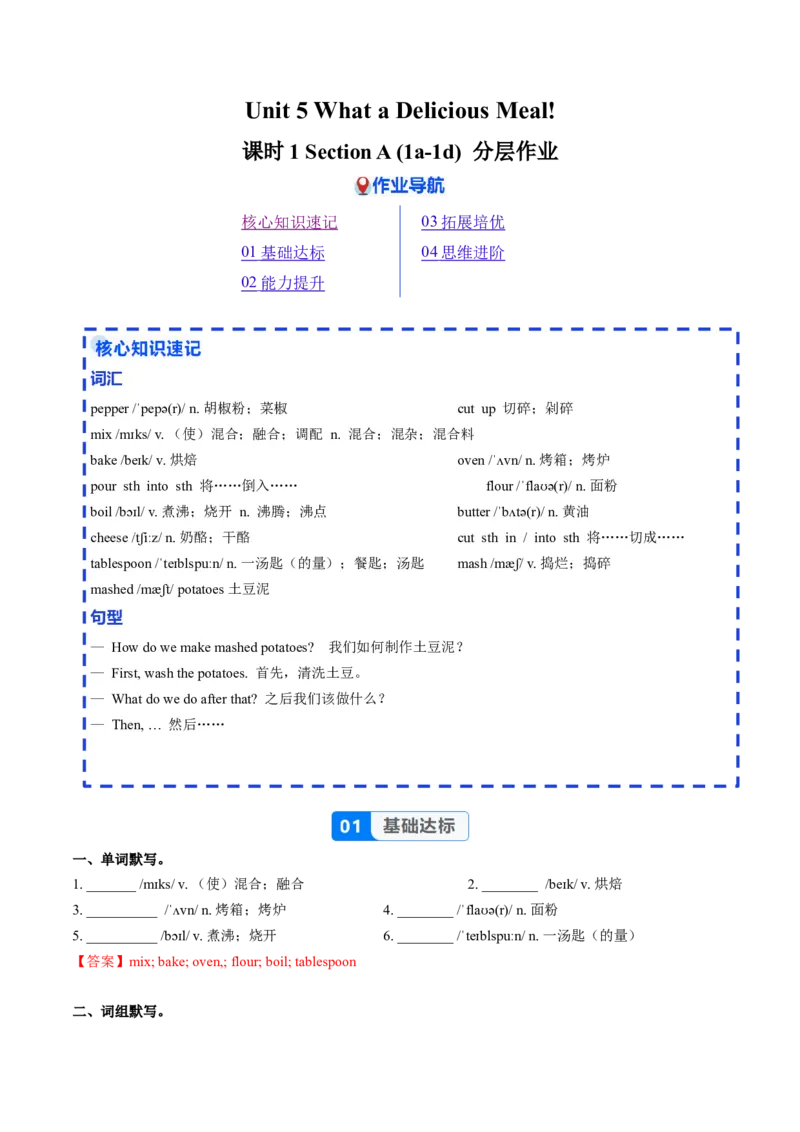
Unit 5 What a Delicious Meal!
课时 1 Section A (1a-1d) 分层作业
核心知识速记 03 拓展培优
01 基础达标 04 思维进阶
02 能力提升
词汇
pepper /ˈpepə(r)/ n. 胡椒粉;菜椒 cut up 切碎;剁碎
mix /mɪks/ v. (使)混合;融合;调配 n. 混合;混杂;混合料
bake /beɪk/ v. 烘焙 oven /ˈʌvn/ n. 烤箱;烤炉
pour sth into sth 将……倒入…… flour /ˈflaʊə(r)/ n. 面粉
boil /bɔɪl/ v. 煮沸;烧开 n. 沸腾;沸点 butter /ˈbʌtə(r)/ n. 黄油
cheese /tʃiːz/ n. 奶酪;干酪 cut sth in / into sth 将……切成……
tablespoon /ˈteɪblspuːn/ n. 一汤匙(的量);餐匙;汤匙 mash /mæʃ/ v. 捣烂;捣碎
mashed /mæʃt/ potatoes 土豆泥
句型
— How do we make mashed potatoes? 我们如何制作土豆泥?
— First, wash the potatoes. 首先,清洗土豆。
— What do we do after that? 之后我们该做什么?
— Then, … 然后……
一、单词默写。
1. _______ /mɪks/ v. (使)混合;融合 2. ________ /beɪk/ v. 烘焙
3. __________ /ˈʌvn/ n. 烤箱;烤炉 4. ________ /ˈflaʊə(r)/ n. 面粉
5. __________ /bɔɪl/ v. 煮沸;烧开 6. ________ /ˈteɪblspuːn/ n. 一汤匙(的量)
【答案】mix; bake; oven,; flour; boil; tablespoon
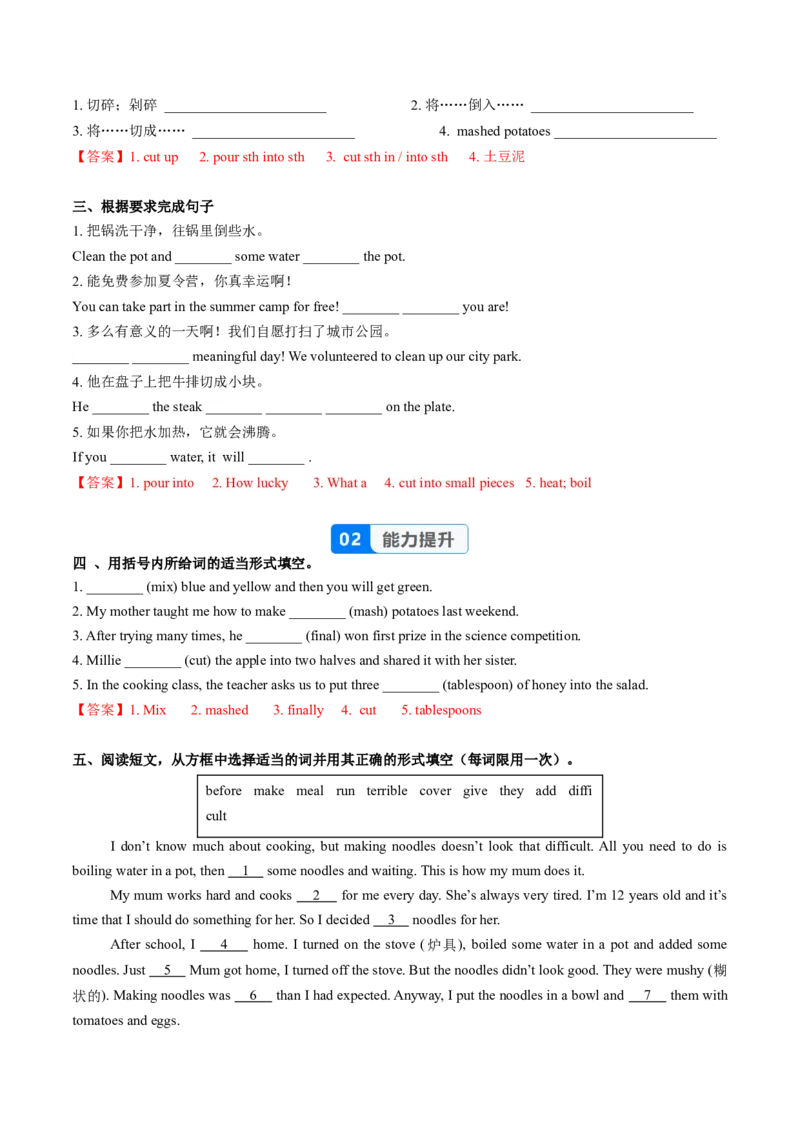
二、词组默写。1. 切碎;剁碎 _______________________ 2. 将……倒入…… _______________________
3. 将……切成…… _______________________ 4. mashed potatoes _______________________
【答案】1. cut up 2. pour sth into sth 3. cut sth in / into sth 4. 土豆泥
三、根据要求完成句子
1. 把锅洗干净,往锅里倒些水。
Clean the pot and ________ some water ________ the pot.
2. 能免费参加夏令营,你真幸运啊!
You can take part in the summer camp for free! ________ ________ you are!
3. 多么有意义的一天啊!我们自愿打扫了城市公园。
________ ________ meaningful day! We volunteered to clean up our city park.
4. 他在盘子上把牛排切成小块。
He ________ the steak ________ ________ ________ on the plate.
5. 如果你把水加热,它就会沸腾。
If you ________ water, it will ________ .
【答案】1. pour into 2. How lucky 3. What a 4. cut into small pieces 5. heat; boil
四 、用括号内所给词的适当形式填空。
1. ________ (mix) blue and yellow and then you will get green.
2. My mother taught me how to make ________ (mash) potatoes last weekend.
3. After trying many times, he ________ (final) won first prize in the science competition.
4. Millie ________ (cut) the apple into two halves and shared it with her sister.
5. In the cooking class, the teacher asks us to put three ________ (tablespoon) of honey into the salad.
【答案】1. Mix 2. mashed 3. finally 4. cut 5. tablespoons
五、阅读短文,从方框中选择适当的词并用其正确的形式填空(每词限用一次)。
before make meal run terrible cover give they add diffi
cult
I don’t know much about cooking, but making noodles doesn’t look that difficult. All you need to do is
boiling water in a pot, then 1 some noodles and waiting. This is how my mum does it.
My mum works hard and cooks 2 for me every day. She’s always very tired. I’m 12 years old and it’s
time that I should do something for her. So I decided 3 noodles for her.
After school, I 4 home. I turned on the stove (炉具), boiled some water in a pot and added some
noodles. Just 5 Mum got home, I turned off the stove. But the noodles didn’t look good. They were mushy (糊
状的). Making noodles was 6 than I had expected. Anyway, I put the noodles in a bowl and 7 them with
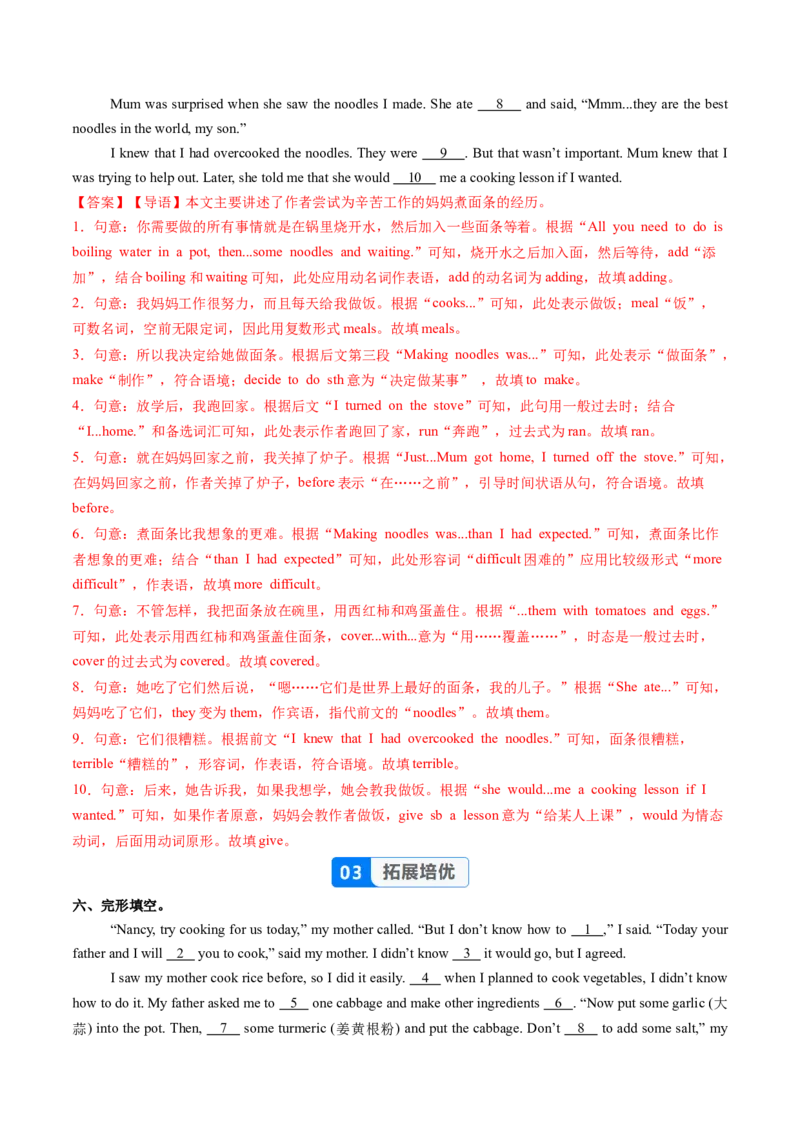
tomatoes and eggs.Mum was surprised when she saw the noodles I made. She ate 8 and said, “Mmm...they are the best
noodles in the world, my son.”
I knew that I had overcooked the noodles. They were 9 . But that wasn’t important. Mum knew that I
was trying to help out. Later, she told me that she would 10 me a cooking lesson if I wanted.
【答案】【导语】本文主要讲述了作者尝试为辛苦工作的妈妈煮面条的经历。
1.句意:你需要做的所有事情就是在锅里烧开水,然后加入一些面条等着。根据“All you need to do is
boiling water in a pot, then...some noodles and waiting.”可知,烧开水之后加入面,然后等待,add“添
加”,结合boiling和waiting可知,此处应用动名词作表语,add的动名词为adding,故填adding。
2.句意:我妈妈工作很努力,而且每天给我做饭。根据“cooks...”可知,此处表示做饭;meal“饭”,
可数名词,空前无限定词,因此用复数形式meals。故填meals。
3.句意:所以我决定给她做面条。根据后文第三段“Making noodles was...”可知,此处表示“做面条”,
make“制作”,符合语境;decide to do sth意为“决定做某事” ,故填to make。
4.句意:放学后,我跑回家。根据后文“I turned on the stove”可知,此句用一般过去时;结合
“I...home.”和备选词汇可知,此处表示作者跑回了家,run“奔跑”,过去式为ran。故填ran。
5.句意:就在妈妈回家之前,我关掉了炉子。根据“Just...Mum got home, I turned off the stove.”可知,
在妈妈回家之前,作者关掉了炉子,before表示“在……之前”,引导时间状语从句,符合语境。故填
before。
6.句意:煮面条比我想象的更难。根据“Making noodles was...than I had expected.”可知,煮面条比作
者想象的更难;结合“than I had expected”可知,此处形容词“difficult困难的”应用比较级形式“more
difficult”,作表语,故填more difficult。
7.句意:不管怎样,我把面条放在碗里,用西红柿和鸡蛋盖住。根据“...them with tomatoes and eggs.”
可知,此处表示用西红柿和鸡蛋盖住面条,cover...with...意为“用……覆盖……”,时态是一般过去时,
cover的过去式为covered。故填covered。
8.句意:她吃了它们然后说,“嗯……它们是世界上最好的面条,我的儿子。”根据“She ate...”可知,
妈妈吃了它们,they变为them,作宾语,指代前文的“noodles”。故填them。
9.句意:它们很糟糕。根据前文“I knew that I had overcooked the noodles.”可知,面条很糟糕,
terrible“糟糕的”,形容词,作表语,符合语境。故填terrible。
10.句意:后来,她告诉我,如果我想学,她会教我做饭。根据“she would...me a cooking lesson if I
wanted.”可知,如果作者原意,妈妈会教作者做饭,give sb a lesson意为“给某人上课”,would为情态
动词,后面用动词原形。故填give。
六、完形填空。
“Nancy, try cooking for us today,” my mother called. “But I don’t know how to 1 ,” I said. “Today your
father and I will 2 you to cook,” said my mother. I didn’t know 3 it would go, but I agreed.
I saw my mother cook rice before, so I did it easily. 4 when I planned to cook vegetables, I didn’t know
how to do it. My father asked me to 5 one cabbage and make other ingredients 6 . “Now put some garlic (大
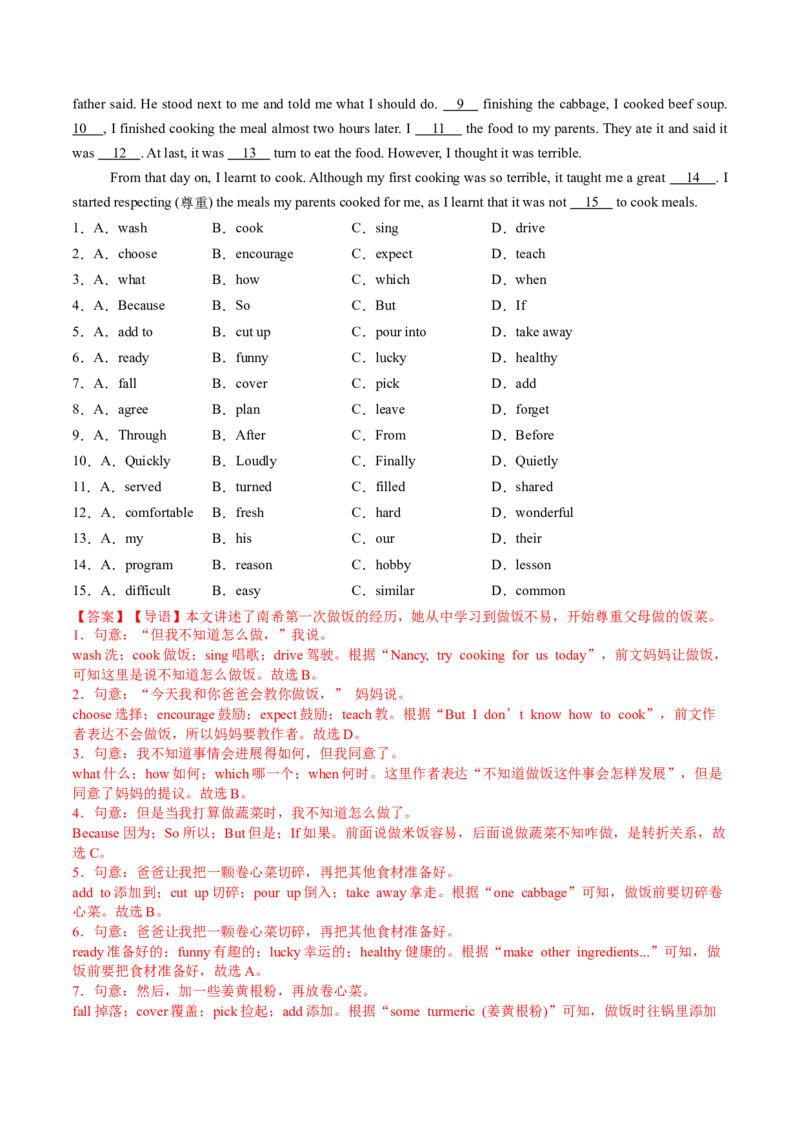
蒜) into the pot. Then, 7 some turmeric (姜黄根粉) and put the cabbage. Don’t 8 to add some salt,” myfather said. He stood next to me and told me what I should do. 9 finishing the cabbage, I cooked beef soup.
10 , I finished cooking the meal almost two hours later. I 11 the food to my parents. They ate it and said it
was 12 . At last, it was 13 turn to eat the food. However, I thought it was terrible.
From that day on, I learnt to cook. Although my first cooking was so terrible, it taught me a great 14 . I
started respecting (尊重) the meals my parents cooked for me, as I learnt that it was not 15 to cook meals.
1.A.wash B.cook C.sing D.drive
2.A.choose B.encourage C.expect D.teach
3.A.what B.how C.which D.when
4.A.Because B.So C.But D.If
5.A.add to B.cut up C.pour into D.take away
6.A.ready B.funny C.lucky D.healthy
7.A.fall B.cover C.pick D.add
8.A.agree B.plan C.leave D.forget
9.A.Through B.After C.From D.Before
10.A.Quickly B.Loudly C.Finally D.Quietly
11.A.served B.turned C.filled D.shared
12.A.comfortable B.fresh C.hard D.wonderful
13.A.my B.his C.our D.their
14.A.program B.reason C.hobby D.lesson
15.A.difficult B.easy C.similar D.common
【答案】【导语】本文讲述了南希第一次做饭的经历,她从中学习到做饭不易,开始尊重父母做的饭菜。
1.句意:“但我不知道怎么做,”我说。
wash洗;cook做饭;sing唱歌;drive驾驶。根据“Nancy, try cooking for us today”,前文妈妈让做饭,
可知这里是说不知道怎么做饭。故选B。
2.句意:“今天我和你爸爸会教你做饭,” 妈妈说。
choose选择;encourage鼓励;expect鼓励;teach教。根据“But I don’t know how to cook”,前文作
者表达不会做饭,所以妈妈要教作者。故选D。
3.句意:我不知道事情会进展得如何,但我同意了。
what什么;how如何;which哪一个;when何时。这里作者表达“不知道做饭这件事会怎样发展”,但是
同意了妈妈的提议。故选B。
4.句意:但是当我打算做蔬菜时,我不知道怎么做了。
Because因为;So所以;But但是;If如果。前面说做米饭容易,后面说做蔬菜不知咋做,是转折关系,故
选C。
5.句意:爸爸让我把一颗卷心菜切碎,再把其他食材准备好。
add to添加到;cut up切碎;pour up倒入;take away拿走。根据“one cabbage”可知,做饭前要切碎卷
心菜。故选B。
6.句意:爸爸让我把一颗卷心菜切碎,再把其他食材准备好。
ready准备好的;funny有趣的;lucky幸运的;healthy健康的。根据“make other ingredients...”可知,做
饭前要把食材准备好,故选A。
7.句意:然后,加一些姜黄根粉,再放卷心菜。
fall掉落;cover覆盖;pick捡起;add添加。根据“some turmeric (姜黄根粉)”可知,做饭时往锅里添加调料,故选D。
8.句意:“别忘了加些盐,” 爸爸说。
agree同意;plan计划;leave离开;forget忘记。根据“Don’t...to add some salt”可知,此处爸爸提醒做
饭时别忘加盐。故选D。
9.句意:做好卷心菜后,我做了牛肉汤。
Through穿过;After在……之后;From从;Before在……之前。根据“...finishing the cabbage, I cooked
beef soup.”可知,此处描述做饭顺序,做完卷心菜之后做牛肉汤。故选B。
10.句意:最终,差不多两个小时后我做完了饭。
Quickly快速地;Loudly大声地;Finally最终;Quietly安静地。根据“I finished cooking the meal almost
two hours later”可知,耗时近两小时,整个做饭过程结束,最终做完饭。故选C。
11.句意:我把食物端给父母。
served端上;turned转动;filled装满;shared分享。serve sth. to sb.“把某物端给某人”,符合把做好的
饭端给父母的语境。故选A。
12.句意:他们吃了,说饭菜很棒。
comfortable舒服的;fresh新鲜的;hard硬的;wonderful美妙的,很棒的。父母回应饭菜如何,结合后文
“However, I thought it was terrible.”作者觉得难吃形成对比,推测父母说饭菜“很棒”。故选D。
13.句意:最后,轮到我吃这些食物了。
my我的;his他的;our我们的;their他们的。it’s one’s turn to do sth.“轮到某人做某事”,前面是
给父母端饭,现在轮到我吃。故选A。
14.句意:虽然我第一次做饭做得非常糟糕,但它给了我一个深刻的教训。
program节目;reason原因;hobby爱好;lesson教训。teach sb. a lesson“给某人一个教训;给某人上一
课”,符合作者从初次做饭经历中有所学有所悟的语境。故选D。
15.句意:我开始尊重父母为我做的饭菜,因为我知道做饭并不容易。
difficult困难的;easy容易的;similar相似的;common普通的。根据“I started respecting (尊重) the
meals my parents cooked for me”可知,通过自己做饭,开始尊重父母做的饭菜,同时体会到做饭不容易。
故选B。
七、阅读理解。
Whole Wheat (全麦粉) Apple PancakesINGREDIENTS:2 cups of whole wheat flour
(面粉), 1/2 teaspoon of salt, 2 eggs
1/4 cup of vegetable oil, 2 large apples, 1 cup of butter
DIRECTIONS:
In a large bowl, stir (搅拌) the flour and salt. Put eggs, oil and apples into the flour. Heat
a large pan over medium heat. Put a large teaspoon of batter (面糊) onto the pan and cook until
the batter becomes dry. Then flip the pancake and cook until it becomes brown on the other
side. When both sides have a light brown color, the pancake is ready. Heat the butter over
medium heat and add it to the pancake. It makes the pancake taste more delicious.
根据材料内容选择最佳答案。
1.The passage tells us how to make ________.
A.bread B.dumplings C.pancakes D.hamburgers
2.How much vegetable oil do you need?
A.1 cup. B.1/2 teaspoon. C.2 cups. D.1/4 cup.3.You don’t need ________ to make whole wheat apple pancakes.
A.milk B.salt C.flour D.butter
4.The right order of making the pancake is ________.
Put eggs, oil and apples in. Cook the batter. Add some butter.
①Stir the flour and salt. ②Heat the pan. ③
A.③①⑤②④ B.④①③⑤② C.④⑤①②③ D.④①⑤②③
④ ⑤
5.What does the underlined word “flip” mean in Chinese?
A.烘烤 B.爆炒 C.翻动 D.切碎
【答案】【导语】本文是一篇说明文。主要介绍了全麦苹果煎饼的制作原料和具体制作步骤。
1.细节理解题。根据“Whole Wheat (全麦粉) Apple Pancakes”可知,本文介绍了全麦苹果煎饼的制作
过程。故选C。
2.细节理解题。根据“1/4 cup of vegetable oil”可知,需要1/4杯植物油,故选D。
3.细节理解题。根据“2 cups of whole wheat flour (面粉) 1/2 teaspoon of salt ... 1 cup of butter”可
知,要做全麦苹果煎饼,不需要牛奶。故选A。
4.细节理解题。根据“In a large bowl, stir (搅拌) the flour and salt. Put eggs, oil and apples into the
flour. Heat a large pan over medium heat. Put a large teaspoon of batter (面糊) onto the pan and cook
until the batter becomes dry...Heat the butter over medium heat and add it to the pancake.”可知,制作
煎饼的正确顺序是:搅拌面粉和盐→把鸡蛋、油和苹果放进面粉里→热锅→烹饪面糊→加入一些黄油。故
选D。
5.词义猜测题。根据“Put a large teaspoon of batter (面糊) onto the pan and cook until the batter
becomes dry. Then flip the pancake and cook until it becomes brown on the other side”可知,先把一面
煎干,然后把另一面煎至浅棕色,这期间需要翻动,flip意为“翻动”。故选C。
任务型阅读。
Food for Thought
Recently, community canteens (食堂) have become popular among young people.
At first, community canteens mostly served old people. As the elderly may face challenges in cooking, and
many young people cannot cook, these canteens have become perfect places for the two generations to become
meal friends.
For only 20 yuan, Fang Wenjing, who works in the training industry in Hangzhou, ordered a well balanced
lunch at a community canteen in the city. “The dishes have a home-cooked taste, just as I expected. The canteen is
also clean,” said Fang.
Community canteens meet the dining habits of young people in a number of ways. For example, the
vegetarian (素食的) restaurants in Hangzhou have meals including a main dish, a bowl of rice, soup, fruit salad,
and a side dish. Hu Yifan, head of a canteen, said 70 per cent of its customers are young people.A canteen at the Zhalongkou Community in Zhejiang Province recently introduced “happiness mystery
boxes”. They cost just 6 yuan but have one meat dish and a vegetarian dish. To keep what’s inside each box a
surprise, stickers are placed over the see-through top to cover the “main dish”. The “mystery boxes” are often sold
out very quickly.
The canteen in Beijing’s Lugu Community in Shijingshan District (区) even introduced self service meals.
The buffet-style (自助式的) dishes there are priced (定价) at just 2.48 yuan per 100grams. This price is lower than
that in the restaurants nearby.
1.Why did Fang Wenjing like the lunch at the community canteen?
_________________________________________________________
2.What do vegetarian meals in a community restaurant in Hangzhou include?
_________________________________________________________
3.How are the “happiness mystery boxes” kept surprises?
_________________________________________________________
4.How much should a customer pay if he orders 300 grams of self-service meals in a canteen in Beijing’s Lugu
Community?
_________________________________________________________
5.If there is a community canteen in your district, would you like to order food there? Why or why not? (Please
give at least two reasons.)
_________________________________________________________
【答案】【导语】本文是一篇说明文,主要介绍了社区食堂如今受年轻人欢迎,其在菜品、价格、服务形
式等方面满足了年轻人的用餐需求,还曾服务老年人,促进了两代人成为饭友。
1.根据“‘The dishes have a home-cooked taste, just as I expected. The canteen is also clean,’ said
Fang.”可知,方喜欢社区食堂的午餐是因为菜品有家常菜的味道,而且食堂很干净。故填Because the
dishes had a home-cooked taste and the canteen was also clean.
2.根据“For example, the vegetarian (素食的) restaurants in Hangzhou have meals including a main
dish, a bowl of rice, soup, fruit salad, and a side dish.”可知,杭州社区食堂的素食餐包括一道主菜、一
碗米饭、汤、水果沙拉和一道配菜。故填They include a main dish, a bowl of rice, soup, fruit salad, and
a side dish.
3.根据“To keep what’s inside each box a surprise, stickers are placed over the see-through top to
cover the ‘main dish’.”可知,“幸福盲盒”通过在透明顶部贴上贴纸盖住“主菜”来保持惊喜。故填
By placing stickers over the see-through top to cover the “main dish”.
4.根据“The buffet-style (自助式的) dishes there are priced (定价) at just 2.48 yuan per 100grams.”可
知,每100克自助菜品2.48元,那么300克需要2.48×3=7.44元。故填7.44 yuan.
5.开放性试题,答案合理即可。故填Yes, I’d love to. Firstly, the food there is usually cheap, which can
save my money. Secondly, the canteen may have a home-cooked taste and make me feel warm and
comfortable, just like eating at home./...