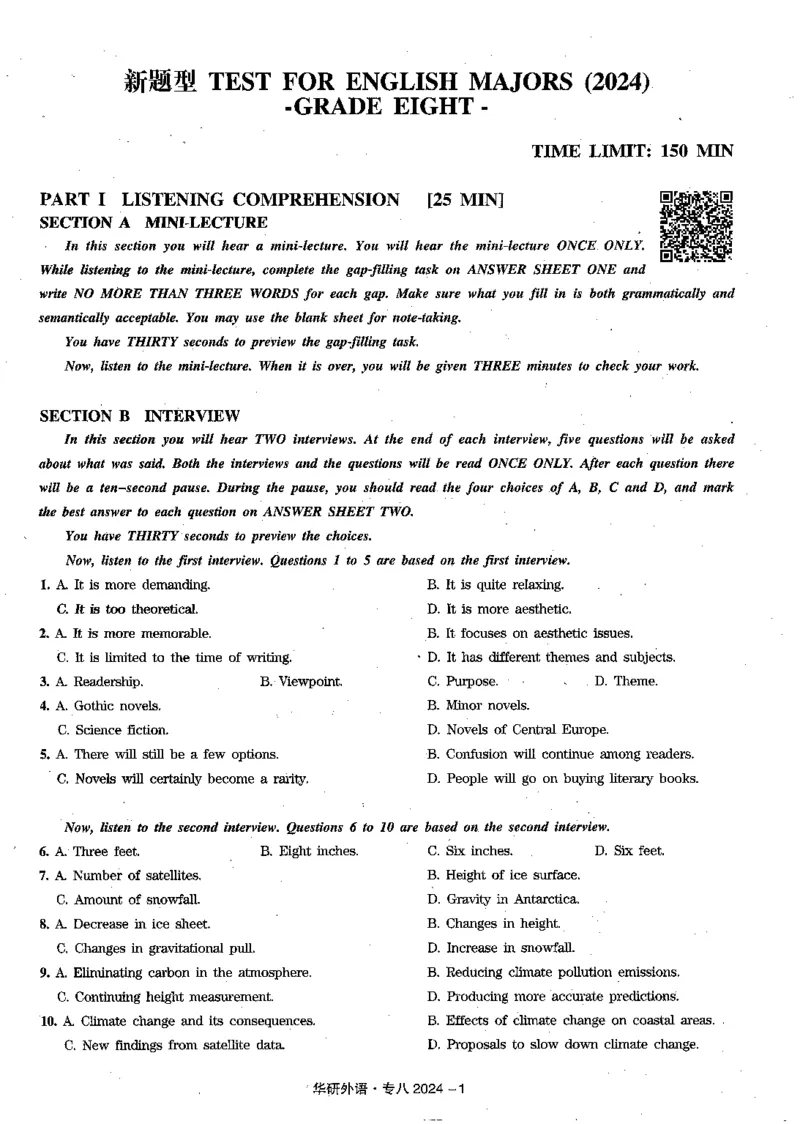
新题型 TEST FOR ENGLISH MAJORS (2012)
-GRADE EIGHT-
TIME LIMIT: 150 MIN
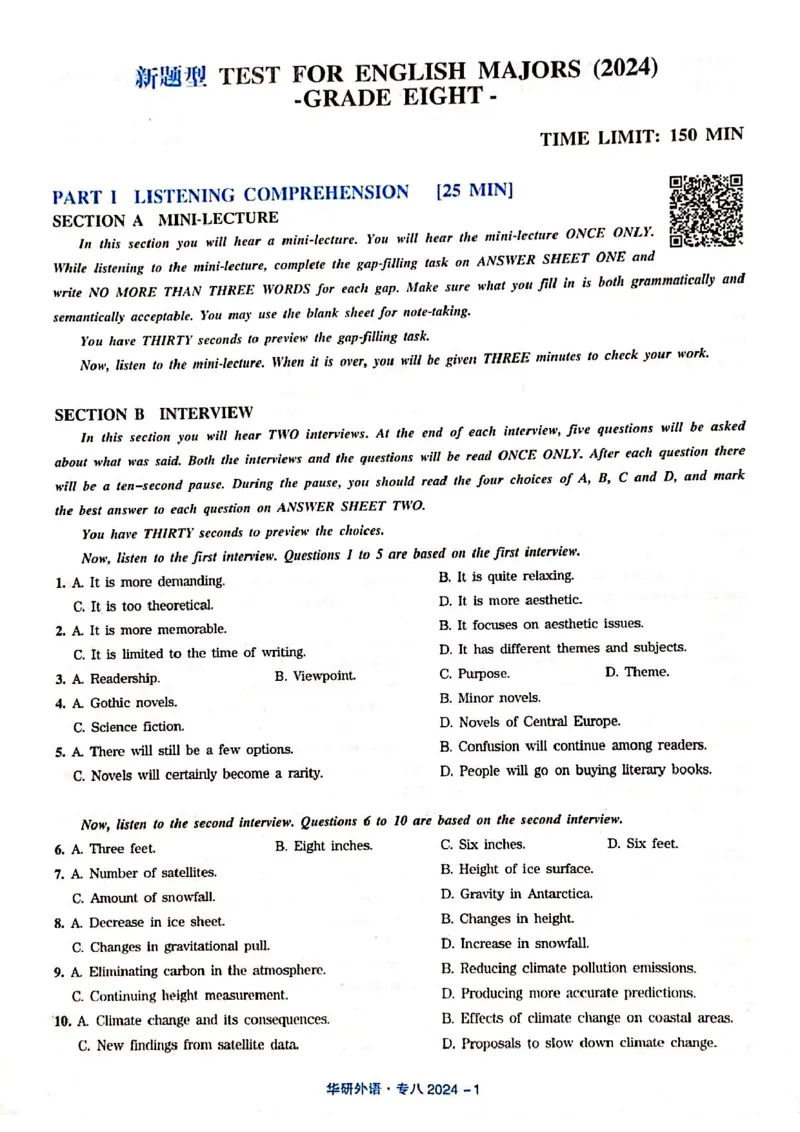
PART I LISTENING COMPREHENSION [25 MIN]
SECTION A MINI-LECTURE
In this section you will hear a mini-lecture. You will hear the mini-lecture ONCE ONLY. While listening to
the mini-lecture, please complete the gap-filling task on ANSWER SHEET ONE and write NO MORE THAN
THREE WORDS for each gap. Make sure the word(s) you fill in is (are) both grammatically and semantically
acceptable. You may use the blank sheet for note-taking.
You have THIRTY seconds to preview the gap-filling task.
Now, listen to the mini-lecture. When it is over, you will be given THREE minutes to check your work.
SECTION B INTERVIEW
In this section you will hear ONE interview. The interview will be divided into TWO parts. At the end of
each part, five questions will be asked about what was said. Both the interview and the questions will be spoken
ONCE ONLY. After each question there will be a ten-second pause. During the pause, you should read the four
choices of A, B, C and D, and mark the best answer to each question on ANSWER SHEET TWO.
You have THIRTY seconds to preview the questions.
Now listen to Part One of the interview. Questions 1 to 5 are based on Part One of the interview.
1. A. Creativity stems from great people's novel thinking.
B. The creative ideas always come to people in a flash.
C. The outcome of human creativity comes in varied forms.
D. Creative people focus on novel thinking rather than on solutions.
2. A. Creativity seems to be attributable to genetic makeup.
B. Creativity appears to be the result of the envirorunent.
C. Creativity appears to be more associated with great people.
D. Creativity comes from both envirorunent and genetic makeup.
3. A. Creativity can also be found in ordinary people.
B. Creative thinking is important to be a good cook
C. A cook can become famous if he creates a recipe.
D. Creative activities can occur easily in a kitchen.
4. A. One. B. Two. C. T缸ee. D. Four.
5. A. Selecting ideas and thoughts. B. Reviewing ide邸 and thoughts.
C. Connecting ideas and thoughts. D. Removing old ideas and thoughts.
Now listen to Part Two of the interview. Questions 6 to 10 are based on Part Two of the interview.
6. A. Unconventional. B. Critical. C. Resolute. D. Original.
7. A. Vincent van Gogh B. Nancy Andreasen.
C. Johann Sebastian Bach. D. Leonardo da Vinci.
8. A. Brain exercising w诅 not make people creative.
B. Most people have diversified interests and hobbies.
C. Creativity can only be found in great people.
D. The environment is significant in the creative process.
9. A. Spending time on thinking every day. B. Censoring thoughts in the mind.
C. Studying new knowledge. . D. Observing things ignored before.
10. A. Two. B. Three. C. Four. D. Five.
专八2012 -1PART II READING COMPREHENSION [45 MIN]
SECTION A MULTIPLE-CHOICE QUESTIONS
In this section there are three passages followed by fourteen multiple choice questions. For each multiple
choice question, there are four suggested answers marked A, B, C and D. Choose the one that you think is the
best answer and mark your answers on ANSWER SHEET TWO.
PASSAGE ONE
(1)1 used to look at my closet and see clothes. These days, whenever I cast my eyes upon the stacks
of shoes and hangers of shirts, sweaters and jackets, I see water.
(2)1t takes 569 gallons to manufacture a T-shirt, from its start in the cotton fields to its appearance on
store shelves. A pair of running shoes? 1,247 gallons.
(3)Until last fall, I'd been oblivious to my "water footprint," which is defined as the total volume of
freshwater that is used to produce goods and seIVices, according to the Water Footprint Network. The
Dutch nonprofit has been working to raise awareness of freshwater scarcity since 2008, but it was through
the "Green Blue Book" by Thomas M. Kostigen that I was able to see how my own actions factored in.
(4)I've installed gray-water systems to reuse the wastewater from my laundry machine and bathtub and
reroute it to my landscape — systems that save, on average, 50 gallons of water per day. I've set up rain
barrels and infiltration pits t? collect thousands of gallons of storm water cascading from my roof. I've
even entered . the last bastion of greendom — installing a composting toilet.
(5)Suffice to say, I've been feeling pretty satisfied with myself for all the 屾king water I've saved
with these big-ticket projects. According to my last bill of water and power, my household's daily water
use is about 58 gallons per day — far less than the 178 gallons per day I'd been using two years ago, be
fore I became water aware and started conserving, saving and hoarding with all these systems.
(6)Now I realize that my daily consumption choices could have an even larger effect — not only on
the local water supply but also globally: 1.1 billion people have no access to freshwater, and, in the future,
those who do have access will have less of it.
(7)Each of the four cups of coffee I drink every day takes 37 gallons of water to produce, from the
growing of the beans, to their processing, to bringing that brown paper bag of coffee blend to my kitchen.
One pound of steak? That takes 1,581 gallons. My car? 32,000 gallons.
(8)To see how much virtual water I was using, I logged on to the "Green Blue Book" website and
used its water footprint calculator, entering my daily consumption habits. Tallying up the water footprint of
my breakfast, lunch, dinner and snacks, as well as my daily dose of over-the-counter uppers and downers
- coffee, wine and beer — I'm using 512 gallons of virtual water each day just to feed myself.
(9)In a word: alarming.
(lO)Even more alarming was how much hidden water I was using to get dressed. I'm hardly a
clotheshorse, but the few new items I buy once again trumped the amount of water flowing from my
faucets each day. If I'm serious about saving water, I realized I could make some simple lifestyle shifts.
Looking more closely at the areas in my life that use the most virtual water, it was food and clothes,
specifically meat, coffee and, oddly, blue jeans and leather jackets.
(11)I'm from the Midwest, which is another way of saying. I'm a carnivore. I grew up eating meat three
times a day. And although I've been trying to reduce my meat consumption for health reasons, I can't
imagine giving up bacon, burgers or prime rib. I can, however, imagine eating less of it, which is what I've
been doing. Occasionally swapping a hamburger for a veggie burger saves 750 gallons of water.
(12)My coffee habit is harder to alter. I drink half a pot each day, and I love every drop, even if it's
cold. OK. So I'm an addict. Switching to tea would save 31 gallons of virtual water per cup, but I'd rather
find other sources of virtual water and cut back there. My solution: Drink more soy milk (208 gallons of
water per gallon) instead of regular milk (708 gallons of water per gallon of milk) and eat more potatoes
(13 gallons per pound) than corn (108 gallons).
(13)Being a motorcyclist, I own an unusually large amount of leather — boots and jackets in particular.
All of·it is enormously water intensive. It takes 7,996 gallons to make a leather jacket, leather being a
byproduct of beef. It takes 2,866 gallons of water to make a single pair of blue jeans, because they're
专八2012-2made from water-hogging cotton.
(14)Water footprint numbers are drawn using various sources, such as government agencies and indus
try associations, and are calculated by measuring each of the water inputs in a product's manufacturing
process. The footprint of a pair of blue jeans, for example, is measured by calculating the amount of water
used to grow enough cotton to make a pair of jeans (2,247 gallons) and to dilute the pesticides used in
growing that amount of cotton, among other things.
(15)Crunching the numbers for the amount of clothes I buy every year, it looks a lot like my friend's
swimming pool. My entire closet is borderline Olympic.
(16)Gulp.
(l 7)My late resolution is to buy some items used. Underwear and socks are, of course, exempt from
this strategy, but I have no problem shopping less and also shopping at Goodwill. In fact, I'd been doing
that for the past year to save money. My clothes' outrageous water footprint just reinforced it for me.
(18)More conscious living and substitution, rather than sacrifice, are the prevailing ideas with the water
footprint. It's one I'm trying, and that's had an unusual upside. I had a hamburger recently, and I enjoyed it
a lot more since it is now an occasional treat rather than a weekly habit.
(One gallon=3.8 litres)
11. According to the passage, the Water Footprint Network
A. worked for freshwater conservation for nonprofit purposes.
B. collaborated with the Green Blue Book in freshwater conservation.
C. made the author aware of freshwater shortage.
D. helped the author get to know the Green Blue Book
12. According to the context, "… lww my own actions factored in" means
A. how I could contribute to water conservation.
B. how much of what I did contributed to freshwater shortage.
C. what behaviour could be counted as freshwater-saving.
D. what efforts I should make to save fresh water.
13. What's NOT among the author's big-ticket projects to save drinking water?
A. Installing a composting toilet B. Installing gray-water systems.
C. Setting up rain barrels and inftltration pits. D. Shopping less and also shopping at Goodwill.
14. It can be learned from the passage that the author eating meat.
A. decided to give up B. refused to imagine
C. was enthusiastic about D. was indifferent towards
15. "My entire closet is borderline Olympic" is an example of
A. analogy. B. exaggeration. C. understatement. D. euphemism.
PASSAGE TWO
(l)In her novel "Reunion, American Style", Rona Jaffe suggests that a class reunion "is more than a
sentimental jotuney. It is also a way of answering the question that lies at the back of nearly all our
呻ds. Did they do better than I?"
(2)Jaffe's obseivation may be misplaced but not completely lost. According to a study conducted by so
cial psychologist Jack Sparacino, the overwhelming majority who attend reunions aren't there invidiously to
compare their recent accomplishments with those of their former classmates. Instead, they hope, primarily,
to relive their earlier successes.
(3)Certainly, a few ret叩1 to show their former classmates how well they have done; others enjoy ob
serving the changes that have occurred in their classmates (not always in themselves, of course). But the ma
jority who attend their class reunions do so to relive the good times they remember having when they
were younger. In his study, Sparacino found that, as high school students, attendees had been more popu
lar, more often regarded as attractive, and more involved in extracurricular activities than those classmates
who chose not to attend For those who t皿ed up at their reunions, then, the old times were also the good
times!
专八2012-3(4)1t would appear that Americans ha、�e a special fondness for reunions, judging by their prevalence.
Major league baseball players, fraternity members, veterans groups, high school and college graduates, and
former Boy Scouts all hold reunions on a regular basis. In addition, family reunions frequently attract blood
relatives from faraway places who spend considerable money and time to reunite.
(5)Actually, in their affection for reuniting with friends, family or colleagues, Americans are probably no
different from any other people, except that Americans have created a mind-boggling number and variety of
institutionalized forms of gatherings to facilitate the satisfaction of this desire. Indeed, reunions have in
creasingly become formal events that are organized on a regular basis and, in the process, they have also
become big business.
(6)Shell Nonis of Class Reunion, Inc., says that Chicago alone has 1,500 high school reunions each
year. A conseivative estimate on the national level would be 10,000 annually. At one time, all high school
reunions were organized by volunteers, usually female homemakers. In the last few years, however, as more
and more women have entered the labour force, alumni reunions are increasingly being planned by special
ized companies rather than by part-time volunteers.
(7)The first college reunion was held by the alumni of Yale University in 1792. Graduates of Pennsylva
nia, Princeton, Stanford, and Brown followed suit. And by the end of the 19th century, most 4-year institu
tions were holding alum11i reunions.
(8)The variety of college reunions is impressive. At Princeton, alumni parade �ough the town wearing
their class uniforms and singing their alma mater. At Marietta College, they gather for a dinner-dance on a
ste扣nship cruising the Ohio River.
(9)Clearly, the thought of cruising on a steamship or marching through the streets is·usually not, by it
self, sufficient reason for large numbers of alumni to return to campus. Alumni who decide to attend their re
unions share a common identity based on the years they spent together as undergraduates. For this reason,
血versities that somehow establish a common bond - for example, because they are relatively small or
.
especially prestigious — tend to draw substantial numbers of their alumni to reunions. In an effort to en
hance _this common identity, larger colleges and universities frequently build their class reunions on partici
pation in smaller units, such.as departments or schools. Or they encourage "affmity reunions" for groups of for
mer cheerleaders, editors fraternity members, musicians, members of m出tary organizations on campus, and
,
the like.
(lO)Of course, not every alumnus is fond of his or her alma mater. Students who graduated during the
late 1960s may be especially reluctant to get involved in alumni events. They were part of the generation
that conducted sit-ins and teach-ins directed at university administrators, protested military recruitment on
campus and marched against "establishment politics." If this generation has a common identity, it may fall
outside of their university ties - or even be hostile to them. Even as they enter their middle years, alumni
who continue to hold unpleasant memories _of college during this period may not wish to attend class re
umons.
(ll)Not all rnunions are school affairs. People also reunite as an unintended consequence, a latent
function of gatherings designed for other reasons. Hundreds of professional associations hold annual
conferences or conventions to keep their members up-to-date with developments in their fields. Yet many of
the professionals who attend pass up the formal sessions — the speeches and seminars — in favor of
meeting informally in bars and hotel lobbies with colleagues from other cities and states.
(12)Attendees are given an excuse to swap experiences with friends they haven't seen since the last
meeting. · Similarly, the manifest function of wedding ceremonies is to unite tlte bride and groom in
matrimony. Yet weddings also seive an important latent function: They provide occasions for scattered
families and friends to reunite.
(13)The poignancy of these meetings suggests a more general principle: If reunions make people cry, it
is not, as Rona Jaffe proposes, because they have come out on the short end of things now. It is because
they measured up so well 20' years ago, and they want to relive the good old days with tears of joy.
专八2012-416. According to the passage, Sp扛acino's study
A. found that interest in reunions was linked with school experience.
B. found evidence for attendees' intense desire for sho咖g off success.
C. showed that attendees tended to excel in high school study.
D. provided strong evidence for Jaffe's statement.
17 ..W 压ch of the following is NOT mentioned as a distinct feature of U.S. class reunions?
A. Class reunions have become a profitable business.
B. Class reunions have brought about a variety of activities.
C. Reunions 扛e regul扛 and formal events organized by professional agencies.
D. U.S. class reunions 扛e usually occasions to show off one's recent success.
18. The rhetorical 'function of the first p扛agraph is to
A. seive as prelude to the author's argument. B. present the author's counterargument.
C. introduce Rona Jaffe's novel. D. bring into focus contrasting opinions.
19. What is the passage mainly about?
A. Alumni reunions and American university traditions.
B. Alumni reunion and its social and economic implications.
C. Reasons for popularity and (non)attendance for alumni reunions.
D. A historical perspective for alumni reunions in the United States.
PASSAGE THREE
(l)George was a neighborhood boy who had quit high school on an impulse when he was sixteen, run
out of patience, and though he was asham.ed every time he went looking for a job, when people asked
him if he had finished and he had to say no, he never went back to school. This summer was a hard
time for jobs and he had none. Having so much time on his hands, George thought of going to summer
school, but the kids in his classes would be too young. He also considered registering in a night high
school, only he didn't like the idea of the teachers always telling him what to do. He felt they had not
respected him. The result was he stayed off the streets and in his room most of the day.
(2)Very early in the morning, George had his coffee by himself, then hung around in the house. When
the house got on his nerves he cleaned it up - mopped the floors with a wet mop and put things away.
(3)But most of the time he sat in his room. In the afternoons he listened to the ball game. Otherwise
he had a couple of old copies of the World Almanac he had bought long ago, and he liked to read them
and also the magazines and newspapers, that had been left on the tables in the cafeteria. They were
mostly picture magazines about movie stars and sports figures.
(4)0ne time while on his walk George met Mr. Cattanzara coming home very late from work He won
dered if he was drunk but then could tell he wasn't. Mr. Cattanzara, a stocky, bald-headed man who
worked in a change booth on an IRT station, lived on the next block after George's, above a shoe repair
store. Nights, during the hot weather, he sat on his stoop in an undershirt, reading the New York Times in
the light of the shoemaker's window. He read it from the first page to the last, then went up to sleep. And
all the time he was reading the paper, his wife, a fat woman with a white face, leaned out of the window,
gazing into the street, her thick white arms folded under her loose breast, on the window ledge.
(5)0nce in a while Mr. Cattanzara cam.e home drunk, but it was a quiet drunk He never made any
trouble, only walked stiffly up the street and slowly climbed the stairs into the hall. Though drunk he
looked the same as always, except for his tight walk, the quietness, and that his eyes were wet. George
liked Mr. Cattanzara because he remembered him giving him nickels to buy lemon ice with when he was a
squirt. Mr. Cattanzara was a different type than those in the neighbourhood. He asked different questions
than the others when he met you, and he seemed to know what went on in all the newspapers. He read
them, as his fat sick w廿e watched from the window.
(6)"What are you doing with yourself this summer, George?" Mr. Cattanzara asked. "I see you walkin'
around at nights."
(7)George felt embarrasse.d. "I like to walk"
(8) "What are you doin' in the day now?"
专八2012-5(9) "Nothing much just now. I'm waiting for a job." Since it shamed him to admit that he wasn't work
ing, George said, "I'm reading a lot to pick up my education."
(lO)"What are you readin'?"
(11)George hesitated, then said, "I got a list of books in the library once and now I'm gonna read them
this summer." He felt strange and a little unhappy saying this, but he wanted Mr. Cattanzara to respect him.
(12)"How many books are there on it?"
(13) "I never counted them. Maybe around a hundred."
(14)Mr. Cattanzara whistled through his teeth.
(15)"1 figure if I did that," George went on earnestly,. "it would help me in my education I don't mean the
kind they give you in high school I .want to know different things than they learn there, 江 you know what I
mean."
(16)The change maker nodded. "Still and all, one hundred books is a pretty big load for one summer."
(17) "It might take longer."
(18) "After you're frnished with some, maybe you and I can shoot the breeze about them?" said Mr. Cattan
zara.
(19)"When I'm frnished," George answered.
(20)Mr. Cattanzara went home and George continued on his walk After that, though he had the urge
to, George did nothing different from usual. He still took his walks at night, ending up in the little park.
But one evening the shoemaker on the next block stopped George to say he was a good boy, and George
figured that Mr. Cattanzara had told him all about the books he was reading. From the shoemaker it must
have gone down the street, because George saw a couple of people smiling kindly at him, though nobody
spoke to him personally. He felt a little better around the neighbourhood and liked it inore, though not so
much he would want to live in it forever. He had never exactly disliked the people in it, yet he had never
liked them very much either. It was the fault of the neighbourhood. To his surprise, George found out that
his father and his sister Sophie lmew about his reading too. His father was too shy to say anything about
—
it - he was never much of a talker in his whole life but Sophie was softer to George, and she showed
him in other ways she was proud of him.
20. In Para. 2, the phrase "got on his nerves" probably means . .
A annoyed him B. amused him C. frightened him D. calmed him
21. In the excerpt, Mr. Cattanzara was described as a man who
A. showed a wide interest. . B. was fond of drinking.
C. often worked overtime. . D. liked to gossip after work.
22. It can be infe rred from the passage . that
A. George lied at the beginning and then became serious.
B. George was forced to tell a lie and then regretted.
C. Mr. Cattanzara was doubtful about·George throughout.
D. Mr. Cattanzara was surprised at George's reading plan.
23. After the street . conversation with Mr. Cattanzara, George
A. remained the same as usual. B. became more friendly with Mr. Cattanzara.
C. began to like his neighbours more than ever. D. continued to read the books from the list.
24. We can tell from the excerpt that George
A. found his neighbours liked to poke their nose into him.
B. found that his sister remained skeptical about him.
C. was dissatisfied with his life and surroUildings.
D. had a neither close nor distant relationship with his father.
SECTION B SHORT ANSWER QUESTIONS
In this section there are eight short answer questions based on the passages in SECTION A. Answer each
question in NO more than 10 words in the space provided on ANSWER SHEET TWO.
专八 2012 -6PASSAGE ONE
25. What can best account for the author's feeling of self-satisfaction?
26. According to the passage, what fact alarmed the author more?
27. What is the tone of the author in the last paragraph?
PASSAGE TWO
28. What mainly attracts many people to return to campus for reunion?
29. Why are alumni reunions increasingly being organized by specialized companies in the last few years?
PASSAGE THREE
30. Why did George stay off the streets and in his room most of the day that summer?
31. From the description in Paras. 1-3, what words can you use to depict George?
32. Why, did George like Mr. Cattanzara according to Para. 5?
PART III LANGUAGE USAGE [15 MIN]
The passage contains TEN errors. Each indicated line contains a maximum of ONE error. In each case,
only ONE word is involved. You should proof-read the passage and correct it in the following way:
For a 1-Y:芦 word, underline the wrong word and write the correct one in the blank
provided at the end of the line.
For a missing word, mark the position of the missing word with a "八" sign and write the
word you believe to be missing in the blank provided at the end of the
line.
For an unnecessary word, cross the unnecessary word with a slash "/" and put the word in the
blank provided at the end of the line.
Example
When /\ art museum wants a new exhibit, (1) an
it 卯面 buys things in fmished form and hangs (2) never
them on the wall. When a natural history museum
wants an exhibition, it must often build it. (3) exhibit
Proofread the given passage on ANSWER SHEET THREE as instructed.
PART IV TRANSLATION [20 MIN]
Translate the underlined part of the following text from Chinese into English. Write your translation on AN
SWER SHEET THREE.
泊珍到偏远小镇的育幼院把生在那里养到 1 岁的孩子接回来。但泊珍看他第一眼,仿似一声雷劈头而来。令她晕头
胀脑,这1岁的孩子脸型长得如此熟悉,她心里的第一道声音是,不能带回去!
痛苦纠聚心中 眉心发烫发热 胸口郁闷难展 胃里一股气冲喉而上。 院长说这孩子发育迟缓时 她更是心头无绪。
她在孩子所待的房里来回踱步 这房里还有其他小孩。整个房间只有一扇窗 窗外树影婆娑。就让孩子留下来吧 这里有
善心的神父和修女 这里将来会扩充为有医疗作用的看护中心 这是留住孩子最好的地方。 这孩子是她的秘密 她将秘
密留在这树林掩映的建筑里。
她将秘密留在心头。
PART V WRITING [45 MIN]
According to a recent survey, 74% of American adults online use social networking sites such as Facebook,
Instagram and Twitter. On social media sites like these, users may develop biographical profiles, communicate
with friends and strangers, do research, and share thoughts, photos, music, links, and more. The same thing is
happening around the world. The following are opinions on the impact of social networking sites on our society.
Read the excerpts carefully and write an article of NO LESS THAN 300 words, in which you should:
1. summarize briefly the opinions mentioned below;
2. give your comment.
专八2012 -7Marks will be awarded for content relevance, content sufficiency, organization and language quality. Failure
to follow the above instructions may result in a loss of marks.
Write your article on ANSWER SHEET FOUR.
Nicole Ellison, PhD, Assistant Professor of Michigan State University
I believe·the benefits provided by social network sites such as Facebook have made us better off as a
society and as individuals, and that, as they continue to be adopted by more diverse populations, we will
see an increase in their utility. Anecdotal evidence of positive outcomes from these technologies such as
一
political activities organized via Facebook or jobs found through Linkedln is well-known. Social
technologies never have predictable and absolute positive or negative effects, which is why social scientists
dread questions like these. In considering the effects of social network sites, it is clear that there are many
—
challenges to work through the increasing commercialization of this space, the need to construct strong
privacy protections for users, and safety issues_:.._btit. I believe· the benefits we receive as a society provided
by these tools far outweigh the risks.
Kyung-Tag Lee, PhD, Professor of Management at Kyungpook National University (South Korea)
Social networking sites are used to facilitate studying, forming new relationships, maintaining preexisting
personal ties, engaging in self-presentation, looking at photos and user profiles of other people, commenting
on messages posted by others, avoiding boredom, passing the time, and procrastinating. These activities
help individuals reduce loneliness·and accumulate personal social capital, including emotional satisfaction,
access to information, increasing one's well-being, and so on. When people use social networking sites,
they tend to establish strong ties online, and strong ties support high ·quality friendships and social
companionship, which ultimately enhance their well-being.
Susan Greenfield, Professor of University of Oxford
Social networking sites might tap into the basic brain systems for delJvering pleasurable experience.
However, these experiences are devoid of cohesive narrative and long-term significance. As a consequence,
the mid-21st century mind might almost be infantilised, characterised by short attention spans,
sensationalism, inability to empathise and a shaky sense of identity.
Tom Hodgkinson, writer for the Guardian
I despise Facebook. This enormously successful American business describes itself as "a social utility
that connects you with the people around you". But hang on. Why on God's earth would I need a
computer to connect with the people around me? Why should my relationships be mediated through the
血agination of a bunch of supergeeks in California? What was wrong with the pub? And does Facebook
really connect people? Doesn't it rather disconnect us, since instead of doing something enjoyable such as
talking and eating and dancing and drinking with my friends, I am merely sending them little ungrammatical
notes and amusing photos in cyberspace, while chained to my desk? … Clearly, Facebook is another uber
capitalist experiment: c� you make money out of friendship? Can you create communities free of national
boundaries -- and then sell Coca-Cola to them? Facebook is profoundly uncreative. It makes nothing at all.
n
It simply mediates i relationships that were happening anyway.
-THE END-
专八 2012 -8.
T
1
- - -- - - - - - -A-N-S-W-E-R- -S-HE-E-T- - (-T-E-M-8)- - - - - - - - - -
.冒
注意事项
准 考 证 号
1答题前, 考生务必用黑色字迹签字笔填
写自己的准考证号、 姓名和学校; 再用
2B铅笔把对应准考证号码的标号涂黑,
使用其它笔填涂无效。 101 [OJ IOI 101 101 101 IOI IOI 101 101 101 lOJ [01 101
2考生不得填涂缺考、 违纪项, 违者责任 111 1.11 111 111 111 111 111 (11 111 111 111 111 111 (1)
自负。
·J 3选��择题必须用2B铅笔填涂, 使用其它笔 121 121 121 121 121 121 121 121 [21 12.l 121 (21 [21 12
填涂无效, 修改时要用橡皮擦干净; 每 [31 131131 131 131 [3) 131 131 131 131 l31 (31 [31 131
此处由监考老师填涂 题只能填涂一个答案, 多填不得分。 l4l £41 141 141 141 14) 141 141 141 14) 141 141 141 141
4. 主观题必须用黑色字迹签字笔 151 151161 15心1 151 1儒51 15::1 [ : 5: 心1 151 1如 51 1 : 5 : 1 ( :: 5 : 1 : 15 : 1 : l:.5 : � :
违纪 一 , 超出红
缺考 II 5. 保持 詈 答 晶 题卡 昙 的清 骂 洁和I 昙 平整 尽 , 不得折叠。 1 I : 8 : I : t : 8 :: 1 I: :8:1 I: 8: l I 8 I t 8 I I 8 I t 8 I t 8 I raI I 8 I l 81 t 8 I I 8 I
[ 吵WL1t�l1, 1 I 9 I I 9 I I 9 I 19 l I 9 I 1"9 I I 9 I (9l [ 9 I 191 I 9 I (9l I 9 I l 9 l
LISTENING COMPREHENSION
— 一
SECTION A MINI-LECTURE
下列各题必须使用黑色字进,.::r '-, •仁 户』区议口作答, 超出红色矩形边框限定区域的答案无效
Observing Behaviour
People do observation in daily life context for safety or for proper behaviour. However,
there are differences in daily-life observation and research observation.
A. (1) (1)
—daily life observation
-casual
-(2) (2)
-dependence on memory
—research observation
-(3) (3)
-careful record keeping
B. Ways to select samples in research
—(4) (4)
-systematic: e.g. fixed inte双als every hour
-random: fixed intervals but (5) (5)
Systematic sampling and random sampling are often used in combination.
—(6) (6)
-defrnition: selection of (7) (7)
-reason: hu mans or animals' behaviour (8) across circumstances
(8)
-(9) : more obJect1ve observat10ns (9)
C. Ways to record behaviour (10) (10)
—observation with intervention
-(11) : researcher as observer and participant (11)
-field experiment: researcher (12) over conditions (12)
—observation without intervention
. -purpose: describing behaviour (13) (13)
_ -(14) : no intervention (14)
-researcher: (15) (15) —l
.昌
高校外语专业教学测试办公室 监制 FS-TEMS-1601一仁Beta
专八2012-9.
6
ANSWER SHEET3 (TEM8)
_
瞿匡 圈瞿 一 一 一 - 一 一 一 一 一 一 圈. 一 一 一 一 圈· 一 一 - 一 一 一 一 圈. 一 一 一 一 一 一 一 一 一 一
注意事项
准 考 证 号
1答题前, 考生务必用黑色字迹签字笔填
学 校:
写自己的准考证号、 姓名和学校; 再用
2B铅笔把对应准考证号码的标号涂黑,
使用其它笔填涂无效。
[0] £OJ 10 l !OJ !OJ ro 1 tOJ (01 lOl [Q] [0] 101 (01 101
2考生不得填涂缺考、 违纪项, 违者责任
姓 名: 自负。 l 1 I [1l 11 l t 1 I [11 {11 [1 I C 1 l [1] [ 11 [ 1 l (1] [ 1 l [ 1l
3选择题必须用2B铅笔填涂, 使用其它笔 121 (21 121 121 121 !21 [21 [21 12] [2] f2l 12] [21 (21
填涂无效, 修改时要用橡皮擦干净; 每 [31 (31 131 [31 [31 [3] [31 [31 [3] (3] l31 13] [3] 13]
正确填涂方式 此处由监考老师填涂 题只能填涂一个答案, 多填不得分。 [41 [41 141 [4] [41 £41 [41 [4l 14] r"4l !41 (41 l4l 141
4.主 观题必须用 黑色字迹签字笔 [ 51 [51 l 51 rsi [5] (51 l51 (5 J 15] 151 [51 !SJ 15) 15 l
违纪 CWl (0.5mm)在答题区域内作答, 超出红 [61 [6] t6l [6] [6] {61 161 [61 l6l 16) [61 [61 {61 rs1
1 错 -t/.J 误 屯 填 l 涂 �· 方 i [ 式 中 缺考 [QJ 5 I 保 色矩 A 持 N 形 S 答 IM 框 睬 题 限 卡 SH 定 EET 的 区 清 3 域 洁 的 I 和 答 平 案 整 无 , 效 不 。一 得折叠。 I 1 [ [ 8 9 7 ] 1 1 1 ( [ 9 8 7 ) ] 1 l ( r 7 e 9 ] 1 l [ [ ( 8 7 9 1 1 ) [ 1 l 8 7 9 1 l ] [ [ [ 8 7 9 .] J 1 1 1 18 9 7 1 1 1 [ [ {71 9 8 1 1 [ [ [ 8 7 91 J 1 [ 1 [ 8 7 9) ) 1 [ [ [ 8 7 9 1 1 1 ( [ 1 7 8 9 ] 1 1 1 [ 1 7 8 9 1 1 1 r t [ n B 9 l 1
t m
杻
下列各题必须使用黑色字迹签字笔在答题区域内作答, 超出红色矩形边框限定区域的答案无效。
The central problem of translating has always been whether to translate
literally or freely. The argument has· been going since at least the first
(1)
century B. C. Up to the beginning of the 19th century, many writers
favoured certain kind of "free" translation: the spirit, not the letter; the
(2)
sense not the words; the message rather the form; the matter not
(3)
the manner. Th讫 is the often revolutionary slogan of 叩ters who
(4)
wanted the truth to be read and understood. Then in the turn of the 19th
(5)
century, when the study of cultural anthropology suggested that
the linguistic b血ers were insuperable and that the language
(6)
wa.c;, entirely the product of culture, the view translation was impossible
(7)
gained some currency, and with it that, if was attempted at all, it must be as
(8)
literal as possible. This view culminated the statements of the
(9)
extreme "literalists" Walter Benjamin and Vladimir Nabokov.
The argument was theoretical: the purpose of the translation, the
nature of the readership, the type of text, was not discussed. Too
.
often, wnter , translator and reader were implicitly identified with
each other. Now, the context has changed, and the basic problem remains.
(10)
•
高校外语专业教学测试办公室 监制 FS-TEM8-1601斗Beta
专八 2012 -10