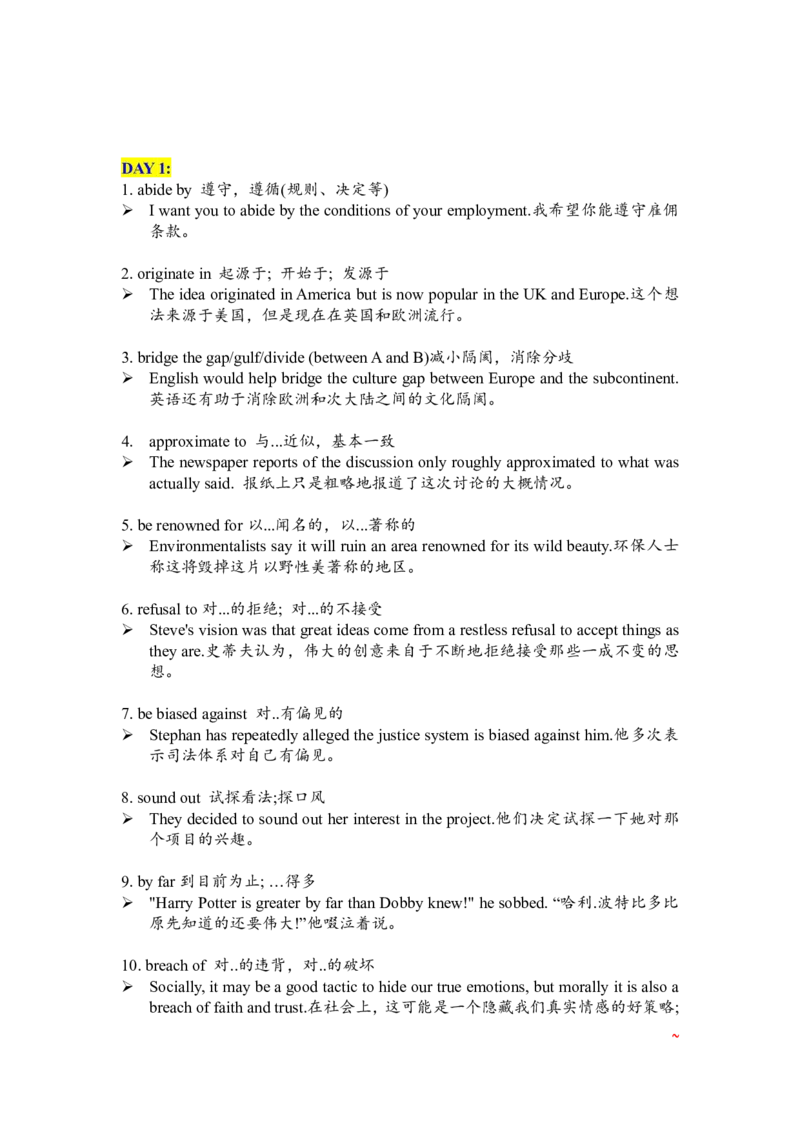
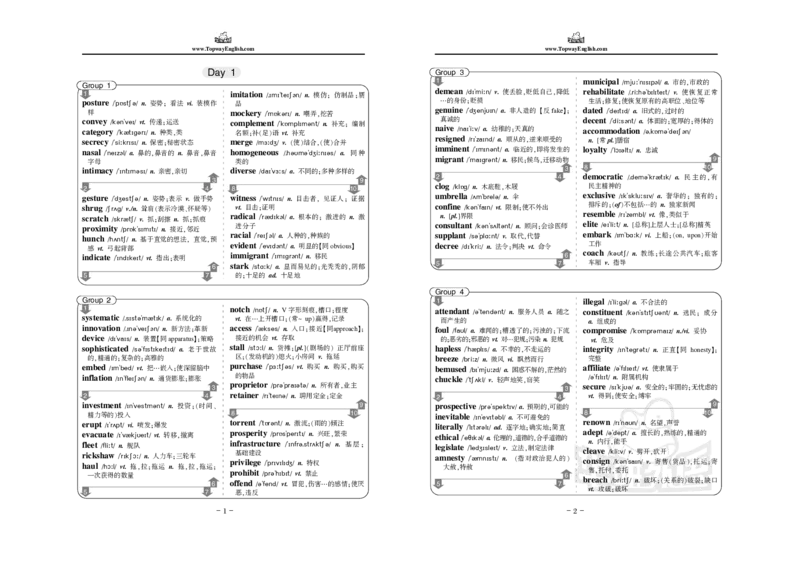
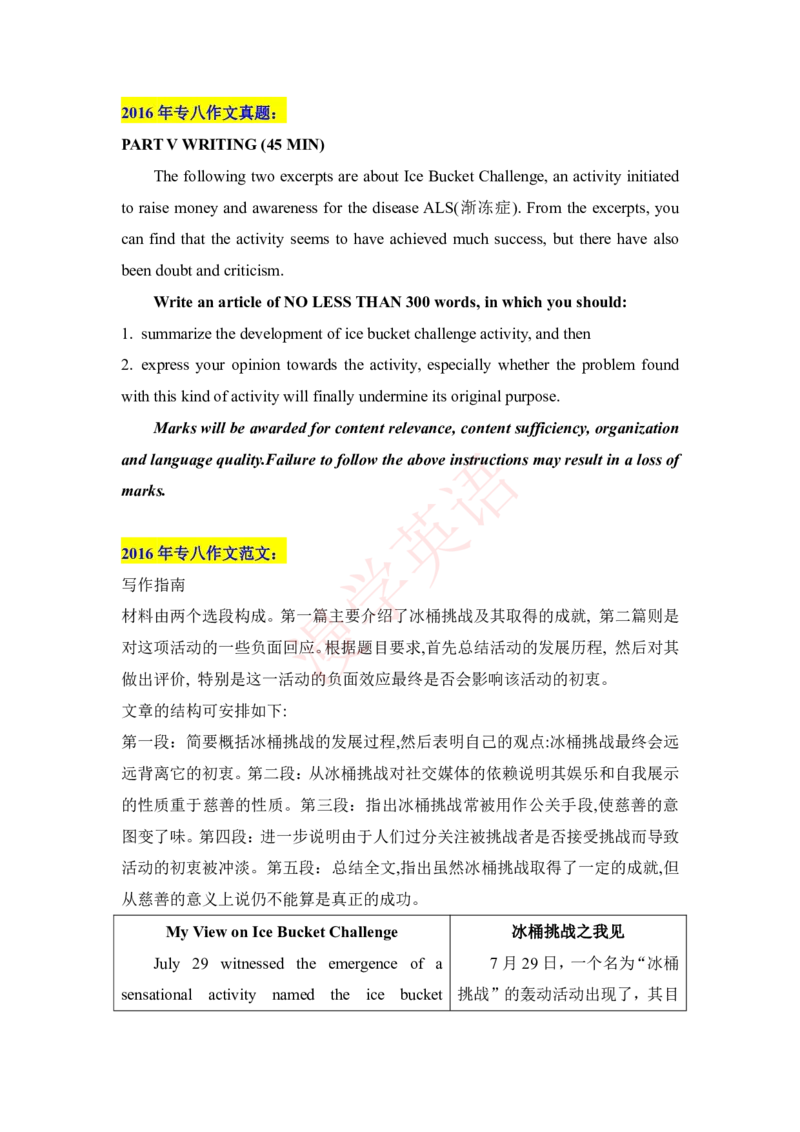
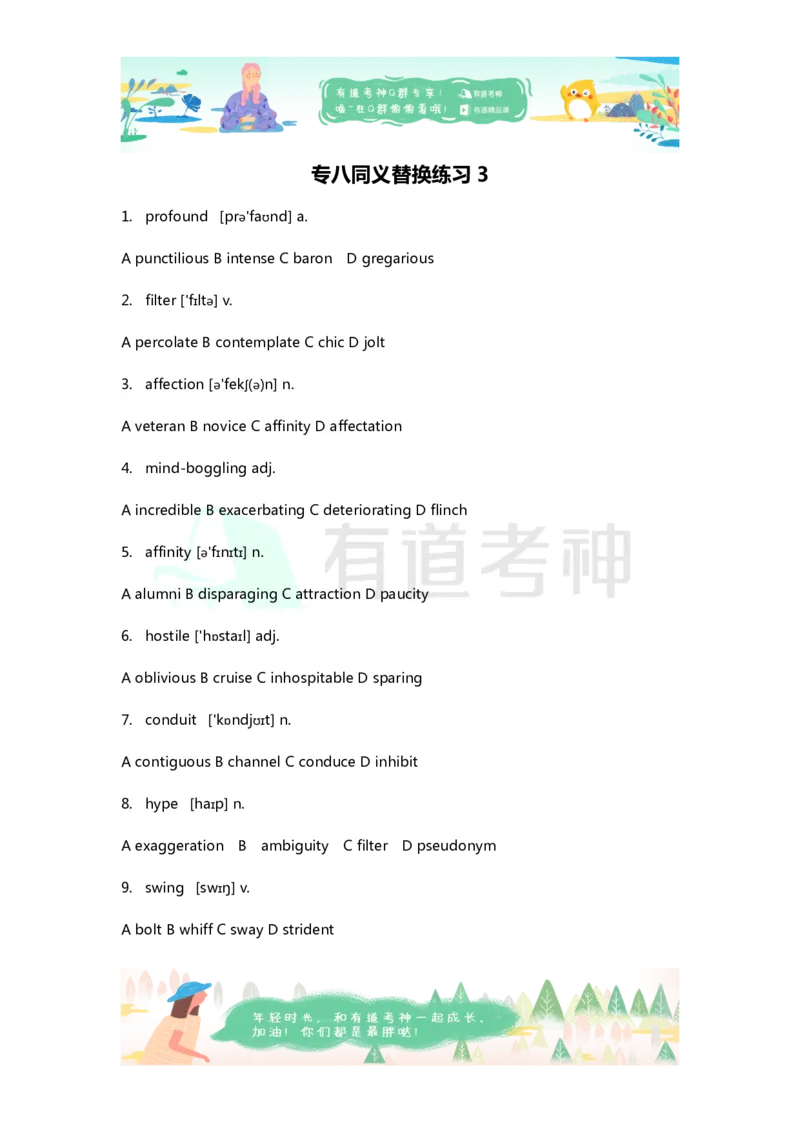
2012 年专八真题详解
(新题型优化)
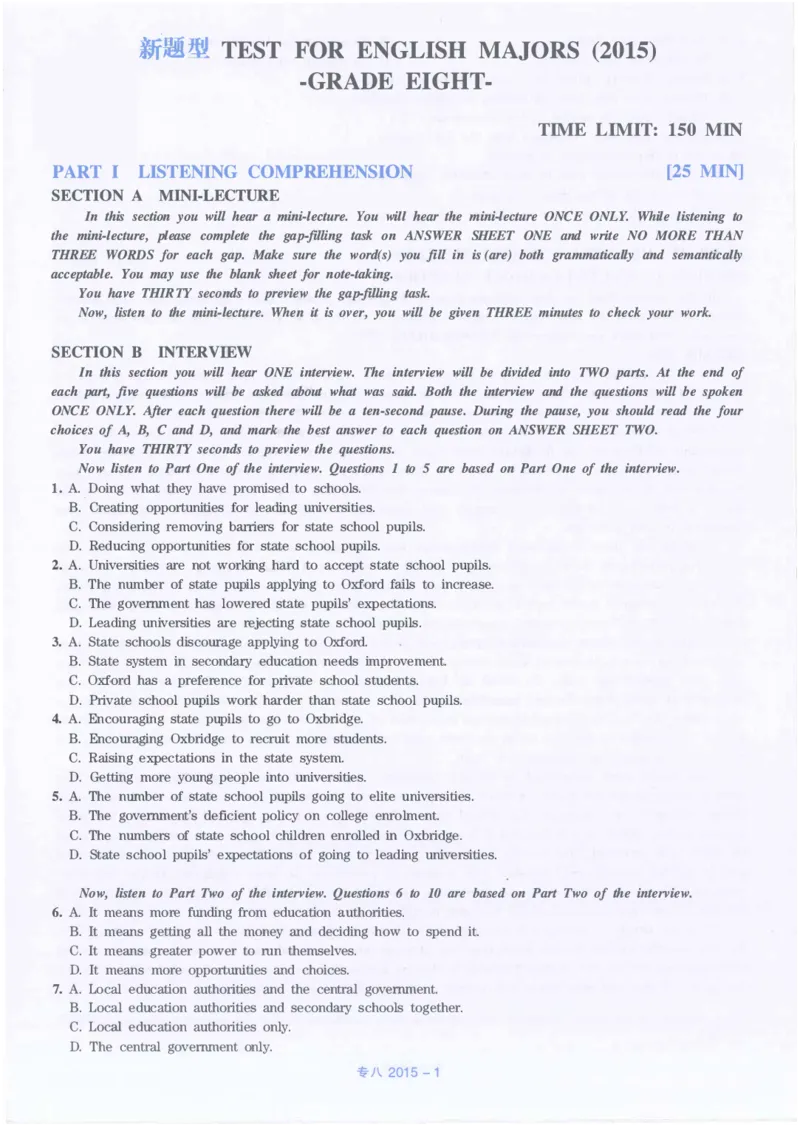
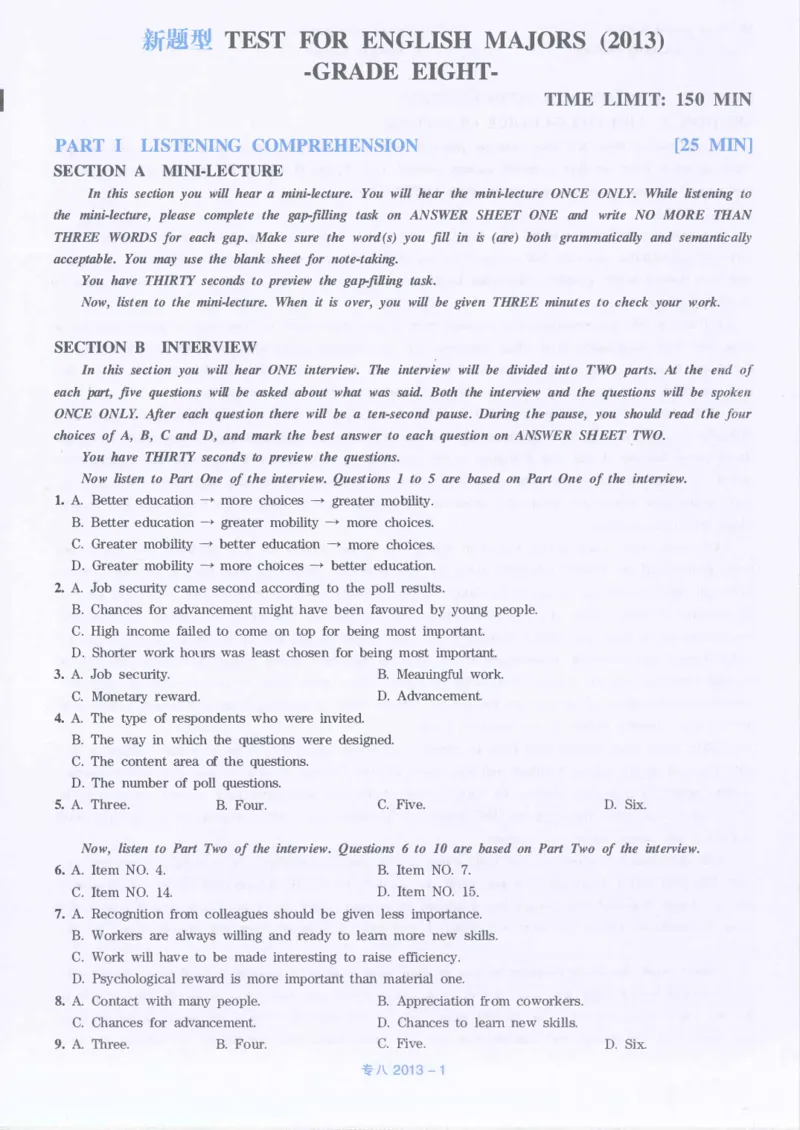
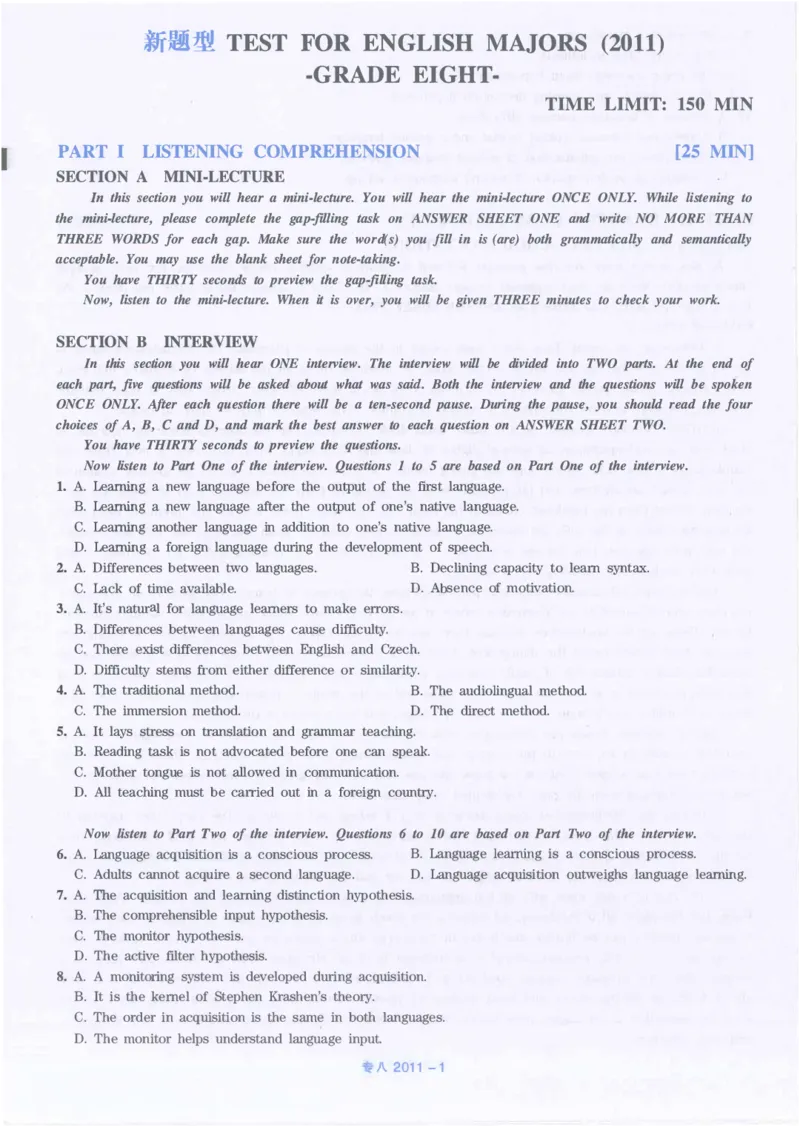
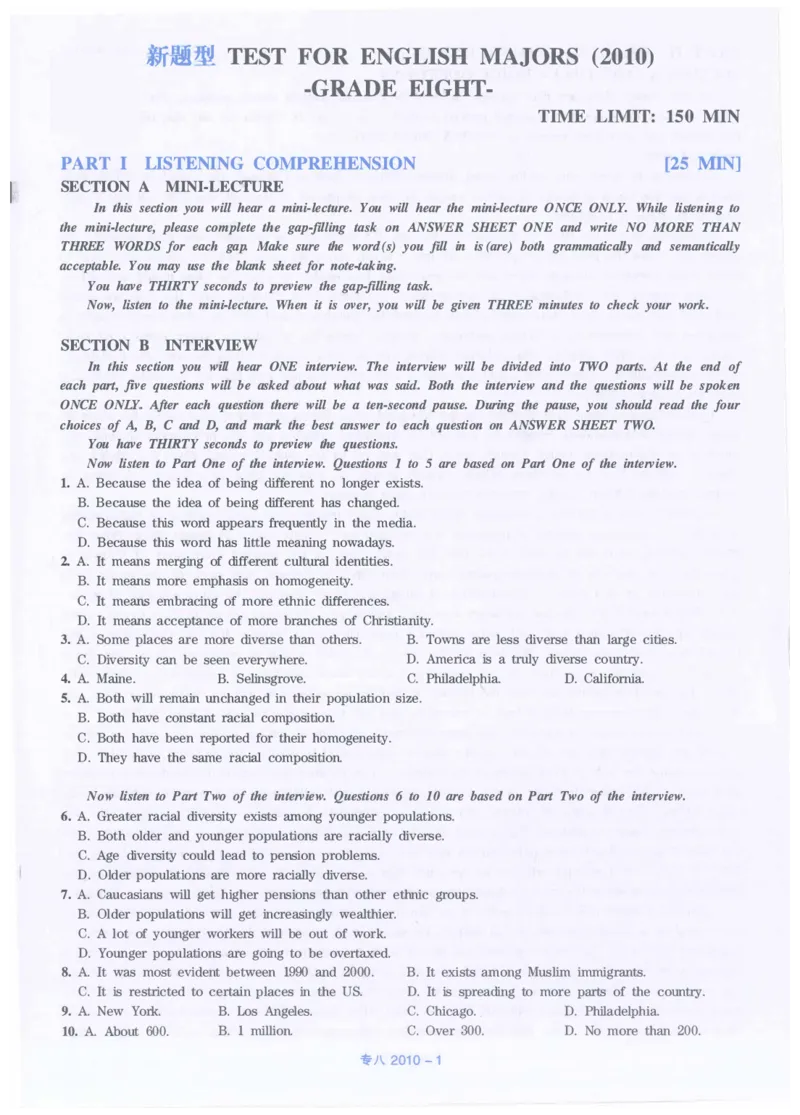
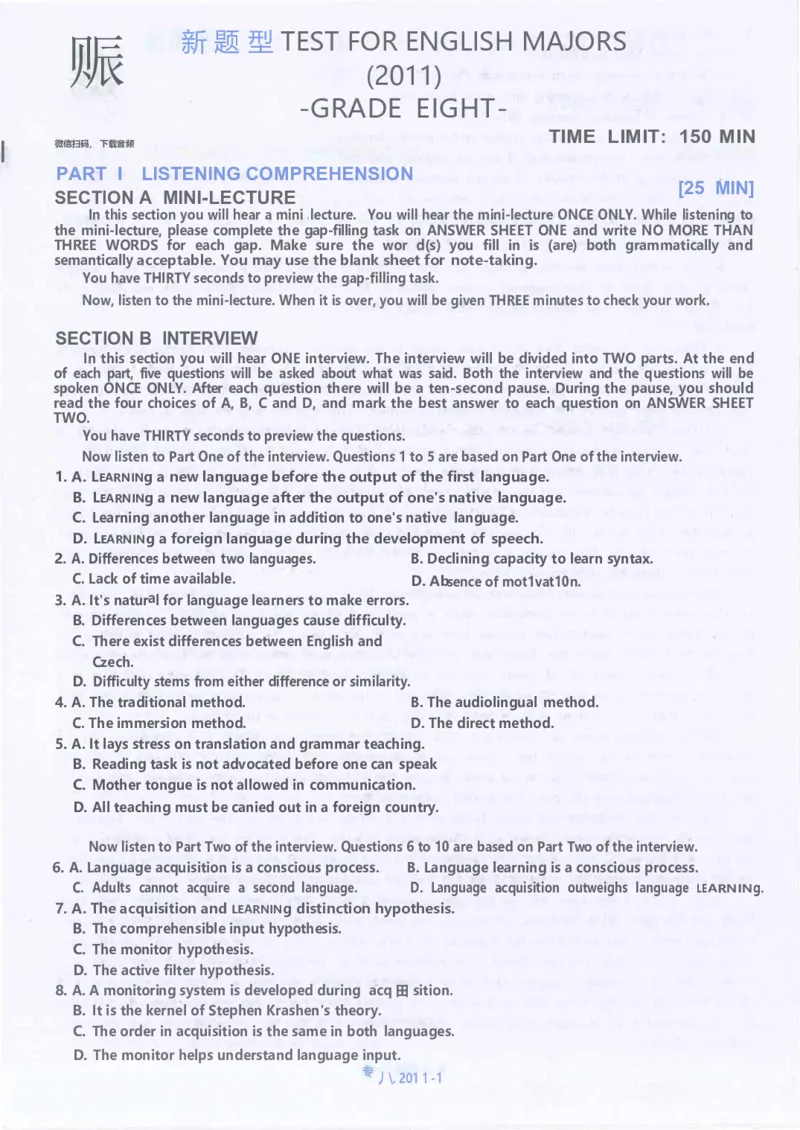
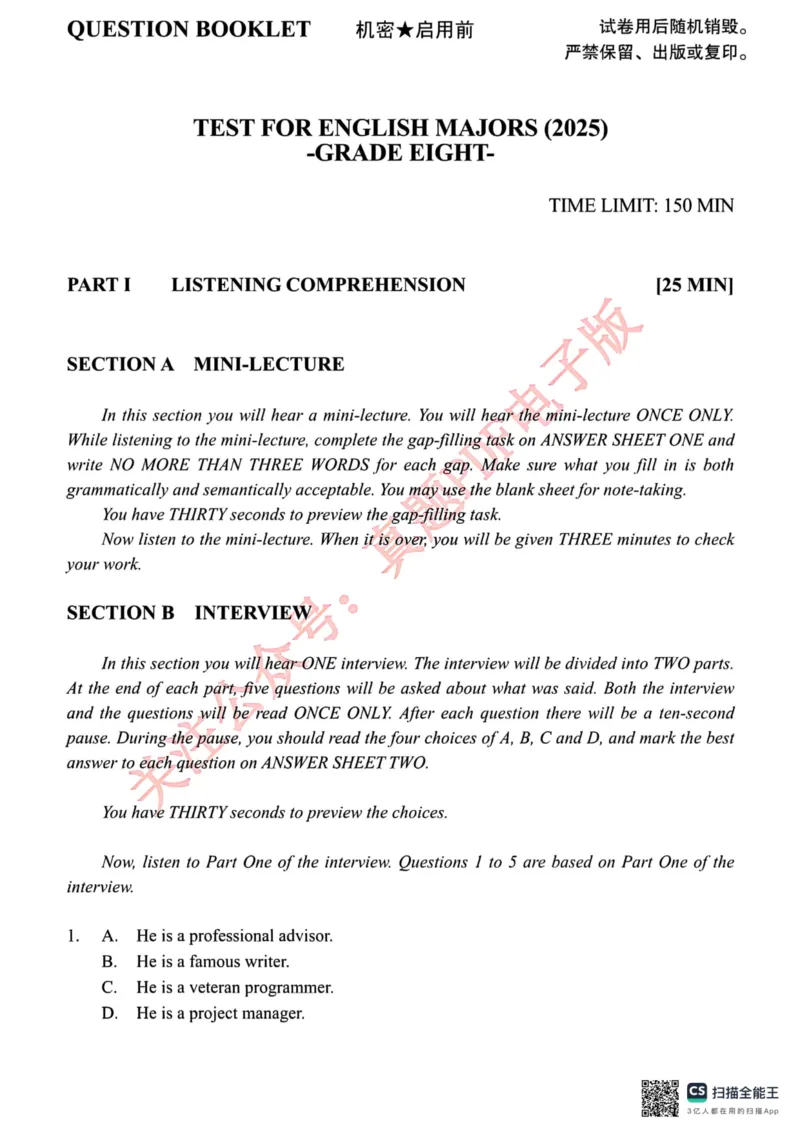
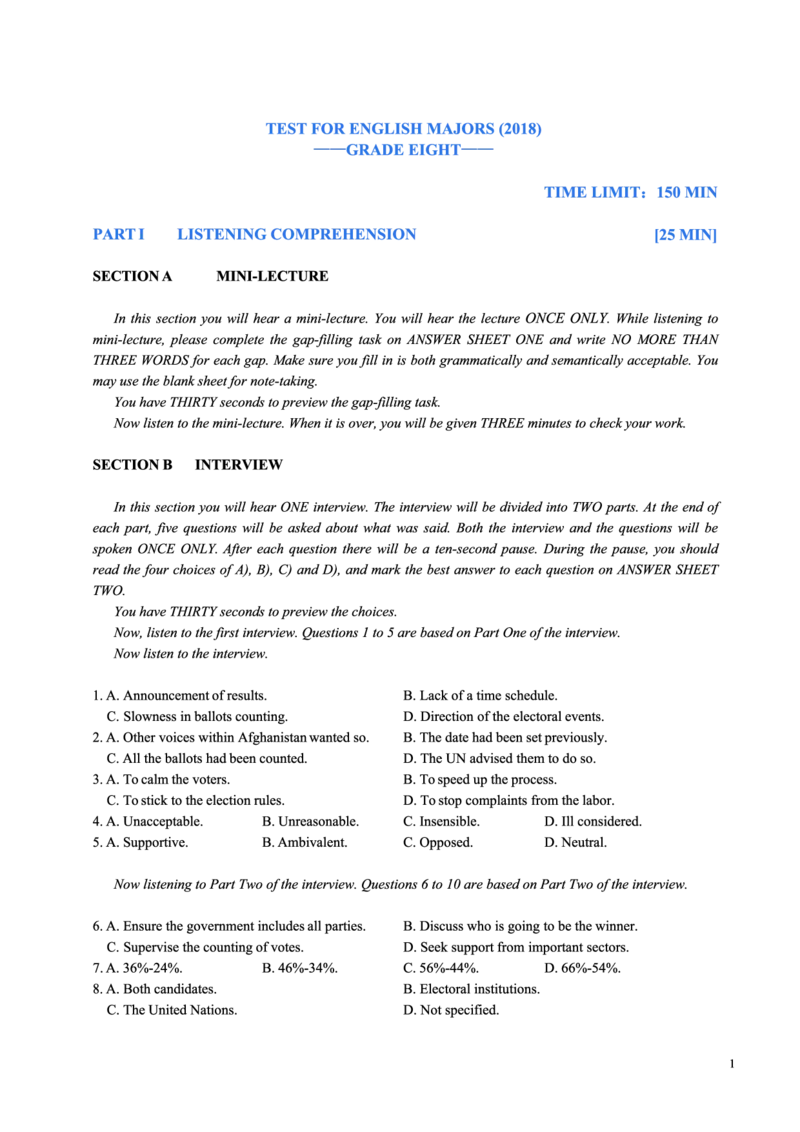
PART I LISTENING COMPREHENSION
SECTION A
Observing Behaviour
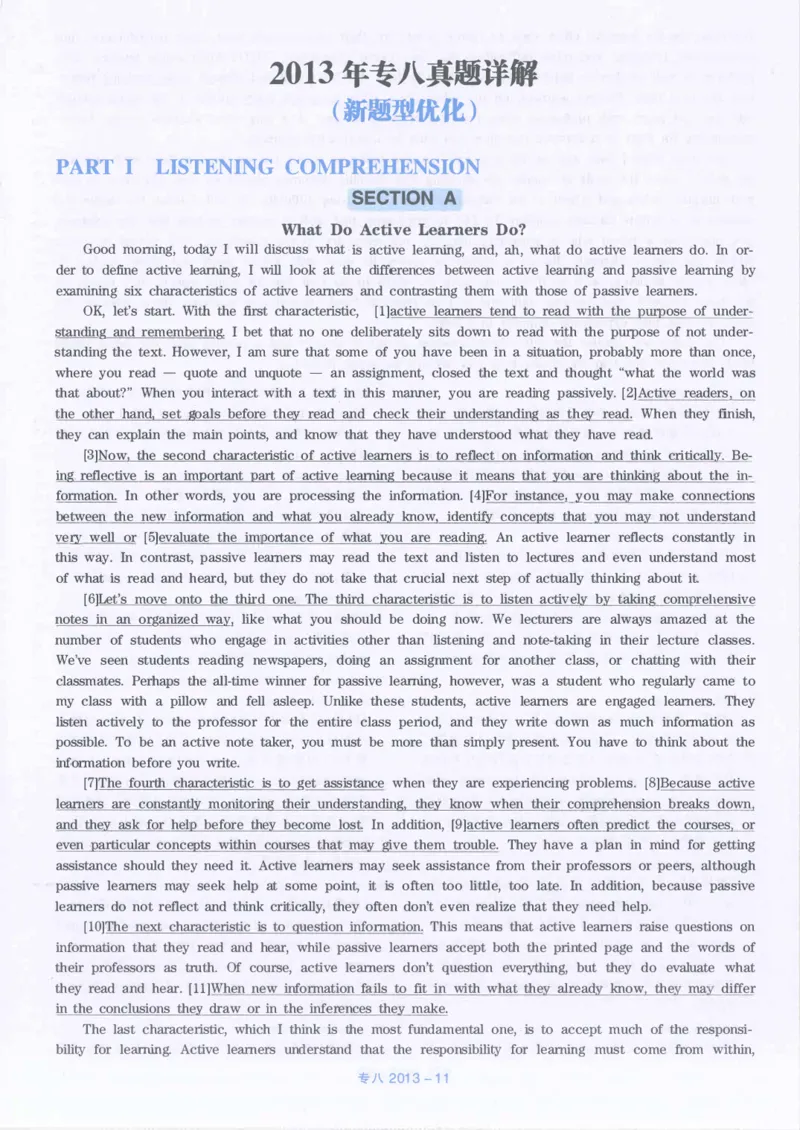
Good morning, everyone. Today we will look at how to observe behaviour in research. Perhaps you
would say it is easy and there is nothing extraordinary. Yes, you may be right. All of . us observe behaviour
every day. For example, when traveling in another country, we can avoid embarrassment by observing how
people behave in that culture. And failing to be observing while walking or driving can be life-threatening.
We learn by observing people's behaviour. Researchers too rely on their observations to learn about
behaviour, [l]but there are differences. For instance, when we observe casually, we may not be aware of
factors that bias our observations, and, [2]and when we rarel kee formal records of our observations. In
stead, we rely on our memory of events. [3]0bservations in research on the other hand are made under
recisel defined conditions that is in a s stematic and ob·ective manner and with careful record kee in .
Then how are we going to conduct observations in our research studies, and what do we need to do
in order to make a scientific and objective observation? Now, as you remember, the primary goal of obser
vation is to describe behaviour, but it is in reality impossible to observe and describe all of a person's be
haviour. So we have to rely on observing samples of people's behaviour. Doing so, we must decide whether
the samples represent people's usual behaviour. Thus, we will first take a brief look at how researchers se
lect samples of behaviour.
Before conducting an observational study, researchers must make a number of important decisions,
that's about when and where observations will be made. As I've said before, the researcher cannot observe
all behaviour. Only certain behaviours occurring at particular times, in specific settings can be observed. In
other words, behaviour must be sampled. In this lecture, I will briefly introduce two kinds of sampling, that
is, [ 4 ]time sampling and situation sampling.
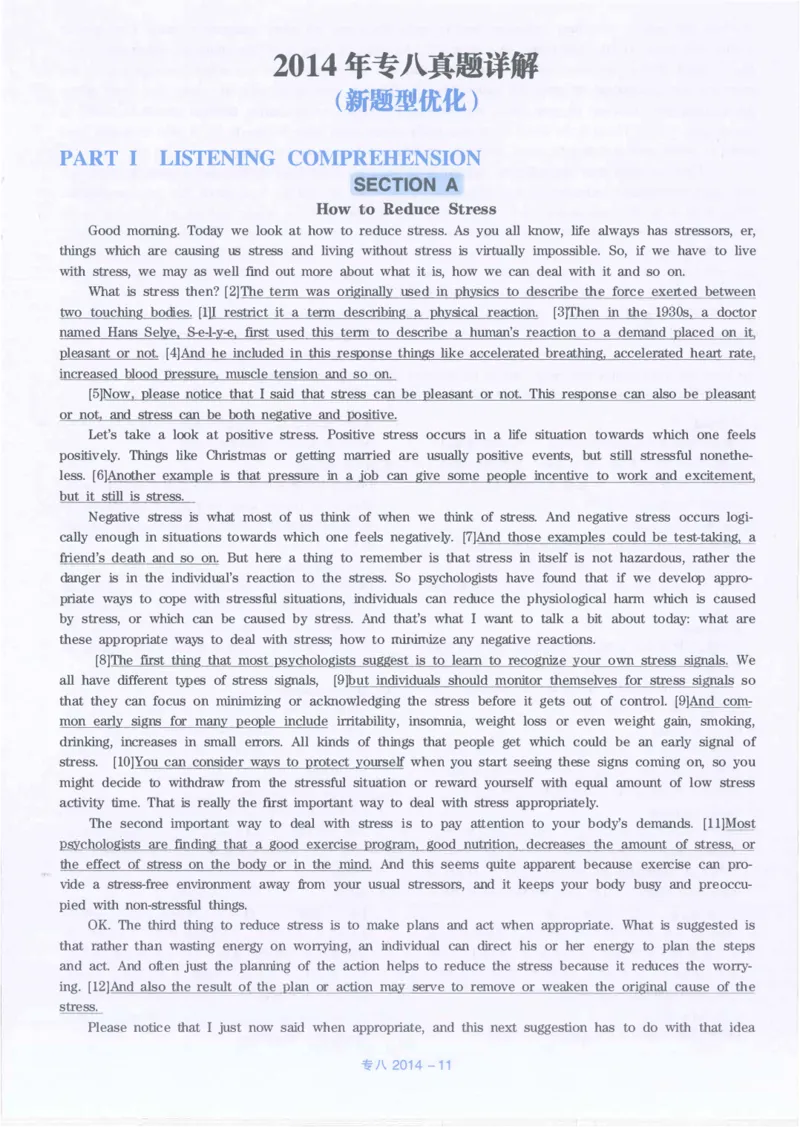
Now first, time sampling. Time sampling means that researchers choose various time intervals for their
observation. Intervals may be selected systematically or randomly. Suppose we want to observe students'
classroom behaviour. Then in systematic time sampling, our observations might be made during five 20-
呻ute periods, beginning every hour. The first observation period could begin at 9 am, the second at 10
am and so forth. [5]However in random sam lin these five 20-minute eriods ma be distributed randoml
over the course of the da . That is to sa intervals between observation eriods could v —some Ion er
others shorter. One point I'd like to make is systematic and random time sampling are not always used in
isolation. They are often combined in studies. For example, while observation intervals are scheduled sys
tematically, observations within an interval are made at random times. That means the researcher might de
cide to observe only during 15-second intervals that are randomly distributed within each 20-rninute period.
[6]Now let's come to situation sam lin . Then what is situation sam lin ? [6]/[7]1t involves studying be
haviour in different locations and under different circumstances and conditions. By sampling as many differ
ent situations as possible researchers . can reduce the chance that their observation results w出 be peculiar
to a certain set of circumstances and conditions. [8]Wh ? Because eo le or for that manner animals do
not behave in exactl the same wa across all situations. For example, children do not always behave the
same way with one parent as they do with the other parent, and animals do not behave the same way in
zoos as they do in the wild. [9]So b sam lin different situations a rese�rcher can make more ob·ective
observations than he would in onl a s ecific situation.
[ lO]Havin discussed wa s to sam le behaviour in research we are now movin onto another issue
that is what researchers should do to record behaviour as it occurs that is whether researchers are active
or passive in recording behaviour. This refers to the methods of observation. Observational methods can be
专八 2012 -11classified as "observation with intervention" or "observation without intervention". Observation with inter
vention can be made in at least two ways, [ 11 ]participant observation and field experiment. In participant
observation, observers, that is researchers, play a dual role: They observe people's behaviour and they par
ticipate actively in the situation they are observing. If individuals who are being (!bserved lmow that the ob
server is present to collect information about their behaviour, this is undisguised participant observation. But
in disguised participant observation, those who are being observed do not lmow that they are being ob
served.
[12]Another method of observation with intervention is field e eriment. What is a field e eriment?
When an observer controls one or more conditions in a natural settin in order to determine the effect on
behaviour this rocedure is called field ·e eriment. The field experiment represents the most extreme form
of intervention in observational methods. The essential difference between field experiments and other ob
servational methods is that researchers have more control in field experiments.
Now let's take a look at observation without intervention. [13]0bservation wi小out intervention is also
called naturalistic observation because its main ose is to describe behaviour as it normall occu巧 that
is in a natural setting, [14]without an attem t b the observer to intervene. [15]An observer using this
1 .
method of observation acts as a assive recorder of what occurs. The events occur naturally and are not
controlled by the observer.
OK, in today's lecture, we have focused on how to make decisions of sampling before beginning our
observation, and what we can do during observation. I hope what we've discussed will help you in your fu
ture research design.
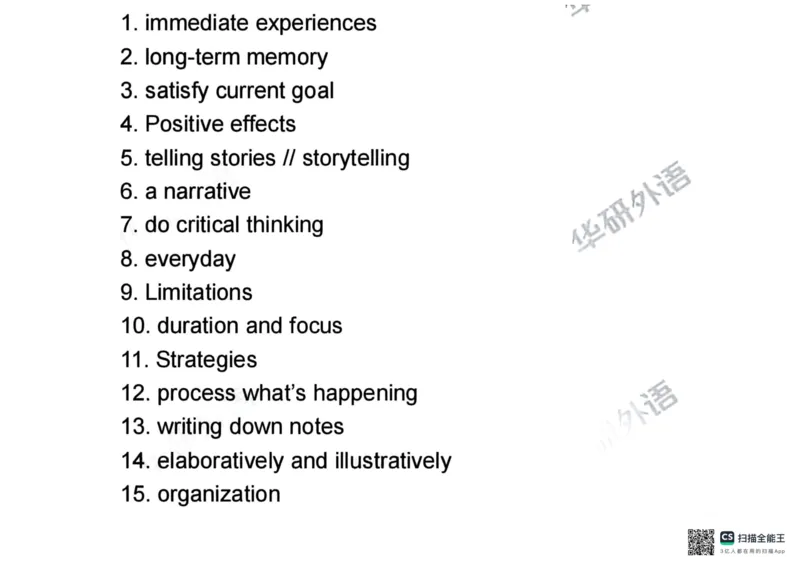
1. Differences piing 提示了第二种取样的方式 , 并通过 what is
【解析】空格处的 A 点与下面的 B、C并列,是讲座的 situation sampling? 对 situation sampling 进行了
第一大要点。 讲座一开始就提到两种观察方法有区别 说明。
(there are differences) , 故答案填 Differences 即 7. different locations II different circumstances // dif
可。 注意首字母要大写,而且应用复数形式。 fe rent conditions
2. rare formal records 【解析】在介绍 situation sampling 的定义时,原文说
【解析】原文提到,在日常生活的观察中,人们往往随 这是在不同地点、不同情况下研究行为(in different
意观察且rarely keep formal records , 另外,由于题 locations and under different circumstances and
目只能填形容词或名词, 且限填三个词, 故答案为 conditions) , 由于字数的限制,答案在locations, cir
rare formal records。 注意要把原文的副词rarely改 cumstances和 conditions 中选填一个即可。
成形容词rare,修饰名词短语formal records。 8. varies // changes // differs
3. under defined conditions II systematic and objec 【解析】原文提到运用situation sampling 的原因是人
tive 或动物的行为方式不可能在所有情景中都一样。 根据
【解析】原文提到研究性行为观察是在准确限定的情 题目 ,答案应该是表示变化或不同的动词的第三人称
况下进行的(under precisely defined conditions) , 单数形式, 故答案可以是 varies, changes, differs
且有详细的记录(careful record keeping)。 并把 等。
under precisely defined conditions 进一步解释为 9. advantage // purpose
in a systematic and objective manner。 故答案可 【解析】原文提到研究者通过 situation sampling可以
填 under defined conditions 或 systematic and 做出更客观的观察报告 (more objective observa
objective。 tions)。 可见, 更客观的观察报告是situation sam
4. time sampling pling 的优势或目的。 因此,答案应该是advantage或
【解析】原文介绍了两种取样的方式, 分别是 time purpose。
sampling 和situation sampling , 这里要填第一种,故 10. as it occurs
填time sampling。 (解析】原文明确指出接下来要讨论另一个问题,并
5. variable // of different lengths 通过 that is 说明要讨论 的是 what researchers
【解析】原文提到在random sampling 中,每次观察的 should do to record behaviour as it occurs:, 因
间隔时间会变(inteivals... could vary…),可长可短 此,答案应该就是as it occurs。
(some longer others shorter)。·根据题目 ,这里可填 11. participant observation
形容词或介词短语,因此,答案是 variable 或of dif 【解析】原文提到 “进行干扰的观察(observation
ferent lengths。 with intervention) "可分为两种,分别是participant
6. situation sampling observation 和 field experiment, 后者在提纲中已
【解析】原文中的 Now let's come to situation sam- 经给出,此空填入前者。
专八2012-1212. has control II having control 14. method
[解析】原文在回答What is a field experiment? 这 【解析】原文提到在 observation without interven
个问题时明确指出, 在 field experiment 中研究者 tion 的情况下, 观察者是不对观察的对象和环境进
控制一个或多个条件。 另外,根据空格后的 over可 行干扰的 (without any attempt by the observer
知control应该是名词 (control作动词时为及物动 to intervene) , 这里即空格后的 no intervention , 而
词,后面不需要加 over);再者,researcher为单数, 根据题目前后的内容, 本题应该填类似于题目中出
因此,答案为 has control或having control。 现的 purpose和researcher这样的单个名词,而“没
13. normally occurring // in natural settings 有干扰” 可以归纳为这一观察手段的方法或实施途
【解析】原文提到 observation without intervention 径,故答案可填method。
的主要 目 的是 to describe behaviour as it nor 15. a passive recorder
mally occurs, that is, in a natural setting。 根据 【解析】原文提到在 observation without interven
题目 , 该题应该填修饰 behaviour 的分词或介词短 tion 的情况下, 观察者实际上是一个 ”被动的记录
语,因此,答案为 normally occurring 或 in natural 者"'答案照写录音提到的a passive recorder即可。
settings。
SECTION B
Part One:
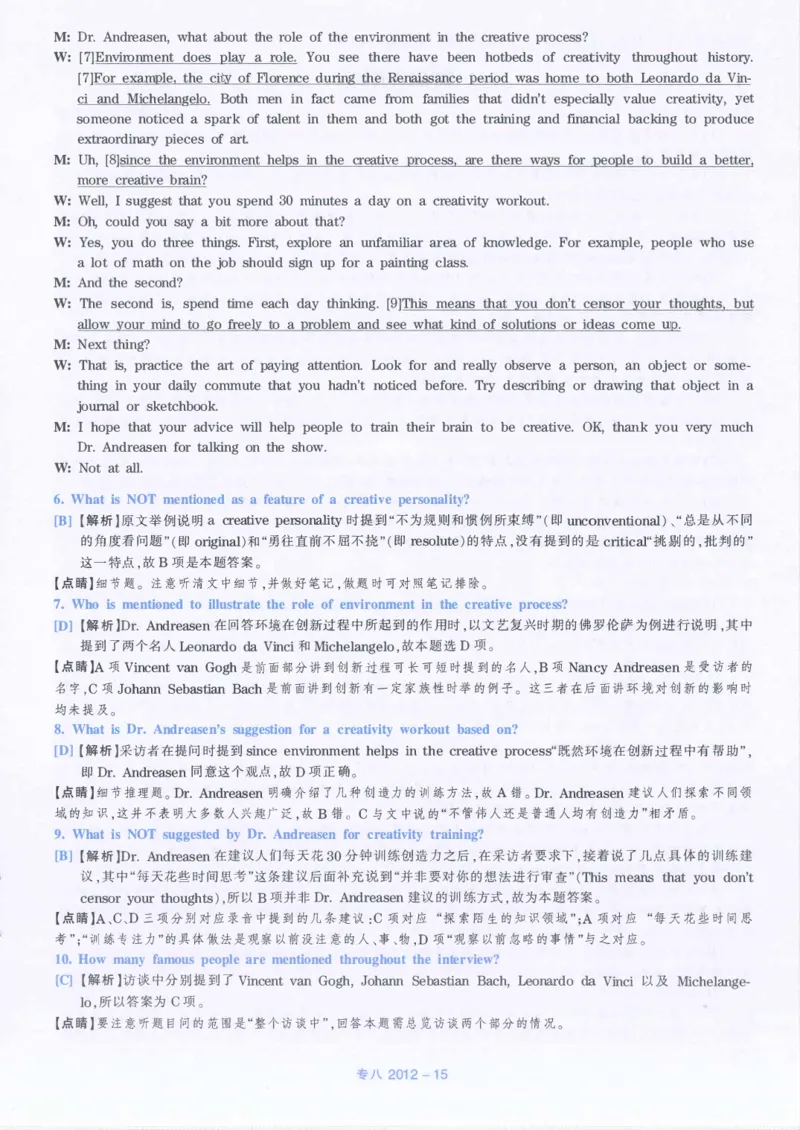
M: People often wonder how the human brain creates, for example, a beautiful painting, a sculpture or
even a delicious dinner. Today we are honoured to have Dr. Nancy Andreasen, a neuroscientist at the
University of Iowa on our talk show. Dr. Andreasen has recently written a book called The Creating
Brain: The Neuroscience of Genius. In her book, she tackles the question and tries to look into the
brain behind creativity.
M: Dr. Andreasen, thanks for coming on our show.
W: Pleasure.
M: Now, Dr. Andreasen can we start with the question "What is creativity?"
W: Well, creativity can be saying as a process. This process starts with a person, for example an artist,
musician, inventor or even someone who's trying to figure out a better way of doing a task at work or
at home. [ 1 ]That erson must think about the roblem or or their ro·ect in a novel wa and then
come up with a solution.
M: Hmm, I see. But how long will it take for the person to find a solution as it were?
W: Well, it depends. [ 1 ]The creative rocess can o b in a flash or it can take ears. But the end result
is invariabl the roduction of somethin new and useful such as the automobile or somethin beauti
ful and artistic such as a aintin b Vincent van Go h.
M: Hmm, Dr. Andreasen, then do you think the ability to be creative is inborn or not?
W: Well, no one knows yet if the ability to be creative, for example, the ability to produce a haunting
symphony is the result of the environment or a genetic makeup that allows people to be creative more
easily. [2]However creativi does seem to run in certain families.
M: Is that so?
W: Yes. You see, [2]Johann Sebastian Bach was the most famous member of the Bach famil but there
were 20 other eminent musicians who came from the same famil
M: That's very interesting. Now Dr. Andreasen, we've so far been talking about those famous creative peo
ple like van Gogh or Bach who have produced great pieces of work. [l]Does that mean that creativity
only resides in great people?
W: [l]No, certainly not. [3]Creativi is not limited I mean to the maste iece work of art but can also be
found in eve da tasks such as cookin or ardenin .
M: Oh, really?
W: [3]For exam le a cook chan es a reci e or even makes one u usin in redients he or she has on
hand to roduce a new one. He is in fact usin the creative rocess to create novel taste sensations.
M: [l]So can we sa both famous and ordin eo le can be creative?
W: [l]阳
M: Now Dr. Andreasen, can you describe to us what the actual creative process is?
W: OK. Uh, [4]artists musicians and writers often describe eriods durin which the 're rel ·n on ordin
专八2012-13—
creativi . For exam le ou know writers can s end hours at the ke board uttin thou hts to ether
this process is similar to the way·people ut to ether novel ideas when talkin . And and man reat
artists also describe a dream-like state du血 which a s hon a oem or the idea for the endin of
a play comes to them in a·flash.
M: So what's going on in the brain during a flash of inspiration?
W: Well, for the moment no one knows for sure, but but researchers suggest that creative people often slip
into a zone in which ideas, uh, and thoughts come up freely in a sort of disorganized way. [5]During
that state, a art of the brain becomes ve active. And that brain re ion is known to be able to link
u ideas or or thou hts in otentiall novel wa s.
1. What do we learn about creativity?
“ ”
[C] 【解析】Dr. Andreasen在回答完 创新者通常需要花多久来想出解决方案 之后,接着提到最终的创新成果都是新
颖而实用的东西(the end result is invariably ... something new and useful),但 形式各异(such as后列举了多
个不同形式的创新成果),所以 C项符合原文信息。
【点睛】原文虽提到创新源于新颖的思考(in a novel way),但 Dr. Andreasen也表示, 目 前并不知道创新能力是否遗
“ ”
传所得,还提到普通人也可以创新,故 A项 创新能力源 自 伟人的创新思考 不对。 录音中 明确说到创新过程有长有短
(in a flash or it can take years) , 所以排除B项 “ 创意总是以灵光一现的方式出现 ” 。 原文明确说创新者 旨在找到解
“
决问题的更佳途径,试图得到解决方案,故最终 目 的应该是solutions,而不应该只着重于 创新思维"'故 D 项也不对。
2. What does Dr. Andreasen want to show by citing the Bach family?
[A] [解析】当采访者问创新能力是否天生时,Dr. Andreasen指出,虽然不能确定创新源自环境还是基因,但是创新确
实有家族性(… creativity does seem to run in certain families)。 随后采访者对此提出疑问"Is that so?" ,
Dr. Andreasen 明确回答 Yes, 并以 Bach family为例进行说明。 可见, 引用该例子是为了说明前面 creativity
“ ”
does seem to run in certain fam让ies这句话,即说明创新能力具有 家族性 ,也就是说,与基因构成有关。 故答
案是A项。
[点睛】例证题。应注意,文章举例都是为上下文的观点服务的。一般来说,观点会出现在例子的前后(以例证前居多)。对
” ” ” ”
话中,没有明确提到 B项 似乎是环境的产物 和 D项 源 自 环境及基因构成 的观点 ,可首先排除。 在 Bach family 的
”
例子后,采访者提出疑问 是不是伟人才有创造力", Dr. Andreasen 明确 回答 No, certainly not, C 项与此相悖,故也可
排除。
3. What does Dr. Andreasen want to explain by mentioning a cook?
[A] 【解析]采访者问 ” 是不是伟人才有创造力", Dr. Andreasen 回答 ” 不是 ” 之后,接着说到创造力也常见于诸如烹任和
园艺等日常活动中,然后对此进一步解释时就以厨师为例,表明普通人也具有创造力。 所以本题选A项。
【点睛】B项 “ 要成为一名好的厨师,创造性思维很重要",C 项 “ 厨师如果创造了 一个食谱,他就能 出名",D 项 “ 厨房里经
"
常发生创新活动 ,它们只是抓住录音中的个别信息(cook, recipe 等)通过断章取义或者胡乱腮测编造出来的于扰项。
4. How many types of the creative process does Dr. Andreasen describe?
[B] 【解析】Dr. Andreasen说,创造过程既有仰赖普通的创造力的时候,也有如做梦般的灵感进发的状态。可见,创新过
程可分为两种,故B项正确。
【点睛】细节总结题。本题答案在录音中没有直接提到,需要听清 Dr. Andreasen对 “ 实际的创新过程是什么样的 ” 这个
问题的回答, 然后再归纳。 某些相似的句式或用词有提示作用 , 如这里的 artists… often describe ... 和 many great
artists also describe ... , 这些就是需要归纳的关键信息处,录音中出现了两处,即使听不太清楚,也可以推断出本题答案。
5. What is likely to happen in the brain during a flash of inspiration?
[C] 【解析】采访者提问人的大脑在灵光一闪的瞬间都会发生些什么事情。 根据Dr. Andreasen 回答中的最后一句 “ 我
们已经知道大脑的那个区域可以连接思想或想法(that brain region is known to… thoughts)" , 可知本题应选C。
“ “ ” “ ”
【点睛】A项 筛选想法".._B项 回顾想法 、D 项 去除旧想法 在录音中均未提及。
Part Two:
M: I see. Another question, do you think there is a creative personality?
W: Well, perhaps w_e can put it this way. Gifted people in the arts or science tend to enjoy adventure.
They often like to explore new places or ideas. Uh, [6]they don't like being hemmed in by rules or
convention and and the often look at roblerns from a different an le. Another oint is is the often
have to move do edl ahead on a ro·ect-even when the outside world re·ects their art or new ideas.
专八 2012 -14M: Dr. Andreasen, what about the role of the environment in the creative process?
W: [7]Environment does play a role. You see there have been hotbeds of creativity throughout history.
[7]For exam le the ci of Florence durin the Renaissance eriod was home to both Leonardo da Vin
ci and Michelangelo. Both men in fact came from ·families that didn't especially value creativity, yet
someone noticed a spark of talent in them and both got the training and fmancial backing to produce
extraordinary pieces of art.
M: Uh, [8]since the environment hel s in the creative rocess are there wa s for eo le to build a better
more creative brain?
W: Well, I suggest that you spend 30 minutes a day on a creativity workout.
M: Oh, could you say a bit more about that?
W: Yes, you do three things. First, explore an unfamiliar area of knowledge. For example, people who use
a lot of math on the job should sign up for a painting class.
M: And the second?
W: The second is, spend time each day thinking. [9]This means that ou don't censor our thou hts but
allow our mind to o·freel to a roblem and see what kind of solutions or ideas come u .
M: Next thing?
W: That is, practice the art of paying attention. Look for and really observe a person, an object or some
thing in your daily commute that you hadn't noticed before. Try describing or drawing that object in a
journal or sketchbook.
M: I hope that your advice will help people to train their brain to be creative. OK, thari.k you very much
Dr. Andreasen for talking on the show.
W: Not at all.
6. What is NOT mentioned as a feature of a creative personality?
[B] a creative personality “ " unconventional) “
【解析】原文举例说明 时提到 不为规则和惯例所束缚 (即 、 总是从不同
" original) “ " resolute) critical" ”
的角度看问题 (即 和 勇往直前不屈不挠 (即 的特点,没有提到的是 挑剔的,批判的
这一特点,故 B 项是本题答案。
【点睛】细节题。 注意听清文中细节,并做好笔记,做题时可对照笔记排除。
7. Who is mentioned to illustrate the role of envirorunent in the creative process?
[D] ]Dr. Andreasen
【解析 在回答环境在创新过程中所起到的作用时,以文艺复兴时期的佛罗伦萨为例进行说明,其中
Leonardo da Vinci Michelangelo, D
提到了两个名人 和 故本题选 项。
A Vincent van Gogh B Nancy Andreasen
[点睛】 项 是前面部分讲到创新过程可长可短时提到 的名人, 项 是受访者的
C Johann Sebastian Bach
名 字, 项 是前面讲到创新有一定家族性时举的例子。 这三者在后面讲环境对创新的影响时
均未提及。
8. What is Dr. Andreasen's suggestion for a creativity workout based on?
[D] since environment helps in the creative process"
【解析】采访者在提问时提到 既然环境在创新过程中有帮助"'
Dr. Andreasen D
即 同意这个观点,故 项正确。
Dr. Andreasen A Dr. Andreasen
【点睛】细节推理题。 明确介绍 了 几种创造力 的训练方法,故 错。 建议人们探索不同领
B C ” ”
域的知识,这并不表明大多数人兴趣广泛,故 错。 与文中说的 不管伟人还是普通人均有创造力 相矛盾。
9. What is NOT suggested by Dr. Andreasen for creativity training?
[B] Dr. Andreasen 30
【解析】 在建议人们每天花 分钟训练创造力之后,在采访者要求下,接着说了几点具体的训练建
“ ” ” "(This means that you don't
议,其中 每天花些时间思考 这条建议后面补充说到 并非要对你的想法进行审查
censor your thoughts) , B Dr. Andreasen
所以 项并非 建议的训练方式,故为本题答案。
A,C D C “ ";A “
【点睛】 、 三项分别对应录音中提到 的几条建议: 项对应 探索陌生的知识领域 项对应 每天花些时间思
” D “ ”
考";"训练专注力 的具体做法是观察以前没注意的人、事、物, 项 观察以前忽略的事情 与之对应。
10. How many famous people are mentioned throughout the interview?
[C] Vincent van Gogh, Johann Sebastian Bach, Leonardo da Vinci Michelange
[解析】访谈中分别提到了 以及
lo, C
所以答案为 项。
“ "
【点睛】要注意听题目 问的范围是 整个访谈中 ,回答本题需总览访谈两个部分的情况。
专八2012-15PART II READING COMPREHENSION
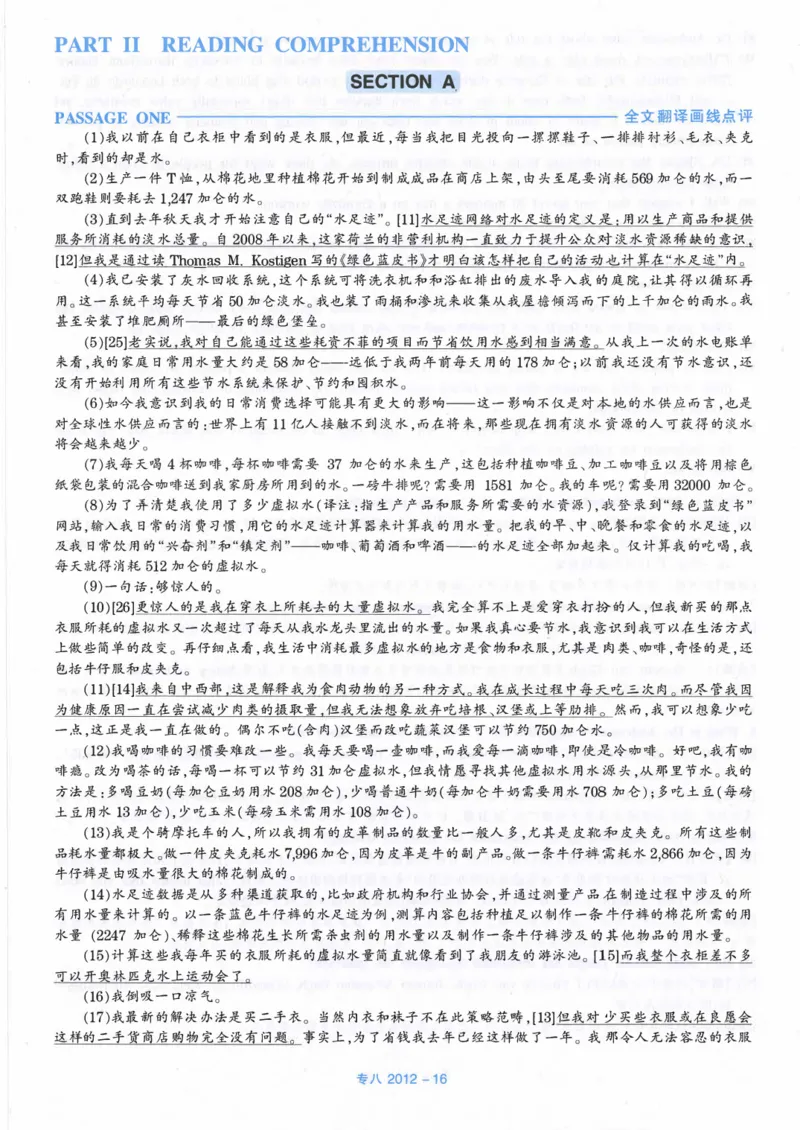
SE�TI��_A_,
PASSAGE ONE 全文翻译画线点评
(1)我以前在 自 己衣柜中看到的是衣服,但最近,每当我把 目 光投向一棵猓鞋子、一排排衬衫、毛衣、夹克
时,看到的却是水。
(2)生产一件T恤,从棉花地里种植棉花开始到制成成品在商店上架,由头至尾要消耗 569加仓的水,而一
双跑鞋则要耗去 1,247加仑的水。
(3)直到去年秋天我才开始注意 自 己的“水足迹”。 [11]水足迹网络对水足迹的定义是:用 以生产商品和提供
服务所消耗的淡水总量。 自 2008年以来 这家荷兰的非营利机构一直致力于提升公众对淡水资源稀缺的意识
[12]但我是通过读 Thof?as M. Kosti en写的 绿色蓝皮书 才明 白该怎样把自 己的活动也计算在“水足迹“内。
(4)我已安装了灰水回收系统,这个系统可将洗衣机和和浴缸排出的废水导入我的庭院,让其得以循环再
用。这一系统平均每天节省 50加仓淡水。我也装了雨桶和渗坑来收集从我屋檐倾泻而下的上千加仑的雨水。我
甚至安装了堆肥厕所——-最后的绿色堡垒。
(5)[25]老实说 我对自 己能通过这些耗资不菲的项 目 而节省饮用水感到相当满意。 从我上一次的水电账单
来看,我的家庭日 常用水量大约是 58加仑——-远低于我两年前每天用的 178加仓;以前我还没有节水意识,还
没有开始利用所有这些节水系统来保护、节约和围积水。
(6)如今我意识到我的 日 常消费选择可能具有更大的影响-这一影响不仅是对本地的水供应而言,也是
对全球性水供应而言的 :世界上有 11 亿人接触不到淡水,而在将来,那些现在拥有淡水资源的人可获得的淡水
将会越来越少。
(7)我每天喝 4杯咖啡,每杯咖啡需要 37 加仓的水来生产 ,这包括种植咖啡豆、加工咖啡豆以及将用棕色
纸袋包装的混合咖啡送到我家厨房所用到的水。一磅牛排呢? 需要用 1581 加仓。我的车呢? 需要用 32000 加仓。
(8)为 了弄清楚我使用 了 多 少虚拟水(译注:指生产产品和服务所需要的水资源),我登录到“绿色蓝皮书”
网站,输入我 日 常的消费习惯,用它的水足迹计算器未计算我的用水量。 把我的早、中、晚餐和零食的水足迹,以
及我 日 常饮用的”兴奋剂”和“镇定剂” 咖啡、葡萄酒和啤酒——-的水足迹全部加起来。 仅计算我的吃喝,我
每天就得消耗 512加仑的虚拟水。
(9)一句话:够惊人的。
(10) [26]更惊人的是我在穿衣上所耗去的大量虚拟水。 我完全算不上是爱穿衣打扮的人,但我新买的那点
衣服所耗的虚拟水又一次超过了每天从我水龙头里流出的水量。 如果我真心要节水,我意识到我可以在生活方式
上做些简单的改变。 再仔细点看,我生活中消耗最多虚拟水的地方是食物和衣服,尤其是肉类、咖啡,奇怪的是,还
包括牛仔服和皮夹克。
(11)[14]我来自 中西部 这是解释我为食肉动物的另一种方式。我在成长过程中每天吃三次肉 。 而尽管我因
为健康原因一直在尝试减少肉类的摄取量 但我无法想象放弃吃培根、汉堡或上等肋排。 然而,我可以想象少吃
一点,这正是我一直在做的。 偶尔不吃(含肉)汉堡而改吃蔬菜汉堡可以节约 750加仓水。
(12)我喝咖啡的习惯要难改一些。 我每天要喝一壶咖啡,而我爱每一滴咖啡,即使是_冷咖啡。 好吧,我有咖
啡瘾。 改为喝茶的话,每喝一杯可以节约 31加仑虚拟水,但我情愿寻找其他虚拟水用水源头,从那里节水。 我的
方法是:多喝豆奶(每加仑豆奶用水208加仑),少喝普通牛奶(每加仓牛奶需要用水708 加仑);多吃土豆(每磅
土豆用水 13加仑),少吃玉米(每磅玉米需用水 108加仑)。
(13)我是个骑摩托车的人,所以我拥有的皮革制品的数量比一般人多 ,尤其是皮靴和皮夹克。 所有这些制
品耗水量都极大。做一件皮夹克耗水 7,996加仑,因为皮革是牛的副产品。做一条牛仔裤需耗水2,866加仑,因为
牛仔裤是由吸水量很大的棉花制成的。
(14)水足迹数据是从多种渠道获取的,比如政府机构和行业协会,并通过测量产品在制造过程中涉及的所
有用水量来计算的。 以一条蓝色牛仔裤的水足迹为例 ,测算内容包括种植足以制作一条牛仔裤的棉花所需的用
水量 (2247 加仑)、稀释这些棉花生长所需杀虫剂的用水量以及制作一条牛仔裤涉及的其他物品的用水量。
(15)计算这些我每年买的衣服所耗的虚拟水量简直就像看到 了我朋友的游泳池。 [15]而我整个衣柜差不多
可以开奥林匹克水上运动会了 。
(16)我倒吸一口凉气。
(17)我最新的解决办法是买二手衣。 当然内衣和袜子不在此策略范畴,[13]但我对少买些衣服或在良愿会
这样的二手货商店购物完全没有问题 事实上,为 了省钱我去年已经这样做了一年。 我 那令人无法容忍的衣服
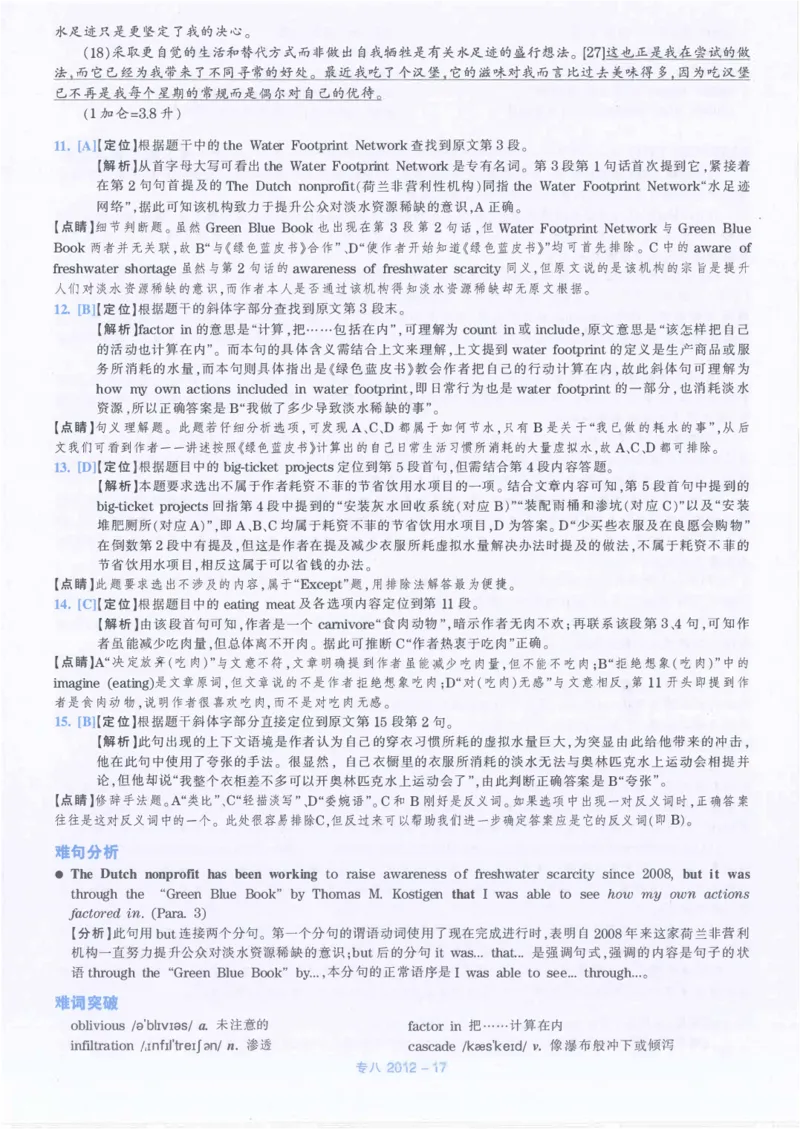
专八2012-16水足迹只是更坚定了我的决心。
(18)采取更自觉的生活和替代方式而非做出 自我牺牲是有关水足迹的盛行想法。 [27]这也正是我在尝试的做
法 而它已经为我带来了不同寻常的好处。 最近我吃了 个汉堡 它的滋味对我而言比过去美味得多 因为吃汉堡
已不再是我每个星期的常规而是偶尔对自 己的优待
(1 加仑=3.8升)
11. [A]【定位】根据题干中的the Water Footprint Network查找到原文第3段。
【解析】从首字母大写可看出 the Water Footprint Network是专有名词。 第3段第 1句话首次提到它,紧接着
在第 2旬旬首提及的The Dutch nonprofit (荷兰非营利性机构)同指the Water Footprint Network"水足迹
网络",据此可知该机构致力于提升公众对淡水资源稀缺的意识,A正确。
【点睛】细节判断题。 虽然 Green Blue Book 也出现在第 3 段第 2 句话 ,但 Water Footprint Network 与 Green Blue
Book 两者并无关联,故 B"与《绿色蓝皮书》合作",D"使作者开始知道《绿色蓝皮书》“均可首先排除。 C 中 的 aware of
freshwater shortage 虽然与第 2 句话的 awareness of freshwater scarcity 同义,但原文说的是该机构的宗 旨是提升
人们对淡水资源稀缺的意识,而作者本人是否通过该机构得知淡水资源稀缺却无原文根据。
12. [B]【定位】根据题干的斜体字部分查找到原文第3段末。
【解析】factor in 的意思是”计算,把……包括在内"'可理解为 count in或include,原文意思是“该怎样把自 己
的活动也计算在内”。 而本句的具体含义需结合上文来理解,上文提到 water footprint的定义是生产商品或服
务所消耗的水量,而本旬则具体指出是《绿色蓝皮书》教会作者把自己的行动计算在内,故此斜体句可理解为
how my own actions included in water footprint, 即 日常行为也是water footprint 的一部分,也消耗淡水
资源,所以正确答案是B"我做了多少导致淡水稀缺的事”。
【点睛】句义理解题。 此题若仔细分析选项,可发现A、C、D 都属于如何节水,只有 B是关于“我 巳做的耗水的事”,从后
文我们可看到作者一一讲述按照《绿色蓝皮书》计算出的 自 己 日 常生活习惯所消耗的大量虚拟水,故A、C、D都可排除。
13. [D]【定位】根据题目中的 big-ticket projects定位到第5段首旬,但需结合第4段内容答题。
【解析】本题要求选出不属于作者耗资不菲的节省饮用水项目的一项。 结合文章内容可知,第 5段首旬中提到的
big-ticket projects 回指第4段中提到的“安装灰水回收系统(对应B)""装配雨桶和渗坑(对应 C)"以及“安装
堆肥厕所(对应A)",即A、B、C均属于耗资不菲的节省饮用水项目,D为答案。D"少买些衣服及在良愿会购物”
在倒数第2段中有提及,但这是作者在提及减少衣服所耗虚拟水量解决办法时提及的做法,不属于耗资不菲的
节省饮用水项目 ,相反这属于可以省钱的办法。
[点睛】此题要求选出不涉及的 内容,属于"Except"题,用排除法解答最为便捷。
14. [C]【定位】根据题目中的eating meat及各选项内容定位到第 11段。
【解析】由该段首句可知,作者是一个 carnivore"食肉动物”,暗示作者无肉不欢;再联系该段第3、4 句,可知作
者虽能减少吃肉量,但总体离不开肉。 据此可推断C"作者热衷于吃肉“正确。
[点睛】A"决定放弃(吃 肉)”与文意不符,文章明确提到作者虽能减少吃 肉量,但不能不吃 肉 ;B"拒绝想象(吃 肉)“中 的
imagine (eating)是文章原词,但文章说的不是作者拒绝想象吃 肉 ;D"对(吃 肉)无感”与 文意相反,第 11 开头即提到作
者是食肉动物,说明作者很喜欢吃 肉,而不是对吃 肉无感。
15. [B]【定位]根据题干斜体字部分直接定位到原文第 15段第2旬。
【解析】此句出现的上下文语境是作者认为自 己的穿衣习惯所耗的虚拟水量巨大,为突显由此给他带来的冲击,
他在此旬中使用了夸张的手法。 很显然, 自 己衣橱里的衣服所消耗的淡水无法与奥林匹克水上运动会相提并
论,但他却说“我整个衣柜差不多可以开奥林匹克水上运动会了",由此判断正确答案是B"夸张“。
【点睛]修辞手法题。A"类比”、C"轻描淡写”、D"委婉语”。C和 B 刚好是反义词。 如果选项中 出现一对反义词时,正确答案
往往是这对反义词中的一个。 此处很容易排除C,但反过来可以帮助我们进一步确定答案应是它的反义词(即 B)。
难句分析
• The Dutch nonprofit has been working to raise awareness of freshwater scarcity since 2008, but it was
through the "Green Blue Book" by Thomas M. Kostigen that I was able to see how my own actions
factored in. (Para. 3)
[分析】此旬用but连接两个分旬。 第一个分句的谓语动词使用了现在完成进行时,表明自 2008年来这家荷兰非营利
机构一直努力提升公众对淡水资源稀缺的意识;but后的分句 it was… that... 是强调句式,强调的内容是句子的状
语through the "Green Blue Book" by…,本分句的正常语序是I was able to see... through…o
oblivious 闷b1Iv1as/ a. 未注意的 factor in 把……计算在内
infiltration 凡nfil'tre1f�n/ n. 渗透 cascade /kces'ke1d/ v. 像瀑布般冲下或倾泻
专八 2.vIC. 一 I/v. 围积,贮藏 结算,总结
hoard /ho:d/ tally up
v. 超过 食肉动物
trump /trAmp/ carnivore /'ka: mv:> :/ n.
上等肋排 v. 交换
prime rib swap /swop/
蔬菜汉堡,素汉堡
veggie burger pesticide /'peshsa1d/ n. 杀虫剂
进行大量运算 V. (因紧张或兴奋)倒吸气
crunch (the) numbers gulp /gAlp/
PASSAGE TWO 全文翻译画线点评
在她的小说《美式聚会》中说,同 学聚会“不仅仅是一次怀旧之旅。 它也是给隐藏在几乎每个
(l)Rona Jaffe
人心中的问题寻求答案的机会:他们是不是过得比我好? ”
这一观察也许有些错位 但并未完全迷失方向 根据社会心理学家 所
(2) [18]Jaffe [16]/[17] Jack Sparacino
做的一个研究 绝大多数参加同学会的人不是到那儿招人恨地和旧 同学比较自 己最近的成就 相反 他们主要
是想重温他们以前在校时的成功
(3) 自然,有些人会向旧 同 学炫耀他们现在过得有多好,另有些人则喜欢观察发生在他们 同 学身上的变化
(当然,这些变化并不总发生在他们 自 己身上)。 但大多数参加同 学聚会的人是来重温他们记忆中年轻时
[16]
的美好时光的。 的研究发现 与不参加同学聚会的人相比 参加的人在高中时更受欢迎 他们经
[28]8 aracino
常被认为更具有吸引 力 岛且他们参加课外活动也更积极。 所以对那些在同 学聚会露面的人来说 旧时光就是
好时光!
(4)从聚会的流行程度来看,似乎美国人特别偏好此道。 高级联赛棒球队队员 、兄弟会成员 、老兵组织、高中
和大学毕业生、前男童子军们都定期举办聚会。 另 外,家庭聚会经常把血亲从遥远的地方召唤回来。 他们为 了 团
圆 ,需要花上大把的金钱和时间。
(5)事实上,美国人对朋友、家庭或同事聚会的喜爱很可能和其他人没什么 不 同 , 但美国人为方便满足
[17]
自 己的这种欲望而创造的有组织聚会的形式和数量之多却令人难以置信 的确 现在的 聚会已逐渐成为定期组
织的正规活动 而在此过程中 它们本身也变成了 巨大的商机。
同学聚会有限公司 的 说,单芝加哥每年就有 场高中同学聚会。 就全国而言,每年举行
(6) Shell Nonis 1500
的同学聚会保守估计在 场。在过去,所有的高中同学会都由志愿者组织,这些志愿者通常是些家庭主妇。但
10,000
在最近几年, 因为越来越多的妇女加入了劳动大军 校友会也就越未越多地由专业公司 来策划 而不再由兼职
[29]
志愿者们来安排。
笫一个大学校友会由耶鲁大学的校友于 年举办。其后,宾夕 法尼亚、普林斯顿、斯坦福、布朗大学纷
(7) 1792
纷效仿。 到 世纪末,大多数四年制大学都举办校友会。
19
(8)大学校友会的形式多样,令人印象深刻。在普林斯顿,校友们穿着班服,唱着校歌,在小镇上游行。而玛丽
埃塔学院的校友们则在巡游于俄亥俄河的汽船内聚会,一起吃饭跳舞。
(9) 自然,.坐船巡游或在大街上游行这些想法本身不足以成为大量校友返校的充分理由。 决定参加聚会
[28]
的校友们分享的是建立在他们作为本科生共同度过的岁 月基础之上的身份认同感。 正因为此,那些已设法建立
起共同纽带的大学——比如说,因为它们相对较小或特别有声望一更容易吸引 大量校友参加聚会。 为了加强
这种身份认同感,大型的学院和大学经常以更小的单位规模举行校友会,比如以系或学院为单位。 或者它们会
鼓励以前的啦啦队队员 、编辑、兄弟会成员 、音乐家、校园军事组织成员等团体举行“亲密聚会”。
(10)当然,并不是每个校友都喜欢他们的母校。 那些毕业于二十世纪六十年代后期的学生尤其可能不愿意
参与校友活动。 他们属于举行旨在反对大学管理人员 的静坐和师生辩论会、抗议校园募兵、举行反”建制政治”
示威游行的那一代人。 如果说这代人有身份认同感的话,那它也是建立在他们大学纽带之外的一或者他们甚
至对这一纽带是仇恨的。 即便步入中年,那些对大学时期持有不愉快回忆的校友们可能仍不愿意参加同学聚会。
(11)并不是所有聚会都与学校有关,人们(有时)也会意外相聚 (比如)因为为其他原因而设的聚会的缘
故相聚。 每年数百专业协会举办年度会议或年度大会,以使其成员 了解各自领域的最新发展动向; 然而,许多与
会的专业人员放弃参加正式会议 演讲和研讨会一—而更喜欢在酒吧和酒店大堂与 来 自 其他城市和州的同
事进行非正式会面。
(12)与会者因此有借口跟自上次一别之后未再见面的朋友交换经验。 同样地,结女昏典礼的显性功能是将新
郎和新娘联结到婚姻中去。 然而,婚礼也发挥着重要的潜在作用 :为分散各地的家人和朋友提供相聚的机会。
(13)这些聚会的心酸场面暗示了一个更通用的原则 :如果相聚让人哭,原因不是像 所说的人们
Rona Jaffe
现在过得不好;而是他们 年前那么好,他们现在想要在喜悦的泪水中重温旧时的好时光。
20
[A]【定位】根据题干中的 查找到原文第 、 段。
16. Sparacino's study 2 3
【解析】原文第 段第 旬话告诉我们,这位社会心理学家的研究发现,绝大多数参加同学会的人是
2 3 relive their
专八
2012 -18earlier successes( A" ”
想重温他们以前在校时的成功),这说明 对同学聚会的兴趣与在校经历有关 是正确的。
此外,第 3 段第 2 、 3 句话也进一步说明了 A 正确。
“
[点睛】细节判断题。 虽然第 3 段第 1 句话说到 自 然,有些人会向 以前的 同学炫耀他们现在过得有多么好"'但 B 中
intense desire C excel in high school study, “
的表述过于极端了。 错在 原文提到愿意参加同 学聚会的人往往更 受欢
” “ “ Jaffe 2 "Jaffe
迎、更具吸引力和更多参与课外活动 ,这些特点都与 学习 无关。 的说法在第 1 段出现,第 段第 1 句 这
” Jaffe Sparacino D
-观察也许有些错位,但并未完全迷失方向 说明 的说法和 的研究结果有出入,所以 也应排除。
17. [D] 【定位】根据题干中的 distinct feature of U.S. class reunions 查找到原文第 5 段。
5 except that.. A"
[解析]第 段中用 来表明美国人聚会不同于其他人的特点,包括 同学聚会已成为有利可图的
” big business) B " (a mind-boggling number and variety of...
生意 (末句的 、 同学会产生了各种各样的活动"
forms of gatherings) C" (institutionalized, formal
和 同学会成为由专业公司组织的定期的、正式的活动"
events that are organized on a regular basis) , D" ”
只有 美国同学会通常是用来炫耀自 己最近成功的场合
并非美国特有的,所以本题答案为D。
"Except" D 3
【点睛】此题要求选出未提及的 内容,属于 题,用排除法解答最便捷。 的内容出现在第 段第 1 句话,是属于
对一般同学聚会情况的描述,句 中并没有表明这是美国特有的,据此也可选出答案。
18. [A] 1
【定位】根据题干直接定位到第 段。
1 1 2
【解析】解答此题却不能只看第 段,因为问题问的是第 段在文章中的功能是什么。 那么看第 段如何续接第
l 段才是本题的解题关键。 第 2 段第 1句话对第 1段的内容做了评价: "Jaffe 这一观察也许有些错位,但并未完
” Jaffe Sparacino Jaffe
全迷失方向 ,这表明 的观点没有被完全否定,因为社会心理学家 的研究结果和 的观点
Jaffe
有相同之处: 都认为参加同学会的人们想证明 自 己的优势。 不过, 认为人们想炫耀自 己现在的成就,而
Sparacino Sparacino
认为人们想要重温以前的好时光。 ,根据下文可看出, 的观点也是作者支持的观点,所以本
A" ”
题答案是 引出作者的论点 。
C" Rona Jaffe " Jaffe B"
【点睛】段落意图题。首先可排除 介绍 的小说 ,因为下文再也没有提到 或该小说。其次,无论 为 了
(counterargument)" D" (contrasting opinions) ”
提供作者的抗辩 还是 引 出对相反观点 的关注 都强调新观点或论点和
Jaffe Jaffe B D
观点的完全相反,这与原文不符, 因为新观点和 的观点虽有区别 ,却也有相似之处 ,故 、 均应排除。
19. [C]
[定位】全文。
【解析】这篇文章大部分讲的是在美国校友会/同学聚会受欢迎的原因以及人们参加此类聚会的原因。此外,在文
章后部也说到有些人不愿参加的原因,所以 C是最佳答案。
“ ”
[点睛】文章主 旨题。 A"校友会和美国大学传统 只讲到大学,失之偏颇。 B"校友会及其社会、经济影响 范围大大,文章
”
虽稍有涉及其经济效益,但其重点不在于此。 D"从历史观点看美国校友会 的历史观点也不是本文重点 ,虽然文章中稍
有提及校友会最早的起源,故 D 应排除。
句分析
• Actually, in their affection for reuniting with friends, family or colleagues, Americans are probably no
different from any other people, except that Americans have created a mind-boggling number and variety
of institutionalized forms of gatherings to facilitate the satisfaction of this desire. (Para. 5)
Americans are probably no different from... people , in
【分析】此旬的主句为 旬首 引导的短语作状语,表示美国
人在哪一方面与其他人没有不同。 except that... to facilitate the satisfaction of this desire 是 except that 引导
institutionalized forms, to
的让步状语从句, 表明美国人的不同之处。 此从旬中, 宾语的核心词是 不定式短语
facilitate this desire
… 为目的状语,说明创造有组织的、数量极多的同学聚会的目的。
难词突破
invidiously /m'v1d1aslI/ ad. mind-boggling /'mamd,bog a.
惹人怨恨地 向I 令人难以置信的
institutionalized nsh'tju:Janala1zd/ a. alumnus /a'IAmnas/ [pl. alumni] n.
凡 制度化的 校友,男毕业生
affmity /a'fm1h/ n. alma mater /, ma'meita/ n.
亲近,密切关系 刮 母校,校歌
latent /'le nt/a. convention /kan'venJ .Jn/ n.
如 潜在的;潜伏的 习俗;公约;(正式)会议
manifest /'m妥mfest/a.
明显的
vt.
显示;使显现
matrimony /'m
岔陌
mam/ n.
已婚状态;婚姻
poignancy /'p::>mjans1/ n.
辛酸(的事)
PASSAGE THREE — 全文翻译画线点评
(1)乔治是长在某个社区的男孩,他在十六岁时因为冲动和失去耐心从高中辍学了 。 尽管每次去找工作,人
[30]/[31]
们问他是否读完高中而他只能给出否定回答时他感觉羞愧,但他再也没有回到学校去。 这个夏天找工
作难度很大 乔治没有找到工作。 因为时间如此之多 乔治想过去读暑期班 但暑期班上的孩子年纪对他未说太
小了 他也想过去夜晚上课的高中注册入学 但一想到老师总要告诉他该做什么他就不喜欢 他感觉他们不尊
_Q,_ 19重他。 由此导致的结果是,乔治大部分时间远离街道待在 自 己的房间里。
(2)早上很早的时候,乔治独 自 喝咖啡,然后在房子里晃荡。 [20]感觉房子令他心烦不安的时候 他会打扫房
子---用湿拖把拖地并把东西收拾起来放回原位。
(3)[31]但是大部分时间他都坐在房间里。 下午的时候他会听球赛,不然的话,他有几份他好久以前买的世
界年鉴的旧副本。他喜欢读这些年鉴,也喜欢读放在餐厅桌子上的杂志和报纸。 [31]大多数杂志是有关电影明星
和体育明星的图片 杂志。
(4)有一次乔治散步的时候碰到 了卡塔扎拉先生,他那天下班很迟,正往家走。乔治想他是不是喝醉了 ,但随
后看出他并没喝醉。 卡塔扎拉先生是个矮壮的秃顶男人,他在纽约区际快速轨道(IRT)沿线一站的零钱兑换处
工作,住在乔治家后面一个街区的一家修鞋店上面。 在酷暑夜晚,他穿着背心坐在他家门廊上,借着鞋店窗户里
透出的灯光读《纽约时报》。他从第一页一直读到最后一页,然后上床睡觉。在他读报的整个过程中 ,他老婆,那个
白面孔的胖女人,身子针靠出窗户 ,眼睛盯着街道。 她把交叉在松垮胸部下的白胖胳膊搁在窗台上。
(5)偶尔卡塔扎拉先生会喝得醉酵醴地回家,但他并不吵吵嚷嚷。他从不惹事儿,只是僵直地在街上走着,慢
慢地爬上楼梯,走进客厅。 虽然醉了 ,他看上去和平时没什么两样,只不过走路僵硬,默不做声 ,两眼湿润。 [32]秃
治喜欢卡塔扎拉先生 因为他记得他还是个小毛孩时 卡塔扎拉先生给过他几个五分媒币 买拧檬冰。 [21]卡塔扎
拉先生和其他街坊不是一类人。 他碰到你时问的问题和别人都不一样 而且他好像知道所有报纸里发生的事。
当他病快快的胖老婆从窗户往外看的时候 他都在读报纸
(6)"乔治,你这个夏天都在忙什么呢? “卡塔扎拉先生问。 “我见你晚上都在四处逛荡。 ”
(7)乔治觉得很窘。 “我喜欢散步。 ”
(8)"那你现在白天在干什么? ”
(9)"现在没什么可干的。我想找份工作。”因为得承认自 己没活儿可干,这让乔治感到羞愧,所以他说,“我在
读不少书 ,以恶补我的学识。 ”
(10)"你在读什么 书? ”
(11)乔治犹豫了一会儿,然后说:“我有次在图书馆拿到 了一个书单,这个夏天我要读完上面的书。 ”这么说
他觉得怪怪的 ,有点不开心,但他想要卡塔扎拉先生尊敬他。
(12)"书单上有多 少书? ”
(13)"我没数过。 也许一百本上下吧。 ”
(14)[22]卡塔扎拉先生吹了声 口哨。
(15)"我想如果我读完它们,“乔治急切地接着说,“那会对我的学识有帮助。 我指的 不是那种他们在高 中给
你的知识。 我想学的跟他们在那儿学的可不一样,希望你明 白我的意思。 ”
(16) [22]零钱兑换员 点了点头。 “不管怎么说 一个夏天看完一百本书可是个不小的 负 担。 ”
(17)"也许要长点时间。 ”
(18)"你读完一些后,也许你我能聊聊它们? “卡塔扎拉先生说。
(19)"等我读完再说吧。 “乔治回答道。
(20)卡塔扎拉先生回家了 ,乔治继续他的散步。 [23]在那之后 尽管乔治想有点变化 可他做的仍和平常没
什么两样。 晚上他仍然到小公园里散步。 [22]但一天晚上隔壁街区的鞋匠叫住乔治 说他是个好孩子 他估摸卡
塔扎拉先生告诉过他关于 自 己读书的事。 鞋匠肯定把这事传遍了整条街, 因为乔治看见不少人友善地向他微
笑,虽然没有人单独和他说过话。 [23]/[24]这让他对这个街区的感觉好了一些 不过还没有到希望永远在这里生
活下去的地步。他从未真正讨厌过这个街区的人 但他也从未有多喜欢过他们。 这都是这个街区本身的错。让乔
治吃惊的是,他发现他父亲和姐姐苏菲也听说了他读书这件事。 他父亲因为太害羞所以对这事只字不提——-他
这辈子从来不是个健谈的人一一-但苏菲对乔治更柔和了 ,她用其他方式向他表明 自 已为他感到骄傲。
20. [A]【定位]直接定位到第2段。
【解析】本题问 goton his neives这个短语可能表达的意思, 属于词义理解题。 熟悉该短语的考生自然知道
get on one's neives这个短语的意思是“使某人心烦不安”,在文中语境下表示“乔治被房子弄得心烦不安(因
而打扫房子)"。 不熟悉该短语的考生结合文章语境也容易猜出答案:该短语出现在第 2 段第 2旬首,属于无所
事事的乔治清洁房子的原因,四个选项相比之下,使他心烦不安作为促使他打扫的原因更合理些,据此也可判
断本题选A。
【点睛阳”逗乐他”与文意相反心”吓到他“和 D"使他感觉平静”也未正确理解get on one's neives这个短语的意思。
21. [A][定位】根据题干中 Mr. Cattanzara was described可查找到原文第4、5段。
【解析】对卡塔扎拉先生的描述集中在第4、5段。 其中第 5段提到“卡塔扎拉先生和其他街坊不是一类人。 他碰
到你时问的问题和别人都不一样,而且他好像知道所有报纸里发生的事”,这符合A的说法,故A正确。
专八 2012 -20”
【点睛】细节推断题。虽然原文提到他偶尔喝醉,但并没有充分根据推断出 B"他喜欢喝酒 ;虽然原文提到他有一次下班
“
很晚,但不能因此推断 C"他经常加班";D"下班后喜欢闲言碎语 在文中就更找不到依据,所 以均应排除。
22. [D]【定位】全文。
(解析】从卡塔扎拉和乔治进行的对话可推断出 ,卡塔扎拉先生对乔治打算在一个夏天读完一百本书是感到吃
惊的,文中用 “ 卡塔扎拉先生吹了声口哨 ” 及 “ 零钱兑换员点了点头。 `不管怎么说,一个夏天看完一百本书可是个
不小的负担。 "'来表明他的惊讶。
【点睛】文意推理题。 A和 B 相似,前半句 lied at the beginning 和 forced to tell a lie 均正确 ,但 A 的后半句 be
came serious (认真对待此事)与最后一段第 2 句话提到 的乔治 did nothing different from usual相悖;而 B 的后半
句 regretted(后悔)则无法从原文中得出。 从原文中也无法推断出 C"卡塔扎拉先生始终怀疑乔治"'相反,从最后一段
讲卡塔扎拉先生告诉邻居乔治读书的事来看,他是相信并喜欢乔治的。
23. [A]【定位】根据题干中 after the street conversation定位到原文最后一段。
(解析】最后一段第 2句话 ” 在那之后,尽管乔治想有点变化,可他做的仍和平常没什么两样 “ 明确告诉我们乔治
没什么改变,所以A是正确答案
。
“
【点睛】细节判断题。 此题只要正确定位,较易找到正确答案。 C"开始比任何时候都更喜欢他的邻居 干扰性较强。 但从
” “
最后一段倒数第 4 句 他从未真正讨厌过这个街区的人,但他也从未有多喜欢过他们 可见乔治原先并不喜欢周 围的街
”
访,故现在也谈不上 更喜欢"'所以 C 不是正确答案。
24. [C](定位】根据选项可确定应查找到原文最后一段。
【解析】最后一段说到: ” 他对这个街坊的感觉好了一些,不过还没有到希望永远在这里生活下去的地步。 他从未
”
真正讨厌过这个街区的人,但他也从未有多喜欢过他们。 这都是这个街区本身的错。 由此可推断,乔治对自 己
的生活和环境整体来说是不满意的,因此答案是C。
” ”
【点睛】细节推断题。 A"发现邻居喜欢打探他的私事 和 B"发现她姐姐仍然对他疑心 和最后一段内容相反,D"和他父
”
亲关系既不亲近也不疏远 从原文中找不到相关依据,所以都应排除。
难句分析
• And all the time he was reading the paper, his wife, a fat woman with a white face, leaned out of the window,
gazing into the street, her thick white arms folded under her loose breast, on the window ledge. (Para. 4)
【分析]此句中,主句是his wife leaned out of the window。 all the time (此处相当于while)引导时间状语从句。
a fat woman with a white face是主语his wife 的同位语短语, 描述他妻子的长相。 现在分词短语gazing into
“
the street作主旬的状语, 表示伴随的动作或状态; 后面的 名词 (her thick white anus)+过去分词短语(fold
ed…) “ 构成独立主格结构,进一步补充描述他妻子当时具体的身体姿势。
难词突破
stocky / stok1/ a. 矮壮的 stoop /stu:p / n. 门廊
ledge /led3/ n. 窗台,壁架 nickel /'mk�I/ n. 五分锦币
squirt /skw3: t/ ,i, 小子 shoot the breeze 闲聊,吹牛
SECTION B
PASSAGE ONE
25. He saved drinking water in his own way.
[定位)根据题目中the author's feeling of self-satisfaction定位到第5段。
【解析)第 5段说,我因为这些耗资不菲的工程所节约的饮用水而对自己满意。 be satisfied with sb. for sth. 意为
“ ” “ ”
因为某事对某人满意 ,句中 for后面的宾语直接说明 满意 的原因是 all the drinking water I've saved (因节
约 了水而感到满意) ,即用 自 己 的方式为节约用水做了贡献 , 因此答案为 He saved drinking ·water in
his own way。
26. His clothes used even more virtual water.
【定位】根据题目中 alanned… more 查找到原文第 10段第 1 句话。
【解析】 第 10 段第 1 句话明确提到更令作者震惊的事实是 how much hidden water I was using to get
dressed "我在穿衣上所耗去的大量虚拟水",how much这个表达暗示穿衣上所耗去的虚拟水更多,因此答案为
H归 clothes used even more virtual water。 注意此处的 hidden water 即为上下文提到的 virtual water "虚
”
拟水 。
专八 2012 -2127. Humorous.
【定位】根据题目直接定位到最后一段。
【解析】通读最后一段,尤其是最后两旬,我们可以发现原来作者提到的 an unusual upside (不同寻常的好处)指的
是当吃汉堡不再是每周的常规而是偶尔的优待时,汉堡对他而言好吃多了,语调轻松幽默。 故答案为 Humorous。
PASSAGE TWO
28. Shared undergraduate experience on campus.
【定位】根据题目中的attracts many people to return to campus查找到原文第 9段开头两句话。
【解析】第 9段第 2句话指出“决定参加聚会的校友们分享的是建立在他们作为本科生共同度过的岁月基础之上的
身份认同感"'"共同的本科生校园经历”可对此内容同义概括,所以答案为Shared undergraduate experience on
campus。
29. Due to the lack of part-time volunteers.
【定位】根据题目中的organized by specialized companies定位到第 6段最后一句。
【解析】本题询问为什么最近几年同学聚会越来越多由专业公司组织。 第 6段最后一旬提到最近几年同学聚会越来
越多由专业公司组织的原因是由于越来越多女性进入职场,再结合上一句的“曾经,所有的高中聚会都是由志愿者
(通常是家庭妇女)组织”,可见最近几年同学聚会越来越多由专业公司组织的原因是由于缺少兼职志愿者。 故答案
为Due to the lack of part-time volunteers。
PASSAGE THREE
30. Because he had no job and didn't go to school.
【定位】根据题目中的stay off the streets and in his room most of the day定位到第 1段。
【解析】本题问那个夏天乔治整天待在家里的原因。 由第 1段可知, 那个夏天乔治没有工作, 也没有去上暑期班
(summer school)或夜晚上课的高中(night high school) , 这是他整天待在家里的原因。 据此,本题答案可简要概
括为Because he had no job and didn't go to school。
31. Jobless and idling away his days most of the time.
【定位】直接定位到第 1-3段。
【解析】通过第 1-3段的描述可知,乔治早早辍学,没有工作,也没有再回学校继续学习,而是整天待在房间里;虽然
下午也看看杂志报纸之类,但所看的杂志大多是关于电影明星和体育明星的,这些对于一个待业中的年轻人来说,
多少有些虚度光阴的意味。 据此, 乔治的状态可简要概括为Jobless and idling away his days most of the
time。
32. Because he remembered Mr. Cattanzara being good to him.
【定位】根据题目定位到第 5段。
【解析】本题问乔治喜欢卡塔扎拉先生的原因。 由第5段第 4旬可知,乔治喜欢卡塔扎拉先生的原因是乔治记得自
己还是个小毛孩的时候, 卡塔扎拉先生给过他几个五分锦币去买拧檬冰(he remembered him giving him
nickels to buy lemon ice…)。 这可以概括为卡塔扎拉先生对乔治的好, 据此答案可概括为 Because he
remembered Mr. Cattanzara being good to·him。
PART III LANGUAGE USAGE
短文大意
本文节选自 Ari Satria 的 Translation Methods。 全文大意是:翻译的核心问题自始至终是直译还是意译之
争。 19世纪以前,很多作家倾向于某种程度的意译,这是因为他们希望读者能读到原文的真实意思。 而在 19世
纪之交,由于文化人类学认为语言障碍是无法逾越的,因此翻译根本是不可能的这种观点得到认可。 也因此,如
果非得翻译的话,那就必须尽可能直译。 到 了今天,尽管语境已经改变,但翻译的基本问题仍然存在。
1. going /\ ---+on 2. certain-飞ome或/\certai兀廿i或kind--六inds
【解析】由首句中的 always可知,这种争论应该至少 【解析】此处限定词certain后面跟可数名词单数(kind)
'
从公元前一世纪以来就一直”持续着",而此旬谓语动 应以 a certain表达,只有后面跟可数名词复数时,才
词go作不及物动词时,意为“去"'没有“继续”的意 能直接用 certain, 故可改为 a certain kind 或 cer
思;而动词词组go on才有“继续”的意思,因此此处 tain kinds。 而some在做限定词时有”某一”的意思,
应加上副词 on。 后面可直接跟可数名词单数,kind是可数名词单数形
专八2012-22式,所以此处也可以把certain改为some。 【解析】此处 the view translation was rmpossible
3. rather/\—.,than或rather-not gained some currency里出现两个谓语动词,不符语
【解析】考点所在旬子中含有四个并列短语,其他三个 法规则。 按照旬意“做好翻译是不可能的这种观点有
都以not来连接两个名词短语,表示”是……而非……", 些市场”来看 ,translation was impossible 应为对
依此推断 the message (信息)和 the form(形式)之 the view 内容的说明,是它的同位语从句。而同位语从
间也应用否定词来连接。原文已提供的rather本身没 旬的引导词that不能省略,所以应在view后加that。
有这个含义,但词组 rather than 的意思是”是……, 8. if was-----1-归6
而非……"' 所以此处既可以在rather后面加 than, 【解析】此处if was attempted at all 中 if 引导的条
也可以把rather改为not。 件状语从旬中没有主语,显然不符语法规则。此外,根
4. is-+was 据上下文, 此分旬的主语应与主旬的主语it一致,即
【解析]考点所在句子中的定语从句用的是一般过去 translation, 意为“如果要尝试翻译的话,就必须尽可
时,而主句谓语动词用的是一般现在时,不符合一个 能直译“。 又因为如果状语从旬中的主语与主旬主语
旬子中时态应保持一致的语法规则。 再者,从上下文 一致,且从旬的谓语动词是 be 动词时,主语和 be 动
来看,这个旬子讲述的是 19世纪之前作家们的清况, 词应同时省略,故此处应把was去掉。
上下旬中使用的都是过去时,所以此处应把谓语动词 9. culminated/\ -----1-in
一
is改为它的一般过去时形式was。 【解析)此处考查culminate一词的用法。 它是不及物
5. in at 动词,后面总是带有介词 in,意思是“以·…..达到高
【解析]此处考的是习语“在……世纪之交”,应为 at 峰/顶点;终于“。 此旬意思是“这种观点最充分地体现
the turn of…o此外,从语法上看,介词at应后接一确 在两位极端'直译家 ' 的话中 ”。 另举一例 :Their
定的时间点,而in应后接某段时间。名词turn在此的 years of work culminated in the discovery of a
一
意思是”时间上的转折点,交替时期”,所以应把in改 cure.(他们经过多年工作,终于发现了治疗的方法。 )
为 at。 10. and but
6. the language-+加 【解析】从此旬上下文中的语义来判断,分旬间的逻辑
【解析]按句意“语言完全是文化的产物”,此处语言显 关系应为转折关系。 上半旬说到“现在语境已发生了
然是泛指所有语言,为不可数名词,而不是特指某一 改变”,后半旬则说“基本问题仍保持不变”,前后分句
特定语言,因此the language 中需去掉定冠词the。 的 changed和remains形成了对比,故应把表顺接的
7. view /\ -+that 连词 and改为表转折的连词but。
PART IV TRANSLATION
本文选自台湾著名女作家蔡素芬的长篇小说《烛光盛宴》。小说以独特的书写方式、完美的架构、如诗般的语言和文
字,真实再现乱世中女性的强韧与强大的求生意志,被誉为华人文坛的又一部“女性史诗”。选段的内容为人物情感活动
描写,文学色彩浓厚,用词文雅,翻译难度较大。 选段为文学性叙事,总体应用一般过去时。
1. 第一旬总共四个小旬,句号前一逗到底,且分别有四个不同的主语,充分体现了汉语句子主语多变的特点。 英译时必
须重新分旬与组句,按汉语“流水旬”形式译出并不可取。 本旬的切分方法有多种,译文可合译成一句,以人称作主
语,后面三个小旬分译成独立主格结构。 ”发烫发热”是同义反复,英译时无需译为burning and hot, 只译为 burning
即可。 “一股气”中的“气”指的是胃里的气,故用gas,而不用表泛指的 air。
2. 第二旬译文没按原语序译出,而将前半旬”院长说……“处理成状语,是为了突出以女主角作为主语的描述重点。 注
意此处的间接引语要用过去完成时。 “发育迟缓“虽为医学术语,但本篇是文学作品,只需按其字面义译作 underde
velopment或slow growth 即可。
3. 第三旬出现两次“房里”,英译这类重复时可采取替代的原则。 如本句将第二个“房里“用 where进行替代。
4. 《现代汉语词典》对“婆娑”的解释是“盘旋舞动的样子",故可译为dancing或whirling。
5. 第五旬与第一句类似,也属于汉语中的流水旬,但与第一旬不同的是,本旬描写主人公的心理活动,而她正处于极度
痛苦郁闷中。 如果按照常规方法,将几个分旬聚合在一起,反而显得人物思维过分连贯,不合常理。 因此此处译文建
议只将各个分旬单独译出,以再现人物的心理活动状况。 本旬为泊珍的心里话,故可酌情增译she thought to her
self。
6. 最后一旬中的”秘密”出现了两次,英译时一般可用替代的原则以衔接句子。 但此处更多是修辞性的重复,以强调主
人公的决心,因此此处译文重复以体现原文重复的修辞效果。
参考译文
She was simmering with agony, her brow burning, her breast swelling with pervading gloom, her stom
ach getting gas toward her throat. She felt even more lost when the director said that the child had suf-
专八 2012 -23fered from slow growth. She paced up and down in the room where her child had lived along with other
children. The room had only one window, out of which the tree shadows were dancing. Leave the child
here, -she thought to herself. There are kindhearted priests and nuns here. The place will be developed into
a nursery center with medical care._ This is the best place for the child. The child was her secret, and she
would b叩 the secret . in the building shaded by trees.
PART V WRITING
写作指南
题目给出了四段关于社交媒体的评价。在概括时,考生须注意总结出共性观点。显然,这四段评价,前两段以褒扬为
主,主要提到社交媒体对个人及社会的积极影响;后两段则以贬斥为主,主要谈及社交媒体的害处。 根据题目的要求,
考生可采取以下的布局:
第一段:从两方面概括专家对社交媒体的褒贬看法,并提出个人见解一社交媒体弊大于利。
第二段:社交媒体让人们行事急躁。 引用例子及题目提到的专家观点说明社交媒体对我们思维方式的负面影响。
第三段:总结全文,指出我们的世界不应局限于社交媒体的 140个字。
范文
We See Limited Faces on Facebook
In the 21st century, people are empowered by new technology. What we do and what we think can
easily be shared to anyone anytime anywhere, thanks to the all-powerful social media. That is why scholars
from America to Korea ac肋owledge the benefits brought by social media: we enjoy stronger ties and in
stantaneous connectivity. With the blessing of social media, we are able to effect individual and social
changes, leading to our well-being. However, social media is not without its problem. Some experts argue
that pleasures gained from social media make our minds under-developed and that virtual connection re
places face-to-face contact, weakening our relationships. As a hesitant social media user, I am inclined to
agree with the second school of thoughts: social media spells more disasters than blessings.
Social media rushes things through and leads to the impatient mindset of its users. Overwhelmed by
the instantaneous supply of information and immediate exchanges of commtmication, people can no longer
wait for things to happen. A recent study shows that if a social networking website takes more than 30
seconds to load, users tend to quit this website and switch to another one. This also explains the Prof.
Greenfield's comment about the "short attention spans" of the mid-21st century minds. With the ubiquitous
social media, it is very difficult to read a novel, sit in a 2-hour concert or wait in a line, without being
disturbed by social media contact. We are trained by the instant technology to be impatient, agitated, rest
less and even super-sensitive.
In conclusion, a major disadvantage of social media is programming people to think that everything
happens in 140 characters. As a viral saying in the Chinese Internet community goes, "the world is so big;
I wanna check it out! " Breaking away from the shackles of the 140 characters,·you will find your horizon
broadened and your mind developed.
亮点词汇
empower /1m paua/ v. 授权(某人)采取行动 instantaneous /,mstan'te1mas/ a. 瞬间的,即刻的
sth. is not without its problem 某事也存在问题 be inclined to do sth. 愿意做某事
sth. spells more dis邸ters than blessings 某事弊大于利 ubiquitous /ju:'切kwitas/ a. 无处不在的
agitated /蕊d3ite1hd/ a. 焦虑的 a viral saying 一个风行的说法
shackle /'J岔kl/ n. 枷锁,束缚
专八 2012 -24