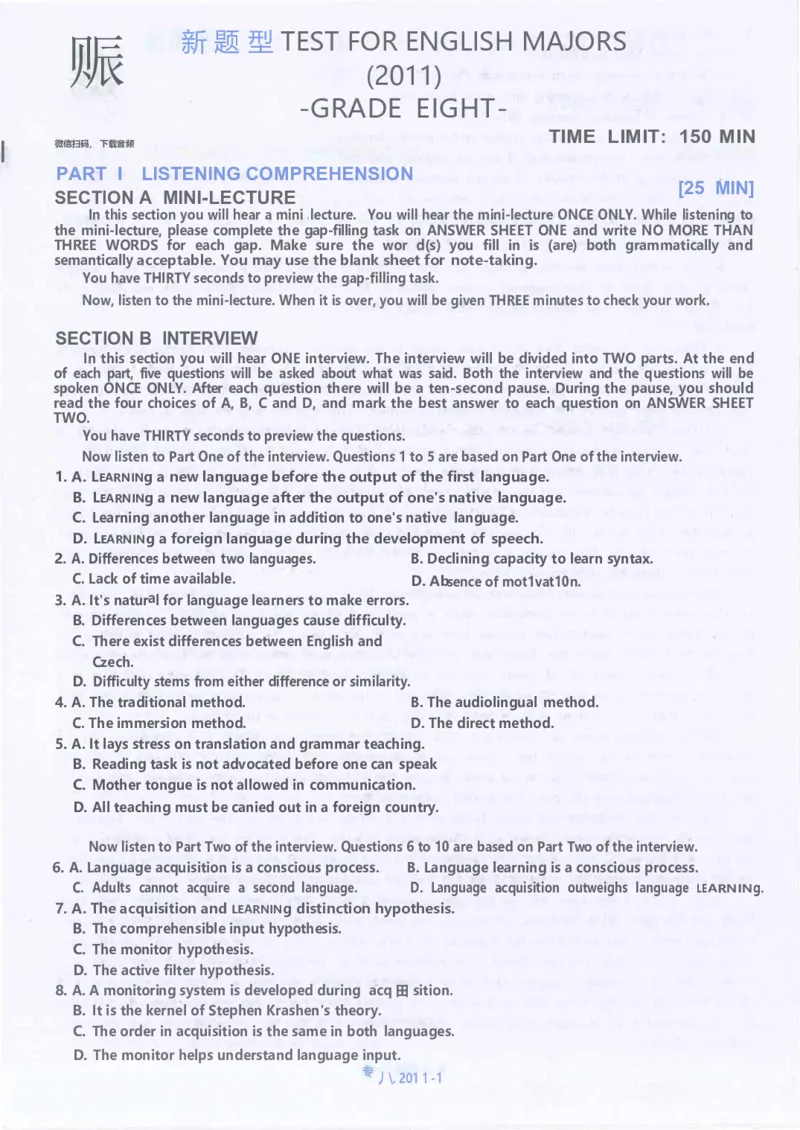
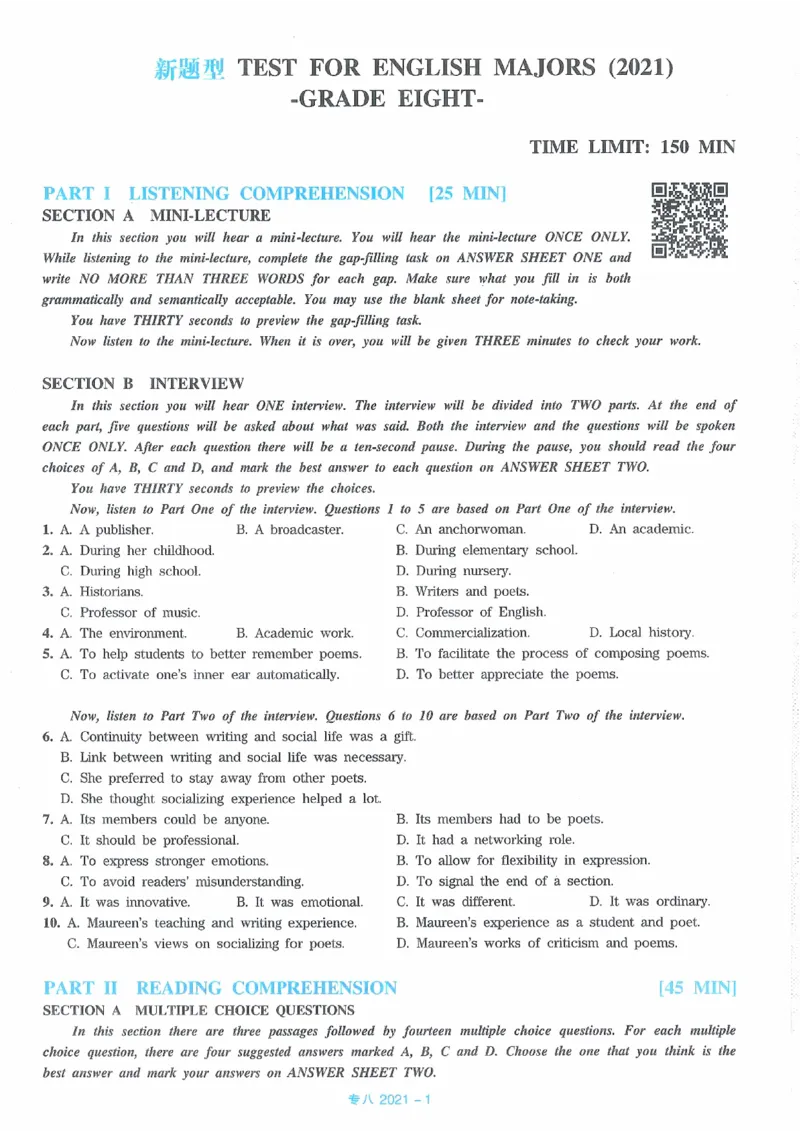
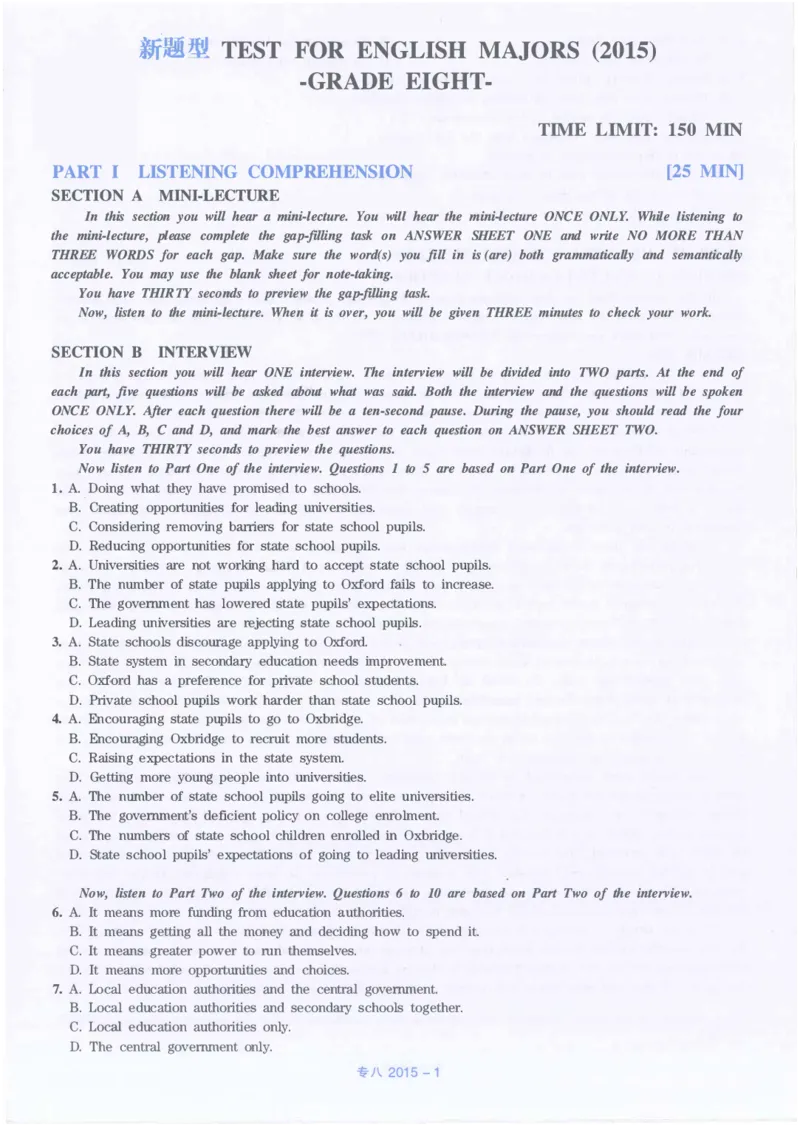
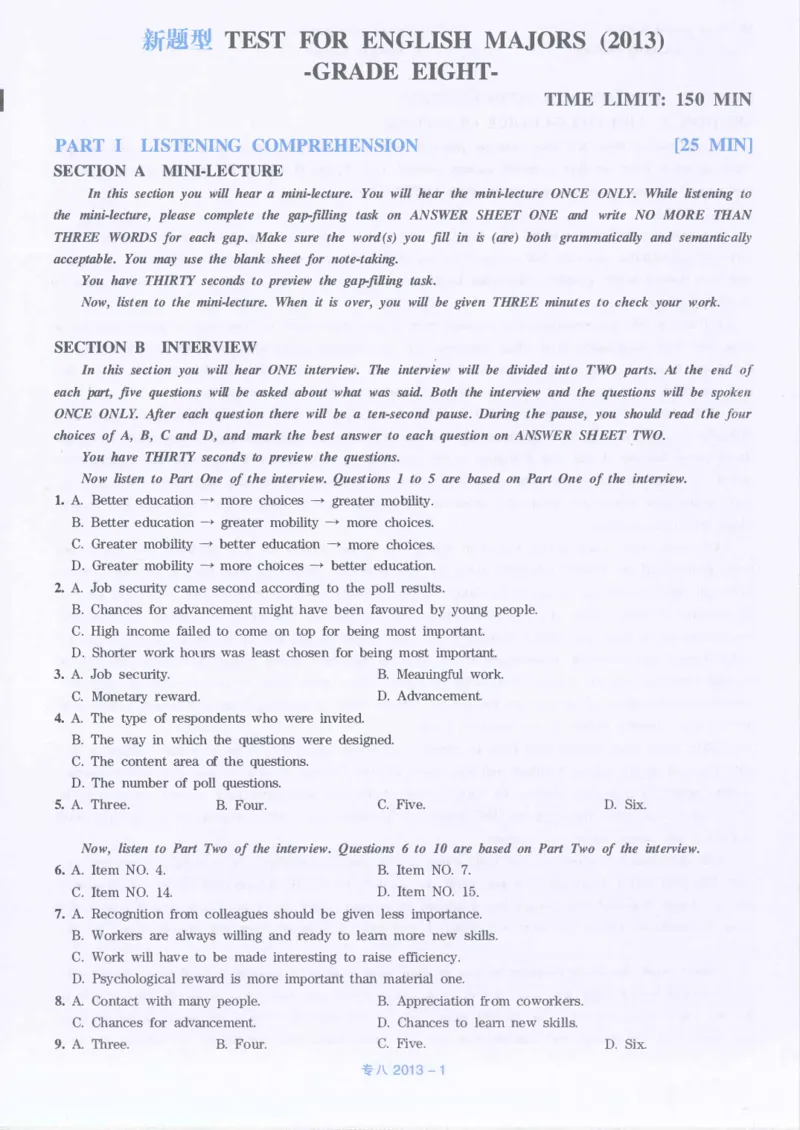
新题型 TEST FOR ENGLISH MAJORS (2011)
-GRADE EIGHT-
TIME LIMIT: 150 MIN
I
PART I LISTENING COMPREHENSION [25 MIN]
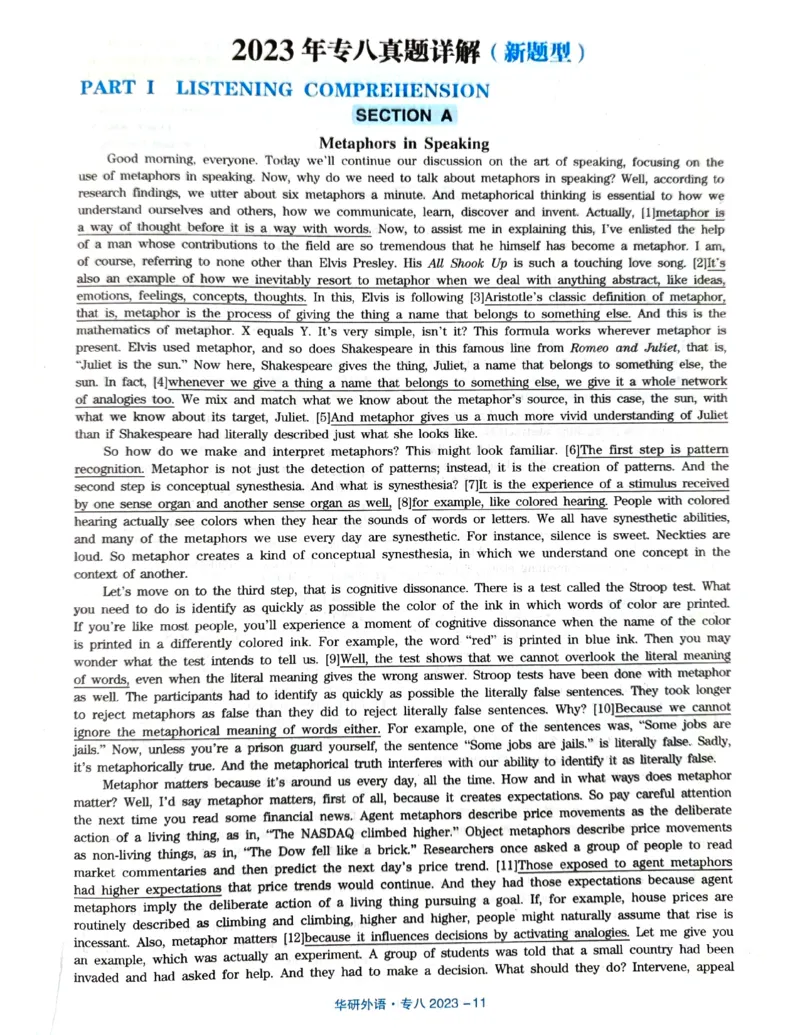
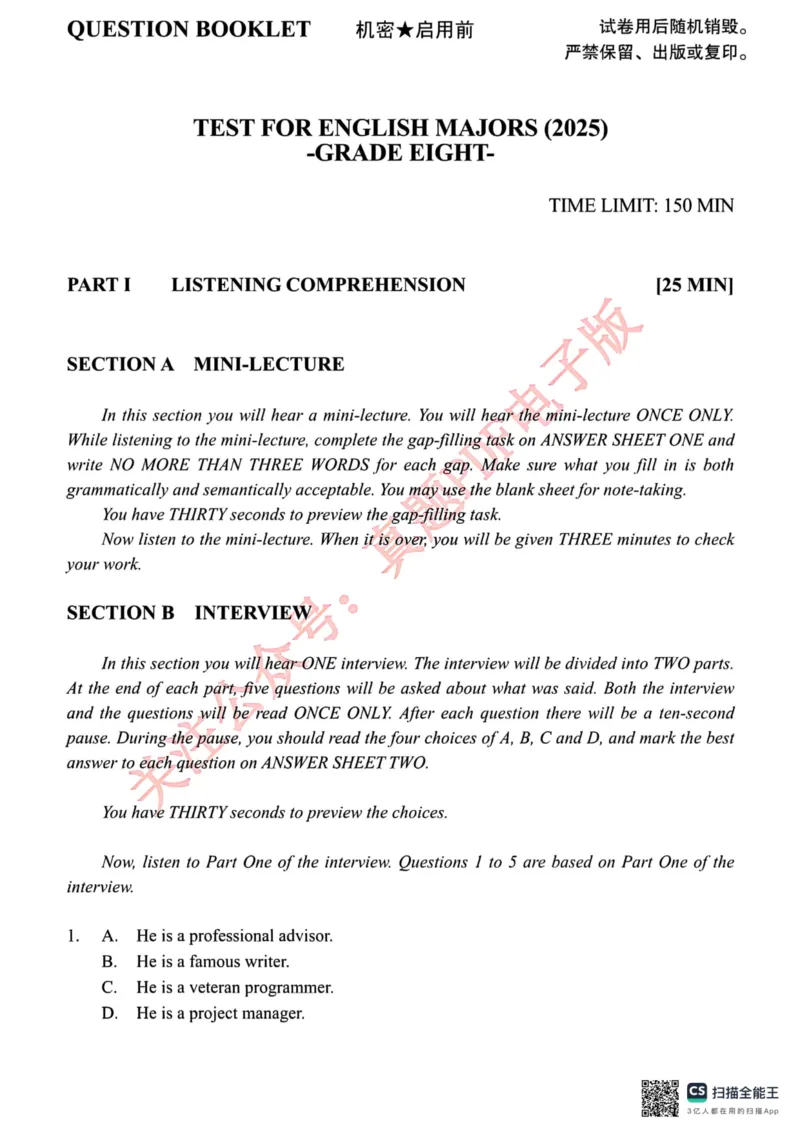
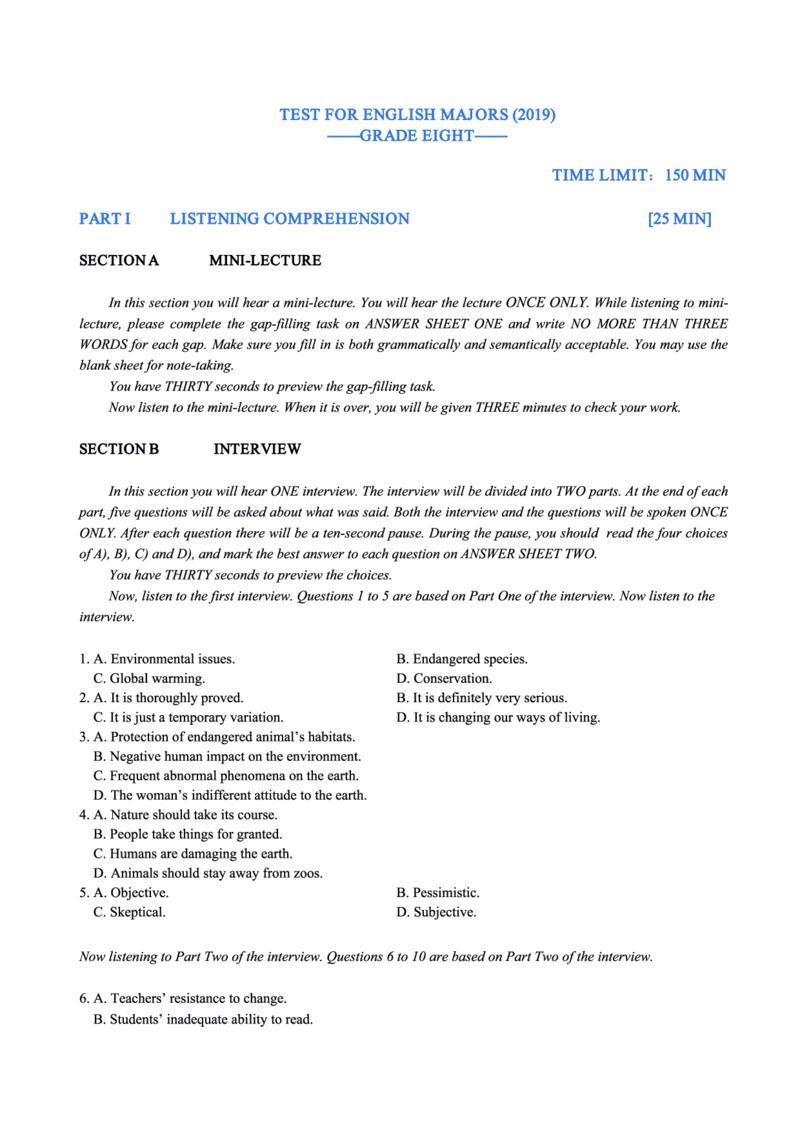
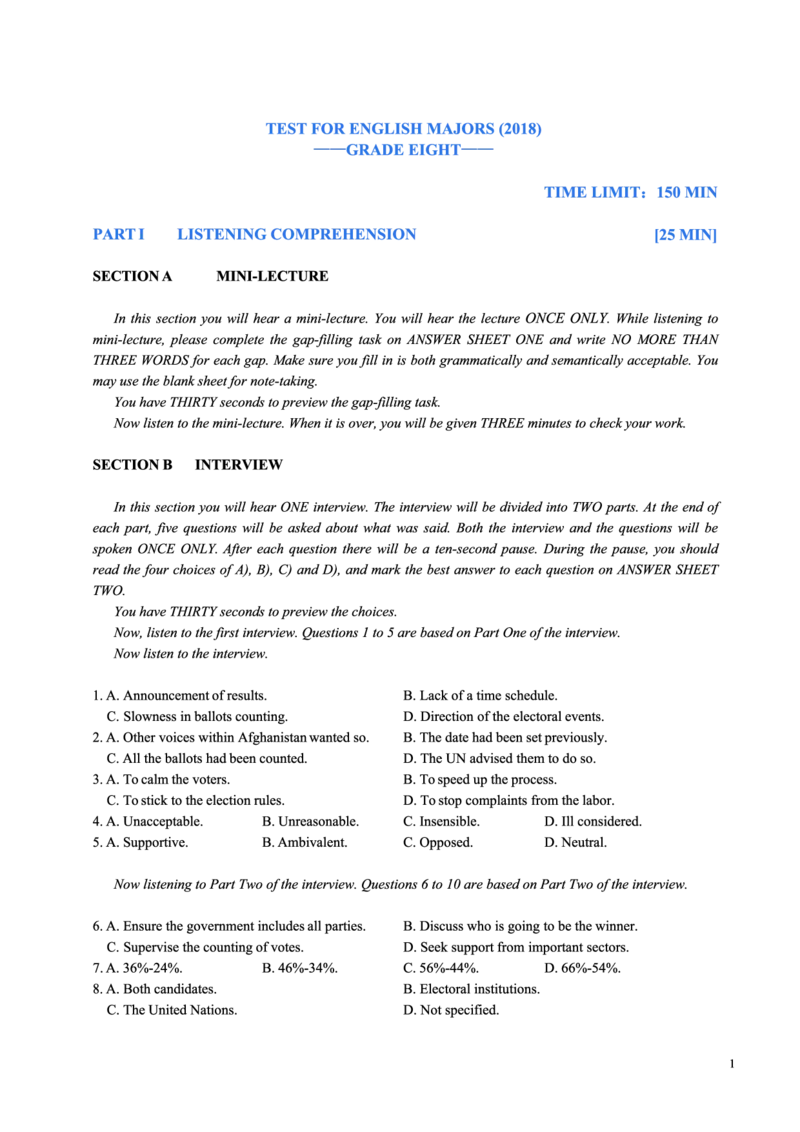
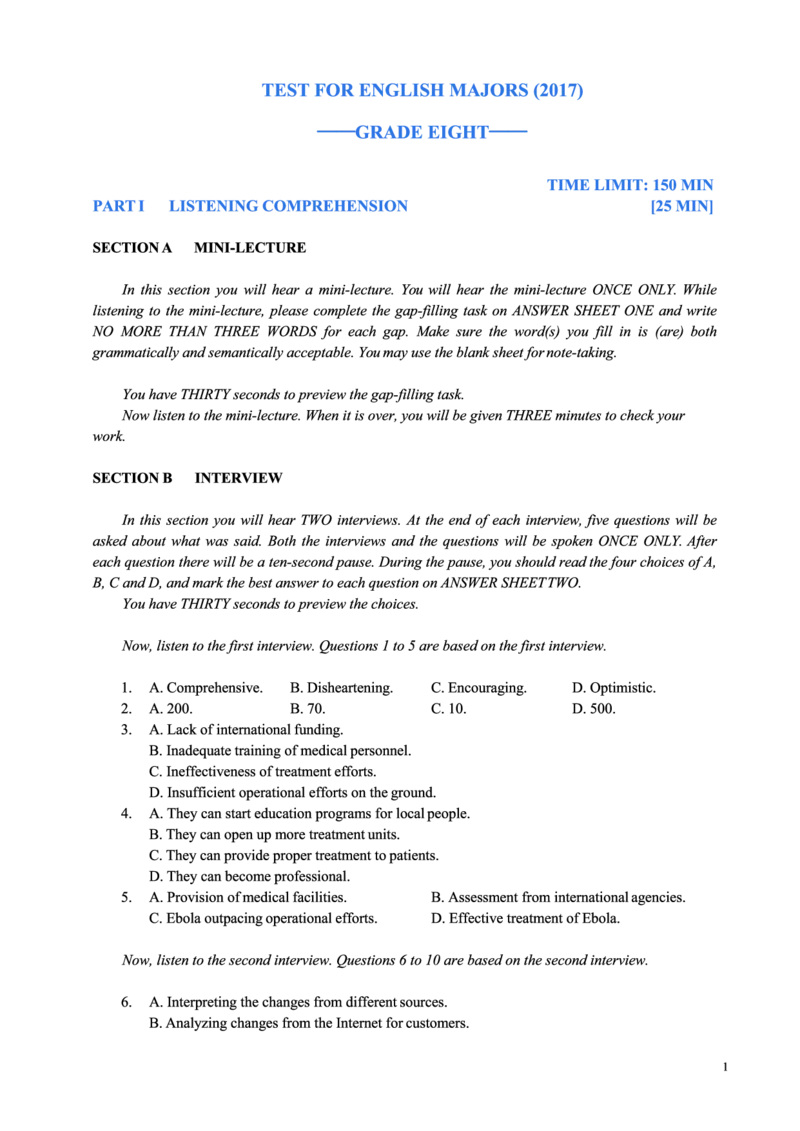
SECTION A MINI-LECTURE
In this section you will hear a mini
雪
lecture.、 You will hear the mini-lecture ONCE ONLY. While listening to
the mini-lecture, please complete the gap-filling task on ANSWER SHEET ONE and write NO MORE THAN
THREE WORDS for each gap. Make sure the word(s) you fill in is (are) both grammatically and semantically
acceptable. You may use the blank sheet for note-taking.
You have THIRTY seconds to preview the gap-filling task.
Now, listen to the mini-lecture. When it is over, you will be given THREE minutes to check your work.
SECTION B INTERVIEW
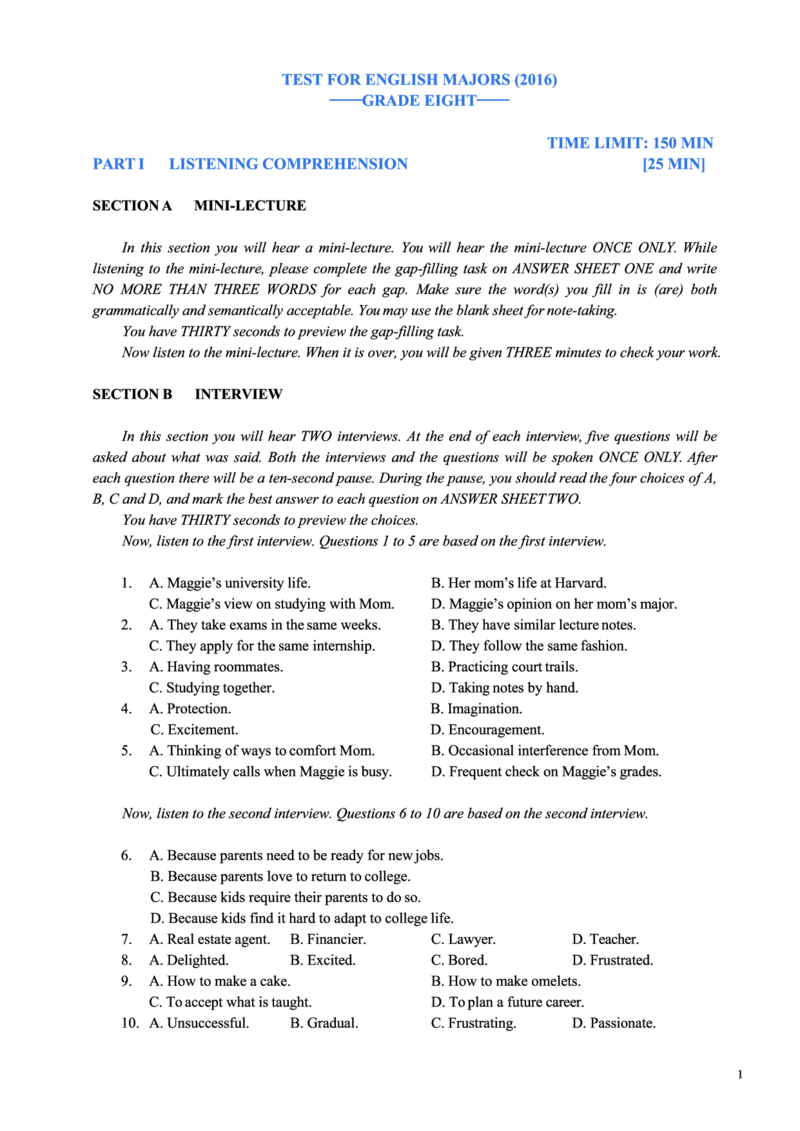
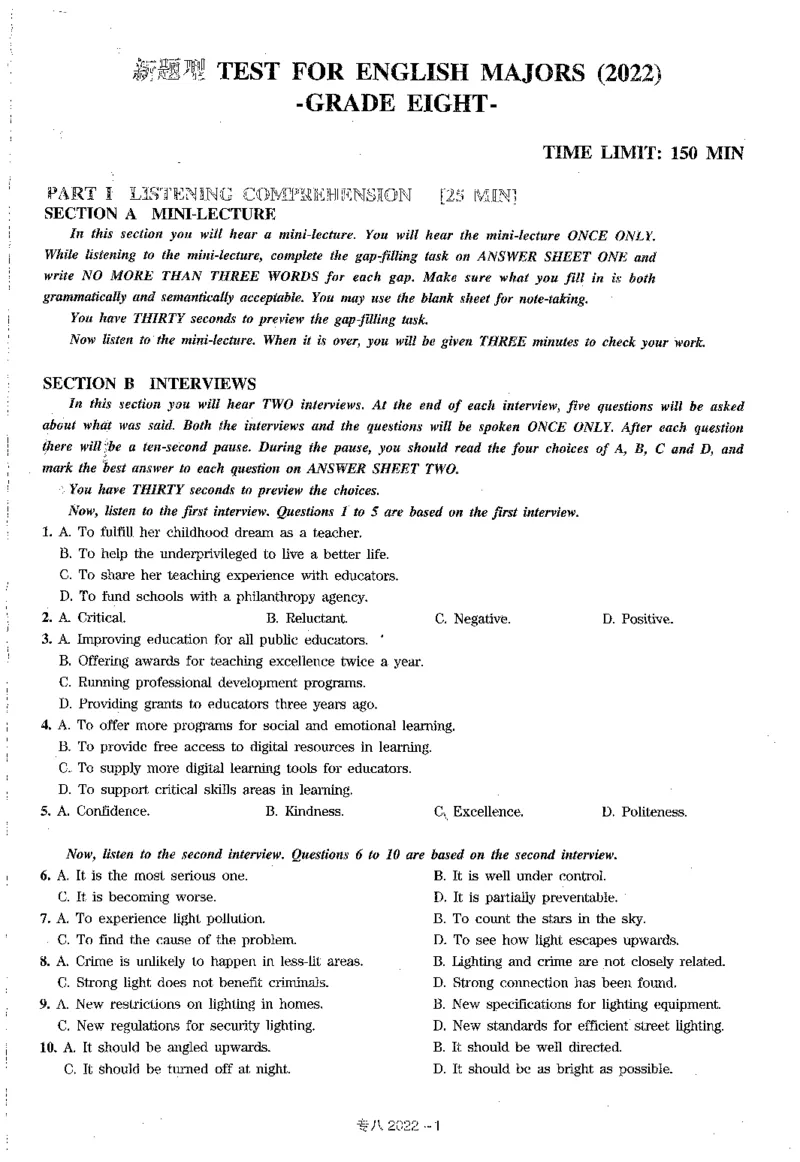
In this section you will hear ONE interview. The interview will be divided into TWO parts. At the end of
each part, five questions will be asked about what was said. Both the interview and the questions will be spoken
ONCE ONLY. After each question there will be a ten-second pause. During the pause, you should read the four
choices of A, B, C and D, and mark the best answer to each question on ANSWER SHEET TWO.
You have THIRTY seconds to preview the questions.
Now listen to Part One of the interview. Questions 1 to 5 are based on Part One of the interview.
1. A. Learning a new language before the output of the first language.
B. Learning a new language after the output of one's native language.
C. Learning another language in addition to one's native language.
D. Learning a foreign language during the development of speech.
2. A. Differences between two languages. B. Declining capacity to learn syntax.
C. Lack of time available. D. Abs ence of mot1vat10n.
3. A. It's natural for language learners to make errors.
B. Differences between languages cause difficulty.
C. There exist differences between English and Czech.
D. Difficulty stems from either difference or similarity.
4. A. The traditional method. B. The audiolingual method.
C. The immersion method. D. The direct method.
5. A. It lays stress on translation and grammar teaching.
B. Reading task is not advocated before one can speak
C. Mother tongue is not allowed in communication.
D. All teaching must be canied out in a foreign country.
Now listen to Part Two of the interview. Questions 6 to 10 are based on Part Two of the interview.
6. A. Language acquisition is a conscious process. B. Language learning is a conscious process.
C. Adults cannot acquire a second language. D. Language acquisition outweighs language learning.
7. A. The acquisition and learning distinction hypothesis.
B. The comprehensible input hypothesis.
C. The monitor hypothesis.
D. The active filter hypothesis.
8. A. A monitoring system is developed during acq田sition.
B. It is the kernel of Stephen Krashen's theory.
C. The order in acquisition is the same in both languages.
D. The monitor helps understand language input.
丿\. 2011 -19. A. The monitor hypothesis.
B. The active filter hypothesis.
C. The comprehensible input hypothesis.
D. The acquisition and learning distinction hypothesis.
10. A. Causes of language learning difficulties.
B. Differences between mother tongue and a second language.
C. Theoretical conceptualization of second language learning.
D. Pedagogical implementation of second language teaching.
PART- II READING COMPREHENSION [45 MIN]
SECTION A MULTIPLE-CHOICE QUESTIONS
In this section there are four passages followed by fourteen multiple choice questions. For each multiple
choice question, there are four suggested answers marked A, B, C and D. Choose the one that you think is the
best answer and mark your answers on ANSWER SHEET TWO.
PASSAGE ONE
(l)Whenever we could, Joan and I took refuge in the streets of Gibraltar. The Englishman's home is
hi� castle because he has not much choice. There is nowhere to sit in the streets of England, not even,
after tw计ight, in' the public gardens. The climate, very often, does not even permit him to walk outside.
Naturally, he stays indoors and creates a cocoon of comfort. That was the way we lived in Leeds.
(2)These southern people, on the other hand, look outwards. The Gibraltarian home is, typically, a
small and crowded apartment up several flights of dark and dirty stairs. In it, one, two or even three old
people share a few ill-lit rooms with the young family. Once he has eaten, changed his clothes, embraced
_
his w庙, kissed his children and his parents, there is nothing to keep the southern man at home. He hur
ries out, taking even his breakfast coffee at his local bar. He comes home late for his afternoon meal after
an appetitive hour at his cafe. He sleeps for an hour, dresses, goes out again and stays out until late at night
His wife does not miss him, for she is out, too — at the market in the morning and in the afternoon sitting
with other mothers, -baby-minding in the sun.
(3)The usual Gibraltarian home has no sitting-room, living-room or lounge. The parlour of our work
ing-class houses would be an intolerable waste of space. Easy-chairs, sofas and such-like furniture are un
known. There are no bookshelves, because there are no books. Talking and drinking, as well as eating, are
done on hard chairs round the dining-table, between a sideboard decorated with the best glasses and an
inevitable display cabinet full of family treasures, photographs and souvenirs. The elaborate chandelier over
this table proclaims it as the hub of the household and of the family. 'Hearth and home' makes very little
sense in Gibraltar. One's home is one's town or village, and one's hearth is the sunshine.
(4)Our northern tow郎 are dormitories with cubicles, by comparison. When we congregate - in the
churches it used to be, now in the cinema, say, impersonally, or at public meetings, formally - . we are
scarcely ever man to man. Only in our pubs can you find the truly gregarious and communal spirit surviv
ing, and in England even the pubs are divided along class lines.
(5)Along this Mediterranean coast, home is only a refuge ·and a retreat. The people live together in
the open air - in the street, market-place. Down here, there is a far stronger feeling of community than
we had ever known. In crowded and circumscribed Gibraltar, with its complicated inter-marriages, its iden
tity of interests, its surviving sense of siege, one can see and feel an integrated society.
(6)To live in a tiny town with all the organization of a state, with Viceroy (总督), Premier, Parliament,
Press and Pentagon, all in miniature, all within arm's reach, is an intensive course in civics. In such an en
vironment, nothing can be hidden, for better or for-worse. One's successes are seen and recognized; one's
failures are immediately exposed. Social consciousness is at its strongest, with the result that there is a
constant an� firm pressure towards good social behaviour, towards courtesy and kindness. Gibraltar, with
all its faults, is the friendliest and most tolerant of places. Straight from the cynical anonymity of a big
city, we luxuriated in its happy personalism. We look back on it, like·all its exiled sons and daughters,
with true affection.
专八 2011 -211. The italicized part in the third paragraph implies that
A. English working-class homes are similar to Gibraltarian ones.
B. English working-class homes have spacious sitting-rooms.
C. English working-class homes waste a lot of space.
D. the English working-class parlour is intolerable in Gibraltar.
12. There is a much stronger sense of among the Gibraltarians.
A. togetherness B. smvival C. identity D. leisure
13. According to the passage, people in Gibraltar tend to be well-behaved because of the following EXCEPT
A. the entirety of the state structure. B. constant pressure from the state.
C. the small size of the town. D. transparency of occurrences.
PASSAGE TWO
(l)For office innovators, the unrealized dream of the "paperless" office is a classic example of high-
(傲慢).
tech hubris Today's office drone is drow血g in more paper than ever before.
(2)But after decades of hype, American offices may finally be losing their paper obsession. The demand
for paper used to outstrip the growth of the US economy, but the past two or three years have seen a
marked slowdown in sales — despite a healthy economic scene.
(3)Analysts attribute the decline to such factors as advances in digital databases and communication
systems. Escaping our craving for paper, however, will be anything but an easy affair.
(4)"0ld habits are hard to break," says Merilyn Dunn, a communications supplies director. "There are
some functions that paper serves where a screen display doesn't work Those functions are both its
strength and its wealmess."
(5)1n the early to mid-'90s, a booming economy and improved desktop printers helped boost paper sales
by 6 to 7 percent each year. The convenience of desktop printing allowed office workers to indulge in
printing anything and everything at very little effort or cost.
(6)But now, the growth rate of paper sales in the United States is flattening by about half a percent
each year. Between 2004 and 2005, Ms. Dunn says, plain white office paper will see less than a 4 percent
growth rate, despite the strong overall economy. A primary reason for the change, says Dunn, is that for
the first time ever, some 4 7 percent of the workforce entered the job market after computers had already
been introduced to offices.
(7)"We're finally seeing a reduction in the amount of paper being used per worker in the workplace,"
says John Maine, vice president of a pulp and paper economic consulting fi皿 "More information is being
transmitted electronically, and more and more people are comfortable with the information residing only in
.
electronic form without printing multiple backups."
—
(8)In addition, Mr. Maine points to the lackluster employment market for white-collar workers the
—
primary driver of office paper consumption for the shift in paper usage.
(9)The real paradigm shift may be in the way paper is used. Since the advent of advanced and reliable
office-network systems, data storage has moved away from paper archives. The secretarial art of "filing" is
disappearing from job descriptions. Much of today's data may never leave its original digital format.
(lO)The changing attitudes toward paper have finally caught the attention of paper companies, says
Richard Harper, a researcher at Microsoft. "All of a sudden, the paper industry has started thinking, 'We
need to learn more about the behavioural aspects of paper use,'" he says. "They had never asked, they'd
just assumed that 70 m诅ion sheets would be brought per year as a literal function of economic growth."
(ll)To reduce paper use, some companies are working to combine digital and paper capabilities. For
example, Xerox Corp. is developing electronic paper: thin digital displays that respond to a stylus, like a
pen on paper. Notations can be erased or saved digitally.
(12)Another idea, intelligent paper, comes from Anoto Group. It would allow notations made with a
stylus on a page printed with a special magnetic ink to simultaneously appear on a computer screen.
(13)Even with such technological advances, the improved capabilities of digital storage continue to act a-
专八 2011 -3gainst "paperlessness," argues Paul Saffo, a technology forecaster. In his prophetic and metaphorical 1989
essay, "The Electronic Piiiata (彩罐)," he suggests that the increasing amounts of electronic data necessarily
require more paper.
(14) "The information industry today is like a huge electronic pifiata, composed of a thin paper crust
surrounding an electronic core," Mr. Saffo wrote. The growing paper crust "is most noticeable, but the hid
den electronic core that produces the crust is far larger - and growing more rapidly. The result is that we
are becoming paperless, but we hardly notice at all."
(15)In the same way that digital innovations have increased paper consumption, Saffo says, so has video
conferencing — with its promise of fewer in-person meetings - boosting business travel.
(16) "That's one of the great ironies of the information age," Saffo says. "It's just common sense that
the more you talk to someone by phone or computer, it inevitably leads to a face-to-fa_ce meeting. The best
thing for the aviation industry was the Internet. "
14. W垃ch of the following is NOT a reason for the slowdown in paper sales?
, A. Workforce with better computer skills. B. Slow growth of the US economy.
C. Changing patterns in paper use. D. Changing employment trends.
15. The two innovations by Xerox Corp. and Anoto Group feature
A. integrated use of paper and digital form. B. a shift from paper to digital form.
C. the use of computer screen. D. a new style of writing.
16. What is the author's attitude towards "paperlessness"?
A. He reviews the situation from different perspectives.
B. He agrees with some of the people quoted in the passage.
C. He has a preference for digital innovations.
D. He thinks airlines benefit most from the digital age.
PASSAGE THREE
(l)When George Orwell wrote in 1941 that England was "the most class-ridden country under the sun",
he was only partly right. Societies have always , had their hierarchies, with some group perched at the top.
In the Indian state of Bihar the Ranveer Sena, an upper-caste private army, even killed to stay there.
(2)By that meas田e class in Britain hardly seems entrenched (根深蒂固的). But in another way Orwell
was 忧ght, and continues to be. As a new Y ouGov poll shows, Britons are surprisingly alert to class -
both their own and that of others. And they still think class is sticky. According to the poll, 48% of people
aged 30 or over say they expect to end up better off than their parents. But only 28% expect to end up in
a different class. More than two-thirds think neither they nor their children will leave the class they were
born into.
(3) What does this thing that people cannot escape consist of these days? And what do people look at
when decoding which class someone belo:µgs to? The most useful identifying markers, according to the poll,
are occupation, address, accent and income, in that order. The fact that income comes fourth is revealing:
though some of the habits and attitudes that class used to defme are, more widely spread than they were,
class still indicates something less blunt than mere wealth.
(4)0ccupation is the most trusted guide to class, but changes in the labour market have made that
harder to read than when Orwell was writing. Manual workers have shrunk along with farming and heavy
industry as a proportion of the workforce, while the nwnber of people in white-collar jobs has surged. De
spite this striking change, when they were asked to place themselves in a class, Brits in 2006 huddled in
much the same categories as they did when they were asked in 1949. So, jobs, which were once a fairly
reliable guide to class, have become misleading.
(5)A sUIVey conducted earlier this year by Expertian shows how this convergence on similar types of
work has blurred class boundaries. Expertian asked people in a n皿ber of different jobs to place them
selves in the working class or the middle class. Secretaries, waiters and journalists were significantly more
likely to think themselves middle-class than accountants, computer programmers or civil seivants. Many new
white-collar jobs offer no more autonomy or better prospects than old blue-collar ones. Yet despite the
专八2011 -4muddle over what the markers of class are these days, 71% of those polled by YouG ov st诅 said they found
it very or fairly easy to figure out which class others belong to.
(6)In addition to changes in the labour market, two other things have smudged the borders on the
class map. First, since 1945 Britain has received large numbers of immigrants who do not fit easily into
existing notions of class and may have their own pyramids to scramble up. The flow of new arrivals has
increased since the late 1990s, multiplying this effect.
—
(7)Second, barriers to fame have been lowered. Britain's fast-growing ranks of celebrities like David
Beckham and his wife Victoria - form a kind of parallel aristocracy open to talent, or at least to those
who are uninhabited enough to meet the requests of television producers. This too has made defi皿tions
more complicated.
(8)But many Brits, given the choice, still prefer to identify with the class they were born into rather
than that which their jobs or income would suggest. This often entails pretending to be more humble than
is actually the case: 22% of white-collar workers told Y ouGov that they consider themselves working class.
Likewise, the Expertian survey found that one in ten adults who call themselves working class are among
the richest asset-owners, and that over half a million households which earn more than $191,000 a year say
they are working class. Pretending to be grander than income and occupation suggest is rarer, though it
happens too.
(9)If class no longer describes a clear social, economic or even political status, is it worth paying any
attention to? Possibly, yes. It is still in most cases closely correlated with educational attainment and career
expectations.
17. "… class still indicates something less blunt than mere wealth" (Paragraph Three) means that
A. class is still defined by its own habits and attitudes.
B. class would refer to something more subtle than money.
C. people from different classes may have the same habits or attitudes.
D. income is unimportant in determining which class one belongs to.
18. W压ch of the following statements is INCORRECT?
w
A. 血e-collar workers would place themselves in a different class.
B. People with different jobs may place themselves in the same class.
C. Occupation and class are no longer related with each other.
D. Changes in the workforce have made it difficult to defme class.
19. W压ch of the follow四 is NOT a cause to blur class distinction?
A. Notions of class by immigrants. B. Changing trends of employment.
C. Fewer types of work D. Easy access to fame.
20. When some successful white-collar workers choose to stay in the working class, it implies that they are
A. showing modesty. B. showing self-respect.
C. expressing boastfulness. D. making an understatement.
PASSAGE FOUR
(l)The train was whirling onward with such dignity of motion that a glance from the window seemed
simply to prove that the plains of Texas were pouring eastward. Vast flats of green grass, dull-hued spaces
of mesquite and cactus, little groups of frame houses, woods of light and tender trees, all were sweeping
into the east, sweeping over the horizon, a precipice.
(2)A newly married pair had boarded this coach at San Antonio. The man's face was reddened from
many days in the wind and sun, and a direct result of his new black clothes was that his brick-coloured
hands were constantly performing in a most conscious fashion. From time to time he looked down respect
fully at his attire. He sat with a hand on each knee, like a man waiting in a barber's shop. The glances he
devoted to other passengers were furtive and shy.
(3)The bride was not pretty, nor was she very young. She wore a dress of blue cashmere, with small
reservations of velvet here and there, and with steel buttons abounding. She continually twisted her head to
regard her puff sleeves, very stiff, and high. They embarrassed her. It was quite apparent that she had
专·八 2011 -5cooked, and that she expected to cook, dutifully. The blushes caused by the careless scrutiny of some pas
sengers as she had entered the car were strange to see upon this plain, under-class countenance, which
was drawn in placid, almost emotionless lines.
(4)They were evidently very happy. "Ever been in a parlor-car before?" he asked, smiling with delight.
(5)"No," she answered, "I never was. It's fme, ain't it?"
(6) "Great! And then after a while we'll go forward to the dinner and get a big lay-out. Fresh meal in
the world. Charge a dollar."
(7)"0h, do they?" cried the bride. "Charge a dollar? Why, that's too much — for us - ain't it, Jack?"
(8)"Not this trip, anyhow," he answered bravely. "We're going to go the whole thing."
(9)Later he explained to her about the trains. "You see, it's a thousand miles from one end of Texas to
the other; and this runs right across it, and never stops but four times;''. He had the pride of an owner. He
.
pointed out to her the dazzling fittings of the coach; and in truth her eyes opened wider and she contem
plated the sea-green figured velvet, the shining brass, silver, and glass, the wood that gleamed as darkly
brilliant as the s咡ace of a pool of oil. At one end a bronze figure sturdily held a support for a separated
chamber, and at convenient places on the ceiling were frescos in olive and silver.
(lO)To the minds of the pair, their surroundings reflected the glory of their marriage that morning in
San Antonio; this was the enviromnent of their new estate; and the man's face in particular beamed with
an elation that made him appear ridiculous to the Negro porter. This individual at times surveyed them
from afar with an amused and superior grin. On other occasions he bullied them with skill in ways that
did not make it exactly plain to them that they were being bullied. He subtly used all the manners of the
most unconquerable kind of snobbery. He oppressed them. But of this oppression they had small 胚owl
edge, and they speedily forgot that infrequently a number of travelers covered them with stares of derisive
enjoyment. Historically there was supposed to be something infinitely humorous in their situation.
(ll)"We are due in Yellow Sky at 3:42," he said, looking tenderly into. her eyes.
(12) "Oh, are we?" she said, as if she had not been aware of it. To evince (表现出) surprise at her
husband's statement was part of her 劝fely amiability. She took from a pocket a little silver watch; and as
she held it before her, and stared at it with a frown of attention, the new husband's face shone.
(13)"1 bought it in San Anton' from a friend of m加," he told her gleefully.
(14) "It's seventeen minutes past twelve," she said, looking up at him with a kind of shy and clumsy
coquetry (调情; 卖俏). A passenger, noting this play, grew excessively sardonic, and winked at himself in
one of the numerous mirrors.
(15)At last they went to the dining-car. Two rows of Negro waiters, in glowing white suits, sUIVeyed
their entrance with the interest, and also the equanimity (平静), of men who had been forewarned. The pair
fell to the lot of a waiter who happened to feel pleasure in steering them through their meal. He. viewed
them with the manner of a fatherly pilot, his countenance radiant with benevolence. The patronage, en
twined with the ordinary deference, was _ not plain to them. And yet, as they returned to their coach, they
showed in their faces a sense of escape.
21. The description of the couple's clothes and behaviour at the beginning of the passage seems to indicate
that they had a sense of
A. secrecy. B. elation. C. superiority. D. awkwardness.
22. W压ch of the following adjectives best depicts the interior of the coach?
A. Modem. B. Luxurious. C. Practical. D. Complex.
23. W血h of the following best describes the attitude of other people on the train towards the couple?
A. They regarded the couple as an object of fun. B. They expressed indifferenc� towards the couple.
C. They were very curious about the couple. D. They showed frieridliness towards the couple.
24. We can .infer from the last paragraph that in the dining-car
A the waiters were snobbish. B. the couple felt ill at ease.
C. the service· was satisfactory. D. the couple enjoyed their dinner.
专八2011 -6SECTION B SHORT ANSWER QUESTIONS
In this section there are eight short answer questions based on the passages in SECTION A. Answer each
question in NO more than 10 words in the space provided on ANSWER SHEET TWO.
PASSAGE ONE
25. What most probably causes the differences in ways of living between the English and the Gibraltarian.s?
26. From the description of the Gibraltarian home, what is it like?
PASSAGE TWO
27. What function does the second sentence in the first paragraph serve?
28. What contributed to the paper sale boost in the early to mid-'90s?
29. What does the author mean by "irony of the information age"?
PASSAGE THREE
30. In what way does class in Britain seem not so entrenched?
31. Why does the author say "… Orwell w邸 right, and continues to be" (Paragraph Two)?
PASSAGE FOUR
32. What rhetorical device is employed in the sentence "…sweeping over the horizon, a precipice"?
PART III LANGUAGE USAGE [15 MIN]
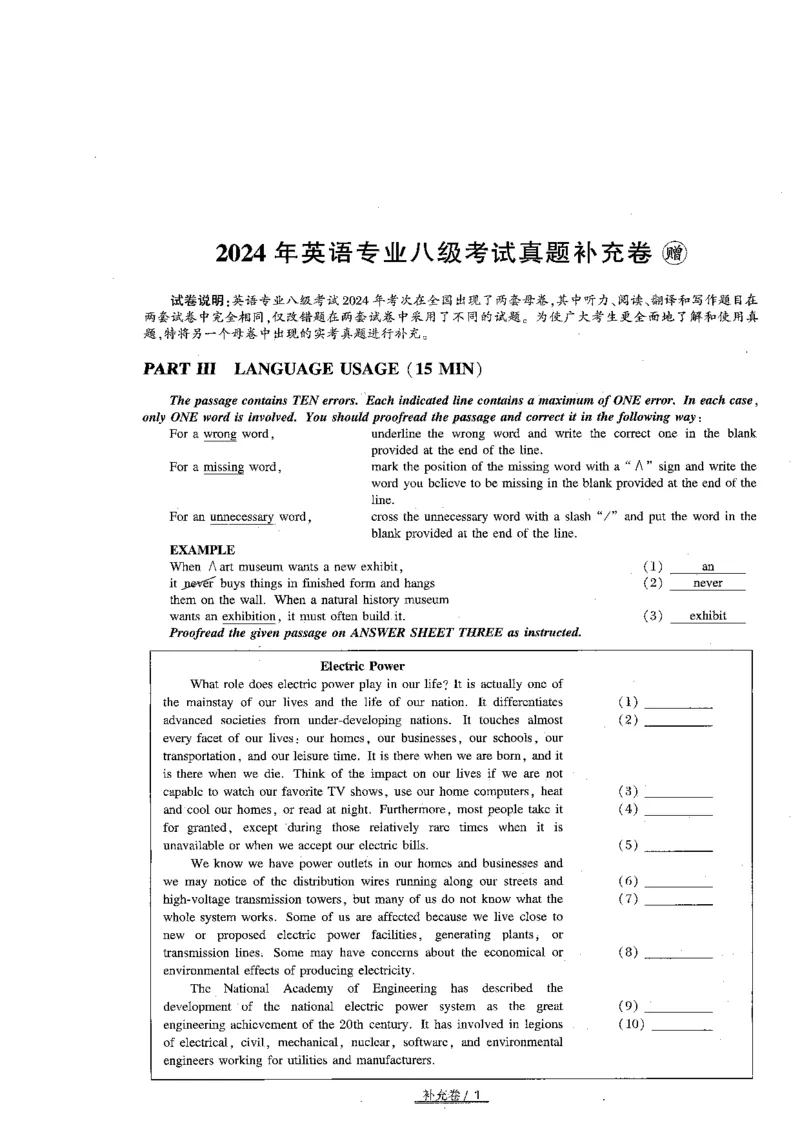
The passage contains TEN errors. Each indicated line contains a maximum of ONE error. In each case,
only ONE word is involved. You should proof-read the passage and correct it in the following way:
For a "YITQ咡 word, underline the wrong· word and write the correct one in the blank
provided at the end of the line.
For a missing word, mark the position of the missing word with a " /\ " sign and write the
word you believe to be missing in the blank provided at the end of the
line.
For an unnecessary word, cross the unnecess扣y word with a slash "/" and put the word in the
blank provided at the end of the line.
Example
When /\ art museum wants a new exhibit, (1) an
it 卯面 buys things in fi血shed form and hangs (2) never
them on the wall. When a natural history museum
wants an exhibition, it must often build it. (3) exhibit
Proofread the given passage on ANSWER SHEET THREE as instructed.
PART IV TRANSLATION [20 MIN]
Translate the underlined part of the following text from Chinese into English. Write your translation on
ANSWER SHEET THREE.
现代社会无论价值观的持有还是生活方式的选择都充满了矛盾。而最让现代人感到尴尬的是 ,面对重重矛盾,许多
时候你却别无选择。 匆忙与休闲是截然不同的两种生活方式。 但在现实生活中 人们却在这两种生活方式间频繁穿梭
“ “ “ “
有时也说不清自已到底是 休闲着 还是 匆忙着 。 譬如说 当我们正在旅游胜地享受假期 却忽然接到老板的电话 告
诉我们客户或工作方面出了麻烦-—-现代便捷先进工具在此刻显示出了它挣狩、阴郁的面容--擂i得人一下子兴趣全
无 接下来的休闲只能徒有其表 因为心里已是火烧火僚了。
PART V WRITING (45 MIN]
The well-known phrase "honoring the teacher and respecting his teaching" has long been a part of Chinese
专八2011 -7tradition and culture. According to recent Global Teacher Status Index, teachers have the highest social status in
China across the world. The following is a new report on people's view on teachi!lg profession. Read it carefully
and write an article of NO LESS THAN 300 words, in which you should:
1. summarize briefly the public's view on teaching profession nowadays;
2. give your comment.
Marks will be awarded for content relevance, content sufficiency, organization and language quality. Failure
.
to follow the above instructions may result in a loss of marks.
Write your article on ANSWER SHEET FOUR.
As Teacher's Day is approaching, the China Youth Daily received 1,089 reader responses from a
nationwide sUIVey. Results indicated that the teaching profession is 'still a respectable occupation; 91.6
percent voted that they wanted the most outstanding people to be teachers.
"The profession of teacher should be the most respectable occupation in our society. The group should
consist of the most outstanding people, or our nation's development will be affected," a respondent stated
in the poll.
Asked about which kind of teachers are the most outstanding ones, some readers answered: "Not all
talented teachers are outstanding in their fields. An excellent teacher ought to be first of all a person of
垃gh morals, since teachers educate young people."
Even more interesting, 76.3 percent of the respondents said that a teacher is someone who influenced
them most. But people's views toward what kind of teachers are good teachers have changed. Another
survey this June showed that 81.6 percent of the people admired knowledgeable teachers, 67.6 perc�nt liked
teachers who made their classes easy and interesting, and 51.9 percent preferred teachers with a good
sense of humor. In short, being knowledgeable is the fi江st and most important aspect of being a teacher,
and on this basis, students clearly prefer lively and witty teachers.
The bad news: recent years have seen the rapid reduction of normal universities and colleges. Many
have been upgraded to comprehensive universities by name changes and mergers. Education experts worry
that this kind of development will harm·teacher training because these courses were conducted in those
types of universities or colleges.
The good news: The latest government work report states that the country would provide free
education for students attending teacher training universities. The policy has become a reality as a total of
11,000 students enrolled in six teacher-training universities have now begun enjoying free education as of
last week These students began registration respectively at the six universities based in Beijing, Shanghai,
Changchun, Wuhan, Xi'an and Chongqing on September 4.
73 percent of the readers who responded to the sUIVey believed that the free education policy signals
that the country is paying greater attention to education and teachers. 60.1 percent of the respondents said
that the policy should be popularized and extended to more normal universities and colleges.
Of those polled, the majority (55.6 percent) said that they wanted to be university or college teachers,
because of the "high salary and low pressure, good working environment and non-fixed office hours."
"Some teachers even have their own .research program." 29.5 percent wanted to be middle school teachers,
13.4 percent wanted to be kindergarten teachers, ard 8.2 percent say they didn't want to teach at all.
Some respondents said that the salary of rural teachers in central and western areas should be
increased. If not, even those students who e可oy free education in normal universities and love their
teaching jobs will still face the ultimate question: choose their dream job or find something better to make
ends meet?
-THE END
专八 2011 -8.
- - - - - - - - - - -- - - - - - - - - - - - - - - - - - - - - - - - -
ANSWER SHEET 1 (TEMS} [1J
_
圈_
_
注意事项
号 _
1.答 题前, 考生务必用黑色字迹签字笔填
学 校:
写自己的准考证号、 姓名和学校; 再用 _
2B铅笔把对应准考证号码的标号涂黑, _
使用其它笔填涂无效。
2考生不得填涂缺考、 违纪项, 违者责任
姓 名: 自负。
3. 选择题必须用2B铅笔填涂, 使用其它笔
填涂无效, 修改时要用橡皮擦干净; 每
题只能填涂一个答案, 多填不得分。 -
4. 主观题必须用 黑色字迹签字笔
_
(0.5mm) 在答题区域内作答, 超出红
色矩形框限定区域的答案无效。
5r 保持答题卡的清洁和r 平-整, 不得折叠。
ANS� 石呾"EJ.r _
LI—STEN—ING C—OM PREHENSION
可IONA 可NI-L飞CTURE -
晃 —_
下列各题必须使用黑色字迹签千工在答迈丛奴内仵 口*, 妇山-··乞总形边朼限定区坟的
]
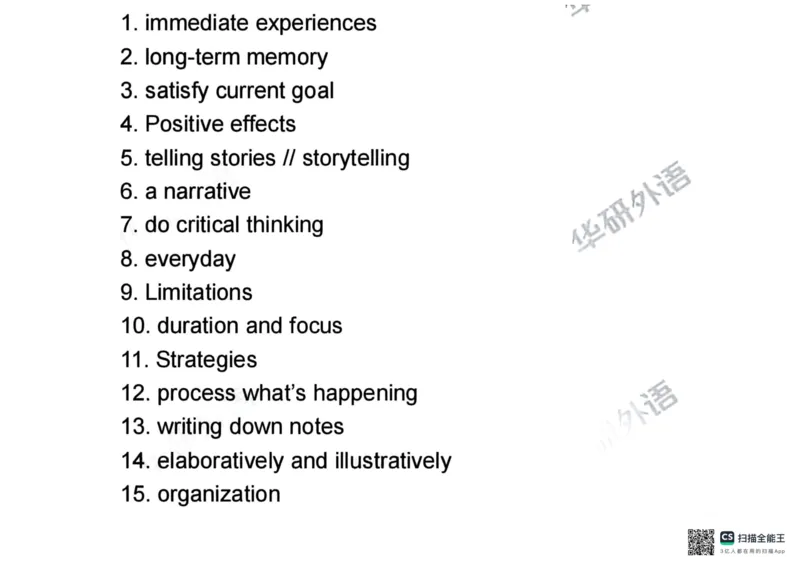
Classifications of Cultures
_
According to Edward Hall, different cultures result in different ideas about the world. Hall is an
anthropologist. He is interested in relations between cultures. ,
I. (1) (1) _
A feature
—context: more important than the message
-meaning (2) (2) _
ie. more attention paid to (3) than to the message itself (3) _u
B. examples
'
—personal space _
-preference for (4) (4)
_
—less respect for (5) (5)
-attention to (6) (6)
__
_
,
-concept of time
-belief in (7) interpretations of time (7)
—no concern for (8) (8)
_
-no control over time
II. Low-context culture _
A feature __
—message: separate from context
-meaning (9) (9) _
B. examples
_
—personal space
_
—desire/respect for individuality/privacy
__
—less attention to (10) (10)
—more concern for (11) (11) _
_
—attitude toward time
—concept of time: (12) (12) _
—dislike of (13) (13) _
—time seen as (14) (14)
__
III. Conclusion
_
awareness of different cultural assumptions
—relevance in work and life
_
-
e.g. business, negotiation, etc. __
— m successful communication
(15) (15) —」
.
_
高校外语专业教学测试办公室 监制 FS-TEMB-1601一仁Beta
_
专八2011 -9 _
_
_
_
_
_
_
_
_
_
_
_-
闭
舰霪 一 一 一 一 一 一 一 一A一N一S-W一E一R一 一SH一E一E一T一3·圈 (-T-EM- 8-)- 一 一 圈· - 圈. 一 一 - 一
圈 1111
注意事项 I
学 校:
1.
写
答 题
自己
前
的
,
准
考
考
生
证
务
号
必
、
用
姓
黑
名
色
和
字
学
迹
校
签字
; 再
笔填
用
准 考 证 号 I
I
1
2B铅笔把对应准考证号码的标号涂黑,
使用其它笔填涂无效。 1
2考生不得填涂缺考、 违纪项, 违者责任 (01 IOI 10 l (Q) !OJ ro'.I 101 lOl [01 lOJ [01 col [01 ro11
姓 名: 自负。 ! 1 l [1] [1] t 1 l ! 1 l 11l ! 1 I (“11” [1] l 1l [11 [1 l 11 I C 1 1l
3. 选择题必须用2B铅笔填涂, 使用其它笔 [21 !2l [2J [2) 12J (21 121 [21 [2) [21 (2� 121 (2-1l
填涂无效, 修改时要用橡皮擦干净; 每 [31 [3J [31 ra1 131 [ 3J 131 131 [31 (3] [31 (3) 131 f31l
正确填涂方式 此处由监考老师填涂 题只能填涂一个答案, 多填不得分。 [41 14] 141 [4) [41 [41 141 『41 [41 f4] [41 (41 141 (411
错误填 匣 涂 匣l 方式 违 缺 纪 考 [ C Q W I J 4 5 I 保 色 . ( 主 矩 0 持 .5 形 观 答 m 框 题 m 题 限 卡 ) 必 定 的 在 须 区 清 答 域 洁 题 用 的 I 和 区 黑 答 平 域 色 案 整 内 无 , 字 作 效 不 答 迹 。 得 一 , 签 折 超 叠 字 出 。 红 笔 I £ l [ ( 8 6 7 5 ] 1 1 1 t ( ( [ 7 s 8 6 ] l i 1 1 l 1 rs 5 6 7 1 1 1 1 [ 1 ( 16 7 5 8 1 ] 1 1 [ [ C [ 6 7 5 8 ! J 1 1 [ t ( [ 6 S 7 8 ] J J ] 1 [ [ [ 5 8 7 8 1 1 1 1 ( [ [ [ 7 5 8 6 1 ) 1 1 1 [ [ l8 5 6 7 l J ] 1 t 邓 [ t8 5 7 l l l ] 1 [ [ 1 7 5 8 6 1 1 1 1 [ c e “ 5 a n ” l 1 1 [ [ 18 7 6 5 1 1 1 1 1 1 ( ( 5 6 7 8 1 1 1 1 1 1 1 1
如 屯1 te.:1 cd1 ANS症RSHEET3 (9l 191 (91 [9] [9] (91 l91 [9] [9] r /J) 191 [91 191 C91l
1
ART III LANGUAGE USAGE 1
下列各题必须使用黑色字迹签字笔在答题区域内作答, 超出红色矩形边框限定区域的答案无效。 1&
1
1
1
1
From a vecy early age, perhaps the age of five or six, I knew that when I 1
1
grew I should be a writer. Between the ages of about seventeen and twenty (1) 1
1
fo田· I tried to abandon this idea, but I did so with the conscience that I (2) 1
1
W邸 outraging my true nature and that soon or later I should have to (3) 1
1
settle down and write books. 1
U1
I was the child of three, but there was a gap of five years on the either side, (4)
I
and _I barely saw my father before I was eight. For this and other reasons I
I
I
was somewhat lonely, and I soon developed disagreeing mannerisms which (5)
I
I
made me unpopular throughout my schooldays. I had the lonely child's habit
I
I
of making up stories and holding conversations with imaginative persons, and (6) I
I
I think from the very start my literal ambitions were mixed up with the (7) I
I
feeling of being isolated and undervalued. I knew that I had a facility with I
I
words and a power of facing in unpleasant facts, and I felt that this created (8) I
I
a sort of private world which I could get my own back for my failure in (9) I
I
everyday life. Therefore, the volume of serious 一 i.e. seriously intended (10) I
I
- vvriting which I produced all through my childhood and boyhood would 1
1
not amount to half a dozen pages. I wrote my first poem at the age of five, 1
1
1
my mother taking it down to dictation.
1
1
1
1
1
1
1
1
1
1
H
I
lJ
圈
高校外语专业教学测试办公室 监制 FS-TEMS-1601-3-Beta
专八2011 -10