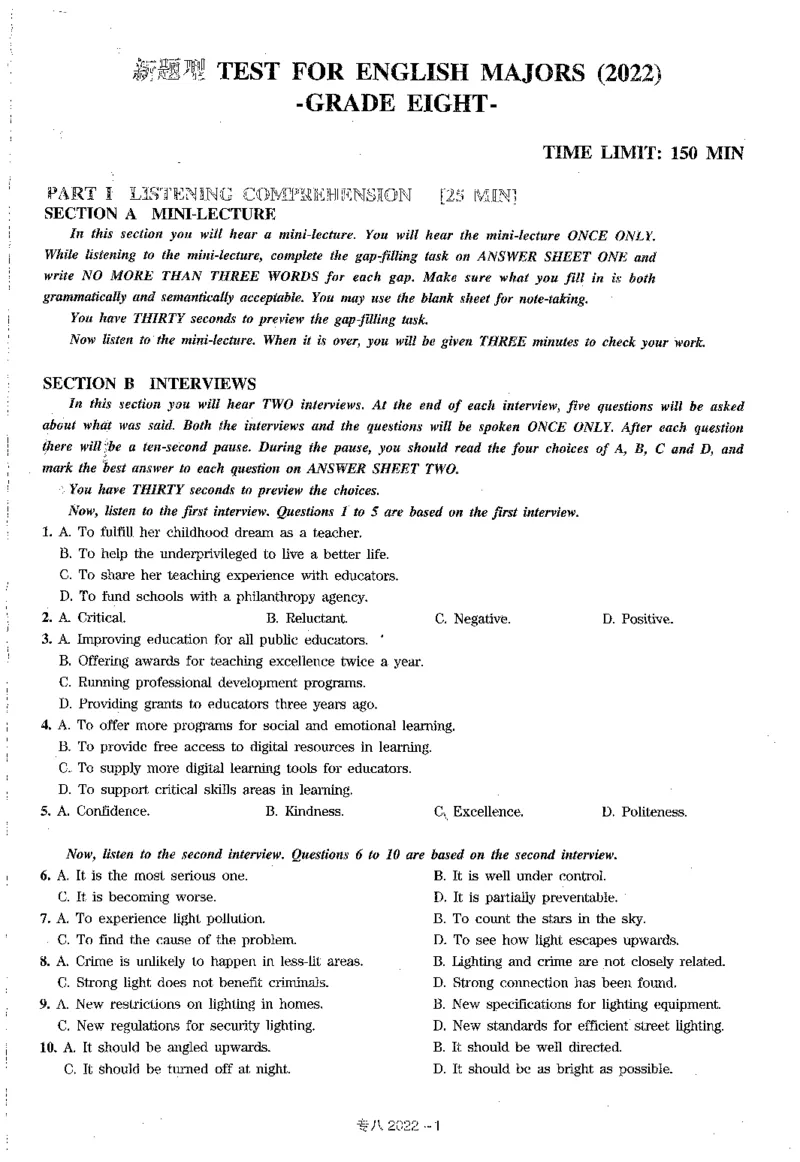
新题型 TEST FOR ENGLISH MAJORS (2013)
-GRADE EIGHT-
TIME LIMIT: 150 MIN
PART I LISTENING COMPREHENSION [25 MIN]
SECTION A MINI-LECTURE
In this section you will hear a mini-lecture. You will hear the mini-lecture ONCE ONLY. While listening to
the mini-lecture, ple�se complete the gap-filling task on ANSWER SHEET ONE and write NO MORE THAN
THREE WORDS for each gap. Make sure the word(s) you fill in is (are) both grammatically and semantically
acceptable. You may use the blank sheet for note-taking.
You have THIRTY seconds to preview the gap-filling task.
Now, listen to the mini-lecture. When it is over, you will be given THREE minutes to check your w_ork.
SECTION B INTERVIEW
In this section you will hear ONE interview. The interview will be divided into TWO parts. At the end of
each part, five questions will be asked about what was said. Both the interview and the questions will be spok叩
ONCE ONLY. After each question there will be a ten-second pause. During the pause, you should read the four
choices of A, B, C and D, and mark the best answer to each question on ANSWER SHEET TWO.
You have THIRTY seconds to preview the questions.
Now listen to Part One of the interview. Questions 1 to 5 are based on Part One of the interview.
1. A Better education - more choices —� greater mobility.
B. Better education - greater mobility - more choices.
C. Greater mobility —� better education —� more choices.
D. Greater mobility - more choices - better education.
2. A Job security came second according to the poll results.
B. Chances for advancement might have been favoured by young people.
C. High income failed to come on top for being most important.
D. Shorter work hmrrs was least chosen for being most important.
3. A Job security. B. Meaningful work
C. Monetary reward. D. Advancement.
4. A The type of respondents who were invited.
B. The way in which the questions were designed.
C. The content area of the questions.
D. The number of poll questions.
5. A Three. B. Four. C. Five. D. Six.
Now, listen to Part Two of the interview. Questions 6 to 10 are based on Part Two of the interview.
6. A. Item NO. 4. B. Item NO. 7.
C. Item NO. 14. D. Item NO. 15.
7. A. Recognition from colleagues should be given less importance.
B. Workers are always willing and ready to learn more new skills.
C. Work will have to be made interesting to raise efficiency.
D. Psychological reward is more important than material one.
8. A. Contact with many people. B. Appreciation from coworkers.
C. Chances for advancement. D. Chances to learn new skills.
9. A. Three. B. Four. C. Five. D. Six.
专八2013 -110. A. A young worker. B. A sociable worker.
C. An industrial worker. D. A smart worker.
PART II READING COMPREHENSION [45 MIN]
SECTION A MULTIPLE-CHOICE .QUESTIONS
In this section there are three passages followed by fourteen multiple choice questions. For each multiple
choice question, there are four suggested answers marked A, B, C and D. Choose the one that you think is. the
best answer and mark your answers on ANSWER SHEET TWO.
PASSAGE ONE
(l)I was standing in the lobby of a hotel. It was winter, a gray morning. I was in Paris as part of a
series of celebrations my wife had aiTanged for my 40th birthday. I did not feel like celebrating, though. I
had been having health problems, including learning a week before I arrived that I was probably going to
develop diabetes.
(2)Paris is like pornography. You respond even if you don't want to. You turn a comer and see a
vista, and your imagination bolts away. Suddenly you are thinking about what it would be like to live in
Paris, and then you think about all the lives you have not lived. Sometimes, though, when you are lucky,
you only think about how many pleasures the day ahead holds. Then, you feel privileged.
(3)The lobby of the hotel is decorated in red and gold. It gives off a wl面f of 19th-century decadence.
Probably as much as any hotel in Paris, this hotel is sexy. I was standing facing the revolving doors and
the driveway beyond. A car with a woman in the back seat - a woman in a short skirt and black-leather
jacket - pulled up before the hotel door. She swung off and she was wearing high heels. Normally, my
mind would have leaped and imagined a story for this woman. Now it didn't. I stood there and told myself:
Cheer up. You're in Paris.
(4)In many ways, Paris is best visited in winter. The tourist crowds are at a minimum, and one is not
being jammed off the narrow sidewalks along the Rue Dauphine. More than this, Paris is like many other
European cities in that the season of blockbuster cttltural events tends to begin in mid- to late fall and so,
by the time of winter, most of the cultural treasures of the city are laid out to be admired. For example,
the Louvre has a show on China's Forbidden City that started at the end of September. and will run till
early January; the Musee du Luxembourg has a gorgeous exhibition which started in October and will go
through February; and the Gale1ies Nationales du Grand Palais, maintaining its recent record of truly sur
prising reconsiderations of art that we thought we already lmew, is showing Matisse, Cezanne, and Picasso ,
through the collecting h_abits of one American family.
(5)The other great reason why Paris in winter is so much better than Paris in spring and fall is that
after the end of the August holidays and the return of chic Parisian women to their city, the restaurant
opening season truly begins hopping. By winter, many of the new restaurants have worked out their kinks
(不足; 困难) and, once the hype has died down, it is possible to see which restaurants are actually good
and which are merely noisy and crowded.
(6)My wife and I checked into our hotel room. A thin, late-morning light was pressing through the win
dow. The cold that I could sense outside made me want to lie in bed and pull the blankets tight around
me. My doctor had told me, though, that I needed to exercise every day. I knew also that if I slept and
woke, I would feel lost in the short winter day. I unpacked my running shoes and sweatshirt and left the
hotel.
(7)Most people are about as happy as they set their mind to being, Lincoln said. In Paris it doesn't take
much to be happy. Outside the hotel, the sky was pale and felt very high up. I walked the few blocks to
the Seine and began running along the blue-green river toward the Eiffel Tower. The tower in the distance
was black, and felt strange and beautiful the way that many things built for the joy of building do. AB I
专八2013 -2ran toward it, because of its lattice structure, the tower seemed obviously delicate. Seeing it, I felt a sense
of protectiveness.
(8)1 think it w邸 this moment of protectiveness that marked the change in my mood and my slowly
becmning thrilled with being in Paris.
(9)1 ran and ran through parks, the gravel crunching beneath me. I ran p邮 the painfully clipped plane
trees that look like a waiter's wrist and hand holding up a tray. I ran on cement sidewalks, p邸sing
Parisian women strolling with their teenage daughters. The daughters, in that wonderful French way, were
dressed much like their mothers because, in Fi·ance, there is not the same fetish for youth 邸 there is in
many countries. Instead, the emphasis is on chicness and on personality. I ran p豁t a 17th-century hospital
for veterans.
(10)1 kept running and the body that I had begun to feel distrust for, the body that, with the warning
of diabetes, seemed to be letting me down, kept responding to my desire to carry me through beautiful
Paris.
(ll)During winter evenings, Paris's streetlamps have a halo and resemble dandelions. In winter, when
one leaves the Paris street and enters a cafe or restaurant, the light and temperature change suddenly and
dramatically, and there is the sense of having discovered something secret. In winter, because the days are
short, there is an urgency to the choices one makes. There is the sense that life is short and so let us de
cide on what matters.
(12)Because it w郘 a milestone birthday, my wife and I were spl邸hing out for our hotel rooms. We
were in Paris for a week, and we stayed half the week at our present hotel and the other half at another
hotel. My wife picked the latter. She had 邸ked me to pick both hotels, but it felt selfish to spend so
much money b邸ed just on my own preferences. Unlike our present sexy hotel, the other hotel feels dis
creet, quiet, elegant.
11. According to Para. I, the author w邸 in a mood of when he w邸 standing in the lobby of a
hotel.
A. joyfulness B. thoughtfulness C. loneliness D. gloominess
12. Winter is the best se邸on to visit Paris. Which of the following does NOT support this statement?
A. F邸hionable Parisian women return to Paris. B. There are more good restaurants to choose from.
C. More entertainment activities are staged. · D. There are fewer tourists in Paris.
13. Why did the author decide to leave the hotel room?
A. Because it �邸 very cold inside the hotel room.
B. Because he wanted to fmd a few good restaurants.
C. Because his doctor told him to exercise every day.
D. Because he wanted to go through beautiful Paris.
14. "Most people are about as happy as they set their mind to being." This statement means that most people
A. expect to be happy. B. hope to be as happy as others.
C. would be happier if they want. D. can be happy ·if they want.
15. In the eyes of the author, w血er in Paris is significant because of
A. its implications for life. B. the atmosphere of its evenings.
C. the contrast it brings. D. the discovery one makes.
PASSAGE TWO
(l)If you want to know why Denmark is the world's leader in wind power, start 面th a three-hour car
trip from the capital Copenhagen — mind the bicyclists _:_ to the small town of Lem on the far west coast
of Jutland. You'll feel it as you cross the 6.8 血-long Great Belt Bridge: Denmark's bountiful w血, so
fierce even on a calm swnmer's day that it threatens to shove your car into the waves below. But wind it
self is only part of the reason. In Lem, workers in factories the size of aircraft hangars build the wind tur-
专八2013 -3bines sold by Vestas, the Danish company that has emerged as the industry's top man哗cturer around the
globe. The work is both gross and fine; employees weld togetl1er massive curved sheets of steel to make
central shafts as tall as a 14-story building, and assemble engine lwusings (机器外罩) that hold some 18,000
sep ate parts'. Most ilnpressive are the turbine's blades, which scoop the wind with each sweeping revolu
釭
tion. As smooth as an Olympic swimsuit and honed to aerodynamic pe汀ection, each blade weighs in at
7,000 kg, 1d they're what help make Vestas' turbines the best in the world. "The blade is where the secret
扣
is," says Erik Therkelsen, a Vestas executive. "If we cah make a turbine, it's sold."
(2)But technology, like the wind itself, is just one more part of the reason for Denmark's dominance.
In the end, it happened because Denmark had the political and public will to decide that it wanted to be a
leader - and to follow through. Beginning in 1979, the government began a determined programme of sub
si出es and loan guarantees to build up its w血 industry. Copenhagen covered 30% of investment costs, and
gu
扛
anteed loans for large turbine exporters such
邸
Vestas. It _ also mandated that utilities purchase w叫
energy at a preferential price - thus guaranteeing investors a customer b e. Energy taxes were channeled
邸
into research centres, where engineers crafted designs that would eventually produce cutting-edge giants like
Vestas' 3-megawatt (MW) V90 turbine.
(3)As a result, wind turbines now dot Denmark The country gets more than 19% of its electricity from
the breeze (Spain and Portugal, the next highest countries, get about 10%) d Danish companies control
叨
one-third of the global wind market, earning billions in exports and creating a national chan1pion from
scratch. "They were out early in driving renewables, and that gave them the chance to be a technology lead
er and a job-creation leader," says Jake Schmidt, international climate policy director for the New York
City-b ed Natural Resources Defense Council. "They have always been one or two steps ahead of others."
邸
(4)The challenge now for Denmark is to help the rest of the world catch up; Beyond wind, the country
(pop. 5.5 million) is a world leader in energy efficiency, getting more GDP per watt than any other member
of the E.U. Carbon emissions are down 13.3% from 1990 levels and total energy consumption h barely
邸
moved, even Denmark's economy continued to grow at a healthy clip. With Copenhagen set to host all
郘
职pmtant U.N. climate change talks in December — where the world hopes for a successor to the expiring
Kyoto Pro!ocol - and the global recession beginning to hit environmental plans in capitals everywhere,
Denmark's example couldn't be more timely. "We'll try to make Denmark a showroom," says Prime Minister
Anders Fogh 胚mussen. "You can reduce energy use and ca�bon emissimlS, and achieve economic growth."
(5)It's tempting to assume that Denmark is innately green, with the kind of Scandinavian good con
science that 匼 made it such a ple 邸 ant global citizen since, oh, the whole Viking thing. But the country's
policies were actually born from a different emotion, one now in common currency: fear. When the 1973
oil crisis hit, 90% of Denmark's energy came from petroleum, almost all of it imported. Buffeted by the
same supply shocks that hit the rest of the developed world, Denmark launched a rapid drive for energy
conservation, to the point of introducing c.ar-free Sundays and king businesses , to switch off lights during
邸
closing hours. Eventually the Mide邸 oil started flowing again, and the Danes themselves began eajoying
the benefits of the petroleum and natural gas in their slice of the North Sea. It w enough to make them
邸
more than self-s可ficient. But unlike most other countries, Denmark never forgot the lessons of 1973, and
kept driving for greater energy efficiency and a more diversified energy supply. The Danish parliament
函sed taxes on energy to encourage conservation and established subsidies and standards to support more
efficient buildings. "It all sta1ied out without any regard for the climate or the environment," says Svend
Auken, the former head of Denmark's opposition Social Democrat Party and the architect of the country's
environmental policies in the 1990s. ''But today there's a consensu.'3 that we need to build renewable power."
(6)To_ the rest of the world, Denmark h the power of its example, showing that you can stay rich
邸
and grow green at the same tune. "Denmark h proven that acting on climate can be a positive experi
邸
ence, not just painful," says NRDC's Schmidt. The real pain could come from failing to follow in their
footsteps.
专八 2013 -416. W垃ch of the following is NOT cited as a main reason for Denmark's world leadership in wind power?
A. Geographical location. B. Government drive. C. Technology. D. Wind.
17. The author has detailed some of the efforts of the Danish Government in promoting the wind industry
in order to show
A. the country's subsidy and loan policies. B. the importance of export to the country.
C. the role of taxation to the economy. D. the government s detel1IlUlat10n.
18. What does the author mean by "Denmark's example couldn't be more timely"?
A. Denmark's energy-saving efforts cannot be followed by other countries.
B. Denmark can manufacture more wind turbines for other countries.
C. Denmark's energy-saving success offers the world a useful model.
D. Denmark aims to show the world that it can develop even faster.
19. W压ch of the following is NOT implied in the passage?
A. Not to save energy could lead to serious consequences.
B. Energy saving efforts can be painful but positive.
C. Energy saving cannot go together with economic growth.
D. Denmark is a powerful leader in the global wind market.
PASSAGE THREE
(1)The first clue came when I got my hair cut. The stylist offered not just the usual coffee or tea but
a complimentary nail-polish change while I waited for my hair to dry. Maybe she hoped this little amenity
would slow the growing inclination of women to stretch each haircut to last four months while nursing our
hair back to whatever natural color we long ago forgot.
(2)Then there was the appliance salesman who offered to carry my bags as we toured the microwave
aisle. When I called my husband to ask him to check some specs online, the salesman offered a pre-emp
tive discount, lest the surfmg turn up the same model cheaper in another store. That night, for the first
time, I saw the Hyundai ad promising shoppers that if they buy a car and then lose their job in the next
year, they can return it.
(3)Suddenly everything's on sale. The upside to the economic downturn is the immense incentive it
gives retailers to treat you like a queen for a day. During the flush times, salespeople were surly, waiters
snobby. But now the customer rules, just for showing up. There's more room to stretch out on the flight,
even in a coach. The malls have that serene aura of undisturbed wilderness, with scarcely a shopper in
sight. Every conversation with anyone selling anything is a pantomime of pain and bluff. Finger the scarf,
then start to walk away, and its price floats silkily downward. When the mechanic calls to tell you that
brakes and a timing belt and other services w让1 run close to $2,000, it's time to break out the newly per
fected art of the considered pause. You really don't even have to say anything pitiful before he'll offer to
knock a few hundred dollars off.
(4)Restaurants are also caught in a fit of ardent hospitality, especially around Wall Street: Trinity Place
offers $3 drinks at happy hour any day the market goes down, with the slogan "Market tanked? Get tanked! "
—which ensures a lively crowd for the closing bell. The "21" Club has decided that men no longer need to
wear ties, so long as they bring their wallets. Food itself is friendlier: you notice more comfort food, a
truce between chef and patron that is easier to e司oy now that you can get a table practically anywhere.
New York Times restaurant critic Frank Bruni characterizes the new restaurant demeanor as "extreme so
licitousness tinged with outright desperation." "You need to hug the customer," one owner told him.
(5)There's a chance that eventually we'll return all this kindness with the extravagant spending that was
once decried but now everyone is hoping will restart the economy. But human nature is funny that way. In
专八2013 -5dangerous times, we clench and squint at the deal that looks too good to miss, suspecting that it must be
too good to be true. Is the store with the supercheap; flat screens going to go bust and thus not be there
to honour the "free" extended warranty? Is there something wrong with that free cheese? Store owners will
tell you horror stories about shoppers with attitude, who walk in demanding discounts and flaunt their new
power at every turn. These store owners w血e as they sense bad habits forming: Will people expect dis
counts forever? Will. their hard-won brand luster be forever cheapened, especially for items whose allure
depends on their being ridiculously priced?
(6)There w出 surely come a day when things go back to "normal"; retail sales even inched up in Jan
uary after sinking for the previous six months. But I wonder what it will take for us to see those $545
Sigerson Morrison studded toe-ring sandals as reasonable? Bargain-hnnting can be addictive regardless of the
stat� of the markets, and haggling is a low-risk, high-value contact sport. Trauma digs deep into habit, like
my 85-year-old mother still calling ·her canned-goods cabinet "the bomb shelter." The children of the first
Depression were saving string and preaching sacrifice long after the skies cleared. They came to be called
the "greatest generation." As we learn to be decent stewards of our resources, who knows what might
come of it? We have lived in an age of wanton waste, , and there is value in practicing conservation that
goes far beyond our own bottom line.
20. According to the passage, what does "the first clue" suggest?
A. Women tend to have their hair cut less frequently.
B. Shops, large or small, are offering big disconnts.
C. Shops try all kinds of means to please customers.
D. Customers refrain from buying things impulsively.
21. W压ch of the following best depicts the retailers now?
A. Over-friendly. B. ,Bad-tempered.
.
C. Highly motivated. D. Deeply frustrated.
22. In Para. 5, the phrase "go bust" probably means .
A. go bankrupt B. get prosperous
C. offer worse services D. raise their prices
、
23. According to the passage, "shoppers ... flaunt their new power- at every turn" means that shoppers would
A. like to show that they are powerful. B. keep asking for more discoun区
C. like to show off their wealth. D. have more doubts or suspicion.
24. What is the author's main message in the last two paragraphs?
A. The practice of frugality·is of great importance.
B. Extravagant spending would boost economic growth.
C. One's life experience would turn into lifelong habi区
D. Customers should expect discoun岱 for luxury goods.
SECTION B SHORT ANSWER QUESTIONS
In this section there are eight short answer questions based on the passages in SECTION A. Answer each
question in NO more than 10 words in the space provided on ANSWER SHEET TWO.
PASSAGE ONE
25. According to the author, why might one feel privileged once in Paris?
26. From the description .in Para. 4, what words can be used to depict the cultural events in 1Paris?
27. What aroused the author's sense of protectiveness?
专八2013 -6PASSAGE TWO
28. Why did the Danish government order utilities to purchase w血 energy?
29. According to the passage, what did Denmark's energy-saving policies stem from?
PASSAGE TI-IREE
30. Why did the salesman offer a pre-emptive discount to the author?
31. What did the cases of the flight and the malls in Par�. 3 show?
32. What renders the restaurants as "extreme solicitousness tinged with outright desperation"?
PART III LANGUAGE USAGE (15 MIN]
The passage contains TEN e"ors. Each indicated line contains a maximum of ONE e汀or. In each case,
only ONE word is involved. You should proof-read the passage and co"ect it in the following way:
For a�亟 word, underline the wrong word and write the correct one in the blank
provided at the end of the line.
For a missing word, mark the position of the missing word with a " /\ " sign and write the
word you believe to be missing in the blank provided at the end of the
line.
For an unnecessary word, cross the unnecessary word with a slash "/" and put the word in the
blank provided at the end of the line.
Example
When /\ art museum wants a new exhibit, (1) an
it 卯面 buys things in finished form and hangs (2)— never
them on the wall. When a natural history museum
wants an exhibition, it must often build it. (3) exhibit
Proofread the given passage on ANSWER SHEET THREE as instructed.
PART IV TRANSLATJ1r11N f?q MIN]
Translate the following text from Chinese into English. Write your translation on ANSWER SHEET THREE.
生活就像一杯红酒,热爱生活的人会从其中品出无穷无尽的美妙。 将它握在手中仔细观察,它的暗红色中有血的
感觉,那正是生命的痕迹。 拫一口留在口中回味,它的甘甜中有一丝苦涩,如人生一般复杂迷离。 喝一口下肚,余香沁人
心脾,让人终身受益。 红酒越陈越美味,生活越丰富越美好。 当人生走向晚年,就如一瓶待开封的好酒,其色彩是沉静
的,味道中充满慷慨与智慧。
PART V WRITING 45 MIN]
The emergence of the Uber digital ride finder and the regulation questions it tends to raise have inspired
debates, protests and supports around the world. The following are comments on legalization of ride-hailing
service both from officials and ordinary citizens. Read the excerpts carefully and write an article of NO LESS
THAN 300 words, in which you should:
1. summarize briefly the commen岱 from both sides;
2. give your comment.
Marks will be awarded for content relevance, content sufficiency, organimtion and language quality. Failure
to follow the above instructions may result in a loss of marks.
Write your article on ANSWER SHEET FOUR.
八2013
严
7Government Authorities
Maranda Gibson, a representative from Los. Angeles Department of Transportation: The . drivers for Uber
are not required to pass background checks or have. their vehicles inspected for safety. They don't h�ve to
pay the same taxes, insurance fees and licensing fees that taxi drivers do. W血e taxi drivers go through an
extensive training course called 'the Knowledge', where drivers must learn 320 routes covering 25,000
streets, as well as important buildings and points of interest, Uber drivers can come straight with a car and
GPS.
Boris Johnson, a British politician:. I have sympathy for taxi drivers, but it would be "difficult" for the
government to ban Uber. We've gone to the high court to get a ruling on this, and the issue is basically: is
the driver's mobile in the cab equivalent to a taxi meter? I can see why my learned friends might think
that it is, because it's receiving data about, or it's calculating, the distance and time and the fare. And
there are other lawyers who say that it isn't, and .that was the advice of the counsel to Transport for
London. And so we've got a legal problem.
Ordinary Citizens
Mary Williams: I think as long as the Uber drivers have the necessary background checks done (they
don't have any warrants, are not reckless drivers, and are properly insured) then they should be allowed to
offer their services. The transportation market is changing as it should with technology. I think it's great
that Uber users are able to see their driver's ratings and can hail them quicker than they can get a cab.
It's just a different way of doing business.
Matthew Yglesias: I think it's pretty obvious that Uber does in fact need to be regulated. And regulated
pretty heavily. A仕er all, here's the business: You've got people cruising around cities in medium-�ized ·metal
boxes capable of traveling at high speeds and powered by burning gasoline. Left unregulated, these vehicles
would poison the air and crush huge numbers of innocent pedestrians. Which is why it's good that the fed
eral government regulates what kind of automobiles are considered safe to drive and regulates what kind of
vehicle emissions are acceptable, and it's why state and local governments regulate both who is allowed to
drive cars (with driver's licenses), under what circumstances (with drunk driving laws), and of course what
you're allowed to do with a vehicle (with road rules). These are important things for the government to do.
Daniel Tencer: The regulatory issue around Uber is whether the rules governing rides-for-hire need to
be drastically different than the rules governing driving-yourself-around. But you don't need rules that
specifically discriminate against rides for hire. Anything you want to do around driving yourself is presump
tively l�gal, and anything you want to do around hiring someone else to drive you is presumptively illegal.
But by all means, regulate cars-for-hire, just regulate them the same way you regulate the other cars.
-THE END-
专八2013 -8-
1
一 一 一 一 一 一 一 一 一 一A一N一S一W一E一R圈 一SH一E圈E一
T
一 一(一T一E一M一8)一 一 一 一 一 一 一 一 一[I]一
.
—一
注意事项
准 考 证 号
学 校
'
,
'
r.`
姓 名 -
1答
写自
题
己
前
的
,
准
考
考
生
证
务
号
必
、
用
姓
黑
名
色
和
字
学
迹
校
签字
; 再
笔填
用 Ol 『01 ro1 !Qi IQ) i01 ICI [QI [01 lOI ,01 '()I 101
2B铅笔把对应准考证号码的标号涂黑,
I 嘉 _ 使用其它笔填涂无效。
r ..' 填 —正 畛 方 一 式 _ 此处鳍 _ i ` 2. 考生不得填涂缺考、 违纪项, 违 ! 者责任 :
涂 — - : I 畔 叩
|
要
错误填涂 |
求
I M y ,
I —L :: ::/ : : ::: ::2
PART I 缺考 LISTENING COMPREHENSION
( SECTION 一 A MINI-LECTURE
下列各题必须使用黑色字;..!t=t • � ··-�.. L -�-义 I. .1 口 , �.11���-�I形边柜限定区戏闪合 儿效
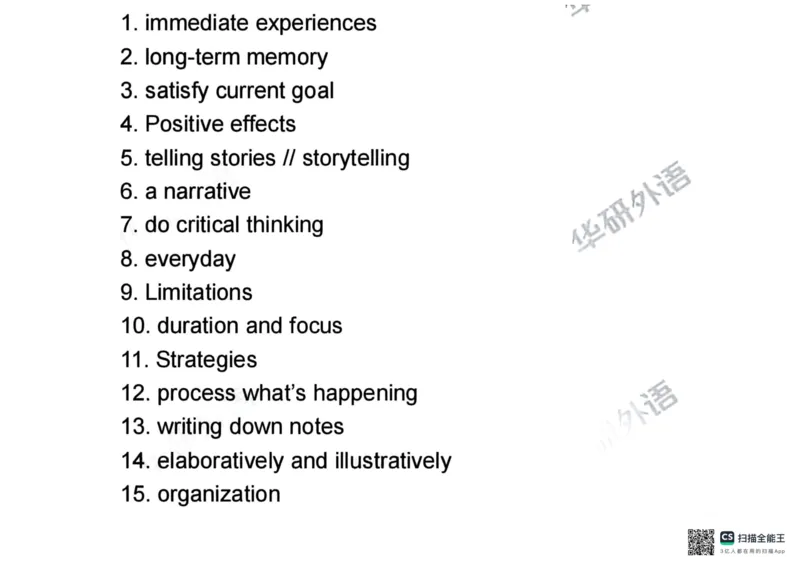
What Do Active Learners Do?
There are differences between active learning and passive learning.
Characteristics of active learners:
I. (1) (1)
A. before reading: setting goals
B. while reading: (2) (2)
II. (3) and critical in thinking (3)
i.e. information processing, e.g.
-connections between the known and the new information
-identification of (4) concepts (4)
-judgment on the value of (5) (5)
III. active in listening
A. ways of note-taking: (6) (6)
B. before note-taking: listening and thinking
IV. being able to (7) (7)
A. reason 1: knowing comprehension problems because of
(8) (8)
B. reason 2: being able to (9) (9)
V. being able to (10) (10)
A. question what they read or hear
B. evaluate and (11) (11)
VI. last characteristic
A. attitude toward responsibility
-active learners: accept
-passive learners: (12) (12)
B. attitude toward (13) (13)
-active learners: evaluate and (14) (14)
-passive learners: no change in approach
Relationship between skill and w出: w出 is more important in
.
(15) (15)
-
Lack of will leads to difficulty in college learning.
高校外语专业教学测试办公室 监制
专八 2013-9
FS-TEMS-1601千Beta-
团
圈 - - 圈 一 一 一 一 一 一A一N一S一W一E一R一 S一H一E一E一T一3一 (一T一EM一8一)一 一 一 一 一 一 一 一 一 一
圈
注意事项
1答题前, 考生务必用黑色字迹签字笔填 准 考 证 号
学 校: 写自己的准考证号、 姓名和学校; 再用
2B铅笔把对应准考证号码的标号涂黑,
使用其它笔填涂无效。
2考生不得填涂缺考、 违纪项, 违者责任 I OJ [01 101 col (01 [Q) [01 (QI l O I ro 1 tQJ EOl [01 ro 1
姓 名: 自负。 [1 J [11 [1 l {1 J 11 J [ 1 J (1 J l 1 I 11 J [1i I 1 J 1.11 r 1 l (1 J
3. 选择题必须用2B铅笔填涂, 使用其它笔 r 21 (21 l2l r21 r'21 !21 [21 (2l 12 l l2l [21 [21 121 (21
填涂无效, 修改时要用橡皮擦干净; 每 l3J [31 l 31 [31 13 l 13] l3 l [;31 131 l3J 131 l 3] r 31 131
填 此处由监考老师填涂 题只能填涂一个答案, 多填不得分。 l4l llll [41 (41 [4] [4] [4 l (41 [41 14] l4l l 4 l [41 141
4. 主观题必须用黑色字迹签字笔 l 5 l C 51 l5l (5 J [51 l5 l 151 (51 l5J l 5 i 15) l 51 151 15 l
涂 违纪 £Wl (0.5mm)在答题区域内作答, 超出红 l6J 161 [61 C 61 [61 [6l 16 J l6l l 6 l r 6J [61 C 61 [61 161
要 求 [ 错 �] 误 名 填 J 涂 1• 方 1 [ 式 中 缺考 [QJ I 5 保 色矩 A 持 NS 形 答 症 框 题 R 限 S 卡 H 定 E 的 ET 区 清 3 域 洁 I 的 和 答 平 案 整 无 , 效 不 。一 得折叠。 I 1 f 1 7 8 9 ] 1 1 ( 1 r 9 7 81 1 ) 1 r 1 7 s 9 1 1 1 [ ( ( 7 9 8 ) J 1 [ r l 7 9 81 J l [ [ [· 7] 8 9 1 1 1 [ 19 7 8 1 1 1 1 [ 『 7 9 8 J 1 1 1 [ 19 7 81 1 I r [ [ 9 B 7 l ] 1 f [ l 7 8 9 1 1 1 l r [ 9 a 7 J i 1 1 1 1 7 9 8 1 1 1 1 ( 1 7 9 8 1 1 1
PART III LANGUAGE Q坠�E
下列各题必须使用黑色字迹签字笔在答题区域内作答, 超出红色矩形边框限定区域的答案无效。
Psycholi11guistics is the name given to the study of the psychological
process involved in language. Psycholinguists study understanding,
production, and remembering language, and hence are concerned with (1)
listening, reading, speaking, writing, and memory for language.
One reason why we take the language for granted is that it usually (2)
.
happens so effortlessly , and, most of t江ne, so accurately (3)
Indeed, when you listen to someone speaking, or looking at this page, (4)
you normally cannot help but understand it It is only in exceptional
circumstances we might become aware of the complexity (5)
involved: if we are searching for a word but cannot remember it;
if a relative or colleague has had a stroke which has influenced (6)
if
their language; we obseive a child acquire language ; if (7)
we tcy to learn a second language ourselves as an adult; or
if we are visually impaired or hearing-impaired or if we meet
anyone else who is. As we shall see, all these examples (8)
of what might be called "language in exceptional circumstances"
reveal a great deal about the processes evolved in speaking, (9)
listening, writing, and reading. But given that language processes
were normally so automatic, we also need to carry out careful (10)
experiments to get at what is happening.
•
高校外语专业教学测试办公室 监制 FS-TEM8-160仁3-Beta
专八2013 -10