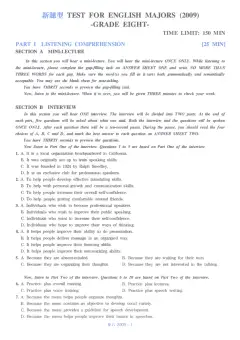
TEST FOR ENGLISH MAJORS (2019)
—
GRADE EIGHT
TIME LIMIT: 150 MIN
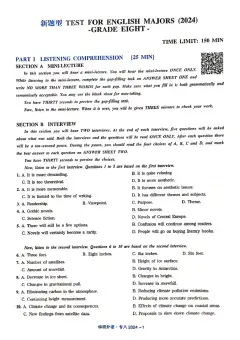
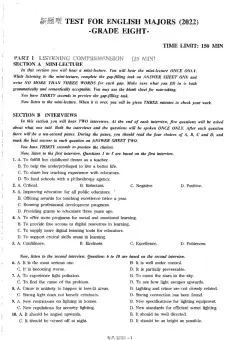
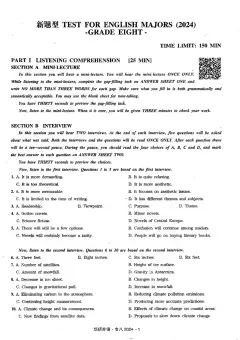
PART! LISTENING COMPREHENSION [25MIN]
SECTION A MINI-LECTURE
In this section you will hear a mini-lecture. You will hear the lecture ONCE ONLY. While listening to mini
lecture, please complete the gap-filling task on ANSWER SHEET ONE and write NO MORE THAN THREE
WORDS for each gap. Make sure you fill in is both grammatically and semantically acceptable. You may use the
blank sheetf or note-taking.
You have THIRTY seconds to preview the gap-filling task.
Now listen to the mini-lecture. When it is over, you will be given TH邸'Eminutes to check your work.
SECTIONB INTERVIEW
In this section you will hear ONE interview. The interview will be divided into TWO parts. At the end ofe ach
part, five questions will be asked about what was said. Both the interview and the questions will be spoken ONCE
ONLY. After each question there will be a ten-second pause. During the pause, you should read the four choices
。ifA), BJ, C) and D), and mark the best answer to each question on ANSWER SHEET TWO.
You have THIRTY seconds to preview the choices.
Now, listen to the first interview. Questions 1 to 5 are based on Part One oft he interview. Now listen to the
interview.
1. A. Environmental issues. B. Endangered species.
C. Global warming. D. Conservation.
2. A. It is thoroughly proved. B. It is definitely very serious.
C. It is just a temporary variation. D. It is changing our ways of living.
3. A. Protection of endangered animal's habitats.
B. Negative human impact on the environment.
C. Frequent abnormal phenomena on the earth.
D. The woman's indifferent attitude to the earth.
4. A. Nature should take its course.
B. People take things for granted.
C. Humans are damaging the earth.
D. Animals should stay away from zoos.
5. A. Objective. B. Pessimistic.
C. Skeptical. D. Subjective.
Now listening to Part Two oft he interview. Questions 6 to 10 are based on Part Two oft he interview.
6. A. Teachers'resistance to change.
B. Students'inadequate ability to read.C. Teachers'misunderstanding of such literacy.
D. Students'indifference to the new method.
7. A. Abilities to complete challenging tasks.
B. Abilities to learn subject matter knowledge.
C. Abilities to perform better in schoolwork.
D. Abilities to perform disciplinary work.
8. A. Recalling specific information. B. Understanding particular details.
CE ..
. xammmg sources ofmformatlon. D. Retelling a historical event.
9. A. Engaging literacy and disciplinary experts in the program.
B. Helping teachers understand what disciplinary literacy is.
C. Teaching disciplinary discourse practices by literacy teachers.
D. Designing learning strategies with experts from both sides.
10. A. To argue for a case. B. To discuss a dispute.
C. To explain a problem. D. To present details.
PART II READING COMPREHENSION [25MIN]
SECTION A MULTIPLE CHOICE QUESTIONS
In this section there are three passages followed by fourteen multiple choice questions. For each multiple
choice question, there are four suggested answers marked A, B, C and D. Choose the one that you think is the best
answer and mark your answer on ANSWER SHEET TWO.
PASSAGE ONE
(1) When it came to concealing his troubles, Tommy Wilhelm was not less capable than the next fellow. So
at least he thought, and there was a certain amount of evidence to back him up. He had once been an actor—no,
—
not quite, an extra and he knew what acting should be. Also, he was smoking a cigar, and when a man is
smoking a cigar, wearing a hat, he has an advantage; it is harder to find out how he feels. He came from the
twenty-third floor down to the lobby on the me立anine to collect his mail before breakfast, and he believed—he
hoped—that he looked passably well: doing all right. It was a matter of sheer hope, because there was not much
that he could add to his present effort. On the fourteenth floor he looked for his father to enter the elevator; they
often met at this hour, on the way to breakfast. If he worried about his appearance it was mainly for his old
father's sake. But there was no stop on the fourteenth, and the elevator sank and sank. Then the smooth door
opened and the great dark-red uneven carpet that covered the lobby billowed toward Wilhelm's feet. In the
foreground the lobby was dark, sleepy. French drapes like sails kept out the sun, but three high, narrow windows
were open, and in the blue air Wilhelm saw a pigeon about to light on the great chain that supported the marquee
of the movie house directly underneath the lobby. For one moment he heard the wings beating strongly.
(2) Most of the guests at the Hotel Gloriana were past the age of retirement. Along Broadway in the
Seventies, Eighties, and Nineties, a great part of New York's vast population of old men and women lives. Unless
the weather is too cold or wet they fill the benches about the tiny railed parks and along the subway gratings from
Verdi Square to Columbia University, they crowd the shops and cafeterias, the dime stores, the tearooms, the
bakeries, the beauty parlors, the reading rooms and club rooms. Among these old people at the Gloriana, Wilhelm
felt out of place. He was comparatively young, in his middle forties, large and blond, with big shoulders; his back
was heavy and strong, if already a little stooped or thickened. After breakfast the old guests sat down on the green
leather armchairs and sofas in the lobby and began to gossip and look into the papers; they had nothing to do but
wait out the day. But Wilhelm was used to an active life and liked to go out energetically in the morning. And forseveral months, because he had no position, he had kept up his morale by rising early; he was shaved and in the
lobby by eight o'clock. He bought the paper and some cigars and drank a Coca-Cola or two before he went in to
—
breakfast with his father. After breakfast out, out, out to attend to business. The getting out had in itself
become the chief business. But he had realized that he could not keep this up much longer, and today he was
afraid. He was aware that his routine was about to break up and he sensed that a huge trouble long presaged (预感)
but till now formless was due. Before evening, he'd know.
(3) Nevertheless he followed his daily course and crossed the lobby.
(4) Rubin, the man at the newsstand, had poor eyes. They may not have been actually weak but they were
—
poor in expression, with lacy lids that furled down at the comers. He dressed well. It didn't seem necessary he
was behind the counter most of the time — but he dressed very well. He had on a rich brown suit; the cuffs
embarrassed the hairs on his small hands. He wore a Countess Mara painted necktie. As Wilhelm approached,
Rubin did not see him; he was looking out dreamily at the Hotel Ansonia, which was visible from his comer,
several blocks away. The Ansonia, the neighborhood's great landmark, was built by Stanford White. It looks like
a baroque palace from Prague or Munich enlarged a hundred times, with towers, domes, huge swells and bubbles
of metal gone green from exposure, iron fretwork and festoons. Black television antennae are densely planted on
its round summits. Under the changes of weather it may look like marble or like sea water, black as slate in the
fog, white as tufa in sunlight. This morning it looked like the image of itself reflected in deep water, white and
cumulous above, with cavernous distortions underneath. Together, the two men gazed at it.
(5) Then Rubin said, "Your dad is in to breakfast already, the old gentleman."
"Oh, yes? Ahead of me today?"
"That's a real knocked-out shirt you got on," said Rubin. "Where's it from, Saks?"
"No, it's a Jack Fagman—Chicago."
(6) Even when his spirits were low, Wilhelm could still wrinkle his forehead in a pleasing way. Some of the
slow, silent movements of his face were very attractive. He went back a step, as if to stand away from himself and
get a better look at his shirt. His glance was comic, a comment upon his untidiness. He liked to wear good clothes,
but once he had put it on each article appeared to go its own way. Wilhelm, laughing, panted a little; his teeth
were small; his cheeks when he laughed and puffed grew round , and he looked much younger than his years. In
the old days when he was a college freshman and wore a beanie (无檐小帽) on his large blonde head his father
used to say that, big as he was, he could charm a bird out of a tree. Wilhelm had great charm still.
(7) "I like this dove-gray color," he said in his sociable, good-natured way. "It isn't washable. You have to
send it to the cleaner. It never smells as good as washed. But it's a nice shirt. It cost sixteen, eighteen bucks."
11. Wilhelm hoped he looked all right on his way to the lobby because he wanted to .
A. leave a good impression
B. give his father a surprise
C. show his acting potential
D. disguise his low spirit
12. Wilhelm had something in common with the old guests in that they all .
A. lived a luxurious life
B. liked to swap gossips
C. idled their time away
D. liked to get up early
13. How did Wilhelm feel when he was crossing the lobby (Para. 2)?
A. He felt something ominous was coming.
B. He was worried that his father was late.
C. He was feeling at ease among the old.
D. He was excited about a possible job offer.
14. Which part of Rubin's clothes made him look particularly awkward (Para. 4)?A. The necktie.
B. The cuffs.
C. The suit.
D. The shirt.
15. What can we learn from the author's description of Wilhelm's clothes?
A. His shirt made him look better.
B. He cared much about his clothes.
C. He looked like a comedian in his shirt.
D. The clothes he wore never quite matched.
PASSAGE TWO
(1) By the 1840s New York was the leading commercial city of the United States. It had long since outpaced
Philadelphia as the largest city in the country, and even though Boston continued to be venerated as the cultural
capital of the nation, its image had become somewhat languid; it had not kept up with the implications of the
newly industrialized economy, of a diversified ethnic population, or of the rapidly rising middle class. New York
was the place where the "new" America was coming into being, so it is hardly surprising that the modem
newspaper had its birth there.
(2) The penny paper had found its first success in New York. By the mid-1830s Ben Day's Sun was drawing
readers from all walks of life. On the other hand, the Sun was a scanty sheet providing little more than minor
diversions; few today would call it a newspaper at all. Day himself was an editor of limited vision, and he did not
possess the ability or the imagination to climb the slopes to loftier heights. If real newspapers were to emerge
from the public's demand for more and better coverage, it would have to come from a youthful generation of
editors for whom journalism was a totally absorbing profession, an exacting vocational ideal rather than a mere
offehoot ofj ob printing.
(3) By the 1840s two giants burst into the field, editors who would revolutionize journalism, would bring
the newspaper into the modem age, and show how it could be influential in the national life. These two giants,
neither of whom has been treated kindly by history, were James Gordon Bennett and Horace Greeley. Bennett
founded his New York Herald in 1835, less than two years after the appearance of the Sun. Horace Greeley
founded his Tribune in 1841. Bennett and Greeley were the day, although for completely different reasons. The
two men despised each other, although not in the ways that newspaper editors had despised one another a few
years before. Neither was a political hack bonded to a political party. Greeley fancied himself a public intellectual.
He had strong political views, and he wanted to run for office himself, but party factotum he could never be; he
bristled with ideals and causes of his own devising. Officially he was a Whig (and later a Republican), but he
seldom gave comfort to his chosen party. Bennett, on the other hand , had long since cut his political ties, and
although his paper covered local and national politics fully and he went after politicians with hammer and tongs,
Bern记ttwas a cynic, a distruster of all settled values. He did not regard himself as an intellectual, although in fact
he was better educated than Greeley. He thought himself only a hard-boiled newspaperman. Greeley was
interested in ideas and in what was happening to the country. Bennett was only interested in his newspaper. He
wanted to find out what the news was, what people wanted to read. And when he found out he gave it to them.
(4) As different as Bennett and Greeley were from each other they were also curiously alike. Both stood
outside the circle of polite society, even when they became prosperous, and in Bennett's case, wealthy. Both
were incurable eccentrics. Neither was a gentleman. Neither conjured up the picture of a successful editor.
Greeley was unkempt, always looking like an unmade bed. Even when he was nationally famous in the 1850s he
— —
resembled a clerk in a third-rate brokerage house, with slips of paper marked-up proofs perhaps hanging
out of his pockets or stuck in his hat. He became fat, was always nearsighted, always peering over spectacles. He
spoke in a high-pitched whine (哀号). Not a few people suggested that he looked exactly like the illustrations of
Charles Dickens's Mr. Pickwick. Greeley provided a humorous description of himself, written under the pretensethat it had been the work of his long-time adversary James Fenimore Cooper. The editor was, according to the
description, a half-bald, long-legged, slouching individual "so rocking in gait(步 态) that he walks down both
sides of the street at once."
(5) The appearance of Bennett was somewhat different but hardly more reassuring. A shrewd, wiry (瘦而结
实的) Scotsman, who seemed to repel intimacy, Bennett looked around at the world with a squinty glare of
suspicion. His eyes did not focus right. They seemed to fix themselves on nothing and everything at the same
time. He was as solitary as an oyster, the classic loner. He seldom made close friendships and few people trusted
him, although nobody who had dealings with him, however brief, doubted his abilities. He, too, could have come
out of a book of Dickensian eccentrics, although perhaps Ebenezer Scrooge or Thomas Gradgrind comes to mind
rather than the kindly old Mr. Pickwick. Greeley was laughed at but admired; Bennett was seldom laughed at but
never admired; on the other hand, he had a hard professional competence and an encyclopedic knowledge of his
adopted country, an in-depth learning uncorrupted by vague idealisms. All of this perfectly suited him for the
journalism of this confusing age.
(6) Both Greeley and Bennett had served long, humiliating and disappointing apprenticeships in the
newspaper business. They took a long time getting to the top, the only reward for the long years of waiting being
that when they had their own newspapers, both knew what they wanted and firmly set about getting it. When
Greeley founded the Tribune in 1841 he had the strong support of the Whig party and had already had a short
period of modest success as an editor. Bennett, older by sixteen years, found solid con订nercial success first, but
he had no one behind him except himself when he started up the Herald in 1835 in a dingy cellar room at 20
Wall Street. Fortunately this turned out to be quite enough.
16. Which of the following is NOT the author's opinion on Ben Day and his Sun (Para. 2)?
A. Sun had once been a popular newspaper.
B. Sun failed to be a high-quality newspaper.
C. Ben Day lacked innovation and imagination.
D. Ben Day had striven for better coverage.
17. Which of the following statements is CORRECT about Greeley's or Bennett's political stance (Para. 3)?
A. Greeley and Bennett were both strong supporters of their party.
B. Greeley, as a Whig member, believed in his party's ideals.
C. Bennett, as an independent, loathed established values.
D. Greeley and Bennett possessed different political values.
18. Which of the following figures of speech was used to describe Greeley's manner of walking (Para.4)?
A. Exaggeration.
B. Paradox.
C. Analogy.
D. Personification.
19. In Para. 5 Bennett was depicted as a man who .
A. had stronger capabilities than Greeley
B. possessed a great aptitude for journalism
C. was in pursuit of idealism in journalism
D. was knowledgeable about his home country
20. How was Greeley different from Bennett according to Para. 6?
A. He had achieved business success first.
B. He started his career earlier than Bennett.
C. He got initial support from a political party.
D. He had a more humiliating apprenticeship.PASSAGE THREE
(1) Why make a film about Ned Kelly? More ingenious crimes than those committed by the reckless
Australian bandit are reported every day. What is there in Ned Kelly to justify dragging the mesmeric Mick
Jagger so far into the Australian bush and away from his natural haunts? The answer is that the film makers know
we always fall for a bandit, and Jagger is set to do for bold Ned Kelly what Brando once did for the arrogant
Emiliano Zapata.
(2) A bandit inhabits a special realm of legend where his deeds are embroidered by others; where his death
rather than his life is considered beyond belief; where the men who bring him to "justice"are afflicted with doubts
about their role.
(3) The bandit had a role to play as definite as that of the authorities who condemned them. These were men
in conflict with authority, and, in the absence of strong law or the idea idea of loyal opposition, they took to the
hills. Even there, however, many of them obeyed certain unwritten rules.
(4) These robbers, who claimed to be something more than mere thieves, had in common, firstly, a sense of
loyalty and identity with the peasant they came from. They didn't steal the peasant's harvest; they did steal the
lord's.
(5) And certain characteristics seem to apply to "social bandits" whether they were in Sicily or Peru. They
were generally young men under the age of marriage, predictably the best age for dissidence. Some were simply
the surplus male population who had to look for another source of income; others were runaway serfs or ex
soldiers; a minority, though the most interesting, were outstanding men who were unwilling to accept the meek
and passive role of peasant.
(6) They usually operated in bands between ten and twenty strong and relied for survival on difficult terrain
and bad transport. And bandits prospered best where authority was merely local — over the next hill and they
were free. Unlike the general run of peasantry they had a taste for flamboyant dress and gesture; but they usually
share the peasants'religious beliefs and superstitions.
(7) The first sign of a man caught up in the Robin Hood syndrome was when he started out, forced into
outlawry as a victiim of injustice; and when he then set out to "right wrongs", first his own and then other
people's. The classic bandit then "takes from the rich and gives to the poor" in conformity with his own sense of
social injustice; he never kills except in self-defense or justifiable revenge; he stays within his community and
even returns to it if he can to take up an honorable place; his people admire and help to protect him; he dies
through the treason of one of them; he behaves as if invisible and invulnerable; he is a "loyalist", never the enemy
of the king but only of the local oppressors.
(8) None of the bandits lived up fully to this image of the "noble robber" and for many the claim of larger
motives was often a delusion.
(9) Yet amazingly, many of these violent men did behave at least half the time in accordance with this
idealist pattern. Pancho Villa in Mexico and Salvatore Giuliano in Italy began their careers harshly victimized.
Many of their charitable acts later became legends.
(10) Far from being defeated in death, bandits'reputation for invincibility was often strengthened by the
manner of their dying. The "dirty little coward" who shot Jesse James in the back is in every ballad about him,
and the implication is that nothing else could have brought Jesse down. Even when the police claimed the credit,
as they tried to do at first with Giuliano's death, the local people refused to believe it. And not just the bandit's
vitality prompts the people to refuse to believe that their hero has died; his death would be in some way the death
ofh ope.
(11) For the traditional "noble robber" represents an extremely primitive form of social protest, perhaps the
most primitive there is. He is an individual who refuses to bend his back, that is all. Most protesters will
eventually be bought over and persuaded to come to terms with the official power. That is why the few who do
not, or who are believed to have remained uncontaminated, have so great and passionate a burden of admiration
and longing laid upon them. They cannot abolish oppression. But they do prove that justice is possible, that poor
men need not be humble, helpless and meek.(12) The bandit in the real world is rooted in peasant society and when its simple agricultural system is left
behind so is he. But the tales and legends, the books and films continue to appear for an audience that is neither
peasant nor bandit. In some ways the characters and deeds of the great bandits could so readily be the stuff of
—
grand opera Don Jose in "Carmen" is based on the Andalusian bandit El Empranillo. But they are perhaps
more at home in folk songs, in popular tales and the ritual dramas of films. When we sit in the darkness of the
cinema to watch the bold deeds of Ned Kelly we are caught up in admiration for their strong individuality, their
simple gesture of protest, their passion for justice and their confidence that they cannot be beaten. This sustains us
nearly as much as it did the almost hopeless people from whom they sprang.
21. Which of the following words is NOT intended to suggest approval ofbandits?
A. Bold (Para. I).
B. Claimed (Para.4).
C. Legend (Para.2).
D. Loyalty (Para.4).
22. Of the following reasons which is the LEAST likely one for becoming bandits?
A. They liked theatrical clothes and behavior.
B. They wanted to help the poor country folk.
C. They were unwilling to accept injustice.
D. They had very few careers open to them.
23." …began their careers harshly victimized" (Para. 9) means that they .
A. had received excessive ill-treatment
B. were severely punished for their crimes
C. took to violence through a sense of injustice
D. were misunderstood by their parents and friends
24. What has made bandits suitable as film heroes is that they .
A. are sure they are invincible
B. possess a theatrical quality
C. retain the virtues of a peasant society
D. protest against injustice and inequality
SECTIONB SHORT ANSWERQUESTIONS
In this section there are eight short answer questions based on the passages in SECTION A. Answer each
question in NO MORE THAN TEN WORDS in the space provided on ANSWER SHEET TWO.
PASSAGE ONE
25. In"…, and there was a certain amount of evidence to back him up (Para. I)", what dose "evidence" refer
to?
26. What is Wilhelm's characteristic that has never changed all those years according to Para. 6?
PASSAGE TWO
27. Summarize in your own words the meaning of the italicized part in the last sentence of Para. 2.
28. What does "…, but he seldom gave comfort to his chosen party" mean according to the context (Para. 3)?
29. What is the similarity between Bennett and Greeley according to Paras. 4 and 5?
PASSAGE THREE
30. Write down TWO features of the idealist pattern (Para. 9).31. What does "hope" mean according to the context (Para. 10)?
32. What does "He is an individual who refuses to bend his back" mean (Para. 11)?
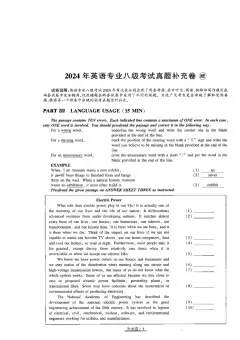
PART III LANGUAGE USAGE [15 MIN]
The passage contains TEN errors. Each indicated line contains a maximum of ONE error. In each case,
only ONE word is involved. You should proof-read the passage and correct it in the following way:
Fora~坚 word, underline the wrong word and write the correct one in the blank provided at
the end of the line.
For a missing word, mark the position of the missing word with a " /\ " sign and write the
word you believe to be missing in the blank provided at the end of the line.
For an unnecessary word, cross the unnecessary word with a slash "/" and put the word in the blank
provided at the end of the line.
Example
When/\ art museum wants a new exhibit, (1) an
m
it nev压e uys things finished form and hangs (2) never
them on the wall. When a natural history museum
wants an exhibition, it must often build it. (3) exhibit
Proofread the given passage on ANSWER SHEET THREE as instructed
PARTIV TRANSLATION [20MIN]
Translate the underlined part of the following text from Chinese into English. Write your translation on
ANSWER SHEET THREE.
白洋淀曾有“北国江南”的说法, 但村舍的形制自 具特色,与江南截然不同。南方多雨, 屋顶是
坡顶; 这里的村舍则不 同, 屋顶是晒粮食的地方,而且历史上每逢水大洪泛,村民就得把屋里的东
西搬到屋顶上。房屋彼此挨得很近,有些屋顶几乎相连。
PARTV W阳TING [45 MIN]
Read carefully the following two excerpts on consumption, and then write your response in NO LESS
THAN 300 WORDS, in which you should:
1. summarize the main message of the two excerpts, and then
2. comment on the role of consumption in human society, especially on whether consumption may lead to
desirable or undesirable results.
You can support yourselfw ith ieformation from the excerpts.
Marks will be awarded for content relevance, content sufficiency, organization and language quality.
Failure to follow the above instructions may result in a loss ofm arks.
Write your article on ANSWER SHEET FOUR.Excerpt 1
Consequences of consumerism
In Human Development Report 1998 Overview by the United Nations Development Program (UNDP),
"World consumption has expanded at an unprecedented pace over the 20th century, with private and public
consumption expenditures reaching $24 trillion in 1998, twice the level of 1975 and six times that of 1950.
In 1990 real consumption expenditure was barely $1.5 trillion."
In September 2001, the BBC aired a documentary called "Shopology," where psychologists looked
into the psychology of shopping and consumerism in countries like Britain, USA and Japan and asked if it
was healthy for consumers. Of the many points they raised, they observed that:
• Consumption now helps to define who we are;
• We essentially "buy" a lifestyle;
• Consumerism can increase stress for various reasons;
• To deal with social and consumerism pressures and their effects, people may on occasion consume
even more to feel better;
• Rising consumer debt puts pressure on families.
Two years later, the BBC aired another documentary called "Spend, Spend, Spend." It looked at the
issues of whether or not the increased wealth and consumerism had led to more content and satisfied
individuals. The documentary observed that research evidence seemed to suggest that increased wealth did
not necessarily lead to more satisfaction in Britain. When interviewed in the program, Professor Andrew
Oswald of Warwick University said that the key reason for this was because as we get wealthier there is
often a tendency to compare more with other, which contributes to more anxiety. The "keeping up with the
Joneses" syndrome. The implications of this are profound. As Oswald suggested, it is "hard to make society
happier as they get richer and richer because human beings look constantly over their shoulders. That's the
curse of human beings; making comparisons."
Excerpt 2
Consumption as a path to cultivation
Consumption, for George Simmel, German sociologist and philosopher, lies at the heart of the process
through which people become cultivated, that is, grow to become participating, reflective members of society.
This is because consumption provides an excellent site for the interaction between subject and object, which
Simmel believed to be the key to cultivation. Subjectivity, the uniquely human capacity for self-reflection,
which allows for the self-conscious construction of action and identity, is not naturally endowed; it only
develops through the creative tension provided by interaction with objects (including people) existing in the
world. For Simmel, consumption provides a vital forum for this subject-object interaction. Through
consumption, people come to understand, instill meaning in, and act upon objects encountered in the world.
Consumption provides people with the opportunity to refine themselves through interacting with objects in
the world. In addition, by confronting, adapting, and integrating various world-views directly or indirectly
demonstrated in consumption objects, people not only realize their potential as unique human beings, they
also become well-socialized members of a society.
--THE END--ANSWER SHEET 1 (TEM8)
PART I LISTENING COMPREHENSION
SECTION A MINI-LECTURE
下列各题必须使用黑色字迹签字笔在答题区域内作答,超出红色矩形边框限定区域的答案无效。
Body Language and Mind
Introduction
Body Language reveals who we are.
Nonverbal expressions of (1) (1)
• feeling powerful: (2) (2)
--e.g. athletes with arms up in a V sign
• feeling powerless: (3) (3)
--e.g. refusing to bump into the person nearby
• people's behavior tends to become (4) (4)
in a high-and low-power situation.
—
people don't mirror each other.
• MBA students exhibit the full range of power nonverbals.
--e.g. students with power have strong desire for (5) . (5)
• power nonv erbals are also related to (6) (6)
Relationship between (7) (7)
• the powerful are more (8) (8)
• hormones differ with (9) (9)
• an experiment:
—procedure:
—
adopting high- or low-power poses and completing items
—
being given (10) (10)
—
having saliva tested
—results:
气11) : much higher with high-power people (11)
—
an mcrease m (12) in low-power people (12)
—
hormonal changes: making brain (13) (13)
Conclusion
• Behavior can (14) (14)
• Before getting into stressful situations
—
get your brain ready to (15) (15)ANSWER SHEET 3 (TEM8)
PART III LANGUAGE USAGE
下列各题必须使用黑色字迹签字笔在答题区域内作答,超出矩形边框限定区域的答案无效。
Learning about Cognitive Grammar (CG), an approach to the
analysis and description of language structure, is not easy. One reason
is vast literature that now exists in CG and in cognitive linguistics (1)
more generally; thanks to limited accessibility, and its being situated (2)
in the Western linguistic tradition, this poses special problems for Chinese
scholars. Another factor is that CG, though is not implemented (3)
computationally or presented as a formal model, nonetheless involves
considerable technical detail. Understanding it at depth, or with any degree of (4)
accuracy, required precision of thought and analysis as well (5)
as the mastering of many terms and notations. The final source of difficulty (6)
is that CG results from non-standard ways of thinking language (7)
and linguistic investigation. In particular, it departs away from tradition (8)
by viewing meaning as the starting point for analyzing grammar, and
conceptualization as the basis for describing meaning.
This book is hardly sufficient for a thorough knowledge of CG but
may at least contribute to the process of learning about it. As it only (9)
introduces the basic notions, its main purpose is to illustrate the framework's
descriptive and explanatory potential through extensive discussions of their
application to diverse facets of language structure. (10)