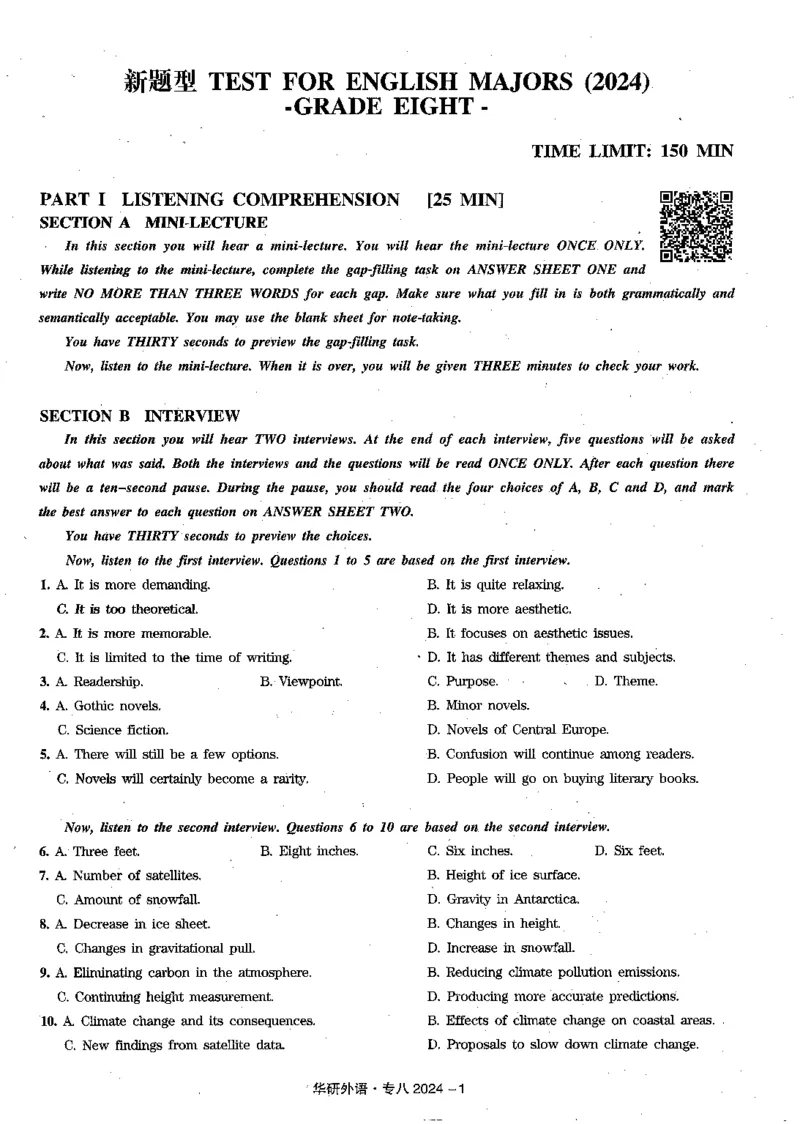
新题型 TEST FOR ENGLISH MAJORS (2009)
-GRADE EIGHT-
TIME LIMIT: 150 MIN
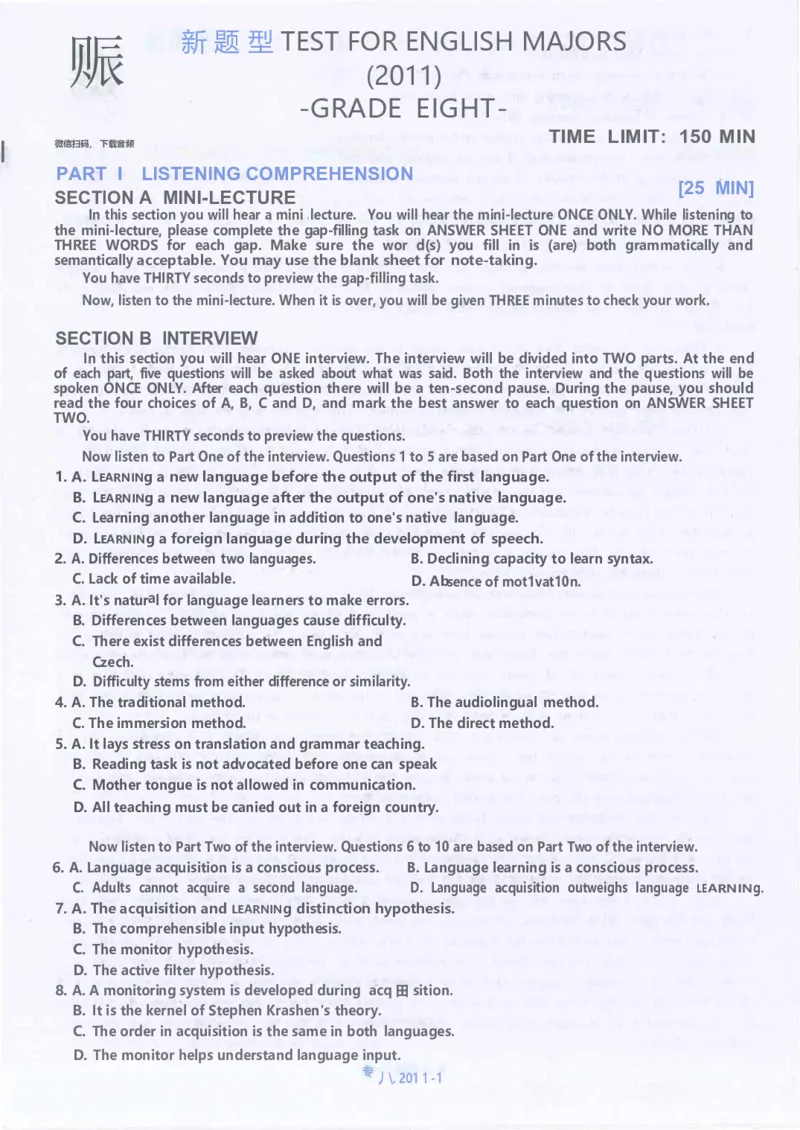
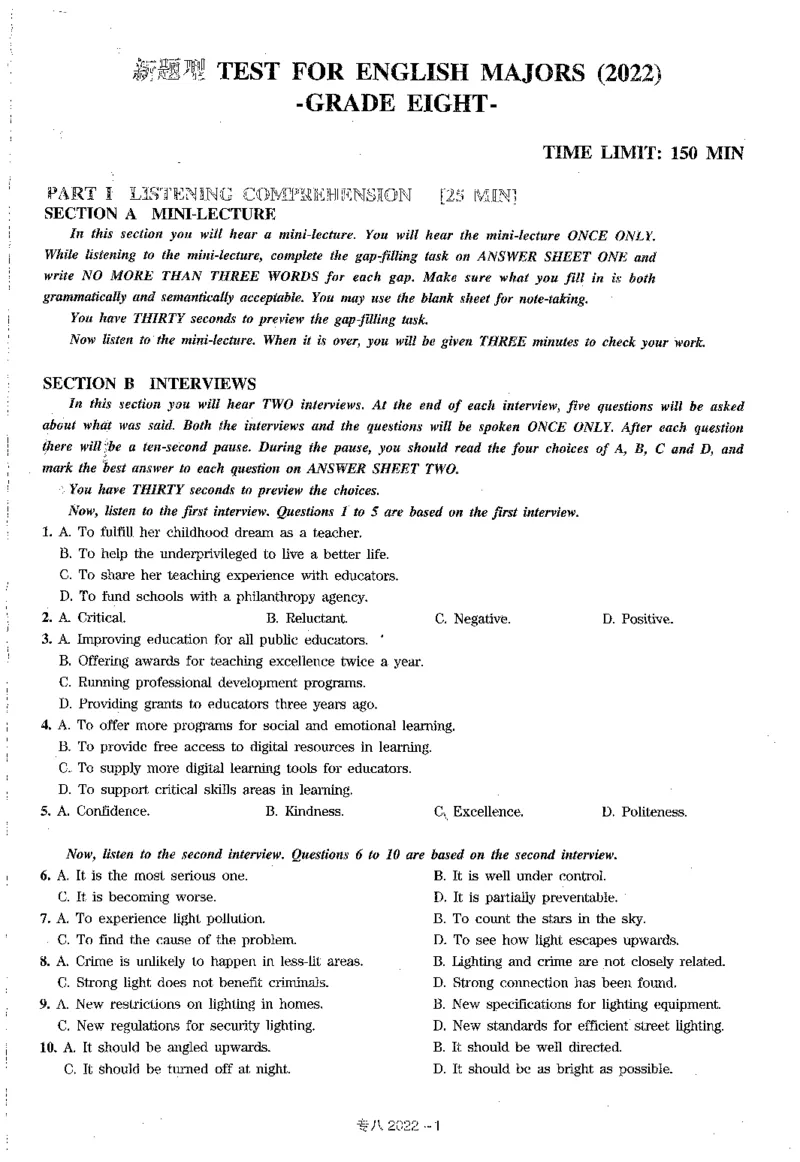
PART I LISTENING COMPREHENSION [25 MIN]
SECTION A MINI-LECTURE
In this section you will hear a mini-lecture. You will hear the minilecture ONCE ONLY. While listening to
皿
the mini-lecture, please complete the gap-filling task on ANSWER SHEET ONE and write NO MORE THAN
THREE WORDS for each gap. Make sure the word(s) you fill in is (are) both grammatically and semantically
acceptable. You may use the blank sheet for note-taking.
You have THIRTY seconds to preview the gap-filling task.
Now, listen to the mini-lecture. When it is over, you will be given THREE minutes to check your work.
SECTION B INTERVIEW
In this section you will hear ONE interview. The interview will be divided into TWO parts. At the end of
each part, five questions will be asked about what was said. Both the interview and the questions will be spoken
ONCE ONLY. After each question there will be a ten-second pause. During the pause, you 'should read the .four
choices of A, B, C and D, and mark the best answer to each question on ANSWER $IIEET TWO.
You have THIRTY seconds to preview the questions.
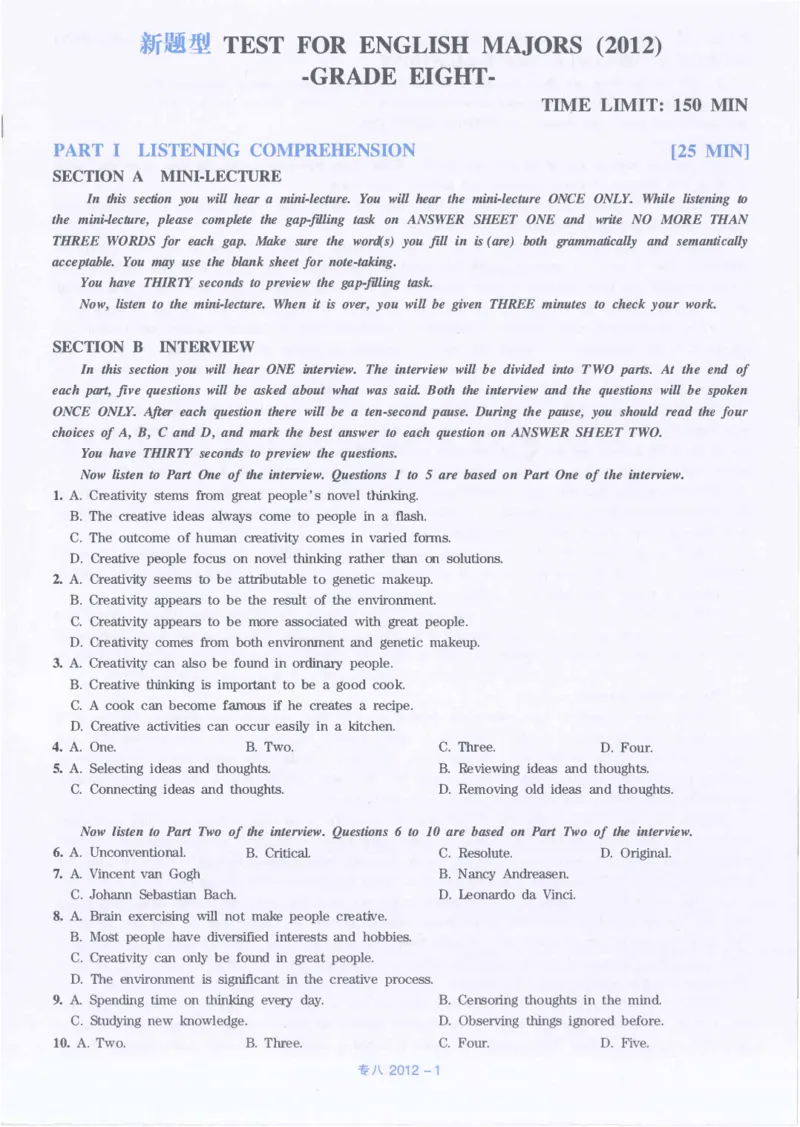
Now listen to Part One of the interview. Questions 1 to 5 are based on Part One of the interview.
1. A. It is a local organization headquartered in California.
B. It was originally set up to train speaking skills.
C. It was founded in 1924 by Ralph Smedley.
D. It is an exclusive club for professional speakers.
2. A. To help people develop effective translating skills.
B. To help with personal growth and commmlication skills.
C. To help people increase their overall self-confidence.
D. To help people getting comfortable around friends.
3. A. Individuals who wish to become professional speakers.
B. Individuals who wish to improve their public speaking.
C. Individuals who want to increase their self-confidence.
D. Individuals who hope to improve their ways of thinking.
4. A. It helps people improve their ability to do presentation.
B. It helps people deliver message in an organized way.
C. It helps people improve their listening skills.
D. It helps people improve their summarizing ability.
5. A. Because they are absent-minded. B. Because they are waiting for their tmn.
C. Because they are organizing their thoughts. D. Because they are not interested in the talking.
Now, listen to Part Two of the interview. Questions 6 to 10 are based on Part Two of the interview.
6. A. Practice plus overall training. B. Practice plus lectures.
C. Practice plus voice training. D. Practice plus speech writing.
7. A. Because the menu helps people organize thoughts.
B. Because the menu contains an objective to develop vocal variety.
C. Because the menu provides a guideline for speech development.
D. Because the menu helps people improve their humor in speeches.
专八2009 -18. A. Serving as toastmaster of the meeting. B. Evaluating others' speeches.
C. Monitoring use of filler words or phrases. D. Polishing speech drafts.
9. A. The introduction to Toastmasters. B. The mission of Toastmasters.
C. The publicity of Toastmasters. D. The programs of Toastmasters.
10. A. The background information. B. The description of training courses.
C. The requirements of public speaking. D. The overall personal growth.
PART II READING COMPREHENSION [45 MIN]
SECTION A MULTIPLE-CHOICE QUESTIONS
....
In this section there are four passages followed by fourteen multiple choice questions. For each multiple
..
choice question, there are four suggested answers marked A, B伽,, C and D. Choose the one that you think is the
best answer and mark your answers on ANSWER SHEET TWO.
PASSAGE ONE
(l)We had been wanting to expand our children's horizons by taking them to a place that was unlike
anything we'd been exposed to during our travels·in Europe and the United States. In thinking about what
was possible from Geneva, where we are based, we decided on a trip to Istanbul, a two-hour plane ride
from Zu血h.
(2) We envisioned the trip as a prelude to more exotic ones, perhaps to New Delhi or Bangkok later
this year, but thought our 11- and 13-year-olds needed a first step away from manicured boulevards and
pristine monuments.
(3) What we didn't foresee was the reaction of friends, who warned that we were putting our children
:
"in danger," referring vaguely, and most incorrectly, to disease, terrorism or just the unknown. To help us
get acquainted with the peculiarities of Istanbul and to give our children a chance to choose wh"a t they
were particularly interested in seeing, we bought an excellent guidebook and read it thoroughly before leaving.
(4) Friendly warnings didn't change our planning, although we might have more prudently checked with
the U.S. State Department's list of troublespots. We didn't see a lot of children among the foreign visi
tors during our six-day stay in Istanbul, but we found the tourist areas quite safe, very interesting and
varied enough even to suit our son, whose oft-repeated request is that we·not see "every single" church
and museum in a given city.
(5)Vaccinations weren't needed for the city, but we were concerned about adapting to the water for a
short stay. So we used bottled water for drinking and brushing our teeth, a precaution that may seem ex
cessive, but we all stayed healthy.
(6)Taking the advice of a friend, we booked a hotel a 20-minute walk from most of Istanbul's major
,
tourist sites. This not only got us some morning exercise, strolling over the Karakoy Bridge, but took us
past a colorful assortment of fishermen, vendors and shoe shiners.
(7)From a teenager and pre-teen's view, Istanbul street life is fascinating since alm、ost everything can
be bought outdoors. They were at a good a:ge to spend time wandering the labyrinth of the Spice Bazaar,
where shops display mounds of, pungent herbs in sacks. Doing this with younger children would be harder
simply because the streets are so packed with people; it would be easy to get lost.
(S)For our two, whose buying experience consisted of department stores and shopping mall boutiques,
_
it was amazing to discover that you could bargain over price and perhaps end up with two of something
for the price of one. They also learned to figure out the relative value of the Turkish lira, not a small
matter with its many zeros.
(9)Being exposed to Islam was an important part of our trip. Visiting the mosques, especially the enor
mous Blue Mosque, was our first glimpse into how this major religion is practiced. Our children's curiosity
already had been piqued by the five daily calls to prayer over loudspeakers in every comer of the·city, and
the scarves covering the heads of many women.
专八2009 -2(lO)Navigating meals can be troublesome with children, but a kebab, bought on the street or in
restaurants, was unfailingly popular. Since we had decided this trip was not for gourmets, kebabs spared us
the agony of trying to find a restaurant each day that would suit the adults' desire to try something new
amid children's insistence that the food be served immediately. Gradually, we branched out to try some
other Turkish specialties.
(11)Although our son had studied Islam briefly, it is impossible to be prepared for every awkward
question that might come up, such as during our visits to the Topkapi Sarayi, the Ottoman Sultans' palace.
No guides were available so it was do-it-yourself, using our guidebook, which cheated us of a lot of
interesting history and anecdotes that a professional guide could provide. Next time, we resolved to make
such arrangements in advance.
(12)0n this trip, we wandered through the magnificent complex, with its imperial treasures, its courtyards
and its harem. The last required a bit of explanation that we would have happily left to a learned third
party.
11. W垃ch of the follo咖g statements is INCORRECT?
A. The family found the city was exactly what they had expected.
B. Their friends were opposed to their holiday plan.
C. They could have been more cautious about bringing kids along.
D. They were a bit cautious about the quality of water in the city.
12. The last two paragraphs suggest that to visit places of interest in Istanbul
A. guidebooks are very useful. B. a professional guide is a must.
C. one has to be prepared for questions. D. one has to make arrangements . in advance.
13. The family have seen or visited all the following in Istanbul EXCEPT
A. religious prayers. B. historical buildings.
C. local-style markets. D. shopping mall boutiques.
PASSAGE TWO
(l)Last month the first baby-boomers turned 60. The bulky generation born between 1946 and 1964 is
heading towards retirement. The looming "demographic cliff" will see vast numbers of skilled workers
dispatched from the labour force.
(2)The workforce is ageing across the rich world. Within the EU the number of workers aged between
50 and 64 will increase by 25% over the next two decades, while those aged 20-29 will decrease by 20%.
In Japan almost 20% of the population is already over 65, the highest share in the world. And in the
United States the number of workers aged 55-64 will have increased by more than half in this decade, at
the same time as the 35- to 44-year-olds decline by 10%.
(3)Given that most societies are geared to retirement at around 65, companies have a looming problem
of knowledge management, of making sure that the boomers do not leave before they have handed over
their expertise along with the office keys and their e-mail address. A survey of human-resources directors
by IBM last year concluded: "When the baby-boomer generation retires, many companies will find out too
late that a career's worth of experience has walked out the door, leaving insufficient talent to fill in the
void."
(4)Some also face a shortage of expertise. In aerospace and defence, for example, as much as 40% of
the workforce· in some companies will be eligible to retire within the next five years. At the same time,
the number of engineering graduates in developed countries is in steep decline.
(5)A few companies are so squeezed that they are already taking exceptional measures. Earlier this
year the Los Angeles Times interviewed an enterprising Australian who was staying in Beverly Hills while
he tried to persuade locals to emigrate to Toowoomba, Queensland, to work for his engineering company
there. Toowoomba today; the rest of the developed world tomorrow?
专八2U09 -J(6)If you look hard enough, you can find companies that·ha俨ve'fbeg血 to adapt the workplace to older
workers. The AARf, an American association for the �ver-50s, produces an annual list of the best
employers of its members. Health-care films invariably come near the top because they are . one of the
industries most in need of skilled labour. Other sectors similarly affected, says the Conference Board,
include oil, gas, energy and government.
(7)N ear the top of the A扭P's latest list comes Deere & Company, a no-nonsense industrial-equipment
manufacturer based in Illinois; about 35% of Deere's 46,000 employees are over 50 and a number of them
are in their 70s. The tools it uses to achieve that - flexible working, telecommuting, and so forth — also
co皿identally help older workers to extend their working lives. The company spends "a lot of tune" on the
ergonomics of its factories, making jobs there less tiring, wluch enables older workers to stay at them for
longer.
(8)1..ikewise, for more than a decade, Toyota, ai·guably the world's most advanced manufacturer, has
adapted its workstations to older workers. The shortage of skilled labour available to the automotive
industry has made it unusually keen to recruit older workers. BMW recently set up a factory in Leipzig that
expressly set out to employ people over the age of 45. Needs must when the devil drives.
(9)0ther firms are polishing their alumni networks. IBM uses its network to recruit retired people for
particular projects.· Ernst & Young, a professional-services firm, has about 30,000 registered alumni, and
about 25% of its "experienced" new recruits are former employees who return after an absence.
(lO)But such examples are unusual. A survey in America last month by Ernst & Young found that
"although corporate America foresees a significant workforce shortage as boomers retire, it is not dealing
with the issue." Almost three-quarters of the 1,400 global companies questioned by Deloitte last year said
they expected a shortage of salaried staff over the next three to five years. Yet few of them are looking to
older workers to fill that shortage; and even fewer are _ looking to them to fill another gap that has already
appeared. Many firms in Europe and America c_omplain that they struggle to find qualified directors for
their boards — this when the pool of retired talent from those very same firms is growing by leaps and
bounds.
(ll)Why are frrms not working harder to keep old employees? Part of the reason is that the cnmch
has been beyond the horizon of most managers. Nor is hanging on to older workers the only way to cope
with a falling supply of labour. The participation of developing countries in the world economy has
increased the overall supply — whatever the local effect of demographics in the rich countries. A vast
amount of work is beh1g sent offshore to such places as China and India and more will go in future. Some
countries, such as Australia, are relaxing their immigration policies to allow much needed skills to come in
.
from abroad. Others w出 avoid the need for workers·by·spending money on machinery and automation.
14. The following are all the measures that companies have adopted to cope with the ageing workforce
EXCEPT
A making places of work accommodate the needs of older workers.
B. using alumni networks to hire retired former employees.
C. encouraging former employees to work overseas.
D. granting more convenience in working hours to older workers.
15. "The company spends 'a lot of time' on the ergonomics of its factories" (Paragraph Seven) means that
A the company attaches great importance to the layout of its factories.
B. the company improves the working conditions in its factories.
C. the company attempts to reduce production costs of its factories.
D. the company intends to renovate its factories and update equipment.一
16. W垃ch of the following best describes the author's development of argument?
A. introducing the issue citing ways to deal with the issue -+describing the actual status -+offering
reasons.
B. describing the actual status—introducing the issue一citing ways to deal with the issue -+offering
reasons.
C. citing ways to deal with the issue -+introducing the issue -+describing the actual status -+offering
reasons.
D. describing the actual status一offering reasons一introducing the issue一citing ways to deal with the
issue.
PASSAGE THREE
(l)The other problem that arises from the employment of women is that of the working wife. It has
two aspects: that of the w廿e who is more of a success than her husband and that of the wife who must
rely heavily on her husband for help with domestic tasks. There are various ways in which the impact of
the first difficulty can be reduced. Provided that husband and w廿e are not in the same or directly
comparable lines of work, the harsh fact of her greater success can be obscured by a genial conspiracy to
reject a purely monetary measure of achievement as intolerably crude. Where there are ranks, it is best if
the couple work in different fields so that the husband can find some special reason for the superiority of
the lowest figure in his to the most elevated in his wife's.
(2)A problem that affects a much larger number of working wives is the need to re-allocate domestic
tasks if there are children. In The Road to Wigan Pier George Oiwell wrote of the unemployed of the
Lancashire coalfields: "Practically never... in a working-class home, will you see the man doing a stroke of
the housework. Unemployment has not changed this convention, which on the face of it seems a little
unfair. The man is idle from morning to night but the woman is as busy as eyer - more so, indeed,
because she has to manage with less money. Yet so far as my experience goes the women do not protest.
They feel that a man would lose his manhood if, merely because he was out of work, he developed in a
'Mary Ann'."
(3)It is over the care of young children that this re-allocation of duties becomes really significant. For
this, unlike the cooking of fish fingers or the making of beds, is an inescapably time-consuming occupation,
and time·is what the fully employed wife has no more to spare of than her husband.
(4)The male initiative in courtship is a pretty indiscriminate affair, something that is tried on with any
remotely plausible woman who comes ·within range and, of course, with all degrees of tentativeness. What
decides the issue of whether a genuine courtship is going to get under way is the woman's response. If
she shows interest the engines of persuasion are set in movement. The truth is that in courtship society
gives women the real power while pretending to give it to men.
(5)W hat does seem clear is that the more men and women are together, at work and away
from it, the more the comprehensive amorousness of men towards women will have to go, despite all its
past evolutionary services. For it is this that makes inferiority at work abrasive and, more indirectly, makes
domestic work seem unmanly. If there is to be an equalizing redistribution of economic and domestic
tasks between men and women there must be a compensating redistribution of the erotic initiative. If
women will no longer let us beat them they must allow us to join them as the blushing recipients of flowers
and chocolates.
17. Paragraph One advises the working wife who is more successful than her husband to
A. work in the same sort of job as her husband.
B. play down her success, making it sound unimportant.
C. stress how much the family gains from her high salary.
D. introduce more labour-saving machinery into the home.
专
专八2009 -518. Orwell's picture of relations· between man and w廿e in Wigan Pier (Paragraph Two) describes a
relationship which the author of the·passage
A thinks is the natural one. B. wishes to see preserved.
C. believes is fair. D. is sure must change.
19. Which of the following words is used literally, NOT metaphorically?
A Abrasive (Paragraph Five). · B. Engines (Paragraph Four).
C. Convention (Paragraph Two). D. Heavily (Paragraph One).
20. W匝h of the following s也tements is INCORRECT about the pres�nt form of courtship?
A. Men are equally serious about courtship.
B. Each man "makes passes" at many women.
C. The woman's reaction decides the fate of courtship.
D. The man leaves himself the opportunity to give up the chase quickly.
PASSAGE FOUR
(l)From Namche Bazaar, the Sherpa capital at 12,000 feet, the long �e threaded south, dropping 2,000
feet to the valley floor, then trudged down the huge Sola-Khumbu canyon 皿til it opened out to the lush
but still da皿ting foothills of Central Nepal.
(2)1t was here at Namche that one man broke rank and leaned north, slowly and arduously climbing
the steep walls of the natural amphitheater behind the scatter of stone huts, then past K皿de and Khumjong.
(3)Despite wearing a balaclava on his head, he had been frequently recognized by the Tibetans, and
treated with the gravest deference and . respect. . Even among those who knew nothing about him,
expressions of s叩rise lit up their dark, liquid eyes. He was a man not expected to be there.
(4)Not only was his stature substantially greater than that of the diminutive Tibetans,·but it was also
obvious from his bearing - and his new broadcloak, ·which covered a much-too-tight army rmiforin 一 that
he came from a markedly loftier station in life than did I the average Tibetan. Among a people virtually
bereft of possessions, he had fewer still, consisting solely of a ro皿ded brmdle about a foot in . diameter
slung securely by a cord over his shoulder. The material the b皿die was wrapped in was of ·a· rough
Tibetan weave, which did not augur that the· content was of any · greater value --:-- except for the
importance he seemed to ascribe to it, never for a moment releasing his grip.
(5)His objective was a tiny huddle of buildings perched halfway up an enormous valley wall across
from him, atop a great wooded spur jutting out from the lower lap of the ?2,493-foot Arna Dablum, one of
the most majestic mo血tains -on earth. There w邸 situated Tengboche, the most famous Buddhist monastery
in the H皿alayas, its setting unsmpassed for magnificence -anywhere on the planet.
(6)From the top of the spur, one's eyes sweep 12 血les up the stupendous Dudh. Kosi canyon to the
six-mile-long granite wall of cliff of Nuptse at its head. If Arna Dablum is the Gatekeeper, then the sheer
·
cliff of Nuptse, never less than four miles high, is·the Final Protector . of the highest and mightiest of them
all: Chomolongma, the Mother Goddess of the World, to the Tibetans; Sagarmatha, the Head of the Seas, to
the Nepalese; and Everest to the rest of us. And over the great barrier of Nuptse She demurely peaks.
(7)1t was late in the afternoon — when the great shadows cast by the colossal mormtains were de:
scending into the deep valley floors — before he reached the crest of the spur and shuffled to a stop just
p邱 Tengboche's entrance gornpa. His chest heaving in the rarefied air, he removed his hand from the
bundle - the first time he had done so - and wiped grimy rivulets of sweat from around his eyes with
the fmgers of his rnitted hand.
(8)His narrowed eye� took in the open sweep of. the quiet gro皿ds, the . p�goda-like monastery itself,
and the stone buildings that tumbled down around it like a protective skirt. Ju the. distance the magic light
of the magic hour lit up the plume flying off Chomolongma's 29,029-foot-high crest like a bright, welcoming
banner.
专八2009-6(9)His breathing calmed, he slowly, stiffly struggled forward and up the rough stone steps to the
monastery entrance. There he was greeted with a respectful nameste - "I recognize the divine in you" 一
from a tall, slim monk of about 35 years, who hastily set aside a twig broom he had been using to sweep
the flagstones of the inner courtyard. While he did so, the visitor noticed that the monk was missing the
small finger on his left hand. The stranger spoke a few formal words in Tibetan, and then the two
disappeared inside.
(lO)Early the next morning the emissary — lightened of his load - appeared at the monastery en
trance, accompanied by the same monk and the elderly abbot. A代er a bow of his head, which was re
turned much more deeply by the two ocher-robed residents, he took his leave. The two solemn monks
watched, motionless, until he dipped over the ridge on which the monastery sat, and out of sight.
(ll)Then, without a word, they turned and went back inside the monastery.
21. W垃ch of the follow四 words in Paragraph One implies diffi叫ty in walking?
A. "threaded". B. "dropping". C. "trudged". D. "daunting".
22. In the passage the contrast between the Tibetans and the man is indicated in all the following aspects
EXCEPT
A. clothing. B. height. C. social status. D. personal belongings.
23. W垃ch of the following details shows that the man became relaxed after he reached the monastery?
A. "… he reached the crest of the spur and shuffled to a stop…”
B. "… he removed his hand from the bundle ... "
C. "His narrowed eyes took in the open sweep of the quiet grounds, …“
D. "… he slowly, stiffly struggled forward and up the rough stone steps…”
24. From how it is described in the passage the monastery seems to evoke
A. a sense of awe. B. a sense of piety. C. a sense of fear. D. a sense of mystery.
SECTION B SHORT ANSWER QUESTIONS
`
In this section there are eight short answer questions based on the passages in SECTION A. Answer each
question in NO more than 10 words in the space provided on ANSWER SHEET TWO.
f ^)
ASSf f'寸 --,NE
25. What is the main reason of the couple's choosing Istanbul as their holiday destination?
26. What can we le印1 about the couple's habits of shopping from their shopping experience back home?
5
. o
AS�AGE T'V
27. According to the passage, what is the most serious consequence of baby-boomers approaching
retirement?
28. Why do Health-care firms invariably come to ne扛 the top of The A扭P's list?
29. In the author's opinion,·why are American firms not doing anything to deal with the issue of the ageing
workforce?
PA Sf,f f'Ii'. "'PPr:;,F
30. What problem affects many more working wives, according to the passage?
31. According to the last paragraph, what must women do if they are to hold important jobs?
l'ASS Ar'.
石
, •F 八TJR
32. According to the passage, what view can one get of the region from the monastecy?
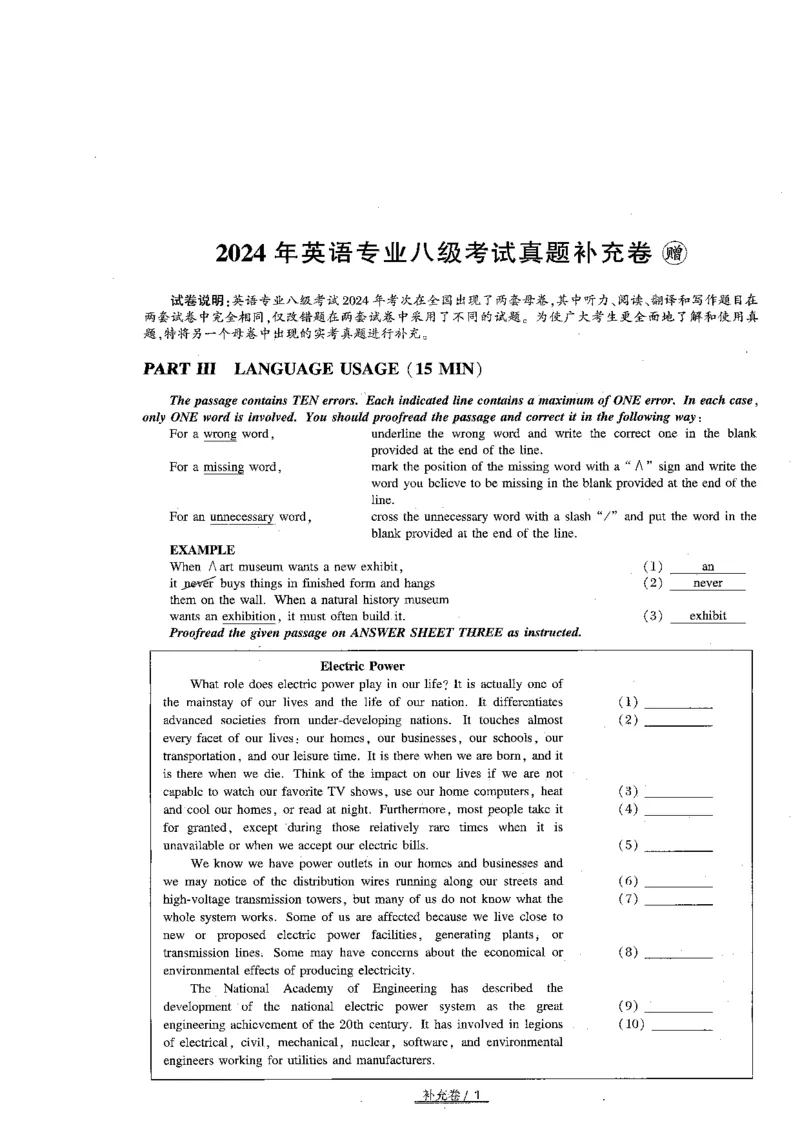
专丿\.2009 -7PART III LANGUAGE USAGE [15 MIN]
The passage contains TEN errors. Each indicated line contains a maximum of ONE error. In each ·case,
only ONE word is involved. You should proof-read the passage and correct it in the following way:
For a 亚亟 word, underline the wrong word and write the correct one in the blank
provided at the end of the line.
For a missing word, mark the position of the missing word with a " /\ " sign and write the
word you believe to be missing in the blank provided at the end of the
line.
For an unnecessary word, cross the unnecessary word with a slash "/" and put the word in the
blank provided at the end of the line.
Example
When /\ art' museum wants a new exhibit, (1) an
it 郎面 buys things in fi血shed form . and·hangs (2) never
them on the wall. When a natural history museum
wants an exhibition, it must often build it. (3) exhibit
Proofread the given passage on ANSWER SHEET THREE as instructed.
PART IV TRANSLATION [20 MIN]
Translate the underlined part of the following text from Chinese into English. Write your translation on
ANSWER SHEET THREE.
我想不起来哪一个熟人没有手机。今天没有手机的人是奇怪的,这种人才需要解释。我们的所有社会关系都储存在
手机的电话本里,可以随时调出使用。 古代只有巫师才能拥有这种法宝。
手机刷新了人与人的关系。会议室门口通常贴着一条通告:请与会者关闭手机。可是会议室里的手机铃声仍然响成
一片。 我们都是普通人 并没有多少重要的事情。 尽管如此 我们也不会轻易关掉手机。 打开手机象征我们与这个世界
的联系 手机反映出我们的“社交饥渴症”。 最为常见的是 一个人走着走着突然停下来 眼睛盯着手机屏幕发短信。 他
不在乎停在马路中央还是厕所旁边。
为什么对于手机来电和短信这么在乎? 因为我们迫切渴望与社会保持联系。
PART V WRITING [45 MIN]
Should museums charge for admission? Museums are expensive to run, with the costs of acquisitions,
conservation, maintenance,· staff salaries and special exhibitions all weighing heavily upon their budgets. But
others think as a non-profit·organization, museum should not charge for admissions since it can get government
support. The following is an article about this issue. Read it carefully and write an article of NO LESS THAN
300 words, in which you should:
1. summarize briefly the author's opinion on the issue;
2. give your comment.
Marks will be awarded for content relevance, content sufficiency, organization and language quality. Failure
to follow the above instructions may result in a loss. of marks.
Write your article on ANSWER SHEET FOUR.
Britain's museums are in crisis. On ·the s咡ace, things look good. Our galleries have benefited from
years of expansion. 13ut ·all. over Britain, a darker reality is emerging in the wake of spending cuts. A
swvey has shown that since the spending review 58% of museums have suffered cuts, and a frfth have
been hit by devastating cuts of 25%.
专八 2009 -8On that measure, yes, 42% have not yet suffered cuts - but surely it's a policy of divide and rule,
with councils, not central g�vernment, making the big decisions, and less fashionable venues taking the
biggest hits (at least as far as I can see). But an overall climate of contraction w让1 surely hit all museums
and all aspects of what they do. And there is little chance of this improving in the near future.
The worst· option is for museums and public collections to start selling works to pay the bills. The
recent sale of a Millais by one cash-strapped council is . a terrible mistake, a betrayal of our cultural
heritage.
The best option, I am starting to think, may be to introduce admission fees. I spat out this notion
earlier this week in the wake of the attack on two paintings recently in the National Gallery. The debate
was taken up by the Telegraph. Obviously, attacks on art happen at museums that charge an entry fee as
well as at free ones. But this is about much more than security.
I remember the drab, uncared-for feeling of some of Britain's biggest museums in the 1980s and 90s.
They seemed to be struggling now, with no big plans and no sense of splendor. Free museums with a
supportive government are very different from free museums in a climate of austerity. Going to the Louvre
or to American museums 20 years ago was like entering a different universe of cultural pride and
enjoyment — these museums really wanted to thrill, and they did justice to their collections.
So do ours - right now. Britons have realized how precious our great collections are. The world
shares the passion, and if you visit the British Museum this smnmer the sheer crowd numbers startle. How
about turning that popularity into money? We can't let recent progress in our galleries and museums be
destroyed by a cost-cutting mentality that first freezes, then rolls back, everything that has been achieved.
Charging for entry cannot be a taboo. I probably make more use of free entry than most people; there
are obviously ways to make entrance fees egalitarian. Free entry for everyone under 20 and all students,
membership schemes for the rest of us, something like the new National Art Pass for those who want to
purchase annual overall access.
I think free museums are a great British tradition, but I don't want these museums to decay. Charging
for entry is a better remedy than selling paintings, closing galleries or sacking staff. Might it even give
visitors a keener sense of the value of some of the greatest experiences it is possible to have?
-THE END-
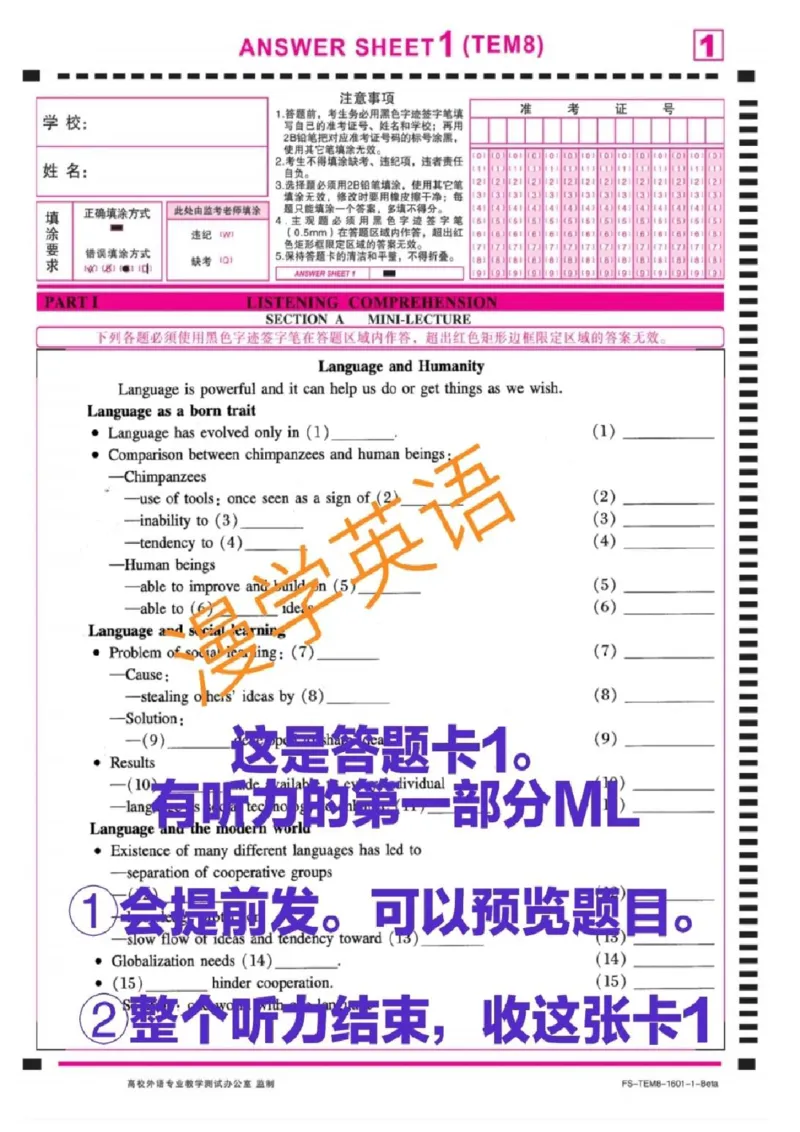
专八2009-9ANSWER SHEET 1 (TEM8) [I]
.眉
瞿
瘛霓 圃露 圈· - - 一 一 一 - - - - - - - 一 一- - - - - - - - 一 一 一 一 - - - - 一 一 -
注意事项 _
1.答 题前, 考生务必用黑色字迹签字笔填 准 考 证 号
学 校: 写自己的准考证号、 姓名和学校; 再用
2B铅笔把对应准考证号码的标号涂黑, _
使用其它笔填涂无效。
2考生不得填涂缺考、 违纪项, 违者责任 IOl ro 1 !OJ [01 COJ [01 l 01 [01 l 01 f Ol (01 [Ql [ 0 J 10』
姓 名: 自负。 11 I L'1 I l 1 J I 1 l l 1 l [1 J L 1 J [ 1 J I 1 I 11 i 111 [ 1 J 11 l 11 I _
3选择题必须用28铅笔填涂, 使用其它笔 l21 121 l 2 l (2l l21 [21 I 21 [21 r 21 [21 [21 (2J [21 121
填涂无效, 修改时要用橡皮擦干净; 每 [3] 「31 r 31 (31 r 31 £3 I l 31 13] [ 31 !31 (3] (31 [3 J [3 l
填 正确填涂方式 尸 此处由监考 勹 老师填涂 4 题 .主 只能 观 填 题 涂 必 一个 须 答· 用 案 黑 , 色 多填 字 不 迹 得 签 分。 字笔 ( 1 4 5 1 I 1 I 4 5 l 1 [ ( 4 5 1 1 [ [4 51 ) l 1 4 5 l 1 [ [5 4 ) 1 I I 4 51 1 [ 15 41 1 l 1 4 5 1 1 £ !S 4] J r ( 5 4 1 1 [ [ 4 5 1 l [ [ 5 4 1 l 1 14 5 1 1 _
涂 慢 违纪 CWl (0.5mm)在答题区域内作答, 超出红 161 r 61 l 61 16] 161 {61 I 61 l 61 [6l (61 161 [61 [6) !'61
要 求 [ 错 始 误 氓 填 1 涂 r• 方 1 c 式 cl1 缺考 IQJ I 5 保 色 A 矩 持 NS 形 答 W 框 E 题 R 限 S 卡 H 定 EE 的 T 区 清 1 域 洁 的 I 和 答 平 - 案 整 无 , 效 不 。 得折叠。 I 1 [ l 7 9 8 ] l 1 l l ! 8 7 9 ) 1 1 I l 1 9 7 8 1 l I ( ( ( 7 8 9 1 ) ) r 1 [ 7 8 9 1 1 1 [ [ [ 8 7 9 1 1 1 r C t 8 7 9 1 1 1 r l I a 7 9 J 1 I [ [ 1 7 9 8 l 1 1 { [ [8 9 7] ] 1 1 I 1 9 7 8 1 1 1 [ l ( 9 8 71 ] l [ l [ 9 7 8 1 1 1 [ ( l 8 9 7l 1 1 _
二一
PART I 一.LIST一ENING 一COMPR一EHENSION _
l
SECTION A MINI-LECTURE
匕 下列各题必须使用黑色字迹签字笔在答题区域内作答, 超出红色矩形边框限定区域的答案无效。 1_
Writing Experimental Reports
_
I. Content of an experimental report, e.g.
- study subject/area _
—
study purpose (1) (1)
II. Presentation of an experimental report _
—
(2) (2)
—
regarding readers as (3) (3) _
III. Structure of an experimental report
- feature: highly structured and (4) (4) _
—
sections and their content:
INTRODUCTION (5) ; why you did it (5) _
METHOD how you did it
RESULTS what you found out _
(6) what you think it shows (6)
IV. Sense of readership _
- (7) : reader is the marker (7)
- (8) : reader is an idealized, hypothetical, intelligent person (8) _
with little knowledge of your study
_
— tasks to fulfill in an experimental report:
- introduction to relevant area
_
- (9) (9)
- development of clear arguments
_
- definition of (10) (10)
.
- precise description of data (11) (11)
_
V. (12) 1n report writing (12)
—
early stage:
_
- understanding of study subject/area and its (13) (13)
- basic grasp of the report's format
_
- later stage:
(14) on research significance (14)
. _
- things to avoid in w戊ing INTRODUCTION:
- inadequate material
_
- (15) of research justification for the study (15)
L_.
_
高校外语专业教学测试办公室 监制 FS-TEMS-1601-仁Beta
专八 2009 -10 _
_
_
_
_
_
_
_
_
_
_
_
_
_
_
_
_
_
_
_
_
_
_
_
_
_
_
_
_
_
_
_
_
_
_
_
_
_
_
_
_
_
_
_
_
丘- - - - - - - - - - - - - - - - - - - - - - - - - - - - - - - - - - -团-
ANSWER SHEET3 (TEM8)
圈.
圈 r=
l
注意事项
准 考 证 号
学 校: 比如、飞怎飞 全
,,.;,,,I
I 』
2B铅笔把对应准考证号码的标号涂黑,
姓 名: r 使用其它笔填涂无效。 II : Ol : 1 : 0 :: 1 : 1. : r.1 .' i! : O ., I l " O J . 1 . 0 . ., ,,
2考
皿
生不得填
雷
涂缺考、 芯违纪项, 违分者?贵, 任每
1 I l 1 l l';1 11 I l 1 l I 1
填 涂 - 一 Y — 1 ·3 选 自 ·, 心 负 择 。 题必须 芦 用2B铅 品 笔填涂 甘 , 使用 ,签晶 其它 : 笔 ' .: •• : : , : , : , ::;i::: ::: ::.,, i
要 L 正确填涂方式 此处由监考老a师 填令
I 求 1 立X'l ,.1 1 I l 违纪 ' " 色矩形框限定区域的答案无效。 勹 71 Ill l"/汁17) ("/<(/ , ' '
错误填涂方式 缺考 J 1 5保持答题卡的清洁和平整, 不得折叠。 10• Ill 101 11111101 ra110
PART III -广~~-L• ANG- UA- G- E U--S: -A- GE- 19- 1!-11 191 (j,J 191 (f/11 - -
勹
(
下列各题必须使用黑色字迹签字笔在答题区域内作答, 超出红色矩形边框限
.
定
•喊 --
区-域的答宽无效 7
.
.
L
、
The previous section has shown how quickly a rhyme passes
..
from one schoolchild to the next and illustrates the further difference (1) “
between school lore and nursery lore. In nursery lore a verse, learnt
in early childhood, is not usually passed on again wh�n the little listener
(2)
has grown up, and has children of their own, or even grandchildren.
(3)
a
The period between learning nursery rhyme and transmitting
,
it may be something from twenty to seventy years. With the playground
(4)
lore, therefore, a rhyme may be excitedly passed on within the very hour
(5)
it is learnt; and, in the general, it passes between children of the
(6)
same age, or nearly so, since it is uncommon for the difference in age
between playmates to be more than five years. 江 therefore, a playground
『
rhyme can be shown to have been currently for a hundred years, or
(7) «
even just for fifty, it follows that it has been retransmitted over '
and over; very possibly it has passed along a chain of two or three
(8)
hundred young hearers and tellers, and the wonder is that it remains live
(9)
after so much handling, to let alone that it bears resemblance to the
(10)
original wording.
, ..
V�
.
.
.
—」
·
圈L
高校外语专业教学测试办公室 监制 FS-TEMB-160仁3-Beta
专八2009 -11