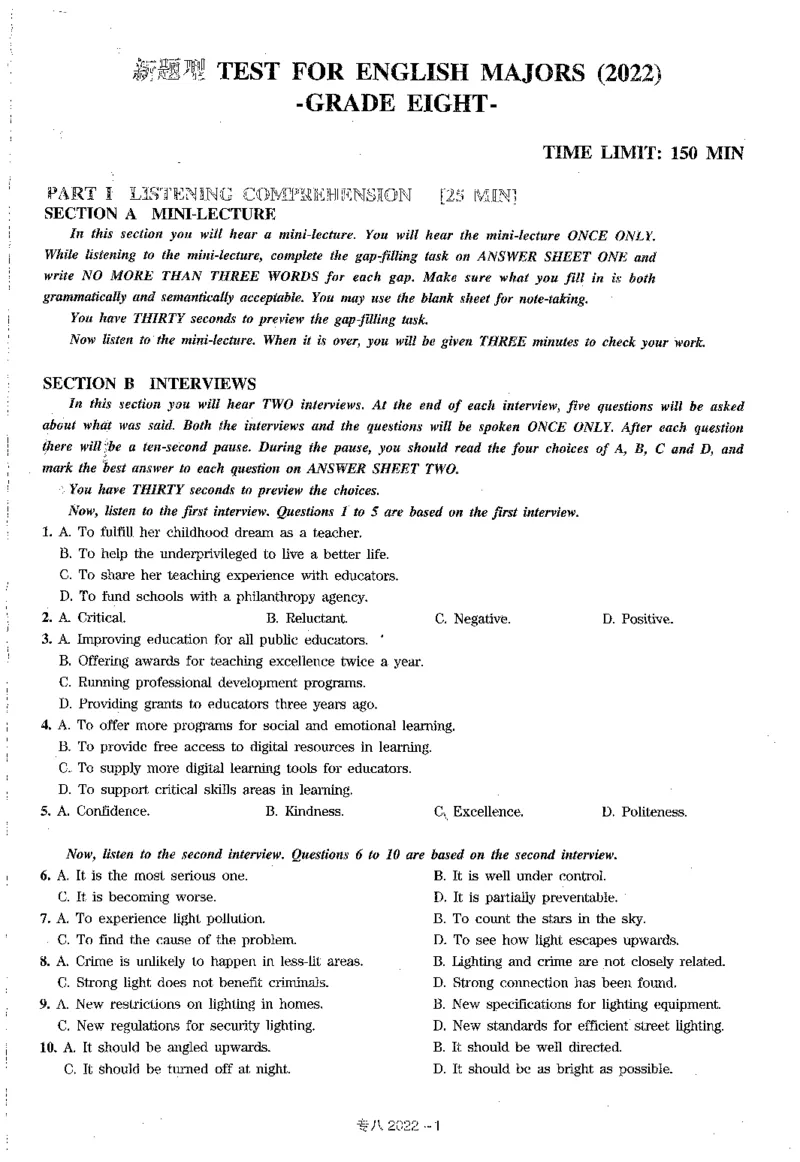
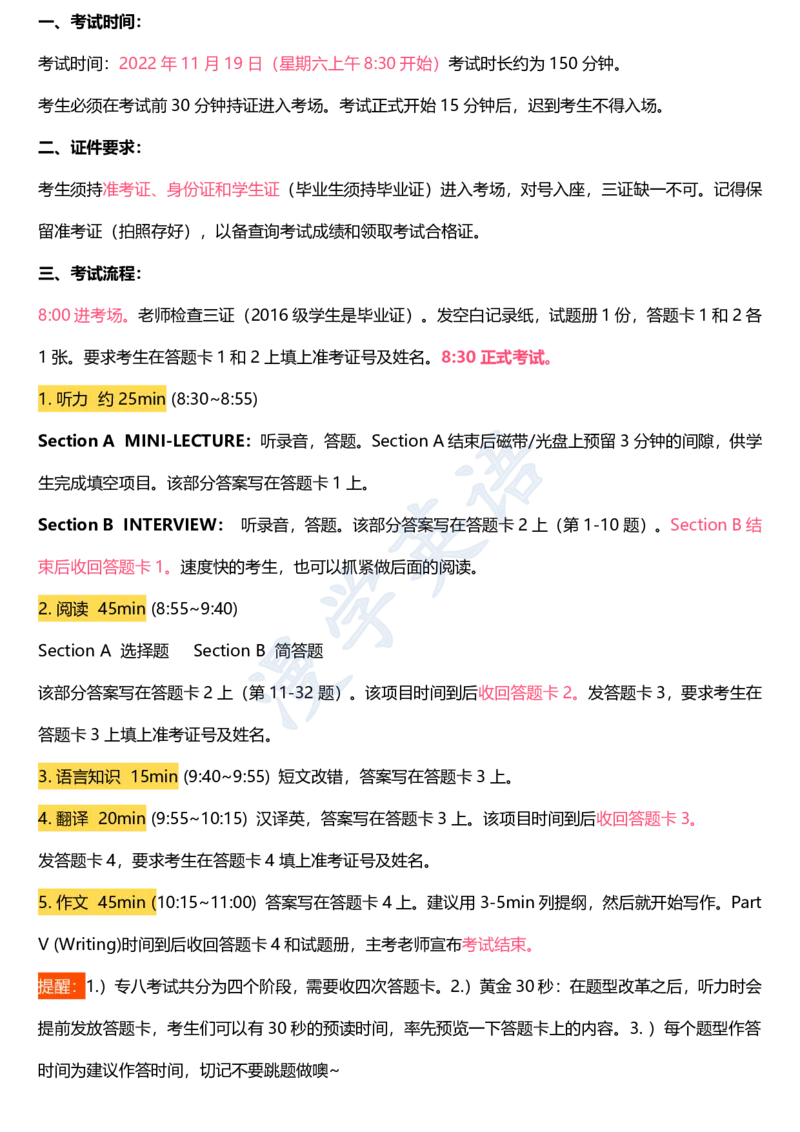
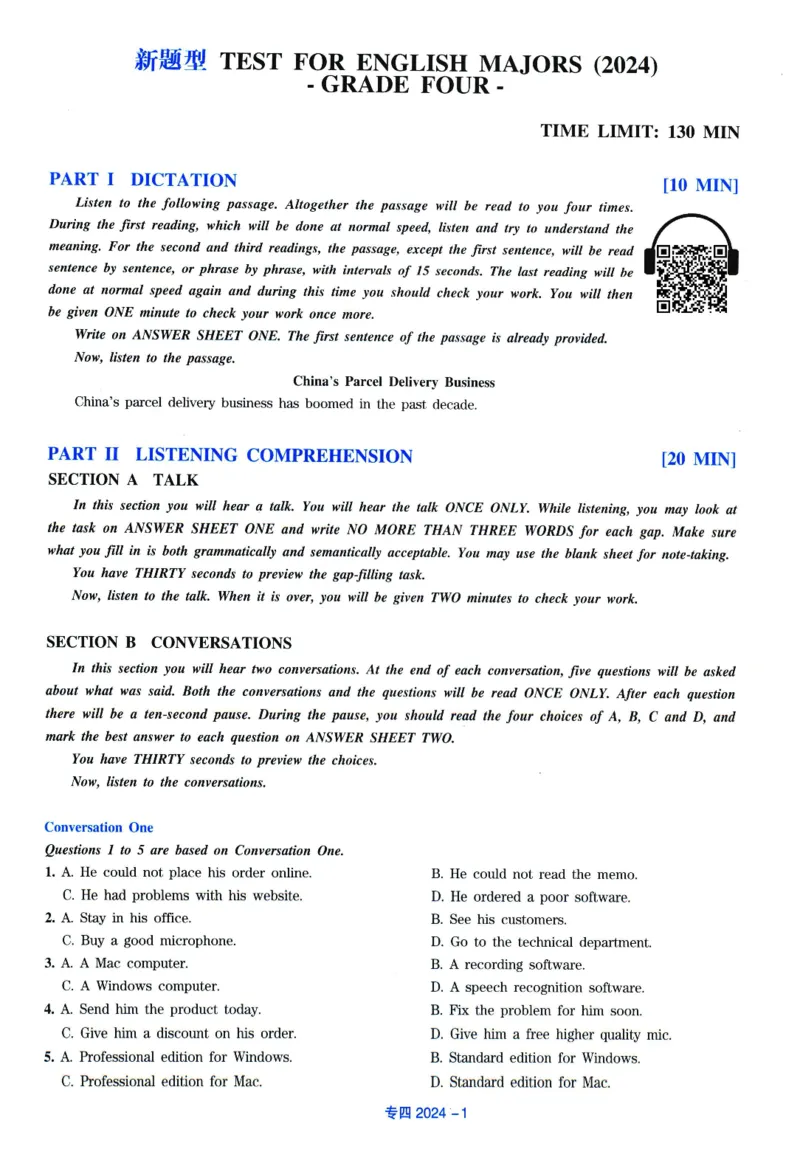
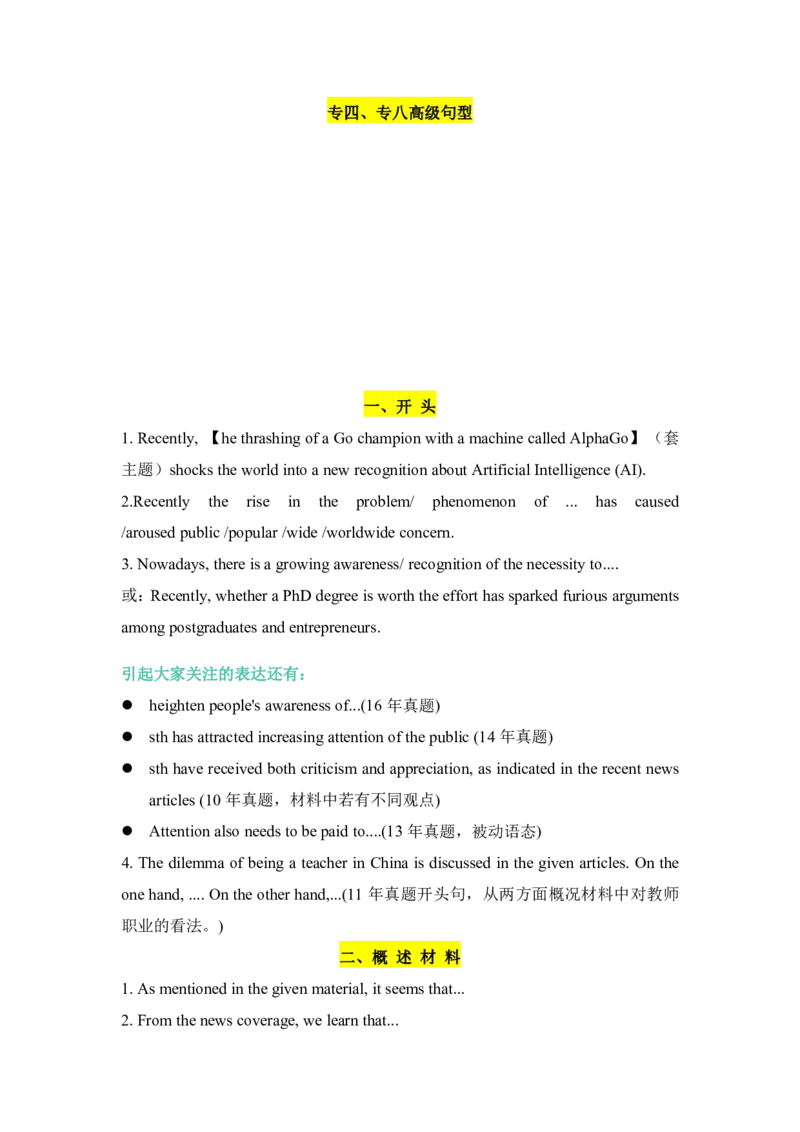
新题型 TEST FOR ENGLISH MAJORS (2010)
-GRADE EIGHT-
TIME LIMIT: 150 MIN
PART I LISTENING COMPREHENSION [25 MIN]
i
SECTION A MINI-LECTURE
In this section you will hear a mini lecture. You will hear the mini-lecture ONCE ONLY. While listening to
咖
the mini-lecture, please complete the gap-filling task on ANSWER SHEET ONE and write NO MORE THAN
THREE WORDS for each gap. Make sure the word(s) you fill in is (are) both grammatically and semantically
acceptable. You may use the blank sheet for note-taking.
You have THIRTY seconds to preview the gap-filling task.
Now, listen to the mini-lecture. When it is over, you will be given THREE minutes to check your work.
SECTION B INTERVIEW
In this section you will hear ONE interview. The interview will be divided into TWO parts. At the end of
each part, five questions will be asked about what was said. Both the interview and the questions will be spoken
ONCE ONLY. After each question there will be a ten-second pause. During the pause, you should read the four
choices of A, B, C and D, and mark the best answer to each question on ANSWER SHEET TWO.
You have THIRTY seconds to preview the questions.
Now listen to Part One of the interview. Questions 1 to 5 are based on Part One of the interview.
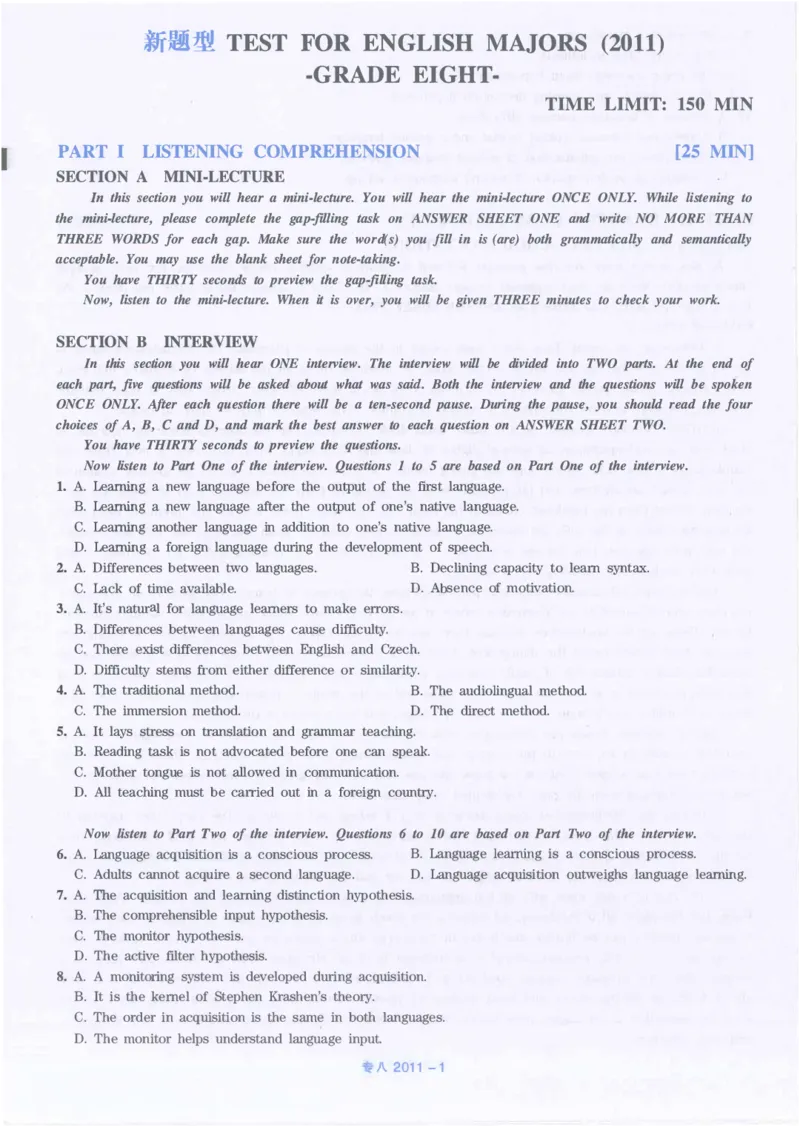
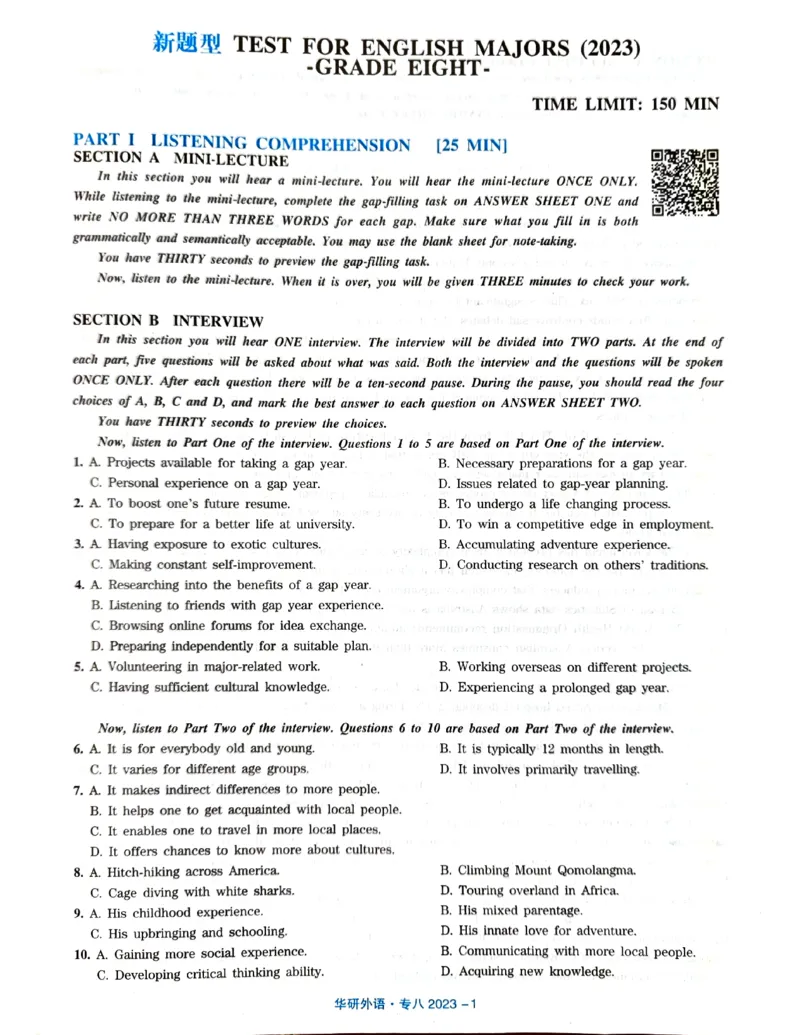
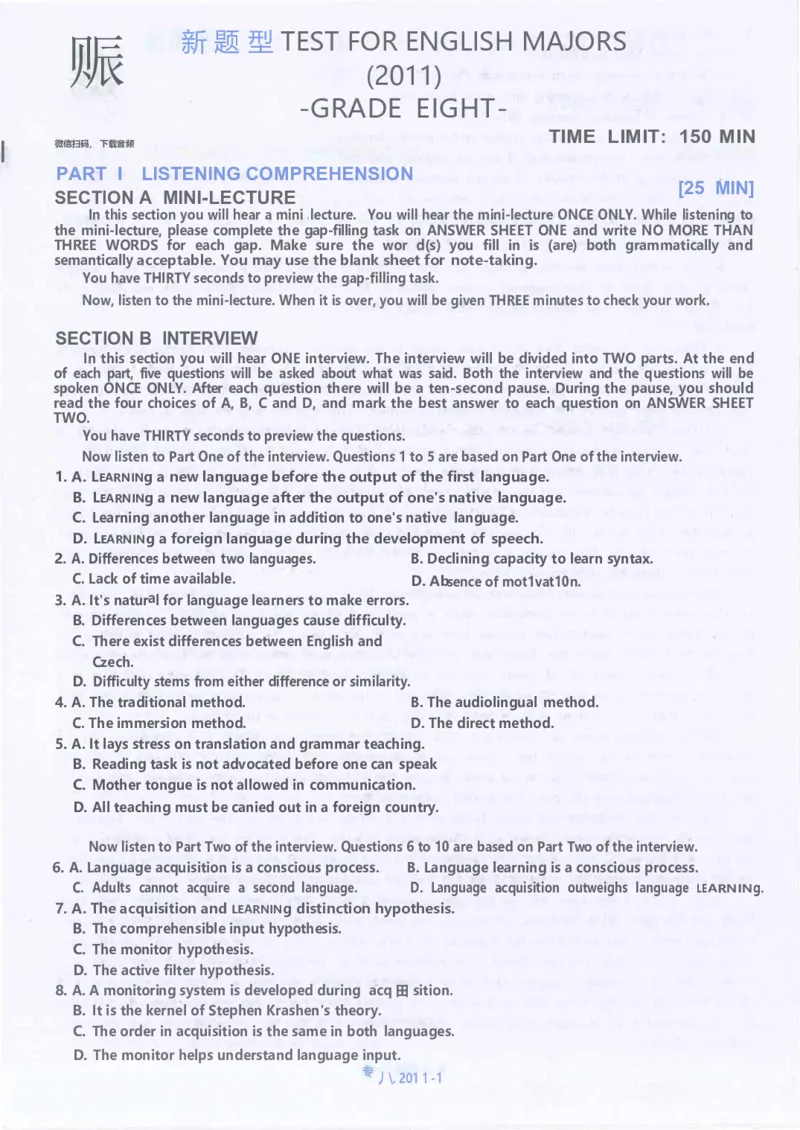
1. A. Because the idea of being different no longer exists.
B. Because the idea of being different has changed.
C. Because this word appears frequently in the media.
D. Because this word has little meaning nowadays.
2. A. It means merging of different cultural identities.
B. It means more emphasis on homogeneity.
C. It means embracing of more ethnic differences.
D. It means acceptance of more branches of Christianity.
3. A. Some places are more diverse than others. B. Towns are less diverse than large cities.
C. Diversity can be seen everywhere. D. America is a truly diverse country.
4. A. Maine. B Selinsgrove. C. Philadelphia. D California.
5. A. Both will remain unchanged in their population size.
B. Both have constant racial composition.
C. Both have been reported for their homogeneity.
D. They have the same racial composition.
Now listen to Part Two of the interview. Questions 6 to 10 are based on Part Two of the interview.
6. A. Greater racial diversity exists among younger populations.
B. Both older and younger populations are racially diverse.
C. Age diversity could lead to pension problems.
D. Older populations are more racially diverse.
7. A. Caucasians w山 get higher pensions than other ethnic groups.
B. Older populations w出 get increasingly wealthier.
C. A lot of younger workers will be out of work
D. Younger populations are going to be overtaxed.
8. A. It was most evident between 1990 and 2000. B. It exists among Muslim immigrants.
C. It is restricted to certain places in the US. D. It is spreading to more parts of the country.
9. A. New York B. Los Angeles. C. Chicago. . D. Philadelphia.
10. A. About 600. B. 1 million. C. Over 300. D. No more than 200.
专八2010-1PART II READING COMPREHENSION [45 MIN]
SECTION A MULTIPLE-CHOICE QUESTIONS
In this section there are four passages followed by fourteen multiple choice questions. For each multiple
choice question, there are four suggested answers marked A, B, C and D. Choose the one that you think is the
best answer and mark your answers on ANSWER SHEET TWO.
PASSAGE ONE
(1)Among the great cities of the world, Kolkata (formerly spelt as Calcu邸), the capital of India's West
Bengal, and the home of nearly 15 million people, is often mentioned as the only one that still has a large
fleet of hand-pulled rickshaws.
(2)Rickshaws are not there to haul around tourists. It's the people in the lanes who most regularly use
.
rickshaws — not the poor but people who are just a notch above the poor. They are people who tend to
travel short distances, through lanes that are sometimes inaccessible to even the most daring taxi driver.
·
An older woman with marketing to do, for instance, can arrive in a rickshaw, have the rickshaw puller
wait until she comes back from various stalls to load her purchases, and then be taken home. People in
the lanes use rickshaws as a 24-hour ambulance service. Proprietors of cafes or corner stores send rick
shaws to collect their supplies. The rickshaw pullers told me their steadiest customers are school children.
Middle-class families contract with a puller to take a child to school and pick him up; the puller essentially
becomes a family retainer.
(3)From June to September Kolkata can get torrential rains. During my stay it once rained for about 48
hours. Entire neighborhoods couldn't be reached by motorized vehicles, and the newspapers showed pic
tures of rickshaws being pulled through water that was up to . the pullers' waists. When it's raining, the
normal customer base for rickshaw pullers expands greatly, as does. the price of a journey. A writer in
Kolkata told me, "When it rains, even the governor takes rickshaws."
(4)While I was in Kolkata, a magazine called India Today published its annual ranking of Indian states,
according to such measurements as prosperity and infrastructure. Among India's 20 largest states, Bihar fin
ished dead last, as it has for four of the past five years. Bihar, a few hundred miles north of Kolkata, is
where the vast majority of rickshaw pullers come from. Once in Kolkata, they sleep on the street or in
their rickshaws or in a dera — a combination of garage and repair shop and dormitory managed by . some
one called a sardar. For sleeping privileges in a dera, pullers pay 100 rupees (about $2.50) a month, which
sounds like a pretty good deal until you've visited a·dera. They gross between 100 and 150 rupees a day,
out of which they have to pay 20 rupees for the use of the rickshaw and an occasional 75 or more for a
payoff if a policeman stops them for, say, crossing a street where rickshaws are prohibited. A 2003 study
found that rickshaw pullers are ne扛 the bottom of Kolkata occupations in income, doing better than only
the beggars. For someone without land or education, that still beats trying to make a living in Bihar.
(5)There are people in Kolkata, particularly educated and politically aware people, who will not ride in
a rickshaw, because they are offended by the idea of being pulled by another human being or because they
consider it not the sort of thing people of their station do or because they regard the hand-pulled rickshaw
as a relic of colonialism. Ironically, some of those people are not enthusiastic about banning rickshaws. The
editor of the editorial pages of Kolkata's Telegraph — Rudrangshu Mukherjee, a former academic who still
writes history books 一 told me, for instance, that he sees humanitarian considerations as coming down on
the side of keeping hand-pulled rickshaws on the road. "I refuse to be carried by another human being my
self," he said, "but I question whether we have the right to take away their livelihood." Rickshaw SUPRP�
ers point out·that when it comes to demeaning occupations, rickshaw pullers are hardly unique in Kolkata.
(6)When I asked one rickshaw puller if he thought the government's plan to rid the city of rickshaws
was based on a genuine interest in his welfare, he smiled, with a quick shake of his head — a gesture I
interpreted to mean, "If you are so n啦e as to ask such a question, I w讥 answer it, but it is not worth
wasting words on." Some rickshaw pullers I met were resigned to the imminent end of their livelihood and
pin their hopes on being offered something in its place. As migrant workers, they don't have the political
clout enjoyed by, say, Kolkata's sidewalk hawkers, who, after supposedly being scaled back at the begin
ning of the modernization drive, still clog the sidewalks, selling absolutely everything — or, as I found dur-
专八2010-2ing the 48 hours of rain, absolutely everything but umbrellas. "The government was the government of the
poor people," one sardar told me. "Now they shake hands with the capitalists and try to get rid of poor people."
(7)But others in Kolkata believe that rickshaws will simply be confmed more strictly to certain neigh
borhoods, out of the view of World Bank traffic consultants and California investment delegations — or
that they will be allowed to die out naturally as they're supplanted by more modem conveyances. Bud
dhadeb Bhattacharjee, after all, is not the first high West Bengal official to say that rickshaws would be off
the streets of Kolkata in a matter of months. Similar statements have been made as far back as 1976. The
ban decreed by Bhattacharjee has been delayed by a court case and by a widely held belief that some re
training or social security settlement ought to be offered to rickshaw drivers. It may also have been de
layed by a quiet reluctance to give up something that has been part of the fabric of the city for more than
a century. Kolkata, a resident told me, "has difficulty letting go." One day a city official handed me a re
port from the municipal government laying out options for how rickshaw pullers might be rehabilitated.
(8)"W压ch option has been chosen?" I asked, noting that the report was dated almost exactly a year
before my visit.
(9) "That hasn't been decided," he said.
(lO)"When w讥 it be decided?"
(ll)"That hasn't been decided," he said.
11. According to the passage, rickshaws are used in Kolkata mainly for the following purposes EXCEPT
A. taking foreign tourists around the city. B. providing transport to school children.
C. carrying、store supplies and purchases. D. carrying people over short distances.
12. W压ch of the following statements best describes the rickshaw pullers from Bihar?
A. They come from a relatively poor area.
B. They are provided with decent accommodation.
C. Their living standards are very low in Kolkata.
D. They are often caught by policemen in the streets.
13. That "For someone without land or education, that still beats trying to make a living in Bihar" (4th
paragraph) means that even so,
A. the poor prefer to work and live in Bihar.
B. the poor from Bihar fare better than back home.
C. the poor never try to make a living in Bihar.
D. the poor never seem to resent their life in Kolkata.
14. We can infer from the p邸sage that some educated and politically aware people
A. hold mixed feelings towards rickshaws.
B. strongly support the . ban on rickshaws.
C. _ call for humanitarian actions for rickshaw pullers.
D. keep quiet on the issue of banning rickshaws.
PASSAGE TWO
(!)Depending on whom you believe, the average American will, over a lifetime, wait in lines for two
years (says National Public Radio) or five years (according to some customer-loyalty experts).
(2)The crucial word is average, as wealthy Americans routinely avoid lines altogether. Once the most
democratic of institutions, lines are rapidly becoming the exclusive province of suckers (people who still
believe in and practice waiting in lines). Poor suckers, mostly.
(3)Airports resemble France before the Revolution: first-class passengers enjoy "elite" security lines and
priority boarding, and disembark before the unwashed in coach, held at bay by a flight attendant, are 社
lowed to foul the Jet-way.
(4)At amusement parks, too, you can now buy your way out of line. This summer I haplessly watched
kids use a $52 Gold Flash Pass to jump the lines at Six Flags New England, and similar systems are in
use in most major American theme parks, from Universal Orlando to Walt Disney World, where the haves
get to watch the have-mores breeze past on their way to their seats.
丿"- 2010 -3(5)Flash Pass teaches children a valuable lesson in real-world economics: . that the rich are more impor
tant than you, especially when it comes to waiting. An NBA player once said to me, with a bemused
chuckle of disbelief, that when playing in Canada -·get this 一 "We have to w拉t in the same customs line
as everybody else."
(6)Almost every line can be breached for a price. In several U.S. cities this sununer, early arrivers a
mong the early·adopters waiting to buy iPhones offered to sell their spots in the lines. On Craigslist,
prospective iPhone purchasers offered to pay "waiters" or "placeholders" to wait in line for them outside
Apple stores.
(7)1nevitably, some semi-populist politicians have seen the value of sortof waiting in lines with the or
-:-
dinary people. This summer Philadelphia mayor John Street waited outside an AT&T store from 3:30 a.
m. to 11:30 a.m. before a stand-in from his office literally stood in for the mayor while he conducted offi
cial business. And billionaire New York mayor Michael Bloomberg often waits for the subway with his fel
low citizens, though he's first driven by motorcade past the stop nearest his house to a station 22 blocks
away, where the wait, or at least the ride, is shorter.
(8)As early as elementary school, we're told that jumping the line is an unethical act, which is why so
many U.S. lawmakers have framed the immigration debate as a kind of fundamental sin of. the school lunch
line. Alabama Senator Richard Shelby, to cite just one legislator, said amnesty would allow illegal immi
grants "to cut in line ahead of millions of people."
(9)No thing annoys a national lawmaker more than a person who will not wait in line, unless that line is in
front of an elevator at the U.S. Capitol, where Senators and Representatives use private elevators, lest they
have to queue with their constituents.
(lO)But compromising the integrity of the line is not just antidemocratic, it's out-of-date. There was
something about the orderly boarding of Noah's Ark, two by two, that seemed to restore not just civiliza
tion but civility during the Great 冈ood.
(ll)How civil was your last flight? Southwest Airlines has frrst-come, first-served festival seating. But
for $5 per flight, an unafftliated company called BoardFirst.com will secure you a coveted "A" boarding
pass when that airline opens for online check-in 24 hours before departure. Thus, the sawy traveler doesn't
even wait in line when he or she is online.
(12)Some cultures are not �enowned for lining up. Then again, some cultures are too adept at lining
up: a citizen of the former Soviet Union would join a queue just so he could get to the head of that queue
and see what everyone was queuing for.
(13)And then there is the U.S., where society seems to be cleaving into two groups: Very Important
Persons, who don't wait, and Very Impatient Persons, who do — unhappily.
(14)For those of us in the latter group — consigned to coach, bereft·of F1ash P部s, too poor or proper
to pay a placeholder - what do we do? We do what Vladimir and Estragon did in Waiting for Godot:
"We w础. We are bored."
15. W垃ch of the following is NOT cited as an example of breaching the line?
A. Going through the customs at a Canadian airport.
B. Using Gold Flash Passes in amusement parks.
C. First-class passenger status at airports.
D. Purchase of a place in a , line from a placeholder.
16. We can infer from the passage that politicians (including mayors and Congressmen)
A. prefer to stand in lines with ordinary people. B. advocate the value of waiting in lines.
C. believe in and practice waiting .in lines. D. exploit waiting in lines for their own good.
17. What is the tone of the passage?
A. Instructive. B. Humorous. C. Serious. D. Teasing.
PASSAGE THREE
(l)A bus took him to the West End, where, among the crazy coloured fountains of illumination, shat-
tering the blue dusk with green and crimson fire, he found the cafe of his choice, a tea-shop that had
丿\. 2010 -4gone mad and turned Babylonian, a white palace with ten thousand lights. It towered above the older
buildings like a citadel, which indeed it was, the outpost of a new age, perhaps a new civilization, perhaps
a new barbarism; and behind the thin marble front were concrete and steel, just � behind the careless
profusion of luxury were millions of pence, balanced to the 1邸 halfpenny. Somewhere in the background,
hidden away, behind the ten thousand lights and acres of white napery and bewildering glittering rows of
teapots, behind the thousand waitresses and cash-box girls and black-coated floor managers and tempera
mental long-haired violinists, behind the mounds of cauldrons of stewed steak, the. vanloads of ices, were a
few men who went to work juggling with fractions of a farthing, who knew how many units of electricity
it took to fmish a steak-and-kidney pudding and how many minutes and seconds a waitress (five feet four
in height and in average health) would need to carry a tray of given weight from the kitchen lift to the
table in the far corner. In short, there was a warm, sensuous, vulgar life flowering in the upper storeys,
and a cold science working in the basement. Such was the gigantic tea-shop into which Turgis marched, in
search not of mere refreshment but of all the enchantment of unfamiliar luxury. Perhaps he knew in his
heart that men have conquered half the known world, looted whole kingdoms, and never arrived in such
luxury. The place w邸 built for him.
(2)It was built for a great many other people too, and, 邸 usual, they were all there. It steamed with
humanity. The marble entrance hall, piled dizzily with bonbons and cakes, was 邸 crowded and bustling as
a railway station. The gloom and grime of the streets, the raw air, all November, were at once left behind,
forgotten: the atmosphere inside was golden, tropical, belonging to some high mid-summer of confectionery.
Disdaining the lifts, Turgis, once more excited by the sight, sound, and smell of it all, climbed the wide
staircase until he reached his favourite floor, where an orchestra, led by a young Jewish violinist with
wandering lustrous eyes and a passion for tremolo effects, acted as a magnet to a thousand girls. The door
W邸 swung open for him by a page; there burst, like a sugary bomb, the clatter of cups, the shiill clatter
of white-and-vermilion girls, and, cleaving the golden, scented air, the sensuous clamour of the strings; and,
as he stood hesitating a moment, half dazed, there came, bowing, a sleek grave man, older than he was
and far more distinguished than he could ever hope to be, who murmured deferentially: "For one, sir?
This way, ple邸e." Shyly, yet proudly, Turgis followed him.
18. That "behind the thin marble front were concrete and steel" suggests that
A. modem realistic commercialism existed behind the luxurious appearance.
B. there w郘 a fundamental falseness in the style and the appeal of the cafe.
C. the architect had made a sensible blend of old and new building materials.
D .. the cafe was b邸ed on physical foundations and real economic strength.
19. The following words or phr邸es are somewhat critical of the tea-shop EXCEPT
A. "… turned Babylonian". B. "perhaps a new barbarism .
C. "acres of white napery". D. "balanced to the last halfpenny".
20. In its context the statement that "the place w邸 built for him" means that the cafe w邸 intended to
A. ple邸e simple people in a simple way. B. exploit gullible people like him.
C. satisfy a demand that already existed. D. provide relaxation for tired young men.
21. W压ch of the following statements about the second paragraph is NOT true?
A. The cafe appealed to most senses simultaneously.
B. The cafe w邸 both full of people and full of warmth.
C. The inside of the cafe w郘 contr邸ted with the weather outside.
D. It stressed the commercial deternrination of the cafe owners.
PASSAGE FOUR
(l)Now elsewhere in the world, Iceland may be spoken of, somewhat breathlessly, as western Europe's
last pristine wilderness. But the enviromnental awareness that is sweeping the world had bypassed the ma
jority of Icelanders. Certainly they were connected to their land, the way one is complicatedly connected
to, or encumbered by, family one can't do anything about. But the truth is, once you're off the beaten paths
of the low-lying coastal areas where everyone lives, the roads are few, and they're all bad, so Iceland's
专八 2010 -5natural wonders have been out of reach and unknown even to its own inhabitants. For them the land has
always just been there, something that had to be dealt, with and, if possible, exploited — the mind-set be
ing one of land as commodity rather than land as, well, priceless art on the scale of the "Mona Lisa."
(2) When the opportunity arose in 2003 for the national power company to enter into a 40-year contract
with the American aluminum company Alcoa to supply hydroelectric power for a new smelter (冶 炼厂),
those who had been dreaming of something like this for decades jumped at it and never looked back Ice
land may at the moment be one of the world's richest countries, with a 99 percent literacy rate and long
life expectancy. But the project's advocates, some of them getting on in years, were more emotionally at
tuned to the country's century upon century of want, hardship, and colonial servitude to Denmark, which
officially ended only in 1944 and whose psychological imprint remained relatively fresh. For the longest
time, life here had meant little more than a hut, dark all winter, cold, no hope, children dying left and right,
earthquakes, plagues, starvation, volcanoes erupting and destroying all vegetation and livestock, all spirit —
a world revolving almost entirely around the welfare of one's. sheep and, later, on how good the cod catch
was. In the outlying regions, it still largely does.
(3)0stensibly, the Alcoa project was intended to save one of these dying regions - the remote and
sparsely populated east - where the way of life had steadily declined to a point of desperation and gloom.
A几er fishing quotas were imposed in the early 1980s to protect fish stocks, many individual boat owners
sold their allotments or gave them away, fishing rights ended up. mostly in the hands of a few companies
and·small fishermen were virtually wiped out. Technological advances drained away even more jobs previ
ously done by human hands, and the people were seeing everything they had worked for all thei_r lives turn
up worthless and their children move away. With the old way of life doomed, aluminum projects like this
one had come to be perceived, wisely or not, as a last chance. "Smelter or death."
(4)The contract with Alcoa would infuse the region with foreign capital, an estimated 400 jobs, and
spin-off service industries. It also w郘 a way for Iceland to develop expertise that potentially could be sold
to the rest of the world; diversify an economy historically dependent on fish; and, in an appealing display
of Icelandic can-do verve, perhaps even protect all of Iceland, once and for all, from the unpredictability of
life itself.
(5)"We have to live," Halldor Asgrimsson said. Halldor, a former prime minister and longtime member
of parliament from the region, was a driving force behind the project. "We have a right to live."
22. What is Iceland's old-aged advocates' feeling towards the Alcoa project?
A. Iceland is wealthy enough to reject the project.
B. The project would lower life expectancy.
C. The project would cause environmental problems.
an
D. The project symbolizes end to the colonial legacies.
23. The disappearance of the old way of life was due to all the following EXCEPT
A. fewer fishing companies. B. fewer jobs available.
C. nligration of young people. . · D. imposition of fishing quot邸
24. The 4th paragraph in the p邸sage
A. sums up the main points of the p邸sage.
B. starts to discuss an entirely new point.
C. elaborates on the. 1邸t part of the 3rd paragraph.
D. continues to depict the bleak economic situation.
SECTION B SHORT ANSWER QUESTIONS
In this section there are eight short answer questions based on the passages in SECTION A. Answer each
question in NO more than 1,0 words in the space provided on ANSWER SHEET TWO.
PASSAGE QNE
25. . Who are the rickshaw pullers' steadiest customers?
26. What is suggested in the dialogue between the author and the city official at the end of the passage?
专八2010-6PASSAGE TWO
27. What does the sentence "Once the most democratic of institutions, lines are rapidly becoming the
exclusive province of suckers... Poor suckers, mostly." (2nd paragraph) mean?
28. What will BoardFirst.com do for you if you pay $5?
PASSAGE THREE
29. What is the author's attitude towards the cafe?
30. Why did. Turgis feel proud at the end of the passage?
PASSAGE FOUR
31. What makes Iceland's natural wonders out of reach and unlmown?
32. According to the passage, how do most Icelanders view land?
PART III LANGUAGE USAGE [15 MIN]
The passage contains TEN errors. Each indicated line contains a maximum of ONE error. In each case,
only ONE word is involved. You should proof-read the passage and correct it in the following way:
For a � word, underline the wrong word and write the correct one in the blank
provided at the end of the line.
For a missing word, mark the position of the missing word with a " /\ " sign and write the
word you believe to be missing in the blank provided at the end of the
line.
For an wmecessary word, cross the unnecessary word with a slash "/" and put the word in the
blank provided at the end of the line.
Example
When /\ art museum wan岱 a new exhibit, (1) an
it 职面 buys things in fi血shed form and hangs (2) never
them on the wall. When a natural history museum
wan岱 an exhibition, it must often build it. (3) exhibit
Proofread the given passage on ANSWER SHEET THREE as instructed.
PART IV TRANSLATION [20 MIN]
Translate the underlined part of the following text from Chinese into English. Write your 订anslation on
ANSWER SHEET THREE.
朋友关系的存续是以相互尊重为前提的,容不得半点强求,干涉和控制。朋友之间 情趣相投、脾气对味则合 则交·
反之 则离、则绝。 朋友之间再熟悉、再亲密 也不能随便过头、不恭不敬。 不然 默契和平衡将被打破 友好关系将不复
存在。 每个人都希望拥有自 己的私密空间 朋友之间过于随便 就容易侵入这片禁区 从而引起冲突 造成隔闵。 待友不
一
敬 或许只是 件小事 却可能已埋下了破坏性的种子。 维持朋友亲密关系的最好办法是往来有节 互不干涉。
PART V WRITING [45 MIN]
The modern Olympic Games are the leading international sporting event nowadays. However, there are
constant voices to call for stopping the Olympic Games. The followings are opinions on whether we should
abolish the Olympics from different media. Read them carefully and write an. article of NO LESS THAN 300
words, in which you should: `
1. summarize briefly the arguments on both sides;
2. give your comment.
Marks will be awarded for content relevance, content sufficiency, organization and language quality. Failure
to follow the above instructions may result in a loss of marks.
专八 2010-7Write your article on. ANSWER SHEET FOUR.
http:// camilla.com.au/
The Olympic charter's call for a "peaceful society" and the "preservation of human dignity" is a very
noble one, but its means are rather odd. Through fierce athletic competition between nations, individual
rivalries between athletes, who, training for 75% of their waking life, probably play a very little role in their
society anyway.
The Olympics is an arena for individual achievement: however, if someone is to win a. race, others
must lose. Emphasis is not placed on athletes improving their . personal best but on who wins.
Having many nations come together shows worldwide solidarity, but it is a strange sort of solidarity,
nations united by their athl忒es in Lycra and branded shoes. The cultures of nations are shown by little
more than flag waving and the appearance of their mascots.
The Guardian
The original "spirit" of the Olympics was supposedly that of sporting competition between amateurs,
who competed for the honour of doing so, and to test themselves against· the best sportspeople from
around the world. However, the Olympics has become ever more commercialised, high-jacked by global
corporations and turned into a giant advertising hoarding. The kinds of moneys and rewards potentially
available from excelling on the international stage has served to incentivise not only professionalisation, but
also corruption and cheating. The professed aspirations of the Olympic movement and the grubby reality of
the contemporary Olympics are now utterly opposed.
The New York Times
Citizens of the host city, often uninterested in the Olympic spectacle, can end up having to foot the
bill by paying extra taxes, or having their existing taxes routed away from other services. The construction
of Olympic facilities, company investment and the regeneration of areas in host cities can be very
disruptive, pricing local residents and shopkeepers out of their areas. Building an Olympic site can
necessitate the demolition of homes and historical places. Previous Olympics have shown that Olympic
resources, when the games are over, do not always benefit the host city or society. Olympic sites can
become ghost towns, so characteristic of the year they were built in as to be aesthetically odd, impractical,
inhospitable and unfashionable a decade later.
TIME
The athletes competing in the Olympic games have worked hard for years, showing dedication to
achieving physical greatness. They keep to a strict diet, and put in hrmdreds of hours training in a week,
all for the honor of competing against the best athletes in the·world. Those that are caught cheating are
dealt with harshly, which teaches against honesty and dedication to one's dreams.
Athletes dedicate the best part of their lives to this ideal, by constantly improving their performance.
Individual performance stands here for "celebration of collective values;' - including that of fair
competition. Individual athletes represent whole nations — their competing actualizes transnational
togetherness and the search for commonality and global cooperation.
Above all, the Olympic spirit is a beacon of hope. Cormtless times the games have instilled hope and
togetherness in many. In a world of growing animosity, it is encouraging to see a sense of peace and
togetherness gather every four years.
-THE END-
专八2010-8.
ANSWER SHEET 1 (TEM8)
_.昌
_
_
_
_
_
学 校: _
_
_
姓 名: _
_
_
_
_
违纪 £WI _
_
缺考 口1 _
_
_
PART I LISTENING COMPREHENS!ON _
_
(
-SEC—TION A— M INI-LECTURE
_
下列各题必须使用黑色字划`宁毛 +答'"lL 飞广11i '. �吵 I ' 砰研户哏定区域的答案无效 — _
一 _
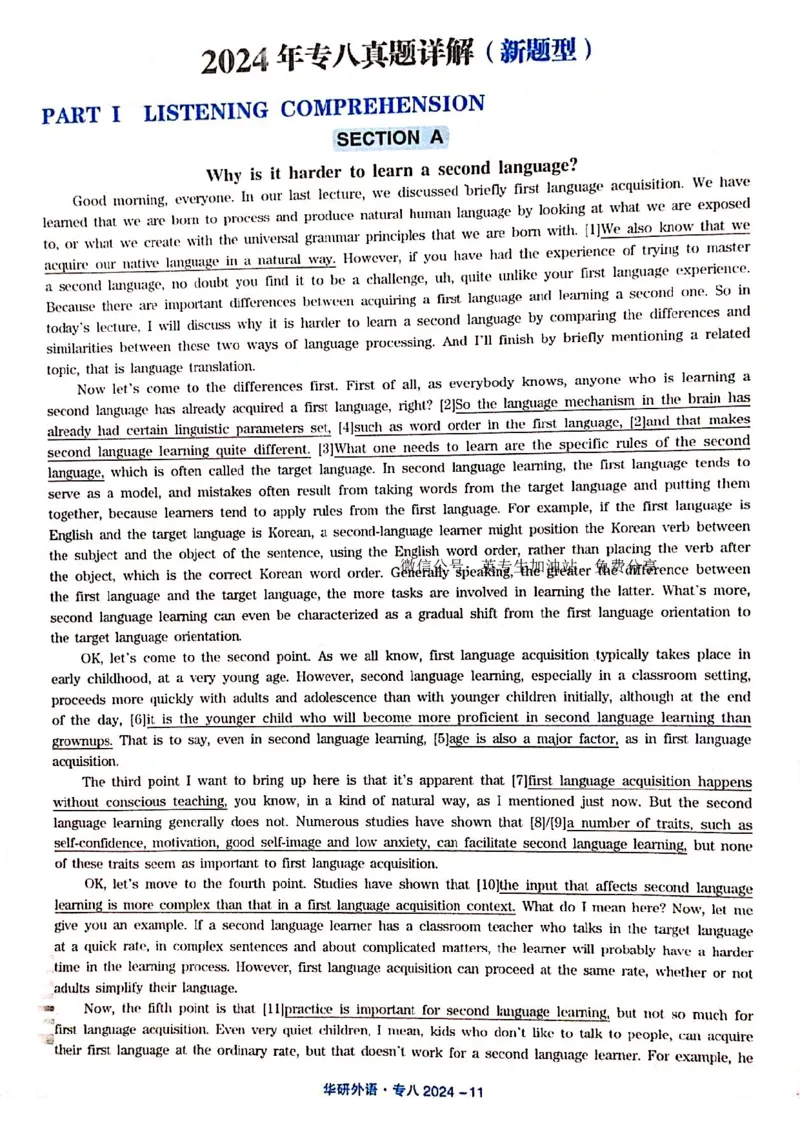
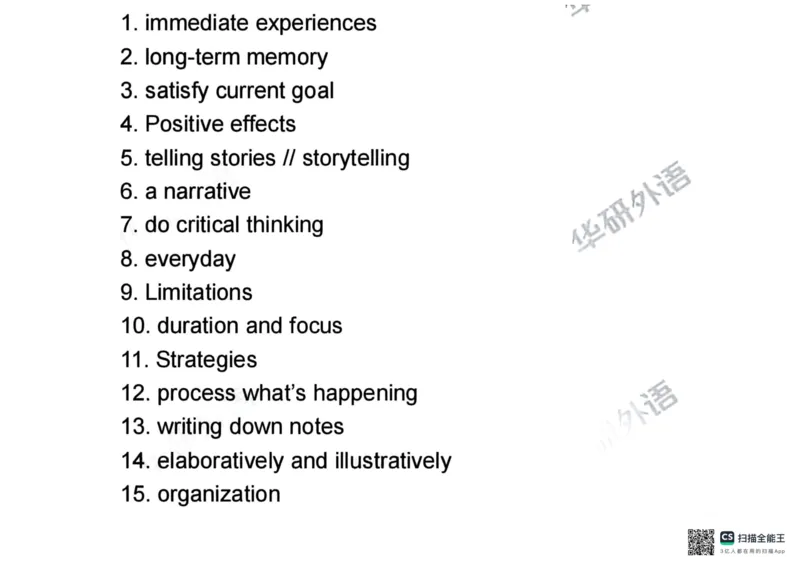
Paralinguistic Features of Language | _
In face-to-face c01nmunication speakers often alter their tones of voice or change their physical _
1
_
postures in order to convey messages. These means are called paralinguistic features of language,
_
which fall into two categories. _
I. First category: vocal paralinguistic features _
_
A (1) : to express attitude or intention (1)
_
B. examples _
1. (2) : need for secrecy (2)
2. breathiness: deep emotion
3 (3) 田umportance (3) 佳
4. nasality: anxiety _
_
5. extra lip rounding: greater intimacy
_
II. Second category: (4) (4)
A facial expressions
1. (5) (5) E
_
—smiling: signal of pleasure or welcome _
2. 1e ss common expressions _
—(6) surpnse or interest (6) _
_
-lip biting: (7) (7) _
B. gesture _
_
Gestures are related to culture. _
1. British culture
—shrugging shoulders: (8) (8) 仁
—scratching head: puzzlement
2. other cultures
匡
-placing hand upon heart: (9) (9)
—pointing at nose: secret _ _
C. proximity, posture and echoing _
1. proximity: physical distance between speakers _
_
—closeness: intimacy or threat _
—(10) : formality or absence of interest (10) _
_
Proximity is person-, culture- and (11) -specific. (11)
_
2. posture _
—hunched shoulders or a hanging head: to indicate (12) (12) _
—direct level eye contact: to express a(n) (13) attitude (13) _
_
. 3. echoing _
—definition: imitation of similar posture _
— .
(14) : aid m commurucat10n (14)
—
conscious rmitation: (15) (15)
一—」
.冒
高校外语专业教学测试办公室 监制 FS-TEMS-1601一仁Beta
专八2010-9-
闭
圈 一 一 一 一 一 一 一 一 一A一N一S一W一E一R一 S一H一E一E一T一3一 (一TE一M一8一) 一 一 一 一 一 一 一 一 一 一
圈
注意事项
准 考 证 号
1答题前, 考生务必用黑色字迹签字笔填
学 校:
写自己的准考证号、 姓名和学校; 再用
28铅笔把对应准考证号码的标号涂黑,
使用其它笔填涂无效。
101 (01 10) l O I [QJ (Q] I OJ (01 101 (01 I 01 !OJ f O I cOJ
姓 名: 2考 自负 生 。 不得填涂缺考、 违纪项, 违者责任 [ 1 I 111 [11 L1 l 11 I l 1J (11 C 1 l 11 I 111 l1 I [ 了 1l C 1 I L1J
3选择题必须用28铅笔填涂, 使用其它笔 [21 (21 {21 [21 [2] [21 r21 [21 [21 121 121 121 [21 r21
填涂无效, 修改时要用橡皮擦干净; 每 131 !31 l3l 131 [31 [3 l [31 [31 131 r 31 131 f 3) l 31 t 3 l
填 正确填涂方式 此处由监考老师填涂 题只能填涂一个答案, 多填不得分。 (41 [41 r41 (4 l [41 t 4 j [41 [4) l41 141 r 41 141 [41 14]
4.主 观题必须用 黑色字迹签字笔 151 151 l5l l 5] [5J 151 [51 15 I l5l 15·1 LS I [5) [51 (5]
涂 围噩l
违纪 CWJ (0.5mm)在答题区域内作答, 超出红 (6] (6) [61 [6) rs 1 [61 l6l [61 [61 !61 r si (61 [61 (61
要
求 错误填涂方式 缺考 [Q] I 5 保
色矩
持
形
答
框
题
限
卡
定
的
区
清
域
洁 I
的
和
答
平
案
整
无
,
效
不
。
得折叠。 I
1
1
7
8
l
1 t
[ 7
8
1
1 1
[
8
7 )
l
l
r
.
e
7
1
]
C
1
8
71
1 [
1
8
7]
1 [
rn
8)
[
18
7)
1 [
[7
8
]
1 1
(
8
7
1
1 1
[
7
8
1
1 r
[
a
7)
1
[
[ 8
71
1
(
r
7
a
1
1
[劝 [pf) [.J ([� ANSWER SHEET 3 (一 191 [91 19] 191 [91 l 91 [91 L9J [91 c91 l9 I 191 191 [91
PART III LANGUAGE USAGE
下列各题必须使用黑色字迹签字笔在答题区域内作答, 超出红色矩形边框限定区域的答案无效。
So far as we can tell, all human languages are equally
complete and perfect as instruments of communication: that
is, every language appears to be well equipped as any other (1)
to say the things their speakers want to say. (2)
There may or may not be appropriate to talk about primitive (3)
peoples or cultures, but that is another matter. Certainly, not
汕 groups of people are equally competent in nuclear physics
or psychology or the cultivation of rice. Whereas this is not (4)
the fault of their language. The Eskimos, it is said, can speak
about snow with further more precision and subtlety than we (5)
can in English, but this is not because the Eskimo language
(one of those sometimes mis-called "primitive") is inherently
more precise and subtle than English. This example does
not come to light a defect in English, a show of unexpected (6)
"primitiveness". The position is simply and obviously that
the Esl<lmos and the English live in similar environments. (7)
The English language w川 be just as rich in terms for (8)
different kinds of snow if the environments in which English
was habitually used made such distinctions as important. (9)
Similarly, we have no reason to doubt that the Eskimo
language could be as precise and subtle on the subject of
motor manufacture or cricket if these topics formed the part (10)
of the Eskimos' life.
.
高校外语专业教学测试办公室 监制 FS-TEMS-160仁3-Beta
专八2010 -10