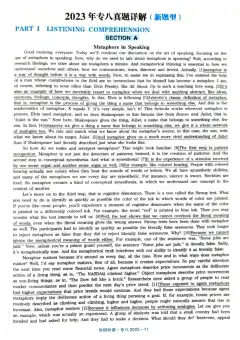
新题型 TEST FOR ENGLISH MAJORS (2014)
-GRADE EIGHT-
TIME LIMIT: 150 MIN
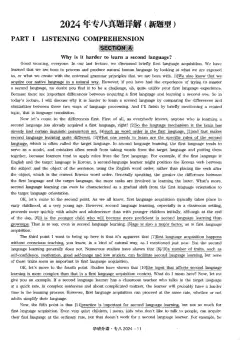
PART I LISTENING COMPREHENSION [25 MIN]
SECTION A MINI-LECTURE
In this section you will hear a mini-lecture. You will hear the mini-lecture ONCE ONLY. While listening to
the mini-lecture, please complete the gap-filling task on ANSWER SHEET ONE and write NO MORE TH,4N
THREE WORDS for-each gap. Make sure the word(s) you fill in is (are) both grammatically and semantically
acceptable. You may use the bla�k sheet for llote-taking.
You have THIRTY seconds to preview the gap-filling task.
Now, li.�ten to the mini-lecture. When it is over, you will be given THREE minutes to check your work.
SECTION B INTERVIEW
In this section you will hear ONE interview. The interview will be div记ed into TWO parts. At the end of
each part, five questions will be asked about what was sa址 Both the interview and the questions will be spoken
ONCE ONLY. After each question there will be a ten-second pause. During the pause, you should read the jour
choices of A, B, C and D, and mark the best answer to each question on ANSWER SHEET TWO.
You have THIRTY seconds to preview the questions.
Now listen to Part One of the interview. Questions 1 to 5 are based on Part One of the interview.
1. A. To draw attention to the refugee crisis. . B. To look after refugees in Iraq.
C. To work for U.N.H.C.R. D. To work out a plan for refugees.
2. A. About 1.5 million. B. About 2 million. C. About 4 rn诅ion. D. About 3.5 million.
3. A. Refugees including young kids suffer from lack of assistance.
B. Relief supplies cannot reach refugees due to Syria's blockage.
C. More than. half of the refugees there are under 12 year old.
D. Local people seem reluctant to appeal for foreign aid.
4. A. She was strongly opposed to officials' opinions.
B. She thought young kids should be given priority.
C. She was much wonied about the lack of action.
D. She proposed that policies be made promptly.
5. ·A. It plays a key role in assisting refugees of Iraq.
B. It sends Angelina to report on refugees in Syria.
C. It has no real presence in Iraq to help refugees.
D. It helps to figure out a plan for refugees of Iraq.
Now, listen to Part Two of the interview. Questions 6 to 10 are based on Part Two of the interview.
6. A. Because the war may spread to other countries.
B. Because Iraq will take revenge on the refugees.
C. Because the refugees may attack local officials.
D. Because instability does no good to anyone.
7. A. Counting the refugees. B. Registering the refugees.
C. Taking people to a safe place. D. Recovering the infrastructure.
8. A. To supervise the construction of schools. B. To take prompt and effective actions.
C. To provide water and power supply. D. To prevent instability and aggression.
9. A. The current situation in Iraq. B. The politics in the Middle East.
专八2014-1C. Refugees returning to normal life. D. International and domestic efforts.
10. A. Because she could help others know where the problems were.
B. Because she could help bring NGOs back to the region.
C. Because she could talk to different people there.
D. Because she could read the official papers.
PART II READING COMPREHENSION [45 MIN]
SECTION A MULTIPLE-CHOICE QUESTIONS
In this section there are three passages followed by fourteen multiple choice questions. For each multiple
choice question, there are four suggested answers marked A, B, C and D. Choose the one that you think is the
best answer and mark your answers on ANSWER SHEET TWO.
PASSAGE ONE
(l)My class at Harvard Business School helps students 皿derstand what good management theory is
and how it is built. In each session, we look at one company through the lenses of different theories, using
them to explain how the company ,got into its situation and to examine what actions will yield the needed
results. On the last day of class, I ask my students to turn those theoretical lenses on themselves to fmd
answers to two questions: First, How can I be sure I'll be happy in my career? Second, How can I be sure
my relationships with my spouse and my family will become an enduring source of happiness?
(2)1 graduated from Harvard Business School in 1979, and over the years, I've seen more and more of
my·classmates come to reunions unhappy, divorced, and alienated from their children. I can guarantee you
that hot a single one of them graduated with the deliberate strategy of getting divorced and raising children
who would become estranged from them. And yet a shocking number 皿wittingly implemented that strategy.
The reason? They didn't keep the purpose of their lives front and center.
.
(3)Having a clear purpose has been essential to me. But it was something I had to think long and hard
about before I 皿derstood it. When I was a Rhode Scholar, I was in a very demand academic program. I
decided to spend an hour every night reading, thinking and praying about why God put me on this earth. It
was a very challenging commitment because every hour I spent doing that, I wasn't studying applied
econometrics. I was conflicted about whether I could really afford to take time away from my studies, but
I stuck with it and ultimately figured out the purpose of my life.
(4)My purpose grew out of my religious faith, but faith isn't the only thing that gives people direction.
For example, one of my former students decided that his purpose was bring honesty and econonlic
prosperity to his co皿ry and to raise, children who were as capably . committed to his cause, and to each
other, as he was. His purpose is focused on family and others, as is mine.
(5)Here are some management tools that can be used to help you lead a purposeful life.
(6)1 USE YOUR RESOURCES WISELY. Your decisions about allocating your personal time, energy,
and talent shape your life's strategy. I have a bunch of "businesses" that compete for these resources: I'm
trying to have a rewarding relationship with my wife, raise great kids, contribute to my community,
succeed in my career, and contribute to my church. And I have exactly the same proble� that a
corporation does. I have a limited amo皿 of time, energy, and talent. How much do I devote to each of
these pursuits?
(7)Allocation choices can make your life turn out to be very different from what you intended.
Sometimes that's good: Opportunities that you never planned for emerge. But if you don't invest your
resources wisely, the outcome can be bad. As I think about people who inadvertently invested in lives of
hollow unhappiness, I can't help believing that their troubles relate right back to a short-term perspective.
(8) When people·with a high need for achievement have an extra half hour of time or an extra o皿ce
of energy, theY:'11 nnconsciously allocate it to activities that yield the most tangible accomplishments. Our
�areers provide the most concrete evidence that we're moving forward. You ship a product, finish a design,
专八2014 -2complete a presentation, close a sale, teach a class, publish a paper, get paid, get promoted. In contrast,
investing time and energy in your ,relationships with your spouse and children typically doesn't offe r that
same immediate sense of achievement. Kids misbehave every day. It's really not until 20 years down the
road that you can say, "I raised a good son or a good daughter." You can neglect your relationship with
your spouse, and on a daily basis it doesn't seem as if things are deteriorating. People who are driven to
excel have this unconscious propensity to underinvest in their families and overinvest in their careers, even
though intimate and loving family relationships are the most powerful and enduring source of happiness.
(9)If you study the root causes of business disasters, over and over you'll fmd this predisposition
toward endeavors that offe r immediate gratification. If you look at personal lives through that lens, you'll
see the same stunning and sobering pattern: people allocating fewer and fewer resources to the things they
would ,have once said mattered most.
(10)2 CREATE A FAMILY CULTURE. It's one thing to see into the foggy future with acuity and chart
the course corrections a company must take. But it's quite another to persuade employees to line up and
work cooperatively to take the company in that new direction.
(ll)When there is little agreement, you have to use "power tools" - coercion, threats, punishment, and
so on, to secure cooperation. But if employees' ways of working together succeed over and over, consensus
begins to form. Ultimately, people don't even think about whether their way yields success. They embrace
priorities and follow procedures by instinct and assumption rather than by explicit decision, which means
that they've created a culture. Culture, in compelling but unspoken ways, dictates the proven, acceptable
methods by which members of a group address recurrent problems. And culture defmes the priority given
to different types of problems. It can be a powerful management tool.
(12)1 use this model to address the question, How can I be sure my family becomes an enduring
source of h�ppiness? My students quickly see that the simplest way parents can elicit cooperation from
children is to wield power tools. But there comes a point during the teen years when power tools no
longer work At that point, parents start wishing they had begun working with their children at a very
young age to build a culture in which children instinctively behave respectfully toward one another, obey
their parents, and choose the right thing to do. Families have cultures, just as companies do. Those
cultures can be built consciously.
(13)If you want your kids to have strong self-esteem and the confidence that they can solve hard
problems, those qualities won't magically 'materialize in high school. You have to design them into your
family's culture, and you have to think about this very early on. Like employees, children build self-esteem
by doing things that are hard and learning what works.
11. What can we learn about the author from the first three paragraphs?
A He is a teacher as well as a former student of Harvard Business School.
B. More and more of his students get divorced and alienated from their children.
C. He figured out the purpose of his life when studying applied econometrics.
D. He was shocked to learn that many of his classmates become unhappy.
12. According to the author, the key to successful allocation of resources in your life depends on whether
you .
A can manage your time well B. have long-term planning
C. are lucky enough to have new opportunities D. can solve both company and family problems
13. What is the role of the statement "Our careers provide the most concrete evidence that we're moving
forward." with reference to the previous statement in the paragraph?
A To offe r further explanation. B. To provide a defmition.
C. To present a contrast. D. To illustrate career development.
专八 2014-314. One of the similarities between company culture and family culture is that
A. problem-solving ability is essential B. cooperation is the foundation
C. respect and obedience are key elements D. culture needs to be nurtured
PASSAGE TWO
(l)It was nearly bedtime and when they awoke next morning land would be in sight. Dr. Macphail lit
his pipe and, leaning over the rail, searched the heavens for the South Cross. A代er two years at the front
and a wound that had taken longer to .heal than it should, he was glad t� settle down quietly at Apia (阿
皮亚, 西萨摩亚首都) for twelve months at least, and he felt already better for the journey. Since some of
the passengers were leaving the ship next day they had had a little dance that evening and in his ears
hammered still the harsh notes of the mechanical piano. But the deck was quiet at last. A little way off he
·
saw his wife in a long chair talking with the Davidsons, and he strolled over to her. When he sat down
under the light and took his hat you saw that he had very red hair, with a bald patch on the crown, and
the red,·freckled skin which accompanied red han:; he was a man of forty, thin, with a pinched face,
precise and rather pedantic; and he spoke with a Scots accent in a very low, quiet voice.
(2)Between·the Macphails and the Davidsons, who were missionaries, there had arisen the intimacy of
shipboard, which is due to proximity rather than to any community of taste. Their chief tie was the
disapproval they shared of·the men who spent their days and nights in the smoking-room playing poker or
bridge and . drinking. Mrs.· Macphail was not a little flattered to think that she and her husband were the
only people on board with whom the Davidsons were willing to associate, and even the doctor, shy but no
fool, half . unconsciously acknowledged the compliment. It was because he was of an argumentative mind
that in their . cabin at·night' he permitted himself to carp (旁叨).
(3)'Mrs. Davidson was saying she didn't know how they'd have got through the journey if it hadn't
been for us, ' said M区. Macphail, as she neatly brushed out her transformation (假发). 'She said we were
really the only people on the ship they cared to know.'
(4)'I shouldn't have thought a missionary was such a big bug (要人、名士) that he could afford to put
on frills (摆架子).,
(5)'It's not frills. I quite understand what she means. It wouldn't have been very nice for the Davidsons
to have to m议 with all that rough lot in the smoking-room.'
(6)'The founder of their religion wasn't so exclusive,' 函d Dr. Macphail with a chuckle.
(7)'I've asked you over and over again not to joke about religion,' answered his wife. 'I shouldn't like
to have a na血e like yours, Alec. You never look for the best in people.'
(8)He gave her a sidelong glance with his pale, blue eyes, but did not reply. A代er many years of
married life he had learned that it was more conducive· to peace to leave his wife with the last word. He
was un.dressed before she was, and climbing into the upper bunk he settled down to read himself to sleep.
(9)When he came on deck next mom四 they were close to land. He looked at it with greedy eyes.
There was a thin strip of silver beach rising quickly to hills covered to the top with luxuriant vegetation.
The coconut trees, thick and green, came nearly to the water's edge, and among them you saw the grass
houses of the Samoans (萨摩亚人);and here and there, gleaming white, a little church. Mrs. Davidson came
and stood beside him. She was dressed ·in black and wore round her neck a gold chain, from which
dangied a cross. She was a little woman, with brown, dull hair very elaborately arranged, and she had
prominent blue eyes behind invisible pince-nez (夫鼻眼镜). Her face was long, like a sheep's, but she gave
no impression of foolishness, rather of extreme alertness; she had the quick movements of a bird. The
most remarkable thing about her was her voice, high, metallic, and without inflexion; it fell on the ear with
a hard monotony, 血tating to the nerves like the pitiless clamor of the pneumatic drill.
(10)'This must seem like home to you,' said Dr. Macphail, with his thin, difficult smile.
(11)'Ours are low islands, you know, not like these. Coral. These are volcanic. We've got another ten
专八2014-4days' journey to reach them.'
(12)'In these parts that's almost like being in the next street at home,' said Dr. Macphail facetiously.
(13)'Well, that's rather an exaggerated way of putting it, but one does look at distances differently in
the South Seas. So far you are right.'
(14)Dr. Macphail sighed faintly.
15. It can be infe rred from the fi订st paragraph that Dr. Macphail .
A. preferred qmetness to nmse B. enjoyed the sound of the mechanical piano
C. was going back to his hometown D. wanted to befriend the David.sons
16. The Macphails and the Davidsons were in each other's company because they .
A. had siinilar experience B. liked each other
C. shared di油ke for some passengers D. had sinlilar religious belief
17. Which of the following statements BEST describes Mrs. Macphail?
A. She was good at making friends. B. She was prone to quarrelling with her husband.
C. She was skillful in dealing with strangers. D. She was easy to get along with.
18. All the following adjectives can be used to depict Mrs. Davidson EXCEPT .
A. arrogant B. unapproachable C. unpleasant D. 血table
19. Which of the following statements about Dr. Macphail is INCORRECT?
A. He was sociable. B. He was intelligent.
C. He was afraid of his wife. D. He made fun of the Davidsons.
PASSAGE THREE
(!)Speaking two languages rather than just one has obvious practical benefits in an increasingly
globalized world. But in recent years, scientists have begun to show that the advantages of bilingualism are
even more fundamental than being able to converse with a wider range of people. Being bilingual, it turned
out, makes you smarter. It can have a profound effect on your brain, improving cognitive skills not related
to language and even shielding against dementia (痴呆) in old age.
(2)This view of bilingualism is remarkably diffe r�nt from the understanding of bilingualism through
much of the 20th century. Researchers, educators and policy makers long considered a second language to
be an interference, cognitively speaking, that hindered a child's academic and intellectual development.
(3)They were not wrong about the interference: there is ample evidence that in a bilingual's brain both
language systems are active even when he is using only one language, thus creating situations in which one
system obstructs the other. But this interference, researchers are finding out, isn't so much a handicap as a
blessing in disguise. It forces the brain to resolve internal conflict, giving the m血 a workout that
strengthens its cognitive muscles.
(4)Bilinguals, for instance, seem to be more adept than monolinguals at solving certain kinds of mental
puzzles. In a 2004 study by the psychologists Ellen Bialystok and Michelle Martin-Rhee, bilingual and
monolingual preschoolers were asked to sort blue circles and red squares presented on a computer screen
into two digital bins - one marked with a blue square and the other marked with a red circle.
(5)1n the ti江st task, the children had to sort the shapes by color, placing blue circles in the bin marked
with the blue square and red squares in the bin marked with the red circle. Both groups did this with
comparable ease. Next, the children were asked to sort by shape, which was more challenging because it
required placing the images in a bin marked with a conflicting color. The bilinguals were quicker at
performing this task
(6)The collective evidence from a number of such studies suggests that the bilingual experience
improves the brain's so-called executive function - a command system that directs the attention processes
that we use for planning, solving problems and performing various other mentally demanding tasks. These
processes include ignoring distractions to stay focused, switching attention willfully from one thing to
..:.丿\. 2.014 -5another and holding information in mind — like remembering a sequence of directions while driving. · ' '
(7)Why does the tussle between two simultaneously active language systems improve these aspects of
cognition? Until recently,. researchers thought the bilingual advantage stemmed primarily from an ability for
inhibition that was honed by the exercise of suppressing one language system: this suppression, it was
thought, would help train the bilingual -mind to ignore distractions in other contexts. But that explanation
increasingly appears to be inadequate, since studies have ·shown that bilinguals perform better than
monolinguals even at tasks that do not require inhibition, like threading a line through an ascending series
of numbers scattered randomly on a page.
(S)The key difference between bilinguals and monolinguals may be more basic: a heightened ability to
monitor the environment. "Bilinguals have to switch languages quite often - you may talk to your father in
one language and to your mother in another language," says Albert Costa, a researcher at the University of
Pompea Fabra in Spain. "It requires keeping track of changes around you in the same way that . we monitor
our surroundings when driving." In a study comparing German-Italian bilinguals with Italian monolinguals in
completing monitoring tasks, Mr. Costa and his colleagues found that the bilingual subjects not only
performed better, but also did so with less activity in parts of the brain involved in monitoring, indicating
that they were efficient at it.
(9)The bilingual experience appears to influence the brain from infancy to old age, and there is reason
to believe that it may also apply to those who learn a second language later in life.
(lO)ln a 2009 study, 7-month-old babies exposed to two languages from birth were compared with peers
raised with one language. In an initial set of trials, the infants were presented with an audio cue and then
shown a puppet on one side of a screen. Both infant groups learned to look at that side of the screen in
anticip�tion of the puppet. But in a later set of trials, when the puppet began appearing on the opposite
side of the screen, the babies exposed to a bilingual environment quickly learned to switch their
anticipatory gaze in the new direction while the other babies did not.
(ll)Bilingualism's effects also extend into the twilight years. In a recent study of 44 elderly Spanish
English bilinguals, scientists found that individuals with a higher degree of bilingualism were more resistant
than others to the onset of dementia and other symptoms of Alzheimer's disease: the higher the degree of
bilingualism, the later the age of onset.
(12)Nobody ever doubted the power of language. But who would have imagined that the words we
hear and the sentences we speak might be leaving such a deep imprint?
20.-According to the passage,·the more recent and old views of bilingualism differ mainly in .
A. its practical advantages B. its role in cognition
C. perceived language fluency D. its role in medicine
21._ The fact that inte汀erence is now seen as a blessing in disguise means that .
A. it has led to unexpectedly favourable results
B. its potential benefits have remained undiscovered
C. its effects on cognitive development have been minimal
D. only a few researchers have realized its advantages
22. What is the role of Paragraphs Four and Five in relation to Paragraph Three?
A.. It provides counter evidence to Paragraph Three.
B. It offers another example of the role of inte汀erence.
C. It serves as transitional paragraphs in the passage.
D. It further illustrates·the point in Paragraph Three.
23. W垃ch of the following can account for better pe汀ormance of bilinguals in doing non-inhibition tasks?
A. An ability to monitor surroundings. B. An ability to ignore distractions.
C. An ability to perform with less effort. D. An ability to exercise suppression.
专八 2014-624. What is the main theme of the passage?
A. Features of bilinguals and monolinguals. B. Interference and suppression.
C. Bilinguals and monitoring tasks. D. Reasons why bilinguals are smarter.
SECTION B SHORT ANSWER QUESTIONS
In this section there are eight short answer questions based on the passages in SECTION A. Answer each
question in NO more than 10 words in the space prov记ed on ANSWER SHEET TWO.
I��f. 、 L 叩,今
25. According to the author, what is a common cause of failure in business and family relationships?
26. In the author's opinion, when does culture begin to emerge?
PA�S!CR TWO
27. Why were the Macphails on the journey according to Para. 1?
28. According to Para. 2, how did the Macphails feel about their associating with the Davisons?
29. How do you smnmarize the land described in Para. 9?
Ir::.:�r-.E TJ:f"llEE
30. How do researchers, educators and policy makers long think of second language?
31. According to Para. 3, what can we learn about the language systems in a bilingual's brain?
32. How did researchers view about the bilingual advantage until recently?
p
I jAl\TGU USft.e! .., [15 MIN]
lf
The passage contains TEN errors. Each indicated line contains a maximum of ONE error. In each case,
only ONE word is involved. You shoula proof-read the passage and co汀ect it in the following way:
For a 三 word, underline the wrong word and write the correct one in the blank
provided at the end of the line.
For a missing word, mark the position of the missing word with a "八 " sign and write the
word you believe to be missing in the blank provided at the end of the
line.
For an unnecessary word, cross the unnecessary word with a slash "/" and put the word in the
blank provided at the end of the line.
Example
When /\ art museum wants a new exhibit, (1) an
it 胆面 buys things in fi血shed form and hangs (2) never
them on the wall. When a natural history museum
wants an exhibition, it must often build it. (3) exhibit
Proofread the given passage on ANSWER SHEET THREE as instructed.
v
p N
f20 MINl
Translate the underlined part of the following text from Chinese into English. Write your translation on
ANSWER SHEET THREE.
当我在小学毕了业的时候,亲友一致的愿意我去学手艺,好帮助母亲。 我晓得我应当去找饭吃,以减轻母亲的勤劳
困苦。 可是 我也愿意升学。 我偷偷地考入了师范学校 制服 饭食 书籍 宿处 都由学校供给。 只有这样 我才敢对
母亲提升学的话。入学 要交十元的保证金。这是一笔巨款!母亲作了半个月的难 把这巨款筹到 而后含泪把我送出门
去。她不辞劳苦 只要儿子有出息。当我由师范毕业 而被派为小学校长 母亲与我都一夜不曾合眼。我只说了旬:”以后
您可以歇一歇了! “她的回答只有一串串的眼泪。
丿\. 2014 -7PAPT V WRITING [45 MIN]
Nowadays, some companies have . work-from-home or remote working policies, which means that their
employees do not have to commute to work every day. This certainly greatly changes the working practice both
for employees and employers. The following are opinions from both sides. Read the excerpts carefully and write
an article of NO LESS THAN 300 words, in which you should:
1. summarize briefly the opinions from both sides;
2. give your comment.
Marks will be awarded for content relevance, content sufficiency, organization and language quality. Failure
to follow the above instructions may result in a loss of marks.
Write your article on ANSWER SHEET FOUR.
Employers
Simon Slade, CEO and co-founder of Af:filorama has experienced first hand the benefits of having
remote workers at his company, "By allowing employees to work remotely, you can hire the best of the
best while not limiting yourself by geographical restrictions. At Doubledot Media, 19 of our 28 employees
work remotely, and I have seen no difference in job satisfaction or work performance. If anything, my
remote employees' production rate is higher because they are better equipped to avoid distractions." The
benefits also extend to his bottom line, "telecommuting saves me money because they pay for their own
computer, electricity and other utilities."
For some companies, work from home can be a matter of more hours in the day. This is especially
true for small businesses and new companies where they can't afford to waste even one minute of the
workday. "Being a small startup, every hour of the day is important," states Tim Segraves, cofounder and
CTO of Revaluate, "If we all spent an hour of day commuting, that would be almost 20 hours a week that
would go to commuting instead of building out our product and business."
Employees
Lynsey Thomas, a homeworker: If I have discovered one thing about working from home over the last
four years, it is that it is defmitely easier to keep your private life private. When I was working in an
office I had to use survival techniques such as loitering in a meeting room, toilet or co订idor to take any
personal calls. Personal calls in the office create disproportionate stress.
Ann Gaffigan, CTO , of Land Pros Systems, Inc.: As a programmer, I need large chunks of time to really
make progress on a project. In . an office, there are ·so many potential distractions, with people lmocking on
the door or customers stopping in. This way I can control when I answer calls and emails and when I "go
silent" to get some work done. I think for employees who can't afford to be distracted a number of times
a day, having a controlled environment can be key to their productivity. Working from home can allow us
to minimize distractions and increase the time they spend focused on a project. It stands to reason that, in
the end, companies benefit from these remote employees by getting projects completed faster with fewer
mistakes.
Alessandra Ceresa, a designer of·Greenrope: Your success in working from home might depend on the
type of work you, do. When it comes to a company's work from home policy, everyone is different. Your
productivity and overall success as a remote employee depends entirely on your preferred work style.
That's also the reason it's hard to fmd any solid data on whether or not people are more productive at
home. We're all different, and some of us can't manage to get work done with a TV nearby and all our
comforts of home surrounding us, while others fmd it a struggle to stay focused 皿ong office chatter and
other distractions.
-THE END
专八2014-8.
-
中
ANSWER SHEET 1 (TEM8)
l
学 校:
姓 名:
错误填涂方式
改'1 l.e'J 1e1c中
LISTENING COMPREHENSION
SECTION A 竺码URE
U l 下列各题必须使用黑色字迹签字笔在答题匕胶I• �. 口, ,且占 飞形边框限定区域的
7
How to Reduce Stress
!
Life is full of things that cause us stress. Though we may not like stress, we have to live with it. 1
i
I. Definition of stress
A. (1) reaction (1)
i.e. force exerted between (2) (2)
B. human reaction
i.e. response to (3) on someone (3)
e.g. increase in breathing, heart rate, (4) , (4)
or muscle tension
IL (5) (5)
A. positive stress
where it occurs: Christmas, wedding, (6) (6)
B. negative stress
where it occurs: test-taking situations, (7) (7)
III. Ways to cope with stress
A. recognition of (8) (8)
-monitor for (9) of stress (9)
-find ways to (10) (10)
B. attention to body demand
-effect of (11) (11)
C. planning and acting appropriately
- reason for planning
-(12) of planning (12)
D. learning to (13) (13)
-e.g. delay caused by traffic
E. (14) (14)
-manageable task
.
-(15) (15)
—」
_
高校外语专业教学测试办公室 监制 FS-TEMB-1601一仁Beta
专八2014-9-
6
ANSWER SHEET3 (TEM8)
圈 圆 - - - - - - - - - - - - - - - - - - - - - - - - - - - - - - - - - - -
注意事项
准 考 证 号
1答题前, 考生务必用黑色字迹签字笔填
学 校: 写自己的准考证号、 姓名和学校; 再用
2B铅笔把对应准考证号码的标号涂黑,
使用其它笔填涂无效。
2考生不得填涂缺考、 违纪项, 违者责任 [OJ r_oi [01 [QJ [0! [OJ 101 101 [OJ !OJ !01 [OJ IOI 『01
姓 名: 自负。 [11 [1.1 (11 [11 111 [11 111 111 111 11( [11 (11 (11 fj]
3选择题必须用2B铅笔填涂, 使用其它笔 c21 c21 121 121 121 c21 c21 121 t21 121 r21 c21 121 121
填涂无效, 修改时要用橡皮擦干净; 每 l3I [31 f3I l31 131 [31 131 !31 !31 131 131 131 f3l 131
填 正确填涂方式 此处由监考老师填涂 题只能填涂一个答案, 多填不得分。 l4l 141 141 l"4"J 141 t4l 141 141 141 [41 L4J l4l l41 £4』
涂 I!!!!!! 违纪 cw1 4. ( 主 0.5 观 mm 题 ) 必 在 须 答题 用 区 黑 域 色 内 字 作答 迹 , 签 超 字 出 笔 红 r [6 5 1 l [ c 6 5 1 l ( l 6 5 l ) [ [ 8 5 1 I 1 I 6 5 l 1 ! [ 6 5 J I [ l 5 6 1 l r ( s 6 · ) I [ c 6 5 1 l 1 r 6 5 ) I [ l 6 6 1 l 1 ( 6 5 1 I [ r 6 5 1 l [ I 6 5 ) I
要 色矩形框限定区域的答案无效。一 [ 7 l (7 I I 7 l t.7 l l 71 [ 7 J [ 7 1 t 7 l l 7 l t 7 I I 71 I 7 I l 71 [ 7 l
求 r 错 -:Cti 误 r,3 填 1 涂 re 方 i r 式 cli 缺考 [QJ I 5 保 A 持 NS 答 症 题 R 卡 SHE 的 ET 清 3 洁 I 和平整, 不得折叠。 I [ l9 8 l 1 ( r 8 9 1 1 [ 1 8 9 1 1 [ r 8 9 1 1 1 l 8 91 1 ( rs 8 1 1 r [ 9 8 1 1 ( r9 81 , [ r 8 9 1 1 [ c9 8 1 1 l 1 8 91 1 r [8 9 1 1 { r 8 9 1 1 f r9 BJ 1
PART III _ LANGUAGE _US_AG�
下列各题必须使用黑色字迹签字笔在答题区域内作答, 超出红色矩形边框限定区域的答案无效。
There is widespread consensus among scholars that second language acquisition (SLA) emerged as a
distil1ct field of research from the late 1950s to early 1960s.
There is a high level of agreement that the following questions (1)
have possessed the most attention of researchers in this area: (2)
常 Is it possible to acquire an additional language in the
* same sense one acquires a first language? (3)
What is the explanation for the fact adults have (4)
more difficulty in acquiring additional languages than children
have?
@ What motivates people to acquire additional languages?
急 What is the role of the language teaching in the (5)
acquisition of an additional language?
渺 What sociocultural factors, if any, are relevant in studying the
learning of additional languages?
J:<rom a check of the literature of the field it is clear that all (6)
the approaches adopted to study the phenomena of SLA Sf! far have
one thing in common: The perspective adopted to view the acquiring
of an additional language is that of an individual attempts to do (7)
so. Whether one labels it "learning" or "acquiring" an additional
language, it is an individual accomplishment or what is under (8)
focus is the cognitive, psychological, and institutional status of an
individual. That is, the spotlight is on what mental capabilities are
involving, what psychological factors play a role in the learning (9)
or acquisition, and whether the target language is learnt in the
classroom or acquired tlrrough social touch with native speakers. (10)
.
高校外语专业教学测试办公室 监制 FS-TEMB-1601-3-Beta
专八 2014 -10