25秋 四年级上册英语1-6 单元必背知识点总结人教版
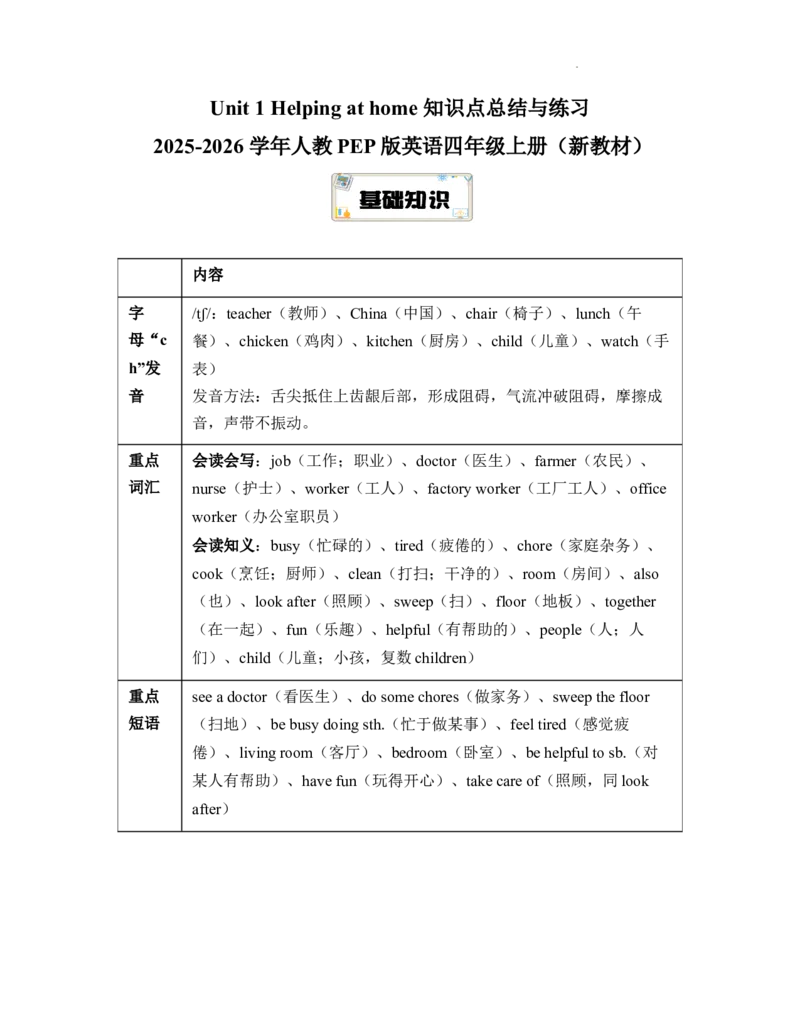
Unit 1 Helping at home
一、重点词汇
*PE 体育(课) * job 工作;职业 * doctor 医生 fun 享乐;乐趣
* nurse 护士 * worker 工人 * busy 忙碌的 * tired 疲倦的
* chore 家庭杂务 * cook 烹饪;煮 * people 人;人们 * room 房间
* also 也 * sweep 扫 * floor 地板;地面
* clean 打扫;干净的 * farmer 农场主;农民 together 在一起;共同
* helpful 有帮助的;有用的 * child (复数 children)儿童;小孩
二、重点短语
help at home 在家帮忙 office worker 公司职员
factory worker 工厂工人 teach Chinese 教汉语
make chairs 制作椅子 amazing peach buns 令人惊叹的桃包
busy and tired 又忙又累 do some chores 做一些家务活
clean the room 打扫房间 make a gift 制作一个礼物
look after 照顾 The Double Ninth Festival 重阳节
sweep the floor 扫地 have fun 玩得开心
三、重要句型
1. — Is this your father? 这是你的父亲吗?
— Yes, it is. He’s a PE teacher. 是的。他是一位体育老师。
2. — What's your mother's job? 你妈妈做什么工作?
— She's a doctor. 她是位医生。
3. — Mum and Dad are busy and tired. What can we do for them?
爸爸妈妈又忙又累。我们能为他们做些什么?
— We can do some chores. 我们可以做一些家务活。
4. The Double Ninth Festival is coming. 重阳节就要到了。
5. How can you help your family? 你能如何帮助你的家人?
第 1 页 共 12 页6. Family members can have different jobs. 家庭成员可以有不同的工作。
四、语音
teacher 老师 chair 椅子 lunch 午餐 peach 桃子 much 许多
ch /tʃ/ China 中国 Chinese 中国的;中国人(的);汉语
child 孩子 kitchen 厨房
五、重点语法
1.询问职业的特殊疑问句
(1)— What's one's job?一人称代词主格+be 动词+a/ an+职业名词.
如:— What's his job? 他做什么工作? He is a driver. 他是一名司机。
(2)— What+ do/ does+主语+ do?一人称代词主格+be 动词-+a/ an+职业
名词.
如:— What do you do? 你是做什么的?—I'm a teacher.我是一名老师。
2.带有情态动词 can 的基本句型
(1)肯定句结构为“主语+ can+动词原形(+其他).”,意为“某人会……”。如:
The boys can play basketball. 男孩们会打篮球。
(2)否定句结构为“主语+ can't/ cannot+动词原形(+其他).”,意为“某人不
会……”。其中 can't 是 cannot 的缩略形式。如:I can't cook.我不会
做饭。
(3)一般疑问句结构为‘“Can+主语+动词原形(+其他)?”,意为“某人会……
吗?”。其肯定回答为“Yes,主语+ can.”;否定回答为“No,主语+ can't.”。
注意答语中作主语的人称代词主格应根据问句中的主语作相应的变
化。如:
— Can I read here? 我可以在这里看书吗?
— Yes, you can.是的,你可以。
(4)特殊疑问句结构为“特殊疑问词+can+主语+动词原形(+其他)?”,特殊疑
问词作主语或主语的定语除外。如: What can you see in the park? 你
能在公园里看到什么?
第 2 页 共 12 页四年级上册英语1-6单元必背知识点总结人教版
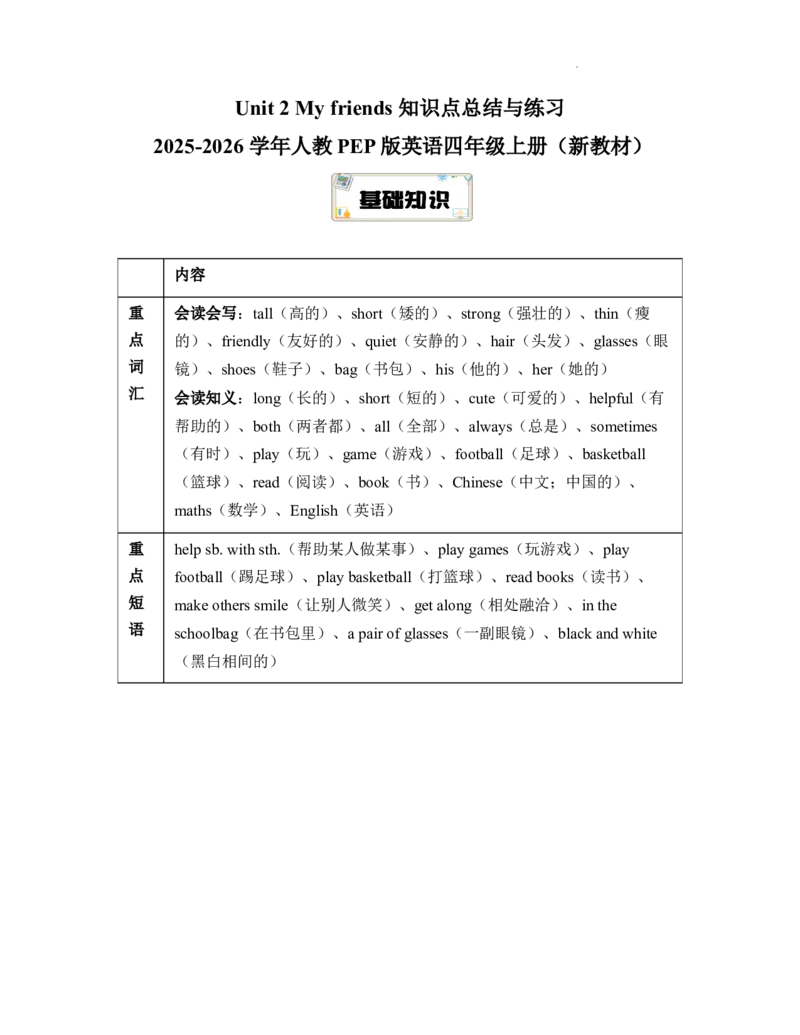
Unit 2 My friends
一、重点词汇
* his 他的 * strong 强壮的 * hair 头发 * kind 友好的
* quiet 文静的 * best 最好的 * read 阅读 * basketball 篮球运动
* play 玩耍 * game 游戏 * always 总是 both 两者
* Chinese 中文;中国人;中国的 * football 足球运动
二、重点短语
a new friend 一个新朋友 your friend’ s name 你朋友的名字
tall and strong 又高又壮 nice short hair 漂亮的短发
short and thin 又矮又瘦 quiet and kind 安静而善良
have no shell 没有外壳 share my shell 分享我的壳
go away 离开 choose our friends 选择我们的朋友
your best friend 你最好的朋友 make me smile 让我开心
read books 阅读书籍 draw pictures with me 和我一起画画
play games together 一起玩游戏 play football 踢足球
help me with English/ Chinese 帮助我学英语/汉语
三、重要句型
1. — What's your friend's name? 你的朋友叫什么名字?
— His name is Zhang Peng.他叫张鹏。
2. — Look! He's tall and strong.看! 他又高又壮。
— He has nice short hair too. 他也有一头漂亮的短发。
— Yes. He’ s also kind. He often helps me.
是的。他也很友善。他经常帮助我。
3. — Who's your best friend? 谁是你最好的朋友?
— Chen Jie. She's funny. She often makes me smile.
陈杰。她很有趣。她经常让我开心。
4. — How about you? 你呢?
第 3 页 共 12 页— My best friend is John. He often helps me with English.
我最好的朋友是约翰。他经常帮助我学英语。
5. She likes weiqi, but I like ball games.她喜欢围棋,但我喜欢球类运动。
四、语音
shell 壳 share 分享 shoo 嘘(赶走鸟等时所发声音) fish 鱼
sh /ʃ/
English 英语 shop 商店 she 她 ship 船 short 矮
五、重点语法
1.代词常用于代替前面出现过的名词、短语或句子。人称代词分为第一人
称、第二人称和第三人称;按照在句子中的用法则分为主格和宾格两种
形式。
第一人称 第二人称 第三人称
人称
单数 复数 单数 复数 单数 复数
主格 I we you you he she it they
人称代词
宾格 me us you you him her it them
形容词性物主代词 my our your your his her its their
物主代词是表示所有关系的代词,也叫代词所有格。放在名词前面
用于修饰名词的叫形容词性物主代词。例如:my best friend 我最好的朋
友 your desk 你的课桌 their classroom 他们的教室 her cat 她的猫
2.描述某人/某物特征的句型
(1)主语+ be 动词+形容词(big/ small/ tall/ short/ long/...).例如:
She is short and thin. 她又矮又瘦。
His mouth is big. 他的嘴巴很大。
(2)主语+ have/ has+名词(短语).例如:
I have big eyes. 我有大眼睛。 It has wings.它有翅膀。
(3)主语+ is wearing/ wears+服饰相关名词(短语). 例如:
She is wearing a red hat today.她今天戴着一顶红帽子。
第 4 页 共 12 页四年级上册英语1-6单元必背知识点总结人教版
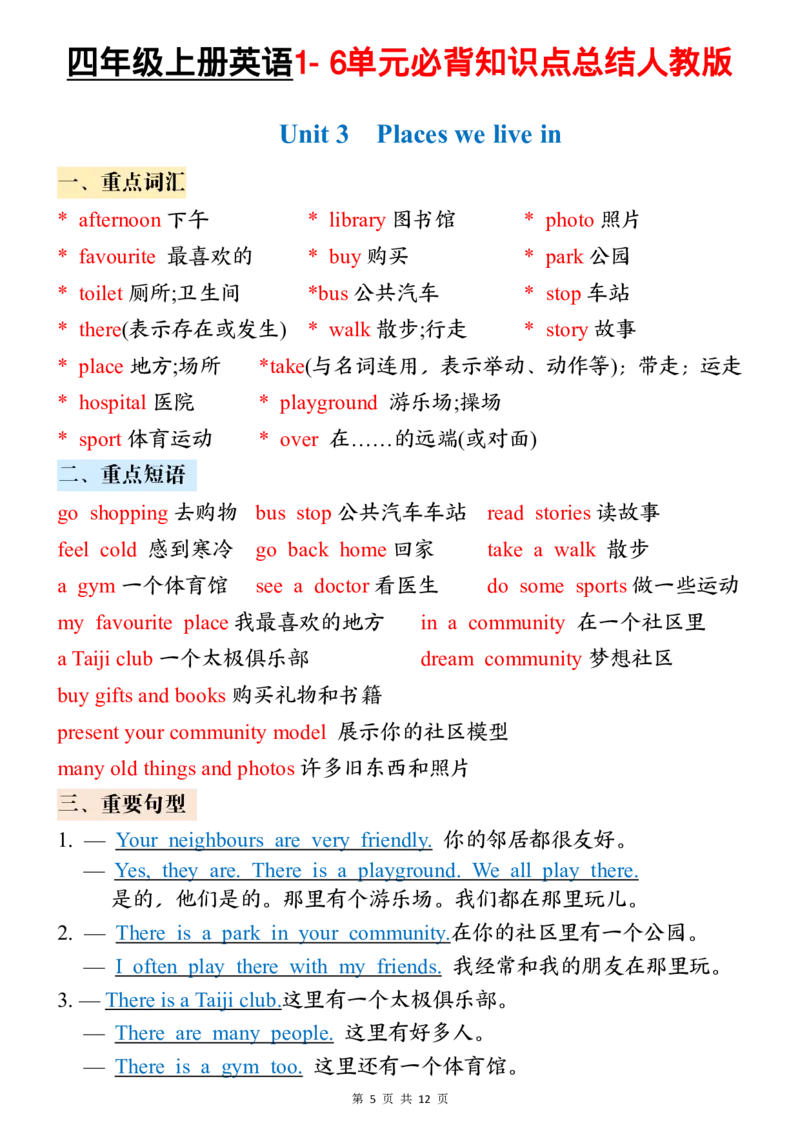
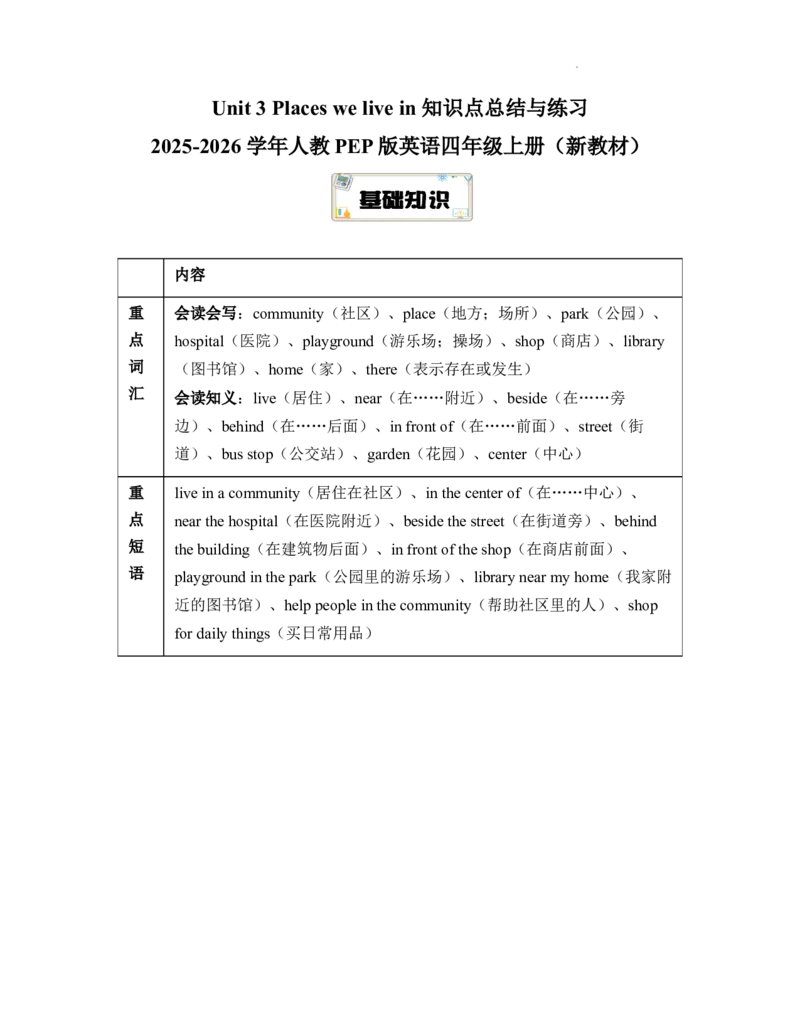
Unit 3 Places we live in
一、重点词汇
* afternoon 下午 * library 图书馆 * photo 照片
* favourite 最喜欢的 * buy 购买 * park 公园
* toilet 厕所;卫生间 *bus 公共汽车 * stop 车站
* there(表示存在或发生) * walk 散步;行走 * story 故事
* place 地方;场所 *take(与名词连用,表示举动、动作等);带走;运走
* hospital 医院 * playground 游乐场;操场
* sport 体育运动 * over 在……的远端(或对面)
二、重点短语
go shopping 去购物 bus stop 公共汽车车站 read stories 读故事
feel cold 感到寒冷 go back home 回家 take a walk 散步
a gym 一个体育馆 see a doctor 看医生 do some sports 做一些运动
my favourite place 我最喜欢的地方 in a community 在一个社区里
a Taiji club 一个太极俱乐部 dream community 梦想社区
buy gifts and books 购买礼物和书籍
present your community model 展示你的社区模型
many old things and photos 许多旧东西和照片
三、重要句型
1. — Your neighbours are very friendly. 你的邻居都很友好。
— Yes, they are. There is a playground. We all play there.
是的,他们是的。那里有个游乐场。我们都在那里玩儿。
2. — There is a park in your community.在你的社区里有一个公园。
— I often play there with my friends. 我经常和我的朋友在那里玩。
3. — There is a Taiji club.这里有一个太极俱乐部。
— There are many people. 这里有好多人。
— There is a gym too. 这里还有一个体育馆。
第 5 页 共 12 页— Great! Let's do some sports. 太棒了! 我们一起做运动吧。
4. My favourite place in my community is the museum.
在我的社区里,我最喜欢的地方就是博物馆。
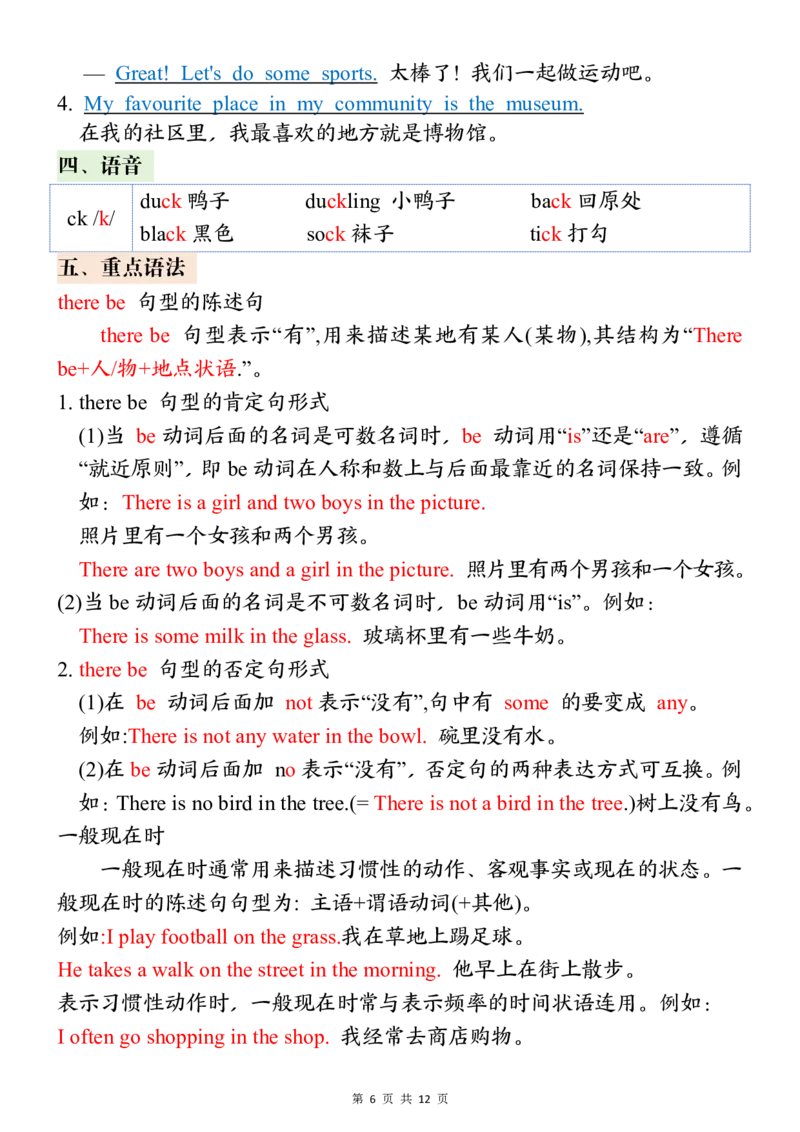
四、语音
duck 鸭子 duckling 小鸭子 back 回原处
ck /k/
black 黑色 sock 袜子 tick 打勾
五、重点语法
there be 句型的陈述句
there be 句型表示“有”,用来描述某地有某人(某物),其结构为“There
be+人/物+地点状语.”。
1. there be 句型的肯定句形式
(1)当 be 动词后面的名词是可数名词时,be 动词用“is”还是“are”,遵循
“就近原则”,即 be 动词在人称和数上与后面最靠近的名词保持一致。例
如:There is a girl and two boys in the picture.
照片里有一个女孩和两个男孩。
There are two boys and a girl in the picture. 照片里有两个男孩和一个女孩。
(2)当 be 动词后面的名词是不可数名词时,be 动词用“is”。例如:
There is some milk in the glass. 玻璃杯里有一些牛奶。
2. there be 句型的否定句形式
(1)在 be 动词后面加 not 表示“没有”,句中有 some 的要变成 any。
例如:There is not any water in the bowl. 碗里没有水。
(2)在 be 动词后面加 no 表示“没有”,否定句的两种表达方式可互换。例
如:There is no bird in the tree.(= There is not a bird in the tree.)树上没有鸟。
一般现在时
一般现在时通常用来描述习惯性的动作、客观事实或现在的状态。一
般现在时的陈述句句型为: 主语+谓语动词(+其他)。
例如:I play football on the grass.我在草地上踢足球。
He takes a walk on the street in the morning. 他早上在街上散步。
表示习惯性动作时,一般现在时常与表示频率的时间状语连用。例如:
I often go shopping in the shop. 我经常去商店购物。
第 6 页 共 12 页四年级上册英语1-6单元必背知识点总结人教版
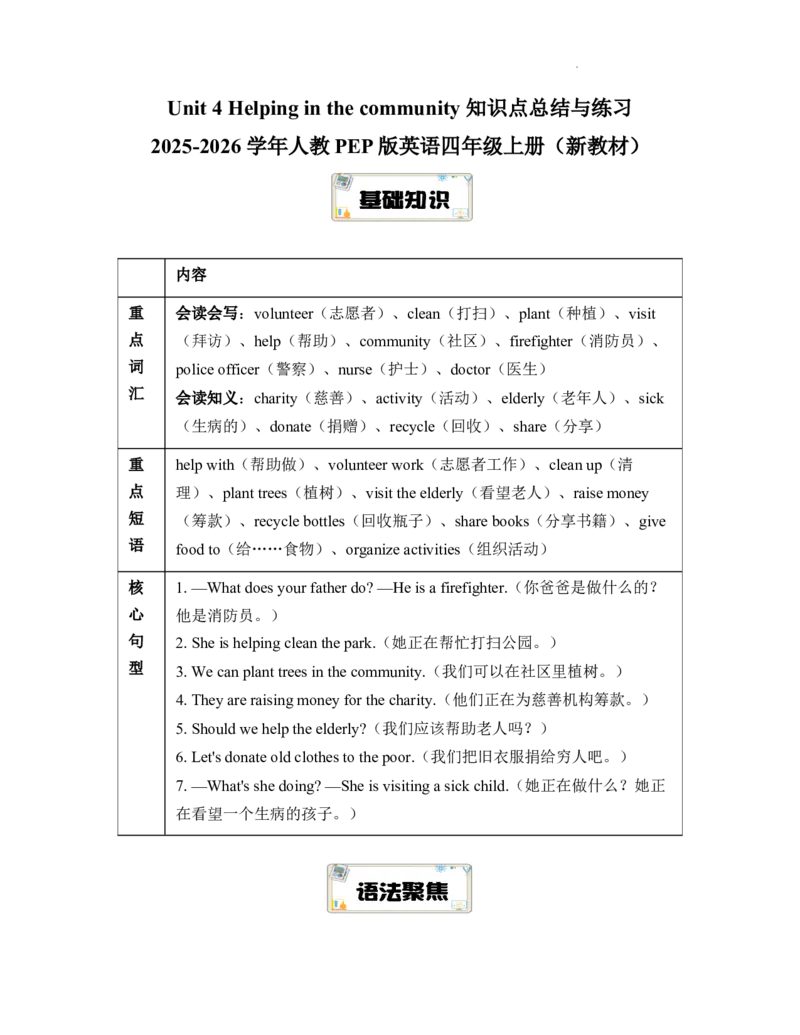
Unit 4 Helping in the community
一、重点词汇
* why 为什么 * driver 司机 * cook 厨师 * police 警察
* tell 讲述;告诉 *bed 床 * Mrs 太太;夫人 cleaner 清洁工
everyone 每人 volunteer 志愿者 firefighter 消防队员
*old 过去的;年纪大的;老的 * those(that 的复数形式)那些
二、重点短语
police officer 警察;警员 a lot of 大量;许多 make the bed 铺床
cross the road 过马路 right now 现在 stay safe 保持安全
clean the community 打扫社区 delivery worker 快递员
tell funny stories 讲有趣的故事 sing old songs 唱老歌
clean the room 打扫房间 at the bus stop 在公共汽车站
community volunteers 社区志愿者 draw a picture 画一幅画
a school bus driver 一位校车司机 an important job 一份重要的工作
make it a better place 使它成为一个更好的地方
三、重要句型
1. Our neighbour is a firefighter. He often helps people.
我们的邻居是消防员。他经常帮助别人。
2. — He’ s a school bus driver. He takes us to school every day.
他是校车司机。他每天送我们去学校。
— That's an important job too! 那个工作也很重要!
3. Chen Jie is making the bed.陈杰正在铺床。
4. Here is Zhang Peng. He’ s singing old songs. 这是张鹏。他在唱老歌。
5. Look! Some students are cleaning the room in an old people's home.
看!一些学生正在一个老人之家里打扫房间。
6. In the kindergarten, John and Class One are singing songs together.
在幼儿园,约翰和一班(的小朋友们)在一起唱歌。
第 7 页 共 12 页7. Liu Jia’ s father takes us to school every day. Look! He is driving our school
bus. 刘佳的爸爸每天送我们去学校。看!他在开我们的校车。
8. Be nice to each other. Don't fight or hurt others.
善待彼此。不要打架或伤害别人。
四、语音
ph /f/ Philip 菲利普 phone 电话 photo 照片 elephant 大象
五、重点语法
现在进行时表示正在进行的动作或存在的状态,也可表示当前一段时间内
的活动或现阶段正在进行的动作。标志词有 now,look,listen 等以及某
些具体时刻。
1.现在进行时的陈述句
肯定句结构为“主语+ be 动词(am/ is/ are)+动词-ing 形式(+其他).”。 be
动词与主语的人称和单复数形式一致。如:
Look! He is cleaning the playground now. 看! 他现在正在打扫操场。
It's nine o' clock, I am sweeping the floor now.
九点钟了。我现在正在扫地。
Listen! They are reading English. 听! 他们正在读英语。
否定句在 be 动词后加 not。如:
He is not(isn't) watering the flowers.
他现在不在浇花。
2.动词现在分词(动词-ing 形式)构成规律:
(1)大部分动词是在其原形后直接加-ing。如: do— doing, clean— cleaning
(2)以不发音的 e 结尾的动词,先去掉 e,再加-ing。
如: make—— making,write—— writing, take—— taking
(3)以重读闭音节结尾的动词,如末尾只有一个辅音字母,则应先双写这个
辅 音 字 母 ,再 加 -ing。 如 : sit— sitting, swim—— swimming, run——
running
(4)部分以 ie 结尾的动词,把 ie 改为 y,再加-ing。如: die— dying(死
亡),lie— lying(躺/撒谎)
第 8 页 共 12 页四年级上册英语1-6单元必背知识点总结人教版
Unit 5 The weather and us
一、重点词汇
* speak 说话;发言 * weather 天气 Sydney 悉尼 * hot 热的
* cloudy 多云的 * cold 冷的 * windy 多风的 * swim 游泳
* warm 温暖的 snowy 多雪的 * cool 凉爽的 rainy 阴雨的
* tomorrow 在明天 * rain 下雨;雨 closed 关闭的 * film 电影
* kite 风筝 snowman 雪人 *their 他们的;她们的;它们的
*fly 操纵(飞行器等);飞 * sunny 阳光充足的 * bad 令人不快的;坏的
二、重点短语
play basketball 打篮球 fly a kite 放风筝 see a film 看电影
affect people's lives 影响人们的生活 cool and sunny 凉爽且晴朗
warm and windy 温暖且多风 thirsty and hungry 又渴又饿
in different weather 在不同的天气 make cards at home 在家做卡片
on sunny days 在阳光明媚的日子里 make a snowman 堆雪人
make a bad weather reminder 制作一个坏天气提醒
三、重要句型
1. — Hello! Mark speaking. 你好! 我是马克。
— Hi, Mark! This is John. What's the weather like in Sydney?
嗨,马克!我是约翰。悉尼的天气怎么样?
— Well, it's quite sunny today. 噢,今天是大晴天。
2. It's only two degrees in Beijing. 北京只有两度。
3. — It's raining now. 现在下雨了。
— Oh no! We can't play basketball in the park.
哦不!我们不能在公园打篮球了。
— It's OK. We can go to the library. 没关系。我们可以去图书馆。
4. There is a new film on. Let's go and see it.
第 9 页 共 12 页有一部新电影上映。我们一起去看吧。
5. It's hot and sunny here. 这里很热,是个大晴天。
四、语音
th /θ/ thirsty 口渴的 thin 瘦的 thank 感谢 think 认为 three 三
th/ð/ these 这些 they 他/她/它们 there 在那里 them 他/她/它们
五、重点语法
1.名词变形容词
一些描述天气的形容词由名词变化而来。让我们一起看看常用的一些名
词如何转化为形容词。
(1) 名 词 +y( 或 双 写 最 后 的 辅 音 字 母 再 加 y) 构 成 形 容 词 。 如 :
rain(雨)→rainy(多雨的)
(2)名词+ ful 构成形容词。如: use(使用)→useful(有用的)
(3)名词+ ly 构成形容词。如: friend(朋友)→friendly(友好的)
(4)名词+ en 构成形容词。如: gold(黄金)→golden(金色的)
2.询问天气的疑问句及回答
询问天气怎么样的特殊疑问句为“What is the weather like(+其他)?”或者
“How is the weather(+其他)?”。问句中的 like 不作动词,而是作介词,意为
“像……一样”;weather 前的 the 不能省略。答语,也就是描述天气的句
型,通常结构为“It+is+表示天气情况的形容词(+其他).”。如:
—— What is the weather like in Nanjing today? = How is the weather in
Nanjing today? 今天南京天气怎么样?
— It is sunny and hot. (天气)晴朗又炎热。
第 10 页 共 12 页四年级上册英语1-6单元必背知识点总结人教版
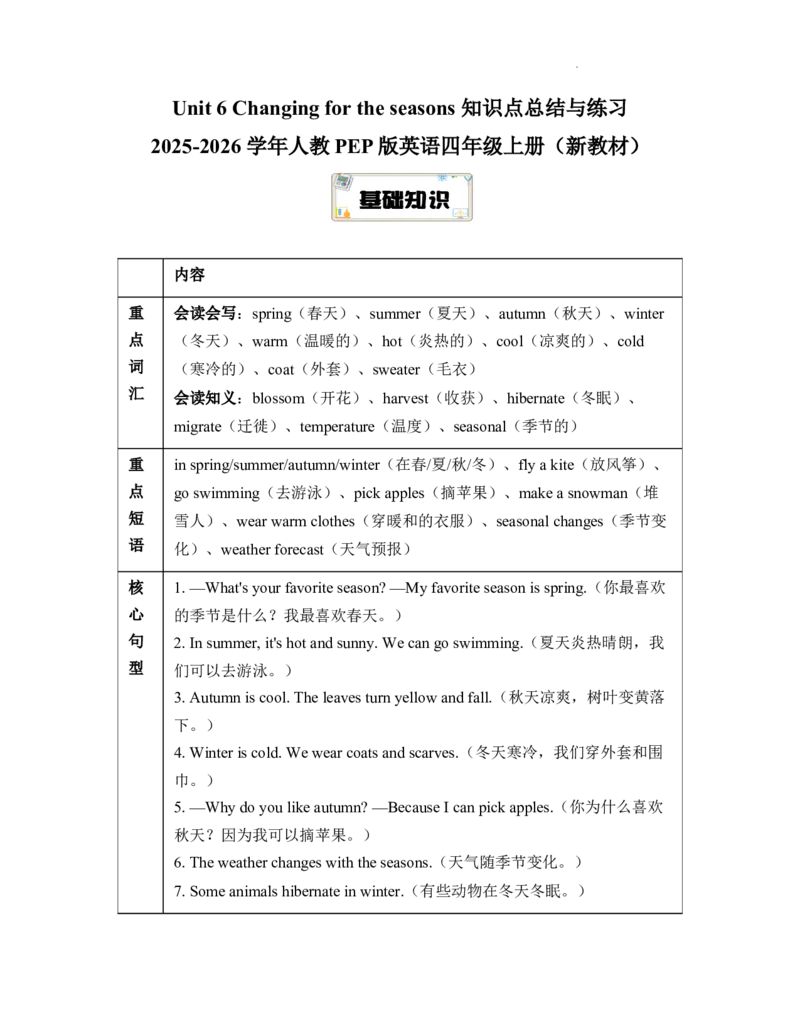
Unit 6 Changing for the seasons
一、重点词汇
* whose 谁的 * sweater 毛衣 * sock 短袜 * wear 穿;戴
* shirt 衬衫 * coat 大衣;外套 * dress 连衣裙 glove 手套
* season 季节 * winter 冬天 * snow 下雪;雪 * get (使)达到,处于
* spring 春天 * summer 夏天 * autumn 秋天 * then 然后;那时
mine 我的 shirt T 恤衫 fall 落下 leaf 叶
* which 哪一个;哪一些
二、重点短语
in different seasons 在不同的季节 wear a coat 穿一件外套
make a snowman 堆雪人 get together 聚会
full of life 充满生机 enjoy mooncakes 品尝月饼
swim in the sea 在海里游泳 eat seafood 吃海鲜
pack for their winter holidays 为他们的寒假打包行装
which season 哪个季节
三、重要句型
1. — Whose sweater is this, Mum? 这是谁的毛衣,妈妈?
— It's your dad’ s. Put it there, please. 是你爸爸的。请把它放在那儿。
2. — Can I wear this new shirt today? 我今天可以穿这件新衬衫吗?
— Yes, but wear a coat too. It's cold and windy outside.
可以,但是再穿一件外套吧。外面有风,很冷。
3. — Which season do you like? 你喜欢哪个季节?
— Winter. It snows a lot. I can play in the snow and make a snow
man. Whatabout you?
冬天。冬天经常下雪。我可以在雪地里玩,还能堆雪人。你呢?
— I like winter too. There are many festivals.
我也喜欢冬天。(在冬天)有很多节日。
第 11 页 共 12 页4. It's full of life. (春天)充满生机。
5. I wear sweaters and shirts. And enjoy mooncakes.
我穿毛衣和衬衫。还品尝月饼。
6. Then spring comes again. 接着春天又来了。
四、语音
wh /w/ why 为什么 what 什么 where 哪里 white 白色
五、重点语法
1.名词性物主代词
物主代词分为形容词性物主代词和名词性物主代词。如下所示:
人称 第一人称 第二人称 第三人称
单复数 单数 复数 单数 复数 单数 复数
形容词性物主代词 my our your your his her its their
名词性物主代词 mine ours yours yours his hers its theirs
为避免重复使用名词,有时会使用名词性物主代词代替“形容词性物主
代词+名词”。如: His shoes are blue. Hers are yellow. 他的鞋是蓝色的。她
的(鞋)是黄色的。
2.有生命之物的名词所有格
名词中表示所属关系的形式叫作名词所有格。有生命之物的名词所有格
具体形式如下:(1)在单数名词词尾加's。如:Amy's cat 埃米的猫
(2)复数名词以 s 结尾的,在词尾加’。如: teachers’chairs 教师的椅子
不以 s 结尾的复数名词,在词尾加’s。如: Children’s Day 儿童节
(3)表示两个人共有时,在后一个名字末尾加’s。表示两个人各自拥有时,
分别在两个名字后加’s。如:
Lucy and Lily's bedroom 露西和莉莉(共有)的卧室
Lucy's and Lily's bedrooms 露西和莉莉(各自)的卧室
3.特殊疑问词 whose 的用法
特殊疑问词 whose 意为“谁的”,一般对名词性物主代词或名词所有格提
问,构成询问事物所属关系的特殊疑问句。常用句型:——Whose+物品
+is/are+指示代词? — It's/ They' re+.名词所有格/名词性物主代词.如:
——Who sepicture is that? 那幅画是谁的? — It’ s Tim’ s./ It’s his.是蒂姆
的。/是他的。
第 12 页 共 12 页