初中英语语法大全,寒假收好慢慢看!
一.名词
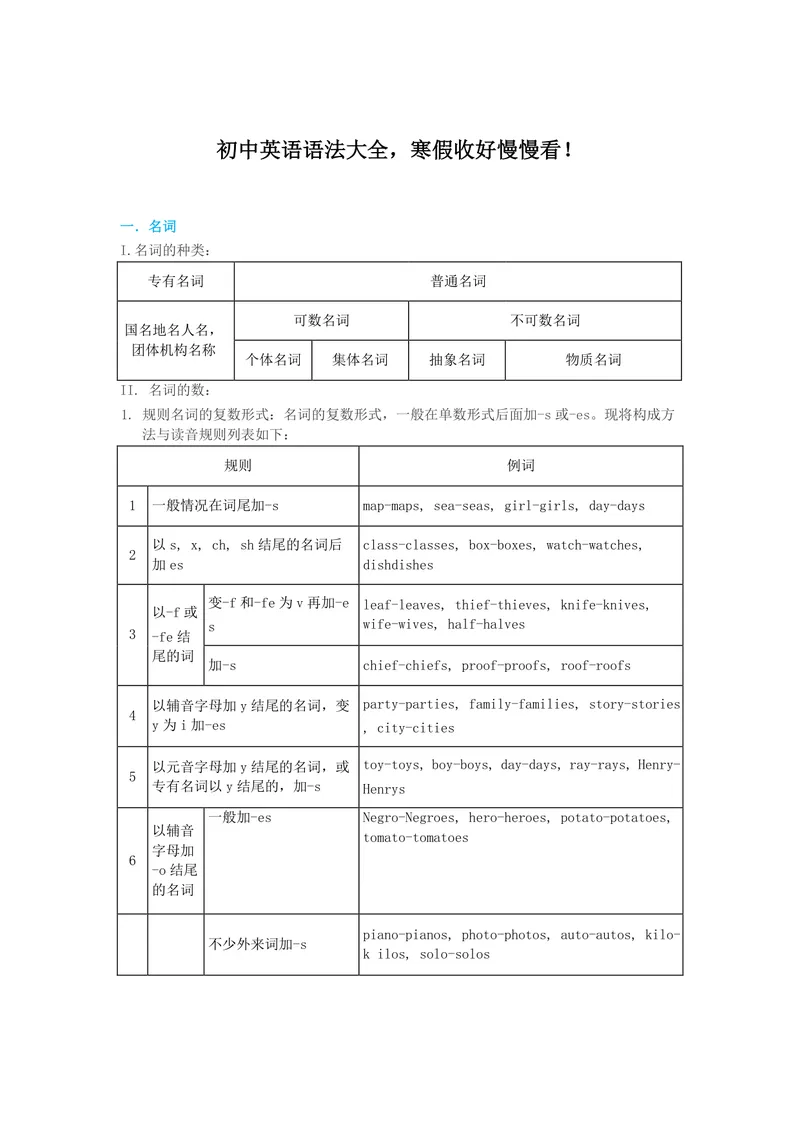
I.名词的种类:
专有名词 普通名词
可数名词 不可数名词
国名地名人名,
团体机构名称
个体名词 集体名词 抽象名词 物质名词
II. 名词的数:
1. 规则名词的复数形式:名词的复数形式,一般在单数形式后面加-s或-es。现将构成方
法与读音规则列表如下:
规则 例词
1 一般情况在词尾加-s map-maps, sea-seas, girl-girls, day-days
以s, x, ch, sh结尾的名词后 class-classes, box-boxes, watch-watches,
2
加es dishdishes
变-f和-fe为v再加-e leaf-leaves, thief-thieves, knife-knives,
以-f或
s wife-wives, half-halves
3 -fe结
尾的词
加-s chief-chiefs, proof-proofs, roof-roofs
以辅音字母加y结尾的名词,变 party-parties, family-families, story-stories
4
y为i加-es , city-cities
以元音字母加y结尾的名词,或 toy-toys, boy-boys, day-days, ray-rays, Henry-
5
专有名词以y结尾的,加-s Henrys
一般加-es Negro-Negroes, hero-heroes, potato-potatoes,
以辅音
tomato-tomatoes
字母加
6
-o结尾
的名词
piano-pianos, photo-photos, auto-autos, kilo-
不少外来词加-s
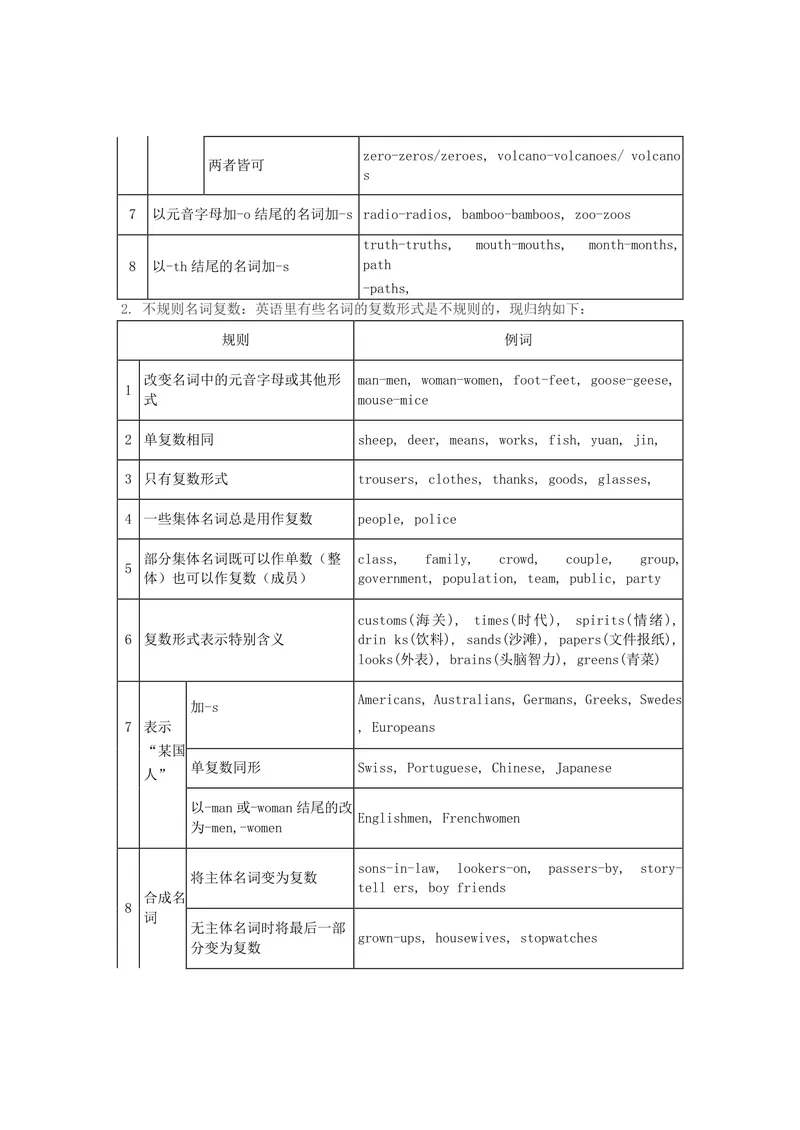
k ilos, solo-soloszero-zeros/zeroes, volcano-volcanoes/ volcano
两者皆可
s
7 以元音字母加-o结尾的名词加-s radio-radios, bamboo-bamboos, zoo-zoos
truth-truths, mouth-mouths, month-months,
8 以-th结尾的名词加-s path
-paths,
2. 不规则名词复数:英语里有些名词的复数形式是不规则的,现归纳如下:
规则 例词
改变名词中的元音字母或其他形 man-men, woman-women, foot-feet, goose-geese,
1
式 mouse-mice
2 单复数相同 sheep, deer, means, works, fish, yuan, jin,
3 只有复数形式 trousers, clothes, thanks, goods, glasses,
4 一些集体名词总是用作复数 people, police
部分集体名词既可以作单数(整 class, family, crowd, couple, group,
5
体)也可以作复数(成员) government, population, team, public, party
customs(海关), times(时代), spirits(情绪),
6 复数形式表示特别含义 drin ks(饮料), sands(沙滩), papers(文件报纸),
looks(外表), brains(头脑智力), greens(青菜)
Americans, Australians, Germans, Greeks, Swedes
加-s
7 表示 , Europeans
“某国
单复数同形 Swiss, Portuguese, Chinese, Japanese
人”
以-man或-woman结尾的改
Englishmen, Frenchwomen
为-men,-women
sons-in-law, lookers-on, passers-by, story-
将主体名词变为复数
tell ers, boy friends
合成名
8
词
无主体名词时将最后一部
grown-ups, housewives, stopwatches
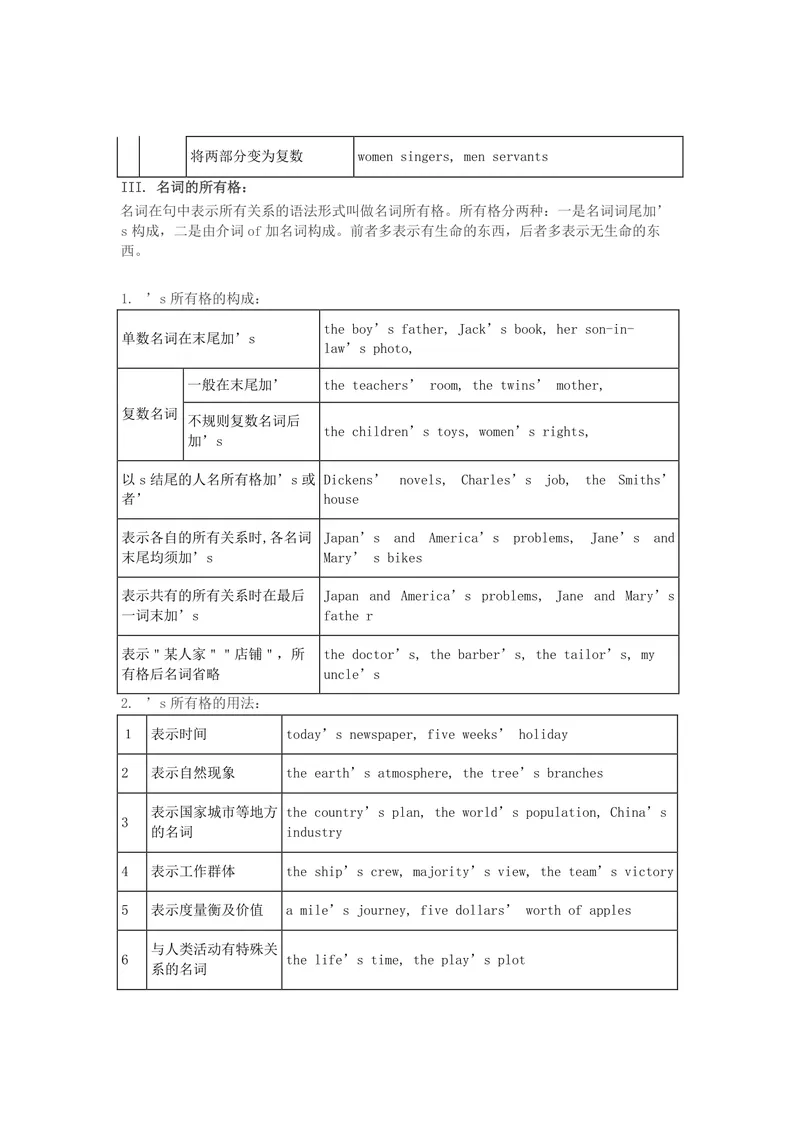
分变为复数将两部分变为复数 women singers, men servants
III. 名词的所有格:
名词在句中表示所有关系的语法形式叫做名词所有格。所有格分两种:一是名词词尾加’
s构成,二是由介词of加名词构成。前者多表示有生命的东西,后者多表示无生命的东
西。
1. ’s所有格的构成:
the boy’s father, Jack’s book, her son-in-
单数名词在末尾加’s
law’s photo,
一般在末尾加’ the teachers’ room, the twins’ mother,
复数名词
不规则复数名词后
the children’s toys, women’s rights,
加’s
以s结尾的人名所有格加’s或 Dickens’ novels, Charles’s job, the Smiths’
者’ house
表示各自的所有关系时,各名词 Japan’s and America’s problems, Jane’s and
末尾均须加’s Mary’ s bikes
表示共有的所有关系时在最后 Japan and America’s problems, Jane and Mary’s
一词末加’s fathe r
表示"某人家""店铺",所 the doctor’s, the barber’s, the tailor’s, my
有格后名词省略 uncle’s
2. ’s所有格的用法:
1 表示时间 today’s newspaper, five weeks’ holiday
2 表示自然现象 the earth’s atmosphere, the tree’s branches
表示国家城市等地方 the country’s plan, the world’s population, China’s
3
的名词 industry
4 表示工作群体 the ship’s crew, majority’s view, the team’s victory
5 表示度量衡及价值 a mile’s journey, five dollars’ worth of apples
与人类活动有特殊关
6 the life’s time, the play’s plot
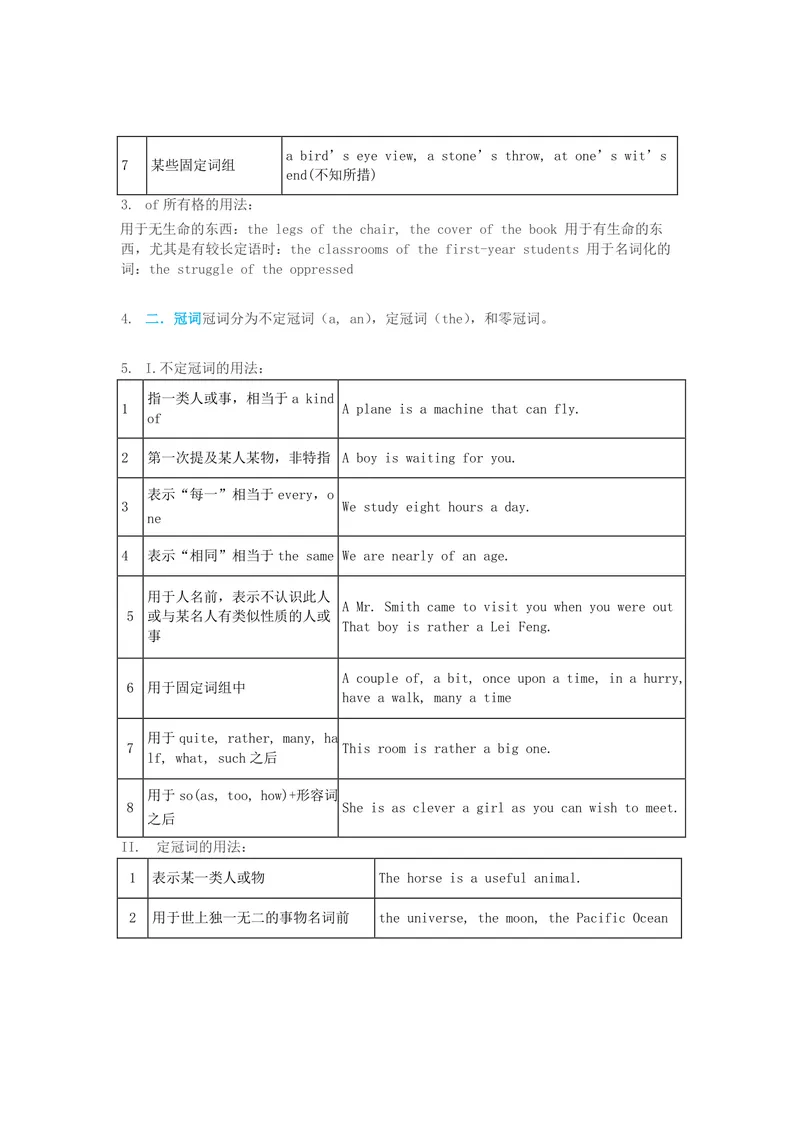
系的名词a bird’s eye view, a stone’s throw, at one’s wit’s
7 某些固定词组
end(不知所措)
3. of所有格的用法:
用于无生命的东西:the legs of the chair, the cover of the book 用于有生命的东
西,尤其是有较长定语时:the classrooms of the first-year students 用于名词化的
词:the struggle of the oppressed
4. 二.冠词冠词分为不定冠词(a, an),定冠词(the),和零冠词。
5. I.不定冠词的用法:
指一类人或事,相当于a kind
1 A plane is a machine that can fly.
of
2 第一次提及某人某物,非特指 A boy is waiting for you.
表示“每一”相当于every,o
3 We study eight hours a day.
ne
4 表示“相同”相当于the same We are nearly of an age.
用于人名前,表示不认识此人
A Mr. Smith came to visit you when you were out
5 或与某名人有类似性质的人或
That boy is rather a Lei Feng.
事
A couple of, a bit, once upon a time, in a hurry,
6 用于固定词组中
have a walk, many a time
用于quite, rather, many, ha
7 This room is rather a big one.
lf, what, such之后
用于so(as, too, how)+形容词
8 She is as clever a girl as you can wish to meet.
之后
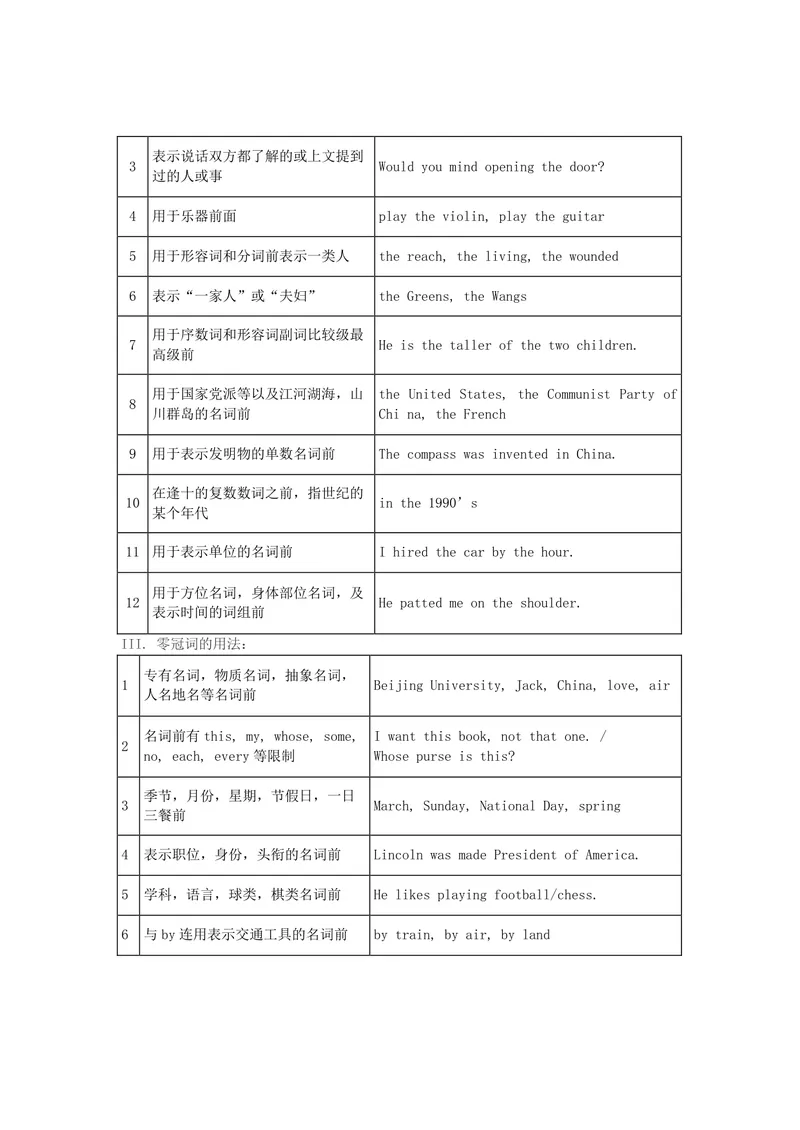
II. 定冠词的用法:
1 表示某一类人或物 The horse is a useful animal.
2 用于世上独一无二的事物名词前 the universe, the moon, the Pacific Ocean表示说话双方都了解的或上文提到
3 Would you mind opening the door?
过的人或事
4 用于乐器前面 play the violin, play the guitar
5 用于形容词和分词前表示一类人 the reach, the living, the wounded
6 表示“一家人”或“夫妇” the Greens, the Wangs
用于序数词和形容词副词比较级最
7 He is the taller of the two children.
高级前
用于国家党派等以及江河湖海,山 the United States, the Communist Party of
8
川群岛的名词前 Chi na, the French
9 用于表示发明物的单数名词前 The compass was invented in China.
在逢十的复数数词之前,指世纪的
10 in the 1990’s
某个年代
11 用于表示单位的名词前 I hired the car by the hour.
用于方位名词,身体部位名词,及
12 He patted me on the shoulder.
表示时间的词组前
III. 零冠词的用法:
专有名词,物质名词,抽象名词,
1 Beijing University, Jack, China, love, air
人名地名等名词前
名词前有this, my, whose, some, I want this book, not that one. /
2
no, each, every等限制 Whose purse is this?
季节,月份,星期,节假日,一日
3 March, Sunday, National Day, spring
三餐前
4 表示职位,身份,头衔的名词前 Lincoln was made President of America.
5 学科,语言,球类,棋类名词前 He likes playing football/chess.
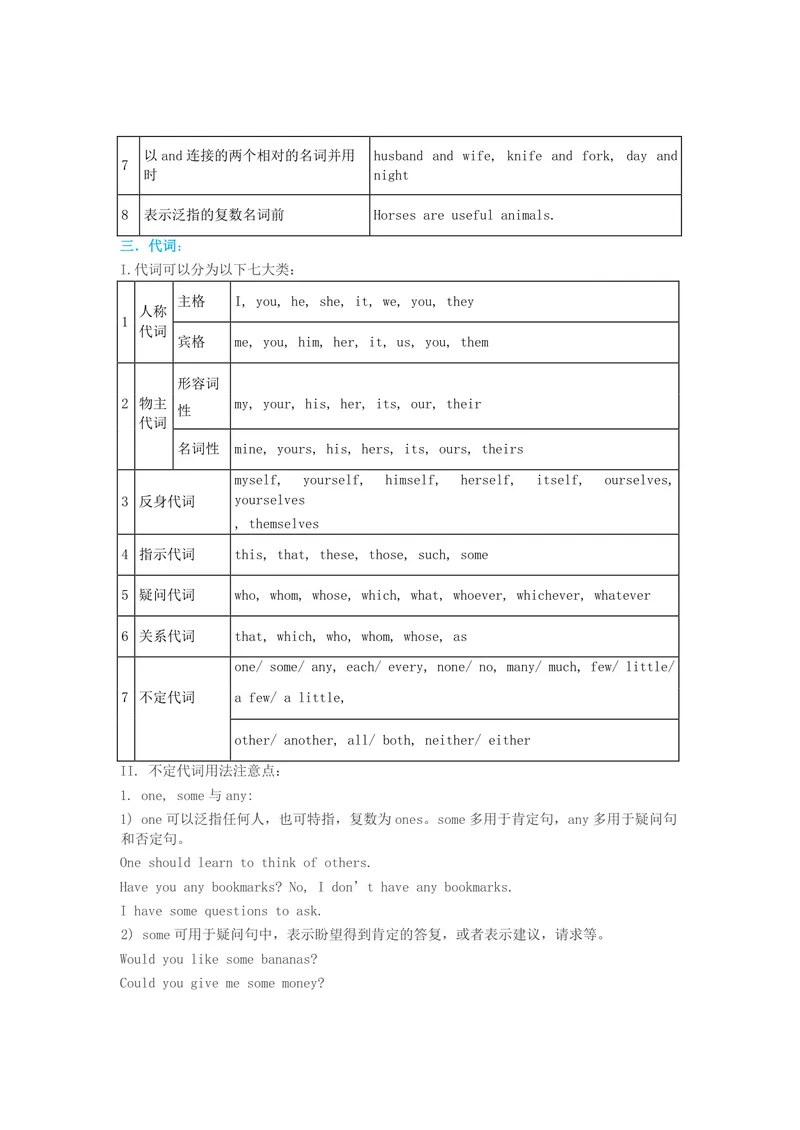
6 与by连用表示交通工具的名词前 by train, by air, by land以and连接的两个相对的名词并用 husband and wife, knife and fork, day and
7
时 night
8 表示泛指的复数名词前 Horses are useful animals.
三.代词:
I.代词可以分为以下七大类:
主格 I, you, he, she, it, we, you, they
人称
1
代词
宾格 me, you, him, her, it, us, you, them
形容词
2 物主 my, your, his, her, its, our, their
性
代词
名词性 mine, yours, his, hers, its, ours, theirs
myself, yourself, himself, herself, itself, ourselves,
3 反身代词 yourselves
, themselves
4 指示代词 this, that, these, those, such, some
5 疑问代词 who, whom, whose, which, what, whoever, whichever, whatever
6 关系代词 that, which, who, whom, whose, as
one/ some/ any, each/ every, none/ no, many/ much, few/ little/
7 不定代词 a few/ a little,
other/ another, all/ both, neither/ either
II. 不定代词用法注意点:
1. one, some与any:
1) one可以泛指任何人,也可特指,复数为ones。some多用于肯定句,any多用于疑问句
和否定句。
One should learn to think of others.
Have you any bookmarks? No, I don’t have any bookmarks.
I have some questions to ask.
2) some可用于疑问句中,表示盼望得到肯定的答复,或者表示建议,请求等。
Would you like some bananas?
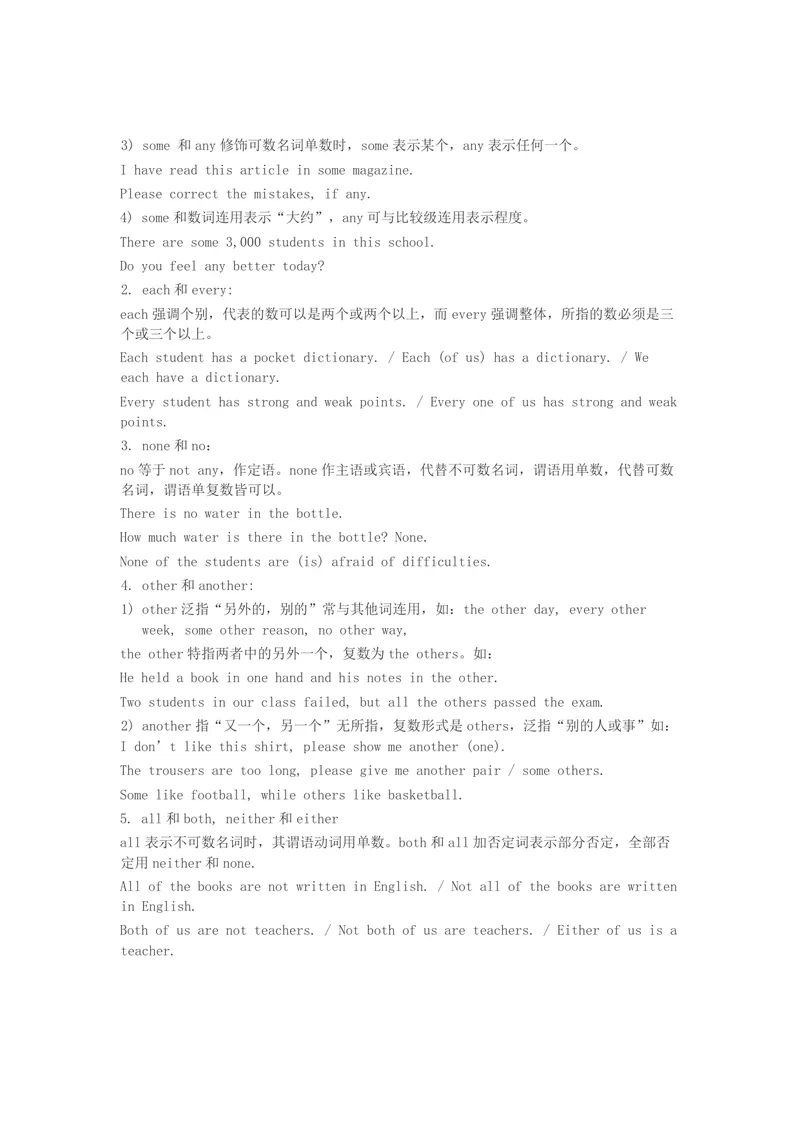
Could you give me some money?3) some 和any修饰可数名词单数时,some表示某个,any表示任何一个。
I have read this article in some magazine.
Please correct the mistakes, if any.
4) some和数词连用表示“大约”,any可与比较级连用表示程度。
There are some 3,000 students in this school.
Do you feel any better today?
2. each和every:
each强调个别,代表的数可以是两个或两个以上,而every强调整体,所指的数必须是三
个或三个以上。
Each student has a pocket dictionary. / Each (of us) has a dictionary. / We
each have a dictionary.
Every student has strong and weak points. / Every one of us has strong and weak
points.
3. none和no:
no等于not any,作定语。none作主语或宾语,代替不可数名词,谓语用单数,代替可数
名词,谓语单复数皆可以。
There is no water in the bottle.
How much water is there in the bottle? None.
None of the students are (is) afraid of difficulties.
4. other和another:
1) other泛指“另外的,别的”常与其他词连用,如:the other day, every other
week, some other reason, no other way,
the other特指两者中的另外一个,复数为the others。如:
He held a book in one hand and his notes in the other.
Two students in our class failed, but all the others passed the exam.
2) another指“又一个,另一个”无所指,复数形式是others,泛指“别的人或事”如:
I don’t like this shirt, please show me another (one).
The trousers are too long, please give me another pair / some others.
Some like football, while others like basketball.
5. all和both, neither和either
all表示不可数名词时,其谓语动词用单数。both和all加否定词表示部分否定,全部否
定用neither和none.
All of the books are not written in English. / Not all of the books are written
in English.
Both of us are not teachers. / Not both of us are teachers. / Either of us is a
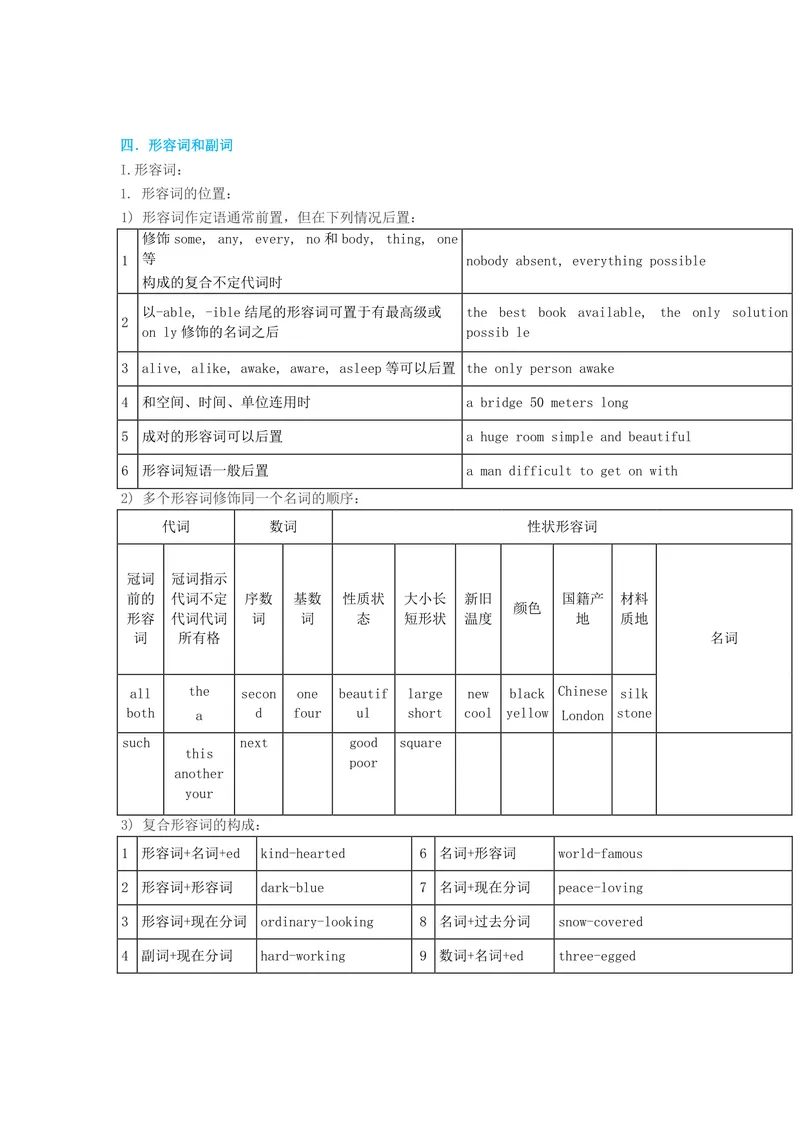
teacher.四.形容词和副词
I.形容词:
1. 形容词的位置:
1) 形容词作定语通常前置,但在下列情况后置:
修饰some, any, every, no和body, thing, one
1 等 nobody absent, everything possible
构成的复合不定代词时
以-able, -ible结尾的形容词可置于有最高级或 the best book available, the only solution
2
on ly修饰的名词之后 possib le
3 alive, alike, awake, aware, asleep等可以后置 the only person awake
4 和空间、时间、单位连用时 a bridge 50 meters long
5 成对的形容词可以后置 a huge room simple and beautiful
6 形容词短语一般后置 a man difficult to get on with
2) 多个形容词修饰同一个名词的顺序:
代词 数词 性状形容词
冠词 冠词指示
前的 代词不定 序数 基数 性质状 大小长 新旧 国籍产 材料
颜色
形容 代词代词 词 词 态 短形状 温度 地 质地
词 所有格 名词
all the secon one beautif large new black Chinese silk
both a d four ul short cool yellow London stone
such next good square
this
poor
another
your
3) 复合形容词的构成:
1 形容词+名词+ed kind-hearted 6 名词+形容词 world-famous
2 形容词+形容词 dark-blue 7 名词+现在分词 peace-loving
3 形容词+现在分词 ordinary-looking 8 名词+过去分词 snow-covered
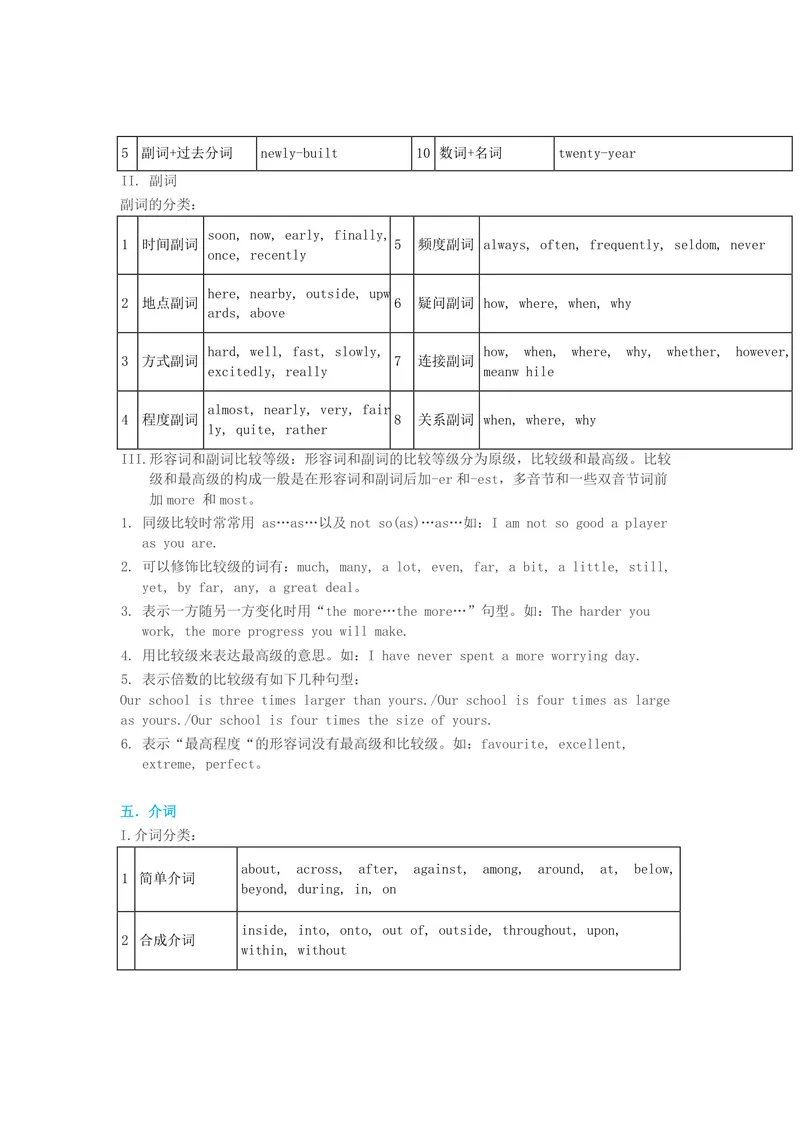
4 副词+现在分词 hard-working 9 数词+名词+ed three-egged5 副词+过去分词 newly-built 10 数词+名词 twenty-year
II. 副词
副词的分类:
soon, now, early, finally,
1 时间副词 5 频度副词 always, often, frequently, seldom, never
once, recently
here, nearby, outside, upw
2 地点副词 6 疑问副词 how, where, when, why
ards, above
hard, well, fast, slowly, how, when, where, why, whether, however,
3 方式副词 7 连接副词
excitedly, really meanw hile
almost, nearly, very, fair
4 程度副词 8 关系副词 when, where, why
ly, quite, rather
III.形容词和副词比较等级:形容词和副词的比较等级分为原级,比较级和最高级。比较
级和最高级的构成一般是在形容词和副词后加-er和-est,多音节和一些双音节词前
加more 和most。
1. 同级比较时常常用 as…as…以及not so(as)…as…如:I am not so good a player
as you are.
2. 可以修饰比较级的词有:much, many, a lot, even, far, a bit, a little, still,
yet, by far, any, a great deal。
3. 表示一方随另一方变化时用“the more…the more…”句型。如:The harder you
work, the more progress you will make.
4. 用比较级来表达最高级的意思。如:I have never spent a more worrying day.
5. 表示倍数的比较级有如下几种句型:
Our school is three times larger than yours./Our school is four times as large
as yours./Our school is four times the size of yours.
6. 表示“最高程度“的形容词没有最高级和比较级。如:favourite, excellent,
extreme, perfect。
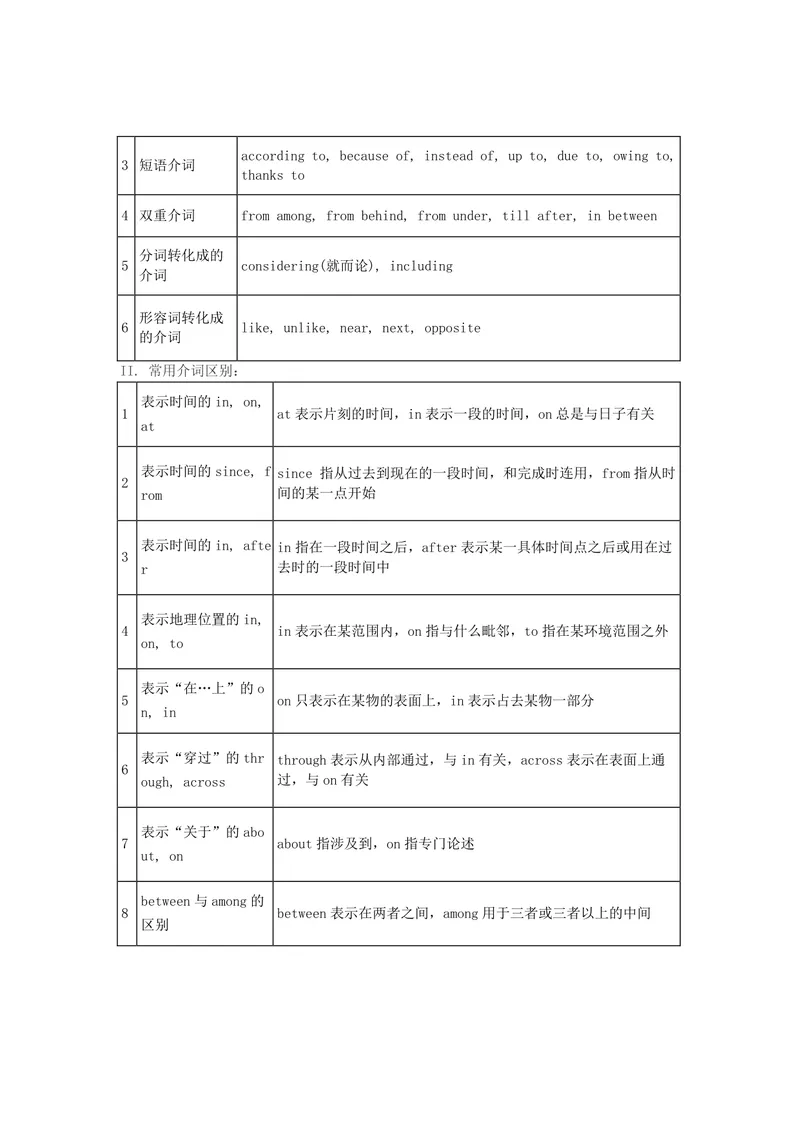
五.介词
I.介词分类:
about, across, after, against, among, around, at, below,
1 简单介词
beyond, during, in, on
inside, into, onto, out of, outside, throughout, upon,
2 合成介词
within, withoutaccording to, because of, instead of, up to, due to, owing to,
3 短语介词
thanks to
4 双重介词 from among, from behind, from under, till after, in between
分词转化成的
5 considering(就而论), including
介词
形容词转化成
6 like, unlike, near, next, opposite
的介词
II. 常用介词区别:
表示时间的in, on,
1 at表示片刻的时间,in表示一段的时间,on总是与日子有关
at
表示时间的since, f since 指从过去到现在的一段时间,和完成时连用,from指从时
2
rom 间的某一点开始
表示时间的in, afte in指在一段时间之后,after表示某一具体时间点之后或用在过
3
r 去时的一段时间中
表示地理位置的in,
4 in表示在某范围内,on指与什么毗邻,to指在某环境范围之外
on, to
表示“在…上”的o
5 on只表示在某物的表面上,in表示占去某物一部分
n, in
表示“穿过”的thr through表示从内部通过,与in有关,across表示在表面上通
6
ough, across 过,与on有关
表示“关于”的abo
7 about指涉及到,on指专门论述
ut, on
between与among的
8 between表示在两者之间,among用于三者或三者以上的中间
区别besides与except besides指“除了…还有再加上”,except指“除了,减去什
9
的区别 么”,不放在句首
1 表示“用”的in, wi with表示具体的工具,in表示材料,方式,方法,度量,单
0 th 位,语言,声音
1 as意为“作为,以…地位或身份”,like为“象…一样”,指
as与like的区别
1 情形相似
1
in与into区别 in通常表示位置(静态),into表示动向,不表示目的地或位置
2
六.动词
I.动词的时态:
1. 动词的时态一共有16种,以ask为例,将其各种时态的构成形式列表如下:
现在时 过去时 将来时 过去将来时
一般 ask / asks asked shall/will ask should/would ask
am/is/are aski was/were askin shall/will be
进行 should/would be asking
ng g ask ing
shall/will have
完成 have/has asked had asked should/would have asked
a sked
完成进 have/has been had been askin shall/will have b should/would have been
行 asking g een asking as king
2. 现在完成时与一般过去时的区别:
1) 现在完成时表示过去发生的动作或存在的状况,但和现在有联系,强调的是对现在造成
的影响或结果,它不能同表示过去的时间状语连用,汉译英时可加“已经”等词。简言
之,利用过去,说明现在。如:
I have already read the novel written by the world-famous writer. (已经看过,且
了解这本书的内容)
2) 一般过去时只表示过去发生的动作或状态,和现在无关,它可和表示过去的时间状语连
用,汉译英时可加“过”,“了”等词。简言之,仅谈过去,不关现在。如:I read the novel last month. (只说明上个月看了,不涉及现在是否记住)
I lived in Beijing for ten years.(只说明在北京住过十年,与现在无关)
3. 现在完成时与现在完成进行时的区别:
两者都可以表示“从过去开始一直持续到现在”,在含义上如着重表示动作的结果时,多
用现在完成时,如着重表示动作一直在进行,即动作的延续性时,则多用现在完成进行
时。一般不能用于进行时的动词也不能用于现在完成进行时。
I have read that book.我读过那本书了。
I have been reading that book all the morning. 我早上一直在读那本书。
4. 一般将来时的表达方式:
将来时 用法 例句
will/shall+动词 My sister will be ten next
1 表示将来发生的动作或存在的状态
原形 year .
It’s going to clear up.
be going to+动词 含有“打算,计划,即将”做某
2 We’re going to have a party
原形 事,或表示很有可能要发生某事
tonight.
go, come, start, move, leave,
be + doing 进行 He is moving to the south.
3 arrive等词可用进行时表示按计
时表示将来 Are they leaving for Europe?
划即将发生的动作
I was about to leave when the
be about to + 动 表示安排或计划中的马上就要发生
4 bell rang.
词原形 的动作,后面一般不跟时间状语
The meeting is about to close.
We’re to meet at the school
5 be to + 动词原形 表示按计划进行或征求对方意见
gate at noon.
The meeting starts at five
一般现在时表示 时刻表上或日程安排上早就定好的
6 o’ clock. The plane leaves
将来 事情,可用一般现在时表示将来
at ten this evening.
II. 动词的被动语态:常用被动 常用被动
构成 构成
语态 语态
一般现在 过去进行
1 am/is/are asked 6 was/were being asked
时 时
一般过去 现在完成
2 was/were asked 7 have/has been asked
时 时
一般将来 过去完成
3 shall/will be asked 8 had been asked
时 时
过去将来 should/would be 将来完成
4 9 will/would have been asked
时 asked 时
现在进行 am/is/are being 含有情态
5 10 can/must/may be asked
时 asked 动词的
被动语态的否定式是在第一个助动词或情态动词后加not,短语动词的被动态不可漏掉
其中介副词。固定结构be
注
意 going to, used to, have to, had better变为被动态时,只需将其后的动词变为被
事
动态。 如:
项
Trees should not be planted in summer. / The boy was made fun of by his
classmates.
Newspapers used to be sent here by the little girl.汉语有一类句子不出现主语,在英语中一般可用被动结构表示。如:
It is believed that…
It is generally considered that…
It is said that…
It is well known that…
It must be pointed out that…
It is supposed that…
It is reported that…
It must be admitted that…
It is hoped that…
下面主动形式常表示被动意义:如:
The window wants/needs/requires repairing.
The book is worth reading twice.
The door won’t shut. / The play won’t act.
The clothes washes well. / The book sells well.
The dish tastes delicious. / Water feels very cold.
下面词或短语没有被动态:
leave, enter, reach, become, benefit, cost, equal, contain, last, lack, fit,
fail, have, appear, happen, occur, belong to, take place, break out, come
about, agree with, keep up with, consist of, have on, lose heart等等
七.情态动词
I.情态动词基本用法:
情态动词 用法 否定式 疑问式与简答
can not / cannot
can 能力(体力,智力,技能) Can…do…?
/c an’t do
允许或许可(口语中常用)
Yes,…can.
可能性(表猜测,用于否定
No,…can’t.
could 句或疑问句中) couldn’t do
May…do…? Yes,…may.
may may not do
可以(问句中表示请求)可 No,…mustn’t/can’t.
能,或许(表推测)祝愿
(用于倒装句中) Might…do…? Yes,…might
might might not do
No,…might not.必须,应该(表主观要求) Must…do…? Yes,…must.
must not/mustn’t
must 肯定,想必(肯定句中表推 No,…needn’t/don’t have
do
测) to.
Do…have to do…?
只好,不得不(客观的必
have to don’t have to do Yes,…do.
须,有时态人称变化)
No,…don’t.
Ought…to do…?
应当(表示义务责任,口语 ought not to/ought
ought to Yes,…ought. No,…
中多用should n’t to do
oughtn’t.
将要,会
Shall…do…?
用于一三人称征求对方意见 shall not/shan’t
shall Yes,…shall.
用于二三人称表示许诺、命 do
No,…shan’t.
令、警告、威胁等
应当,应该(表义务责任) should not/should
should Should…do…?
本该(含有责备意味) n’t do
will will not/won’t do
意愿,决心 Will…do…?
请求,建议,用在问句中w Yes,…will.
would
would ould比较委婉 No,…won’t.
not/wouldn’t do
Dare…do…?
敢(常用于否定句和疑问句 dare not/daren’t
dare Yes,…dare.
中) do
No,…daren’t .
需要 Need…do…?
need not/needn’t
need 必须(常用于否定句和疑问 Yes,…must.
do
句中) No,…needn’t .
Used…to do…?
Yes,…used.
used not/usedn’t
No,…use(d)n’t.
used to 过去常常(现在已不再) /usen’t to do
Did…use to do…?
didn’t use to do
Yes,…did.
No,…didn’t.II. 情态动词must, may, might, could, can表示推测:以must为例。must + do(be)是
推测现在存在的一般状态进行;must + be doing 推测可能正在进行的事情;must +have
done是推测可能已经发生过的事情。
1. must“肯定,一定”语气强,只用于肯定句中。
He must be a man from America. / He must be talking with his friend. / He must
have already arrived there.
2. may和might“也许”,后者语气弱,更没有把握。可用于肯定句和否定句。
He may not be at home. / They might have finished their task.
3. can和could“可能”,could表示可疑的可能性,不及can’t语气强,用于肯定、否
定、疑问句中。
The weather in that city could be cold now.
We could have walked there; it was so near.(推测某事本来可能发生,但实际上没有
发生)
Can he be in the office now? No, he can’t be there, for I saw him in the
library
just now.(语气很强,常用于疑问句和否定句中)
III. 情态动词注意点:
1. can和be able to: 都可以表示能力。但be able to可以表达“某事终于成功”,而
can 无法表达此意。Be able to有更多的时态。另外,两者不能重叠使用。
2. used to和would:
used to表示过去常常做现在已经不再有的习惯,而would只表示过去的习惯或喜好,不
涉及现在。
3. need和dare作情态动词和实义动词的区别:
两者作情态动词时常用于否定句和疑问句。其形式为:needn’t/daren’t do;
Need/dare…do…?
做实义动词时可用于肯定句,否定句和疑问句。其形式为:
need(needs/needed)/dare(dares/dared) to do, don’t(doesn’t/didn’t) need/dare
to do
八.非谓语动词
I.非谓语动词的分类、意义及构成:构成
非谓语形
特征和作用
式
时态和语态 否定式 复合结构
to do to
to be done for sb.
be doin g 具有名词,副词和形容词的作用
不定式 to have t o do
to have 在句中做主、宾、定、表和状语
been done sth.
do ne
doing being done
在非谓
现在
having don having been d
语前加
分词
e one 具有副词和形容词的作用在句中
not
分词
做定、表、宾补和状语
过去
done
分词
doing being done
sb’s do 具有名词的作用在句中做主、
动名词 having don having been d
ing 宾、定和表语
e one
II. 做宾语的非谓语动词比较:
情况 常用动词
只接不定式做 hope, want, offer, long, fail, expect, wish, ask, decide, pretend,
宾语的动词 manage, agree, afford, determine, promise, happen
mind, miss, enjoy, imagine, practise, suggest, finish, escape,
只接动名词做
excus e, appreciate, admit, prevent, keep, dislike, avoid, risk,
宾语的动词或
resist,
短语 consider
can’t help, feel like, succeed in, be fond of, object to, get
down to, be engaged in, insist on, think of, be proud of, take
pride in, set about, be afraid of, be tired of, look forward to,
devote oneself to, be worth, be busy, pay attention to, stick to
begin, start, like, love, hate, prefer, continue(接不定式多指具
体
的动作,接动名词多指一般或习惯行为)意义基本
need, want, require(接动名词主动形式表示被动意义,若接不定式则
相同
应用被动形式)
stop to do 停止手中事,去做另一件事
意义相反
两 stop doing 停止正在做的事
者
都 remember/forget/regret to do
可 (指动作尚未发生) go on to do(接着做另外一件事)
以
remember/forget/regret doing go on doing(接着做同一件事)
(指动作已经发生)
意义不同 try to do(设法,努力去做,尽
力) mean to do(打算做,企图做)
mean doing (意识是,意味着)
try doing(试试去做,看有何结
果)
can’t help to do(不能帮忙做) can’t help doing(忍不住要做)
III.非谓语动词做宾语补足语的区别:
与宾语的逻辑关系及时
常见动词 例句
间概念
ask, beg, expect,
get , order, tell,
want, wish, encourage
主谓关系。强调动作将 I heard him call me several
不定式
发生或已经完成 times.
have, notice, see, wa
tch, hear, feel, let,
make
主谓关系。强调动作正 I found her listening to
现在分词
在进行,尚未完成 the radio.
notice, see, watch, h
动宾关系。动作已经完 We found the village
ear, find, keep, have
过去分词
成,多强调状态 greatly changed.
, feel
IV. 非谓语动词做定语的区别:
区别 举例与被修饰词往往有动宾关系,一般式表示将
I have a lot of papers to type. I
不定式 来,进行式表示与谓语动作同时发生,完成式
have a lot of papers to be typed.
表示在谓语动词之前发生
动名词 通常指被修饰词的用途,无逻辑上的任何关系 Shall we go to the swimming pool?
现在分 与被修饰词之间是主谓关系,表示动作与谓语
词 动作同时发生 the boiling water / the boiled water the
developing country/the developed country the
过去分 与被修饰词之间是被动关系,表示动作发生在 falling leaves / the fallen leaves
词 谓语动作之前,现已经完成
V. 非谓语动词做主语和表语的区别:
区别 举例
My dream is to become a teacher.
多表示一个特定的具体的将来的动作,做主语
To obey the law is important.
不定 时可以借助于it把不定式移到句子后面。做
(dream, business, wish, idea,
式 表语有时可和主语交换位置,而且意义不变,
pla
并且还能用what来提问主语或表语。
n, duty, task做主语时常用)
与不定式的功能区别不大,然而它更接近于名
动名 词,表示的动作比较抽象,或者泛指习惯性的 It is no use saying that again
词 动作,有时也可以用it做形式主语,做表语 and again. Teaching is my job.
时可以和主语互换位置。
无名词的性质,不能做主语。但是有形容词的
The situation is encouraging.
性质,可以做表语,多表明主语的特征性质或
The book is well written.
者状态等,可被very, quite, rather等副词
(常见分词有astonishing,m oving,
修饰。
分词 tiring, disappointing,
现在分词多含有“令人…”之意,说明主语的
puzzling, shocking, boring,
性质特征,多表示主动,主语多为物。过去分
amusing及其-e
词一般表示被动或主语所处的状态,含有“感
d形式)
到…”之意,主语多是人。
九.定语从句
I.定语从句起了形容词的作用,在句中修饰一个名词或代词。被修饰的词叫做先行词,引
导定语从句的词叫关系词,他的作用一是放在先行词与定语从句中间起了连接作用,二是
在从句中担当一个成分,并与先行词保持数的一致。
关系词 先行词 从句成分 例句 备注Do you know the man who is
who 人 主语
talking with your mother?
Mr. Smith is the person with whom
I am working
whom 人 宾语
The boy (whom) she loved died in
the war..
whom, which和th
I like those books whose topics at在从句中做宾语
are about history. 时,常可以省
关系 whose 人,物 定语
代词 The boy whose father works abroad 略,但介词提前时
is my deskmate. 后面关系代词不能
省略,也不可以用
A plane is a machine that can that
主语,宾
that 人,物 fly. She is the pop star (that)
语
I want to see very much.
The book (which) I gave you was
主语,宾 worth $10. The picture which
which 物
语 was about the accident was
terrible.
He is such a person as is
主语,宾 respecte d by all of us. as做宾语一般不省
as 人,物
语 略
This is the same pen as I lost
yest erday.
I will never forget the day when
when 时间 时间状语 可用on which
we met there.
关系 This is the house where I was
where 地点 地点状语 可用in which
副词 born .
I can’t imagine the reason why
why 原因 原因状语 可用for which
he turned down my offer.
II. that与which, who, whom的用法区别:
情况 用法说明 例句1.
先行词为all, everything, anythin
g, nothing, little, much,等不定代
词时。 1.He told me everything that he
2. kno ws. 2.All the books that you
先行词被all, any, every, each, mu offered has been given out.
ch, little, no, some, few等修饰 3.This is the best film that I have
时 ever read.
只用that的
3. 4.We talked about the persons and
情况
先行词有形容词最高级和序数词修饰 things that we remembered. 5.He
时 is the only man that I want to
4. see.
先行词既指人又指物时 6.Who is the man that is making a
speech?
5.先行词被the only, the very修
饰时
6.句中已经有who或which时,为
了避免重复时
1.
在非限制性定语从句中,只能用whi
ch指代物,用who/whom指人
He has a son, who has gone abroad
2.
for further study.
只用which, 在由“介词+关系代词”引导的定语
I like the person to whom the
who, whom
从句中,只能用which指物,whom
teache r is talking.
的情况
指人。
Those who respect others are
3.
usuall y respected by others.
先行词本身是that时,关系词用wh
ich, 先行词为those, one, he时多
用who。
III. as与which的区别:
定语从
区别 例句
句
限制性 He is not such a fool as he looks. Don’t
名词前有such和the same修饰
定语从 read such books as you can’t under
时,关系代词用as,不能用which
句中 stand.as和which都可以指代前面整个主 They won the game, as we had expected.
句。如果有“正如,象”的含义,
非限制 They won the game, which we hadn’t
并可以放在主句前,也可以放在后
性定语 expect ed.
面,那么用as;而which引导的从
从句中
句只能放主句后,并无“正如”的 As is well known, he is a famous film
意思。 star in the 1980s.
IV. 限制性定语从句与非限制性定语从句的区别:
类别 语法意义及特征 例句
对先行词起修饰限制作用,如果去掉,
限制性定 主句意思就不完整明确,这种从句与主 The accident happened at the
语从句 句的关系十分密切,写时不用逗号分 time when I left.
开。
His mother, whom he loved
对先行词作附加的说明,与主句的关系
deeply, died ten years ago.
不十分密切,较松散。从句和主句之间
非限制性
用逗号分开,相当于一个插入语,不能
定语从句
用that引导,关系代词做宾语时也不能
省略。