Unit 2 单元测试
班级________________ 姓名___________________ 学号___________________
一、单项选择 (每题1分,共15分)
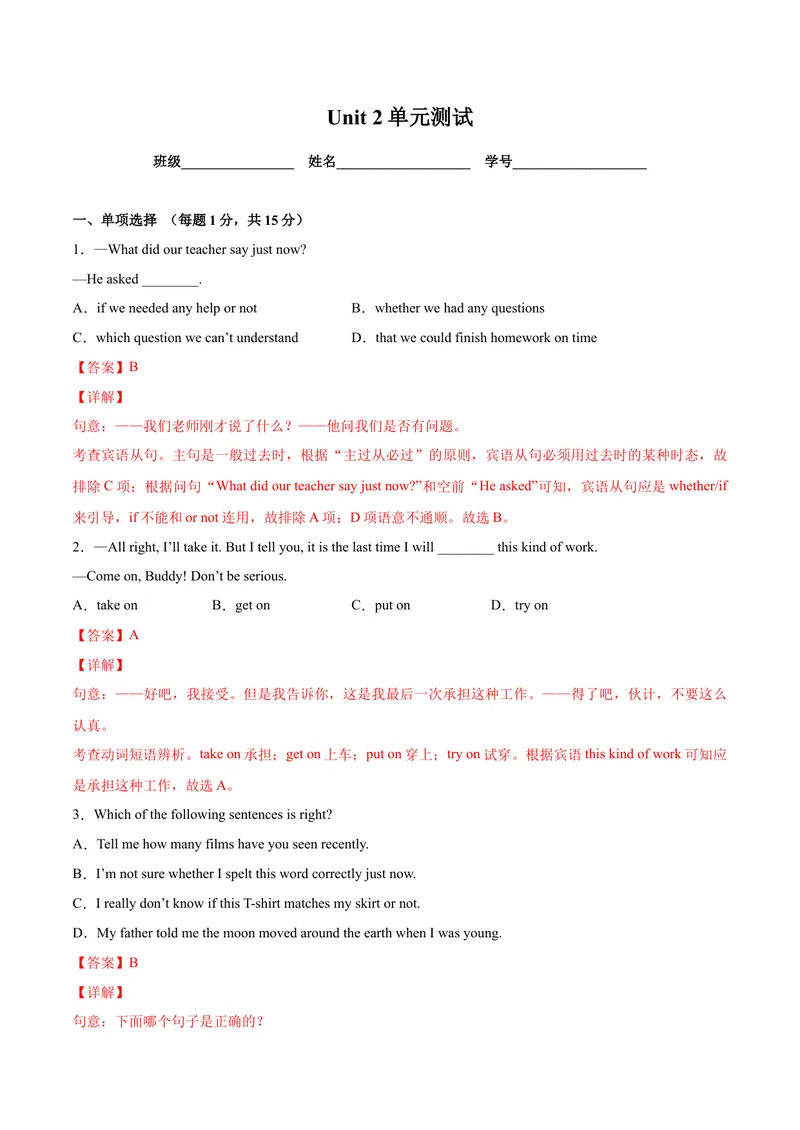
1.—What did our teacher say just now?
—He asked ________.
A.if we needed any help or not B.whether we had any questions
C.which question we can’t understand D.that we could finish homework on time
【答案】B
【详解】
句意:——我们老师刚才说了什么?——他问我们是否有问题。
考查宾语从句。主句是一般过去时,根据“主过从必过”的原则,宾语从句必须用过去时的某种时态,故
排除C项;根据问句“What did our teacher say just now?”和空前“He asked”可知,宾语从句应是whether/if
来引导,if不能和or not连用,故排除A项;D项语意不通顺。故选B。
2.—All right, I’ll take it. But I tell you, it is the last time I will ________ this kind of work.
—Come on, Buddy! Don’t be serious.
A.take on B.get on C.put on D.try on
【答案】A
【详解】
句意:——好吧,我接受。但是我告诉你,这是我最后一次承担这种工作。——得了吧,伙计,不要这么
认真。
考查动词短语辨析。take on承担;get on上车;put on穿上;try on试穿。根据宾语this kind of work可知应
是承担这种工作,故选A。
3.Which of the following sentences is right?
A.Tell me how many films have you seen recently.
B.I’m not sure whether I spelt this word correctly just now.
C.I really don’t know if this T-shirt matches my skirt or not.
D.My father told me the moon moved around the earth when I was young.
【答案】B
【详解】
句意:下面哪个句子是正确的?考查宾语从句。宾语从句应用陈述语序,排除A;if不跟or not连用,排除C;“月亮绕着地球转”是客观
事实和真理,时态用一般现在时,排除D。故选B。
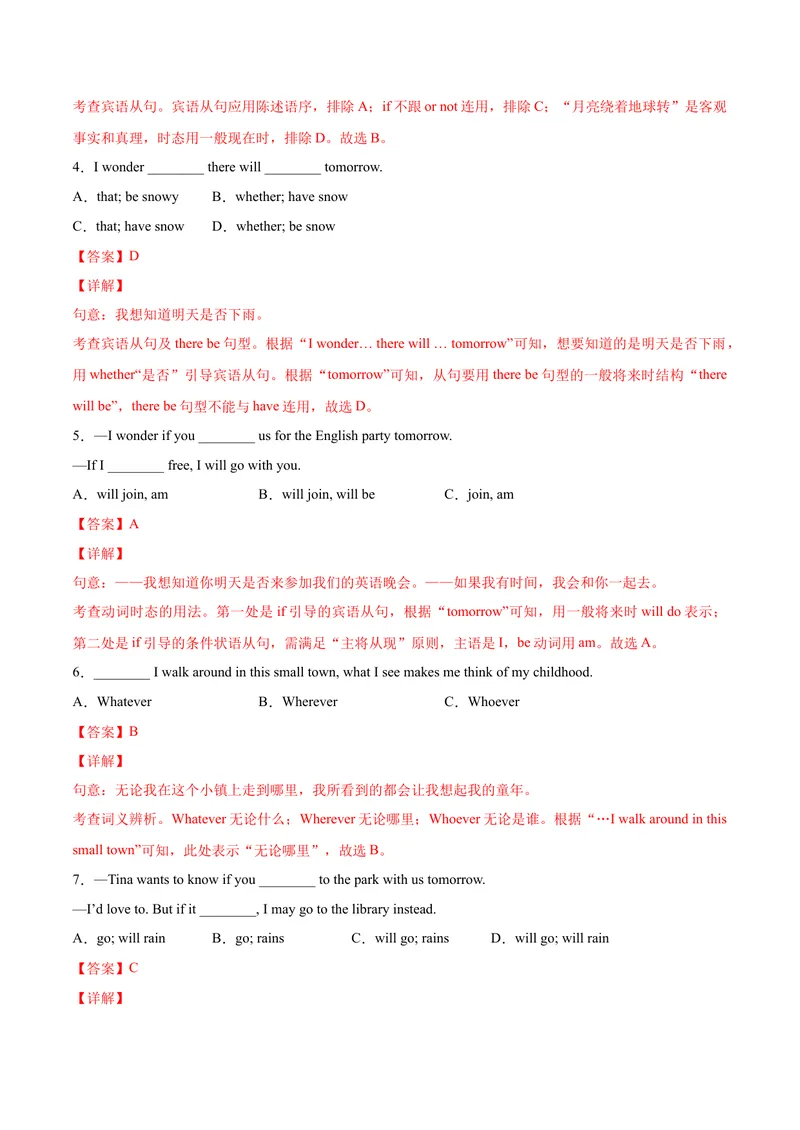
4.I wonder ________ there will ________ tomorrow.
A.that; be snowy B.whether; have snow
C.that; have snow D.whether; be snow
【答案】D
【详解】
句意:我想知道明天是否下雨。
考查宾语从句及there be句型。根据“I wonder… there will … tomorrow”可知,想要知道的是明天是否下雨,
用whether“是否”引导宾语从句。根据“tomorrow”可知,从句要用there be句型的一般将来时结构“there
will be”,there be句型不能与have连用,故选D。
5.—I wonder if you ________ us for the English party tomorrow.
—If I ________ free, I will go with you.
A.will join, am B.will join, will be C.join, am
【答案】A
【详解】
句意:——我想知道你明天是否来参加我们的英语晚会。——如果我有时间,我会和你一起去。
考查动词时态的用法。第一处是if引导的宾语从句,根据“tomorrow”可知,用一般将来时will do表示;
第二处是if引导的条件状语从句,需满足“主将从现”原则,主语是I,be动词用am。故选A。
6.________ I walk around in this small town, what I see makes me think of my childhood.
A.Whatever B.Wherever C.Whoever
【答案】B
【详解】
句意:无论我在这个小镇上走到哪里,我所看到的都会让我想起我的童年。
考查词义辨析。Whatever无论什么;Wherever无论哪里;Whoever无论是谁。根据“…I walk around in this
small town”可知,此处表示“无论哪里”,故选B。
7.—Tina wants to know if you ________ to the park with us tomorrow.
—I’d love to. But if it ________, I may go to the library instead.
A.go; will rain B.go; rains C.will go; rains D.will go; will rain
【答案】C
【详解】句意:——Tina想知道你明天是否和我们一起去公园。——我想去。但是如果下雨,我可能会去图书馆。
考查时态。第一处if翻译为“是否”,引导宾语从句,其后时间状语是tomorrow,所以用一般将来时will
do结构,排除AB。第二处if翻译为“如果”,引导条件状语从句,需遵循“主将从现”原则,主语是
it,谓语动词用三单。故选C。
8.We haven’t decided ________.
A.that we will repair our house B.when did we go to the party
C.where we went on vacation D.whether we will keep a pet
【答案】D
【详解】
句意:我们还没有决定是否要养宠物。
考查宾语从句。此句是宾语从句,从句用陈述语序,排除B选项。C选项是一般过去时,主句也要用过去
的某种时态,而主句 haven’t decided 是现在完成时结构,排除 C;由 haven’t decided 可知,引导词用
whether最合语境。故选D。
9.—In China, we use red paper for hongbao because red means good luck.
—That’s interesting. I want to know more about Chinese ________.
A.problems B.cities C.traditions D.notices
【答案】C
【详解】
句意:——在中国,我们使用红色的纸来当红包,因为红色是好运的含义。——那很有趣。我想了解更多
关于中国传统的东西。
考查名词。problems问题;cities城市;traditions传统;notices通知。根据“we use red paper for hongbao
because red means good luck”可知讲述的是关于中国传统的东西,用名词“traditions”。故选C。
10.—I am worried about ________ I can enter a good high school or not.
—Take it easy. Be confident of yourself.
A.why B.when C.whether D.where
【答案】C
【详解】
句意:——我担心我能否进入一所好的高中。 ——别紧张。相信你自己!
考查宾语从句引导词。why为什么;when什么时候;whether是否;where哪里;about是介词,后接宾语
从句。结合句末的or not可知,此处应用whether,意为“是否”。故选C。
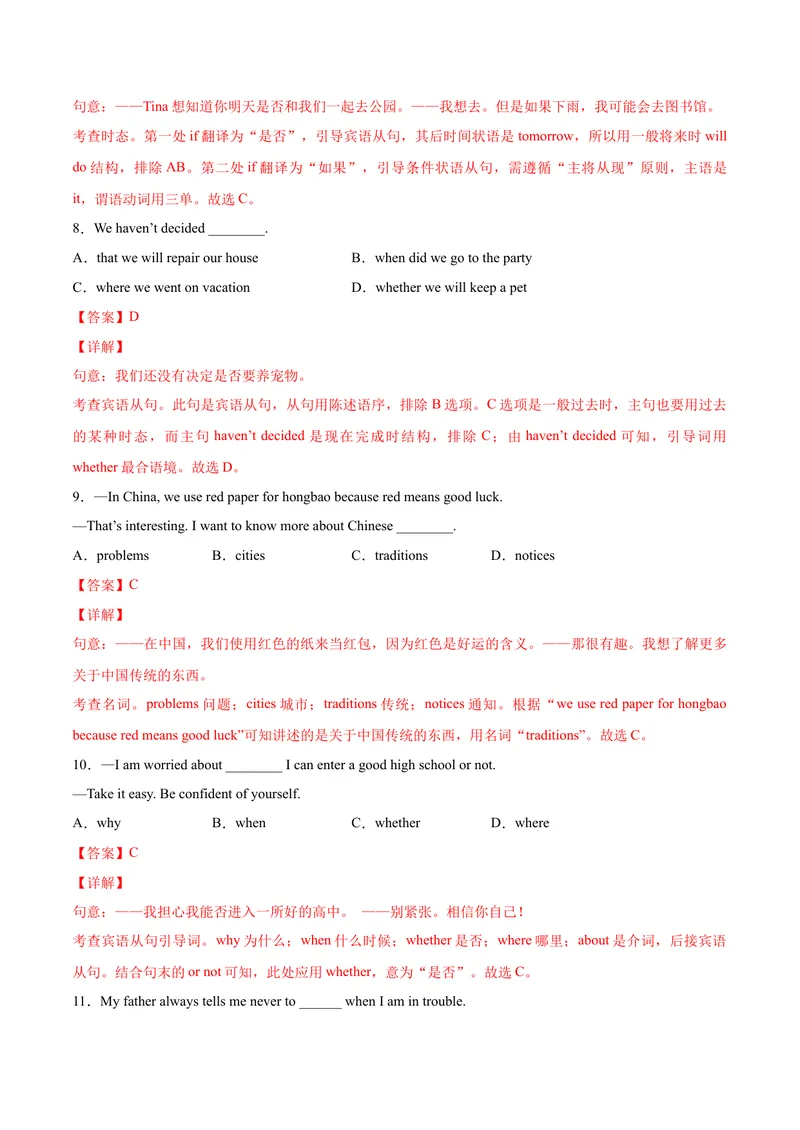
11.My father always tells me never to ______ when I am in trouble.A.give up B.put on C.help out
【答案】A
【详解】
句意:我的父亲总是告诉我,当我遇到困难时,永远不要放弃。
考查动词短语辨析。give up放弃;put on穿上;help out帮助……摆脱困难。根据“My father always tells
me never to … when I am in trouble”可知,遇到困难不要放弃,故选A。
12.—What did you do just now?
—I called Lily to ask her ________.
A.what will she do this weekend
B.whether she’d like to go shopping with me
C.why she is late for class today
D.who did she play volleyball with
【答案】B
【详解】
句意:——你刚才做了什么? ——我打电话给莉莉问她是否愿意和我一起去购物。
考查宾语从句。宾语从句应该用陈述句语序,排除 A/D;由called可知,主句的时态为一般过去时,因此
宾语从句也用过去的某种时态,排除C。故选B。
13.My father is crazy about DIY. He’s trying to ________ a cupboard in the kitchen.
A.put up B.put in C.put on D.put away
【答案】B
【详解】
句意:我爸爸很喜欢DIY。他想在厨房里装个碗柜。
考查动词短语辨析。put up举起,张贴;put in安装;put on穿上;put away整理。根据“He’s trying to…a
cupboard in the kitchen.”可知,是安装碗柜,故选B。
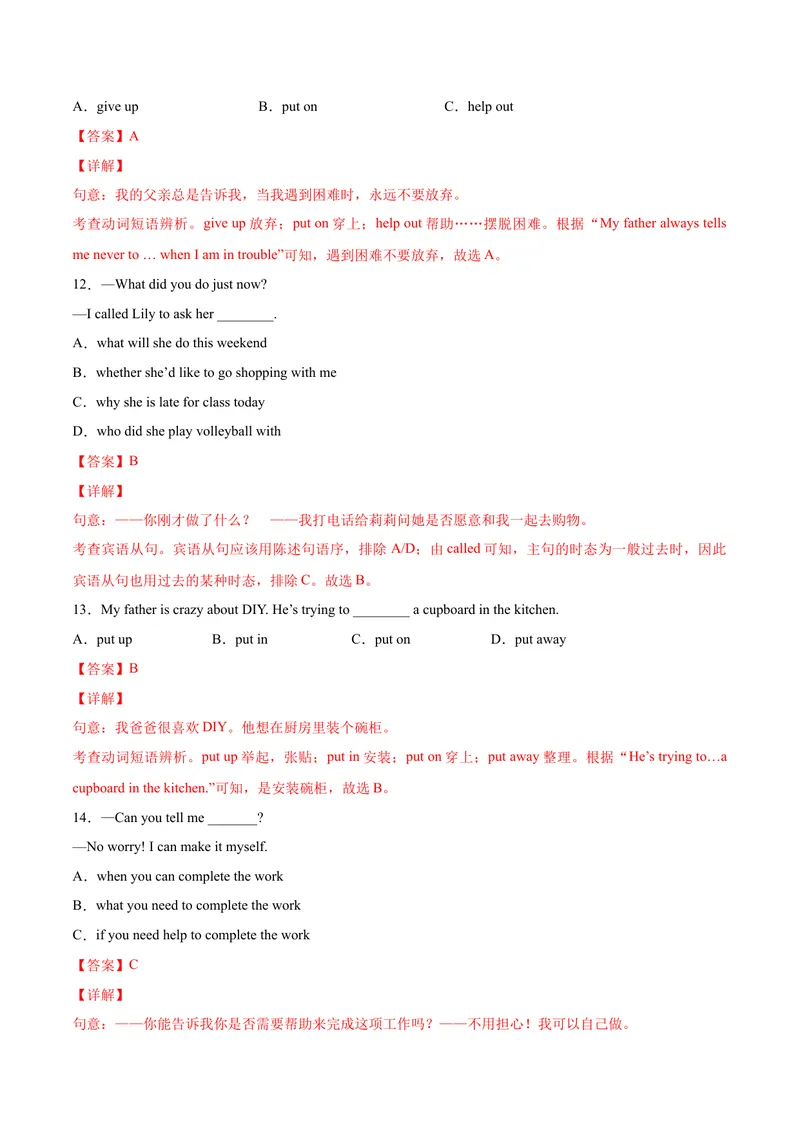
14.—Can you tell me _______?
—No worry! I can make it myself.
A.when you can complete the work
B.what you need to complete the work
C.if you need help to complete the work
【答案】C
【详解】
句意:——你能告诉我你是否需要帮助来完成这项工作吗?——不用担心!我可以自己做。考查宾语从句。when you can complete the work你什么时候能完成这项工作;what you need to complete the
work你需要什么来完成工作;if you need help to complete the work你是否需要帮助来完成这项工作。根据
答语“No worry! I can make it myself.”可知,此处表示“是否”,故选C。
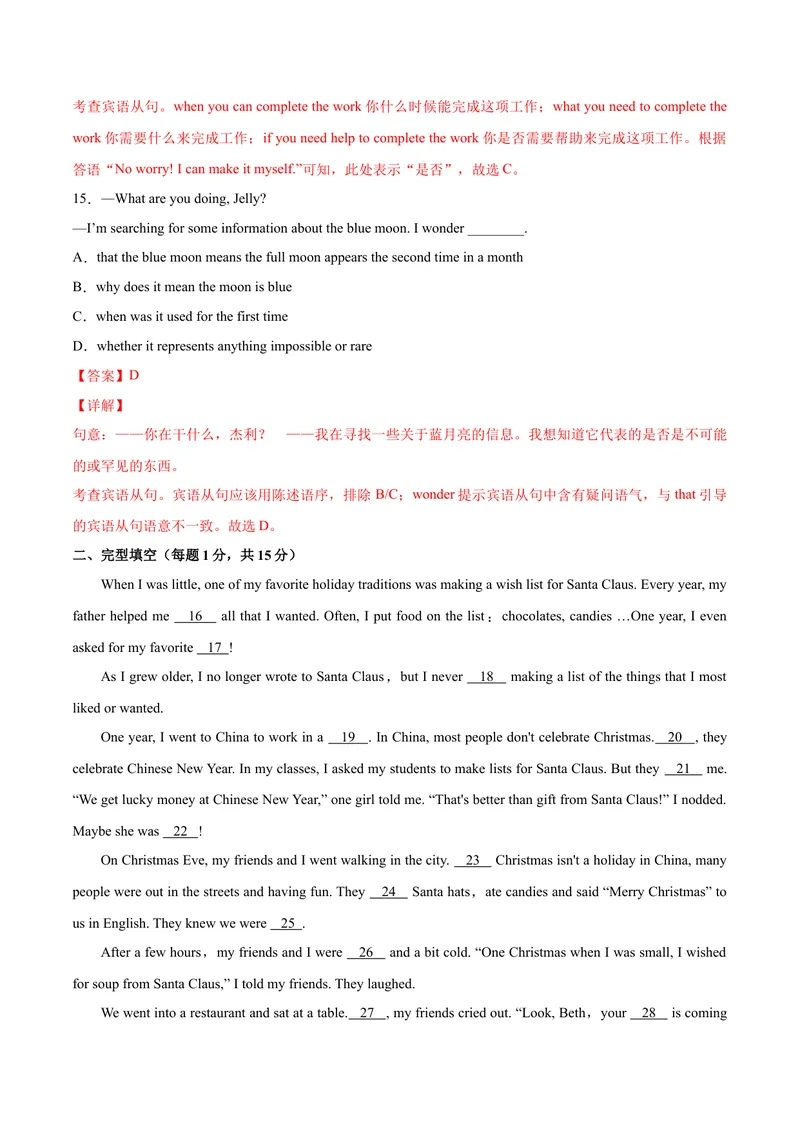
15.—What are you doing, Jelly?
—I’m searching for some information about the blue moon. I wonder ________.
A.that the blue moon means the full moon appears the second time in a month
B.why does it mean the moon is blue
C.when was it used for the first time
D.whether it represents anything impossible or rare
【答案】D
【详解】
句意:——你在干什么,杰利? ——我在寻找一些关于蓝月亮的信息。我想知道它代表的是否是不可能
的或罕见的东西。
考查宾语从句。宾语从句应该用陈述语序,排除 B/C;wonder提示宾语从句中含有疑问语气,与that引导
的宾语从句语意不一致。故选D。
二、完型填空(每题1分,共15分)
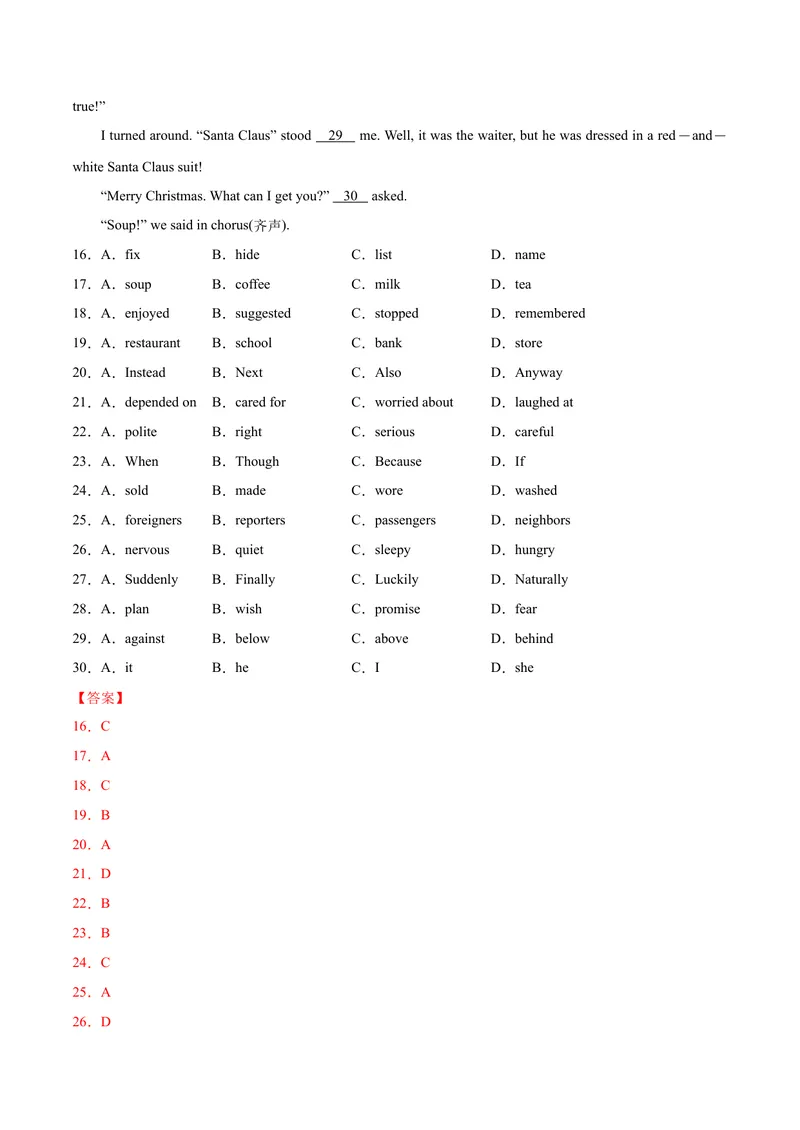
When I was little, one of my favorite holiday traditions was making a wish list for Santa Claus. Every year, my
father helped me 16 all that I wanted. Often, I put food on the list:chocolates, candies …One year, I even
asked for my favorite 17 !
As I grew older, I no longer wrote to Santa Claus,but I never 18 making a list of the things that I most
liked or wanted.
One year, I went to China to work in a 19 . In China, most people don't celebrate Christmas. 20 , they
celebrate Chinese New Year. In my classes, I asked my students to make lists for Santa Claus. But they 21 me.
“We get lucky money at Chinese New Year,” one girl told me. “That's better than gift from Santa Claus!” I nodded.
Maybe she was 22 !
On Christmas Eve, my friends and I went walking in the city. 23 Christmas isn't a holiday in China, many
people were out in the streets and having fun. They 24 Santa hats,ate candies and said “Merry Christmas” to
us in English. They knew we were 25 .
After a few hours,my friends and I were 26 and a bit cold. “One Christmas when I was small, I wished
for soup from Santa Claus,” I told my friends. They laughed.
We went into a restaurant and sat at a table. 27 , my friends cried out. “Look, Beth,your 28 is comingtrue!”
I turned around. “Santa Claus” stood 29 me. Well, it was the waiter, but he was dressed in a red-and-
white Santa Claus suit!
“Merry Christmas. What can I get you?” 30 asked.
“Soup!” we said in chorus(齐声).
16.A.fix B.hide C.list D.name
17.A.soup B.coffee C.milk D.tea
18.A.enjoyed B.suggested C.stopped D.remembered
19.A.restaurant B.school C.bank D.store
20.A.Instead B.Next C.Also D.Anyway
21.A.depended on B.cared for C.worried about D.laughed at
22.A.polite B.right C.serious D.careful
23.A.When B.Though C.Because D.If
24.A.sold B.made C.wore D.washed
25.A.foreigners B.reporters C.passengers D.neighbors
26.A.nervous B.quiet C.sleepy D.hungry
27.A.Suddenly B.Finally C.Luckily D.Naturally
28.A.plan B.wish C.promise D.fear
29.A.against B.below C.above D.behind
30.A.it B.he C.I D.she
【答案】
16.C
17.A
18.C
19.B
20.A
21.D
22.B
23.B
24.C
25.A
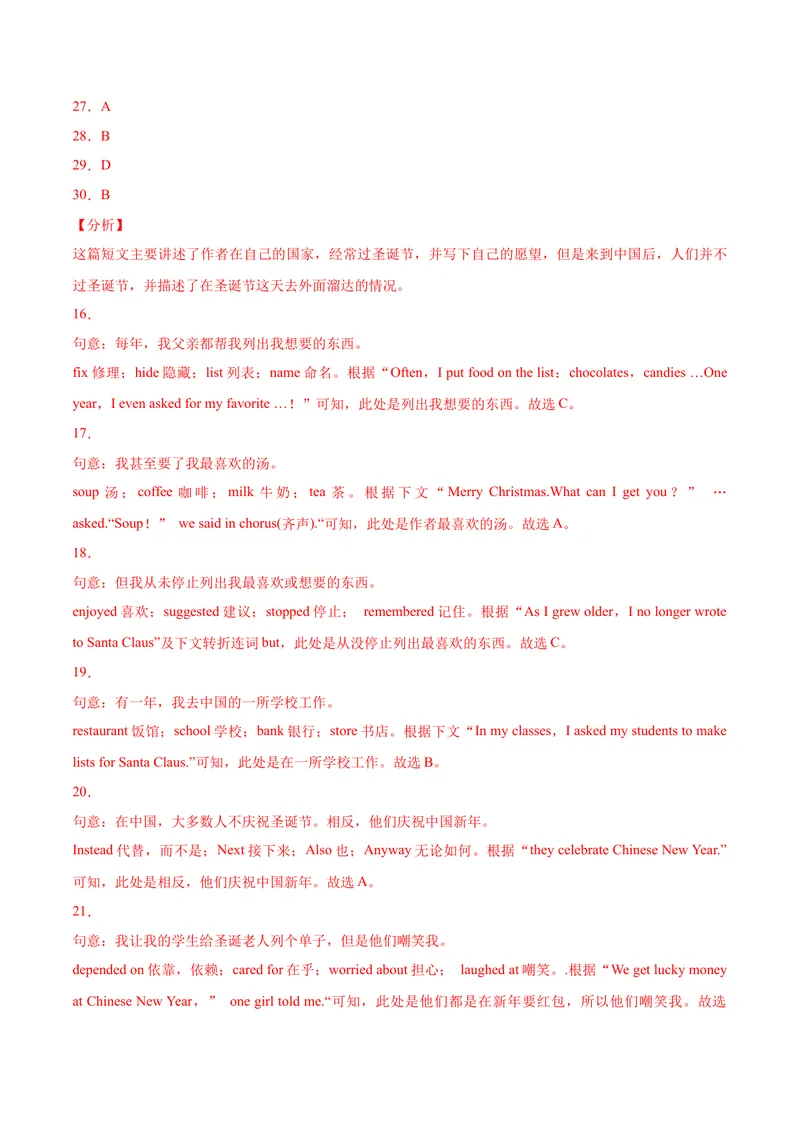
26.D27.A
28.B
29.D
30.B
【分析】
这篇短文主要讲述了作者在自己的国家,经常过圣诞节,并写下自己的愿望,但是来到中国后,人们并不
过圣诞节,并描述了在圣诞节这天去外面溜达的情况。
16.
句意:每年,我父亲都帮我列出我想要的东西。
fix修理;hide隐藏;list列表;name命名。根据“Often,I put food on the list:chocolates,candies …One
year,I even asked for my favorite …!”可知,此处是列出我想要的东西。故选C。
17.
句意:我甚至要了我最喜欢的汤。
soup 汤;coffee 咖啡;milk 牛奶;tea 茶。根据下文“Merry Christmas.What can I get you?” …
asked.“Soup!” we said in chorus(齐声).“可知,此处是作者最喜欢的汤。故选A。
18.
句意:但我从未停止列出我最喜欢或想要的东西。
enjoyed喜欢;suggested建议;stopped停止; remembered记住。根据“As I grew older,I no longer wrote
to Santa Claus”及下文转折连词but,此处是从没停止列出最喜欢的东西。故选C。
19.
句意:有一年,我去中国的一所学校工作。
restaurant饭馆;school学校;bank银行;store书店。根据下文“In my classes,I asked my students to make
lists for Santa Claus.”可知,此处是在一所学校工作。故选B。
20.
句意:在中国,大多数人不庆祝圣诞节。相反,他们庆祝中国新年。
Instead代替,而不是;Next接下来;Also也;Anyway无论如何。根据“they celebrate Chinese New Year.”
可知,此处是相反,他们庆祝中国新年。故选A。
21.
句意:我让我的学生给圣诞老人列个单子,但是他们嘲笑我。
depended on依靠,依赖;cared for在乎;worried about担心; laughed at嘲笑。.根据“We get lucky money
at Chinese New Year,” one girl told me.“可知,此处是他们都是在新年要红包,所以他们嘲笑我。故选D。
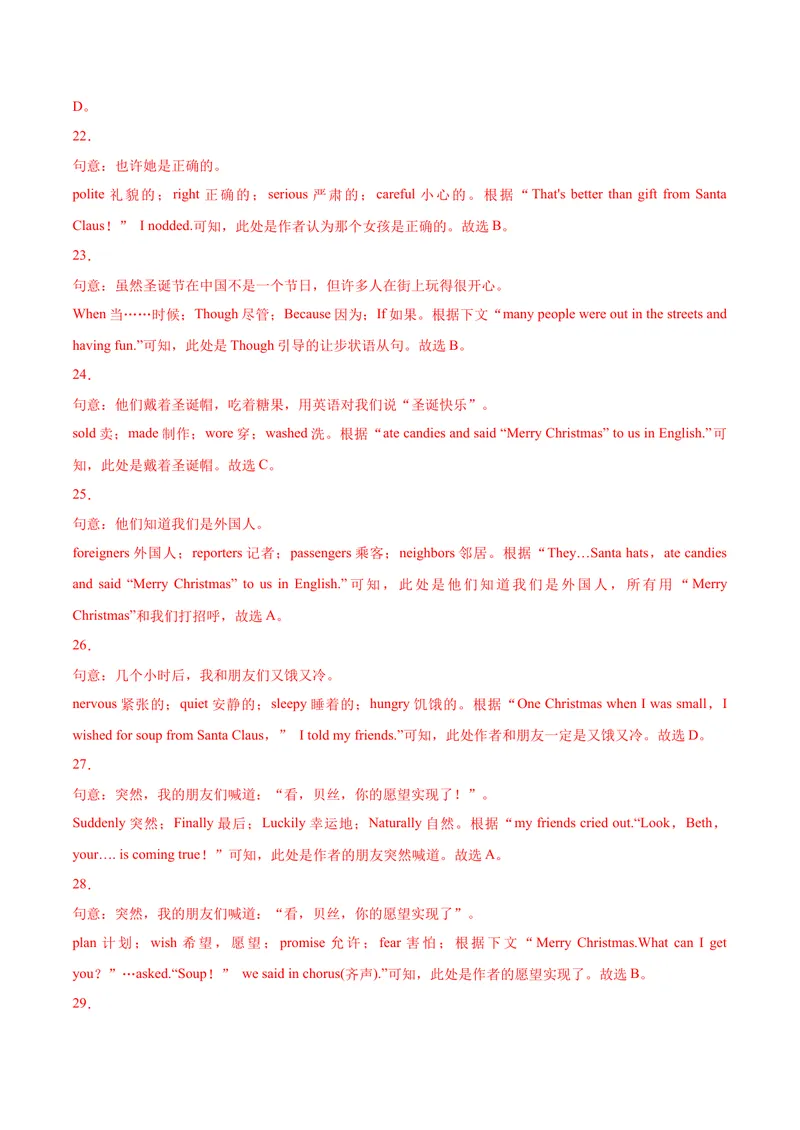
22.
句意:也许她是正确的。
polite 礼貌的;right 正确的;serious 严肃的;careful 小心的。根据“That's better than gift from Santa
Claus!” I nodded.可知,此处是作者认为那个女孩是正确的。故选B。
23.
句意:虽然圣诞节在中国不是一个节日,但许多人在街上玩得很开心。
When当……时候;Though尽管;Because因为;If如果。根据下文“many people were out in the streets and
having fun.”可知,此处是Though引导的让步状语从句。故选B。
24.
句意:他们戴着圣诞帽,吃着糖果,用英语对我们说“圣诞快乐”。
sold卖;made制作;wore穿;washed洗。根据“ate candies and said “Merry Christmas” to us in English.”可
知,此处是戴着圣诞帽。故选C。
25.
句意:他们知道我们是外国人。
foreigners外国人;reporters记者;passengers乘客;neighbors邻居。根据“They…Santa hats,ate candies
and said “Merry Christmas” to us in English.”可知,此处是他们知道我们是外国人,所有用“Merry
Christmas”和我们打招呼,故选A。
26.
句意:几个小时后,我和朋友们又饿又冷。
nervous紧张的;quiet安静的;sleepy睡着的;hungry饥饿的。根据“One Christmas when I was small,I
wished for soup from Santa Claus,” I told my friends.”可知,此处作者和朋友一定是又饿又冷。故选D。
27.
句意:突然,我的朋友们喊道:“看,贝丝,你的愿望实现了!”。
Suddenly突然;Finally最后;Luckily幸运地;Naturally自然。根据“my friends cried out.“Look,Beth,
your…. is coming true!”可知,此处是作者的朋友突然喊道。故选A。
28.
句意:突然,我的朋友们喊道:“看,贝丝,你的愿望实现了”。
plan 计划;wish 希望,愿望;promise 允许;fear 害怕;根据下文“Merry Christmas.What can I get
you?”…asked.“Soup!” we said in chorus(齐声).”可知,此处是作者的愿望实现了。故选B。
29.句意:我转过身,“圣诞老人”站在我身后。
against反对;below在……下面;above在……上面;behind在……后面。根据下文“Well,it was the
waiter,but he was dressed in a red-and-white Santa Claus suit!”可知,此处是穿着圣诞老人服装的服务员站
在我身后。故选D。
30.
句意:他问“快乐圣诞节,“我能帮你拿吗?”。
it它;he他;I我;she她。根据上文“it was the waiter,but he was dressed in a red-and-white Santa Claus
suit!”可知,此处是那位服务员问作者,想吃什么。故选B。
三、根据汉语或首字母提示填空(每题1分,共10分)
31.Wherever the volunteers go, they spread love and ________(温暖).
【答案】warmth
【详解】
句意:志愿者们走到哪,哪里就传递着爱和温暖。并列连词 and连接的是句法作用相同的两个成分,连词
前的“love”为名词作宾语,所以其后也应填“温暖”的名词形式“warmth”作宾语。故填warmth。
32.If we don’t protect the environment well, we’ll be ________(惩罚)sooner or later.
【答案】punished
【详解】
句意:如果我们不保护好环境,我们迟早会受到惩罚。punish惩罚,此处用于will be done结构中,构成一
般将来时的被动语态,故填punished。
33.We’ll find out ________ (是否) it turns out to be a good idea or not.
【答案】whether
【详解】
句意:我们将会知道这是否是个好主意。是否:whether/if;分析句子可知,这是一个宾语从句,whether
引导的从句常可以与连词or或or not直接连用,而if一般不能。故填whether。
34.There’s a ________ (传统) in our family that we have a party on New Year’s Eve.
【答案】tradition
【详解】
句意:我们家有个传统,在新年前夕开个晚会。此前有a修饰,使用名词单数tradition,故填tradition。
35.Big cities can be lonely places if you have no friends or ________ (亲戚) there.
【答案】relatives
【详解】句意:大城市可能是孤独的地方,如果你没有朋友或亲戚在那里。“亲戚”译为relative,or连接并列成分,
根据“friends”可知此处也用复数形式。故填relatives。
36.Spring Festival is a holiday to visit friends and r________.
【答案】relatives
【详解】
句意:春节是一个拜访亲朋好友的节日。此空与 friends 构成并列关系,所以也填名词复数形式。
relative“亲戚”,其复数形式是relatives,故填relatives。
37.—May I take my cousin to the holiday party?
—Of course. W________ comes is welcome.
【答案】Whoever
【详解】
句意:——我可以带我的堂兄去参加节日聚会么?——当然,谁来都欢迎。空格处缺少主语,根据
“comes is welcome”可知,泛指无论谁来都欢迎,“无论谁”的英文是whoever。故填Whoever。
38.For most Americans, C________ Day is as important as Spring Festival to Chinese.
【答案】Christmas
【详解】
句意:对大多数美国人来说,圣诞节和中国人的春节一样重要。根据“For most Americans”及“s as
important as Spring Festival to Chinese”,结合常识,可知,美国人的圣诞节和中国人的春节一样重要,
Christmas Day“圣诞节”,故填Christmas。
39.The development of the app WeChat can make s________ be friends.
【答案】strangers
【详解】
句意:微信应用的开发可以让陌生人成为朋友。由语境可知,此处指让很多陌生人成为朋友,stranger“陌
生人”,此处应用复数形式表示泛指。故填strangers。
40.Anyone caught smoking in school will be p________, because smoking is not allowed here.
【答案】punished
【详解】
句意:任何在学校吸烟的人都会受到惩罚,因为这里是不允许吸烟的。根据“smoking is not allowed here”
和首字母提示可知,此处表示“被惩罚”,构成“will be done”结构,所以用其过去分词形式,故填
punished。
四、短文填空(每题1分,共10分)When you are about to do something brave, a cheerful wish of “Good luck!” from a friend can be helpful.
But if you think you need lots of luck, what else might you do?
In the UK and US there are some strange traditions for bringing yourself a little more good 41 . .Some are
hundreds of years old and some are 42 . newer.
Have you heard the saying “When you wish upon a star”? If you are looking up at the sky on a clear night
and you 43 . a sudden flash of light, it is probably a shooting star! Seeing one doesn't happen very often. The
saying goes that 44 . you see one you have been very lucky, and so if you make a wish, it will come 45 . .
Maybe you have heard 46 . the lucky rabbit's foot. Some people believe that rabbits are lucky 47 . , so they
carry a part of the rabbit, its foot, for good luck. There are all 48 . of strange, unclear rules about which of the
rabbit's feet is the luckiest. It is 49 . that this good luck tradition is the oldest one of all. However, as the funny
saying goes, “Depend on the rabbit's foot if you will, but remember 50 . didn't work for the rabbit!”
【答案】
41.luck
42.much
43.see
44.if
45.true
46.of
47.animals
48.kinds
49.said
50.it
【解析】
【分析】
本文讲述了关于流星和兔子脚能给人们带来好运的故事。在英国和美国,有一些奇怪的传统可以给你自己
带来更多的好运。有些已经有几百年的历史了,有些则更新了很多。如果你仰望天空,能看到流星,你是
很幸运的,如果你许愿,它就会实现。有些人认为兔子是幸运动物,所以他们带着兔子的一个器官-----它
的脚,以求好运。关于兔子的脚中哪一只最幸运,有各种奇怪的,不清楚的规则。然而,正如一句有趣的
谚语所说:“如果你愿意,就依靠兔子的脚,但要记住,这对兔子不起作用!”
41.句意:在英国和美国,有一些奇怪的传统给你带来更多的好运。考查细节理解。根据第一段最后一句
But if you think you need lots of luck, what else might you do?(但是如果你认为你需要许多运气,你可以做其他的什么吗?)结合英文提示可知此句要表达的句意是“在英国和美国,有一些奇怪的传统给你带来更多
的好运。”故答案是luck。
42.句意:有些是几百年前的,有些则是更新的。考查细节理解和形容词比较级。根据前文“有些是几百
年前的”可知“有些则是更新的”,much/even可修饰形容词比较级,意思是更…,…多多了;故答案是
much/even。
43.句意:如果你在晴朗的夜晚仰望天空,你看到一道突然的闪光,它可能是一颗流星!考查语境理解。
根据上文“你在晴朗的夜晚仰望天空”结合下文“看见流星这件事并不会经常发生。”可知是“你看到一
道突然的闪光”,可知填“看见”,and前时态是现在进行时,结合句意可知and后可以使用一般现在时,
故答案是see。
44.句意:俗话说,如果你看到流星你已经很幸运。考查细节理解。根据文中that可知下文是that引导的
宾语从句。根据句意可知此句是if引导的条件状语从句;故答案if。
45.句意:所以如果你许下一个愿望,它就会成真。考查动词短语。come true:实现;结合句意可和答案
是true。
46.句意:也许你听说过幸运兔的脚。考查动词短语。短语hear of/about:听说;结合句意可知答案
是of/about。
47.句意:有些人认为兔子是幸运的动物,所以他们为了好运携带兔子的一部分------它们的脚。本句是主
从复合句,从句是that引导的宾语从句。根据主语rabbits是复数,可知后面名词用复数,我们知道“兔子
是动物”,可知答案是animals。
48.句意:关于兔子的脚中哪一只最幸运,有各种奇怪的、不清楚的规则。短语all kinds of:各种各样的;
结合句意可知答案是kinds。
49.句意:据说这个好运气的传统是最古老的传统之一。短语It is said that+句子:据说….;结合句意可知
答案是said。
50.句意:如果你愿意,那就依靠兔子的脚,但是记住它对兔子来说不起作用!根据句意和语境可知兔子
的脚对兔子来说不起作用,兔子的脚是单数,用it指代上文提到的兔子的脚(the rabbit's foot);故答案是
it。
五、补全对话7选5(每题1分,共5分)
Li Lei: Hey, Bruce. I’m going home this weekend.
Bruce: 51 .
Li Lei: To celebrate the Mid-Autumn Festival.
Bruce: 52 .
Li Lei: It is an important time for family.Bruce: 53 .
Li Lei: We’ll have dinner together, watch the moon and eat mooncakes.
Bruce: Mooncakes? Are they delicious?
Li Lei: Yes. 54 . We can celebrate it together.
Bruce: 55 . Thank you!
Li Lei: You are welcome.
A.Well done!
B.For what?
C.That’s great.
D.What kind of festival is it?
E. I have never tasted them
F. How will you celebrate it?
G. Would you like to go with me?
【答案】
51.B
52.D
53.F
54.G
55.C
【分析】
试题分析:本题是李磊和布鲁斯的对话。李磊告诉布鲁斯周末回家过中秋节,布鲁斯问他是什么样的节日,
怎样庆祝?李磊告诉他中秋节对于中国家庭很重要,全家会一起吃团圆饭、赏月、吃月饼。布鲁斯好奇什
么是月饼,李磊对他进行了描述,并邀请布鲁斯一起过中秋节。布鲁斯答应了邀请,并对李磊表示了感谢。
51.根据下文李磊的回答To celebrate the Mid-Autumn Festival.,结合上句可知,布鲁斯问他“为了什么回
家”。备选答案中,只有For what?符合句意,故选B。
52.根据李磊前后两句答语To celebrate the Mid-Autumn Festival. 和It is an important time for family.,可知
他在向布鲁斯描述中秋节。所以,布鲁斯问了他中秋节是什么节日,即What kind of festival is the Mid-
Autumn Festival?备选答案中,只有第四句符合句意,所以选D。
53.根据李磊的回答We’ll have dinner together, watch the moon and eat mooncakes.,他在向布鲁斯描述怎样
庆祝中秋节,可知布鲁斯问了相关问题。故选F。
54.根据布鲁斯的问题Mooncakes? Are they delicious?和语气,可知李磊会向他描述月饼,故选G。55.根据李磊的语句We can celebrate it together.,他向布鲁斯发出了邀请,布鲁斯一定很高兴,结合布鲁
斯的感谢语Thank you!,可知选C。
六、阅读单选(每题3分,共30分)
A
The most important holiday in spring, especially for Christians, is Easter. This Christian holiday is not on the
same date every year, but it's always on a Sunday. It can be any Sunday between March 22 and April 25. Many
people celebrate Easter by buying new clothes. Children celebrate by hunting for colored eggs that their parents
have hidden around the house. People also give Easter baskets filled with candy and other goodies to one another to
celebrate the day.
But the holiday is more than new clothes and good things to eat. On Easter, many people go to church to
celebrate Jesus’ resurrection(复活)from the dead. Most people color Easter eggs. Some people hide them. Others
just eat them. But no matter what one does with Easter eggs, they are an important Easter tradition throughout the
Western world.
People from many different cultures celebrate Easter. In both America and Belgium, children look for Easter
eggs hidden on lawns and in bushes. In America, children believe the eggs are hidden by the Easter bunny(兔子).
But in Belgium, the hidden eggs are supposed to have fallen from church bells. In Bulgaria(保加利亚),red Easter
eggs are lucky in churches. Bulgarian families also hit these Easter eggs together to see whose is the strongest. The
winner looks forward to good fortune that year. Still dozens of other Easter traditions exist. In parts of Austria, for
example, children sing from door to door and are rewarded with colorful eggs.
56.Easter comes________.
A.on Sunday on April 25
B.on a Sunday between March 22 and April 25
C.on the same date every year
D.on Sunday on March 22
57.To celebrate Easter, people________ .
A.go shopping, hide colored eggs and children hunt for them
B.give Easter baskets filled candy and goodies to one another
C.buy new clothes, hide colored eggs and children look for them around the house
D.both B and C
58.For Christians the more important thing to do on Easter is________.
A.going to church to celebrate Jesus’ resurrectionB.buying new clothes
C.eating delicious food and coloring eggs
D.exchange beautiful gifts with each other
59.People from different cultures have different ideas about Easter eggs. What do we know about the Easter eggs?
A.In both America and Belgium, children hunt for Easter eggs hidden in rooms and in bushes
B.In Belgium, the hidden eggs are thought to have fallen from doorbells
C.In America, the hidden eggs are supposed to have fallen from doorbell
D.In America, children believe the eggs are hidden by the Easter bunny
60.In some places of Austria, children sing from door to door for________.
A.Easter bunny B.blesses C.candy and goodie D.Easter eggs
【答案】
56.B
57.D
58.A
59.D
60.D
【分析】
本文介绍了复活节的习俗以及各国人们在复活节的不同的庆祝活动。
56.
细节理解题。根据“It can be any Sunday between March 22 and April 25.”可知,复活节是3月22日到4月25
日之间的任何一个星期天。故选B。
57.
细节理解题。根据“Many people celebrate Easter by buying new clothes. Children celebrate by hunting for
colored eggs that their parents have hidden around the house. People also give Easter baskets filled with candy and
other goodies to one another to celebrate the day.”可知,为了庆祝复活节,人们买新衣服,孩子们的庆祝方式
是寻找父母藏在房子周围的彩蛋,人们也互相赠送装满糖果和其他好吃的东西的复活节篮子。故选D。
58.
细节理解题。根据“But the holiday is more than new clothes and good things to eat. On Easter, many people go
to church to celebrate Jesus’ resurrection(复活)from the dead.”可知,对于基督徒来说,复活节更重要的事情就
是去教堂庆祝耶稣的复活。故选A。
59.细节理解题。根据“In America, children believe the eggs are hidden by the Easter bunny(兔子).”可知,在美国,
孩子们认为复活节彩蛋被复活节兔子藏起来了,故选D。
60.
细节理解题。根据“In parts of Austria, for example, children sing from door to door and are rewarded with
colorful eggs.”可知,在奥地利的一些地方,孩子们挨家挨户唱歌是为了获得彩蛋,故选D。
B
You see people in movies celebrating a white Christmas in England or the United States. But Christmas in
Australia is different.
Australians celebrate the holiday on Dec.25th. It is at the hottest time of the year in Australia. The temperature
is usually about 30°C in most cities and can even be over 40°C.There is certainly no white Christmas in Australia.
Because it is so hot, the tradition is to have a lunch outside and to swim in the pool or beach. Most people have
a one-week holiday during this time, so they will travel to meet their family for Christmas lunch. Christmas lunch
is usually a big meal of ham, turkey, salad and fresh seafood. Family members all cook something different and
bring it to the big meal. I always enjoy Christmas lunch because there are lots of good cooks in my family. One
year my aunt even made a delicious gingerbread house(姜饼屋) for us to eat as desert.
Children get presents from Santa Claus and are always excited to play with them. It is a fun time to play or
swim in the pool with the other members of your family.
The sport of cricket(板球) is very popular in Australia and another tradition is to play a game of cricket in your
backyard. I always enjoyed playing with my uncle and cousins when I was growing up.
So Australia might not have a white Christmas. But it is still a very exciting and fun time of the year.
61.Australians celebrate Christmas in ________.
A.spring B.summer C.fall D.winter
62.Australians rest for ________ during Christmas.
A.five days B.six days
C.seven days D.eight days
63.Which is NOT the tradition in Australia during Christmas?
A.The family have lunch or swim together.
B.People enjoy white snow outside.
C.The family play cricket together happily.
D.Children get presents from Santa Claus.
64.What can we infer (推断) from the passage?A.Australians often get together to play on Christmas.
B.Australians usually eat ham, turkey, salad and gingerbread house on Christmas.
C.Children are excited to see the Santa Claus have lunch with them.
D.Christmas in Australia isn't the same as that in England or in the United States.
65.What does writer think of Christmas in Australia according to the passage?
A.Exciting. B.Boring.
C.Interesting. D.Both A and C.
【答案】
61.B
62.C
63.B
64.D
65.D
【分析】
本文介绍了澳大利亚庆祝圣诞节的方式和活动。
61.
推理判断题。根据“It is at the hottest time of the year in Australia. The temperature is usually about 30°C in
most cities and can even be over 40°C”,可知,这是澳大利亚一年中最热的时候,由此可推断,澳大利亚人
在夏天庆祝圣诞节,故选B。
62.
细节理解题。根据“Most people have a one-week holiday during this time, so they will travel to meet their
family for Christmas lunch”,可知,在圣诞节期间大部分人有一个星期的假期,故选C。
63.
推理判断题。根据“It is at the hottest time of the year in Australia”及“So Australia might not have a white
Christmas”,可知,澳大利亚在夏天庆祝圣诞节,所以室外不会下雪,故B表述错误,故选B。
64.
推理判断题。根据“You see people in movies celebrating a white Christmas in England or the United States. But
Christmas in Australia is different”,可知,澳大利亚的圣诞节和英国或美国的圣诞节都是不同的,故选D。
65.
推理判断题。根据“So Australia might not have a white Christmas. But it is still a very exciting and fun time of
the year”可知,作者认为澳大利亚的圣诞节既令人兴奋又很有趣,故选D。C
April Fool’s Day is coming! But do you know how April Fool’s Day comes?
In the sixteenth century in France, the start of the New Year was on April 1st. People celebrated the New Year
in the same way as it is today. They held parties and danced into the late night.
Then in 1562, Pope Gregory introduced a new calendar into the Christian(基督教的)world, and the new year
fell on January 1st. Some people didn’t believe the change in the date, so they celebrated the New Year on April 1st.
Others played tricks on them and called them “April fools”.
Today Americans play small tricks on friends on the first day of April. One common trick on April Fool’s Day
is pointing down to a friend’s shoe and saying, “Your shoelace is untied.” School children like to tell a classmate
that there are no classes. Then if someone believes the trick, he or she will be called the “April fool”! People play
tricks on each other only because they want to enjoy themselves together. Most jokes are really funny and people
play tricks not to hurt anyone but to find happiness.
66.In the sixteenth century in France, people______ to celebrate the New Year.
A.held parties and danced B.only made delicious food
C.played tricks on others D.went to church together
67.People started to celebrate the New Year on January 1st from_______.
A.1556 B.1558 C.1560 D.1562.
68.The underlined word “shoelace” here means _______ in Chinese.
A.鞋套 B.鞋帮 C.鞋带 D.鞋跟
69.On April Fool’s Day students may say “_______” most to others according to the passage.
A.Your shoelace is untied. B.There aren't any classes.
C.We have no homework. D.You are a fool.
70.What is the best title for the passage? _______
A.How does April Fool’s Day come? B.When is April Fool’s Day?
C.Who invented April Fool’s Day? D.How to play tricks on April Fool’s Day?
【答案】
66.A
67.D
68.C
69.B
70.A【分析】
本文主要讲述了愚人节的来历。
66.细节理解题。根据第二段 In the sixteenth century in France, the start of the New Year was on April 1st.
People celebrated the New Year in the same way as it is today. They held parties and danced into the late night. 可
知在16世纪,法国人民庆祝新年的方式和现在是一样的,举行聚会并跳舞。故选A。
67.细节理解题。根据 Then in 1562, Pope Gregory introduced a new calendar into the Christian(基督教
的)world, and the new year fell on January 1st.可知人们是从1562年开始在1月1日庆祝新年的,故选D。
68.词义猜测题。根据单词所在的前后文one common trick on April Fool’s Day is pointing down to a friend’s
shoe and saying, “Your shoelace is untied.” 指着朋友的鞋说,你的….开了,所以可以推测出这里shoelace可
能指的是鞋带,故选C。
69.细节理解题。根据School children like to tell a classmate that there are no classes.可知学生们喜欢开玩笑,
告诉同学说今天没有课。结合选项,故选B。
70.最佳标题。通过阅读文章,尤其文章的开头April Fool’s Day is coming! But do you know how April
Fool’s Day comes? 可知本文主要是介绍了愚人节的来历。故选A。
七、书面表达(共15分)
根据要求完成下面内容,并将答案写在答题卡的相应位置。
最近,某英文报刊正在举办征文活动,主题是“弘扬中华传统文化,畅谈中国传统佳节”。请你以“My
Favorite Chinese Festival”为题,写一篇英语作文,为本次活动投稿。
1. 内容提示:(1)简单介绍你最喜欢的传统节日:名称及时间等;
(2)讲述该节日有哪些主要庆祝方式:食物及活动等;
(3)说说你对这个节日的感受及喜爱它的原因。
2. 写作要求:
(1)内容包含以上要点;
(2)语言表达准确,语意通顺、连贯,词数:60~80词;
(3)书写工整、规范, 文中不得出现真实姓名、校名和地名。
My Favorite Chinese Festival
___________________________________________________________________________
___________________________________________________________________________
___________________________________________________________________________
___________________________________________________________________________
______________________________________________________________________________________________________________________________________________________
___________________________________________________________________________
___________________________________________________________________________
___________________________________________________________________________
【答案】
My Favorite Chinese Festival
As we all know, there are many traditional festivals in China. Among them, I like the Spring Festival best.
It comes in January or February. It is a time for family members to get together. On the eve of the Spring Festival,
all family members enjoy different kinds of food, such as dumplings and fish. We also watch the Spring Festival
Gala and stay up late, hoping to have a new start in the following year.
The Spring Festival can not only make us feel love and happiness, but also the importance of home and family.
【详解】
这是一篇话题作文,根据材料中的相关信息介绍一下“我”最喜欢的中国节日。所提供的材料中列举了本
次征文活动的主题是“弘扬中华传统文化,畅谈中国传统佳节”。主要从(1)简单介绍你最喜欢的传统
节日:名称及时间等;(2)讲述该节日有哪些主要庆祝方式:食物及活动等;(3)说说你对这个节日的
感受及喜爱它的原因。这三个方面去介绍。时态为一般现在时,人称为第一人称。注意作文中必须包含材
料上的所有信息,并适当发挥。写作时,避免使用汉语式的英语,尽量使用我们熟悉的句子或短语。语法
要正确,表达要符合英语习惯,注意时态、时间状语的搭配及主谓一致问题。写作中适当使用连词,注意
上下文联系紧密,符合逻辑关系,表达具有条理性。
【高分句型一】
On the eve of the Spring Festival, all family members enjoy different kinds of food, such as dumplings and fish. 在
春节前夕,所有家庭成员都喜欢吃各种各样的食物,如:饺子和鱼。
On the eve of the Spring Festival,是介词短语做时间状语。
different kinds of:不同种类的;such as:例如。这些短语的运用,增加了语感,丰富了文章的内容。
【高分句型二】
The Spring Festival can not only make us feel love and happiness, but also the importance of home and family. 春
节不仅能让我们感受到爱和幸福,更能让我们感受到家和家庭的重要性。这句话运用了 not only…but
also…,“不但……而且……”。体现了作者的写作功底扎实。