Unit1 单元测试
班级________________ 姓名___________________ 学号___________________
一、单项选择(每题1分,共15分)
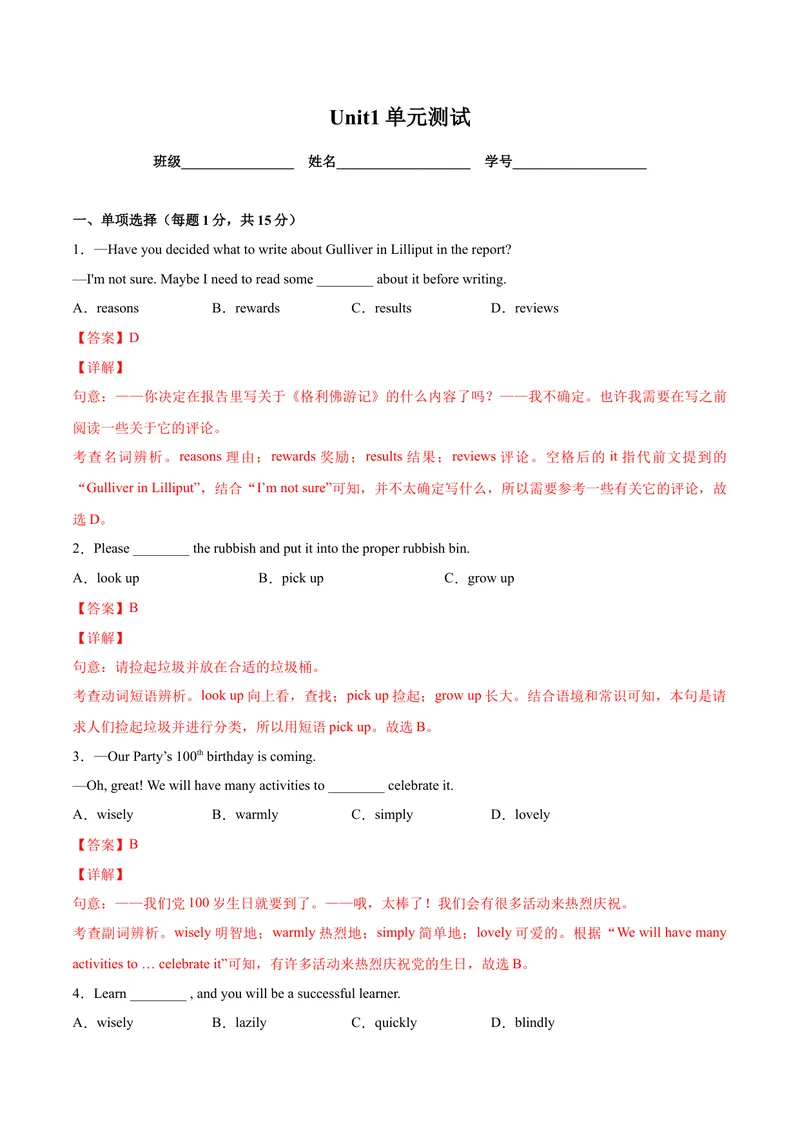
1.—Have you decided what to write about Gulliver in Lilliput in the report?
—I'm not sure. Maybe I need to read some ________ about it before writing.
A.reasons B.rewards C.results D.reviews
【答案】D
【详解】
句意:——你决定在报告里写关于《格利佛游记》的什么内容了吗?——我不确定。也许我需要在写之前
阅读一些关于它的评论。
考查名词辨析。reasons理由;rewards奖励;results结果;reviews评论。空格后的 it指代前文提到的
“Gulliver in Lilliput”,结合“I’m not sure”可知,并不太确定写什么,所以需要参考一些有关它的评论,故
选D。
2.Please ________ the rubbish and put it into the proper rubbish bin.
A.look up B.pick up C.grow up
【答案】B
【详解】
句意:请捡起垃圾并放在合适的垃圾桶。
考查动词短语辨析。look up向上看,查找;pick up捡起;grow up长大。结合语境和常识可知,本句是请
求人们捡起垃圾并进行分类,所以用短语pick up。故选B。
3.—Our Party’s 100th birthday is coming.
—Oh, great! We will have many activities to ________ celebrate it.
A.wisely B.warmly C.simply D.lovely
【答案】B
【详解】
句意:——我们党100岁生日就要到了。——哦,太棒了!我们会有很多活动来热烈庆祝。
考查副词辨析。wisely明智地;warmly热烈地;simply简单地;lovely可爱的。根据“We will have many
activities to … celebrate it”可知,有许多活动来热烈庆祝党的生日,故选B。
4.Learn ________ , and you will be a successful learner.
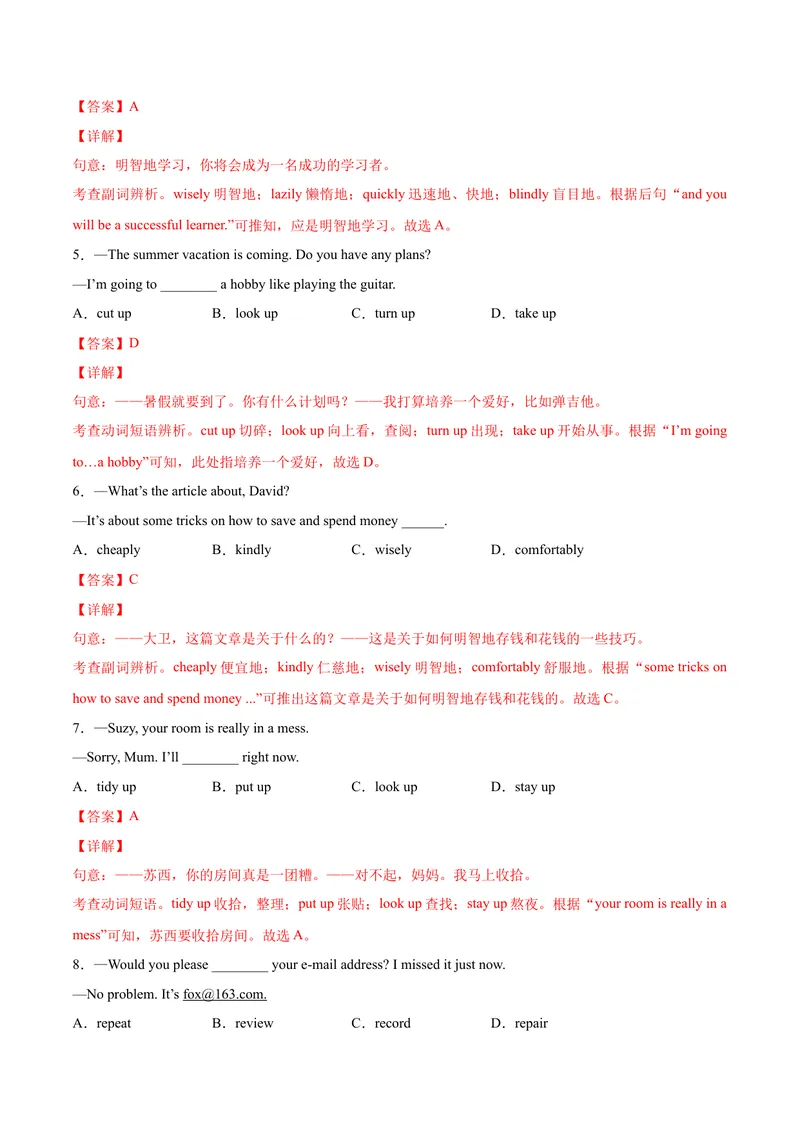
A.wisely B.lazily C.quickly D.blindly【答案】A
【详解】
句意:明智地学习,你将会成为一名成功的学习者。
考查副词辨析。wisely明智地;lazily懒惰地;quickly迅速地、快地;blindly盲目地。根据后句“and you
will be a successful learner.”可推知,应是明智地学习。故选A。
5.—The summer vacation is coming. Do you have any plans?
—I’m going to ________ a hobby like playing the guitar.
A.cut up B.look up C.turn up D.take up
【答案】D
【详解】
句意:——暑假就要到了。你有什么计划吗?——我打算培养一个爱好,比如弹吉他。
考查动词短语辨析。cut up切碎;look up向上看,查阅;turn up出现;take up开始从事。根据“I’m going
to…a hobby”可知,此处指培养一个爱好,故选D。
6.—What’s the article about, David?
—It’s about some tricks on how to save and spend money ______.
A.cheaply B.kindly C.wisely D.comfortably
【答案】C
【详解】
句意:——大卫,这篇文章是关于什么的?——这是关于如何明智地存钱和花钱的一些技巧。
考查副词辨析。cheaply便宜地;kindly仁慈地;wisely明智地;comfortably舒服地。根据“some tricks on
how to save and spend money ...”可推出这篇文章是关于如何明智地存钱和花钱的。故选C。
7.—Suzy, your room is really in a mess.
—Sorry, Mum. I’ll ________ right now.
A.tidy up B.put up C.look up D.stay up
【答案】A
【详解】
句意:——苏西,你的房间真是一团糟。——对不起,妈妈。我马上收拾。
考查动词短语。tidy up收拾,整理;put up张贴;look up查找;stay up熬夜。根据“your room is really in a
mess”可知,苏西要收拾房间。故选A。
8.—Would you please ________ your e-mail address? I missed it just now.
—No problem. It’s fox@163.com.
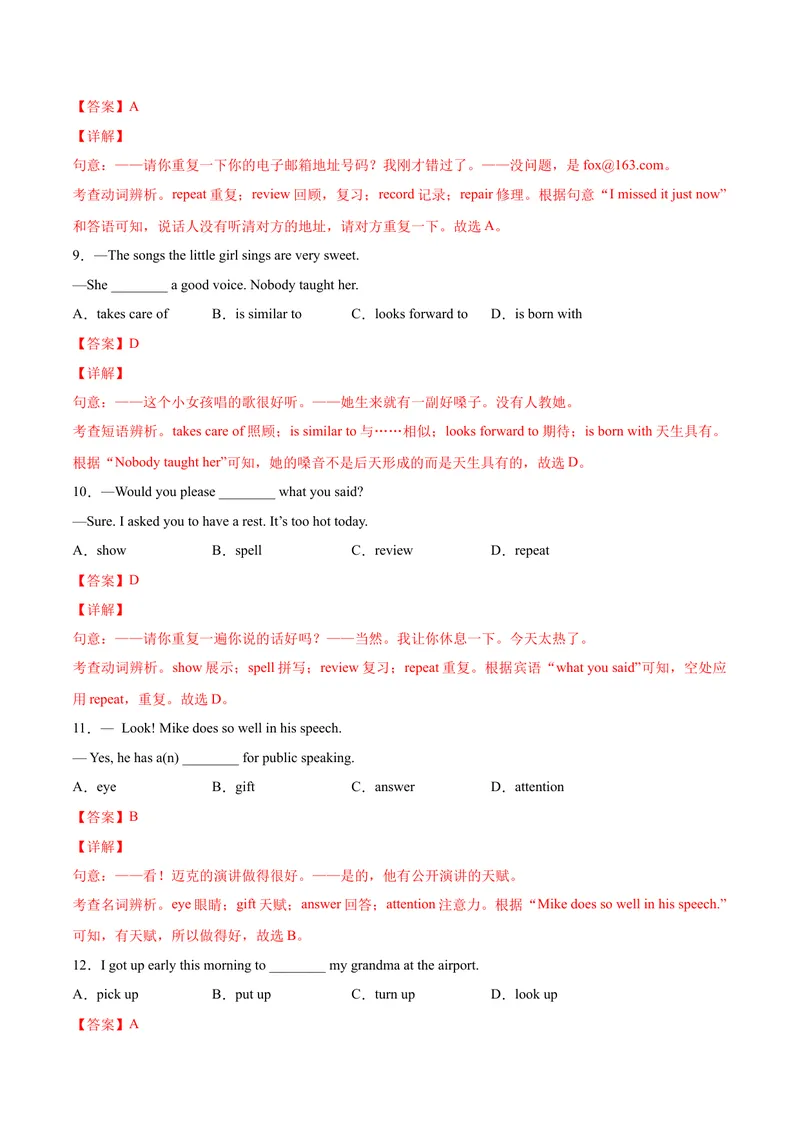
A.repeat B.review C.record D.repair【答案】A
【详解】
句意:——请你重复一下你的电子邮箱地址号码?我刚才错过了。——没问题,是fox@163.com。
考查动词辨析。repeat重复;review回顾,复习;record记录;repair修理。根据句意“I missed it just now”
和答语可知,说话人没有听清对方的地址,请对方重复一下。故选A。
9.—The songs the little girl sings are very sweet.
—She ________ a good voice. Nobody taught her.
A.takes care of B.is similar to C.looks forward to D.is born with
【答案】D
【详解】
句意:——这个小女孩唱的歌很好听。——她生来就有一副好嗓子。没有人教她。
考查短语辨析。takes care of照顾;is similar to与……相似;looks forward to期待;is born with天生具有。
根据“Nobody taught her”可知,她的嗓音不是后天形成的而是天生具有的,故选D。
10.—Would you please ________ what you said?
—Sure. I asked you to have a rest. It’s too hot today.
A.show B.spell C.review D.repeat
【答案】D
【详解】
句意:——请你重复一遍你说的话好吗?——当然。我让你休息一下。今天太热了。
考查动词辨析。show展示;spell拼写;review复习;repeat重复。根据宾语“what you said”可知,空处应
用repeat,重复。故选D。
11.— Look! Mike does so well in his speech.
— Yes, he has a(n) ________ for public speaking.
A.eye B.gift C.answer D.attention
【答案】B
【详解】
句意:——看!迈克的演讲做得很好。——是的,他有公开演讲的天赋。
考查名词辨析。eye眼睛;gift天赋;answer回答;attention注意力。根据“Mike does so well in his speech.”
可知,有天赋,所以做得好,故选B。
12.I got up early this morning to ________ my grandma at the airport.
A.pick up B.put up C.turn up D.look up
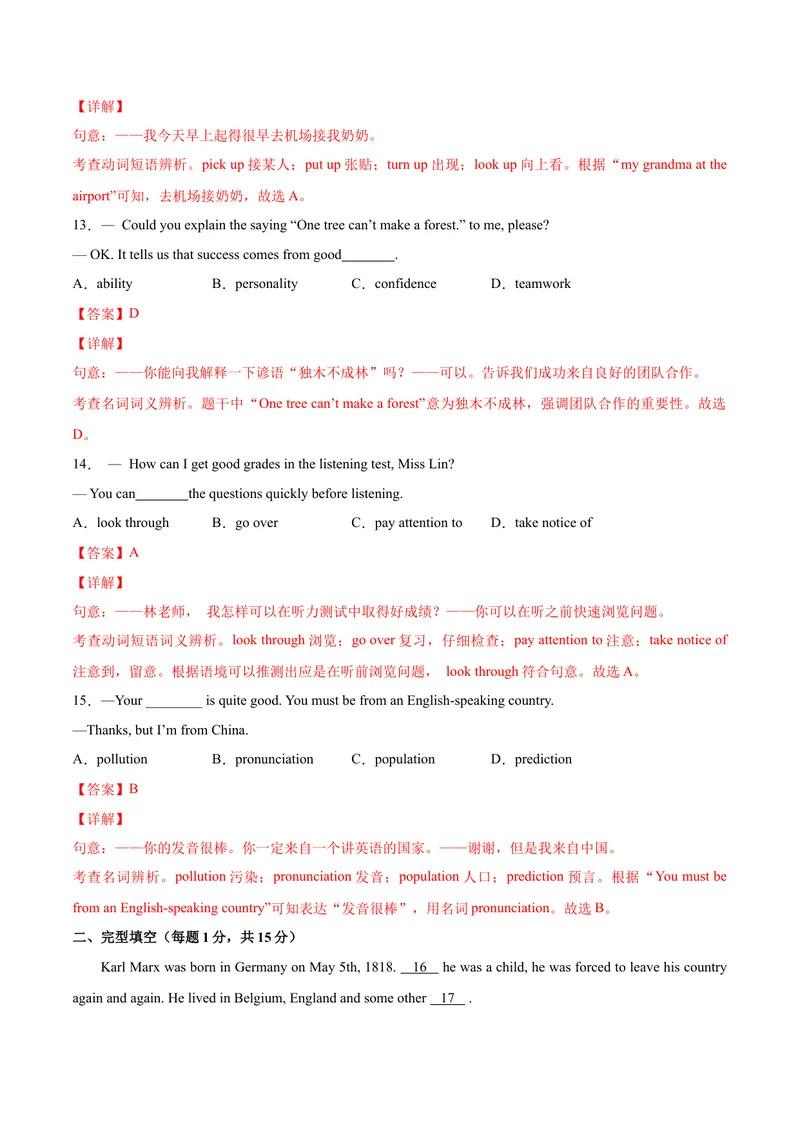
【答案】A【详解】
句意:——我今天早上起得很早去机场接我奶奶。
考查动词短语辨析。pick up接某人;put up张贴;turn up出现;look up向上看。根据“my grandma at the
airport”可知,去机场接奶奶,故选A。
13.— Could you explain the saying “One tree can’t make a forest.” to me, please?
— OK. It tells us that success comes from good .
A.ability B.personality C.confidence D.teamwork
【答案】D
【详解】
句意:——你能向我解释一下谚语“独木不成林”吗?——可以。告诉我们成功来自良好的团队合作。
考查名词词义辨析。题干中“One tree can’t make a forest”意为独木不成林,强调团队合作的重要性。故选
D。
14. — How can I get good grades in the listening test, Miss Lin?
— You can the questions quickly before listening.
A.look through B.go over C.pay attention to D.take notice of
【答案】A
【详解】
句意:——林老师, 我怎样可以在听力测试中取得好成绩?——你可以在听之前快速浏览问题。
考查动词短语词义辨析。look through浏览;go over复习,仔细检查;pay attention to注意;take notice of
注意到,留意。根据语境可以推测出应是在听前浏览问题, look through符合句意。故选A。
15.—Your ________ is quite good. You must be from an English-speaking country.
—Thanks, but I’m from China.
A.pollution B.pronunciation C.population D.prediction
【答案】B
【详解】
句意:——你的发音很棒。你一定来自一个讲英语的国家。——谢谢,但是我来自中国。
考查名词辨析。pollution污染;pronunciation发音;population人口;prediction预言。根据“You must be
from an English-speaking country”可知表达“发音很棒”,用名词pronunciation。故选B。
二、完型填空(每题1分,共15分)
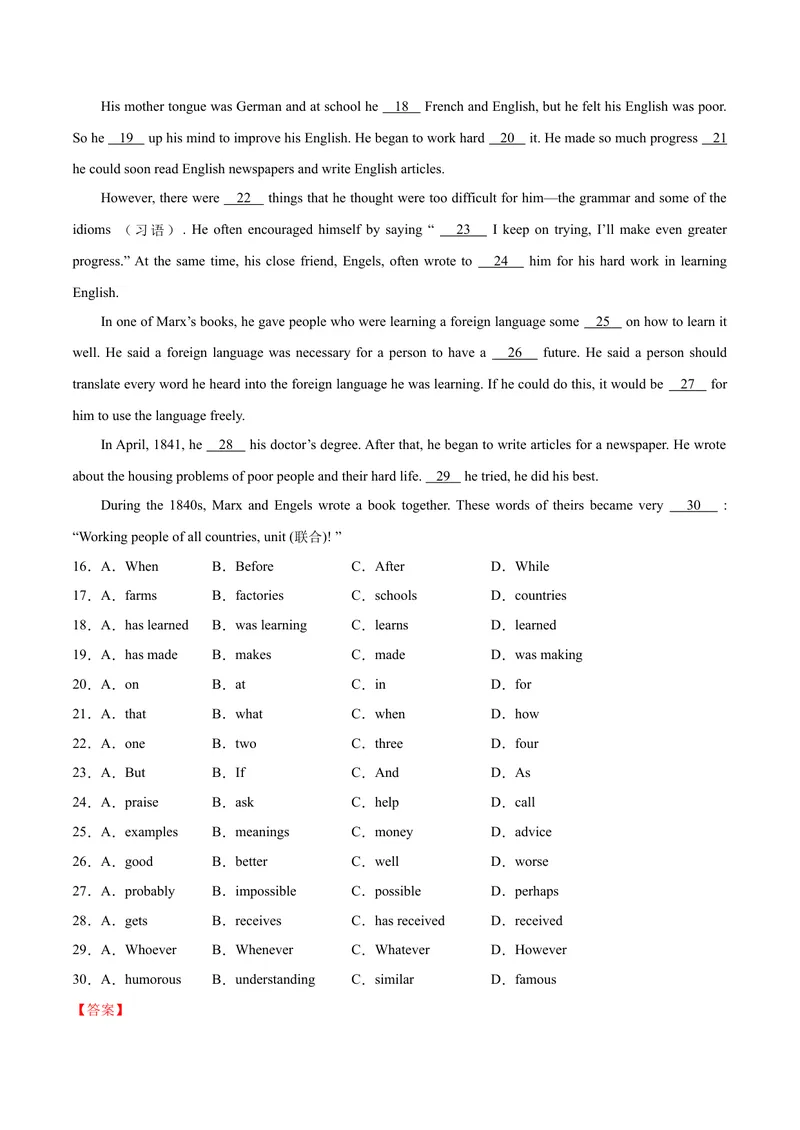
Karl Marx was born in Germany on May 5th, 1818. 16 he was a child, he was forced to leave his country
again and again. He lived in Belgium, England and some other 17 .His mother tongue was German and at school he 18 French and English, but he felt his English was poor.
So he 19 up his mind to improve his English. He began to work hard 20 it. He made so much progress 21
he could soon read English newspapers and write English articles.
However, there were 22 things that he thought were too difficult for him—the grammar and some of the
idioms (习语). He often encouraged himself by saying “ 23 I keep on trying, I’ll make even greater
progress.” At the same time, his close friend, Engels, often wrote to 24 him for his hard work in learning
English.
In one of Marx’s books, he gave people who were learning a foreign language some 25 on how to learn it
well. He said a foreign language was necessary for a person to have a 26 future. He said a person should
translate every word he heard into the foreign language he was learning. If he could do this, it would be 27 for
him to use the language freely.
In April, 1841, he 28 his doctor’s degree. After that, he began to write articles for a newspaper. He wrote
about the housing problems of poor people and their hard life. 29 he tried, he did his best.
During the 1840s, Marx and Engels wrote a book together. These words of theirs became very 30 :
“Working people of all countries, unit (联合)! ”
16.A.When B.Before C.After D.While
17.A.farms B.factories C.schools D.countries
18.A.has learned B.was learning C.learns D.learned
19.A.has made B.makes C.made D.was making
20.A.on B.at C.in D.for
21.A.that B.what C.when D.how
22.A.one B.two C.three D.four
23.A.But B.If C.And D.As
24.A.praise B.ask C.help D.call
25.A.examples B.meanings C.money D.advice
26.A.good B.better C.well D.worse
27.A.probably B.impossible C.possible D.perhaps
28.A.gets B.receives C.has received D.received
29.A.Whoever B.Whenever C.Whatever D.However
30.A.humorous B.understanding C.similar D.famous
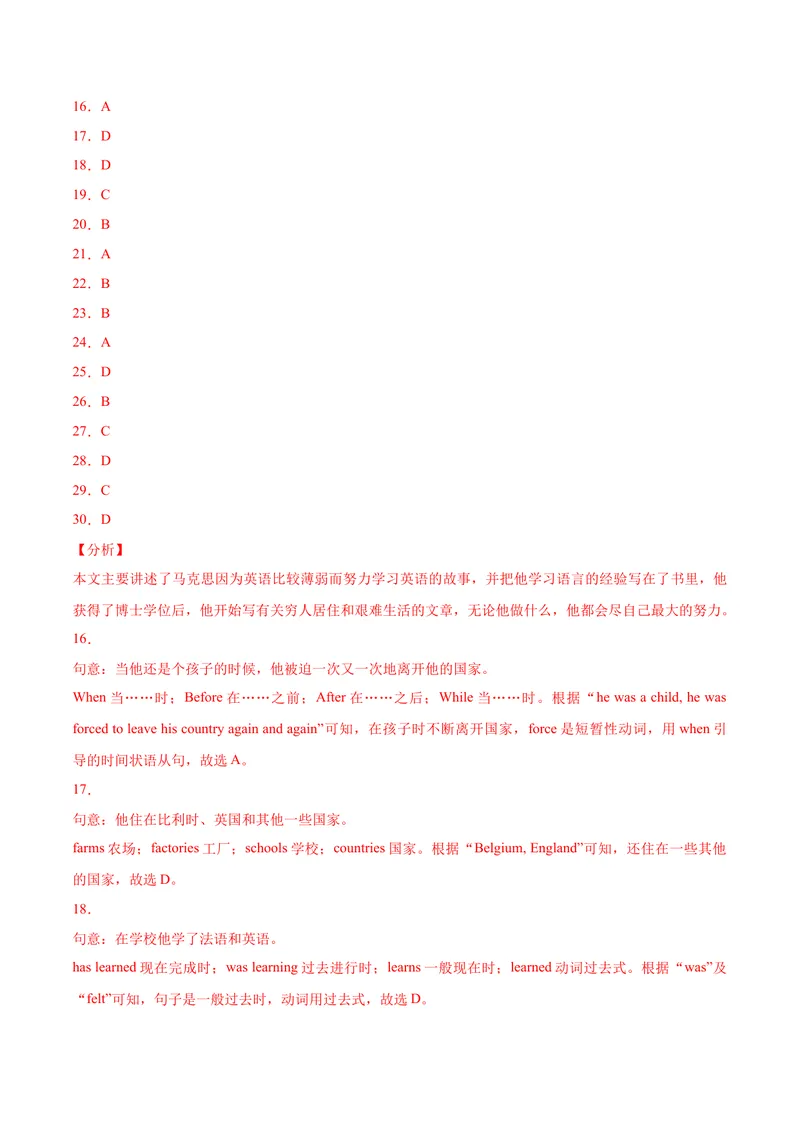
【答案】16.A
17.D
18.D
19.C
20.B
21.A
22.B
23.B
24.A
25.D
26.B
27.C
28.D
29.C
30.D
【分析】
本文主要讲述了马克思因为英语比较薄弱而努力学习英语的故事,并把他学习语言的经验写在了书里,他
获得了博士学位后,他开始写有关穷人居住和艰难生活的文章,无论他做什么,他都会尽自己最大的努力。
16.
句意:当他还是个孩子的时候,他被迫一次又一次地离开他的国家。
When当……时;Before在……之前;After在……之后;While当……时。根据“he was a child, he was
forced to leave his country again and again”可知,在孩子时不断离开国家,force是短暂性动词,用when引
导的时间状语从句,故选A。
17.
句意:他住在比利时、英国和其他一些国家。
farms农场;factories工厂;schools学校;countries国家。根据“Belgium, England”可知,还住在一些其他
的国家,故选D。
18.
句意:在学校他学了法语和英语。
has learned现在完成时;was learning过去进行时;learns一般现在时;learned动词过去式。根据“was”及
“felt”可知,句子是一般过去时,动词用过去式,故选D。19.
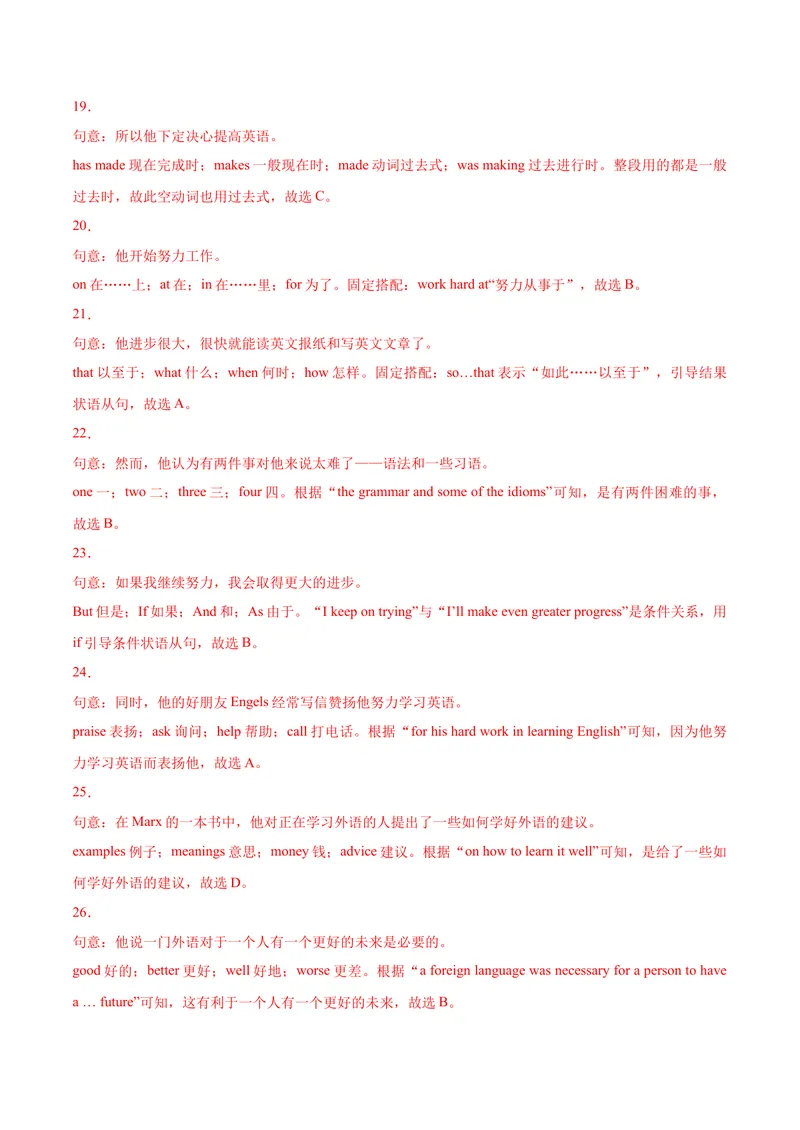
句意:所以他下定决心提高英语。
has made现在完成时;makes一般现在时;made动词过去式;was making过去进行时。整段用的都是一般
过去时,故此空动词也用过去式,故选C。
20.
句意:他开始努力工作。
on在……上;at在;in在……里;for为了。固定搭配:work hard at“努力从事于”,故选B。
21.
句意:他进步很大,很快就能读英文报纸和写英文文章了。
that以至于;what什么;when何时;how怎样。固定搭配:so…that表示“如此……以至于”,引导结果
状语从句,故选A。
22.
句意:然而,他认为有两件事对他来说太难了——语法和一些习语。
one一;two二;three三;four四。根据“the grammar and some of the idioms”可知,是有两件困难的事,
故选B。
23.
句意:如果我继续努力,我会取得更大的进步。
But但是;If如果;And和;As由于。“I keep on trying”与“I’ll make even greater progress”是条件关系,用
if引导条件状语从句,故选B。
24.
句意:同时,他的好朋友Engels经常写信赞扬他努力学习英语。
praise表扬;ask询问;help帮助;call打电话。根据“for his hard work in learning English”可知,因为他努
力学习英语而表扬他,故选A。
25.
句意:在Marx的一本书中,他对正在学习外语的人提出了一些如何学好外语的建议。
examples例子;meanings意思;money钱;advice建议。根据“on how to learn it well”可知,是给了一些如
何学好外语的建议,故选D。
26.
句意:他说一门外语对于一个人有一个更好的未来是必要的。
good好的;better更好;well好地;worse更差。根据“a foreign language was necessary for a person to have
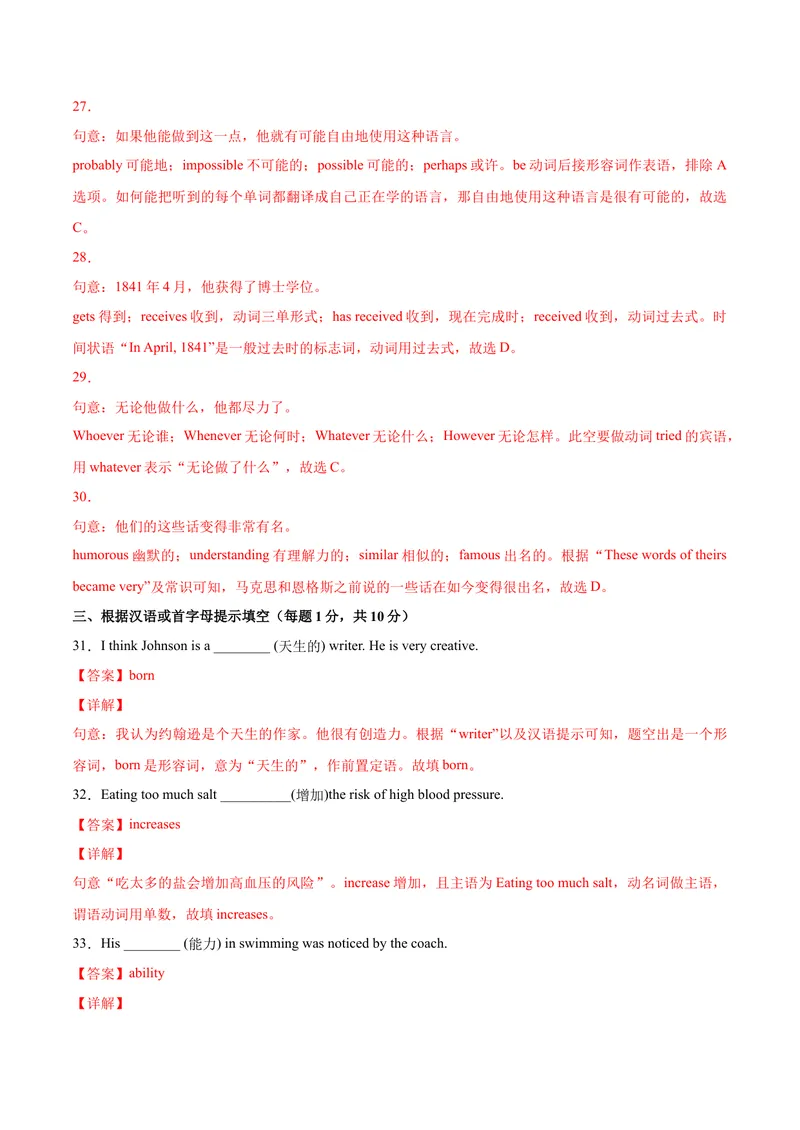
a … future”可知,这有利于一个人有一个更好的未来,故选B。27.
句意:如果他能做到这一点,他就有可能自由地使用这种语言。
probably可能地;impossible不可能的;possible可能的;perhaps或许。be动词后接形容词作表语,排除A
选项。如何能把听到的每个单词都翻译成自己正在学的语言,那自由地使用这种语言是很有可能的,故选
C。
28.
句意:1841年4月,他获得了博士学位。
gets得到;receives收到,动词三单形式;has received收到,现在完成时;received收到,动词过去式。时
间状语“In April, 1841”是一般过去时的标志词,动词用过去式,故选D。
29.
句意:无论他做什么,他都尽力了。
Whoever无论谁;Whenever无论何时;Whatever无论什么;However无论怎样。此空要做动词tried的宾语,
用whatever表示“无论做了什么”,故选C。
30.
句意:他们的这些话变得非常有名。
humorous幽默的;understanding有理解力的;similar相似的;famous出名的。根据“These words of theirs
became very”及常识可知,马克思和恩格斯之前说的一些话在如今变得很出名,故选D。
三、根据汉语或首字母提示填空(每题1分,共10分)
31.I think Johnson is a ________ (天生的) writer. He is very creative.
【答案】born
【详解】
句意:我认为约翰逊是个天生的作家。他很有创造力。根据“writer”以及汉语提示可知,题空出是一个形
容词,born是形容词,意为“天生的”,作前置定语。故填born。
32.Eating too much salt __________(增加)the risk of high blood pressure.
【答案】increases
【详解】
句意“吃太多的盐会增加高血压的风险”。increase增加,且主语为Eating too much salt,动名词做主语,
谓语动词用单数,故填increases。
33.His ________ (能力) in swimming was noticed by the coach.
【答案】ability
【详解】句意:教练注意到了他的游泳能力。能力:ability,为可数名词,句中指游泳的能力,用单数。故填
ability。
34.Tu Youyou won the Nobel Prize for medicine ________ (凭借) many years of hard work.
【答案】through
【详解】
句意:屠呦呦通过多年的努力获得了诺贝尔医学奖。根据中文提示,可拼写出介词 through,译为“通
过……;凭借……”在句中作状语,故填through。
35.We need to increase our ________(知识)of the history of the Communist Party of China.
【答案】knowledge
【详解】
句意:我们需要增加对中国共产党历史的了解。knowledge“知识”,是不可数名词,此处用原形,故填
knowledge。
36.Many students are good at English grammar, but poor in p________.
【答案】pronunciation
【详解】
句意:许多学生很擅长语法,但是发音很差。此处作介词in的宾语,应该用名词;根据“Many students
are good at English grammar, but...”和首字母 p,可知是 pronunciation,意为“发音”,是名词,故填
pronunciation。
37.An expert is someone who has special skills or k________ ['nɒlɪdʒ] of a field.
【答案】(k)nowledge
【详解】
句意:专家是指对某一领域有特殊技能或知识的人。根据音标及首字母 k,可知,此空应填knowledge表
示“知识”,是不可数名词。故填(k)nowledge。
38.Painting tangkas is a l________ job for the artists in Tibet. Sometimes they may spend the whole life painting
one piece of work.
【答案】(l)ifelong
【详解】
句意:唐卡绘画是西藏的艺术家的终身的工作。有时候,他们可能花一生的时间绘制一幅作品。名词
“life”前用形容词修饰,根据“the whole life”可知表示“终身的”,根据首字母提示可知用形容词
“lifelong”。故填(l)ifelong。
39.Please speak a________ or I can’t hear you.【答案】aloud
【详解】
句意:请大声说,否则我听不见。根据下文“or I can’t hear you.”可知,此处是大声说,此处是副词修饰动
词,aloud是副词,大声地,speak aloud“大声说”。故填aloud。
40.I used to have similar learning experiences like you. I often made mistakes in g________ as well.
【答案】grammar
【详解】
句意:我以前也和你有过类似的学习经历。我还经常犯语法错误。根据“I often made mistakes in g…as
well.”可知,此处表示“语法”方面的错误,用grammar在介词后作宾语,故填grammar。
四、短文填空(每题1分,共10分)
Of all the languages, English is the most widely used. I’m very lucky to start 41 . (learn) English at the age
of 5 at the coolest school in town. And we had a 42 . /ˈfɒrən/ teacher, a young gentleman who hardly understood
Spanish. However when he really wanted 43 . (we) to get the message, he could shout in 44 . very loud broken
Spanish. If we behaved, we can watch English cartoons and they 45 . (complete) blew our minds.
After that, I went to a different academy(学园), known for being 46 . /strɪkt/ and concentrating on achieving
high 47 . (result). I was quite motivated(激励) to learn English. I listened to Green Day and I wanted to
understand their lyrics(歌词). There were about 10 of us sitting around a big white rectangular table. We only spoke
one 48 . one, usually in the seating order. Breaking the thick 49 . /ˈsaɪləns/ was a bit scary. Even coughing was
not allowed.
It was in that old-school room I had the ‘aha’ moment: I felt I understood English, I got it and it would stick
there forever. I could write 50 . a sentence or say it out loud, as if I had a native English inner(内在的) voice. I
feel very proud of this moment, and I am sure it made a difference to my journey.
【答案】
41.learning
42.foreign
43.us
44.a
45.completely
46.strict
47.results
48.by49.silence
50.down
【分析】
文章主要介绍了作者的英语学习经历。
41.
句意:我很幸运,5岁的时候在镇上最酷的学校开始学习英语。start doing sth.开始做某事,learn的动名词
形式为learning。故填learning。
42.
句意:我们有一个外国老师,一个几乎不懂西班牙语的年轻绅士。音标/ˈfɒrən/对应单词foreign,意为“外
国的”,形容词在句中作定语。故填foreign。
43.
句意:然而,当他真的想让我们得到信息时,他可以用非常大声的断断续续的西班牙语喊。动词“wanted”
后接we的宾格形式us,意为“我们”。故填us。
44.
句意:然而,当他真的想让我们得到信息时,他可以用非常大声的断断续续的西班牙语喊。Spanish前有形
容词修饰,此处作可数名词用,very以辅音音素开头,其前用不定冠词a表示“一”。故填a。
45.
句意:如果我们表现好,我们可以看英语动画片,它们完全让我们震惊。此处要用complete的副词形式
completely修饰动词“blew”。故填completely。
46.
句意:在那之后,我去了另一所学院,那里以严格和专注于取得高成绩而闻名。音标/strɪkt/对应单词
strict,意为“严格的”。故填strict。
47.
句意:在那之后,我去了另一所学院,那里以严格和专注于取得高成绩而闻名。“high”前没有不定冠词,
此处要用result的复数形式,表示不止一个高成绩。故填results。
48.
句意:我们通常按照座次顺序,一个接一个地交谈。one by one一个接一个。故填by。
49.
句意:打破这种沉闷的寂静有点可怕。音标/ˈsaɪləns/对应单词silence意为“沉默,寂静”。故填silence。
50.
句意:我可以写下一个句子或大声说出来,就像我有一个地道的英语的内在声音。根据“write ... asentence”可推出是写下一个句子,write down写下。故填down。
请用适当的词完成这篇短文,每个空只能填写一个形式正确、意义相符的单词。
五、补全对话7选5(每题1分,共5分)
A: Hello! This is Follow Me. Can I help you?
B: Yes. 51 .
A: What are your problems?
B: First of all, 52 .
A: Listen to English tapes and repeat what you hear. And keep practicing.
B: 53 .
A: Listening to more tapes will help improve your listening skills.
B: What about new words?
A: First, you should try to guess the meanings of them. 54 .
B: OK. Thank you very much.
A: You’re welcome. 55 .
A.I am afraid to listen to English in front of others.
B.I hope your English will improve soon.
C.I can’t get the pronunciation right.
D.Then you can look them up in a dictionary if necessary.
E. Keeping a diary can improve your writing skill.
F. And I can’t understand the teacher when she talks to the class.
G. I have some problems with my English.
【答案】
51.G
52.C
53.F
54.D
55.B
【分析】
本文是B向A询问关于学习英语的建议。
51.
根据“What are your problems”可知,此处应描述在某些事情上有些问题,G选项“我的英语有些问题”符
合,故选G。52.
根据“What are your problems”可知,此处应介绍自己的问题,结合“Listen to English tapes and repeat what
you hear”可知,问题应是与英语发音有关,C选项“我的发音不正确”符合,故选C。
53.
根据“Listening to more tapes will help improve your listening skills”可知,此处应描述听力也有问题,F选项
“我听不懂老师讲课的意思”符合,故选F。
54.
根据“What about new words”可知,此处提的建议应与解决生词有关,D选项“如果有必要,你可以查字
典”符合,故选D。
55.
根据“You’re welcome”可知,此处是一个祝愿的话,B选项“我希望你的英语能很快提高”符合,故选
B。
六、阅读单选(每题2分,共30分)
A
If you live in a place where most people speak the language you are learning, you may use the language for
several hours each day. It may become part of your “inner speech.” In other words, you start thinking in that
language. Your mind stops trying to translate things from your native language into the second language. But most
of the English learners live in places where English is not the main language. This may be true for you. You may
not have many chances to practice English. You may even be self-taught.
When you speak, your speech might be slower than you would like. This is because your mind is still
translating from your first language, which can also sound unnatural. English, like every other language, has its
own sentence structure.
The good news is that thinking in English can bring you a huge step closer to fluency (流利)! It is not very
difficult, but it does need practice.
Most experts note that it’s best to start small. So, a good first step is to think in individual (单独的) words.
Look around you. What do you see? In your head, try to name each object in your surroundings. Charles Thomashas taught English for over 10 years. He tells his students to name the things that they see around them, wherever
they are. Start with nouns and then add in verbs, he suggests.
Another exercise that Thomas suggests is describing in your mind objects you don’t know the words for. For
example, if you’re looking at your house and you see your garage, but you can’t think of the name in English. You
can say, “The place inside where I put my car.” You can also use shorter phrases, such as “It’s similar to...” or “It’s
the opposite of...” Thomas says doing this can help learners of any language. As a Spanish learner, he does it
himself.
Next, you can move to exercises like thinking in simple sentences and in conversations. So, how much time
should you spend on these exercises? Thomas says you do a little every day. “When you make things a habit, then it
just appears suddenly into your mind without thinking and then, before you know it, really, you’re thinking in
English.”
56.According to the writer, people may speak a second language slowly because ________.
A.they don’t live in a place people speak that language
B.they try to translate from their native language
C.they don’t have time to practice that language
D.they may teach that language by themselves
57.What can we learn from the passage?
A.Your surroundings can help you translate the language well.
B.The sentence structure is the key to learn a second language well.
C.Thinking more in a second language may help you speak fluently.
D.Describing with shorter phrases can help spell the unknown words.
58.What is the writer’s main purpose in writing this passage?
A.To explain why our second language sounds unnatural.
B.To discuss our problems of learning a second language.
C.To show some examples of learning English by thinking.
D.To encourage people to train their brains to think in English.
【答案】
56.B
57.C
58.D
【分析】文章介绍了用外语思考的重要性,并给出了具体的练习方法。
56.
细节理解题。根据“When you speak, your speech might be slower than you would like. This is because your
mind is still translating from your first language”可知,当你说话时,你的语速可能比你希望的要慢。这是因
为你的大脑仍然在从你的母语里翻译出来,故选B。
57.
推理判断题。根据“The good news is that thinking in English can bring you a huge step closer to fluency (流利)!
It is not very difficult, but it does need practice.”可知,用英语思考会让你离流利的表达更近一大步,也就是
说多用第二语言思考可以帮助你说得流利。故选C。
58.
主旨大意题。根据“…Thomas says you do a little every day. “When you make things a habit, then it just appears
suddenly into your mind without thinking and then, before you know it, really, you’re thinking in English.” ”可知,
文章主要是用外语思考的重要性,并给出了具体的练习方法,目的就是鼓励人们训练大脑用英语思考。故
选D。
B
Green is an important color in nature. It is also the color of most growing plants. Sometimes the word green
means young, fresh and growing. Sometimes it describes something that is not yet ripe (成熟的) or finished. For
example, a greenhorn is someone who has no experience, who is new to a situation, in the fifteenth century, a
greenhorn was a young cow or ox whose horns had not yet developed. A century or so later, a greenhorn was a
soldier who had not yet had any experience in battle. By the eighteenth century, a greenhorn had the meaning it has
today——a person who is new in a job.
Someone who has the ability-to grow plants well is said to have a green thumb. The expression comes from
the early 1900s. A person with a green thumb seems to have a magic touch that makes plants grow quickly and
well. You might say that the woman next door has a green thumb if her garden continues to grow long after your
plants have died.
The Green Revolution is the name given some years ago to the development of new kinds of rice and other
grains. The new plants produced much larger crops. The Green Revolution was the result of hard work by
agricultural scientists who had green thumbs.
Green is also the color used to describe the powerful emotion, jealousy(嫉妒). The green-eyed monster is not a
frightening creature from outer space. It describes the unpleasant feeling a person has when someone has somethinghe wants. A young man may suffer from the green-eyed monster if his girlfriend begins going out with someone
else. Or, that green-eyed monster may affect your friend if you get a pay raise and she does not.
59.From the first paragraph, we can conclude(得出结论) that ________.
A.a greenhorn refers to (指的是) a horn of a young cow or ox
B.a word has different meanings in the same century.
C.the language develops with time going by
D.a greenhorn means a soldier who hasn’t had any experience in battle today
60.If a person has a green thumb, he or she probably ________.
A.suffers from an illness in the thumb B.does well in growing plants
C.has a thumb in green color D.has wonderful magic and energy
61.If Jane has a beautiful dress that Mary likes very much, ________
A.Jane may suffer from the green-eyed monster
B.Mary is probably a girl with a green thumb
C.Jane is probably called a greenhorn.
D.Mary may suffer from the green-eyed monster
62.Which of the following statements is NOT true according to the passage?
A.In about the 16th century, a greenhorn meant an experienced soldier.
B.The Green Revolution may have some connection with green thumbs.
C.The green-eyed monster was probably created by William Shakespeare.
D.The green-eyed monster can be used to describe a person who is jealous.
【答案】
59.C
60.B
61.D
62.A
【分析】
本文是一篇说明文。主要介绍了绿色是重要的颜色,还介绍了有关green的习语。
59.
主旨大意题。根据文中“For example, a greenhorn is someone who has no experience, who is new to a situation,
in the fifteenth century, a greenhorn was a young cow or ox whose horns had not yet developed. A century or so
later, a greenhorn was a soldier who had not yet had any experience in battle. By the eighteenth century, agreenhorn had the meaning it has today——a person who is new in a job.”对不同时期的“a greenhorn”的解释可
知,语言随着时间的推移而发展。故选C。
60.
细节理解题。根据文中“Someone who has the ability-to grow plants well is said to have a green thumb .”可知,
如果一个人有园艺天赋,他或她可能在种植植物方面做得很好。故选B。
61.
细节理解题。根据文中“A young man may suffer from the green-eyed monster if his girlfriend begins going out
with someone else. Or, that green-eyed monster may affect your friend if you get a pay raise and she does not.”可
知,如果简有一件玛丽非常喜欢的漂亮衣服,玛丽可能会嫉妒。故选D。
62.
细节理解题。根据文中“in the fifteenth century, a greenhorn was a young cow or ox whose horns had not yet
developed. A century or so later, a greenhorn was a soldier who had not yet had any experience in battle.”可知,大
约在16世纪,新手的意思是没有经验的士兵,而不是有经验的士兵,故A项错误。故选A。
C
26 March, 2021—11:28 Hu Bo
Hello everyone! I’m tired because I can’t improve my English skill. Who can help me? Please!
26 March, 2021—11:47 Jo
Hi Hu Bo,
If you want to improve your English, you are in the right place. Don’t worry just start slowly working through
some of the pages in the sections that are most interesting and useful to you. The more English you read and listen
to, the more you will learn.
Best wishes, Jo (Learn English Teens Team)
8 April, 2021—19:22 Forever-in-dream
Thank you for these tips. They help me very much. But I’m taking an English exam (speaking)this Friday
and I’m a bit scared about it. I can’t stop being nervous, so in this condition I always say something wrong with
long pauses(停顿). Can you suggest me anything to deal with it?
9 April, 2021—10:14 Jo
Hi Forever-in-dream,
Thanks for your comment(评论). OK, first thing to remember is that everyone gets nervous for speaking
exams. It’s totally natural to feel nervous. Also, it’s normal to make some mistakes. The examiners will not expect
you to do the exam perfectly and they will get a good idea about your level of English even if you make somemistakes. If you make a mistake and you realize right away, then go back and say it again. We all do this sometimes
even when we are speaking our native(本土的)language. Also it’s normal to pause and think when you’re
speaking in your own language and in a foreign language, so try not to worry about that.
So, take a deep breath before you start the exam and remember that these feelings are natural. In fact feeling a
bit nervous sometimes helps you to do your best.
Good luck! Jo(Learn English Teens Team)
63.Which of the following is TRUE according to the passage?
A.If you want to improve English, you should read and listen to more English.
B.You cannot go back and say it again if you make a mistake in a speaking exam.
C.You will get bad grades if you have a pause and think in your own language.
D.Feeling a little nervous always helps you to do your best during an exam.
64.Which of the following does Jo think is normal?
A.Making mistakes. B.Listening to others.
C.Having an exam. D.Speaking English.
65.What can we infer(推断)from the passage?
A.Jo comes from the United Kingdom.
B.Jo, Hu Bo and Forever-in-dream are good friends.
C.Hu Bo and Forever-in-dream are good at speaking English.
D.Jo’s job is to help teens with English and answer their questions.
66.Where might you see these messages?
A.On TV. B.In a book. C.On a website. D.On a newspaper.
【答案】
63.A
64.A
65.D
66.C
【分析】
本文主要讲述网友Hu Bo和Forever-in-dream在网站上留言自己在英语中遇到的问题,Jo针对他们的问题
提出了相关的建议。
63.
细节理解题。根据“The more English you read and listen to, the more you will learn.”可知,读和听的英语越多,学到的就越多,选项A表述正确。故选A。
64.
细节理解题。根据“Also, it’s normal to make some mistakes.”可知,Jo认为犯错误是正常的。故选A。
65.
推理判断题。阅读全文可知,Jo回答Hu Bo和Forever-in-dream在英语中遇到的问题,并且在名字后面有
“(Learn English Teens Team)”,可知Jo的工作是帮助青少年学习英语。故选D。
66.
推理判断题。根据每一部分开头的时间和人名以及“Thanks for your comment.”可知,可以在网站上看到这
篇文章。故选C。
D
Here are some tips on listening. We hope it can help you in one way or other.
Relax yourself.
Before you start to listen to something, you need to relax. Don’t get nervous or excited. This will help you
with your listening.
Listen carefully to the first sentence.
The first sentence tells a lot about the whole passage. For example, if at the very beginning, you hear “Many
shops in many parts of China have decided to take away all kinds of Japanese goods off their shelves but some
people say it’s not a good idea. Our reporter says ...”, you know you will hear a piece of news, not a children’s
story, or a science report.
Think when you’re listening.
When you’re listening, try to do some thinking. For example, you can think of the following questions: What
happened, when, where and how? What was the result and what does the speaker want to tell us? In this way, you
may understand the passage better.
Listen for important facts.
It’s important for you to remember some important facts. For example, if the passage is a science report, you
should try to remember its findings and how the scientists got their results.
Don’t think about one or two words for too long.
You may hear some words that you don’t know, but don’t spend too much time on them. Very often, you’ll
find out what they mean later when you go on with the listening. But you can remember some words or sentences
that you think are important, and you can use them when you’re answering the questions.
67.This whole passage is mainly about ________.A.thinking B.finding the facts
C.listening D.remembering words
68.It’s better for you to keep ________ when you begin to have a listening exam.
A.excited B.relaxed C.nervous D.worried
69.When you’re listening, it’s important for you to remember ________.
A.every word B.every sentence
C.some important facts D.the whole passage
70.The passage is the most helpful to ________.
A.journalists B.doctors
C.scientists D.foreign language learners
【答案】
67.C
68.B
69.C
70.D
【分析】
这篇短文主要介绍了一些听力技巧:首先要放松,认真听第一个句子,边听边思考,听取主要内容等。
67.
主旨大意题。根据“Here are some tips on listening.”可知这篇短文主要是关于听力的。故选C。
68.
细节理解题。根据“Before you start to listen to something, you need to relax.”可知开始听力考试的时候要保持
放松。故选B。
69.
细节理解题。根据“It’s important for you to remember some important facts.”可知作听力的时候,记住一些重
要信息很重要。故选C。
70.
推理判断题。根据“Here are some tips on listening.”可知文章介绍的是听力技巧,应是对外语学习者最有帮
助。故选D。
七、书面表达(共15分)
学习一门新的语言不是一件容易的事情,不过万事都有规律可循。请根据思维导图提示的语言学习经历和
经验,以 “How can we become good language learners?”为题,写一篇英语短文。要求:
1. 应包含思维导图提示中所有要点,可适当进行拓展;
2. 词数:80词左右;
3. 书写工整规范;
4. 标题、首末段已给出,不计入总词数,无需抄写在答题卡书面表达作答区域;
5. 文中不得提及真实的人名、校名等相关信息。
How can we become good language learners?
What makes a good language learner? There are some things that good language learners do and some things they
don’t do.
____________________________________________________________________________________________
____________________________________________________________________________________________
____________________________________________________________________________________________
____________________________________________________________________________________________
____________________________________________________________________________________________
____________________________________________________________________________________________
____________________________________________________________________________________________
____________________________________________________________________________________________
____________________________________________________________________________________________
____________________________________________________________________________________________
____________________________
Don’t forget that it’s never too late to become a good language learner.
【答案】参考范文:
How can we become good language learners?
What makes a good language learner? There are some things that good language learners do and some things they
don’t do.
First, don’t be afraid of making mistakes. People often get things wrong. Good language learners notice theirmistakes and learn from them. Then, do group activities. People use language to communicate with other people.
Also, be sure to use a dictionary. Good language learners often use dictionaries to check the meaning of words they
don’t know. What’s more, good language learners have fun with the language. Watch a film, listen to songs, play
video games or read a book. At last, think in the language you’re learning outside the classroom.
Don’t forget that it’s never too late to become a good language learner.
【详解】
1.题干解读:题目要求根据思维导图的提示,写一篇题目为“How can we become good language learners?”
的短文。
2.写作指导:本文时态为一般现在时为主,人称主要为第三人称。根据思维导图所给的要点提示进行写作,
可适当发挥,注意表达清楚自己的观点,并给出合理的理由和建议来支撑观点,写作时注意语句通顺、语
法正确、条理清晰。