单元知识点梳理
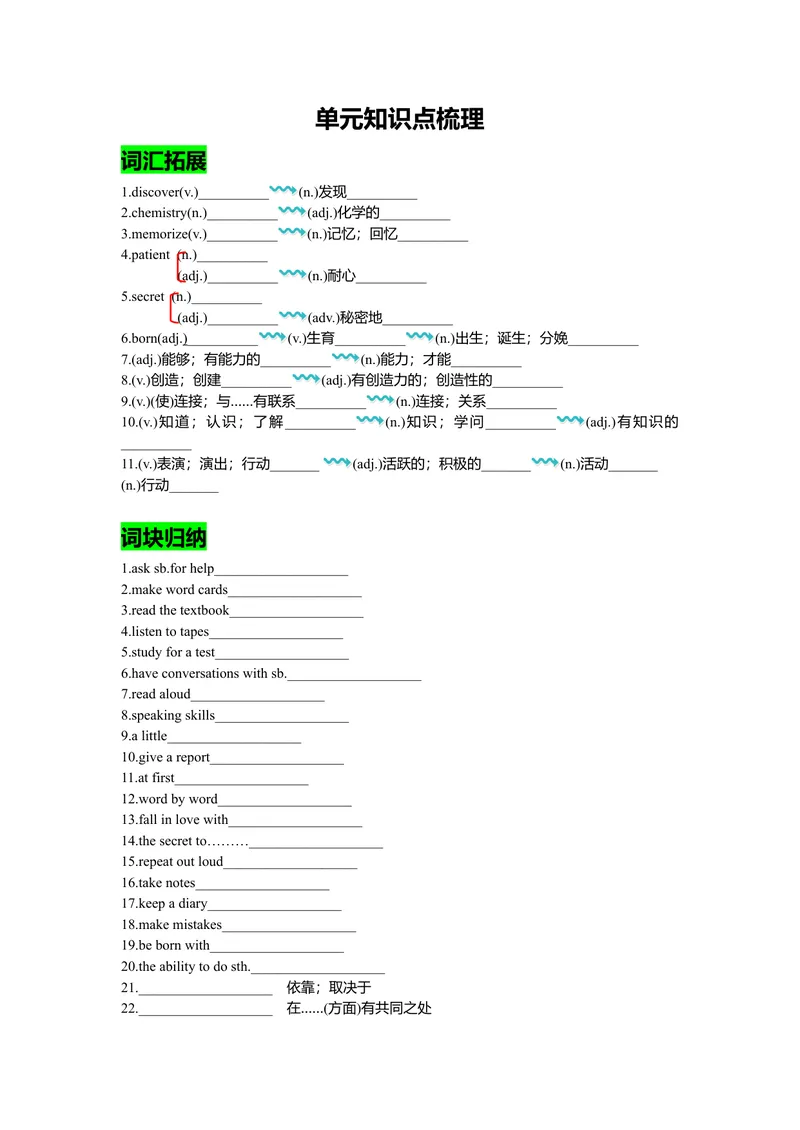
词汇拓展
1.discover(v.)__________ (n.)发现__________
2.chemistry(n.)__________ (adj.)化学的__________
3.memorize(v.)__________ (n.)记忆;回忆__________
4.patient (n.)__________
(adj.)__________ (n.)耐心__________
5.secret (n.)__________
(adj.)__________ (adv.)秘密地__________
6.born(adj.)__________ (v.)生育__________ (n.)出生;诞生;分娩__________
7.(adj.)能够;有能力的__________ (n.)能力;才能__________
8.(v.)创造;创建__________ (adj.)有创造力的;创造性的__________
9.(v.)(使)连接;与……有联系__________ (n.)连接;关系__________
10.(v.)知道;认识;了解__________ (n.)知识;学问__________ (adj.)有知识的
__________
11.(v.)表演;演出;行动_______ (adj.)活跃的;积极的_______ (n.)活动_______
(n.)行动_______
词块归纳
1.ask sb.for help___________________
2.make word cards___________________
3.read the textbook___________________
4.listen to tapes___________________
5.study for a test___________________
6.have conversations with sb.___________________
7.read aloud___________________
8.speaking skills___________________
9.a little___________________
10.give a report___________________
11.at first___________________
12.word by word___________________
13.fall in love with___________________
14.the secret to………___________________
15.repeat out loud___________________
16.take notes___________________
17.keep a diary___________________
18.make mistakes___________________
19.be born with___________________
20.the ability to do sth.___________________
21.___________________ 依靠;取决于
22.___________________ 在……(方面)有共同之处23.___________________ 对……感兴趣
24.___________________ 注意;关注
25.___________________ 把……和……连接或联系起来
26.___________________ 例如
27.__________________ 考虑
28.___________________ 即使;虽然
29.___________________ 一直做某事
30.___________________ 写下;记下
31.___________________ 彼此;互相
32.___________________ 弄清;查明
33.___________________ 担心;忧虑
34.___________________ 紧张;饱受压力
35.___________________ 独自地;独立地
36.___________________ 代替;反而
37.___________________ 立刻;马上
38.___________________ 反复
39.___________________ 有时;偶尔
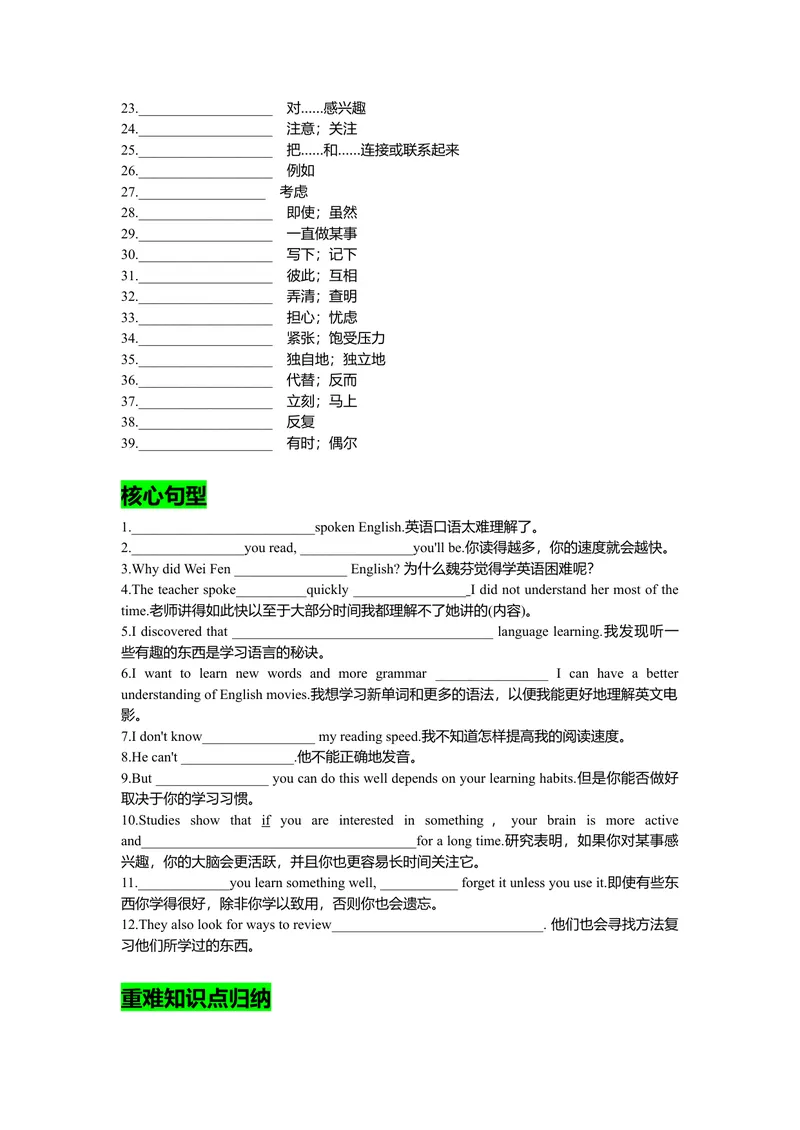
核心句型
1.__________________________spoken English.英语口语太难理解了。
2.________________you read, ________________you'll be.你读得越多,你的速度就会越快。
3.Why did Wei Fen ________________ English? 为什么魏芬觉得学英语困难呢?
4.The teacher spoke__________quickly ________________ I did not understand her most of the
time.老师讲得如此快以至于大部分时间我都理解不了她讲的(内容)。
5.I discovered that _____________________________________ language learning.我发现听一
些有趣的东西是学习语言的秘诀。
6.I want to learn new words and more grammar ________________ I can have a better
understanding of English movies.我想学习新单词和更多的语法,以便我能更好地理解英文电
影。
7.I don't know________________ my reading speed.我不知道怎样提高我的阅读速度。
8.He can't ________________.他不能正确地发音。
9.But ________________ you can do this well depends on your learning habits.但是你能否做好
取决于你的学习习惯。
10.Studies show that if you are interested in something , your brain is more active
and_______________________________________for a long time.研究表明,如果你对某事感
兴趣,你的大脑会更活跃,并且你也更容易长时间关注它。
11._____________you learn something well, ___________ forget it unless you use it.即使有些东
西你学得很好,除非你学以致用,否则你也会遗忘。
12.They also look for ways to review______________________________. 他们也会寻找方法复
习他们所学过的东西。
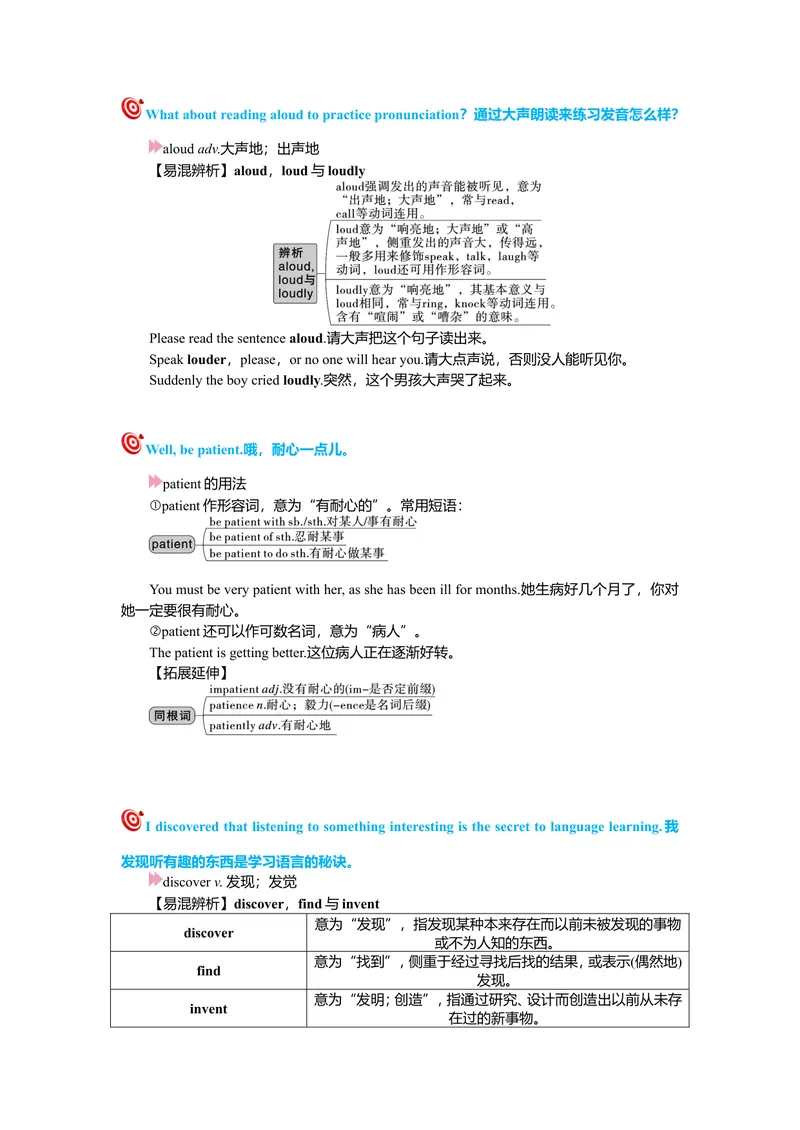
重难知识点归纳What about reading aloud to practice pronunciation?通过大声朗读来练习发音怎么样?
aloud adv.大声地;出声地
【易混辨析】aloud,loud与loudly
Please read the sentence aloud.请大声把这个句子读出来。
Speak louder,please,or no one will hear you.请大点声说,否则没人能听见你。
Suddenly the boy cried loudly.突然,这个男孩大声哭了起来。
Well, be patient.哦,耐心一点儿。
patient的用法
①patient作形容词,意为“有耐心的”。常用短语:
You must be very patient with her, as she has been ill for months.她生病好几个月了,你对
她一定要很有耐心。
②patient还可以作可数名词,意为“病人”。
The patient is getting better.这位病人正在逐渐好转。
【拓展延伸】
I discovered that listening to something interesting is the secret to language learning.我
发现听有趣的东西是学习语言的秘诀。
discover v. 发现;发觉
【易混辨析】discover,find与invent
意为“发现”,指发现某种本来存在而以前未被发现的事物
discover
或不为人知的东西。
意为“找到”,侧重于经过寻找后找的结果,或表示(偶然地)
find
发现。
意为“发明;创造”,指通过研究、设计而创造出以前从未存
invent
在过的新事物。We discovered this beach while we were sailing around the island.我们在围绕这个海岛航
行时发现了这个海滩。
My watch was finally found in my bed.我的手表最终在我床上被找到。
We all know Edison invented the light bulb.我们都知道爱迪生发明了灯泡。
But because I wanted to understand the story,I looked them up in a dictionary.但因为
我想了解这个故事,所以我在词典中查阅了它们(这些句子)。
look up (在词典、参考书中或通过电脑)查阅;抬头看。是“动词+副词”构成的短语,
在此处意为“(在词典、参考书中或通过电脑)查阅”。后接名词或代词作宾语,如接代词,代
词应放在look与up之间。look up…in…意为“在……中查找……”。
Can you look up the time for the next train to Nanjing?你能不能看看到南京的下一次班
车什么时候开?
Please look up her number in the phone book over there.请在那边的电话簿里查找一下她
的电话号码。
【拓展延伸】look up 还有“抬头看”之意。
Please look up at the blue sky and listen to the birds singing to relax yourself.请抬头看蓝天,
听鸟唱歌来让自己放松。
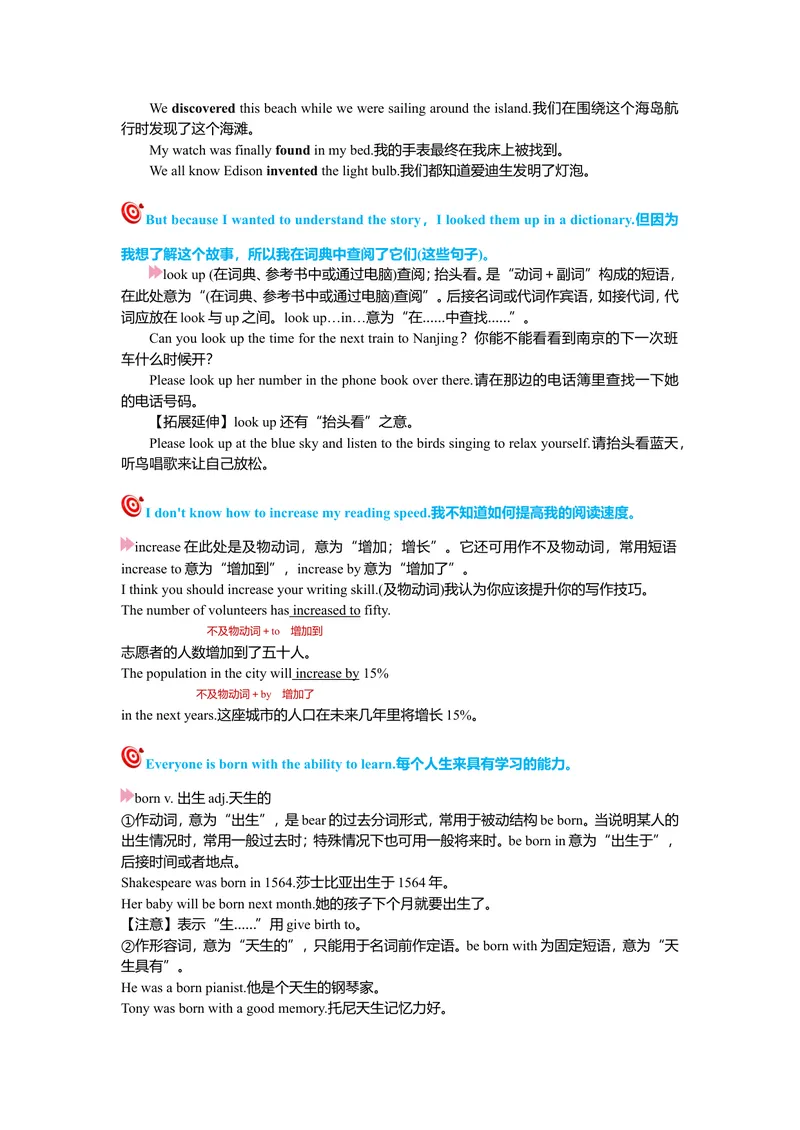
I don't know how to increase my reading speed.我不知道如何提高我的阅读速度。
increase在此处是及物动词,意为“增加;增长”。它还可用作不及物动词,常用短语
increase to意为“增加到”,increase by意为“增加了”。
I think you should increase your writing skill.(及物动词)我认为你应该提升你的写作技巧。
The number of volunteers has increased to fifty.
不及物动词+to 增加到
志愿者的人数增加到了五十人。
The population in the city will increase by 15%
不及物动词+by 增加了
in the next years.这座城市的人口在未来几年里将增长15%。
Everyone is born with the ability to learn.每个人生来具有学习的能力。
born v. 出生adj.天生的
①作动词,意为“出生”,是bear的过去分词形式,常用于被动结构be born。当说明某人的
出生情况时,常用一般过去时;特殊情况下也可用一般将来时。be born in意为“出生于”,
后接时间或者地点。
Shakespeare was born in 1564.莎士比亚出生于1564年。
Her baby will be born next month.她的孩子下个月就要出生了。
【注意】表示“生……”用give birth to。
②作形容词,意为“天生的”,只能用于名词前作定语。be born with为固定短语,意为“天
生具有”。
He was a born pianist.他是个天生的钢琴家。
Tony was born with a good memory.托尼天生记忆力好。课本长难句分析
The more you read, the faster you'll be.你读得越多,你就读得越快。
“the+比较级,the+比较级”意为“越……,就越……”。两个“the+比较级”分别引
导一个分句,前一个分句表示假设、条件等,后一个分句表示结果。
The higher the ground is , the thinner the air becomes .
表示条件 表示结果
离地面越高,空气就变得越稀薄。
The busier he is, the happier he will be.他越忙,就越高兴。
Why did Wei Fen find it difficult to learn English?为什么魏芬发现学习英语困难呢?
find it+形容词+to do sth.发现做某事……该结构中的it为形式宾语,真正的宾语是后
面的动词不定式短语,形容词作宾语补足语。
I find it very easy to use a computer.我发现使用电脑十分简单。
【同类归纳】
make it+形容词+to do sth.使做某事……
think it+形容词+to do sth.认为做某事……
The teacher spoke so quickly that I did not understand her most of the time.老师讲得如
此快,以至于大部分时间我都听不懂。
so…that…意为“如此……以至于……”,so后接形容词或副词,that引导的是结果状语从句。
He is so tall that he can touch the roof.
so+adj. that引导结果状语从句
他是如此高以至于他能摸到屋顶。
Lily ran so fast that I couldn't catch up with her.
so+adv. that引导结果状语从句
莉莉跑得如此快以至于我追不上她。
【同类归纳】可以与so…that…互换的结构
①当that引导的结果状语从句是一个肯定句时,可以与“形容词/副词+enough+to…
(足够……可以……)”结构互换。
I was so lucky that I caught the last bus.=I was lucky enough to catch the last bus.我很幸运
赶上了最后一班公共汽车。
②当that引导的结果状语从句是一个否定句时,可以与“too…to…(太……而不能……)”
结构互换。
The boy was so excited that he couldn't fall asleep.=The boy was too excited to fall asleep.
这个男孩太兴奋而睡不着觉。
【拓展延伸】such…that…意为“如此……以至于……”,引导结果状语从句,such后跟名
词(短语),结构为:
①such a(n)+形容词+单数可数名词+that从句(=so+形容词+a(n)+单数可数名词+
that从句)It is such an interesting book that I like it very much.=It is so interesting a book that I like it
very much.这本书真有趣,我很喜欢。
②such+形容词+复数名词+that从句
My grandma told us such funny stories that we all burst into laughing.奶奶给我们讲如此有
趣的故事,我们都大笑起来。
I discovered that listening to something interesting is the secret to language learning.我
发现听有趣的东西是学习语言的秘诀。
本句中that引导宾语从句,作discover的宾语。宾语从句中,listening to something
interesting是动名词作主语,从句的谓语动词用单数形式。
I don't know how to increase my reading speed.我不知道如何提高我的阅读速度。
“how to increase my reading speed”是“疑问词 (how)+动词不定式”结构,在句中作宾语。
此时可以和宾语从句进行同义句转换。
I don't know how to increase my reading speed.=I don't know how I can increase my reading
speed.
【拓展延伸】动词不定式可以和疑问词连用,在句中作主语、宾语、表语或宾语补足语等。
When to have the party is still unknown.什么时候举行聚会还不知道。
(作主语)
She wanted to know why to leave so early.她想知道为什么要这么早离开。
(作宾语)
My doubt is where to go next.我的疑虑是接下来该去哪里。
(作表语)
Can you tell me how to get to the nearest hospital?你能告诉我怎样去最近的医院吗?
(作宾语补足语)
He can't get the pronunciation right.他不能正确地发音。
“get+宾语+宾语补足语”结构
此处get为使役动词,而right是形容词,在句中作宾语补足语。“get+宾语+宾语补足语”
表示“使某人或某物处于……状态/位置”。其中,宾语补足语可以是形容词、介词短语、现在
分词、过去分词或动词不定式等。
I don't know if I can get it clean.我不知道自己是否能把它清理干净。
get+宾语+形容词
She got her coat washed.她把外套洗了。
get+宾语+过去分词
We should get the fire burning all the time to keep warm.我们应该让火一直烧着来取暖。
get+宾语+现在分词
【拓展延伸】单元语法点回顾
一 by 的用法
1.用作介词
(1)表示方式、方法或手段,意为“使用某物;靠;乘(车、船等)”。
Lisa study English by listening to the news. 莉萨通过听新闻的方式学英语的。
(2)表示时间,意为“不迟于;在……以前;到……为止”。
Mr. Hu has to finish his work by eight o'clock.胡先生必须要在八点前完成他的工作。
(3)用于被动语态中,表示动作的执行者,意为“由;被”。
My fish was eaten by a stray cat.我的鱼被一只流浪猫吃掉了。
(4)表示位置,意为“靠近;在……旁边”。
The Greens often take a walk by the river on weekends.格林一家经常周末在河边散步。
2.用作副词
by用作副词,意为“经过”,相当于past。
He didn't even raise his head when I drove by. 我开车过去,他连头都没有抬。
3.用在某些短语中
by the way顺便说 by oneself(某人)独自
二 动名词的用法
1.动名词在句中作主语
动名词作主语时,谓语动词用第三人称单数形式。可以用it作形式主语,将动名词改为动词
不定式,作真正的主语。
Eating too much sweet food is bad for our health.=It is bad for our health to eat too much sweet
food.吃太多甜食对我们的身体不好。2.动名词在句中作宾语
动名词在句中作宾语时,一般放在某一及物动词或介词之后充当这一动词或介词的宾语。后
跟动名词作宾语的动词或短语有:finish, enjoy, keep, stand, suggest, advise, practice, allow,
mind, imagine, how about, thanks for, feel like, be interested in, look forward to等。
单元知识点过关
过单词
Ⅰ.根据句意用方框中所给词的适当形式填空。
aloud conversation know discover create
1.Teachers should _____ what the students are interested in and help them build self-confidence.
2. _____ a more comfortable space, eating or drinking on the subway in Beijing is not allowed.
3.The Readers on CCTV is a great TV show that expresses our true feelings by reading _____ in
public.
4.I think having ______ with foreigners can improve my English.
5.Our science teacher tells us that _________ will give us wings to fly.
Ⅱ. 根据句意用括号内所给单词的适当形式填空。
1. As students, we should use the Internet__________(wise).
2.- I am afraid to ask questions because of my poor _____(pronounce).
- You'd better practice speaking more.
3. The number of people who have computers has ________ (increase) to 3 million in this city.
4.That young man has a special _________(able) to write with two hands at the same time.
5.Sally didn't catch me, so she asked me ______(repeat) my question.
Ⅲ.单项选择。
1.Just be _____. You can't make such great progress in a day. It takes time.
A. available B. humorous
C. patient D. unbelievable
2.(2018·安徽中考)-What is the ______ of your excellent spoken English?
-Practice makes perfect!
A.result B. influence C. duty D. secret
3.—What's the _____ of the car at present?
—It's about 70 kilometers an hour.
A. place B. speed C. price D. mark
4. The girl used to be shy in class, but now she is _______. She always puts up her hand and wants
to answer the teachers' questions.A. active B. quiet C. nervous D. strict
5.(2019·湖北武汉中考)-Have you _______ chemistry for the coming exam?
-Yes. I'm quite ready for it.
A.repeated B. copied C. marked D. reviewed
过短语
根据句意用方框中所给短语的适当形式填空。
look ... up at first be born with pay attention to connect ... with...
1.It’s not easy___________,but it soon becomes second nature.
2.—Dad, I don’t know this new word.
— Well, you can ________ it ________ in the dictionary.
3.When you visit a museum, you should _____ the instructions and don't be against them.
4.A good student should know how to ________ what he learns in books _____ what he sees
around him.
5.—Do you believe the boy ___________ the ability to predict the future?
—No,I really doubt it.
过句子
根据汉语意思完成句子,每空一词。
1.我们发现对于我们来说,要在短时间内学好一门外语是不可能的。
We _____ _____ _____ _____ ______ ______ _____ a foreign language well in a short time.
2.你读书的快慢主要取决于你的词汇量和阅读习惯。
_______ _______ _______ you read fast mainly ______ _______ your vocabulary and reading
habits.
3.(2018·重庆中考B卷)我们应该学好英语,以便能向世界讲述中国故事。
We should learn English well _______ _______ we can tell China stories to the world.
4. 李明是如此地忙着备战高考,以至于他根本没时间每天锻炼。
Li Ming was _______ busy preparing for the high school entrance exam _______ he had no time
to do sports every day
5.王老师刚才告诉我们如何提高阅读速度。
Miss Wang told us _______ _______ _______ our reading speed just now.
6.—我们这个城市春天雾霾好严重。你怎么看?—我认为我们开车越少,空气污染也就越少
—There was thick haze in our city this spring. What do you think of it?
—I think ______ _________cars we drive, ______ _____ air pollution our city will have.
7.你最好找个同学一起练习英语口语。
You’d better find a classmate_______ _______ spoken English _______ .过交际
补全对话。(有两项多余)
W: You look worried, David. What's wrong?
M: 1 _______________
W: You said you liked English. 2 _______________
M: I find it difficult to do English reading, especially reading a long passage.
W: That doesn't sound too bad.
M: 3______________ What should I do?
W: Just read quickly to get the main idea at first. Don't read word by word. Read words in groups.
M: 4 _______________
W: To guess a word's meaning by reading the sentences before and after it. You probably
understand more than you think.
M: That sounds difficult.
W: 5 _____________You can improve your English reading by more practice. The more you read,
the faster you'll be.
M: I'll try. Thank you, Mrs. Black.
A. I hope I can.
B. I failed my math test.
C. What's your problem?
D. But I'm a very slow reader.
E. Well, be patient. It takes time.
F. I'm having trouble learning English.
G. But how do I deal with the words I don't understand?
过语法
Ⅰ.根据句意用方框中所给词的适当形式填空。
how understand visit make by correct watch
1.As we all know, a person learns many things by _______ mistakes and _______ them
2.—I have trouble _______ the new word. Can you help me?
—Sure. You can look it up in the dictionary.
3.Yunnan Museum is such an interesting place that many kids have fun ______ it.
4.I think ________ English cartoons is very helpful for you to learn English.
5. – _____ do you know so much about the history of the country?
– I usually get the information _____ using the internet.
Ⅱ.单项选择。
1.(2019·安徽中考)On sunny days,my grandma often reads a novel ______the window.
A.by B.for C.with D.from
2.(2019· 四川达州)22.—Hello, Lucy, please give me some ______ on how to improve my
English!
—You’d better keep ______ more English books.A.advices; read B. advice; read C. advice; reading D.advices; reading
3.(2019· 广东)35. Nobody taught the old lady how to use WeChat. She learned it all by ______.
A. she B. her C. herself D. hers
4. —________ did you tell Mary about the story?
—By ________ an email.
A. How; send B. How; sending
C. What; send D. What; sending
过综合
阅读短文,然后用方框中所给单词的适当形式填空,每个词限用一次。
with that think listen pronounce be note use other understand
Last year my English class was difficult. First of all,it wasn’t easy for me 1.______
the teacher when she talked . She spoke so quickly 2.______ I did not understand every
word. I was afraid to speak in class because I 3.______ my classmates might laugh at me.
Then one day I watched an English movie called Toy Story. I fell in love 4.______ this
exciting and funny movie! So I decide to watch 5.______ English movies. I realized I could
get the meaning by 6.______ for just the key words. My 7.______ improved as well. I think
that doing lots of listening practice 8.______ the secret to language learning.
Another thing that I found very difficult was English grammar. So I started to take
lots of grammar 9.______ in every class. I wrote my own original sentences 10.______
the grammar I was learning. It’s amazing how much this helped.
Now I am really enjoying my English class.
综合填空。阅读下面材料,在空白处填入一个适当的单词或括号内单词的正确形式。(每空不
超过三个单词)
Research shows that successful learners have some good habits in common.
Creating an interest in what they learn
Studies show that if you are interested in something, your brain is more active and it is also
easier for you 1._____(pay) attention to it for a long time. Good learners often connect what they
need to learn 2.______ something they are interested in. For example, if they need to learn English
and they like music or sports, they can listen to English songs or watch sports programs in
English. This way they will not get 3._______(bore).
Practicing and learning from mistakes
Good learners think about what they are good at and what they need to practice more.
Remember, “use it or lose it”! Even if you learn something well, you will forget it 4._______ you
use it. Practice makes perfect. Good learners are also not afraid of making mistakes. Alexander
Graham Bell did not invent the telephone overnight. He succeeded by 5._______(try) many times
and learning from his mistakes.Developing their study skills
It is not enough to just study hard. Good learners know 6._______ to study best. For
example, they may take 7._______(note) by writing down key words or by drawing mind maps.
They also look for ways to review what they 8._______(learn). They may do this by reading their
notes every day or by explaining the information to another student.
Asking questions
Good learners often ask questions during or after class. They even ask each other and try to
find out the answers. 9._______(know) comes from questioning.
Learning is a lifelong journey because every day brings something new. Everything that you
learn becomes a part of you and changes you, so learn 10._______(wise) and learn well.