文档文本内容
单元知识点梳理
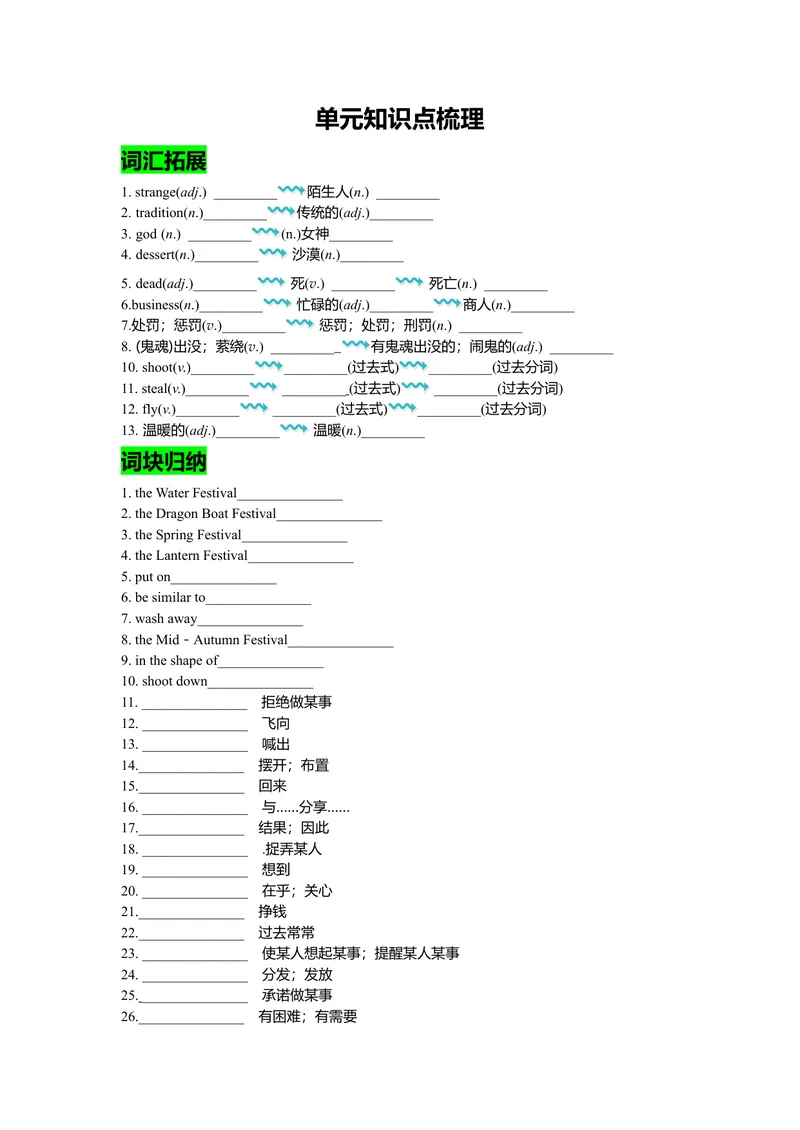
词汇拓展
1. strange(adj.) _________ 陌生人(n.) _________
2. tradition(n.)_________ 传统的(adj.)_________
3. god (n.) _________ (n.)女神_________
4. dessert(n.)_________ 沙漠(n.)_________
5. dead(adj.)_________ 死(v.) _________ 死亡(n.) _________
6.business(n.)_________ 忙碌的(adj.)_________ 商人(n.)_________
7.处罚;惩罚(v.)_________ 惩罚;处罚;刑罚(n.) _________
8. (鬼魂)出没;萦绕(v.) _________ 有鬼魂出没的;闹鬼的(adj.) _________
10. shoot(v.)_________ _________(过去式) _________(过去分词)
11. steal(v.)_________ _________ (过去式) _________(过去分词)
12. fly(v.)_________ _________(过去式) _________(过去分词)
13. 温暖的(adj.)_________ 温暖(n.)_________
词块归纳
1. the Water Festival_______________
2. the Dragon Boat Festival_______________
3. the Spring Festival_______________
4. the Lantern Festival_______________
5. put on_______________
6. be similar to_______________
7. wash away_______________
8. the Mid-Autumn Festival_______________
9. in the shape of_______________
10. shoot down_______________
11. _______________ 拒绝做某事
12. _______________ 飞向
13. _______________ 喊出
14._______________ 摆开;布置
15._______________ 回来
16. _______________ 与……分享……
17._______________ 结果;因此
18. _______________ .捉弄某人
19. _______________ 想到
20. _______________ 在乎;关心
21._______________ 挣钱
22._______________ 过去常常
23. _______________ 使某人想起某事;提醒某人某事
24. _______________ 分发;发放
25. _______________ 承诺做某事
26._______________ 有困难;有需要核心句型
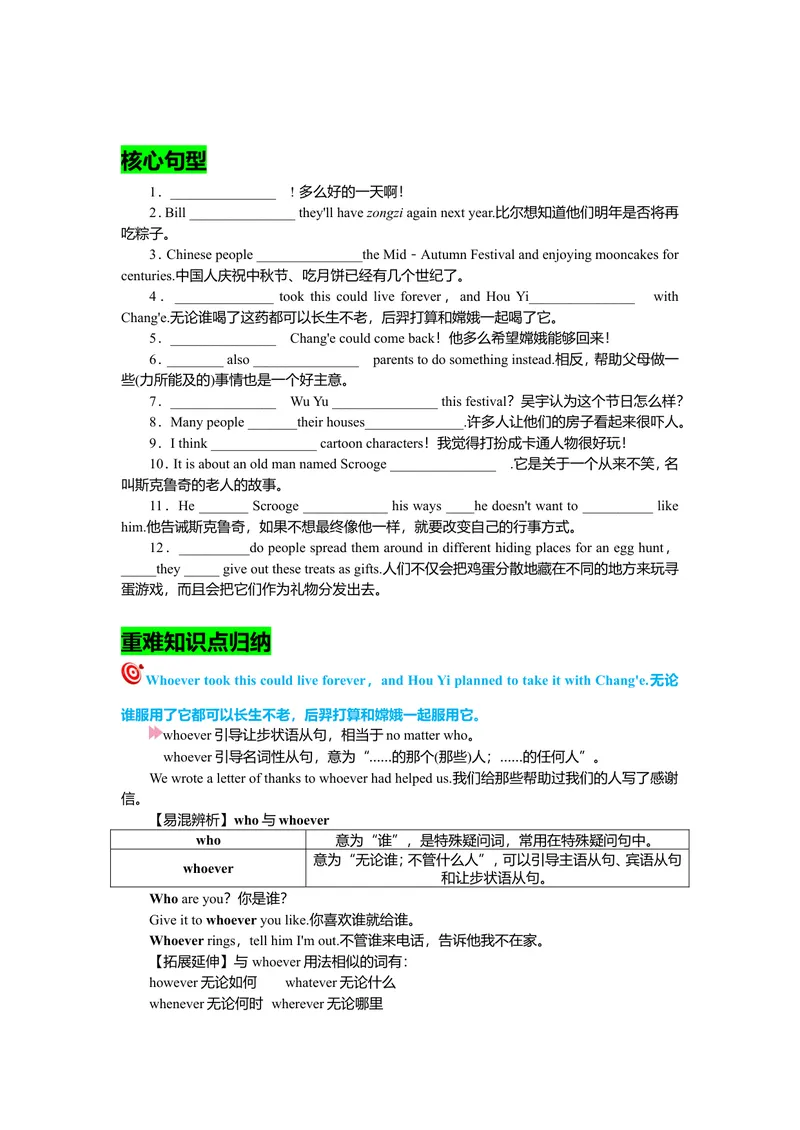
1._______________ ! 多么好的一天啊!
2.Bill _______________ they'll have zongzi again next year.比尔想知道他们明年是否将再
吃粽子。
3.Chinese people _______________the Mid-Autumn Festival and enjoying mooncakes for
centuries.中国人庆祝中秋节、吃月饼已经有几个世纪了。
4.______________ took this could live forever,and Hou Yi_______________ with
Chang'e.无论谁喝了这药都可以长生不老,后羿打算和嫦娥一起喝了它。
5._______________ Chang'e could come back!他多么希望嫦娥能够回来!
6.________ also _______________ parents to do something instead.相反,帮助父母做一
些(力所能及的)事情也是一个好主意。
7._______________ Wu Yu _______________ this festival?吴宇认为这个节日怎么样?
8.Many people _______their houses______________.许多人让他们的房子看起来很吓人。
9.I think _______________ cartoon characters!我觉得打扮成卡通人物很好玩!
10.It is about an old man named Scrooge _______________ .它是关于一个从来不笑,名
叫斯克鲁奇的老人的故事。
11.He _______ Scrooge ____________ his ways ____he doesn't want to __________ like
him.他告诫斯克鲁奇,如果不想最终像他一样,就要改变自己的行事方式。
12.__________do people spread them around in different hiding places for an egg hunt,
_____they _____ give out these treats as gifts.人们不仅会把鸡蛋分散地藏在不同的地方来玩寻
蛋游戏,而且会把它们作为礼物分发出去。
重难知识点归纳
Whoever took this could live forever,and Hou Yi planned to take it with Chang'e.无论
谁服用了它都可以长生不老,后羿打算和嫦娥一起服用它。
whoever引导让步状语从句,相当于no matter who。
whoever引导名词性从句,意为“……的那个(那些)人;……的任何人”。
We wrote a letter of thanks to whoever had helped us.我们给那些帮助过我们的人写了感谢
信。
【易混辨析】who与whoever
who 意为“谁”,是特殊疑问词,常用在特殊疑问句中。
意为“无论谁;不管什么人”,可以引导主语从句、宾语从句
whoever
和让步状语从句。
Who are you?你是谁?
Give it to whoever you like.你喜欢谁就给谁。
Whoever rings,tell him I'm out.不管谁来电话,告诉他我不在家。
【拓展延伸】与 whoever用法相似的词有:
however无论如何 whatever无论什么
whenever无论何时 wherever无论哪里whichever无论哪个
However,a bad man,Pang Meng,tried to steal the medicine when Hou Yi was not
home.然而,歹人逢蒙企图趁后羿不在家的时候偷走神药。
steal的常用短语是steal sth.from…,意为“从……偷某物”。
Bridge stole the money from clients' accounts.布里奇从客户的账户里偷了钱。
The thief stole(偷) food from the supermarket and was caught by the policemen.
After this,people started the tradition of admiring the moon and sharing mooncakes
with their families.从此以后,人们开始了赏月和与家人共享月饼的传统。
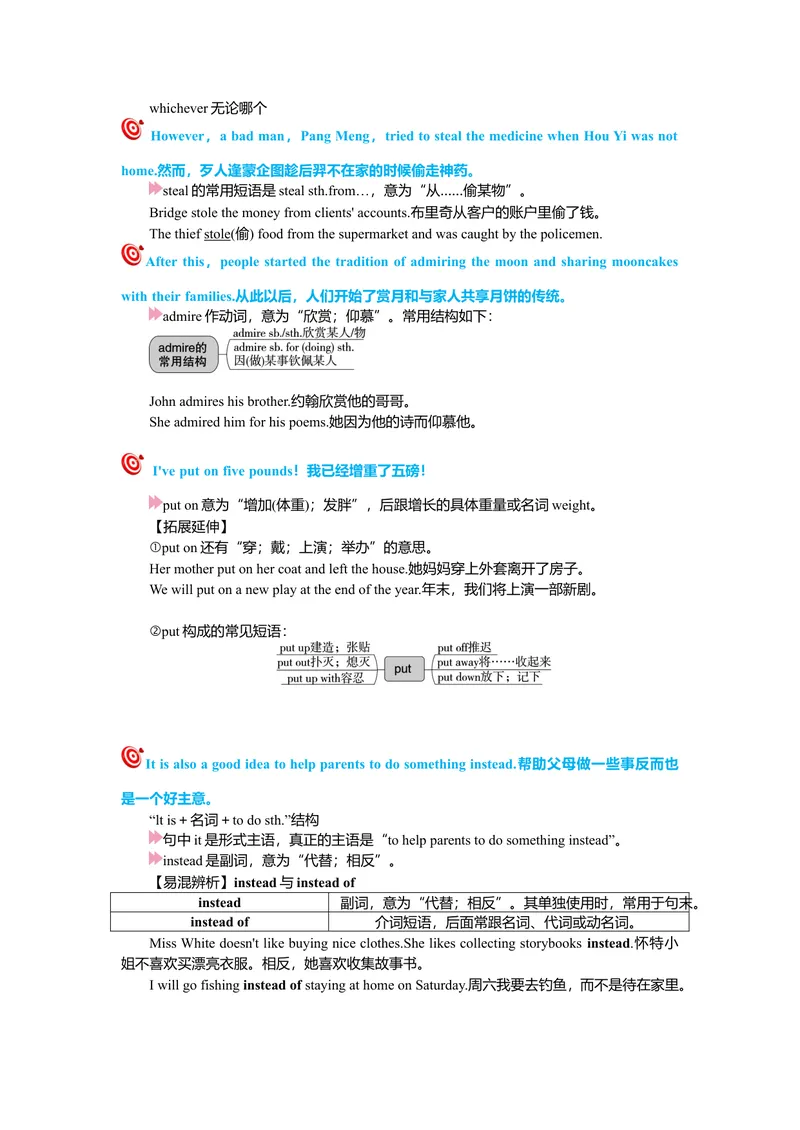
admire作动词,意为“欣赏;仰慕”。常用结构如下:
John admires his brother.约翰欣赏他的哥哥。
She admired him for his poems.她因为他的诗而仰慕他。
I've put on five pounds!我已经增重了五磅!
put on意为“增加(体重);发胖”,后跟增长的具体重量或名词weight。
【拓展延伸】
①put on还有“穿;戴;上演;举办”的意思。
Her mother put on her coat and left the house.她妈妈穿上外套离开了房子。
We will put on a new play at the end of the year.年末,我们将上演一部新剧。
②put构成的常见短语:
It is also a good idea to help parents to do something instead.帮助父母做一些事反而也
是一个好主意。
“lt is+名词+to do sth.”结构
句中it是形式主语,真正的主语是“to help parents to do something instead”。
instead是副词,意为“代替;相反”。
【易混辨析】instead与instead of
instead 副词,意为“代替;相反”。其单独使用时,常用于句 末。
instead of 介词短语,后面常跟名词、代词或动名词。
Miss White doesn't like buying nice clothes.She likes collecting storybooks instead.怀特小
姐不喜欢买漂亮衣服。相反,她喜欢收集故事书。
I will go fishing instead of staying at home on Saturday.周六我要去钓鱼,而不是待在家里。“Trick or treat” means kids will play a trick on you if you don't give them a treat.“不招
待就使坏”的意思是如果你不招待孩子们,他们就会捉弄你。
treat的用法
①作名词,意为“款待;招待”。give sb.a treat意为“招待某人”。
Let's go out for lunch.It's my treat.咱们去外面吃午餐吧。我请客。
②作动词,意为“招待;请(客)”。treat sb.to sth.意为“请某人吃某物;用某物款待某人”。
Let me treat you to some juice.让我请你喝点儿果汁吧。
【拓展延伸】treat作动词还可意为“对待;把……看作;治疗”。
They treat the dog as a member of their family.他们把这只狗视作家庭的一员。
The doctor is treating her for her illness.医生正在给她治病。
Marley used to be just like Scrooge,so he was punished after he died.马利过去像斯克鲁
奇一样,因此死后他受到了惩罚。
punish作及物动词,意为“处罚;惩罚”。常用结构:
punish sb.with/by…以……处罚某人
punish sb.for (doing) sth.因(做)某事而处罚某人
The teacher punished Jim by doing the homework again.老师惩罚吉姆再做一遍家庭作业。
Their mother punished them for their rudeness.他们的妈妈因他们的无礼而惩罚了他们。
【拓展延伸】punishment n.惩罚;处罚
Punishment had very little effect on him.惩罚对他没有什么效果。
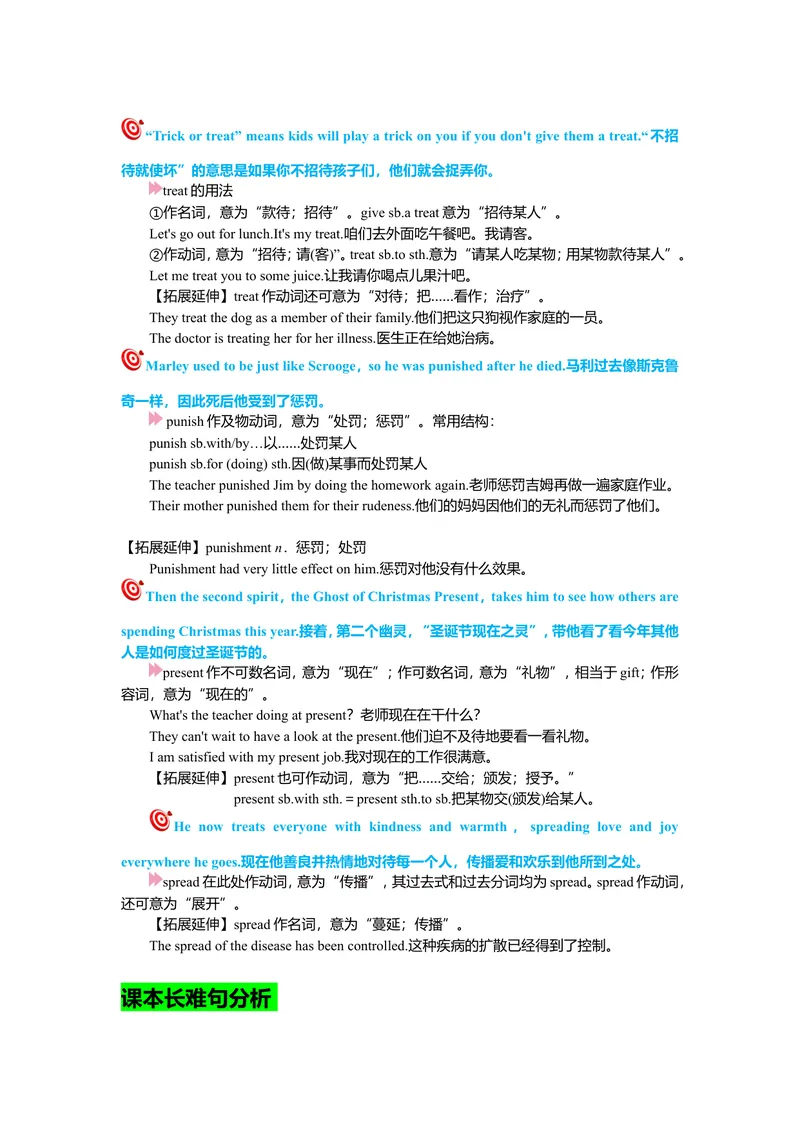
Then the second spirit,the Ghost of Christmas Present,takes him to see how others are
spending Christmas this year.接着,第二个幽灵,“圣诞节现在之灵”,带他看了看今年其他
人是如何度过圣诞节的。
present作不可数名词,意为“现在”;作可数名词,意为“礼物”,相当于gift;作形
容词,意为“现在的”。
What's the teacher doing at present?老师现在在干什么?
They can't wait to have a look at the present.他们迫不及待地要看一看礼物。
I am satisfied with my present job.我对现在的工作很满意。
【拓展延伸】present也可作动词,意为“把……交给;颁发;授予。”
present sb.with sth.=present sth.to sb.把某物交(颁发)给某人。
He now treats everyone with kindness and warmth , spreading love and joy
everywhere he goes.现在他善良并热情地对待每一个人,传播爱和欢乐到他所到之处。
spread在此处作动词,意为“传播”,其过去式和过去分词均为spread。spread作动词,
还可意为“展开”。
【拓展延伸】spread作名词,意为“蔓延;传播”。
The spread of the disease has been controlled.这种疾病的扩散已经得到了控制。
课本长难句分析Chinese people have been celebrating the Mid - Autumn Festival and enjoying
mooncakes for centuries.中国人庆祝中秋节、吃月饼已经有几个世纪了。
本句时态为现在完成进行时,结构是“have/has been+现在分词”。现在完成进行时
表示动作从过去的某一时间开始,一直持续到现在,或者可能仍要继续下去。
I have been living in the city for five years.
我在这个城市已经住了五年了
But behind all these things lies the true meaning of Christmas:the importance of
sharing and giving love and joy to people around us.但在所有这些东西的背后,存在着圣诞
节的真谛:分享和给予我们身边的人爱和欢乐的重要性。
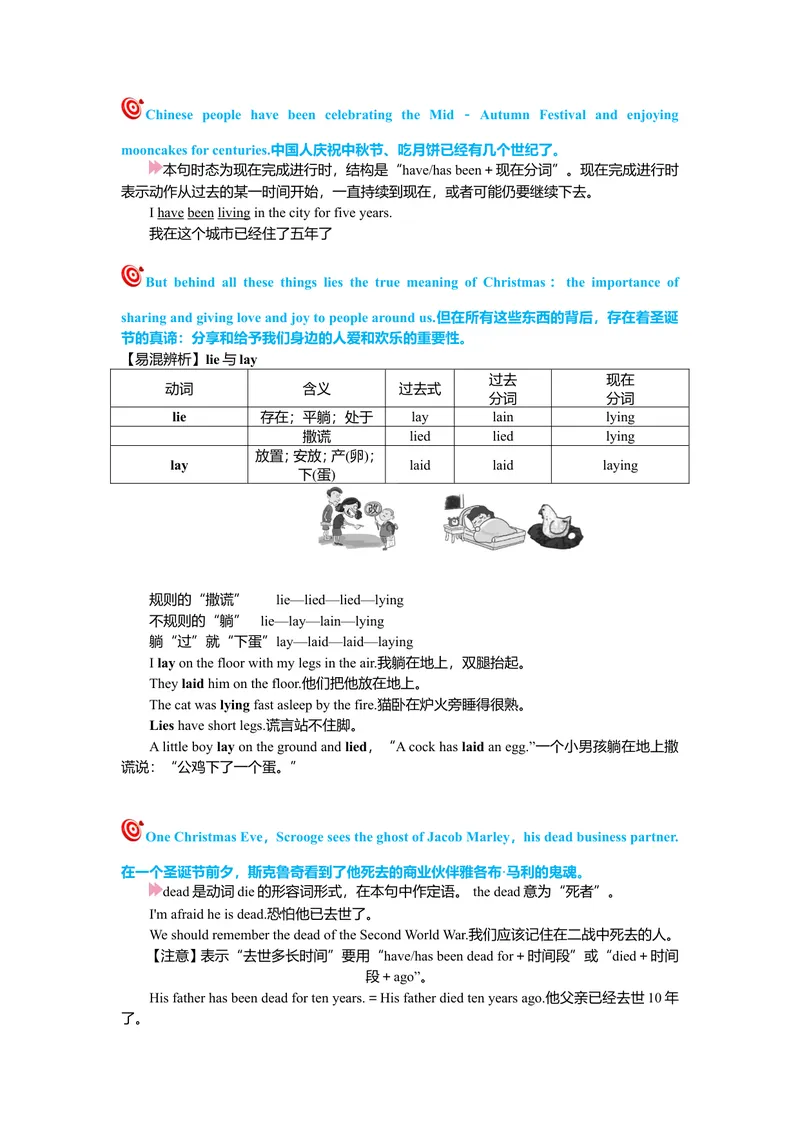
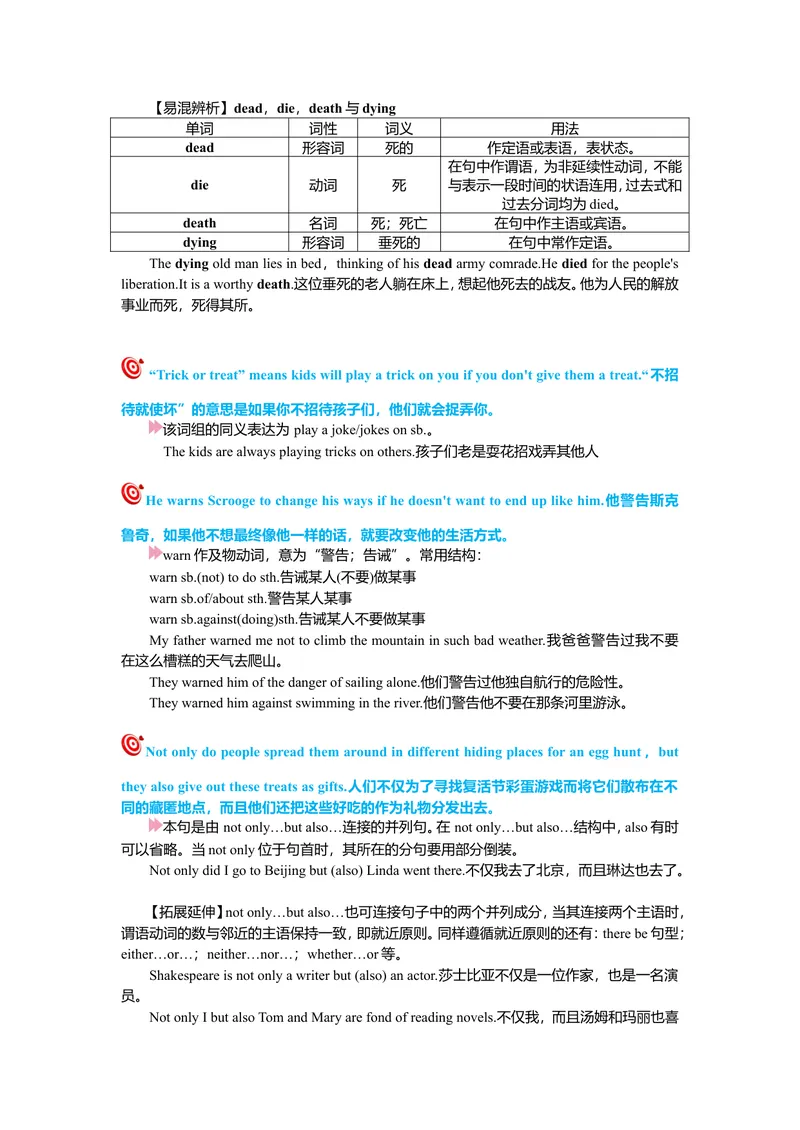
【易混辨析】lie与lay
过去 现在
动词 含义 过去式
分词 分词
lie 存在;平躺;处于 lay lain lying
撒谎 lied lied lying
放置;安放;产(卵);
lay laid laid laying
下(蛋)
规则的“撒谎” lie—lied—lied—lying
不规则的“躺” lie—lay—lain—lying
躺“过”就“下蛋”lay—laid—laid—laying
I lay on the floor with my legs in the air.我躺在地上,双腿抬起。
They laid him on the floor.他们把他放在地上。
The cat was lying fast asleep by the fire.猫卧在炉火旁睡得很熟。
Lies have short legs.谎言站不住脚。
A little boy lay on the ground and lied,“A cock has laid an egg.”一个小男孩躺在地上撒
谎说:“公鸡下了一个蛋。”
One Christmas Eve,Scrooge sees the ghost of Jacob Marley,his dead business partner.
在一个圣诞节前夕,斯克鲁奇看到了他死去的商业伙伴雅各布·马利的鬼魂。
dead是动词die的形容词形式,在本句中作定语。 the dead意为“死者”。
I'm afraid he is dead.恐怕他已去世了。
We should remember the dead of the Second World War.我们应该记住在二战中死去的人。
【注意】表示“去世多长时间”要用“have/has been dead for+时间段”或“died+时间
段+ago”。
His father has been dead for ten years.=His father died ten years ago.他父亲已经去世10年
了。【易混辨析】dead,die,death与dying
单词 词性 词义 用法
dead 形容词 死的 作定语或表语,表状态。
在句中作谓语,为非延续性动词,不能
die 动词 死 与表示一段时间的状语连用,过去式和
过去分词均为died。
death 名词 死;死亡 在句中作主语或宾语。
dying 形容词 垂死的 在句中常作定语。
The dying old man lies in bed,thinking of his dead army comrade.He died for the people's
liberation.It is a worthy death.这位垂死的老人躺在床上,想起他死去的战友。他为人民的解放
事业而死,死得其所。
“Trick or treat” means kids will play a trick on you if you don't give them a treat.“不招
待就使坏”的意思是如果你不招待孩子们,他们就会捉弄你。
该词组的同义表达为 play a joke/jokes on sb.。
The kids are always playing tricks on others.孩子们老是耍花招戏弄其他人
He warns Scrooge to change his ways if he doesn't want to end up like him.他警告斯克
鲁奇,如果他不想最终像他一样的话,就要改变他的生活方式。
warn作及物动词,意为“警告;告诫”。常用结构:
warn sb.(not) to do sth.告诫某人(不要)做某事
warn sb.of/about sth.警告某人某事
warn sb.against(doing)sth.告诫某人不要做某事
My father warned me not to climb the mountain in such bad weather.我爸爸警告过我不要
在这么槽糕的天气去爬山。
They warned him of the danger of sailing alone.他们警告过他独自航行的危险性。
They warned him against swimming in the river.他们警告他不要在那条河里游泳。
Not only do people spread them around in different hiding places for an egg hunt,but
they also give out these treats as gifts.人们不仅为了寻找复活节彩蛋游戏而将它们散布在不
同的藏匿地点,而且他们还把这些好吃的作为礼物分发出去。
本句是由 not only…but also…连接的并列句。在 not only…but also…结构中,also有时
可以省略。当not only位于句首时,其所在的分句要用部分倒装。
Not only did I go to Beijing but (also) Linda went there.不仅我去了北京,而且琳达也去了。
【拓展延伸】not only…but also…也可连接句子中的两个并列成分,当其连接两个主语时,
谓语动词的数与邻近的主语保持一致,即就近原则。同样遵循就近原则的还有:there be句型;
either…or…;neither…nor…;whether…or等。
Shakespeare is not only a writer but (also) an actor.莎士比亚不仅是一位作家,也是一名演
员。
Not only I but also Tom and Mary are fond of reading novels.不仅我,而且汤姆和玛丽也喜欢看小说。
单元语法点回顾
一 宾语从句(一)
宾语从句三要素: 引导词;语序;时态
1.引导词:
(1)that: 当宾语从句由陈述句变化而来时,由that来引导从句,其中的that无具体意义,可以
省略。
I believe(that)our team will win the basketball match. 我相信我们的队伍将会赢得篮球比赛。
(2) if 和 whether:当宾语从句由一般疑问句变化而来时,由if或whether来引导,意为“是
否” ,不可省略。
注意:用于不定式之前、介词之后或与or not 连用时,只能用whether,不能用if。
David asked her if/whether she slept well last night. 大卫问她昨晚是否睡得好。
My mother asks me whether I will go to the picnic tomorrow or not. 我妈妈问我明天是否会去
野餐。
2.语序: 宾语从句要用陈述句语序,即主语 + 谓语 + 其他成分
I wonder if they give similar gifts to their parents. 我想知道他们是否给父母相似的礼物。
3.时态:
(1)主句是现在时或将来时,宾语从句的时态根据实际情况而选择。
He asks me if I came back on time last night.
He is wondering if I will come back on time tonight.
(2)主句是过去时,宾语从句也常用过去时。
He asked me if I would study for the English test.
(3)宾语从句讲述的是客观事实,普遍真理,自然现象等时,其时态不受主句限制,均为一般现
在时。
My teacher told us that a friend in need is a friend indeed.
I will always remember that practice makes perfect.二 感叹句
1.定义: 用来表示喜怒哀乐等带有强烈感情的句子,一般由what或
how引导。
2.句型:
(1) What (+ a/an) + 形容词 + 名词(+主语+谓语)!
What a lovely girl (she is) ! 多么可爱的一个小女孩啊!
What terrible weather (it is)! 多么糟糕的天气啊!
(2) How + 形容词/副词(+主语+谓语)!
How fast he runs! 他跑得真快啊!
(3) How +主语+谓语 !
How time flies!时间过得真快啊!
(4) How +形容词+a/an+可数名词的单数形式+主语+谓语 !
How useful a subject it is!多么有用的一个科目啊!
单元知识点过关
过单词
Ⅰ.根据句意及首字母提示写单词
1.The police often w______ drivers not to drive too fast.
2.Mrs. Jones usually has some pudding for d_________.
3.I’d like a house with a big g_______ where I can plant many beautiful flowers.
4.C______ is the most important festival in some Western countries.
5.Charles Dickens was a famous writer. He wrote many wonderful n________.
Ⅱ.根据句意用括号内所给单词的适当形式填空。
1.The young people _________(lie) on the grass and relaxed themselves.
2.After __________ (lay) the birthday cake down on the table, we clapped and sang for Tom.
3.Oh, my God! Someone has _______(steal) my wallet! I have to call the police.4.Mr. Smith will be away on ___________ (busy) next weekend.
5.She felt the _________(warm) of his arms around her.
Ⅲ.单项选择。
1.—It seems that you don't know much about Wuhan City.
—You're right. I'm a ________ here.
A. stranger B. relative C. patient D. partner
2.—The little boy's parents have been ________ for two years in a traffic accident, and he has to
live alone.
—What a poor boy! Let's do something for him.
A. wise B. sleepy C. angry D. dead
3.—Do you know the man who is making a speech?
—Yes. He is such a successful businessman that all the people in the town ________ him.
A. spread B. punish C. consider D. admire
4.—What are your class rules?
— One of them is that ________doesn’t hand in homework will be punished.
A. whenever B. whoever
C. whatever D. however
5.—The dishes in this restaurant must be very expensive.
—Don’t worry. You can enjoy yourself. It’s my _________ .
A. time B. task C. treat D. present
过短语
根据句意用方框中所给短语的适当形式填空。
end up care about dress up lay out put on
1.The girl is too thin. It’s OK for her to ________five kilos.
2.John often_____________ his toys on the floor.
3.It’s fun _____________________ as cartoon characters.
4.He is mean, and he only _____________ himself.
5.It was not expected that he _____________ writing a saying.
过句子
阅读下列各小题,根据汉语及句末括号内的动词提示,用相关的动词短语完成句子。(每空最
多不超过四个词)
1. 无论谁犯了错误都将会被惩罚。(punish)
________makes mistakes will ________.
2.在昨天上午的会议中,我们以讨论如何保护环境而结束。(end)
We _____________how to protect the environment at the meeting yesterday morning.
3. 当我看到这张旧照片时,它使我想起了我的小学语文老师。(remind)When I saw the old picture, it ________________________________ my Chinese teacher in
the primary school.
4. 他只关心自己能否取得好成绩,从不友好地对待他的同学。(care)
He only ________________ he can get good grades. He never treats his classmates nicely.
过交际
补全对话。(有两项多余)
Nathan: There is a festival in June in our country, it's Father's Day. (1)____
Li Fei: Yes, it's on the fifth day of the fifth lunar (阴历) month. We call it the Dragon Boat
Festival.
Nathan: (2)____
Li Fei: We make and eat zongzi and hold dragon boat races.
Nathan: (3)____ Why do you celebrate the Dragon Boat Festival?
Li Fei: Oh, it is a story about Qu Yuan. He lived about two thousand years ago. His job was to
give advice to the emperor. But he wasn't trusted and often got punishment. So he jumped into the
Miluo River and died.
Nathan: (4)____ Was the day that Qu Yuan died on the fifth day of the fifth lunar month in that
year?
Li Fei: (5)____ From then on, Chinese people began to eat zongzi and had dragon boat races on
that day to memorize him.
A What happened to him?
.
B Is there a Chinese festival in June, too?
.
C Thank you for telling me.
.
D Yes, you are very smart.
.
E It sounds very interesting.
.
F What do you usually do on that day in China?
.
G What a pity!
.
过语法
I.单项选择。
1. He said he ________ to join the basketball club.
A. wants B. is wanting
C. wanted D. has wanted
2.Father’s Day is coming. I’m thinking about ________for my father.
A. that gift I gave B. if we had the other tie
C. if I will buy a tie D. that I give a tie
3._________ wonderful The Reader is! Many people enjoy the TV program.
A. What B. How a C. How D. What a4.— I watched the live(现场直播的)NBA game last night.How about you?
—Of course I did. _________ amazing game it was!
A. What an B. How an C. What D. How
5.We’re not sure if it __________ tomorrow. If it _________, we won’t climb the
South Hill.
A. will rain; rains B. will rain; will rain
C. rains; rains D. rains; will rain
1-5 CCCAA
Ⅱ.按要求完成下列各题。
1.The earth moves around the sun. The teacher told us.(改为含宾语从句的复合句)
___________________________________________________________________
2.How interesting the book is!(改为同义句)
___________________________________________________________________
3.”Do you admire Mo Yan very much?” Li Yan asked me.(改为含宾语从句的复合句)
___________________________________________________________________
4.That man spread the news around the village.(改为否定句)
___________________________________________________________________
5.His father died four years ago.(改为同义句)
___________________________________________________________________
过综合
Passage 1
阅读下面短文,在空白处填入一个适当的词,或填入括号中所给单词的正确形式。
Chinese people have been 1._________ (celebrate) the Mid Autumn Festival and enjoying
mooncakes for 2._________ (century). There are many traditional folk stories 3._________ this
festival.However,most people think that the story of Chang’e is 4_________most touching. It tells
that after Hou Yi 5._________ (shoot) down nine suns,a goddess gave him magic medicine to
thank him. Hou Yi planned 6._________(drink) it with his wife,Chang’e. But a bad man,Pang
Meng,tried to steal the medicine when Hou Yi was out. Chang’e wasn’t ready to give it to him and
then drink it all. She became very light and flew up to the moon. Hou Yi was so sad and missed
7._________(she) very much. On night,he found that the moon was so bright and round that he
could see his wife there. He 8._________ (quick) laid out her favorite fruits and desserts in the
garden. 9._________ he wished that she could come back!
After this,people started the tradition of admiring the moon and sharing mooncakes that carry their
10._________(wish) to the families they love and miss.
Passage 2
根据短文内容,用方框中所给词的适当形式填空,使短文完整、通顺。每词只用一次。
change remind two be warm important write nice whether punish
Many would agree that when we think of Christmas, we probably think of gifts, Christmas
trees and Santa Claus. But behind all these things lies the true meaning of Christmas: the 1
of sharing and giving love and joy to people around us. The story in A Christmas Carol is perhapsthe best example of this.
A Christmas Carol is a famous novel 2 by Charles Dickens. It is about an old man
named Scrooge who never laughs or smiles. He is mean and only thinks about himself. He doesn’t
treat others 3 . He just cares about 4 he can make more money and he hates
Christmas. One Christmas Eve, Scrooge sees the ghost of Jacob Marley, his dead business partner.
Marley used to be just like Scrooge, so he was 5 after he died. He warns Scrooge 6
his ways if he doesn’t want to end up like him. He also tells Scrooge to expect three spirits to visit
him.
That night, three ghosts visit Scrooge. First, the Ghost of Christmas Past takes him back to
his childhood and 7 Scrooge of his happier days as a child. Then the 8 spirit, the
Ghost of Christmas Present, takes him to see how others are spending Christmas this year.
Everyone is happy, even poor people. The last one, the Ghost of Christmas Yet to Come, takes him
to the future. Scrooge sees that he is dead, but nobody cares. He is so scared that he wakes up in
his bed and finds out it is only the next morning — Christmas Day!
He decides to change his life and promises 9 a better person. He happily celebrates
Christmas with his relatives. He also gives gifts to people in need. He now treats everyone with
kindness and 10 (warm), spreading love and joy everywhere he goes. And that is the true
spirit of Christmas!