单元知识点梳理
词汇拓展
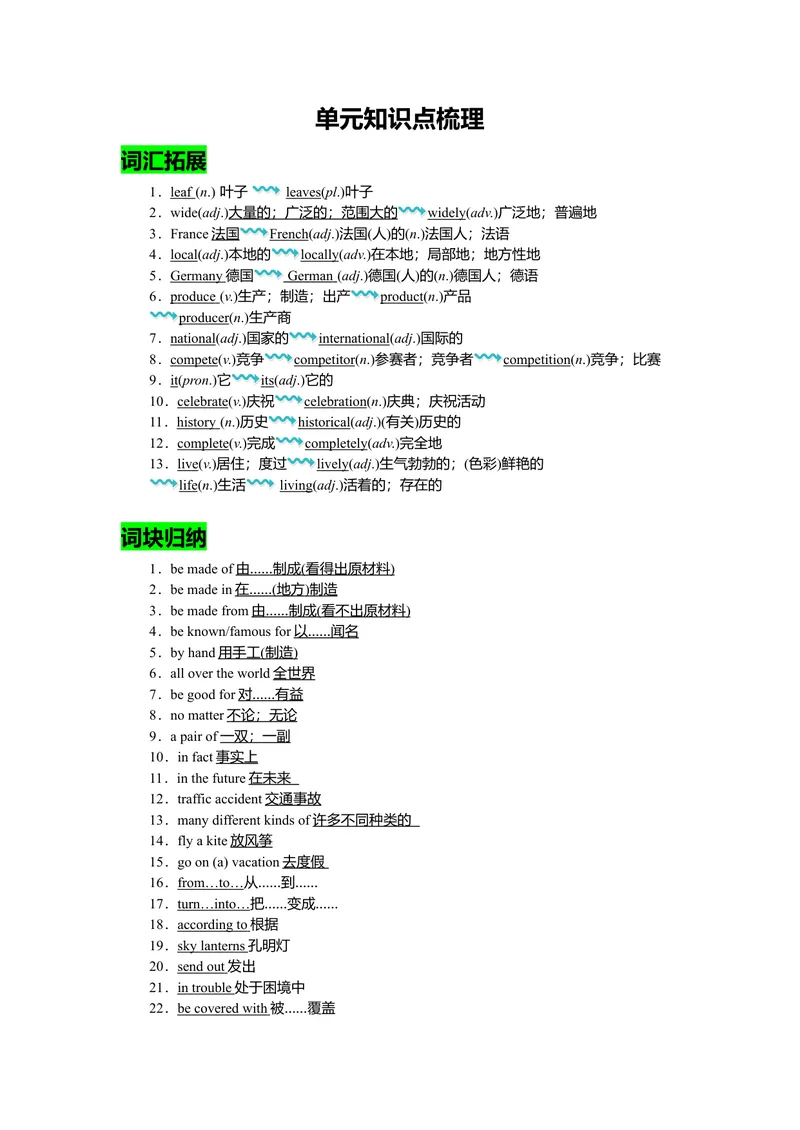
1. l eaf (n.) 叶子 leaves(pl.)叶子
2.wide(adj.)大量的;广泛的;范围大的 widely(adv.)广泛地;普遍地
3.France法国 French(adj.)法国(人)的(n.)法国人;法语
4.local(adj.)本地的 locally(adv.)在本地;局部地;地方性地
5.Germany 德国 German (adj.)德国(人)的(n.)德国人;德语
6. p roduce (v.)生产;制造;出产 product(n.)产品
producer(n.)生产商
7.national(adj.)国家的 international(adj.)国际的
8.compete(v.)竞争 competitor(n.)参赛者;竞争者 competition(n.)竞争;比赛
9.it(pron.)它 its(adj.)它的
10.celebrate(v.)庆祝 celebration(n.)庆典;庆祝活动
11. h istory (n.)历史 historical(adj.)(有关)历史的
12.complete(v.)完成 completely(adv.)完全地
13.live(v.)居住;度过 lively(adj.)生气勃勃的;(色彩)鲜艳的
life(n.)生活 living(adj.)活着的;存在的
词块归纳
1.be made of 由……制成 ( 看得出原材料 )
2.be made in 在…… ( 地方 ) 制造
3.be made from 由……制成 ( 看不出原材料 )
4.be known/famous for以……闻名
5.by hand 用手工 ( 制造 )
6.all over the world全世界
7.be good for对……有益
8.no matter不论;无论
9.a pair of一双;一副
10.in fact事实上
11.in the future在未来
12.traffic accident交通事故
13.many different kinds of许多不同种类的
14.fly a kite放风筝
15.go on (a) vacation去度假
16. from…to… 从……到……
17. turn…into… 把……变成……
18. according to 根据
19. sky lanterns 孔明灯
20. send out 发出
21. in trouble 处于困境中
22. be covered with 被……覆盖23. rise into 升入
24. paper cutting 剪纸
25. during the Spring Festival 春节期间
26. good luck 好运
27. Chinese clay art 中国陶土工艺
28. at a very high heat 在高温下
29. be used for 被用于(做)……
核心句型
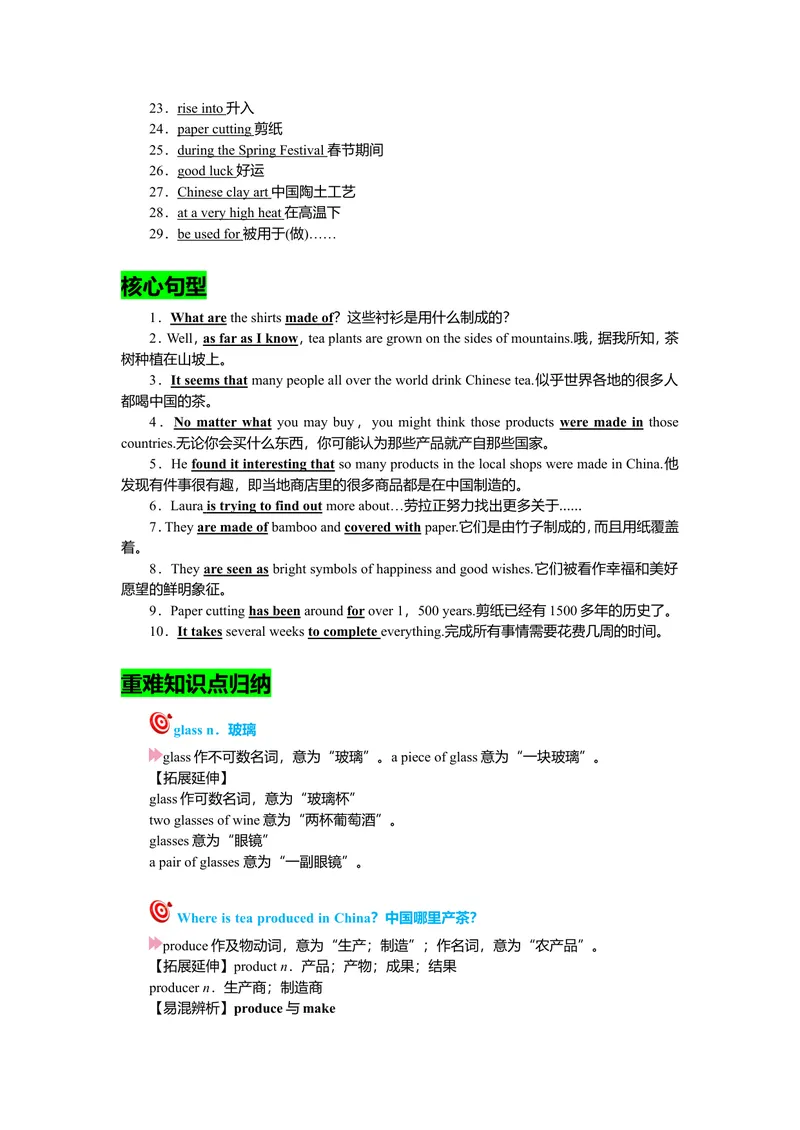
1.What are the shirts made of?这些衬衫是用什么制成的?
2.Well,as far as I know,tea plants are grown on the sides of mountains.哦,据我所知,茶
树种植在山坡上。
3.It seems that many people all over the world drink Chinese tea.似乎世界各地的很多人
都喝中国的茶。
4.No matter what you may buy,you might think those products were made in those
countries.无论你会买什么东西,你可能认为那些产品就产自那些国家。
5.He found it interesting that so many products in the local shops were made in China.他
发现有件事很有趣,即当地商店里的很多商品都是在中国制造的。
6.Laura is trying to find out more about…劳拉正努力找出更多关于……
7.They are made of bamboo and covered with paper.它们是由竹子制成的,而且用纸覆盖
着。
8.They are seen as bright symbols of happiness and good wishes.它们被看作幸福和美好
愿望的鲜明象征。
9.Paper cutting has been around for over 1,500 years.剪纸已经有1500多年的历史了。
10.It takes several weeks to complete everything.完成所有事情需要花费几周的时间。
重难知识点归纳
glass n.玻璃
glass作不可数名词,意为“玻璃”。a piece of glass意为“一块玻璃”。
【拓展延伸】
glass作可数名词,意为“玻璃杯”
two glasses of wine意为“两杯葡萄酒”。
glasses意为“眼镜”
a pair of glasses 意为“一副眼镜”。
Where is tea produced in China?中国哪里产茶?
produce作及物动词,意为“生产;制造”;作名词,意为“农产品”。
【拓展延伸】product n.产品;产物;成果;结果
producer n.生产商;制造商
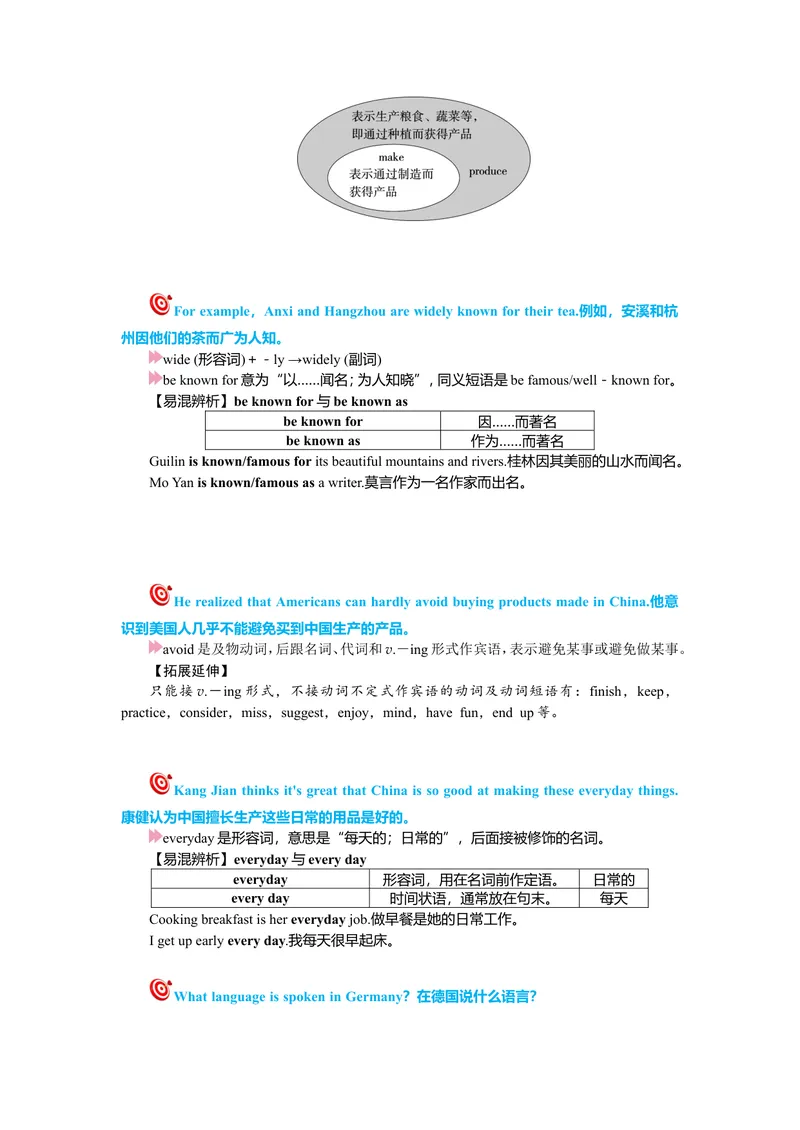
【易混辨析】produce与makeFor example,Anxi and Hangzhou are widely known for their tea.例如,安溪和杭
州因他们的茶而广为人知。
wide (形容词)+-ly →widely (副词)
be known for意为“以……闻名;为人知晓”,同义短语是be famous/well-known for。
【易混辨析】be known for与be known as
be known for 因……而著名
be known as 作为……而著名
Guilin is known/famous for its beautiful mountains and rivers.桂林因其美丽的山水而闻名。
Mo Yan is known/famous as a writer.莫言作为一名作家而出名。
He realized that Americans can hardly avoid buying products made in China.他意
识到美国人几乎不能避免买到中国生产的产品。
avoid是及物动词,后跟名词、代词和v.-ing形式作宾语,表示避免某事或避免做某事。
【拓展延伸】
只能接v.-ing形式,不接动词不定式作宾语的动词及动词短语有:finish,keep,
practice,consider,miss,suggest,enjoy,mind,have fun,end up等。
Kang Jian thinks it's great that China is so good at making these everyday things.
康健认为中国擅长生产这些日常的用品是好的。
everyday是形容词,意思是“每天的;日常的”,后面接被修饰的名词。
【易混辨析】everyday与every day
everyday 形容词,用在名词前作定语。 日常的
every day 时间状语,通常放在句末。 每天
Cooking breakfast is her everyday job.做早餐是她的日常工作。
I get up early every day.我每天很早起床。
What language is spoken in Germany?在德国说什么语言?Germany意为“德国”;German意为“德国人;德语”,其复数形式是Germans,如:
three Germans三个德国人。
【拓展延伸】
国人 复数变化规则
Japanese、 Chinese 复数不变
Frenchman、Englishman 把a改为e
German、 Russian、 American、
词尾加s
Indian、 Italian、Korean
The international kite festival is held in April every year.国际风筝节每一年在四月
份举行。
【拓展延伸】
international adj.国际的
national adj.国家的
The competitors at the festival are from all over the world.这个节日的参赛者都是
来自世界各地的。
competitor是可数名词,意为“参赛者;竞争者”。
【拓展延伸】
compete 动词 比赛
competitor 名词 参赛者
competition 名词 比赛
We can compete with the best teams.我们可以与最好的团队竞争。
Each competitor should wear a number.每个参赛者都应该佩戴一个号码。
She will take part in the singing competition soon.她将很快参加歌唱比赛。
The pieces are usually cute children or lively characters from a Chinese fairy tale
or historical story.这些作品通常是可爱的孩子或中国童话故事或历史故事中的活泼可爱的
人物形象。
lively意为“生气勃勃的”,既可以指活着的生物,也可以指抽象的概念。
My hometown is a lively city.我的家乡是一座生机勃勃的城市。
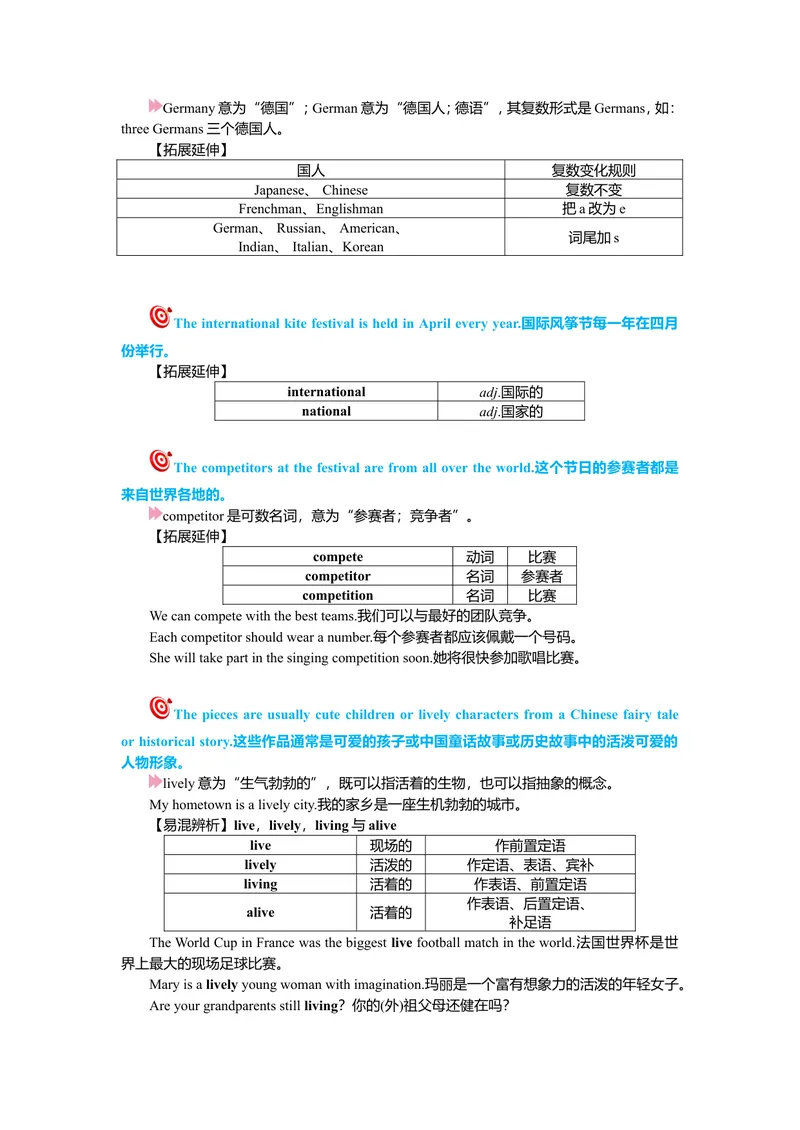
【易混辨析】live,lively,living与alive
live 现场的 作前置定语
lively 活泼的 作定语、表语、宾补
living 活着的 作表语、前置定语
作表语、后置定语、
alive 活着的
补足语
The World Cup in France was the biggest live football match in the world.法国世界杯是世
界上最大的现场足球比赛。
Mary is a lively young woman with imagination.玛丽是一个富有想象力的活泼的年轻女子。
Are your grandparents still living?你的(外)祖父母还健在吗?The bear was caught alive.这只熊被活捉了。
After drying,they are fired at a very high heat.风干之后,把它们进行高温烧制。
at a high heat意为“以高温”。heat此处作名词,意为“热;高温”。
【拓展延伸】heat v.加热;变热
If you heat the ice,it will become water soon.如果你加热冰,它很快就会变成水。
It takes several weeks to complete everything.要花上若干个星期完成一切事情。
complete (doing) sth.表示“完成(做)某事”。
They have just completed building the bridge.他们刚刚建成那座大桥。
【拓展延伸】complete adj.完整的;completely adj.完全地;彻底地。
His answer is complete.他的答案是完整的。
He completely forgot her name.他完全把她的名字给忘了。
He sent them out to ask for help when in trouble.当遇到麻烦时,他就把它们(孔明
灯)放出来求援。
send out 意为“发出”,为动副短语,接代词时,应放在send与out 中间。send out 还可
以表示“发送出某物;派出某人”。
【拓展延伸】与send有关的词组或短语:
send up发射 send for派人去请
send off寄出;发出 send away派遣
in trouble 意为“处于困境中”;“in+名词”表示“处于……中”如:in danger在危
险中;in silence默默地;in excitement兴奋地。
You are always getting yourself in trouble.你总是给自己找麻烦。
【拓展延伸】与trouble 相关的短语:
get into trouble 陷入困境
out of trouble 脱离困境
have trouble doing sth. 做某事有困难
课本长难句分析No matter what you may buy,you might think those products were made in those
countries.无论你可能会买什么东西,你也许会认为那些产品是在那些国家制造的。
no matter表示“无论;不论”,通常与what,who,when,where等疑问词连用,引导让
步状语从句,句中的 no matter what可用whatever表示。上面的句子还可以这样表达:
Whatever you may buy,you might…those countries.
【拓展延伸】“no matter+疑问词”相当于“疑问词+-ever”。
no matter who whoever 无论谁
no matter which whichever 无论哪一个
no matter when whenever 无论何时
no matter how however 无论怎样
no matter where wherever 无论在哪里
【注意】引导名词性从句、时间状语从句和地点状语从句时,只能用“疑问词+-ever”,
不能用“no matter+疑问词”。如:
He does whatever she asks him to do.她要他做什么,他就做什么。
What is the model plane made of?这个飞机模型是由什么做的?
What is the painting made from?这幅画是由什么做的?
be made of 和be made from 都有“用……制成;由……构成”的含义,但用法不同。
【拓展延伸】
be made of 用……制成(可看出原材料)
be made from 用……制成(看不出原材料)
be made in 在……制造(后接地点或时间)
be made by 由……制造(接动作的执行者)
be made into (原材料)被制成
The kite is made of paper.风筝是纸做的。
The book is made from wood.书是由木头制成。
The washing machine was made in Qingdao.这个洗衣机产于青岛。
Was the model plane made by your brother?飞机模型是你弟弟(哥哥)做的吗?
Glass can be made into bottles.玻璃可以被制成瓶子。
It seems that many people all over the world drink Chinese tea.似乎全世界的很多
人喝中国茶。
It seems that…的意思是“似乎……;看来好像……”,其中 it 是形式主语,seem为系动
词,that 引导表语从句。
【拓展延伸】seem的常见用法:
①seem (+to be)+形容词
Mr.Black seemed to be quite happy.布莱克先生似乎相当高兴。
②seem to do sth.
The young man seemed to have changed much.这个年轻人似乎已经改变了很多。He found it interesting that so many products in the local shops were made in
China.让他感到有趣的是,他发现当地商店里的许多产品都是中国制造的。
“find it+adj.+that从句”意为“发现做某事是……的”。在此结构中,it是形式宾语,
真正的宾语是后面的that从句。
【拓展延伸】与find有关的句型:
find it+adj.+to do sth.
find+that从句
find+宾语+宾语补足语(形容词/副词/动词-ing形式)
He found the room empty.他发现房间是空的。
Paper cutting has been around for over 1,500 years.剪纸已经有1500多年的历史
了。
have been around是习语,意为“存在;相传承”,相当于have/has existed。
【拓展延伸】have been around结构还可用来表示“见过世面;经验丰富;老于世故”。
He knows what to do.He's been around.他知道该做什么。他阅历很丰富。
They are seen as bright symbols of happiness and good wishes.它们被看作幸福和
美好愿望的鲜明标志。
be seen是see的被动形式,be seen as 意为“被看作”,主动形式see…as…意为
“将……视为/看作……”。
【拓展延伸】consider/look on/regard…as…意为“把……看作……”。
People consider/look on/regard the firemen as heroes.=The firemen are considered/looked
on/regarded as heroes by people.消防员被人们视为英雄。
单元语法点回顾
一 一般现在时的被动语态1.定义:
被动语态表示句子的主语是谓语动词动作的承受者,或动作的对象。
2. 结构:
be(am/is/are)+及物动词的过去分词
3. 句式:
(1) 肯定句:主语+助动词be(am/is/are)+及物动词的过去分词(+by短语)+其他.
例如:The hotel is cleaned by workers every day.
(2) 否定句:主语+助动词be(am/is/are)+not+及物动词的过去分词(+by短语)+其他.
例如:The shirts are not made by hand.
(3) 一般疑问句:助动词Be(Am/Is/Are)+主语+及物动词的过去分词(+by短语)+其他?
答语:Yes,主语+助动词be(am/is/are)./No,主语+助动词be(am/is/are)+not.
例如:--Is the tea planted on the sides of mountains?
--Yes,it is./No,it isn’t.
(4) 特殊疑问句:
特殊疑问词+助动词be(am/is/are)+主语+及物动词的过去分词(+by短语)+其他?
例如:What are the shirts made of?
二 主动语态变被动语态
(1) 方法:
①将原主动句中的宾语转换成被动语态中的主语;
②把原动词改成“be+过去分词”的形式;
③将原主动语态中的主语以宾格形式置于by后,有时可以省略;
④状语、定语等其他成分不变。
(2)例句:
Farmers grow rice in spring. Rice is grown by farmers in spring.
(3) 拓展:
主动句中的谓语动词是have,own,belong to 等表示状态的动词(短语)时,不能用于被动
语态。单元知识点过关
过单词
Ⅰ.根据句意用方框中所给词的适当形式填空。
form local mobile fork chopstick fair grass
1. They are lying on the __________ to enjoy the sunshine.
2. Every year, Guangzhou holds a __________. There are many new things on show.
3.[2019· 桂 林 改 编 ]Americans always use __________ to have meals while Chinese use
__________ .
4.On my birthday, my father bought me a__________ phone.
5.The __________ government decided to set up a hospital in this area.
6.Ice and steam(水蒸气) are two different __________ of water.
1.grass 2.fair 3.forks;chopsticks 4.mobile 5.local 6.forms
Ⅱ. 根据句意用括号内所给单词的适当形式填空。
1.When the fall comes, all the ________ (leaf) turn yellow and brown.
2.For safety, drivers must avoid ________ (smoke) while driving.
3.The girl often wears ________ (glass) when looking at the blackboard.
4.—What do you think of these ________(produce)?
—Very good and cheap.
5.How many________(postman) are there in your post office?
6.The Olympics are the biggest ______________ (nation) sports meeting.
7. ________ (French) is a very romantic country to enjoy your life.
8.Everyone thinks Sally is the most ___________ (live) girl in our class.
9.Cars of this kind are made in ___________ (German).
10.My mother bought me a pair of ___________ (glove) on my tenth birthday.
1.leaves 2.smoking 3.glasses 4.products 5.postmen 6.international 7.France 8.lively
9.Germany 10.gloves
Ⅲ.单项选择。
1.[20 19·滨州]—Confucius Institute(孔子学院)has been set up in many other countries.
— Yes, Chinese is ______spoken in those countries. I’m proud of that as a Chinese.
A. hardly B. widely
C. never D. seldom
2.Boxing Day, the 26th of December, got ________ name from a time when many rich families
gave boxes of gifts to poor people who had to work at Christmas.
A. it's B. its C. one's D. one
3.If you want to improve your ________ English, you should practice it ________.
A. everyday; every day B. every day; everyday
C. everyday; everyday D. every day; every day
4.—Do you think we will be late for school today?
—I don't think so. There isn't much ____ on the roads now.A. attention B. noise C. traffic D. challenge
5.—Would you like to go shopping with us now?
—I'd love to, but I have to ____ the housework first.
A. produce B. complete
C. compete D. suggest
1-5BBACB
过短语
根据句意用方框中所给短语的适当形式填空。
send out according to no matter by hand as far as
1.________________________ I know, the Greens will be away from their hometown.
2.The sweater on me is made________________ .
3.__________________ what you may buy, you might think they were made in those countries.
4.—I think everything should go ________ our plan.
—OK, we will do so.
5.Bats can ______________ sound waves to make sense of their environment.
1.As far as 2.by hand 3.No matter 4.according to 5.send out
过句子
阅读下列各小题,根据汉语及句末括号内的动词提示,用相关的动词短语完成句子。(每空最
多不超过四个词)
1.蕲春因为李时珍 而 出名 。( know )
Qichun _________________ Li Shizhen.
2.现在它被广泛地运用在工厂和医院里。(use)
Now it_________________in factories and hospitals.
3.没有家长,10岁以下的孩子不允许看这部演出。(allow)
Children under 10______________________watch this show without their parents.
4.他们尽量避免惹李太太生气。(avoid)
They tried to ________________ Mrs Li angry.
5.蛋糕是我姐姐昨晚做的。(make)
The cake _________________my sister last night.
1.is known for 2.is widely used 3.are not allowed to 4.avoid making 5.was made by
过交际
补全对话。
A: Hi, Jane! Your dress feels very soft. ______1B: It’s made of cotton.
A: I see. It’s very good. ____2
B: It was made in my mother’s factory.
A: What? ______3
B: Yes. She works at Zig Clothes Factory. She makes many clothes every day.
A: I know that factory. _____4 By the way, how long does it take your mom to make such a dress?
B: About three hours. It’s easy for her.
A: Oh? ______5
B: Sorry, I don’t know. My mother hasn’t shown me how to make it.
A. It’s famous for making clothes.
B. What’s it made of?
C. Was it made by your mother?
D. Do you know how it is made?
E. Where was it produced?
1-5BECAD
过语法
I.用括号内所给词的适当形式填空。
1.【2019•绥化】It's ________ (say) that the pianist will come to our city next week.
2.【2019•大庆】In many restaurants, tea is ________ (serve) for free.
3.【2019•武威、白银】Smoking _____________ (not allow) in public.
4.【2019•常德】The classroom _______________ (clean)by the students every day.
5.Rice________ (not grow) in winter in the north.
1.said 2.served 3.isn’t allowed 4.is cleaned 5.isn’t grown
Ⅱ.单项选择。
1.【2019•辽阳】—Your classroom looks so clean and tidy.
—Yes, it ________ every day.
A. cleans B. is cleaned
C. cleaned D. was cleaned
2.【2019•河北】 These cakes ________ with chocolate. Have one, please.
A. fill B. filled
C. are filled D. were filled
3.【2019•曲靖】Pu'er Tea ________ in some western areas of Yunnan.
A. plants B. was planted
C. is planting D. is planted
4.【2019•株洲】The students in this school ________ to choose their own school uniforms.
A. are allowed B. allowed
C. are allowing
5.【2019•铁岭】The traditional Chinese poems ________ to spread by popular singers.
A. is singing B. are singingC. is sung D. are sung
1-5BCDAD
III.语法填空。
My favorite funny story in The Adventures of Tom Sawyer is when Tom 1.________(tell) by his
aunt to paint the gate white. The work is a punishment(惩罚) because he missed school one day.
Of course,he does not want to do any work. At first,Tom 2.__________(watch) by his friends and
3.___________(laugh) at,so he feels quite bad. But soon he turns the situation round,and he
4.__________(help) by his friends instead. Tom says that he enjoys painting the gate white,and his
friends want to try. He asks each friend to give him something valuable,and in return(回报) they
5._______(allow) to do some to Tom’s work!
1.is told 2.is watched 3.is laughed 4.is helped 5.are allowed
过综合
Passage 1
综合填空。阅读下面材料,在空白处填入一个适当的单词或括号内单词的正确形式。(每空不
超过三个单词)
If you go to another country what kinds of things would you buy?Would you buy a camera
,
in Japan some 1._________(beautifully) clothes in France 2._________a watch in Switzerland?
, ,
No matter what you may buy you might think those products were 3._________(make) in those
,
countries. However you could 4._________(be) wrong.Kang Jian is 5._________ 17yearold
,
student from Shanghai.Last year he 6._________(go) to visit his aunt and uncle in San
Francisco.He found it interesting that so 7._________(much) products in the local shops were
made in China.“I wanted 8._________(buy) a toy car for my cousin but even though most of the
,
toys were American 9._________(brand) they were made 10._________China.”
,
1.beautiful 2.or 3.made 4.be 5.a 6.went 7.many 8.to buy 9.brands 10.in
Passage 2
根据短文内容,用方框中所给词的适当形式填空,使短文完整、通顺。每词只用一次。
beauty complete add heat careful because during fold rise common
Each different part of China has its own special forms of traditional art. These usually try to
represent the things that are important in life such as love, beauty and family. The most 1.______
things, from paper to clay to bamboo, are turned into objects of beauty.
People used to send out sky lanterns when they were in trouble. But today, people light the
lanterns and watch them 2.______ into the sky with their wishes.
Paper cutting has been around for more than 1,500 years. Paper cutting sounds very easy but it
can be difficult to do. The paper, usually red, is 3.______ before it is cut with scissors. The most
common pictures are flowers, fish, animals, and things about Chinese history. 4.______ the Spring
Festival, they are put on windows, doors and walls as symbols of wishes for good luck and a
happy new year.
Chinese clay art is famous 5.______ the clay pieces are so small that they look very real.The pieces are 6._________ shaped by hand from a very special kind of clay and then allowed to
air-dry. After drying, they are fired at a very high 7._________. They are then polished and
painted. Finally, materials such as wood or paper are 8._________ to make different things. It
takes several weeks 9._________ everything. These small pieces of clay art show the love that all
Chinese people have for life and 10._________.
1.common 2.rising 3.folded 4.During 5.because 6.carefully 7.heat 8.added 9.to
complete 10.beauty