单元知识点梳理
词汇拓展
1.________(v.)和……打招呼;迎接 ________(n.)问候;致意
2.________(v.)放松;休息 ________(adj.)放松的;自在的 ________(adj.)令人放
松的;轻松的
3.________(n.)价值(v.)重视;珍视 ________(adj.)贵重的;很有用的;宝贵的
4.________(n.)方式;方法 ________(pl.)礼貌;礼仪
5.________(v.)摇晃;晃动 ________(过去式) ________(过去分词)
6.________(v.)感谢;谢谢 ________(adj.)欣慰的;感谢(或感激)的
7.________(v.&n.)改变 ________(v.&n.)交换
8.________(adj.)十几岁的;青少年的 ________(n.)青少年
9.________(v.)舒服 ________(adj.)舒服的 ________(adj.)不舒服的
10.________(v.)表现;举止 ________(n.)举止;行为
11.________(adj.)逐渐的 ________(adv.)逐步地;渐进地
12.________adj.)空的 ________(adj.)满的(反义词)
(v.)倒空 ________(v.)装满(反义词)
词块归纳
1.for the first time ______________________
2.shake hands ______________________
3.hold out ______________________
4.to one's surprise ______________________
5.find out ______________________
6. ______________________顺便访问;顺便进入
7. ______________________四处走动
8. ______________________按时
9. ______________________毕竟;终归
10. ______________________大动肝火;气愤
11.make an effort ______________________
12.clean…off ______________________
13.take off ______________________
14.stick…into… ______________________
15. point at ______________________
16. ______________________在桌旁
17. ______________________餐桌礼仪
18. ______________________玩得开心
19. ______________________没有理由
20. ______________________寄宿家庭
21. go out of one's way ______________________
22.make…feel at home ______________________
23. because of ______________________24. be different from ______________________
25. cut…up ______________________
26.get used to ______________________
27. look forward to ______________________
核心句型
1.In your country,what ________ you ________ when you meet someone for the first
time?在你的国家,你第一次见到某个人时应该做什么?
2.I met a Japanese boy ________ Sato,and ________ I held out my hand,he bowed.我遇到
了一个叫佐藤的日本男孩,我一伸出手,他就鞠躬。
3.That's how people in Japan ________ each other.那就是日本人互相问候的方式。
4.I always leave the house early to avoid heavy traffic because I think ________ others
________ .我总是早早离开家以避免交通拥挤,因为我认为让别人一直等着是不礼貌的。
5.It's ________!没有什么大不了的!
6.They go out of their way ________ .他们格外努力使我感到宾至如归。
7.________ how quickly my French has improved because of that.你简直想不到就因为那
样我的法语提高得有多快。
8.________________________ now.我现在讲法语很轻松自如。
9.My biggest challenge is learning ____________ at the dinner table.我最大的挑战是学习
如何在餐桌上举止得体。
10.I have to say that I ________________________ everything,but I'm gradually getting
used to it.我不得不说,我发现记住所有的事情是困难的,但是我正在逐渐习惯它。
重难知识点归纳
Talk about customs and what you are supposed to do.谈论习俗以及你应该做什么。
custom 既可作可数名词,又可作不可数名词,特指个人的习惯时,是可数名词,多用单
数形式;表示某一国家或地区的各种风俗习惯时常用复数。
【易混辨析】custom与habit
主要指某个民族或社会在发展过程中长期沿袭下来的礼节、风
custom
俗和习惯。
habit 指一个人长时间养成的习惯。
The Japanese customs are different from the Chinese ones.日本的风俗习惯与中国的不同。
Nail-biting is one of her bad habits.咬指甲是她的坏习惯之一。
Where I'm from,we're pretty relaxed about time.在我所在的那个地方,我们的时
间观念比较随意。
【易混辨析】relaxing与relaxed
意为“令人放松的”,主语通常是物,指物的性质,可作表
relaxing
语和定语。
意为“感到放松的”,主语通常是人,常指人的感受,作表
relaxed
语。【注意】以上所说修饰人或物是相对而言的。如:
The little boy is cute and interesting.这个小男孩可爱又有趣。
【拓展延伸】辨析-ing 形容词与-ed形容词
-ing形容词 -ed形容词 常用短语
interesting interested be interested in对……感兴趣
exciting excited be excited about对……感到兴奋
boring bored be bored with对……感到厌倦
tiring tired be tired of对……感到厌烦
surprising surprised be surprised at对……感到惊奇
amazing amazed be amazed at对……感到惊讶
If you visit the northern coast of Norway during the winter season,it is important
to pack warm clothes.如果你在冬季参观挪威北部,装上暖和的衣服很重要。
northern 是形容词,意为“北方的;北部的”。north+-ern(形容词后缀)=northern。
She lives in the northern part of China.她住在中国北部。
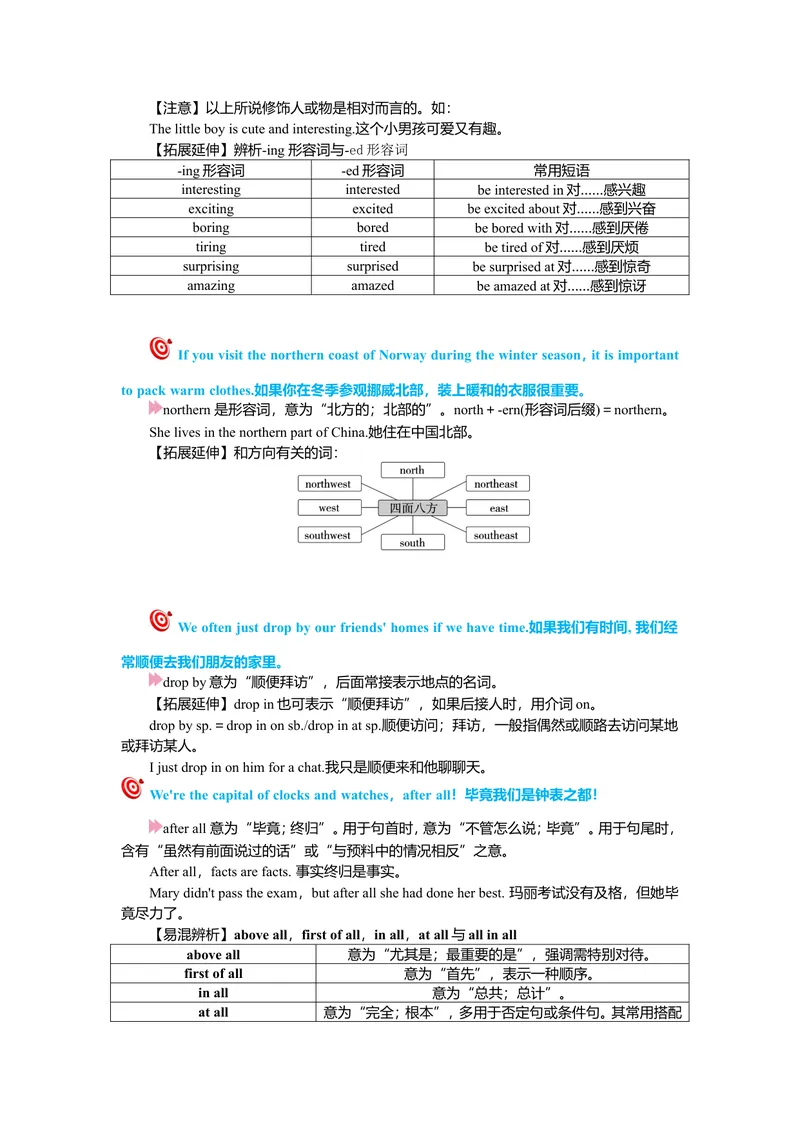
【拓展延伸】和方向有关的词:
We often just drop by our friends' homes if we have time.如果我们有时间, 我们经
常顺便去我们朋友的家里。
drop by意为“顺便拜访”,后面常接表示地点的名词。
【拓展延伸】drop in也可表示“顺便拜访”,如果后接人时,用介词on。
drop by sp.=drop in on sb./drop in at sp.顺便访问;拜访,一般指偶然或顺路去访问某地
或拜访某人。
I just drop in on him for a chat.我只是顺便来和他聊聊天。
We're the capital of clocks and watches,after all!毕竟我们是钟表之都!
after all 意为“毕竟;终归”。用于句首时,意为“不管怎么说;毕竟”。用于句尾时,
含有“虽然有前面说过的话”或“与预料中的情况相反”之意。
After all,facts are facts. 事实终归是事实。
Mary didn't pass the exam,but after all she had done her best. 玛丽考试没有及格,但她毕
竟尽力了。
【易混辨析】above all,first of all,in all,at all与all in all
above all 意为“尤其是;最重要的是”,强调需特别对待。
first of all 意为“首先”,表示一种顺序。
in all 意为“总共;总计”。
at all 意为“完全;根本”,多用于否定句或条件句。其常用搭配not…at all 意为“一点儿也不”。
all in all 意为“总的来说;头等重要的”。
Above all,we must believe in ourselves.最重要的是,我们必须相信自己。
First of all,let me introduce myself.首先让我来进行自我介绍。
We have 1,000 students in all.我们总共有1000名学生。
I don't like playing football at all.我根本不喜欢踢足球。
All in all,English is very interesting.总的来说,英语很有趣。
So I make an effort to be on time when I meet my friends.因此当我会见朋友的
时候,我尽可能地准时。
make an effort意为“作出努力”。make an effort to do sth.意为“尽力做……”。
Teachers should encourage students to make an effort to study.老师应该鼓励学生努力学习。
In many eastern European countries,…take off your gloves before shaking
hands.在许多东欧国家,……握手前要脱掉手套。
take off是“动词+副词”的固定短语,在句中意为“脱下(衣服)”,此时反义短语为
put on。若代词作宾语,需要放在 take 和 off 之间,且代词需用宾格形式。
【拓展延伸】take off 还可意为“(飞机等)起飞;匆匆离去,急忙离开;休假;休息”。
The plane took off an hour late.飞机晚了一个小时起飞。
When he saw me coming,he took off in the opposite direction.他见我走过来便赶快转身离
开了。
I have decided to take a few days off next week.我已决定下周休息几天。
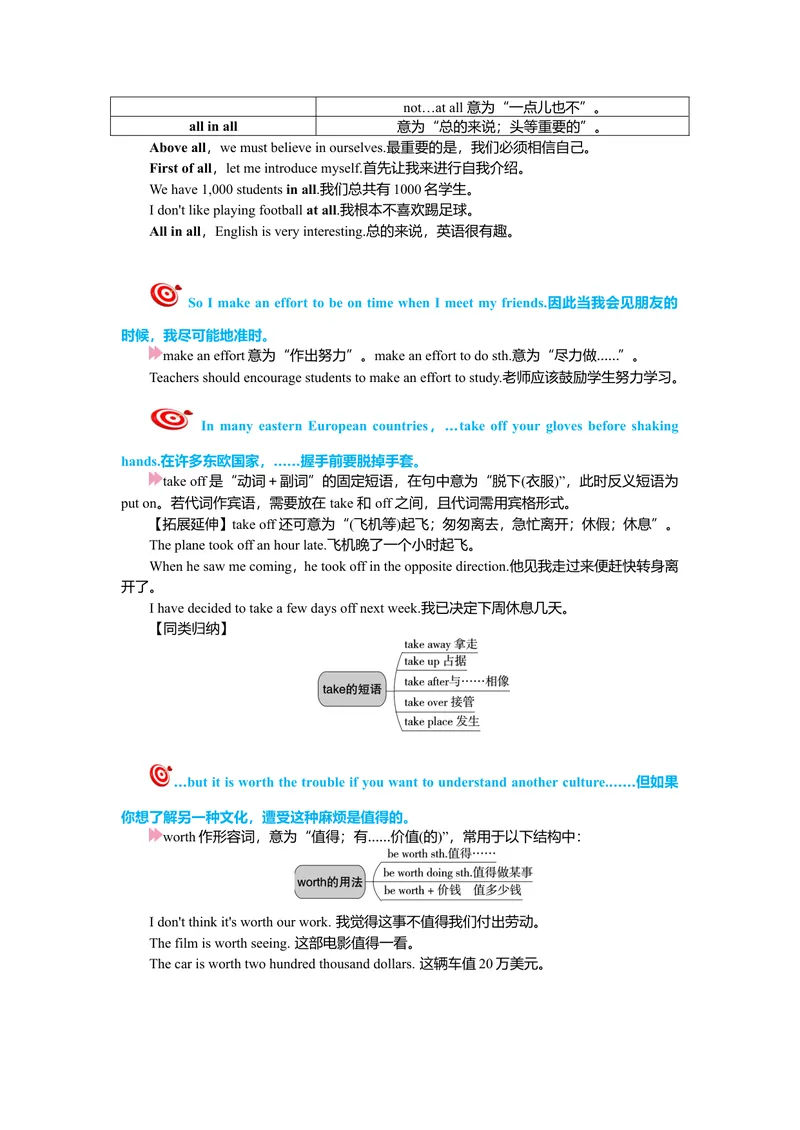
【同类归纳】
…but it is worth the trouble if you want to understand another culture.……但如果
你想了解另一种文化,遭受这种麻烦是值得的。
worth作形容词,意为“值得;有……价值(的)”,常用于以下结构中:
I don't think it's worth our work. 我觉得这事不值得我们付出劳动。
The film is worth seeing. 这部电影值得一看。
The car is worth two hundred thousand dollars. 这辆车值20万美元。Yes,I'm having a great time on my student exchange program in France.是的,我
在法国的交换生生活过得很愉快。
exchange在此作名词,意为“交换;互换”,常用短语in exchange of意为“交换……”。
Tom gave me some sweets in exchange of a box of biscuits.汤姆给了我一些糖果,换了一盒
饼干。
【拓展延伸】exchange 作及物动词,意为“交换;兑换”,常用短语exchange…for…意为
“用……来换……”;exchange sth.with sb.意为“和某人交换某物”。
He exchanged the blue sweater for a red one.他把蓝毛衣换成红色的。
We exchanged gifts with each other at the end of the party.在晚会结束时,我们互相交换了
礼物。
My biggest challenge is learning how to behave at the dinner table.我最大的挑战
就是在餐桌上学会如何表现。
behave常用作不及物动词,意为“表现;举止”,behave well/badly意为“表现好/糟
糕”,behave as if/as though意为“表现得好像……”。
The boy behaved very well last night.这个男孩昨晚表现很好。
Bruce was a little boy,but he behaved as if/as though he was an adult.布鲁斯是个小男孩,
但他表现得像一个成年人一样。
Another example is that you're not supposed to eat anything with your hands
except bread…另一个例子就是你不应该用手吃除了面包以外的任何东西……
【易混辨析】except,besides,but与except for
介词,意为“除……之外”,排除后者,即不包括后面的内
except 容。着重强调在同类人或物中除去一个或几个,表示一种排
除关系,有“减除”之意。前面常用表示整体的词。
介词,意为“除了……(还有……)”,不排除后者,包括后面的
besides 内容。指在整体中加入一部分,表示一种累加关系,有“加
上”之意,常与 other 连用。
可与except换用,但 but 往往放在 all,none,every,any,no
but 以及who,everything,everybody,nothing,no one,anywhere
等词之后。
except 是排除同类;而 except for 是排除非同类,常在说明
except for
基本情况后,再从细节上加以修正。
They all went to the zoo except Tom.除了汤姆,他们都去了动物园。
What other sports do you play besides soccer?除了足球,你还做哪些运动?
There is nothing but a desk in the room.房间里除了一张课桌外,什么也没有。
The composition is very good except for a few spelling mistakes.除了几处拼写错误之外,
这篇作文整体还是很不错的。(作文与拼写错误是非同类的)
I have to say that I find it difficult to remember everything,but I'm gradually
getting used to it.我不得不说我发现记住所有的东西是困难的,但我正在逐渐地习惯它。【归纳拓展】
I used to listen to music before sleep.我过去常常在睡觉前听歌。(暗示现在不听了)
I am used to traveling in holidays.我习惯了在假期旅游。
The trees planted are used to keep the soil from being blown away.这些种植的树是用来防
止土壤被风吹走的。
The machine is used for cutting things.这台机器是用来切割东西的。
English is used as a foreign language in China.在中国,英语被当作一门外语。
课本长难句分析
You're supposed to shake hands.你们应该握手。
suppose 意为“假定;认为,推断;料想”,其用法如下:
You're not supposed to smoke on the bus.=You're not allowed to smoke on the bus.你不应
该在公共汽车上吸烟。
①当 be supposed to…的主语是“物”时,意为“本应;本该”,用于表示“某事本应该
发生而没有发生”。如:
The train was supposed to arrive half an hour ago.火车本应在半小时之前到达。
②suppose+(that)从句
I suppose that he can finish the work on time.我认为他能按时完成那项工作。
③suppose+宾语+宾语补足语(不定式、形容词或介词短语)
I suppose him to be over twenty.我猜他二十多岁了。
【注意】
①suppose 后接宾语从句时,如果从句是表示否定意义的句子,要否定主句。
I don't suppose he will come here.我想他不会来这儿的。
②suppose 可引导条件状语从句,相当于 if。
Suppose it rains,what will happen?如果下雨,会发生什么?
I'm very comfortable speaking French now.我现在讲法语很轻松自如。be comfortable doing sth.意为“做某事自信,自如”,相当于feel good about doing
sth.。
In China,it's impolite to use your chopsticks to hit an empty bowl.在中国,用筷子
敲空碗是不礼貌的。
“It is+adj.+to do sth.”句型中,it在句中作形式主语,而真正的主语是后面的不定式短
语。有时动词不定式有自己的逻辑主语,常由“for/of+sb.”构成。
【拓展延伸】it作形式主语时有用两种句式结构:
形容词描述事物的特征、性质,如 easy,difficult,interesting,
It is+adj.+for sb.to do sth.
funny,dangerous,important,impossible,useful等。
形容词描述行为者的性格、品质,如 kind,friendly,nice,rude,
It is+adj.+of sb. to do sth.
brave,clever,polite,careless,cute 等。
It's interesting for us to play games in the park,but I think it's impolite of us to make so much
noise.我们在公园里玩游戏是很有意思的,但我觉得我们这么吵闹是不礼貌的。
单元语法点回顾
一 suppose 用法单元知识点过关
过单词
Ⅰ.根据句意及汉语意思完成句子。
1. Their knowledge is very ______ (基本的).
2. Her ______________ (孙女) has started to work but her grandson is still at university.
3. He was a little boy, but he ________ (举止,表现) as if he was an adult.
4. In ancient times, people used to ________ (交换) things with others because money was not
invented.
5. The office is open every day ________ (除了) Sundays.
Ⅱ. 根据句意,用方框中所给词的正确形式填空,其中有一词多余。
season,noon,custom,mad,capital,relaxed
1.Beijing is the ________city of China.
2.My father got _________when I failed the exam.
3.The guide offers information on local ________ .
4.A short sleep at _____ is good for people’s health.
5.There are four __________in a year,spring,summer,autumn and winter.
Ⅲ.单项选择。
1.Listening to some _____ songs or staying with friends always makes us _____ .
A. relaxing; relaxing B. relaxing; relaxed
C. relaxed; relaxed D. relaxed; relaxing
2.Tom, you should ______ this iPad mini. It is ____ .
A. value; value B. valuable; valuable
C. value; valuable D. valuable; value
3.As it was getting dark, the streets in this town became almost ______ .
A. new B. empty C. big D. old
4. —Do you know how the French ________ a stranger?—They kiss him on both sides of his face.
A. expect B. follow C. behave D. greet
5. —Do you consider yourself a rude person?
—Certainly not. I always have good _______.
A.duty B.hobby C.habit D.manners
6.(2019本溪) The article gives students some___________ about how to stay safe online.
A. suggestions B. activities C. decisions D. advantages
过短语
根据句意用方框中所给短语的适当形式填空。
clean off drop by take off after all get mad
1.Don’t push him too hard; ________ , he’s only a kid.
2.My teacher ______________ when he heard that 127 students were caught cheating in
the exam in Henan.
3.On May 5th,2017,the C919_____________successfully for the first time at Shanghai
Pudong International Airport.
4.She ________________to see me yesterday.
5.Would you please ________________the blackboard?
过句子
阅读下列各小题,根据汉语及句末括号内的动词提示,用相关的动词短语完成句子。
1.王阿姨格外努力地帮我学习地理。 (go )
Aunt Wang _________________________her way to help me learn geography.
2.玛丽将会让你感到宾至如归的。 (make )
Mary will _______________________________at home.
3.张晴习惯每天听音乐。 (get )
Zhang Qing ____________________________to music every day.
4.当你到达山顶时,你会发现吸入空气很困难。(find)
When you reach the top of the mountain,you’ll _________________ take in air.
5.(2019自贡中考)法国承诺努力重建巴黎圣母院。(make)
France has______________ to make an______________ to rebuild Notre-Dame Cathedral in
Paris.
过交际
补全对话。(有两项多余)
A:You must be really excited about leaving for America tomorrow,Li Ping.B:Yeah. (1)________
A:Nervous about what?
B:I don't know many of the customs and manners in the USA. (2)________
A:Sure.
B:(3)________
A:Well,it's important to be on time when you're invited to dinner. (4)________ Americans expect
their guests to be on time.
B:Then how long may I stay there?
A:(5)________Or you seem to come only for the meal. When your friends seem to be getting
tired and running out of things,it's time to leave. The next day,call or write a thankyou note to
say how much you enjoyed the evening.
A. It's good for you to stay at home.
B. After the meal,don't leave at once.
C. Could you give me a hand?
D. What rules do they have in America?
E. But I'm a bit nervous.
F. You're supposed to leave before the meal.
G. It's impolite to arrive late.
过语法
I.用括号内所给词的适当形式填空。
1. “How am I supposed ________ (live) without you?” Jane said to Dad, tears in eyes.
2._______I ________ (suppose) to wear school uniform to go to school?
3.It’s important for us ________ (remember) the knowledge of first-aid.
4.Everyone is supposed ________ (wear) a seat belt in the car.
5.It’s polite ________ (say) “Thank you” when others help you.
Ⅱ.单项选择。
1.People are supposed _____ hands when they meet for the first time in America.
A. shaking B. to shake C. shake
2.— Henry, you _______ tell the teacher if you want to go out of the classroom.
— Sorry, sir.
A. are supposed to B. are surprised to C. are afraid to
3.— Could I go swimming with my friend, dad?
— No, it’s very dangerous for you kids ____ swimming without adults.
A. go B. going C. to go D. went
4.It’s very dangerous for us ________ the mobile phone while crossing the street.
A. answering B. to answer C. answer
5. —Why are you so late? You _______get here at seven.
—Sorry. I was caught in a traffic jam.
A.were supposed to B.like to C.expected to D.were hoped to
6.I don’t supposed you are serious,___________?
A.don’t you B.do I C.are you D.aren’t youIII.根据汉语提示完成句子,每空词数不限。
1.共享单车的使用人数今年有望达到五千万。
The number of shared bike users________________ reach 50 million this year.
2.遇见老师时,你应该向老师问好。
You ________________ say “hello” to your teachers when you meet them.
3.准时很重要。
It’s important ________________.
过综合
Passage 1
综合填空。阅读下面材料,在空白处填入一个适当的单词或括号内单词的正确形式。(每空不
超过三个单词)
Where I’m from, we’re pretty relaxed about time. We don’t like to rush around,
1._______ we don’t mind if people are a little late sometimes. If you tell a friend you’re
going to their house for dinner,it’s OK if you arrive a bit late. We like to enjoy our time
2._______(slow). We value the time we spend 3.______ our family and friends in our
everyday lives. We ofte just drop by our 4.________(friends) homes if we have time. We
don’t usually have to make plans to meet 5._______(we) friends. When we see each
other, it’s polite for boys 6.________(shake) hands and for girls to kiss each other on the
side of the face. We often just walk around the town center,seeing as 7.________(much)
of our friends as we can!
In switzerland, it’s very important to be on time. We’re the capital of clocks and
watches,after all! If someone invites you to meet him or her 8.______ noon, then you’re
expected to be there at noon. If you’re even 15 minutes late,your friend may get mad. So
I make 9._______ effort to be on time when I meet my friends. I always leave the house
early to avoid heavy traffic because I think it’s impolite to keep others
10._________(wait). Also, we never visit a friend’s house without calling first. We almost
always make plans to see friends. We usually plan to do something interesting, or go
somewhere together.
Passage 2
阅读下面的材料,在空白处填入一个适当的单词或括号内单词的正确形式。(提示:每空不超
过三个单词)
Dear Laura,
Thanks for your message. Yes, I’m having a great time on my exchange program in France. I
was a bit nervous before I arrived here, but there was no reason to be. My host family is really
nice. They go out of their way 1 (make) me feel at home. The grandmother has a teenage
granddaughter about my age 2 is really kind. She always talks to me in French to help me
practice. And you wouldn’t believe how quickly my French has 3 (improve)! I'm very
comfortable speaking French now. 4 I still make lots of mistakes, it doesn’t worry me as it
used to.My biggest challenge is learning how to behave at the dinner table. 5 you can imagine,
things are really different from the way they are at home. For example, you shouldn’t put your
bread on your plate. You 6 ( suppose) to put it on the table! I thought that was pretty strange at
first, but now I’m used to it. You shouldn’t eat 7 ( something) with your hands except bread,
not even fruit. You have to cut it up and eat it with a fork. Another thing is that it is very 8
(polite) to say you're full. If you don't want any more food, you should just say, “It was delicious.”
Also, you shouldn't put your elbows on the table. I have to say that I find it difficult to remember
everything, but I’m 9 ( gradual) getting used to it. I don’t find French customs so strange any
more.
Dear Laura, I’ll write again soon and tell you more about my life in France. Hope you are
having 10 good school year.
Yours,
Lin Yue