单元知识点梳理
词汇拓展
1.restroom(n.)______________ ______________(n.)洗手间;厕所(近义词)
2.suggest(v.)______________ __________(n.)建议 __________(v.)建议(同义词)
3.center(n.)__________ __________(adj.)中心的;中央的
4.east(n.)________;(adv.)__________;(adj.)__________ __________(adj.)东方的;朝
东的
5.__________(n.&v.)要求;请求 __________(v.)请求;要求;询问(近义词)
6.__________(v.)说(某种语言);说话 __________(n.)讲(某种语言)的人;发言者
7.__________(n.)课程;学科 __________(n.)学科;科目(近义词)
8.__________意大利 __________(adj.)意大利(人)的(n.)意大利人;意大利语
9.direct(v.)__________ __________(n.)方向;方位 __________(n.)导演;部门负
责人(adj.)__________ __________(adv.)直接地;径直地
词块归纳
1.get some magazines_____________
2.a pair of_____________
3.on one's right_____________
4.turn left/right_____________
5.go past_____________
6.between…and…_____________
7.start with_____________
8.no problem_____________
9.on one's way to…_____________
10.get to_____________
11.excuse me_____________
12._____________ 抱歉,对不起;什么,请再说一遍
13._____________ 购物中心
14._____________ 寻求帮助
15._____________ 在不同的情形下
16. _____________ 花费……做某事
17._____________ (道路)通向;引入
18._____________ .与某人交流
19. _____________ 停车场;停车区
20. _____________ 盼望;期待
21._____________ 准时;按时
核心句型
1._________Main Street____ you pass Center Street.沿着主大街走一直到经过中心街为止。2.Excuse me,_____________ where__________ get some postcards?打扰一下,你知道我
在哪里可以买到一些明信片吗?
3.I was scared at first,but shouting_____ help.起初我很害怕,但大声喊真的很管用。
4.____________ we come back here for dinner later?为什么我们不晚点来这里吃晚饭呢?
5.___________what time the band starts playing.让我们问一下乐队什么时候开始演奏吧。
6.I ______________________go next.我想知道我们接下来去哪里。
7._____________ tell me _____________the post office?请问您能告诉我怎样去邮局吗?
8._____________ ,do you know if there's a restaurant around here?打扰一下,你知道这附近
有餐厅吗?
9.Can you tell me where there's_____________?你能告诉我哪里有可以吃东西的好地方吗?
10.When you visit a foreign country,_______________how to ask for help politely.当你去国外
旅游时,知道如何礼貌地寻求帮助是很重要的。
11._____________it is a very direct question.那是因为它是一个非常直接的问题。
12.The expressions they use might_____________________________________ each other.他们
使用的表达可能取决于他们与谁交谈或他们互相了解的程度。
13.___ might ___________________ politely _____ directly.看起来说得客气要比说得直白更
难一点。
重难知识点归纳
Pardon?Restroom?You want to rest?But we haven't even started yet!什么?休
息室?你想要休息了?我们可还没有开始玩呢!
Pardon me的用法:
①表示道歉,意为“对不起”。
—Pardon me,I suppose I should have knocked.对不起,我想我应该敲门的。
—That's all right.没关系。
②表示没听清或没听懂对方的话,请求对方再说一遍(也说 I beg your pardon等),意为
“请再说一遍;对不起,我没听清”。
—Where's the post office?邮局在哪里?
—Pardon me?什么?
—I asked where the post office is.我问邮局在哪里。
【拓展延伸】
①pardon me与excuse me同义。
②pardon sb.for (doing) sth.意为“原谅某人(做)某事”。
I hope you will pardon me for arriving here late.我希望你能原谅我来晚了。
You don't need to rush!你不需要着急!
rush此处用作动词,意为“仓促;急促”。
rush to do sth.意为“赶紧/抢着做某事”;
rush to…意为“冲/奔向……”。
He stood up and rushed to the door.他站起来向门口冲去。
【拓展延伸】rush用作名词,意为“匆忙;繁忙”
in a rush“匆忙地”
rush hour“(交通)高峰期;拥挤时刻”
If you go now,you're likely to hit the rush hour.你要是现在走,很有可能会赶上交通高峰
期。
I suggest Water City Restaurant in Water World.我建议(去)水上世界的水城餐厅。
suggest作动词,其后可以跟名词、动词-ing形式。
suggest doing sth.意为“建议做某事”。
Amy suggests solving the problem in a different way.艾米建议用一种不同的方法来解决这
个问题。
【拓展延伸】suggestion n.建议;提议(可数名词)
Ben made some suggestions at the meeting.本在会上提了一些建议。
You go east along this street…你沿着这条街向东走……
east adj.东方的;东部的 adv.向东;朝东
n.东;东方
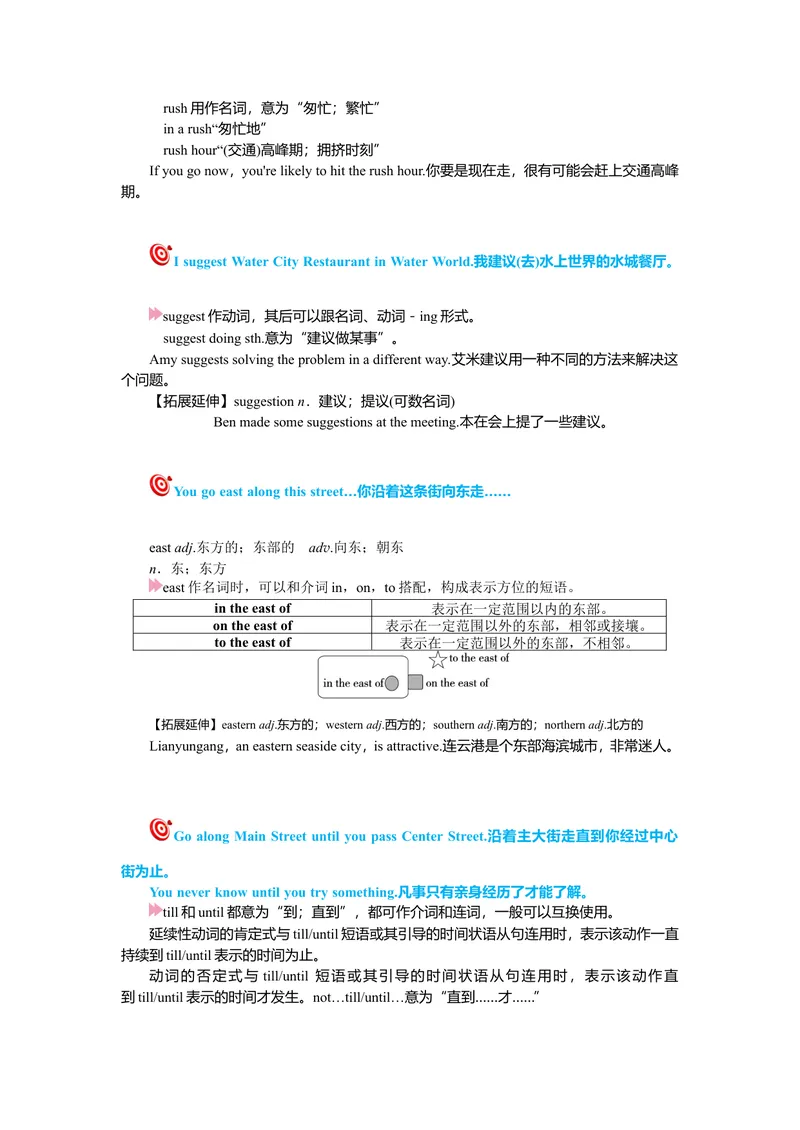
east作名词时,可以和介词in,on,to搭配,构成表示方位的短语。
in the east of 表示在一定范围以内的东部。
on the east of 表示在一定范围以外的东部,相邻或接壤。
to the east of 表示在一定范围以外的东部,不相邻。
【拓展延伸】eastern adj.东方的;western adj.西方的;southern adj.南方的;northern adj.北方的
Lianyungang,an eastern seaside city,is attractive.连云港是个东部海滨城市,非常迷人。
Go along Main Street until you pass Center Street.沿着主大街走直到你经过中心
街为止。
You never know until you try something.凡事只有亲身经历了才能了解。
till和until都意为“到;直到”,都可作介词和连词,一般可以互换使用。
延续性动词的肯定式与till/until短语或其引导的时间状语从句连用时,表示该动作一直
持续到till/until表示的时间为止。
动词的否定式与 till/until 短语或其引导的时间状语从句连用时,表示该动作直
到till/until表示的时间才发生。not…till/until…意为“直到……才……”I was scared at first,but shouting did help.起初我很害怕,但大声喊真的很管用。
此句相当于 I was scared at first,but shouting really helped。原句是一种表示强调的句
式,英语中,可用助动词do对谓语动词进行强调,构成强调句。
Please do be careful.请一定小心。
He did warn you the other day,remember?他前两天就告诫过你,还记得吗?
…and the clerk tells her to go to the corner of Market and Middle Streets.……工
作人员告诉她去市场大街和中心大街交汇的拐角处。
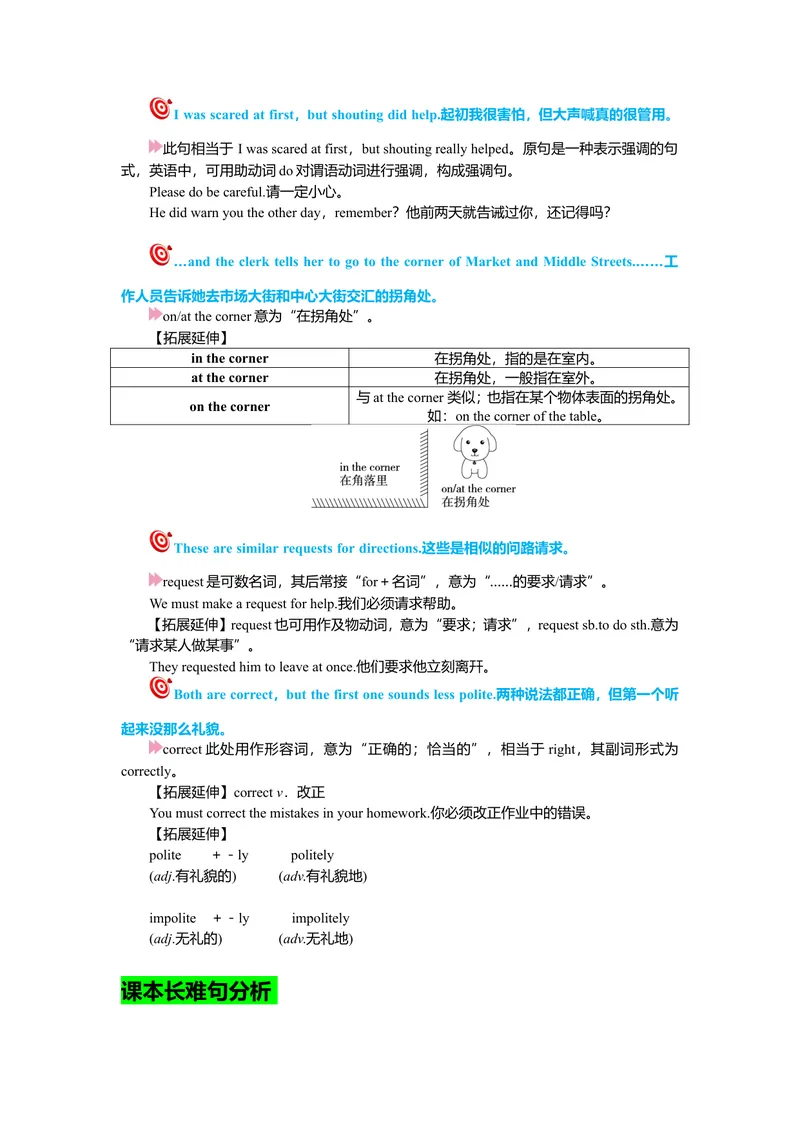
on/at the corner意为“在拐角处”。
【拓展延伸】
in the corner 在拐角处,指的是在室内。
at the corner 在拐角处,一般指在室外。
与at the corner 类似;也指在某个物体表面的拐角处。
on the corner
如:on the corner of the table。
These are similar requests for directions.这些是相似的问路请求。
request是可数名词,其后常接“for+名词”,意为“……的要求/请求”。
We must make a request for help.我们必须请求帮助。
【拓展延伸】request也可用作及物动词,意为“要求;请求”,request sb.to do sth.意为
“请求某人做某事”。
They requested him to leave at once.他们要求他立刻离幵。
Both are correct,but the first one sounds less polite.两种说法都正确,但第一个听
起来没那么礼貌。
correct此处用作形容词,意为“正确的;恰当的”,相当于 right,其副词形式为
correctly。
【拓展延伸】correct v.改正
You must correct the mistakes in your homework.你必须改正作业中的错误。
【拓展延伸】
polite +-ly politely
(adj.有礼貌的) (adv.有礼貌地)
impolite +-ly impolitely
(adj.无礼的) (adv.无礼地)
课本长难句分析On their way to Water City Restaurant,Alice and He Wei pass by Uncle Bob's.在
他们去水城餐馆的路上,爱丽斯和何伟路过鲍勃叔叔的餐馆。
go past=pass by,意为“经过;路过”。其中 past为介词,意为“从……旁边过去”。
Go past our school.=Pass by our school.经过我们学校。
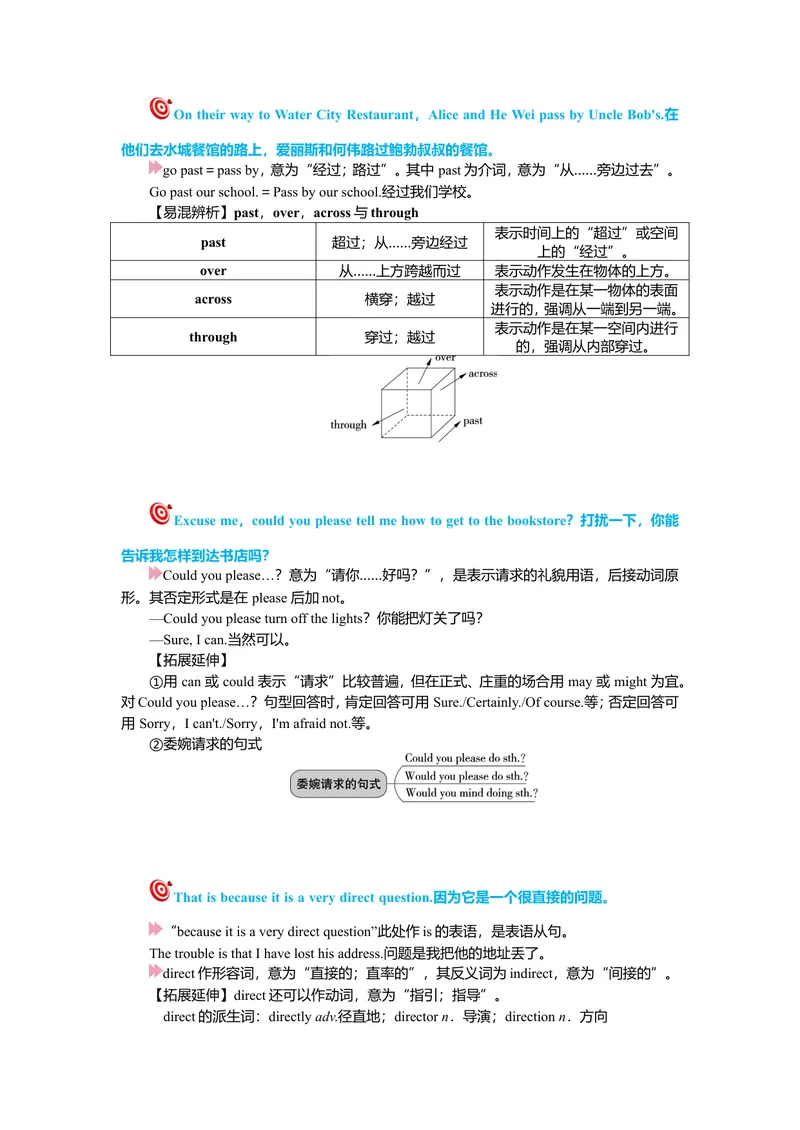
【易混辨析】past,over,across与through
表示时间上的“超过”或空间
past 超过;从……旁边经过
上的“经过”。
over 从……上方跨越而过 表示动作发生在物体的上方。
表示动作是在某一物体的表面
across 横穿;越过
进行的,强调从一端到另一端。
表示动作是在某一空间内进行
through 穿过;越过
的,强调从内部穿过。
Excuse me,could you please tell me how to get to the bookstore?打扰一下,你能
告诉我怎样到达书店吗?
Could you please…?意为“请你……好吗?”,是表示请求的礼貌用语,后接动词原
形。其否定形式是在 please 后加not。
—Could you please turn off the lights?你能把灯关了吗?
—Sure, I can.当然可以。
【拓展延伸】
①用 can 或 could 表示“请求”比较普遍,但在正式、庄重的场合用 may 或 might 为宜。
对Could you please…?句型回答时,肯定回答可用 Sure./Certainly./Of course.等;否定回答可
用 Sorry,I can't./Sorry,I'm afraid not.等。
②委婉请求的句式
That is because it is a very direct question.因为它是一个很直接的问题。
“because it is a very direct question”此处作is的表语,是表语从句。
The trouble is that I have lost his address.问题是我把他的地址丢了。
direct作形容词,意为“直接的;直率的”,其反义词为indirect,意为“间接的”。
【拓展延伸】direct还可以作动词,意为“指引;指导”。
direct的派生词:directly adv.径直地;director n.导演;direction n.方向Sometimes we even need to spend time leading into a request.有时,我们甚至需要
花时间来导入一个请求。
lead into在此意为“导入”。其后接名词或代词作宾语。
We often use “excuse me” to lead into a request.我们常用“excuse me”来导入一个请求。
【拓展延伸】lead to意为“导致;通向”。
All roads lead to Rome.条条大道通罗马。
单元语法点回顾
一 宾语从句(二)
宾语从句三要素: 引导词;语序;时态
1.引导词:
(1) 特殊疑问词(what;who;which;why;how;when;where等): 当一个特殊疑问句充当宾语时,
由原来的疑问词作为引导宾语从句的关联词。不可省略。可分为疑问代词和疑问副词。
疑问代词:who,whom,whose,which,what,whoever...
特殊疑问词
疑问副词:when,where,how,why,whenever...
2.语序: 宾语从句要用陈述句语序,即主语 + 谓语 + 其他成分
I wonder who did the cleaning.我想知道谁做的清洁。
Do you know what’s wrong with him? 你知道他怎么吗?
Could you please tell me how I can get to the restroom?你能告诉我怎样到达洗手间吗?
3.转换: 宾语从句为特殊疑问句时,当从句的主语与主句的主语或间
接宾语一致时,宾语从句可简化为“特殊疑问词+动词不定式”形式。
Could you please tell me how I can get to the restroom?
= Could you please tell me how to get to the restroom?你能告诉我怎样到达洗手间吗?单元知识点过关
过单词
Ⅰ.根据句意及首字母提示填空
1. ---Can you tell me your email a________?
--- OK. 3300556@163.com
2. The teacher asked us to circle the c________answers.
3. The story tells us that we should be p________ when we ask for help.
4. “I have only one r________ . I hope you can take good care of yourselves. ” the old man said.
5. There are usually u___________ car parks for shoppers to use in many big supermarkets.
Ⅱ. 根据句意用括号内所给单词的适当形式填空。
1. Could you please tell me the ________(center) idea of this passage?
2. The young lady went off in the ________ (direct) of the railway station.
3. The ______________(restroom) in Fantawild Adventure (方特欢乐世界) are very clean.
4. English ________ (speak) usually say “Excuse me” before asking for help.
5. Whether we’ll have a good time depends on_______ (who) we are going with and where we are
going.
6.He’s busy all day and he always _______(rush) in and out.
7.I thank the teacher for her ___________(suggest) on my interview.
Ⅲ.单项选择。
1.I have to say it is not ________ for me to see you now,because I am very busy with my work.
A. impolite B. safe C. inexpensive D. convenient
2.—Ann, did you find the post office this morning?
—Oh, yes. A kind lady gave me ________ to it.
A. chances B. courses
C. secrets D. directions
3.—Ann is not good at speaking English.
—I ________ she should practice speaking English for two hours a day.
A. suggest B. explain C. refuse D. forget
4.The boy said to me ________,"I'm sorry to trouble you, but I wonder if you can help me carry
this box. "
A. politely B. hardly C. normally D. impatiently
5.In the picture, he sits _________ me, looking very happy.
A. beside B. among C. up D. through
6.Before 2003, there was no_______airline between Taiwan and the mainland.
A. indirect B. direct C. correct D. directly过短语
根据句意用方框中所给短语的适当形式填空。
Start with pass by pardon me lead into depend on
1.When I ________________ the bank, I saw a man running out of it.
2. Mr. Brown always __________________ a joke. It makes us relaxed.
3.—Can you help me carry the box?
— ___________?
4. Whether we'll go to Huangguoshu Waterfall tomorrow __________________ the weather.
5.Small talk will help you to_____a pleasant conversation.
过句子
根据汉语意思完成句子,每空一词。
1.似乎有礼貌地说话比直接表达更困难。
It might seem more difficult to ________ ________ ________ ________.
2.我想知道接下来我们该去哪儿。
I wonder ________ ________ ________ next.
3.起初我很害怕, 但大声喊叫确实有帮助。
I was scared at first, but shouting ________ ________.
4.有时我们甚至需要花些时间来导入一个请求。
Sometimes we even need to spend time ________ ________ a ________.
5.你能告诉我哪里有吃东西的好地方?
Could you please tell me _____ there is a good place ____ _____?
过交际
补全对话。
A: Excuse me!
B: Yes? ______1
A: Could you tell me the way to Beihai Park?
B: ______2 Go along this street, and then turn left at the second crossing…
A: Oh! I’m sorry I can’t follow you. ______3
B: OK. Go along this street, and then turn left at the second crossing. Go on until you reach the
end of the street, and then you’ll find it.
A: _____4
B: Yes, it is. You’d better take a bus. The bus stop is just over there.
A: Thank you very much.
B: _____5
A. Well, let me see.
B. Is it far from here?C. What can I do for you?
D. You’re welcome.
E. Would you please say that again more slowly?
过语法
I.单项选择。
1.【2019·成都】—Could you please tell me ________ ?
—Sure. On Friday afternoon.
A. where the book sale is
B. when the book sale is
C. what the book sale is about
2.【2019·温州】 —Could you tell me ________ ?
—You will stay with an English family and take part in their daily life.
A. when I should pay for the course
B. what the best part of the course is
C. how long the shortest course lasts
D. where I can go sightseeing after class
3.【2019·重庆A卷】—Dear friends, do you still remember ________ three years ago?
—To realize our dreams!
A. why you came here B. why did you come here
C. how you came here D. how did you come here
4.【2019·南京】—I wonder ________.
—Someone who can make me a better person.
A. when you often meet your friends
B. how you make your friends happy
C. who you want to make friends with
D. where you spend weekends with friends
5.【2019·北京】—Did you notice________ in her office?
—Yes. She was going over our writing.
A. what was Miss Lin doing
B. what Miss Lin was doing
C. what does Miss Lin do
D. what Miss Lin does
6.(2020·湖北襄阳中考)—Do you know ______?
—Yes.They'll go there by train at 8:30 tomorrow morning.
A.how would they leave for Beijing
B.how will they leave for Beijing
C how they would leave for Beijing
D.how they will leave for Beijing
7.(2020·山东菏泽中考)—Excuse me,Mr.Wang.Do you know ______?
—Yes.It's on May 20th.
A.when is the school trip
B.how we can go there
C.when the school trip is8.(2020·江苏淮安中考)—Excuse me,would you please tell me ______?
—Certainly.It's about ten minutes' walk.
A.where is the nearest shop
B.how I can get to the nearest shop
C.how far the nearest shop is
D.how soon can I reach the nearest shop
Ⅱ.将下列句子改成宾语从句。
1. “Where can you buy so many grapes?” I asked Alice.
I asked Alice________she ________buy so many grapes.
2. “Why does Jim send flowers to Ms. Grey every September?” he wondered.
He wondered why________ ________ flowers to Ms. Grey every September.
3. Could you please tell me how to go to the Central Park?
Could you please tell me_________ _________ _______ go to the Central Park?
4. Do you know? Whom did he go to mail a letter with?
Do you know________ ________ _________to mail a letter with?
5. He asked me, “When will you leave for Beijing?”
He asked me_______ _________ _________leave for Beijing.
过综合
Passage 1
综合填空。阅读下面材料,在空白处填入一个适当的单词或括号内单词的正确形式。(每空不
超过三个单词)
When you visit a foreign country, it is important to know how to ask for help 1 (polite). For
example, you may ask “Where are the restrooms? ” or “Could you please tell me where the
restrooms are?” These are similar requests for directions. Both are correct, but the first one 2
(sound) less polite. That is because it is a very direct question. It is not enough to just ask a
question correctly. We also need to learn how to be polite when we ask for help.
Good 3 (speak) change the way they speak in different situations. The expressions they use
might depend on whom they are speaking to or how well they know each other. It is all right 4
(ask) direct questions to your classmates because you know them well. However, If you say to
your teacher, “When is the school trip?”, this might sound 5 (polite). But if you say, “Excuse me,
Mr. West. Do you know when the school trip is?”, this will sound much more polite.
Usually polite questions are longer. They include expressions such as “Could you please ...?”
or “May I ask ...?” It sounds more polite to say, “Peter, could you please tell me your e-mail
address?” 6 “Peter, tell me your e-mail address.” Sometimes we even need to spend time 7
(lead) into a request. For example, we might first say to a stranger “Excuse me, I wonder if you
can help me” or “I’m sorry 8 (trouble) you, but ...” before asking for help.
It might seem 9 (difficult) to speak politely than directly. However, it is important to learn
10 to use the right language in different situations. This will help you communicate better with
other people.