Unit1 单元测试
班级________________ 姓名___________________ 学号___________________
一、单项选择(每题1分,共15分)
1.—Have you decided what to write about Gulliver in Lilliput in the report?
—I'm not sure. Maybe I need to read some ________ about it before writing.
A.reasons B.rewards C.results D.reviews
2.Please ________ the rubbish and put it into the proper rubbish bin.
A.look up B.pick up C.grow up
3.—Our Party’s 100th birthday is coming.
—Oh, great! We will have many activities to ________ celebrate it.
A.wisely B.warmly C.simply D.lovely
4.Learn ________ , and you will be a successful learner.
A.wisely B.lazily C.quickly D.blindly
5.—The summer vacation is coming. Do you have any plans?
—I’m going to ________ a hobby like playing the guitar.
A.cut up B.look up C.turn up D.take up
6.—What’s the article about, David?
—It’s about some tricks on how to save and spend money ______.
A.cheaply B.kindly C.wisely D.comfortably
7.—Suzy, your room is really in a mess.
—Sorry, Mum. I’ll ________ right now.
A.tidy up B.put up C.look up D.stay up
8.—Would you please ________ your e-mail address? I missed it just now.
—No problem. It’s fox@163.com.
A.repeat B.review C.record D.repair
9.—The songs the little girl sings are very sweet.
—She ________ a good voice. Nobody taught her.
A.takes care of B.is similar to C.looks forward to D.is born with
10.—Would you please ________ what you said?
—Sure. I asked you to have a rest. It’s too hot today.
A.show B.spell C.review D.repeat
11.— Look! Mike does so well in his speech.
— Yes, he has a(n) ________ for public speaking.
A.eye B.gift C.answer D.attention
12.I got up early this morning to ________ my grandma at the airport.
A.pick up B.put up C.turn up D.look up
13.— Could you explain the saying “One tree can’t make a forest.” to me, please?
— OK. It tells us that success comes from good .
A.ability B.personality C.confidence D.teamwork
14. — How can I get good grades in the listening test, Miss Lin?
— You can the questions quickly before listening.
A.look through B.go over C.pay attention to D.take notice of
15.—Your ________ is quite good. You must be from an English-speaking country.
—Thanks, but I’m from China.
A.pollution B.pronunciation C.population D.prediction二、完型填空(每题1分,共15分)
Karl Marx was born in Germany on May 5th, 1818. 16 he was a child, he was forced to leave his country again and again. He lived in Belgium, England and some
other 17 .
His mother tongue was German and at school he 18 French and English, but he felt his English was poor. So he 19 up his mind to improve his English. He began
to work hard 20 it. He made so much progress 21 he could soon read English newspapers and write English articles.
However, there were 22 things that he thought were too difficult for him—the grammar and some of the idioms (习语). He often encouraged himself by saying “
23 I keep on trying, I’ll make even greater progress.” At the same time, his close friend, Engels, often wrote to 24 him for his hard work in learning English.
In one of Marx’s books, he gave people who were learning a foreign language some 25 on how to learn it well. He said a foreign language was necessary for a person
to have a 26 future. He said a person should translate every word he heard into the foreign language he was learning. If he could do this, it would be 27 for him to use
the language freely.
In April, 1841, he 28 his doctor’s degree. After that, he began to write articles for a newspaper. He wrote about the housing problems of poor people and their hard
life. 29 he tried, he did his best.
During the 1840s, Marx and Engels wrote a book together. These words of theirs became very 30 : “Working people of all countries, unit (联合)! ”
16.A.When B.Before C.After D.While
17.A.farms B.factories C.schools D.countries
18.A.has learned B.was learning C.learns D.learned
19.A.has made B.makes C.made D.was making
20.A.on B.at C.in D.for
21.A.that B.what C.when D.how
22.A.one B.two C.three D.four
23.A.But B.If C.And D.As
24.A.praise B.ask C.help D.call
25.A.examples B.meanings C.money D.advice
26.A.good B.better C.well D.worse
27.A.probably B.impossible C.possible D.perhaps
28.A.gets B.receives C.has received D.received
29.A.Whoever B.Whenever C.Whatever D.However
30.A.humorous B.understanding C.similar D.famous
三、根据汉语或首字母提示填空(每题1分,共10分)
31.I think Johnson is a ________ (天生的) writer. He is very creative.
32.Eating too much salt __________(增加)the risk of high blood pressure.
33.His ________ (能力) in swimming was noticed by the coach.
34.Tu Youyou won the Nobel Prize for medicine ________ (凭借) many years of hard work.
35.We need to increase our ________(知识)of the history of the Communist Party of China.
36.Many students are good at English grammar, but poor in p________.
37.An expert is someone who has special skills or k________ ['nɒlɪdʒ] of a field.
38.Painting tangkas is a l________ job for the artists in Tibet. Sometimes they may spend the whole life painting one piece of work.
39.Please speak a________ or I can’t hear you.
40.I used to have similar learning experiences like you. I often made mistakes in g________ as well.
四、短文填空(每题1分,共10分)
Of all the languages, English is the most widely used. I’m very lucky to start 41 . (learn) English at the age of 5 at the coolest school in town. And we had a 42 .
/ˈfɒrən/ teacher, a young gentleman who hardly understood Spanish. However when he really wanted 43 . (we) to get the message, he could shout in 44 . very loud broken
Spanish. If we behaved, we can watch English cartoons and they 45 . (complete) blew our minds.
After that, I went to a different academy(学园), known for being 46 . /strɪkt/ and concentrating on achieving high 47 . (result). I was quite motivated(激励) to learn
English. I listened to Green Day and I wanted to understand their lyrics(歌词). There were about 10 of us sitting around a big white rectangular table. We only spoke one 48 .
one, usually in the seating order. Breaking the thick 49 . /ˈsaɪləns/ was a bit scary. Even coughing was not allowed.
It was in that old-school room I had the ‘aha’ moment: I felt I understood English, I got it and it would stick there forever. I could write 50 . a sentence or say it outloud, as if I had a native English inner(内在的) voice. I feel very proud of this moment, and I am sure it made a difference to my journey.
五、补全对话7选5(每题1分,共5分)
A: Hello! This is Follow Me. Can I help you?
B: Yes. 51 .
A: What are your problems?
B: First of all, 52 .
A: Listen to English tapes and repeat what you hear. And keep practicing.
B: 53 .
A: Listening to more tapes will help improve your listening skills.
B: What about new words?
A: First, you should try to guess the meanings of them. 54 .
B: OK. Thank you very much.
A: You’re welcome. 55 .
A.I am afraid to listen to English in front of others.
B.I hope your English will improve soon.
C.I can’t get the pronunciation right.
D.Then you can look them up in a dictionary if necessary.
E. Keeping a diary can improve your writing skill.
F. And I can’t understand the teacher when she talks to the class.
G. I have some problems with my English.
六、阅读单选(每题2分,共30分)
A
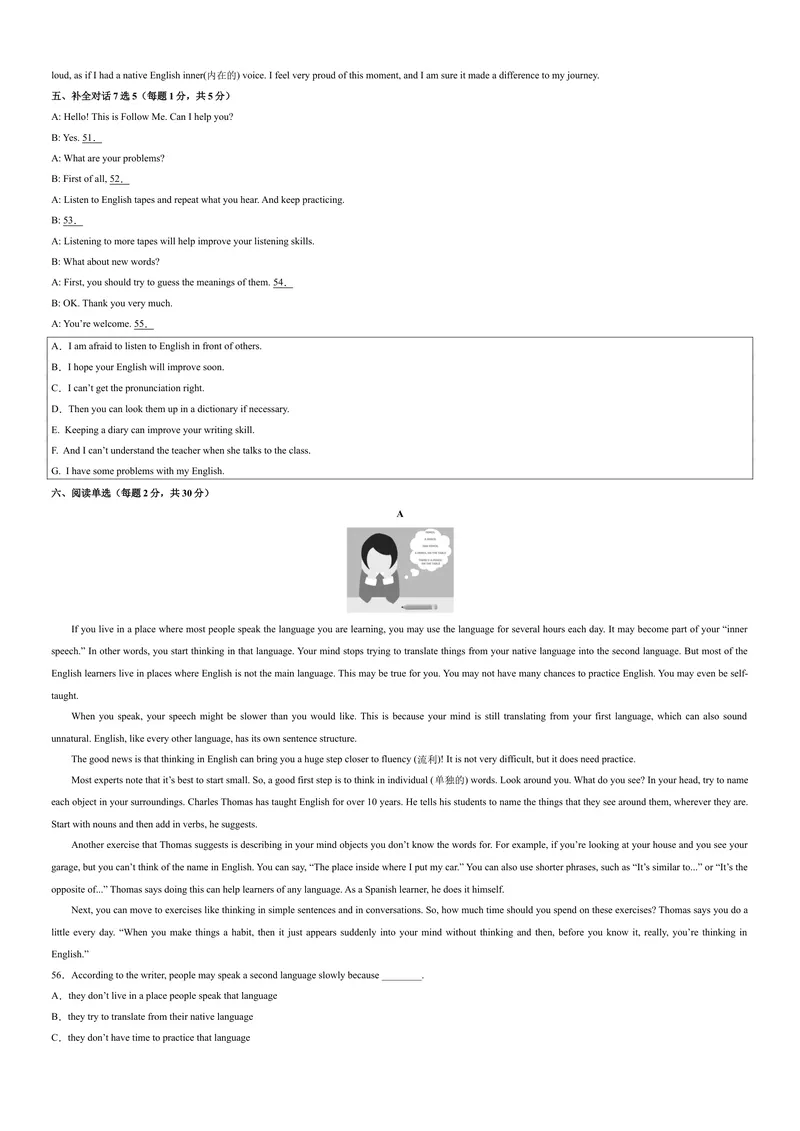
If you live in a place where most people speak the language you are learning, you may use the language for several hours each day. It may become part of your “inner
speech.” In other words, you start thinking in that language. Your mind stops trying to translate things from your native language into the second language. But most of the
English learners live in places where English is not the main language. This may be true for you. You may not have many chances to practice English. You may even be self-
taught.
When you speak, your speech might be slower than you would like. This is because your mind is still translating from your first language, which can also sound
unnatural. English, like every other language, has its own sentence structure.
The good news is that thinking in English can bring you a huge step closer to fluency (流利)! It is not very difficult, but it does need practice.
Most experts note that it’s best to start small. So, a good first step is to think in individual (单独的) words. Look around you. What do you see? In your head, try to name
each object in your surroundings. Charles Thomas has taught English for over 10 years. He tells his students to name the things that they see around them, wherever they are.
Start with nouns and then add in verbs, he suggests.
Another exercise that Thomas suggests is describing in your mind objects you don’t know the words for. For example, if you’re looking at your house and you see your
garage, but you can’t think of the name in English. You can say, “The place inside where I put my car.” You can also use shorter phrases, such as “It’s similar to...” or “It’s the
opposite of...” Thomas says doing this can help learners of any language. As a Spanish learner, he does it himself.
Next, you can move to exercises like thinking in simple sentences and in conversations. So, how much time should you spend on these exercises? Thomas says you do a
little every day. “When you make things a habit, then it just appears suddenly into your mind without thinking and then, before you know it, really, you’re thinking in
English.”
56.According to the writer, people may speak a second language slowly because ________.
A.they don’t live in a place people speak that language
B.they try to translate from their native language
C.they don’t have time to practice that languageD.they may teach that language by themselves
57.What can we learn from the passage?
A.Your surroundings can help you translate the language well.
B.The sentence structure is the key to learn a second language well.
C.Thinking more in a second language may help you speak fluently.
D.Describing with shorter phrases can help spell the unknown words.
58.What is the writer’s main purpose in writing this passage?
A.To explain why our second language sounds unnatural.
B.To discuss our problems of learning a second language.
C.To show some examples of learning English by thinking.
D.To encourage people to train their brains to think in English.
B
Green is an important color in nature. It is also the color of most growing plants. Sometimes the word green means young, fresh and growing. Sometimes it describes
something that is not yet ripe (成熟的) or finished. For example, a greenhorn is someone who has no experience, who is new to a situation, in the fifteenth century, a
greenhorn was a young cow or ox whose horns had not yet developed. A century or so later, a greenhorn was a soldier who had not yet had any experience in battle. By the
eighteenth century, a greenhorn had the meaning it has today——a person who is new in a job.
Someone who has the ability-to grow plants well is said to have a green thumb. The expression comes from the early 1900s. A person with a green thumb seems to have
a magic touch that makes plants grow quickly and well. You might say that the woman next door has a green thumb if her garden continues to grow long after your plants
have died.
The Green Revolution is the name given some years ago to the development of new kinds of rice and other grains. The new plants produced much larger crops. The
Green Revolution was the result of hard work by agricultural scientists who had green thumbs.
Green is also the color used to describe the powerful emotion, jealousy(嫉妒). The green-eyed monster is not a frightening creature from outer space. It describes the
unpleasant feeling a person has when someone has something he wants. A young man may suffer from the green-eyed monster if his girlfriend begins going out with someone
else. Or, that green-eyed monster may affect your friend if you get a pay raise and she does not.
59.From the first paragraph, we can conclude(得出结论) that ________.
A.a greenhorn refers to (指的是) a horn of a young cow or ox
B.a word has different meanings in the same century.
C.the language develops with time going by
D.a greenhorn means a soldier who hasn’t had any experience in battle today
60.If a person has a green thumb, he or she probably ________.
A.suffers from an illness in the thumb B.does well in growing plants
C.has a thumb in green color D.has wonderful magic and energy
61.If Jane has a beautiful dress that Mary likes very much, ________
A.Jane may suffer from the green-eyed monster
B.Mary is probably a girl with a green thumb
C.Jane is probably called a greenhorn.
D.Mary may suffer from the green-eyed monster
62.Which of the following statements is NOT true according to the passage?
A.In about the 16th century, a greenhorn meant an experienced soldier.
B.The Green Revolution may have some connection with green thumbs.
C.The green-eyed monster was probably created by William Shakespeare.
D.The green-eyed monster can be used to describe a person who is jealous.
C
26 March, 2021—11:28 Hu Bo
Hello everyone! I’m tired because I can’t improve my English skill. Who can help me? Please!
26 March, 2021—11:47 Jo
Hi Hu Bo,If you want to improve your English, you are in the right place. Don’t worry just start slowly working through some of the pages in the sections that are most interesting
and useful to you. The more English you read and listen to, the more you will learn.
Best wishes, Jo (Learn English Teens Team)
8 April, 2021—19:22 Forever-in-dream
Thank you for these tips. They help me very much. But I’m taking an English exam (speaking)this Friday and I’m a bit scared about it. I can’t stop being nervous, so
in this condition I always say something wrong with long pauses(停顿). Can you suggest me anything to deal with it?
9 April, 2021—10:14 Jo
Hi Forever-in-dream,
Thanks for your comment(评论). OK, first thing to remember is that everyone gets nervous for speaking exams. It’s totally natural to feel nervous. Also, it’s normal
to make some mistakes. The examiners will not expect you to do the exam perfectly and they will get a good idea about your level of English even if you make some
mistakes. If you make a mistake and you realize right away, then go back and say it again. We all do this sometimes even when we are speaking our native(本土的)
language. Also it’s normal to pause and think when you’re speaking in your own language and in a foreign language, so try not to worry about that.
So, take a deep breath before you start the exam and remember that these feelings are natural. In fact feeling a bit nervous sometimes helps you to do your best.
Good luck! Jo(Learn English Teens Team)
63.Which of the following is TRUE according to the passage?
A.If you want to improve English, you should read and listen to more English.
B.You cannot go back and say it again if you make a mistake in a speaking exam.
C.You will get bad grades if you have a pause and think in your own language.
D.Feeling a little nervous always helps you to do your best during an exam.
64.Which of the following does Jo think is normal?
A.Making mistakes. B.Listening to others.
C.Having an exam. D.Speaking English.
65.What can we infer(推断)from the passage?
A.Jo comes from the United Kingdom.
B.Jo, Hu Bo and Forever-in-dream are good friends.
C.Hu Bo and Forever-in-dream are good at speaking English.
D.Jo’s job is to help teens with English and answer their questions.
66.Where might you see these messages?
A.On TV. B.In a book. C.On a website. D.On a newspaper.
D
Here are some tips on listening. We hope it can help you in one way or other.
Relax yourself.
Before you start to listen to something, you need to relax. Don’t get nervous or excited. This will help you with your listening.
Listen carefully to the first sentence.
The first sentence tells a lot about the whole passage. For example, if at the very beginning, you hear “Many shops in many parts of China have decided to take away all
kinds of Japanese goods off their shelves but some people say it’s not a good idea. Our reporter says ...”, you know you will hear a piece of news, not a children’s story, or a
science report.
Think when you’re listening.
When you’re listening, try to do some thinking. For example, you can think of the following questions: What happened, when, where and how? What was the result and
what does the speaker want to tell us? In this way, you may understand the passage better.
Listen for important facts.
It’s important for you to remember some important facts. For example, if the passage is a science report, you should try to remember its findings and how the scientists
got their results.
Don’t think about one or two words for too long.
You may hear some words that you don’t know, but don’t spend too much time on them. Very often, you’ll find out what they mean later when you go on with the
listening. But you can remember some words or sentences that you think are important, and you can use them when you’re answering the questions.
67.This whole passage is mainly about ________.A.thinking B.finding the facts
C.listening D.remembering words
68.It’s better for you to keep ________ when you begin to have a listening exam.
A.excited B.relaxed C.nervous D.worried
69.When you’re listening, it’s important for you to remember ________.
A.every word B.every sentence
C.some important facts D.the whole passage
70.The passage is the most helpful to ________.
A.journalists B.doctors
C.scientists D.foreign language learners
七、书面表达(共15分)
学习一门新的语言不是一件容易的事情,不过万事都有规律可循。请根据思维导图提示的语言学习经历和经验,以 “How can we become good language
learners?”为题,写一篇英语短文。
要求:
1. 应包含思维导图提示中所有要点,可适当进行拓展;
2. 词数:80词左右;
3. 书写工整规范;
4. 标题、首末段已给出,不计入总词数,无需抄写在答题卡书面表达作答区域;
5. 文中不得提及真实的人名、校名等相关信息。
How can we become good language learners?
What makes a good language learner? There are some things that good language learners do and some things they don’t do.
___________________________________________________________________________________________________________________________________________
___________________________________________________________________________________________________________________________________________
___________________________________________________________________________________________________________________________________________
___________________________________________________________________________________________________________________________________________
___________________________________________________________________________________________________________________________________________
___________________________________________________________________________________________________________________________________________
__________________________________________________________________________________________________________________
Don’t forget that it’s never too late to become a good language learner.