参照秘密级管理 启用前
★
2026 年高三仿真考试
英 语
注意事项:
1.答卷前,考生务必将自己的姓名、考生号等填写在答题卡和试卷指定位置上。
2.回答选择题时,选出每小题答案后,用铅笔把答题卡上对应题目的答案标号涂黑。
如需改动,用橡皮擦干净后,再选涂其他答案标号。回答非选择题时,将答案写在答题卡
上。写在本试卷上无效。
3.考试结束后,将本试卷和答题卡一并交回。
第一部分 听力 (共两节,满分30分)
第一节(共5小题;每小题 1.5 分,满分 7.5 分)
听下面5段对话。每段对话后有一个小题,从题中所给的A、B、C三个选项中选出
最佳选项,并标在试卷的相应位置。听完每段对话后,你将有10 秒钟的时间来回答有关
小题和阅读下一小题。每段对话读两遍。
1.Whatistheprobablerelationshipbetweenthespeakers?
A.Strangers. B.Classmates. C.Colleagues.
2.Whydoesthewomantalktotheman?
A.Toaskforadvice. B.Toarrangeanouting. C.Tocancelanappointment.
3.Howdoesthemansoundwhenspeakingofthecanteen?
A.Concerned. B.Dissatisfied. C.Pleased.
4.Whatarethespeakersprobablydoing?
A.Doinggymnastics. B.Watchingagame. C.Ridingarollercoaster.
5.Whatarethespeakersmainlytalkingabout?
A.Ajob. B.Aletter. C.Apresent.
第二节(共15小题;每小题1.5分,满分22.5分)
听下面5段对话或独白。每段对话或独白后有几个小题,从题中所给的A、B、C三
个选项中选出最佳选项。听每段对话或独白前,你将有时间阅读各个小题,每小题5秒钟;
听完后,各小题将给出5秒钟的作答时间。每段对话或独白读两遍。
听第6段材料,回答第6、7题。
6.Whywillthemangotothepark?
高三英语试题 第1页 (共12页)A.Tolookatlanterns. B.Tohavearun. C.Toenjoyaconcert.
7.Whenwillthespeakersgotothepark?
A.ThisFriday. B.ThisSaturday. C.ThisSunday.
听第7段材料,回答第8至10题。
8.WhywasMarialookingforDanny?
A.Toexpressthanks. B.Tomakeanapology. C.Toaskafavor.
9.WhatisDannybusydoingafterschoolthesedays?
A.Practicingdancing. B.Decoratingthestage. C.Lookingafterhissister.
10.WhatwillMariadonext?
A.Gohome. B.Attendaclass. C.TalktoMark.
听第8段材料,回答第11至13题。
11.Whatwastheman’soriginalplanforlastweekend?
A.Togoclimbing. B.Toseeamovie. C.Tovisitafriend.
12.Whichofthefollowingerhupiecesinterestedthemanmost?
A.Liangzhu. B.WomanFlower. C.ALoveBeforeTime.
13.WhatdoesthemandecidetodofirstinChina?
A.Findajob. B.Studymusic. C.Travelaround.
听第9段材料,回答第14至17题。
14.Whatmadethemanlovewildplaces?
A.Hisbusinesstrips. B.Hischildhoodexperiences.C.Hiscollegeeducation.
15.Wheredoesthemanlikeworkingthemost?
A.Inthecaves. B.Intheoceans. C.Inthejungle.
16.Howdidthemanfeelwhenhemetawhaleshark?
A.Frightened. B.Calm. C.Curious.
17.Whatisthemangoingtodo?
A.GototheAntarctic. B.WalkalongtheNile. C.CrosstheSaharaDesert.
听第10段材料,回答第18至20题。
18.Whatdoesthevolunteers’taskmainlyinvolve?
A.Growingcrops. B.Buildinghouses. C.Caringforchildren.
19.Whatisarequirementforthevolunteers?
A.SpeakingEnglishfluently. B.Beingatleast18yearsold.C.Havingrelatedexperience.
20.Howmuchdoesavolunteerneedtopayfortwo-weekparticipation?
A.$295. B.$590. C.$885.
高三英语试题 第2页 (共12页)第二部分 阅读(共两节,满分 50分)
第一节(共15小题:每小题 2.5分,满分37.5分)
阅读下列短文,从每题所给的 A、B、C、D 四个选项中选出最佳选项。
A
NatureDetectives:NewMedicinesfromAncientWisdom
WhatisEthnopharmacology?
Ethnopharmacologists (民族药理学) are nature detectives who bridge two different ways
of knowing the world. Western science, based on controlled experiments, starts with a clear
hypothesis (假设) and tests it step by step. Traditional knowledge, on the other hand, passes
downnature-basedwisdomthroughstoriesandelder’teachingsoverhundredsofyears.
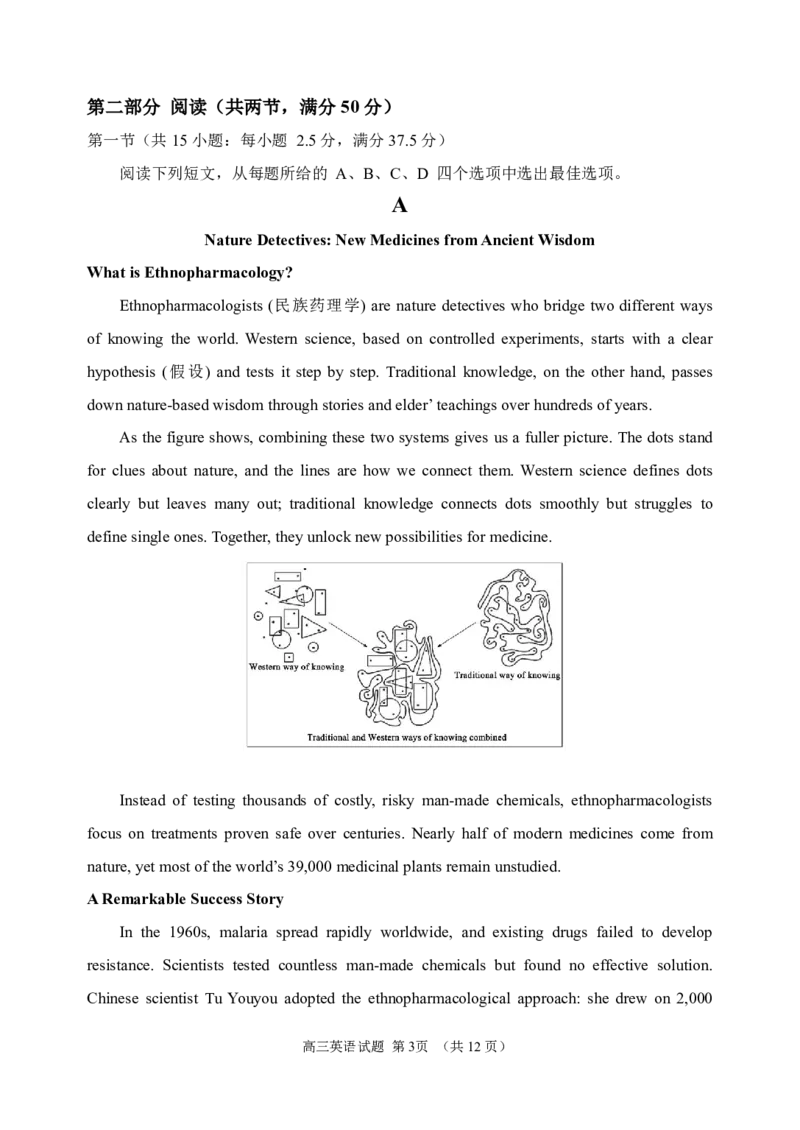
As the figure shows, combining these two systems gives us a fuller picture.The dots stand
for clues about nature, and the lines are how we connect them. Western science defines dots
clearly but leaves many out; traditional knowledge connects dots smoothly but struggles to
definesingleones.Together,theyunlocknewpossibilitiesformedicine.
Instead of testing thousands of costly, risky man-made chemicals, ethnopharmacologists
focus on treatments proven safe over centuries. Nearly half of modern medicines come from
nature,yetmostoftheworld’s39,000medicinalplantsremainunstudied.
ARemarkableSuccessStory
In the 1960s, malaria spread rapidly worldwide, and existing drugs failed to develop
resistance. Scientists tested countless man-made chemicals but found no effective solution.
Chinese scientist Tu Youyou adopted the ethnopharmacological approach: she drew on 2,000
高三英语试题 第3页 (共12页)years of traditional Chinese medical knowledge to identify Artemisia annua (青蒿), and then
used modern lab techniques to extract its key medicinal component, artemisinin. This perfect
combination of ancient wisdom and modern science created the global standard malaria
treatment,savingmillionsoflives.
TheTrueSpiritofEthnopharmacology
The artemisinin story perfectly illustrates the power of ethnopharmacology. It is not just
about finding new chemicals in plants; it is about respecting and valuing the wisdom passed
down through generations. By bringing together different ways of understanding the world,
ethnopharmacology builds a bridge between the past and the present, creating life-saving
medicinesforpeopleeverywhere.
21.Whatdoesthefigureillustrate?
A.Traditionalwayhascleardots. B.Neitherapproachleavesdotsout.
C.Bothwayshaveshortage. D.Westernwayconnectsdotssmoothly.
22.HowdidTuYouyousolvethemalariacrisis?
A.Bysavingmillionsoflives. B.Bytestingman-madechemicals.
C.Byusingmodernlabtechniques. D.Bycombiningtwoknowingsystems.
23.Whatisethnopharmacology’scorespirit?
A.Savingmillionsoflives. B.Respectingtraditionalwisdom.
C.Findingnewplantchemicals. D.Usingmodernlabtechniques.
B
AsachildIwasaddictedtobooksuntilmyeyeswereblurred(模糊的).Butinrecentyears,
I’vewatchedthatcapacityforintenseconcentrationdissolveintoendlessscrollingonmyphone.
Readingforpleasurefeelslesslikenutrientandmorelikeendurancetraining.Iwantedtorestore
thatmentalelasticity(弹性),tosuspendthebrainshrink.
So, aboutayear ago,Imadeupmymind:everytime Icame acrossawordI didn’tknow –
whether in a novel, an article, or an overheard conversation – I would look it up and write it
down. Just a running list kept, ironically, on my phone. Each week, I’d spend a few minutes
高三英语试题 第4页 (共12页)readingthelistbackinanattempttoputthewordintomymemory.
Thelistnowspansalmost20pages,andthistinyhabithasbeenquietlytransformative.The
payoff is less aboutpeacocking with little-known adjectives –which, let’s face it, canmake you
sound insufferable – and more about the mental training ofthe routine. Each time I look up and
recordaword,Ifeelafaintstretch,asthoughsomeignoredpartofmybrainisflexingagain.
Realistically, I absorb maybe 5% of these words into my everyday speech. “Incorrigible”
made the cut. “Lugubrious” too. But most of them remain like museum pieces–admired and
listed butrarely handled. Even if I never use“eidolon”in conversation,the very actof noticing,
recording and revising it interrupts the slide into passive, semi-skimmed attention. Ifind myself
reaching less often for the same tired handful of adjectives, and more often for something
precise and muscular. Few things are more satisfying than digging the exact word you were
searchingfor–likefindingthemissingpuzzlepiecethatlocksthepictureintoplace.
In an era when our devices siphon off our attention with pitiless efficiency, it feels
innovative to use mine as a toolfor slow thinking.And it has given me back something I feared
I’d lost – the pleasure of exercising a mind that, after years of loose scrolling, is finally waking
upagain.
24.Whatledtotheauthor’slossofdeepconcentration?
A.Thedecreaseofreading. B.Lackofnutritiousbooks.
C.Constantuseofasmartphone. D.Toomuchendurancetraining.
25.Whydoestheauthorkeepthewordlist?
A.Toimprovetheflexibilityofbrain. B.Tohelptoavoiddigitaldistractions.
C.Toshowofftheadvancedvocabulary. D.Torecordwordsfromnovelsandarticles.
26.Whatmakestheauthorsatisfied?
A.Usingaccuratewords. B.Improvingtheattention.
C.Losingthepuzzlepiece. D.Masteringuncommonwords.
27.Whatdoestheunderlinedexpression“siphonoff”inparagraph5mean?
A.Calloff. B.Drawoff. C.Boostup. D.Windup.
高三英语试题 第5页 (共12页)C
Bioluminescence,nature’sownlightproducedthroughchemicalreactionsinliving cells,is
best known for its dramatic displays in the deep ocean, where roughly 90 percent of marine
creatures can glow (发光) to communicate, attract food, or escape from enemies. Yet this
phenomenon is not limited to the darkest depths. The soft cold blue light from bioluminescent
algae (发光的藻类) like P. lunula occasionally lights up the ocean waves at night, though it
normallyfadesinjustaninstantwhendisturbed.
What if we could use this natural light and make it last longer? That ambitious question
drives researchers at the University of Colorado Boulder, aiming to replace electricity-powered
lighting with living organisms. Unlike traditional artificial glows that rely on dangerous
chemicals and consume fossil-fueled electricity, bioluminescent algae offer a harmless,
carbon-negativealternative.
Led by civil engineer Wil Srubar, the team conducted carefully controlled laboratory
experiments to investigate how P. lunula responds to different chemical environments. They
tested acidic solutions and basic solutions (碱性溶液), discovering both could cause sustained
light far longer than their natural flashes. Acidic exposure produced bright light lasting upto 25
minutes,whilebasicconditionscreatedasofterandlessconcentratedglow.
“Thisisthefirsttimewe’vefiguredouthowtokeepalgaeglowingcontinuouslyforweeks,”
said co-author Giulia Brachi. The researchers went further, placing the algae into naturally
sourced, 3D-printed hydrogel ( 水 凝 胶 ) structures of various shapes. Remarkably, the
combination of the hydrogel environment and harmless chemicals allowed the algae to survive
and glow steadily for weeks. After four weeks, the acid-treated samples in hydrogel still
maintained75percentoftheiroriginalbrightness.
The potential applications are far-reaching. These living lights could power autonomous
robotsandspaceexplorationequipmentwithoutbatteries.Theymightalsoserveaswaterquality
sensors, changing their glow in response to harmful pollutants. Most critically, these algae
absorb carbon dioxide while producing light, which helps to reduce the net emissions compared
to conventional lighting. As Srubar noted, “This discovery paves the way for creating a new
generationofsustainablelivingmaterialsanddevices.”
高三英语试题 第6页 (共12页)28.WhatdoweknowaboutP.lunula?
A.Itflasheswhendisturbed. B.Itinhabitsthedeepocean.
C.Itbrightensseawavesattimes. D.Itgeneratesbrightbluelight.
29.Forwhatpurposedidtheresearchersconducttheexperiments?
A.Totestvariouschemicalsolutions. B.Todevelopbiologicallightsources.
C.Toreducecarbondioxideemissions. D.Toproducebioluminescentbluelight.
30.Whatdotheexperimentsindicate?
A.Acidglowslastfourweeks. B.Baseglowsfadefarfaster.
C.3Dprintscreatelongglows. D.Twofactorsmakelongglows.
31.Whichmightbethebesttitleforthetext?
A.LivingLightsReshapeFutureLighting
B.HydrogelImprovesAlgae-BasedLighting
C.GlowingAlgaeOffersEco-friendlyLighting
D.ChemicalsHelpAlgaeProduceSteadyGlow
D
As China steps into the busy summer harvest season across vast northern grain-producing
areas, advanced smart agricultural technologies are thoroughly changing the traditional way of
grain planting and harvesting. Instead of depending purely on farmers’ limited practical
experienceandunpredictablechangeableweatherconditions,modernfarmingnowreliesheavily
on BeiDou Navigation Satellite System, artificial intelligence, various sensors and intelligent
farmequipmenttosteadilyboostoverallagriculturalproductivity.
Equipped with advanced BeiDou positioning modules, self-driving harvesters and
intelligent tractors can carry out complicated field work with centimeter-level precision. They
can independently set reasonable working paths, avoid hidden field obstacles and finish reaping
ripe wheat steadily without frequent human supervision. Besides intelligent ground machinery,
large numbers of agricultural drones ( 无 人 机 ) are widely put into use for daily field
management. They can conduct precise pesticide spraying (喷洒) and scientific fertilizer
application efficiently, which effectively cuts down the waste of water resources and chemical
agents,andgreatlysavesprecioushumanlaboraswell.
高三英语试题 第7页 (共12页)To further promote orderly and standardized farm work during the busy harvest period,
local agricultural authorities have built complete unified digital farm management platforms.
These platforms gather real-time information including soil humidity, crop growth situation and
pest distribution through professional field sensors. Professional agricultural technicians can
carefully analyze the collected data and offer targeted farming suggestions to farmers in remote
rural areas. What’s more, newly popular agricultural AI large models can further optimize the
overall arrangement of intelligent farm tools, making the whole summer harvest work more
systematicandhighlyefficient.
Despite its bright long-term development prospect, the large-scale popularization of smart
farming still meets certainobvious difficulties. High purchase costofintelligent devices and the
severe shortage of young skilled agricultural technicians remain two major obstacles in rural
areas.Evenso,thereisnodoubtthatdigitalfarmingtechnologywillkeepupgrading,effectively
guarantee national food security and lead traditional agriculture toward a more modernized and
sustainablefuture.
32.Whatcontributestoimprovingmodernfarmingefficiency?
A.Morelaborinput. B.Smarttechnology.
C.Predictableweather. D.Traditionalexperience.
33.Whatdoagriculturaldronesbringtofarming?
A.Abandoningchemicalusepartly. B.Boostingcropyieldandquality.
C.Cuttingdownplatformbuildingcosts. D.Savingresourcesandmanpower.
34.WhatisParagraph3mainlyabout?
A.Thehistoryofsmartagriculture.
B.ThenecessityofusingAIinfarming.
C.Theworkingprincipleofdigitalplatforms.
D.Theroleofsmartagricultureinharvest.
35.Whatdoestheauthorthinkofthefutureofsmartagriculture?
A.Promising. B.Doubtful. C.Concerning. D.Unclear.
高三英语试题 第8页 (共12页)第二节(共 5 小题;每小题 2.5 分,满分 12.5 分)
阅读下面短文,从短文后的选项中选出可以填入空白处的最佳选项。选项中有两项为
多余选项。
Cybercrime refers to any type of criminal activity that involves the use of computers,
computer networks, or other digital technologies to commit or facilitate illegal activities. These
crimes can range from the theft of personal and financial data to complicated attacks on basic
facilities, such as power systems or financial systems. 36 With a few smart habits and
tools,netizencanstayprotected.
Creating complex passwords is your first line of defense. Avoid using common phrases,
birthdays, or easily guessable numbers. Instead, use a combination of uppercase and lowercase
letters,numbers,andsymbols. 37 Ifonegetsexposed,therestareatrisk.
Cybercriminals often make use of known software bugs. That’s why software companies
constantly release patches(补丁) to close those gaps. Make sure your operating system,
antivirus programs, browsers, and even mobile apps are up to date. Enable auto-updates when
possible. 38
Phishing(钓鱼) emailsremainoneofthemostcommoncyberattackmethods.Theseemails
often look legal and may even appear to come from trusted brands or coworkers. Always
double-check the sender’s email address. Stop at links to see where they really lead. If you’re
unsure,contactthesenderdirectlythroughadifferentchannelbeforeclickinganything.
39 These tools can create false emails, clone voices in phone calls, or generate
realisticvideostoimpersonatetrustedindividuals.Alwaysverifyunexpectedrequestsformoney,
credentials,or sensitive information,especiallyif theyclaim urgency.Use aseparateandknown
methodtoconfirm.
Cybercrime isn’t just rising. It’s evolving. Attacks are getting more frequent, more
complicated, and more damaging. 40 It’s a wake-up call for every business leader,
organization, andindividualwho operates online. Cybersecurity is nolonger a technicaladd-on.
It’sacorepartofstayinginbusinessandstayingtrusted.
A.Don’treusethemacrossdifferentsites.
B.Thisisn’tjustawarningbellforITteams.
C.Cybercrimecanhitanyone,butmostthreatsarepreventable.
D.DeceiversnowuseAItoimitatevoices,faces,andwritingstyles.
E.Alwaysbackupyourimportantdatatoanexternaldriveorcloudservice.
F.Usingapasswordmanagercanhelpyougenerateandstorecomplexpasswords.
G.Don’tignorethosesystemrestartremindersusuallycausedbyimportantpatches.
高三英语试题 第9页 (共12页)第三部分 语言运用(共两节,满分 30 分)
第一节(共 15 小题:每小题 1 分,满分 15 分)
阅读下面短文,从每题所给的 A、B、C、D 四个选项中选出可以填入空白处的最佳
选项。
Something could have turned into a tragedy. Instead, it became a powerful reminder that
courageoften 41 fromthemostunexpectedsources—sometimesfromchildren.
The 42 happened in an instant.AMississippi school bus driver, Leah Taylor, 43
a heart attack while driving students home. She suddenly passed out, and the bus began 44
dangerously off the road. Without a second’s delay, seventh-grader Jackson directly 45
forward, grabbed the wheel, and fought desperately to keep the bus on track.At the same time,
sixth-grader Clark 46 himself toward the brake pedal (刹车板) and stepped on it with all
his 47 —abraveandfearlessactthatstoppedthespeedingvehicle justintime.“Itnearly
threw me through the windshield,” Clark 48 . Their lightning-fast, perfectly timed actions
broughtthebustoanunsteadybut 49 standstill.
As the bus stopped, other students swiftly 50 their attention to assisting Taylor.
Kayleigh calmly dialed emergency number, while Destiny 51 spotted the medicine in
Taylor’shand.“Iknewthatwasexactlywhatsheneeded,”Destinyexplained.Theyalsobravely
kepttherestofthechildren 52 untilfirstrespondersarrived.
Taylor later expressed her 53 to each of them. The school principal hoped the story
would challenge negative 54 about today’s youth. Indeed, when adults might have frozen
55 ,theseordinarychildrenrosetothemoment—provingthatheroismisnotamatterofage,
butofheartandinstinct.
41.A.breaks B.springs C.differs D.benefits
42.A.truth B.pressure C.surprise D.crisis
43.A.started B.experienced C.developed D.suffered
44.A.waving B.staying C.wandering D.escaping
45.A.struggled B.continued C.rushed D.turned
46.A.threw B.pulled C.controlled D.adapted
47.A.weight B.strength C.opportunity D.courage
48.A.recalled B.imagined C.admitted D.guaranteed
49.A.convenient B.rewarding C.soft D.safe
50.A.devoted B.switched C.caught D.spared
51.A.occasionally B.casually C.instantly D.deliberately
52.A.calm B.real C.proud D.ashamed
53.A.tolerance B.gratitude C.sympathy D.praise
54.A.instructions B.evaluations C.experiments D.assumptions
55.A.inpanic B.insurprise C.withrelief D.withregret
高三英语试题 第10页 (共12页)第二节(共 10 小题;每小题 1.5 分,满分 15 分)
阅读下面短文,在空白处填入1个适当的单词或括号内单词的正确形式。
During this year’s Labor Day holiday, a micro-short drama series named ENEMY went
viral online, 56 (attract) over 760 million views. At first glance, it seems like a
survival-game thriller. However, beneath the surface 57 (lie) a tragic love story from
anotherlifetime.
The story follows two traditional Chinese opera performers 58 were forced by
Japanese invaders to perform in a play during the Nanjing Massacre (屠杀). In their past lives,
thetwocharacterswerechildhoodcompanionsandlovers. 59 thebackdrop(背景)ofwar,
the couple pretended to obey while secretly planning their resistance. Ultimately, they chose to
poison 60 (they)andtheirenemies,dyingtogetheronstage.
Remarkably, this viral hit was created by just two young content creators with 61
limited budget. They handled nearly every aspect of production themselves, even making
costumes by hand 62 (recreate) the Republican-era China.Their efforts paid off when the
series became an unexpected hit. The popularity reflects young 63 (audience) growing
appetite for sincere storytelling. In an era filled with AI-generated contents, viewers are still
drawn to stories 64 (shape) by genuine creative devotion. The success proves that
audiences value emotional depth and authenticity (真实性) over flashy production. It is this
combination of historical 65 (accurate)andheartfeltstorytellingthathastouchedmillions
ofviewersacrossChina.
第四部分 写作(共两节,满分 40 分)
第一节(满分 15 分)
假定你是李华,外教Chris对于你们的劳动课程(laborcourses)很感兴趣。请你给他
写一封邮件,内容包括:
(1)介绍劳动课的情况;
(2)你的收获与感受。
注意:
(1)写作词数应为80 左右;
(2)请按如下格式在答题卡的相应位置作答。
DearChris,
Yours,
LiHua
高三英语试题 第11页 (共12页)第二节(满分25分)
阅读下面材料,根据其内容和所给段落开头语续写两段,使之构成一篇完整的短文。
My name is Caisuojia, andI work atthe Sonam Dargye Protection Station deepin the Hoh
Xil National Nature Reserve, 4,470 meters above sea level. The “children” I look after are not
human kids — they are baby Tibetan antelopes, rescued from injuries, accidents, or separation
fromtheirmothersduringthelongmigration.
Every year from May to July, pregnant female antelopes travel hundreds of kilometers to
givebirthnearZonagLake.Ontheirwayback,somecalves(幼崽)fallbehindandgetseparated
from the herd. Our station has 13 caretakers, and saving these fragile lives is what we do. This
year, we rescued eight calves .Among them, one was my special responsibility.We named him
Norbu — “treasure” in Tibetan — because he arrived so weak that we feared he might not
survive.
I will never forgetthoseearly days. Every morning, I preparedNorbu’s milk with the same
care a parent gives their own baby.Each bottle had to be disinfected (消毒) with hot water and
carefully dried. Before feeding him, I would squeeze a few drops onto the back of my hand to
test the temperature — too hot would burn him, too cold might make him sick. Day by day,
Norbu grew stronger. As he grew older, we began taking him out on the grassland for short
periods, letting him learn to sense the wind for danger. He learned to recognize my footsteps.
When I approached his pen, he would lift his head and gaze at me with those gentle, dark eyes.
On cold nights, I would check on him before going to bed, making sure he was warm and safe.
Over the months, a bond formed between us — something beyond caretaker and animal,
somethingclosertofamily.
But according to the rules of our station, rescued antelopes must be released back into the
wild once they turn two years old. They belong to Hoh Xil, not to us. I knew this. I had always
known this.YetasNorbu’ssecondbirthdaydrewnear,aquietachegrew insidemyheart. Every
morningwhenIlookedathim,thethoughtofseparationwouldwashovermelikethecoldwind
acrosstheplateau.Thedaywouldcome—soonerthanIwasreadyfor.
注意:
(1)续写词数应为 150 左右;
(2)请按如下格式在答题卡的相应位置作答。
Onemorning,mycolleaguestoldmeitwastimetosetNorbufree.
AsIwatchedhimdisappear,somethingchangedinsideme.
高三英语试题 第12页 (共12页)