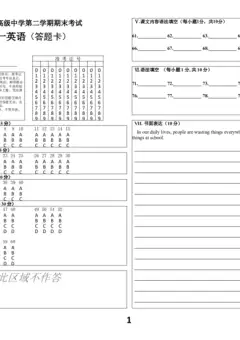
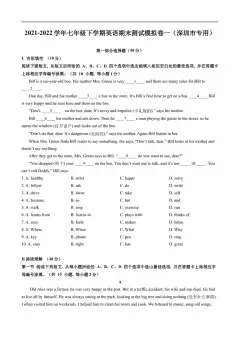
深圳市高级中学第二学期期末考试
初一英语
说明:
1、 本试卷分为第I卷基础知识与能力考查部分和第Ⅱ卷本学期知识与能力考查部分。共计100分,考试
时间为90分钟。
2、 第I卷基础知识与能力考查部分内容为听力测试(15小题,共15分)和七年级全册的词汇考核(15
小题,共15分),共计30分;第II卷本学期知识与能力考查部分内容为完形填空(10小题,共10
分)、阅读理解(20小题,共30分)、课文内容语法填空(10小题,共10分)、语法填空(10小
题,共10分)和书面表达(10分),共计70分。
3、 请考生务必将自己的姓名、班级、准考证号(必须涂黑)填在答题卡上,用2B铅笔涂黑选择题答案,
一律在答题卡上作答。
第I卷 基础知识与能力考查部分(共30分)
I. 听力测试(共15小题,每小题1分)
i. 听句子,根据所听内容选择最佳应答句,句子念两遍。 (共5小题,每小题1分)
( ) 1. A. Yes, she does. B. No, she hasn’t. C. No, she isn’t.
( ) 2. A. More than 2,000 yuan. B. On the playground. C. We are so happy.
( ) 3. A.I agree with you. B. They are beautiful. C. I can also dance.
( ) 4. A. Two weeks ago. B. Once a week. C. Last month.
( ) 5. A. That’s a pity. B. My pleasure. C. It’s interesting.
ii. 听对话,根据对话内容选择最佳答案,对话念两遍。 (共6小题,每小题1分)
听第一段对话,回答第6-7小题
( ) 6. How long will the man’s holiday last?
A. For three weeks. B. For five days. C. For a week.
( ) 7. Where will the man go?
A. To France. B. To America. C. To England.
听第二段对话,回答第8-9小题
( ) 8. When did the boy have the match?
A. Just now. B. Yesterday. C. Last Friday.
( ) 9. How was the result of the match?
A. Grade Three was the first.
B. Grade Three was the second.
C. Grade Three was the third.
听第三段对话,回答第10-11小题
( ) 10. What’s David’s report about?
A. Famous people. B. Space travel. C. Animals.
( ) 11. What’s the girl’s advice?
A. Using the Internet.
B. Asking her uncle for help.
C. Asking her teacher for help.
iii. 听短文,根据所听内容选择最佳答案,短文念两遍。 (共4小题,每小题1分)
( ) 12. What’s the plan about?
1A. Doing voluntary work.
B. Living in the small town.
C. Taking a trip.
( ) 13. How can the classmates go to small town?
A. By bike. B. By bus. C. By train.
( ) 14. What will the classmates do when they get to the small town?
A. Clean up the roads and plant flowers.
B. Teach children to sing songs.
C. Talk with the old people.
( ) 15. How often does the boy decide to do voluntary work from now on?
A. Three times a week. B. Once a week. C. Once a month.
II. 词汇测试(共15小题,每小题1分)
i. 从下面每小题的A、B、C三个选项中选出可以替换划线部分的最佳选项,并在答题卡
上将相应的字母编号涂黑。(共8小题,每小题1分)
( ) 16. ---Our teacher asked us to write an article about our daily lives.
---I hope you can take your time to write a good one.
A. every day B. one day C. everyday
( ) 17. ---It's said that the new hospital will lie in the centre of the city.
---That's good news. It will be more convenient for people to go to see a doctor in the
future.
A. middle B. side C. suburb
( ) 18. ---The COVID-19 epidemic has kept people at home for such a long time.
---That's true. All of us are looking forward to going outside to breathe the fresh air.
A. get in B. fill in C. take in
( ) 19. ---My grandmother has a serious eye disease. She can hardly see anything.
---I'm sorry to hear that.
A. almost B. almost not C. never
( ) 20. ---We are going to graduate next month. I hope we will remain friends forever.
---I'm sure we will.
A. become B. still be C. make
( ) 21. ---The city is famous for its beautiful scenery. Would you like to go sightseeing with me
next week?
---I'd like to. Actually that's just the place I want to visit.
A. well-known B. excellent C. popular
( ) 22. --- You can continue doing the experiment after a break.
--- All right. I really need to relax my brain and eyes now.
A. stop B. go on C. remember
( ) 23. ---Mum, the book says that electricity is like water, in a way . Is that true?
---Yes, it can flow through wires just like water flowing through pipes.
A. in this way B. on the way C. to some degree
ii. 从下面每小题的A、B、C三个选项中选出可以填入空白处的最佳选项,并在答题卡上
将相应的字母编号涂黑。(共7小题,每小题1分)
( ) 24. A(n) __________ is a person whose job involves designing and building engines,
machines, roads, bridges and so on.
A. architect B. engineer C. dentist
( ) 25. ---It's very important for us to protect the environment and save __________.
2---I couldn't agree more. If not, humans won't have a bright future.
A. energy B. time C. pollution
( ) 26. ---__________ is an exciting activity which children like doing in winter.
---You are right. It can bring them a lot of fun.
A. Flying kites B. Having picnics C. Making snowmen
( ) 27. ---Remember to tell me your flight number later. I will go to the _______ to pick you up.
---It's kind of you. Thank you very much.
A. bus station B. airport C. landing site
( ) 28. ---__________ you are in the forest now and take a deep breath. Then you will feel
relaxed.
---OK, doctor. Let me have a try.
A. Discuss B. Connect C. Imagine
( ) 29. ---She is happy that her daughter is 160 centimeters in __________ already.
---Wow, that's amazing! Her daughter is only ten years old.
A. height B. weight C. tall
( ) 30. --- My sister finally __________ her dream through hard work.
---Congratulations! She has set a good example to us.
A. achieved B. gave up C. made
第Ⅱ卷 本学期知识与能力考查部分(共70分)
III. 完形填空(共10小题,每小题1分)
阅读下面短文,从短文后所给的A、B、C三个选项中选出能填入相应空白处的最佳
选项,并在答题卡上将相应的字母编号涂黑。
It was the last day of school and I planned to travel to my friend’s hometown. I hadn’t seen
him for years and this was a good 3 1 to meet him again.
I was busy at school so it was rather 3 2 when I came back home. It was already 10
o’clock at night. Time was running out. After a hurried meal, I left. 33 I found a taxi
very soon. I asked the driver to drive me fast to the station and then I relaxed for a while. On
the way, I imagined what my friend looked like now. I was soon at the station and was sure that I
would be able to 3 4 the train. Unfortunately, I fell on the way and lost some time. To my
complete 3 5 , when I reached the platform, I saw that the train had just left! It was the last
train, so I had to 3 6 home.
My mother was glad to see me back as she had a feeling about my trip. But I was unhappy. I
tried to relax and went to bed, but I had a 37 sleep. The next morning I was very tired.
As I was having breakfast, the 3 8 arrived. I read over the pages and was shocked to
3 9 that the train I missed had had an accident. How 4 0 I was that I missed
the train!
( ) 31. A. place B. chance C. time
( ) 32. A. tiring B. cold C. late
( ) 33. A. Luckily B. Suddenly C. Finally
( ) 34. A. make B. get C. catch
( ) 35. A. satisfaction B. hope C. surprise
( ) 36. A. return B. call C. reach
( ) 37. A. deep B. bad C. great
( ) 38. A. ticket B. milk C. newspaper
3( ) 39. A. find B. hear C. feel
( ) 40. A. hopeful B. thankful C. careful
IV. 阅读理解(共20小题,每小题1.5分)
阅读下列短文,从下面每小题的A、B、C、D四个选项中选择最佳选项,并在答题卡
上将相应的字母编号涂黑。
A
In the United States, we are lucky to have an easy way to get clean water — just by turning
on the tap.
We wake up in the morning, take a shower, brush our teeth, drink a cup of coffee and go out
to enjoy a beautiful day. Water is an important part in our daily lives and we use it for different
purposes (目的),but do we really know how much we use?
Each American family uses more than 300 gallons (加仑)of water per day at home. About
70% of this use is indoors.
Water also plays a big part in our local communities (社区). Without water there would be no
local business or factories. Fire fighting, parks and public swimming pools all need lots of water.
We need a lot of pipes to bring us a large amount of water to our taps each day.
Where does all this water come from? It starts out as rain or snow and flows into our local
lakes, rivers and streams or into underground. You can learn more about water in your country, for
example, how people protect water and where your local drinking water comes from.
The more you learn about water, the better you will make use of it.
( ) 41. What does the underlined word “it” in paragraph 2 refer to?
A. Water. B. Coffee. C. A shower. D. A
day.
( ) 42. What does Paragraph 4 talk about?
A. The use of water at home.
B. How to use water at home.
C. How to use water in the local community.
D. The use of water in the local community.
( ) 43. What can we know from the passage?
A. It is difficult to get clean water for the writer.
B. Most use of water in American families is indoors.
C. Water is not valuable for Americans.
D. Each family uses less than 300 gallons of water.
( ) 44. Why did the writer write the passage?
A. To ask us to save water. B. To tell us where water comes
from.
C. To tell us some information about water. D. To ask us to get clean water.
B
At 19 years old, John Kraus is a professional photographer. He has been taking photos of
rocket launches for different magazines since 2016, as well as selling them to different buyers.
He's even traveled to California just to take photos of two different rocket launches.
He started his journey in early 2015. At that time he was a 15-year-old boy living in Satellite
Beach, Florida, near the Kennedy Space Center. He had used his birthday and Christmas cash to
buy a DSLR camera and began practising by shooting rocket launches. Living on Florida's Space
Coast gave him many chances to practise.
However, he wasn't sure his hobby was going to be his life's work, "When I first started in
4early 2015, photographing rockets was just like 'Oh, look, there's a launch tomorrow night. I guess
I'll take photos! " Kraus wrote.
But online attention and increasing photo sales led him to take a look deeper at his hobby.
Could he really turn his hobby into his career? After graduating from high school, he decided
to work as a full-time photographer.
Kraus spoke about some of the challenges of deciding what kind of job he wanted to do.
"Parents, teachers and all of those around us often say we should know as soon as possible
what we want to do with our life," he said. "It's okay to not know what you want to do! But it's
important to try new things. Never pass down a chance to try or experience something new.
You'll never know when you find the aim of your life; it could be right in front of you."
( ) 45. What made Kraus work as a photographer?
A. His home near the space center.
B. Encouragement from people around him.
C. His birthday and Christmas cash.
D. Online attention to his photos and photo sales.
( ) 46. When he was facing the challenges in choosing jobs, Kraus_______.
A. was sure what he really wanted
B. passed down the chances to find his dream job
C. was brave enough to try everything new to him
D. talked about his dream with parents and teachers
( ) 47. What does the underlined phrase "pass down" in the last paragraph mean?
A. Compare. B. Refuse. C. Catch. D. Notice.
( ) 48. What is the main idea of the passage?
A. Kraus grew up in Satellite Beach, Florida.
B. Kraus had a change of jobs because of his interests.
C. Kraus was encouraged by his teachers to take photos.
D. Kraus has turned his hobby into a successful career.
C
In the modern age, human society runs on energy. Most machines need electricity to operate.
Humans cannot live without electricity even a single day in their daily life and work. They have
many different ways to create electricity. But some ways are harmful to the environment.
For example, fossil fuels (化石燃料) are the most common kind of energy. They include
coal, oil, and natural gas. First, people have to dig them from the ground. This can sometimes
harm the environment. However, scientists are creating cleaner and better ways to do that these
days. So the environment is not harmed as much as before. But when people burn these fossil
fuels, they can give off a lot of harmful gases, which is considered to be one of the greatest causes
of global warning. This might harm the environment.
Tidal (潮汐的) energy is another way to make electricity. This uses the ocean tides to make
electricity. But some kinds of tidal energy can kill many fish and other sea animals. Also dams (大
坝) can create lots of clean energy. But dams create lakes and change the way that rivers run. So
they can do great harm to the balance of nature around the lakes and along the rivers.
Nuclear (核的) energy is a very powerful form of energy. It is cheap. It is also very clean. But
many people are afraid of it because it uses radioactive materials. Also, there have been some very
serious accidents in the past which caused great harm to human and nature. But the technology is
much better these days. so many countries are starting to use nuclear energy more.
( ) 49. What does the underlined part “human society runs on energy” in Paragraph 1
5mean?
A. It means that humans in the society waste much energy.
B. It means that people use energy to make the world work.
C. It means that our society is full of varied kinds of energy.
D. It means that humans cannot run fast without energy.
( ) 50. According to the passage, which of the following is TRUE about fossil fuels?
A. They are dug from the ground. B. They are considered expensive.
C. They hardly harm the environment. D. They are not widely used in the
world
( ) 51. From the passage, we know that tidal energy can ______.
A. cause serious accidents B. change the way that rivers run
C. give off a lot of harmful gases D. kill many living things in the ocean
( ) 52. Many countries start to use nuclear energy more because ______.
A. it’s a common kind of energy B. people are not afraid of it now
C. it’s cheap, clean and safer than before D. people can’t live without it
D
Ms Wang, a young office lady in Shenzhen, stands in front of a vending machine
(自动售货机). She puts some notes into the machine and then a paper box rolls out. She
can hardly wait to open the box and is excited to find a limited-edition (限量版) Molly
doll inside. The paper box is called the "blind box". In recent years, it has gone from
being favourites of children and students to a big hole that young adults keep jumping
into.
What's the blind box? As the name says, people don't know what doll they will get
until they open the box. Molly, a little girl with curly hair, wide eyes and pouting lips, is
one of the best-selling dolls in China. Over 400 million Molly dolls were sold in the
country in 2018.
Someone wants to know why people have spent money on such dolls. Psychologists
(心理学家) say that collectors are trying to bring some order and meaning to their lives.
To some collectors, it's a way of relaxing. Mr Li, a young businessman, keeps his dolls at
home and in his office. "When I look at the dolls, they make me smile," he said. " And
when other people see them, they smile too."
As for me, it's just fun. Imagine using social media to show off your collections and
exchange the dolls. So if you are a doll collector, enjoy the joy the blind box brings you.
A daily smile is certainly worth 59 yuan you have spent.
( ) 53. What can we know from the first paragraph?
A. The dolls are usually put in a big hole.
B. Ms Wang gets the Molly doll without any money.
C. More and more young people love the blind box.
D. Among all the dolls, Ms Wang likes the Molly doll best.
( ) 54. What does the third paragraph talk about?
A. How many dolls Mr Li has collected.B. What the Molly doll looks like.
C. What is in the blind box. D. Why people buy the dolls.
( ) 55. What can we infer (推断) from the last paragraph?
A. The writer thinks 59 yuan is expensive for a doll.
B. The writer supports the doll collectors.
C. The writer enjoys his doll collections.
D. The writer often exchanges his dolls with others.
6( ) 56. What's the passage mainly about?
A. The development of the blind box. B. People's opinions about the blind
box.
C. The popularity of the blind box in China.
D. The Molly doll, the best-selling doll in China.
E
US poet Allen Ginsberg once said, "Poetry is the one place where people can speak their
original human mind."
In celebrating World Poetry Day, March 21, UNESCO discovers the special ability of poetry
to express the human spirit.
The magic of poetry lies in the connection built up through words between the author and the
reader. When we read a poem, we often imagine what the poet was thinking when they wrote it, or
what they were doing at that time. These thoughts let us connect with the words better.
But in the age of AI (人工智能), would a poem still mean as much if it wasn't written by a
human at all? Today, computers can create all kinds of texts, even poems included.
In 2013, Australian researcher Oscar Schwartz and his friend Benjamin Laird created a
website called "bot or not". Readers can read poems there and they can guess whether they
were written by a human or a computer. During a recent speech at TedX Sydney, Schwartz said
that throughout the years, some of the website's poems were able to fool 65 percent of human
readers into thinking they were written by a human.
By starting the website, Schwartz and Laird hoped that people would question the difference
between humans and machines and be able to find out what makes us human.
Unstableness (不稳定性) is part of the answer. "The human is not a cold, hard fact,"
Schwartz said. "Rather, it is something that's constructed (构成) with our ideas and something
that changes over time."
A computer may be able to create poems that are correct in both grammar and style, but it
wouldn't be able to get the same meanings and feelings across as a human poet could. In fact,
today's AI software creates poems based on ones that have already been written by humans. As
Schwartz noted, "The computer works like a mirror that reflects (反映) any idea of a human that
developers teach it."
So a new challenge arises (出现): What kind of human mind do we want the computer to
reflect back at us?
( ) 57. What's the purpose of the first three paragraphs?
A. To introduce how World Poetry Day was started.
B. To show the popularity of poetry around the world.
C. To show the importance and beauty of poetry.
D. To give some tips on appreciating (欣赏) poetry.
( ) 58. What do the data (数据) from "bot or not" show?
A. Computers are better than humans at writing poetry.
B. Computers can also produce poems of high quality.
C. Readers don't really care whether the poems were written by humans.
D. Few readers can tell poems written by computers from those by humans.
( ) 59. According to Schwartz, what makes humans different from machines?
A. We have changing ideas. B. We often make mistakes.
C. We are stable in what we do. D. We value feelings over facts.
( ) 60. Why can't computers match humans in creating poems according to the article?
A. They can't express feelings as well as humans.
7B. They can't create poems that make sense (说得通) at all.
C. They fail to use the correct grammar and style.
D. They only know how to copy poems written by humans.
V. 课文内容语法填空(共10小题,每小题1分)
It was an unusual morning. While Dora (61) __________(brush) her teeth in the bathroom,
the tap was still on. (62) __________ angry voice told her to turn that tap off. Dora looked
around, (63) __________ she saw nobody there. The voice said he was a drop of water. Dora
didn’t know (64) __________ he came from. Some days ago, he was in a cloud. Then he (65)
__________ (drop) into a river and ran into a reservoir. Then it was time for people (66)
__________(clean) him because he was dirty. They cleaned him and added some chemicals (67)
__________ him. After that, he travelled through the pipes under the streets and he was in Dora’s
bathroom. Dora asked if that was the end of his journey. The water told her he should (68)
__________(clean) again. He would go into a river and then into the sea again. His journey
started there. Dora felt sorry and knew what (69) __________(do) next. She turned the tap off
and came out of the bath- room.
Remember not to waste or pollute water. It is quite (70) __________(value).
VI. 语法填空(共10小题,每小题1分)
Once, Mark Twain went to Maine for a holiday. He stayed in the forest for three
weeks. (71) __________ his way back home, he stopped at a station with his bag (72)
__________(have) a rest. He (73) __________(take) a seat and started to talk to the
stranger sitting next to (74) __________(he). First they talked about the weather and then
about Maine. The stranger asked if he had been to the (75) __________(beauty) woods.
Mark Twain said, "Yes, I’ve just spent three pleasant weeks there. (76) __________
fishing isn’t allowed in Maine in this season, I’ve got two hundred pounds of fish in my
bag." The stranger looked at Mark Twain for several (77) __________ (second) and then
answered, “I'm a police officer. My job is to catch people who hunt and fish during the
wrong seasons. And who are you?”
Mark Twain was (78) __________(surprise) when he heard this. He thought (79)
__________(quick) and then answered, "Well, sir. I’m the man who tells (80)
__________(big) lies in America."
VII. 书面表达(10分)
在我们的日常生活中,浪费现象随处可见,在校园里也很普遍。请描述以下现象,并提
出1—2条建议。
1. 洗完手不关水龙头。
2. 离开教室不关灯。
3. 不热的时候也开着空调。
4. 补充1—2个校园里的浪费现象。
注意:1. 词数不少于80词(开头已给出,不计入总数)
2. 不得透露学校、姓名等任何个人信息,否则不予评分。
In our daily lives, people are wasting things everywhere. It is also very common to
see such things at school.
_______________________________________________________________________________
_______________________________________________________________________________
_______________________________________________________________________________
_______________________________________________________________________________
_______________________________________________________________________________
8_______________________________________________________________________________
_______________________________________________________________________________
_______________________________________________________________________________
_______________________________________________________________________________
_______________________________________________________________________________
深圳市高级中学 2019—2020 学年第二学期期末考试
初一英语
答案:
第I卷 基础知识与能力考查部分
I. 听力测试
1—5 BAABA 6—10 ACABB 11—15 B ABAC
II. 词汇测试
16—20 C A C B B 21—25 A B C B A 26—30 C B C A A
第Ⅱ卷 本学期知识与能力考查部分
III. 完形填空
31—35 B C A C C 36—40 A B C A B
IV. 阅读理解
41—44 A D B A 45—48 D C B D 49—52 B A D C
53—56 C D B C 57—60 C B A A
V. 课文内容语法填空
61. was brushing 62. An 63. but 64. where 65. dropped
66. to clean 67. to 68. be cleaned 69. to do 70. valuable
VI. 语法填空
71. On 72. to have 73. took 74. him 75. beautiful
76. Although/Though 77. seconds 78. surprised 79. quickly 80. the biggest
VII. 书面表达
In our daily lives, people are wasting things everywhere. It is also very common to
see such things at school.
For example, many students don't turn off the tap after washing hands. What's more,
when they leave the classroom, they always forget to switch off the lights. And they like
to keep the air conditioner on even though they don't feel hot. Besides, we can see lots of
leftovers on the tables after some students finish their lunch. Also, some paper is only
used one side.
So I strongly suggest that we students should know the importance of saving. Let's
take action right now. Firstly, remember to turn off the taps or lights when we don't use
them. Secondly, don't order too much food to eat. Thirdly, use both sides of paper. I am
sure if we do our best, the Earth will be better.
9