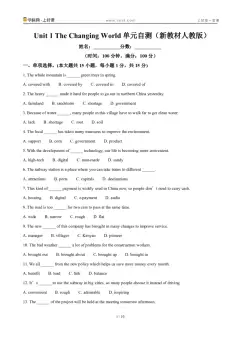
Unit 1 The Changing World 单元自测(新教材人教版)
姓名:___________分数:___________
(时间:100 分钟,满分:100 分)
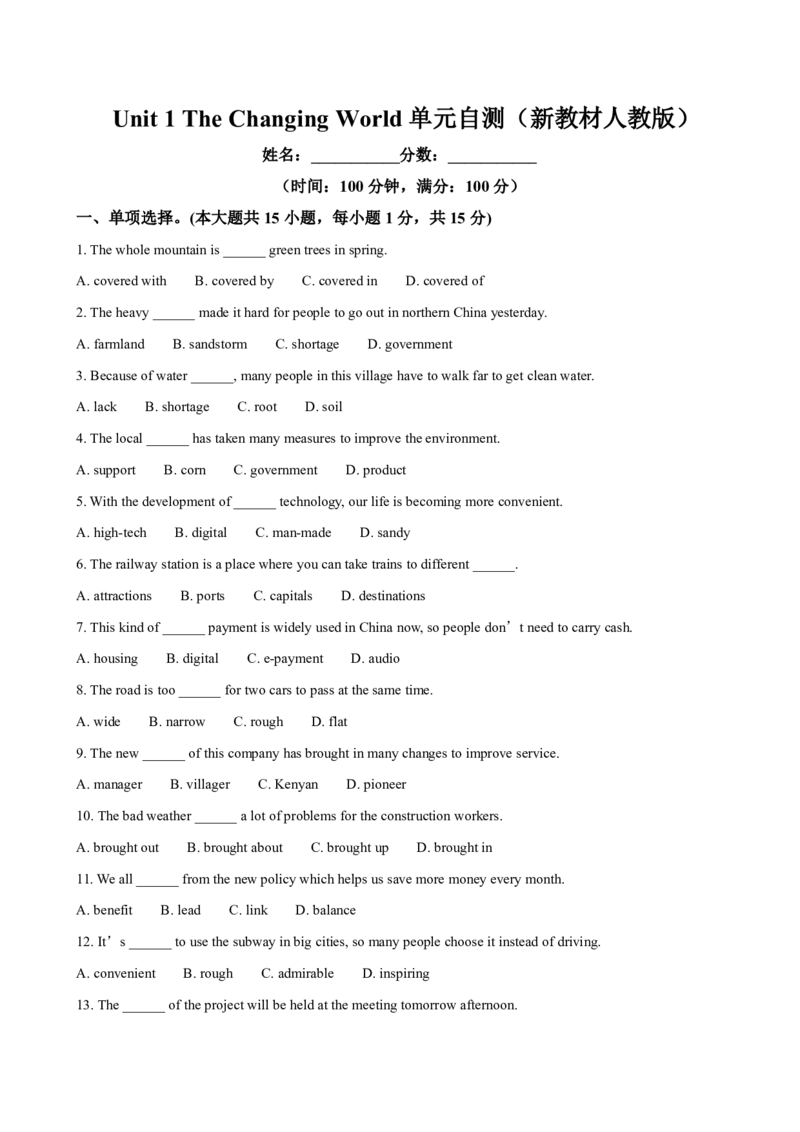
一、单项选择。(本大题共15 小题,每小题1 分,共15 分)
1. The whole mountain is ______ green trees in spring.
A. covered with
B. covered by
C. covered in
D. covered of
2. The heavy ______ made it hard for people to go out in northern China yesterday.
A. farmland
B. sandstorm
C. shortage
D. government
3. Because of water ______, many people in this village have to walk far to get clean water.
A. lack
B. shortage
C. root
D. soil
4. The local ______ has taken many measures to improve the environment.
A. support
B. corn
C. government
D. product
5. With the development of ______ technology, our life is becoming more convenient.
A. high-tech
B. digital
C. man-made
D. sandy
6. The railway station is a place where you can take trains to different ______.
A. attractions
B. ports
C. capitals
D. destinations
7. This kind of ______ payment is widely used in China now, so people don’t need to carry cash.
A. housing
B. digital
C. e-payment
D. audio
8. The road is too ______ for two cars to pass at the same time.
A. wide
B. narrow
C. rough
D. flat
9. The new ______ of this company has brought in many changes to improve service.
A. manager
B. villager
C. Kenyan
D. pioneer
10. The bad weather ______ a lot of problems for the construction workers.
A. brought out
B. brought about
C. brought up
D. brought in
11. We all ______ from the new policy which helps us save more money every month.
A. benefit
B. lead
C. link
D. balance
12. It’s ______ to use the subway in big cities, so many people choose it instead of driving.
A. convenient
B. rough
C. admirable
D. inspiring
13. The ______ of the project will be held at the meeting tomorrow afternoon.
A. conclusion
B. discussion
C. aspect
D. inspiration
14. The young man ______ his team to win the first place in the competition last week.
A. led
B. leads
C. lead
D. leading
15. The old farmer knows that the ______ here is very rich and good for growing crops.
A. dirt
B. soil
C. sand
D. bush
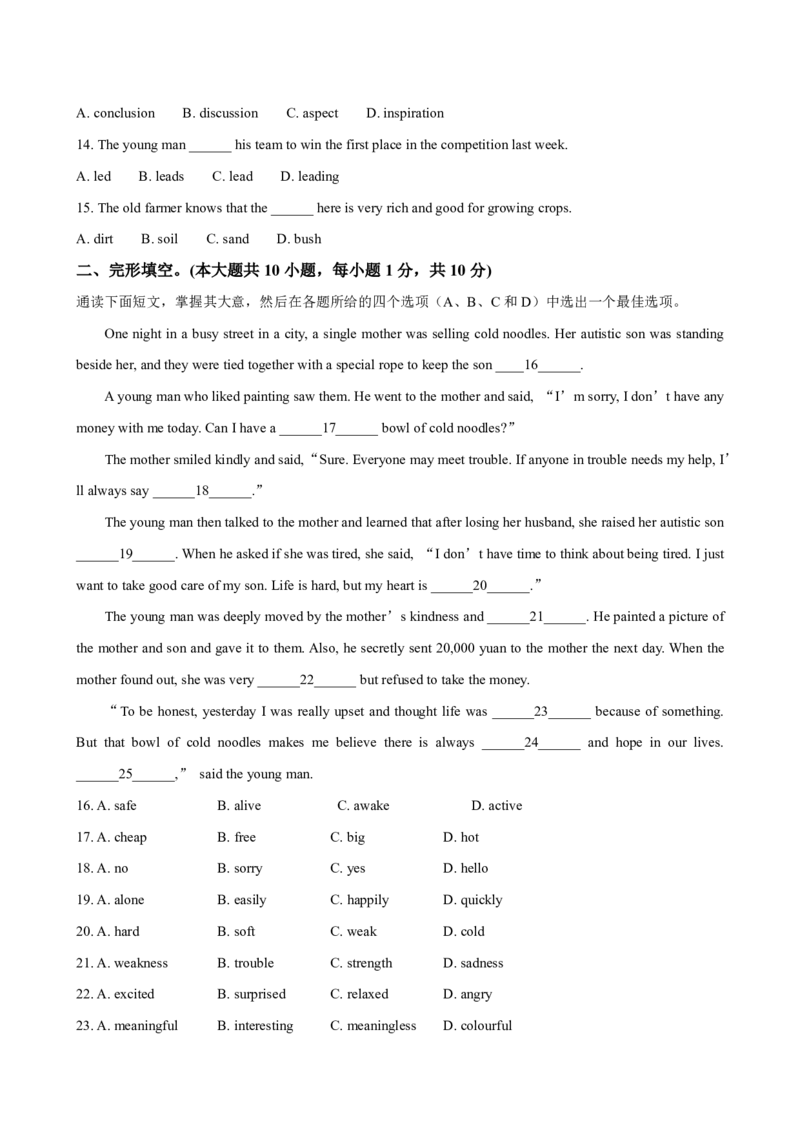
二、完形填空。(本大题共10 小题,每小题1 分,共10 分)
通读下面短文,掌握其大意,然后在各题所给的四个选项(A、B、C 和D)中选出一个最佳选项。
One night in a busy street in a city, a single mother was selling cold noodles. Her autistic son was standing
beside her, and they were tied together with a special rope to keep the son ____16______.
A young man who liked painting saw them. He went to the mother and said, “I’m sorry, I don’t have any
money with me today. Can I have a ______17______ bowl of cold noodles?”
The mother smiled kindly and said,“Sure. Everyone may meet trouble. If anyone in trouble needs my help, I’
ll always say ______18______.”
The young man then talked to the mother and learned that after losing her husband, she raised her autistic son
______19______. When he asked if she was tired, she said, “I don’t have time to think about being tired. I just
want to take good care of my son. Life is hard, but my heart is ______20______.”
The young man was deeply moved by the mother’s kindness and ______21______. He painted a picture of
the mother and son and gave it to them. Also, he secretly sent 20,000 yuan to the mother the next day. When the
mother found out, she was very ______22______ but refused to take the money.
“To be honest, yesterday I was really upset and thought life was ______23______ because of something.
But that bowl of cold noodles makes me believe there is always ______24______ and hope in our lives.
______25______,” said the young man.
16. A. safe
B. alive
C. awake
D. active
17. A. cheap
B. free
C. big
D. hot
18. A. no
B. sorry
C. yes
D. hello
19. A. alone
B. easily
C. happily
D. quickly
20. A. hard
B. soft
C. weak
D. cold
21. A. weakness
B. trouble
C. strength
D. sadness
22. A. excited
B. surprised
C. relaxed
D. angry
23. A. meaningful
B. interesting
C. meaningless
D. colourful
24. A. love
B. money
C. food
D. success
25. A. Sorry
B. Hello
C. Thanks
D. Goodbye
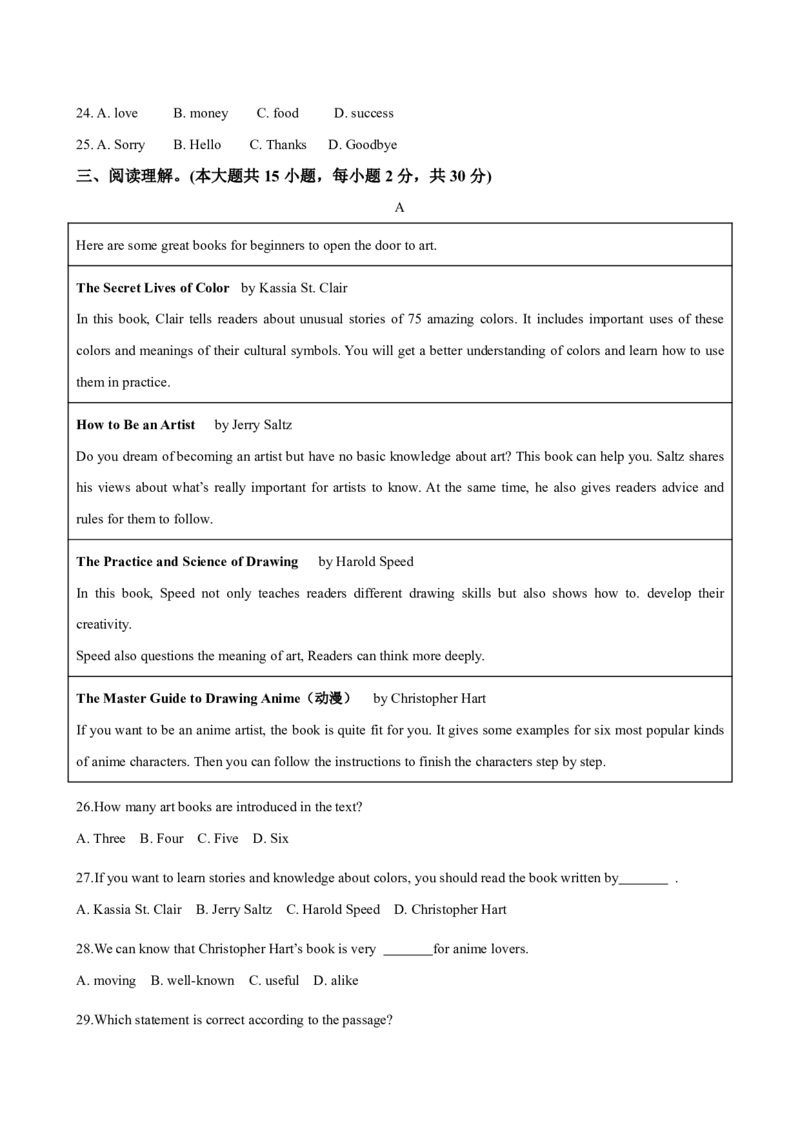
三、阅读理解。(本大题共15 小题,每小题2 分,共30 分)
A
Here are some great books for beginners to open the door to art.
The Secret Lives of Color
by Kassia St. Clair
In this book, Clair tells readers about unusual stories of 75 amazing colors. It includes important uses of these
colors and meanings of their cultural symbols. You will get a better understanding of colors and learn how to use
them in practice.
How to Be an Artist
by Jerry Saltz
Do you dream of becoming an artist but have no basic knowledge about art? This book can help you. Saltz shares
his views about what’s really important for artists to know. At the same time, he also gives readers advice and
rules for them to follow.
The Practice and Science of Drawing
by Harold Speed
In this book, Speed not only teaches readers different drawing skills but also shows how to. develop their
creativity.
Speed also questions the meaning of art, Readers can think more deeply.
The Master Guide to Drawing Anime(动漫)
by Christopher Hart
If you want to be an anime artist, the book is quite fit for you. It gives some examples for six most popular kinds
of anime characters. Then you can follow the instructions to finish the characters step by step.
26.How many art books are introduced in the text?
A. Three
B. Four
C. Five
D. Six
27.If you want to learn stories and knowledge about colors, you should read the book written by
.
A. Kassia St. Clair
B. Jerry Saltz
C. Harold Speed
D. Christopher Hart
28.We can know that Christopher Hart’s book is very
for anime lovers.
A. moving
B. well-known
C. useful
D. alike
29.Which statement is correct according to the passage?
A. Kassia St. Clair writes stories of over 100 colors.
B. Jerry Saltz gives readers some practical advice.
C. Harold Speed only teaches different drawing skills.
D. Christopher Hart is the best anime painter.
30.What is the main purpose of the passage?
A. To introduce some famous art creators.
B. To advise people to write art books.
C. To suggest some books for art beginners.
D. To share the writer’s own ideas about art.
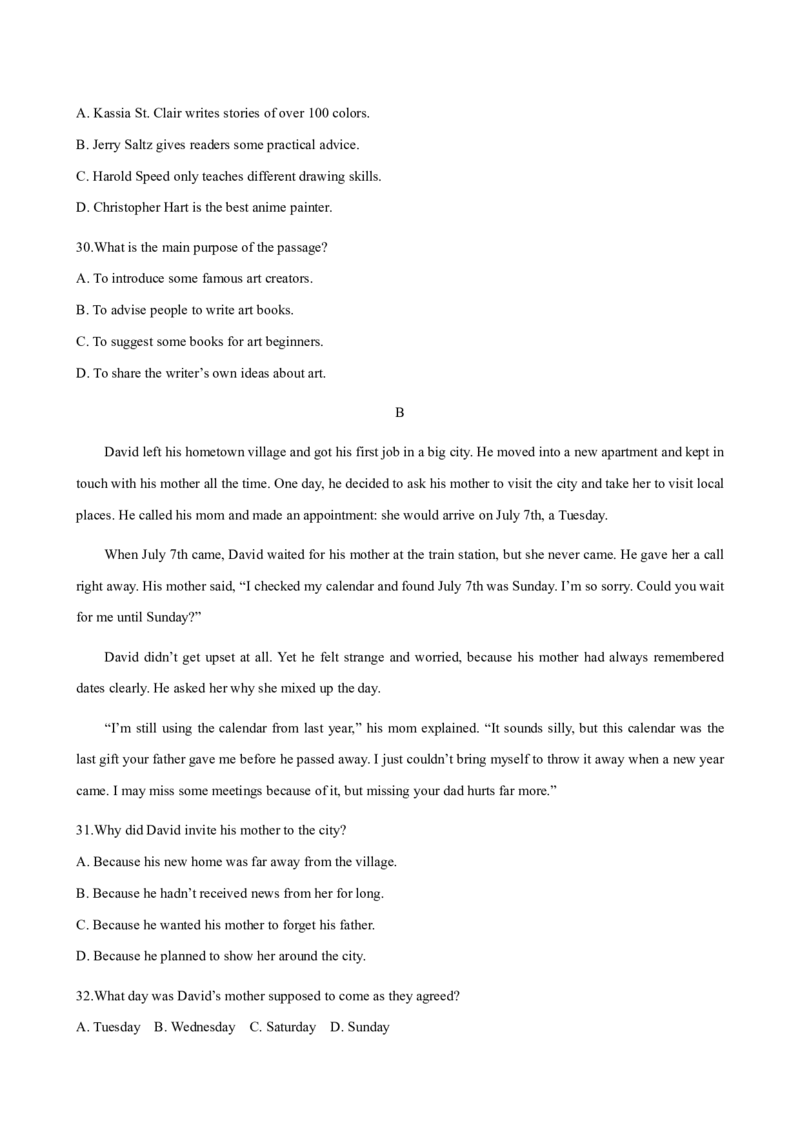
B
David left his hometown village and got his first job in a big city. He moved into a new apartment and kept in
touch with his mother all the time. One day, he decided to ask his mother to visit the city and take her to visit local
places. He called his mom and made an appointment: she would arrive on July 7th, a Tuesday.
When July 7th came, David waited for his mother at the train station, but she never came. He gave her a call
right away. His mother said, “I checked my calendar and found July 7th was Sunday. I’m so sorry. Could you wait
for me until Sunday?”
David didn’t get upset at all. Yet he felt strange and worried, because his mother had always remembered
dates clearly. He asked her why she mixed up the day.
“I’m still using the calendar from last year,” his mom explained. “It sounds silly, but this calendar was the
last gift your father gave me before he passed away. I just couldn’t bring myself to throw it away when a new year
came. I may miss some meetings because of it, but missing your dad hurts far more.”
31.Why did David invite his mother to the city?
A. Because his new home was far away from the village.
B. Because he hadn’t received news from her for long.
C. Because he wanted his mother to forget his father.
D. Because he planned to show her around the city.
32.What day was David’s mother supposed to come as they agreed?
A. Tuesday
B. Wednesday
C. Saturday
D. Sunday
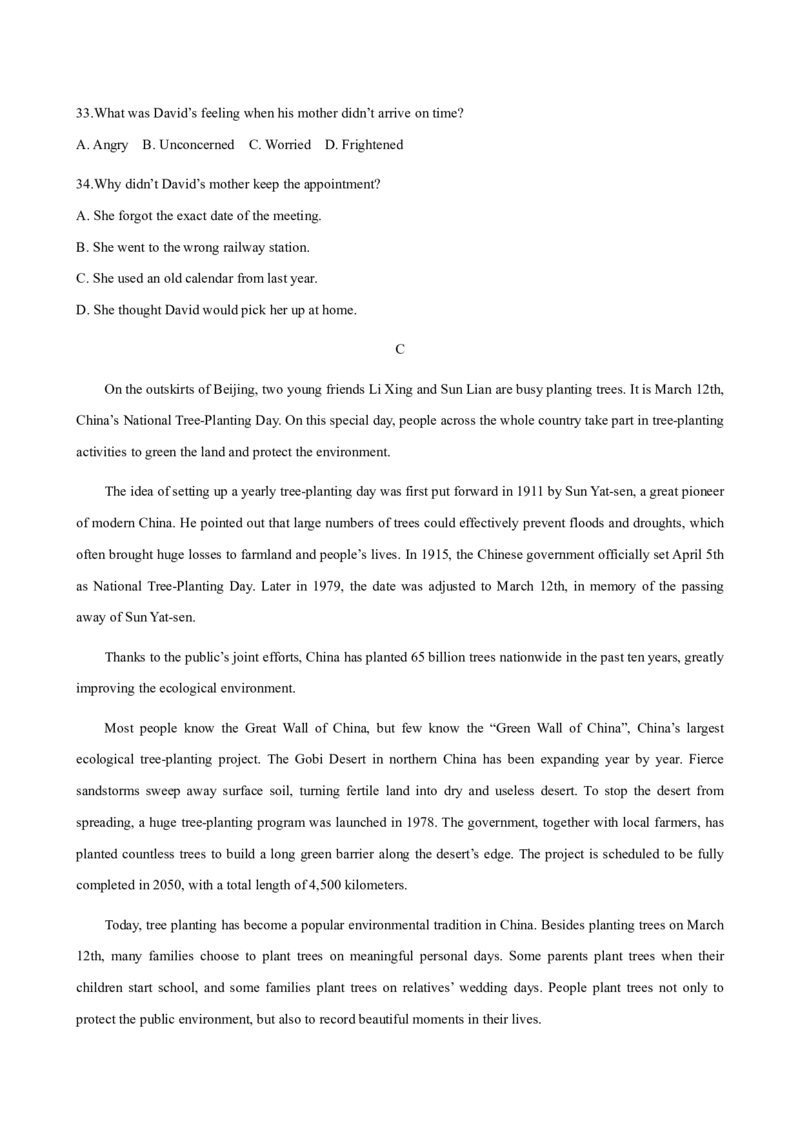
33.What was David’s feeling when his mother didn’t arrive on time?
A. Angry
B. Unconcerned
C. Worried
D. Frightened
34.Why didn’t David’s mother keep the appointment?
A. She forgot the exact date of the meeting.
B. She went to the wrong railway station.
C. She used an old calendar from last year.
D. She thought David would pick her up at home.
C
On the outskirts of Beijing, two young friends Li Xing and Sun Lian are busy planting trees. It is March 12th,
China’s National Tree-Planting Day. On this special day, people across the whole country take part in tree-planting
activities to green the land and protect the environment.
The idea of setting up a yearly tree-planting day was first put forward in 1911 by Sun Yat-sen, a great pioneer
of modern China. He pointed out that large numbers of trees could effectively prevent floods and droughts, which
often brought huge losses to farmland and people’s lives. In 1915, the Chinese government officially set April 5th
as National Tree-Planting Day. Later in 1979, the date was adjusted to March 12th, in memory of the passing
away of Sun Yat-sen.
Thanks to the public’s joint efforts, China has planted 65 billion trees nationwide in the past ten years, greatly
improving the ecological environment.
Most people know the Great Wall of China, but few know the “Green Wall of China”, China’s largest
ecological tree-planting project. The Gobi Desert in northern China has been expanding year by year. Fierce
sandstorms sweep away surface soil, turning fertile land into dry and useless desert. To stop the desert from
spreading, a huge tree-planting program was launched in 1978. The government, together with local farmers, has
planted countless trees to build a long green barrier along the desert’s edge. The project is scheduled to be fully
completed in 2050, with a total length of 4,500 kilometers.
Today, tree planting has become a popular environmental tradition in China. Besides planting trees on March
12th, many families choose to plant trees on meaningful personal days. Some parents plant trees when their
children start school, and some families plant trees on relatives’ wedding days. People plant trees not only to
protect the public environment, but also to record beautiful moments in their lives.
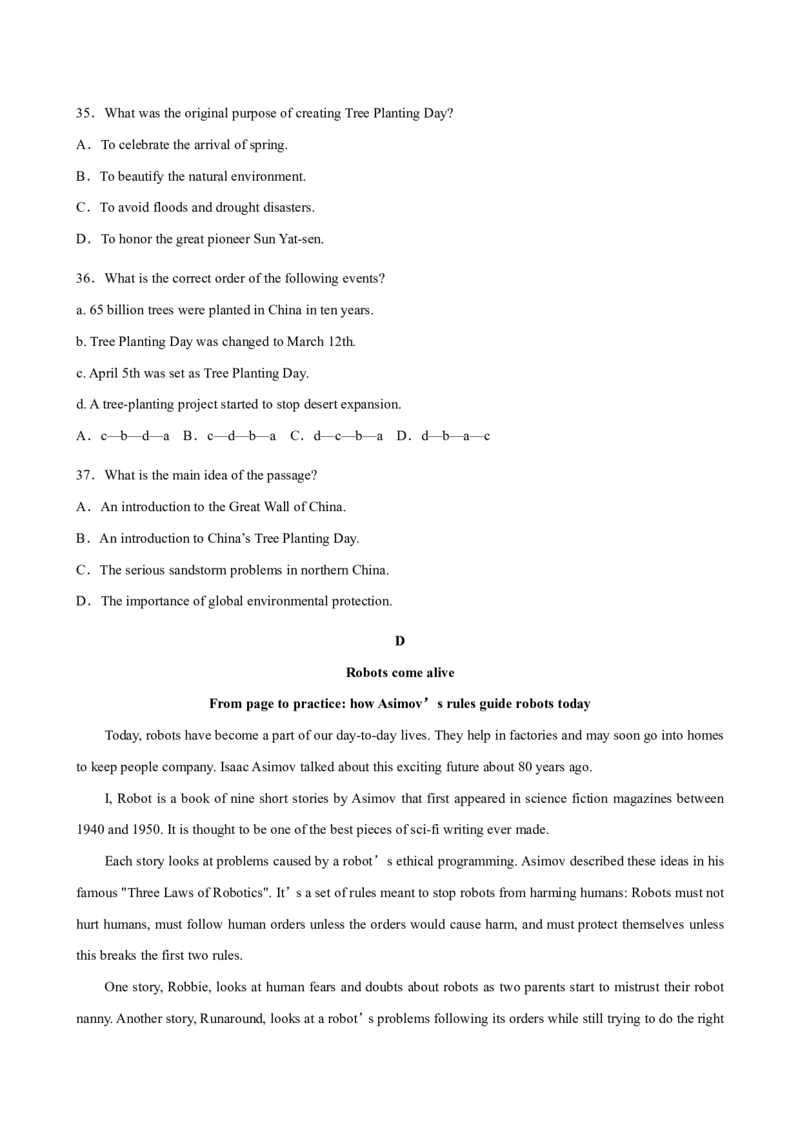
35.What was the original purpose of creating Tree Planting Day?
A.To celebrate the arrival of spring.
B.To beautify the natural environment.
C.To avoid floods and drought disasters.
D.To honor the great pioneer Sun Yat-sen.
36.What is the correct order of the following events?
a. 65 billion trees were planted in China in ten years.
b. Tree Planting Day was changed to March 12th.
c. April 5th was set as Tree Planting Day.
d. A tree-planting project started to stop desert expansion.
A.c—b—d—a
B.c—d—b—a
C.d—c—b—a
D.d—b—a—c
37.What is the main idea of the passage?
A.An introduction to the Great Wall of China.
B.An introduction to China’s Tree Planting Day.
C.The serious sandstorm problems in northern China.
D.The importance of global environmental protection.
D
Robots come alive
From page to practice: how Asimov’s rules guide robots today
Today, robots have become a part of our day-to-day lives. They help in factories and may soon go into homes
to keep people company. Isaac Asimov talked about this exciting future about 80 years ago.
I, Robot is a book of nine short stories by Asimov that first appeared in science fiction magazines between
1940 and 1950. It is thought to be one of the best pieces of sci-fi writing ever made.
Each story looks at problems caused by a robot’s ethical programming. Asimov described these ideas in his
famous "Three Laws of Robotics". It’s a set of rules meant to stop robots from harming humans: Robots must not
hurt humans, must follow human orders unless the orders would cause harm, and must protect themselves unless
this breaks the first two rules.
One story, Robbie, looks at human fears and doubts about robots as two parents start to mistrust their robot
nanny. Another story, Runaround, looks at a robot’s problems following its orders while still trying to do the right
thing.
In many other sci-fi stories, a robot turns against the person who built it, like in Frankenstein. But Asimov
wrote about friendly robots that follow simple rules. However, these rules sometimes lead to mistakes, showing
that real life can be hard to control.
Asimov’s stories even influenced real robot engineers. Joseph Engelberger, who developed the first factory
robot, said that his love of robots came from reading I, Robot as a child. He even invited Asimov to write a
foreword for his robotics manual.
In his work, Asimov imagines a future where humans and machines live together peacefully. This idea is still
just as meaningful today as it was when he first wrote it.
38. What is the main purpose of Asimov’s "Three Laws of Robotics"?
A. To make robots work faster in factories.
B. To prevent robots from harming humans.
C. To help robots protect themselves all the time.
D. To let robots make their own decisions freely.
39. Why is the book I, Robot important according to the passage?
A. It was the first sci-fi book about robots.
B. It directly led to the invention of the first robot.
C. It influenced both sci-fi writing and real robot engineers.
D. It tells the same story as the movie of the same name.
40. What can we learn from Asimov’s stories?
A. Robots with strict rules will never make mistakes.
B. It is easy to control robots in real life.
C. Robots will definitely turn against humans in the future.
D. Humans and robots can live together peacefully.
四、根据句意及中文提示写出单词,使句子完整正确。(本大题共10 小题,每小题1 分,共10 分)
41. The ______ (崎岖的) road made the long trip very uncomfortable.
42. The ______ (政府) is trying to solve the housing problem in big cities.
43. Many people are worried about the water ______ (短缺) in this area.
44. The company’s new ______ (产品) sells very well in the market.
45. The ______ (首都) of China is Beijing.
46. This city has many beautiful tourist ______ (景点/向往的地方).
47. The new railway ______ (连接) the two cities and makes travel easier.
48. It’s a ______ (奇迹) that the little boy survived the big earthquake.
49. We all look up to the scientist for his great ______ (智慧).
50. The ______ (村民) here live a simple but happy life.
五、语法填空。(本大题共10 小题,每小题1 分,共10 分)
阅读下列材料,在空白处填入适当的内容(每空一词)或括号内单词的适当形式。
I was at a restaurant eating my dinner. And there was a father
51
(sit) with his two young girls. The
girls were asking about everything and anything. I was
52
(interest) in their endless questions.
One of the
53
(girl) looked at me and asked her father, “Daddy,
54
is she wearing that?”
As a foreigner in this country, I still
55
(wear) my national dress every day, so I often heard people talk
about me.
Her father said something that made my heart so warm. He said, “There are different countries, cultures and
languages
56
the world. We all have to learn about them.” He then shared a
57
(person)
experience with his daughter. He said, “You know what, girls? I lived abroad and learned
58
(speak)
Spanish many years ago. I really learned a lot. When you grow up, you must go to visit different countries. That
59
(be) amazing!”
This is how parents should teach their children love, acceptance, understanding and respect. It starts from
60
early age. Children copy the way their parents talk and do thing. They are their role models.
六、任务型阅读(共5 小题,每小题2 分,满分10 分)
阅读下面短文,根据要求完成各小题。
Have you heard of the phrase "Becoming Chinese"? It is not about changing your passport or nationality.
Instead, it is a fun and healthy lifestyle trend (趋势) that is popular on social media platforms (平台) like TikTok
in 2026. Many young people in the world are now trying to live like Chinese people.
This trend was started by a popular video from a Chinese-American blogger ( 博主) named Sherry. She
jokingly told her viewers, "From tomorrow, you are going to become Chinese." Her video encouraged people to
try traditional Chinese habits, especially those related to health and keeping fit.
So, what does "becoming Chinese" include? It includes many simple but meaningful daily habits. For
example, people are drinking hot water or herbal (草药) tea instead of ice water. They are wearing comfortable
indoor slippers at home and washing their feet in warm water before bed. Many are also trying traditional
exercises like Baduanjin, a form of Qigong that helps relax the body and mind. Cooking congee (粥) for breakfast
or making hot pot with family has also become popular.
Why are so many people joining this trend? Because they find these habits comforting and good for their
health. In a busy and quick world, these simple routines offer a sense of peace and balance. Plus, with more
foreigners visiting China and sharing their real experiences online, people are discovering that Chinese daily life
is both warm and interesting.
"Becoming Chinese" is more than just a joke — it's a way for people to connect with a different culture
through everyday actions. It shows that good ideas about health and happiness can come from anywhere.
61. What does the phrase "Becoming Chinese" mean according to the passage?
62. Who started the "Becoming Chinese" trend?
63. List two healthy daily habits mentioned in the passage that are part of "Becoming Chinese".
64. Translate the underlined sentence into Chinese.
It shows that good ideas about health and happiness can come from anywhere.
65. What is the best title for this passage?
七、书面表达。(共15 分)
66.请以Great Changes in My Hometown 为题,根据以下提示介绍你家乡发生的巨大变化。
1. 过去:道路狭窄,出行不便,生活简单;
2. 现在:道路宽阔,交通便利,环境优美,科技让生活更便捷;
3. 谈谈你的感受与展望。
词数:80–100 词
提示词:narrow, convenient, be covered with, high-tech, digital payment
注意:
1. 表达中必须包含所给要点并进行适当发挥;
2. 词数100 左右。
3.文中不得出现真实的姓名、校名和地名等信息。
Great Changes in My Hometown
___________________________________________________________________________________________
___________________________________________________________________________________________
___________________________________________________________________________________________
___________________________________________________________________________________________
___________________________________________________________________________________________
___________________________________________________________________________________________
___________________________________________________________________________________________
___________________________________________________________________________________________
___________________________________________________________________________________________
___________________________________________________________________________________________
___________________________________________________________________________________________
___________________________________________________________________________________________
___________________________________________________________________________________________
___________________________________________________________________________________________