2026 届上海市高考英语听力第一期专项训练
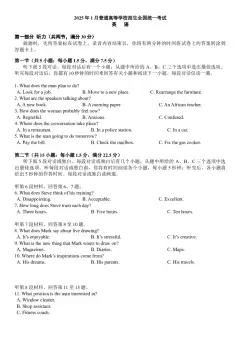
I. Listening Comprehension
Section A
Directions: In Section A, you will hear ten short conversations
between two speakers. At the end of each conversation, a question
will be asked about what was said. The conversations and the
questions will be spoken only once. After you hear a conversation
and the question about it, read the four possible answers on your
paper, and decide which one is the best answer to the question
you have heard.
1.  A. Buy a new laptop.
    B. Borrow a laptop.
    C. Buy a second-hand laptop.
    D. Repair his old laptop.
2.  A. He was ill.
    B. He had to look after his sister.
    C. He forgot about the lecture.
    D. He went on business with his parents.
3.  A. It's not rush hour now.
    B. The bus ride will take 20 minutes.
    C. There is a traffic jam now.
    D. The City Library is far away.
4.  A. Easy.
    B. Interesting.
    C. Difficult.
    D. Boring.
5.  A. Go to the cinema.
    B. Prepare for an English test.
    C. Visit her friend.
    D. Do some shopping.
6.  A. Go hiking.
    B. Watch a movie.
    C. Stay at home.
    D. Visit his classmates.
7.  A. 76.5 yuan.
    B. 85 yuan.
    C. 93.5 yuan.
    D. 100 yuan.
8.  A. In the classroom.
    B. In the reading room.
    C. In the library.
    D. In the dining hall.
9.  A. If the man has a phone.
    B. If the charger fits the man’s phone.
    C. If the man needs a new phone.
    D. If the charger is working.
10. A. To drink more water.
    B. To do more exercise.
    C. To go to bed earlier.
D. To ask for leave.
Section B
Directions: In Section B, you will hear two passages and one longer
conversation. After each passage or conversation, you will be asked
several questions. The passages and the conversation will be read
twice, but the questions will be spoken only once. When you hear
a question, read the four possible answers on your paper and
decide which one is the best answer to the question you have
heard.
Questions 11 through 13 are based on the following passage.
11. A. To expand vocabulary.
    B. To make more friends.
    C. To travel abroad easily.
    D. To pass the math exam.
12. A. Original English novels.
    B. Simple storybooks.
    C. Popular science books.
    D. English newspapers.
13. A. Read as fast as possible.
    B. Read only classic novels.
    C. Read for 15-20 minutes every day.
    D. Read books with difficult words.
Questions 14 through 16 are based on the following passage.
14. A. It is expensive.
    B. It is convenient.
    C. It has few resources.
    D. It requires a lot of time.
15. A. They can learn at their own pace.
    B. They can make more friends.
    C. They can get more homework.
    D. They can study with teachers face-to-face.
16. A. Play games while studying.
    B. Have good self-discipline.
    C. Study without a schedule.
    D. Avoid using mobile phones.
Questions
17
through
20
are
based
on
the
following
conversation.
17. A. To read an English essay.
    B. To write a short essay about online English learning.
    C. To search educational websites.
    D. To interview his cousin.
18. A. It is cheap.
    B. It is convenient.
    C. It has more homework.
    D. It is easy to get bored.
19. A. From her teachers.
    B. From her parents.
    C. From educational websites and articles.
    D. From her classmates.
20. A. He has finished the assignment.
    B. He has made a detailed plan.
    C. He will ask Lily for advice on his draft.
    D. He will learn English online with Lily.
听力原文
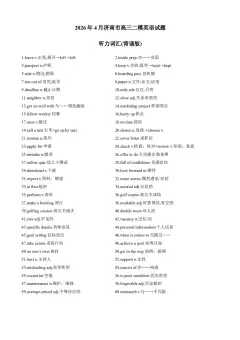
one.
M: I'm thinking about buying a new laptop for the college entrance
exam preparation.
W: Why not consider a second-hand one? It's much cheaper and
still works well.
Q: What does the woman suggest the man do?
two.
W: Hi, Tom. Did you attend the English lecture yesterday afternoon?
M: No, I had to look after my little sister at home. My parents
were on business.
Q: Why didn't Tom go to the English lecture?
three.
M: Excuse me, how long will it take to get to the City Library by
bus?
W: About 20 minutes if there's no traffic jam. But it's rush hour
now, so maybe 40 minutes.
Q: What can we learn from the conversation?
four.
W: The math homework is really difficult. I spent two hours on it
last night.
M: Me too. I even asked my elder brother for help, but he couldn't
solve some problems either.
Q: What do the speakers think of the math homework?
five.
M: Would you like to go to the cinema with me this weekend?
There's a new English movie on show.
W: I'd love to, but I have to prepare for the upcoming English test.
Maybe next weekend?
Q: What will the woman do this weekend?
six.
W: Look at the weather report. It will rain tomorrow.
M: Oh no! I planned to go hiking with my classmates. We have to
change our plan.
Q: What's the man's plan for tomorrow?
seven.
M: How much is this English dictionary?
W: It's 85 yuan. But if you buy it today, you can get a 10%
discount.
Q: How much will the dictionary cost if the man buys it today?
eight.
W: Do you know where Lily is? I need to return her the English
novel she lent me.
M: She's probably in the reading room. She usually spends her
lunch break there.
Q: Where is Lily most probably?
nine.
M: My phone ran out of power. Can I borrow your charger?
W: Sure, here you are. But it's a Type-C charger. Is that okay for
your phone?
Q: What does the woman want to know?
ten.
W: I feel so tired recently. I can't focus on my studies.
M: You should have a good rest. Maybe you can go to bed earlier
instead of staying up late.
Q: What's the man's advice?
11-13 题的听力原文
Reading English books is one of the most effective ways to improve
your English skills. It can help you expand your vocabulary, improve
your grammar, and enhance your reading comprehension. But how
to choose the right English books for yourself? First, you should
consider your English level. If you are a beginner, you can start
with simple storybooks or picture books. These books usually have
simple
sentences
and
common
words,
which
are
easy
to
understand. For intermediate learners, novels and short stories are
good choices. You can try reading classic novels adapted for English
learners, as they not only help you learn English but also let you
know about different cultures. Advanced learners can read original
English novels, newspapers, or magazines. They can expose you to
more complex sentence structures and formal vocabulary. Besides,
you should choose books that interest you. If you like history, you
can read historical novels. If you are interested in science, you can
read popular science books. Reading books you like will make you
more willing to keep reading. Remember, consistency is key. Try to
read for at least 15 to 20 minutes every day, and you will see great
progress in your English.
Now listen again.
Questions
11. What is one of the benefits of reading English books?
12. What kind of books should English beginners start with?
13. What suggestion does the speaker give for reading English
books?
14 到16 题的听力原文
Nowadays, more and more students are using online learning
platforms to study English. Online learning has many advantages.
First, it is very convenient. Students can study at any time and any
place as long as they have a computer or a mobile phone. They
don't need to go to a training center, which saves a lot of time on
transportation. Second, online learning provides a variety of learning
resources. There are many English courses, videos, audios, and
exercises on the platforms. Students can choose the resources that
suit their needs and interests. Third, online learning allows students
to learn at their own pace. If they don't understand a certain part,
they can watch the video again or listen to the audio repeatedly.
This is especially helpful for students who learn slowly. However,
online learning also has some disadvantages. Some students may
be distracted by other things when studying online, such as playing
games or watching videos. Besides, it lacks face-to-face interaction
with teachers and classmates. To make the most of online learning,
students should have good self-discipline. They should set a study
schedule and stick to it. Teachers and parents can also help
supervise students to ensure that they study effectively. In general,
online learning is a useful supplement to traditional classroom
learning, and it will become more and more popular in the future.
Now listen again.
Questions
14. What is the first advantage of online English learning mentioned
in the passage?
15. What is the benefit of online learning for slow learners?
16. What should students do to make full use of online learning?
17 到20 的听力原文
W: Hi, Mike. Have you finished your English assignment yet?
M: Not yet. The assignment is to write a short essay about online
English learning. I'm still thinking about how to start.
W: Oh, I just finished it yesterday. Maybe I can share some ideas
with you.
M: That would be great! Thank you.
W: You're welcome. First, I introduced the popularity of online
English learning among students. Then I talked about its advantages
and disadvantages.
M: That sounds like a good structure. What advantages did you
mention?
W: I said it's convenient because we can study anytime and
anywhere. And there are many learning resources available online.
M: I agree. What about the disadvantages?
W: Well, some students may be distracted easily when studying
online. And there's less face-to-face communication with teachers.
M: Those are good points. Did you give any suggestions?
W: Yes. I suggested that students should have self-discipline and
make a study plan.
M: That's useful. By the way, where did you get the information for
your essay?
W: I searched some educational websites and read a few articles. I
also asked my cousin, who has been learning English online for a
year.
M: That's a good idea. I should do some research too.
W: How much have you written so far?
M: I haven't started writing yet. I just made a rough outline.
W: Don't worry. You still have two days to finish it. If you need any
help, just let me know.
M: Thanks a lot, Lily. I will. Maybe I can show you my draft
tomorrow and ask for your advice.
W: Sure. I'll be happy to help.
Now listen again.
Questions
17. What is Mike's English assignment?
18. What advantage of online English learning did Lily mention?
19. Where did Lily get the information for her essay?
20. What will Mike probably do tomorrow?
参考答案及解析
Section A
1. C  解析:女士说“Why not consider a second-hand one?”,明确建议
男士买二手笔记本电脑,故选C。
2. B  解析:男士回答“I had to look after my little sister at home”,说
明他没去听讲座是因为要照顾妹妹,故选B。
3. C  解析:女士提到“it's rush hour now, so maybe 40 minutes”,可推
断现在有交通堵塞,故选C。
4. C  解析:女士说作业很难,男士也表示认同并提到哥哥也有不会的题,故
选C。
5. B  解析:女士说“ I have to prepare for the upcoming English
test”,说明她周末要准备英语考试,故选B。
6. A  解析:男士说“I planned to go hiking with my classmates”,可知
他原本计划去远足,故选A。
7. A  解析:字典原价85 元,打9 折,85×0.9=76.5 元,故选A。
8. B  解析:男士说“She's probably in the reading room”,故选B。
9. B  解析:女士问“Is that okay for your phone?”,即询问充电器是否适
合男士的手机,故选B。
10. C  解析:男士建议“go to bed earlier instead of staying up late”,
故选C。
Section B
11. A  解析:短文开头提到“Reading English books... help you expand
your vocabulary”,故选A。
12. B  解析:文中说“If you are a beginner, you can start with simple
storybooks or picture books”,故选B。
13. C  解析:短文结尾提到“Try to read for at least 15 to 20 minutes
every day”,故选C。
14. B  解析:短文说“Online learning has many advantages. First, it is
very convenient”,故选B。
15. A  解析:文中提到“ online learning allows students to learn at
their own pace”,故选A。
16. B  解析:短文指出“To make the most of online learning, students
should have good self-discipline”,故选B。
17. B  解析:男士说“The assignment is to write a short essay about
online English learning”,故选B。
18. B  解析:女士提到“I said it's convenient because we can study
anytime and anywhere”,故选B。
19. C  解析:女士说“I searched some educational websites and read
a few articles”,故选C。
20. C  解析:男士说“Maybe I can show you my draft tomorrow and
ask for your advice”,故选C。