绝密★考试结束前
2026 年高考第二次模拟考试
英语
(考试时间:120 分钟  试卷满分:150 分)
注意事项:
1.本试卷分第Ⅰ卷(选择题)和第Ⅱ卷(非选择题)两部分。答卷前,考生务必将自己的姓名、准
考证号填写在答题卡上。
2.回答第Ⅰ卷时,选出每小题答案后,用2B 铅笔把答题卡上对应题目的答案标号涂黑。如需改动,
用橡皮擦干净后,再选涂其他答案标号。写在本试卷上无效。
3.回答第Ⅱ卷时,将答案写在答题卡上。写在本试卷上无效。
4.考试结束后,将本试卷和答题卡一并交回。
第一部分 听力(共两节,满分 30 分)
做题时,请先将答案标在试卷上。录音内容结束后,你将有两分钟的时间将试卷上的答案转涂到答
题卡上。
第一节(共5 小题;每小题1.5 分,满分7.5 分)
听下面5 段对话。每段对话后有一个小题,从题中所给的A、B、C 三个选项中选出最佳选项。听完每段
对话后,你都有10 秒钟的时间来回答有关小题和阅读下一小题。每段对话读两遍。
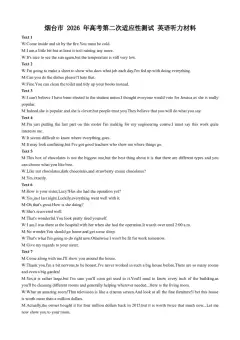
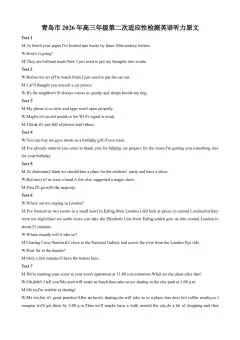
1.What does the man mean?
A.He didn’t intend to make the woman unhappy.
B.He thought the woman was being unreasonable.
C.He wanted to say something upsetting to the woman.
2.Where does the woman want the man to drive her probably?
A.To the tailor’s.
B.To the gym.
C.To her home.
3.What happened to Josh’s sister yesterday?
A.She served the wrong dish.
B.She was shouted at by a waiter.
C.She complained loudly to the waiter.
4.When will the match take place?
A.This Friday.
B.Next Friday.
C.Next Saturday.
5.What are the speakers mainly talking about?
A.A noisy night.
B.A place of residence.
C.Their sleeping habits.
第二节(共15 小题;每小题1.5 分,满分22.5 分)
听下面 5 段对话或独白。每段对话或独白后有几个小题,从题中所给的A、B、C 三个选项中选出最佳
选项,并标在试卷的相应位置。听每段对话或独白前,你将有时间阅读各个小题,每小题 5 秒钟;听完
后,各小题将给出 5 秒钟的作答时间。每段对话或独白读两遍。
听下面一段较长对话,回答以下小题。
6.What does the man tell the woman to do?
A.Look for the missing pages.  B.Correct some mistakes.C.Contact the printer’s.
7.What’s the probable relationship between the speakers?
A.Workmates.
B.Professor and student.
C.Customer and repairman.
听下面一段对话,回答以下小题。
8.What is Lewis like?
A.Patient.
B.Talented.
C.Creative.
9.What kept Sophia from going abroad?
A.A poor command of foreign languages.
B.The fear of a new environment.
C.Her bad academic performance.
听下面一段对话,回答以下小题。
10.Why does the woman take her cat to the vet's?
A.It needs a bath.
B.It had a poor appetite yesterday.
C.It has to have a routine check-up.
11.How does the woman feel about bathing her cat herself?
A.It's time-consuming.
B.It's challenging.
C.It's easy.
12.What do the speakers mainly talk about in the end?
A.The tips for bathing a cat.
B.The time to buy pet supplies.
C.The place for a medical check.
听下面一段对话,回答以下小题。
13.Why does Catherine feel anxious?
A.There are too many activities for her to cope with.
B.Most of her schoolmates are younger than she is.
C.She may not be able to adapt to the new school.
14.What does Mr. Lee encourage Catherine to do?
A.Seek advice from senior students.
B.Pick up some meaningful hobbies.
C.Establish bonds with other students.
15.What does Mr. Lee promise to do for Catherine?
A.Give her help whenever she needs it.
B.Find her accommodation on campus.
C.Introduce her to her roommates.
16.Who is Bree?
A.A returning student.
B.A transfer student.
C.A teacher.
听下面一段独白,回答以下小题。
17.What is the purpose of this activity?
A.To offer the locals leisure time.
B.To train more volunteers.
C.To promote rural travel.
18.What is provided in the activity?
A.Tools.
B.Supper.
C.Trainers.
19.What should volunteers pay attention to?
A.The special digging equipment.
B.Their tree-planting experience.
C.The transportation to the site.
20.What is necessary for people that are watching?
A.Walking boots.
B.Warm clothes.
C.New gloves.
第二部分  阅读(共两节,满分50 分)
第一节(共15 小题;每小题2.5 分,满分37.5 分)
阅读下列短文,从每题所给的A、B、C、D 四个选项中选出最佳选项。
A
Teen Creative Writing
Release your creativity as a writer, while learning the tricks of the trade. You have the freedom to write
what you want, but you also need to gain the discipline of writing. There are no grades, no exams, and no wrong
answers — just creative writing. Each class is taught by a teacher experienced in helping young writers discover
and develop their unique voices. This course is offered as a 6-week online class (with a 3-hour session per week).
It’s open to students aged from 13 to 17.
Upcoming Classes
Start on Tuesday, October 14th
Online, anytime
Price: Registration fee $25, paid once per term
The Syllabus (教学大纲)
The syllabus varies from teacher to teacher, term to term. Many topics will be similar to those covered in
the online classes.
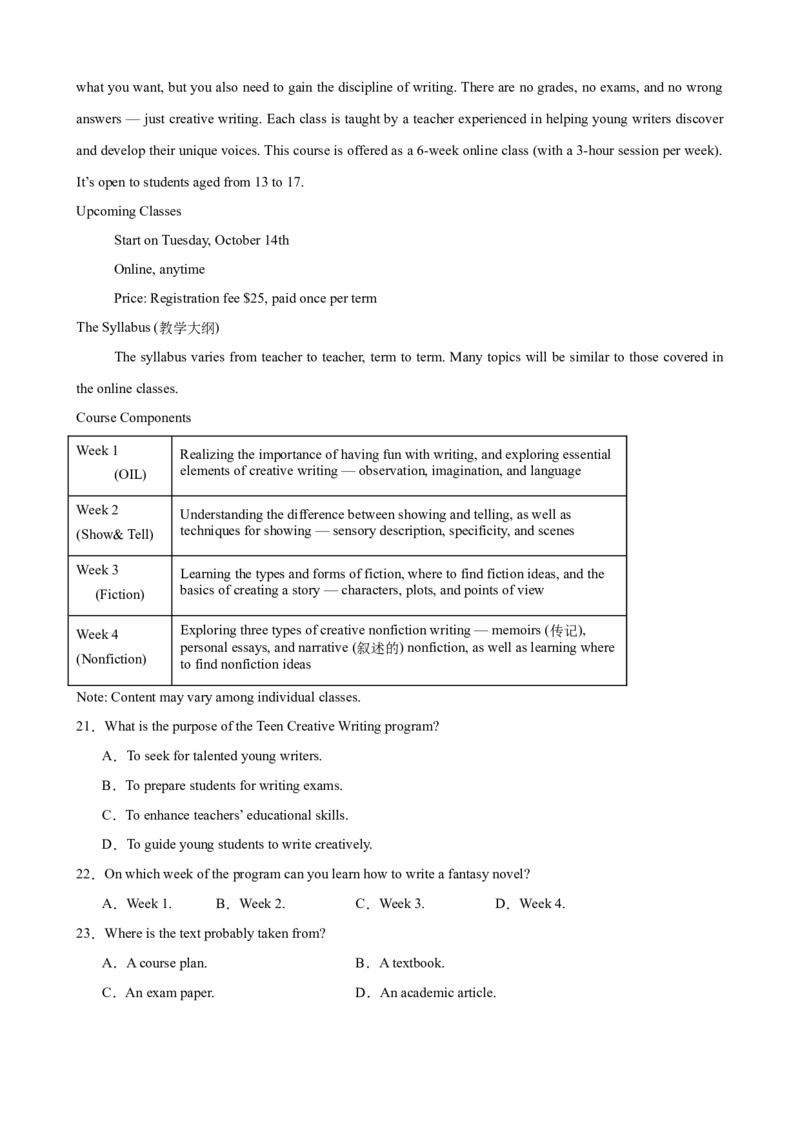
Course Components
Week 1
(OIL)
Realizing the importance of having fun with writing, and exploring essential
elements of creative writing — observation, imagination, and language
Week 2
(Show& Tell)
Understanding the difference between showing and telling, as well as
techniques for showing — sensory description, specificity, and scenes
Week 3
(Fiction)
Learning the types and forms of fiction, where to find fiction ideas, and the
basics of creating a story — characters, plots, and points of view
Week 4
(Nonfiction)
Exploring three types of creative nonfiction writing — memoirs (传记),
personal essays, and narrative (叙述的) nonfiction, as well as learning where
to find nonfiction ideas
Note: Content may vary among individual classes.
21.What is the purpose of the Teen Creative Writing program?
A.To seek for talented young writers.
B.To prepare students for writing exams.
C.To enhance teachers’ educational skills.
D.To guide young students to write creatively.
22.On which week of the program can you learn how to write a fantasy novel?
A.Week 1.
B.Week 2.
C.Week 3.
D.Week 4.
23.Where is the text probably taken from?
A.A course plan.
B.A textbook.
C.An exam paper.
D.An academic article.
B
My adventure with pottery began unexpectedly online. I saw a video of a person making a late-night snack,
but what truly caught my eye was the plate — a beautifully simple, cream-colored piece with a unique bubbled
shape. I had never seen anything like it and immediately wanted one, I imagined all the meals I could present on it
and how lovely they would look.
However, it was quite expensive. I couldn’t justify the purchase, so a bold idea struck me: Why not make it
myself? I admitted this was a little unreasonable. My only experience with clay was from a brief encounter in
elementary school. Yet, driven by the desire for that unique plate and then a wish to learn something new, I signed
up for a pottery class last April.
I entered the first class confidently, but reality soon hit. In the beginning, handling clay — which seemed so
simple — was much harder for me, a rather carefree girl, than I had anticipated. My posture was wrong; I failed to
center the clay on the wheel; I even couldn’t control its speed properly. Once, I spun the wheel too fast and made
my piece flying across the room. I felt embarrassed and thought about quitting right then.
However, I was not the one to give up easily. I continued attending class. By the third session, a shift
occurred. I concentrated on steadying my elbows, gently applying pressure to the clay, and slowly pulling up the
walls to form a bowl. The quiet rhythmic sound of the spinning wheel had a calming effect. To my surprise, by the
end of that class, I had created my first real piece — a small, imperfect, yet completely handmade bowl.
That semester taught me more than pottery; it taught me perseverance, and how to find beauty in
imperfection. I left with several bowls and a vase. The bubble-shaped plate remained my goal in my next round of
classes. This journey reminded me that true value lies not in a perfect product, but in the rewarding process of
creating something with my own hands.
24.What was the author’s initial intention of making a piece of pottery?
A.To learn a new skill.
B.To join a pottery class.
C.To have a special plate.
D.To decorate a perfect room.
25.Why did the author almost give up pottery making?
A.She found it too tiring.
B.She was rather careless.
C.She lacked the proper instruction.
D.She struggled with the basic techniques.
26.Which of the following can best describe the author?
A.Daring and modest.
B.Cautious and sensitive.
C.Determined and patient.
D.Curious and considerate.
27.What does the author learn from her pottery experience?
A.Well begun is half done.
B.The journey is the reward.
C.Perfection is the enemy of progress.
D.A bird in the hand is worth two in the bush.
C
We know a lot about why people work for their own rewards, but much less about why they sometimes put
in the same effort when the reward goes to someone else. Previous research in both animals and humans has
shown that boosting dopamine, a chemical associated with pleasure, motivation, and reward, can increase the
willingness to exert (耗费) effort to obtain rewards for ourselves. What we don’t yet fully understand is whether
the same brain chemical that fuels our personal motivation also makes us more willing to help others.
To find out, a group of researchers turned to people with Parkinson’s disease because many take dopamine-
boosting medication to manage their symptoms, so it created a natural experiment. In the experiment, participants
made a choice between two options: A “work” offer that was higher in physical effort but obtained a better reward
versus a “rest” offer that was equal in duration but involved no physical effort and obtained a worse reward. In
half of the rounds, the Parkinson’s patients decided whether to try to obtain rewards to increase their own bonus.
During the other half, they were provided with the same offers, but were informed that rewards earned would be
delivered to others instead of themselves.
When the patients were off their medication, they were less likely to choose the harder “work” option when
the reward was for someone else than when rewards were for themselves. This is known as a “self-bias” and is
common in healthy participants and the patients. However, when the patients were on their dopamine-boosting
medication, the patients were less biased and relatively more helpful towards others.
While medication is not a shortcut to boosting kindness, the study carries the potential to provide valuable
clues about the interplay between brain chemistry and our social world. The results from this study provide the
first insight into the neurochemicals behind prosocial ( 亲社会) effort and also highlight dopamine as a key to
working hard to help others.
28.Why were people with Parkinson’s disease chosen to be study subjects?
A.They were good at making decisions.
B.Their symptoms were fairly detectable.
C.Their medication was related to dopamine.
D.They could easily be attracted by rewards.
29.What did participants tend to do due to a “self-bias”?
A.Make efforts for their own benefit.
B.Seize opportunities to help strangers.
C.Reject dopamine-boosting medication.
D.Take part in various voluntary activities.
30.What is the last paragraph mainly about concerning the study?
A.Its value.
B.Its process.
C.Its limitation.
D.Its background.
31.What is a suitable title for the text?
A.Prosocial Behaviors Prove Demanding B.Medication Is a Shortcut to Boosting Kindness
C.Patients Become More Dependent on Dopamine
D.Dopamine Affects Our Willingness to Help
Others
D
AI image generators have made a giant leap forward in a remarkably short period. These highly-developed
systems are now capable of creating human faces that are not only convincing but often perceived as more
realistic than actual human ones. This phenomenon, termed “hyper-realism”, poses a significant challenge to
digital trust. However, a recent collaborative study by researchers from the UK points to a promising path:
improving our collective AI-face detection capabilities through specialized, targeted training.
The research team tested the face-assessing skills of 664 volunteers, categorized into two distinct groups:
“super-recognizers” — individuals who possess a rare, naturally superior ability for facial recognition — and
those with typical recognition skills. The experiment involved two core tasks designed to test intuition (直觉) and
logic. In the initial task, volunteers evaluated a single image to determine its origin; in the subsequent task, they
were presented with a pair of faces — one real and one artificial — and asked to identify the fake.
In the control group that received no prior instruction, the data revealed a worrying trend. Super-
recognizers correctly identified AI faces only 41 percent of the time, while typical recognizers dropped to a mere
31 percent. Given that half the images were AI-generated, both groups performed significantly worse than random
chance (50 percent). This statistical gap confirms that AI portraits can effectively trick the human brain’s natural
processing systems.
To counter this, the study introduced a brief five-minute intervention. Participants were trained to look for
“tell-tale” signs — fine biological imperfections such as unnatural teeth alignment or strange blurring where the
hair meets the skin.
Following this session, the accuracy of super-recognizers boosted to 64 percent. In contrast, while typical
recognizers improved to 51 percent, they remained at the level of a coin flip.
“As AI images are increasingly exploited for illegal purposes like identity theft scams ( 骗局), testing
detection methods is crucial from a security perspective”, explains researcher EilidhNoyes. The findings highlight
that while technology evolves, human expertise remains irreplaceable. Combining natural talent with professional
training may be our best defence in confirming digital identities and securing the future of online interaction.
32.The study mainly examines participants’ ________.
A.logical reasoning
B.reaction speed
C.technical knowledge
D.observational skills
33.What is the meaning of “counter” in paragraph 4?
A.To approve of.
B.To argue against.
C.To act in opposition to.
D.To examine in detail.
34.What is the significance of the 64 percent accuracy rate mentioned in paragraph 5?
A.It confirms the potential of combining gift with practice.
B.It represents the maximum limit of human recognition.
C.It shows the similarity between human and AI.
D.It indicates that most people can be trained to spot false images.
35.What can be inferred from the last paragraph?
A.Technical evolution will eventually eliminate identity theft
B.Professional training is more essential than natural talent.
C.Human factors remain a critical layer in digital defense.
D.The security risks of AI are currently overestimated.
第二节(共5 小题;每小题2.5 分,满分12.5 分)
阅读下面短文,从短文后的选项中选出可以填入空白处的最佳选项。选项中有两项为多余选项。
We’ve all been there after a long trip — staring blankly at emails, counting the hours until bed. Yet when 2
a. m. hits, you’re still wide awake, mindlessly looking through social media, trapped in the control of jet lag.    36
Our internal clock governs everything from sleep to digestion to hormones (激素分泌) and uses light to
maintain its natural 24-hour cycle. But when we land in a new time zone and day suddenly turns to night, this
rhythm is thrown off balance.    37    But scientists have found ways to help our bodies keep up. Even
reducing jet lag by a day can improve the productivity and well-being of so many people.
The best strategy?    38    For example, Timeshifter, an app developed by a neuroscientist and his team,
suggests a personalized schedule for light exposure and sleep based on flight arrangements.
    39    While the brain is our master clock, other tissues like the liver and muscles have their own
clocks that regulate metabolism (新陈代谢), the body’s process of turning food into energy. That is, meal timing
and composition could also be key to reducing jet lag.
In reality, there are lots of things that come into effect.    40    While we don’t yet have a way to
comprehensively avoid jet lag, researchers and airlines aren’t asleep on the job in their hunt for a cure.
A.A complete cure for jet lag is unlikely to find.
B.Jet lag can affect people’s eating habits and sleep patterns.
C.That’s the price for crossing time zones too fast.
D.There are some tools to help with this, of course.
E.Different people have different rhythms.
F.The most important step is to control when you get sunlight.
G.However, jet lag isn’t just about light exposure and sleep.
第三部分  语言运用(共两节,满分30 分)
第一节  (共15 小题;每小题1 分,满分15 分)
阅读下面短文,从每题所给的A、B、C、D 四个选项中选出可以填入空白处的最佳选项。
Last year on Mother’s Day morning, I was at the supermarket with my five-year-old son, Tenyson. As we
were about to     41    , we saw that an elderly woman had just fallen over at the entrance and     42

her head. Her husband was with her. However, there was blood everywhere. The woman was both embarrassed
and clearly in     43    .
At the entrance, a charity stand was selling flowers to     44     funds. Tenyson suggested, “Let’s buy
her a flower. It will make her feel better.” Moved by his     45    , I asked the seller if we could buy one for
the injured woman. She replied, “Just take it. I cannot take money for such a kind     46    .”
By then, paramedics (护理人员) had arrived and were     47     the injured woman. As we walked up
to her, my son became     48     with all the blood and medical equipment. He said he was actually too     49
to go up to her.
Instead, I gave the     50     to her husband and explained, “My son was worried about your wife and
wanted to give her this to help her     51     better.”
Upon hearing these words, the elderly man’s eyes     52     with tears. He said emotionally, “Thank
you so much. You have a wonderful son. Happy Mother’s Day to you.”
He then bent down,     53     his wife the flower, and told her who it was from.     54     her pain
and shock, the elderly lady looked up at Tenyson with     55     in her eyes and offered him a gentle smile.
41.A.stay
B.wait
C.return
D.leave
42.A.turned
B.lowered
C.hit
D.buried
43.A.trouble
B.shock
C.anger
D.confusion
44.A.raise
B.collect
C.save
D.count
45.A.curiosity
B.kindness
C.bravery
D.wisdom
46.A.gesture
B.gift
C.offer
D.action
47.A.contributing to B.turning to
C.attending to
D.getting to
48.A.alert
B.patient
C.innocent
D.upset
49.A.scared
B.ashamed
C.bored
D.disappointed
50.A.water
B.flower
C.food
D.card
51.A.connect
B.perform
C.focus
D.feel
52.A.shone
B.opened
C.filled
D.closed
53.A.showed
B.gave
C.presented
D.sold
54.A.Thus
B.Despite
C.Given
D.Regardless
55.A.warmth
B.hope
C.honesty
D.worth
第二节(共10 小题;每小题1. 5 分, 满分15 分)
阅读下面材料,在空白处填入适当的内容(1 个单词)或所给单词的正确形式。
Amsterdam is world-famous for its canals, but it is also known for its deep affection for cats. Recently, the
city has begun taking solid     56     (measure) to protect its cats from drowning in these waterways.
Winter has always been the season     57     survival is most challenging, as the freezing water leaves
animals with little chance to survive. To improve safety, during last winter, the government     58

(position) small wooden staircases along several canal walls. These act as emergency exits for creatures that     59
(accidental) slip into the water.
However, these first steps are not enough. More staircases     60     (schedule) to be built later this
year, but their placement must be carefully chosen. In many areas, high stone walls make it almost impossible for
animals     61     (escape) once they fall in. To address this, Amsterdam is working closely     62     an
animal protection group called Dierenambulance.     63     organization is creating detailed maps of high-risk
areas to guide the strategic placement of the new staircases.
“Cats     64     (trap) in the canals are a constant concern,” explains Maggie Ruitenberg from a cat
information centre. “Although they can swim, their, fur quickly becomes waterlogged, leaving them exhausted.
These staircases could really save     65     (life).”
第四部分 写作(共两节, 满分40 分)
第一节(满分15 分)
66.你校英文报“Teenage Life”栏目正在征集有关“Digital Minimalism”的稿件。请你写一篇短文投稿,
内容包括:
1. 同学们过度使用电子产品的现象;
2. 数字极简主义带给你的改变;
3. 向同学们发出倡议。
注意:
1. 写作词数应为80 个左右;
2. 请按如下格式在答题卡的相应位置作答。
Less Screen, More Life
___________________________________________________________________________________________
___________________________________________________________________________________________
___________________________________________________________________________________________
___________________________________________________________________________________________
___________________________________________________________________________________________
___________________________________________________________________________________________
______
第二节(满分25 分)
67.阅读下面材料,根据其内容和所给段落开头语续写两段,使之构成一篇完整的短文。
The school’s annual tech contest was announced. I read the poster carefully, feeling excited. At lunch, I
found my friends Lewis and Sarah in the cafeteria. “Look at this contest,” I said, showing them the notice. “What
if we try to build a robot together? One that can help people.” Lewis was interested right away, while Sarah asked
many thoughtful questions about how it might work. After a long discussion, we finally agreed on a goal: to build
a robot that could carry small objects, hoping it might one day assist those who need help.
We started full of hope, buying motors, wires, and wheels. However, the step — making the robot move —
stopped us completely. The motors became hot quickly, and the wheels just wouldn’t turn together. After three
long afternoons of failed tries, Lewis dropped his tools on the worktable. “This is impossible,” he said in a low
voice. “Maybe we should pick an easier project.” Sarah stayed quiet, but her worried face showed she felt the
same.
Seeing them so discouraged, I knew I had to do something. “Remember why we started,” I said, trying to
sound confident. “We wanted to build something useful. Let’s not give up yet.” I suggested we split the work:
Sarah and I would search the library and Internet for solutions, while Lewis would talk to Mr. Davis, our science
teacher, whom I had already asked for permission to consult.
Mr. Davis’s help was the turning point. He didn’t just give us answers; he taught us how to find them. In his
laboratory, he looked at our messy wiring and smiled. “The problem is here,” he said, pointing to where the motor
wires connected to the battery. “They are loose, causing a short circuit and heat.” He patiently showed us the right
way to connect and secure them. Meanwhile, Sarah and I found a clear online video about motor control. We took
detailed notes and brought everything back to the team.
注意:
(1)续写词数应为150 个左右;
(2)请按如下格式在答题卡的相应位置作答。
With Mr. Davis’s guidance and our new research, we tried again.
___________________________________________________________________________________________
___________________________________________________________________________________________
___________________________________________________________________________________________
___________________________________________________________________________________________
_____________________________
The contest day was busy and noisy.
___________________________________________________________________________________________
___________________________________________________________________________________________
___________________________________________________________________________________________
___________________________________________________________________________________________
_____________________________