绝密★考试结束前
2026 年高考第二次模拟考试
英语
(考试时间:120 分钟  试卷满分:150 分)
注意事项:
1.本试卷分第Ⅰ卷(选择题)和第Ⅱ卷(非选择题)两部分。答卷前,考生务必将自己的姓名、准
考证号填写在答题卡上。
2.回答第Ⅰ卷时,选出每小题答案后,用2B 铅笔把答题卡上对应题目的答案标号涂黑。如需改动,
用橡皮擦干净后,再选涂其他答案标号。写在本试卷上无效。
3.回答第Ⅱ卷时,将答案写在答题卡上。写在本试卷上无效。
4.考试结束后,将本试卷和答题卡一并交回。
第一部分 听力(共两节,满分 30 分)
做题时,请先将答案标在试卷上。录音内容结束后,你将有两分钟的时间将试卷上的答案转涂到答
题卡上。
第一节(共5 小题;每小题1.5 分,满分7.5 分)
听下面5 段对话。每段对话后有一个小题,从题中所给的A、B、C 三个选项中选出最佳选项。听完每段
对话后,你都有10 秒钟的时间来回答有关小题和阅读下一小题。每段对话读两遍。
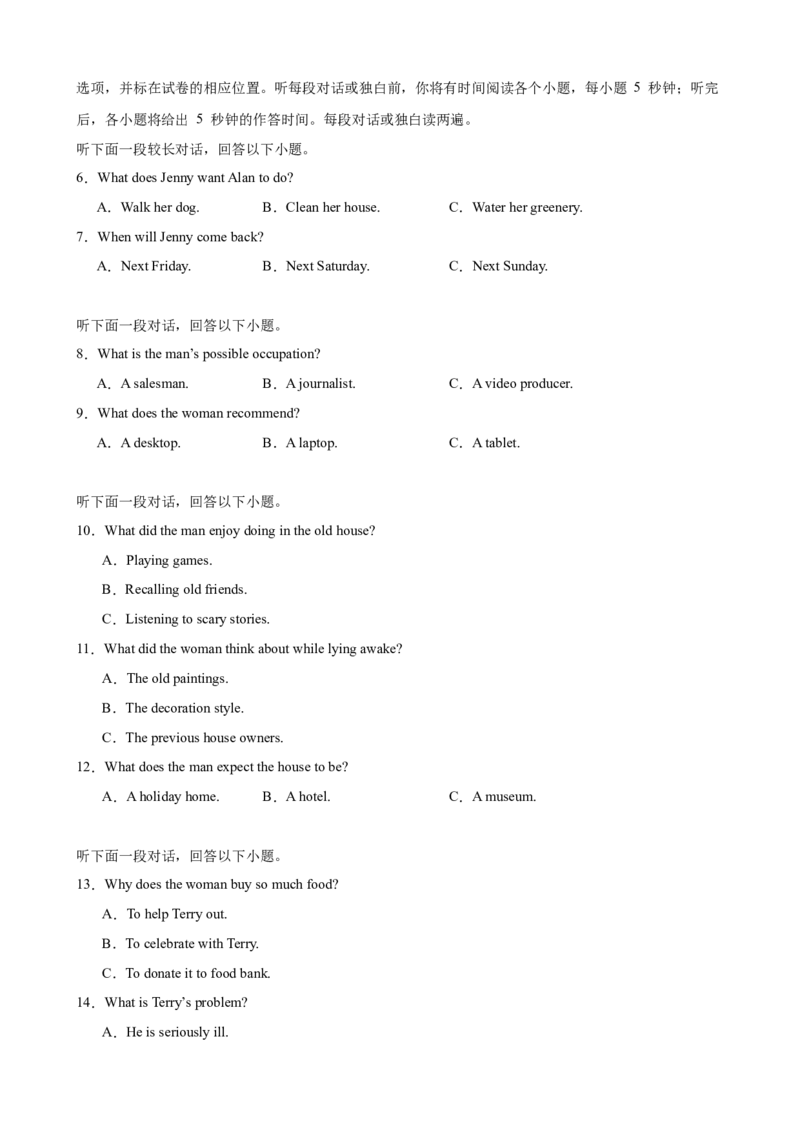
1. What will the speakers do together?
A.Go out for dinner.
B.Cook at home.
C.Attend a meeting.
2. Who will the man turn to for help?
A.Jenny.
B.Tom.
C.George.
3. What is the woman’s opinion about the course?
A.Challenging.
B.Beneficial.
C.Outdated.
4. How will the woman get to the National Arts Museum?
A.By taxi.
B.By bus.
C.By subway.
5. What does the woman mean?
A.They earned much less than expected.
B.The man shouldn’t have seen the doctor.
C.They can’t make ends meet this month.
第二节(共15 小题;每小题1.5 分,满分22.5 分)
听下面 5 段对话或独白。每段对话或独白后有几个小题,从题中所给的A、B、C 三个选项中选出最佳
选项,并标在试卷的相应位置。听每段对话或独白前,你将有时间阅读各个小题,每小题 5 秒钟;听完
后,各小题将给出 5 秒钟的作答时间。每段对话或独白读两遍。
听下面一段较长对话,回答以下小题。
6.What does Jenny want Alan to do?
A.Walk her dog.
B.Clean her house.
C.Water her greenery.
7.When will Jenny come back?
A.Next Friday.
B.Next Saturday.
C.Next Sunday.
听下面一段对话,回答以下小题。
8.What is the man’s possible occupation?
A.A salesman.
B.A journalist.
C.A video producer.
9.What does the woman recommend?
A.A desktop.
B.A laptop.
C.A tablet.
听下面一段对话,回答以下小题。
10.What did the man enjoy doing in the old house?
A.Playing games.
B.Recalling old friends.
C.Listening to scary stories.
11.What did the woman think about while lying awake?
A.The old paintings.
B.The decoration style.
C.The previous house owners.
12.What does the man expect the house to be?
A.A holiday home.
B.A hotel.
C.A museum.
听下面一段对话,回答以下小题。
13.Why does the woman buy so much food?
A.To help Terry out.
B.To celebrate with Terry.
C.To donate it to food bank.
14.What is Terry’s problem?
A.He is seriously ill.
B.He is unemployed.
C.He broke up with his wife.
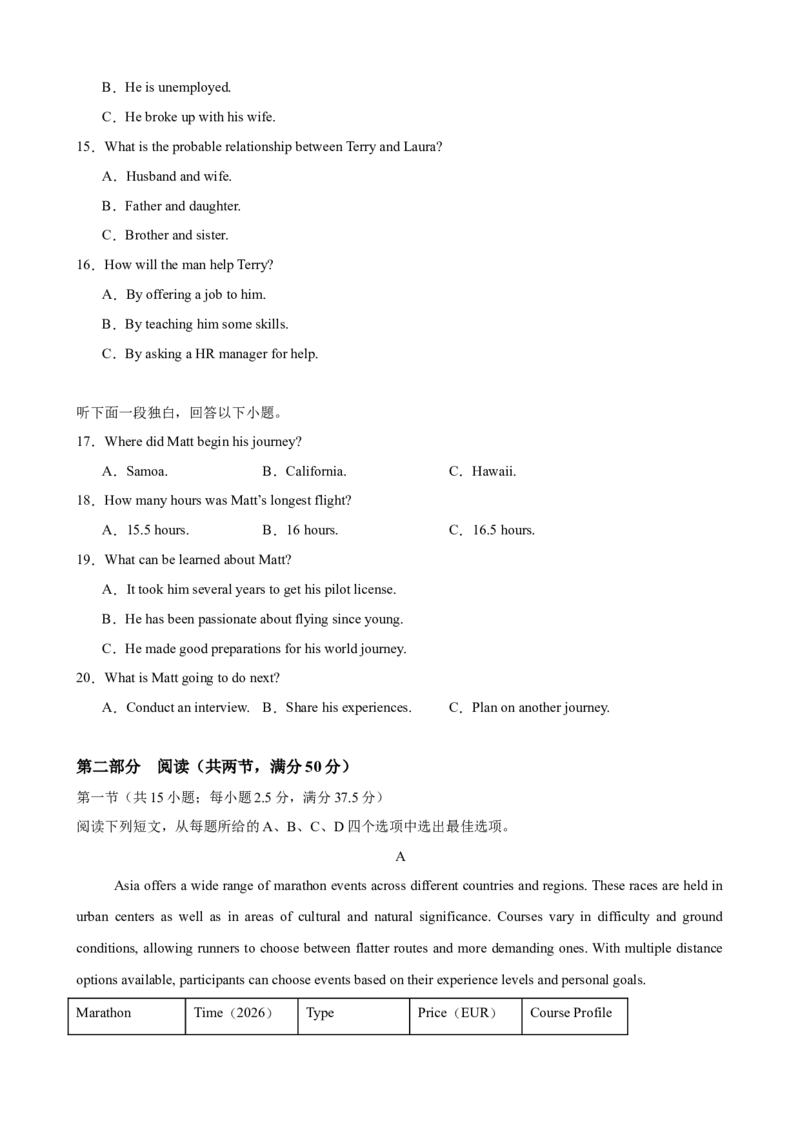
15.What is the probable relationship between Terry and Laura?
A.Husband and wife.
B.Father and daughter.
C.Brother and sister.
16.How will the man help Terry?
A.By offering a job to him.
B.By teaching him some skills.
C.By asking a HR manager for help.
听下面一段独白,回答以下小题。
17.Where did Matt begin his journey?
A.Samoa.
B.California.
C.Hawaii.
18.How many hours was Matt’s longest flight?
A.15.5 hours.
B.16 hours.
C.16.5 hours.
19.What can be learned about Matt?
A.It took him several years to get his pilot license.
B.He has been passionate about flying since young.
C.He made good preparations for his world journey.
20.What is Matt going to do next?
A.Conduct an interview.
B.Share his experiences.
C.Plan on another journey.
第二部分  阅读(共两节,满分50 分)
第一节(共15 小题;每小题2.5 分,满分37.5 分)
阅读下列短文,从每题所给的A、B、C、D 四个选项中选出最佳选项。
A
Asia offers a wide range of marathon events across different countries and regions. These races are held in
urban centers as well as in areas of cultural and natural significance. Courses vary in difficulty and ground
conditions, allowing runners to choose between flatter routes and more demanding ones. With multiple distance
options available, participants can choose events based on their experience levels and personal goals.
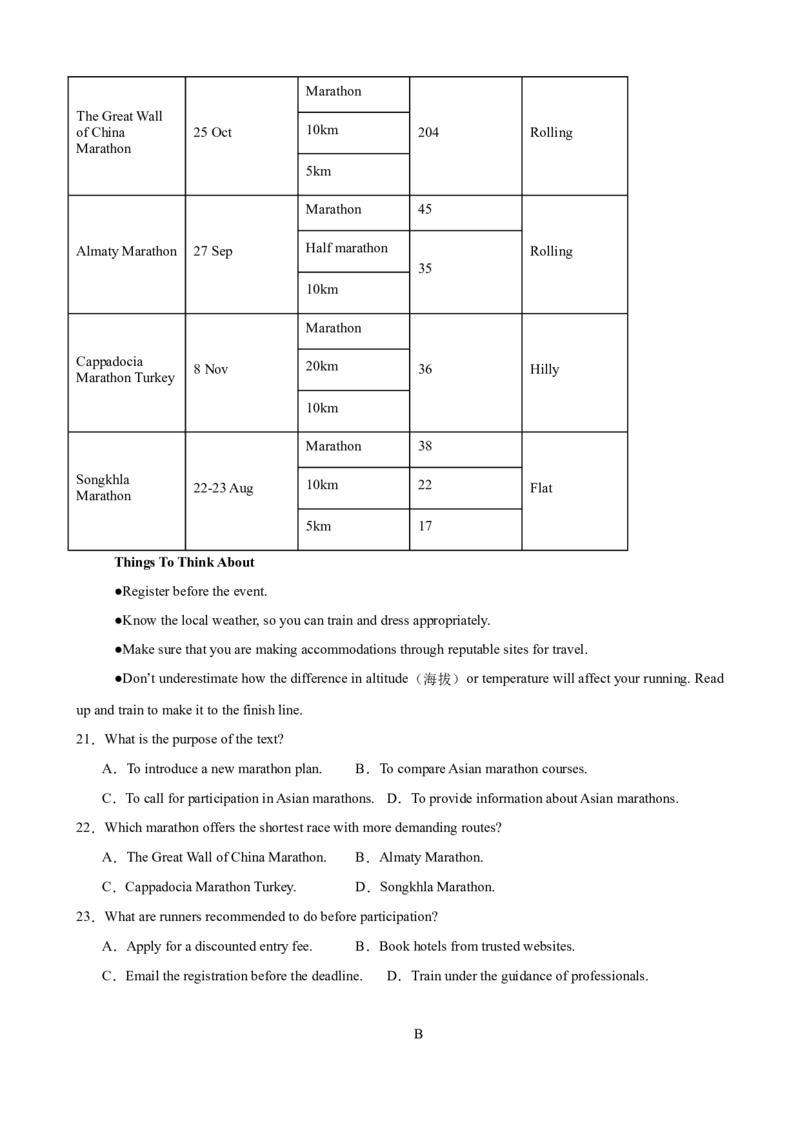
Marathon
Time(2026)
Type
Price(EUR)
Course Profile
The Great Wall
of China
Marathon
25 Oct
Marathon
204
Rolling
10km
5km
Almaty Marathon
27 Sep
Marathon
45
Rolling
Half marathon
35
10km
Cappadocia
Marathon Turkey
8 Nov
Marathon
36
Hilly
20km
10km
Songkhla
Marathon
22-23 Aug
Marathon
38
Flat
10km
22
5km
17
Things To Think About
●Register before the event.
●Know the local weather, so you can train and dress appropriately.
●Make sure that you are making accommodations through reputable sites for travel.
●Don’t underestimate how the difference in altitude(海拔)or temperature will affect your running. Read
up and train to make it to the finish line.
21.What is the purpose of the text?
A.To introduce a new marathon plan.
B.To compare Asian marathon courses.
C.To call for participation in Asian marathons.
D.To provide information about Asian marathons.
22.Which marathon offers the shortest race with more demanding routes?
A.The Great Wall of China Marathon.
B.Almaty Marathon.
C.Cappadocia Marathon Turkey.
D.Songkhla Marathon.
23.What are runners recommended to do before participation?
A.Apply for a discounted entry fee.
B.Book hotels from trusted websites.
C.Email the registration before the deadline.
D.Train under the guidance of professionals.
B
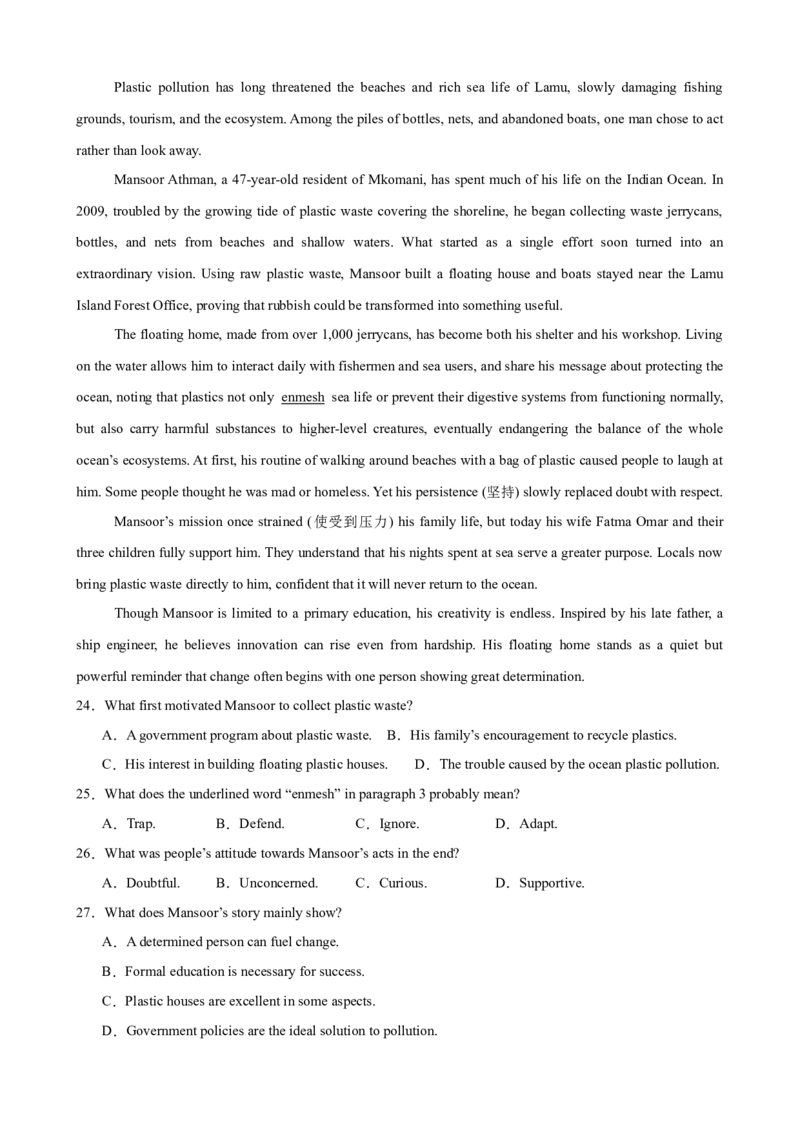
Plastic pollution has long threatened the beaches and rich sea life of Lamu, slowly damaging fishing
grounds, tourism, and the ecosystem. Among the piles of bottles, nets, and abandoned boats, one man chose to act
rather than look away.
Mansoor Athman, a 47-year-old resident of Mkomani, has spent much of his life on the Indian Ocean. In
2009, troubled by the growing tide of plastic waste covering the shoreline, he began collecting waste jerrycans,
bottles, and nets from beaches and shallow waters. What started as a single effort soon turned into an
extraordinary vision. Using raw plastic waste, Mansoor built a floating house and boats stayed near the Lamu
Island Forest Office, proving that rubbish could be transformed into something useful.
The floating home, made from over 1,000 jerrycans, has become both his shelter and his workshop. Living
on the water allows him to interact daily with fishermen and sea users, and share his message about protecting the
ocean, noting that plastics not only enmesh sea life or prevent their digestive systems from functioning normally,
but also carry harmful substances to higher-level creatures, eventually endangering the balance of the whole
ocean’s ecosystems. At first, his routine of walking around beaches with a bag of plastic caused people to laugh at
him. Some people thought he was mad or homeless. Yet his persistence (坚持) slowly replaced doubt with respect.
Mansoor’s mission once strained (使受到压力) his family life, but today his wife Fatma Omar and their
three children fully support him. They understand that his nights spent at sea serve a greater purpose. Locals now
bring plastic waste directly to him, confident that it will never return to the ocean.
Though Mansoor is limited to a primary education, his creativity is endless. Inspired by his late father, a
ship engineer, he believes innovation can rise even from hardship. His floating home stands as a quiet but
powerful reminder that change often begins with one person showing great determination.
24.What first motivated Mansoor to collect plastic waste?
A.A government program about plastic waste.
B.His family’s encouragement to recycle plastics.
C.His interest in building floating plastic houses.
D.The trouble caused by the ocean plastic pollution.
25.What does the underlined word “enmesh” in paragraph 3 probably mean?
A.Trap.
B.Defend.
C.Ignore.
D.Adapt.
26.What was people’s attitude towards Mansoor’s acts in the end?
A.Doubtful.
B.Unconcerned.
C.Curious.
D.Supportive.
27.What does Mansoor’s story mainly show?
A.A determined person can fuel change.
B.Formal education is necessary for success.
C.Plastic houses are excellent in some aspects.
D.Government policies are the ideal solution to pollution.
C
New research from Syracuse University, New York, has found that weight training can reactivate fast motor
neurons (运动神经元) that decline with age, potentially preventing falls for the elderly.
The study, published in Medicine & Science in Sports & Exercise, notes that falls are the leading cause of
injury in adults aged 65 and older. Every year, millions of elderly people fall and get head injuries or long-term
disabilities. In serious cases, these accidents can even cause death, bringing heavy pressure to both individuals and
global healthcare systems.
The reason for this is that our muscles gradually weaken with age, which in turn slows down the
neuromuscular response. This is called neuro-muscular decrement (功能衰退), and is common for adults in their
70s and 80s. It slows down their reaction time and reduces their muscle control — reasons that directly make it
more likely for them to lose balance and fall.
However, in a recently published study that specifically explored the effects of resistance training on nerve
conduction velocity (NCV), a measure of how quickly electrical signals travel along a nerve. With a group of 48
adults between the ages of 18—84, researchers recorded NCV in the forearm, both before and after four weeks of
handgrip resistance training. The results showed that every senior improved their nerve conduction after taking
part in weight training.
“When nerve conduction for fast-twitch fibers (快肌纤维) is damaged, your power and the speed activated
by these fibers will decrease,” says researcher Jason Fried. “These neurons are supposed to drive fast-twitch
muscle fibers. If you cannot reactivate these neurons, you won’t be able to regain that fast movement speed — and
this has important implications, because it can prevent a simple slip or trip from turning into a bad fall.”
28.Why are elderly people over 65 likely to fall?
A.Their fast-twitch fibers are mostly lost.
B.Their bones are weaker than young people’s.
C.They have decreased neuro-muscular function.
D.They are more likely to do intense weight training.
29.How did the recent study obtain its result?
A.By comparing data.
B.By interviewing seniors.
C.By analyzing medical records.
D.By reviewing previous studies.
30.What does the damage of fast-twitch nerve conduction result in?
A.Increased risk of heart disease.
B.Slower recovery from injuries.
C.Improved neuro-muscular response.
D.Reduced muscle power and activation speed.
31.What is the positive significance of this research?
A.To promote weight training.
B.To uncover the secret of aging.
C.To give guidance to the weightlifters.
D.To offer a way to prevent the elderly falling.
D
You might be leaving some happiness on the table by doing your everyday activities all by yourself.
Happiness, it seems, is not just a state of mind — it’s a shared enterprise. A new study has found that almost any
activity, from the ordinary to the profound, becomes more enjoyable when done with others. Whether pumping
gas, or cooking dinner, the company of another person appears to make life’s routines a little brighter.
The study, published in Social Psychological and Personality Science, drew on data from more than
40,000 Americans who collectively reported over 100,000 daily activities. “Participants consistently rate every
common daily activity as more enjoyable when they’re interacting with somebody else,” said Elizabeth Dunn, the
study’s senior author. Even seasoned experts on social behavior were taken aback by the consistency of the
findings. “I was surprised by the extent and extremity of the effects,” admitted Nicholas Epley, a behavioral
scientist who was not involved in the research.
Unsurprisingly, the biggest boosts were linked to activities already social by nature — eating, drinking,
walking, running, and playing games. Yet even solitary (独自的) pursuits such as reading, or crafting also saw a
happiness bump when shared. While in-person interactions provided the strongest benefits, even phone calls
produced measurable mood improvements. Dunn notes that if it can’t be in-person, having some element of voice
seems to be important.
The study did not include personality data, leaving unanswered how individual characteristics might
influence outcomes. Previous studies, however, suggest that social connection reliably enhances wellbeing across
personality types. Researchers identify “undersociality” — the tendency to underestimate how warmly others will
respond to social initiatives — as a primary barrier to seeking connection.
The practical implications are clear; we should intentionally create more opportunities for social
engagement. Simple strategies such as working alongside friends at coffee shops or conversing by phone while
completing chores can transform ordinary activities into sources of joy. Ultimately, the research convincingly
demonstrates that happiness arises not merely from what we do, but fundamentally from who we do it with.
32.How was the research mainly conducted?
A.By analyzing massive activity reports.
B.By conducting laboratory experiments.
C.By comparing different personality types.
D.By interviewing experts in social behavior.
33.What did the study find about social interactions?
A.They require face-to-face communication.
B.Their effects vary greatly among individuals.
C.They enhance enjoyment of various activities.D.They bring greater joy in independent activities.
34.Why does the author mention previous studies in paragraph 4?
A.To stress the limitation of the new study.B.To introduce a different research method.
C.To provide supporting evidence for a claim.
D.To question the findings of the new study.
35.What can be a suitable title for the text?
A.Alone or Together: A Social Dilemma.
B.Social Activities: Relationship Builder.
C.Personality Differences: A Factor in Social Joy.
D.Shared Moments: The Social Key to Happiness.
第二节(共5 小题;每小题2.5 分,满分12.5 分)
阅读下面短文,从短文后的选项中选出可以填入空白处的最佳选项。选项中有两项为多余选项。
As a student of Chinese language and culture, I was introduced to many fascinating aspects of the country’s
culinary (烹饪的) heritage. One dish that particularly stood out in my studies was Crossing Brıdge Rice Noodles,
a specialty from Yunnan Province. In 2024, when I traveled to Yunnan, I finally experienced this famous dish
firsthand.    36
Walking into a traditional Yunnan restaurant and settling down, I felt anticipation that only a long-awaited
experience can bring.    37    Each ingredient was presented separately, allowing me to assemble my bowl
according to my preference. The waiter placed a large bowl of hot broth (肉汤) in front of me, followed by thinly
sliced meats, fresh vegetables, quail eggs, tofu skin, and herbs. Then, the most exciting part came: white, smooth,
and silky rice noodles.
Following the traditional method, I first added the raw meat slices into the hot broth, watching them cook
instantly. Then, I added the vegetables, tofu and eggs, letting them blend into the broth.    38    As I lifted the
noodles with my chopsticks, their delicate texture was evident — soft, yet firm enough to hold their shape.
   39    The broth, made from slow-simmered chicken and pork bones, was rich and deeply comforting.
The rice noodles were incredibly smooth, almost jellylike, yet with a satisfying chewiness. The combination of
fresh ingredients created a balance of textures — tender meat, crisp vegetables, and silky noodles, all coming
together harmoniously.
Trying the dish in Yunnan was an experience that connected me to China’s rich culinary heritage and
reaffirmed (再次确定) the deep bond between food and culture. This dish, with its rich broth, silky noodles, and
heartwarming service, is a representation of the beauty of Chinese cuisine.        40
A.The first bite was an explosion of flavors.
B.The dish was served in a traditional manner.
C.The experience was nothing short of extraordinary.
D.While studying in Beijing, I often heard about the dish.
E.Finally, I carefully placed the rice noodles into the bowl.
F.What amazed me the most was how familiar the flavors felt.
G.And now, it holds a special place in my personal journey as well.
第三部分  语言运用(共两节,满分30 分)
第一节  (共15 小题;每小题1 分,满分15 分)
阅读下面短文,从每题所给的A、B、C、D 四个选项中选出可以填入空白处的最佳选项。
When I was young, the freckles (雀斑) on my cheeks always bothered me. Those brown spots would be a
constant source of     41     to me.
It was in middle school that I first     42     my freckles. Every time someone stared at my face, I’d
quickly look away,     43     they were focusing on my freckles. And I also realized how directly these
freckles     44     my self-esteem (自尊).
On the     45    , I probably looked perfectly okay. I took part in every volunteer event with     46
. Deep down, though, I couldn’t help thinking about those spots.
Through the years, I     47     to cover my freckles in any possible way. But I didn’t solve them
successfully. I was trapped in a cycle of hope and disappointment that felt hard to     48    . Then, a few years
ago, something     49    .
At a school reunion, an old classmate said to me, “I still remember how you helped me finish the science
experiment. Your generosity was really amazing!” I was     50     — she didn’t mention my freckles at all. All
she remembered was my     51    . In that moment, I felt sorry for all the occasions when I     52     my
energy in worrying about my freckles. Those little spots made it     53     for me to enjoy my youth fully.
Now, at 35, I understand a     54     I wish I’d known earlier: No one has ever judged me harder than
myself. The thing that truly     55     us is not the marks on our skin, but the warmth we bring to others.
41.A.argument
B.annoyance
C.amusement
D.misunderstanding
42.A.searched for
B.showed off
C.cared about
D.cheered for
43.A.pretending
B.admitting
C.remembering
D.believing
44.A.proved
B.affected
C.hid
D.protected
45.A.surface
B.spot
C.contrary
D.whole
46.A.anxiety
B.difficulty
C.permission
D.enthusiasm
47.A.happened
B.promised
C.sought
D.hesitated
48.A.assess
B.recover
C.choose
D.break
49.A.shifted
B.returned
C.remained
D.lasted
50.A.determined
B.astonished
C.embarrassed
D.discouraged
51.A.kindness
B.honesty
C.bravery
D.forgiveness
52.A.valued
B.collected
C.saved
D.wasted
53.A.convenient
B.necessary
C.impossible
D.unacceptable
54.A.truth
B.method
C.standard
D.qualification
55.A.limits
B.defines
C.impresses
D.disturbs
第二节(共10 小题;每小题1. 5 分, 满分15 分)
阅读下面材料,在空白处填入适当的内容(1 个单词)或所给单词的正确形式。
The grand conclusion of the 16th Budapest International Circus Festival,     56     featured a high-
profile closing ceremony and award presentation, was held on Jan 12.
Two original acrobatic (杂技) works, Time — Hoop Diving by China National Acrobatic Troupe and
Mom’s Pride — Contortion with Glasses by Beijing Acrobatic School,     57     (claim) the Grand Prix, the
festival’s highest honor, earning critical praise for their creative integration of tradition with modern artistic styles.
Since its founding in 1996, the festival has become one of the world’s most     58     (influence) circus
competitions, held every two years. The Grand Prix is presented only     59     the festival judging panel
identifies a performance that goes beyond excellence. This year, 200 artists from over 20 countries and regions
competed fiercely     60     top honors with extraordinary acrobatic skills.
Both     61     (win) performances represent the depth of contemporary Chinese acrobatics, using
distinct physical expressions to tell fascinating stories.
In a strategic move that further solidifies the partnership between China and Hungary, a cooperation
agreement,     62     (sign) by four institutions at the closing ceremony of the festival,     63     (notable)
marks the establishment of the Chinese Acrobatic Troupe European Performance Base in Budapest.
This strategic partnership is not only     64     union of artistic institutions, but a powerful step forward
in fostering cultural exchanges. It aims to promote circus arts across Europe, enhancing the ecological
development of the industry     65     enriching cultural understanding between East and West.
第四部分 写作(共两节, 满分40 分)
第一节(满分15 分)
66.假定你是李华,你校将举办近视预防讲座。请你给英国交换生Jenny 写一封电子邮件,邀请她参加,
内容包括:
(1)讲座时间、地点;
(2)主讲人介绍。
注意:
(1)写作词数应为80 个左右;
(2)请按如下格式在相应位置作答。
参考词汇:近视防控myopia prevention and control
Dear Jenny,
___________________________________________________________________________________________
___________________________________________________________________________________________
___________________________________________________________________________________________
___________________________________________________________________________________________
_______________________________________________________________________________________
Yours truly,
Li Hua
第二节(满分25 分)
67.阅读下面材料,根据其内容和所给段落开头语续写两段,使之构成一篇完整的短文。
The orphanage (孤儿院) stood at the edge of town where the pavement ended and the dust started, with tall
walls painted the color of old gray and windows that were rarely opened, and inside it, the air was filled with the
quiet calm of daily routine, including the sound of footsteps in the hallways, the rustle of pages being turned, and
the faint echo of an unfinished piano lesson.
When I arrived that summer as a volunteer, I was told to “brighten things up”. No one explained what that
meant. On my first day, I wandered from room to room, wiping tables, straightening books, and feeling strangely
unnecessary. The children moved quietly past me, polite but distant, their eyes lowered as if waiting for
permission to breathe. I wondered whether anything I did would matter here.
Then I found the wall behind the dining hall — a long stretch of concrete, sun-faded and scarred with years
of rain. It faced the morning light but gave nothing back. Something in its emptiness mirrored the quiet inside the
orphanage.
One afternoon, while sweeping nearby, I noticed a boy standing close to it, tracing invisible shapes on the
surface. His name was Kai, a silent child with brown-colored hair. He didn’t look at me; he only studied the blank
wall as if he could see something I couldn’t. That moment stayed with me through the night.
The next morning, unsure what else to do, I brought my paints. The first yellow stroke ( 笔画) looked
shockingly bright against the gray. Then came another, and another. As I worked, I sensed movement behind me.
Kai approached, dipped his palm into green paint, and pressed it beneath the branch I had drawn. His quiet
certainty told me I wasn’t working alone anymore.
The following days changed everything. Children who rarely spoke began adding their own marks — tiny
hands shaping forests, rivers, suns, and soaring birds. Laughter returned in small bursts, shy at first, then growing
louder. Although the wall wasn’t entirely covered, it was full of color and alive.
注意:1.续写词数应为150 个左右;
2.请按如下格式在答题卡的相应位置作答。
Unluckily, a terrible storm attacked the city.
___________________________________________________________________________________________
___________________________________________________________________________________________
___________________________________________________________________________________________
___________________________________________________________________________________________
______________________________________________________________
After the storm, I surprisedly found many children gathering before the wall.
___________________________________________________________________________________________
___________________________________________________________________________________________
___________________________________________________________________________________________
___________________________________________________________________________________________
____