2026 年高考第二次模拟考试(上海卷)
高三英语·
注意事项:
1.答卷前,考生务必将自己的姓名、准考证号等填写在答题卡和试卷指定位置上。
2.回答选择题时,选出每小题答案后,用铅笔把答题卡上对应题目的答案标号涂黑。如需改动,用
橡皮擦干净后,再选涂其他答案标号。回答非选择题时,将答案写在答题卡上。写在本试卷上无效。
3.考试结束后,将本试卷和答题卡一并交回
I. Grammar and Vocabulary   (每题1 分;共20 分)
Section A
Directions: After reading the passage below, fill in the blanks to make the passage coherent and grammatically
correct. For the blanks with a given word, fill in each blank with the proper form of the given word; for the other
blanks, use one word that best fits each blank.
【原创】题源:The Guardian《AI Adaptive Learning: Transforming Classroom Education》
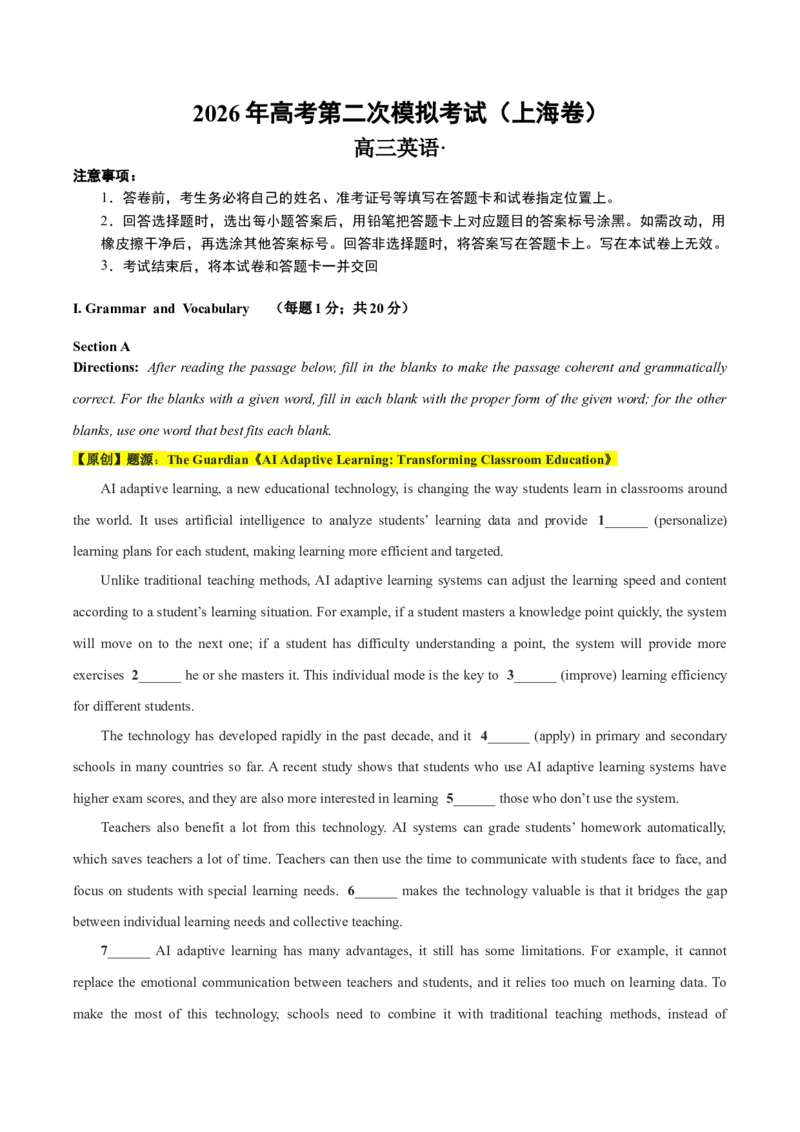
AI adaptive learning, a new educational technology, is changing the way students learn in classrooms around
the world. It uses artificial intelligence to analyze students’ learning data and provide 1______ (personalize)
learning plans for each student, making learning more efficient and targeted.
Unlike traditional teaching methods, AI adaptive learning systems can adjust the learning speed and content
according to a student’s learning situation. For example, if a student masters a knowledge point quickly, the system
will move on to the next one; if a student has difficulty understanding a point, the system will provide more
exercises 2______ he or she masters it. This individual mode is the key to 3______ (improve) learning efficiency
for different students.
The technology has developed rapidly in the past decade, and it 4______ (apply) in primary and secondary
schools in many countries so far. A recent study shows that students who use AI adaptive learning systems have
higher exam scores, and they are also more interested in learning 5______ those who don’t use the system.
Teachers also benefit a lot from this technology. AI systems can grade students’ homework automatically,
which saves teachers a lot of time. Teachers can then use the time to communicate with students face to face, and
focus on students with special learning needs. 6______ makes the technology valuable is that it bridges the gap
between individual learning needs and collective teaching.
7______ AI adaptive learning has many advantages, it still has some limitations. For example, it cannot
replace the emotional communication between teachers and students, and it relies too much on learning data. To
make the most of this technology, schools need to combine it with traditional teaching methods, instead of
replacing one with the other.
Experts say that AI adaptive learning is not a replacement for teachers, but a powerful tool to help them. As AI
technology continues to improve, AI adaptive learning systems will become more advanced in the future. They will
not only help students learn better, but also help teachers teach better. This educational technology shows that when
science and technology are used for good purposes, 8______ can bring great benefits to humans.
AI adaptive learning is still in its early stage, but it has a bright future. We believe that 9______ we use it
properly, it will transform classroom education and make learning a happier experience for all students. It is a
typical example of how science and technology can change education, and it also gives us a new way 10______
(look) at the future of teaching and learning.
Section B
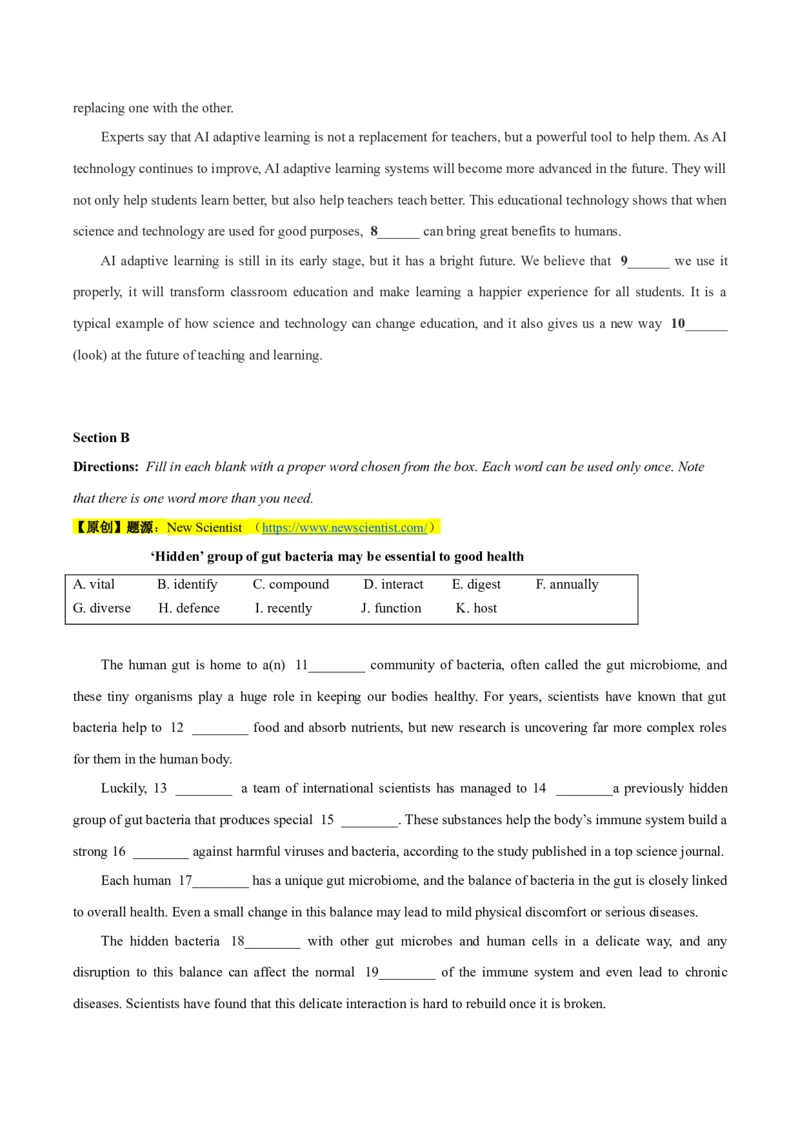
Directions: Fill in each blank with a proper word chosen from the box. Each word can be used only once. Note
that there is one word more than you need.
【原创】题源:New Scientist (https://www.newscientist.com/)
 ‘Hidden’ group of gut bacteria may be essential to good health
A. vital      B. identify     C. compound     D. interact    E. digest     F. annually
G. diverse    H. defence     I. recently       J. function     K. host
The human gut is home to a(n) 11________ community of bacteria, often called the gut microbiome, and
these tiny organisms play a huge role in keeping our bodies healthy. For years, scientists have known that gut
bacteria help to 12 ________ food and absorb nutrients, but new research is uncovering far more complex roles
for them in the human body.
Luckily, 13 ________ a team of international scientists has managed to 14 ________a previously hidden
group of gut bacteria that produces special 15 ________. These substances help the body’s immune system build a
strong 16 ________ against harmful viruses and bacteria, according to the study published in a top science journal.
Each human 17________ has a unique gut microbiome, and the balance of bacteria in the gut is closely linked
to overall health. Even a small change in this balance may lead to mild physical discomfort or serious diseases.
The hidden bacteria 18________ with other gut microbes and human cells in a delicate way, and any
disruption to this balance can affect the normal 19________ of the immune system and even lead to chronic
diseases. Scientists have found that this delicate interaction is hard to rebuild once it is broken.
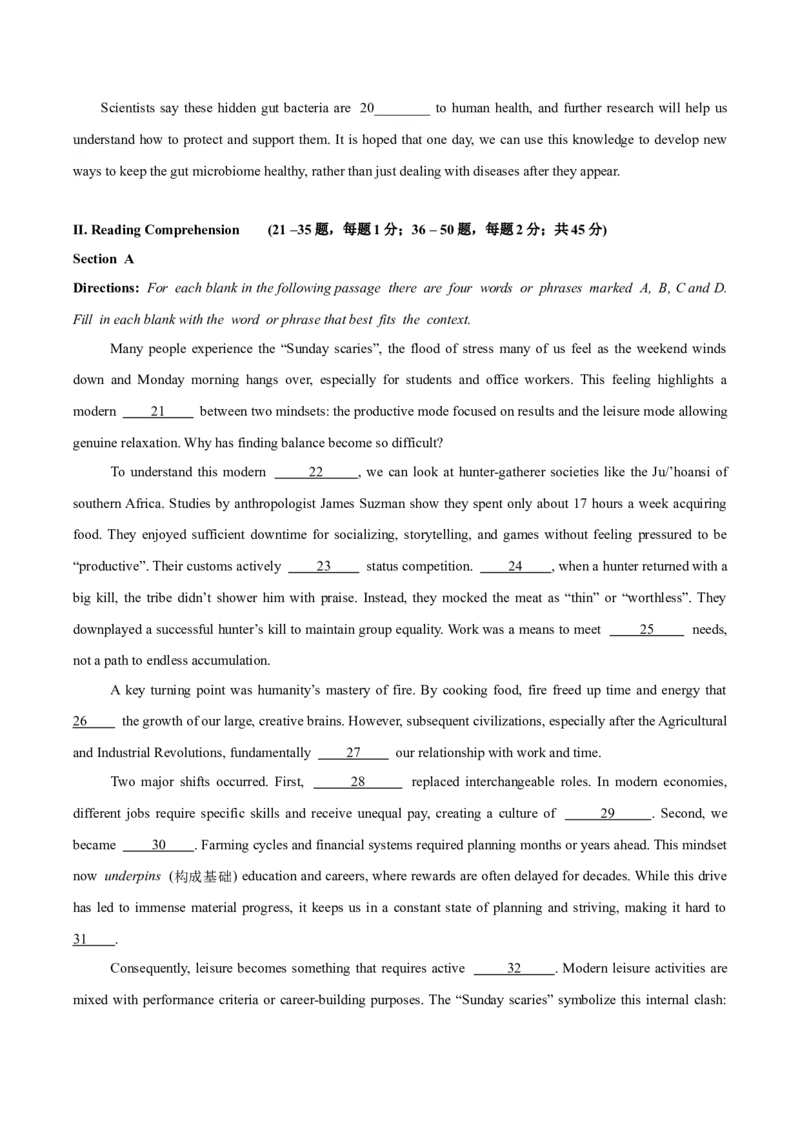
Scientists say these hidden gut bacteria are 20________ to human health, and further research will help us
understand how to protect and support them. It is hoped that one day, we can use this knowledge to develop new
ways to keep the gut microbiome healthy, rather than just dealing with diseases after they appear.
II. Reading Comprehension    (21 –35 题,每题1 分;36 – 50 题,每题2 分;共45 分)
Section A
Directions: For each blank in the following passage there are four words or phrases marked A, B, C and D.
Fill in each blank with the word or phrase that best fits the context.
Many people experience the “Sunday scaries”, the flood of stress many of us feel as the weekend winds
down and Monday morning hangs over, especially for students and office workers. This feeling highlights a
modern     21     between two mindsets: the productive mode focused on results and the leisure mode allowing
genuine relaxation. Why has finding balance become so difficult?
To understand this modern     22    , we can look at hunter-gatherer societies like the Ju/’hoansi of
southern Africa. Studies by anthropologist James Suzman show they spent only about 17 hours a week acquiring
food. They enjoyed sufficient downtime for socializing, storytelling, and games without feeling pressured to be
“productive”. Their customs actively     23     status competition.     24    , when a hunter returned with a
big kill, the tribe didn’t shower him with praise. Instead, they mocked the meat as “thin” or “worthless”. They
downplayed a successful hunter’s kill to maintain group equality. Work was a means to meet     25     needs,
not a path to endless accumulation.
A key turning point was humanity’s mastery of fire. By cooking food, fire freed up time and energy that
26     the growth of our large, creative brains. However, subsequent civilizations, especially after the Agricultural
and Industrial Revolutions, fundamentally     27     our relationship with work and time.
Two major shifts occurred. First,     28     replaced interchangeable roles. In modern economies,
different jobs require specific skills and receive unequal pay, creating a culture of     29    . Second, we
became     30    . Farming cycles and financial systems required planning months or years ahead. This mindset
now underpins (构成基础) education and careers, where rewards are often delayed for decades. While this drive
has led to immense material progress, it keeps us in a constant state of planning and striving, making it hard to
31    .
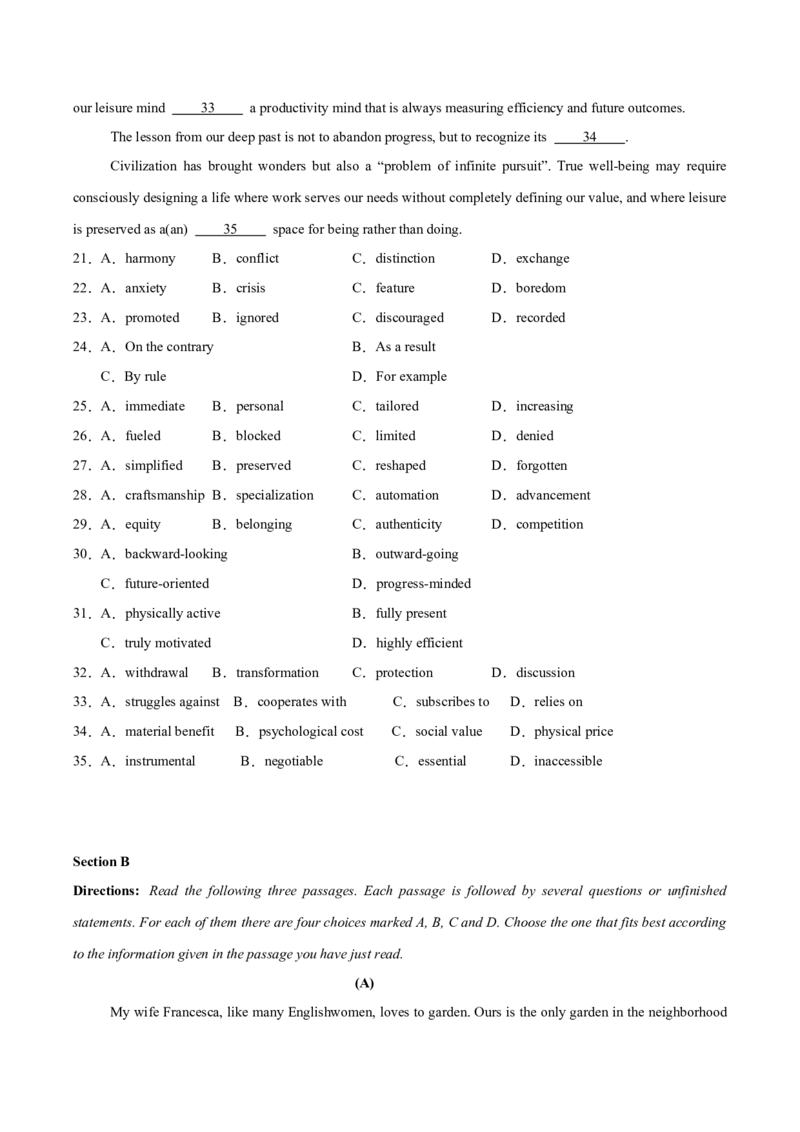
Consequently, leisure becomes something that requires active     32    . Modern leisure activities are
mixed with performance criteria or career-building purposes. The “Sunday scaries” symbolize this internal clash:
our leisure mind     33     a productivity mind that is always measuring efficiency and future outcomes.
The lesson from our deep past is not to abandon progress, but to recognize its     34    .
Civilization has brought wonders but also a “problem of infinite pursuit”. True well-being may require
consciously designing a life where work serves our needs without completely defining our value, and where leisure
is preserved as a(an)     35     space for being rather than doing.
21.A.harmony
B.conflict
C.distinction
D.exchange
22.A.anxiety
B.crisis
C.feature
D.boredom
23.A.promoted
B.ignored
C.discouraged
D.recorded
24.A.On the contrary
B.As a result
C.By rule
D.For example
25.A.immediate
B.personal
C.tailored
D.increasing
26.A.fueled
B.blocked
C.limited
D.denied
27.A.simplified
B.preserved
C.reshaped
D.forgotten
28.A.craftsmanship B.specialization
C.automation
D.advancement
29.A.equity
B.belonging
C.authenticity
D.competition
30.A.backward-looking
B.outward-going
C.future-oriented
D.progress-minded
31.A.physically active
B.fully present
C.truly motivated
D.highly efficient
32.A.withdrawal
B.transformation
C.protection
D.discussion
33.A.struggles against  B.cooperates with
C.subscribes to  D.relies on
34.A.material benefit   B.psychological cost    C.social value
  D.physical price
35.A.instrumental
B.negotiable
C.essential      D.inaccessible
Section B
Directions: Read the following three passages. Each passage is followed by several questions or unfinished
statements. For each of them there are four choices marked A, B, C and D. Choose the one that fits best according
to the information given in the passage you have just read.
(A)
My wife Francesca, like many Englishwomen, loves to garden. Ours is the only garden in the neighborhood
that is handcrafted, unique and natural — not a fake one assembled by hired hands. People often stop to admire it. I
myself admire it. Though mostly while sitting on the patio (露台) reading about the NFL’s (美国橄榄球联盟) new
kickoff rules.
Yet even though I’ve been around Francesca for 50 years, and have been enjoying the splendors of that
garden since 1993, I still can’t tell flowers apart. I’m OK around obvious delights like tulips and roses, but ask me
to distinguish a daisy from a black-eyed Susan and I’m lost at sea. So after almost a half-century of taking my
wife’s gardening efforts for granted, I decided to stop being insensitive and figure out how to tell a daylily apart
from a zinnia.
I didn’t want to make a big deal out of this, so I didn’t ask Francesca to give me a crash course. But I did
start making discreet inquiries and secretly leafing through her seed catalogs. When we were driving through
Kansas on our way to Colorado, I would ask pointed questions like: “Is that yellow stuff forsythia or a weed?” And:
“Are those plants corn?”
I was not an overnight success. No matter how hard I applied myself, I just didn’t have any natural aptitude
(天赋) in this area. But eventually I did make a breakthrough. I can now identify hollyhocks and rhododendrons. I
pretty much know my way around Japanese maples and weeping willows. And I can tell peonies apart from similar
flowers because of their somewhat acrid smell.
But I made a shattering discovery. I realized that I could only identify flowers in my wife’s garden because
I’d memorized where everything was. When I went somewhere else, it was back to square one. Colorado is covered
with Russian sage. I still confuse it with lavender.
In my defense, Francesca still doesn’t fully understand the safety blitz ( 突袭) or the infield-fly rule, even
though she has been watching football and baseball with me for half a century. But those things are hard to
understand. Wisteria is not.
It has come to my attention that apps exist that instantaneously identify flowers. But that’s cheating, like
apps that tell you how to pronounce “grenouille” or that the song you’re hearing is “Highway to Hell.” And if I
couldn’t get phone reception in the woods and Francesca suddenly asked: “Is that a locust or a walnut tree?” I’d be
exposed as a fraud (骗子).
Still, I’m determined to one day become very familiar with the world of flora. I’m going to start by
memorizing one plant a week. That way in about 10 years I’ll have the plants knocked.
Will I ever be able to tell forget-me-nots apart from Siberian bugloss? I doubt it. Will I ever be able to say:
“That’s a periwinkle and that’s a crocus!” or to instantaneously distinguish between delphiniums and zinnia? Could
be a tough one. Maybe if I live to be 100. But at least I’ll die trying.
36.What does the word “discreet” in paragraph 3 most likely mean?
A.Confident and open.
B.Careful and secretive.
C.Quick and careless.
D.Bold and enthusiastic.
37.What does the author’s breakthrough in identifying flowers reveal about his learning process?
A.He learned to identify flowers by studying their unique features.
B.He developed his skills by consistently practicing in various gardens.
C.He memorized the locations of plants rather than truly recognizing them.
D.He relied on context clues like smell and arrangement to distinguish flowers.
38.What does the author’s comparison of gardening to understanding football and baseball suggest?
A.Gardening is more enjoyable than sports.
B.Both gardening and sports are equally hard to master.
C.Francesca struggles with sports just as he struggles with plants.
D.Francesca should teach him gardening in return for his sports lessons.
39.What is the author’s primary purpose in writing the article?
A.To praise his wife’s dedication to gardening.
B.To encourage readers to learn more about gardening.
C.To criticize the use of technology in identifying plants.
D.To share his humorous struggle with plant identification.
(B)
COOL INVENTIONSBETTER ‘LEATHER’
These shoes are ‘grown’ by bacteria!
Leather is a material that’s made from
the skin of animals. It’s used to create lots of
products, from shoes to handbags to furniture.
But the chemicals typically used to preserve
the animal skins are bad for the environment.
The chemicals pollute the water and air
nearby, and they can make the leather workers
sick. Plus, livestock farmers cut down trees in
forests so the cows used for leather and meat
have room to graze.
But in the future, you might slip on a more
sustainable pair of shoes. National Geographic Explorer
Theanoe Schiros is experimenting with bacteria and
living things — to “grow” shoes with a similar texture to
real leather! The shoes are zero waste, chemical free,
fully decomposable and still super strong. Discover how
these cool kicks come to life.
3
The
n the microbes spin
the sugar into threads
of cellulose (纤维素)
to create protective
shells

around
themselves to keep
from drying out.
(Cellulose is the same
stuff that trees are
made of!)
2
The team places the microbes
in a vessel like this beaker,
along with food waste like
fruit pulp. The microbes eat
the sugar in the food.
1
Schiros and her team start
with bacteria cells that are
too small to see without a
microscope. Seventy of
these rod-shaped (杆状的)
microbes would fit across
the width of a human hair!
4
A lot of microbes
+ a lot of sugar
=a mass of cellulose!
5
Next the team cleans the mass
and treats it with a sunflower
seed-based recipe to make the
material soft and strong —
similar to traditional leather.
Then it’s dried flat.
6
Want it to be colored? A
natural dye made of indigo
will work. For black, use
the bark  from the acacia
tree followed by a dip in
iron-filled water (The iron
comes from old carpentry
nails!)
Around a hundred billion pieces of clothing
are made each year. Of that clothing, about 90
percent eventually gets thrown away.
HOW CAN YOU HELP?
Don’t toss out damaged shoes! Instead, take
them to a shoe mender to be fixed. You’ve
outgrown them? Host a clothing exchange
with friends.
7Each piece of cellulose
can be specially grown into
the shape of the part of the
shoe it will become. The
pieces are then sewn
together. These shoes grew
in just 30 days, and
they’ll last for years!
40.The bacteria-grown shoes have been developed to ________.
① produce shoes of better quality               ② improve visual design
③ protect the health of leather workers         ④ reduce environmental pollution
A.①③
B.②④
C.③④
D.①④
41.Which of the following statements is true about the procedure of growing leather?
A.The raw materials include microbes about the width of a human hair.
B.The microbes can be transformed into a mass of cellulose after consuming sugar.
C.With a special treatment, the material can possess a texture similar to genuine leather.
D.The material can be dyed black after a dip in natural dye made from indigo.
42.Who is this article most likely intended for?
A.Chemistry majors.
B.Materials science experts.
C.Shoe manufacturers.
D.General science readers.
(C)
Adolescents around the world have experienced a decline in their mental health over the past decade. Recent
UK data suggests that one in six 7-16- year- olds and one in four 17-19- year- olds have a probable mental health
condition, a clear rise from the one in nine and one in ten recorded in 2017, respectively. As 48% of those with a
mental health condition first experience relevant symptoms before the age of 18, this increased mental health
burden will negatively impact society and the economy, as well as adolescent and adult life. Many have raised
concerns that this trend has been caused, at least in part, by increased adolescent social media use, which has
revolutionized how adolescents live, learn and interact:93% of 12-17-year-olds now report having a social media
profile.
To address these concerns, academic investigation of social media use and adolescent mental health has
increased substantially in recent years. Research teams have recruited adolescent populations in schools,
universities or as part of broader community-based samples to identify cross-sectional and longitudinal (纵向的)
links between increased smartphone or social media use and scores on questionnaires of depression, anxiety,
disordered eating and other mental health symptoms. These studies have primarily found small positive
associations. Some researchers have used these to argue that there exists a causal link between social media use and
mental health declines (that is, “screen time, perhaps especially social media, may have larger effects on adolescent
girls’ mental health than on boys’ and that is indeed what we found, with social media significantly correlated with
depressive symptoms…” ) Such arguments, in turn, have been used to call for restrictive policy regulations to limit
smartphone and social media use in adolescent age groups.
However, many researchers have also questioned the strength of the current evidence base and highlighted
that existing studies do not support the idea that there is a causal relationship linking social media use to mental
health. Indeed, the literature provides many conflicting results. Researchers have not only debated about a lack of
longitudinal or causal evidence, but have also disagreed about how to deal with the substantial individual
differences present, which have been linked to factors such as age, gender and ethnicity.
43.According to the first paragraph, what has happened to adolescents in the last years?
A.There’s an increase in their mental health condition.
B.15% more 17-19-year-olds have mental issues.
C.48% of them have mental health problems.
D.Their mental condition has burdened society.
44.The second paragraph is mainly organized by ________
A.comparing historical and modern investigations focusing on social media use.
B.presenting the research response to the concerns and its typical findings.
C.listing the contributors of teenagers’ declining mental health.
D.criticizing the methodologies of certain academic studies.
45.Which of the following is NOT employed by researchers intending to find the link between social media use
and its impact on teenagers?
A.Gender is counted as a factor.
B.Various mental troubles are considered.
C.The adolescent samples cover different sectors.
D.The teenagers’ academic scores are taken into account.
46.It can be inferred from the text that future high-quality research on this topic should prioritize ________
A.ignoring individual differences like age and gender.
B.establishing clearer causal links, not just correlations.
C.covering a larger sample crossing geographical borders.
D.focusing only on a limited number of mental problems.
Section C
Directions: Read the following passages. Fill in each blank with a proper sentence given in the box. Each
sentence can be used only once. Note that there are two more sentences than you need.
The Renaissance of Repair
In our modern “throwaway culture,” when a toaster breaks or a smartphone screen cracks, the typical
reaction is often to dispose of it and buy a new one. It seems easier, faster, and sometimes even cheaper than trying
to fix it, and advertisements quietly encourage us to see replacement as a sign of progress rather than waste.    47
Electronic waste has become the fastest-growing waste stream in the world, and our growing disconnection from
the objects we use has left many of us strangely helpless and dependent when they fail.
Fortunately, a counter-movement is rising: the “Right to Repair.” This global trend urges a return to a
mindset where fixing things is not just a necessity, but a virtue and even a form of quiet resistance to disposable
culture. Proponents argue that repair is about more than just saving money or reducing landfill.    48    When
you understand how a machine works well enough to fix it, you move from being a user to being a master of your
tools. Matthew Crawford, author of Shop Class as Soulcraft, suggests that this hands-on engagement provides a
deep, almost meditative satisfaction that our screen-based lives often lack, precisely because it roots us in the
physical world rather than the virtual one.
Yet the path to repair is paved with obstacles. Over the last few decades, products have become increasingly
sealed off, both physically and digitally.    49    We encounter “tamper-proof” screws, glued-in batteries, and
software locks that prevent independent repair shops from working on devices, even when the problem is minor.
This strategy, known as “planned obsolescence,” ensures a steady stream of sales but creates a cycle of endless
consumption, in which even well-intentioned consumers feel they have little choice but to keep buying.
   50    Governments in Europe and parts of the United States are beginning to pass laws that protect the
consumer’s right to repair, arguing that true sustainability requires extending a product’s life rather than merely
recycling it at the end. This legislative shift forces companies to provide manuals and spare parts. As these barriers
fall, we may see a revival of the local repair shop and a shift in how we value our possessions — not for their
novelty, but for their longevity, the care invested in them, and the stories they carry across years of use.
A.A tangible wave of change, however, is around the corner.
B.Manufacturers often make devices hard to open or source parts for.
C.It fosters a sense of independence and connection to the material world.
D.It transforms us from passive consumers into active problem-solvers.
E.Recycling is the only solution to our mounting electronic waste issue.
F.However, this comes at a hidden environmental and psychological cost.
IV. Summary Writing   (10 分)
51.Directions: Read the following passage. Summarize in no more than 60 words the main idea of the passage
and how it is illustrated. Use your own words as far as possible.
Keeping Kids Interested in Science Is a Matter of Language
Parents often delight in their children’s inborn curiosity about the world, from toddlers marveling at rolling
balls to older kids questioning why the sky is blue. But as children age, their enthusiasm for science can decrease.
Research suggests a surprising cause: the language adults use.
Well-intentioned phrases like “Let’s be scientists!” or “You’re a great scientist!” may backfire. Such identity-
focused language can faintly signal that science is reserved for “scientist-types” — often labeled as white men.
When children don’t see themselves reflected in that image, they may disengage. For example, studies show that
young girls persist longer in science tasks when encouraged with action-focused cues like “Let’s do science” rather
than identity-based phrases. This shift highlights a key insight: framing science as activities (observing,
experimenting, asking questions) rather than a fixed identity keeps curiosity alive.
So now parents are perhaps thinking, “Great, I will just focus on doing science and the actions that make up
the scientific process!” And certainly that is likely to be effective even as children transition from childhood to
adolescence and into early adulthood. But it’s also true that, around adolescence, kids are actively trying on and
ultimately forming different identities for themselves. So while identity-focused language about science might be
demotivating for young children, identity-focused language may help teens stay interested in science. For example,
cueing a future identity (e. g., scientist, doctor) that is based on science motivated middle schoolers to do more
homework, and was associated with higher grades. That might be because if teens think of themselves as scientists,
then they are willing to do what it takes to be whom they want to become.
By balancing these strategies, adults can nurture both short-term curiosity and long-term passion. After all,
Science isn’t just for “scientists” — it’s a process anyone can engage in. Adjusting the language could sustain a
lifelong love of discovery.
____________________________________________________________________________________________
____________________________________________________________________________________________
____________________________________________________________________________________________
____________________________________________________________________________________________
____________________________________________________________________________________________
V. Translation  (第1-2 句,每句3 分;第3 句,4 分;第4 句5 分;共15 分)
Directions: Translate the following sentences into English, using the words given in the brackets.
52.医生查看最新的化验报告后,推翻了最初的诊断。 (dismiss)

53.与我的预期相反,虽然他只是个孩子,但却能对我的遭遇感同身受。(relate)

54.万一电梯出故障了,请发出警告,并且安排机械师来维修。(arrange)

55.这座拥有百年历史的图书馆坐落于市中心,馆藏丰富,读者可以在这里找到各种珍贵的书籍。(whose)

VI. Guided Writing  (25 分)
56.假设你是明启中学的学生李宁,你正在一所英国高中游学,该校拟举办一个中英文化交流活动,名叫
Cultural Workshop,介绍并现场演示中国美食、手工艺品或书法。你对这个活动很感兴趣,请你向组织者
写一封申请信,信的内容包括:
(1)你想演示的项目及演示流程;
(2)你申请的理由。
____________________________________________________________________________________________
____________________________________________________________________________________________
____________________________________________________________________________________________
____________________________________________________________________________________________
____________________________________________________________________________________________
____________________________________________________________________________________________