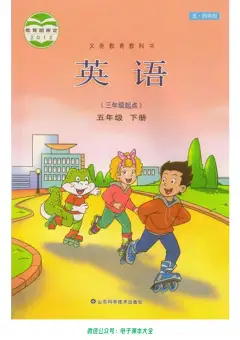
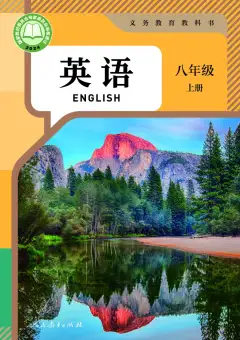
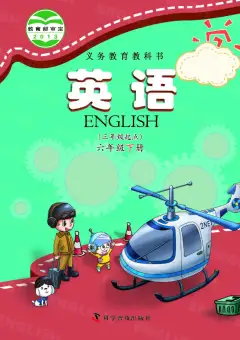
英语
下册
八年级
义务教育教科书
主 编:赵美娟
分册主编:顾琦一
编 者(按姓氏拼音排列):
丁冬汉 胡新秀 黄海东 马建锋 周丽萍
图书在版编目(CIP)数据
义务教育教科书. 英语八年级 下册 / 赵美娟主编 ; 顾琦一分册主编 ; 丁冬汉
等编. -- 上海 : 上海外语教育出版社, 2024
ISBN 978-7-5446-7939-8
Ⅰ. ①义… Ⅱ. ①赵… ②顾… ③丁… Ⅲ. ①英语课—初中—教材 Ⅳ. ①G634
中国国家版本馆CIP数据核字(2024)第006865号
策划编辑:陈 菊 韩天霖
美术编辑:董雪晴
项目负责:陈 菊 陆轶晖
封面设计:严 翔
责任编辑:郑明月
义务教育教科书 英语 八年级下册
出版 上海外语教育出版社(上海市大连西路558 号)
广东教育出版社(广州市环市东路472 号12-15 楼)
发行 上海外语教育出版社
印刷
开本 787 毫米×1092 毫米 1/16
印张 10.5
字数 269 千字
版次 2026 年 1 月 1 版
印次 2026 年 1 月第1 次印刷
定价 10.80 元
版权所有·未经许可不得采用任何方式擅自复制或使用本产品任何部分·违者必究
如发现内容质量问题,请拨打电话 4008-213-263。
如发现印、装质量问题,影响阅读,请与上海外语教育出版社联系。
电话:021-65609540
全国物价举报电话:12315
声明:按照《中华人民共和国著作权法》第二十五条有关规定,我们已尽量寻找著作
权人支付报酬。著作权人如有关于支付报酬事宜可及时与出版社联系。
致同学
亲爱的同学:
你好!
春去秋来,我们迎来了新学年,开始了八年级的英语学习!
八年级教材分上下两册,每册各8 个单元。每个单元始于核心问题(Key question),
从准备活动(Getting ready),到阅读与思辨(Reading and critical thinking)、语
法(Grammaring)、听说(Listening and speaking)和写作(Writing),再到项目
(Project)活动,完成对核心问题的回答,帮助大家建构起对单元主题的深层认知。
八年级教材中既有与七年级相关联的话题,例如文化习俗、学会学习、坚强勇敢、
环境保护等,也有一些新的话题,例如保护濒危动物、理想职业、伟大人物、交流沟通、
抗击疫病、志愿活动、艺术与工艺品、音乐世界、数据安全、科技生活等。围绕这些话题,
教材秉持英语学习活动观,设计了理解、发现、表达、拓展等不同类型的活动,利用文字、
图片、音频等不同媒介,引领你深入学习相关主题。希望你能从中获得积极的学习体验,
成为意义探究的主体和积极主动的知识建构者。
八年级教材中的语篇类型有报刊文章、访谈、故事、传记、播客等,希望你在学习
不同的文体特征、内容结构和语言特点的同时,认真领会语篇传递的文化意涵和价值意义,
从基于语篇的学习走向深入语篇和超越语篇的学习。
教材将语音、词汇、语法知识融于语言实践活动之中,创设情景,让你在语境
中理解与运用相关知识。教材还提供了听、说、读、写的微技能(Subskill)和青少
年素养知识(Teen skill),帮助你掌握有效的学习方法,开展合作学习。文化链接
(Culture link)介绍了鸳鸯的象征意义、甲骨文、诺贝尔奖、遗忘曲线、国际志愿者日、
古罗马的信息加密方式、机器人三大定律等中外文化事项和文化活动,帮助你认识世界
文化的丰富与多样,提高文化意识。
建议你在开始单元学习前,先仔细阅读本单元的学习任务(Tasks)和学习目标
(Objectives),了解学习重点和难点,更好地规划自己的学习。在完成单元学习后,利
用自我评价表(Self-assessment)反思自己的学习,了解自己的进步和不足,及时调整,
提高学习效率,成为善学者、乐学者。
祝你在英语学习上取得新的进步!
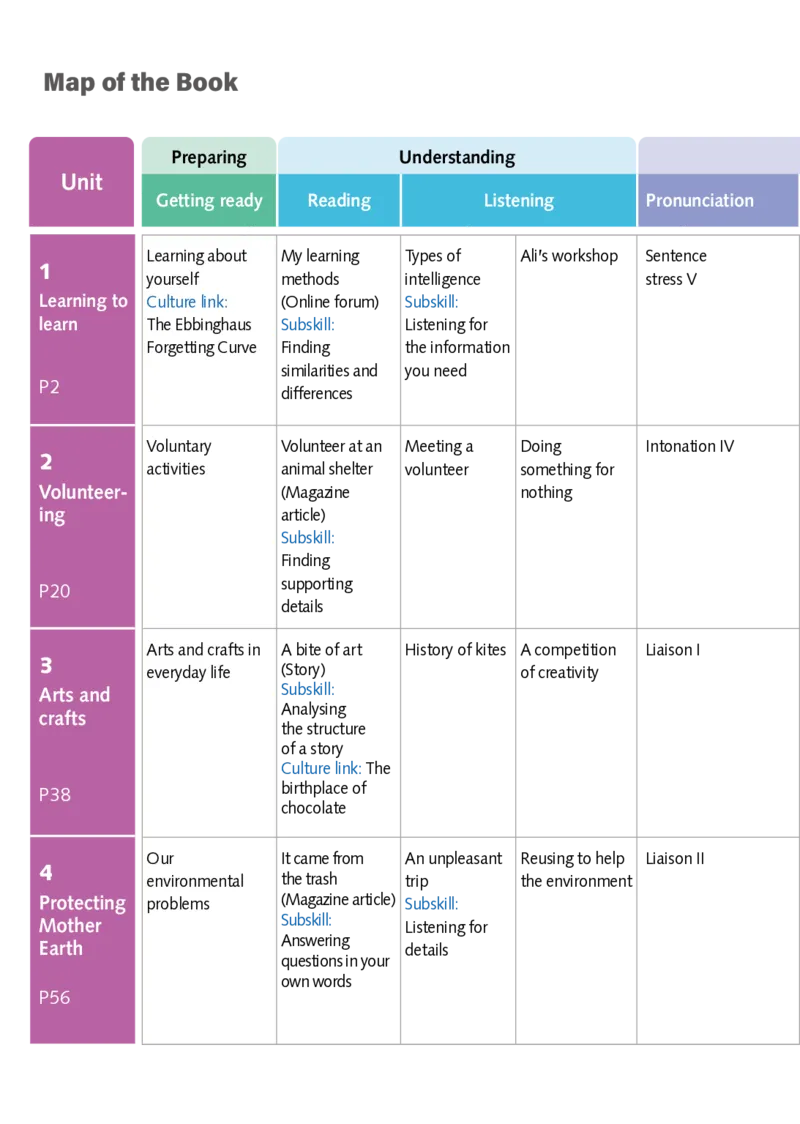
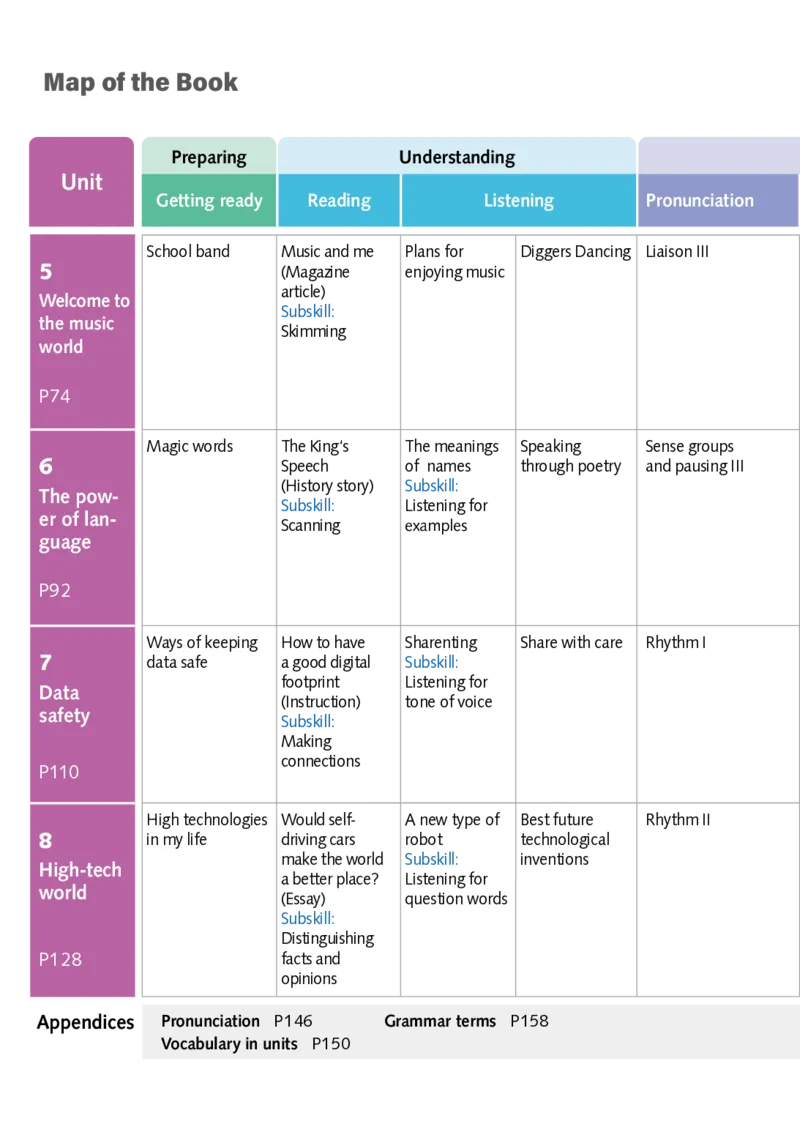
Map of the Book
S
p
e
a
1
Learning to
learn
P2
2
Volunteer-
ing
P20
3
Arts and
crafts
P38
4
Protecting
Mother
Earth
P56
Unit
Preparing
Understanding
Getting ready
Reading
Listening
Pronunciation
Learning about
yourself
Culture link:
The Ebbinghaus
Forgetting Curve
My learning
methods
(Online forum)
Subskill:
Finding
similarities and
differences
Types of
intelligence
Subskill:
Listening for
the information
you need
Ali's workshop
Sentence
stress V
Voluntary
activities
Volunteer at an
animal shelter
(Magazine
article)
Subskill:
Finding
supporting
details
Meeting a
volunteer
Doing
something for
nothing
Intonation IV
Arts and crafts in
everyday life
A bite of art
(Story)
Subskill:
Analysing
the structure
of a story
Culture link: The
birthplace of
chocolate
History of kites
A competition
of creativity
Liaison I
Our
environmental
problems
It came from
the trash
(Magazine article)
Subskill:
Answering
questions in your
own words
An unpleasant
trip
Subskill:
Listening for
details
Reusing to help
the environment
Liaison II
k
i
n
g
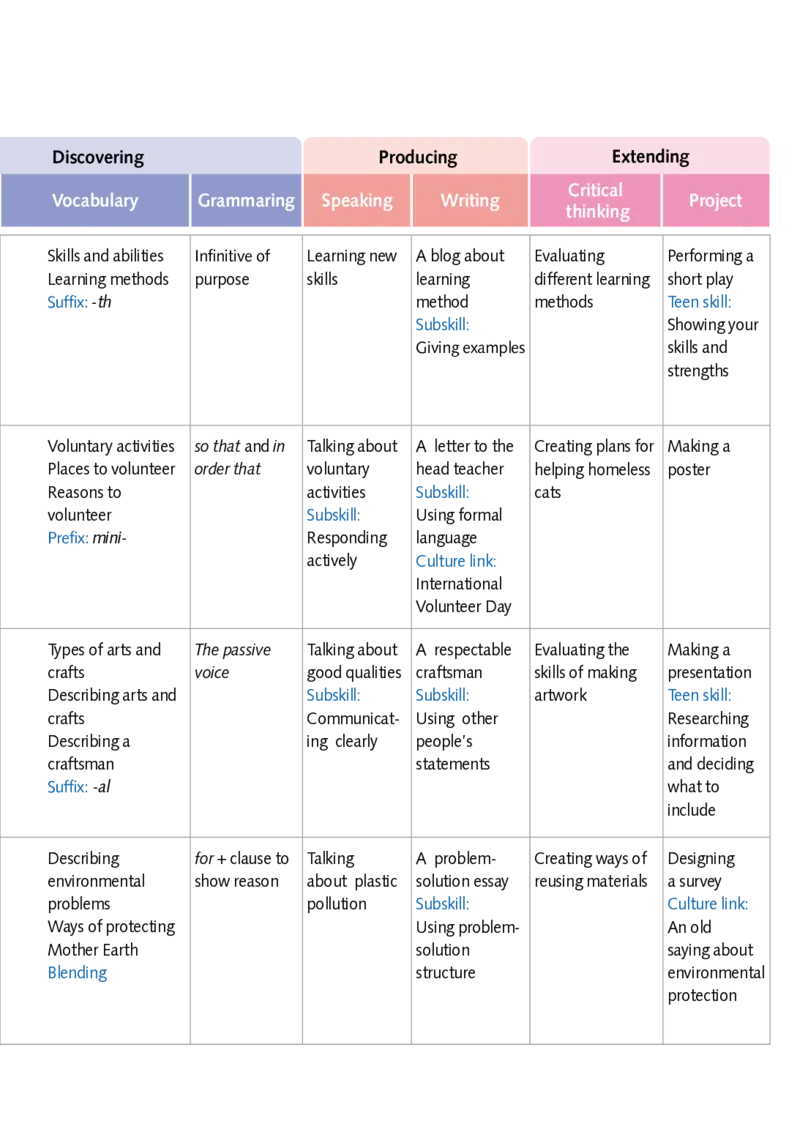
Discovering
Producing
Extending
Vocabulary
Grammaring
Speaking
Writing
Critical
thinking
Project
Skills and abilities
Learning methods
Suffix: -th
Infinitive of
purpose
Learning new
skills
A blog about
learning
method
Subskill:
Giving examples
Evaluating
different learning
methods
Performing a
short play
Teen skill:
Showing your
skills and
strengths
Voluntary activities
Places to volunteer
Reasons to
volunteer
Prefix: mini-
so that and in
order that
Talking about
voluntary
activities
Subskill:
Responding
actively
A letter to the
head teacher
Subskill:
Using formal
language
Culture link:
International
Volunteer Day
Creating plans for
helping homeless
cats
Making a
poster
Types of arts and
crafts
Describing arts and
crafts
Describing a
craftsman
Suffix: -al
The passive
voice
Talking about
good qualities
Subskill:
Communicat-
ing clearly
A respectable
craftsman
Subskill:
Using other
people’s
statements
Evaluating the
skills of making
artwork
Making a
presentation
Teen skill:
Researching
information
and deciding
what to
include
Describing
environmental
problems
Ways of protecting
Mother Earth
Blending
for+clause to
show reason
Talking
about plastic
pollution
A problem-
solution essay
Subskill:
Using problem-
solution
structure
Creating ways of
reusing materials
Designing
a survey
Culture link:
An old
saying about
environmental
protection
Map of the Book
S p e a k i n g
5
Welcome to
the music
world
P74
6
The pow-
er of lan-
guage
P92
7
Data
safety
P110
8
High-tech
world
P128
Unit
Preparing
Understanding
Getting ready
Reading
Listening
Pronunciation
School band
Music and me
(Magazine
article)
Subskill:
Skimming
Plans for
enjoying music
Diggers Dancing Liaison III
Magic words
The King‘s
Speech
(History story)
Subskill:
Scanning
The meanings
of names
Subskill:
Listening for
examples
Speaking
through poetry
Sense groups
and pausing III
Ways of keeping
data safe
How to have
a good digital
footprint
(Instruction)
Subskill:
Making
connections
Sharenting
Subskill:
Listening for
tone of voice
Share with care Rhythm I
High technologies
in my life
Would self-
driving cars
make the world
a better place?
(Essay)
Subskill:
Distinguishing
facts and
opinions
A new type of
robot
Subskill:
Listening for
question words
Best future
technological
inventions
Rhythm II
Pronunciation P146
Vocabulary in units P150
Grammar terms P158
Appendices
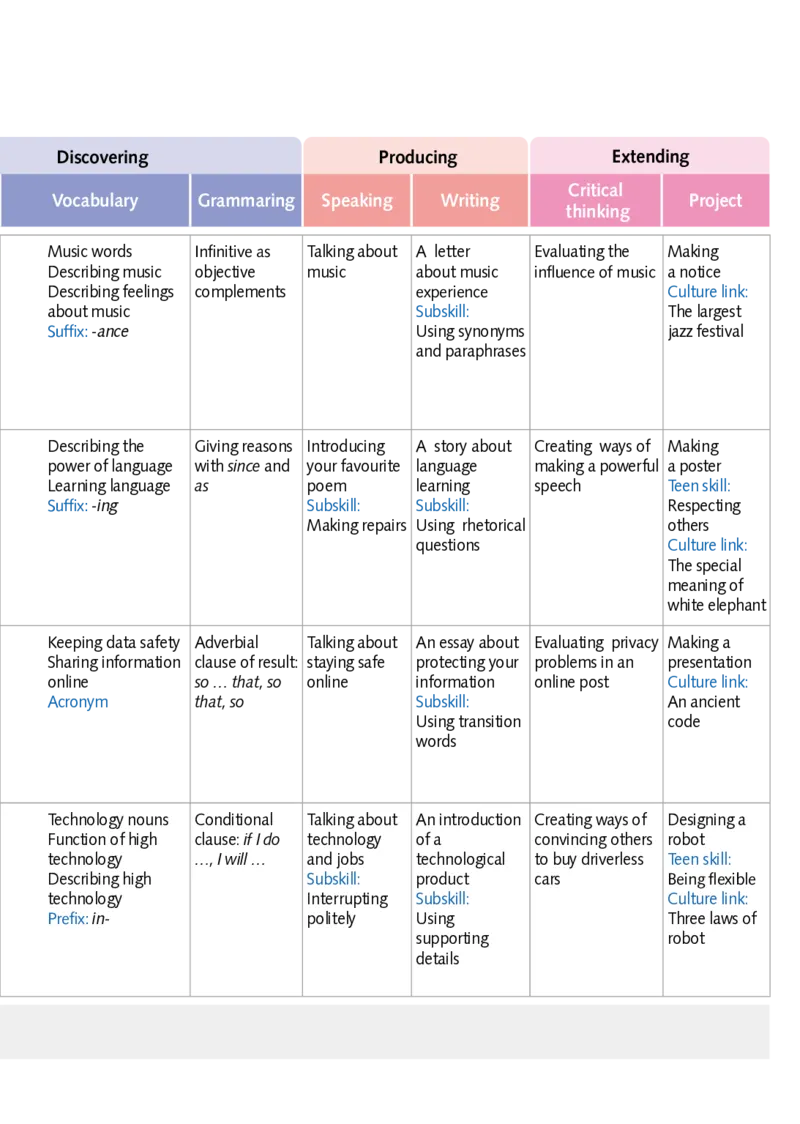
Discovering
Producing
Extending
Vocabulary
Grammaring
Speaking
Writing
Critical
thinking
Project
Music words
Describing music
Describing feelings
about music
Suffix: -ance
Infinitive as
objective
complements
Talking about
music
A letter
about music
experience
Subskill:
Using synonyms
and paraphrases
Evaluating the
influence of music
Making
a notice
Culture link:
The largest
jazz festival
Describing the
power of language
Learning language
Suffix: -ing
Giving reasons
with since and
as
Introducing
your favourite
poem
Subskill:
Making repairs
A story about
language
learning
Subskill:
Using rhetorical
questions
Creating ways of
making a powerful
speech
Making
a poster
Teen skill:
Respecting
others
Culture link:
The special
meaning of
white elephant
Keeping data safety
Sharing information
online
Acronym
Adverbial
clause of result:
so … that, so
that, so
Talking about
staying safe
online
An essay about
protecting your
information
Subskill:
Using transition
words
Evaluating privacy
problems in an
online post
Making a
presentation
Culture link:
An ancient
code
Technology nouns
Function of high
technology
Describing high
technology
Prefix: in-
Conditional
clause: if I do
…, I will …
Talking about
technology
and jobs
Subskill:
Interrupting
politely
An introduction
of a
technological
product
Subskill:
Using
supporting
details
Creating ways of
convincing others
to buy driverless
cars
Designing a
robot
Teen skill:
Being flexible
Culture link:
Three laws of
robot
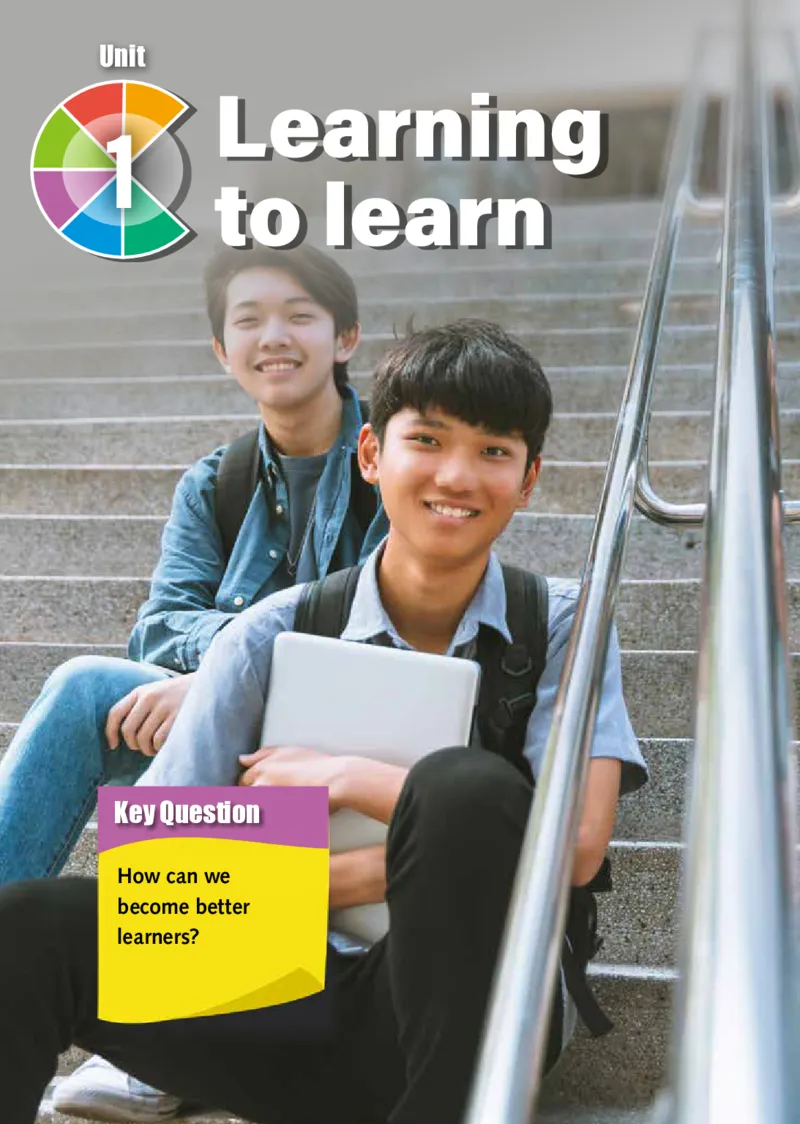
Learning
to learn
1
Unit
How can we
become better
learners?
Key Question
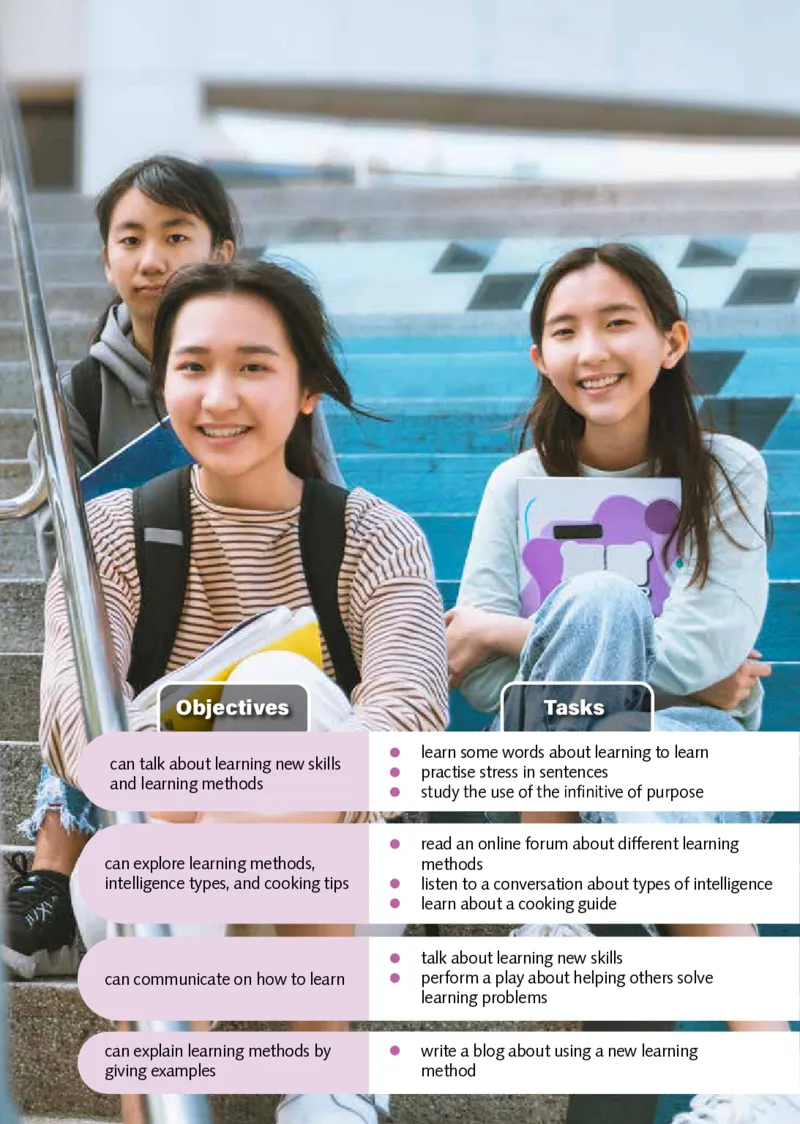
Tasks
Objectives
read an online forum about different learning
methods
listen to a conversation about types of intelligence
learn about a cooking guide
talk about learning new skills
perform a play about helping others solve
learning problems
write a blog about using a new learning
method
learn some words about learning to learn
practise stress in sentences
study the use of the infinitive of purpose
can explain learning methods by
giving examples
can explore learning methods,
intelligence types, and cooking tips
can communicate on how to learn
can talk about learning new skills
and learning methods
4
Unit 1
Getting ready
A
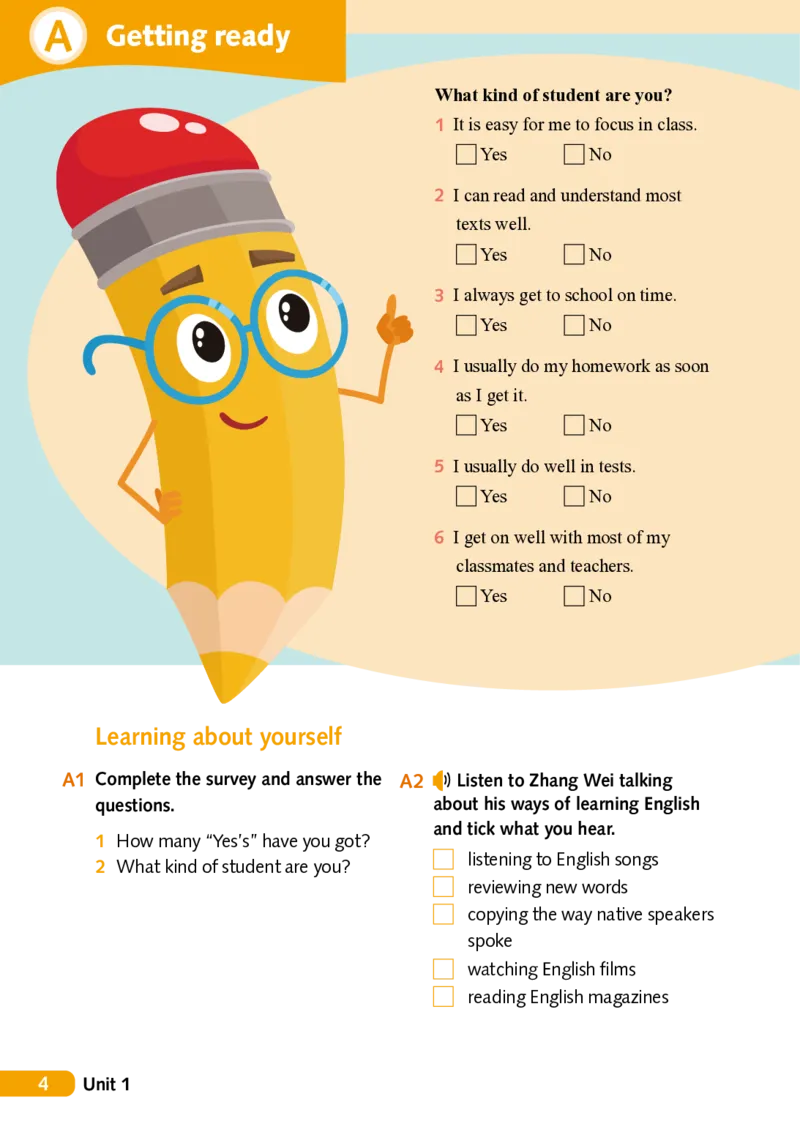
Complete the survey and answer the
questions.
Learning about yourself
Getting ready
A
A1
Listen to Zhang Wei talking
about his ways of learning English
and tick what you hear.
listening to English songs
reviewing new words
copying the way native speakers
spoke
watching English films
reading English magazines
A2
What kind of student are you?
1 It is easy for me to focus in class.
Yes
No
2 I can read and understand most
texts well.
Yes
No
3 I always get to school on time.
Yes
No
4 I usually do my homework as soon
as I get it.
Yes
No
5 I usually do well in tests.
Yes
No
6 I get on well with most of my
classmates and teachers.
Yes
No
1 How many “Yes’s” have you got?
2 What kind of student are you?
5
Learning to learn
A
I think you should manage your
time better and go to bed earlier.
A4
I always feel sleepy and it’s
hard for me to focus in class.
To finish my homework.
Why do you stay up late?
Work in pairs. Talk about your
learning problems and give each
other suggestions.
Circle the correct word to
complete each sentence.
1 Her weakness / strength in learning
new languages allowed her to
become fluent in Spanish within a
few years.
2 We can do many things to improve
/ manage ourselves and become
better than before.
3 I’m not excellent / average enough
now but I’ll work hard.
4 It’s important for us to review /
copy our textbooks before exams.
A3
5–6 Yes’s: You are an excellent
student. You are responsible
and you have a positive attitude
towards your studies.
3–4 Yes’s: You may be an
average student. You can do
more to improve and become
an excellent student.
0–2 Yes’s: You really need to
change your ways of learning.
You should make some effort
before it’s too late.
Suffix: –th
The suffix -th can create nouns showing
qualities, measurements, or states —
for example, strength, length and
growth.
Culture link
The Ebbinghaus Forgetting Curve
describes the nature of memory loss
over time. The graph shows how you
may forget things you learned in a week.
Simply practising what you have learned
from time to time will help your memory
become stronger.
50
75
100
25
0
Point of
Learning
One hour
24 hours
6 days
Remembered %
5 I need to understand / focus on
my studies without thinking about
anything else to prepare for the
coming exam.
6
Reading and critical thinking
B
Unit 1
6
Unit 1
Reading and critical thinking
B
Tom, Lee and Alice are sharing their learning experience on an online forum. What can
you learn from them?
Have you ever found it difficult to understand a concept? Well,
I find it turns out to be much easier when I draw it out. Last
week, my geography teacher gave us a lesson about the
rotation and revolution of the Earth. To understand the
difference between them, I drew a picture. It’s really clear, isn’t
it?
Drawing to understand a concept isn’t just limited to personal
use. It can also serve as a useful tool for sharing information in
a report or presentation. Have a try!
One of the best ways of remembering what I’ve learned is to
make picture stories and it’s fun too! Experts say that our brain
works well with pictures. So sometimes, if I want to remember
new information, I’ll make a picture story. For example, to
remind me of the word “playful” I learned yesterday, I made a
picture story for it: In the cold Arctic, there is a PLAYFUL polar
bear named Ben. He had an excellent skiing skill.
The best part is that anyone can learn to do this. Let yourself
be surprised by your memory!
I used to feel nervous about having trouble focusing on my
homework. To fix it, I tried out the “Pomodoro Technique.”
Pomodoro is the Italian word for tomato. It was named for the
inventor’s use of a tomato-shaped timer. I used this technique
to divide my homework into parts and set a 25-minute timer for
each part. After each part, I took a short 5-minute break before
moving on to the next one. After four parts, I took a longer
break, about a quarter. Surprisingly, I finished my homework in less time. Focusing
on one task at a time and breaking it down into smaller parts also made me feel less
tired.
Tom
Last updated: 18 March
Lee
Last updated: 5 April
Alice
Last updated: 2 May
Forum l My learning experience
7
B
Learning to learn
Differences
Similarities
1 Tom used drawing to help him
understand but Lee used picture
stories to help him remember. √
2 Everyone could use Tom’s
method but Lee’s and Alice’s are
not easy to use.
3 Alice’s technique was mainly
about time management and
task division.
4 Tom and Alice both mentioned the
benefits of using visual techniques. Lee
5 They all shared their methods for
improving memory.
6 They all have a positive attitude
towards learning.
Subskill
Finding similarities
and differences
This means we look at two
or more things and see how
they are similar (compare)
and different (contrast).
When we compare and
contrast some people, we
should talk about what they
have in common and what
makes each person different
from the others.
B1
B
Comprehension
Complete the table with the information from the texts.
Read again and answer the questions.
1 What was the topic of Tom’s geography lesson?
2 What was the best part of Lee’s learning method?
3 What did experts say about our brain?
4 Why did Alice feel anxious before?
5 After how many work periods did Alice take a
longer break?
Following are some notes about the forum, but
there are some mistakes. Read and correct the
mistakes.
B2
B3
To understend a 1
Draw a picture
Tom
To 3
new words
Make a 2
Lee
To focus on 4
Use the "Pomodoro
Technique"
Alice
Topic of the forum: How to learn
8
Unit 1
Reading and critical thinking
B
Word work
turn out focus on try out remind break down
B4
B6
Find the words from the texts to complete the sentences. Use the first letters to
help you.
Complete the passage about learning tips with the words in the box.
Reading and critical thinking
B
B5 Complete the summary of the texts with the words in B4.
Tom, Lee and Alice shared their learning experiences on an online forum.
Tom used drawing to help understand a 1
. And it can also be used
to share information in a report or 2
. Lee made up a story about
a polar bear to remember words because 3
said it worked. Alice
4
her tasks into small parts. She is not 5
anymore
because now she spends less time doing homework than before!
Here are some tips for middle school students:
• Don’t be afraid of making mistakes.
• 1
one task at a time because your attention is limited.
• Use a timer to 2
you of time when you do your
homework.
• You can 3
a difficult concept into simpler ones to help
you learn.
• 4
as many learning methods as you can before finding
the right one for you.
• The harder you work, the better the result will 5
to be.
1 A c
is a basic idea or understanding about something.
2 The p
was a useful tool to explain your ideas to your audience.
3 He is an e
who knows a lot about this subject and is really good
at it.
4 If you are worried about something, you may feel a
.
5 To d
means to break something into several smaller parts.
9
B
Critical thinking
9
1 Review. Use your own words to retell the three methods
mentioned in the texts.
e.g. Tom drew a picture to help him better understand the
revolution of the Earth.
2 Apply. Use the method introduced by Lee to help you remember
the following words. Then write down as many words as you can
remember.
3 Evaluate. Do you think these learning methods are suitable for
you? Give your reasons.
EXAMPLE
I think drawing pictures is not suitable for me. I’m not good at
drawing. It’s easier for me to imagine a picture in my mind.
Learning to learn
polar bear
rotation
revolution
technique
brain
timer
Grammaring
C
10
Unit 1
Infinitive of purpose
Study the blue parts and answer the questions below.
Match the two parts of the sentences.
Complete the sentences with the correct forms of the verbs in the box.
C1
C2
C3
Grammaring
C
1 To increase my vocabulary, I began reading more English magazines.
2 You can do more to improve and become an excellent student.
3 Drawing to understand a concept isn’t just limited to personal use.
4 B: Why do you stay up late?
A: To finish my homework.
1 You should talk to your teachers
a to pass her exam.
2 I called my father
b to improve his pronunciation.
3 He copied the way native
c to get more information and support.
speakers spoke
4 She’s working hard
d to make some sandwiches.
5 I’m going to buy some bread
e to tell him the good news.
1 To
more effectively, we should choose learning methods
suitable for us.
• We can use the infinitive to say why the subject is doing something. For example:
[explains why I made a picture story]
I made a picture story to remind me of the word “playful”.
• We can put “in order” or “so as” before “to”:
I made a picture story in order / so as to remind me of the word “playful” .
• When the purpose is negative, we use in order not to or so as not to. For example:
I repeated the word several times in order not to / so as not to forget it.
The infinitive form stays the same no matter what tense of the main verb is.
Grammar highlights
balance pass help have learn
Q1 What is the relationship of the infinitive clause and the main clause?
Q2 Does the infinitive have a tense?
C
11
Learning to learn
Rewrite the sentences by using the infinitive, but don’t change the meaning.
Rewrite the underlined parts of the passage using the infinitive.
C
C4
C5
C
1 I signed up for online courses because I can study at home.
2 I want to work with groups of people because I want to practise my people
skills.
3 She went to Paris because she wanted to study art there.
4 More people are cycling to work because they want to do more exercise.
If you want to be a top student, you need to work hard through the
year. Think about the things that can help you learn, such as taking notes
in class or recording the class to listen again later.
For learning a new language, you can use language apps. You
can draw mind maps to group words because it can help you learn
vocabulary effectively. You can also put sticky notes around the house!
You can set up a study group when you want to study with others.
And remember, don’t just learn everything by heart — you need to
understand it too!
2 She carefully manages her time to
her hobbies and school life.
3 In order to
the exam, she stayed up late studying almost every
night.
4 I want to
a better relationship with my parents.
5 He used the internet to
him find more information about this
workshop.
Listening and speaking
D
12
Unit 1
Types of intelligence
Read the questions and circle your answers.
1 How do you memorise new words?
a By seeing them.
b By hearing them.
c By seeing pictures about them.
2 How do you understand something better?
a By trying it out.
b By hearing things about it.
c By writing it down.
Listen and find out who said the following things.
Fill in the blanks with the correct names in the box.
1 I’m not good at languages — it's difficult for me to memorise new words and
to understand the grammar.
2 Nobody has to be good at everything, right?
3 Maybe I’ve got good body intelligence.
4 I always believe I have good visual and logical intelligence.
5 My best subjects are math and art.
Listen again and read the statements. Write T (true) or F (false).
1 Lisa feels upset because she failed her math exam.
2 Mark is good at learning new languages.
3 Lisa loves dancing and running.
4 Mark plans to study architecture after finishing school.
5 Lisa wants to be good at everything.
Discuss the questions in pairs.
1 Do you agree or disagree with the statements?
• People who are good at solving math problems have good logical
intelligence.
• People with good verbal intelligence are usually good speakers.
2 What kinds of intelligence do you have?
D1
D2
D3
D4
Subskill
Listening for the
information you need
Read the sentences carefully
and think about the kind of
information you’ll need to
listen for, e.g. names, places
or verbs. For example, you
should pay attention to the
names mentioned by the
speakers in this conversation.
Mark Lisa
D
13
Learning to learn
( see p146 )
Pronunciation
sentence stress (V)
Listen again and put the events in the correct order by writing the numbers 1-5.
They add the tomato sauce.
They make the base.
Now it’s time to put the pizzas in the oven.
The pizzas are ready to come out.
They add the toppings.
Work in groups and answer the questions.
1 Which of the skills in the video do you want to learn the most?
2 What skills have you learned before? Tell your classmates.
Learning new skills
Work in pairs. Talk about a new skill
you have learned recently. Use the
questions to help you.
D8
D7
D9
Listen and answer the questions.
1 Which of the skills in D5 does Ali’s workshop teach?
2 What do Willow, Patricia, Rose and Owen learn to make today?
3 How do they feel after today’s workshop?
D6
1 cooking 2 making clothes 3 building things 4 doing art
Ali’s workshop
Match the pictures with the skills in the box.
D5
a
Useful expressions
• What’s the skill?
• What made you want to learn it?
• How long have you learned it?
• How did you learn?
• I’m interested in … because …
• I learned how to … ago.
• It took me … to learn …
• I practised … a lot.
• I read and watched videos about …
b
c
d
Writing
E
14
Unit 1
14
Subskill
Giving examples
We can use examples to explain an unfamiliar
point and make a difficult idea easier to
understand.
Study a model. Complete the table with the information from the blog.
1
Write a blog about a learning
method you once used.
A blog about a
learning method
How I learned history
I used to have trouble remembering important dates and events in history. It all
seemed like a big mix-up in my mind. To help me, my history teacher taught me a
helpful learning method: making up simple stories.
He suggested that I create easy stories around historical events, connecting the
important details. For example, to remember the date of the First World War, I made
up a funny story about a soldier riding on a snail who unexpectedly won an important
battle during that war. This simple story also helped me
remember the duration of the war.
With this new method, history became more interesting
to me. Each story I made up became a way to remember
important things from the past. Thanks to his advice and
the storytelling learning method, history became easier to
understand and remember.
Follow this blog
20 April | Lee’s blog
What trouble did
Lee have?
He couldn’t remember 1
in history.
Who taught him
this method?
His 2
.
What was the
method?
Creating 3
around his-
torical events.
How did he use
the method?
Example: To remember the date of the First World
War, he made up a funny story about a soldier.
4
.
How did the meth-
od help him?
History became 5
.
E
15
Learning to learn
Think. Think about your answers to questions 1–5 in the table. Make notes
to answer the five questions. Give examples for the “how” questions.
Write. Write your blog. Use the model and your notes in Step 2 to help you.
Peer review.
Peer review. Exchange your blog with another student. Answer the
questions.
1 Does the writer answer all five questions in the blog?
2 Does the writer give useful information about how you could learn?
Check. Read your blog. Answer the questions.
1 Did you give examples for your method?
2 Did you use the correct forms of verbs in your writing?
Questions
1
What was the problem?
2
What was the method?
3
How did you learn the method?
4
How did you use it?
5
How did the method help you?
2
3
4
5
Project
F
16
Unit 1
Project
F
16
Unit 1
Task: Perform a short play about helping
classmates solve their learning problems.
How can we become
better learners?
Script
Act the play.
Characters:
Narrator
Setting:
In the classroom
Simon
Dylan
Lily
Scene 1
[Narrator] Simon was asking his friend Dylan about his learning problem.
Simon, a boy, energetic and easygoing
[Simon] How's your revision going?
Dylan, a boy sitting next to Simon, working on his notebook, nervous
[Dylan] Not so good. Remembering vocabulary is a bit hard for me. What
about you?
[Simon] For me, I find the grammar hard, but the vocabulary is a lot easier.
[Dylan] How do you remember all the words? What's your secret?
[Simon] Well, when I get home from class, I record all the new words I've
learned onto my phone. And I make up these sentences with the words and
say them to myself.
[Dylan] Does it work?
[Simon] Most of the time. I don't know why but remembering the sounds of the
words is important for me.
[Dylan] Interesting. But I don't know if it would work for me. I need to write
things down. I need to look at the word.
[Simon] Right. Lily's like that too. She uses vocabulary cards. We can ask her.
Scene 2
[Narrator] Simon and Dylan go to Lily and ask her about her advice.
[Dylan] Hi Lily, Simon told me you used vocabulary cards to help you learn new
words. How does that work?
Lily, a girl, with small cards in her hands, sitting on her desk
[Lily] I had all these small cards and I wrote all the new words on a card with a
picture or an example, sometimes a translation too. It worked really well ... for
a while.
[Simon] For a while? Why? What happened?
[Lily] Well, I left the cards everywhere and couldn’t find them.
[Dylan] That's probably what I would do!
[Simon] I felt so sorry for you—after all that work.
[Dylan] It sounds like a good idea, but it sounds like you have to be quite
organised to have a card system.
[Lily] Yes, that’s true.
[Dylan] I’ll try it anyway! Thank you both for your advice.
End of play.
F
17
Learning to learn
F
17
Read the model script. Think about the answers to the questions and make notes.
1
Work in groups. Think of some learning problems to discuss and choose a
problem to write in your play. Use the table to help you.
2
Work in groups. Write the scene about helping a classmate solve his/her
learning problems. Use the correct style and the information
in Step 2.
3
Choose the role you want to take on in
the play.
5
Work in groups. Perform the short play in your class using the script you wrote.
6
Showing your skills and
strengths
Tips
• Be confident and honest.
• Say what you want to say
quickly and focus on the
key information.
Useful expressions
• I’m a good listener/speaker
…
• I’m good at working with
others/talking to others …
• I consider myself to be a
good speaker/performer …
• I think I should take on the
role of … because I’m good
at …
TEEN SKILL
Learning to learn
What is the problem?
Who has this problem?
What learning method can you use?
4
Work in groups. Read the script to check
whether your writing includes the following
features. Decide what changes you want to
make and write the final script.
• description of where/when things happen
• short descriptions of characters
• details of the learning problems and advice
• details of how the characters should say each line
1 Who is in the scene?
2 Where does the scene happen?
3 What is the learning problem they are talking about?
4 What is the advice they give to each other?
18
Self-assessment
Unit 1
18
Self-assessment
A. find out the differences and similarities and
understand the information you need in
different texts
B. communicate on how to learn by using words
about learning methods and abilities, and
correctly use the infinitive of purpose
C. write a blog about learning by giving examples
D. understand the Forgetting Curve and use it to
help me learn effectively
E. evaluate different learning methods and
choose the suitable ones for myself
F. solve learning problems through working with
others and show our own skills and strengths
How well I can do these
19
Learning to learn
19
Key words to use
Skills and abilities
body intelligence
build new things
cook
dance
do art
draw
learn new languages
logical intelligence
make clothes
perform a short play
swim
verbal intelligence
Learning methods
balance hobbies and school life
copy
draw mind maps
draw pictures
make picture stories
Pomodoro technique
record the class
review
study with others
take notes in class
use vocabulary cards
Cool things to know
Learning to learn
Rotation and
revolution of
the Earth
Add more! What other useful words
or cool things have you learned?
Add them to the lists.
Volunteering
2
Unit
Why should we
volunteer?
Key Question
Tasks
Objectives
read an article about a teenager's voluntary
experience at an animal shelter
listen to a radio programme about a university
student's voluntary experience
learn about a story of two volunteers
write a letter to ask for the head teacher’s
permission
learn some words about voluntary activities
practise using intonation in sentences
study the use of so that / in order that
can learn to use formal language
can explore what makes a good
volunteer
talk about voluntary work
make a poster to invite volunteers
can communicate on taking
part in voluntary activities
can describe voluntary activities
and reasons for volunteering
22
Unit 2
Getting ready
A
Read the mini-texts and fill in the
blanks with the places in the box.
beach animal shelter children’s
hospital city park
Voluntary activities
Getting ready
A
A1
Getting ready
A
Place: ________
What I did: I want to do
something for my community. I
joined in cleaning up the parks.
Later I planted a tree there.
Place: ________
What I did: I always wanted to help
protect the natural environment.
I took a minibus to the seaside. I
picked up plastic bottles there and
did garbage sorting.
Place: ________
What I did: I met a boy
there. He hurt his legs. I
taught him how to paint a
picture so he could forget
his pain for a while.
1
2
3
1
2
3
4
Complete the sentences with the
words in the mini-texts. Use the
meanings and the first letters to
help you.
1 Our school ordered a m
to take students on a field trip to
the museum. (a small bus)
A2
Prefix: mini-
The prefix “mini-” means “small”.
When added to a word, it means
that the thing itself is getting
smaller.
23
Volunteering
A
V
o
l
V
o
l
u
n
t
e
e
r
W
e
e
k
n
t
e
e
r
W
e
e
k
Complete the passage with the words
from the box.
My school’s Spring Sports Meeting is
coming. Many of my schoolmates want to
volunteer at the meeting. As 1
,
we can prepare for the opening ceremony,
guide the players to the playing fields, keep
2
around the playground and
3
up the playing field. Are you
also 4
in being a volunteer?
clean volunteers order interested
A
A4
Yes, I once helped a
cleaning lady in my school.
I helped her clean up the schoolyard
and did garbage sorting.
A5
Have you offered help to
people in need?
What did you do to help?
Work in pairs. Talk about what you
can do to help people around you.
A
Place: ________
What I did: I love spending time
with animals. I signed up for a
volunteering programme where I
could walk dogs and feed cats.
4
2 I want to h
the local
charity by donating my pocket
money. (to give or provide
something)
3 Please remember to f
the
cat before you leave for work in the
morning. (to give food to someone)
4 I p
the books from the
floor and put them on the shelf. (to
take something from one place)
Listen to a conversation and
complete the sentences with the
name Mark or Betty.
1
did some voluntary work
in a nursing home.
2
went to the children’s
hospital.
3
read news and funny
stories to an old woman.
4
wants to do more to help
5
suggests they can
continue to volunteer.
A3
24
Reading and critical thinking
B
Unit 2
5
10
30
35
40
45
15
20
Volunteer at an
Volunteer at an
animal shelter
animal shelter
My name is Li Han. I’ve always
had a dream of working with animals.
Two years ago, after graduating from
middle school, I decided to spend the
summer volunteering at the local animal
shelter so that I could realise my dream.
It turned out to be the best decision ever.
Working at an animal shelter
isn’t always exciting. From my own
experience, I can tell you not to wear
your favourite shirt when training the
dogs. The big kisses from the dogs will
ruin it! Also, be careful with new shoes
when feeding the cats. Some of them
can be very picky eaters and they will
spit food at you.
Even with the challenges, it was
an amazing and rewarding experience.
When I first came to the shelter, I was
scared of dogs. Thanks to my dog-
loving friend’s encouragement, now I
enjoy playing with the dogs too. I love
walking around, choosing which dogs
to train and teach them new tricks. I
remember teaching Max, an energetic
little dog, how to sit. And the next visit,
another volunteer taught him how to
give his paw and shake hands. So, every
time I came with a treat, he would sit
and give me his paw and shake hands.
It was just as satisfying as staying with
my own cat.
However, shelters often run low
on basic things like pet food and
medicine. Many people don’t realise how
important donations are for a shelter’s
survival. To help the animal shelter,
I collected small donations from my
school after learning about this need.
Even if you’re not a big fan of
animals, there are still many ways to
make a difference. Raising money,
collecting donations, or helping out at
the front desk are also very helpful. For
me, working at the animal shelter was
the greatest decision.
24
Unit 2
If you have a chance to volunteer, what
will you do? How will you feel? Let’s read
Li Han’s story in a magazine and find
out what she said about her volunteering
experience.
Reading and critical thinking
B
25
25
B
Volunteering
B
Comprehension
Match paragraphs 1-5 with their main ideas.
1 Paragraph 1
2 Paragraph 2
3 Paragraph 3
4 Paragraph 4
5 Paragraph 5
B1
Reporter: Good morning. I’m a reporter from a student newspaper. Can I ask
you a few questions?
Li Han:
Sure.
Reporter: What makes you volunteer at the animal shelter?
Li Han:
1
Reporter: What challenges have you met when you volunteered?
Li Han:
2
Reporter: Can you tell us some of your experiences with the animals there?
Li Han:
I remember 3
Reporter: What else have you done to help the animal shelter?
Li Han:
4
Reporter: Besides volunteering at the animal shelter, do you think there are
other ways to make a difference?
Li Han:
Of course. 5
are also very helpful, even if you’re not a big fan of animals.
Reporter: It’s so nice of you to share all this information with us. Thanks a lot.
Li Han:
You’re welcome!
1 Li Han enjoys her time at the animal shelter.
2 Training dogs can be challenging work.
3 Donations are very important for a shelter’s survival.
Find facts in the text to support these statements and write down the facts.
B3
Subskill
Finding supporting details
Supporting details can help you
understand and remember the
writer’s ideas. These might include
facts, examples or descriptions.
When you read, you can ask yourself
how well the writer supports the
main idea of the passage.
a Li Han encourages people to help animal shelters in different ways.
b Li Han finds the experience at the animal shelter amazing and
rewarding.
c Li Han has always dreamed of working with animals.
d Li Han highlights the importance of donations for the shelter’s
survival.
e Li Han shares her challenges of working at an animal shelter.
A reporter from a student newspaper interviewed Li Han. Complete Li Han’s
answers with information from the text.
B2
26
Unit 2
Reading and critical thinking
B
Word work
B4 Circle the correct answer to complete each sentence.
make a difference
run low on
be careful of
challenge
thanks to
playing with
collected
B5 Complete Li Han’s diary with the words in the box.
Reading and critical thinking
B
1 My cat is very picky about her treats and she
.
a only eats meat
b eats everything
2 Jack is an energetic kid. He is always
.
a full of energy
b tired
3 Although it is
, I have to face this challenge by myself.
a an easy task
b a difficult task
4 Being a volunteer for animals is such a rewarding experience that I think
it’s
.
a worth doing
b not worth doing at all
5 She was scared of the dark so she was
to take a bus late at night.
a happy
b afraid
6 When I was a kid, eating
like chocolate was a treat to me.
a something enjoyable
b something terrible
7 The animal shelter often runs low on food during winter so they
food for the animals.
a don’t have enough
b have enough
Dear Diary,
Today my dream came true. I spent my summer volunteering at the
local animal shelter. It wasn't always exciting. I had to 1
my
favourite shirt when dogs gave me big kisses. Feeding the cats was a
2
too because they can be picky eaters. But it was all worth it,
and I got over my fear of dogs 3
my friend Lisa. Now, I enjoy
4
them and teaching them tricks. Today, Max learned to sit and
give his paw! I even 5
donations to help the shelter, as they
often 6
supplies. Working here is rewarding and I can really
7
here. I can’t wait for more days like this!
Love,
Li Han
27
B
Critical thinking
27
1 Review. What challenges did Li Han face when she volunteered at
the animal shelter? List at least three challenges.
e.g. Some of the cats can be very picky eaters and they will spit
food at her.
2 Analyse. Think about the situation of homeless cats in your school
and the problems they might face. Consider their needs and what
you can do to help them.
EXAMPLE
3 Create. Talk with your classmates about how to help the homeless
cats in your school. Choose the most useful plan.
Problems
Causes
Things you can do
The cats in my
school don’t
have enough
food to eat.
• There are a lot of food
cats can’t eat, like
grapes or vegetables.
We can’t feed them
most human food.
• There is not enough
money to buy cat food.
• We can set up
feeding stations in
our school.
…
…
…
Volunteering
Grammaring
C
28
Unit 2
so that and in order that
Study the blue parts of the sentences and answer the questions.
Rewrite the sentences with so that or in order that.
Match the sentence halves and combine them using so that or in order that.
C1
C2
C3
Grammaring
C
1 I decided to spend the summer volunteering at the local animal shelter so that
I could realise my dream.
2 I read news and funny stories to her so she would not feel lonely.
3 I collected small donations from my school after learning about this need in
order that I could help the shelter.
1 She is learning Chinese because she wants to study in China.
2 We moved to Shenzhen because we wanted to see our friends more often.
3 I’ll take my umbrella because I don’t want to get wet.
4 I’m going to leave the party early because I want to get a good sleep tonight.
• We use so that or in order that to talk about the purpose of doing something.
• We often use can or will (for the present) and could or would (for the past) with
so that or in order that. We can leave out that when using so that.
• In order that is less commonly used.
• So that or in order that is usually not used at the beginning of a sentence.
Grammar highlights
Q1 What is used to connect clauses in each sentence?
Q2 What modal verb is used in each sentence?
1 I get up early today.
2 I wore a thin coat.
3 She arrived early this morning.
4 We spoke very quietly.
5 I’m going to help clean up the
city park.
a I don’t want to be late.
b She wanted to start the meeting on time.
c We didn’t want anyone to hear us.
d I want to make a difference in my
community.
e I want to look slim.
C
29
Volunteering
1
2
3
4
5
C
Some students are chatting online. Fill in the blanks using so that or in order
that and the phrases in the box.
C4
reduce waste in my community
take care of homeless pets
help the younger schoolmates
keep company with the old people
protect the natural environment
Volunteers group (5)
Student B
I spend every weekend volunteering at the animal
shelter 2
.
Student D
I volunteered at the local nursing home 4
.
Student A
I started a recycling club 1
.
Student E
I joined a beach cleanup 5
.
Student C
I signed up for the coaching programme 3
.
09:30 AM
Listening and speaking
D
30
Unit 2
Meeting a volunteer
Look at the picture and answer the questions.
1 What words can you see in this picture?
2 Which one do you think is the most
important quality of a volunteer?
Listen to a radio programme and fill in the table.
Listen again and read the statements. Write T (true) or F (false).
1 Zhang Wei took English language courses.
2 Zhang Wei had to learn about European culture.
3 Zhang Wei had to pass exams after the Olympics started.
4 Zhang Wei could use this chance to develop his people skills.
5 Being a volunteer was an easy job for Zhang Wei.
6 Zhang Wei wanted to help the world understand China better.
Discuss the questions in pairs.
1 What qualities does Zhang Wei have as a volunteer?
2 Do you think Zhang Wei is a good volunteer? Why or why not?
Doing something for nothing
Answer the questions.
1 How do you understand the title of the supporting material?
2 Have you ever done something for nothing?
D1
D2
D3
D4
D5
Who was the volunteer?
Zhang Wei, a university student.
Where did he volunteer?
At the 1
.
What did he do before
he volunteered?
He took over 2
online courses.
How did he feel?
He felt very 3
.
Listen and complete
the table.
D6
D6
D
31
Volunteering
( see p146 )
Pronunciation
Intonation IV
Talking about voluntary activities
Work in groups. Take turns to ask each other
about voluntary activities you want to take part in.
D8
Listen again and fill in the blanks.
D7
Useful expressions
• Which activity are you going to …?
• I’m going to …
• I want to … so I could help …
• I’m planning to …
• What do you think of …?
• Do you think it’s a good idea to …?
What are
their jobs?
What do they do as
volunteers?
Why do they volunteer?
He is a
hairdresser.
• He volunteers his time and
skills giving free 1
to the homeless.
• He 2
a project
called “Do something for
nothing”.
• Helping others is good
for the 5
and
makes you feel good too.
• They can help people and
also meet people and
make 6
.
She is a 3
.
She helps homeless people
4
their dogs.
Subskill
Responding actively
In a group conversation, make
sure everyone has a chance to
speak. You should speak and
then ask a question. When
your friends speak, you should
listen and respond to what
they say.
Do Something for Nothing
It’s good to 1
.
• You can speak to people in
the community.
• You can just say 2
and smile and show
understanding.
• A conversation can make a
3
difference.
• You can make people smile even if
you don’t have 4
.
Help others, help 5
.
• take care of homeless animals
• keep company with the old people
• clean up the city parks
• raise money for children in need
Writing
E
32
Unit 2
32
Subskill
Using formal language
You can use formal language to
express politely what you need, e.g.
We are writing to … / We would like
to … / We look forward to …
You and your classmates are planning
a money-raising activity to help the
homeless cats in your school on
International Volunteer Day. Write a letter
to your head teacher to ask for permission.
A letter to the head teacher
Dear Ms Wang,
We are writing to ask for your permission to organise a
money-raising activity in our school to support the local
animal shelter.
The local animal shelter provides home for 20 homeless
cats and dogs. However, it always runs low on basic
supplies, especially pet food. We want to raise money for
this animal shelter so that we can help these animals in
need.
We would like to hold our activities in the schoolyard.
Our activities include a food sale and a small book fair.
We will sell some homemade treats, and old books.
These activities will be organised responsibly and will
not influence our regular school activities.
We hope you could consider our request and give us your
permission. We look forward to your positive response.
Sincerely,
Class 4
E
33
Volunteering
How to raise
money for
homeless cats
Idea 1:
Book sales
Sell old books
Idea 2:
Talent show
Idea 4 ...
Idea 3 ...
Charge entrance fee
...
...
Why are they writing this letter?
To raise money for 1
.
How are they going to raise money?
• Sell homemade treats.
• Sell 2
.
Where do they want to have this
activity?
• At 3
.
What do they want from Ms Wang?
• Her 4
to hold this
activity.
Study a model. Complete the table with information from the letter.
1
Think. Work in groups.
Think about how to help
you raise money for the
homeless cats in your
school.
2
Write. Write your letter to
the head teacher. Use your
ideas in Step 2 and the
model to help you.
3
Check. Read your letter and answer the questions.
1 Did you answer all the questions in Step 1 in your letter?
2 Did you use the ideas in Step 2?
4
Peer review.
Peer review. Exchange your letter
with another student. Answer the
questions.
1 Does the writer include the questions
and ideas in Step 1 and Step 2?
2 Does the writer use formal language
in the letter?
3 Does the writer use so that in the
letter? Is it correctly used?
5
Culture link
International Volunteer Day
is celebrated on 5 December
each year. It was set by the
United Nations to recognise the
efforts of volunteers worldwide.
The day aims to raise awareness
about the importance of
volunteering.
Project
F
34
Unit 2
Project
F
34
Unit 2
Task: Make a poster to ask more classmates to
join your voluntary group. A model is given.
Why should we
volunteer?
Volunteers
wanted!
Our school is going to have a Volunteer Week
from 5 March to 12 March
Please contact us at: xxx school@volunteer.com
We need you to:
shop for the older people
do some cleanup
take care of homeless cats
We offer you:
support and advice
life-changing experience
unforgettable memories
We need your help!
F
35
Volunteering
F
35
Look at the model poster and find out what information it includes.
(e.g. the organisation name, volunteer activities, contact details, requirements)
1
Work in groups. Discuss the goal of your voluntary group. Use the questions
below to help you.
1 Who/What do you think needs help? (e.g. children, older people, animals)
2 What places do you think need more volunteers? (e.g. hospitals, communities,
older people’s homes)
2
Discuss in groups. Talk about the information of the poster. Fill in the table
below and think of more details.
3
Discuss how to design your poster to make it more beautiful. Pay attention to
the colour and pictures of the model poster.
4
Create your own poster and prepare to present it in class. Remember to
check for spelling mistakes.
5
Present your poster in class.
6
Volunteering
Name of the voluntary group
Activities
Requirements for volunteers
Benefits for volunteers
…
36
Self-assessment
Unit 2
36
Self-assessment
A. understand information in different texts by
finding supporting details
B. communicate on different ways to volunteer
and correctly use so that /in order that
C. write a letter to my head teacher by using
formal language
D. understand the history of volunteering and
meanings of being volunteers
E. analyse different challenges and plans and
choose a suitable plan
F. take turns to communicate in groups and work
together on a project
How well I can do these
37
Volunteering
37
Key words to use
Voluntary activities
clean up
collect
deal with
donate
feed cats
garbage sorting
guide
keep company with
pick up bottle
plant a tree
play with
prepare for
raise money
take care of
talk with
walk dogs
Places to volunteer
animal shelter
beach
children’s hospital
city park
nursing home
programme
project
school
sports meeting
Reasons to volunteer
challenge
happy
homeless
important
in need
joy
make a difference
peace
positive
proud
rewarding
satisfied
understand
unforgettable
Cool things to know
Volunteering
vet
Add more! What other useful words
or cool things have you learned?
Add them to the lists.
Vets are animal
doctors. A vet’s
job is to treat
animals in pain.
Arts and
crafts
3
Unit
Why do we need
arts and crafts in
everyday life?
Key Question
Tasks
Objectives
read a story about making chocolate sculpture
listen to a talk about kites
learn about a competition of creativity
talk about craftsmen
make a presentation about a work of art or
craft made out of things in everyday life
write an introduction about a respectable
craftsman
learn some words about arts, crafts and
craftsmen
learn to use liaison
study the use of the passive voice
can introduce a craftsman using
other people’s words
can find out why we need arts
and crafts in our everyday life
can communicate clearly on
craftsmen and their qualities
can describe arts and crafts, their
history and importance
40
Unit 3
Getting ready
A
Complete the introduction of a craftsman with the words in the box.
Yao is very skillful at Su embroidery. Her
job is to keep this folk art 1
.
Some of her works would take her years to
2
but she never gives up. Yao is
also very 3
. She 4
new ways like using modern technology to
Read the mini-texts and match the pictures with the words in the box.
pottery painting embroidery paper cutting clay figurine
creative finish explores alive traditional
Arts and crafts in everyday life
Getting ready
A
A1
A2
1
2
3
4
5
You can use heavy sticky soil to
make it by hand.
Qipao can be decorated
and made beautiful with
this skill. It can also mean
patterns like pictures or
words sewn onto cloth.
It is a small lifelike
statue of a person or
animal made of clay.
You can use it as
decoration.
1
2
3
Suffix: -al
The suffix “-al” can be added to words
to create adjectives that describe
characteristics, qualities, or relationships.
For example, the word “tradition” can be
changed into the adjective “traditional”.
41
Arts and crafts
A
Listen to a conversation about a folk art and complete the table.
A
A3
I’d like to present my
paper cutting work.
It’s a traditional Chinese art.
I like its special patterns and
it can be used to decorate
my room.
A4
What would you like to
present?
That sounds great. Why do you
choose it?
Work in pairs. Talk about the
arts or crafts you want to present at
your school art festival.
What is it?
Huishan clay figurine
How is it made?
It is made of 1
mud.
What makes it special?
• The mud is very 2
.
• It won’t crack when 3
.
• It shows the 4
and history of that
area.
It means creating
pictures using
paint.
It is a traditional Chinese art
form. You can use scissors,
knives, or other tools to make
it out of paper.
4
5
make embroideries. Yao hopes that
more young people get to know and like
this traditional art. Like many craftsmen
in China, Yao plays an important role in
protecting 5
Chinese culture.
42
Reading and critical thinking
B
Unit 3
5
10
15
20
25
A bite of art
A bite of art
42
Unit 3
Can you create art out of
things in everyday life? What
will you make?
Reading and critical thinking
B
Lily is a 14-year-old girl with
a passion for art. She spends all her
free time creating art using whatever
materials she can find nearby.
One day she watched a video
about an amazing chocolate sculpture.
The chocolate was turned into art by
the skilled artist’s hands. Lily was
so amazed that she wanted to make
a chocolate sculpture by herself. She
asked her parents to buy her some
chocolate, and they agreed right away.
However, things didn’t go as well
as she hoped. To start with, chocolate
broke easily when she made it into a
sculpture. But Lily didn’t give up. After
many tries, she learned to be careful
with her tools. Another problem was
that the chocolate started to melt before
she could finish her work. She tried
different ways, like working under
the air conditioner, but it wasn’t very
helpful. It was heartbreaking to see her
hard work falling apart.
Thankfully, a friend with the same
hobby lent her a hand. Together, they
researched and watched videos of
chocolate artists working. It reminded
Lily of how happy creating works of art
made her. With patience and practice,
her skills improved. Finally, she created
a chocolate sculpture with amazing
details and a lifelike quality.
She couldn’t wait to show her
work to her family and friends. They
were all impressed and praised her
work. This sculpture was also enjoyed
as a delicious treat. Since then, Lily has
continued to make wonderful chocolate
sculptures. As she explores her passion
for art, her creations bring joy to others
too.
35
40
Culture link
Guatemala is seen as the
birthplace of chocolate. The Mayans
who once lived there thought
highly of the cacao tree and called
chocolate the “food of the gods”.
30
43
B
Arts and crafts
Subskill
Analysing the structure of a story
B1
B
Comprehension
Put the letters in the correct box of the story mountain.
Read the statements and write T (true) or F (false). Correct the false one (s).
1
Lily’s parents didn’t agree to buy her chocolate at first.
2
Lily’s first challenge was that she couldn’t break the chocolate.
3
Making chocolate under the air conditioner didn’t work for Lily.
4
Lily’s friend also enjoyed creating things.
5
Lily’s sculpture could only be used as decoration.
Find facts from the text to support the statements about Lily. Write down the facts.
1 Lily is a very creative girl.
2 Lily always tries to solve problems instead of avoiding them.
3 All of Lily’s parents and friends support Lily a lot.
4 Lily loves sharing.
B2
B3
a Lily faced some challenges when making her chocolate sculpture.
b Lily successfully created a chocolate sculpture.
c Lily shared her work with her family and friends and she kept creating works of
art.
d Lily got new ideas and wanted to make a chocolate sculpture.
e Lily got cheered up with her friend’s help.
She spends all her free time creating art using whatever materials she can find nearby.
Turning point
Falling action
Ending
Introduction
Rising action
44
Unit 3
Reading and critical thinking
B
Word work
Lily is a 14-year-old girl with a passion for art. She loves to 1
different materials into creative works of art. One day, she watched a video about
a chocolate sculpture and became interested. She asked her parents for chocolate
and they agreed 2
, but things didn’t go well. 3
,
the chocolate kept 4
apart and melting. She almost wanted to
5
. Luckily, her friend 6
her a hand. Together, they
researched and improved their skills. With patience, they turned the chocolate into
a wonderful sculpture.
turn lend give up right away fall to start with
B4
B5
B6
Match the words with their meanings.
Complete the sentences with the correct forms of the words from B4.
Complete the passage with the correct forms of the words in the box.
Reading and critical thinking
B
1 material
2 delicious
3 patience
4 quality
5 tool
6 skilled
a something used to create things
b the ability to remain calm when facing trouble
c having a high level of skill
d a thing that helps you do your job
e very enjoyable to taste or eat
f the standard of excellence
1 The artist used expensive
to create his sculpture.
2 Fangfang carefully chose the best
for her painting project.
3 The cook prepared a
meal using fresh vegetables.
4 The
musician played a beautiful song on the piano.
5 He showed great
while teaching his little sister to ride a bike.
6 That piece of clothing was of high
and it lasted for many years.
45
B
Critical thinking
45
1 Understand. Find facts in the text to show that the chocolate
sculpture made by Lily is a work of art.
e.g. She created a chocolate sculpture with amazing details and
a lifelike quality.
2 Analyse. Find a thing in your daily life that you think is a work of
art and give reasons why you think so.
EXAMPLE
3 Evaluate. Work in groups. Share your artwork with your group
members and choose the one you think is the most artistic.
What is the thing?
My handbag.
What makes it art?
My mother made it with my worn
jeans and made paintings on it.
It looks very different from other
handbags.
Arts and crafts
Grammaring
C
46
Unit 3
The passive voice
Study the examples and answer the questions below.
Fill in the blanks with the correct forms of the words in the box.
C1
C2
Grammaring
C
Active
The skilled artist’s hands turned the chocolate into art.
Passive The chocolate was turned into art by the skilled artist’s hands.
Subject
be
Past participle
Present
The sculpture
1
made
by Lily.
The potatoes
aren’t
2
enough.
Past
The movie
was
3
a great review.
The oranges
4
bought
from the
supermarket.
In the active voice, we focus on the person or thing that does the action.
e.g. Lily watched a video about an amazing chocolate sculpture.
In the passive voice, we focus on the person or thing that the action happens to.
• We use the passive when it is unknown or unimportant who or what does the
action.
e.g. It can be used as decoration.
• If we want to say who or what does the action, we use “by”.
e.g. The chocolate sculpture will be completed by herself.
Grammar highlights
Q1 Who did the action “turn”?
Q2 How does the action “turn” change from the active to the passive?
cook give is were
C
47
Arts and crafts
Complete the sentences with the correct
forms of the verbs in brackets.
C
C3
C
47
Arts and crafts
Rewrite the sentences using the passive voice.
C4
1 People praise the Yixing clay teapot as the best teapot in China.
2 In ancient times, women did most of the embroidery.
3 People will not forget the traditional arts and crafts.
Oil-paper umbrella
• The earliest umbrella 1
(invent) thousands of years ago.
• In the Tang Dynasty, paintings 2
(draw) on oil-paper umbrellas.
• Later, it 3
(spread) to other Asian countries.
Sugar painting
• It dates back to the Ming Dynasty. It can
4
(see) at some markets now.
• Sugar making and painting skills 5
(use)
on this artwork.
• It 6
(say) that people showed respect for gods through sugar
paintings.
Listening and speaking
D
48
Unit 3
History of kites
Look at the picture and answer the questions.
1 What can you see in the picture?
2 Do you know anything about it?
Listen and tick what you hear.
Kites have a long history in China.
Many people helped in the making of kites.
Kites were expensive in ancient times.
Kites are still popular today.
Listen again and match the names with what they did.
A competition of creativity
Tick what you can see in the picture.
a potter’s hands
clay
a pot
tiles
D1
D2
D3
D4
48
Unit 3
Names
1 Mozi
2 Lu Ban
3 Cai Lun
4 Marco Polo
5 Benjamin Franklin
6 the Wright brothers
What they did
a introduced kites to Europe.
b tested their ideas with a kite.
c made a bird kite out of wood.
d improved kites by using bamboo.
e made the famous kite experiment.
f greatly improved papermaking skills.
D
49
Arts and crafts
( see p147 )
Pronunciation
Liaison I
Answer the questions.
1 How do you understand “choosing the best is not an easy thing to do”?
2 Do you agree or disagree with it?
Talking about good qualities
Work in groups. Talk about the qualities a
good craftsman should have and give your opinions.
D7
Useful expressions
• I think … is a great quality because …
• A good craftsman should … so he/she can …
• His/her skills for … are also important.
• It is … that brought life to …
• I don’t think a good craftsman should …
D8
Listen again and complete the sentences with your choices in D5.
1 The artists are all
, which means they use clay to make artwork.
2 The artists have just
to show the judges what they can do.
3 Every artist has
blank clay tiles.
4 Some artists were
that their neighbour’s work might be better
than theirs.
5 The judge liked the good use of the different kinds of
.
6
won the first place in this competition.
D6
Listen and choose to complete the notes.
D5
Subskill
Communicating clearly
You should look at your friends
when you speak. When you
give an opinion, give reasons.
Make sure everyone can hear
what you say.
A competition of creativity
1 The artists in this competition: a sculptors b painters c potters
2 The time they had: a 60 minutes b 90 minutes c 2 hours
3 The materials they used: a nine tiles b six tiles c eight tiles
4 The artists’ feelings during the competition: a excited b worried c sad
5 In what ways the artists showed creativity: a designs b colours c difficulty
6 The winner of the competition: a Matthew b Sarah c Joana
Writing
E
50
Unit 3
50
Subskill
Using other people’s statements
When you introduce a person in your
writing, you can use other people’s
words to describe that person. You can
also use statements from that person
himself.
Study a model. Match the questions with the answers.
1
Write a short article about a craftsman
you respect.
A respectable craftsman
50
Unit 3
A respectable craftsman
Mr Xiong is a famous craftsman in my hometown. He can make figurines out of
sugar. He is a nice old man and he has spent over 20 years making sugar figurines.
Mr Xiong can make a sugar figurine in just minutes. He makes the sugar into a
piece of dough, shapes it with his hands, then blows it, and a cute little pig figurine
comes to life. Different shapes of animals and cartoon characters can be made this
way. Sugar of different colours is also used to make his figurines more attractive.
I respect him a lot because he has excellent skill. When I ask why he spends so
much time on the craft, he says he wants to keep this traditional skill alive because
it’s his childhood memory.
Questions
1 How long has Mr Xiong made sugar figurines?
2 What is Mr Xiong like?
3 How does Mr Xiong make sugar figurines?
4 What does Mr Xiong use to make his figurines more attractive?
5 Why is Mr Xiong respectable?
Answers
a He is a famous craftsman and he is also a nice old man.
b He spends over 20 years making sugar figurines.
c He makes sugar figurines by shaping sugar dough with his hands and then blows it.
d He uses sugar of different colours to make his figurines more attractive.
e His skills remain excellent for years and he wants to keep this traditional skill alive.
E
51
Arts and crafts
What does the person do?
How does the person make the craft?
What do you think of the person’s skills?
Why do you think the person is respectable?
Think. Think about a craftsman you respect and write down some notes.
Use the table to help you.
Write. Write your article, using the model and the table in Step 2 to help
you.
Peer review.
Peer review. Exchange your writing with another student. Answer the
questions.
1 Does the writer use the passive voice correctly?
2 Does the writer use other people’s statements?
Check. Read your writing. Answer the questions.
1 Did you include the information from the questions in the table above?
2 Did you use the passive voice in your writing?
2
3
4
5
51
Arts and crafts
Project
F
52
Unit 3
Project
F
52
Unit 3
Task: Make a presentation to introduce a work
of art or craft you can make out of things in your
everyday life. A model presentation is given.
Why do we need
arts and crafts in
everyday life?
What to prepare
What to do
What I made
Draw: Use the pencil to draw
flowers and wrapping paper on
the colour papers.
Cut: Use the scissors to cut out
the flowers and the wrapping
paper from the papers.
Glue: Glue the flowers to the
bouquet paper.
Frame: Put the flower bouquet
in a frame.
My work of
art or craft
To use it as a
Mother's Day gift
Paper
flowers
· scissors
· colour papers
· glue
· pencil
Why I made it
F
53
Arts and crafts
F
53
Study the model presentation
to find out what information it
includes.
1
Work in groups. Discuss and
choose the work of art or craft
you want to present as a group.
2
Work in groups. Research materials and steps of making the work of art or
craft you’ve chosen.
3
Discuss with your group members what information you want to include in
your presentation. Use the mind map to help you.
4
Design your presentation and try
to make it attractive. Study the
model presentation and discuss
what makes it attractive. e.g. It
uses many colourful pictures.
5
Put up your work of art and craft in the classroom.
6
Arts and crafts
Researching information and
deciding what to include
Tips
• Discuss all your ideas before you
decide.
• Include interesting information or
pictures in your presentation.
Useful expressions
• What information have you got?
• What information do you think is
interesting/important?
• Shall we include …?
• I think/I don’t think … is very good.
TEEN SKILL
The work of
art or craft
Why
make it …
What to
prepare …
…
…
54
Self-assessment
Unit 3
54
Self-assessment
A. analyse the structure of a story and observe
visual details
B. describe qualities of good craftsmen by
communicating clearly
C. write an introduction by using other people’s
statements
D. understand the importance of arts and crafts in
history and culture
E. evaluate the skills of making artwork in
everyday life
F. take part in group work to make a presentation
about a work of art or craft in daily life
How well I can do these
55
Arts and crafts
55
Key words to use
Arts and crafts
basket
folk art
kite
painting
paper cutting
paper flower
pottery
sculpture
sugar figurine
umbrella
Describing arts and crafts
clay
colourful
create
cut
decorate
design
detail
finish
history
important
improve
lifelike
materials
paint
popular
quality
represent
shape
spread
tool
use
Describing craftsmen
amazing
attractive
change
cheer
compete
creative
easy
enjoy
excellent
explore
hard-working
help
impress
joy
lifelike
patience
practice
remain
skilled
solve
traditional
win
Cool things to know
Arts and crafts
embroidery
Add more! What other useful words
or cool things have you learned?
Add them to the lists.
Protecting
Mother Earth
4
Unit
What can we do
to build a green
world?
Key Question
Tasks
Objectives
read an article about how an artist protects the
environment
listen to an interview about an unpleasant trip
learn about how to help protect the environment
in daily life
talk about ways to reduce pollution
design a survey about green lifestyle
write a problem-solution essay about
protecting animals
learn some words about environmental
problems and protection
practise assimilation in sentences
study the use of for+clause to show reason
can describe environmental
problems using a problem-
solution structure
can find out how to better
protect Mother Earth
can communicate on ways to
build a green world
can describe different
environmental problems and
solutions
58
Unit 4
Getting ready
A
Getting ready
A
Read the mini-texts and fill in the blanks with the words in the box.
air pollution climate change plastic pollution water pollution loss of forest
Our environmental problems
Getting ready
A
A1
Listen to a talk about environmental problems and tick what you hear.
A2
Circle the correct words to complete the sentences.
A3
Problem: ________
Harm to environment: Cutting
down too many trees means loss
of homes for animals, and it can
also lead to more greenhouse gas
in the air. This can cause global
warming.
Problem: ________
Harm to
environment: Dirty
gas from factories
and cars can make the
air unsafe to breathe.
This causes heavy
fog and even health
problems for humans.
Problem: ________
Harm to environment:
Using too much plastic
and not recycling
enough can lead to
plastic waste in oceans
and on lands. This hurts
animals.
1
2
3
1 Using too much plastic can lead to / solve plastic pollution.
2 Air pollution can harm / improve people’s health.
soil pollution
air pollution
light pollution
noise pollution
water pollution
Subskill
Blending
A blending word is created by combining parts
of two or more words. For example, “smog” is
formed by combining the word “smoke” with
“fog”.
59
Protecting Mother Earth
A
Complete the passage with the words
in the box.
Plastic pollution is a big environ-
mental problem. A lot of plastic pollution
comes from things like 1
bottles and bags. People just use them
and then 2
them away.
So they end up in places they shouldn't
be, like oceans, rivers, and land. Plastics
can stay around for a really long time,
for they don’t 3
easily.
Some animals might eat or get stuck
in the plastic. And they also make our
environment 4
.
To help reduce plastic pollution,
it's important to use less plastic and
5
what you can. Many
people and organisations are working
together to find ways to deal with plastic
pollution and stop more plastic from
6
our environment.
plastic break down getting into
dirty recycle throw
A
A4
Yeah, it’s pretty bad. I think
it's because of air pollution.
We can ride bikes more often
instead of driving cars.
A5
Have you noticed how dirty the
air has been lately?
What do you think we can do
to reduce air pollution?
Work in pairs and talk about the
environmental problems you know.
Problem: ________
Harm to
environment: When
waste and other
harmful things get
into rivers, lakes, and
oceans, it can make
the water unsafe.
Problem: ________
Harm to environment:
The Earth’s temperature
is rising, for there is too
much greenhouse gas in the air.
This causes extreme weather like
floods and heat waves.
5
4
3 People should use recyclable /
unrecyclable bottles, for it can
help reduce pollution.
4 There are more heat waves around
the world, for global temperatures
continue to rise / fall.
5 Our forest is getting smaller
because people cut down / plant
too many trees.
60
Reading and critical thinking
B
Unit 4
5
10
30
15
It came from the trash
It came from the trash
60
Unit 4
Can trash be useful and beautiful?
Read the article about Thomas
Dambo and find out the answer.
Reading and critical thinking
B
It’s a beautiful day for a walk in
the woods. As you look up, you see a
big face looking down at you. A giant!
Don’t worry! It’s not going to eat you.
It’s a sculpture by an artist named
Thomas Dambo and it’s made out of
trash!
Some artists use paint and
paintbrushes. Thomas Dambo uses
trash.
When Thomas was a boy growing
up in Denmark, he liked building things.
But Thomas had no money to buy the
materials he needed. So, what did he
do? He biked around his neighbourhood
looking for trash he could recycle
for his structures. Thomas became a
recycling superstar, for he was good at
finding materials to build with. Today,
you can find Thomas Dambo’s art made
of recycled materials all over the world.
Thomas finds his materials just
about everywhere, in recycling bins,
construction sites or just by riding
through his neighbourhood. He still
has a bike to carry his finds, though
it is bigger now. And in case you are
wondering, Thomas likes building big
things. Most of his structures can be sat
in. His most recent works are giants,
which really are big!
Thomas wants his giants more alive
and real so he has his giants resting on
trees or sitting under bridges. A lot of
the time, Thomas brings his art outside
and into nature. He wants people to
25
20
35
61
B
Protecting Mother Earth
40
Subskill
Answering questions in
your own words
When you answer questions, find
the information in the text. Then
think of another way to say the
same thing. For example, When
Thomas was a boy growing up in
Denmark, he liked building things.
→ The Danish boy Tom liked
building things.
B1
B
Comprehension
Put these events about Thomas Dambo in the correct order.
Thomas is interviewed by a reporter. Answer
the questions in your own words for him.
Reporter: What do you do as an artist?
Thomas: I make 1
.
Reporter: When did you start to like building things?
Thomas: 2
.
Reporter: What materials did you use?
Thomas: I had no money to buy the material so I 3
.
Reporter: Why do you bring your art outside and into nature?
Thomas: 4
.
Reporter: What do you want to tell people through your work?
Thomas: I hope to show everyone that 5
.
B2
experience the beauty of trees, lakes,
and wildlife, and to get into places they
may have never been before.
Thomas builds all of his creatures
from trash and recycled materials,
for he wants people to look at trash
differently. He hopes to show everyone
that trash can be beautiful and useful.
Thomas becomes a recycling star.
Thomas biked to look for trash because he had no money.
Thomas uses a bigger bike to carry his finds.
Thomas’s most recent creatures are giants.
Thomas’s art structures can be seen around the world.
1 In what ways does Thomas help protect the environment?
2 Do you think Thomas is creative? Why?
3 What positive effects do you think Thomas’s art structures will have?
Discuss and answer the questions in pairs.
B3
62
Unit 4
Reading and critical thinking
B
Word work
This story is about an artist named Thomas Dambo. He creates big sculptures
that you can sit in. When you 1
at them, you might be surprised
because they’re 2
trash. Thomas Dambo 3
in
Denmark. As a boy, he liked building things, but he didn’t have much money. So,
look up look for ride through make out of grow up
B4
B5
B6
Complete the sentences with the words from the text. Use the first letters to
help you.
Complete the sentences with the correct forms of the words from B4.
Fill in the blanks with the correct forms of the words in the box.
Reading and critical thinking
B
1 You throw t
away because you no longer want or need them.
2 Unlike plastic bottles, r
bottles can be used again.
3 To c
means to take something from one place to another.
4 If you find something interesting or useful, it can be seen as your
f
.
5 When you think about something, it means you are w
.
6 To r
means to relax, sleep or do nothing after work.
7 If you want to e
the beauty of nature, you should feel it by
yourself.
1 After a long ride, we decided to
by the lake and enjoy the view.
2 She used a big bag to
her books to school every day.
3 I was
about the secrets of the universe when Alice called.
4 Thomas found a lot of useful things among the
at construction sites.
5 The plastic bottles were collected and
to reduce waste in the
environment.
6 Travelling to new countries allows you to
different cultures.
7 Every time I clean out my room, I come across unexpected
from
my childhood, like old toys and journals.
Protecting Mother Earth
63
B
Critical thinking
63
1 Review. Think about the materials Thomas uses and how he
finds them.
e.g. He biked around his neighbourhood looking for trash he
could recycle for his structures.
2 Analyse. What materials do you think you can use to build
things and where can you find these materials?
3 Create. Work in pairs and discuss what you will make with the
materials you can find.
Example
Materials I
can use
Where I find
these materials
What I make
Why I make it
Plastic
bottles and
green plants.
In recycling
bins.
A bottle
with green
plants.
To reuse plastic
bottles and
reduce plastic
pollution.
Protecting Mother Earth
he started 4
trash in his neighbourhood to use. He 5
the area on his bike, finding materials. Now he builds all of his sculptures from
trash and recycled materials. He wants people to experience nature while
enjoying his art. He hopes his work will change how we see trash.
Grammaring
C
64
Unit 4
Using for + clause to show reason
Study the blue parts of the sentences and answer the questions.
Match the sentence halves with for.
C1
C2
Grammaring
C
1 The Earth's temperature is rising, for there is too much greenhouse gas in the air.
2 People should use recyclable bottles, for it can help reduce pollution.
3 Thomas became a recycling superstar, for he was good at finding materials to
build with.
4 Thomas builds all of his creatures from trash and recycled materials, for he
wants people to look at trash differently.
1 We should use both sides of the paper,
2 We should pick up the trash on the street,
3 We shouldn’t leave the water running,
4 We should ride bikes more often instead of driving cars,
1 We should use both sides of the paper,
.
2
.
3
.
4
.
a it is our responsibility to keep our environment clean.
b it is helpful to reduce greenhouse gas.
c we can cut down fewer trees.
d it is important to protect water resources.
• We can use for to introduce a reason clause.
• There is usually a coma (,) before “for”.
• “for” means the same as because and because is more common.
Grammar highlights
Q1 What do the sentences after “for” mean?
Q2 What are the differences between the use of “for” and “because”?
C
65
Protecting Mother Earth
When you visit a national park, there are a lot of
things you mustn’t do to protect the environment there.
* Never pick plants or collect rocks. 1
.
* Never try to touch wild animals, no matter how cute they
might be.
* Human’s food is not good for wild animals. 2
.
* Never take shortcuts. 3
. You may also step
on the plants accidentally. Some of them can take a hundred
years to grow back from being stepped on!
C
a They can lead you into dangerous places.
b Many may be endangered and it’s also against the law!
c Too much of it can make animals dependent on humans.
65
Complete the passage with the sentences from the box and for.
C3
Two students are chatting online about environmental protection. Complete the
conversation.
C4
What do you think of plastic bags?
Do you think taking short showers is a
good idea?
I think the use of plastic bags should
not be allowed, for 1
.
I think it’s a good idea, for
2
.
Listening and speaking
D
66
Unit 4
An unpleasant trip
Look at the picture and answer the questions.
1 What can you see in the picture?
2 What makes it happen?
Predict what will be mentioned in the interview. Listen and check.
suggestions on making better trip plans
reasons for the unpleasant trip
unpleasant trip experiences
advice on reducing plastic pollution
Listen again and complete the passage with one word for each blank.
When Haoyu and his friend travelled to the seaside, they felt a little sick. They
saw 1
everywhere. Haoyu thought it was bad for the environment.
In the interview, he said that humans produce too much plastic. At least
2
million tons of plastics end up in the oceans every year. And the
interviewer told him that one plastic bottle could take 3
years to
break down. Haoyu said we should make some 4
. Students could
bring their own 5
to school, use cloth bags and buy fewer new
plastic products. Everyone should do their part to protect the environment.
Discuss the questions in pairs.
1 What do you think of Haoyu’s advice?
2 Do you have any other advice on reducing plastic pollution?
Reusing to help the environment
Put the words from the box in the right place in the table and think of more
words.
D1
D2
D3
D4
D5
Subskill
Listening for details
66
leftover glass bottles plastic bags battery glass jars
1 Recyclables
glass bottles, …
2 Food waste
3 Harmful waste
4 Other waste
D
67
Protecting Mother Earth
Reusing bags
Reusing glass
Avoiding toothpaste in a box
Conclusion
• Use bags again for 1
and fruits.
• Reuse 2
as many times as possible.
• Reusable bags are better than supermarket plastic bags.
• Find new ways to reuse 3
, jars or anything made of glass.
• Use old yogurt jars for spices.
• Use water bottle to 4
plants.
• Never buy plastic bottles of water.
• Don’t buy toothpaste in a box.
• Toothpaste tubes are better than boxes for saving 5
.
Discuss the questions in pairs.
1 What did you do with the recyclables in your daily life?
e.g. This was a ... before, but now I use it for ...
2 Can you think of any other ways of reusing things to help the environment?
D8
Talking about plastic pollution
Work in groups. Talk with your group members about ways to reduce
plastic pollution in daily life.
Useful expressions
• We’d like to share ...
• We find it ... to ...
• There are many plastic products in our lives, for example ...
• We think the best way to ... is to ...
• Let’s stop ... from harming our environment.
D9
Listen again and complete the notes.
D7
Cool ways to reuse bags, jars and bottles
Listen and tick the ways to help the environment mentioned in it.
Use reusable bags.
Don’t throw away waste before sorting.
D6
Reuse glass.
Don’t buy toothpaste in a box.
( see p147 )
Pronunciation
Liaison II
Try to think of different ways to help the environment because it’s important.
Writing
E
68
Unit 4
68
Subskill
Using problem-solution structure
In a problem-solution essay, you introduce a
problem, and then discuss your suggestions
and their expected results. At the end of the
essay, you need to draw a conclusion.
Study a model. Fill in the blanks with the information from the essay.
1
Write a problem-solution essay about
how to help solve one environmental
problem.
A problem-solution essay
68
How can we better protect animals?
Is the Earth a safe place for animals? Unluckily, it doesn’t seem
like it. Thousands of animals have become extinct. We need to do
something before it is too late.
Firstly, actions need to be taken to protect our wildlife. The
destruction of animal habitats should not be allowed by the law. This
will protect animals and the environments they live in.
Another solution is to educate people about endangered animals,
for it can make people buy fewer products made of materials such as
ivory or fur.
Finally, we should create more national parks. This will allow
animals to live safely in their natural habitats. As a result, their
numbers will increase.
In conclusion, there are many ways to make our world a better
place for animals. We all need to do whatever we can.
Solution 1
Solution 2
Solution 3
Conclusion
Introduction to
the problem
Animal protection
Problem: Thousands of animals
.
Conclusion: There are many ways to make our world a better place for animals.
Solutions: 1
.
2
.
3
.
Expected results: 1
.
2
.
3
.
E
69
Protecting Mother Earth
Think. Think about what you can do to help the environment and answer
the questions.
1 What environmental problem do you want to solve?
2 What are your solutions to the problem?
3 What results would your solutions have?
4 How can you summarise your opinion?
2
Write. Write your essay, using the model and the following sentence
structures to help you.
To solve this problem, we should …
Another useful solution would be …
In this way, …
The result will be …
3
Check. Read your essay. Answer the questions.
1 Did you use the problem-solution structure correctly?
2 Did you include useful solutions and results in your writing?
3 Did you include conclusion in your writing?
4
Peer review.
Peer review. Exchange your essay with another student. Answer the
questions.
1 Is the structure of the writer’s essay clear?
2 Does the writer’s essay include useful solutions and expected results?
3 Does the writer use for correctly?
5
69
Protecting Mother Earth
Project
F
70
Unit 4
Project
F
70
Unit 4
Task: Design a survey to find out if you and
your classmates have a green lifestyle. A
model is given.
What can we do
to build a green
world?
Mostly a’s: It sounds
like you’re doing all
you can to help Mother
Earth. You’re living
green!
Mostly b’s: You may
know about some
environmental problems
and are trying to do
what you can to help.
But you can still do some more things!
Mostly c’s: There is a lot more you could do to help
the environment. Every little bit can help!
Are you living green?
1 When you leave a room, do you …
a
turn off all the lights?
b
leave one light on?
c
never turn off the lights?
2 Do you …
a
take short showers (less than 10
minutes)?
b
have baths?
c
take long showers (more than 10
minutes)?
3 Do you …
a
walk or ride a bike?
b
take public transport when you
can?
c
travel everywhere by car?
4 Do you …
a
separate all your garbage?
b
recycle some of your garbage?
c
never recycle anything?
5 Do you … when you shop?
a
only use recyclable bags
b
sometimes use recyclable bags
c
always use plastic bags
F
71
Protecting Mother Earth
F
71
Look at the model survey. Answer the questions.
1
Think of two more questions to ask in the survey.
2
Work in groups. Discuss what green lifestyles are. Use the table below to help you.
3
Work in groups. Design your own survey and talk about it.
4
Ask other students in the class to answer your survey questions. Each student
in your group asks three or four other students. Remember to write down the
answers.
5
Prepare to present your survey and
its results. Remember to check your
spelling and grammar before you
present.
6
What do you know about green ways of living?
What do you know about recycling?
How can you live green at home and at school?
…
Protecting Mother Earth
1 What is the purpose of this survey?
2 Is there any space for you to write your answers?
3 Can you get a clear survey result?
• Write at least three questions.
• Include space to write the answers.
• Make sure that each person in the group has got a copy of the survey.
Culture link
There is an old saying in
Kenya. It goes like this: Treat
the Earth well, for it was not
given to you by your parents—
it was loaned to you by your
children.
72
Self-assessment
Unit 4
72
Self-assessment
A. analyse different texts by answering questions
in my own words and using what I know
B. communicate on how to live a green life by
asking and answering questions
C. write a problem-solution essay about
protecting the environment
D. understand the importance of protecting
Mother Earth
E. create different ways of making good use of
recyclables
F. collect useful information through listening to
and working with others
How well I can do these
73
Protecting Mother Earth
73
Key words to use
Describing environmental problems
extinct
extreme weather
global warming
greenhouse
harm
health problems
lead to
light
loss
noise
plastic
pollution
soil
throw
trash
unsafe
waste
water
Ways to protect Mother Earth
break down
build
creative
deal with
educate
habitat
improve
law
less
national parks
plant
protect
public
recycle
reduce
reuse
ride
short showers
walk
work together
Cool things to know
Protecting Mother Earth
garbage sorting
Add more! What other useful words
or cool things have you learned?
Add them to the lists.
Welcome to
the music
world
5
Unit
Why do we need
music?
Key Question
talk about different kinds of music
make a poster about a school music festival
write a letter to one’s friend about one’s music
experience
can tell one’s own music story
read an article about a music story
listen to a conversation about plans to enjoy music
learn about how to make your own music
can get a deep understanding of
the connection between music
and people
can communicate clearly on
music
Tasks
Objectives
learn some words about music
practise the use of linking sounds
use infinitive as object complements in sentences
can describe music and feelings
about music
76
Unit 5
Getting ready
A
Zhao Lin
I’m the keyboard player
in the band. I like music
with a fast beat, such as
pop music. I used to be
shy, but music changed
me. I would like to
make my own record
one day.
I am a quiet girl but
music helps me make
friends. One of my
best friends is in the
band. I play the violin
here. I really love the
beautiful lyrics in
country music.
Guitar is my instrument.
I prefer classical music.
Whenever I feel stressed,
I’ll listen to classical music
and I can get relaxed. What
I value most in a song is the
sound quality. I want to be a
composer when I grow up.
Lily
Hao Ming
Getting ready
A
Read the mini-texts and
match each person with the
instrument they play.
Find words from the mini-texts and complete
the picture. Add more music words.
School band
Getting ready
A
A1
A2
1 Hao Ming
a keyboard
2 Lily
b violin
3 Weiwei
c guitar
4 Zhao Lin
d drum
...
...
...
...
77
Welcome to the music world
A
Weiwei
A
Complete the passage about music
with the words in the box.
There are many different kinds of
music, each with its own special style.
Pop music is easy to 1
along
to. Rock music has strong guitar sounds.
It can make you feel energetic and
2
. Classical music is calm and
beautiful. Hip-hop music has cool beats
and 3
that tell stories. Electronic
music uses computer 4
to
make cool electronic sounds. Jazz music
is always changing and can give you a
lot of 5
. Music brings people
together and helps us 6
how
we feel. Whatever you like, there’s always
some music for you to enjoy.
lyrics sing programs
excited express surprises
A
A4
A5
1 I can play at least one musical instrument.
2 I like calm music more than lively music.
3 I’d rather listen to the music than play
on the stage.
4 I’d rather be a lead singer than a
drummer in a band.
Work in pairs. Ask each other
if you agree or disagree with the
following sentences.
1 I have been learning to play the
piano / drum since I was a kid.
2 I feel relaxed / joyful when I play
my instrument.
3 My favourite music is pop music /
rock music.
4 I like listening to music with /
without lyrics when I study.
Listen to a student talking
about music and circle the correct
words in the sentences.
A3
suffix: - ance
The suffix “-ance” can be used to form
nouns. For example, “performance”
means the action of performing.
5 I’m going to perform at a music
festival / concert.
6 I’m excited / nervous about my
performance.
I’m the drummer of the
school band. Jazz music
is my favourite. It makes
me feel energetic when
I’m down. If a singer I
like has a new single, I
will download it at once.
78
Reading and critical thinking
B
Unit 5
5
10
35
15
20
Music and me
Music and me
78
Unit 5
Do you think music is important to you? Read
the school magazine article and find out what
music means to Li Fei.
Reading and critical thinking
B
Music is all around us: in shopping
malls, on television, in schools and
hospitals. I believe that music is
everywhere.
Different kinds of music give
me different feelings. I mainly listen
to rock and pop, but I also like other
types of music, such as hip-hop, jazz,
and classical. I feel sad when I hear a
sad song. Lively music makes me feel
joyful. I think I can do better at school
if I could do my work with music on.
Music makes it easier for me to focus.
I find out about new music in
different ways. I listen to new songs
on the radio, especially in the car. I
discovered my favourite song on a
friend’s playlist. But the main way I
find out about new music is to check the
top-watched videos online. I couldn’t
feel more excited when I find a new
song I love.
I’m learning how to play the
keyboard. The happiest moment is
when I play it after I know a piece well.
I can just enjoy it without thinking
about how to get the beat right or play
the notes right. But I’m not sure I’m
going to stay with the keyboard. I might
want to learn some traditional Chinese
musical instruments like the erhu.
I would like to create my own
music—I’ll take all these different
sounds and put them together into a
piece. I have tried a bit on the computer
with a simple music program. It was so
fun to produce my own music.
I’m always amazed at how many
ways there are to learn, create, and
enjoy music. I cannot imagine a world
without it.
30
25
40
79
B
Welcome to the music world
Subskill
Skimming
B1
B
Comprehension
Match paragraphs 1-6 with their main ideas a-d.
Li Fei is chatting online with his friend Mike. Complete the conversation with
information from the text.
B2
1 Paragraphs 1-2
2 Paragraph 3
3 Paragraph 4
4 Paragraphs 5-6
a I love music and I want to make my own music.
b I’m learning how to play the keyboard.
c Music is everywhere and I like different kinds of music.
d I know how to find new music.
Li Fei
Li Fei
Li Fei
Mike
Mike
Mike
Mike
Mike
What kind of music do
you like listening to?
How do you find your
favourite song?
Do you want to be
a keyboard player?
Mike
How do you produce
your own music?
Do you like listening to
music when you study?
How do you find new music?
I mainly listen to
1
.
Li Fei
I find new music on the
3
.
I find it on
4
.
Li Fei
Maybe. But I might want to
learn 5
.
Li Fei
I have tried a bit 6
. It was so fun!
2
.
09:30 AM
80
Unit 5
Reading and critical thinking
B
Word work
Computer music has become more and more popular. You cannot
1
how easy it can be to make a new song with the help of a
computer 2
. You’ll be 3
how easy it is to create your
own music 4
the limit of time or place. You can take your computer
with you and record 5
or wherever you hear a beautiful or
interesting sound. Then you can 6
different sounds ____________
into a piece of music. As long as you are skillful enough, the next popular music
video can be yours.
amazed at without program imagine put ... together whenever
B4 Complete the sentences with the words from the text. Use the first letters to
help you.
B5 Complete the passage about music with the words in the box.
Reading and critical thinking
B
1 If you d
a piece of music, you find it for the first time.
2 Sometimes, even a short p
of music can make you cry.
3 Different n
can remind you to notice different sounds in a
song.
4 The erhu, guzheng, and pipa are traditional Chinese i
.
5 The p
in a computer is like an app on a smartphone.
6 I can use my piano skill to create a song, which means I can p
music by myself.
7 When I listen to piano music, I always i
that I’m on the soft
grass under the blue sky.
Find sentences from the text to support the statements about Li Fei.
1 Different types of music give me different feelings.
2 I can do better at school while listening to music.
3 I like to play the keyboard when I know a piece well.
4 I can’t imagine my life without music.
B3
Welcome to the music world
81
B
Critical thinking
81
1 Review. Li Fei thinks that music is everywhere. Find examples in the
text that show this point.
e.g. Music is all around us: in shopping malls, on television, in schools
and hospitals.
2 Apply. Can you find other examples in real life that show music is
everywhere? Share your examples with your classmates.
3 Evaluate. Do you agree with the statement “Music should be
everywhere.”? Why or why not? Share your ideas with your
classmates. Use the expressions in the table to help you.
e.g. Agree: Playing music in the hospital could help the patients relax.
Disagree: Music loved by some patients might make others
unhappy.
Welcome to the music world
Introduce your idea
Agree
Disagree
My point of view
is ...
I couldn’t agree
more.
I’m afraid I disagree
with you.
I believe that ...
I’m for ...
I’m against ...
I’d like to point out
that ...
That’s a good point.
I don’t think ...
Grammaring
C
82
Unit 5
Infinitive as object complements
Study the blue parts of the sentences and answer the questions.
C1
Grammaring
C
1 I am a quiet boy but music helps me make friends.
2 Music makes me feel energetic when I’m down.
3 It allows me to express my ideas and feelings in my own way.
4 Different notes can remind you to notice different sounds in a song.
allow
have
hear
order
hate
wish
need
invite
feel
remind
notice
let
expect
believe
want
warn
watch
advise
lead
see
help
Put the verbs in the box into the correct places.
C2
Q1 In which sentences is the infinitive used without “to”?
Q2 What type of verbs is used before the infinitive in the sentences?
• There are two forms of infinitive: to-infinitive (to do) and bare infinitive (do).
• Here are some verbs that can be used in the structure: verb + object +
infinitive.
advise, allow, ask, encourage, remind;
consider, think, imagine, find
+ ... (object) +
to do
make, let, have;
see, hear, feel, watch, notice
+ ... (object) +
do
help
+ ... (object) +
do / to do
• When see, hear, notice, make are in the passive form, we use to-infinitive after
them. Compare:
We made him leave.
I heard John sing.
He was made to leave.
John was heard to sing.
Grammar highlights
C
83
Welcome to the music world
C
Circle the correct answer to complete the sentences.
C3
1 We should let this wonderful music to stay / stay in our life forever.
2 My teacher advised me learn / to learn how to play the guitar in my free time.
3 Mr Wu warned us not / not to touch the guitar.
4 Beethoven’s music invited me to enter /enter the world of piano.
5 The soft tune of the piano reminds me to do / do my daily exercise.
83
Four students are chatting online about music. Fill in the blanks with the correct
forms of the verbs in brackets.
C4
verb+object+to do
verb+object+do
verb+object+do/to do
Welcome to the music world
Music is life (4)
I have been learning to play the harp for years. My mother
expects me 2
(play) in the concert next Friday.
Classical music is my favourite music. The sound of the
piano always makes me 4
(feel) peaceful.
Tom
Lee
I love Jazz very much. This kind of music helps me
1
(stay) true to myself.
Alice
I’m interested in folk music so my teacher advised me
3
(choose) the guzheng. It’s a little difficult
to learn but I believe I can play it well in the future.
Listening and speaking
D
84
Unit 5
Plans for enjoying music
Listen to the music and rank the type of music you hear from 1 to 4.
Jazz
Rock
Classical music
Pop music
Listen to three students talking about plans and circle the correct name to
complete each sentence.
1 Becky / Rachel says she and Tom are going to see a band tomorrow.
2 Rachel / Tom suggests going to see a jazz band.
3 Rachel / Becky doesn’t like classical music.
4 Tom / Rachel suggests a local rock band.
Listen again and complete the table with the information about the three
plans.
Plans
Time
Place
Music
jazz band
every Friday
in the
1
live jazz music
classical music
festival
2
at the university
classical music
rock band
3
around the street
corner
rock music but quite
the 4
Diggers Dancing
Work in pairs and answer the questions.
1 What kind of sounds in nature do you
like to hear?
2 Do you think you can create a piece of
music from the sounds of nature?
D1
D2
D3
D4
84
D
85
Welcome to the music world
( see p147 )
Pronunciation
Liaison III
Work in groups and answer the questions.
1 How do you feel when you hear Diggers Dancing?
2 What are the interesting ways you can think of to create your own music?
D7
Talking about music
Work in pairs. Ask and answer questions about
music. Use the questions and expressions to help you.
• Do you know anyone who plays a musical
instrument? How long has he/she been playing?
• Do you play a musical instrument? If yes, how long
have you been playing? If not, would you like to?
Which instrument(s) would you like to play?
• What's your favourite kind of music?
• Who are your favourite bands/singers?
• How often do you listen to music?
• How do you like listening to music? On the radio?
On your phone?
Useful expressions
• I like listening to …
• I always/often/almost
never listen to …
• My favourite singer/
band/music is …
• I prefer … to …
• I would like to learn
how to play …
D8
Listen and tick the sounds you hear.
sound of rocks
sound of birds
sound of pools
sound of ocean
sound of grass
D5
Listen again and complete the diagram.
D6
How to make “Diggers Dancing”
Step 2
Step 1
Step 3
Record some interesting
1
into this
microphone.
Play all of these
3
together
as a piece of music.
Listen to them and think
about how to turn them into
2
.
Step 4
Visualise the 4
while you listen.
Writing
E
86
Unit 5
86
Subskill
Using synonyms and
paraphrases
We can use different words or sentences
to express the same meaning. For example,
you can use “soft and relaxing” to replace
“calm and comforting”.
Study a model. Answer Jenny’s questions for Li Mei with information from
the letter.
1
Write a letter to your friend to tell
him/her about your music experience.
A letter about music experience
86
Dear Jenny,
I’m happy to tell you my story with music. My music experience
sort of started when I was seven. It was my mother who started
it. She gave me a CD of country music. I kept playing it. My mum
says I was always dancing to it.
I love country music because the singers have got great voices. It's very
soft and relaxing. Finally, I decided I wanted to play the music, not just
listen to it, so I saved up and bought a guitar. I taught myself to play it.
This year I played in my first music festival with my friends. We were
playing at school, and people around us were dancing, and it was like my
whole body was part of the music. It was the best thing I've ever done!
So now I've decided that I want to be a music teacher. What about you?
Please write back soon.
Love,
Li Mei
Jenny’s questions
1 How did your music experience start?
2 What kind of music do you like?
3 Why do you like this music?
4 Do you know how to play a musical instrument?
5 How does this music influence you?
E
87
Welcome to the music world
Think. Think about your own answers to Jenny’s questions in Step 1 and
take notes. Use the expressions to help you.
2
Write. Imagine you’re Jenny’s friend and you want to share your own
music story with her. Organise your writing into paragraphs. Use Jenny’s
questions and your notes in Step 2 to help you.
3
Check. Read your letter. Answer the questions.
1 Did you answer all Jenny’s questions in your letter?
2 Did you use synonyms and paraphrases in your letter?
4
Peer review.
Peer review. Exchange your letter with another student. Answer the questions.
1 Does the writer answer all Jenny’s questions in Step 1?
2 Does the writer use the infinitive correctly in the letter?
5
87
I’m happy to tell you about …
My music experience starts when I was …
I like … because …
Finally, I made up my mind to …
This music makes me want to …
Each time I heard … , I would …
I think I will learn …
Project
F
88
Unit 5
Project
F
88
Unit 5
Task: Make a notice for your school music festival. A
model is given.
Why do we
need music?
Where words fail, music speaks.
Date
5 p.m.–9 p.m., Saturday
Location
Music centre, Sunflower Middle School
Performers
Wonderful school bands and solo singers
Activities
Beautiful classical music played on the piano
Relaxing country music played on the flutes
Lively R&B played with bass guitars and keyboards
High-energy rock music with drums
FESTIVAL
F
89
Welcome to the music world
F
89
Study the notice to find out what information it includes and what makes this
notice clear and attractive.
e.g. topic of the music festival, time and place, activities, performers, …
1
Work in groups and research on the internet to find information about
different types of music and music instruments.
2
Work in pairs and discuss the types of music and the instruments you want to
include in your notice. Make some notes during the discussion.
3
Work by yourself and find some attractive pictures for the music festival notice.
4
Present your notice to the class.
Remember to organise your
notice into clear parts.
7
Work in pairs. Exchange your notes and decide what information you’ll keep
in your notice.
5
Create your notice and prepare
to talk about it.
6
Welcome to the music world
Culture link
In 2004, the Festival International de
Jazz de Montreal was ranked the “largest
jazz festival” by Guinness World Record.
The ten-day music festival has both indoor
and outdoor concerts with over hundreds of
performances with artists coming from far
and wide. This festival has seen millions of
visitors with fans of all types of jazz music.
• Music instruments:
• What makes these instruments special:
• Types of music:
• What makes these types of music special:
90
Self-assessment
Unit 5
Self-assessment
90
A. find out information quickly through skimming
and respond creatively to visual texts
B. talk about music by asking and answering
questions
C. describe my own music story by using
synonyms and paraphrases
D. understand the power of music and get to
know the largest jazz festival in the world
E. analyse the influence of music by expressing
agreement or disagreement
F. research information and work together with
others on a project
How well I can do these
91
Welcome to the music world
91
Key words to use
Music words
band
beat
classical
composer
country
drum
festival
folk
guitar
harp
hip-hop
instrument
jazz
keyboard
learn
lyric
microphone
musician
note
piano
play
playlist
pop
produce
quality
radio
rap
rock
singer
solo
song
sound
tune
video
violin
Describing music
amazing
beautiful
best
calm
cool
easy
energetic
fast
high
lively
loud
low
popular
relaxing
slow
soft
strong
traditional
wonderful
Describing feelings about music
amazed
familiar
favourite
fun
interested
joyful
like
love
peaceful
quiet
relaxed
sad
shy
stressful
surprise
Cool things to know
erhu
Welcome to the music world
Add more! What other useful words
or cool things have you learned?
Add them to the lists.
The power
of language
6
Unit
How does language
influence us?
Key Question
Tasks
Objectives
read a story about the power of a speech
listen to a podcast about the meanings of names
learn about a story of speaking through poems
talk about our favourite poems
make a poster to introduce some interesting
words
write a story to share one’s own language
learning experience
learn some words about the power of language
and language learning
practise pausing between sense groups
study the use of since and as
can write a lively story using
rhetorical questions
can understand how language
connects people, shapes cultures
and changes the world
can communicate on how
language influences us
can describe the power of
language
94
Unit 6
Getting ready
A
Read the mini-texts and match pictures 1-4 with texts a-d.
Magic words
Getting ready
A
A1
Fill in the blanks with the right magic words.
Today I got up late and came to school in a hurry. It was time for class, but I found
I forgot to bring my pencil box. I decided to turn to my classmate Lily for help. I said,
“1
to bother you, but I forgot my pencil and eraser. Could I borrow
yours, 2
?”
Lily quickly agreed to help and lent me hers. I said, “3
!”After
hearing my words, Lily seemed happy and she said, “4
!”
A2
2
1
4
3
1
2
3
4
95
The power of language
A
Complete the passage with the
words in the box.
Language has power. Words
like “thank you” and “I’m sorry”
are quite useful to change people’s
1
. Words like “excuse
me” are also 2
. They’re
used when we want to politely cut in
on others, get attention, or say sorry
for our 3
. Language
itself is magic. Some words not only
have special 4
but also
help us 5
with each
other.
Listen to three students talking
about their favourite words in English
and number the words you hear.
new
tomorrow
happiness
probably
smile
feelings meanings powerful
communicate mistakes
A
A4
A3
My favourite word is snow.
Because I like the quiet, snow-
covered world.
A5
What is your favourite word?
Why do you like it?
Work in pairs. Talk about your
favourite words.
a You may not be happy if you
did something for someone but
the person didn’t say “thank you”.
When you receive a gift or a helping
hand, you should remember to say
“thank you” or “thanks”.
b If someone says “thank you”,
you should reply with “you’re
welcome”. This will show your
good manners. Using such words
also shows you are quite willing to
help.
c This word is used to ask for
something politely. For example,
“Please pass me the salt.” or “Could
you please help me with this?” is
more powerful than just asking for
something directly.
d This is a very powerful word
since everyone makes mistakes. If
you hurt someone accidentally, it’s
important to know that saying “I’m
sorry” does not make you weak.
Instead, it means you’re brave
enough to take responsibility for
your mistakes.
Suffix: -ing
We can add -ing after a verb to
form a noun. For example, we add
-ing after mean to form meaning.
96
Reading and critical thinking
B
Unit 6
5
10
25
20
30
35
15
The King
The King’s Speech
s Speech
All his life King George VI fought
against his fear of speaking in public.
Whenever he spoke to a big audience,
he found it difficult to speak clearly and
confidently. But he had to give a speech
to the public on radio.
Luckily, a doctor came to help the
King get better at speaking. One of the
most effective methods he used was
to ask the King to read Shakespeare’s
plays out loud. This helped him control
his breathing and speaking speed. Over
time, the King’s speech skills improved
greatly.
On 3 September, 1939, a very
important moment came as the King
gave the speech of his life. He explained
to the country why they were going
to war again so soon after the terrible
experience of the First World War. The
King spoke with power. His voice was
strong and calm. He encouraged his
people by saying “I know that you will
all play your part with calmness and
courage”. He also spoke of the need for
unity in the face of the enemy.
This speech defined him as a king
capable of leading his nation through its
worst time. By the end of the speech, he
believed in himself.
The speech was a great success
for the King since he got over his fear
of public speaking. It was also an
important event in history. It gave the
British people hope during the dark
days of the Second World War.
96
Unit 6
Language is powerful. It
can have great influence.
Let’s read a story to see
how a king used a speech to
encourage his people.
Reading and critical thinking
B
97
B
The power of language
Subskill
Scanning
B1
B
Comprehension
Put the events in the correct order.
The King found it difficult to speak clearly and confidently in public.
A doctor came to help the King get better at speaking.
The King encouraged his people with his speech.
The speech gave the British people hope.
The King used Shakespeare’s plays to improve his speaking skills.
Answer the questions.
1 What was King George VI’s fear?
2 What did the King mainly talk about in his speech?
3 What was the result of the King’s speech?
4 Why is the King’s speech so important in the history of Britain?
Complete the chart with the correct numbers.
B2
B3
Introduction
Body
The King’s
Speech
End
The King’s
problem
Paragraph ____
Paragraph ____
Paragraph ____
Paragraph ____
How the King
got over his fear
How the King
gave his speech
The result of the
speech
The influence of
the speech
Paragraph ____
98
Unit 6
Reading and critical thinking
B
Word work
You need to consider many things when you prepare a speech. To begin
with, as your speech depends on who your audience is, you should think about
fight against over time in the face of speak to capable of
B4
B5
B6
Find the words in the text to complete the sentences. Use the first letters to help
you.
Complete the summary of the text with the words you wrote in B4.
Fill in the blanks with the words in the box.
Reading and critical thinking
B
1 He gave this speech c
since he did everything with a strong feeling
that he could do it well.
2 I like making things go the way I want them to because I like being in
c
.
3 My teacher always e
every word to us clearly. She told us about
this word so we could understand it better.
4 He is very brave to face this problem as he is a man with c
.
5 We should work together and help each other as it shows the u
of our team.
6 I consider Tom my e
since he is always against me and making
things difficult.
King George VI was afraid of talking in public. He had trouble speaking
clearly and 1
, but he needed to give an important radio speech.
A doctor helped him get better. Reading Shakespeare’s plays out loud was
a good way to 2
his breathing and speed. On 3 September,
1939, he gave a big speech. He 3
why they were going to
war again so soon. He sounded strong and calm. He told people to have
4
during difficult times. His speech also encouraged people to
show 5
in the face of the 6
. This speech showed he
could be a good leader. He believed in himself by the end.
99
B
Critical thinking
99
1 Review. How did language influence King George VI and his
country? Find examples in the text.
e.g. The speech gave the British people hope during the dark days
of World War II.
2 Evaluate. Do you know any other famous
speeches in history? What are their
influences? Use the table and the example
to help you.
EXAMPLE
3 Create. Think about how to make a speech to encourage your
classmates to enter for the school sports meeting. What can you
speak about? How can you make your speech powerful?
Speech
Zhou Enlai’s speech at Nankai Middle School
Powerful words
“For young people, it is surely important to
study. But what is more important is to care
about the rise and fall of your nation.”
Influence
The speech made the students realise the
importance of working hard for the good of
their country.
The power of language
your listeners. A 60-minute speech might be hard for small children to focus on.
Second, think about the purpose of your speech. Are you going to 1
your classmates before the sports meeting? Or are you going to address the public
to 2
pollution? Third, write down what you will say. You may feel
like covering a great number of points, but actually, it’s better to focus on a single
point. Last, speak with confidence. You should believe that you are 3
speaking in public. You might feel nervous 4
a big audience. But you
will be more and more confident through practising 5
.
Grammaring
C
100
Unit 6
Giving reasons with since and as
Study the blue parts and answer the questions below.
Match the questions with the answers and use since/as to combine each pair.
C1
C2
Grammaring
C
1 On 3 September, 1939, a very important moment came as the King gave the
speech of his life.
2 These are very powerful words since everyone makes mistakes.
3 As your speech depends on who your audience is, you should think about your
listeners.
4 Since he is always against me and making things difficult, I consider him my
enemy.
• We can use since or as to give reasons for something.
• Since and as can be used in the same way to express reasons.
• When we use since or as, usually the reasons are already known.
• Their tone is weaker than because.
• When we put since or as at the beginning of the sentence, we often separate it
from the main clause with a comma (,).
Grammar highlights
Q1 What is the purpose of using since or as in the sentences above?
Q2 Can we use since to replace as in sentences 1 and 3?
Questions
1 Why does the vocabulary of English
language keep increasing?
2 Why does English change over time?
3 Why does English borrow words
from other languages?
4 Why are some English words easy
to understand by speakers of other
languages?
Answers
a It is greatly influenced by
different cultures.
b These words have rich
meanings.
c These words may be
borrowed from other
languages.
d It never stops learning
from other cultures.
C
101
The power of language
Complete the conversation with since/as.
Rewrite the underlined sentences with since/as.
C
C3
C4
C
I found that there are many loanwords in different languages.
Taking English as an example, loanwords are very important. They
often appear in the most basic English vocabulary. These loanwords allow
English-speaking people to communicate with the rest of the world more
easily and clearly.
During my study, I realised that language makes us human. It is an
important part of human connection. We need it to communicate in our
daily life. It helps us share our feelings and thoughts with others. Language
is also an important life skill. It gives us the ability to tell others what to do
in any situation.
A: Have you watched the film The King’s Speech?
B: Yes. I was really moved 1
King George VI made a perfect speech
in the end.
A: The ending surely was very impressive. The King trusted Lionel Logue
2
he was a great doctor.
B: Yes. His way of using Shakespeare’s play was effective 3
it helped
the King to control his breathing and speaking speed.
A: That’s why the King’s speech skills improved a lot.
B: And that famous speech was also meaningful 4
it gave the British
people hope in those dark days.
A: Yes. 5
the King’s speech was encouraging and powerful, it also
showed the power of words.
101
The power of language
1
2
3
4
The vocabulary of the English language keeps increasing since/as it never stops learning
from other cultures.
Listening and speaking
D
102
Unit 6
The meanings of names
Work in groups. Write down
your names and tell each other
their meanings.
Listen and tick the information
mentioned in the podcast.
meanings of Chinese names
ways of changing names in China
meanings of Western names
ways of choosing names for babies
Listen again and complete the sentences with examples in the podcast.
1 In China, the names are worked out
birth and usually are not changed.
2 Jianguo and Guoqing are popular Chinese
names for people born in the 1950s and
.
3 In China, the name Kang means being
and Yong means being brave.
4 The name William is often connected with
and determination.
5 The name Sophia means
.
Discuss the questions in pairs.
1 Do you know any other names that carry special meanings?
2 What are the differences between the meanings of Chinese and Western names?
Speaking through poetry
Answer the questions.
1 Have you read poems before?
2 What do you think of poems?
D1
D2
D3
D4
D5
Subskill
Listening for examples
Speakers often give examples
to make their ideas clearer and
easier to understand. When you
listen to a speaker, you should
pay attention to words like a few
examples are, another example is,
for example, like, one example is
and so on.
102
Unit 6
D
103
The power of language
Listen again and write T (true) or F (false). Correct the false one(s).
1 As soon as Lucrecia begins to feel happy, she starts to write.
2 When she writes down her thoughts, she feels a lot better.
3 Writing and performing poetry by herself makes her feel good.
4 Lucrecia hopes that her poem can help people to feel less anxious.
Discuss and answer the questions in pairs.
1 Why are poems important to Lucrecia?
2 What kind of power do you think poetry brings to her?
Introducing your favourite poem
Work in pairs. Talk about your favourite
poem and explain why it is your favourite.
D8
D7
Useful expressions
• I like this poem because …
• What is special about …?
• What do you think of …?
• This poem is not only written for …, but also for …
• I mean, it is such … that …
• I always feel excited/happy/energetic … when I read this poem.
D9
Listen and complete the notes about Lucrecia.
D6
Subskill
Making repairs
Everyone makes mistakes when
speaking. If you realise you have
made a mistake with something
you’ve said, you can use expressions
such as I mean ..., sorry, uh, oh, um.
Then correct the mistake.
( see p148 )
Pronunciation
Sense groups and pausing III
Name: Lucrecia
• How she felt in the past: She felt angry, depressed and 1
.
• What helped her: 2
.
• How it helped her: It gave her a new way to use her 3
.
Writing
E
104
Unit 6
104
Subskill
Using rhetorical questions
A rhetorical question is a
question that makes a statement
rather than expecting an answer.
You can use rhetorical questions
in your writing to make it more
interesting to readers.
Study a model. Complete the table with
information from the story.
1
Write a story about your own language
learning experience.
A story about language learning
Why do Chinese people buy “east and west”?
When I first moved to China with my parents at the age of 15, I
could only say nihao and xiexie. But since then, I’ve learned a
lot about the language.
One thing that I really like about Chinese is that there are
plenty of strange words, like dongxi. The first time I heard
this word from my Chinese friends, I didn’t understand and
felt quite curious. They would say qu mai dongxi. How could they buy the two
directions? I asked them, “Can we buy nanbei?” My friends laughed and told me a
story. Since all markets in ancient China were set up from east to west, people just
used dongxi to mean things. Isn’t this amazing?
After that, I became more interested in studying Chinese. It’s not only about learning
a new language but also learning a different culture. Learning a new language seems
to be a challenge, but it’s also fun.
Language learning My Story
Click here to find out what other students say about their language learning stories.
104
Unit 6
My language learning story
When did I learn Chinese?
At the age of 15.
Which word did I not understand?
I didn’t understand the word 1
.
How did I think of the word in my own way?
I didn’t understand how they could
2
.
How did I understand the correct meaning
of the word?
My friends told me a story that all markets in
ancient China were 3
.
What was the correct meaning of this word?
This word actually means 4
.
How did this experience influence me?
After that, 5
.
E
105
The power of language
Think. Think of a language learning experience of your own. Use the
following questions to help you.
Write. Write a story about a misunderstanding caused by language
difference (a foreign language or the same language). Use since/as to give
reasons and use rhetorical questions to make your story as lively as possible.
e.g. Was this an interesting experience?
It was very difficult to understand since/as …
Peer review.
Peer review. Exchange your story with another student and answer the
questions.
1 Does the writer make the story lively?
2 Does the writer use since/as correctly?
Check. Read your story and answer the questions.
1 Did you include the information from Step 2 in your writing?
2 Did you use rhetorical questions in your writing?
2
3
4
5
105
The power of language
1 Which word(s) did you misunderstand?
2 How did you think of the word(s) at first?
3 How did you understand the correct meaning of the word(s)?
4 What was the correct meaning of the word(s)?
5 How did this experience influence you?
Project
F
106
Unit 6
Project
F
106
Unit 6
Task: Make a poster to introduce some
interesting words. A model is given.
How does language
influence us?
ColOuring our
ColOuring our
world with
world with
words
words
You’re a black sheep!
What it means: A black sheep is about
someone in the family or a group who’s
not liked or accepted.
Where it comes from: A black sheep in
a group of sheep was considered less
valuable than the white ones because
its wool couldn’t be dyed different
colours like that of the white sheep.
Be careful! It’s a red herring!
What it means: A red herring is a
misleading clue that’s meant to lead
someone the wrong way.
Where it comes from: It comes from
using a dried, smoked herring to stop
a dog from tracking smell.
Fangfang is a true blue friend.
What it means: A true blue friend is an honest and
dependable friend.
Where it comes from: During old days, the town
of Coventry in England found a way to make a
strong, long-lasting blue dye. This dependable colour
became known as “true blue”.
F
107
The power of language
F
107
Look at the poster about colour
words. What information does it
include?
• The use of the words
• The meanings of the words
• The origin of the words
a title
section headings
different fonts or letters
drawings or photos
graphs and tables
several small texts
1
Study how the poster looks.
Tick the things that are
presented in the poster.
2
Work in groups. Choose the words
you want to present in your poster.
Use the ideas in the model poster or
your own.
3
Discuss what information you want
to include in the poster. Research the
information together and ask each
other’s opinions.
4
Create the poster together
and present it in class. Use the
information from Steps 1 and 2 to
help you create the poster.
7
Discuss each word and write some
notes. e.g. The word … is from … /
The word means …
5
Choose one person to do the
presentation in class.
6
The power of language
Culture link
Many words of colours have different
meanings in different countries. That is
because they are influenced by different
cultures. These words also influence how
people think and feel. For example, the
word “white elephant” has no special
meaning in China. But in English it means
a useless and expensive thing. So if you
want to sell something in America, don’t
name it white elephant!
Respecting others
Tips
• Think about your opinions before you speak.
• Could someone feel unhappy after working
with you?
Useful expressions
• That’s true. / That’s a good point.
• That’s only one way of looking at it.
• Should we consider ...?
• I’m not sure I go along with that view.
• I don’t know if that’s necessary.
TEEN SKILL
108
Self-assessment
Unit 6
108
Self-assessment
A. understand different texts clearly by scanning
and listening for examples
B. exchange ideas on favourite poems and
interesting words I know, and correctly give
reasons by using since/as
C. write a lively language learning story by using
rhetorical questions
D. understand the meanings of people’s names
and colour words in different cultures
E. create ways to make a powerful speech by
analysing famous speeches
F. solve problems in language learning through
active thinking and researching
How well I can do these
109
The power of language
109
Key words to use
Describe the power of language
capable
communicate
confidence
connect
culture
dark
different
effective
encourage
express
health
hope
important
improve
influence
manners
mark
nation
powerful
public
respect
show
special
unity
Learning language
amazing
ancient
black sheep
challenge
control
curious
difference
get over
mean
misunderstand
origin
red herring
speech
speed
true blue
Cool things to know
The power of language
loanwords
words borrowed from one
language and used in another
Add more! What other useful words
or cool things have you learned?
Add them to the lists.
Data
safety
7
Unit
How do we keep
our data safe?
Key Question
Tasks
Objectives
read a passage about digital footprint
listen to Lucy’s and her mum’s opinions on
“sharenting ”
learn about sharing with care
talk about ways to stay safe online
design a poster about how to share secrets
write a persuasive essay to highlight the
importance of using strong password
learn some words about data safety
practise rhythm in making a speech
study the use of adverbial clause of result
can describe some dangerous
online behaviours
can inform people about the
possible dangers of some online
behaviours
can communicate on how
to keep information safe
can understand the importance
of data safety and ways to keep
data safe
112
Unit 7
Getting ready
A
A
is a secret word or
phrase that you set to protect your
accounts and keep your information safe.
1
A computer or phone can use
to recognise people by
analysing their facial features.
3
A computer or phone can use
to recognise people by
scanning the patterns on their fingertips.
4
are little tests such as
solving math problems or clicking
photos with dogs. They are easy for
humans, but hard for a computer.
2
Read the mini-texts and fill in the blanks with the
words in the box.
Complete the phrases with the nouns in the box.
password captchas fingerprint recognition
face recognition data backup
Ways of keeping data safe
Getting ready
A
A1
A2
1 send
to your friends
2 post
online
Acronym
An acronym is a word
formed by taking the first
letter of each word in a
longer phrase. For example,
the word “captcha” comes
from the phrase "Completely
Automated Public Turing
test to tell Computers and
Humans Apart".
a photo privacy settings emails a strong password
3 set
for your phone
4 check
of your computer
113
Data safety
A
People use
to make
copies of important information in
their computers or phones to avoid
data loss.
5
Complete the sentences with the
words in the box.
“12345” or the word “password”
are the top two worst passwords ever!
Think of 1
passwords
f o r e a c h 2
. T h e s e
use a mix of lower case and capital
3
, numbers and symbols.
Also, use a 4
or PIN
screen lock on all your digital products.
Having strong password or screen lock
is no good if you share them — keep
them 5
.
account letters safe
private pattern
A
Listen to a conversation
between two friends and write T
(true) or F (false).
1 Setting a strong password is a
must for online accounts.
2 It is easy for hackers to crack
passwords like 12$@mNq.
3 Hackers crack passwords to
steal your money.
4 Don’t be so careless when
sharing personal information
online.
A3
A4
A5 Work in pairs and talk about
how often you do the things in A2.
Use the diagram to help you.
I always post my photos
online. About once a week.
How often do you post a photo
on your social media?
Never
Often
Sometimes
Very often
Always
114
Reading and critical thinking
B
Unit 7
5
10
25
30
35
15
20
How to have a good
How to have a good
digital footprint
digital footprint
We live in two words: physical and
digital. While it is exciting to have so
much information at your fingertips,
every time you go online, you leave a
data mark of your activity. This mark
about who you are is called your digital
footprint.
There are so many dangers to your
safety online that it is very important
to be aware of your digital footprint.
If you do not keep it clean, strangers
will get to know you even without
meeting you: some want to steal money
or information from you to use or sell;
some want to plant harmful software,
like a virus, on your computer; others
even bully you using electronic
text through email or social media.
However, this doesn’t mean that you
must stop using the digital world to
learn, socialise and have fun.
If you are aware of these dangers,
you can protect yourself. First, think
before you post or share anything
online. What you do online shows who
you are and creates a profile of your
character, so it could really influence
your future when you apply for jobs or
future studies. Also, it is a bad idea to
share too much about your life, where
you live, contact details and information
about your friends and family. Always
check your privacy settings — your
online safety is key!
With strong safety awareness, you
can protect yourself against online
dangers and create a more positive
digital footprint.
114
Unit 7
Do you know that any information shared on the internet stays online forever?
How can we behave responsibly online? Read this text to find out.
Reading and critical thinking
B
115
B
Data safety
B1
B
Comprehension
Fill in the blanks with the information from the text.
Read the statements and write T (true) or F (false)?
1 Living in the physical world is much safer than living in the digital world.
2 Any information you leave on the internet can stay forever.
3 Some strangers can steal money from you without meeting you.
4 What you post online now cannot influence your studies in the future.
5 You can never be too careful when sharing things online.
Work in pairs and share your own online experience. Use information from the
text and the sentence structure below to help you.
B2
B3
Subskill
Making connections
When I read … in the text,
I was reminded of my own
experience of …
Digital
Footprint
What is it?
Why is it important?
How to deal with it?
It is the 1
about yourself and who
you are online.
Without you knowing it, 2
will
get to know you and hurt you.
• 3
before you post or share anything online.
• Do not 4
too much of your life.
• Always 5
privacy settings.
1
2
3
116
Unit 7
Reading and critical thinking
B
Word work
B4 Match the words with their meanings.
B5 Complete the sentences with the correct form of words in B4.
B6 Combine the two sentences with the conjunctions in the box.
Reading and critical thinking
B
1 aware
a to take something from a person without permission
2 bully
b a sign that shows something existed
3 steal
c to meet and spend time with people in a friendly way
4 profile
d the programs used to operate a computer
5 software
e to hurt a weaker person
6 mark
f knowing or realising something
7 socialise
g a description of somebody that gives useful information
1 Digital footprint means the
you leave online.
2 I enjoy going to parties to
and meet new people.
3 Unluckily, someone managed to
my wallet while I was shopping.
4 He updated his social media
picture to a recent vacation photo.
5 The company developed a new
for their project management.
6 The school has a strict rule against
to create a safe environment
for all students.
7 Being
of possible dangers online is so important that you should
always keep it in mind.
1 You start using a new application on your phone. You should check privacy
settings.
2 Information about your health is important and private. You should only share
it with your doctor.
while ... every time ... so ... that ... if ...
117
B
Critical thinking
117
1 Understand. Think of information that is private according to
the text about digital footprints.
e.g. street address, phone numbers, passwords, etc.
2 Analyse. Think of some situations where your private
information is stolen and explain the reason why this can be
dangerous. An example is given.
EXAMPLE
3 Evaluate. Find out as many privacy problems as possible in this
post.
Situation
social media website
Information
being stolen
your full name, address, photos ...
Reason
If your social media settings are public, strangers
can get to know where you live or what your
phone number is and use the information to steal
your money or do something dangerous.
Data safety
3 An email or pop-up advertisement seems strange. You should not click on any
links.
4 You have great skills about using technology. The internet comes with many
problems that you need to control.
�����������������������
�������������
����
������_����� ���������������������������������������������������
������_������ �������������
-�� �
�� ��������������������� ������
����������������������������-����������������������
������������������������
�������������������� ���������������
����������������������������������
����������_�
Grammaring
C
118
Unit 7
Adverbial clause of result: so … that …, so that, so
Study the blue parts of the sentences and answer the question.
C1
Grammaring
C
1 There are so many dangers to your safety online that it is very important to be
aware of your digital footprint.
2 Information about your health is so important and private that you should
only share it with your doctor.
3 With the photo, a hacker can steal my private information, like my banking
account information, so easily that I may not even be aware of it.
4 They know so much about you that they can steal your information.
5 We should build a strong password so that our personal information online is
safe.
1 Facial recognition is
that the police use it to identify missing
persons.
2 Digital footprint is
that everyone should behave responsibly online.
3 The post is
that it attracted more than 100 comments.
Complete the sentences with so and the adjectives in the box.
C2
• We use so + adjective / adverb + that to express cause and effect.
e.g. He was so pleased with the photo that he posted it on the social media.
[adj.]
e.g. The information travelled so fast that I hardly had time to take in and respond to it.
[adv.]
• We use so and so that to say what the result of an action or situation is.
e.g. What you do online shows who you are, so it could really influence your
future when you apply for jobs or future studies.
e.g. He has got over the flu, so that he can work now.
Grammar highlights
Q What words follow “so” in the above sentences, adjectives, adverbs or
nouns?
important popular effective
C
119
Data safety
Complete the paragraph about the safety tools in the table using so … that ….
Work in groups. Take turns to talk about the importance of data safety with the
sentence pattern “so ... that ...”.
e.g. I was so careless when setting a password that all my accounts have been stolen.
Match the sentences in boxes A and B, and then combine the two sentences
using so ... that ... or ... so that ...
C
C4
C5
C3
C
119
Tool
Character
Result
good password
hard
other people can’t guess
captchas
easy
everyone can use
data backup
restore quickly
make sure the normal operation of the system
There are many useful tools to keep your data safe online.
A
B
a Strangers won’t get your personal
information.
b Her computer is planted with
many viruses.
c I am beginning to worry about
her privacy safety.
1 My sister posts many pictures
on her social media.
2 Always check the privacy
settings of your applications.
3 Mary often clicks on unknown
links.
1
2
3
Listening and speaking
D
120
Unit 7
Lucy
Lucy’s Mum
• Mum should 1
before posting her photo online.
• Mum can 2
and video chatting instead of on social media.
• A hacker can easily 3
the private information.
• The picture shows the memory of a 4
moment.
• It is a good chance to 5
close friends and relatives in real life.
Sharenting
Answer the questions.
1 Do your parents often share your photos or information on their social media?
2 If yes, how do you feel about their sharing behaviours?
3 If no, will you encourage them to do so? Why?
Listen to a conversation between
Lucy and her mum. Tick the picture
that shows their feelings about sharing
on social media.
Listen again and complete the notes with what you hear.
D1
D2
D3
Subskill
Listening for tone of voice
Tone of voice means the way a speaker
changes his or her voice while speaking. For
example, if a speaker’s voice is relaxed, moves
up and down a lot, and rises at the end, it
means the speaker may have positive feelings.
120
Lucy
Lucy’s mum
1
3
2
4
Answer the questions.
1 Do you agree with what Lily said about online safety?
2 If you were Lucy, what are some tips you would like to offer to your Mum to
keep your information safe?
D4
Different opinions on “sharenting”
D
121
Data safety
( see p148 )
Pronunciation
Rhythm I
Work in pairs and discuss whether you
should include the following in your
social media posts and why.
• personal experience
• friends or family photos
• address or phone number
Talking about staying safe online
Work in pairs. Talk about how to
stay safe online. You may talk about the
following things.
• Sharing photos
• Keeping passwords safe
• Keeping things private
• Personal information
D7
Useful expressions
• Do you think it’s a good idea to
…?
• Which personal information is
it OK to share?
• You should always/never …
• It’s / It isn’t a good idea to …
• Make sure you always/never …
• It’s very important to …
D8
Listen again and match pictures a-d
with tips 1-4.
D6
Share with care
Listen and predict the main idea. Tick your choice.
experience of the boy’s birthday party
reasons for the boy’s online sharing
ways to protect the boy’s privacy online
D5
a
b
c
d
1
Choose a difficult password
and share it only with your
parents.
2
Don’t share phone numbers,
addresses, or personal details.
3
If you have any doubts,
always ask an adult for help.
4
Always check the privacy
settings of the apps you use.
Writing
E
122
Unit 7
Protecting your personal information
Introduction
What is the
argument?
1
Body (paragraph 2)
What are the
supporting
statements of the
argument?
2
3
Conclusion
What is the
conclusion?
4
122
Subskill
Using transition words
When writing an essay, we can use
transition phrases like to begin with,
therefore, but, also. This helps readers
follow our argument without getting lost.
Study a model. Complete the table with the information from the model essay.
1
Write an essay to persuade your
classmates to use strong passwords on
the internet.
An essay about protecting
your information
122
Unit 7
You should be careful about leaving personal information when surfing
the internet. Some big companies might steal your information.
To begin with, these companies can collect your information and record
all your online habits. With the information, they can guess things about you,
such as your age, your interests, and even your shopping habits. Your personal
information can also be sold. When this happens, a lot of companies will
know your online habits. You also have to worry about thieves. They can buy
your online information and learn so much about you that they can even steal
money from your bank account.
Therefore, as someone’s always “watching” you online, you should be
well aware of protecting your personal information.
Protecting your personal information
E
123
Data safety
Think. Think about the problems caused by setting a weak password. Use
examples to support your argument.
Write. Write your essay. Use your ideas in Step 2 and the following
sentence structures to help you.
You should be careful about .... because ....
First, ... For example, ...
Also ...
Therefore, ... you should be well aware of ...
Peer review.
Peer review. Exchange your writing with another student. Answer the
questions.
1 Does the writer include examples in the essay?
2 Does the writer use good reasons and the correct transition words?
Check. Read your writing and answer the questions.
1 Did you have a clear argument about the topic?
2 Did you include examples to support each problem?
3 Did you use transition words to connect your ideas?
4 Did you include a concluding sentence at the end?
2
3
4
5
Setting a strong password
Introduction
(paragraph 1)
Body
(paragraph 2)
Conclusion
(paragraph 3)
Your argument
One problem caused by
setting a weak password
Examples
Examples
Your conclusion
1
2
3
4
5
6
Another problem
caused by setting a
weak password
Project
F
124
Unit 7
Project
F
124
Unit 7
How do we keep
our data safe?
Designer
an Italian scientist
called Giovanni Porta
Sharing
your secrets
on an egg!
Method
hide a message within a
hard-boiled egg
What to use
How to use the method
Make ink from vinegar
and alum powder.
Use the ink to write the
message on the egg shell.
Boil the egg in hot water.
Remove the shell and read
the message.
vinegar
an egg
alum powder
( a mineral salt)
Weakness of the method
If the message were found,
it could be read at once.
! !
Task: Make a presentation about one
method of sharing secret information.
A model is given.
F
125
Data safety
F
125
Study the presentation to find out what information it includes and what
makes this presentation clear and attractive.
1
Work in pairs and research different methods of sharing secret information.
Choose one method to present.
2
Discuss what information to include in your presentation. Use the questions
below to help you.
3
Work in pairs. Exchange your ideas and decide what information you’ll
include in your presentation.
4
Create your poster and prepare to
talk about it.
5
Present your presentation to the
class. Remember to organise your
presentation into clear parts.
6
Culture link
A code invented during
the time of ancient Rome was
used for hundreds of years. It
was quite simple but remained
unbroken for a long time. All the
letters of the alphabet simply
moved three places. For example,
A became D, B became E, etc.
The code for “BED” is “EHG”.
Data safety
• What is the method?
• Who invented this method?
• What are needed to use this method?
• How can you use this method?
• Is there any weakness of using this method?
• How can you improve this method?
126
Self-assessment
Unit 7
126
A. identify connections with a text and listen for
tone and attitude
B. work with others to research and decide what
to include
C. express my opinions in a persuasive essay
D. understand how people kept information safe
in ancient times
E. analyse different situations where I should keep
my information safe
F. play an active part in teamwork and clearly
express my opinions
How well I can do these
127
Data safety
127
Key words to use
Keeping our data safe
account
careful
check
clear
code
crack
data backup
digital footprint
face recognition
fingerprint recognition
forget
guess
hacker
method
operation
password
privacy settings
profile
responsible
restore
safe
strong
weak
Sharing information online
aware
bully
check
comment
data
mark
online
personal information
photo
post
privacy
protect
safe
secret
socialise
steal
watch
Cool things to know
Data safety
CAPTCHA
Add more! What other useful words
or cool things have you learned?
Add them to the lists.
High-tech
world
8
Unit
What can we do
to better use high
technology?
Key Question
Tasks
Objectives
read a magazine article about self-driving cars
listen to an interview about a new type of robot
learn about some future technological inventions
talk about the relationship between techno-
logical development and jobs
design a robot used in daily life
write an introduction about a technological
product
learn some words about high technology
practise speaking with rhythm in sentences
study the use of conditional clause (if)
can introduce one’s favourite
technological product
can better understand the influence
of high technology on people’s life
can communicate on how
technology can be used to
make the world better
can describe how high technology
helps us in daily life
130
Unit 8
Getting ready
A
Read the mini texts and fill in the
blanks with the words in the box.
VR glasses smartwatch
electric car robot cleaners
High technologies in my life
Getting ready
A
A1
Circle the best answer to complete
each sentence.
1 It would be so convenient /
inconvenient if a robot could do all the
housework for us.
A2
2
It is like a cool friend who helps me keep my room clean. If my room gets
dirty, it will automatically sweep the floor. With its help, I have more time to
focus on my homework and hobbies.
3
Well, I don’t drive yet, but my parents drive me to
school in it every day. It’s quiet and doesn’t use fuel so
it’s good for the environment. If we go to places in this
car, I know we’re helping reduce pollution.
It makes my studies come to life! I use it to take exciting
virtual trips right from my classroom. It makes me feel
like I’m in different places and times. Thanks to it, my
schoolwork is a lot more fun.
1
2 If you want to have real-life
experience in games, you can wear /
take off VR glasses.
3 A driverless car / car with a driver
must be familiar with the road
conditions and drive safely.
4 If you know how to use the navigation
function on your phone, you can
easily find your way through a(n)
familiar / unfamiliar place.
Prefix: in-
The prefix “in-” can be added at the
begining of a word to create negative or
opposite meanings. For example, the word
“inconvenient” means not convenient.
131
High-tech world
A
Listen to the conversation and
complete the paragraph.
Jason, Fangfang and Eric are
talking about their experiences at
the science fair. After visiting the
science fair, Jason is impressed by the
1
. Fangfang likes 2
best because it saves people a lot of
3
. As for Eric, he wants to
buy the latest 4
for himself
A3
4
It’s not just for telling
time. It can do lots of
amazing things! I use it
to check messages from
my parents and see how
many steps I’ve taken
in a day. If I’m walking
home and want to listen to
my favourite songs, I can
play them on it. It is like
a mini-computer on my
wrist.
Fill in the blanks with the words in the
box.
Have you ever used a robot cleaner?
In a world where cleaning can be hard
work, there’s a clever 1
that
can clean your home all on its own. It
follows the 2
of your house and
knows where to go, making sure your
floors are never dirty. Let it 3
your old dustbin because it can clean
itself. It can also 4
your floors
to make sure they stay clean. You can
leave your timetable 5
for more
enjoyable activities. Say hello to a
cleaner, more relaxed home!
map machine empty
monitor replace
A4
I use it to do my homework
and play games.
I like how easy it is to use it to
find information and learn new
things.
A5
What do you use a computer
for?
What do you like most
about it?
Work in pairs. Talk about
technologies in your life.
at once because he really likes the new
5
of it.
132
Reading and critical thinking
B
Unit 8
Would self-driving cars
Would self-driving cars
make the world a better
make the world a better
place?
place?
If you need to take a taxi to go to school,
will you choose a driverless car? Will self-
driving cars be a reality in the future?
Let’s read this magazine article about it.
132
Unit 8
Reading and critical thinking
B
5
10
25
30
35
40
15
20
Getting ready to go to school?
Imagine tapping an application on your
smartphone, and a car will pick you
up all by itself. It knows when to stop,
where to turn, and how to avoid other
cars and people in the street. Unlike
human drivers, it never falls asleep or
sends messages while driving.
Although self-driving cars already
exist, we’re still years away from a
society where you can use one to go
anywhere on your own. Many car
companies are adding features to make
cars smarter, such as accident avoidance
and self-parking. But a human driver
still needs to be in control.
However, a company is now
producing 100 cars that can drive
themselves without any human control.
These cars use computer programs and
sensors to navigate, and some riders
say the experience is like being in a
spaceship.
However, if self-driving cars
become more common, not everyone
will be excited about them. Some
people worry that they will take away
jobs from taxi and truck drivers. Others
worry about hackers who may take
control of the cars and cause accidents.
Finally, some people just love the
experience of driving and don’t want to
give it up.
What do you think? Will self-driving
cars make the world a better place?
Though they may make transportation
safer, some problems also need to be
solved. We must make a wise decision
about whether we want to accept this
new technology or not.
133
B
High-tech world
B1
B
Comprehension
Match the main idea of each paragraph with its supporting examples.
Read the sentences and write F if they are facts and O if they are opinions.
1 Unlike human drivers, it never falls asleep or sends messages while driving.
2 Although self-driving cars already exist, we’re still years away from a society
where you can use one to go anywhere on your own.
3 Many car companies are adding features to
make cars smarter.
4 A company is now producing 100 cars that
can drive themselves without any human control.
5 We must make a wise decision about whether
we want to accept this new technology or not.
Work in pairs and answer the questions.
1 Will you take a driverless car after reading the text? Why?
2 Do you think self-driving cars will take away jobs from taxi and truck drivers?
B2
B3
Main ideas
Examples
a We must make a wise decision.
b It can pick you up by itself, know how to
drive and never fall asleep.
c Some worry that they will take away
jobs, others worry about hackers.
d These cars can drive themselves by using
computer programs and sensors.
e Although some features are added to
make cars smarter, a driver needs to be
in control.
1 The advantages of
self-driving cars
2 The situation of
self-driving cars
3 A test made by a
company
4 People’s opinions on
self-driving cars
5 What we should do
Subskill
Distinguishing facts and
opinions
Facts can be proven true, like
numbers or history. Opinions are
what someone thinks, feels or
believes. To tell the differences,
you need to check for proof and
consider who’s talking in a text.
134
Unit 8
Reading and critical thinking
B
Reading and critical thinking
B
Q&As about Self-driving Cars
Q: Are self-driving cars safe?
A: With the development of computer science and technology, self-driving cars
are becoming safer. The system that 1
the car will never get
tired or 2
. These are two big reasons for many car accidents.
Q: Are self-driving cars more environment-friendly?
A: Yes, self-driving cars can benefit the environment by reducing the number
of cars on the road. For example, the car that takes you to football practice
will be smart enough to know it should 3
two or three of your
teammates on the way.
Q: Can self-driving cars communicate with each other?
A: Of course, they can communicate with other self-driving cars to
4
traffic jams. They can monitor other cars’ locations and take
the passengers in the car away from dangerous places. They are truly smart
cars!
Word work
B4 Complete the sentences with the words from the text. Use the first letters to
help you.
1 If you t
your finger on the screen of your phone, it means you’re
lightly touching the screen.
2 To a
is to stay away from or not do something to stop trouble.
3 Although driverless cars have already become real and e
in our
life, it won’t be everywhere in the near future.
4 A f
is a special part of something that makes it interesting or
useful.
5 If someone says it rains a lot in spring, he/she means rain is c
in
spring.
6 If you’re a w
person, you should make smart choices based on
your knowledge and experience.
pick up fall asleep take control of avoid
B5 Complete the Q&As with the words in the box.
135
B
Critical thinking
135
1 Review. List some ways that self-driving cars are different from
regular cars in the text.
Example
2 Evaluate. In what ways can self-driving cars make people’s life
better? What problems might they bring?
e.g. By tapping an app on the smartphone, we can control the
car even when we are not in the car. But sometimes we may tap
on the wrong place by mistake, which will cause trouble.
3 Create. If you are the leader of a company that produces
self-driving cars, what can you do to persuade customers to
buy a driverless car instead of a regular car?
High-tech world
Self-driving cars
Regular cars
How to start
Tap an app on the smartphone.
Use car keys.
Grammaring
C
136
Unit 8
Conditional clause: if I do…, I will…
Study the blue parts of the sentences and answer the questions.
C1
Grammaring
C
Complete the sentences.
C2
1 If my room gets dirty, it will automatically sweep up the dust and dirt.
2 If I’m walking home and want to listen to my favourite songs, I can play them
on it.
3 If you need to take a taxi to go to school, will you choose a driverless car?
4 However, if self-driving cars become more common, not everyone will be
excited about them.
• We use the conditional clause to talk about a possible situation and its result. For
example:
If my room gets dirty, the robot cleaner will automatically sweep up the dust.
[if-clause: possible situation] [main clause: result]
• The if-clause usually uses the present tense to talk about a situation that may
exist in the future: If ... (present tense)..., ... will / may / can ...
• The if-clause can come before or after the main clause. A comma (,) is needed
when it appears before the main clause.
Grammar highlights
Q1 What are the conditions and results in the sentences above?
Q2 Does the if-clause use the present tense or the future?
1 If I can take only one technological device to the desert, I
.
2 If people use electric cars instead of gas-powered cars, the environment
.
3 If I
, I will call my parents with my
smartphone.
4 If there
, people will spend a lot
of time washing clothes.
5 There will be serious problems if
.
C
137
High-tech world
Combine the sentences with if.
C
C3
C
1 You use a 3D printer. You create many different objects easily.
2 You connect to the internet. You have a lot of information.
3 You use a virtual reality glasses. You feel like you are in a different world.
4 Your smartphone supports sound control. You control your smartphone
without touching it.
5 You do not update your software regularly. Your computer is at risk of being
hacked.
137
If you use a 3D printer, you will create many different objects easily.
Fill in the blanks with if, because, though and before.
C4
VR glasses can offer new experiences on
classic games, movies, and more. 1__________
it hasn’t been long since this wave of virtual
reality started, technology has already developed
a lot. There are many reasons to pick one up
2__________ some truly amazing things are VR-
only.
Friendly reminder: 3 __________ you get into
VR, read on to find our list of the best VR glasses
and the PCs that support them. We have a little
bit of something for everyone! 4__________ you
have any problem, feel free to contact us.
About
FAQs
Contact
Home
Listening and speaking
D
138
Unit 8
A new type of robot
Work in pairs. Ask and answer the questions.
1 What kind of robots do you know?
2 Can robots help people stay healthy?
3 Who do you think may need these robots most? Why?
Listen and tick the information mentioned in the interview.
how the robot works
where to buy the robot
what the robot looks like
how much money the robot costs
who the robot is designed for
what benefit the robot can bring
Listen again and circle the best answer to complete each sentence.
Work in pairs and answer the questions.
1 Will the service robots become more common in the future? Why or why not?
2 There is the concern that this robot will make family members less close. What
do you think of it?
Best future technological inventions
Work in Pairs and answer the questions.
1 Which high-tech product has changed your life the most?
2 What do you think of the high-tech product? How does it influence your life?
D1
D2
D3
D4
D5
Subskill
Listening for question words
In an interview, the interviewer’s
questions usually introduce new topics
or main ideas. Listen carefully to the
questions and use them to better
understand the ideas of the interview.
138
Information about the service robot
1 The robot is designed to help children / older people / the disabled
live safely at home.
2 The camera / computer / sensor can monitor health signs and calls for
help when necessary.
3 It can bring changes to users / users and their families / users, their
families and society.
4 The robot is ready for use / under development right now.
D
139
High-tech world
How these inventions will make a difference
Invention 1: You can just draw a sketch and give it to the 1
and you will have a 2
in ten days!
Invention 2: Turn on the 3
mode and you can read a book
or just have a nap!
Invention 3: It can automatically 4
when it gets dark. One
day it may save a 5
.
Listen again and complete the notes with the information you hear.
Talking about technology and jobs
Work in groups. Talk about the
relationship between the development of
technology and jobs. Use the questions to
help you.
• What kind of job is most likely to be
replaced by robots?
• What kind of job is least likely to be replaced in the future?
• What can people do to save more jobs from robots?
D7
D8
Listen and choose the technological inventions introduced in it.
3D house printer
artificial leg
self-driving car
electric dog collar
D6
Subskill
Interrupting politely
In order to understand a classroom
discussion clearly, it is sometimes
necessary to interrupt and ask
questions. In class, use more formal
language and raise your hand
before interrupting. If you don’t
want to be interrupted, you can
say “Sorry, let me finish”.
Useful expressions
• Jobs like ... are most likely to be replaced by robots because ...
• Compared to jobs that require ..., I think jobs that need ... are less likely
to be replaced by robots.
• Robots may take the place of jobs that ..., while jobs that ... are safer.
• I’m sorry to interrupt but I think if we can improve/learn/understand …,
we will keep more jobs.
• Could I ask …?
( see p149 )
Pronunciation
Rhythm II
Writing
E
140
Unit 8
The smartwatch is my favourite technological product because its
functions can make my life more convenient.
First, I can use it to make phone calls easily. Last Tuesday, I needed to
stay in school a little longer, but I couldn’t contact my parents at that time.
Luckily, I had the smartwatch with me and I made a phone call to my parents
with it so they wouldn’t worry about me.
Second, it makes e-payment possible for me. If I don’t have any cash on
me when I want to buy something, I can still pay with my smartwatch. It is
faster and safer for me than paying with cash.
It also allows me to listen to whatever I want on my way to
school. When paired with earphones, my smartwatch can be used
as an MP3 player. If I want to improve my listening skills, I can
use it to listen to some English programmes.
In a word, my smartwatch is like a small smartphone to me.
I can enjoy all the conveniences of a smartphone, but without
being disturbed by it. Who won’t love it?
Smartwatch is the greatest thing ever!
Topic Sentences
Supporting details
I can use it to make phone calls easily.
1
2
If I don’t have any cash on me when
I want to buy something, I can still
pay with my smartwatch.
It also allows me to listen to whatever
I want on my way to school.
3
140
Subskill
Using supporting details
Every paragraph needs a topic sentence
and supporting details. The topic sentence
tells what the paragraph is about. After
the topic sentence, you should write more
details to support it.
Study a model. Complete the table with the topic sentences and supporting
details from the text.
1
Write an introduction of your
favourite technological product.
An introduction of a
technological product
140
Unit 8
E
141
High-tech world
Think. Choose your favourite technological product. Take notes about why
you like it and write some details about it.
Write. Write about your favourite technological product and use the
following sentences to help you.
I like ... most because ...
Among all the technological products, ... is my favourite.
It makes my life ... in the following ways.
In a word, I think ...
It can not only ... but also ...
Peer review.
Peer review. Exchange your writing with another student. Answer the
questions.
1 Does the writer use if correctly?
2 How many topic sentences does the writer have in the essay?
3 Is each topic sentence supported by details?
Check. Read your writing and answer the questions.
1 Did you use if to explain the function of the product?
2 Did you include topic sentences and supporting details in your writing?
2
3
4
5
Topic Sentences:
•
•
•
Details:
•
•
•
Project
F
142
Unit 8
Project
F
142
Unit 8
Study the model robot to find out what information it includes and how it
can help people.
1
Work in pairs. Discuss the purpose of the robot you’re going to design.
Choose from the list below or write your own ideas.
2
Task: Design a robot that can be used to
help people in daily life. A model is given.
What can we do
to better use high
technology?
I can help at home!
A friendly face
Function No.3:
babysitting
Solar-powered
Iron body
Function No.1:
housekeeping
Function No.2:
cooking
F
143
High-tech world
F
143
Think about what your robot will look like.
Draw a simple picture on a piece of paper.
4
Work together and choose your favourite one
between the two designs. Prepare to present it
in class and explain your choice to the class.
7
Work in pairs. Design your own robot together
and then exchange your design with another pair.
5
Discuss with your classmates how to
design your robot and fill in the table.
3
Take turns to give each other advice about
how to improve your design and make notes
while discussing.
6
High-tech world
• to be a friend to children or adults
• to do household works
• to work in schools
• to work in hospitals
• to do factory work / to build things
others:
What I call the robot
What the robot can do
Why my robot is as good as or better than a human
Culture link
The three laws of robotics
by Issac Asimov: First, a robot
mustn’t hurt people or let people
get hurt by not doing anything.
Second, a robot has to do what
people tell it, unless those orders
go against the first rule. Last but
not least, a robot must keep
itself safe, as long as it doesn’t
go against the first and second
rules.
Being flexible
Tips
• When you listen to other
people’s suggestions, you
should be flexible and willing
to make changes. Flexible
thinking can help you make
better choices.
Useful expressions
• What do you think we have
to do exactly?
• What’s the best way to do
this?
• Which is the best choice?
• OK, let’s try … instead of …
TEEN SKILL
144
Self-assessment
Unit 8
144
Self-assessment
A. Find out the main idea and distinguish opinions
and facts in different texts
B. communicate on technologies and their
influence
C. write an introduction by using supporting
details
D. understand how robots work and some basic
rules about robots
E. compare self-driving cars with regular cars and
give reasons
F. respond flexibly to other people’s opinions and
suggestions when working together with them
How well I can do these
145
High-tech world
145
Key words to use
Technology nouns
3D printer
application
computer
earphone
electric cars
keyboard
machine
MP3 player
programme
robot
screen
self-driving cars
sensor
smartphone
smartwatch
software
spaceship
virtual reality
VR glasses
Using technology
avoid
babysit
check
clean
communicate
control
cook
determine
drive
e-payment
housekeeping
information
leave
listen
location
monitor
park
pick up
play
produce
real-life experience
reduce
save
solve
support
sweep
take away
tap
update
wear
Describing high technology
amazing
automatic
better
bright
close
convenience
dangerous
difficult
disturbed
easy
exciting
friendly
future
happy
iron
possible
risk
safe
smart
solar-powered
under development
useful
wise
worried
Cool things to know
self-driving
mode
High-tech world
Add more! What other useful words
or cool things have you learned?
Add them to the lists.
146
146
Pronunciation
单元语音练习
Unit 1 Sentence stress V
1
Listen and pay attention to the sentence stress. Then mark (') the stressed
words. An example is given.
Example: One of the 'best ways of remembering what I’ve learned is to make
'picture stories and it’ s 'fun too!
❶ I used to feel anxious because I had trouble focusing on my homework.
❷ —That’s great! So, do you have any plans for the future after finishing school?
— I’m planning to study architecture.
❸ Making pizza is hard work ... but loads of fun too.
When the key words appear again without new
information, usually they
(are / are not) stressed.
2 Read after the recording.
Unit 2 Intonation IV
1
Listen and pay attention to the rising tone. Then mark ( ) the rising words.
An example is given.
Example: Raising money , collecting donations , or helping out at the front desk
are also very helpful.
❶ I picked up plastic bottles there and did garbage sorting.
❷ I signed up for a volunteering programme where I could walk dogs and feed
cats.
❸ Zhang Wei took over 30 online courses on many subjects like health and safety,
English-language skills, and Chinese culture.
When we’re in the
(middle / end) of expressing
our thoughts or ideas, we use rising intonation.
2 Read after the recording.
Working out the rules.
Working out the rules.
147
147
Unit 3 Liaison I
1
Listen and pay attention to the liaison. Then mark (
) the following
words. An example is given.
Example: right away
around us
create her own chocolate
a pair of
for example
after all
share it with her family
a member of
In the same sense group, if a word ends with a
(consonant/vowel) sound like /r/ and the next word starts with a
(consonant/vowel) sound, they can link together smoothly.
2 Read after the recording.
Unit 4 Liaison II
1
Listen and pay attention to the assimilation. Then mark (
) the
following sentences. An example is given.
Example: Could you give me some advice about reducing air pollution?
❶ Could you please turn off the light when you leave?
❷ Could you please clean up the trash on the ground?
When speaking English, if a word ends with /d/ and the next
word starts with /j/, we often use assimilation, like /d/+/j/=
.
2 Read after the recording.
Unit 5 Liaison III
1
Listen and pay attention to the linking sounds. Then mark (
) the
following words. An example is given.
Example: what about
think about
that’s all
work on
reach out
different effects
that is to say
believe it or not
Working out the rules.
Working out the rules.
148
In the same sense group, if a word ends with a
(consonant/vowel) sound like /t/ and the next word starts with a
(consonant/vowel) sound, they can link together smoothly.
2 Read after the recording.
Unit 6 Sense groups and pausing III
1
Listen and pay attention to the sense groups and pausing. Mark the
pauses ( ) in the following sentences. An example is given.
Example: In some families, names are worked out before birth and cannot be
changed.
❶ Some parents also choose meaningful names for their children.
❷ Similarly, in Western countries, names also have special meanings.
❸ Language helps us share our stories with others.
Pauses may be made before or
(in the middle/
after) an adverbial part.
2 Read after the recording.
Unit 7 Rhythm I
1
Listen and pay attention to the rhythm of the phrases and sentences.
Then mark (_) the stressed syllables. An example is given.
Example: digital footprint
❶ face recognition
❷ privacy settings
❸ I always post my photos online.
❹ It’s very important to set a password.
To create a natural rhythm,
(stressed /
unstressed) syllables are said quicker.
2 Read after the recording.
Working out the rules.
Working out the rules.
Working out the rules.
149
Unit 8 Rhythm II
1
Listen and pay attention to the rhythm of the sentences. Then mark (_)
the stressed words in the sentences. An example is given.
Example: But a human driver still needs to be in control.
❶ Will self-driving cars make the world a better place?
❷ The only annoying thing is travelling long distances on really boring highways.
❸ The robot is called Service Robot. It’s designed to help older people live safely
at home when there’s nobody around.
When we read a sentence, we
(stress/don’t
stress) some of the words to produce rhythm. In any sentence, some words, usually
nouns, verbs, adjectives and adverbs may carry a stress. The remaining words,
conjunctions, pronouns, prepositions, auxiliaries, articles are
(stressed/
unstressed).
Working out the rules.
150
Vocabulary in units
Getting ready
understand /"nd@'st{nd/ v. 理解
most /məUst/ adj. 大多数;几乎所
有
text /tekst/ n. 文本
excellent /'eksələnt/ adj. 优秀的;
杰出的
towards /tə'wɔ:dz/ prep. 向;朝;
对着
average /'{vərIdZ/ adj. 普通的;平
常的;一般的
need /ni:d/ v. 需要
change /tʃeIndZ/ n. & v. 改变;变化
Reading
forum /'fO:r@m/ n. 论坛
ever /'evə(r)/ adv. (用于否定句和
疑问句,或与 if 连用的句子)在任
何时候,从来
concept /'kɒnsept/ n. 概念;观念
recently /'ri:sntli/ adv. 不久前;最
近
rotation /rəU'teIʃn/ n. 旋转;转动
revolution /"revə'lu:ʃn/ n. (环绕中
心点的)旋转;(尤指)天体运行
presentation /"prezn'teIʃn/ n. 幻灯
片演示
expert /'eksp:t/ n. 专家;行家
playful /'pleIfl/ adj. 爱玩的
bear /be@/ n. 熊
ski /ski:/ v. 滑雪(运动)
memory /'mem@ri/ n. 记忆;记忆力
trouble /'trbl/ n. 问题;困难;苦恼
*
*
*
*
*
*
fix /fIks/ v. 修理;校正
technique /tek'ni:k/ n. 技巧;技艺
timer /'taIm@(r)/ n. 计时器
divide /dI'vaId/ v. (使)分开,分割
quarter /'kwO:t@(r)/ n. 15 分钟,一
刻钟
surprisingly /sə'praIzIŋli/ adv. 惊人
地
break down 划分(以便分析)
focus on 集中(注意力、精力等)
try out 测试;试验
the Pomodoro Technique
/'pɒmə'dɔ:rəU tεk'ni:k/ 番茄工作法
Listening and speaking
intelligence /In'telIdZəns/ n. 智力;
智慧
memorise /'meməraIz/ v. 记忆;记
住
grammar /'gr{mə(r)/ n. 语法
maybe /'meIbi/ adv. (不确定)大概,
或许,可能
visual /'vIZuəl/ adj. 视力的;视觉的
logical /'lɒdZIkl/ adj. 逻辑的;按照
逻辑的
exam /Ig'z{m/ n. (笔头、口头或
操作)考试
architecture /'ɑ:kItektʃə(r)/ n. 建筑
学
disagree /"dIsə'gri:/ v. 不同意;持
不同意见
verbal /'v:bl/ adj. 文字的;言语的
workshop /'w:kʃɒp/ n. 研讨会;
讲习班
*
*
*
*
*
*
*
*
Unit 1
【注:标注* 的为《义务教育英语课程标准(2022 年版)》词汇表中未作要求的词汇】
151
Unit 2
teach /ti:tʃ/ v. 教(课程);讲授;
教授
sauce /sO:s/ n. 调味汁;酱
pizza /'pi:tsə/ n. 比萨饼
Getting ready
volunteer /"vɒl@n'tI@(r)/ n. 志愿者
v. 自愿做;义务做
community /kə'mju:nəti/ n. 社区;
社会
programme /'pr@Ugr{m/ n. 项目
shelter /'ʃeltə(r)/ n. (无家可归者
或受虐待者的)收容所,庇护所
garbage /'gɑ:bIdZ/ n.(生活)垃圾
sign up for 报名(参加课程)
Reading
realise /'ri:əlaIz/ v. 实现;意识到
decision /dI'sIZn/ n. (作出的)决定,
抉择
kiss /kIs/ n. 吻
picky /'pIki/ adj. 挑剔的;难伺候的
spit /spIt/ v. 吐,唾(食物等)
rewarding /rI'wɔ:dIŋ/ adj. 值得做
的;有益的
scared /skeəd/ adj. 害怕的;担心的
encouragement /In'krIdZmənt/ n.
鼓舞;鼓励
choose /tʃu:z/ v. 选择;挑选;选取
trick /trIk/ n. 戏法;把戏
paw /pO:/ n. 爪子
treat /tri:t/ n. 乐事;款待
*
*
*
*
*
*
*
oven /'vn/ n. 烤箱;烤炉
base /beIs/ n. 底座
topping /'tɒpIŋ/ n. (菜肴、蛋糕等
上的)浇汁,浇料
satisfying /'s{tIsfaIIŋ/ adj. 令人满
意(或满足)的
however /haU'evə(r)/ adv. 然而;不
过;仍然
basic /'beIsIk/ adj. 必需的;基本需
要的
raise /reIz/ v. 筹集
donation /dəU'neIʃn/ n. 捐赠物;
捐赠;赠送
survival /sə'vaIvl/ n. 生存;存活
collect /kə'lekt/ v. 收集
make a difference 有作用,关系,
影响
be careful of 当心;注意
run low on 缺乏;减少;即将用尽
Listening and speaking
university /"ju:nI'v:səti/ n. (综合
性)大学;高等学府
course /kɔ:s/ n. (有关某学科的系
列)课程,讲座
hairdresser /'heədresə(r)/ n. 理发
师;发型师
voluntary /'vɒl@nt@ri/ adj. 自愿的;
志愿的
keep company with 陪伴
*
*
152
Unit 3
Getting ready
soil /sOIl/ n. 土壤
sew /s@U/ v. 缝
pattern /'p{tn/ n. 图案
lifelike /'laIflaIk/ adj. 逼真的
clay /kleI/ n. 黏土;陶土
decorate /'dekəreIt/ v. 装饰
statue /'st{tSu:/ n. 雕像
scissors /'sIzə(r)z/ n. 剪刀(复)
knife /naIf/ n. 刀
pottery /'pɒt@ri/ n. 制陶手艺
embroidery /Im'brOId@ri/ n. 刺绣技
法;刺绣
figurine /"fIgjU'ri:n/ n.(人、动物的)
小雕像
Reading
bite /baIt/ n.(咬下的)一口
passion /'p{ʃn/ n. 强烈情感;激情
whatever /wɒt'evə(r)/ pron. 任何;
每一;任何事物
material /mə'tIəriəl/ n. 材料;原料
nearby /"nIə'baI/ adj. 附近的;邻
近的
chocolate /'tʃɒklət/ n. 巧克力;朱
古力
sculpture /'sklptʃə(r)/ n. 雕像;雕
塑品
skilled /skIld/ adj. 有技能的;熟练的
amazed /ə'meIzd/ adj. 大为惊奇
away /ə'weI/ adv. (时间或空间上)
离开(某距离),在(某距离)处
heartbreaking /'hɑ:tbreIkIŋ/ adj.
令人心碎的
*
*
*
*
*
*
*
*
*
*
*
*
apart /@'pA:t/ adv. 分离;分开
praise /preIz/ v. 赞扬;称赞
continue /kən'tInju:/ v. 持续
creation /kri'eIS@n/ n. 创造,创作
to start with (给出首要理由)首先,
第一
air conditioner /'e@ k@ndIS@n@(r)/
空调
give up 投降;认输;放弃
right away 立即;马上;毫不耽搁
Listening and speaking
expensive /Ik'spensIv/ adj. 昂贵的;
花钱多的;价格高的
wood /wUd/ n. 木;木头
bamboo /"b{m'bu:/ n. 竹;竹子
tile /taIl/ n. 瓦片
potter /'pɒt@(r)/ n. 陶艺家
sculptor /'sklpt@(r)/ n. 雕塑家
difficulty /'dIfIk@lti/ n. 困难
artwork /'ɑ:tw:k/ n. (尤指博物
馆里的)艺术作品
blank /bl{ŋk/ adj. 空白的
craftsman /'krɑ:ftsmən/ n. 工匠;
手艺人;工艺师
Marco Polo /'mA:k@U 'p@Ul@U/
马可·波罗(意大利旅行家)
Benjamin Franklin /'bendZəmIn
'fr{ŋklIn/ 本杰明·富兰克林(美
国科学家及政治家)
the Wright brothers /raIt 'brðəz/
莱特兄弟(飞机发明者)
*
*
*
*
*
*
*
153
Unit 4
Getting ready
harm /hɑ:m/ n. 伤害;损害
greenhouse /'gri:nhaUs/ n. 温室;
暖房
gas /g{s/ n. 气体
loss /lɒs/ n. 丧失;丢失
recycle /"ri:'saIkl/ v. 回收利用;再
利用
waste /weIst/ n. 废料;垃圾
heat /hi:t/ n. 热
harmful /'hA:mfl/ adj. 有害的
Reading
trash /tr{ʃ/ n. 废物;垃圾
paintbrush /'peIntbrS/ n. 画笔
structure /'strktʃə(r)/ n.(尤指)
建筑物
superstar /'su:pəstɑ:(r)/ n. 超级明星
bin /bIn/ n. 垃圾箱
construction /kən'strkʃn/ n. 建
筑;建造;施工
site /saIt/ n.(建筑物)地点
case /keIs/ n. 实例;特定情况
alive /ə'laIv/ adj. 有生气;有活力
rest /rest/ v. (被)支撑;(使)倚靠;
托
bridge /brIdZ/ n. 桥
recycled /"ri:'saIkld/ adj. 可回收利
用的
creature /'kri:tS@(r)/ n.(尤指不明
的)生物;动物
differently /'dIfr@ntli/ adv. 不同地
in case 以防万一
*
*
*
*
*
*
*
*
*
look up (在低头看某物时)抬头
往上看
rest on 依靠;依赖
Denmark /'denmɑ:k/ 丹麦(欧洲
国家名)
Listening and speaking
unpleasant /n'pleznt/ adj. 不愉快
的
suggestion /sə'dZestʃən/ n. 建议;
提议
reduce /rI'dju:s/ v. 减少,缩小(尺
寸、数量、价格等)
pollution /pə'lu:ʃn/ n. 污染物
produce /prə'dju:s/ v. 生产;制造
ton /tn/ n. 吨
product /'prɒdkt/ n. 产品;制品
reuse /"ri:'ju:z/ v. 再次使用;重复
使用
leftover /'leftəUvə(r)/ n. 吃剩的食物
battery /'b{tri/ n. 电池
jar /dZɑ:(r)/ n. (玻璃)罐子;广
口瓶
recylable /"ri:'saIkləbl/ adj. 可再生
的
resuable /"ri:'ju:zəbl/ adj. 可重复使
用的;可再次使用的
toothpaste /'tu:TpeIst/ n. 牙膏
yogurt /'jɒgət/ n. 酸奶
spice /spaIs/ n. 香料
avoid /ə'vɔId/ v. 避免;防止
tube /tju:b/ n. 管,管子
conclusion /kən'klu:Zn/ n. 结论;
推论
*
*
*
*
*
*
*
*
*
154
Unit 5
Unit 6
Getting ready
guitar /gI'tɑ:(r)/ n. 吉他
instrument /'Instrəmənt/ n. 乐器
classical /'kl{sIkl/ adj. 古典的;经
典的;传统的
whenever /wen'evə(r)/ conj. 每当;
每次
relaxed /rI'l{kst/ adj. 放松的;冷静
的;镇定的
composer /kəm'pəUzə(r)/ n. 作曲家
band /b{nd/ n. 乐队
violin /"vaIə'lIn/ n. 小提琴
lyric /'lIrIk/ n. 歌词
keyboard /'ki:bɔ:d/ n. 键盘式电子
乐器
pop /pɒp/ n. 流行音乐
record /'rekɔ:d/ n. 唱片
drum /drm/ n. 鼓
jazz /dZ{z/ n. 爵士乐
singer /'sIŋ@(r)/ n. 歌手,歌唱家
single /'sIŋgl/ n. 单曲
download /"daUn'ləUd/ v. (通常经
互联网)下载
Reading
mall /mɔ:l/ n. 购物商场
*
*
*
Getting ready
manner /'m{nə(r)/ n. 礼貌;礼仪
politely /pə'laItli/ adv. 有礼貌地
salt /sɔ:lt/ n. 盐;食盐
rock /rɒk/ n. 摇滚乐
hip-hop /'hIp hɒp/ n. 嘻哈音乐(由
美国黑人青年兴起,包括说唱和电
子乐器演奏)
playlist /'pleIlIst/ n. (电台节目的)
音乐播放清单
top-watched /tɒp-wɒtSt/ adj. 最受
关注的
piece /pi:s/ n. (文章、艺术品、音
乐作品等的)一件,一篇,一首,
一支
beat /bi:t/ n. 节拍
note /n@Ut/ n. 音符
musical /'mju:zIkl/ adj. 音乐的
program /pr@Ugr{m/ n. 程序;编
码指令
put sth together 组装;组织;汇集
Listening and speaking
suggest /s@'dZest/ v. 建议
microphone /'maIkrəfəUn/ n. 麦克
风;话筒;传声器
pool /pu:l/ n. 池塘
visualise /'vIZu@laIz/ v. 使形象化;
想象
*
*
*
*
*
since /sIns/ conj. 因为;由于;既然
accidentally /"{ksI'dentəli/ adv. 意
外地;偶然地
weak /wi:k/ adj. 易受影响的;懦弱
155
的;软弱无力的
Reading
king /kIŋ/ n. 君主;国王
encourage /In'krIdZ/ v. 支持;鼓励
audience /'ɔ:diəns/ n. (戏剧、音
乐会或演讲等的)观众,听众
confidently /'kɒnfIdəntli/ adv. 自信
地;有自信心地
effective /I'fektIv/ adj. 有效的
method /'meθəd/ n. 方法;办法
control /kən'trəUl/ v. 控制
war /wɔ:(r)/ n. 战争;战争状态
voice /vɔIs/ n. 嗓音;说话声;歌唱
声
calmness /'kA:mn@s/ n. 冷静
unity /'ju:nəti/ n. 团结一致;联合
enemy /'enəmi/ n. 敌国;敌军
*
*
*
nation /'neIʃn/ n. 国家
dark /dɑ:k/ adj. 不快的;无望的
in the face of 即使面对(问题、困
难等)
speak of 提起;讲述
be capable of 有能力;有才能
Listening and speaking
meaning /'mi:nIŋ/ n. (声音、文字、
信号等传递的)意义
western /'west@n/ adj. 西方的
determination /dI"t:mI'neISn/ n.
决心
poetry /'pəUətri/ n. 诗歌
past /pɑ:st/ n. 过去;昔日
depressed /dI'prest/ adj. 抑郁的
thought /θɔ:t/ n. 心思;思想
Shakespeare /'ʃeIkspIər/ 莎士比亚
*
*
Unit 7
Getting ready
account /ə'kaUnt/ n. 账户
click /klIk/ v. (用鼠标或在触摸板
上)点击,单击
identify /aI'dentIfaI/ v. 识别;确定
analyse /'{nəlaIz/ v. 分析
facial /'feIʃl/ adj. 面部的
scan /sk{n/ v. (X 射线、超声波、
电磁波等)扫描
private /'praIvət/ adj. 私有的;私
人的
fingertip /'fIŋg@"tIp/ n. 指尖
copy /'kɒpi/ n. (尤指文件或艺术
品的)复印件
*
*
*
*
recognition /"rekəg'nIʃn/ n. 认出;
认识;识别
Reading
digital /'dIdZItl/ adj. 数字信息系统
的;数码的
footprint /'fUtprInt/ n. 足迹
physical /'fIzIkl/ adj. 客观存在的;
物质的
data /'deItə/ n. 数据;资料
mark /mɑ:k/ n. 符号;痕迹
safety /'seIfti/ n. 安全;平安
stranger /'streIndZə(r)/ n. 陌生人
steal /sti:l/ v. 偷;窃取
*
*
156
software /'sɒftweə(r)/ n. 软件
bully /'bUli/ v. 恐吓;伤害
electronic /I"lek'trɒnIk/ adj. 电子的
media /'mi:diə/ n. 大众传播工具
(指电视、广播、报纸、互联网)
socialise /'səUʃəlaIz/ v. (和他人)
交往,交际
profile /'prəUfaIl/ n. 概述;简介
apply /@'plaI/ v. 申请
contact /'kɒnt{kt/ n. 熟人;(尤指)
社会关系
privacy /'prIv@si/ n. 隐私
key /ki:/ adj. 最重要的;主要的;
关键的
*
*
*
awareness /ə'weənəs/ n. 知道;意识
be aware of 知道;意识到
apply for (通常以书面形式)申请
Listening and speaking
behaviour /bI'heIvjə(r)/ n. 行为;
举止
hacker /'h{kə(r)/ n. 黑客(秘密窥
视或改变他人计算机系统信息)
care /ke@(r)/ n. 关怀;谨慎
number /'nmb@(r)/ n. 数字
*
*
Unit 8
Getting ready
virtual /'v:tʃuəl/ adj. (通过计算
机软件,如在互联网上)模拟的,
虚拟的
automatically /"ɔ:tə'm{tIkli/ adv.
自动地
latest /'leItIst/ adj. 最近的;最新的
drive /draIv/ v. 驾驶;开车
yet /jet/ adv. 还;但是(用于否定
句和疑问句,谈论尚未发生但可能
发生的事)
step /step/ n. 步;脚步
wrist /rIst/ n. 手腕
electric /I'lektrIk/ adj. 电的;电动
的
navigate /'n{vIgeIt/ v. 导航
function /'fŋkSn/ n. 功能
*
*
*
*
*
Reading
driverless /'drIvələs/ adj. 无人驾
驶的
tap /t{p/ v. 轻敲;轻拍
application /"{plI'keIʃn/ n. 应用程
序
asleep /ə'sli:p/ adj. 睡着的
although /ɔ:l'ðəU/ conj. 虽然;尽管;
即使
already /ɔ:l'redi/ adv. 已经;早已
society /sə'saIəti/ n. 社会
company /'kmpəni/ n. 公司
avoidance /ə'vɔIdəns/ n. 避免;防
止
sensor /'sensə(r)/ n. (探测光、热、
压力等的)传感器
self-driving /"sεlf'drIvIŋ/ adj. 无
人驾驶的
*
*
157
spaceship /'speIs"SIp/ n. 太空飞船
truck /trk/ n. 卡车
whether /'weðə(r)/ conj. (表示迟
疑或两个可能性之间的选择)是否
fall asleep 入睡
take control of 管理;控制
Listening and speaking
cost /kɒst/ v. 需付费;价钱为
disabled /dIs'eIbld/ adj. 丧失能力
的;有残疾的;无能力的
camera /'k{mərə/ n. 照相机
monitor /'mɒnItə(r)/ v. 监视;检查
technological /"teknə'lɒdZIkl/ adj.
科技的
*
*
*
printer /'prIntə(r)/ n. 打印机(尤
指与计算机相连的)
artificial /"ɑ:tI'fIʃl/ adj. 人工的;人
造的;假的
collar /'kɒl@(r)/ n. 颈圈;衣领
sketch /sketS/ n. 草图;速写
mode /m@Ud/ n. 模式
nap /n{p/ n. 小睡,打盹
replace /rI'pleIs/ v. 代替;取代
compare /kəm'peə(r)/ v. 比较;对
比
require /rI'kwaIə(r)/ v. 需要;依靠
*
*
*
*
*
158
Grammar terms
Unit 1
Infinitive of purpose 不定式作目的状语
Unit 3
The passive voice 被动语态
The active voice 主动语态
Past participle 过去分词
Subject 主语
Unit 4
Clause 从句
Unit 5
Infinitive as object complements 不定式作宾语补足语
Verb 动词
Object 宾语
Unit 6
Main clause 主句
Unit 7
Adverbial clause of result 结果状语从句
Adjective 形容词
Adverb 副词
Noun 名词
Unit 8
Conditional clause 条件状语从句
Present tense 现在时
Future tense 将来时
后 记
本套教材以《义务教育英语课程标准(2022 年版)》为依据编写。为保证教材
与课程标准的契合度,便于一线教学使用,有效发挥教材培根铸魂、启智增慧的作用,
所有参与本套教材编写的人员精心设计、反复打磨。在此,特别感谢编写团队的辛勤
付出,没有他们的努力与奉献,本套教材不可能顺利问世。
本套教材编写过程中得到了教育主管部门的悉心指导和英语教育领域专家学者的
大力支持,在形成初稿后的教材试用试教过程中,许多教研员和一线教师为教材的编
写和修改提供了宝贵的意见建议,在此一并表示衷心的感谢!
特别感谢顾艺、袁李瑶老师为本册教材编写做出的辛勤工作。
本册教材供九年义务教育八年级第二学期使用。
热忱欢迎广大教师和同学在教材使用过程中指出教材的不足之处,以便我们及时
修订完善。
如发现内容质量问题,请发邮件到邮箱zhiliang@sflep.com,或拨打上海外语
教育出版社质量服务热线4008-213-263。
上海外语教育出版社