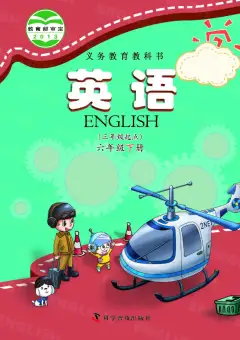
义务教育教科书
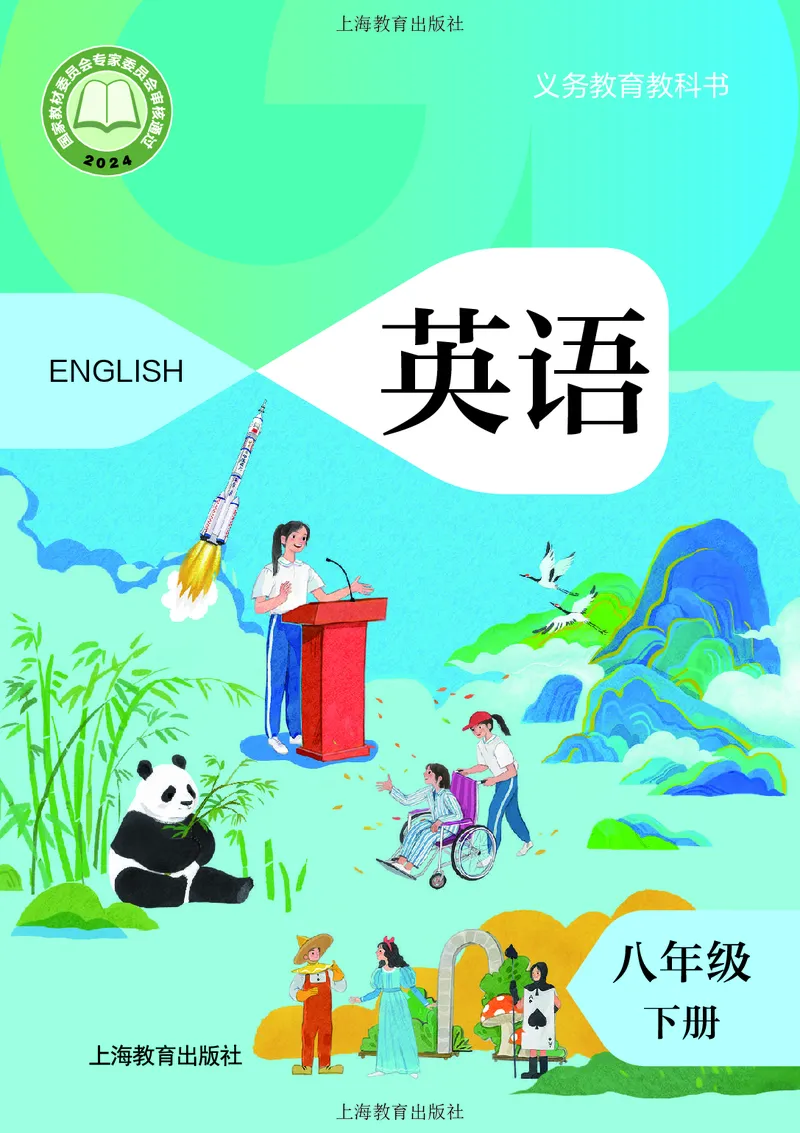
英语
八年级
下册
ENGLISH
上海教育出版社
上海教育出版社
智慧中小学000120260122
英语
英语
义务教育教科书
八年级
下册
主编 舒白梅
上海教育出版社
上海教育出版社
智慧中小学000220260122
主  编:舒白梅
副  主  编:程 林
编写人员:(以姓氏笔画为序)
叶方兴 向宗平 李 睿 何 琳
陈皓曦 秦文娟 倪 宏
责任编辑:周长天 黄 艳
特约审读:张迎庆
美术编辑:朱博韡
封面设计:郑 艺 朱博韡
版式设计:严 冬
插图绘制:庞 坤
本册教材部分图片由图虫网图片库提供
义务教育教科书  英语  八年级  下册
出
版 上海教育出版社(上海市闵行区号景路 159 弄 C 座)
版权所有·未经许可不得采用任何方式擅自复制或使用本产品任何部分·违者必究
上海教育出版社
上海教育出版社
智慧中小学000320260122
致  同  学
亲爱的同学:
英语是当今世界广泛使用的语言,是各国之间交流的重要工具。学习英语能够让我们获
得跨文化交流能力,为自己成长为具有家国情怀、国际视野和跨文化沟通与交流能力的高素
质人才打下基础。
这套教材将陪伴大家度过初中阶段的英语学习。它是一套怎样的教材?
教材的每个单元都有一个主题,围绕主题呈现一个“关键问题”(Key question),以
激发同学们对主题的学习兴趣和初步认识。随着单元学习的推进,我们将基于这个关键问题,
一步步探究该单元的主题意义。在单元主题的统领下,单元内容分为四个以E 开头的部分,
它们之间是循序渐进的关系。
第一个E 是Experiencing and understanding language。这个部分将带领我们体验和
理解英语语言,其中的阅读和听力板块选用了题材广泛、体裁丰富的语篇。同学们能在学习
语言的同时体验生活,了解自我、自然和社会。
第二个E 是Exploring and applying rules。语言意义的理解需要借助一定的语言规则。
同学们需要在不断习得和积累中归纳语言规则,并在语境中运用规则表达意义。
第三个E 是Expressing and communicating ideas。语言是思维的载体和表达思想的
工具,这个部分说和写的活动为同学们提供了运用语言的机会。同学们可围绕单元主题,以
口头或书面形式表达观点,交流思想。
第四个E 是Extending and developing competencies。这个部分提供了丰富的中外文
化和跨学科内容,通过听、说、读、看、写等活动,帮助同学们拓展和扩宽英语学习的边界
和视野,增加学习的深度和广度,进一步提升核心素养。
单元最后的项目(Project)是检测单元学习效果的综合实践活动。这些活动需要同学们
充分运用知识和智慧,开展合作学习,发挥想象力和创造力,以项目成果的形式呈现学习结果。
此外,教材中还有各种小栏目等着同学们去探索。同学们能在“初步思考”栏目(First
thoughts)中初步了解单元主题,在“阅读策略”栏目(Reading strategy)和“提示”栏
目(Tip)中学习阅读、视听等基本方法策略,在“词汇建构”栏目(Word building)中掌
握构词法和词汇的使用规律,在“归纳规则”栏目(Let’s sum up the rules!)中总结英语
语法规则,在“语法综合运用”栏目(Grammar in use)中灵活运用所学语法知识,在“迁
移创新”栏目(Your ideas)中充分交流自己的思想,在文化“注释”栏目(Notes)中了
解多元文化知识,在“自主探究”栏目(Exploring more)中开展自主探究学习,在“名言
警句”栏目(Wits corner)中感悟人生哲理……
希望这套教材为同学们提供珍贵的英语学习体验。通过学习这套教材,同学们能够探索
大千世界,品味不同文化的内涵,学有所思,学有所得,学有所成!
上海教育出版社
上海教育出版社
智慧中小学000420260122
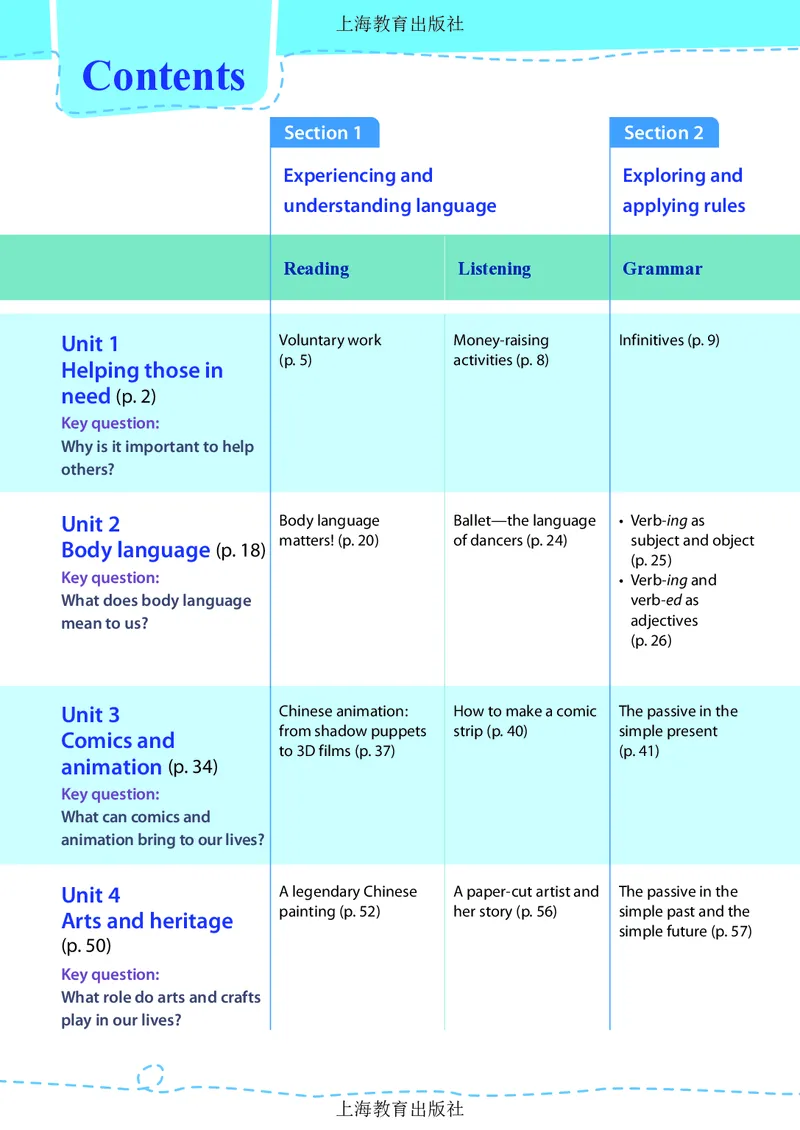
Contents
Section 1
Section 2
Experiencing and
understanding language
Exploring and
applying rules
Reading
Listening
Grammar
Unit 1
Helping those in
need (p. 2)
Key question:
Why is it important to help
others?
Voluntary work
(p. 5)
Money-raising
activities (p. 8)
Infinitives (p. 9)
Unit 2
Body language (p. 18)
Key question:
What does body language
mean to us?
Body language
matters! (p. 20)
Ballet—the language
of dancers (p. 24)
•  Verb-ing as
subject and object
(p. 25)
•  Verb-ing and
verb-ed as
adjectives
(p. 26)
Unit 3
Comics and
animation (p. 34)
Key question:
What can comics and
animation bring to our lives?
Chinese animation:
from shadow puppets
to 3D films (p. 37)
How to make a comic
strip (p. 40)
The passive in the
simple present
(p. 41)
Unit 4
Arts and heritage
(p. 50)
Key question:
What role do arts and crafts
play in our lives?
A legendary Chinese
painting (p. 52)
A paper-cut artist and
her story (p. 56)
The passive in the
simple past and the
simple future (p. 57)
上海教育出版社
上海教育出版社
智慧中小学000520260122
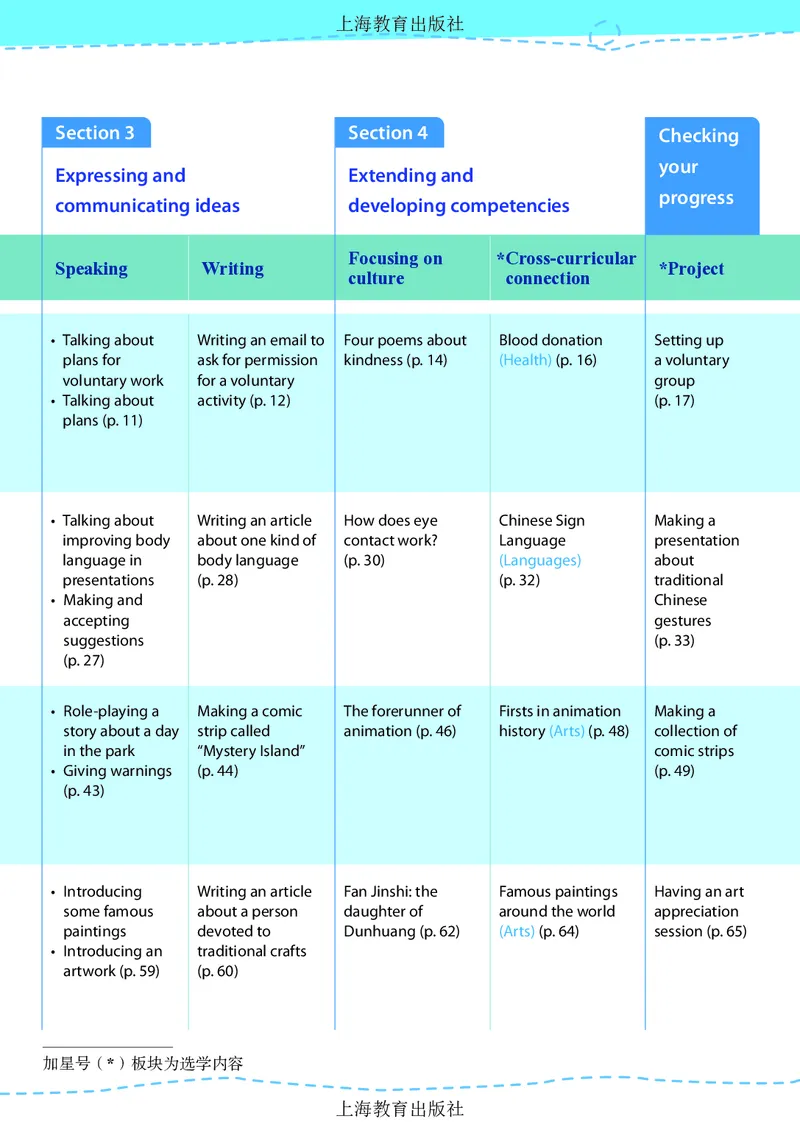
Section 3
Section 4
Checking
your
progress
Expressing and
communicating ideas
Extending and
developing competencies
Speaking
Writing
Focusing on
culture
Cross-curricular
connection
*Project
•  Talking about
plans for
voluntary work
•  Talking about
plans (p. 11)
Writing an email to
ask for permission
for a voluntary
activity (p. 12)
Four poems about
kindness (p. 14)
Blood donation
(Health) (p. 16)
Setting up
a voluntary
group
(p. 17)
•  Talking about
improving body
language in
presentations
•  Making and
accepting
suggestions
(p. 27)
Writing an article
about one kind of
body language
(p. 28)
How does eye
contact work?
(p. 30)
Chinese Sign
Language
(Languages)
(p. 32)
Making a
presentation
about
traditional
Chinese
gestures
(p. 33)
•  Role-playing a
story about a day
in the park
•  Giving warnings
(p. 43)
Making a comic
strip called
“Mystery Island”
(p. 44)
The forerunner of
animation (p. 46)
Firsts in animation
history (Arts) (p. 48)
Making a
collection of
comic strips
(p. 49)
•  Introducing
some famous
paintings
•  Introducing an
artwork (p. 59)
Writing an article
about a person
devoted to
traditional crafts
(p. 60)
Fan Jinshi: the
daughter of
Dunhuang (p. 62)
Famous paintings
around the world
(Arts) (p. 64)
Having an art
appreciation
session (p. 65)
*
加星号(*)板块为选学内容
上海教育出版社
上海教育出版社
智慧中小学000620260122
Section 1
Section 2
Experiencing and
understanding language
Exploring and
applying rules
Reading
Listening
Grammar
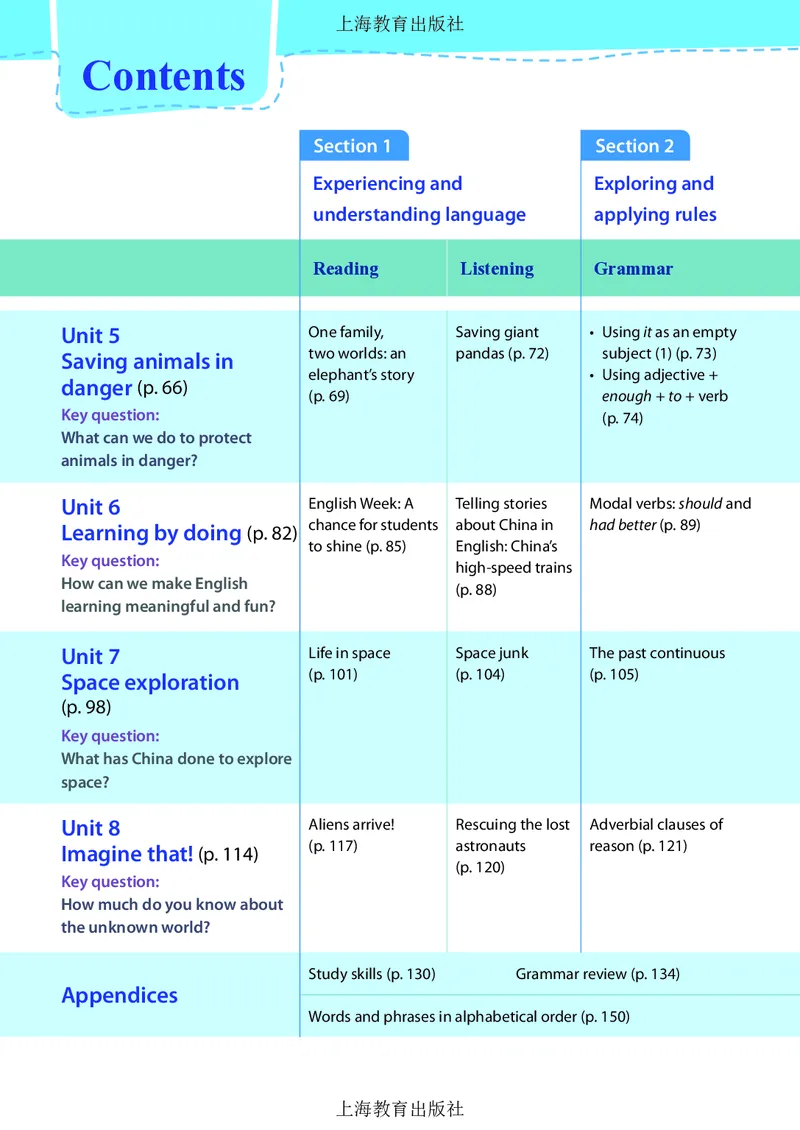
Unit 5
Saving animals in
danger (p. 66)
Key question:
What can we do to protect
animals in danger?
One family,
two worlds: an
elephant’s story
(p. 69)
Saving giant
pandas (p. 72)
•  Using it as an empty
subject (1) (p. 73)
•  Using adjective +
enough + to + verb
(p. 74)
Unit 6
Learning by doing (p. 82)
Key question:
How can we make English
learning meaningful and fun?
English Week: A
chance for students
to shine (p. 85)
Telling stories
about China in
English: China’s
high-speed trains
(p. 88)
Modal verbs: should and
had better (p. 89)
Unit 7
Space exploration
(p. 98)
Key question:
What has China done to explore
space?
Life in space
(p. 101)
Space junk
(p. 104)
The past continuous
(p. 105)
Unit 8
Imagine that! (p. 114)
Key question:
How much do you know about
the unknown world?
Aliens arrive!
(p. 117)
Rescuing the lost
astronauts
(p. 120)
Adverbial clauses of
reason (p. 121)
Appendices
Study skills (p. 130)     Grammar review (p. 134)
Words and phrases in alphabetical order (p. 150)
Contents
上海教育出版社
上海教育出版社
智慧中小学000720260122
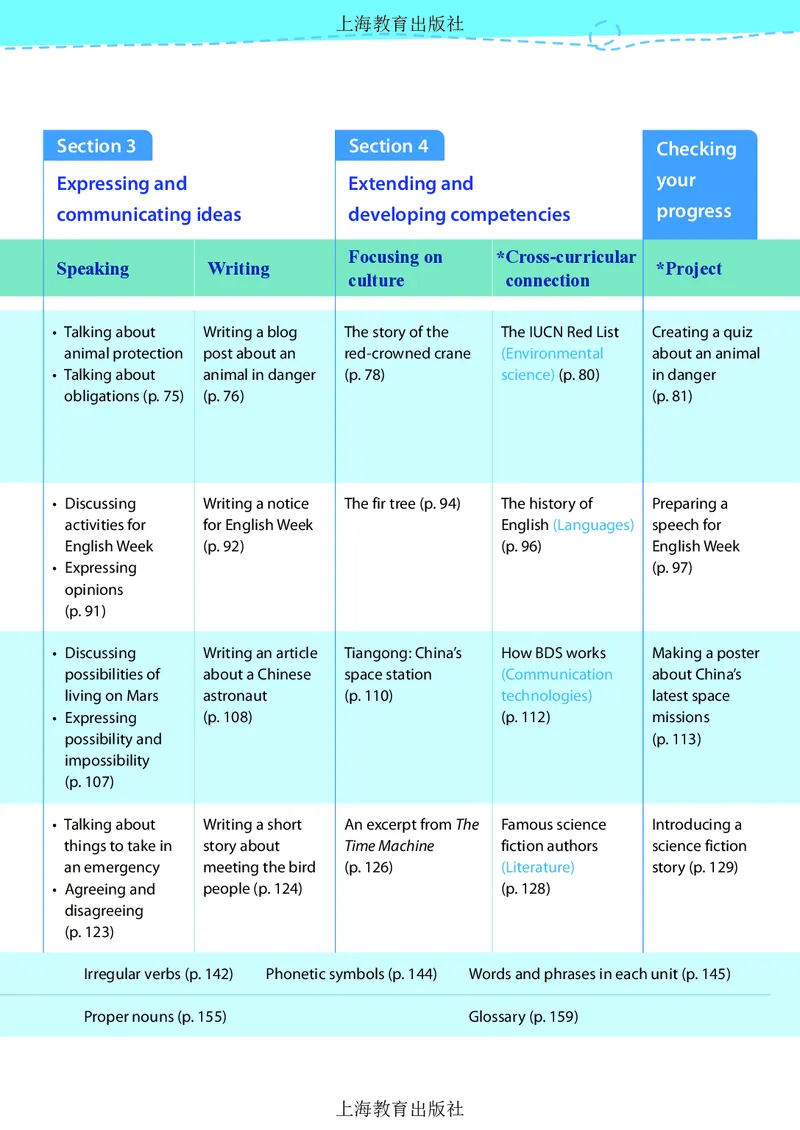
Section 3
Section 4
Checking
your
progress
Expressing and
communicating ideas
Extending and
developing competencies
Speaking
Writing
Focusing on
culture
Cross-curricular
connection
*Project
•  Talking about
animal protection
•  Talking about
obligations (p. 75)
Writing a blog
post about an
animal in danger
(p. 76)
The story of the
red-crowned crane
(p. 78)
The IUCN Red List
(Environmental
science) (p. 80)
Creating a quiz
about an animal
in danger
(p. 81)
•  Discussing
activities for
English Week
•  Expressing
opinions
(p. 91)
Writing a notice
for English Week
(p. 92)
The fir tree (p. 94)
The history of
English (Languages)
(p. 96)
Preparing a
speech for
English Week
(p. 97)
•  Discussing
possibilities of
living on Mars
•  Expressing
possibility and
impossibility
(p. 107)
Writing an article
about a Chinese
astronaut
(p. 108)
Tiangong: China’s
space station
(p. 110)
How BDS works
(Communication
technologies)
(p. 112)
Making a poster
about China’s
latest space
missions
(p. 113)
•  Talking about
things to take in
an emergency
•  Agreeing and
disagreeing
(p. 123)
Writing a short
story about
meeting the bird
people (p. 124)
An excerpt from The
Time Machine
(p. 126)
Famous science
fiction authors
(Literature)
(p. 128)
Introducing a
science fiction
story (p. 129)
Irregular verbs (p. 142)  Phonetic symbols (p. 144)  Words and phrases in each unit (p. 145)
Proper nouns (p. 155)
Glossary (p. 159)
*
上海教育出版社
上海教育出版社
智慧中小学000820260122
2
Key question
Why is it important to help others?
Unit 1
Helping those in need
     Unit objectives
I can:
  name different kinds of voluntary work.
  talk about my plan for voluntary activities.
  explain how we can help ourselves by helping others.
  understand the importance of voluntary work to society.


上海教育出版社
上海教育出版社
智慧中小学000920260122
3
First thoughts
My feelings
People in need of help
My experiences
Helping those
in need
Importance of voluntary
work
• How does voluntary work help others?
• What can you do to help others?
• What voluntary work do you plan to do?
• What do we need to help others?
Think
上海教育出版社
上海教育出版社
智慧中小学001020260122
Reading
Before you read
 In pairs, talk about the different kinds of voluntary work. Why are they important?
helping disabled people
helping elderly people
helping sick people
Voluntary work
teaching children English
teaching childre
teaching childre
teaching childre
teaching childre
looking after homeless dogs or cats
elderly people
elderly people
elderly people
elderly people
picking up litter
How can we help elderly people?
We can go and visit them. That can make
them feel happier and less lonely.
How does voluntary work help others?
Think
i
4
Section1
Experiencing and understanding language
上海教育出版社
上海教育出版社
智慧中小学001120260122
5
Section  1
My mother and I met some children with no parents. The children were quiet
and unhappy. We encouraged them to tell stories from their own life. This helps
them express their feelings. One child said, “My friends don’t understand my
pain. Sometimes I feel like I don’t belong anywhere.”
We spent time with a girl called Liu Yun. Her parents died in a car accident, so
she is very lonely. She is really unhappy and needs
someone to talk to. My mother and I will continue
to visit Liu Yun in our spare time.
10
Wang Jie yesterday
Three teenagers did some voluntary work during the school holidays. Read their online
posts to find out who they helped and what they did.
Voluntary work
Voluntary work
Voluntary work
Voluntary work
Voluntary work
Voluntary work
Voluntary work
Voluntary work
Voluntary work
y
I saw a notice for voluntary work at the children’s hospital, so my
best friend and I offered to help. The children there all suffer from
serious diseases like cancer. Some of them were very sad. We
wanted to cheer them up with some fun activities. For example,
we organized a painting competition to raise their spirits.
I met a girl called Jin Ya. She wanted to paint a picture of the
park near her home. However, she could not go there herself, so I
went to the park and took some photos. Jin Ya used them for her painting.
e
so I
so I
so I
so I
5
Dong Lili 39 minutes ago
I volunteered to help disabled children. Some of
them have difficulty moving around and taking part
in social activities. I taught them to sing because music can bring them joy.
I met a boy called Su Le. He lost his leg in an accident two months ago.
Football is his favourite sport, and he was in low spirits because he could not
play it any more. We can help children like Su Le feel more positive after an
accident. I will continue to do voluntary work in the future.
20
Ding Ling
3 days ago
p
15
上海教育出版社
上海教育出版社
智慧中小学001220260122
6
Unit 1 Helping those in need
Reading comprehension
1  Match the columns with the information from the posts on page 5.
2 Read the posts again and complete the notice below.
Teenager
Who they helped
What the problem was
Dong Lili
Liu Yun
had difficulty moving around
Wang Jie
Su Le
suffered from a serious disease
Ding Ling  Jin Ya
felt very lonely because of her parents’ death
Your ideas
3 Discuss the questions below.
(1) How would you help the children in Exercise 2?
(2)  Have you ever helped someone in a similar situation? How did you help him or
her?
(3)  Can you think of other people who might need help? What can you do to help
them?
Volunteers needed
Can you help these children?
Jin Ya, aged 12
Jin Ya is in
(1)________________. She wants to
(2)______________________.
We need someone to
(3)___________________________________ for Jin Ya.
Liu Yun, aged 13
Liu Yun’s parents died in
(4)________________. She is lonely and unhappy.
We need someone to
(5)________________ and keep her company.
Su Le, aged 14
Su Le loves sport. He used to play football until he
(6)___________________.
We need a volunteer to give him some singing lessons because music can
(7)___________________.
Notice
上海教育出版社
上海教育出版社
智慧中小学001320260122
7
Section  1
Vocabulary practice
1  The words and phrases in italics are from the posts on page 5. Match the sentence
halves.
disease pain raise ... spirits suffer from voluntary work
Every Saturday afternoon, Li Dong does
(1)_______________ at the
children’s hospital. He sings and plays the guitar for the children. This always
(2)____________ the children’s ____________. One of the children, Lu
Jia, has been in hospital for a long time. She
(3)_______________ a serious
(4)____________. Last week, Lu Jia asked Li Dong to play her favourite
song. At the end of the song, Lu Jia started to cry. Li Dong was worried. But
Lu Jia said, “I am crying because I feel happy. You helped me forget my
(5)____________ for a while.” Li Dong is now organizing a music concert at
the hospital. He wants more children to take part in the concert.
3  Write about voluntary activities you plan to take part in with the words and phrases
below.
(1)  Kate suffers from a serious illness,
a  after I kicked a stone by accident.
(2)  This is not a very serious disease,
b  but she is still very positive.
(3)  I was in a lot of pain
c   so most patients get better after a few
days.
(4) In order  to raise the team’s spirits,
d  so I suggested going for a walk in the
park.
(5)  Tim was in low spirits,
e   the fans sang songs.
2  Complete the passage with the words and phrases below. Change the form if necessary.
disabled lonely
offer  organize
unhappy
encourage ... to ... express one’s feelings have difficulty doing ...
in low spirits
in need
Negative prefixes: un-, dis-
We add un- or dis- to the beginning of a word to make it negative.
happy→unhappy
appear→disappear
Can you give more examples?
Word building
上海教育出版社
上海教育出版社
智慧中小学001420260122
8
Unit 1 Helping those in need
1  You are going to listen to a podcast about how students in the UK can raise money.
Match the verbs with the nouns and noun phrases.
Listening
Money-raising activities
2 Listen to the podcast and answer the questions.
(1) Who are Doris and David? What did their classes do?
(2) Why did Teenagers’ Voice interview them?
3 Listen again and complete the notes below.
   How did your class raise
money?
How much money
did you raise?
What will you use
the money for?
•  A (1)_____________________
for students
• Everyone paid money to
take part.
More than
(2)_______________
pounds
To (3)_____________
______________ for
the school library
• A (4)_______________ in the
school stadium
• The students sold
(5)_______________________.
(6)_______________
pounds
To (7)_____________
______________ for
elderly people in
the community
mon
mon
mon
mon
• A
• A
• A
• A (1)
(1)
(1)
(1)
Doris
• A
• A
• A
• A (4)
(4)
(4)
(4)
David
(1) organize _______
(2) sell _____________
A
B
a a book fair
e clothes
b a dance competition
f food
c a money-raising activity
g snacks
d books
Your ideas
4  Which money-raising activity would you like to take part in? Why? Discuss in pairs.
What can you do to help others?
Think
i
上海教育出版社
上海教育出版社
智慧中小学001520260122
1  Dong Lili is visiting Jin Ya in the hospital. Complete their conversation with the correct
form of the words in brackets.
Dong Lili:  Morning, Jin Ya. We’re organizing a painting competition, and we’re
(1)__________________ (invite, everyone, take part in) it. Would you
like to take part?
Jin Ya:
 Yes, I’d love to! I
(2)______________ (want, paint) a picture of the
park near my home, but the doctor won’t
(3)______________ (let, I,
go) out. He
(4)______________ (tell, I, stay) in hospital.
Dong Lili:  Do you
(5)______________ (want, I, take) some photos for you?
Jin Ya:
 Yes, that would be very kind of you!
Dong Lili:  I’ll go there this weekend to take some
photos. I’ll show them to you next week and
(6)__________________ (teach, you, paint).
Jin Ya:
 Thanks for your help!
•  We often use to + infinitive after these verbs: want, continue, offer, plan,
etc.
•  We often use object + to + infinitive after these verbs: encourage, tell, ask,
etc.
Let’s sum up the rules!
Look!
After certain verbs, such as see, hear, help, make and let, we usually use
infinitives without to.
He saw a volunteer help an elderly lady.
She heard the singer perform for the children in the next room.
The students helped the woman (to) find her bag.
Grammar
Infinitives
The infinitive is the basic form of a verb. Some verbs can be followed by to +
infinitive or object + (to) + infinitive.
Read the sentences below. Pay attention to the words in bold.
Jin Ya wanted to paint a picture of the park near her home.
We encouraged them to tell stories from their own life.
My mother and I will continue to visit Liu Yun in our spare time.
9
Section2
Exploring and applying rules
上海教育出版社
上海教育出版社
智慧中小学001620260122
10
Unit 1 Helping those in need
2  Answer the questions below with infinitives. Use the information from the posts on
page 5 to help you.
(1)  Why did the three teenagers offer to do some voluntary work during the school
holidays?
(2) Why did Dong Lili go to the children’s hospital?
(3) Why did Dong Lili go to the park near Jin Ya’s home?
(4) Why did Wang Jie and his mother encourage Liu Yun to share her stories?
(5) Why did Ding Ling teach disabled children to sing?
Read the poster below. Pay attention to the words in bold.
What do you
want
to do
to help people in need?
plan
hope
...
S1:
What do you plan to do to help people in need?
S2:
I plan to raise money to buy books for children with no parents, and I hope to
raise ¥300. What about you?
S3:
I want to help elderly people do their housework.
...
Wash your hands to stay clean.
Wash your hands to get rid of viruses.
Wash your hands to prevent the spread of diseases.
Wash your hands to keep everyone healthy!
Wash your hands
Grammar in use
3  Talk in groups about doing voluntary work. Use the questions to help you.
We can use infinitives to express the purpose of an action.
Let’s sum up the rules!
上海教育出版社
上海教育出版社
智慧中小学001720260122
Speaking
Talking about plans for voluntary work
1  Two students are talking about the voluntary work they plan to do. Read the dialogue
and learn how to talk about plans. Pay attention to the expressions in blue.
look after homeless cats  volunteer at a museum
read books for the blind  ...
S1:  What voluntary work
are you going to do?
S2:  I’m going to volunteer
in a children’s home.
S1:  What are you going to
do there?
S2:  I’m planning to help
the children with their
homework. I’m also hoping to do
some gardening and play football
with them. What about you?
S1:
I’ll help elderly people in an old people’s home.
S2: Sounds great! How are you going to help them?
S1:
I’m thinking about teaching them to use smartphones.
Talking about plans
Describing future plans is an important part of life. Here are some
common structures:
• If we are certain about our plans, we use I’m going to ... or I’ll ...
•  If we are less / not certain, we use I want to ..., I’m planning to ..., I’m
hoping to ... or I’m thinking about ...
 2  Imagine that you and your friend have decided to do voluntary work. In pairs, discuss
what kinds of activities you plan to do.
Improving your communication
11
Section3
Expressing and communicating ideas
What voluntary work do you plan to do?
Think
i
上海教育出版社
上海教育出版社
智慧中小学001820260122
12
Unit 1 Helping those in need
Writing
Writing an email to ask for permission for a voluntary
activity
W
1  Wang Yao has written an email to her head teacher to ask for permission for a
voluntary activity. Read the email and tick (✓) the points that are included.
You and your classmates are planning a voluntary activity. You need
to get permission from the head teacher.
(1) Why Wang Yao has written the email
(2) What voluntary activity Wang Yao and her classmates are going to organize
(3) Who they are going to help
(4) How many students are going to take part in the activity
(5) When and where they are going to have the activity
(6) How much money they will need
(7) What they are going to do there
Ms Yan
Organize a voluntary activity
Dear Ms Yan,
I am writing to you about my group’s plans to start a voluntary activity.
In order to help children in need, we plan to organize a visit to the children’s
home next week. Five students from our class have offered to help.
We plan to teach the children there to do fun activities like flower arranging
and paper-cutting. Some local shops have donated craft materials for us to
use. We are also thinking about helping the children tidy up their rooms.
We would like to visit the children’s home on Saturday, 23 March. Could
you please give us permission to organize the activity? Thank you for your
support!
We look forward to your reply.
Yours sincerely,
Wang Yao
上海教育出版社
上海教育出版社
智慧中小学001920260122
13
Section  3
▪  I used polite language in my email.
▪I explained the purpose at the beginning of the email.
▪  I used certain expressions, such as ______________________________,
to explain our plans clearly.
▪I used the words and expressions I learnt in this unit.
▪I used correct spelling, grammar and punctuation.
2  Write your email to your head teacher to ask for permission.
    Step 1  Plan
Brainstorm what voluntary activity you plan to organize and


take notes. Use the points in Exercise 1 to help you.
    Step 2  Write
Write an email to ask for permission.
Step 3  Check and revise
Tick (✓) the boxes to check your writing, and then
revise it.
上海教育出版社
上海教育出版社
智慧中小学002020260122
Focusing on culture
F
Little things
by Julia Abigail Fletcher Carney
Little drops of water,
Little grains of sand,
Make the mighty ocean
And the pleasant land.
Little deeds ① of kindness,
Little words of love,
Help make earth happy
Like the heaven above.
I know you are feeling sad
(author unknown)
I know you are feeling sad,
Because things aren’t going right.
Though I can’t be with you there,
I want you to know how much I
care.
So I wrote this little poem for you.
I hope it will help you to continue.
Kind hearts are the gardens
by Henry Wadsworth Longfellow
Kind hearts are the gardens,
Kind thoughts are the roots,
Kind words are the flowers,
Kind deeds are the fruits.
Take care of your garden,
And keep out the weeds ②,
Fill it with sunshine,
Kind words, and kind deeds.
②
s
If I can stop one heart from breaking
by Emily Dickinson
If I can stop one heart from breaking,
I shall not live in vain;
If I can ease one life the aching,
Or cool one pain,
Or help one fainting ③ robin ④
Unto ⑤ his nest ⑥ again,
I shall not live in vain.
1  Read the four poems and think about why and how we could help people in need.
(1)
(2)
(3)
(4)
① deed /di:d/ n. 行为;行动 ② weed /wi:d/ n. 杂草 ③ faint /feInt/ v. 晕厥
④ robin /9rBbIn/ n. 知更鸟 ⑤ unto /9Vntu/ prep. 朝;向 ⑥ nest /nest/ n. 鸟巢
What do we need to help others?
Think
i
You may think you need special skills to help others, but all you really need is
kindness. Let’s find out how we can help others with kindness.
Four poems about kindness
14
Section4
Extending and developing competencies
上海教育出版社
上海教育出版社
智慧中小学002120260122
15
Section  4
2  Read the poems again and fill in the blanks with the correct number.
(1) Poem _____ shows that it is important to have kind thoughts.
(2) Poem _____ shows that helping others makes life meaningful.
(3) Poem _____ shows that we should support our friends when they are sad.
(4)  Poem _____ shows how even a small act of kindness can make a big difference.
3  Find the words and the phrase in the poems with these meanings.
(1) pleasing and beautiful
___________ (Poem 1)
(2) great, powerful
___________ (Poem 1)
(3) to make less serious
___________ (Poem 3)
(4) to feel pain
___________ (Poem 3)
(5) without success
___________ (Poem 3)
•  Julia Abigail Fletcher Carney was an educator, poet, author
and editor in the 19th century.
•  Henry Wadsworth Longfellow was a poet and educator in
the 19th century.
•  Emily Dickinson was a poet in the 19th century. Her work
has had a strong influence on modern poetry.
Notes
Helping others can make the world a better place. Go online and find out
more about voluntary work and volunteering.
Exploring more
Your ideas
4  Discuss the questions below.
(1) What can we learn from helping others?
(2) How can we help ourselves by helping others?
上海教育出版社
上海教育出版社
智慧中小学002220260122
16
Unit 1 Helping those in need
Cross-curricular connection Health*
There are many different ways to help others. Donating blood is one of them.
1  Read the text about blood donation and answer the questions below.
C
2  Will you consider donating blood when you become an adult? Discuss in groups.
Why donate blood?
Donating blood saves lives.  About one in seven people in hospital need blood
in order to get better or even survive. Therefore, a blood donation can be a
life-giving gift for someone.
Who can donate blood?
In many countries, a person needs to be healthy and older than 18 to donate
blood. Blood donors should also weigh at least 50 kg.
What are the different blood types?
It is important to know a person’s blood type before they donate or receive
blood.  Most countries use the ABO system to group blood types. There are four
main blood groups in this system: A, B, O, and AB.
Type O is the “universal donor”. This means that people of any ABO blood type
can accept Type O red blood cells. (see purple lines)
Type AB is the “universal recipient”. People with this type of blood can usually
receive red blood cells from donors with any ABO blood type. (see bottom-
right part of illustration)
What is World Blood Donor Day?
World Blood Donor Day (WBDD) is celebrated
every year on 14 June. This date is the birthday
of the Nobel Prize winner Karl Landsteiner. He
discovered the ABO blood group system.
Blood donation
(1) Who is qualifi ed to donate blood?
(2)  A patient with blood type B needs to receive blood immediately. What type(s)
of blood can the patient receive?
(3) Who was Karl Landsteiner and what did he discover?
上海教育出版社
上海教育出版社
智慧中小学002320260122
Project*
Setting up a voluntary group
What can you do to help others in your local area? In groups, discuss different ways of
helping others. Then set up a voluntary group and create a poster to ask for more volunteers.
Step 1
 Set a goal for your voluntary group. Think about the following questions.

• Who are you going to help?

•  Why are you going to help them?
Step 2
 Name your voluntary group and create a slogan and a logo.
Step 3
Think of suitable activities for your group.

•  What can you do to help these people?
Step 4
 Make a poster to introduce your voluntary group.
Step 5
Show the poster and give a presentation to the class.
An act of kindness, no matter how small, is worth performing.
— Liu Bei ①
Wits corner
p
A
W
Super Teen Helpers—We help elderly people
Alone or together, not lonely any more!
What do we do?
We visit elderly people every weekend and …

• help clean their rooms

• go for walks with them

• chat with them

• teach them to use smartphones

...
Become a member of Super Teen Helpers today. You can apply by sending
an email to Liuyan@...
① Liu Bei 刘备
17
Checking your progress
上海教育出版社
上海教育出版社
智慧中小学002420260122
     Unit objectives
I can:
  describe appropriate body language in different situations.
  give advice on using appropriate body language
in communication.
  describe cultural differences in body language.
  understand the importance of body language.


18
Key question
What does body language mean to us?
Unit 2
Body language
上海教育出版社
上海教育出版社
智慧中小学002520260122
My use of body
language
Importance of
body language
Body language in
different cultures
Body
Body
language
language
First thoughts
19
•  How does body language help us communicate?
•  How does body language help people express their
thoughts and feelings?
•  How can we use body language effectively?
•  How does body language differ across cultures?
Think
上海教育出版社
上海教育出版社
智慧中小学002620260122
20
Section1
Experiencing and understanding language
20
Li Lele and Wang Haoran are university students. They both have
part-time jobs at a travel company.
A well-dressed lady entered the office. She
looked at Li Lele and Wang Haoran, and then
walked over to Lele. Lele looked excited. “Good
morning, madam!” she said cheerfully.
Haoran sighed
② and walked away.
“What’s the matter?” asked Mr Yang, the boss.
“People always choose Lele instead of me.
I don’t understand.”
“I do. It’s the way you communicate.”
“How can that be?” Haoran asked. “I don’t get a chance to speak.”
“Communicating means more than just speaking. Your body language is
important too.”
“Body language?”
“It’s the way you stand and sit. It’s your gestures
③ and the expressions
5
10
15
Reading
Before you read
Look at the pictures . Why do people use these kinds of body language? Discuss in pairs.
Read the story and think about the differences between Lele’s and Haoran’s body language.
② sigh /saI/ v. 叹气
How does body language help us communicate?
Think
i
① fist /fIst/ n. 拳头
Body language matters!
③ gesture /9dZestSR(r)/ n. 手势;姿势
shaking his fists①
(1)
(2)
crossing his arms
clapping
(3)
上海教育出版社
上海教育出版社
智慧中小学002720260122
resting her head
on her hand
(6)
I think she wants to show her appreciation. We always clap
our hands when we enjoy a play or show.
cheering
(5)
on your face. Your whole appearance communicates things. You don’t
give people a good impression, Haoran. You look down, you never smile,
and you don’t turn your head towards them.
“Look at Lele. She’s holding her head up. She always smiles and looks
friendly. Her body language is making people feel welcome, so they go
to her for help.”
Haoran observed Lele carefully for a while and then decided to improve
his own body language. He sat up straight and tried smiling at people.
Minutes later, a beautiful girl entered. She walked over to Haoran. A
few moments later, she left with a smile.
Mr Yang came over at once and said, “You made a good impression on
her, Haoran.”
“That was my sister,” said Haoran. “She wanted to remind me that
tomorrow is her birthday.”
20
25
30
Look at picture 3. The girl is clapping her hands.
Why do you think she is doing this?
(4)
covering his mouth
with his hands
Identifying the speaker
In a written conversation, a new paragraph starts and ends with quotation
marks (“...”). If a paragraph does not end in a quotation mark, the same speaker
continues speaking in the next paragraph. Mr Yang’s line of dialogue starts on
line 16. Where does it end?
Reading strategy
21
Section  1
上海教育出版社
上海教育出版社
智慧中小学002820260122
Reading comprehension
1  Wang Haoran is talking to a friend on the phone. Complete the speech bubble with the
information from the story on pages 20 and 21.
Your ideas
3  Lele and Haoran gave people very different first impressions. Have you had any similar
experiences? Share your stories in groups.
2  Read the story again and answer the questions below.
(1) What is body language, according to Mr Yang?

_______________________________________________________________________________
(2) Why did Wang Haoran not give customers a good impression?

_______________________________________________________________________________
(3) Why did customers always choose to talk to Li Lele?

_______________________________________________________________________________
(4) What happened after Wang Haoran sat up straight and tried smiling at people?

_______________________________________________________________________________
(5) Why did the girl walk over to Wang Haoran?

_______________________________________________________________________________
Our customers always (1)__________________.
I didn’t know why, but Mr Yang told me the reason.
It was because of (2)__________________. I wasn’t
giving customers (3)__________________. My
(4)__________________ wasn’t making them
(5)__________________. So I need to improve it.
22
Unit 2 Body language
上海教育出版社
上海教育出版社
智慧中小学002920260122
Vocabulary practice
1  Find the words and phrases in the story on pages 20 and 21 with these meanings.
(1) someone who tells other people what to do at work _______________ (line 8)
(2) to keep something in the same position
_______________ (line 20)
(3) to look at and learn from somebody or something _______________ (line 23)
(4) to move yourself into a sitting position
_______________ (line 24)
(5) to cause people to have a good opinion of you
_______________ (line 27)
2  Complete the conversation with the words and phrases below. Change the form if
necessary.
boss hold up make a good impression on remind sit up
Liu Dong:  Hi Uncle Li, I’ve got an interview next week for a new job! I know
that you are the
(1)__________________ of a big company. Can you
give me some tips, please?
Uncle Li:  Well, you really need to think about your body language if you want to
(2)__________________ your interviewer.
Liu Dong:  What do you mean?
Uncle Li:   Well, think about how you hold your body during the interview.
Liu Dong:  Do you mean that I should
(3)__________________ straight?
Uncle Li:  Exactly. You should also
(4)__________________ your head and make
eye contact with the interviewer. This will show them that you are
interested.
Liu Dong:  That’s a good point. Thanks for
(5)___________________ me, Uncle Li!
Uncle Li:  No problem! Good luck!
observe   remind
sigh
gestures and expressions
give ... a good impression  look down
make ... feel welcome
smile at
sit up straight  walk away
3  Summarize the story of Lele and Haoran with the words and phrases below.
Noun suffi x: -ion
We can add -ion to the end of a verb to make a noun.
express→expression
impress→impression
invent→invention
act→action
Can you give more examples?
Word building
23
Section  1
上海教育出版社
上海教育出版社
智慧中小学003020260122
1  You are going to listen to a lecture about ballet. Write down what you know
about ballet and what you expect to hear in the lecture.
(1) What I know about ballet: __________________________________________
(2) What I expect to hear: _____________________________________________
2  Now listen to the lecture and note down the main ideas. Did the speaker mention the
things you expected?
________________________________________________________________
 ________________________________________________________________
Listening
Ballet—the language of dancers
3 Listen again and complete the notes below.
Your ideas
4  Besides ballet, what other types of performing arts do you know? How do performers
use their body language to tell stories and express their thoughts and feelings? Share
your ideas with your classmates.
•  The ballet dancers express themselves through
(1)__________________.
They also use other forms of body language, such as gestures and
(2)__________________, to tell stories.
•  Ballet started in Western Europe in
(3)__________________.
•
(4)__________________ is one of the most famous ballets in
the world. In the dance, the Swan Queen
(5)__________________ to
mean love and
(6)__________________ to say forever.
•  Ballet dancers start training at
(7)______________________.
  The dancers learn to use their bodies to
(8)______________________.
How does body language
help people express their
thoughts and feelings?
Think
i
24
Unit 2 Body language
上海教育出版社
上海教育出版社
智慧中小学003120260122
25
Section2
Exploring and applying rules
Grammar
A Verb-ing as subject and object
We can use the verb-ing form as a noun. These nouns refer to actions and activities.
Communicating means more
than just speaking.
My friend Lu Na and I were talking about people’s hobbies the other day.
Lu Na said her cousin Lu Yao has an interesting hobby:
(1)____________
(draw) portraits.
(2)____________ (study) people’s facial expressions is an
important part of her hobby. She likes
(3)____________(observe) people’s
faces and
(4)____________ (guess) what they are thinking or how they are
feeling. She is not always right, but she is not afraid of
(5)____________
(make) mistakes. When she makes a mistake, she simply smiles and
says, “Oh well, I was wrong.” She says that
(6)____________ (smile) can make people around
you feel good. I have not known anyone like Lu
Yao, and I look forward to
(7)____________ (meet)
her in person.
1  Complete the passage with the correct  form of the verbs in brackets.
•  We can use verb-ing as the subject or object of a sentence.
•  When we use verb-ing as the subject, the main verb is in singular form.
Let’s sum up the rules!
Look!
• The verb-ing form is usually uncountable. We do not add a or an before it.
 Cycling is his favourite hobby.
•  Verb-ing can have its own object.
 She loves playing chess.
上海教育出版社
上海教育出版社
智慧中小学003220260122
2  Complete the sentences with the correct form of the words in brackets.
(1)  Haoran, it seems like you don’t want to talk to the customers. It’s not ________
(surprising / surprised) that they don’t want to talk to you either.
(2)  Some people are not very patient, so they get ________ (boring / bored) easily.
(3) His explanation was ________ (confusing / confused). Nobody understood it.
(4)  Lu Yao is very ________ (interesting / interested) in art and goes to art galleries
every Saturday.
(5)  I’m starting a new part-time job next week. I’m very ________ (exciting /
excited) about it.
(6)  Li Chen is a good storyteller. His stories are very ________ (amusing /
amused).
Grammar in use
3  Read the poem. Pay attention to the underlined words. Then try writing your own
poem using as many verb-ed and verb-ing forms as possible.
B Verb-ing and verb-ed as adjectives
Don’t worry!
I study very hard,
But English grammar makes me confused.
When I make silly mistakes,
My teacher is amused.
But I’m not worried; I just smile.
Grammar can be confusing.
I really don’t mind,
If my mistakes are amusing.
Wang Haoran was sitting at his desk.
Nobody spoke to him. He was bored
and he thought his job was boring.
•  Adjectives that end in -ed usually
describe how people feel.
•  Adjectives that end in -ing usually
describe the thing or person that
makes people feel a certain way.
Let’s sum up the rules!
26
Unit 2 Body language
上海教育出版社
上海教育出版社
智慧中小学003320260122
Speaking
Talking about improving
body language in presentations
1  One student is practising his presentation in front of two classmates. Read the dialogue
and learn how to make and accept suggestions. Pay attention to the expressions in
blue.

S1: ... How can I improve my presentation?

S2:  I liked it, but maybe you should think about your body language.

S1: OK, what do you think I should do?

S2:  You look a bit nervous when you speak. I think you should try to breathe
slowly and relax. Besides, you’re always looking at your notes. If you want
to connect with your audience, you’d better make more eye contact with
them.

S1: Oh, that’s a good suggestion!

S3:  Also, why don’t you try using gestures to emphasize your points?

S1: That’s a good idea!

S3:  You didn’t keep your back straight during your presentation. If I were you, I
would stand up straight.

S1: I’ll try that next time. Thank you both!
How can we use body language effectively?
Think
i
Sometimes we need to suggest ideas or things to do. We also need to
know how to accept suggestions. Here are some common expressions:
Making suggestions
Accepting suggestions
• Maybe / I think you should ...
• That’s a good suggestion!
• Why don’t you ...?
• That’s a good idea!
• You’d better ...
• I’ll try that next time.
• If I were you, I would ...
Improving your communication
2  Three students are giving presentations in class. How can they improve their body
language? Choose one of the situations below and role-play making and accepting
suggestions.
•  Wu Di is looking at the whiteboard all the time. He is not looking at the audience.
•  Han Li is looking down while she is talking. She is also playing with her hair as
she speaks.
•  Wang Jun is very nervous, and his hands are shaking during the presentation.
27
Section3
Expressing and communicating ideas
上海教育出版社
上海教育出版社
智慧中小学003420260122
Writing
Writing an article about one kind of body language
W
1  Wang Yao wrote about nodding. Read her article and find out the meanings of
nodding.
Understanding different kinds of body language can help us
communicate more effectively. Write a short article to introduce one
kind of body language.
crossing one’s arms
shaking one’s head
crossing one’s fingers
shaking one’s fists
Nodding: a simple but useful gesture
When you nod, you move your head up and down. This gesture can have
many different meanings.
To begin with, a nod often shows agreement. For example, when I asked
my father if I could join a voluntary group, he just nodded,
and I immediately understood what he meant. This meaning
of nodding is very common. In fact, we use the phrase “give
someone the nod” to show that someone said yes.
However, a nod does not always mean you agree. Nodding
your head can simply mean that you are listening and paying
attention. You can also nod your head to encourage someone
to continue speaking.
Understanding the different meanings of a simple gesture like
a nod can help us improve our communication.
2  Now write an article about one kind of body language.
    Step 1
Plan
Pick a kind of body language from the list below or choose

another one. Then do some research and make notes.
28
Unit 2 Body language
上海教育出版社
上海教育出版社
智慧中小学003520260122
▪I followed a clear outline and organized the information in a logical way.
▪ I introduced two or more meanings of this type of body language and
provided examples.
▪I used the words and expressions I learnt in this unit.
▪I used correct spelling, grammar and punctuation.
Meanings of ___________:
(1) _______________________________________________________________
(2) _______________________________________________________________
(3) _______________________________________________________________
    Step 2 Write
Write about this kind of body language. You may refer to Wang

Yao’s article and your notes. Try to give your article an eye-catching

title.
Step 3 Check and revise
Tick (✓) the boxes to check your writing, and then

revise it.
29
Section  3
上海教育出版社
上海教育出版社
智慧中小学003620260122
Focusing on culture
F
1  Read the online article about eye contact and find out how it is viewed in different
cultures.
How does body language differ across cultures?
Think
i
How does eye contact work?
Eye contact means looking into another person’s eyes. It is a very important
part of body language. You may avoid looking someone in the eye when
talking with them because you are shy. But in many cases, eye contact is
the key to good communication. You can show friendliness, interest and
understanding through eye contact.
Eye contact can mean different things in different places. For example, in
northern Europe, direct eye contact is a sign that you are truly interested in
what the other person is saying. If you look down and avoid eye contact, a
northern European may think you are not listening to what they are saying.
However, in many Asian countries, looking down when talking with an
older person, like a teacher or a parent, is polite.
These differences can cause problems. Suppose that an East Asian woman
meets a person from northern Europe for the first time. If she avoids direct
eye contact during the conversation, the northern European may think her
behaviour is strange. He or she may even believe that the woman is lying,
or that she is not confident. In fact, the East Asian woman is most likely
showing respect and being polite.
Avoiding eye contact can cause problems, but
too much eye contact is not polite either. In
many countries, looking at other people for
a long time is impolite. This may make them
feel uncomfortable.
5
10
15
20
Understanding body language can help us communicate better. Let’s explore how
people around the world use eye contact.
30
Section4
Extending and developing competencies
上海教育出版社
上海教育出版社
智慧中小学003720260122
Eye contact plays an important role in communication. Maintaining
eye contact makes it easier to build an emotional connection with
the other person. Psychologists ① study eye contact to learn more
about how the brain works, and doctors may nowadays look at
eye contact to identify illnesses and other health problems.
Notes
3  Find the words in the article and match them with their meanings.
(1) case (line 3)
a a particular situation
(2) direct (line 7)
b feeling uneasy
(3) suppose (line 12)
c the way that you act, especially towards others
(4) behaviour (line 15)
d straight
(5) uncomfortable (line 22)
e to imagine that something is true
Your ideas
4 Discuss the questions below.
(1) Why does the article say “eye contact can be the key to communication”?
(2)  How do your friends and other people around you use eye contact when they
are talking? Do some people use more / less eye contact than others?
To learn more about cultural differences in body language, you can search for
articles online about signs and gestures that mean different things in different
cultures (e.g. nods and headshakes).
Exploring more
2 Answer the questions below with the information from the article on page 30.
(1) What does “eye contact” mean?
(2)  What kinds of things do people express through eye contact?
(3)  What may happen if an East Asian woman avoids direct eye contact when
talking to a northern European?
(4)  What is an Asian woman most likely showing if she looks down and avoids eye
contact during a conversation?
(5) What kind of eye contact is impolite in many countries?
① psychologist /saI9kBlRdZIst/ n. 心理学家
31
Section  4
上海教育出版社
上海教育出版社
智慧中小学003820260122
Cross-curricular connection Languages*
Body language is an important part of communication. Do you know how deaf
people communicate?
1  Read the text about Chinese Sign Language and write what the signs in the pictures
mean.
C
Chinese Sign Language
2  Do you know any other CSL signs? Share with your classmates.
① index fi nger /9Indeks fINGR(r)/ n. 食指 ② palm /pA:m/ n. 手掌
③ curve /kF:v/ v. 弯曲 ④ thumbs-up /0PVmz 9Vp/ n. 竖起大拇指
Sign language is a system of communication for deaf people. It uses a mix of
hand signs, facial expressions and hand movements.
People from different parts of the world use different sign languages. Sign
language is not simply a “silent version” of any spoken language. There is often
a strong relationship between a country’s sign language and its culture. In China,
the offi cial sign language is Chinese Sign Language (CSL).
Here are some simplifi ed examples of signs from CSL:
Yes
Yes Cross your index fi nger① and middle fi nger of one hand, point the fi ngertips
forwards and upwards, and press down.
Listen
Listen Raise your hand behind your ear, palm ② outwards, fi ngers slightly
curved ③.
No
No Raise one hand upright with the palm outwards and swing it from side to
side.
Thanks
Thanks Make a thumbs-up ④ sign, and bend your thumb forward twice with a
smile on your face.
Love
Love Make a thumbs-up sign with your left hand, point it forwards and gently
stroke the back of the thumb with the right hand.
Remember: these descriptions are simplifi ed. If you want to learn CSL, you can
take a course or watch offi cial training videos. There are also handbooks and
other reference materials available.
(1)
(4)
(5)
(2)
(3)
_________
_________
_________
_________
_________
32
Unit 2 Body language
上海教育出版社
上海教育出版社
智慧中小学003920260122
Project*
Making a presentation about traditional Chinese
gestures
Chinese people use many traditional gestures to show respect, politeness, etc. In this
project, you are going to work in groups and make a presentation to introduce a
traditional Chinese gesture.
Step 1
 In your group, pick one of the traditional Chinese gestures below for your
presentation. You may also choose another gesture.
The body says what words cannot.
— Martha Graham
Wits corner
T
W
Step 2
 Find information about the gesture. Use the questions below to help you.

• How do we make the gesture, and what is it called?

• What does the gesture mean?

• When is it used?
Step 3
 Make a presentation with the information you found in step 2. In your
presentation, you may role-play a situation where you use the gesture.
I am going to introduce a Chinese traditional
gesture called zuoyi. It is a polite way to show your
appreciation, greet, apologize or ask for help. We make
the gesture like this: place one hand over the other,
and then bow slightly.
We can use this gesture in the following situations: ...
zuoyi
baoquan
33
Checking your progress
上海教育出版社
上海教育出版社
智慧中小学004020260122
34
① animation /0ænI9meISn/ n. 动画片
Key question
What can comics and animation bring to our lives?
Unit 3
Comics and animation
①
     Unit objectives
I can:
  describe the development of Chinese animation.
  explain how to make a comic strip.
  talk about different types of Chinese animation.
  understand the history of animation.


上海教育出版社
上海教育出版社
智慧中小学004120260122
35
First thoughts
My favourite comic
My favourite animated film
History of animation
Popular comics and
animated films
Comics and
animation
• What do you know about Chinese animation?
• How are comic strips made?
• How could you make your own comic strip?
• What do you know about the history of Chinese
animation?
Think
上海教育出版社
上海教育出版社
智慧中小学004220260122
Reading
Before you read
1  Below are a few different ways of making animated films. Match the animated
film-making techniques to the pictures.
K (What I know)
W (What I want
to know)
L (What I learnt)
Chinese animation
What do you know about Chinese animation?
Think
i
2  What kind of Chinese animation have you ever seen? What was it like, and what do
you know about it? Fill in the K and W columns of the KWL chart. Then fill in the L
column after you have read the article on page 37.
(1)
(2)
(3)
(4)
a 3D-computer animation
c shadow puppet performances
b ink-wash painting
d watercolours
36
Section1
Experiencing and understanding language
上海教育出版社
上海教育出版社
智慧中小学004320260122
Chinese animation: from shadow puppets to 3D films
Chine
Chine
Chine
Chine
5
10
15
20
25
Read the article about Chinese animation and learn about its history.
① Qi Baishi 齐白石
Chinese animation has a history of more than 100 years. This art form combines
modern technology with traditional art techniques, such as paper-cutting, shadow
puppet performances and ink-wash painting. Films in this style often contain many
themes from Chinese art, literature and culture.
Pigsy Eats Watermelon from 1958 was the first paper-cut animation. In this
groundbreaking short film, Zhu Bajie and the other characters come to life on
screen just like shadow puppets. The film amazed audiences across China with its
bright colours and lively animation style.
Two years later, another important breakthrough came with the first ink-wash
animated film, Baby Tadpoles Look for Their Mother. This short film was influenced
by the famous artist Qi Baishi①, and it looks exactly like a traditional ink painting.
The film was very successful, and won several national and international awards.
Besides traditional art techniques, Chinese animated
films also reflect traditional Chinese culture. Ancient
stories are a common theme, and it is no surprise
that the much-loved characters from the adventure
novel Journey to the West often appear in animation.
Havoc in Heaven from 1961 tells the story of the
Monkey King, and is perhaps the most famous
Chinese animated film. It combines traditional
Chinese painting techniques with the sound effects
from Beijing opera.
Today, Chinese animators continue to explore new methods of film-making. Films
like Monkey King: Hero is Back were made with advanced 3D animation software.
With the help of the latest computer technology, such as artificial intelligence (AI),
film-makers are bringing the heroes from classic Chinese stories into the 21st
century.
Skimming
To understand the main ideas of a text, you do not have to read all the words carefully.
Instead, you can read quickly to get the big picture. This is called “skimming”. Now skim
the article and find the main idea of each paragraph.
Reading strategy
37
Section  1
上海教育出版社
上海教育出版社
智慧中小学004420260122
Reading comprehension
1 Skim the article on page 37 and match the main ideas with the paragraphs.
Your ideas
3  Discuss the questions below.
(1) What kind of animation do you like best? Why?
(2) What do you think the future of animation will look like?
2  Read the article again and answer the questions below.
(1) What traditional art techniques are usually found in Chinese animation?

______________________________________________________________

______________________________________________________________
(2) What is special about ink-wash animation?

______________________________________________________________

______________________________________________________________
(3) What art techniques were used in Havoc in Heaven?

______________________________________________________________

______________________________________________________________
(4)  What new technologies can animators use to adapt classic Chinese stories into
films?

______________________________________________________________

______________________________________________________________
(1) Paragraph 1
(2) Paragraph 2
(3) Paragraph 3
(4) Paragraph 4
(5) Paragraph 5
( ) P
h
( ) P
h
( ) P
h
( ) P
h
Paragraphs
Main ideas
a Chinese animation in the 21st century
b traditional culture in Chinese animation
c the success of ink-wash animation
d the first paper-cut animation
e introduction to Chinese animation
38
Unit 3 Comics and animation
上海教育出版社
上海教育出版社
智慧中小学004520260122
Vocabulary practice
1  Find the words and phrases in the article on page 37 and match them with their
meanings.
3  Write about the history of Chinese animation with the words and expressions below.
2  Complete the passage with the words and phrases from Exercise 1. Change the form if
necessary.
amaze  groundbreaking  successful
be influenced by  bright colours
combine ... with ...
come to life
important breakthrough
lively animation style  with the help of
It is no surprise that ...
Animation has developed a lot over the years. In the past, all animated
films were drawn by hand. To make a character
(1)_________________, the
animators had to draw each part of his or her movements. For example, if
they wanted to show the
(2)_________________ jumping up and down, they
had to do a different drawing for each part of the movement. Since there are
many frames ① in each second of film, it takes a long time to make a film with
traditional animation techniques.
Since the 1990s, powerful computers and
(3)_________________ software
have made it much easier and cheaper to make an animated film.
(4)_________________ computer technology, animators can work much more
quickly. Today, animators can even use
(5)_________________ to make the
characters more lifelike.
(1) come to life (line 6)

a  the main character of a story
(2)  advanced (line 24)

b  thanks to
(3)  with the help of (line 25)

c   the ability of a machine / computer to
think, learn and carry out tasks like a
human
(4)  artificial intelligence (line 25)
d  to start moving / behaving like a
living thing
(5) hero (line 26)

e  modern, hi-tech
① frame /freIm/ n. 帧;画格
39
Section  1
上海教育出版社
上海教育出版社
智慧中小学004620260122
1  Before you listen to a talk about how to make a comic strip, match the words and
phrases below with the parts of a comic strip.
Listening
How to make a comic strip
2 Listen to the first part of the talk and check your answers in Exercise 1.
CRASH!
(1)______________
Step 1: ______________ Step 2: ______________ Step 3: ______________
Step 4: ______________ Step 5: ______________ Step 6: Finish the work
caption   frame   speech bubble   thought bubble
4  Listen to the second part again and tick ( ) the things you should do when you make
a comic strip.
(1) Mark where the speech bubbles and thought bubbles will go.
(2) Use basic shapes if you are not good at drawing.


(3) Use a pen so that you can save time later.


(4) Add text in the speech bubbles and thought bubbles.


(5) Always add captions.


This will fool those
two bad guys!
This is my
only chance.
Meanwhile
...
Chief? We’ve got
some news ...
(2)______________
(3)______________
(4)______________
How are comic strips made?
Think
i
Your ideas
5  Have you ever made your own comic strip? How did you make it? Share with your
classmates.
3 Listen to the second part of the talk and complete the steps.
CRASH!
TINKLE!
40
Unit 3 Comics and animation
上海教育出版社
上海教育出版社
智慧中小学004720260122
Grammar
The passive in the simple present
Active sentences tell us who or what does something.
The artist erases① the mistakes. (We know who erases.)
Passive sentences often do not focus on who or what does something.
The mistakes are erased. (We don’t know or care who erases.)
Read the sentences below. Pay attention to the words in bold.
In traditional animation, each character is drawn by hand.
The backgrounds are often painted with watercolours.
Nowadays, most animated films are not drawn by hand. Digital tools are used
instead.
Is the story created first?
Lianhuanhua: the Chinese comic books
Lianhuanhua is a traditional Chinese art form that combines pictures and text to
tell stories. It is similar to comic books and sprang up in the early 20th century as
a popular art form for spreading Chinese culture.
In lianhuanhua, the story is often written before the artist starts to draw. The
written story is usually told in the captions. However, some artists do not use
captions, but rather show the characters’ personalities, conversations or thoughts
through the artwork.
One of the most famous lianhuanhua series is Sanmao. The artist Zhang Leping②
first created the character in 1935, and Sanmao’s adventures are still enjoyed by
people to this day.
1  Read the passage about lianhuanhua. Underline the examples of the passive in the
simple present.
① erase /I9reIz/ v. 擦掉;抹掉 ② Zhang Leping 张乐平
Look!
When we want to say who or what does something, we can add a phrase with
by in the passive sentence.
The mistakes are erased by the artist.
We use am, is or are + past participle to form the passive in the simple present.
Let’s sum up the rules!
41
Section2
Exploring and applying rules
上海教育出版社
上海教育出版社
智慧中小学004820260122
The drawings in comic books usually do not look very real.  Instead, the characters
(1)_______________ (draw) in a funny or surprising way. Sometimes different parts of
the face, such as the nose, eyes or mouth,
(2)_______________ (make) smaller or bigger.
Basic shapes like circles and triangles①(3)_______________ (use) a lot in comics. This
makes it easier to draw the characters quickly, and it also makes the characters look
interesting.
There is usually a lot of drama in comic books, and the characters’ feelings
(4)_______________ (show) in very eye-catching ways. Angry characters
(5)_______________ (give) sharp teeth and huge mouths. And if a character
(6)_______________ (draw) with black clouds and lightning around them, it shows
that they are furious ②.
2 Complete the passage with the correct form of the verbs in brackets.
First, ____________________________________________________________
In the second stage, _________________________________________________
Then, ____________________________________________________________
Next, ____________________________________________________________
In the next stage, __________________________________________________
Finally, _________________________________________________________
After everything has been checked, the film is finally ready!
Decide on basic
ideas for a story.
Record voices and
sound effects.
Design your
characters.
Put the pictures
together as a film.
Draw a rough sketch③
of the story.
Draw detailed pictures
and add colours.
Grammar in use
3  Work in pairs and talk about how to make an animated film. Use passive sentences in
the simple present.
① triangle /9traIæNGl/ n. 三角形 ② furious /9fjWriRs/ adj. 狂怒的
③ rough sketch /0rVf 9sketS/ 草图
42
Unit 3 Comics and animation
上海教育出版社
上海教育出版社
智慧中小学004920260122
Speaking
Role-playing a story
about a day in the park
1  Look at the first two frames of the comic strip and learn about how to give warnings.
Pay attention to the expressions in blue.
2 Complete the speech bubbles, and then role-play the story in pairs.
Improving your communication
43
Section3
Expressing and communicating ideas
Look! How fast
I am!
Wow, so many
fi sh! Whoops!
(1)

(4)

(3)

Be careful!
Watch out for
the dog!
Giving warnings
When we see that something bad is about to happen to someone, we need to
warn them. Warnings take the form of short imperatives.
• Mind your step. / Mind the gap.
• Look out! / Watch out! / Be careful!
• Don’t swim here.
• Slow down.
How could you make your own comic strip?
Think
i
(2)

上海教育出版社
上海教育出版社
智慧中小学005020260122
Writing
Making a comic strip called “Mystery Island”
W
1
3
After the storm ...
A few days
later ...
15
A few minutes
later ...
4
2
Thanks.
Goodbye.
5
7
8
9
11
12
13
14
16
17
10
6
Help!
a
b
c
d
e
f
g
h
1 In groups, discuss what happens in each frame.
This is the first part of a comic strip called “Mystery Island”. You are going to
write the captions and speech bubbles for the comic strip.
CRASH!
44
Unit 3 Comics and animation
上海教育出版社
上海教育出版社
智慧中小学005120260122
▪The story is interesting and creative.
▪The captions are short and clear.
▪The speech bubbles make the story easy to understand.
▪Interesting words and expressions are used.
▪ The spelling, grammar and punctuation are correct.
a small boat
a trip around the world
... were celebrating
the weather forecast
a storm is coming
in trouble
life jacket
Thank goodness
a huge wave
Look! There’s a / an ...
Let’s ...
We made it!
Quick! Run!
a dinosaur
a
b
c
d
e
f
g
h
Read and checked by _________________ (sign your name here).
(1) Jim and Betty got on a small boat and began their trip around the world.
2 Now make your comic strip.
    Step 1  Plan
Think about the story you want to tell in your comic strip. Use

the expressions below to help you.
    Step 2  Write
Write the captions and speech bubbles for the comic strip on
page 44 in your notebook. Follow the example below.
Step 3  Check and revise
Work in pairs. Read your classmate’s captions and
speech bubbles and tick ( ) the boxes. Then revise your own writing.
45
Section  3
上海教育出版社
上海教育出版社
智慧中小学005220260122
Focusing on culture
Shadow puppet plays are a traditional form of
storytelling in China. Many people think of these
plays as a forerunner of animation. Let us find out
how and why.
F
What do you know about
the history of Chinese
animation?
Think
i
It is Saturday afternoon in a small town near Xi’an. Wang Weifang and his
friends are putting on a play. The audience can hear them, but they cannot see
them. This is because they are behind a screen—they are performing a shadow
puppet play, an art form on UNESCO’s Intangible Cultural Heritage list.
The oldest shadow puppet plays in China date back over 1,000 years. In shadow
puppet plays, light and shadows are used to tell a story on a screen. This art
form is probably one of the earliest forms of moving images. It has had a huge
influence on modern film-making and animation. However, this ancient folk art is
at risk of dying out, so local artists are trying to save it.
Shadow puppets were first made of paper. Later, people used leather to make
them. That is why they are called piying (i.e. “leather shadows”) in Chinese. One
of the advantages of using leather is that the puppets last for a long time. The
leather is cut in the shape of people, animals or objects. Each puppet is painted in
different colours and put on a stick. Some puppets have movable parts like arms
and legs, or even fingers and eyes.
During the shadow puppet play, Wang and his friends stand behind a white screen.
The audience sits in front of the screen. The screen is lit up, and the puppeteers
hold the puppets close to it so the audience can see the puppets’ shadows clearly.
They then move the puppets around and do the voices of the different characters.
The puppet characters talk and move around the screen,
just like in an animated film. The audience can’t take
their eyes off the puppets, and they hold their breath at
exciting moments.
These days, people seldom attend shadow puppet plays.
However, neither Wang nor his friends are prepared to let this
traditional folk art die out. When they perform ancient plays,
they add in some new elements. To the joy of their audience,
the puppets can even perform modern dance moves!
The forerunner
① of animation
5
10
15
20
25
1 Read the article from an online art magazine to learn about shadow puppet plays.
① forerunner /9fO:rVnR(r)/ n. 先驱
46
Section4
Extending and developing competencies
上海教育出版社
上海教育出版社
智慧中小学005320260122
Today, puppeteers are exploring new ways of performing
these traditional plays. Some puppeteers use digital images
and new types of lighting to create special effects. Others are
experimenting with unusual materials to make colourful shadow
puppets.
Notes
2 Answer the questions below with the information from the article on page 46.
(1) How are shadow puppets made?
(2) How do the puppeteers perform shadow puppet plays?
(3) Why is it called a “shadow puppet play”?
(4) What do shadow puppet plays and modern animation have in common?
How do Chinese animators use elements from traditional arts and culture? Do
some research and share your fi ndings with your classmates.
Exploring more
Your ideas
4  Discuss the questions below.
(1) How do you understand the title of the article?
(2)  Do you think shadow puppet plays are popular among young people? Why or
why not?
(1) The earliest Chinese writing ___________________ to the Shang dynasty.
(2)  The audience ___________________ as the magician performed the difficult
magic trick.
(3)  One ___________________ of animation is that the characters can do things
that real actors cannot do.
(4)  There are a lot of traditional Chinese ___________________ in this film, and
that makes it really interesting to watch.
(5)  There was an amazing dance performance on TV, and I couldn’t ___________
________ the screen.
3  Complete the sentences with the words and phrases below. Change the form if
necessary.
advantage   element
take one’s eyes off
date back
hold one’s breath
47
Section  4
上海教育出版社
上海教育出版社
智慧中小学005420260122
Cross-curricular connection Arts*
The early 20th century marked the beginning of animation, and there have been
many big milestones since then. Let’s take a look at some important firsts in the
history of animation.
1  Read the text about some firsts in animation history and fill in the blanks with the
correct titles below.
C
a The first animated film with synchronized ① sound
b The first Chinese animated film
c The first fully animated film
d The first entirely computer-animated feature-length② film
2  Share other facts you know about the history of animation with your classmates.
① synchronized /9sINkrRnaIzd/ adj. 同步的
② feature-length /9fi:tSR leNP/ adj.(影片)达到正片应有长度的
1908
(1)________—Fantasmagorie
Produced in 1908 in France by Émile Cohl, Fantasmagorie is often
described as the first fully animated film. It took Cohl four to five
months to make this animation from 700 drawings.
1928
(2)________—Steamboat Willie
Released in 1928, Steamboat Willie was the first animated film with
synchronized sound. It was about eight minutes long. For the first time in
history, sound was not just added to animation but made to correspond to
the images.
1941
(3)________—Princess Iron Fan
Created by the Wan brothers in Shanghai in 1941, Princess Iron Fan
was the first feature-length animated film in China, as well as the first
in Asia. It was based on a chapter from the book Journey to the West.
The film was so successful that the Wan brothers went on to create their
famous film Havoc in Heaven. Both films were strongly influenced by
traditional Chinese folk art.
1995
(4)________—Toy Story
Released in 1995, Toy Story was the first entirely computer-animated
feature-length film and received a Special Achievement Academy Award.
Firsts in animation history
48
Unit 3 Comics and animation
上海教育出版社
上海教育出版社
智慧中小学005520260122
Project*
Making a collection of comic strips
In this project, you are going to make your own collection of comic strips. Follow the
example below.
Step 1
 Work in groups. Decide on an idea that would make a good story for your
comic strip.

 Little Dinosaur wants to play football, but everyone tells him that it’s not a
sport for dinosaurs. One day, he decides to talk to ...
Step 2
Plan your comic strip.
Story: Little Dinosaur wants to play football.

 Characters: Little Dinosaur, Little Dinosaur’s mum, the football coach,
football players
Step 3
 Draw your comic strip. Add speech bubbles, thought bubbles and captions.
Mum, I want to play football.
You’d better do your
homework first. You
need to finish it today.
I do everything I can to reduce the number of words on the page.
I use my brushstrokes to tell the readers what they need to know.

— Zhang Leping
Wits corner
Step 4
 Collect the comic strips from all the groups and make a book. Remember to
make a cover and a contents page.
Can I play for the
Blue Team, Captain?
Don’t be silly. Dinosaurs
don’t play football.

Blue
Red

3
0
I scored!
Oh, OK. You can play
against the Red Team
next week.
Mum, I’ve finished.
Can I play football now?
Dinosaurs don’t play football.
I
I
W
make
make
make
make
49
Checking your progress
上海教育出版社
上海教育出版社
智慧中小学005620260122
50
Key question
What role do arts and crafts play in our lives?
Unit 4
Arts and heritage
     Unit objectives
I can:
  talk about different forms of artworks and famous artists.
  express my opinion about how traditional arts help
spread Chinese culture.
  describe famous artworks and traditional craftspeople.
  understand the importance of promoting traditional arts
and protecting our cultural heritage.


上海教育出版社
上海教育出版社
智慧中小学005720260122
51
First thoughts
Common traditional
art forms
Famous artworks
and artists
Ways of protecting
cultural heritage
Importance of promoting
traditional arts
Arts and heritage
•  How can we appreciate traditional arts?
•  How do traditional Chinese arts help people learn more
about Chinese culture?
•  How can we promote traditional arts?
•  What can we do to protect our cultural heritage?
Think
上海教育出版社
上海教育出版社
智慧中小学005820260122
Reading
Before you read
The words and phrases below are about different traditional art forms. Match them with
the pictures. Then talk in pairs about the art forms you like.
calligraphy dough figurines ① ink painting mural ② paper-cut
Read the article to learn about a famous Chinese painting.
(1)_______________
(2)_______________
(3)_______________
How can we appreciate traditional arts?
Think
i
R
d h
i l
l
b
f
Chi
i
i
R
d h
i l
l
b
f
Chi
i
i
R
d h
i l
l
b
f
Chi
i
i
R
d h
i l
l
b
f
Chi
i
i
Read the article to learn about a famous Chinese painting.
Read the article to learn about a famous Chinese painting.
Read the article to learn about a famous Chinese painting.
Read the article to learn about a famous Chinese painting.
Have you heard about a world-famous landscape painting named
Dwelling in the Fuchun Mountains? It was painted by Huang
Gongwang
③, one of the Four Masters of the Yuan dynasty. Many
experts think it is among the greatest masterpieces in Chinese art
history. The story behind this painting is also very unusual.
Huang was almost eighty years old when he began working on Dwelling
in the Fuchun Mountains. He first made a rough drawing of the whole
painting in one sitting. Over the following years, he then added parts to
it whenever he was in the mood. The final painting was almost seven
metres long and it was given to a friend as a present.
Dwelling in the Fuchun Mountains shows the beauty of the countryside
of Jiangnan. The painting takes us on a breathtaking journey in the
A legendary Chinese painting
5
10
① dough fi gurine /0dRW fIGR9ri:n/ 面人 ② mural /9mjWRrRl/ n. 壁画
③ Huang Gongwang 黄公望
52
Section1
Experiencing and understanding language
上海教育出版社
上海教育出版社
智慧中小学005920260122
(4)_______________
(5)_______________
What kind of traditional art forms do you like?
I like paper-cutting. I learnt how to make paper-cuts from my grandma.
I can cut out beautiful shapes from a piece of paper. What about you?
mountains. Along the way, we follow narrow paths, cross wooden bridges
and pass along a wide river. If we look carefully, we can see people far
away in the landscape. Some woodsmen are hidden among the trees. On
the river, there is a man sitting alone on a boat. He is fishing. It looks
like he is at one with nature, and we feel the same when we look at the
painting.
Dwelling in the Fuchun Mountains was such an amazing painting that it
was copied by hundreds of artists. The original painting changed owners
many times. One of the owners liked it so much that he even put it next
to himself while sleeping and eating.
Sometime around 1650, something terrible happened: the famous
painting was damaged by fire, and it was split
① into two pieces. The two
parts went their separate ways. In the following centuries, they each
experienced many dramatic events. One of them even became part of
the Qianlong Emperor’s art collection!
In 2011, after more than 300 years of separation, the two parts of the
legendary painting were at last shown together in one exhibition.
15
20
25
① split /splIt/ v. 分开;使分开
53
Section  1
上海教育出版社
上海教育出版社
智慧中小学006020260122
Reading comprehension
1 Put the events from the article on pages 52 and 53 in the correct order.
2  There is a mistake in each of the following statements. Read the article again. Then
underline the mistakes and correct them.
(1) It was created by the Four Masters of the Yuan dynasty.

______________________________________________________________
(2) The artist was very young when the painting was completed.

______________________________________________________________
(3) The painting shows people travelling in the countryside of Jiangnan.

______________________________________________________________
(4) Hundreds of artists became owners of the painting.

______________________________________________________________
(5)  The painting was damaged after it became part of the Qianlong Emperor’s art
collection.

______________________________________________________________

______________________________________________________________
Your ideas
3  Discuss the questions below.
(1)  How do you feel when you read the article about Dwelling in the Fuchun
Mountains? What impressed you most about the painting?
(2) What else do you know about the painting?
(1)
(2)
(3)
(4)
(5)
a  The painting Dwelling in the Fuchun Mountains was completed.
b  One piece of the painting became part of the Qianlong Emperor’s art collection.
c The painting was damaged and was split into two pieces.
d Huang Gongwang gave the painting to a friend as a present.
e The two pieces of the painting were shown together in an exhibition.
54
Unit 4 Arts and heritage
上海教育出版社
上海教育出版社
智慧中小学006120260122
Vocabulary practice
1  Complete the sentences with the words and the phrase below. Change the form if
necessary.
legendary   masterpiece   original   unusual
If we look carefully, we can see ...
The story behind it is ...
(1)  Wang Xizhi ① was one of the greatest ___________ of calligraphy.
(2)  When I’m ___________, I usually sit down with a good book to read.
(3)  When I first started painting, I practised ___________ famous paintings.
(4)  Sun Hui had to go home and help her parents prepare dinner, so we went our
___________ ways after our visit to the art museum.
(5)  Leonardo da Vinci worked on the painting, the Mona Lisa, for many years. In
1505, it was finished ___________.
Last Saturday, Li Na wanted to see an art show, but it started raining heavily. Li Na
was not
(1)____________ to go anywhere, so she stayed at home.
However, it was a bit boring to be
(2)____________ in her apartment, so she picked
an interesting book from her bookcase and began reading it. The book was about
famous artworks by different Ming-dynasty
(3)____________, and it was full
of beautiful landscape paintings. It was not a very long book, so she finished it
(4)____________. The paintings inspired Li Na to draw, so she spent the rest of the
day
(5)____________ one of them and put it up on her bedroom wall.
alone  copy  in one sitting  in the mood  master
alone  at last  copy  master  separate
Compound adjectives and compound verbs
We can make compound adjectives or compound verbs by putting two words
together. Some compound words are written with a hyphen, and some are
written as one word.
world + famous = world-famous breath + taking = breathtaking
day + dream = daydream
Can you give more examples?
Word building
2  Complete the passage with the words and phrases below. Change the form if necessary.
3  Describe the painting Dwelling in the Fuchun Mountains with the words and
expressions below.
① Wang Xizhi 王羲之
55
Section  1
上海教育出版社
上海教育出版社
智慧中小学006220260122
1  You are going to listen to an interview with a Chinese paper-cut artist. What does she
think of making paper-cuts? Tick (✓) the reason(s) that you think will be mentioned.
Listening
A paper-cut artist and her story
Li thinks that making paper-cuts is __________.
 great fun
 a form of storytelling
 a relaxing activity
 a good chance to make money
 a social activity that brings people together
 a great way to teach people about Chinese culture
2  Listen to the interview and check your answers in Exercise 1.
3  Listen again and answer the questions.
(1) Where did Li take her first paper-cutting class?

_______________________________________________________________________________
(2) Who can learn to make paper-cuts, according to Li?

_______________________________________________________________________________
(3) Who does Li teach to make paper-cuts in her community?

_______________________________________________________________________________
(4) How does Li feel about teaching paper-cutting?

_______________________________________________________________________________
Your ideas
4  Why do you think more and more foreigners are interested in traditional Chinese arts,
such as paper-cuts? Discuss with your classmates.
How do traditional Chinese
arts help people learn more
about Chinese culture?
Think
i
56
Unit 4 Arts and heritage
上海教育出版社
上海教育出版社
智慧中小学006320260122
Grammar
The passive in the simple past and the simple future
Read the sentences below. Pay attention to the words in bold.
The painting was damaged by fire, and it was split into two pieces.
The two parts of the painting were shown together at last in 2011.
The paintings will be displayed in the library.
The artist will be invited to give a talk.
1  Read the two passages and underline examples of the passive in the simple past and
the simple future.
•  We use was or were + past participle to form the passive in the simple past.
• We use will be + past participle to form the passive in the simple future.
Let’s sum up the rules!
Four weeks ago, the local painting competition began. Some art teachers
and local artists were invited to be the judges. The competition was a great
success! The winners will be announced this afternoon. Awards for the top
five paintings will be presented. This year, an artist under the age of 18 will
be given a special prize. All the paintings will be put on display in the local
library for two weeks. Come and have a look!
In 1269, a boy named Lu Jian ① was born into a poor
family. He lost his parents at a very young age, and
he was later adopted by Huang Le ②. Following the
custom of the day, his family name was changed from
Lu to Huang. From then on, he was known as Huang
Gongwang. He worked for the government and then
became a painter. Most of his famous landscapes were
painted after his 70th birthday. His last years were spent
near the Fuchun River in Zhejiang. Huang loved the beautiful landscape in
the area, and his best paintings were created there. He passed away at the
age of 85.
(1)
(2)
① Lu Jian 陆坚 ② Huang Le 黄乐
57
Section2
Exploring and applying rules
上海教育出版社
上海教育出版社
智慧中小学006420260122
An 84-year-old grandmother’s first art show
Granny Chen started painting when she was very young, but she never showed
anyone her paintings. When she was 84 years old, her first art show
(1)___________
(hold) at the local library. Dozens of her paintings
(2)___________ (put) on display.
However, on the day of the opening, it started raining very heavily. Almost no one
came to see her paintings, and Granny Chen was very unhappy about it.
The same day, her grandson posted a story about it online. To her surprise,
the post
(3)___________ (share) by thousands of people. Granny Chen’s inbox
(4)___________ (fill) with kind messages from across the country.
Now, Granny Chen will hold another
art show at her grandson’s school. The
students’ parents
(5)___________ (invite)
to the opening next month. Some of her
paintings
(6)___________ (sell) online and
the money
(7)___________ (donate) to an
arts programme for children.
2  Complete the passage with the correct form of the verbs in brackets.
Grammar in use
3  Suppose you are going to hold an art exhibition at school. Discuss in groups how to
plan the exhibition. Use the following questions to help you.
(1) What will this year’s exhibition be called?
(2) When and where will it be held?
(3) Where was the exhibition held last year?
(4) What kind of artworks will be displayed this year?
(5) Who will be invited to the opening?
S1: We’re going to have the art exhibition again in summer.
S2: What will this year’s exhibition be called?
S3: Let’s call it “Bright Summer Colours”!
...
58
Unit 4 Arts and heritage
上海教育出版社
上海教育出版社
智慧中小学006520260122
Speaking
Introducing some famous paintings
1  Read the description of Along the River During the Qingming Festival and tick (✓)
what is mentioned in the text. Pay attention to the expressions in blue.
2  Work in pairs. Pick one of the paintings from the list below or choose another painting,
and then take turns to introduce it.
• One Hundred Horses by Lang Shining ②  • Five Oxen by Han Huang ③
• A Panorama of Rivers and Mountains by Wang Ximeng ④
 the title of the painting
 when it was painted
 the name of the artist
 where the painting is now
 the price of the painting
 what it is famous for
 the size of the painting
 what we can see in the painting
 where it was painted
Introducing an artwork
When we introduce an artwork, we usually include the following information:
• The title of ... is ...
• It was painted / made by ...
• It is famous for ...
• It shows / presents ...
• It is ... wide / long / tall.
• We can see it in ... (museum)
• It was made in / during ... (time) at / in ... (place)
① Zhang Zeduan 张择端 ② Lang Shining 郎世宁 ③ Han Huang 韩滉
④ Wang Ximeng 王希孟
Improving your communication
The title of the painting is Along the River During the
Qingming Festival. It was painted by Zhang Zeduan ①,
a famous Northern Song dynasty artist. The painting is
more than 5 metres long and about 25 centimetres tall. It is
famous for showing the lifestyles of people from all walks
of life. As one of the most well-known Chinese paintings,
it has been copied by many artists. We can see it at the
Palace Museum in Beijing.
A detail from the
painting: a city gate
59
Section3
Expressing and communicating ideas
How can we promote traditional arts?
Think
i
上海教育出版社
上海教育出版社
智慧中小学006620260122
Mr Chen’s fantastic dough figurines
Mr Chen makes toys from dough. He is an inheritor ①
of a cultural heritage skill: dough figurines. He is over
50 years old now. His hands are rough because he
works with dough all the time.
Mr Chen makes dough toys of different sizes. Only a
small piece of dough and some simple tools are required to make a dough
toy. Mr Chen uses his hands to turn the dough into different characters, like
the Monkey King. Dough of different colours is used to make the toys more
interesting. Both children and adults love dough toys made by Mr Chen. He
is happy and proud to keep this traditional art alive.
I like Mr Chen’s toys because they are very lovely and lifelike. I hope that
one day I can learn to make dough toys.
Writing
Writing an article about a person devoted to traditional
crafts
W
es
es
es
es
1  Wang Yao wrote an article about a person devoted to traditional crafts. Read her
article and see how she described the process of making dough figurines in detail.
Paragraph 1: Describe the person
Name: _________________________________
Age: ___________________________________
Traditional skill: _________________________
Paragraph 2: Describe the person’s work
How does he / she do it? _________________________
① inheritor /In9herItR(r)/ n. 继承人
It is Traditional Arts Week. We are looking for articles about traditional crafts
and the people doing them. The best articles will be posted on the school
website.
2 Write an article about a craftsperson.
    Step 1
Plan
Plan your writing using the outline below.
60
Unit 4 Arts and heritage
上海教育出版社
上海教育出版社
智慧中小学006720260122
What tools are used? _____________________________
Why does he / she do it? _________________________
Paragraph 3: Give your opinion
How do you feel about his / her work? _________________________
▪  I provided basic information about the person devoted to traditional
crafts.
▪I described what the craftsperson does in detail.
▪I wrote what I think of his / her skill.
▪I used the words and expressions I learnt in this unit.
▪I used correct spelling, grammar and punctuation.
    Step 2  Write
Write about a person doing traditional crafts.
Step 3  Check and revise
Tick (✓) the boxes to check your writing, and then
revise it.
61
Section  3
上海教育出版社
上海教育出版社
智慧中小学006820260122
Focusing on culture
Many people work hard to protect traditional
artworks. Let’s explore the work done by the
caretakers of the Mogao Caves.
F
1  Read the article about Fan Jinshi and find out how she helped save the Mogao Caves.
① colleague /9kBli:G/ n. 同事 ② humidity /hju:9mIdRti/ n. (空气中的)湿度
③ harsh /hA:S/ adj. 恶劣的 ④ dedicate /9dedIkeIt/ v. 把……奉献给
What can we do to protect
our cultural heritage?
Think
i
Fan Jinshi: the daughter of Dunhuang
5
10
15
20
25
Dunhuang’s Mogao Caves is one of China’s first UNESCO
World Heritage Sites. It has the world’s largest collection of
Buddhist art. The caves are full of priceless wall paintings
and sculptures. Unfortunately, the site has been damaged by sand, weather and
human activity. Thanks to the hard work of Fan Jinshi and her colleagues ①, we
can still see these cultural treasures today.
Fan began working as an archaeologist in Dunhuang after she graduated from
Peking University. Her job was to study and protect the Dunhuang artworks. One
day when she was comparing old photos with new ones, she made a shocking
discovery. Some caves were completely different, and some of the old artworks
were gone. “Will this happen to all the paintings?” she wondered. Fan made up
her mind: she had to save these cultural treasures.
Fan and her colleagues did everything they could: they limited the number of
visitors, they put doors on the caves, and they did their best to control the
temperature and humidity ② inside. However, Fan soon realized that the damage
could only be slowed down—they could not stop it completely. In this harsh ③
natural environment, these caves simply wouldn’t last forever.
It was heartbreaking to think about it, but Fan did not give up. She and her
colleagues continued to search for ways of preserving the treasures. They finally
decided to make digital copies of the paintings. This was the start of the Digital
Dunhuang project. After many years of hard work, the first part of the collection
came online in 2016. Now, people all over the world can explore the unique art
of the Mogao Caves without leaving their homes.
Fan has dedicated ④ her life to researching and preserving this important part of
China’s cultural heritage. “The longer I’ve stayed here, the deeper my love has
grown for Dunhuang,” Fan said. That is why people call her “the daughter of
Dunhuang”.
62
Section4
Extending and developing competencies
上海教育出版社
上海教育出版社
智慧中小学006920260122
The Mogao Caves are one of the three most famous cave sites in
China. They are located at the eastern foot of the Mingsha Hill.
The first of these caves was dug in the 4th century CE. Famous for
their beautiful wall paintings and statues of great artistic value,
the caves were added to the UNESCO World Heritage List in 1987.
Notes
3  Complete the sentences with the words and the phrase below. Change the form if
necessary.
(1)  The woman named her _____________ Charlotte, Emily and Anne, after the
three famous authors.
(2) After she _____________ from university, she started working at an art school.
(3)  Winters can be quite cold in Dunhuang. In January, the _____________ often
falls below -10°C.
(4)  He finally _____________ to become an archaeologist.
(5)  _____________, an earthquake damaged several World Heritage Sites in Nepal
in 2015.
Many other people have worked tirelessly to protect the art in the Mogao
Caves. Go online to learn more about the caretakers of the Mogao Caves.
Exploring more
daughter graduate make up one’s mind temperature unfortunately
2 Answer the questions below with the information from the article on page 62.
(1) Why are the Mogao Caves listed as a UNESCO World Heritage Site?
(2)  What did Fan Jinshi discover when she compared old photos of the caves with
new ones? What happened to these caves?
(3) How did Fan Jinshi and her colleagues try to save the cultural treasures?
(4) Why was the Digital Dunhuang project started?
(5) Why is Fan Jinshi called “the daughter of Dunhuang”?
Your ideas
4  If you could interview Fan Jinshi, what questions would you ask her? Discuss in pairs.
63
Section  4
上海教育出版社
上海教育出版社
智慧中小学007020260122
Cross-curricular connection Arts*
We have learnt about some famous Chinese paintings. Besides those, there are also
many beautiful paintings in the world’s art history.
1  Read the introductions to three famous paintings and complete the sentences with the
names of the paintings.
C
(1) _____________ is recognized all over the world as an anti-war symbol.
(2) _____________ uses striking colours and lively brushstrokes.
(3) _____________ is seen by about ten million people every year at the Louvre.
2  Which of these three paintings do you like best? Why? Discuss in groups.
Leonardo da Vinci
(Italian)
(1452–1519)
Key facts
•  The Mona Lisa is one of the most valuable
pieces of art in the world.
•  About ten million people go to see it every year
at the Louvre.
•  It is widely reproduced ① in pop art and culture.
Where to see it: the Louvre in Paris, France
Mona Lisa
(between 1503
and 1505)
Key facts
•  The Starry Night uses striking colours and lively
brushstrokes ②.
•  It was based on Vincent van Gogh’s observations, as well as
his imagination, memories and emotions.
•  It reflects Vincent van Gogh’s creative use of thick
brushstrokes.
Where to see it: the Museum of Modern Art in New York, the
USA
Vincent van Gogh
(Dutch)
(1853–1890)
The Starry Night
(1889)
Key facts
•  Guernica is one of the most powerful anti-war paintings in
history.
•  It shows the terrible suffering of people and animals in war.
•  It is recognized all over the world as an anti-war symbol.
Where to see it: Queen Sofia National Museum Art Centre
in Madrid, Spain
Guernica (1937)
Pablo Picasso
(Spanish)
(1881–1973)
① reproduce /0ri:prR9dju:s/ v. 再现 ② brushstroke /9brVSstrRWk/ n. (画笔的)一笔
Famous paintings around the world
64
Unit 4 Arts and heritage
上海教育出版社
上海教育出版社
智慧中小学007120260122
Art is not a handicraft; it is the transmission of feeling the artist
has experienced.

 — Leo Tolstoy
Wits corner
A
h
W
(1) LOOK What can you see?
(2) FEEL How does it make you feel?
(4)  DISCOVER What do you know about
the painting and the artist?
(3) THINK What do you think?
Project*
Having an art appreciation session
We have seen many works of art in this unit. Which one impressed you most? In this
project, you are going to share your favourite artwork with the class.
Step 1
 When we try to appreciate an artwork, we can use four verbs to help us:
look, feel, think and discover. Take the painting Impression, Sunrise as an
example. Look at the painting and discuss the questions in groups. Use
the example below to help you.
(1)
(1)
(1)
(1) LOOK
 LOOK
 LOOK
 LOOK What can you see?
What can you see?
What can you see?
What can you see?
(2)
(2)
(2)
(2) FEEL
 FEEL
 FEEL
 FEEL How does it make you feel?
How does it make you feel?
How does it make you feel?
How does it make you feel?
(4)
(4)
(4)
(4)  DISCOVER
  DISCOVER
  DISCOVER
  DISCOVER What do you know about
What do you know about
What do you know about
What do you know about
the painting and the artist?
the painting and the artist?
the painting and the artist?
the painting and the artist?
(3)
(3)
(3)
(3) THINK
 THINK
 THINK
 THINK What do you think?
What do you think?
What do you think?
What do you think?
65
Checking your progress
(1) Look: I can see a boat, sunlight, water and clouds.
(2) Feel: It makes me feel calm and peaceful.
(3) Think:  This is an amazing painting. The scene is painted in many different
shades of colour, and Monet’s soft painting style makes the scene feel
like a strange dream.
(4) Discover:  This painting was painted by a French artist called Claude Monet in
1872. It was one of the first Impressionist paintings.
Step 2
 Choose an artwork, either from this unit or from elsewhere, and write
down your answers to the four questions. You may search the internet for
more information.
Step 3
 When you are ready, show a picture of the artwork to the class, explain its
historical background and share your personal thoughts about it.
Step 4
 When everyone has shared their artworks, put the pictures up on the wall to
create an art exhibition in the classroom.
上海教育出版社
上海教育出版社
智慧中小学007220260122
66
Key question
What can we do to protect animals in danger?
Unit 5
Saving animals in danger
     Unit objectives
I can:
  talk about how people protect animals in danger.
  describe some achievements in wildlife protection.
 explain why some animals are in danger.
  understand the relationship between humans and animals.


上海教育出版社
上海教育出版社
智慧中小学007320260122
First thoughts
67
Reasons to protect them
Ways of protecting them
Saving animals in
danger
Animals in danger
Reasons why they
are in danger
•  What do you know about the living environments of
animals?
•  What efforts has China made to save the giant panda?
•  What can you do to protect animals in danger?
•  How do people protect animals in danger?
Think
上海教育出版社
上海教育出版社
智慧中小学007420260122
Reading
Before you read
1  The animals below are all in danger. Match the names of the animals with the pictures.
a African lion
c giant panda
e red-crowned crane
b Asian elephant
d polar bear
f South China tiger
(1)
(4)
(5)
(6)
(2)
(3)
)
2  What do you know about elephants? Why do you think some people want to hurt
elephants? Discuss in pairs.
What do you know about the living
environments of animals?
Think
i
Elephants are really smart. I heard that
they can even recognize themselves in the
mirror. And they greet and hug each other
by wrapping their trunks together.
Cool! And I know that ...
What do you know about elephants?
68
Section1
Experiencing and understanding language
上海教育出版社
上海教育出版社
智慧中小学007520260122
I’m now very old and near the end of my life. But I can still remember
many many years ago, I lived with my mother, aunts and cousins in a wild
and beautiful land. We enjoyed our time under the deep blue sky. We had
more than enough to eat. We never worried about anything until one day,
when I was about three.
On that day, a group of two-legged strangers appeared in front of us—
I found out later that they were humans. Without warning they raised
their guns and shot dead my mother and several of my relatives. As I was
about to be shot, one of them said, “Keep that little one. He’s handsome
and seems smart. We can make greater use of him.” I was then trained and
forced to do all kinds of stupid tricks to make humans laugh.
Now, years and years later, things are changing for the better. Our
population is starting to grow again. My great-great-grandsons and
granddaughters are able to move freely across the land. They search for
food, water and places to rest. The little ones sometimes damage crops and
people’s homes. But they are not chased
①or harmed. There are no angry
humans going after them. Instead, people leave them bags of corn and fruit
on the roadside. The food leads them in the right direction back to their
homeland. Drones
② follow their progress and volunteers protect them from
harm. The little ones do not have to worry about anything. They move
around without a care in the world. They eat when they are hungry and
sleep when tired. They swim in the river and play when they feel like it.
No one forces them to move away from their land.
What a different world this is! This is a world of harmony
③ between man
and other animals. In the old world, we were killed for our tusks
④. In this
new world, humans respect and value all animal species.
5
10
15
20
25
①chase /tSeIs/ v. 追捕 ② drone /drRWn/ n. 无人驾驶飞机
③harmony /9hA:mRni/ n. 融洽;和睦 ④ tusk /tVsk/ n. 象牙
One family, two worlds: an elephant’s story
Read the story about an elephant family and find out how we can improve the situation
of animals in danger.
69
Section  1
上海教育出版社
上海教育出版社
智慧中小学007620260122
Reading comprehension
1  Complete the table about the old world and the new world in the elephant’s eyes with
the information from the story on page 69.
Your ideas
3  Imagine that you will interview the elephant who told the story on page 69. What
question(s) would you like to ask? Discuss in pairs.
The old world
•  There were fewer and fewer
elephants.
The new world
•  The elephant population is growing
bigger.
2 Read the story again and answer the questions below.
(1) What was life like when the elephant was young?

_______________________________________________________________________________
(2) What happened to the elephant family when the little elephant was about three?

_______________________________________________________________________________
(3) Why didn’t the group of humans shoot the elephant?

_______________________________________________________________________________
(4) How have humans’ attitudes towards animals changed?

_______________________________________________________________________________
70
Unit 5 Saving animals in danger
上海教育出版社
上海教育出版社
智慧中小学007720260122
Vocabulary practice
1  Find the words and phrases in the story on page 69 and match them with their
meanings.
force  progress  in a wild and beautiful land  more than enough
move freely
protect ... from harm
search for  shoot dead
worry about
In the old world, ...
In this new world, ...
force make use of progress shoot dead without a care in the world
3  Summarize the story of the elephant family with the words and expressions below.
(1)  more than enough (line 4)
a more than what is needed
(2) shoot dead (line 8)
b to kill someone with a gun
(3) handsome (line 9)
c  movement forwards or towards a place
(4) force (line 11)
d (of man / boy) good-looking
(5) progress (line 19)
e  to make someone do something that they do not
want to do
2  Complete the passage with the words and phrases below. Change the form if
necessary.
The Asian elephant is one of the biggest land animals in the world. However,
its population has sharply declined over recent years, mainly due to habitat
loss and human activities. In the past, elephants could roam① in the forests
(1)__________________. But today, they face many threats. They are
squeezed② into limited spaces and are often
(2)__________________ to go on
the move to search for food. Sadly, some humans still
(3)__________________
Asian elephants. They
(4)__________________ their tusks, meat, and skin
for trade. Luckily, nowadays, efforts are
being made to protect elephants. For
example, people use drones to detect
elephants’
(5)__________________ so that
local residents can avoid human-elephant
conflicts.
① roam /rRWm/ v. 漫步 ② squeeze /skwi:z/ v. 挤入;塞入
71
Section  1
上海教育出版社
上海教育出版社
智慧中小学007820260122
1  You are going to listen to a podcast about protecting the giant panda in China. Discuss
the questions below.
(1)  Do you know of any organization / event that has a panda in its logo① or as a
mascot②?
(2) Do you know how the giant panda is protected in China today?
Listening
Saving giant pandas
Your ideas
4  Have you visited the giant panda reserve in Chengdu? If you have, what did you see and
learn there? If you have not, what do you expect to see and learn there? Discuss in groups.
•  The giant panda is loved around the world. For
example, the logo of the WWF and the official
mascot of
(1)_____________________________
are both giant pandas.
•  The number of giant pandas in China was about
(2)__________ in 1980. Now, there are about
(3)__________ in the country.
•  There are three main ways of saving the giant
panda:

(4)____________________ of the giant panda
(The Giant Panda National Park was founded
in the year
(5)__________.)
 bring pandas to breeding③ centres to make
sure that
(6)_________________, and then
(7)_________________________________.
(8)_____________________________________
① logo /9lRWGRW/ n. 徽标 ② mascot /9mCskRt/ n. 吉祥物 ③ breed /bri:d/ v. 饲养
What efforts has China made
to save the giant panda?
Think
i
2 Listen to the podcast and complete the sentence.
3 Listen again and fill in the blanks.
The podcast is about _________________________________________________.
72
Unit 5 Saving animals in danger
上海教育出版社
上海教育出版社
智慧中小学007920260122
Grammar
A Using it as an empty subject (1)
When the subject of a sentence is a long infi nitive expression, we usually start the
sentence with the empty subject it and put the infi nitive expression at the end.
Read the passage about protecting animals in danger. Pay attention to the sentences
in bold. Explain what it refers to in each of the sentences in bold.
1  Read the notes below. Then write a short notice to remind your classmates about how
to protect animals in danger.
Ways to protect animals in danger
(1) learn about the animals in danger in the area—important
(2) buy products made from animals in danger—wrong
(3) report any hunting of animals in danger—helpful
(4) protect the homes of animals in danger—right
(5) take care of injured animals—necessary
Let’s protect animals in danger!
(1) It is important for people / us to _________________________________.
(2) ___________________________________________________________
(3) ___________________________________________________________
(4) ___________________________________________________________
(5) ___________________________________________________________
Notice
There are more and more people on this planet, and this is harming the
environment. It is not easy for many animal species to survive. I once watched
a video about illegal hunting. In the video, some hunters killed a tiger. It was very
cruel of them to do so. What is worse, those people also make a lot of money from
this. I think it is wrong of them to sell products made from animals in danger.
It is important for us to protect nature. My friend and I have joined a local
environmental group. This weekend, we will collect money for a wildlife charity.
My uncle has offered to drive us to the event. It is very kind of him to help!
•  We use for when the adjective mainly modifi es the verb.
•  We use of when the adjective mainly describes the person.
Let’s sum up the rules!
73
Section2
Exploring and applying rules
上海教育出版社
上海教育出版社
智慧中小学008020260122
B Using adjective + enough + to + verb
Grammar in use
3  Talk in pairs about why we should help protect animals in danger. Use the expressions
below to help you.
It is important for us to ...
It is cruel of humans to ...
We are old enough to ...
It is never too late to ...
2  Ma Kai is telling Du Yun about his trip to the zoo. Complete their conversation with the
words in brackets.
Ma Kai:  A boy was throwing rocks at a wild duck in the zoo, but I was
(1) __________________ (not brave / tell) him to stop doing it. Then
a man and a woman walked past, so I told them what was going on.
They were
(2) __________________ (kind / help) me. The boy ran away
immediately!
Du Yun:  What happened to the duck then?
Ma Kai:  It flew away from us. I think it came close because it was hungry.
Du Yun:  Did you see any other animals during your trip?
Ma Kai:   Yes, I saw some sheep in the feeding area. Baby sheep are
(3) __________________ (big / feed) themselves. I took some photos.
Here! Take a look!
Du Yun:  Wow! How cute!
The elephant is now strong
enough to walk.
74
Unit 5 Saving animals in danger
Look!
The elephant was not strong enough to walk. =
The elephant was too weak to walk.
上海教育出版社
上海教育出版社
智慧中小学008120260122
Speaking
Talking about animal protection
1  Two students are talking about animal protection. Read the dialogue and learn how to
talk about obligations①. Pay attention to the expressions in blue.
S1:  What should we do to protect some sea animals in danger?
S2:  We must keep the oceans clean. For example, we
mustn’t throw rubbish into the sea when we are
on the beach. Plastic rubbish can kill sea animals.
S1:
What else should we do?
S2:  We should write to factories and ask them to stop
polluting the sea. And if they break the law, the
government should punish them.
S1: Good idea!
Tip
•  You must do something. → It is necessary / important for you to do
something.
•  You mustn’t do something. → It is wrong of you to do something.
•  You should do something. → It is right for you to do something.
① obligation /0BblI9GeISn/ n. 义务;责任
What can you do to protect
animals in danger?
Think
i
Improving your communication
Talking about obligations
An obligation is something we must do because we have promised to do
it, or because it is the right thing to do. Here are some common ways of
talking about obligations:
• What should / must we do to ...?
• We should / ought to / must ...
• We shouldn’t / oughtn’t to / mustn’t ...
• We need to / have to ...
2  Work in pairs. Choose one animal from Exercise 1 on page 68 and discuss what we can
do to protect it. Use the questions below to help you.
• Which animal are you going to talk about?
• What dangers does it face?
• How should we protect it?
75
Section3
Expressing and communicating ideas
上海教育出版社
上海教育出版社
智慧中小学008220260122
Writing
Writing a blog post about an animal in danger
W
1  Read the blog post about Asian elephants and choose the correct subheading for each part.
a Appearance
c Food
e Life
b Behaviour
d Home
f Why in danger
2 Refer to the example above and write a blog post about an animal in danger.
    Step 1  Plan
Choose one animal from the list below, or choose your own

animal. Do some research on it. Then make a mind map.
• giant panda • South China tiger • red-crowned crane • blue whale
Our huge friend—the Asian elephant
Our huge friend—the Asian elephant
(5) ______________
In the wild, Asian elephants may live
for up to 60–70 years, but most do
not live that long.
(6) ______________
People are cutting down forests. They
are also killing Asian elephants for
their tusks. It is important for us to
protect them.
(1) ______________
Asian elephants are huge and grey.
They weigh up to 5,400 kilograms
and can be up to 3.2 metres tall at
the shoulder.
(2) ______________
Asian elephants live in the
grasslands and forests of South East
Asia.
(3) ______________
Asian elephants usually eat grass,
leaves and fruit.
(4) ______________
Asian elephants often move in large
groups.
Nature Club
It is Wildlife Protection Week. Our club is collecting blog posts about animals
in danger. Send us your blog posts. We will publish the best ones on our blog.
76
Unit 5 Saving animals in danger
上海教育出版社
上海教育出版社
智慧中小学008320260122
▪I used subheadings to present the information.
▪I included interesting facts about the animal.
▪I added a picture of the animal to attract readers’ attention.
▪I used the words and expressions I learnt in this unit.
▪I used correct spelling, grammar and punctuation.
Tip
 Remember to:
•  use subheadings to help readers quickly find what they are looking for;
• add a picture of the animal to attract readers’ attention.
    Step 2 Write
 Use your mind map to help you write the blog post.
Step 3 Check and revise
Tick(✓) the boxes to check your writing, and then

revise it.
picture
77
Section  3
上海教育出版社
上海教育出版社
智慧中小学008420260122
Focusing on culture
F
1  Read the story of Xu Xiujuan① and the red-crowned crane.
How do people protect
animals in danger?
Think
i
People have done a lot to save animals in danger. Let’s
look at an example of such a person in China.
y
j
y
j
y
j
y
j
The story of the red-crowned crane
5
10
15
20
25
25
25
25
25
Have you ever heard the song “The Story of the Red-Crowned Crane”? You
may think it is about a rare bird. In fact, it is about a girl called Xu Xiujuan.
Xiujuan was born in Zhalong, Heilongjiang Province, in 1964. Her father
looked after red-crowned cranes at the local nature reserve. These tall,
slim-necked birds are a symbol of luck, long life and loyalty, but they are now
among the rarest crane species in the world.
Xiujuan loved birds and started helping her father with his work at 17. At
first, it was hard, but later she became very good at taking care of them.
When she hatched ② her first cranes, she was only a teenager.
When she was 21, Xiujuan was offered a job at a nature reserve in Yancheng,
Jiangsu Province. She carefully packed three red-crowned crane eggs and
took them with her to Yancheng. The trip was long but Xiujuan made sure the
eggs were warm and safe.
Xiujuan worked hard at the nature reserve. She not only cared for cranes, but
also looked after swans and other bird species. Whenever a bird became sick,
she would stay with it day and night until it was strong enough to fly again.
One day in 1987, two swans went missing. The workers in the nature reserve
looked everywhere for them. Xiujuan was alarmed, and searched for them for
two days and nights. Since it is typical of swans to feed in the wetlands, she
decided to look for the birds there. She was hungry and thirsty, and her body
was sore from swimming, but she continued searching
in the water for many hours. Finally, she was too tired
to return to the shore ③. Xiujuan lost her life. She was
only 23.
Later, a song called “The Story of the Red-Crowned
Crane” was written in memory of Xiujuan and her
courage and dedication.
① Xu Xiujuan 徐秀娟 ② hatch /hCtS/ v. 孵化 ③ shore /SO:(r)/ n. 岸
78
Section4
Extending and developing competencies
上海教育出版社
上海教育出版社
智慧中小学008520260122
The red-crowned crane is one of the rarest crane species in
the world. The species is under threat, and the biggest threat
to the red-crowned crane is loss of habitat. China has set up
nature reserves such as Yancheng Wetland Rare Birds National
Nature Reserve and Zhalong National Nature Reserve to
protect them.
Notes
Your ideas
4 Discuss the questions below.
What did Xu Xiujuan do when the two swans went missing? Would you do the
same if you were her? Why or why not?
Exploring more
Can you find some other stories of people saving animals in danger? Do some
research online and share your findings with your classmates.
Time
Event
1964
Xu Xiujuan was
(1)_______________________________.
When she was 17
Xu helped her father
(2)___________________________
at the local nature reserve. Xu hatched
(3)______________.
When she was 21
Xu took
(4)_________________________ from Zhalong
to Yancheng.
One day in 1987
Xu died when she was
(5)_________________________.
Later
A song was written
(6)________________________ her.
2  Complete the table below with the information from the story on page 78.
3  Find the words and phrases in the story and match them with their meanings.
(1) slim (line 5)
a an area of protected land (for animals / plants)
(2) nature reserve (line 10)
b to die
(3) alarmed (line 18)
c  anxious or afraid that something bad might
happen
(4) typical (line 19)
d  thin
(5) lose one’s life (line 23)
e  having the usual feature of a particular group
or thing
79
Section  4
上海教育出版社
上海教育出版社
智慧中小学008620260122
Cross-curricular connection Environmental science*
Many animals are in danger today. You can find some specific information about
them on the IUCN Red List.
C
The IUCN Red List
The IUCN Red List was created in 1964. It contains information about the
conservation status① of different animal species. The list divides species into nine
categories.
NOT
EVALUATED
DATA
DEFICIENT②
LEAST
CONCERN
NE
DD
LC
NT
VU
NEAR
THREATENED VULNERABLE
CRITICALLY
ENDANGERED
EXTINCT
IN THE WILD EXTINCT
< ENDANGERED >
EN
CR
EW
EX
Below are two of the conservation categories on the list:
Vulnerable (VU) The species risks dying out in the wild. For example:
• There are fewer than 1,000 individuals left, or
•  the population has fallen by 30%–60% in the past 10 years / three generations.
Endangered (EN) The species faces a very high risk of dying out in the wild. For
example:
• There are fewer than 250 individuals left, or
•  the population has fallen by 50%–80% in the past 10 years / three generations.
Animal
IUCN Red List status
Current population trend
tiger
EN
decreasing
Asian elephant
EN
decreasing
giant panda
VU
increasing
(1)  Which category of wildlife is the most at risk of dying out? Which category is
the least at risk?
(2) Which of the three animals above is the least at risk? Why?
1  Read the text about the IUCN Red List and answer the questions below.
①status /9steItRs/ n. 状况;情形 ②defi cient /dI9fISnt/ adj. 缺乏的;缺少的
2  Find information about another animal on the IUCN Red List and tell your classmates
about it.
80
Unit 5 Saving animals in danger
上海教育出版社
上海教育出版社
智慧中小学008720260122
Project*
Creating a quiz about an animal in danger
You have learnt a lot about animals in danger in this unit. In this project, you are going to
work in groups and create a quiz of five to six multiple-choice questions about an animal
in danger.
Step 1
In your group, choose an animal in danger that you are interested in.
Step 2
 Research the animal you have chosen. You can find information on the
internet or in the library. Make notes on the most important points.
Step 3
 Discuss what questions you want to ask the other classmates. Write the
questions and answers. Make sure there is at least one correct answer for
each question.
A red-crowned crane quiz
(more than one answer may be correct)
(1) In China, what are red-crowned cranes believed to bring?
a changes

b good luck

c bad luck
(2) On average, how long do red-crowned cranes live?
a 15–20 years

b 30–40 years

c 50–60 years
(3) What do red-crowned cranes eat?
a fish


b snails


c corn
(4) Where do red-crowned cranes live?
a in wetlands

b in forests


c in deserts
(5) Which of these is a threat to the survival of red-crowned cranes?
a traditional farming
b loss of their home
c illegal hunting
(6) What actions can be taken to protect red-crowned cranes?
a building nature reserves
b making wildlife protection laws
c bringing back wetlands
Heaven, Earth, and I were produced together, and all things and I
are one.
— Zhuangzi①
Wits corner
H
a
W
①Zhuangzi
庄子
81
Checking your progress
Step 4
When you have finished creating your quiz, use it to test your classmates.
上海教育出版社
上海教育出版社
智慧中小学008820260122
Key question
How can we make English learning meaningful and fun?
     Unit objectives
I can:
  introduce the school’s English Week activities.
  talk about the benefits of learning English.
  try different ways to make English learning meaningful
and fun.
  understand the importance of using English in real-life
situations.


Unit 6
Learning by doing
82
上海教育出版社
上海教育出版社
智慧中小学008920260122
Learning English
First thoughts
Activities held at school
Things you can do to
improve your English
Benefi ts of
learning English
Your views on these activities
Learning English
Learning English
Learning English
Learning English
Benefi
Benefi
Benefi
Benefi
learn
learn
learn
learn
Think
•  What makes a successful English Week?
•  What stories about China can you tell in English?
•  What ideas do you have for English Week?
•  What can you learn from reading fairy tales?
83
上海教育出版社
上海教育出版社
智慧中小学009020260122
Reading
Before you read
1  It is English Week at Yangguang Junior High School, and the students are taking part
in some fun activities. Label the activities with the phrases below.
book fair
speaking competition
stage play
poster design competition
spelling bee
treasure hunt
2 Which activities would you like to take part in? Why? Discuss in pairs.
(1)___________
(3)___________
(5)___________
(2)___________
(4)___________
(6)___________
What makes a successful English Week?
Think
i
Which activity would you like to take part in?
I’d like to take part in the treasure hunt. In this
activity, the students try to figure out clues in
teams and find the treasure. The clues are in
English, so it’s quite a fun activity!
84
Section1
Experiencing and understanding language
W
上海教育出版社
上海教育出版社
智慧中小学009120260122
Last week, students at Yangguang Junior High School worked hard
to make their English Week a big success. This year’s theme was
“promoting cultural exchange”.
There were a number of events and activities during the week. There
was an English book fair and a treasure hunt. Some students took
part in a speaking competition. They spoke for two minutes on a
topic of their choice, and there were wonderful speeches about recent
technological developments in China and abroad. Other students put
on an English play. They designed the costumes themselves and had
great fun acting in the play.
One of the most popular activities was a poster design competition.
We spoke to the winner, Zhang Xin. “I’m so happy I won,” he said. “I
made a poster about the Silk Road. It was great to learn about this
important network of trade routes between China and Europe.”
We spoke to several other students about English Week. One of them
was Su Mei. “It gave me a chance to learn about other parts of the
world, and it has really helped me improve my English speaking skills.
I didn’t know that learning could be this fun!”
The teachers were all very happy with the result. “English Week is a
great opportunity for students: they get to take part in fun activities,
practise using English and acquire valuable cultural knowledge at the
same time,” said a teacher. “No wonder everyone is looking forward
to next year’s event!”
5
10
15
20
English Week: A chance for students to shine
Read the online news report about the English Week at Yangguang Junior High School
and see what students and teachers think about it.
Key elements in news reports
When journalists write news reports, they have to answer these questions:
1. Who (Who was involved?)
4. Where (Where did it happen?)
2. What (What happened?)
5. Why (Why did it happen?)
3. When (When did it happen?)
6. How (How did it happen?)
Reading strategy
85
Section  1
上海教育出版社
上海教育出版社
智慧中小学009220260122
Reading comprehension
1  Complete the notes with the information from the news report on page 85.
2  What did the students and teachers think about English Week? Find quotes in the news
report to support the opinion.
Your ideas
3  Discuss the question below.
If your school asks you to provide suggestions on improving English Week, what
would you suggest?
Who
Students at Yangguang Junior High School
Two students interviewed by the reporter:
(1)_____________________
Where
(2)_______________________________________________________
What
(3)_______________________________________________________
When
Last week
Why
An opportunity to practise
(4)________________________ and acquire
(5)_______________________________________________________
How
A number of events and activities:
• an English book fair
•
(6)_________________________________
•
(7)_________________________________
•
(8)_________________________________
•
(9)_________________________________
Opinion: It’s fun!
Opinion: It’s fun!
Opinion: It’s fun!
Opinion: It’s fun!
Opinion: It’s fun
Opinion: It’s fun
Opinion: It’s fun
Opinion: It’s fun
Opinion: It’s valuable!
Opinion: It’s valuable!
Opinion: It’s valuable!
Opinion: It’s valuable!
Opinion: It s valuable
Opinion: It s valuable
Opinion: It s valuable
Opinion: It s valuable
Quotes:
Quotes:
86
Unit 6 Learning by doing
上海教育出版社
上海教育出版社
智慧中小学009320260122
Vocabulary practice
1  Find the words and phrases in the news report on page 85 and match them with their
meanings.
(1) abroad (line 8)
a a chance to do something
(2) trade route (line 14)
b  it is not surprising
(3) opportunity (line 20)
c a particular way that goods travel
(4) acquire (line 21)
d in or to another country
(5) no wonder (line 22)
e to get something
competition
popular
valuable
a great opportunity for
make ... a big success
no wonder
It gives ... a chance to ...   It was great to learn about ...
3  Write about the English Week at your school with the words and expressions below.
2  Two students are talking about their experiences during English Week. Complete
the conversation with the words and phrases from Exercise 1. Change the form if
necessary.
Xiao Min:
 Congratulations on winning the poster design competition! Your Silk
Road poster was so cool—
(1)_________________ everyone loved it!
Why did you choose that topic?
Zhang Xin:
 Thank you. I chose it because there were many cultural exchanges
between different groups of people along the Silk Road. It was very
important in world history.
Xiao Min:
 I really liked your map of all the
(2)_________________. It was
really beautiful and easy to understand.
Zhang Xin:
 Thanks! I put a lot of work into it. The drawing really took me a long
time. But it was worth the effort. It was a great
(3)_________________
to learn about history. What about you? Did you take part in any fun
activities?
Xiao Min:
 Yes. I was in the English play. I was very nervous before I went
onstage. But the other actors helped me relax, and I felt so much
better when I put on my costume.
Zhang Xin:
 English Week is great! It gives us a chance to
(4)_________________
new skills. I’ll surely be more confident when I travel
(5)__________
_______ for a school exchange programme next summer.
87
Section  1
上海教育出版社
上海教育出版社
智慧中小学009420260122
Listening
Telling stories about China in English:
China’s high-speed trains
1  During English Week, students gave speeches about technological developments in
China and abroad. What do you know about the topic?
2 Listen to Li Jie’s speech and answer the questions.
(1) What is Li Jie’s interest?
(2) What does Li Jie want to do in the future?
3  Listen again and complete the fact sheet about the Fuxing high-speed train.
Your ideas
5  In the past ten years, there have been many great technological achievements in
China. Which one do you want to give a speech about? Share your ideas in groups.
Fact sheet about the Fuxing high-speed train
• Started running in
(1)_________________________
• Top speed:
(2)_______________________ km / h
• Appearance: the train looks like a
(3)___________
• Inside the train: the seats are
(4)________________
• Among
(5)______________________ in the world
4  Li Jie’s speech can be divided into three sections. Listen again and summarize the
content of each section.
Part 1: Introduction
• Introducing myself:
(1)____________________________________________.
• Telling a story about a childhood hobby—
(2)__________________________.
Part 2: Body
• Describing the Fuxing train:
(3)______________________________________.
• Explaining its special features and
(4)_________________________________.
Part 3: Conclusion
• Hopes for the future:
(5)____________________________________________.
• Concluding the speech:
(6)_________________________________________.
What stories about
China can you tell
in English?
Think
i
88
Unit 6 Learning by doing
上海教育出版社
上海教育出版社
智慧中小学009520260122
Grammar
Modal verbs: should and had better
We can use should to say what is best or right to do. We can use had better to give
strong advice in a particular situation.
Zhang Xin is calling his cousin Zhang Lei for advice on designing a poster. Read the
dialogue and pay attention to the words in bold.
Zhang Xin:  Lei, I’m going to take part in the poster design competition
next week. My teacher said we should pick something related
to Chinese culture.
Zhang Lei:  Cool! There are so many topics to choose from. Remember,
you shouldn’t put too much information on your poster.
Zhang Xin:  That’s important to know! Can I make a poster about how
people travelled in ancient China?
Zhang Lei:  Hmm ... You’d better not pick such a broad topic. How about
the Silk Road?
Zhang Xin:  Sounds good! Thank you!
Zhang Lei:  You’d better start early. It can take a long time to make a
poster.
• We use should and had better with the base form of a verb.
• The negative form of had better is had better not.
Let’s sum up the rules!
Look!
• should not = shouldn’t
• Ought to is similar in meaning to should.
You ought to read more English books.
• had better = ’d better
 had better not = ’d better not
89
Section2
Exploring and applying rules
上海教育出版社
上海教育出版社
智慧中小学009620260122
Grammar in use
3  Su Mei is interested in taking part in the speech competition during English Week. Can
you give her some suggestions? Try to use should, should not, had better, had better
not in your suggestions.
You should start your speech with an interesting story.
1  Ms Chen is writing comments about her students. Help her complete the comments
with should or should not and the verbs below.
be  do  make  pronounce  read  think  try
2  Read about the situations first. Then complete the sentences with had better or had
better not.
(1)  Today is Friday. Zhang Xin hasn’t finished his poster yet. The deadline is next
Monday.

 Zhang Xin’s cousin: You _________________________________ this weekend.
(2) Wang Yao has a high fever, and she looks very pale.

 Wang Yao’s mother: You _________________________________ this morning.
(3)  Li Jie wants to have dinner at a restaurant this evening. The restaurant is always
busy.

 Li Jie’s friend: You ____________________________________ before you go.
(4)  The sky is getting dark. There’s going to be a thunderstorm. Su Mei wants to go
out for a walk.

Su Mei’s dad: You ________________________________________________.
(5) Mr Chen was late for work again because of the heavy traffic.

Mr Chen’s boss: You _____________________________________________.
•  Li Jie should read more English books. He
(1)____________ magazines about
pop stars all the time.
•  Su Mei
(2)____________ her words more clearly when she speaks in English.
She
(3)____________ the speaking competition again next year.
•  Wang Yao
(4)____________ more friends. She
(5)____________ so shy.
•  Xiao Chen
(6)____________ his homework more carefully. He
(7)____________
also ____________ before he speaks!
90
Unit 6 Learning by doing
上海教育出版社
上海教育出版社
智慧中小学009720260122
Speaking
Discussing activities for English Week
1  Yangguang Junior High School has asked students to come up with some ideas for
English Week. Read the dialogue and learn how to express opinions. Pay attention to
the expressions in blue.
S1:  We need to come up with activities for English Week. Do you have any ideas?
S2: How about a spelling bee?
S3:  Good idea! I believe that would be a very popular event! And if we have
exciting prizes for the winner, more students will sign up.
S1:  I love taking part in competitions, and I’m sure other students will enjoy it
too.
S2:  I think we should also have some performances
during English Week. How about a singing
competition?
S4:  Oh yes, everyone will love that! We could even
have a drama competition. What do you think?
S1:  In my opinion, drama is a fun way to learn
English. Many students are really into acting, so I
believe we’ll see a lot of great performances—let’s
start planning the drama competition!
What ideas do you have for English Week?
Think
i
2 In pairs, discuss what activities you would like to have during English Week.
poetry corner
speaking competition
poster design competition treasure hunt
Expressing opinions
We can express opinions in many different ways in English:
Improving your communication
• In my opinion / view, ...
• From my point of view, ...
• I’d like to point out that ...
•  If you want my opinion / view,
 I think (that) ...
• As far as I’m concerned, ...
•  I (don’t) think / believe (that) ...
• I’m sure / certain (that) ...
91
Section3
Expressing and communicating ideas
上海教育出版社
上海教育出版社
智慧中小学009820260122
English Week
notice
A play
Activities
Theme
Writing
Writing a notice for English Week
W
The school’s English Week is two weeks away. Help the school
write a notice. Include your creative idea for the event and make
it fun and interesting!
Heading
English Week at ____________________ School
Theme
_________________________________________
Place
_________________________________________
Time
_________________________________________
Activities
• a book fair: ________________________________________
• a play: ____________________________________________
• competitions: ______________________________________
• games: ____________________________________________
• __________________________________ (Your own ideas)
    Step 1
 Plan
Complete the notes for your notice.
1  Discuss in pairs what you want to include in your notice. Use the spidergram below to
help you.
2 Write a notice for your school’s English week.
92
Unit 6 Learning by doing
上海教育出版社
上海教育出版社
智慧中小学009920260122
  I included all the key information about English Week, such as
_______________________________________________________.
I used short and simple sentences to make the notice easy to read.
I used the words and expressions I learnt in this unit.
I used correct spelling, grammar and punctuation.
Theme: ___________________________________________________
Address: __________________________________________________
Come to our English Week from _____________ to _____________.
Visit our book fair in the school library. You will _______________
__________________________________________________________
__________________________________________________________
__________________________________________________________
__________________________________________________________
__________________________________________________________
__________________________________________________________
__________________________________________________________
__________________________________________________________
__________________________________________________________
Come and take part in English Week! Have fun and enjoy English!
English Week at _____________________________ School
    Step 2  Write
Write your notice. Remember to use short and simple sentences.
Use your notes in step 1 to help you.
Step 3  Check and revise
Tick (✓) the boxes to check your writing, and
then revise it.
93
Section  3
上海教育出版社
上海教育出版社
智慧中小学010020260122
Focusing on culture
English Week has allowed us to experience many fun ways to use and learn English,
including reading and turning a story into a play. Let’s explore more possibilities for
learning by doing.
1  Read a fairy tale by Hans Christian Andersen and find out what happened to the fir tree ①
in the story.
F
① fi r tree /0fF: 9tri:/ 冷杉 ② fl utter /9flVtR(r)/ v. (使)飘动 ③ attic /9CtIk/ n. (紧靠
屋顶的)阁楼
Deep in the forest grew a pretty little fir tree. The forest was a perfect home for
many plants and animals, but the little fir tree was not happy. It wanted to be tall
like the other trees.
The sun shone, and the tree’s leaves fluttered ② in the soft air. Some children
played and laughed as they passed by. A child said, “What a pretty little tree!”
But the fir tree remained unhappy.
The tree grew a little bit each year, but even this didn’t make it happy. “Oh! Why
can’t I just be tall like all the other trees?” it cried. The tree was so unhappy—it
took no pleasure in the warm sunshine, the birds, or the rosy clouds that floated
over it morning and evening.
Years passed, and finally the tree grew very tall. Still, it complained, “Oh, I must
keep growing tall and old! Nothing else matters in the world!” The sunshine was
tired of hearing the fir tree’s cries. “Don’t wish away your youth,” it said. “Enjoy
your bright life in the fresh air—it is worth more than you think!” But the fir tree
didn’t listen.
One winter, a few days before Christmas, a woodcutter came and cut the
unhappy fir tree down. Two men carried it into a beautiful room. On Christmas
Eve, the people in the house decorated the fir tree with colourful paper, stars and
candles. “How beautiful the tree is!” everyone cheered. The fir tree was happy
now. “What will happen next?” it thought.
The next morning, some people carried the fir tree out of the room and threw
it into a dark corner of the attic ③. Many days and nights went by, but no one
came. “Oh no,” thought the tree, “this place is dark and lonely. I wish I were in
the forest with the sunshine on my leaves and the birds singing around me. The
forest was the perfect home for me. I didn’t realize how happy I was at the time!”
5
10
15
20
25
The fir tree
94
Section4
Extending and developing competencies
What can you learn from reading fairy tales?
Think
i
上海教育出版社
上海教育出版社
智慧中小学010120260122
3  Find the words in the fairy tale and match them with their meanings.
“The fir tree” is a timeless classic, and has been turned into films
and plays. Today, the themes in the story continue to touch
readers across the world.
Notes
Your ideas
4  Turn the story into a play and perform it during your school’s English Week.
2 Answer the questions below with the information from the fairy tale on page 94.
(1)  What is the main theme of this fairy tale?
(2) What can you learn from it?
What do you know about Hans Christian Andersen? Go online or visit the
library to find more information about him and his works.
Exploring more
(1) pleasure (line 9)
a  the day or evening before an event, especially a
festival or holiday
(2) rosy (line 9)
b  a feeling of happiness
(3) youth (line 13)
c  having a nice pink colour
(4) worth (line 14)
d  having a certain value
(5) eve (line 18)
e  the state of being young
Act one
Scene: in the forest
Characters: the fir tree, other tall trees, children, cloud, sunshine
...
95
Section  4
上海教育出版社
上海教育出版社
智慧中小学010220260122
Cross-curricular connection Languages*
Do you know how English evolved? Let’s explore how it became the language we
know today!
C
1 Read the timeline to learn about the history of English.
2  Discuss the question below.
What historical events infl uenced the development of English?
The history of English
Before English
Old English
Middle English
Modern English
The Celts In ancient times, people in Britain did not speak English;
instead, they probably spoke Celtic languages.
The Romans Around 2000 years ago, the Romans took over most of
Britain. Their language was Latin.
The Anglo-Saxons After a few hundred years of Roman rule, Anglo-
Saxons from northern Europe became the new rulers of the island.
Their language became the basis for Old English.
The Vikings Vikings began attacking the coasts of Britain in the late
8th century. Soon, they created a Viking kingdom across a large part
of England. They introduced Norse words into English.
The Normans In 1066, the Normans (people from France)
conquered England. They brought with them their version of French.
With the Industrial Revolution, the British started trading all over the
world and made English a global language.
In the late Middle Ages, the language we know today began to
appear. During this time, the spelling and pronunciation of many
words changed a lot. By the time William Shakespeare wrote
his plays, the language looked completely different from Middle
English.
Middle English Norman French became the language of
government, but ordinary people continued to speak Old English.
However, the grammar and vocabulary soon changed because of the
influence of the Vikings and the Normans. Old English gradually
turned into Middle English.
Approximately
500 BCE
43 CE
793
1066
Middle Ages
1400–1600
1800–
5th century CE
96
Unit 6 Learning by doing
上海教育出版社
上海教育出版社
智慧中小学010320260122
Project*
Preparing a speech for English Week
In this project, you will work in groups to prepare and give a two-minute speech for
English Week.
Step 1
 In groups, decide what your speech will be about. Pick one of the topics
below, or choose another topic you like.
helping those in need
body language
comics and animation
arts and heritage
saving animals in danger
learning by doing
Step 2
 Each group brainstorms ideas for the topic. Use the questions to help you.

• What ideas do you want to present to your classmates?

• What examples or quotes will you use to support your ideas?

• What do you want your classmates to learn from your speech?
Step 3
 Write your speech in groups. Use the outline below to help you.
Introduction
(Introduce yourself
and the topic of
your speech.)
Body
(Give specific
information about
several points.)
Conclusion
(End with a short
summary.)
Step 4
 Choose a member of your group to deliver the speech to the class. Then,
decide on the best speech as a class.
For the things we have to learn before we can do them, we learn
by doing them.
— Aristotle
Wits corner
F
b
W
97
Checking your progress
上海教育出版社
上海教育出版社
智慧中小学010420260122
98
98
Key question
What has China done to explore space?
Unit 7
Space exploration
     Unit objectives
I can:
 talk about astronauts’ life and work in space.
 understand problems caused by space junk.
  explain China’s efforts in space exploration.
 describe China’s latest space missions.


上海教育出版社
上海教育出版社
智慧中小学010520260122
First thoughts
99
99
Space exploration
Reasons for exploring space
Famous astronauts
Living and working
in space
• What is it like to live and work in space?
• Why is space junk a problem?
• How can we explore space?
•  What do you know about the development of
China’s space station?
Think
上海教育出版社
上海教育出版社
智慧中小学010620260122
Reading
Before you read
1  Look at the pictures from the Tiangong space station and describe astronauts’ daily
lives. Use the phrases below to help you.
do exercise
do experiments
float around
What is it like to live and work in space?
Think
i
The astronauts have a lot of work to do on the space station.
For example, they need to do all kinds of experiments in space.
Sometimes, they even go outside the space station and perform a
spacewalk. ...
2  Below are some statements about living and working in space. Discuss in pairs and
guess if they are true (T) or false (F). Then read the article on page 101 and check if you
were right.
(1) Astronauts do not have much choice of food in space.
T / F
(2) Astronauts sleep in the same way in space as they do on Earth.
T / F
(3) Astronauts are not very busy so they have a lot of time to exercise.
T / F
(4) Astronauts must wear a spacesuit when they are inside the space station.
T / F
look at the Earth from space
move carefully
perform a spacewalk
100
Section1
Experiencing and understanding language
上海教育出版社
上海教育出版社
智慧中小学010720260122
5
10
15
20
25
30
It was the proudest moment
of my life. We were waiting for
instructions from ground control.
The minutes seemed like hours.
Finally, we took off. We were
travelling so fast—it only took
about 10 minutes to get into
orbit. At first, it was a shock to
my body. I wasn’t feeling great.
However, I soon adjusted and felt
better. At last, we reached the
space station—my new home for
a while! Let me tell you what life
in space is like.
Eating in space
I used to worry about the food in
space. But in fact we can choose
from many types of food, such
as fruit, nuts, chicken, beef and
seafood. We have different types
of tea, juice and soup as well. It
turns out that eating can be a
pleasure in space too!
Working in space
We are very busy every day.
Being an astronaut is hard
because you do not experience
gravity when you are in orbit.
Everything floats, including you,
so simple tasks seem harder
and take longer to do. When we
go outside, we have to move
very carefully. We can’t afford to
make any mistakes, so it can be
stressful sometimes. However, it
is an amazing experience to go
outside the space station in a
spacesuit. The view of the Earth
is great!
Sleeping in space
Just like on Earth, I go to bed at a
certain time. However, I sleep in
a sleeping bag in a small room,
and I have to stick my sleeping
bag to the wall. This stops me
from floating around the room
and hitting something by
mistake!
Exercising in space
Exercise is an important part of
our daily routine in space. When
we live in space, we start losing
muscle. Exercise can slow down
the muscle loss. If we do not
exercise, we will be very weak
when we return to the Earth.
Luckily, we have a small gym
on the space station to help us
stay fit. However, the exercise
equipment is very different from
what we use on Earth.
Read the article about an astronaut’s life in space and learn about the differences between
living in space and living on Earth.
Life in space
35
40
45
50
55
60
101
Section  1
上海教育出版社
上海教育出版社
智慧中小学010820260122
Reading comprehension
1  Scan the article on page 101 and choose the correct words to complete the sentences.
(1) It takes the astronauts about ________ (10 / 20) minutes to get into orbit.
(2)  Astronauts have ________ (few / many) types of food to choose from on the
space station.
(3)  Working in space is ________ (easier / harder) than working on Earth.
(4)  When astronauts go outside the space station, they have to move very ________
(quickly / carefully).
(5)  Astronauts have to stick their sleeping bags to the ________ (wall / bed) before
they go to sleep.
(6)  The exercise equipment on the space station is ____________ (the same as /
different from) that used on Earth.
2  Read the article again and answer the questions below.
(1) Why did the astronaut think that the minutes seemed like hours?

_______________________________________________________________________________
(2)  Does the astronaut seem to be satisfied with the food in space? How do you
know?

_______________________________________________________________________________
(3) Why do simple tasks seem harder and take longer to do in space?

_______________________________________________________________________________
(4) Why does the astronaut need to sleep in a sleeping bag?

_______________________________________________________________________________
(5) Why is exercise an important part of the daily routine in space?

_______________________________________________________________________________
Your ideas
3 Discuss the questions below.
(1) What do you think is the most difficult part of an astronaut’s job?
(2) What do you think is the most interesting part of an astronaut’s job?
(3) Would you like to be an astronaut? Why or why not?
102
Unit 7 Space exploration
上海教育出版社
上海教育出版社
智慧中小学010920260122
Vocabulary practice
1  Find the words and phrases in the article on page 101 and match them with their
meanings.
(1) cannot afford to (line 33)
a  a place with equipment for doing exercise
(2) mistake (line 34)
b  to knock a part of your body against
something
(3) hit (line 47)
c something you do that goes wrong
(4) daily routine (line 51)
d activities you do every day
(5) gym (line 57)
e cannot let ... happen
3  Describe an astronaut’s life on the space station with the words and phrases below.
busy  stressful
an amazing experience
exercise equipment
move very carefully
sleeping bag
stay fit
stop ... from floating around
worry about
Hi! I just finished my space mission. It’s so strange to be back
on Earth. In space, there’s very little gravity, so we float around
all the time. We even need to stick our sleeping bags to the wall
to stop us from
(1)___________ something in our sleep. My body
feels so heavy now. I need to go to the
(2)___________ every day
to build up my strength again.
I’m so glad to be on holiday. Astronauts have a very busy
schedule. We have a strict
(3)___________ so that we can get
everything done! We have to do lots of different experiments. We
need to do them very carefully because one small
(4)___________
can cause a lot of problems. We
(5)___________ take any risks.
However, I really miss being in space. The best part of being an
astronaut is going on spacewalks —it’s a wonderful experience.
When we meet next time, I’ll tell you all about the journey!
2  Complete the astronaut’s message to his friend with the words and phrases from
Exercise 1. Change the form if necessary.
103
Section  1
上海教育出版社
上海教育出版社
智慧中小学011020260122
1  You are going to listen to a lecture. Look at the picture below. What do you think the
lecture will be about? Discuss in pairs.
2  Listen to the lecture and check if your guesses were correct. Then write down the main
idea of the lecture.
 _______________________________________________________________________________
 _______________________________________________________________________________
3  Listen again and choose the correct answers. Note that there can be more than one
answer to a question.
(1) Which of the following can be space junk?
a astronauts’ gloves
b broken satellites
c parts of rockets
(2) Why can tiny pieces of space junk destroy spacecraft and satellites?
a Because spacecraft and satellites travel very fast.
b Because most pieces of space junk are man-made objects.
c Because the amount of space junk is growing fast.
(3) What problems can space junk cause?

a It may fall back to the Earth and hurt people.

b It may make space missions dangerous.

c It may hit satellites and spacecraft in orbit.
Your ideas
4  What can we do to solve the problem of space junk? Discuss in pairs.
Listening
Space junk
Why is space junk a problem?
Think
i
104
Unit 7 Space exploration
上海教育出版社
上海教育出版社
智慧中小学011120260122
We form the past continuous with was or were + verb-ing.
Let’s sum up the rules!
Grammar
The past continuous
We use the past continuous to talk about actions that were happening at a
particular time in the past.
Look at the sentences. Pay attention to the words in bold.
We were waiting for instructions from ground control.
We were travelling so fast—it only took about 10 minutes to get into orbit.
At first, it was a shock to my body. I wasn’t feeling great.
I / He / She / It
was (not)
sleeping
at eight o’clock last night.
You / We / They
were (not)
Was
I / he /she / it
sleeping
at eight o’clock last night?
Were
you / we / they
Yes,
I / he / she / it
was.
you / we / they
were.
No,
I / he / she / it
was not / wasn’t.
you / we / they
were not / weren’t.
1  Complete the passage with the correct form of the verbs in brackets.
A Russian satellite and an American satellite
(1)_____________ (crash) into each
other on 11 February 2009. The crash
(2)_____________ (create) two large clouds
of junk. The American satellite
(3)_____________ (belong) to a company, and
the Russian one was a broken old military satellite. When the crash happened,
both satellites
(4)_____________ (travel) very fast. Although space agencies
(5)_____________ (track) all objects larger than a football, they didn’t notice that
the two satellites
(6)_____________ (move) towards each other.
Look!
We can also use the past continuous with while to talk about two actions
happening at the same time in the past.
While we were travelling into space, ground control was following us closely
on the screens.
105
Section2
Exploring and applying rules
上海教育出版社
上海教育出版社
智慧中小学011220260122
Grammar in use
2  Three astronauts are visiting the space station. Look at their schedule and describe
what they were doing at different times. Then work in groups of four and role-play an
interview with the astronauts.
Time
Yao
Liu
Zhang
6:30
get up
7:30–8:00
breakfast
9:00–11:00
do experiments
repair equipment
do experiments
12:00–12:30
lunch
12:40–14:10
rest
14:30–15:30
spacewalk
16:00–17:30
jogging
do experiments
cycling
18:00–18:30
dinner
19:00–20:00
team meeting
20:00–21:00
talk to family
cycling
watch TV
22:00
go to bed
S1 (Journalist): What were you doing at 8:30 last night, Yao?
S2 (Yao):
I was talking to my family.
S1 (Journalist): What about you, Liu and Zhang?
S3 (Liu):
I was cycling.
S4 (Zhang):
And I was watching TV.
...
106
Unit 7 Space exploration
上海教育出版社
上海教育出版社
智慧中小学011320260122
Speaking
Discussing possibilities of living on Mars
Expressing possibility
Expressing impossibility
• It’s possible to ...
• It’s impossible to ...
• It’s (very) likely that ...
• It’s unlikely that ...
• It’s quite probable that ...
• I seriously doubt that ...
• There is a good chance that ...
• That’s impossible!
1  Two students are talking about going to Mars. Read the dialogue and learn how to
express possibility and impossibility. Pay attention to the expressions in blue.
S1: I’m going to visit Mars.
S2:
That’s impossible! You must be joking.
S1:  No, I’m not joking. It’ll be possible to travel to Mars in the near future!
S2: Says who?
S1:  The scientists. They say that we’ve made great progress in Mars exploration.
So it’s very likely that we’ll be able to fly there by the 2050s.
S2:
I still think it’s unlikely.
2  Do you think people will be able to live on Mars in the future? Discuss in pairs. Use the
facts below to help you.
When we talk about things we are not sure about, we can use the
expressions below:
What scientists know about Mars
• There’s very little oxygen. The air is mostly CO2 (about 95%).
• It’s very cold (average surface temperature: -63 °C).
• The air is thin, so the radiation ① levels are high.
•  There is ice on Mars’s north pole. In the future, water may allow people to
survive there.
•  Of all the planets, the environment on Mars is most similar to the Earth’s.
• There are different seasons on Mars, just like on Earth.
Improving your communication
① radiation /0reIdi9eISn/ n. 辐射
107
Section3
Expressing and communicating ideas
How can we explore space?
Think
i
上海教育出版社
上海教育出版社
智慧中小学011420260122
Writing
Writing an article about a Chinese astronaut
W
Nie Haisheng: a heroic astronaut
When Nie Haisheng was little, he loved planes and often dreamt of flying. While
the other children were playing, Nie was studying hard. He was determined to
make his dream come true. “I’ve never given up, and I’m always ready to face the
next challenge,” said Nie.
On 12 October 2005, he finally went on his first space flight in the Shenzhou-6
spacecraft. Although the mission only lasted for 5 days, he enjoyed the flight a
Nie Haisheng (born in October 1964)
When he was little
• loved planes • loved reading • dreamt of flying
1998
• was selected for the Chinese spaceflight programme
12 October 2005–
17 October 2005
• Shenzhou-6
• celebrated his 41st birthday in space
11 June 2013–
26 June 2013
• Shenzhou-10 (commander ②)
17 June 2021–
17 September 2021
• Shenzhou-12 (commander)
•  one of the first three astronauts on the Tiangong space
station
Honours and titles
• was given the title “Heroic Astronaut”
•  The asteroid 9517 Niehaisheng was named after him.
Quotes
•  I’ve never given up, and I’m always ready to face the
next challenge.
1  Wang Yao has written an article about Chinese astronaut Nie Haisheng ①. Before she
wrote the article, she did some research and made some notes. Read her notes and
article. Then answer the questions.
What information from her notes did she use? What did she not use?
① Nie Haisheng
聂海胜 ② commander /kR9mA:ndR(r)/ n. 指令长
Science Club
Next month, the Science Club will focus on astronauts from around the world.
We’d like you to write articles about Chinese astronauts. The best articles will
be put on the school website.
108
Unit 7 Space exploration
上海教育出版社
上海教育出版社
智慧中小学011520260122
▪ I included the most suitable facts from my notes in my article.
▪ I used the words and expressions I learnt in this unit.
▪ I used correct spelling, grammar and punctuation.
lot. Then, in 2013 and 2021, Nie served as commander on the Shenzhou-10 and
Shenzhou-12 missions. The latter made him one of the first three astronauts to
live and work on China’s Tiangong space station. They did different kinds of
experiments and even performed a spacewalk! Their mission lasted 93 days.
Nie was given the title “Heroic Astronaut” to recognize his great work. In
addition, the asteroid 9517 Niehaisheng was named after him.
2 Write an article about a Chinese astronaut.
    Step 1
Plan
Choose an astronaut and collect information about him or her.

Think about how to organize the information.
    Step 2  Write
Write your article. Try to give it an eye-catching title. Find a
photo of the astronaut you are writing about and add it to the article.
Step 3  Check and revise
Tick (✓) the boxes to check your writing, and then
revise it.
photo
109
Section  3
上海教育出版社
上海教育出版社
智慧中小学011620260122
Focusing on culture
F
1  Read the article about Tiangong and the development of China’s space station.
What do you know about
the development of
China’s space station?
Think
i
A space station makes it possible for scientists and
astronauts to live, work and conduct experiments
in space. Let’s explore and learn about China’s
space station.
5
10
15
20
① module /9mBdju:l/ n. 舱
Tiangong: China’s space station
Chinese people have long dreamt of exploring space. In 2022, China finished
building a space station called Tiangong (“Heavenly Palace”). The name comes
from ancient Chinese legends about the sky.
The most important part of Tiangong space station is called Tianhe (“Harmony
of Heavens”). It was sent into space on 29 April 2021. Just a few weeks after it
arrived at its destination, Tianhe got its first visitor—the Tianzhou-2 spacecraft.
The spacecraft delivered fuel, equipment, tools and supplies for the astronauts. At
this point, the space station was ready to receive human visitors. Seven weeks later,
the first three astronauts arrived at Tianhe on Shenzhou-12. The crew spent three
months testing equipment and preparing it for future astronauts. Since then, several
more Shenzhou crews have visited Tiangong, and two more lab modules① (Wentian
and Mengtian) have been added.
Astronauts on space missions are always very busy.
They need to do important experiments and collect
scientific data. But it is definitely an amazing
experience. The astronauts get to go on spacewalks,
and they can see the sun rise 16 times in one day
because Tiangong travels at about 28,000 kilometres
an hour. That means it only takes about 90 minutes to
go around the Earth!
At a height of about 400 kilometres above the Earth, Tiangong passes across the
sky. We do not need any special tools to see it: the space station can be seen from
most parts of the world with the naked eye. If you know when and where to look,
you will see a tiny shiny object moving across the night sky.
110
Section4
Extending and developing competencies
上海教育出版社
上海教育出版社
智慧中小学011720260122
China’s first-ever spacewalk was about 20 minutes long and was
performed by Zhai Zhigang ① in 2008. On 4 July 2021, the first
spacewalk outside the Tiangong space station was performed
by Liu Boming ② and Tang Hongbo ③. Their spacewalk lasted 6
hours and 46 minutes.
Notes
deliver  lab  naked eye  point  supplies
3  Complete the sentences with the words and the phrase below. Change the form if
necessary.
(1)  If you know where to look, you can see Mars with the __________ at certain
times of year.
(2)  During long space missions, astronauts need to receive fresh __________ from
Earth.
(3) Scientists often do their experiments in a __________.
(4)  Cargo spaceships regularly __________ food and other things to the astronauts
on the space station.
(5)  At some __________ in the future, human beings will visit Mars.
Your ideas
4  Do you want to visit the Tiangong space station? What do you want to see and do
there? Share your ideas with the class.
2  Answer the questions below with the information from the article on page 110.
(1) When was the core module Tianhe sent into space?
(2) Which spacecraft reached Tianhe first, Shenzhou-12 or Tianzhou-2?
(3) What are astronauts busy with when they visit the space station?
(4) Why can astronauts see the sun rise 16 times in one day?
What’s next for space travel? Go online and find out more about future
possibilities for space exploration.
Exploring more
①Zhai Zhigang
翟志刚
②Liu Boming 刘伯明 ③Tang Hongbo 汤洪波
111
Section  4
上海教育出版社
上海教育出版社
智慧中小学011820260122
2  Work in groups. Search for more information about BDS, and discuss how different
people (e.g. farmers, scientists, drivers) can use BDS.
How BDS
How BDS works
works
What is BDS?
BDS, officially known as the BeiDou Navigation Satellite System, is one of
the global navigation satellite systems.
How does BDS work?
• BDS is a group of satellites in orbit around the Earth.
•  Each satellite sends radio signals to the Earth with information.
The signals answer two important questions: “Where in space is the
satellite?” and “When did the signal leave the satellite?”
•  The radio signal travels through space at the speed of light—that is
299,792 kilometres a second!
•  Back here on Earth, your phone receives the signal and compares it to
the exact time of arrival. The phone then calculates how far it is from the
satellite.
•  One satellite is not enough. Your phone needs information from four
satellites to calculate your location. It does this all the time. So, when we
use a BDS device, we won’t get lost.
What’s special about BDS?
We can also use BDS for two-way communication. In areas without any
mobile network, people can send text messages through BeiDou satellites.
How do we use BDS?
If your phone supports BDS, it will automatically pick the navigation
system with the best signal at the time.
Can we use BDS outside China?
Yes, we can use BDS outside China, but its accuracy is higher in China and
the Asia-Pacific region.
Cross-curricular connection Communication technologies*
China’s recent development in space exploration has inspired many people. Now we are
going to learn about another great Chinese achievement in space: BDS.
1  Read the article about BDS and try to explain how it works.
C
112
Unit 7 Space exploration
上海教育出版社
上海教育出版社
智慧中小学011920260122
Our only chance of long-term survival is not to remain inward-
looking on planet Earth, but to spread out into space.

 — Stephen Hawking
Wits corner
O
lolololo
W
Project*
Making a poster about China’s latest space missions
In this project, you are going to work in groups and make a poster about one of the latest
developments in China’s space exploration.
Step 1
 In your group, choose one of the topics below. You may also choose your
own topic.
China’s manned space programme
Long March rockets series
China’s lunar exploration programme
Tianwen Mars mission
Step 2
Do some research in the library or online and take notes.
Time
Event
Step 3
 Use the information you collected in step 2 to make the poster. Add pictures
to make your poster more attractive. Use the following as an example.
① probe /prRWb/ n. (不载人)空间探测器
Step 4
Present your poster to the class.
113
Checking your progress
Tianwen-1—China’s first mission to Mars
The Tianwen-1 probe ① consists of an orbiter, a lander and a rover.
Timeline
•  23 July 2020—Tianwen-1 was launched from the
Wenchang Spacecraft Launch Site.
•  10 February 2021—Tianwen-1 entered the Mars orbit.
•  15 May 2021—Tianwen-1 successfully landed on the surface of Mars.
•  22 May 2021—The Mars rover Zhurong began exploring the area around the
landing site.
Achievement
Tianwen-1 was China’s first mission to Mars. With Tianwen-1, China became
the first nation to successfully orbit and land a spacecraft with a rover on Mars
on the first try.
上海教育出版社
上海教育出版社
智慧中小学012020260122
114
Key question
How much do you know about the unknown world?
Unit 8
Imagine that!
     Unit objectives
I can:
  express my opinion about the possibility of life on other
planets.
  understand some instructions for surviving in the unknown.
  describe ways of solving problems when we explore the
unknown.
  understand how science fiction authors imagine possible
futures.


上海教育出版社
上海教育出版社
智慧中小学012120260122
First thoughts
115
The possibility of
life on other planets
Ways of
exploring the unknown
Reasons for
exploring the unknown
Exploring
the unknown
•  Could there be life on other planets?
•  How can people survive in the unknown world?
•  How do people deal with challenges when exploring
the unknown world?
•  How do science fiction authors imagine possible
futures?
Think
上海教育出版社
上海教育出版社
智慧中小学012220260122
Reading
Before you read
1  Look at the scene from a science fiction story. Use the words below to label the picture.
alien①   astronaut   rocket   spaceship   UFO
2  Below are a few things that people believe about aliens. Do you think these things are
true? Why or why not? Discuss in pairs.
Aliens have tried to
communicate with
people on Earth.
Aliens sometimes take
people from the Earth
into their spaceships.
Aliens live on some of
the planets in space.
(3)
(4)
(2)
(1)
(5)
I’ve heard lots of things about aliens. I’ve heard
that some scientists have received messages
from aliens, but I don’t think that’s true.
I don’t think so either. But I do believe that
there is life on other planets.
① alien /9eIliRn/ n. 外星人;外星生物
Could there be life on other planets?
Think
i
(1)
(2)
(3)
116
Section1
Experiencing and understanding language
上海教育出版社
上海教育出版社
智慧中小学012320260122
Aliens arrive!
Read the excerpt from a science fiction story and find out what happened to Tina and
Tom.
5
10
15
20
25
Tina woke up at midnight. She looked out of her window and
saw a yellow light in the sky. It suddenly dived
① towards the
ground. She heard a noise and saw a red light.
The next morning, Tina mentioned it to her brother
Tom. “I’m sure something landed in the forest near the hills
as I heard a loud noise last night,” she said.
“Let’s go and explore after school tonight.”
At 6:00 p.m., Tina and Tom reached the forest. They heard some voices
speaking a strange language, so they hid behind some bushes
② and
kept quiet. Then they saw an alien! It was tall, with a round head and a
silver body. It was standing next to a long spaceship. The spaceship was
damaged because of a crash.
Suddenly, another alien appeared from the bushes in front of them. The
children were frightened. But then Tom got a feeling at the back of his
throat. He couldn’t stop himself and coughed loudly. The aliens saw them
both and made a terrible noise! The children ran away in fear.
The next day, Tina and Tom told their parents about the strange creatures.
“They were very ugly. They had some hair, but they didn’t have any
feathers,” said Tina.
“There was something written on the spaceship,” said Tom. “It looked like
this. I wonder what it means.” He drew some lines on a piece of paper.
Dad looked at them as if they were crazy. “Since no one else saw these
aliens, I refuse to believe you. Now go to school!”
The children spread their wings and flew to school together.
Dad looked at the piece of paper with the strange marks on it. “It looks
strange,” he said, as he looked at the word “EARTH”.
① dive /daIv/ v. 俯冲 ② bush /bWS/ n. 灌木
117
Section  1
上海教育出版社
上海教育出版社
智慧中小学012420260122
Reading comprehension
1  Tina and Tom are telling a police officer what they saw. Complete the conversation
with the information from the story on page 117.
Your ideas
3 What do you think would happen next? Share your ideas in groups.
2  Read the story again and answer the questions below. Find evidence from the story to
support your answers.
(1) What are Tina and her family?

_______________________________________________________________________________

_______________________________________________________________________________
(2) Who are the aliens and where do they come from?

_______________________________________________________________________________

_______________________________________________________________________________
Police: Why did you go to the forest?
Tina:
 We went there because I heard
(1)_____________________________ last night.
Police: What happened?
Tina:
 I woke up at midnight and saw
(2)______________________________________. It
(3)_____________________________. Then I heard a noise and saw a red light.
Police: I see. So when did you reach the forest and what did you see?
Tom:
 We got to the forest
(4)______________________________________. We saw an
alien. It was tall, with
(5)_____________________________.
Police: What else did you see?
Tina:
 We saw
(6)______________________________________. There was a big hole in
its side, and it couldn’t fly because of
(7)__________________________________.
Police: What happened next?
Tom:
(8)___________________________________.
Police:  Thanks for telling us! We’ll search the
forest to try and find out more about
these aliens.
118
Unit 8 Imagine that!
上海教育出版社
上海教育出版社
智慧中小学012520260122
Vocabulary practice
1  Read the sentences from the story on page 117. Look at the words and phrases in italics
and choose the correct meaning.
(1) Tina mentioned it to her brother Tom.
a showed
b told
c took
(2) The children were frightened.
a scared
b surprised
c relaxed
(3) The children ran away in fear.
a because they were tired
c because they were excited
b because they were afraid
(4) They were very ugly.
a beautiful to look at
b funny to look at
c unpleasant to look at
(5) I refuse to believe you.
a might
b do not want to
c want to
3 Summarize the story on page 117 with the words and phrases below.
appear discover
dive explore
refuse
spread
in fear keep quiet mention ... to ... wake up
“UFO” seen by a seven-year-old boy
At around 7:00 p.m. last night, seven-year-old Ted Johnson heard a loud noise
and saw a bright light in the sky. Something then fell into the bushes. Ted was
(1)
 because he thought it was an alien. He hid under his bed
(2)
. After a while, Ted ran downstairs to tell his parents. They
told him to stay in the house and
(3)
. Mr Johnson went into
the garden and saw a strange-looking creature running away. He immediately
called the police. The police found some feathers in the bushes. They also
(4)
 that they found some fresh blood there.
(5)
 this, the police believed that a bird must have hit something
and died. Next to the feathers, there was a broken power line. The Johnson
family, however,
(6)
 to believe that the strange creature was a
bird. “It was a UFO, I tell you!” said Mr Johnson.
2  Complete the passage with the words and phrases below. Change the form if
necessary.
because of frightened in fear keep quiet mention refuse
119
Section  1
上海教育出版社
上海教育出版社
智慧中小学012620260122
(3)
(4)
(2)
Two astronauts, Liz and Gus, are lost in the Bird World. Captain Troy is talking to them
from the mothership.
1  Before you listen, help Liz and Gus label the map of the Bird World with the words
below.
Listening
Rescuing the lost astronauts
desert  lake  mountains  town
2  Listen to Captain Troy’s instructions and mark the landing site and the spaceship on
the map above.
3 Listen again and complete the instructions below.
Your ideas
4  How can Liz and Gus survive in this condition? What should they do? Discuss in pairs.
Captain Troy:
• We cannot land the mothership in the forest because of
(1)______________.
• You must get to the landing site
(2)______________ hours.
• You must
(3)______________ behind.
• You can only carry
(4)______________________________.
• You mustn’t
(5)___________________________________.
How can people survive in
the unknown world?
Think
i
(1)
120
Unit 8 Imagine that!
上海教育出版社
上海教育出版社
智慧中小学012720260122
Grammar
Adverbial clauses of reason
Adverbial clauses of reason tell us why things happen.
Read the summary of the story on page 117. Pay attention to the words in bold. Then
answer the questions.
Look!
•  When we put the adverbial clause of reason at the beginning of the sentence,
we often separate it from the main clause with a comma (,).
•  We can also use because of to give the reason for something. We can use a
noun, a noun phrase or an object pronoun after because of.
(1) Why was there a loud noise last night?
(2) Why couldn’t the spaceship fly?
At midnight, there was a loud noise because a
spaceship crashed in the forest. As it was too late
to go outside, Tina and her brother Tom decided
to go and have a look the next day instead. They
found the spaceship in the forest. The spaceship
couldn’t fly because of the damage. Tina
and Tom saw the spaceship and some strange
creatures in the forest. Since no one else saw the
aliens, their father refused to believe them.
•  We usually use because, as and since to introduce adverbial clauses of
reason.
 As / Because / Since no one else saw these aliens, I refuse to believe you.
•  We can put the adverbial clause of reason either before or after the main
clause.
 I refuse to believe you as / because / since no one else saw these aliens.
Let’s sum up the rules!
121
Section2
Exploring and applying rules
上海教育出版社
上海教育出版社
智慧中小学012820260122
Police officer’s notes
(1) (because of)
(2) (because)
(3) (as)
(4) (Since)
Grammar in use
2  Do you think aliens exist? Why or why not? Read the news headlines and discuss the
questions in pairs.
Aliens exist and they could be living among us, says Britain’s first astronaut
Aliens may not exist and we are perhaps totally alone in the universe, scientists say
Why some experts believe alien life might really exist
S1:  Since life exists on Earth, it is possible for it to exist on other planets too.
S2:  I agree. As there are so many planets in the universe, we’ll discover alien life one
day.
...
Police officer
Tom
(1)  Why was Tina sure that
something landed in the forest
near the hills?
a  We heard some voices
speaking a strange language.
(2)  Why did you and Tina hide
behind some bushes?
b  She heard a loud noise last
night.
(3)  Why did you run away?
c  No one else saw these aliens.
(4)  Why did your father refuse to
believe you?
d  An alien saw us and made a
terrible noise.
1  The police officer asked Tom some more questions about the aliens. Match the
questions with the answers. Then use them to complete the officer’s notes with as,
since, because or because of. Remember to write complete sentences.
122
Unit 8 Imagine that!
上海教育出版社
上海教育出版社
智慧中小学012920260122
Speaking
Talking about things to take
in an emergency
Look at the map on page 120 again. Liz and Gus’s spaceship is on fire. They need to save
the most important things from the ship. The following is a list of things in their spaceship.
1  Three students are discussing what things Liz and Gus should save from the ship. Read
the dialogue and learn how to agree and disagree. Pay attention to the expressions in
blue.
S1: I think they should take the map of the Bird World.
S2: I agree. The map is very important. You can’t go anywhere without the map.
S3: I think they should also take a camera with them.
S1: I don’t agree. I think the camera is unnecessary.
2  Work in pairs. Imagine that you and your classmate are Liz and Gus. Discuss what five
things to take with you.
• Choose five things and explain why you need them.
•  Explain why you agree or disagree with your classmate.
• Try to reach an agreement on which five things to take.
•  Share your list with the class and give your reasons for
choosing these things.
a camera
a tent
oxygen
a knife
food
water
a map of the Bird World
medicine
sleeping bags
How do people deal with challenges
when exploring the unknown world?
Think
i
Improving your communication
Agreeing
Disagreeing
• I agree. / Exactly.
• I don’t agree. / I disagree.
• So do I. / I think so too.
• That’s not exactly / quite true.
• That’s a good point.
• I see, but that’s different.
• That’s just what I was thinking.
• I see your point, but …
We often need to say whether we agree or disagree with an opinion. Here
are some expressions for agreeing and disagreeing:
123
Section3
Expressing and communicating ideas
上海教育出版社
上海教育出版社
智慧中小学013020260122
Writing
Writing a short story about meeting the bird people
W
2  Write a story about meeting the bird people.
No one knew what to do. Then Liz … She began to … because she ...
Liz had … The bird people liked …, so they started ... They were ….
1  Look at the picture and discuss in pairs what will happen next. Use the phrases below
to help you.
    Step 1  Plan
Liz wants to make friends with the bird people. Discuss what

she might do. Use the words and expressions below to help you.
dance
friendly
happy sing smile a beautiful voice
draw some pictures
give them some gifts have a good idea
bird people with wings
shout for help
look at the sky
strange noises
Liz and Gus have finally arrived at the landing site of their mothership. How
will the story end?
124
Unit 8 Imagine that!
上海教育出版社
上海教育出版社
智慧中小学013120260122
Liz and Gus finally reached the landing
site and saw Captain Troy.
“Liz! Gus! Welcome back!” said
Captain Troy. “I’m very pleased to see
you. Now let’s get on the mothership
and ...”
Suddenly,


As a result, the people from the Earth and Bird World became friends!
Read and checked by _________________ (sign your name here).
▪ The story is creative with a surprising plot.
▪ The characters in the story are presented in a lively way.
▪ Interesting words and expressions are used to make the story appealing.
▪ The spelling, grammar and punctuation are correct.
    Step 2  Write
Finish the story about Liz and Gus with your ideas from the
previous page.
Step 3  Check and revise
Work in pairs. Read your classmate’s story and tick (3)
the boxes. Then revise your own writing.
125
Section  3
上海教育出版社
上海教育出版社
智慧中小学013220260122
“But,” said the Medical Man, “if Time
is really only a fourth dimension ① of
Space, why can’t we move in Time as
we move about in the other dimensions
of Space?”
The Time Traveller smiled. “Are you
so sure we can move freely in Space?
We can go right and left, backward and
forward, but not up and down.”
“Not exactly,” said the Medical Man.
“There are balloons.”
“Yes, but not before the balloons.”
“Well, they could a bit,” said the Medical
Man. “But you can’t move at all in Time.
We can’t get away from the present
moment.”
“My dear sir, I’m sorry to disappoint you
but you’re wrong about this. The whole
world is wrong. We always get away
from the present moment. Our thoughts
pass along the Time-Dimension from the
cradle to the grave②.”
The Psychologist nodded. He agreed
with the Medical Man, “You can move
about in all directions of Space, but you
can’t move about in Time.”
“You are wrong. For example, if I am
remembering an event very clearly, I go
back to the moment when it happened.
I jump back for a moment. Of course, I
can’t stay back for long. But if a man can
go up in a balloon, why shouldn’t he stop
or speed up along the Time-Dimension,
or even travel the other way?”
“Oh, this,” began Filby, “is all
nonsense③.”
“Why not?” said the Time Traveller.
“It’s against reason,” said Filby.
“What reason?” said the Time Traveller.
“You can argue that black is white,”
said Filby, “but you will never make me
believe.”
“Possibly not,” said the Time Traveller.
“But now you begin to see my reason for
studying the Four Dimensions. Long ago
I had a vague④ idea of a machine—”
“To travel through Time!” said the Very
Young Man.
Focusing on culture
Many ideas from science fiction novels have
inspired scientists to do great things. Let’s
learn about one of the most famous science
fiction novels ever written.
F
5
10
15
20
25
30
35
40
45
50
An excerpt from The Time Machine
The Time Machine is a novel by H.G. Wells. It is about a man called “The Time
Traveller”. The following excerpt introduces us to five different characters. Here
they are having a conversation after dinner about time travel.
1  Read the adapted excerpt from The Time Machine and find out how the characters in
the story think of time travel.
① dimension /daI9menSn/ n. 维(构成空间的因素) ② from the cradle to the grave 从生
到死 ③ nonsense /9nBnsns/ n. 胡言乱语 ④ vague /veIG/ adj. 模糊的
How do science fiction authors
imagine possible futures?
Think
i
126
Section4
Extending and developing competencies
上海教育出版社
上海教育出版社
智慧中小学013320260122
The Time Machine is one of the most loved science fiction
novels of all time. H. G. Wells created a vivid picture of an Earth
some 800,000 years into the future. The book was the first
novel about time travel. Its impact on science fiction is huge.
Notes
3  Complete the sentences with the words and phrases below. Change the form if
necessary.
(1)  Don’t worry. I’ll finish the article about H. G. Wells tonight—I won’t
_____________ you.
(2) The traffic is terrible here. It is impossible to _____________ freely in this town.
(3) He looked around _____________ to see where the noise came from.
(4) He _____________ that we should make a decision based on the data collected.
(5) We need to _____________ in order to get to the airport in time.
Your ideas
4  Do you think time travel is possible? Discuss in groups.
Statement: We can travel through time.
Character
Agree
Disagree
Unclear
Medical Man
Time Traveller
Psychologist
Filby
Very Young Man
2  Do the five characters in the excerpt agree or disagree with the statement below?
Tick (3) agree, disagree or unclear. Then underline the evidence in the excerpt on page
126 to support each of your answers.
To learn more about The Time Machine, you can read the book or watch the film.
Exploring more
argue disappoint move about in all directions speed up
127
Section  4
上海教育出版社
上海教育出版社
智慧中小学013420260122
Author
Nationality
Books or series
Style
Jules Verne
Isaac Asimov
Liu Cixin
Cross-curricular connection Literature*
Science fiction authors use their imagination to explore possible futures. How much
do you know about them?
1  Read the introductions to three science fiction authors and find out their typical writing
styles.
C
The Three-Body Problem  The Wandering Earth
Liu Cixin is a Chinese science fiction writer. He has won many
awards for his stories, and the novel The Three-Body Problem
made him world-famous. In 2015, Liu won the Hugo Award for
Best Novel, one of the most important science-fiction prizes.
Liu’s stories are popular across the world because they explore
big questions about the future. His thought-provoking ② novels
deal with topics like the destiny ③ of humanity and the universe.
Liu Cixin
①
(1963– )
Isaac Asimov
(1920–1992)
Foundation  Galactic Empire  Robot
Isaac Asimov was an American writer. He is known for
his attention to scientific detail in his science fiction. He
published about 500 books during his life and has influenced
science fiction writers since the 1950s. His most famous work
is the Foundation series.
2  Do you know of any other famous science fiction authors and their books? Share your
ideas with your classmates.
Journey to the Centre of the Earth
Twenty Thousand Leagues Under the Sea
Around the World in Eighty Days
Jules Verne was a French writer. He is known as the “Father of
Science Fiction”. His writings are full of futuristic ideas and
inventions. He is the second most translated author in the world.
Jules Verne
(1828–1905)
① Liu Cixin 刘慈欣 ② thought-provoking /9PO:t prRvRWkIN/  adj. 引人深思的
③ destiny /9destRni/ n. 命运
Famous science fiction authors
128
Unit 8 Imagine that!
上海教育出版社
上海教育出版社
智慧中小学013520260122
Project*
Introducing a science fiction story
In this project, you are going to make a poster to introduce a science fiction story to your
group members.
Step 1
 Choose one of the science fiction novels below, or choose another one
you know.

• Journey to the Centre of the Earth
• The Time Machine

• Around the World in Eighty Days
• The Three-Body Problem
Step 2
 Research your chosen fiction and note down any information you want to
include on your poster.

• Who are the main characters?

• What is your favourite part of the novel / story?

• What do you think of the novel / story?
Step 3
Make a poster about the novel / story. Use the example below to help you.
Only those who will risk going too far can possibly find out just
how far one can go.

 — T. S. Eliot
Wits corner
     Around the World in Eighty Days
by Jules Verne
Main characters:
• Phileas Fogg  • Jean Passepartout  • Inspector Fix  • Aouda
Phileas Fogg, a wealthy English gentleman, bets his friend £20,000 that he can travel
around the world in 80 days. Will he succeed? What will happen during the journey?
My favourite part:
My favourite part is when Mr Fogg and his butler① Passepartout rush to catch a train in
India. They’re in a big hurry, and Passepartout even loses his shoes! He has to continue
running barefoot. This part of the story is very funny and exciting!
My review:
In my opinion, the novel is definitely worth reading. It is a great story about an
around-the-world journey in the 1870s. If you like classic adventure stories, I very
much recommend this novel!
O
h
W
① butler /9bVtlR(r)/ n. 男管家
Step 4
 Show the poster and introduce the story to the other members of your group.
129
Checking your progress
上海教育出版社
上海教育出版社
智慧中小学013620260122
Appendices
130
Study skills
1 Using a story map or a story mountain while reading
A story map is a type of graphic organizer that helps us understand the parts of a story. When we
read a story, we can use a story map to record and organize the characters and events. We may also
use a story mountain. It shows the ups and downs of a story.
1  Read the story and complete the story map and the story mountain.
Stu
Story map
Characters:
Problem:
Resolution:
Plot / Events:
Your ideas
2  Read another story. Use the story map or the story mountain to help you find the key parts of the story,
and then retell it.
Story mountain
Sinbad was a merchant ① who went on many
adventures. Once, he went on a sea journey with some
other merchants, but they got caught in a terrible storm
and ended up on an island. There, they discovered a
huge house and walked inside. Suddenly, they saw a
horrible giant ②. The giant picked up the fat captain of
the ship and ate him, and then fell asleep.
The next evening, the giant ate another of the men.
When the giant left in the morning, Sinbad made a
plan. During the day, they built a boat. In the evening,
the giant once again ate one of them. When the giant
fell asleep, they attacked him with sharp poles, and he
ran out screaming. However, he quickly came back
with two other giants! The men ran down to their boat,
but only Sinbad managed to escape.
At sunrise, Sinbad went down to the beach. To his
surprise, there was a ship nearby. He waved a big
branch and caught the sailors’ attention. He was saved!
① merchant /9mF:tSRnt/ n. 商人 ② giant /9dZaInt/ n. 巨人
When and where the story takes place:
During a journey across the sea
Turning point: _________________
____________________________.
Rising action: __________________
____________________________.
Opening: _____________________
____________________________.
Falling action: _________________
____________________________.
Ending: _____________________
___________________________.
上海教育出版社
上海教育出版社
智慧中小学013720260122
131
Your ideas
3  Find an article about a famous person’s life, or an article about a famous scientific discovery. Read the
article and create a timeline. Then retell the key events in the article to your classmates.
2 Using a timeline while reading
A timeline is a type of graphic organizer that shows events in the order they happen. Timelines help
us get an idea about the order of key events. They are particularly useful for studying history.
1  How can we create a timeline? Put the following steps in the correct order.
a Identify the most important events and fi nd out when they happened.
b Draw a timeline.
c Add details to the timeline.
d Put the events on the timeline. Include basic information about each event.
(1)
(2)
(3)
(4)
2 Read the passage and complete the Confucianism timeline.
Confucius was born in 551 BCE in the State of Lu. He worked for the government and became a
minister. Later in life, he began travelling from state to state because he wanted to share his wisdom.
Confucius had many followers, and they wrote down his wise words.
Confucius died in 479 BCE, and his sayings were collected in a book called Lunyu. Mencius ①
(c. ② 372–c. 289 BCE) and Xunzi ③ (c. 313–c. 238 BCE) built on Confucius’ philosophy and
helped spread his ideas. During the Han dynasty, Confucianism became very important in society,
especially in education. Since then, Confucianism has been a key part of Chinese culture, and people
still study the wisdom of Confucius today.
Confucianism timeline
In 551 BCE,
(1)
.
Confucius worked
(2)
.
Later in life, he
(3)
.
Mencius and Xunzi
(6)
.
Since then,
(8)
.
In 479 BCE,
(4)
and
(5)
.
During the Han dynasty,
(7)
.
① Mencius /9menSIRs/ 孟子
②c. /si:/ abbr. 大约 ③ Xunzi 荀子
上海教育出版社
上海教育出版社
智慧中小学013820260122
132
Your ideas
3  Find a recent news article about an unusual place. Read the article and create a bubble map. Then retell
the key information in the article to your classmates.
3 Using a bubble map while reading
A bubble map is another type of graphic organizer. It can be used to brainstorm ideas. We can also
use a bubble map when we read to help us identify the central idea and the important details.
1 How can we use a bubble map when we read? Put the following steps in the correct order.
a Identify important details and put them in the circles around the central circle.
b Find the central idea and put it in the central circle.
c Think about how the important details are related to one another and to the central idea.
d Use the bubble map to help you retell the main content of the article.
(1)
(2)
(3)
(4)
2  Read the passage and complete the bubble map.
Australia’s big attraction
Australia is a very big country. It also has many
big attractions. The Big Banana is one of them.
The Big Banana is in Coffs Harbour. It was
made in 1964 by John Landi. Landi wanted
something to make people come to his fruit
shop, so he built the Big Banana. The idea
worked. Many people visited his fruit shop
and took pictures of the Big
Banana. Soon people all
over Australia began making
big things.
Tip

You may draw more circles and ask yourself questions if you want to
know more about the topic.
What?
When?
Where?
Who?
The Big
Banana
What
effect(s)?
Why?
上海教育出版社
上海教育出版社
智慧中小学013920260122
133
(1)____________________
(2)____________________
(3)____________________
4 Using a Venn diagram while reading
When we read, we can use a Venn diagram to compare different things, events, people or ideas. A
Venn diagram helps us see how two things are both different and alike at the same time.
2 Read the passage about cats and dogs and complete the Venn diagram.
Both cats and dogs are popular pets, but they are different in many ways. First, cats prefer staying
indoors while dogs love going outside. Second, cats are independent, whereas dogs depend on their
owners a lot more. Third, dogs have bigger brains than cats, but they both have a sharp memory.
One more interesting difference: dogs have 42 teeth while cats only have 30. Do you find these
differences surprising? Do you know any other differences between cats and dogs? Which of our
four-legged friends do you prefer to have as a pet?
Your ideas
3 Reread the posts on page 5 and complete the Venn diagram.
Dong Lili
Ding Ling
Wang Jie
1  What information can we put in the red part of the diagram below?
Cats
Dogs
Cats
Dogs
____________
____________
____________
____________
____________
____________
上海教育出版社
上海教育出版社
智慧中小学014020260122
134
Grammar review
Unit 1 Infinitives
The infi nitive is the basic form of a verb.
We use to + infi nitive after some verbs like hope, decide, wish, learn, like, love, manage, offer, plan,
remember and forget.
We hope to help the disabled.
I decided not to wait until next month to become a volunteer.
Some verbs like tell, ask, want, warn, invite, order and allow have an object before to + infi nitive.
My parents want me to help those in need.
Miss Li warns us not to go out at night.
Some verbs like ask, decide, explain, forget, know and understand can be followed by a question
word + to + infi nitive.
He asked his teacher what to do next.
Emma knows how to make French toast.
We also use an infi nitive without to after verbs like make, let, see, hear, fi nd and feel.
No one heard him call for help.

Don’t let others make decisions for you.
We use to + infi nitive to express purpose.
We went there to give a helping hand, not to win praise.

Complete the email with the correct form of the verbs below. Note that there is one word more than you
need.
Gra
buy enjoy enter get join raise take make
SEND
Dear all,
I am writing to invite you
(1)_________ us for our annual Fun Run on 15 June this year. The run
starts from the school playground and participants are able to choose
(2)_________ part in a 2-,
3- or 5-kilometre run.
We advise all the participants
(3)_________ your running shorts and T-shirts ready and good
running shoes are a must! Good preparation will let you
(4)_________ the run more. During
the run, you will see volunteers offering services like giving cold drinks.
Last year we raised a total of 10,500 yuan and we donated it to the children’s hospital. This
time we expect
(5)_________ over 12,000 yuan. We are going to raise money
(6)_________
books for the school library. So your participation will be warmly welcomed!
(7)_________ the run, please email funrun@...
Thanks in advance for your support!
Li Ming
Yangguang Junior High School Fun Run Manager
上海教育出版社
上海教育出版社
智慧中小学014120260122
135
Unit 2
A Verb-ing as subject and object
We use verb-ing form like a noun as the subject of a sentence.
Learning English is not easy. (With learning English as the subject of the sentence, the main verb
is in singular form.)
Taking regular exercise and getting enough sleep are good for your health. (Two verb-ings serve
as the subject, so the main verb is in plural form.)
We put verb-ing after certain verbs like enjoy, suggest, mind, fi nish and practise as an object. We
also use verb-ing in this way after prepositions.
Li Lele enjoys talking to customers.

Mr Yang suggested using more body language.
Li Lele is good at making eye contact.

Wang Haoran is thinking about taking Mr Yang’s advice.
We often use go + verb-ing to describe an activity like shopping, fi shing, swimming or camping.
Let’s go shopping this weekend.
B Verb-ing and verb-ed as adjectives
We use verb-ing as adjectives to describe things or people that make others feel a certain way, while
we use verb-ed as adjectives to describe people’s feelings.
The audience were surprised at the surprising ending of the show.
Complete the passage with the correct form of the words in brackets.
If you are learning a new language, you will be
(1)____________ (interest) to know
that you may want to move your arms more. We all know body language can help us
communicate but scientists now think
(2)____________ (use) gestures when you are
learning new words can improve your language skills. This is because
(3)____________
(link) the part of your brain in charge of movement with a new word will help you
remember it. The head of this
(4)____________ (excite) research team says, “Our results
show that
(5)____________ (learn) is improved when movement is included.” So, if
you fi nd learning new words diffi cult, think about
(6)____________ (use) gestures more
when you study. You may be impressed with the results.
上海教育出版社
上海教育出版社
智慧中小学014220260122
136
Unit 3 The passive in the simple present
The passive is made of two parts: verb be + past participle. We form the passive in the simple
present like this:
I
am (not)
seen.
He / She / It
is (not)
You / We / They
are (not)
We use the passive when we don’t know who or what performs the action or when it is unimportant
or obvious who or what performs the action.
Millions of copies of comics are sold every year. (We don’t know exactly who sells comics.)
Comics are sometimes drawn to discuss heavy topics. (It doesn’t matter which artist draws the
comic.)
Comics are read from left to right, top to bottom. (There is no need to mention who is doing the
action, i.e. the readers.)
When we want to emphasize the person or thing affected, we use by to introduce the person or thing.
The shadow puppet show is played by a puppeteer behind a white screen.
Rewrite the sentences using the passive form.
(1)  Animation is the process of creating moving images and people describe it as “the state of being
alive”.

_____________________________________________________________________________
(2)  Both adults and children enjoy animations.

_____________________________________________________________________________
(3)  Animators use lots of drawings to make the images look like they are moving.

_____________________________________________________________________________
(4)  In traditional animations, animators draw characters and scenes one frame at a time.

_____________________________________________________________________________
(5)   Old films like Princess Iron Fan and Snow White and the Seven Dwarfs use early animation
techniques.

_____________________________________________________________________________
(6)  Today, animators create 3D animations with computers.

_____________________________________________________________________________
(7)  An animator creates a detailed character image and shows it on the computer monitor.

_____________________________________________________________________________
上海教育出版社
上海教育出版社
智慧中小学014320260122
137
Unit 4 The passive in the simple past and the simple future
We use the passive in the simple past and the simple future like this:
Active
Passive
Simple
past
He painted his great works in difficult
times.
Vincent van Gogh painted Sunflowers in
1888.
He made the handicrafts with a knife.
His great works were painted in difficult
times.
Sunflowers was painted by Vincent van
Gogh in 1888.
The handicrafts were made with a knife.
Simple
future
She will hold an art show next year.
The organizer will present her best
paintings in the art show.
An art show will be held next year.
Her best paintings will be presented in
the art show.
Complete the passage with the correct form of the verbs in brackets.
Chinese paper-cutting
(1)_________ (believe) to date
back thousands of years to the Han dynasty. Back
then, paper was expensive, and
(2)_________ normally
_________ (use) for writing and recording important
events. So people only
(3)_________ (make) paper-cuts
for festivals and special occasions.
Making a paper-cut takes three main steps. First, the
artist chooses a design or pattern. Then, the design
(4)_________ (draw) onto a piece of paper. Finally, the
design
(5)_________ (cut) out with sharp scissors or a
knife. Once you
(6)_________ (fi nish) the cutting, you
can use it to decorate windows and doors.
Chinese paper-cuts are a symbol of Chinese culture,
and today it
(7)_________ (love) by people all over the
world. Despite its popularity, learning to make paper-
cuts is very challenging. Complex designs
(8)_________
easily _________ (damage), and some people worry
that in the future we
(9)_________ (lose) this traditional
art form. However, there are many places you can go to
try paper-cutting yourself, so we hope that the beauty of
Chinese paper-cuts
(10)_________ (appreciate) for many
years to come.
上海教育出版社
上海教育出版社
智慧中小学014420260122
138
Unit 5
A Using it as an empty subject (1)
When the subject of a sentence is a long infinitive expression, we usually start the sentence with the
empty subject it and put the infinitive expression at the end.
We use the structure “It is + adjective + for + noun / pronoun + to + verb” to describe the action.
Adjectives like amazing, easy, exciting, good, helpful, impossible, interesting, important, necessary,
possible, simple and wonderful can be used in such structure.
It is necessary for us to involve more people in animal protection. (The action of “to involve more
people in animal protection” is necessary.)
We use the structure “It is + adjective + of + noun / pronoun + to + verb” to make a comment on a
person. Adjectives like brave, generous, kind, wise, good, mean, polite and thoughtful can be used in
such structure.
It is wise of you to involve so many people in animal protection. (You have involved so many people
in animal protection. You are wise.)
B Using adjective + enough + to + verb
We use the structure “adjective + enough + to + verb” to show something is as much as we need. We
use the structure “not + adjective + enough + to + verb” to show that there is too little. We can also
use the structure “too + adjective + to + verb” to express it is more than necessary, and too is used
with adjectives with negative meanings here.
He was quick enough to take action.
He is not brave enough to stay in the wild alone. = He is too timid to stay in the wild alone.
Complete the conversation with the words in brackets and the structure “It is + adjective + of / for +
noun / pronoun + to + verb” or “adjective + enough + to + verb”.
Li Lan:
 Hi Wang Wei, what are you reading?
Wang Wei:
 It’s a book about endangered animals. Time is running out for some amazing animals.
It’s awful.
Li Lan:
 I agree. I often think people aren’t
(1)_________________ (aware, enough, help)
endangered animals but I don’t know what I can do.
Wang Wei:
 It’s
(2)_________________ (natural, us, feel, helpless) about global problems like this,
but my book has some advice that we can follow. First, we need to think about where
these animals live because it is
(3)_________________ (important, us, protect) their
habitats. For example, plastic in rivers and oceans is killing lots of sea life.
Li Lan:
 So, we need to stop polluting our waters. I think it is also
(4)_________________ (wise,
us, reduce) the amount of plastic we use.
Wang Wei:
 Another thing we can do is raise awareness and take action soon. We need to be
(5)_________________ (quick, enough, help) before it’s too late.
Li Lan:
 We can make posters to educate people and show them that it is
(6)_________________
(wrong, them, ignore) this problem.
Wang Wei:
 It’s
(7)_________________ (clever, you, think of) that! We can also support wildlife
charities. ...
上海教育出版社
上海教育出版社
智慧中小学014520260122
139
Unit 6 Modal verbs: should and had better
We use should or ought to to talk about what is right or give advice. We also use had better to give
stronger advice.
Subject
Positive
Negative
I / You / He / She /
We / They
should go now.
should not / shouldn’t go now.
ought to go now.
ought not to/ oughtn’t to go now.
had better/ ’d better go now.
had better not / ’d better not go now.
Question
Should
I / you / he / she / we / they
stay here?
Short answer
Yes,
I / you / he / she / we /
they
should.
No,
I / you / he / she / we /
they
shouldn’t.
Note: We do not usually use ought to or had better for questions. We use should for questions.
Use the phrases below to give advice according to the given context. Remember to use should or had better.
(1) Context: I haven’t finished my English homework and the deadline is tomorrow!

_____________________________________________________________________________
(2) Context: I am thinking about organizing an English Corner.

_____________________________________________________________________________
(3) Context: I am poor at remembering English words.

_____________________________________________________________________________
(4) Context: My pronunciation is not so good.

_____________________________________________________________________________
You should stay up and work on it. / You had better talk to your teacher.
ask your classmates to prepare discussion topics  record yourself, listen back and make a note
of difficult sounds
encourage quieter classmates to ask questions
review new vocabulary every day
keep a vocabulary notebook
stay up and work on it
listen to English songs
talk to your teacher
上海教育出版社
上海教育出版社
智慧中小学014620260122
140
Unit 7 The past continuous
We use the past continuous to describe an action that was in progress at a specific past time. The past
continuous emphasizes the duration of an action.
We were watching the rocket launch at eight o’clock last night.
She was cleaning her room last night.
We can use the past continuous with while or when to describe two actions that were in progress
at the same time. The time clause introduced by while or when can be put before or after the main
clause.
When I was waiting for the bus, I was reading a book.
The audience were already enjoying themselves while we were getting ready to perform.
We can also use the past continuous and the simple past together to talk about a shorter action that
happened while another action was still in progress. In this case, we use the past continuous to
describe ongoing actions and we use the simple past to describe shorter actions.
He was watching a football match when I left.
While he was watching a football match, I left.
The phone rang while I was reading the book.
Read the journal entry of an astronaut in a science fiction story. Underline the mistakes in the use of tenses
and correct them.
What was happening to me today was unbelievable! Around 1:00 p.m.
I did an experiment when all of a sudden a loud sound was disturbing
me. “Maybe something exploded on the space station? Is it the
engine?” I thought to myself. I was rushing out while I was shouting for
help. To my surprise, our captain talked calmly to the chief on Earth
on the video phone in the control room while my colleagues watched
TV and laughed.
“Did you hear the explosion!” I shouted.
“What explosion?” they looked at me strangely.
“There was a loud noise, just 10 seconds ago!”
“Oh, we watched a news report about the launch of our spaceship!”
they said, “You were mistaking the sound of the TV for an explosion.”
上海教育出版社
上海教育出版社
智慧中小学014720260122
141
Unit 8 Adverbial clauses of reason
We use because, as and since to introduce adverbial clauses of reason. They express the cause or the
reason why something happens.
I enjoy reading science fiction because / as / since it’s all about future expectations.
I started to read science fiction because / as / since my father loved it.
We can also use because of + noun / pronoun to give the reason for something.
I enjoy reading science fiction because of its interesting future expectations.
I started to read science fiction because of my father.
When we use because, we put emphasis on the reason. It is often used to answer the why question.
—Why did Columbus sail west?
—Because he wanted to find a new trading route to Asia.
We often use as and since to lay more emphasis on the result than the reason.
I hope they’ve decided to come as / since I wanted to hear about their Antarctica trip.
When we put the adverbial clause at the beginning of the sentence, we use a comma to separate it
from the main clause.
Because / As / Since human beings are curious, they always try to explore the unknown.
Complete the sentences with because, as, since or because of and the phrases below.
(1) We explore the ocean ___________________________________________________________.
(2) Living on Mars is a possibility in the future __________________________________________.
(3) Jules Verne’s novels have been adapted for fi lms many times ____________________________.
(4) I enjoyed watching Journey to the Centre of the Earth _________________________________.
(5) ___________________________________________, humans have always wanted to explore it.
(6) ________________________________________________, astronauts have to be fi t and strong.
(7) We don’t know if aliens exist _____________________________________________________.
(8) I am excited about going to space _________________________________________________!
its amazing special effects
the fast-developing technology
Mars is the closest planet to the Earth
there will be lots of amazing things out there
so much of the universe is unexplored they are well written and exciting
space travel is often dangerous
we don’t know enough about it
上海教育出版社
上海教育出版社
智慧中小学014820260122
142
Irregular verbs
Irre
Base form
Simple
past
Past
participle
eat
ate
eaten
fall
fell
fallen
feed
fed
fed
feel
felt
felt
fi ght
fought
fought
fi nd
found
found
fl y
fl ew
fl own
forget
forgot
forgotten
get
got
got / gotten
give
gave
given
go
went
gone
grow
grew
grown
have
had
had
hear
heard
heard
hit
hit
hit
hold
held
held
hurt
hurt
hurt
keep
kept
kept
know
knew
known
lead
led
led
learn
learnt /
learned
learnt /
learned
leave
left
left
let
let
let
lie(位于;躺)
lay
lain
Base form
Simple
past
Past
participle
be (am, is, are)
was, were
been
bear
bore
born / borne
beat
beat
beaten
become
became
become
begin
began
begun
blow
blew
blown
break
broke
broken
bring
brought
brought
build
built
built
burn
burnt /
burned
burnt /
burned
buy
bought
bought
can
could
—
catch
caught
caught
choose
chose
chosen
come
came
come
cut
cut
cut
deal
dealt
dealt
dig
dug
dug
do
did
done
draw
drew
drawn
dream
dreamt /
dreamed
dreamt /
dreamed
drink
drank
drunk
drive
drove
driven
上海教育出版社
上海教育出版社
智慧中小学014920260122
143
Base form
Simple
past
Past
participle
light
lit / lighted
lit / lighted
lose
lost
lost
make
made
made
may
might
—
mean
meant
meant
meet
met
met
must
had to / must
—
pay
paid
paid
put
put
put
read /ri:d/
read /red/
read /red/
ride
rode
ridden
rise
rose
risen
run
ran
run
say
said
said
see
saw
seen
sell
sold
sold
send
sent
sent
set
set
set
shake
shook
shaken
shall
should
—
shine
shone
shone
shoot
shot
shot
show
showed
shown
sing
sang
sung
sit
sat
sat
Base form
Simple
past
Past
participle
sleep
slept
slept
smell
smelt /
smelled
smelt /
smelled
speak
spoke
spoken
speed
sped /
speeded
sped /
speeded
spell
spelt /
spelled
spelt /
spelled
spend
spent
spent
spread
spread
spread
stand
stood
stood
stick
stuck
stuck
sweep
swept
swept
swim
swam
swum
take
took
taken
teach
taught
taught
tell
told
told
think
thought
thought
throw
threw
thrown
understand
understood
understood
wake
woke
woken
wear
wore
worn
will
would
—
win
won
won
write
wrote
written
上海教育出版社
上海教育出版社
智慧中小学015020260122
144
Phonetic symbols
说明:
本书词汇表主要以英式英语的发音为标准。表音符号如下:
Consonants
辅音
Vowels and diphthongs
元音和双元音
p
pen
/pen/
i:
meet
/mi:t/
b
bad
/bæd/
i
happy
/9hæpi/
t
tea
/ti:/
I
sit
/sIt/
d
did
/dId/
e
ten
/ten/
k
cat
/kæt/
æ
fat
/fæt/
G
get
/Get/
A:
father
/9fA:ðR(r)/
tS
watch
/wBtS/
B
hobby
/9hBbi/
dZ
joy
/dZOI/
O:
four
/fO:(r)/
f
fall
/fO:l/
W
put
/pWt/
v
brave
/breIv/
u
actually
/9æktSuRli/
P
thin
/PIn/
u:
too
/tu:/
ð
this
/ðIs/
V
cup
/kVp/
s
see
/si:/
F:
work
/wF:k/
z
zoo
/zu:/
R
about
/R9baWt/
S
shoe
/Su:/
eI
say
/seI/
Z
usually
/9ju:ZuRli/
RW
go
/GRW/
h
hat
/hæt/
aI
my
/maI/
m
man
/mæn/
OI
boy
/bOI/
n
now
/naW/
aW
how
/haW/
N
sing
/sIN/
IR
near
/nIR(r)/
l
leg
/leG/
eR
hair
/heR(r)/
r
red
/red/
WR
sure
/SWR(r)/
j
yes
/jes/
w
wet
/wet/
Ph
上海教育出版社
上海教育出版社
智慧中小学015120260122
145
Words and phrases in each unit
说明:
标* 的单词只要求理解。
Wo
Unit 1
elderly /9eldRli/ adj. 上了年纪的
p. 4
offer /9BfR(r)/ v. 主动提出
p. 5
serious /9sIRriRs/ adj. 严重的
p. 5
disease /dI9zi:z/ n. 病;疾病
p. 5
cancer /9kænsR(r)/ n. 癌;癌症
p. 5
spirits /9spIrIts/ n. [pl.] 情绪;心境
p. 5
pain /peIn/ n. 痛苦;苦恼
p. 5
belong /bI9lBN/ v. 适应;合得来
p. 5
spare /speR(r)/ adj. 空闲的;空余的 p. 5
volunteer /0vBlRn9tIR(r)/ v. 自愿做
p. 5
joy /dZOI/ n. 高兴;愉快;喜悦
p. 5
lose /lu:z/ v. 丧失;失去
p. 5
raise /reIz/ v. 筹募
p. 8
pound /paWnd/ n. 英镑
p. 8
*structure /9strVktSR(r)/ n. 结构
p. 11
permission /pR9mISn/ n. 准许;许可
p. 12
arrange /R9reIndZ/ v. 排列;布置
p. 12
donate /dRW9neIt/ v. 捐赠;赠送
p. 12
mighty /9maIti/ adj. 巨大的;非凡的  p. 14
pleasant /9pleznt/ adj. 令人愉快的;
 宜人的
p. 14
ease /i:z/ v. 减轻;缓解
p. 14
ache /eIk/ v. 疼痛;隐痛
p. 14
____________________________________
voluntary work
志愿工作
p. 4
disabled people
残障人士
p. 4
look after
照料;照顾
p. 4
suffer from
遭受;患……病
p. 5
cheer somebody up
(使)高兴起来 p. 5
raise one’s spirits
使某人振奋
p. 5
in low spirits
情绪低落
p. 5
in order to
目的是;为了
p. 12
in need
在危难中;在穷困中的
p. 12
flower arranging
插花
p. 12
tidy up
收拾;整理
p. 12
in vain
枉费心机;徒劳无益
p. 14
Unit 2
shake /SeIk/ v. 摇动;抖动
p. 20
clap /klCp/ v. 鼓掌;拍手
p. 20
madam /9mædRm/ n. 夫人;女士
p. 20
boss /bBs/ n. 老板
p. 20
expression /Ik9spreSn/ n. 表情;神色 p. 20
impression /Im9preSn/ n. 印象
p. 21
hold /hRWld/ v. 使保持(在某位置) p. 21
observe /Rb9zF:v/ v. 注意到;观察到 p. 21
remind /rI9maInd/ v. 提醒;使想起
p. 21
ballet /9bCleI/ n. 芭蕾舞
p. 24
*emphasize /9emfRsaIz/ v. 强调
p. 27
nod /nBd/ v. 点头
p. 28
meaning /9mi:nIN/ n. 意义;意思
p. 28
immediately /I9mi:diRtli/ adv. 立即;
 马上;立刻
p. 28
shy /SaI/ adj. 羞怯的;腼腆的
p. 30
case /keIs/ n. 具体情况;事例
p. 30
direct /dR9rekt/ adj. 直接的
p. 30
truly /9tru:li/ adv. 真诚地
p. 30
suppose /sR9pRWz/ v. 假定;假设
p. 30
behaviour /bI9heIvjR(r)/ n. 行为;举止 p. 30
uncomfortable /Vn9kVmftRbl/
 adj. 不自在的
p. 30
____________________________________
上海教育出版社
上海教育出版社
智慧中小学015220260122
146
hold something up   抬起
p. 21
sit up   坐起来;坐直
p. 21
make a good impression on
 给……留下好印象
p. 21
eye contact   目光接触
p. 27
pay attention   注意
p. 28
Unit 3
performance /pR9fO:mRns/ n. 表演;
 演出
p. 36
*combine /kRm9baIn/ v. 组合;联合
p. 37
theme /Pi:m/ n. 主题
p. 37
advanced /Rd9vA:nst/ adj. 先进的
p. 37
artificial intelligence /0A:tIfISl
 In9telIdZRns/ n. 人工智能
p. 37
hero /9hIRrRW/ n. 男主人公;男主角 p. 37
classic /9klCsIk/ adj. 经典的
p. 37
speech /spi:tS/ n. 讲话
p. 40
text /tekst/ n. 正文;文本
p. 40
warning /9wO:nIN/ n. 警告;警示
p. 43
mind /maInd/ v. 当心;注意
p. 43
gap /GCp/ n. 缺口;裂口
p. 43
crash /krCS/ n. 碰撞声;破裂声
p. 44
wave /weIv/ n. 海浪;波浪
p. 45
folk /fRWk/ adj. 民间的;民俗的
p. 46
risk /rIsk/ n. 危险;风险
p. 46
*leather /9leQR(r)/ n. 皮革
p. 46
advantage /Rd9vA:ntIdZ/ n. 优点
p. 46
breath /breP/ n. 呼吸的空气
p. 46
element /9elImRnt/ n. 要素;基本部分 p. 46
____________________________________
shadow puppet   皮影
p. 36
ink-wash painting   水墨画
p. 36
come to life   显得逼真
p. 37
with the help of   在……的帮助下
p. 37
comic strip   连环漫画
p. 40
watch out   小心;留神
p. 43
look out   小心;当心
p. 43
weather forecast   天气预报
p. 45
life jacket   救生衣
p. 45
thank goodness   谢天谢地
p. 45
make it   幸免于难;渡过难关
p. 45
date back   追溯到;始于
p. 46
have an influence on   对……有影响
p. 46
folk art   民间艺术
p. 46
at risk of   有危险;冒风险
p. 46
in the shape of   呈……的形状
p. 46
take one’s eyes off something   把视线
 移开
p. 46
hold one’s breath   屏住呼吸
p. 46
neither ... nor ...   既不……也不……  p. 46
Unit 4
master /9mA:stR(r)/ n. 著名画家;
 绘画大师
p. 52
masterpiece  /9mA:stRpi:s/ n. 代表作;
 杰作
p. 52
whenever /wen9evR(r)/ conj. 每当;
 每次
p. 52
alone /R9lRWn/ adv. 独自
p. 53
copy /9kBpi/ v. 仿造;临摹
p. 53
  n. 复印件;复制品
p. 62
*damage /9dCmIdZ/ v. 损坏;毁坏
p. 53
separate /9seprRt/ adj. 不同的;
 不相关的
p. 53
exhibition /0eksI9bISn/ n. 展览;展出 p. 53
lifestyle /9laIfstaIl/ n. 生活方式
p. 59
detail /9di:teIl/ n. 细部;局部
p. 59
require /rI9kwaIR(r)/ v. 需要
p. 60
daughter /9dO:tR(r)/ n. 女儿
p. 62
priceless /9praIslRs/ adj. 无价的
p. 62
*sculpture /9skVlptSR(r)/ n. 雕像
p. 62
上海教育出版社
上海教育出版社
智慧中小学015320260122
147
unfortunately /Vn9fO:tSRnRtli/
 adv. 不幸地;遗憾地
p. 62
graduate /9GrCdZueIt/ v. 毕业
p. 62
*limit /9lImIt/ v. 限量;减量
p. 62
temperature /9temprRtSR(r)/ n. 温度
p. 62
*preserve /prI9zF:v/ v. 维持……的
 原状;保存
p. 62
____________________________________
in one sitting   一口气的工夫
p. 52
in the mood   有心情
p. 52
pass along   向前行;沿……而过
p. 53
be at one with ...   完全一致;
 是……的一部分
p. 53
next to   紧邻;在……近旁
p. 53
at last   最后;终于
p. 53
all walks of life   各行各业;各界人士 p. 59
all the time   一直;始终
p. 60
make up one’s mind   下定决心
p. 62
Unit 5
recognize /9rekRGnaIz/ v. 认出;
 辨别出
p. 68
mirror /9mIrR(r)/ n. 镜子
p. 68
gun /GVn/ n. 枪;炮
p. 69
handsome /9hCnsRm/ adj. 英俊的;
 漂亮的
p. 69
force /fO:s/ v. 强迫;迫使
p. 69
corn /kO:n/ n. 谷物;谷粒
p. 69
direction /dR9rekSn/ n. 方向;方位
p. 69
progress /9prRWGres/ n. 前进;行进
p. 69
value /9vClju:/ v. 重视;珍视
p. 69
official /R9fISl/ adj. 官方的
p. 72
throw /PrRW/ v. 抛;扔
p. 75
law /lO:/ n. 法律;法规
p. 75
punish /9pVnIS/ v. 处罚;惩罚
p. 75
blog /blBG/ n. 博客
p. 76
publish /9pVblIS/ v. 发表;公布
p. 76
shoulder /9SRWldR(r)/ n. 肩膀;肩胛
p. 76
*rare /reR(r)/ adj. 稀罕的;珍贵的
p. 78
slim /slIm/ adj. 苗条的;纤细的
p. 78
alarmed /R9lA:md/ adj. 担忧的
p. 78
typical /9tIpIkl/ adj. 典型的;
 有代表性的
p. 78
thirsty /9PF:sti/ adj. 渴的;口渴的
p. 78
sore /sO:(r)/ adj. 疼痛的;酸痛的
p. 78
____________________________________
red-crowned crane   丹顶鹤
p. 68
polar bear   北极熊
p. 68
more than enough   绰绰有余
p. 69
shoot dead   枪杀;击毙
p. 69
make use of   使用;利用
p. 69
without a care in the world   无忧无虑 p. 69
ought to   应该;应当
p. 75
up to   到达(某数量、程度等);
 至多有
p. 76
nature reserve   自然保护区
p. 78
day and night   夜以继日
p. 78
go missing   失踪;不见
p. 78
look for   寻找
p. 78
lose one’s life   牺牲生命;丧命
p. 78
Unit 6
stage /steIdZ/ n. 舞台
p. 84
*clue /klu:/ n. 线索;提示
p. 84
*promote /prR9mRWt/ v. 促进;推动
p. 85
abroad /R9brO:d/ adv. 在国外;到国外 p. 85
*costume /9kBstju:m/ n. 戏装;装扮
 用服装
p. 85
opportunity /0BpR9tju:nRti/ n. 机会
p. 85
acquire /R9kwaIR(r)/ v. 获得;得到
p. 85
sheet /Si:t/ n. 一张(通常指标准尺寸
 的纸)
p. 88
上海教育出版社
上海教育出版社
智慧中小学015420260122
148
*conclusion /kRn9klu:Zn/ n. 结束;
  结尾
p. 88
poetry /9pRWRtri/ n. 诗歌
p. 91
concerned /kRn9sF:nd/ adj. 关切的;
  关注的
p. 91
creative /kri9eItIv/ adj. 创造(性)的;
  创作的
p. 92
pleasure /9pleZR(r)/ n. 高兴;快乐
p. 94
rosy /9rRWzi/ adj. 粉红色的
p. 94
youth /ju:P/ n. 年轻;青春
p. 94
worth /wF:P/ adj. 有…… 价值
p. 94
Christmas /9krIsmRs/ n. 圣诞节
p. 94
eve /i:v/ n. 前夜;前夕
p. 94
____________________________________
spelling bee    拼写比赛
p. 84
treasure hunt    寻宝游戏
p. 84
cultural exchange    文化交流
p. 85
technological development    技术发展  p. 85
no wonder    难怪
p. 85
high-speed train    高铁
p. 88
pass by    通过;经过(……旁边)
p. 94
go by    (时间)流逝;过去
p. 94
Unit 7
beef /bi:f/ n. 牛肉
p. 101
seafood /9si:fu:d/ n. 海鲜
p. 101
afford /R9fO:d/ v. 承担得起(后果)  p. 101
mistake /mI9steIk/ n. 错误;失误
p. 101
stick /stIk/ v. 粘;贴
p. 101
hit /hIt/ v. 碰撞;撞击
p. 101
*muscle /9mVsl/ n. 肌肉
p. 101
gym /dZIm/ n. 健身房
p. 101
*satellite /9sCtRlaIt/ n. 人造卫星
p. 104
destroy /dI9strOI/ v. 摧毁
p. 104
average /9CvRrIdZ/ adj. 平均的
p. 107
probable /9prBbRbl/ adj. 很可能发生
  (或存在等)的
p. 107
select /sI9lekt/ v. 挑选;选拔
p. 108
spaceflight /9speIsflaIt/ n. 航天;
  宇宙飞行
p. 108
serve /sF:v/ v. 为……工作;服务
p. 109
deliver /dI9lIvR(r)/ v. 传送;运载
p. 110
*fuel /9fju:Rl/ n. 燃料
p. 110
supplies /sR9plaIz/ n. [pl.] 补给;
  补给品
p. 110
point /pOInt/ n. 时刻;阶段
p. 110
lab /lCb/ n. 实验室
p. 110
____________________________________
take off   起飞
p. 101
for a while   一段时间
p. 101
turn out   证明是;结果是
p. 101
cannot afford to   承担不起(后果)
p. 101
by mistake   错误地;无意中
p. 101
daily routine   日常生活;日常工作
p. 101
space junk   太空垃圾
p. 104
naked eye   肉眼
p. 110
Unit 8
mention /9menSn/ v. 提到;说到
p. 117
tonight /tR9naIt/ adv. 在今夜;在今晚  p. 117
frightened /9fraItnd/ adj. 受惊的;
  害怕的
p. 117
throat /PrRWt/ n. 咽喉;喉咙
p. 117
cough /kBf/ v. 咳嗽
p. 117
fear /fIR(r)/ n. 害怕;惧怕
p. 117
*creature /9kri:tSR(r)/ n. 生物
p. 117
ugly /9VGli/ adj. 丑陋的;难看的
p. 117
crazy /9kreIzi/ adj. 不理智的;疯狂的 p. 117
refuse /rI9fju:z/ v. 拒绝;回绝
p. 117
emergency /I9mF:dZRnsi/ n. 紧急情况  p. 123
camera /9kCmRrR/ n. 照相机
p. 123
tent /tent/ n. 帐篷;帐棚
p. 123
unnecessary /Vn9nesRsRri/ adj. 不需要的;
上海教育出版社
上海教育出版社
智慧中小学015520260122
149
  不必要的;多余的
p. 123
whether /9weQR(r)/ conj. 是否
p. 123
backward /9bCkwRd/ adv. 朝反方向;
  倒着
p. 126
disappoint /0dIsR9pOInt/ v. 使失望
p. 126
argue /9A:Gju:/ v. 争吵;争辩
p. 126
____________________________________
keep quiet   保持安静
p. 117
because of   因为;由于
p. 117
in fear   恐惧地
p. 117
landing site   着陆位置;登陆地带
p. 120
agree with   同意;和……意见一致
p. 123
disagree with   不同意;不一致
p. 123
move about   四处走动
p. 126
in all directions   向四面八方
p. 126
speed up   加速
p. 126
上海教育出版社
上海教育出版社
智慧中小学015620260122
150
Words and phrases in alphabetical order
Wo
A
abroad /R9brO:d/ adv. 在国外;到国外 p. 85
ache /eIk/ v. 疼痛;隐痛
p. 14
acquire /R9kwaIR(r)/ v. 获得;得到
p. 85
advanced /Rd9vA:nst/ adj. 先进的
p. 37
advantage /Rd9vA:ntIdZ/ n. 优点
p. 46
afford /R9fO:d/ v. 承担得起(后果) p. 101
agree with
同意;和……意见一致
p. 123
alarmed /R9lA:md/ adj. 担忧的
p. 78
all the time
一直;始终
p. 60
all walks of life
各行各业;各界人士 p. 59
alone /R9lRWn/ adv. 独自
p. 53
argue /9A:Gju:/ v. 争吵;争辩
p. 126
arrange /R9reIndZ/ v. 排列;布置
p. 12
artificial intelligence /0A:tIfISl
 In9telIdZRns/ n. 人工智能
p. 37
at last
最后;终于
p. 53
at risk of
有危险;冒风险
p. 46
average /9CvRrIdZ/ adj. 平均的
p. 107
B
backward /9bCkwRd/ adv. 朝反方向;
 倒着
p. 126
ballet /9bCleI/ n. 芭蕾舞
p. 24
be at one with ...
完全一致;
 是……的一部分
p. 53
because of
因为;由于
p. 117
beef /bi:f/ n. 牛肉
p. 101
behaviour /bI9heIvjR(r)/ n. 行为;举止 p. 30
belong /bI9lBN/ v. 适应;合得来
p. 5
blog /blBG/ n. 博客
p. 76
boss /bBs/ n. 老板
p. 20
breath /breP/ n. 呼吸的空气
p. 46
by mistake
错误地;无意中
p. 101
C
camera /9kCmRrR/ n. 照相机
p. 123
cancer /9kænsR(r)/ n. 癌;癌症
p. 5
cannot afford to
承担不起(后果)
p. 101
case /keIs/ n. 具体情况;事例
p. 30
cheer somebody up
(使)高兴起来 p. 5
Christmas /9krIsmRs/ n. 圣诞节
p. 94
clap /klCp/ v. 鼓掌;拍手
p. 20
classic /9klCsIk/ adj. 经典的
p. 37
*clue /klu:/ n. 线索;提示
p. 84
*combine /kRm9baIn/ v. 组合;联合
p. 37
come to life
显得逼真
p. 37
comic strip
连环漫画
p. 40
concerned /kRn9sF:nd/ adj. 关切的;
 关注的
p. 91
*conclusion /kRn9klu:Zn/ n. 结束;
 结尾
p. 88
copy /9kBpi/ v. 仿造;临摹
p. 53
n. 复印件;复制品
p. 62
corn /kO:n/ n. 谷物;谷粒
p. 69
*costume /9kBstju:m/ n. 戏装;装扮
 用服装
p. 85
cough /kBf/ v. 咳嗽
p. 117
crash /krCS/ n. 碰撞声;破裂声
p. 44
crazy /9kreIzi/ adj. 不理智的;疯狂的 p. 117
creative /kri9eItIv/ adj. 创造(性)的;
 创作的
p. 92
*creature /9kri:tSR(r)/ n. 生物
p. 117
cultural exchange
文化交流
p. 85
D
daily routine
日常生活;日常工作
p. 101
*damage /9dCmIdZ/ v. 损坏;毁坏
p. 53
date back
追溯到;始于
p. 46
daughter /9dO:tR(r)/ n. 女儿
p. 62
上海教育出版社
上海教育出版社
智慧中小学015720260122
151
day and night   夜以继日
p. 78
deliver /dI9lIvR(r)/ v. 传送;运载
p. 110
destroy /dI9strOI/ v. 摧毁
p. 104
detail /9di:teIl/ n. 细部;局部
p. 59
direct /dR9rekt/ adj. 直接的
p. 30
direction /dR9rekSn/ n. 方向;方位
p. 69
disabled people   残障人士
p. 4
disagree with   不同意;不一致
p. 123
disappoint /0dIsR9pOInt/ v. 使失望
p. 126
disease /dI9zi:z/ n. 病;疾病
p. 5
donate /dRW9neIt/ v. 捐赠;赠送
p. 12
E
ease /i:z/ v. 减轻;缓解
p. 14
elderly /9eldRli/ adj. 上了年纪的
p. 4
element /9elImRnt/ n. 要素;基本部分 p. 46
emergency /I9mF:dZRnsi/ n. 紧急情况 p. 123
*emphasize /9emfRsaIz/ v. 强调
p. 27
eve /i:v/ n. 前夜;前夕
p. 94
exhibition /0eksI9bISn/ n. 展览;展出 p. 53
expression /Ik9spreSn/ n. 表情;神色 p. 20
eye contact   目光接触
p. 27
F
fear /fIR(r)/ n. 害怕;惧怕
p. 117
flower arranging   插花
p. 12
folk /fRWk/ adj. 民间的;民俗的
p. 46
folk art   民间艺术
p. 46
for a while   一段时间
p. 101
force /fO:s/ v. 强迫;迫使
p. 69
frightened /9fraItnd/ adj. 受惊的;
 害怕的
p. 117
*fuel /9fju:Rl/ n. 燃料
p. 110
G
gap /GCp/ n. 缺口;裂口
p. 43
go by    (时间)流逝;过去
p. 94
go missing   失踪;不见
p. 78
graduate /9GrCdZueIt/ v. 毕业
p. 62
gun /GVn/ n. 枪;炮
p. 69
gym /dZIm/ n. 健身房
p. 101
H
handsome /9hCnsRm/ adj. 英俊的;
 漂亮的
p. 69
have an influence on   对……有影响
p. 46
hero /9hIRrRW/ n. 男主人公;男主角 p. 37
high-speed train    高铁
p. 88
hit /hIt/ v. 碰撞;撞击
p. 101
hold /hRWld/ v. 使保持(在某位置) p. 21
hold one’s breath   屏住呼吸
p. 46
hold something up   抬起
p. 21
I
immediately /I9mi:diRtli/ adv. 立即;
 马上;立刻
p. 28
impression /Im9preSn/ n. 印象
p. 21
in all directions   向四面八方
p. 126
in fear   恐惧地
p. 117
in low spirits   情绪低落
p. 5
in need   在危难中;在穷困中的
p. 12
in one sitting   一口气的工夫
p. 52
in order to   目的是;为了
p. 12
in the mood   有心情
p. 52
in the shape of   呈……的形状
p. 46
in vain   枉费心机;徒劳无益
p. 14
ink-wash painting   水墨画
p. 36
J
joy /dZOI/ n. 高兴;愉快;喜悦
p. 5
K
keep quiet   保持安静
p. 117
L
lab /lCb/ n. 实验室
p. 110
上海教育出版社
上海教育出版社
智慧中小学015820260122
152
landing site   着陆位置;登陆地带
p. 120
law /lO:/ n. 法律;法规
p. 75
leather /9leQR(r)/ n. 皮革
p. 46
life jacket   救生衣
p. 45
lifestyle /9laIfstaIl/ n. 生活方式
p. 59
*limit /9lImIt/ v. 限量;减量
p. 62
look after   照料;照顾
p. 4
look for   寻找
p. 78
look out   小心;当心
p. 43
lose /lu:z/ v. 丧失;失去
p. 5
lose one’s life   牺牲生命;丧命
p. 78
M
madam /9mædRm/ n. 夫人;女士
p. 20
make a good impression on
 给……留下好印象
p. 21
make it   幸免于难;渡过难关
p. 45
make up one’s mind   下定决心
p. 62
make use of   使用;利用
p. 69
master /9mA:stR(r)/ n. 著名画家;
 绘画大师
p. 52
masterpiece  /9mA:stRpi:s/ n. 代表作;
 杰作
p. 52
meaning /9mi:nIN/ n. 意义;意思
p. 28
mention /9menSn/ v. 提到;说到
p. 117
mighty /9maIti/ adj. 巨大的;非凡的  p. 14
mind /maInd/ v. 当心;注意
p. 43
mirror /9mIrR(r)/ n. 镜子
p. 68
mistake /mI9steIk/ n. 错误;失误
p. 101
more than enough   绰绰有余
p. 69
move about   四处走动
p. 126
*muscle /9mVsl/ n. 肌肉
p. 101
N
naked eye   肉眼
p. 110
nature reserve   自然保护区
p. 78
neither ... nor ...   既不……也不……  p. 46
next to   紧邻;在……近旁
p. 53
no wonder    难怪
p. 85
nod /nBd/ v. 点头
p. 28
O
observe /Rb9zF:v/ v. 注意到;观察到 p. 21
offer /9BfR(r)/ v. 主动提出
p. 5
official /R9fISl/ adj. 官方的
p. 72
opportunity /0BpR9tju:nRti/ n. 机会
p. 85
ought to   应该;应当
p. 75
P
pain /peIn/ n. 痛苦;苦恼
p. 5
pass along   向前行;沿……而过
p. 53
pass by    通过;经过(……旁边)
p. 94
pay attention   注意
p. 28
performance /pR9fO:mRns/ n. 表演;
 演出
p. 36
permission /pR9mISn/ n. 准许;许可
p. 12
pleasant /9pleznt/ adj. 令人愉快的;
 宜人的
p. 14
pleasure /9pleZR(r)/ n. 高兴;快乐
p. 94
poetry /9pRWRtri/ n. 诗歌
p. 91
point /pOInt/ n. 时刻;阶段
p. 110
polar bear   北极熊
p. 68
pound /paWnd/ n. 英镑
p. 8
*preserve /prI9zF:v/ v. 维持……的
 原状;保存
p. 62
priceless /9praIslRs/ adj. 无价的
p. 62
probable /9prBbRbl/ adj. 很可能发生
 (或存在等)的
p. 107
progress /9prRWGres/ n. 前进;行进
p. 69
*promote /prR9mRWt/ v. 促进;推动
p. 85
publish /9pVblIS/ v. 发表;公布
p. 76
punish /9pVnIS/ v. 处罚;惩罚
p. 75
R
raise /reIz/ v. 筹募
p. 8
raise one’s spirits   使某人振奋
p. 5
上海教育出版社
上海教育出版社
智慧中小学015920260122
153
*rare /reR(r)/ adj. 稀罕的;珍贵的
p. 78
recognize /9rekRGnaIz/ v. 认出;
  辨别出
p. 68
red-crowned crane   丹顶鹤
p. 68
refuse /rI9fju:z/ v. 拒绝;回绝
p. 117
remind /rI9maInd/ v. 提醒;使想起
p. 21
require /rI9kwaIR(r)/ v. 需要
p. 60
risk /rIsk/ n. 危险;风险
p. 46
rosy /9rRWzi/ adj. 粉红色的
p. 94
S
*satellite /9sCtRlaIt/ n. 人造卫星
p. 104
*sculpture /9skVlptSR(r)/ n. 雕像
p. 62
seafood /9si:fu:d/ n. 海鲜
p. 101
select /sI9lekt/ v. 挑选;选拔
p. 108
separate /9seprRt/ adj. 不同的;
  不相关的
p. 53
serious /9sIRriRs/ adj. 严重的
p. 5
serve /sF:v/ v. 为……工作;服务
p. 109
shadow puppet   皮影
p. 36
shake /SeIk/ v. 摇动;抖动
p. 20
sheet /Si:t/ n. 一张(通常指标准尺寸
  的纸)
p. 88
shoot dead   枪杀;击毙
p. 69
shoulder /9SRWldR(r)/ n. 肩膀;肩胛
p. 76
shy /SaI/ adj. 羞怯的;腼腆的
p. 30
sit up   坐起来;坐直
p. 21
slim /slIm/ adj. 苗条的;纤细的
p. 78
sore /sO:(r)/ adj. 疼痛的;酸痛的
p. 78
space junk   太空垃圾
p. 104
spaceflight /9speIsflaIt/ n. 航天;
  宇宙飞行
p. 108
spare /speR(r)/ adj. 空闲的;空余的  p. 5
speech /spi:tS/ n. 讲话
p. 40
speed up   加速
p. 126
spelling bee    拼写比赛
p. 84
spirits /9spIrIts/ n. [pl.] 情绪;心境
p. 5
stage /steIdZ/ n. 舞台
p. 84
stick /stIk/ v. 粘;贴
p. 101
*structure /9strVktSR(r)/ n. 结构
p. 11
suffer from   遭受;患……病
p. 5
supplies /sR9plaIz/ n. [pl.] 补给;
  补给品
p. 110
suppose /sR9pRWz/ v. 假定;假设
p. 30
T
take off   起飞
p. 101
take one’s eyes off something   把视线
  移开
p. 46
technological development    技术发展  p. 85
temperature /9temprRtSR(r)/ n. 温度
p. 62
tent /tent/ n. 帐篷;帐棚
p. 123
text /tekst/ n. 正文;文本
p. 40
thank goodness   谢天谢地
p. 45
theme /Pi:m/ n. 主题
p. 37
thirsty /9PF:sti/ adj. 渴的;口渴的
p. 78
throat /PrRWt/ n. 咽喉;喉咙
p. 117
throw /PrRW/ v. 抛;扔
p. 75
tidy up   收拾;整理
p. 12
tonight /tR9naIt/ adv. 在今夜;在今晚  p. 117
treasure hunt    寻宝游戏
p. 84
truly /9tru:li/ adv. 真诚地
p. 30
turn out   证明是;结果是
p. 101
typical /9tIpIkl/ adj. 典型的;
  有代表性的
p. 78
U
ugly /9VGli/ adj. 丑陋的;难看的
p. 117
uncomfortable /Vn9kVmftRbl/
 adj. 不自在的
p. 30
unfortunately /Vn9fO:tSRnRtli/
 adv. 不幸地;遗憾地
p. 62
unnecessary /Vn9nesRsRri/ adj. 不需要的;
  不必要的;多余的
p. 123
上海教育出版社
上海教育出版社
智慧中小学016020260122
154
up to   到达(某数量、程度等);
  至多有
p. 76
V
value /9vClju:/ v. 重视;珍视
p. 69
voluntary work   志愿工作
p. 4
volunteer /0vBlRn9tIR(r)/ v. 自愿做
p. 5
W
warning /9wO:nIN/ n. 警告;警示
p. 43
watch out   小心;留神
p. 43
wave /weIv/ n. 海浪;波浪
p. 45
weather forecast   天气预报
p. 45
whenever /wen9evR(r)/ conj. 每当;
  每次
p. 52
whether /9weQR(r)/ conj. 是否
p. 123
with the help of   在……的帮助下
p. 37
without a care in the world   无忧无虑  p. 69
worth /wF:P/ adj. 有…… 价值
p. 94
Y
youth /ju:P/ n. 年轻;青春
p. 94
上海教育出版社
上海教育出版社
智慧中小学016120260122
155
Proper nouns
Names of people
Anne /Cn/ 安妮(女名)
p. 63
Aouda /9A:W0dR/ 奥达夫人(小说人物)

p. 129
Aristotle /9CrIstBtl/ 亚里士多德
p. 97
Betty /9beti/ 贝蒂(女名)
p. 45
Ding Ling
丁玲
p. 5
Dong Lili
董丽丽
p. 5
Émile Cohl /e0mi:l 9kRWl/
埃米尔·科尔
p. 48
Emily Dickinson /0emRli 9dIkInsRn/
艾米莉·狄金森
p. 14
Filby /9fIlbi/ 菲尔比(小说人物)
p. 126
Gus /GVs/ 格斯(男名)
p. 120
H. G. Wells /0eItS 0dZi: 9welz/ H. G.
 威尔斯
p. 126
Han Huang
韩滉
p. 59
Hans Christian Andersen /0hCns 0krIstSRn
 9CndRsRn/ 汉斯·克里斯蒂安·
 安徒生
p. 94
Henry Wadsworth Longfellow /0henri
0wBdzwRP 9lBNfelRW/
亨利·沃兹沃思·朗费罗
p. 14
Huang Gongwang
黄公望
p. 52
Huang Le
黄乐
p. 57
Inspector Fix /In9spektR fIks/ 菲克斯
侦探(小说人物)
p. 129
Isaac Asimov /0aIzRk 9CzImBf/
艾萨克·阿西莫夫
p. 128
Jean Passepartout /0ZA:n pCspA:9tu/
路路通(小说人物)
p. 129
Jim /dZIm/ 吉姆(男名)
p. 45
Jin Ya
金雅
p. 5
John Landi /0dZBn 9lCndi/ 约翰·兰迪 p. 132
Jules Verne /0dZu:lz 9vF:n/ 儒勒·
凡尔纳
p. 128
Julia Abigail Fletcher Carney
 /0dZu:liR 0CbIGeIl 0fletSR 9kA:ni/
 茱莉亚·阿比盖尔·弗莱彻·卡尼 p. 14
Karl Landsteiner /0kA:l 9lCndstaInR(r)/
卡尔·兰德施泰纳
p. 16
Lang Shining
郎世宁
p. 59
Leo Tolstoy /0li:RW 9tBlstOI/ 列夫·
 托尔斯泰
p. 65
Li Jie
李杰
p. 88
Li Lele
李乐乐
p. 20
Liu Bei
刘备
p. 17
Liu Boming
刘伯明
p. 111
Liu Cixin
刘慈欣
p. 128
Liu Dong
刘东
p. 23
Liu Yun
刘芸
p. 5
Lu Jian
陆坚
p. 57
Lu Jia
陆佳
p. 7
Lu Na
陆娜
p. 25
Lu Yao
陆瑶
p. 25
Liz /lIz/ 莉兹(女名)
p. 120
Martha Graham /0mA:PR 9GreIRm/
 玛莎·葛兰姆
p. 33
Medical Man /9medIkl mCn/ 医生
(小说人物)
p. 126
Mencius /9menSIRs/ 孟子
p. 131
Nie Haisheng
聂海胜
p. 108
Phileas Fogg /0fIliRs 9fBG/ 菲莱亚斯·
福格(小说人物)
p. 129
Psychologist /saI9kBlRdZIst/ 心理学家
(小说人物)
p. 126
Qi Baishi
齐白石
p. 37
Pro
上海教育出版社
上海教育出版社
智慧中小学016220260122
156
Qianlong Emperor    乾隆皇帝
p. 53
Sinbad /9sInbCd/  辛巴达
p. 130
Su Le    苏乐
p. 5
T. S. Eliot /0ti: es 9eliRt/  T. S. 艾略特
p. 129
Tang Hongbo    汤洪波
p. 111
Ted Johnson /0ted 9dZBnsn/
 泰德·约翰逊
p. 119
Time Traveller /9taIm 0trCvRlR(r)/
 时间旅行家(小说人物)
p. 126
Very Young Man /9veri jVN mCn/
 年轻人(小说人物)
p. 126
Vincent van Gogh /9vInsnt vCn 9GRW/
 文森特·凡·高
p. 64
Wang Haoran    王浩然
p. 20
Wang Weifang    王伟方
p. 46
Wang Ximeng    王希孟
p. 59
Wang Xizhi    王羲之
p. 55
Xiao Chen    肖辰
p. 90
Xiao Min    肖敏
p. 87
Xu Xiujuan    徐秀娟
p. 78
Xunzi    荀子
p. 131
Zhai Zhigang    翟志刚
p. 111
Zhang Lei    张磊
p. 89
Zhang Leping    张乐平
p. 41
Zhang Xin    张欣
p. 85
Zhang Zeduan    张择端
p. 59
Zhuangzi    庄子
p. 81
Names of places
Coffs Harbour /kBfs 9hA:bR(r)/
 考夫斯港
p. 132
Madrid /mR9drId/  马德里
p. 64
Nepal /nR9pO:l/  尼泊尔
p. 63
New York /0nju: 9jO:k/  纽约
p. 64
Yancheng Wetland Rare Birds National
 Nature Reserve    盐城湿地珍禽
 国家级自然保护区
p. 79
Zhalong National Nature Reserve
 扎龙国家级自然保护区
p. 79
Names of festivals
World Blood Donor Day /wF:ld blVd
 9dRWnR deI/  世界献血者日
p. 16
Others
A Panorama of Rivers and Mountains
 /R 0pCnR9rA:mR Rv 9rIvRz Rnd
 9maWntRnz/  《千里江山图》
p. 59
African /9CfrIkRn/  非洲的;非洲人
p. 68
Along the River During the Qingming
 Festival    《清明上河图》
p. 59
Anglo-Saxon /0CNGlRW 9sCksn/
 盎格鲁- 撒克逊人
p. 96
Around the World in Eighty Days
 /R9raWnd QR wF:ld In 9eIti deIz/
 《八十天环游地球》
p. 128
Asian /9eISn/  亚洲的
p. 30
Asia-Pacific /0eISR pR9sIfIk/
 亚太地区
p. 112
上海教育出版社
上海教育出版社
智慧中小学016320260122
157
Baby Tadpoles Look for Their Mother
 /9beIbi 9tCdpRWlz lWk fR QeR 9mVQR(r)/
 《小蝌蚪找妈妈》
p. 37
Buddhist /9bWdIst/  佛教的;佛教徒   p. 62
Celt /kelt/  凯尔特人
p. 96
Chinese Sign Language /0tSaI9ni:z
 saIn 9lCNGwIdZ/  中国手语
p. 32
Confucianism /kRn9fju:SRnIzRm/
 儒学
p. 131
Digital Dunhuang    数字敦煌
p. 62
Dutch /dVtS/  荷兰的;荷兰人;
 荷兰语
p. 64
Dwelling in the Fuchun Mountains
 《富春山居图》
p. 52
Fantasmagorie /0fCntCzmR9GBriR/
 《幻想曲》
p. 48
Five Oxen /faIv 9Bksn/  《五牛图》
p. 59
Foundation /faWn9deISn/  《基地》
p. 128
Galactic Empire /GR9lCktIk 9empaIR(r)/
 《银河帝国》
p. 128
Guernica /9GF:nIkR/  《格尔尼卡》
p. 64
Harmony of Heavens /9hA:mRni Rv
 9hevnz/  天和号(英译名)
p. 110
Havoc in Heaven /9hCvRk In 9hevn/
 《大闹天宫》
p. 37
Heavenly Palace /9hevnli 9pClRs/
 天宫号 (英译名)
p. 110
Impressionist /Im9preSRnIst/  印象派的;
 印象派画家
p. 65
Italian /I9tCliRn/  意大利的;意大利人;
 意大利语
p. 64
Journey to the Centre of the Earth
 /9dZF:ni tR QR 9sentR Rv Qi F:P/
 《地心游记》
p. 128
Lunyu    《论语》
p. 131
Mingsha Hill    鸣沙山
p. 63
Monkey King /9mVNki kIN/  美猴王
p. 37
Monkey King: Hero is Back /9mVNki
 kIN 9hIRrRW Iz bCk/  《西游记之大圣
 归来》
p. 37
Norman /9nO:mRn/  诺曼人
p. 96
Norse /nO:s/  (古)挪威语
p. 96
Northern Song dynasty    北宋
p. 59
One Hundred Horses /wVn 9hVndrRd
 9hO:sIz/  《百骏图》
p. 59
Peking University /0pi:9kIN 0ju:nI9vF:sRti/
 北京大学
p. 62
Pigsy Eats Watermelon /9pIGsi i:ts
 9wO:tRmelRn/  《猪八戒吃西瓜》
p. 37
Princess Iron Fan /9prInses 9aIRn fCn/
 《铁扇公主》
p. 48
Queen Sofia National Museum Art Centre
 /kwi:n sRW9fi:R 9nCSnRl mju9zi:Rm
 A:t 9sentR(r)/  索菲亚王后国家艺术
 中心博物馆
p. 64
Robot /9rRWbBt/  《机器人》
p. 128
Russian /9rVSn/  俄罗斯的;俄罗斯人;
 俄语
p. 105
Sanmao    《三毛》系列漫画
p. 41
Shang dynasty    商朝
p. 47
Spanish /9spænIS/  西班牙的;
 西班牙人;西班牙语
p. 64
Steamboat Willie /9sti:mbRWt 9wIli/
 《汽船威利号》
p. 48
Swan Queen /swBn kwi:n/  天鹅女王
p. 24
the BeiDou Navigation Satellite System
 北斗卫星导航系统
p. 112
the Big Banana /QR bIG bR9nA:nR/
 大香蕉
p. 132
the Four Masters of the Yuan dynasty
 元四家
p. 52
the Hugo Award for Best Novel
 /QR 9hju:GRW R9wO:d fR best 9nBvl/
 雨果奖最佳长篇小说奖
p. 128
上海教育出版社
上海教育出版社
智慧中小学016420260122
158
the IUCN Red List /Qi aI ju: si: en red
 lIst/  世界自然保护联盟红色名录
p. 80
the Museum of Modern Art /QR mju0zi:Rm
 Rv 0mBdn 9A:t/  现代艺术博物馆
p. 64
the Special Achievement Academy Award
 /QR 9speSl R9tSi:vmRnt R9kCdRmi R9wO:d/
 奥斯卡特别成就奖
p. 48
The Starry Night /QR 9stA:ri naIt/
 《星夜》
p. 64
The Story of the Red-Crowned Crane
 /QR 9stO:ri Rv QR red kraWnd kreIn/
 《丹顶鹤的故事》
p. 78
The Three-Body Problem
 /QR Pri: 9bBdi 9prBblRm/  《三体》   p. 128
The Time Machine /QR 9taIm mRSi:n/
 《时间机器》
p. 126
The Wandering Earth /QR 9wBndRrIN F:P/
 《流浪地球》
p. 128
the Wenchang Spacecraft Launch Site
 文昌航天发射场
p. 113
Tiangong    天宫(空间站)
p. 100
Tianhe    天和(核心舱)
p. 110
Tianwen Mars mission    天问火星探测
 任务
p. 113
Toy Story /9tOI stO:ri/  《玩具总动员》 p. 48
Twenty Thousand Leagues Under the
 Sea /9twenti 9PaWznd li:Gz 9VndR QR si:/
 《海底两万里》
p. 128
UFO /0ju: ef 9RW/  不明飞行物
p. 116
上海教育出版社
上海教育出版社
智慧中小学016520260122
159
Glossary
active sentence
主动句
p. 41
adverbial clause of reason
原因状语
 从句
p. 121
comma
逗号
p. 121
empty subject
形式主语
p. 73
infinitive
(动词的)不定式
p. 9
object
宾语
p. 9
passive
被动语态
p. 41
passive sentence
被动句
p. 41
past continuous
过去进行时
p. 105
quotation mark
引号
p. 21
skimming
略读
p. 37
subject
主语
p. 25
verb-ed
动词-ed 形式
p. 26
Glo
上海教育出版社
上海教育出版社
智慧中小学016620260122
上海教育出版社
上海教育出版社
智慧中小学016720260122
本教材以教育部颁布的《义务教育英语课程标准(2022 年版)》为依据修订
编写。
本教材由舒白梅教授担任主编,程林编审担任副主编。参与本教材编写的
有何琳、陈皓曦、秦文娟、向宗平、倪宏、李睿、叶方兴以及上海教育出版社英
语教材编辑团队。在保留原教材优势和特色的基础上,本教材的修订编写优化
了结构与内容,整合了英语的学科逻辑、教学逻辑与学习逻辑,明确了由体验到
理解,由探索到运用,由表达到交流,再到发展核心素养的英语学习路径,以落
实立德树人根本任务,促进学生核心素养的发展。
本次修订编写工作得到了国内英语教育、教学、测评等领域专家的鼎力支
持和悉心指导。曲卫国教授、汤青老师、徐雯老师审读了本教材内容,提出了
很多宝贵的指导性意见和建议;童欣老师参与编写了本教材的部分内容;陈琼
老师编写了本教材附录中的语法回顾(Grammar review)部分;金敏老师针对
本教材各单元项目(Project)提出了优化建议。在此,向各位专家和教师表示
衷心的感谢!在教材编写完成后,深圳市、广州市、沈阳市、西安市、晋城市和
长治市等地的部分学校参加了本教材的试教试用和一线教师审读工作,为教材
质量的提升提出了有价值的意见和建议,在此一并表示诚挚的感谢!
欢迎广大师生来电来函指出教材的不足,提出宝贵意见和建议。电话:
021-64319241。电子邮箱:jcjy@seph.com.cn。通讯地址:上海市闵行区号景路
159 弄 C 座上海教育出版社(201101)。
初中《英语》编写组
上海教育出版社
后 记
上海教育出版社
上海教育出版社
智慧中小学016820260122
上海教育出版社
上海教育出版社
智慧中小学016920260122
YINGYU
英语
八年级 下册
上海教育出版社
上海教育出版社
智慧中小学017020260122