绝密★考试结束前
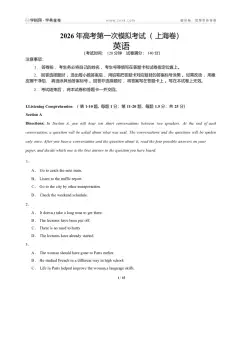
2026 年高考第二次模拟考试(上海卷)
英语
(考试时间:90 分钟  试卷满分:115 分)
注意事项:
1.本试卷分第Ⅰ卷(选择题)和第Ⅱ卷(非选择题)两部分。答卷前,考生务必将自己的姓名、准
考证号填写在答题卡上。
2.回答第Ⅰ卷时,选出每小题答案后,用2B 铅笔把答题卡上对应题目的答案标号涂黑。如需改动,
用橡皮擦干净后,再选涂其他答案标号。写在本试卷上无效。
3.回答第Ⅱ卷时,将答案写在答题卡上。写在本试卷上无效。
4.考试结束后,将本试卷和答题卡一并交回。
I.
Grammar and Vocabulary   (每题1 分;共20 分)
Section A
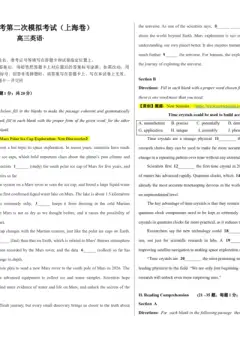
Directions: After reading the passage below, fill in the blanks to make the passage coherent and grammatically
correct. For the blanks with a given word, fill in each blank with the proper form of the given word; for the other
blanks, use one word that best fits each blank.
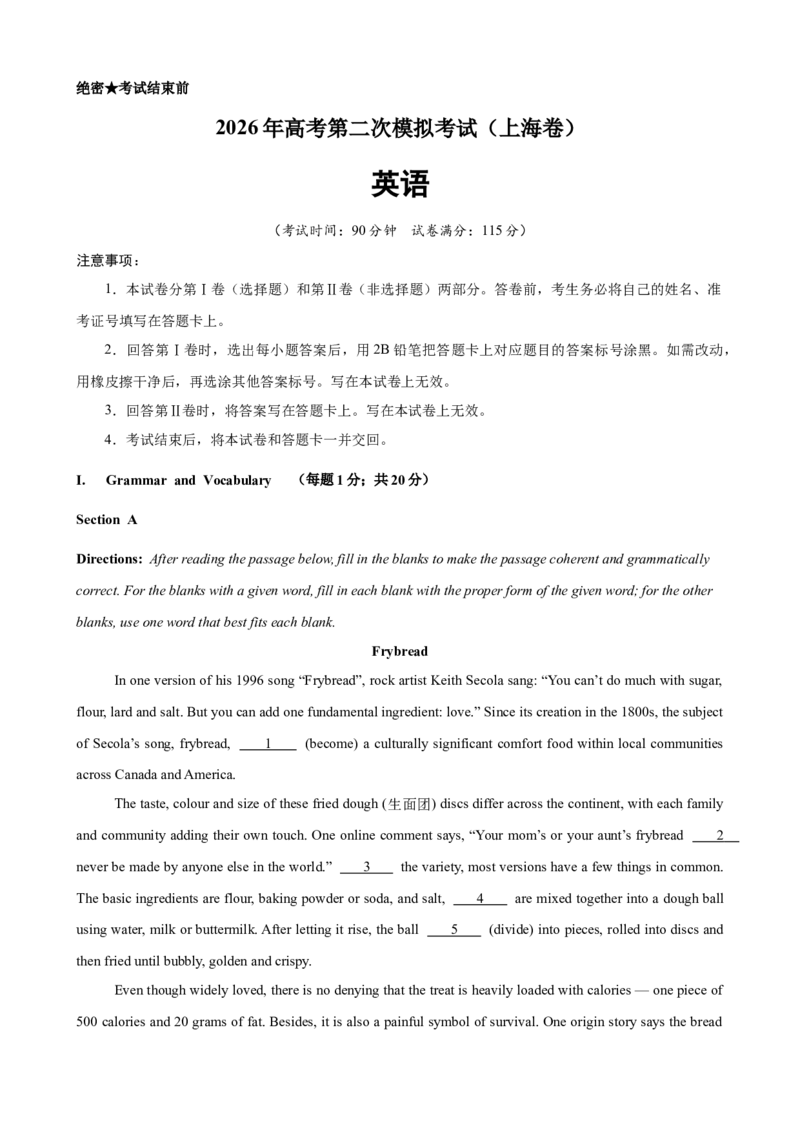
Frybread
In one version of his 1996 song “Frybread”, rock artist Keith Secola sang: “You can’t do much with sugar,
flour, lard and salt. But you can add one fundamental ingredient: love.” Since its creation in the 1800s, the subject
of Secola’s song, frybread,    1    (become) a culturally significant comfort food within local communities
across Canada and America.
The taste, colour and size of these fried dough (生面团) discs differ across the continent, with each family
and community adding their own touch. One online comment says, “Your mom’s or your aunt’s frybread    2
never be made by anyone else in the world.”    3    the variety, most versions have a few things in common.
The basic ingredients are flour, baking powder or soda, and salt,    4    are mixed together into a dough ball
using water, milk or buttermilk. After letting it rise, the ball    5    (divide) into pieces, rolled into discs and
then fried until bubbly, golden and crispy.
Even though widely loved, there is no denying that the treat is heavily loaded with calories — one piece of
500 calories and 20 grams of fat. Besides, it is also a painful symbol of survival. One origin story says the bread
was first made by the Diné. In 1864, the Diné were forced to leave their traditional homeland in eastern Arizona
and western New Mexico and walk the nearly 500-kilometre journey,    6    (know) as the Long Walk.
Hundreds of them died of starvation along the way.    7    among the cheap ingredients, was given to them by
the U.S. government as daily rations was wheat flour previously unknown to them. As the legend goes, the Diné
fried the often spoiled flour to kill off parasites (寄生虫).
Today, a food-valuing movement,    8    (aim) to bring back traditional diets, is booming. However, the
diets don’t include frybread. “There is no oral tradition    9    (teach) about frybread,” wrote Devon A.
Mihesuah, a historian as well as a professor at the University of Kansas.
    10     the future holds for frybread, it will always stand as proof to the adaptability of those native
communities. As an enduring food, frybread has demonstrated its lasting significance.
Section B
Directions: Complete the following passage by using the words in the box. Each word can only be used once.
Note that there is one word more than you need.
A.accompanied    B.allowed    C. feasibly    D.fueled
E. intensity    F. option    G. prompting    H. routine
I. surgically    J. underlying    K. varied
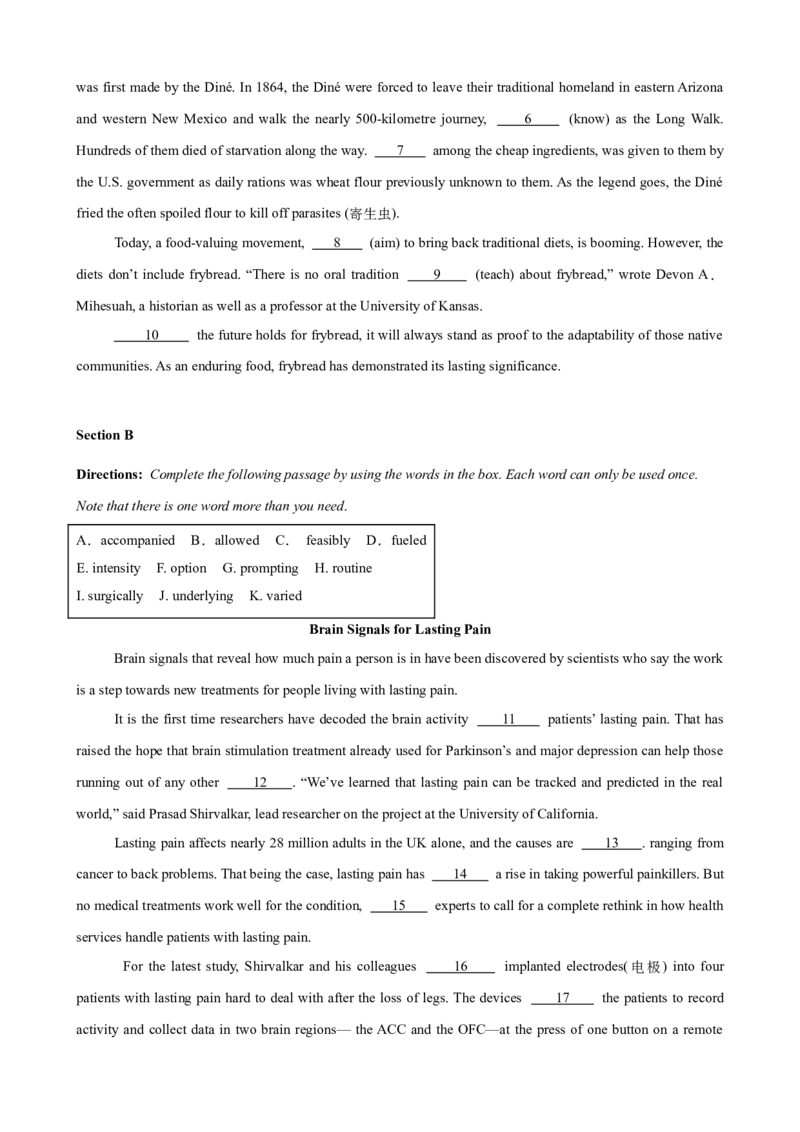
Brain Signals for Lasting Pain
Brain signals that reveal how much pain a person is in have been discovered by scientists who say the work
is a step towards new treatments for people living with lasting pain.
It is the first time researchers have decoded the brain activity    11    patients’ lasting pain. That has
raised the hope that brain stimulation treatment already used for Parkinson’s and major depression can help those
running out of any other    12   . “We’ve learned that lasting pain can be tracked and predicted in the real
world,” said Prasad Shirvalkar, lead researcher on the project at the University of California.
Lasting pain affects nearly 28 million adults in the UK alone, and the causes are    13   . ranging from
cancer to back problems. That being the case, lasting pain has    14    a rise in taking powerful painkillers. But
no medical treatments work well for the condition,    15    experts to call for a complete rethink in how health
services handle patients with lasting pain.
 For the latest study, Shirvalkar and his colleagues    16    implanted electrodes( 电极) into four
patients with lasting pain hard to deal with after the loss of legs. The devices    17    the patients to record
activity and collect data in two brain regions— the ACC and the OFC—at the press of one button on a remote
handset. Several times a day, the volunteers were asked to complete short surveys on the    18    of pain,
meaning how strong the pain was, and then record their brain activity. These scientists, armed with the survey
responses and brain recordings, found they could use computers to predict a person’s pain based on the electrical
signals in their OFC. “We found very different brain activity    19    severe pain and have developed an
objective biomarker for that kind of pain,” said Shirvalkar. The finding may explain, at least in part, why    20
painkillers are less effective for lasting pain. “The hope is that we can use the information to develop personalized
brain stimulation treatment for the most severe forms of pain.”
II.
Reading Comprehension   (21 – 35 题,每题1 分;36 – 50 题,每题2 分;共45 分)
Section A
Directions: For each blank in the following passage there are four words or phrases marked A, B, C and D.
Fill in each blank with the word or phrase that best fits the context.
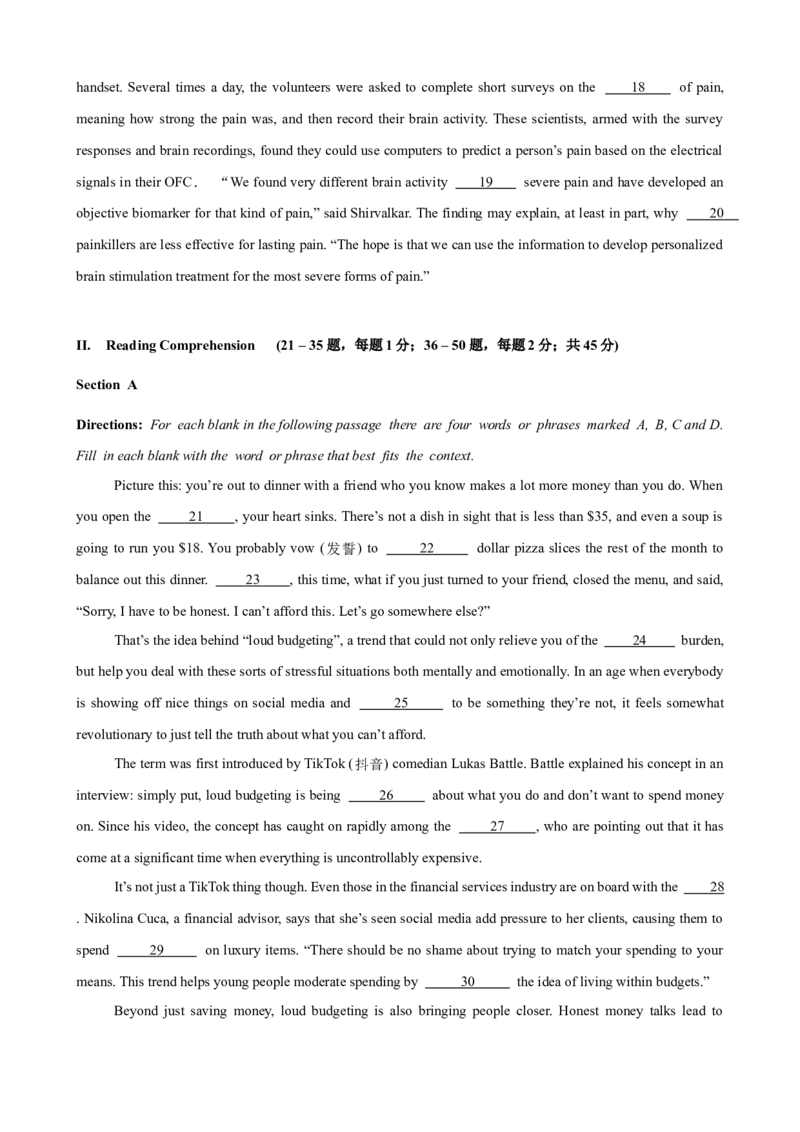
Picture this: you’re out to dinner with a friend who you know makes a lot more money than you do. When
you open the     21    , your heart sinks. There’s not a dish in sight that is less than $35, and even a soup is
going to run you $18. You probably vow ( 发誓) to     22     dollar pizza slices the rest of the month to
balance out this dinner.     23    , this time, what if you just turned to your friend, closed the menu, and said,
“Sorry, I have to be honest. I can’t afford this. Let’s go somewhere else?”
That’s the idea behind “loud budgeting”, a trend that could not only relieve you of the     24     burden,
but help you deal with these sorts of stressful situations both mentally and emotionally. In an age when everybody
is showing off nice things on social media and     25     to be something they’re not, it feels somewhat
revolutionary to just tell the truth about what you can’t afford.
The term was first introduced by TikTok (抖音) comedian Lukas Battle. Battle explained his concept in an
interview: simply put, loud budgeting is being     26     about what you do and don’t want to spend money
on. Since his video, the concept has caught on rapidly among the     27    , who are pointing out that it has
come at a significant time when everything is uncontrollably expensive.
It’s not just a TikTok thing though. Even those in the financial services industry are on board with the     28
. Nikolina Cuca, a financial advisor, says that she’s seen social media add pressure to her clients, causing them to
spend     29     on luxury items. “There should be no shame about trying to match your spending to your
means. This trend helps young people moderate spending by      30      the idea of living within budgets.”
Beyond just saving money, loud budgeting is also bringing people closer. Honest money talks lead to
greater respect among friends and family. By      31      discussing money goals, people are creating stronger
bonds based on mutual understanding for each other’s financial situations. And perhaps the most valuable part of
the loud budgeting trend is that it provides a sense of      32     . For example, if you tell a friend you are
trying to cut back spending on drinks out, you are much      33      to stick with the goal than if you just
keep it to yourself.
With its focus on being open, spending wisely, and building      34     , loud budgeting is more than
just a passing trend, but a cool way for the younger generation to      35      their finances. As more people
adopt this approach, it is likely to stay a big part of how we handle money in the future.
21.A.door
B.menu
C.bill
D.wallet
22.A.appeal to
B.lead to
C.stick to
D.object to
23.A.Otherwise
B.Meanwhile
C.Therefore
D.However
24.A.financial
B.cultural
C.physical
D.economical
25.A.refusing
B.pretending
C.agreeing
D.guaranteeing
26.A.worried
B.angry
C.honest
D.excited
27.A.male
B.female
C.young
D.old
28.A.tradition
B.truth
C.treasure
D.trend
29.A.below their standards B.beyond their means C.towards their goals
D.despite their differences
30.A.normalizing
B.criticizing
C.memorizing
D.visualizing
31.A.endlessly
B.intelligently
C.openly
D.formally
32.A.belonging
B.accountability
C.flexibility
D.rigidity
33.A.less motivated B.less equipped
C.more hesitant
D.more likely
34.A.connections
B.business
C.habitats
D.reputation
35.A.lose faith in
B.take charge of
C.do away with
D.make up for
Section B
Directions: Read the following three passages. Each passage is followed by several questions or unfinished
statements. For each of them there are four choices marked A, B, C and D. Choose the one that fits best according
to the information given in the passage you have just read.
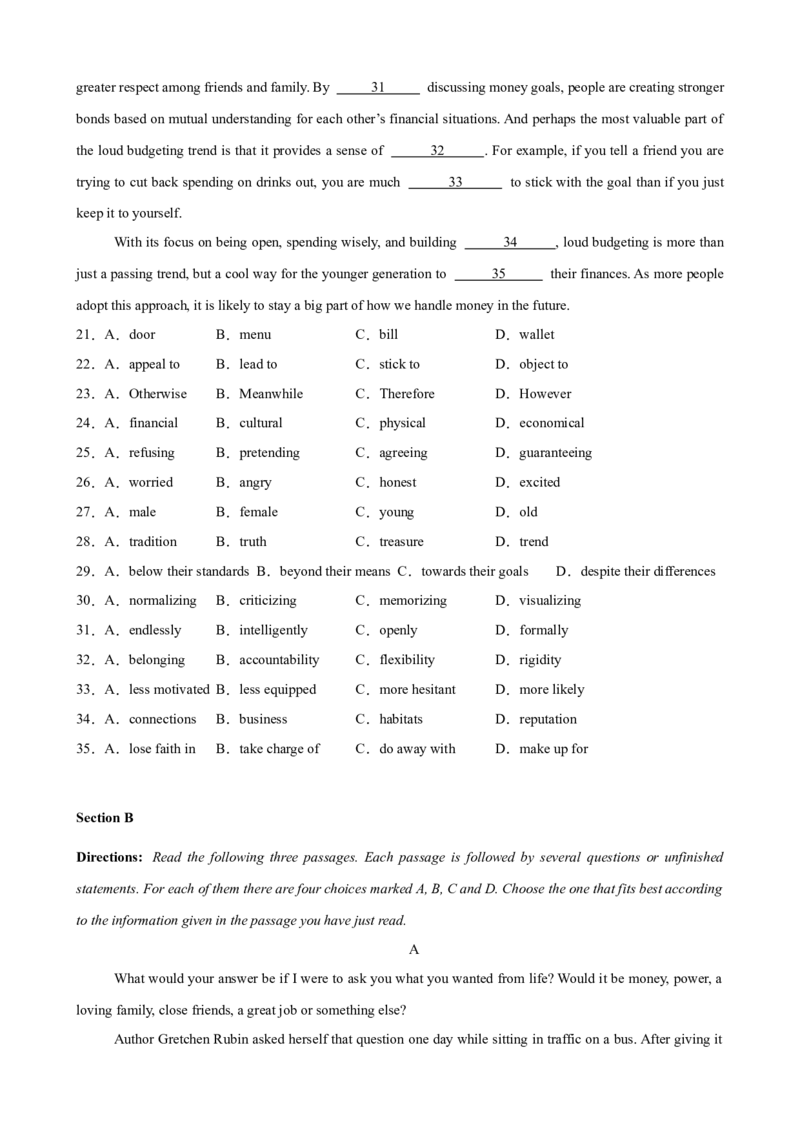
A
What would your answer be if I were to ask you what you wanted from life? Would it be money, power, a
loving family, close friends, a great job or something else?
Author Gretchen Rubin asked herself that question one day while sitting in traffic on a bus. After giving it
some thought, she realized that, overall, she wanted to be happy. If happiness was to be her goal, Rubin realized,
“The days are long, but the years are short. Time is passing, and I’m not focusing enough on the things that really
matter.” This conclusion began a 12-month commitment to discover what would add more happiness to her life.
The pursuit resulted in Rubin’s New York Times best-selling book The Happiness Project.
According to some of the reviews, this is more than a typical self-help book. One Amazon review reads,
“This is the rare book that will make you both smile and think — often on the same page.” It’s full of humor,
insight and actual examples from Rubin’s year-long experiment. In an effort to reach her goal, she tested
numerous theories on happiness. Going through philosophy, science, popular culture and more, the writer chose
specific habits to examine and try to integrate into her lifestyle.
Rubin’s book is divided into 12 chapters, each highlighting a different month and specific area of focus. In
chapters one through 11, each new focus or category includes three or four things to work on. For example, the
first chapter begins with January and the importance of getting more physical and mental energy. The
corresponding goals consist of getting better sleep and exercising more. Later chapters discuss topics such as the
importance of making time for friends, play, your passions and more. Chapter 12 concentrates on pulling
everything together and adopting all the new habits. At the end of her 12-month journey, Rubin concluded that
small, daily changes had, in fact, resulted in a deeper sense of happiness.
In this new year, instead of making new resolutions that you’ll probably abandon by February, why not give
Rubin’s Happiness Project a try? It is likely that you will then see an increase in your own happiness in 2025 and
the happiness you bring to others around you.
36.____ made Gretchen Rubin start her 12-month commitment to studying how to achieve happiness.
A.Sitting in traffic on a bus
B.Reading a self-help book
C.Noticing her overlooking crucial matters
D.Wanting to write a best-selling book
37.Which of the following is a feature of The Happiness Project?
A.It is organized by monthly challenges.
B.It is written in a quite serious way.
C.It provides detailed experimental data.
D.It offers fun and wise real-life examples.
38.According to The Happiness Project, ____ contributes to greater physical and mental energy.
A.enhancing rest and activity
B.adopting a strict habit tracker
C.scheduling weekly social hours
D.pursuing creative outlets daily
39.The main purpose of the passage is to ____.
A.describe the author’s personal journey of self-discovery
B.inspire readers to seek happiness as the book suggests
C.explain the importance of setting goals in life
D.promote sales of a particular self-help book
B
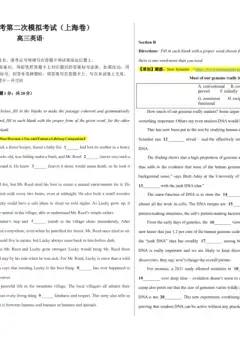
IN CONTEXT
BRANCH
Geology
BEFORE
6th century BCE The Greek thinker
Thales of Miletus notes magnetic rocks, or
lodestones (天然磁石).
1st century CE Chinese diviners make
primitive compasses with iron spoon that
can turn around to point south.
1269 French scholar Pierre de Maricourt
sets out the basic laws of magnetic
attraction, repulsion, and poles.
AFTER
1824 French mathematician Siméon
Poisson models the forces in a magnetic
field.
1940s American physicist Walter Maurice
Elsasser attributes Earth’s magnetic field
to iron swirling in its outer core as the
planet rotates.
1958 Explorer 1 space mission shows
Earth’s magnetic field extending far out
into space.
By the late 1500s, ships’ captains already relied on
magnetic compasses to maintain their course across the oceans.
Yet no one knew how they worked. Some thought the compass
needle was attracted to the North Star, others that it was drawn to
magnetic mountains in the Arctic. It was English physician
William Gilbert who discovered that Earth itself is magnetic.
Stronger reasons are obtained from sure experiments and
demonstrated arguments than from probable conjectures (推测)
and the opinions of philosophical speculators.
William Gilbert
Gilbert’s breakthrough came not from a flash of
inspiration, but from 17 years of careful experiment. He learned
all he could from ships’ captains and compass makers, and then
he made a model globe, or “terrella,” out of the magnetic rock
lodestone and tested compass needles against it. The needles
reacted around the terrella just as ships’ compasses did on a larger
scale—showing the same patterns of declination (pointing
slightly away from true north at the geographic pole, which
differs from magnetic north) and inclination (tilting down from
the horizontal toward the globe).
Gilbert concluded, rightly, that the entire planet is a
magnet and has a core of iron. He published his ideas in the book
De Magnete (On the Magnet) in 1600, causing a sensation.
Johannes Kepler and Galileo, in particular, were inspired by his
suggestion that Earth is not fixed to rotating celestial spheres, as
most people still thought, but is made to spin by the invisible
force of its own magnetism.
40.Before the 16th century, how did captains navigate across oceans?
A.The North Star navigated their ships.
B.The magnetic mountains in the Arctic guided their journey.
C.Magnetic compasses helped them maintain the course.
D.The forces in a magnetic field attracted the ships.
41.How did William Gilbert find out the fact that Earth itself is magnetic?
A.Through trials and errors.
B.Through some personal philosophical speculation.
C.By acquiring some flash inspiration.
D.By studying the ideas of some philosophers.
42.Which of the following statement might Galileo agree with?
A.The earth stays still.
B.Gilbert successfully refuted the laws of magnetic attraction.
C.Gilbert’s findings and conclusions are sensational.
D.The earth has its own magnetic field.
C
Animal products could produce electricity, one British power company warns — and to give consumers a
choice, it's offering what it calls the world’s first vegan electricity.
Ecotricity, a renewable energy provider in the U.K., announced its electricity and gas would be certified
vegan after it claimed half of British homes are powered by electricity made from animal byproducts. Company
founder Dale Vince accused companies that consider themselves “ethical” or “green” of keeping consumers in the
dark about their “secret ingredient.” “We need clear labeling of energy sourcing so that people can make informed
choices,” he said in a statement.
The company offers “vegan energy” in wind and solar power, and it’s developing “sea power” produced by
wave oscillation and marine currents. None of Ecotricity’s electrical sources contains animal byproducts that the
company knew of before it made the announcement, but it registered with the Vegan Society to certify its green
status.
Though not widely disclosed, it’s fairly common for power companies to derive electricity from animals
through anaerobic digestion (厌氧消化). Animal waste is generally considered a clean, renewable energy source.
Turning manure into fuel eliminates a sizeable chunk of carbon pollution and lessens power companies’ reliance
on “dirtier” fossil fuels like coal and oil. Plus, animals provide a limitless supply of waste, while Earth’s natural
gas stores are finite, so crackers wouldn’t need to drill into rock to extract it.
Cows are pictured at a Wagyu cattle breeding center in June in Petit-Mars, France. A U.K. energy company
announced the first “vegan electricity” after warning consumers about animal byproducts in energy production.
After anaerobic digestion, farmers can use the liquid remains of the manure as fertilizer and make chips for
animal bedding from the solid leftovers, chemical engineer David Simakov told Popular Science.
“We are talking about producing the amount of renewable natural gas enough to heat thousands of homes
from just a single large landfill site,” he said. “We need to stop pumping carbon from underground into the
atmosphere and start caring about introducing more and more renewable energy to make our lives more
sustainable.”
Renewable energy only accounts for 11 percent of energy consumption in the U.S., according to the Energy
Information Administration. Fossil fuels and nuclear energy generate more than 80 percent of the country’s
electricity, and that’s unlikely to change: like other clean energy sources, anaerobic digestion is still more
expensive than traditional sources of energy.
43.According to Dale Vince, ____________________.
A.it’s necessary for consumers to know how electricity is produced
B.people don’t need to make choices of whether to use vegan electricity
C.vegan electricity and gas shouldn’t use animal byproducts
D.it’s not certain whether Ecotricity has used animal byproducts
44.In Paragraph 2, “secret ingredient” refers to ___________________.
A.an energy provider
B.vegan energy
C.animal waste
D.energy labelling
45.What can be inferred from the passage?
A.It’s forbidden to get exploited natural gas since it is limited.
B.Clean energy may not replace fossil fuels to be used by families.
C.Power companies can rely on animal waste to produce clean energy.
D.The waste of cows is first used to produce clean energy in the world.
46.What does the author think of clean energy?
A.It has been a mainstream.
B.It has a promising future.
C.Consumers tend to use more clean energy now.
D.Its producing cost has decreased its popularity.
Section C
Directions: Read the following passages. Fill in each blank with a proper sentence given in the box. Each
sentence can be used only once. Note that there are two more sentences than you need.
Ratting on Crimes
“You are never more than six feet away from a rat, ” goes the saying. Though it has been concluded that
this estimate is incorrect, it might soon be accurate for those involved in the illegal wildlife trade. A team of
researchers have trained African rats to pick up the scents (气味) of endangered animal products, such as elephant
ivory and rhino horn.    47
The rat pack can even identify these items when concealed among other substances, and have been shown
to remember the smells after months of non-exposure. This isn't the first time APOPO, a Tanzania-based non-
profit, have recognized a potential for a super-rat workforce.    48    The organization looks to provide low-
tech, cost-efficient solutions to pressing challenges throughout Africa.
The rats in the new study went through several demanding stages of training. They first learned to smell a
target scent for several seconds to earn a flavoured reward.    49    The final step was memory consolidation
training, where they were reintroduced to scents they'd not encountered for five and eight months, respectively.
Despite the months of non-exposure, the rats showed perfect memory scores, suggesting that their cognitive
memory performance is similar to that of dogs.
Illegal capture, killing, and harvesting of animals and plants have increased dramatically in recent years.
For example, 55 African elephants are killed for their tusks every day, over 20, 000 a year. This has to be stopped
immediately.
   50    They will be armed with custom-made vests (马甲) . With their front paws, they will be able to
pull a small ball attached to the chest of their vest, which gives out a beeping sound. This way rats will be able to
alert handlers when they detect a target. Once fully trained and prepared, these giant rats could become illegal
hunters' worst enemy.
A.Previously, they've trained packs of hero rats to detect dangerous bacteria.
B.Then they were introduced to common scents used to mask illegal wildlife trade.
C.This effort aims to provide a low-cost detection system to prevent illegal hunting.
D.However, there are concerns that the rats might be distracted by some common scents.
E.Existing screening tools are expensive and time intensive, necessitating a new approach.
F.For this purpose, these trained rats will be expected to work in likely hotspots for illegal wildlife trade.
III. Summary Writing   (10 分)
51.Directions: Read the following passage. Summarize the main idea and the main point(s) of the passage in no
more than 60 words. Use your own words as far as possible.
How to Make a Good Video Resumé (简历)?
Video resumés have been around for a long time. With a well-made video resumé, you can present yourself
creatively and allow a hiring manager to assess your personality, thus giving you an opportunity for interview. But
how to make a good video resumé?
First, start by introducing yourself and addressing the company you are applying to. For example, “Hello
InVideo, I’m John Doe”. Not only does this get their attention but it makes them feel prioritized. The next thing is
to address what profession you’re in or desire to be in. If you’re a filmmaker, you can simply state that or be
creative with words and say you’re a visual storyteller.
Then, talk about your passion for what you do and support it by referring to your past experiences and
work. For example, building on the filmmaker’s introduction, you could talk about how meeting people from
around the world and sharing their stories deeply motivates you, and then you can share an experience that
supports it. You can also focus on life experiences that have led you to cultivate skills-like taking a year off to
travel abroad, volunteering at a shelter, or a hobby that you actively pursue. You can also speak about your special
achievements and awards that will add value to your profile or you can get someone to speak on behalf of you as
social proof.
At the end of the video, leave the ball in their court. However, you also need to give them a reason to call
you for an interview. For example, you could end the video with this — “I have a lot more to me than I could fit in
this short video and I hope you give me a chance to tell you about it over an interview”.
___________________________________________________________________________________________
___________________________________________________________________________________________
___________________________________________________________________________________________
___________________________________________________________________________________________
___________________________________________________________________________________________
_____
IV. Translation  (第1-2 句,每句3 分;第3 句,4 分;第4 句5 分;共15 分)
Directions: Translate the following sentences into English, using the words given in the brackets.
52.随着技术革新,人人都能拍一段视频上传到平台。 (With) (汉译英)

53.在当前乃至未来很长一段时间,人工智能并非无所不能。 (far from) (汉译英)

54.这位外国记者说,作为一个曾长期在沪居住的外国人,回到上海就有到家的感觉。 (feel) (汉译英)

55.她将中国深厚的传统文化与西方古典音乐的作曲与演奏技法融为一体,赋予音乐全新的生命和表现
力。 (combine) (汉译英)

七、书信写作
56.Directions: Write an English composition in 120-150 words according to the instructions given below in
Chinese.
假设你是明启中学高三学生王磊,在一本英语文化类杂志上读到一则“我家的传统”的征稿通知(内容如
下)。你对此很有兴趣,请根据征稿要求写一篇短文。
Call for Submissions: Essays on “A Tradition in My Family”We invite you to share your
thoughts on the theme “A Tradition in My Family.”
Submission Guidelines:
1. Introduce the most valued family tradition.
2. Explain why this tradition is important for your family.
We look forward to your contributions!
___________________________________________________________________________________________
___________________________________________________________________________________________
___________________________________________________________________________________________
___________________________________________________________________________________________
___________________________________________________________________________________________
___