2026 年高考第二次模拟考试(上海卷)
高三英语·
注意事项:
1.答卷前,考生务必将自己的姓名、准考证号等填写在答题卡和试卷指定位置上。
2.回答选择题时,选出每小题答案后,用铅笔把答题卡上对应题目的答案标号涂黑。如需改动,用
橡皮擦干净后,再选涂其他答案标号。回答非选择题时,将答案写在答题卡上。写在本试卷上无效。
3.考试结束后,将本试卷和答题卡一并交回
I. Grammar and Vocabulary (每题1 分;共20 分)
Section A
Directions: After reading the passage below, fill in the blanks to make the passage coherent and grammatically
correct. For the blanks with a given word, fill in each blank with the proper form of the given word; for the other
blanks, use one word that best fits each blank.
【原创】题源:VOA Learning English《A Man Rescued a Fox and Found a Lifelong Companion》
In a quiet mountain village, Mr. Reed, a forest keeper, found a baby fox 1______ had lost its mother in a heavy
storm last winter. The fox, only a few weeks old, was hiding under a bush, and Mr. Reed 2______ (never see) such a
weak wild animal in his life before he found it. He knew 3______ (leave) it alone would mean death, so he took it
home without a second thought.
4______ is not easy to raise a wild fox, but Mr. Reed tried his best to create a natural environment for it. He
named the fox Lucky and fed it with fresh milk every two hours, even at midnight. He also built a small wooden
house in the yard 5______ ______ Lucky could have a safe place to sleep on cold nights. As Lucky grew up, it
became 6______ (clever) than any other animal in the village, able to understand Mr. Reed’s simple orders.
One day, Lucky was hurt by a hunter’s trap and 7______ (send) to the village clinic immediately. After
recovering, Lucky still followed Mr. Reed everywhere, even when he patrolled the forest. Mr. Reed once tried to set
Lucky free, for he knew wild animals should live in nature, but Lucky always came back to him before dark.
As time went by, the bond between Mr. Reed and Lucky grew stronger. Lucky would bring Mr. Reed fresh
fruits from the forest every morning, and stay by his side when he was sick. For Mr. Reed, Lucky is more than a wild
animal; it is a family member. He often says that meeting Lucky is the best thing 8______ has ever happened to
him, and he will cherish the friendship forever.
Now, Mr. Reed and Lucky live a peaceful life in the mountain village. The local villagers all admire their
special bond, and they have learned to treat every living thing 9______ kindness and respect. This story also tells us
that love has no boundaries, 10______ it is between humans and humans or humans and animals.
Section B
Directions: Fill in each blank with a proper word chosen from the box. Each word can be used only once. Note that
there is one word more than you need.
【原创】题源:New Scientist (https://www.newscientist.com/)
Most of our genome really is junk
A. conventional B. conserve C. exclusively D. massive E.
prevail F. initially
G. consistent H. recipe I. copy J. estimate K.
functional
How much of our genome really matters? Some argue that because most of our DNA is active, it must be doing
something important. Others say even random DNA would be highly active.
This has now been put to the test by studying human cells containing 11________ chunks of plant DNA, New
Scientist can 12________ reveal – and the effectively random plant DNA was indeed nearly as active as human
DNA.
The finding shows that a high proportion of genome activity is just noise, rather than having any purpose, and
thus adds to the evidence that most of the human genome is junk. “A large amount can simply be explained by
background noise,” says Brett Adey at the University of Auckland in New Zealand. “This seems to be broadly
13________ with the junk DNA idea.”
The main function of DNA is to store the 14________ for making proteins, the molecular machines that do
almost all the work in cells. The DNA recipes are 15________ to make messenger RNA that carry the recipes to
protein-making structures, the cell’s protein-making factories.
From the early days of genetics, the 16________ view was that almost all DNA serves a useful purpose, but we
now know that just 1.2 per cent of the human genome codes for proteins. So what does the rest do? Since the 1960s,
the “junk DNA” idea has steadily 17________ among biologists. Yes, a small percentage of non-protein-coding
DNA is really important and we are likely to keep discovering bits that do useful things for decades, but such
discoveries, they say, won’t change the overall picture.
For instance, a 2011 study allowed scientists to 18________ that only around 5 per cent of the genome is
19________ over deep time – evolution doesn’t seem to care about the rest of it. Researchers in the mostly-junk
camp also point out that the size of genomes varies wildly among species, which further supports the idea that most
DNA is not 20________. This new experiment, combining human and plant cells, has strengthened the argument by
proving that random DNA can be active without any practical function, challenging the old view that activity equals
usefulness.
II. Reading Comprehension (21 –35 题,每题1 分;36 – 50 题,每题2 分;共45 分)
Section A
Directions: For each blank in the following passage there are four words or phrases marked A, B, C and D.
Fill in each blank with the word or phrase that best fits the context.
How to be more efficient: stop ‘precrastinating’
Whether or not we care to admit it, we’re all familiar with procrastination: waiting until the last minute to
catch up with pressing tasks, often leading to subpar (低于标准的)or incomplete work. The antidote — while easier
said than done — is simply to start on your assignments sooner, long before the cut-off time. But in your quest to
21 procrastination, is it possible to go too far?
David Rosenbaum, a professor of psychology at the University of California, Riverside, certainly think so.
His research focuses on the perils of “precrastination”, the 22 to rush too quickly into tasks. It can 23
an expenditure of unnecessary effort that could be avoided with a bit of planning — in other words, haste makes
waste.
24 a procrastinator, who might leave an inbox full of emails untouched until the next day, a
precrastinator would read and respond to each of them first thing in the morning. 25 they know most of
the emails are unimportant, they would choose to clear them off as soon as possible. In some cases, this can mean
draining the precious energy they might need for a more 26 task later on.
So why do people precrastinate? Rosenbaum says that for most, it’s tough to 27 reaching for low-
hanging fruit. If something is immediately 28 to you, you’re instinctively wired to go for it. Think about
the sweet attraction of free food samples at the market. 29 , when you complete simple short-term tasks,
you have one fewer thing to think about — “I can wrap this up in five minutes. Why not take care of it now?”
Personality 30 such as conscientiousness, eagerness to please and high energy can predict precrastination
behaviors, Rosenbaum says, but the evolutionary impulse behind them is universal.
The real 31 of precrastination comes when, in your rush to finish, you encounter the naturally
higher chance of doing your work incompletely or inaccurately. In the case of emails, sometimes waiting to 32
can show respect for careful thought over expediency, especially if the content of the message is emotional.
Of course, precrastination is not without its 33 , but it’s critical to do so only when it makes sense.
Chronic precrastinators must also realize that it’s OK to 34 trivial things, because they will not require
huge mental energy later in the day, Rosenbaum says.
He argues that the managers of today would be wise to acknowledge that it’s not always best to do everything
as quickly as possible. “It should be agreed in our society that it’s okay to smell the flowers,” he says. “To be 35
, mindful and to be allowed to slow down.”
21.A.beat
B.enhance
C.adapt
D.reveal
22.A.feasibility
B.tendency
C.possibility
D.activity
23.A.rise from
B.result from
C.result in
D.end with
24.A.With regards to
B.In terms of
C.In response to
D.As opposed to
25.A.Only if
B.Even if
C.As if
D.What if
26.A.common
B.minor
C.special
D.urgent
27.A.overcome
B.realize
C.sense
D.resist
28.A.desirable
B.available
C.approachable
D.agreeable
29.A.Especially
B.Fairly
C.Similarly
D.Arguably
30.A.traits
B.drawbacks
C.themes
D.strengths
31.A.upside
B.downside
C.feature
D.value
32.A.respond
B.read
C.reflect
D.edit
33.A.shortcomings B.interests
C.benefits
D.improvements
34.A.take on
B.set aside
C.put forward
D.break down
35.A.intentional
B.imaginative
C.deliberate
D.impulsive
Section B
Directions: Read the following three passages. Each passage is followed by several questions or unfinished
statements. For each of them there are four choices marked A, B, C and D. Choose the one that fits best according to
the information given in the passage you have just read.
(A)
Knowing that Mrs. Mallard was affected with a heart trouble, great care was taken to break to her as gently as
possible the news of her husband’s death.
It was her sister Josephine who told her, in broken sentences. Her husband’s friend Richards was there, too,
near her. It was he who had been in the newspaper office when intelligence of the railroad disaster was received,
with Brently Mallard’s name leading the list of “killed.” He had only taken the time to assure himself of its truth by a
second telegram, and had hastened to forestall
any less careful, less tender friend in bearing the sad message.
She did not hear the story as many women have heard the same, with a paralyzed inability to accept its
significance. She wept at once, with sudden, wild abandonment, in her sister’s arms. When the storm of grief had
spent itself she went away to her room alone. She would have no one follow her.
There stood, facing the open window, a comfortable, roomy armchair. Into this she sank, pressed down by a
physical exhaustion that haunted her body and seemed to reach into her soul.
There was something coming to her and she was waiting for it, fearfully. What was it? She did not know; it
was too subtle and elusive to name. But she felt it, creeping out, reaching toward her through the sounds, the scents,
the color that filled the air.
Now she was beginning to recognize this thing that was approaching to possess her, and she was striving to
beat it back with her will — as powerless as her two white slender hands would have been. When she abandoned
herself a little whispered word escaped her slightly parted lips. She said it over and over under the breath: “free, free,
free!” The vacant stare and the look of terror that had followed it went from her eyes. They stayed keen and bright.
Her pulses beat fast, and the coursing blood warmed and relaxed every inch of her body.
There would be no one to live for during the coming years; she would live for herself. There would be no
powerful will bending hers in that blind persistence with which men and women believe they have a right to impose
a private will upon a fellow-creature.
“Free! Body and soul free!” she kept whispering.
She arose at length and opened the door. There was a feverish triumph in her eyes, and she carried herself
unwittingly like a goddess of Victory. She clasped her sister’s waist, and together they descended the stairs. Richards
stood waiting for them at the bottom.
Someone was opening the front door with a latchkey. It was Brently Mallard who entered, a little travel-
stained, composedly carrying his grip-sack and umbrella. He had been far from the scene of the accident, and did not
even know there had been one. He stood amazed at Josephine’s piercing cry; at Richards’ quick motion to screen
him from the view of his wife.
When the doctors came they said she had died of heart disease — of the joy that kills.
36.Why does the author include the detail about Mrs. Mallard’s heart condition in the first paragraph?
A.To foreshadow the ending and make it believable.
B.To explain why she needed Mr. Mallard to care for her.
C.To alert the readers to the potential harm of heart attacks.
D.To reinforce the notion that women are weak.
37.The underlined word “forestall” in the second paragraph is closest in meaning to ________.
A.predict
B.beg
C.prevent
D.propose
38.At the end of the story, we learn that Mr. Mallard ________.
A.was cheating on Mrs. Mallard with Josephine
B.made up the entire story to play a joke on his wife
C.jumped off the train before it crashed
D.was never even on the train in the first place
39.What might have led to the death of Mrs. Mallard?
A.The excitement at the thought that she would soon enjoy freedom
B.The shock upon the sight of her husband walking in while she thought he was dead
C.The late arrival of the doctors who failed to save her in time
D.The sadness that struck her when she was informed of her husband’s deaths
(B)
Living with Fire: Surviving the Forest Wildfires of California
California wildfires can cause devastating damage to property and human lives. But for plant species that have
lived for thousands of years in the fire-prone Sierra Nevada, forest fires are an expected part of the natural
environment. This infographic introduces four different California plant species, all with different adaptations to fire.
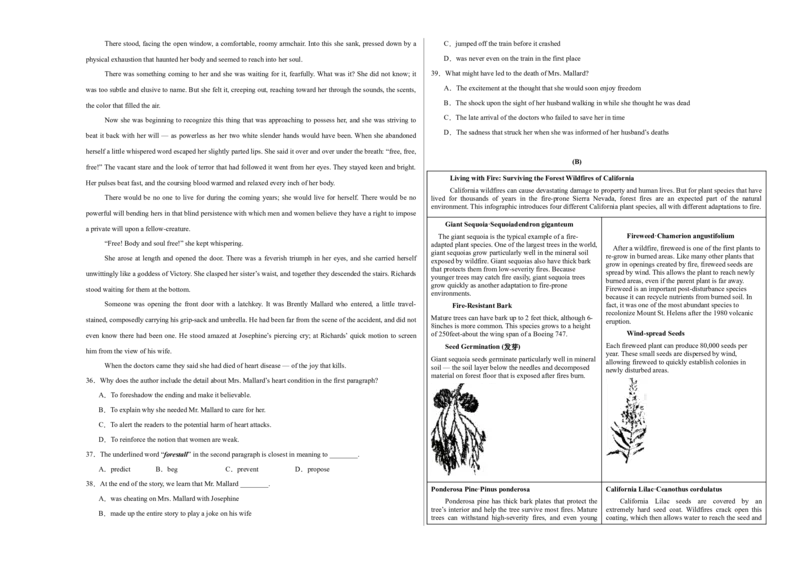
Giant Sequoia·Sequoiadendron giganteum
The giant sequoia is the typical example of a fire-
adapted plant species. One of the largest trees in the world,
giant sequoias grow particularly well in the mineral soil
exposed by wildfire. Giant sequoias also have thick bark
that protects them from low-severity fires. Because
younger trees may catch fire easily, giant sequoia trees
grow quickly as another adaptation to fire-prone
environments.
Fire-Resistant Bark
Mature trees can have bark up to 2 feet thick, although 6-
8inches is more common. This species grows to a height
of 250feet-about the wing span of a Boeing 747.
Seed Germination (发芽)
Giant sequoia seeds germinate particularly well in mineral
soil — the soil layer below the needles and decomposed
material on forest floor that is exposed after fires burn.
Fireweed·Chamerion angustifolium
After a wildfire, fireweed is one of the first plants to
re-grow in burned areas. Like many other plants that
grow in openings created by fire, fireweed seeds are
spread by wind. This allows the plant to reach newly
burned areas, even if the parent plant is far away.
Fireweed is an important post-disturbance species
because it can recycle nutrients from burned soil. In
fact, it was one of the most abundant species to
recolonize Mount St. Helens after the 1980 volcanic
eruption.
Wind-spread Seeds
Each fireweed plant can produce 80,000 seeds per
year. These small seeds are dispersed by wind,
allowing fireweed to quickly establish colonies in
newly disturbed areas.
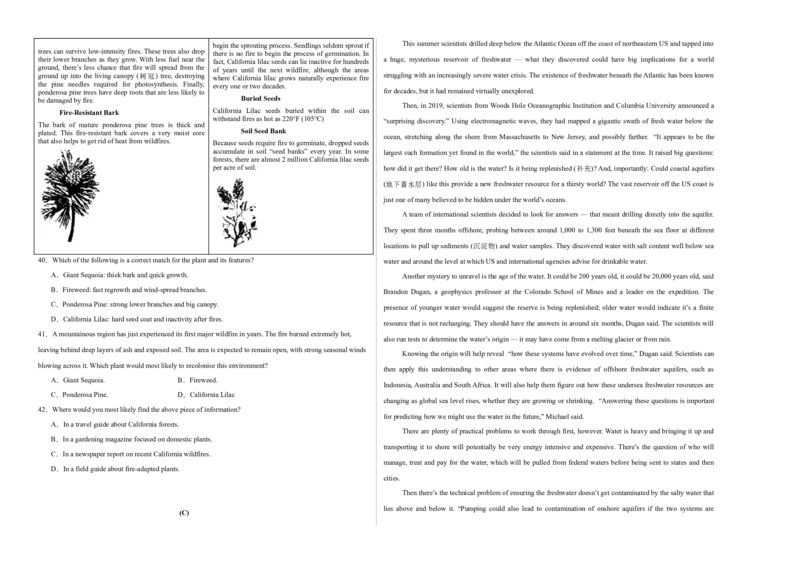
Ponderosa Pine·Pinus ponderosa
Ponderosa pine has thick bark plates that protect the
tree’s interior and help the tree survive most fires. Mature
trees can withstand high-severity fires, and even young
California Lilac·Ceanothus cordulatus
California Lilac seeds are covered by an
extremely hard seed coat. Wildfires crack open this
coating, which then allows water to reach the seed and
trees can survive low-intensity fires. These trees also drop
their lower branches as they grow. With less fuel near the
ground, there’s less chance that fire will spread from the
ground up into the living canopy (树冠) tree, destroying
the pine needles required for photosynthesis. Finally,
ponderosa pine trees have deep roots that are less likely to
be damaged by fire.
Fire-Resistant Bark
The bark of mature ponderosa pine trees is thick and
plated. This fire-resistant bark covers a very moist core
that also helps to get rid of heat from wildfires.
begin the sprouting process. Seedlings seldom sprout if
there is no fire to begin the process of germination. In
fact, California lilac seeds can lie inactive for hundreds
of years until the next wildfire, although the areas
where California lilac grows naturally experience fire
every one or two decades.
Buried Seeds
California Lilac seeds buried within the soil can
withstand fires as hot as 220°F (105℃)
Soil Seed Bank
Because seeds require fire to germinate, dropped seeds
accumulate in soil “seed banks” every year. In some
forests, there are almost 2 million California lilac seeds
per acre of soil.
40.Which of the following is a correct match for the plant and its features?
A.Giant Sequoia: thick bark and quick growth.
B.Fireweed: fast regrowth and wind-spread branches.
C.Ponderosa Pine: strong lower branches and big canopy.
D.California Lilac: hard seed coat and inactivity after fires.
41.A mountainous region has just experienced its first major wildfire in years. The fire burned extremely hot,
leaving behind deep layers of ash and exposed soil. The area is expected to remain open, with strong seasonal winds
blowing across it. Which plant would most likely to recolonise this environment?
A.Giant Sequoia.
B.Fireweed.
C.Ponderosa Pine.
D.California Lilac
42.Where would you most likely find the above piece of information?
A.In a travel guide about California forests.
B.In a gardening magazine focused on domestic plants.
C.In a newspaper report on recent California wildfires.
D.In a field guide about fire-adapted plants.
(C)
This summer scientists drilled deep below the Atlantic Ocean off the coast of northeastern US and tapped into
a huge, mysterious reservoir of freshwater — what they discovered could have big implications for a world
struggling with an increasingly severe water crisis. The existence of freshwater beneath the Atlantic has been known
for decades, but it had remained virtually unexplored.
Then, in 2019, scientists from Woods Hole Oceanographic Institution and Columbia University announced a
“surprising discovery.” Using electromagnetic waves, they had mapped a gigantic swath of fresh water below the
ocean, stretching along the shore from Massachusetts to New Jersey, and possibly farther. “It appears to be the
largest such formation yet found in the world,” the scientists said in a statement at the time. It raised big questions:
how did it get there? How old is the water? Is it being replenished (补充)? And, importantly: Could coastal aquifers
(地下蓄水层) like this provide a new freshwater resource for a thirsty world? The vast reservoir off the US coast is
just one of many believed to be hidden under the world’s oceans.
A team of international scientists decided to look for answers — that meant drilling directly into the aquifer.
They spent three months offshore, probing between around 1,000 to 1,300 feet beneath the sea floor at different
locations to pull up sediments (沉淀物) and water samples. They discovered water with salt content well below sea
water and around the level at which US and international agencies advise for drinkable water.
Another mystery to unravel is the age of the water. It could be 200 years old, it could be 20,000 years old, said
Brandon Dugan, a geophysics professor at the Colorado School of Mines and a leader on the expedition. The
presence of younger water would suggest the reserve is being replenished; older water would indicate it’s a finite
resource that is not recharging. They should have the answers in around six months, Dugan said. The scientists will
also run tests to determine the water’s origin — it may have come from a melting glacier or from rain.
Knowing the origin will help reveal “how these systems have evolved over time,” Dugan said. Scientists can
then apply this understanding to other areas where there is evidence of offshore freshwater aquifers, such as
Indonesia, Australia and South Africa. It will also help them figure out how these undersea freshwater resources are
changing as global sea level rises, whether they are growing or shrinking. “Answering these questions is important
for predicting how we might use the water in the future,” Michael said.
There are plenty of practical problems to work through first, however. Water is heavy and bringing it up and
transporting it to shore will potentially be very energy intensive and expensive. There’s the question of who will
manage, treat and pay for the water, which will be pulled from federal waters before being sent to states and then
cities.
Then there’s the technical problem of ensuring the freshwater doesn’t get contaminated by the salty water that
lies above and below it. “Pumping could also lead to contamination of onshore aquifers if the two systems are
connected,” Attias said. “Tapping offshore groundwater will be expensive,” Michael said. “Protecting the fresh water
we have on land is still the best thing we can do...Of course, that doesn’t mean we shouldn’t look for alternate
options, which is why we are doing this science.”
Dugan is optimistic about the potential. “All the pieces exist. It’s just a case of time,” he said. He estimates it
will take around 10 years before offshore aquifers could be properly tapped. Dugan said. “We can take what we’ve
learned in this postage stamp of New England and start thinking about how it relates to other areas.”
43.According to the passage, which of the following statement is TRUE about underwater aquifer?
A.Scientists first found freshwater below the Atlantic Ocean in 2019.
B.The water originates entirely from melting glaciers.
C.The salt content of the water is suitable for drinking.
D.The technology to tap the water is now available.
44.What can be inferred from the passage about the age of the water in the aquifer?
A.The age will directly determine the water’s market value
B.It is a key factor in assessing the sustainability of the resource.
C.Older water is preferable because it is purer.
D.Scientists have already reached an agreement on the water age.
45.The author discusses the “technical problems” in the last few paragraphs primarily to ________.
A.criticize the current inefficiency of water management policies
B.explain why protecting on-land freshwater remains the best option
C.demonstrate the superiority of this new resource over others
D.highlight the obstacles that must be overcome before practical use
46.What is the best title for the passage?
A.Prediction about a Vast Undersea Freshwater Discovery
B.Unlocking the secrets of Ancient Water Beneath the Atlantic
C.The Challenges of Tapping into Undersea Freshwater
D.Old Wisdom Saving Modern People from Water Crises
Section C
Directions: Read the following passages. Fill in each blank with a proper sentence given in the box. Each
sentence can be used only once. Note that there are two more sentences than you need.
Human beings are social creatures. We build bonds, cultivate friendships, and nurture family ties in hopes of
finding love, support, and understanding. Ideally, these relationships become safe havens where we can share our
deepest thoughts, worries, and vulnerabilities without fear of judgment. 47 Why is this the case? Why
would we share our fears with a therapist, a fellow traveler on a train, or even an anonymous voice on the internet
rather than with our spouse, sibling, or best friend? The answer lies in the intricate interplay between psychology,
social expectations, and human emotion.
There’s something you’ve been dying to get off your chest but you don’t want to live in the reality of a world
where this secret is not. If you share it with a stranger, you release the tension and still keep your personal world
away from it. 48 You’ll literally tell them anything in the world. This uncertainty between us ushers in a
certain ease; the judgement of strangers matters little because it’s unlikely one will cross paths with them again. The
absence of attachment we feel towards a stranger during our interactions, coupled with the fact that there are hardly
any repercussions (恶果), lead to a sense of relative safety, encouraging emotional expression and disclosure.
49 Our interactions with strangers lack the baggage of these dynamics. When talking to strangers,
however, one can share highly personal information without damaging their reputation within one’s social circle. The
spouse is a friend, often a co-parent, also a lover, and hopefully, an advocate of our work. Our parents have your
entire life’s history in their head and friends are familiar with which the person what we should to be. When we need
comfort, we’re unsure which of their roles these people might play- and wary that it might be a role that gives us
something other than the unconditional support we’re looking for in the moment. So, we confide in someone else
altogether.
Conversations with strangers, on the contrary, can thus allow us to reexamine our lives through a new lens.
Strangers offer the unique advantage of providing fresh perspectives and objective viewpoints, offering unbiased
advice and impartial opinions. 50 That is one of the reasons that we can find solace in the validation and
support offered by strangers, which they were otherwise denied by the people in their lives. Moreover, we don’t
necessarily have to worry about bookending everything we say with social niceties. This also increases the appeal of
the advice we might receive from strangers in return: they can be blunt in their takes because they too don’t have to
worry about the way we might feel about their responses.
A.Yet, paradoxically, many of us discover that it is sometimes easier to confide
in a stranger than in someone close to us.
B .Sometimes we choose not to open our hearts to family or friends, not
because we don’t trust them, but because we fear burdening them or altering the
relationship.
C.They allow us to get out of our heads and break up that negative self-focus,
and prevent the train of negative circular thinking.
D.Social connections built over time come with assumptions, judgments, and
expectations, which can inhibit individuals from fully expressing themselves.
E.Perhaps the paradox of intimacy is that the closer we are to someone, the
easier it becomes to take them for granted.
F .When you know you won’t see the person again, you’re a little too
comfortable.
IV. Summary Writing (10 分)
51.Directions: Read the following passage. Summarize the main idea and the main point(s) of the passage in no
more than 60 words. Use your own words as far as possible.
Sweetness: The Silent Killer in Disguise
Imagine starting your day with a flavored yogurt, sipping soda at lunch, and ending with a “healthy” granola
bar. You’d be shocked to learn these daily choices may contain over 50g of added sugar — far exceeding the WHO’s
recommended 25g limit. This unconscious intake is just the first step toward a chain of health risks, as excessive
sugar disrupts our bodies in ways we often ignore.
Sugar’s most immediate threat lies in its metabolic disruption. When consumed in excess, fructose ( 果糖)
overloads the liver, converting into fat and triggering insulin (胰岛素) resistance. This process not only raises blood
sugar levels but also lays the groundwork for type 2 diabetes, as confirmed by Harvard research linking high-sugar
diets to a 26% higher diabetes risk.
Beyond metabolism, sugar wages war on the heart. A study in JAMA Internal Medicine revealed that adults
consuming 25% of calories from sugar faced three times the risk of heart-related death. Sugar irritates blood vessels,
raises “bad” cholesterol (LDL), and speeds up artery hardening. Research from the University of California shows
that drinking just one sugary drink daily increases heart disease risk by 20%.
New research shows how sugar harms the brain. UCLA studies found that diets high in sugar make the
hippocampus smaller, which weakens memory and learning. Sugar addiction works like drug addiction, causing
strong sugar cravings that take over clear thinking. A 2025 Neuroscience study found that sugar consumption
potentially causes memory problems, restlessness and shorter attention spans.
Breaking free requires mindful choices: check labels for hidden sugars, replace sodas with flavored water, and
enjoy fruits’ natural sweetness. Simple changes, such as picking dark chocolate over candy, can help. Every spoonful
of sugar is a decision — choose wisely for your health’s future.
_____________________________________________________________________________________________
_____________________________________________________________________________________________
_____________________________________________________________________________________________
_____________________________________________________________________________________________
_____________________________________________________________________________________________
__________
V. Translation (第1-2 句,每句3 分;第3 句,4 分;第4 句5 分;共15 分)
Directions: Translate the following sentences into English, using the words given in the brackets.
52.这项新政策对员工和公司都大有裨益。 (as…as)
53.对于一家老字号品牌而言,如何才能保持吸引力? (take)
54.随着幕布升起,首次亮相的演员们随着音乐的节拍尽情载歌载舞。(With)
55.上周二,我在一家二手书店淘到了一本漫画书,虽略显陈旧,但插图生动、文字清晰,堪称物超所值。
(worth)
VI. Guided Writing (25 分)
56.Directions: Write an English composition in 120-150 words according to the instructions given below in
Chinese.
你是明天中学的一名高三学生李华。你们学校将邀请来自英国的大学教授Peter Brown 来访参观。你负责和
他联系,他给你发了一封电子邮件(内容如下),请根据他在电子邮件中提出的要求写一封回信。内容须
包括:
1) 具体的活动安排;
2) 活动安排的理由。
Dear Li Hua,
I’m a professor from the UK. I’m very interested in Chinese education and campus life. I’ll visit your school
next month and would like to spend a day experiencing school life there. Could you please design a one-day
schedule for me and explain your reasons for the arrangement?
Yours,
Peter Brown
_____________________________________________________________________________________________
_____________________________________________________________________________________________
_____________________________________________________________________________________________
_____________________________________________________________________________________________
_____________________________________________________________________________________________
_____________________________________________________________________________________________
________________________________________________________________________________