绝密★考试结束前
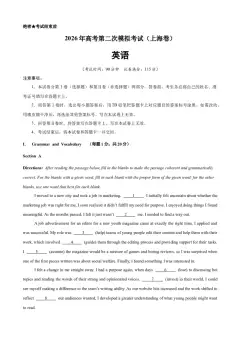
2026 年高考第一次模拟考试(上海卷)
英语
(考试时间:90 分钟  试卷满分:115 分)
注意事项:
1.本试卷分第Ⅰ卷(选择题)和第Ⅱ卷(非选择题)两部分。答卷前,考生务必将自己的姓名、准
考证号填写在答题卡上。
2.回答第Ⅰ卷时,选出每小题答案后,用2B 铅笔把答题卡上对应题目的答案标号涂黑。如需改动,
用橡皮擦干净后,再选涂其他答案标号。写在本试卷上无效。
3.回答第Ⅱ卷时,将答案写在答题卡上。写在本试卷上无效。
4.考试结束后,将本试卷和答题卡一并交回。
I.
Grammar and Vocabulary   (每题1 分;共20 分)
Section A
Directions: After reading the passage below, fill in the blanks to make the passage coherent and grammatically
correct. For the blanks with a given word, fill in each blank with the proper form of the given word; for the other
blanks, use one word that best fits each blank.
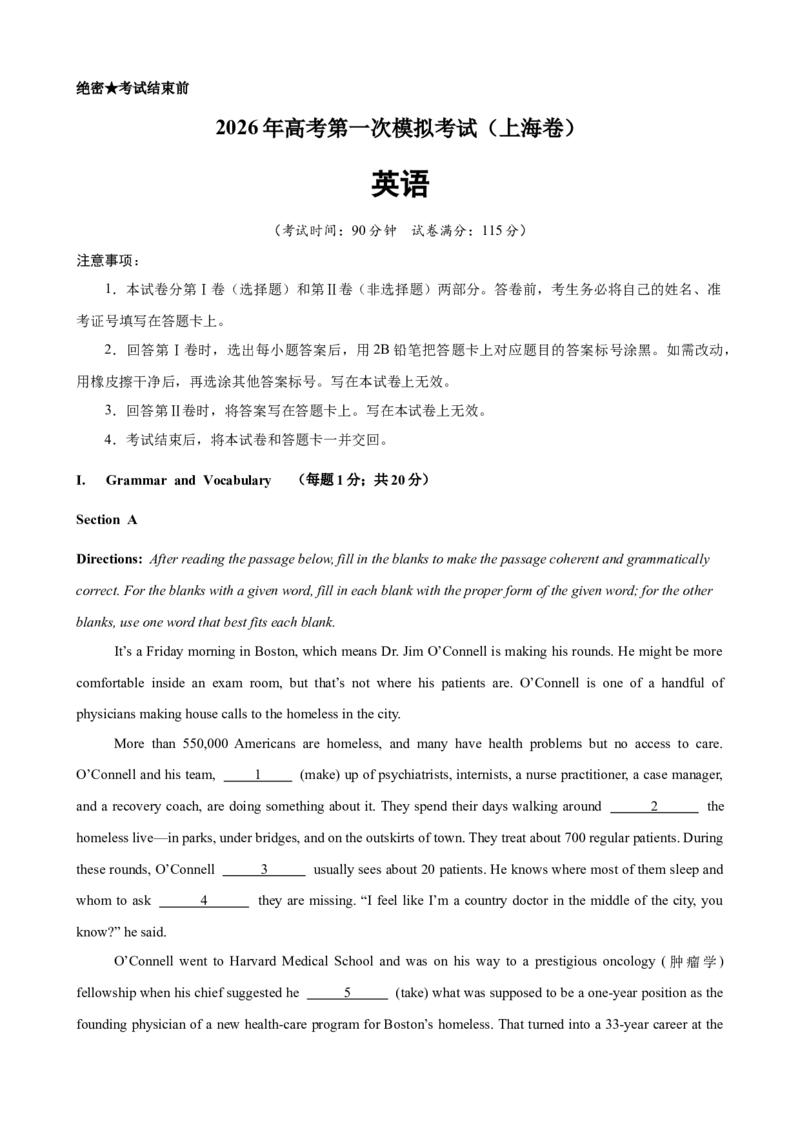
It’s a Friday morning in Boston, which means Dr. Jim O’Connell is making his rounds. He might be more
comfortable inside an exam room, but that’s not where his patients are. O’Connell is one of a handful of
physicians making house calls to the homeless in the city.
More than 550,000 Americans are homeless, and many have health problems but no access to care.
O’Connell and his team,     1     (make) up of psychiatrists, internists, a nurse practitioner, a case manager,
and a recovery coach, are doing something about it. They spend their days walking around      2      the
homeless live—in parks, under bridges, and on the outskirts of town. They treat about 700 regular patients. During
these rounds, O’Connell      3      usually sees about 20 patients. He knows where most of them sleep and
whom to ask      4      they are missing. “I feel like I’m a country doctor in the middle of the city, you
know?” he said.
O’Connell went to Harvard Medical School and was on his way to a prestigious oncology ( 肿瘤学)
fellowship when his chief suggested he      5      (take) what was supposed to be a one-year position as the
founding physician of a new health-care program for Boston’s homeless. That turned into a 33-year career at the
Boston Health Care for the Homeless Program, one of the country’s      6      (large) of its kind.
“You realize, ‘You know what, I’m just a doctor. And what I can do is I can get to know you and ease your
suffering, just      7      I would as an oncologist,’” O’Connell said. “You could not find      8

more grateful population.”
And his patients are grateful. “This man is unbelievable!” one remarked. “He’s like Jesus,” another added.
When asked about      9      his life might have turned out had he become a highly paid oncologist,
O’Connell said, “I never think about it anymore.” Some things are more valuable than money. Just ask the man
10      gets everything from patients with nothing material to give.
Section B
Directions: Complete the following passage by using the words in the box. Each word can only be used once.
Note that there is one word more than you need.
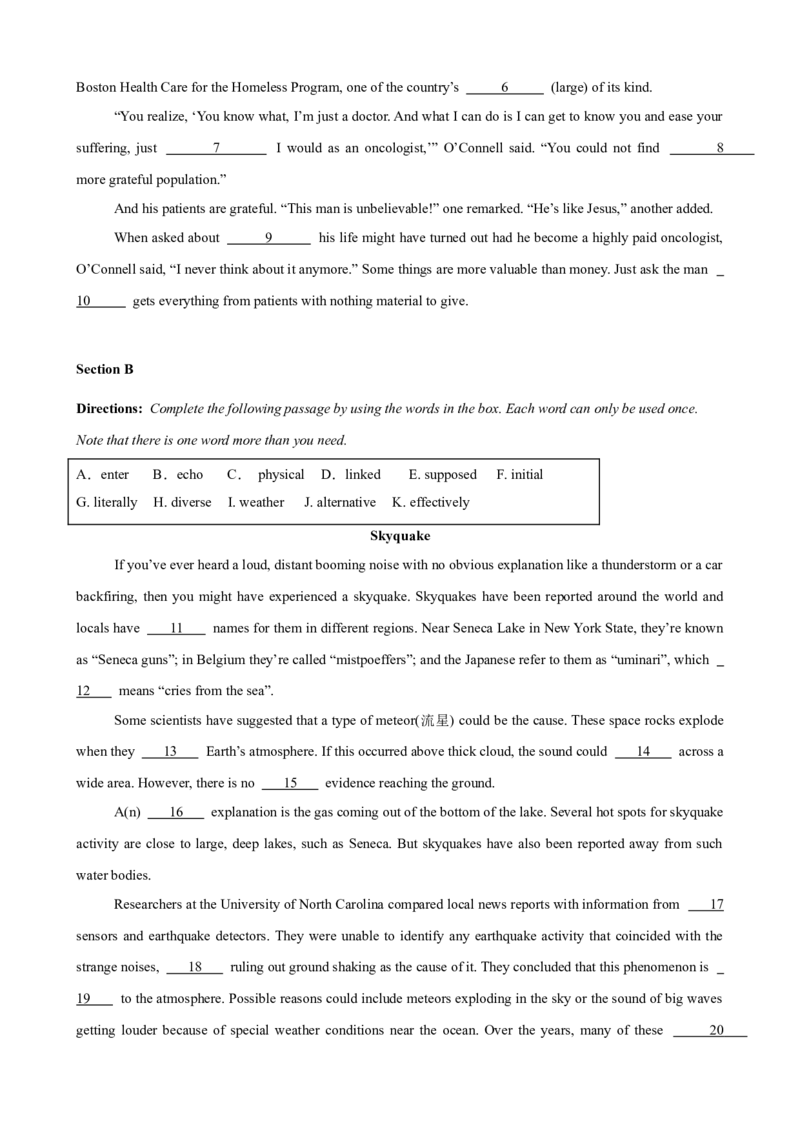
A.enter      B.echo      C. physical    D.linked       E. supposed     F. initial
G. literally    H. diverse    I. weather     J. alternative    K. effectively
Skyquake
If you’ve ever heard a loud, distant booming noise with no obvious explanation like a thunderstorm or a car
backfiring, then you might have experienced a skyquake. Skyquakes have been reported around the world and
locals have    11    names for them in different regions. Near Seneca Lake in New York State, they’re known
as “Seneca guns”; in Belgium they’re called “mistpoeffers”; and the Japanese refer to them as “uminari”, which
12    means “cries from the sea”.
Some scientists have suggested that a type of meteor(流星) could be the cause. These space rocks explode
when they    13    Earth’s atmosphere. If this occurred above thick cloud, the sound could    14    across a
wide area. However, there is no    15    evidence reaching the ground.
A(n)    16    explanation is the gas coming out of the bottom of the lake. Several hot spots for skyquake
activity are close to large, deep lakes, such as Seneca. But skyquakes have also been reported away from such
water bodies.
Researchers at the University of North Carolina compared local news reports with information from    17
sensors and earthquake detectors. They were unable to identify any earthquake activity that coincided with the
strange noises,    18    ruling out ground shaking as the cause of it. They concluded that this phenomenon is
19    to the atmosphere. Possible reasons could include meteors exploding in the sky or the sound of big waves
getting louder because of special weather conditions near the ocean. Over the years, many of these     20

mystery noises have turned out to be caused by military planes flying faster than the speed of sound.
Given the diversity of locations and explanations, it’s possible that skyquakes in different parts of the world
have different causes. But for now, their true cause remains mysterious.
II.
Reading Comprehension   (21 – 35 题,每题1 分;36 – 50 题,每题2 分;共45 分)
Section A
Directions: For each blank in the following passage there are four words or phrases marked A, B, C and D.
Fill in each blank with the word or phrase that best fits the context.
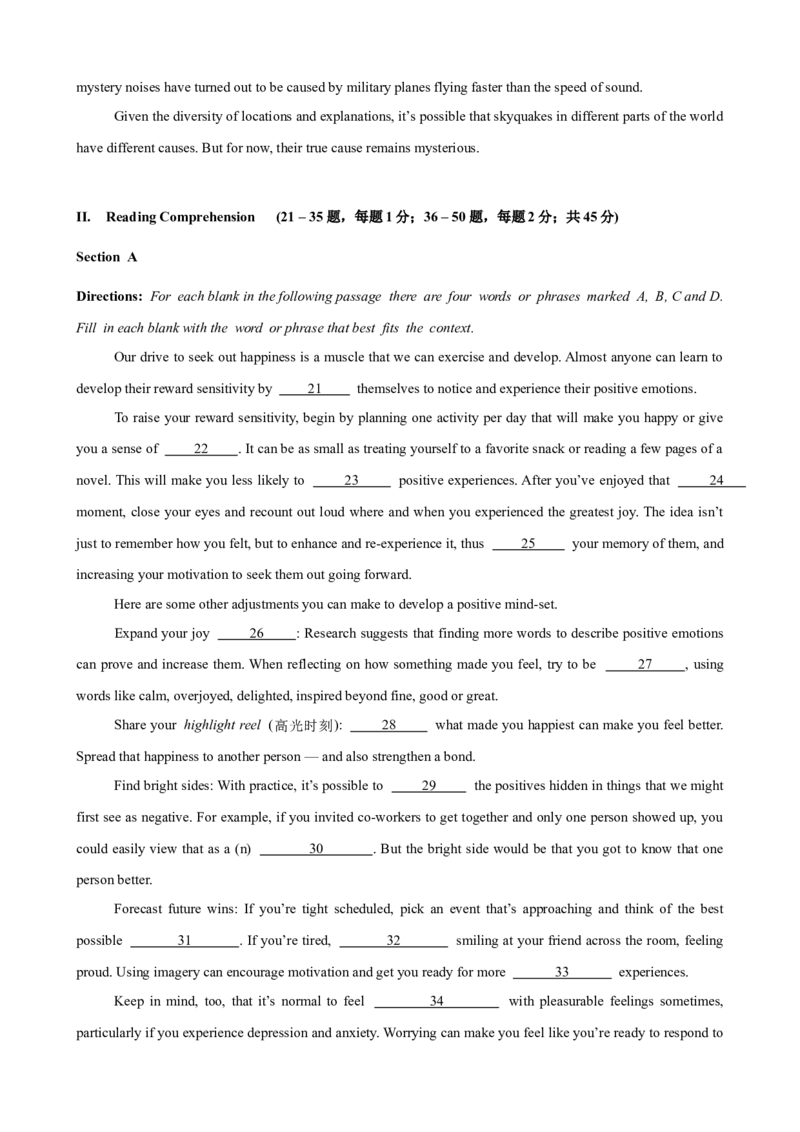
Our drive to seek out happiness is a muscle that we can exercise and develop. Almost anyone can learn to
develop their reward sensitivity by     21     themselves to notice and experience their positive emotions.
To raise your reward sensitivity, begin by planning one activity per day that will make you happy or give
you a sense of     22    . It can be as small as treating yourself to a favorite snack or reading a few pages of a
novel. This will make you less likely to     23     positive experiences. After you’ve enjoyed that     24

moment, close your eyes and recount out loud where and when you experienced the greatest joy. The idea isn’t
just to remember how you felt, but to enhance and re-experience it, thus     25     your memory of them, and
increasing your motivation to seek them out going forward.
Here are some other adjustments you can make to develop a positive mind-set.
Expand your joy     26    : Research suggests that finding more words to describe positive emotions
can prove and increase them. When reflecting on how something made you feel, try to be     27    , using
words like calm, overjoyed, delighted, inspired beyond fine, good or great.
Share your highlight reel (高光时刻):     28     what made you happiest can make you feel better.
Spread that happiness to another person — and also strengthen a bond.
Find bright sides: With practice, it’s possible to     29     the positives hidden in things that we might
first see as negative. For example, if you invited co-workers to get together and only one person showed up, you
could easily view that as a (n)       30      . But the bright side would be that you got to know that one
person better.
Forecast future wins: If you’re tight scheduled, pick an event that’s approaching and think of the best
possible       31      . If you’re tired,       32       smiling at your friend across the room, feeling
proud. Using imagery can encourage motivation and get you ready for more       33       experiences.
Keep in mind, too, that it’s normal to feel       34       with pleasurable feelings sometimes,
particularly if you experience depression and anxiety. Worrying can make you feel like you’re ready to respond to
threats — but by constantly       35       disaster, we miss the happiness in front of us right now. Sometimes
we need to behave like happy people if we actually want to be happy.
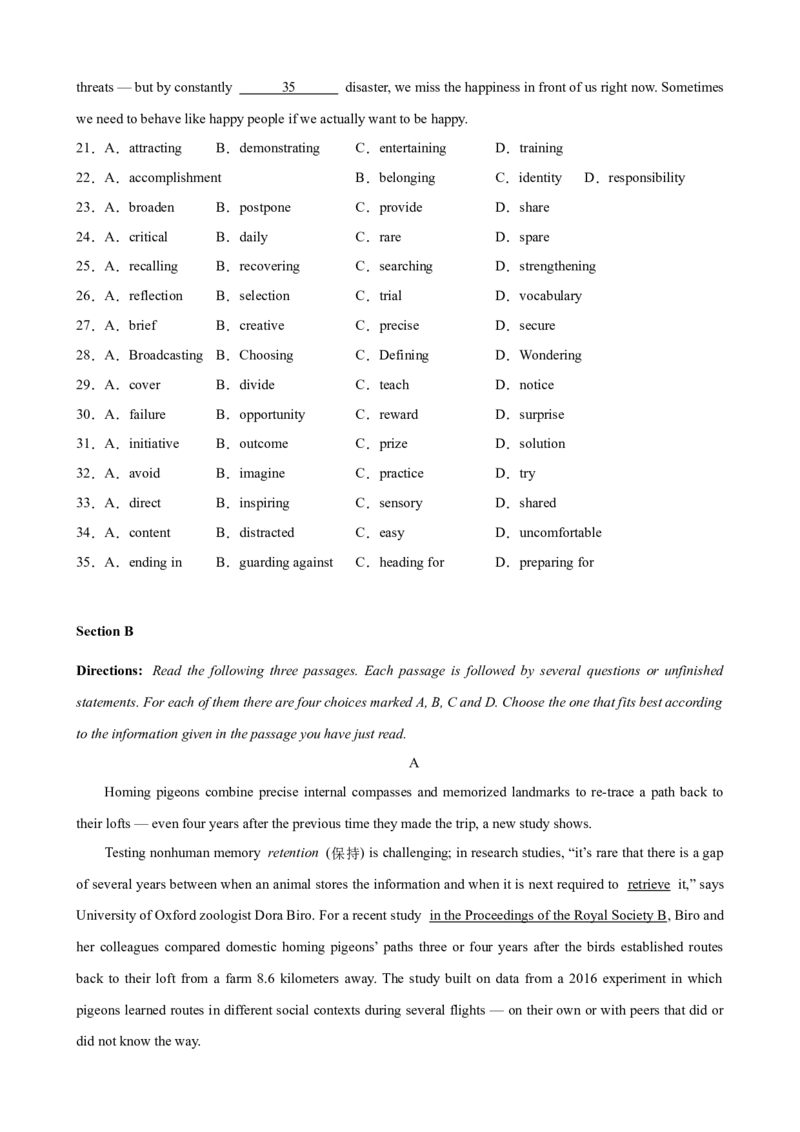
21.A.attracting
B.demonstrating
C.entertaining
D.training
22.A.accomplishment
B.belonging
C.identity
D.responsibility
23.A.broaden
B.postpone
C.provide
D.share
24.A.critical
B.daily
C.rare
D.spare
25.A.recalling
B.recovering
C.searching
D.strengthening
26.A.reflection
B.selection
C.trial
D.vocabulary
27.A.brief
B.creative
C.precise
D.secure
28.A.Broadcasting
B.Choosing
C.Defining
D.Wondering
29.A.cover
B.divide
C.teach
D.notice
30.A.failure
B.opportunity
C.reward
D.surprise
31.A.initiative
B.outcome
C.prize
D.solution
32.A.avoid
B.imagine
C.practice
D.try
33.A.direct
B.inspiring
C.sensory
D.shared
34.A.content
B.distracted
C.easy
D.uncomfortable
35.A.ending in
B.guarding against
C.heading for
D.preparing for
Section B
Directions: Read the following three passages. Each passage is followed by several questions or unfinished
statements. For each of them there are four choices marked A, B, C and D. Choose the one that fits best according
to the information given in the passage you have just read.
A
Homing pigeons combine precise internal compasses and memorized landmarks to re-trace a path back to
their lofts — even four years after the previous time they made the trip, a new study shows.
Testing nonhuman memory retention (保持) is challenging; in research studies, “it’s rare that there is a gap
of several years between when an animal stores the information and when it is next required to retrieve it,” says
University of Oxford zoologist Dora Biro. For a recent study in the Proceedings of the Royal Society B, Biro and
her colleagues compared domestic homing pigeons’ paths three or four years after the birds established routes
back to their loft from a farm 8.6 kilometers away. The study built on data from a 2016 experiment in which
pigeons learned routes in different social contexts during several flights — on their own or with peers that did or
did not know the way.
Using data from GPS devices temporarily attached to the birds’ backs, the researchers compared the flight
paths a pack of pigeons took in 2019 or 2020, without the birds visiting the release site in between. Some birds
missed a handful of landmarks along the way, but many others took “strikingly similar” routes to those they used
in 2016, says Oxford zoologist and study co-author Julien Collet: “It was...as if the last time they flew there was
just the day before, not four years ago.”
The team found that the pigeons remembered a route just as well if they first flew it alone or with others and
fared much better than those that had not made the journey in 2016.
The result is not surprising, says Verner Bing-man, who studies animal navigation at Bowling Green State
University and was not involved with the study. But it provides new confirmation of homing pigeons’ remarkable
memory, he says: “It closes the distance a little bit between our self-centered sense of human intellectual abilities
and what animals can do.”
36.The underlined word “retrieve” is closest in meaning to ________.
A.reserve
B.return
C.recover
D.record
37.Which of the following conclusions may be found in the recent study in the Proceedings of the Royal
Society B ?
A.Pigeons remember specific routes home after years away.
B.Pigeons remember routes better when flying with others.
C.Pigeons can find their way back though taking different routes.
D.Pigeons can retrace the path home through an attached GPS device.
38.Which of the following is TRUE about the 2016 experiment?
A.Oxford zoologist Julien Collet designed the experiment procedure.
B.GPS devices were attached permanently to collect data about flight routes.
C.The experiment was designed to eliminate pigeons that missed key landmarks.
D.Pigeons were made to fly from the release site to their lofts several times.
39.What can be inferred from the last paragraph?
A.Humans need to adopt a more rigid approach to pigeons’ memory.
B.Humans are blinded by superiority when it comes to animal intelligence.
C.Riddles about animals are too complex to be solved in the foreseeable future.
D.There have been mixed responses to the findings about pigeons’ memory.
B
Take our latest quiz!
 You’ve just finished a book
①
— do you know what you’ll
read next?
a)Yes! Perhaps a sequel, I want to spend more time in that
world.
b)A book that everyone’s talking about.
c)No, but I love finding unexpected books.
d)No. I like asking for my friends’ recommendations.
 Do you value other people’s
②
opinions when deciding what
to read?
a)I don’t like listening to others—I know what I like.
b)I love to know what celebrities are reading!
c)No. I just let the books do the talking!
d)Yes! Friends know which books I’ll enjoy.
 What do you most look
③
forward to in a new book?
a)To see what my favourite characters are doing in new
situations.
b)Talking about it with my friends.
c)Discovering new voices and stories.
d)Reading books as good as other ones I’ve loved.
 Do you like reading lots of
④
books by the same author?
a)Yes, once I find an author I like, I’ll read everything they
write!
b)If they’re a popular author, then yes!
c)No, I like to read books by different authors.
d)I tend to read books by authors my friends suggest.
 When you go to a bookshop,
⑤

where do you head first?
a)To see if there’s a new book in my favourite series.
b)I head to the new releases and bestsellers.
c)I like to walk around the whole shop to see what catches
my eye.
d)To look at the bookseller’s recommendations.
Mostly As: you’ re a
SERIES-HOPPER
There’s no better feeling
than reading something
you love... and then
discovering it’s part of a
series! You’ re always
guaranteed to have
something new to look
forward to, and a
familiar world to revisit
again.
Mostly Bs: you’re a
TREND-TRACKER
You like to read the
books that everyone is
talking about. Your
local bestseller will
know better than
anyone which books
and authors are truly
up-and-coming, so ask
them for their top tips.
Mostly Cs:
you’re a
RISK-TAKER
________
Mostly Ds: you’re a
ADVICE-SEEKER
You feel reassured
when someone you
trust recommends a
book to you. If you
want to expand your
reading experiences,
try getting those
recommendation from
lots of different
places.
40.Which of the following best explains what a “sequel” is?
A.A story or book that is about imaginary characters.
B.A book that continues the story of a previous book.
C.A book that conveys. relationships between multiple characters.
D.A collection of stories written by fans of an original book series.
41.Which of the following description best fits the definition of a “risk-taker”?
A.You’re happy to pick up something you’ve never heard of.
B.You hope to find the new book of your favourite author.
C.You’re willing to wander in the world of the classics.
D.You only read those on top of the list of best sellers.
42.What can those who take this quiz learn from the results?
A.Why they prefer reading to other activities.
B.Which author is probably their favourite.
C.Who they should turn to for reading tips. D.What their book-choosing style is.
C
For a long time, psychologists agreed with the findings of Roy Baumeister, whose research showed that
willpower was a limited resource that could easily be exhausted through use. His book, Willpower: Rediscovering
the Greatest Human Strength, has long been seen as the typical handbook on this subject. Plus, hundreds of
experiments showed that when people had to complete two back-to-back tasks which both required willpower,
they would demonstrate less willpower on the second task.
From this research, willpower came to be understood as a “brain muscle” that would grow more tired the
longer you used it. With adequate rest and recovery, the muscle’s energy would be restored, and willpower levels
would return to normal. This made sense and even opened the door for an optimistic long-term approach to
willpower: You could improve your willpower by using it regularly, just as you can strengthen a muscle through
exercise.
However, just because an idea sounds good doesn’t mean it’s true. Later research failed to find
Baumeister’s willpower exhaustion effect. And other research even showed that willpower exhaustion can be
reversed if you have a positive belief about what hard work does for you. If you believe using willpower is
draining, you’ll experience it as draining, but if you believe it energizes you, you’ll be energized. In other words,
what you believe about willpower might be a self-fulfilling prophecy.
The trouble is that studying a psychological quality like willpower in the lab is very difficult. Willpower
experiments greatly oversimplify the human experience and don’t reflect how willpower is used in the real world.
Sample sizes are usually small because of limited funding, and it’s difficult to find diverse subjects. It almost
certainly matters how meaningful the willpower-requiring task is to the person doing it, and laboratory
experiments generally don’t ask participants to perform meaningful tasks.
Furthermore, there are a great many factors that can affect how much willpower an individual has.
Willpower levels change from moment to moment and day to day. Someone who has excellent willpower in one
situation might have terrible willpower in another. You might have high self-control one day and low self-control
another.
So we just don’t know how willpower really works, and we might never know. People may or may not have
a limited amount of willpower. Believing you have unlimited willpower might help you work harder than you
otherwise would, or it might lead to overconfidence.
43.Roy Baumeister’s book, Willpower: Rediscovering the Greatest Human Strength, is mentioned at the
beginning of the passage in order to show that _____.
A.willpower as a limited resource has been widely accepted
B.his book is very popular among people in various fields
C.willpower is essential in completing back-to-back tasks
D.a great many experiments has been done on willpower
44.By “a self-fulfilling prophecy” in paragraph 3, the author means that _____.
A.with enough rest, willpower can recover itself
B.with the right attitude, we can own our willpower
C.we can fulfil our dream as long as we have willpower
D.there is a fixed amount of willpower if we think positively
45.The author implies in the passage that we should _____.
A.view willpower as unlimited to fully cultivate our potential
B.try doing different tasks when our willpower levels change
C.stop doing research on willpower since it is too changeable
D.treat willpower critically as it’s hard to get a full picture of it
46.Which of the following is the best title for the passage?
A.The Definition of Willpower
B.The Great Willpower Debate
C.The Importance of Willpower
D.Strategies to Increase Willpower
Section C
Directions: Read the following passages. Fill in each blank with a proper sentence given in the box. Each
sentence can be used only once. Note that there are two more sentences than you need.
Addiction to Labeling
Maybe you’ve noticed it in the comments section of popular social media posts about anxiety. depression or
things alike, with a number of people claiming to pick these labels for themselves.
These days, labeling is everywhere.    47    However, the negative part is that it’s easy for someone to
identify with the characteristics without truly recognizing the context in which these characteristics would require
diagnosis, according to Charlotte Armitage, a registered integrative psychotherapist and psychologist.
If you have done your research and genuinely feel that you have some form of mental health concern, then
finally having a name for your behaviors can be great. But the risk is that many people will seek labels and
intervention for any behavior, pattern or emotion that is outside of the permanent happy group that society has set
as the norm. “   48    Then the saying ‘a little bit of knowledge is dangerous’ springs to my mind,” Armitage
adds.
   49    “Children are still developing and evolving, and many childhood behavioral features may seem
like those of a disorder when there’re other potential explanations for that behavior,” Armitage notes. Ideally, a
diagnosis for a child should be carried out by a qualified mental health professional. So it is with an adult.
Nevertheless, the most important thing to bear in mind is that diagnosis doesn’t mean to indicate that you
are broken or less capable.    50    And if you go deeper, it can alert you to the fact that you are not alone, and
that many people experience life in the same way as you do.
A.Labeling poses even more of a problem when it comes to kids.
B.It can be helpful for those not quite able to understand why they feel the way they do.
C.There seems to be a desire to see negative emotions as something requiring intervention or diagnosis.
D.Labeling leads to children’s overcoming their addiction to what is posted online.
E.Someone has had only a certain experience and judges all behavior with that experience.
F.The basic function of a diagnosis is to give you a name for those behaviors once felt unusual.
III. Summary Writing   (10 分)
51.Directions: Read the following passage. Summarize the main idea and the main point(s) of the passage in no
more than 60 words. Use your own words as far as possible.
England Prohibits Phones in Schools, But Will It Help?
Recently, England’s Department of Education has confirmed plans to ban the use of mobile phones in
English schools during the school day, including break times. The guidance offers schools a variety of ways to
implement (实施) the ban, ranging from an order to leave all phones at home, to handing them in on arrival or
keeping them in inaccessible lockers.
England’s response to the growing frustration with students’ cellphone use during school time is not
unfounded. The United Nations this past summer published a report issuing a strong warning regarding
technology use in schools around the globe. Some countries had already implemented strict “no-cellphone”
policies. For example, France prohibited students in elementary and middle schools from using cellphones while
on campus. Meanwhile, it is reported that most teens use their phones for an average of 43 minutes during school
hours, with some students reaching six hours on the high end. These addictive devices often lead to distraction and
social anxiety. Worse still, almost one-third of secondary school teachers said that their lessons were interrupted
by students’ mobile phones.
However, some people don’t believe that banning mobile phones in England’s schools will fundamentally
address the harm that mobile phones do to children. “We work with children daily. We understand that a phone is
a device to pay for a bus, contact your mum, and find information,” Kidron, a secondary school teacher, said. “So
the device is not the issue; it is the persistent irresponsible content provided by online tech platforms that is to
blame. Companies that engage with children, therefore, should offer content that is suitable for their age and
development capacity.” Ghey, a concerned mother, also raised her voice on this matter, but with a different
perspective. She argued for the phone manufacturers to make specific products for under-18s that prevent them
from accessing harmful content.
___________________________________________________________________________________________
___________________________________________________________________________________________
___________________________________________________________________________________________
___________________________________________________________________________________________
___________________________________________________________________________________________
____________________
IV. Translation  (第1-2 句,每句3 分;第3 句,4 分;第4 句5 分;共15 分)
Directions: Translate the following sentences into English, using the words given in the brackets.
52.比赛结束时,观众席上掌声雷动。(burst) (汉译英)

53.无论情况有多复杂,他都能应对自如。(No matter) (汉译英)

54.公司感受到了威胁, 其应对策略是书写长长的警示标签,试图预见可能发生的事故。(respond)(汉
译英)

55.由于路面结冰,部分高速公路临时封闭,致使许多乘客困在路上,出门前最好留意天气预报。
(trap)(汉译英)

七、书信写作
56.Directions: Write an English composition in 120-150 words according to the instructions given below in
Chinese.
假如你是明启中学的吴磊,高考结束之后,你的学校组织校友活动,请即将毕业的高三学生进班给高一
高二的学弟学妹们传授经验,请结合自身经历写一篇发言稿。你的发言稿须:
1. 描述你在高中三年最大的收获;
2. 就如何过好高中生活,给出你的建议。
___________________________________________________________________________________________
___________________________________________________________________________________________
___________________________________________________________________________________________
___________________________________________________________________________________________
_________________________________________________________________________________________