重难点 19 阅读理解之四大常考语篇类型(综合
练)
【考点统计】
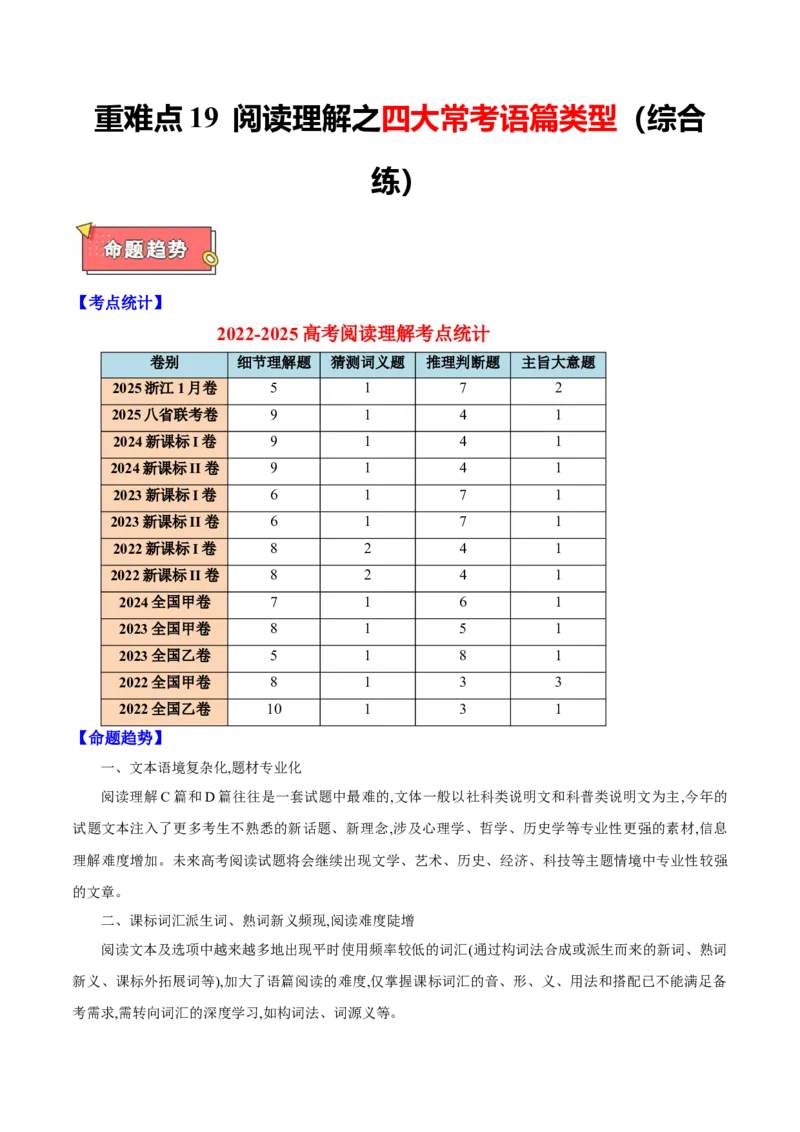
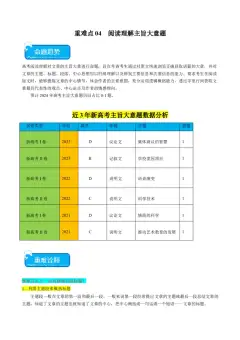
2022-2025高考阅读理解考点统计
卷别 细节理解题 猜测词义题 推理判断题 主旨大意题
2025浙江1月卷 5 1 7 2
2025八省联考卷 9 1 4 1
2024新课标I卷 9 1 4 1
2024新课标II卷 9 1 4 1
2023新课标I卷 6 1 7 1
2023新课标II卷 6 1 7 1
2022新课标I卷 8 2 4 1
2022新课标II卷 8 2 4 1
2024全国甲卷 7 1 6 1
2023全国甲卷 8 1 5 1
2023全国乙卷 5 1 8 1
2022全国甲卷 8 1 3 3
2022全国乙卷 10 1 3 1
【命题趋势】
一、文本语境复杂化,题材专业化
阅读理解C篇和D篇往往是一套试题中最难的,文体一般以社科类说明文和科普类说明文为主,今年的
试题文本注入了更多考生不熟悉的新话题、新理念,涉及心理学、哲学、历史学等专业性更强的素材,信息
理解难度增加。未来高考阅读试题将会继续出现文学、艺术、历史、经济、科技等主题情境中专业性较强
的文章。
二、课标词汇派生词、熟词新义频现,阅读难度陡增
阅读文本及选项中越来越多地出现平时使用频率较低的词汇(通过构词法合成或派生而来的新词、熟词
新义、课标外拓展词等),加大了语篇阅读的难度,仅掌握课标词汇的音、形、义、用法和搭配已不能满足备
考需求,需转向词汇的深度学习,如构词法、词源义等。三、聚焦长难句、逻辑思维,凸显考查深层理解能力
鉴于高考阅读文本内容越来越专业,为了更好地将主旨表达清楚,长难句今后很可能变成较难文章的标
配。
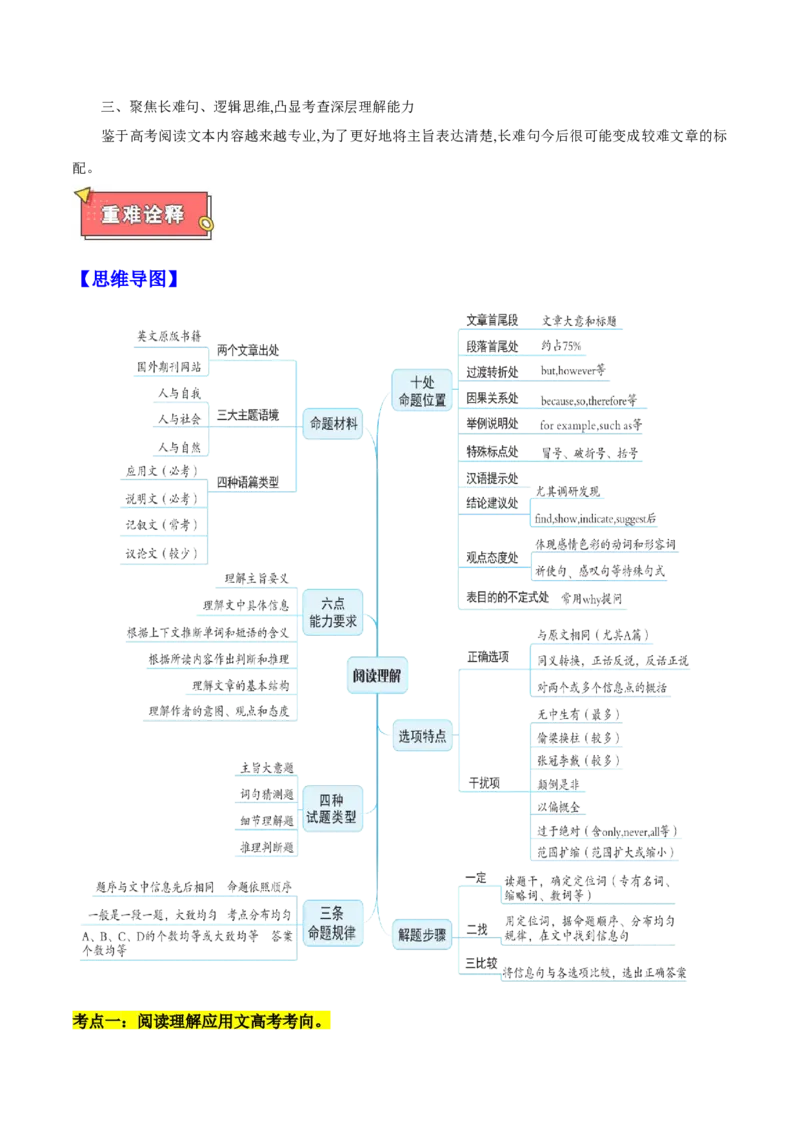
【思维导图】
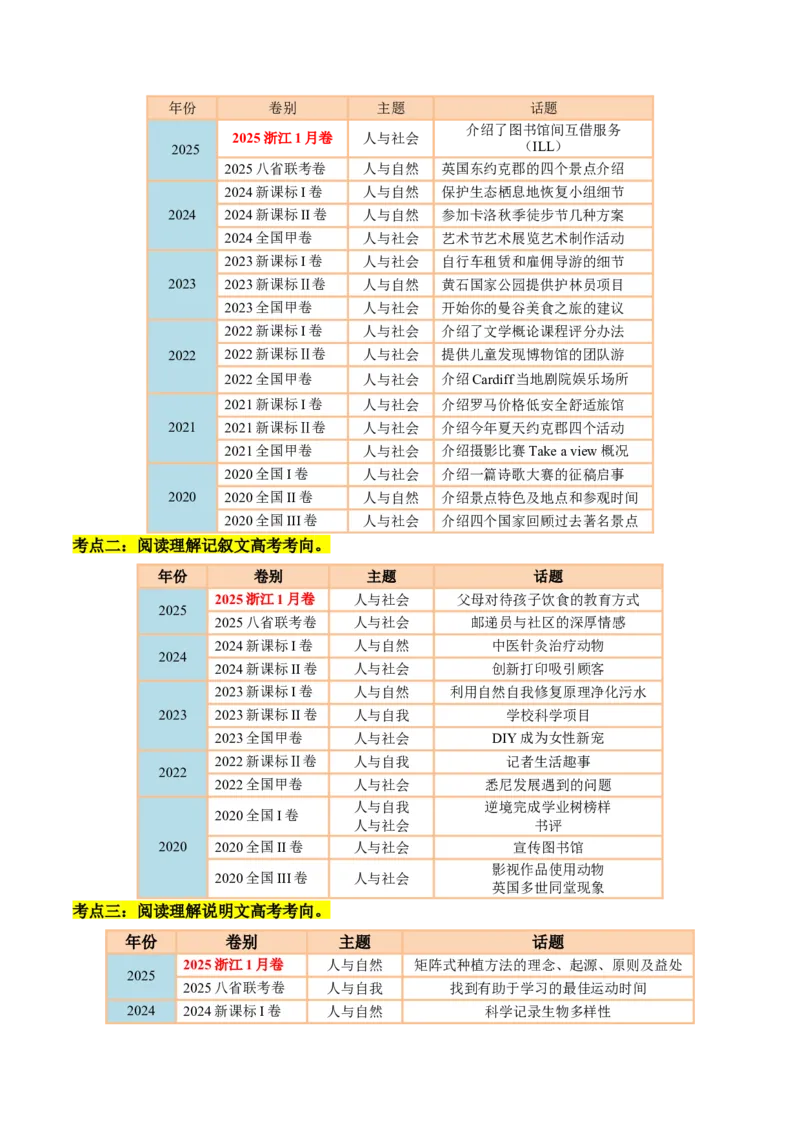
考点一:阅读理解应用文高考考向。年份 卷别 主题 话题
介绍了图书馆间互借服务
2025浙江1月卷 人与社会
22025
(ILL)
2025八省联考卷 人与自然 英国东约克郡的四个景点介绍
2024新课标I卷 人与自然 保护生态栖息地恢复小组细节
2024 2024新课标II卷 人与自然 参加卡洛秋季徒步节几种方案
2024全国甲卷 人与社会 艺术节艺术展览艺术制作活动
2023新课标I卷 人与社会 自行车租赁和雇佣导游的细节
2023 2023新课标Ⅱ卷 人与自然 黄石国家公园提供护林员项目
2023全国甲卷 人与社会 开始你的曼谷美食之旅的建议
2022新课标I卷 人与社会 介绍了文学概论课程评分办法
2022 2022新课标Ⅱ卷 人与社会 提供儿童发现博物馆的团队游
2022全国甲卷 人与社会 介绍Cardiff当地剧院娱乐场所
2021新课标I卷 人与社会 介绍罗马价格低安全舒适旅馆
2021 2021新课标Ⅱ卷 人与社会 介绍今年夏天约克郡四个活动
2021全国甲卷 人与社会 介绍摄影比赛Take a view概况
2020全国I卷 人与社会 介绍一篇诗歌大赛的征稿启事
2020 2020全国II卷 人与自然 介绍景点特色及地点和参观时间
2020全国III卷 人与社会 介绍四个国家回顾过去著名景点
考点二:阅读理解记叙文高考考向。
年份 卷别 主题 话题
2025浙江1月卷 人与社会 父母对待孩子饮食的教育方式
2025
2025八省联考卷 人与社会 邮递员与社区的深厚情感
2024新课标I卷 人与自然 中医针灸治疗动物
2024
2024新课标II卷 人与社会 创新打印吸引顾客
2023新课标I卷 人与自然 利用自然自我修复原理净化污水
2023 2023新课标II卷 人与自我 学校科学项目
2023全国甲卷 人与社会 DIY成为女性新宠
2022新课标Ⅱ卷 人与自我 记者生活趣事
2022
2022全国甲卷 人与社会 悉尼发展遇到的问题
人与自我 逆境完成学业树榜样
2020全国I卷
人与社会 书评
2020 2020全国II卷 人与社会 宣传图书馆
影视作品使用动物
2020全国III卷 人与社会
英国多世同堂现象
考点三:阅读理解说明文高考考向。
年份 卷别 主题 话题
2025浙江1月卷 人与自然 矩阵式种植方法的理念、起源、原则及益处
2025
2025八省联考卷 人与自我 找到有助于学习的最佳运动时间
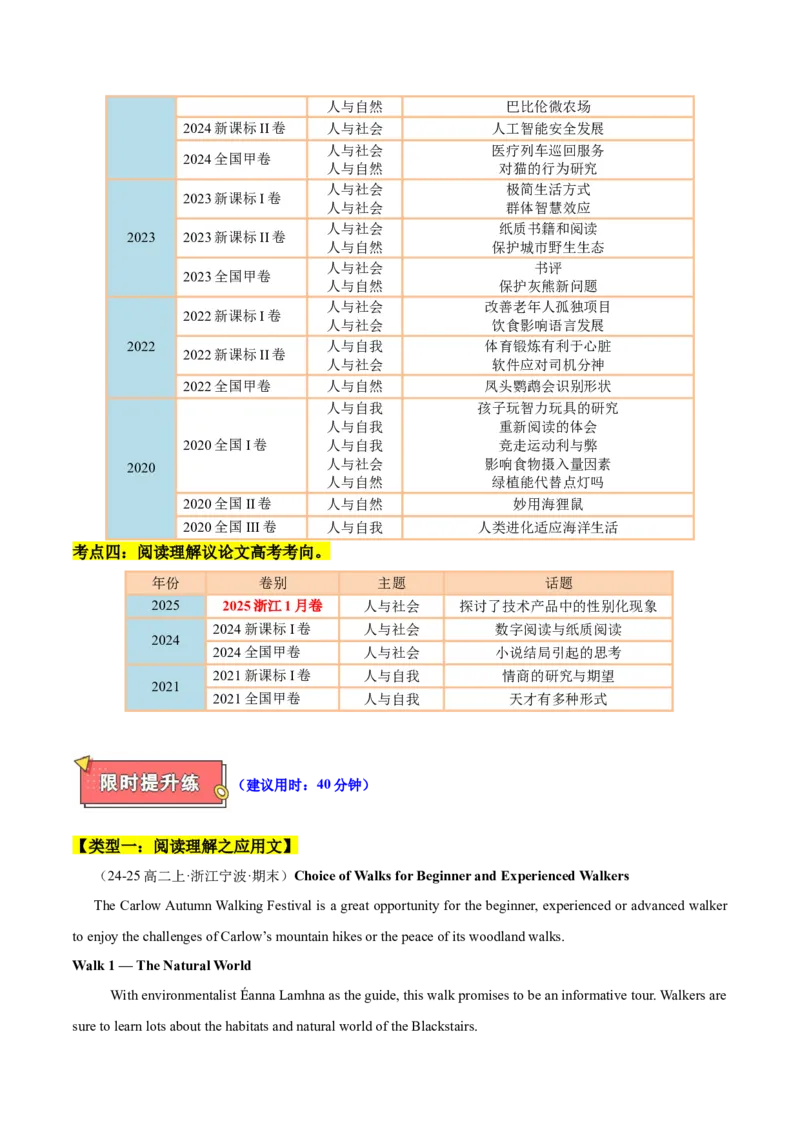
2024 2024新课标I卷 人与自然 科学记录生物多样性人与自然 巴比伦微农场
2024新课标II卷 人与社会 人工智能安全发展
人与社会 医疗列车巡回服务
2024全国甲卷
人与自然 对猫的行为研究
人与社会 极简生活方式
2023新课标I卷
人与社会 群体智慧效应
人与社会 纸质书籍和阅读
2023 2023新课标II卷
人与自然 保护城市野生生态
人与社会 书评
2023全国甲卷
人与自然 保护灰熊新问题
人与社会 改善老年人孤独项目
2022新课标I卷
人与社会 饮食影响语言发展
2022 人与自我 体育锻炼有利于心脏
2022新课标II卷
人与社会 软件应对司机分神
2022全国甲卷 人与自然 凤头鹦鹉会识别形状
人与自我 孩子玩智力玩具的研究
人与自我 重新阅读的体会
2020全国I卷 人与自我 竞走运动利与弊
人与社会 影响食物摄入量因素
2020
人与自然 绿植能代替点灯吗
2020全国II卷 人与自然 妙用海狸鼠
2020全国III卷 人与自我 人类进化适应海洋生活
考点四:阅读理解议论文高考考向。
年份 卷别 主题 话题
2025 2025浙江1月卷 人与社会 探讨了技术产品中的性别化现象
2024新课标I卷 人与社会 数字阅读与纸质阅读
2024
2024全国甲卷 人与社会 小说结局引起的思考
2021新课标I卷 人与自我 情商的研究与期望
2021
2021全国甲卷 人与自我 天才有多种形式
(建议用时:40分钟)
【类型一:阅读理解之应用文】
(24-25高二上·浙江宁波·期末)Choice of Walks for Beginner and Experienced Walkers
The Carlow Autumn Walking Festival is a great opportunity for the beginner, experienced or advanced walker
to enjoy the challenges of Carlow’s mountain hikes or the peace of its woodland walks.
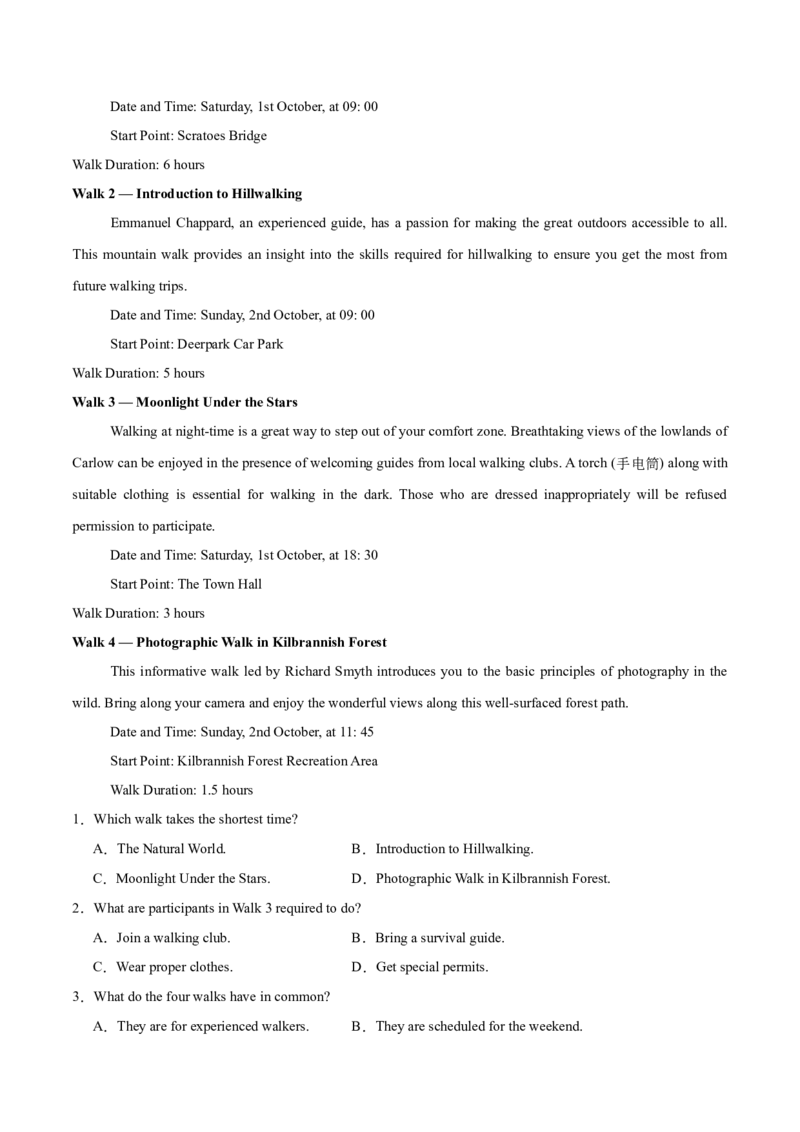
Walk 1 — The Natural World
With environmentalist Éanna Lamhna as the guide, this walk promises to be an informative tour. Walkers are
sure to learn lots about the habitats and natural world of the Blackstairs.Date and Time: Saturday, 1st October, at 09: 00
Start Point: Scratoes Bridge
Walk Duration: 6 hours
Walk 2 — Introduction to Hillwalking
Emmanuel Chappard, an experienced guide, has a passion for making the great outdoors accessible to all.
This mountain walk provides an insight into the skills required for hillwalking to ensure you get the most from
future walking trips.
Date and Time: Sunday, 2nd October, at 09: 00
Start Point: Deerpark Car Park
Walk Duration: 5 hours
Walk 3 — Moonlight Under the Stars
Walking at night-time is a great way to step out of your comfort zone. Breathtaking views of the lowlands of
Carlow can be enjoyed in the presence of welcoming guides from local walking clubs. A torch (手电筒) along with
suitable clothing is essential for walking in the dark. Those who are dressed inappropriately will be refused
permission to participate.
Date and Time: Saturday, 1st October, at 18: 30
Start Point: The Town Hall
Walk Duration: 3 hours
Walk 4 — Photographic Walk in Kilbrannish Forest
This informative walk led by Richard Smyth introduces you to the basic principles of photography in the
wild. Bring along your camera and enjoy the wonderful views along this well-surfaced forest path.
Date and Time: Sunday, 2nd October, at 11: 45
Start Point: Kilbrannish Forest Recreation Area
Walk Duration: 1.5 hours
1.Which walk takes the shortest time?
A.The Natural World. B.Introduction to Hillwalking.
C.Moonlight Under the Stars. D.Photographic Walk in Kilbrannish Forest.
2.What are participants in Walk 3 required to do?
A.Join a walking club. B.Bring a survival guide.
C.Wear proper clothes. D.Get special permits.
3.What do the four walks have in common?
A.They are for experienced walkers. B.They are scheduled for the weekend.C.They share the same start point. D.They involve difficult climbing.
(24-25高三上·江苏苏州·期末)Silk Roads
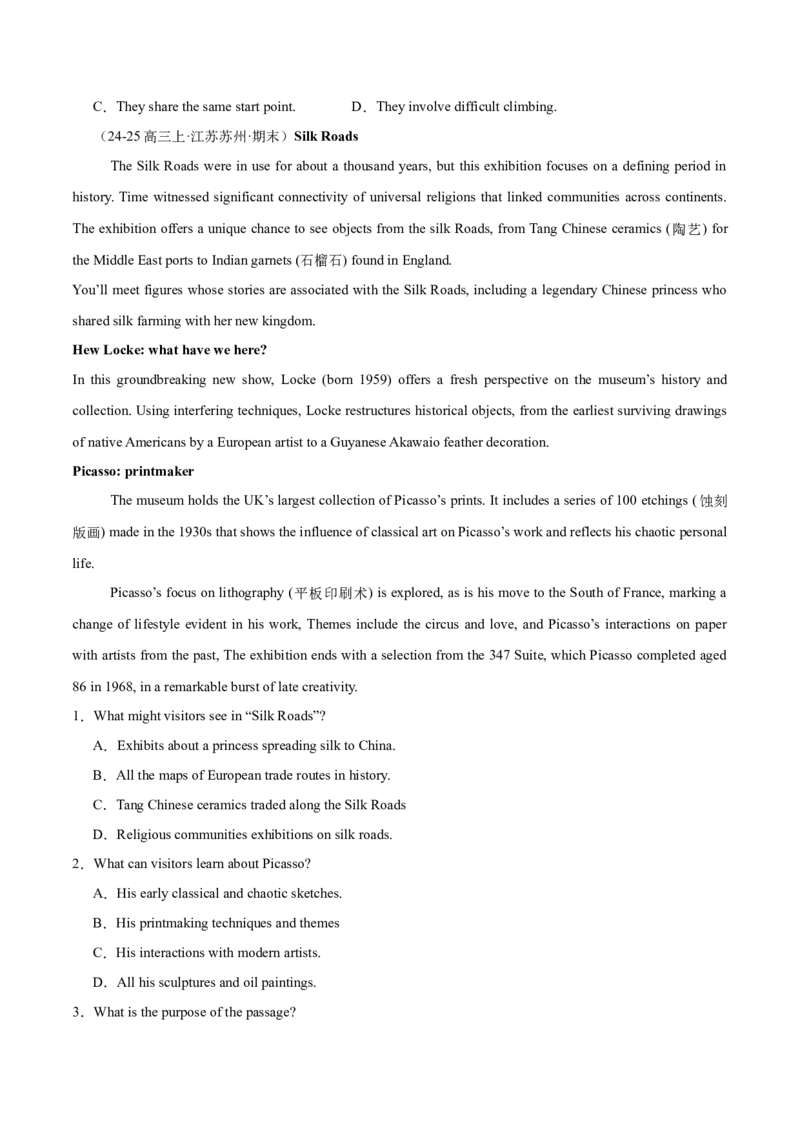
The Silk Roads were in use for about a thousand years, but this exhibition focuses on a defining period in
history. Time witnessed significant connectivity of universal religions that linked communities across continents.
The exhibition offers a unique chance to see objects from the silk Roads, from Tang Chinese ceramics (陶艺) for
the Middle East ports to Indian garnets (石榴石) found in England.
You’ll meet figures whose stories are associated with the Silk Roads, including a legendary Chinese princess who
shared silk farming with her new kingdom.
Hew Locke: what have we here?
In this groundbreaking new show, Locke (born 1959) offers a fresh perspective on the museum’s history and
collection. Using interfering techniques, Locke restructures historical objects, from the earliest surviving drawings
of native Americans by a European artist to a Guyanese Akawaio feather decoration.
Picasso: printmaker
The museum holds the UK’s largest collection of Picasso’s prints. It includes a series of 100 etchings (蚀刻
版画) made in the 1930s that shows the influence of classical art on Picasso’s work and reflects his chaotic personal
life.
Picasso’s focus on lithography (平板印刷术) is explored, as is his move to the South of France, marking a
change of lifestyle evident in his work, Themes include the circus and love, and Picasso’s interactions on paper
with artists from the past, The exhibition ends with a selection from the 347 Suite, which Picasso completed aged
86 in 1968, in a remarkable burst of late creativity.
1.What might visitors see in “Silk Roads”?
A.Exhibits about a princess spreading silk to China.
B.All the maps of European trade routes in history.
C.Tang Chinese ceramics traded along the Silk Roads
D.Religious communities exhibitions on silk roads.
2.What can visitors learn about Picasso?
A.His early classical and chaotic sketches.
B.His printmaking techniques and themes
C.His interactions with modern artists.
D.All his sculptures and oil paintings.
3.What is the purpose of the passage?A.To analyze British art history. B.To promote UK art tourism.
C.To discuss artworks’ impacts. D.To introduce museum exhibitions.
(24-25 高三上·广东揭阳·期末)Do you know the best and cheapest way to see Europe? How about
travelling by train across Europe? If booked in advance, it can offer some incredible deals. It beats flying anyway
and also is the most sustainable and one of the cheapest ways to travel across Europe. Here comes one of the best-
value train deals in Europe — tick off three classic Europe destinations with one incredible fare.
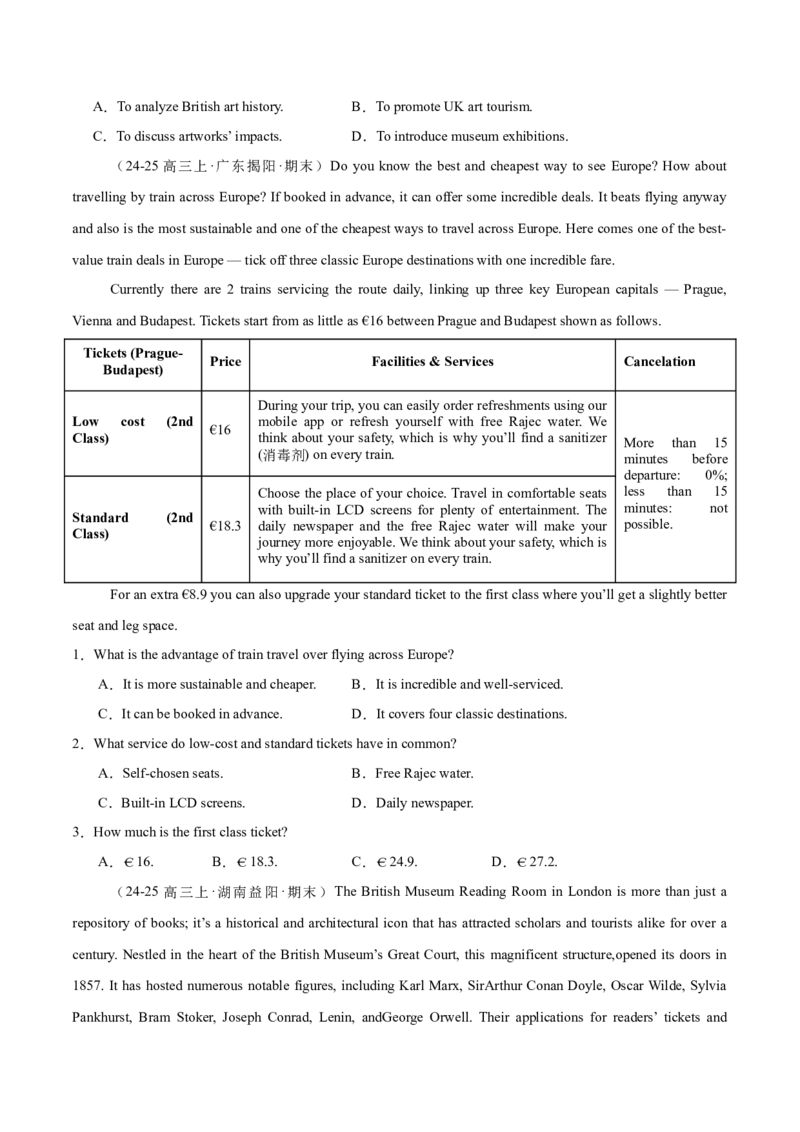
Currently there are 2 trains servicing the route daily, linking up three key European capitals — Prague,
Vienna and Budapest. Tickets start from as little as €16 between Prague and Budapest shown as follows.
Tickets (Prague-
Price Facilities & Services Cancelation
Budapest)
During your trip, you can easily order refreshments using our
Low cost (2nd mobile app or refresh yourself with free Rajec water. We
€16
Class) think about your safety, which is why you’ll find a sanitizer
More than 15
(消毒剂) on every train.
minutes before
departure: 0%;
Choose the place of your choice. Travel in comfortable seats less than 15
with built-in LCD screens for plenty of entertainment. The minutes: not
Standard (2nd
€18.3 daily newspaper and the free Rajec water will make your possible.
Class)
journey more enjoyable. We think about your safety, which is
why you’ll find a sanitizer on every train.
For an extra €8.9 you can also upgrade your standard ticket to the first class where you’ll get a slightly better
seat and leg space.
1.What is the advantage of train travel over flying across Europe?
A.It is more sustainable and cheaper. B.It is incredible and well-serviced.
C.It can be booked in advance. D.It covers four classic destinations.
2.What service do low-cost and standard tickets have in common?
A.Self-chosen seats. B.Free Rajec water.
C.Built-in LCD screens. D.Daily newspaper.
3.How much is the first class ticket?
A.€16. B.€18.3. C.€24.9. D.€27.2.
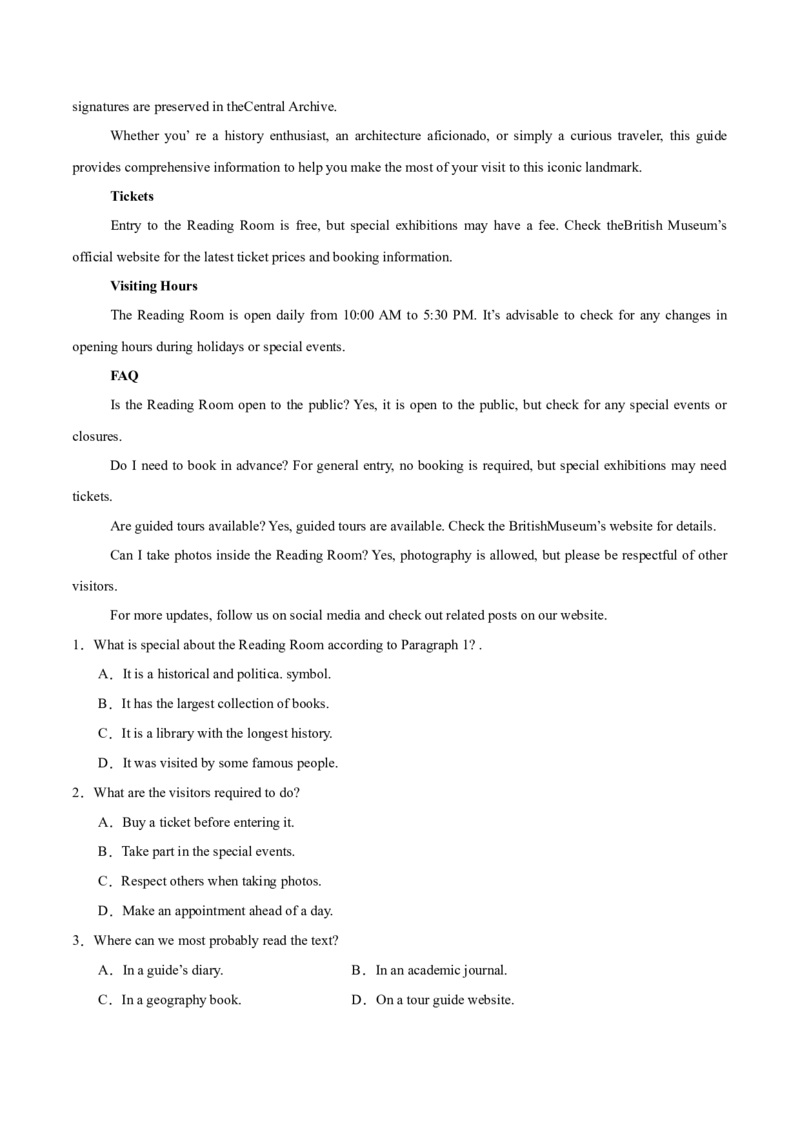
(24-25 高三上·湖南益阳·期末)The British Museum Reading Room in London is more than just a
repository of books; it’s a historical and architectural icon that has attracted scholars and tourists alike for over a
century. Nestled in the heart of the British Museum’s Great Court, this magnificent structure,opened its doors in
1857. It has hosted numerous notable figures, including Karl Marx, SirArthur Conan Doyle, Oscar Wilde, Sylvia
Pankhurst, Bram Stoker, Joseph Conrad, Lenin, andGeorge Orwell. Their applications for readers’ tickets andsignatures are preserved in theCentral Archive.
Whether you’ re a history enthusiast, an architecture aficionado, or simply a curious traveler, this guide
provides comprehensive information to help you make the most of your visit to this iconic landmark.
Tickets
Entry to the Reading Room is free, but special exhibitions may have a fee. Check theBritish Museum’s
official website for the latest ticket prices and booking information.
Visiting Hours
The Reading Room is open daily from 10:00 AM to 5:30 PM. It’s advisable to check for any changes in
opening hours during holidays or special events.
FAQ
Is the Reading Room open to the public? Yes, it is open to the public, but check for any special events or
closures.
Do I need to book in advance? For general entry, no booking is required, but special exhibitions may need
tickets.
Are guided tours available? Yes, guided tours are available. Check the BritishMuseum’s website for details.
Can I take photos inside the Reading Room? Yes, photography is allowed, but please be respectful of other
visitors.
For more updates, follow us on social media and check out related posts on our website.
1.What is special about the Reading Room according to Paragraph 1? .
A.It is a historical and politica. symbol.
B.It has the largest collection of books.
C.It is a library with the longest history.
D.It was visited by some famous people.
2.What are the visitors required to do?
A.Buy a ticket before entering it.
B.Take part in the special events.
C.Respect others when taking photos.
D.Make an appointment ahead of a day.
3.Where can we most probably read the text?
A.In a guide’s diary. B.In an academic journal.
C.In a geography book. D.On a tour guide website.【类型二:阅读理解之记叙文】
(24-25 高三上·山东青岛·期末)A whale shark under the waves caught in a ray of sunlight, a snow
leopard (豹) moving forward with its eyes locked on yours–these images could easily be mistaken for photographs,
but in fact they were captured by a paintbrush.
British artist Sophie Green often creates paintings of endangered animal species. With a following of over
115, 000 on a social platform, she’s not doing so badly.
Last year, one of Green’s works was auctioned (拍卖) at the Royal Geographical Society in London. It was a
painting of a chimp (黑猩猩), called Wounda, which had been rescued from a illegal trade by the Jane Goodall
Institute in the Republic of Congo. When Wounda arrived at the institute, she was in desperate need of medical
attention, but since receiving treatment, she has made a full recovery and now lives in an island reserve.
Profits from all Green’s artworks goes towards funding a range of projects, from shark and turtle research to
conservation for African land mammals.
As a child, Green was diagnosed (诊断) with selective-mutism — a form of anxiety, meaning she wouldn’t
speak in class or to her teachers. Consequently, she bathed herself in nature. Green believed painting can be more
effective than photography, because it affords more control over the composition. “If you want the animal to be
looking directly into your eyes, then you can do that,” she said.
Green’s process differs from piece to piece. She often finds images for inspiration everywhere, sometimes
using photographs captured by herself or her friends, and sometimes surfing the Internet to find images of the
creature she wants to paint. Often, the final piece comes from a combination of several images.
Her goal is to encourage action from people who view the artwork. “If you’ve looked into the animal’s eyes,
I think it’s much harder to forget that there’s so much going on in the world right now and so many animals that
need our help,” Green said.
1.What does the author start the text with?
A.Photographs of animals.
B.Excellence of Green’s works.
C.Limitations of Green’s works.
D.Impacts of animal-focused paintings.
2.Why is Green’s painting about a rescued chimp mentioned?
A.To stress her environmental awareness.
B.To display the main theme of her works.
C.To encourage people to support the auction.D.To show her contribution to protecting animals.
3.What do we know about Green’s art-making process?
A.She often turns to others for help.
B.She mainly relies on online information.
C.She observes real animals to get inspiration.
D.She combines different images into her work.
4.What does Green mean in the last paragraph?
A.Criticizing people for ignoring the endangered animals.
B.Emphasizing the importance of eye contact with animals.
C.Highlighting the emotional impact of the work on viewers.
D.Showing her paintings are more realistic than photographs.
(24-25高三上·山东菏泽·期末)When I was growing up, my mom often said that no matter what grades I
got in school, as long as I did my best, she’d be proud of me. Then she added, “But if you didn’t get an A, I’ll know
you didn’t do your best.” She said it with a smile, but I took it seriously: I shouldn’t settle for anything less than
perfect. My greatest weakness is that I’m too much of a perfectionist.
Perfectionism is the desire to be 100% perfect. The goal is zero faults and no failures. In an increasingly
competitive world, kids face growing pressure from parents to be perfect and severe criticism when they fall short.
Every fault is a blow to their self-esteem (自尊). I’ve lived it myself.
When I won the fifth-grade quiz bowl on world explorers, I beat myself up afterward for missing one
question. How could I forget that the sea route to India was discovered by da Gama, but not Magellan? When I
made the finals of a Mortal Kombat tournament and won a lifetime pass to a local movie theater, I didn’t celebrate.
Third place is the second loser. When I won the first prize in a math test, I was disappointed. Only a 98? Not good
enough. There was always a voice in the back of my mind whispering that it wasn’t enough and that I could have
done better.
It was during my college years that I started to question the value of this perfectionism. I met people who
didn’t seem to be weighed down by the same expectations, who accepted their mistakes and saw them as
opportunities for growth rather than failures. They taught me that it was okay to be imperfect, that it was human to
make mistakes, and that sometimes, the most important lessons come from our failures.
1.What is paragraph 1 mainly about?
A.Why the author became a perfectionist. B.The disadvantage of being a perfectionist.
C.How the author got the good grades in school. D.The feeling of being grateful to the author’s mother.2.What made the author unsatisfied with what had been achieved?
A.Blame from parents. B.Desire to get first prize.
C.Eagerness to be perfect. D.Pressure of competitions.
3.What made the author change the attitude towards perfectionism?
A.Losing expectation to succeed. B.Realizing the harm of being perfect.
C.Learning lessons from other people’s failure. D.Encountering those accepting imperfection.
4.Which column of a magazine may the text be taken from?
A.Parenting Styles. B.Coming-of-Age Stories.
C.People of Achievement. D.Challenges Facing Youth.
(24-25高二上·江苏泰州·期末)With a father who is a chemist and a mother who is a biologist it seemed
natural for Kelydra to learn how the world worked by doing science experiments. Kelydra was 15 when the
breaking news came that a chemical called C8 in her town’s water supply might cause cancer. Kelydra wondered
what she could do to help.
Like any good scientist, she started by researching the problem. What exactly was C8? She found out that
C8, also known as APFO, is a chemical with a chain of eight carbon atoms. This chemical has shown up not only in
drinking water but also in the bodies of people and animals. How much of this chemical was in the water supply? In
fact, nobody even knew of an inexpensive, reliable test that could measure the amount of APFO in water. So
Kelydra decided to invent one.
Kelydra learned that when you shake water contaminated with high amounts of APFO, the water gets foamy
(起泡沫的) . The more APFO in the water, the more foam there will be. In this way she could calculate the level of
pollutants of the original river water sample. But she wanted to know more than that.
So she started working on a way to remove APFO from the water. She finally succeeded by using a device,
consisting of a dry cell battery and two electrodes (电极) . Kelydra dipped the electrodes in the water. Then, in a
specific process, one of the electrodes became an electrically charged tool that attracted the APFO in the water.
Kelydra could then remove the electrode, wash it off, and put it back in the water to draw out more of the chemical.
Kelydra then added another ingredient to the water: activated carbon which looks like grains of black sand
and is used in water filters. The carbon filtered (过滤) out even more of the APFO. Kelydra repeated the
electrosorption and carbon-filtering process until the water was completely free of APFO — and safe to drink.
1.What inspired Kelydra to solve the problem?
A.Her extensive knowledge in chemistry.
B.Her deep concern for the locals’ health.C.Her great passion for doing experiments.
D.Her firm desire to follow her parents’ path.
2.What does the underlined word “contaminated” in Paragraph 3 mean?
A.Cleaned. B.Polluted. C.Heated. D.Identified.
3.Why did Kelydra add activated carbon to the water?
A.To purify the water. B.To remove the foam.
C.To filter the carbon. D.To charge the electrodes.
4.Which of the following best describes Kelydra?
A.Curious and adventurous. B.Confident and cheerful.
C.Conservative and courageous. D.Innovative and committed.
(24-25 高三上·湖北·期末)After graduating from high school, Amelia Earhart spent a vacation in
Toronto, Canada, where she spotted wounded soldiers returning from World War I. Then, she volunteered as a
nurse’s aide, coming to know many wounded pilots. She developed a strong admiration for aviators, spending much
of her free time watching the Royal Flying Corps practicing at the airfield nearby.
At a Long Beach air show, Earhart took a plane ride that transformed her life. It was only 10 minutes, but
when she landed she knew she had to learn to fly. Working at a variety of jobs, from photographer to truck driver,
she earned enough money to take flying lessons. She read everything she could find on flying and spent much of
her time at the airfield. She cropped her hair short, in the style of other women aviators. Worried about what the
other more experienced pilots might think of her, she even slept in her new leather jacket for three nights to give it a
more “worn” look.
Soon, she rose her fame and became the 16th woman to be issued a pilot’s license by The Federation
Aeronautique. One day, Earhart received a phone call, asking her, “Would you like to fly the Atlantic?” In a
heartbeat, she said yes. She was selected to be the first woman on a transatlantic flight as a passenger.
On June 17, 1928, Earhart took off from Trepassey Harbor in a Fokker named Friendship. Accompanying
her on the flight were three other male pilots. Approximately 20 hours and 40 minutes later, they touched down
safely. Earhart later confessed that she felt she “was just baggage, like a sack of potatoes”. Then she added, “Maybe
someday I’ll try it alone.”
1.What contributed to Earhart’s determination to be a pilot?
A.Experiencing a ten-minute air ride.
B.Appreciating a Long Beach air show.
C.Volunteering as a nurse's aide during World War I.D.Watching wounded soldiers returning from the war.
2.Why did Earhart sleep in her new leather jacket?
A.She cared for it a lot. B.She tried to make it look old.
C.She worried others would take it away. D.She was too worn out to take it off.
3.The reason why Earhart felt like “baggage” was that ______.
A.she landed the plane safely
B.she was the only woman on the flight
C.she was not an active-enough participant
D.she was not given credit for her role in the flight
4.Which words can best describe Earhart?
A.Adventurous and patient. B.Humble and persistent.
C.Determined and passionate. D.Diligent and unselfish.
【类型三:阅读理解之说明文】
(24-25高三上·江西·期末)Gideon Mendel, a photojournalist who has been documenting climate change
through his series “Submerged Portraits”. Starting his project in 2007, Mendel’s goal is to make the impact of
climate change on human deeply felt, moving away from typical imagery of glaciers and polar bears to focus on
flood-affected individuals.
He goes where the floods are — floods typically linked to climate change. But instead of racing to capture
ongoing storms and rainfall, he waits for the water to settle and tries to capture the trauma(创伤)endured by
communities. His subjects stand still in their flooded homes, creating heart-breaking images that convey both
aesthetic(美学的)beauty and profound content. These portraits come from 13 different flood zones across the
globe, demonstrating the wide existence of climate change impacts.
As Mendel continues his work, he shifts towards video, creating installations(装置)like Deluge, which is part
of the photography exhibition “Coal + Ice” at New York’s Asia Society. The exhibition, showing videos of flood
survivors returning home, emphasizes the personal and global consequences of climate change.
“He makes it human and real, that we are all vulnerable and impacted by climate change, regardless of where
we live or what our income is,” commented Tzeporah Berman, chair and founder of the Fossil Fuel Non-
Proliferation Treaty Initiative, after viewing Deluge. “He brings to life not just what’s happening in the landscape
but shows the despair in people’s faces.”
Mendel’s long-term mission to portray trauma connects deeply with his family history of the Holocaust,
influencing both his artistic and activist pursuits. Despite the connection, he says, “Real activists take risks and goto prison and put themselves on the line. I only put my pictures online.”
1.What effect may Mendel’s photographs of flood survivors have on viewers?
A.Calming. B.Touching. C.Refreshing. D.Challenging.
2.What do we know about “Coal+ Ice”?
A.It focuses on historical flood events.
B.It highlights the impact of climate change.
C.It gives birth to installations like Deluge.
D.It displays the aesthetic beauty of flood zones.
3.What can we learn from the last paragraph?
A.Mendel only cares about online exposure.
B.Mendel takes the same risks as real activists.
C.Mendel holds a humble attitude towards his efforts.
D.Mendel’s mission is irrelevant to his family history.
4.Which of the following best describes Mendel?
A.Devoted and sympathetic. B.Passionate and humorous.
C.Ambitious and courageous. D.Thoughtful and generous.
(24-25 高三上·福建福州·期末)About a decade ago, Fuchsia Dunlop attended a banquet (宴会) in
Guangzhou. The most memorable dish, however, was the plain white cup of soup served at the end. Made from
chicken, it was simple, clean and perfect. It seem odd to Westerners, but, as Ms Dunlop, an English food writer,
explains in a new book, stock (家禽) is a unique expression of a chef’s art. And the clean, “almost invisible soup” is
an ideal conclusion to a banquet, with its rich and strong flavours.
Invitation to a Banquet is Ms Dunlop’s seventh book where, unlike a traditional cookbook, she has chosen 30
dishes to illustrate different aspects of Chinese cuisine — and, in turn, Chinese life and history. Like other outsiders
who focus on a foreign cuisine, she is more a gatherer than an inventor of recipes. Her well-researched cookbooks
read as mini-ethnographies (民族志).
Readers will not learn how to make traditional Chinese cuisines but how and why Chinese chefs have long
prized unusual (and to Westerners, sometimes unappealing) ingredients. A seemingly humble yet labor-intensive
dish of braised carp (鲤鱼) tail serves as a starting point for exploring the significance of kougan, or mouthfeel, in
Chinese cuisine. Westerners, Ms Dunlop argues, “have traditionally assumed that the Chinese eat less desirable
animal parts out of poverty”, when in fact they shut the door on various foods that is wonderfully cui (“slippery,
often in a wet way”).Altogether, Ms Dunlop makes a persuasive argument for the superiority of Chinese cuisine, highlighting its
strengths in a joyful manner rather than a boastful one. She shows how it has embraced foreign influences, how it
has changed with China’s increasing wealth and how central it is to the country’s cultural history.
She makes an equally persuasive argument that what Westerners think of as “Chinese food”, commonly found at
their local takeaway, is neither inauthentic nor wrong. Instead, it is an adaptation shaped by Chinese communities
living abroad and as representative of the cuisine’s diversity as a frozen pizza is of Italy’s. Immigration has made
the authentic flavors more accessible than ever outside China. Eaters should learn to appreciate that.
1.Why might the plain chicken soup seem odd to Westerners?
A.It is placed in a white cup. B.It is served at the end of the meal.
C.It is made of unusual ingredients. D.It is enriched with complex flavors.
2.How does Invitation to a Banquet differ from traditional cookbooks?
A.It keeps track of foreign recipes.
B.It explores aspects beyond recipes.
C.It is intended for cuisine research.
D.It teaches how to make Chinese cuisines.
3.What can be inferred from the mentioning of “westerners” in Para.3?
A.They view Chinese cuisine as pricey.
B.They hesitate to try new ingredients.
C.They like Chinese cuisine’s diversity.
D.They often misinterpret Chinese cuisine.
4.What does Ms Dunlop think of Chinese cuisine?
A.Inclusive and dynamic. B.Inflexible and adapted.
C.Simple and overvalued. D.Beautiful and boastful.
(24-25高三上·山东济南·期末)Robots are separated into two parts: the brain and the body. An AI brain
can help run the traffic system of a city, but many robots still struggle to open a door — why is that?
“Software has advanced rapidly in recent years, but hardware has not kept up. Currently, all robots rely on
electricity and software to function. The robotic brain composed of software translates information to the body or
hardware through an encoder (编码器), which then performs an action,” said Dr Antonio Forte, a senior lecturer in
engineering at King’s College London.
To overcome this, Forte’s team developed a circuit by integrating liquid-based circuits with an adjustable
valve (阀) placed within a robot’s hardware. This valve acts like a switch in a normal circuit and engineers can sendsignals directly to hardware using variations in pressure from liquid inside, allowing the robot to perform complex
tasks without the need for electricity or instruction from the central brain. This leads robots to function
independently in challenging environments, such as low-income countries that do not have reliable access to
electricity.
Independent from the software running it, the advanced hardware system carries the majority of
computational load by itself. This opens up the possibility of a new generation of robots, whose bodies could
operate independently of their built-in control center, with this space potentially being used instead for more
complex AI-powered software, and consequently they can be more aware of their social context, which provides for
a new kind of robotics in places like social care and mass production.
“Ultimately, without investment in such field robots will stay at a certain level after a period of growth.
Soon, if we do not offload the computational tasks that modern-day robots take on, computing improvements will
have little impact on their performance. The work is just a first step on this path, but the future holds smarter robots
with smarter bodies,” Mostafa Mousa, a post-graduate researcher at King’s College London, commented.
1.What is holding back the development of robots nowadays?
A.Backward hardware. B.High electricity cost.
C.Low-speed encoders. D.Complex calculations.
2.How does the valve function in a robot?
A.It translates information. B.It adjusts liquid pressure.
C.It sends electrical signals. D.It powers robots’ brains.
3.What sets the new generation of robots apart from others?
A.Autonomy with adaptability. B.Resistance to physical damage.
C.Understanding of users’ likes. D.Capability to control softwares.
4.What does Mousa think of the work of Forte’s team?
A.Eventful. B.Doubtful. C.Promising. D.Dismissive.
(24-25高三上·湖北·期末)Wisdom teeth are the third set of molars (臼齿) located at the very back of the
mouth. They are the last of the 32 permanent teeth to appear, emerging between 17 and 25 years of age, when you
are older and wiser. You might know that not everyone grows all four wisdom teeth. You might also know many
people get them pulled. We study teeth and find the reason has a lot to do with the distant past and a bit about the
present day, too.
A few million years ago, early human ancestors had larger jaws and teeth than humans do today. Scientists
think robust jaws and teeth were needed because the foods early human ancestors ate were much more difficult tochew than food today. Softer, easier-to-chew food means teeth have a less challenging job. Therefore, modern
human jaws have evolved to be smaller and faces to be flatter than our extinct ancestors’ were. Given these
changes, the third molars might not be as important now as they once were.
About 25% of people today are missing at least one wisdom tooth completely. Sometimes, due to lack of
space, wisdom teeth can get stuck inside the jawbone and never fully come up- or they only partially emerge. An
impacted wisdom tooth will never come up properly. And it happens more often in the lower jaw than in the upper
jaw. In cases where wisdom teeth are only partially up, people can sometimes experience pain, tooth decay (龋齿)
or gum infection, which is why they have them pulled.
But wisdom teeth don’t usually need to be removed if they are fully erupted in the mouth, positioned
correctly and healthily. Dentists can examine your mouth to see if your wisdom teeth are present, or look at X-ray
pictures of your jaw if these last molars haven’t yet emerged and you suspect they may be impacted. Dentists can
also advise you if any treatment or removal is recommended for your wisdom teeth. In the meantime, brushing at
least twice a day will help keep all your teeth healthy.
1.What is the function of the first paragraph?
A.To explain some reasons. B.To illustrate a concept.
C.To introduce the topic. D.To raise a question.
2. What does the underlined word “robust” in paragraph 2 mean?
A.Flexible. B.Demanding. C.Rigid. D.Powerful.
3.What can be inferred about wisdom teeth from the passage?
A.Some people get them pulled for convenience.
B.Our face is bound to become smaller by removing them.
C.Impacted wisdom teeth should be removed as early as possible.
D.The transformation of diet structure gives rise to their degeneration.
4.What is the best title for the passage?
A.Wisdom teeth: the ache source. B.Wisdom teeth: To Pull or Not?
C.Why do wisdom teeth disappear? D.What influence will wisdom teeth bring?
【类型四:阅读理解之议论文】
(24-25高三上·湖南邵阳·期末)A primary school has announced that it no longer requires parents to sign
their children’s homework.
A newspaper comments: Putting an end to the requirement that parents sign the homework of their children
eases the burden on many parents, as otherwise they would have to do primary school homework after a hard day’swork. But there are worries that if parents stop signing their children’s homework, the children will not get good
grades.
However, the most efficient way for children to study is to cultivate their willingness to learn and do their
own studies. When doing homework, students practice and hopefully apply what they have learned. True teachers
are supposed to check students’ homework and identify their mistakes. But some parents correct their children’s
mistakes by themselves when signing the homework.
It is students’ duty to do their homework, be responsible for their studies and correct their mistakes. Parents
supervising their homework, checking their answers and dealing with the harder problems will only make children
less aware of their mistakes and encourage them to wait for their parents’ help when they face any problems.
Children have to manage their own learning and develop the ability to study by themselves, as competence
will not be achieved if a student simply repeats rigid tasks in which he is assisted at school by teachers and at home
by parents.
An experiment conducted by American psychologist Walter Mischel in the 1960s proved that children with
better self-discipline performed better in their studies and relationships.
There is little doubt that parents’ supervision can make children’s homework better. But it does not give
children the chance to solve problems independently.
1.What can we learn about the announcement?
A.Parents don’t support it. B.It makes everyone pleased.
C.It makes parents worried. D.It reduces parents’ burdens.
2.What’s the most efficient way for children to study?
A.Teachers check students’ homework.
B.Parents sign their children’s homework.
C.Children are willing to learn by themselves.
D.Parents supervise their children’s homework.
3.What will happen to children if parents supervise their homework?
A.They will lack confidence. B.They may feel great pressure.
C.They will be more independent. D.They may not realize their mistakes.
4.What’s the author’s attitude to parents signing their children’s homework?
A.Opposed. B.Neutral. C.Optimistic. D.Unconcerned.
(24-25高三上·广东·期末)In a stimulating interview with the philosopher Daniel Dennett in Living on
Earth, Dannet shared that Charles Darwin and Alan Turing might make the same discovery. Darwin showed howyou can get the appearance of purpose and design out of blind processes of natural selection. And Turing said that
any computable problem can be computed by a machine without understanding.
The host then voiced a concern: as Al advances, machines will come to lord over us. Dennett acknowledges
there’s a takeover risk but claims it’s misunderstood. The risk is not that machines will become autonomous rulers
but that we will depend too much on machines.
The main issue with AI is not intelligence but autonomy. At the end of the day, even the smartest computers
are our tools, and their intentions are ours. Or, to the extent that we can speak of their intentions at all. The intention
of a self-driving car to avoid an obstacle, for example, is what it’s designed for.
Our growing dependence on technologies doesn’t mean we are losing our natural autonomy in quite this
sense. Our needs remain. But it is a loss of autonomy. Even auto mechanics these days rely on computers and, in
the era of self-driving cars, will any of us still know how to drive? Think what would happen if we lost electricity?
We’d be thrown back into the 19th century, as Dennett says. But things would be worse as we lack know-how that
made it possible for our ancestors to live well in the olden days.
The truth is, we’ve been technological since our dawn as a species. We first found ourselves in the
archaeological record where we saw a great exposition of tools, technologies, art-making and language. In a sense,
being human means being like a cyborg, which is a technological extension of our natural selves. This suggests that
at any time in our development, a large-scale breakdown in the technological system would spell not exactly our
doom, but our complete reorganization.
Perhaps what makes our current dilemma unprecedented (史无前例的) is the fact that we are so closely
networked. When the library of Alexandria burned down, books and knowledge were lost. But in a world where
libraries are replaced by their online versions, it isn’t unimaginable that every library could be sinply deleted.
What happens to us then?
1.Which of the following statements might Dennet most likely agree with?
A.AI might be overly relied on.
B.AI doesn’t have comprehension.
C.AI’s development is bounded.
D.AI’s evolution resembles natural selection.
2.Which of the following examples best matches the idea of “know-how” in paragraph 4?
A.A scholar studies the theory of natural selection.
B.A nobleman hires servants to do all the housework.
C.A farmer builds a table by hand using traditional tools.D.A worker operates a machine following preset instructions.
3.Why did the author mention libraries in paragraph 6?
A.To show the technological stability.
B.To prove the technological safeguard.
C.To emphasize the technological weakness.
D.To illustrate the technological transformation.
4.What would be the best title for the passage?
A.Is the Concern Artificial Intelligence or Autonomy?
B.How will Technology Breakdown Change Our Lives?
C.Will Artificial Autonomy Threaten Humanity’s Existence?
D.How does the Human-Technology Relationship Develop?
(24-25高三上·广东深圳·期末)I have been studying the French language for three years. This field of
study has been the hardest but most precious of my life. I would put it above the study of writing simply because I
started writing as a 6-year-old boy under my mother’s guidance. I always “felt” I could write. I did not always
“feel” I could study a foreign language effectively.
But here I am, right now, in a French hotel. I spoke French at the border, when I checked in and when I went
to get lunch. I fail to speak with fluency. I mishear words. I can’t really use complicated grammar. But my words
are perfectly understandable and serve their purpose. I feel, as I always do, like I am lost in the dark, but with each
misstep, I find my way more clearly. I didn’t feel it when reading French novels; I didn’t feel it at school. I just felt
it when I first arrived Paris.
I’m emphasizing feelings because, when studying, they are as important as any reality. The fear of making
mistakes feeds the hopeless and makes learners quit. It is not the study of language that is hard. It is the feelings of
who you are at the present level and pessimistic belief of who you will always be that make it hard. The
transformation to turn struggles into growth is what truly makes learning a life-changing journey.
Maybe one day, someone will say something to me that I do not understand, and in that moment. I may feel a
bit discouraged. But now, I feel a sense of being high. These moments of confidence and motivation are precious,
for they remind me of how far I’ve come. They are not the norm (常态), though. The truth is, the lows are what I
encounter more often. They are part of the learning process, part of the transformation that shapes us into better
versions of ourselves. And yet, it is through these lows that I am constantly learning and growing.
1.How does the author feel about making mistakes in French?
A.Awkward. B.Hopeless. C.Competent. D.Rewarding.2.Why does the author emphasize feelings?
A.To highlight his struggles in learning French.
B.To show that positive thinking can drive growth.
C.To illustrate that people should follow their hearts.
D.To clarify his experience in mindset transformation.
3.What can we infer from the last paragraph?
A.The lows are always followed by highs.
B.Feeling confident should be made a norm.
C.Struggles are an essential part of learning.
D.The ups are the real times when learning occurs.
4.Which statement might the author probably agree with?
A.Fail again, fail better. B.Stay grounded, work for greatness.
C.Accept the lows, wait for the chance. D.Be courageous, explore the unknown.
(24-25 高三上·北京丰台·期末)The 2024 Nobel Prize in Physics was awarded for machine learning
development and the Chemistry Nobel was for protein structure prediction via AI. Some said the physics prize
wasn’t really physics. “AI is coming for science, too,” the New York Times concluded. With powerful large
language models, AIs can generate various outputs and even make Nobel-winning discoveries. But have AIs really
taken over science?
To begin with, the physics prize went to Hinton and John Hopfield, a physicist, who discovered how the
physical dynamics of a network can encode memory. Hopfield came up with an intuitive analogy: a ball, rolling
across a bumpy landscape, will often “remember” to return to the same lowest valley. Hinton’s work extended
Hopfield’s model. In short, the Physics Nobel was awarded for fundamental research about the physical principles
of information, not the broad umbrella of “AI” and its applications.
Meanwhile, the Chemistry Nobel was awarded to biochemist David Baker and DeepMind researchers Demis
Hassabis and John Jumper. Baker first developed software to design novel protein structures from scratch. Yet by
2018, of the roughly 200 million proteins cataloged in all genetic databases, only about 150, 000 had confirmed
structures. Then Hassabis and Jumper introduced AlphaFold, which provided accurate folding structures for the
rest. But even so, the AI has failed to predict defects in proteins. It’s not a catholicon for every problem in protein
folding, but rather an excellent tool.
Many of these tools have disappeared into their uses. We rarely pause to consider the transistor (晶体管) (for
which the 1956 physics prize was awarded) when we use electronics containing them by the billions. Somepowerful machine-learning features are already on this path. The neural networks that provide accurate language
translation or song recommendations in popular consumer software programs are simply part of the service. In
science, as in so many other domains, this trend suggests that when AI tools become commonplace, they will fade
into the background, too.
Still a reasonable concern might be that such automation threatens the efforts of human scientists. As AI
becomes essential to further scientific progress, will any prizes recognize work truly free of AI?
AI can revolutionize science. It has already helped us see proteins with previously unimaginable clarity.
Soon AIs may dream up new molecules for batteries. In short, they may do many things, some of which previously
seemed impossible. But they have a crucial limitation tied to something wonderful about science: its empirical
dependence on the real world, which cannot be overcome by computation alone.
Science also needs experimenters — human experts driven to study the universe, and who will ask questions
an AI cannot. Physics — its core ethos is “that the world is understandable” in quantitative, predictive terms solely
by careful experiment and observation. That real world still exists for future scientists to study, whether aided by AI
or not.
1.Regarding the Nobel Prize in Physics, the author might think ________.
A.it should have been awarded to more physicists
B.it aims to encourage physicists to engage in AI research
C.it is a recognition of the broad applications of AI in physics
D.it is justified for its focus on physical principles of information
2.What does the word "catholicon" underlined in Paragraph 3 probably mean?
A.A final solution. B.A big improvement.
C.A complete cure-all. D.A common obstacle.
3.What can we learn from this passage?
A.AI tools are restricted to specific scientific branches.
B.AI tools will become less noticeable once widely used.
C.AI will overcome its dependence on real-world experience.
D.AI poses a threat on traditional methods of scientific inquiry.
4.What would be the best title for this passage?
A.AI and Science: Revolution or Evolution?
B.Is AI Coming to End Scientific Exploration?
C.AI and Science: A New Era of Collaboration?D.Is AI Dominant in Nobel-Winning Discoveries?