文档文本内容
2026秋新版|人教PEP六年级上册
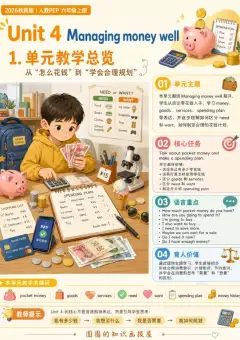
Unit 5 Exploring space
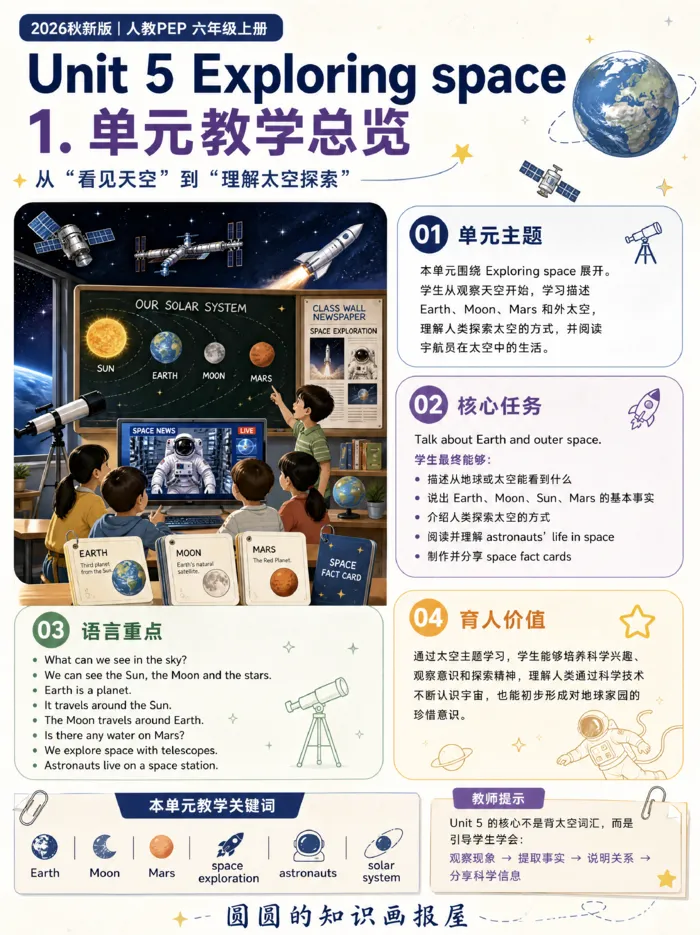
1.单元教学总览
从“看见天空”到“理解太空探索”
01
本
本单元围绕 Exploring space展开。
单元主题
学生从观察天空开始,学习描述
Earth、Moon、Mars 和外太空,
理解人类探索太空的方式,并阅读
宇航员在太空中的生活。
OUR SOLAR
CLASS WALL
NEWSPAPER
SPACE EXPLORATION
EARTH
MOON
MARS
NEWS
LIVE
EARTH
MOON
MARS
Third planet
Earth's natural
The Red Planet.
SPACE
from the Sun
satellite.
FACT CARD
02
Talk about Earth and outer space.
学生最终能够:
● 描述从地球或太空能看到什么
●说出 Earth、Moon、Sun、Mars的基本事实
●介绍人类探索太空的方式
●阅读并理解 astronauts’life in space
●制作并分享space fact cards
核心任务
03 语言重点
04
通过太空主题学习,学生能够培养科学兴趣、
育人价值
观察意识和探索精神,理解人类通过科学技术
不断认识宇宙,也能初步形成对地球家园的
珍惜意识。
· What can we see in the sky?
· We can see the Sun, the Moon and the stars.
· Earth is a planet.
· It travels around the Sun.
· The Moon travels around Earth.
· Is there any water on Mars?
· We explore space with telescopes.
· Astronauts live on a space station.
本单元教学关键词
教师提示
Unit 5的核心不是背太空词汇,而是
引导学生学会:
Earth
Moon
Mars
space
exploration
astronauts
solar
system
观察现象→ 提取事实→说明关系→
分享科学信息
圆圆的知识画报屋
2026秋新版|人教PEP 六年级上册
Unit 5 Exploring space
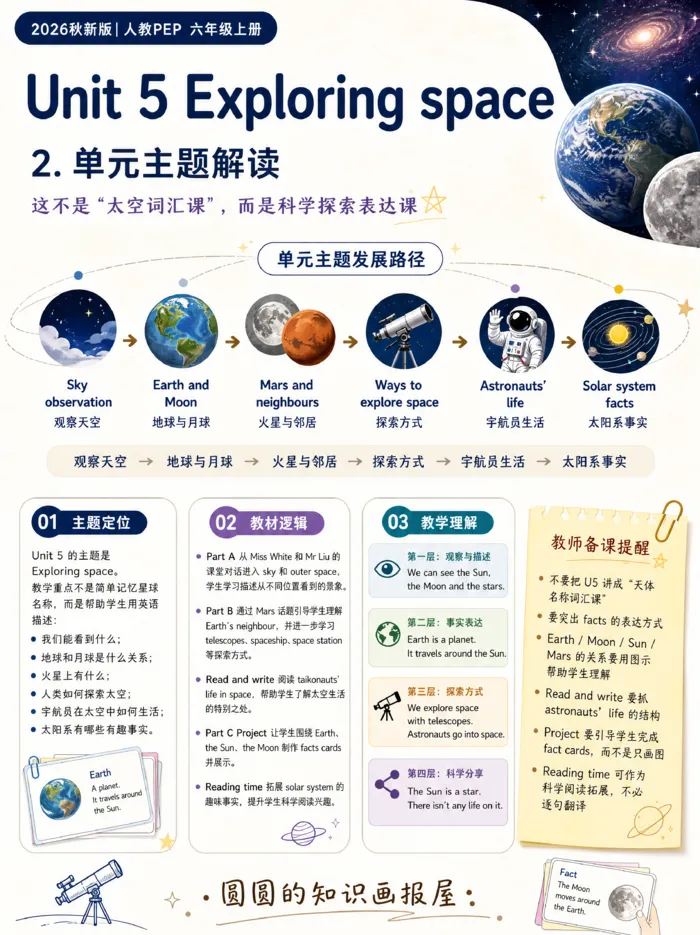
2.单元主题解读
这不是“太空词汇课”,而是科学探索表达课
单元主题发展路径
Sky
Earth and
Mars and
Ways to
Astronauts'
Solar system
observation
Moon
neighbours
explore space
life
facts
观察天空
地球与月球
火星与邻居
探索方式
宇航员生活
太阳系事实
观察天空→ 地球与月球→ 火星与邻居→ 探索方式→宇航员生活→ 太阳系事实
01主题定位
02教材逻辑
03 教学理解
Unit 5的主题是
教师备课提醒0
Exploring space。
教学重点不是简单记忆星球
● Part A从Miss White和Mr Liu的
课堂对话进入sky和 outer space,
学生学习描述从不同位置看到的景象。
第一层:观察与描述
We can see the Sun,
the Moon and the stars.
名称,而是帮助学生用英语
●不要把 U5讲成“天体
名称词汇课”
描述:
●我们能看到什么;
●地球和月球是什么关系;
● Part B通过 Mars话题引导学生理解
Earth's neighbour,并进一步学习
telescopes、spaceship、space station
等探索方式。
第二层:事实表达
Earth is a planet.
It travels around the Sun.
●要突出 facts的表达方式
●火星上有什么;
● Earth/ Moon /Sun/
Mars 的关系要用图示
帮助学生理解
●人类如何探索太空;
●宇航员在太空中如何生活;
● Read and write 阅读 taikonauts'
life in space,帮助学生了解太空生活
的特别之处。
●太阳系有哪些有趣事实。
O
Earth
A planet.
It travels around
the Sun.
● Part C Project 让学生围绕 Earth,
the Sun、the Moon 制作 facts cards
并展示。
第三层:探索方式
We explore space
with telescopes.
Astronauts go into space.
● Read and write要抓
astronauts’life 的结构
● Project要引导学生完成
fact cards,而不是只画图
● Reading time 拓展solar system的
趣味事实,提升学生科学阅读兴趣。
第四层:科学分享
The Sun is a star.
There isn't any life on it.
● Reading time 可作为
科学阅读拓展,不必
逐句翻译
Telescope
.圆圆的知识画报屋:
Fact
The Moon
moves around
the Earth.
2026秋新版|人教PEP六年级上册
Unit 5 Exploring space
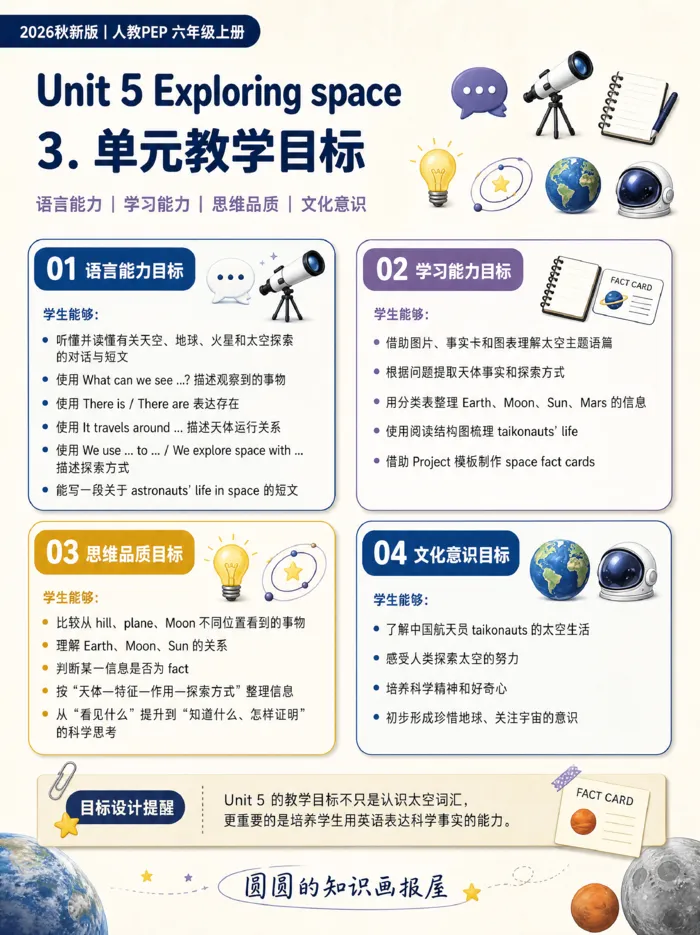
3.单元教学目标
语言能力|学习能力|思维品质|文化意识
01
学生能够:
● 听懂并读懂有关天空、地球、火星和太空探索
● 使用What can we see ..?描述观察到的事物
●使用 There is / There are表达存在
●使用 It travels around ...描述天体运行关系
●使用 We use ...to... / We explore space with.⋯.
●能写一段关于astronauts' life in space的短文
语言能力目标
的对话与短文
描述探索方式
02学习能力目标
FACT CARD
学生能够:
●借助图片、事实卡和图表理解太空主题语篇
●根据问题提取天体事实和探索方式
●用分类表整理 Earth、Moon、Sun、Mars的信息
●使用阅读结构图梳理 taikonauts' life
●借助 Project模板制作space fact cards
03思维品质目标
A
学生能够:
●比较从 hill.plane、Moon不同位置看到的事物
●理解 Earth、Moon、Sun的关系
●判断某一信息是否为fact
●按“天体一特征一作用一探索方式”整理信息
● 从“看见什么”提升到“知道什么、怎样证明”
0
的科学思考
04文化意识目标
学生能够:
●了解中国航天员taikonauts的太空生活
●感受人类探索太空的努力
●培养科学精神和好奇心
●初步形成珍惜地球、关注宇宙的意识
目标设计提醒
Unit 5的教学目标不只是认识太空词汇,
更重要的是培养学生用英语表达科学事实的能力。
FACT CARD
★
圆圆的知识画报屋
2026秋新版|人教PEP六年级上册
Unit 5 Exploring space
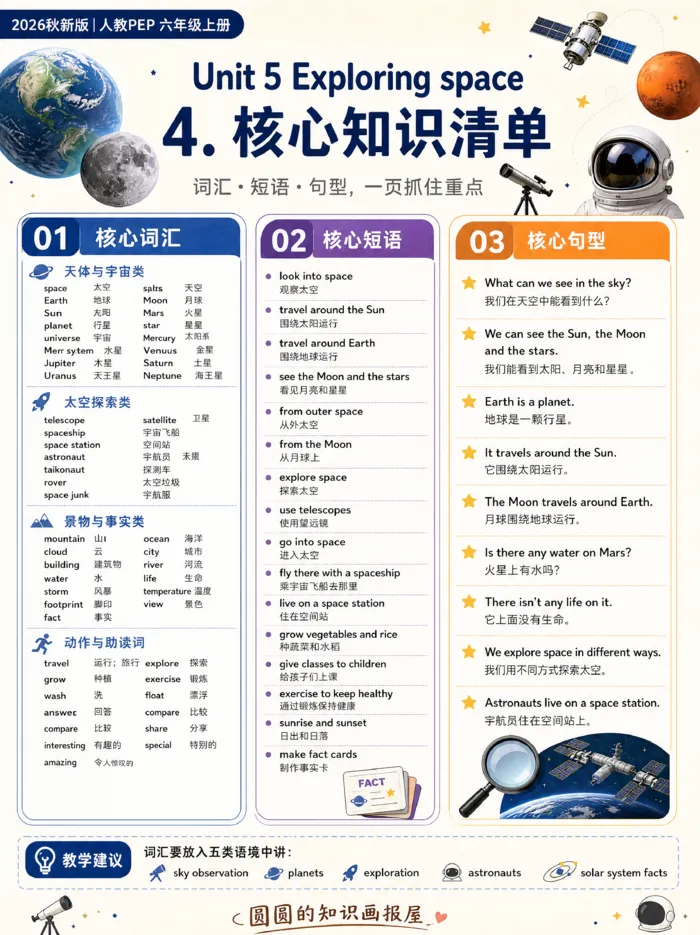
4.核心知识清单
词汇·短语·句型,一页抓住重点
01
核心词汇
02 核心短语
03 核心句型
天体与宇宙类
space
太空
salrs
天空
Earth
地球
Moon
月球
Sun
无阳
Mars
火星
planet
行星
star
星星
universe 宇宙
Mercury 太阳系
Mer sy.tem 水星
Venuus
金星
Jupiter
木星
Saturn
土星
Uranus
天王星
Neptune 海王星
o look into space
观察太空
What can we see in the sky?
我们在天空中能看到什么?
● travel around the Sun
围绕太阳运行
● travel around Earth
围绕地球运行
We can see the Sun, the Moon
and the stars.
● see the Moon and the stars
看见月亮和星星
我们能看到太阳、月亮和星星。
了
太空探索类
telescope
satellite
卫星
spaceship
宇宙飞船
space station
空间站
astronaut
宇航员未
taikonaut
探测车
rover
太空垃圾
space junk
宇航服
o from outer space
从外太空
Earth is a planet.
地球是一颗行星。
● from the Moon
从月球上
It travels around the Sun.
它围绕太阳运行。
● explore space
探索太空
景物与事实类
o use telescopes
使用望远镜
The Moon travels around Earth.
月球围绕地球运行。
mountain 山1
ocean
海洋
cloud
云
city
城市
building
建筑物
river
河流
waterr
水
life
生命
storm
风暴
temperature温度
footprint 脚印
view
景色
fact
事实
● go into space
进入太空
o fly there with a spaceship
乘宇宙飞船去那里
Is there any water on Mars?
火星上有水吗?
o live on a space station
住在空间站
There isn't any life on it.
它上面没有生命。
Running
动作与助读词
● grow vegetables and rice
种蔬菜和水稻
travel
运行;旅行 explore 探索
grow
种植
exercise 锻炼
wash
洗
float
漂浮
answer
回答
compare 比较
compare
比较
share
分享
interesting 有趣的
special
特别的
amazing
令人惊叹的
● give classes to children
给孩子们上课
We explore space in different ways.
我们用不同方式探索太空。
● exercise to keep healthy
通过锻炼保持健康
● sunrise and sunset
日出和日落
Astronauts live on a space station.
宇航员住在空间站上。
● make fact cards
制作事实卡
FACT
教学建议
词汇要放入五类语境中讲:
大sky observation planets
exploration
astronauts
solar system facts
圆圆的知识画报屋
2026秋新版|人教PEP六年级上册
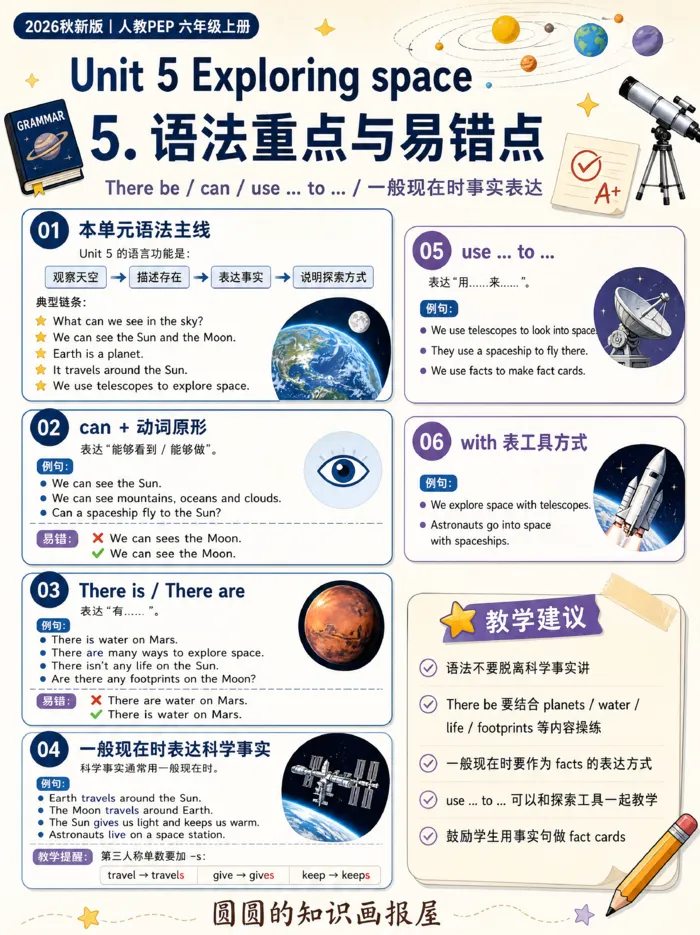
Unit 5 Exploring space
GRAMMAR 5.语法重点与易错点
There be/ can/ use...to.../一般现在时事实表达
01
Unit 5的语言功能是:
观察天空
典型链条:
☆ What can we see in the sky?
☆ We can see the Sun and the Moon.
☆ Earth is a planet.
☆ It travels around the Sun.
☆ We use telescopes to explore space.
02
表达“能够看到/能够做”。
例句:
o We can see the Sun.
o We can see mountains, oceans and clouds.
● Can a spaceship fly to the Sun?
易错:
本单元语法主线
描述存在
can +动词原形
× We can sees the Moon.
表达事实
We can see the Moon.
说明探索方式
03
There is / There are
表达“有⋯⋯"”。
例句:
There is water on Mars.
● There are many ways to explore space.
● There isn't any life on the Sun.
○ Are there any footprints on the Moon?
易错:
XThere are water on Mars.
There is water on Mars.
04
一般现在时表达科学事实
科学事实通常用一般现在时。
例句:
● Earth travels around the Sun.
● The Moon travels around Earth.
o The Sun gives us light and keeps us warm.
● Astronauts live on a space station.
教学提醒: 第三人称单数要加-s:
travel→ travels
give→gives keep→keeps
05use....to ...
表达“用⋯⋯·来⋯⋯”。
例句:
o We use telescopes to look into space.
o They use a spaceship to fly there.
o We use facts to make fact cards.
06 with 表工具方式
例句:
o We explore space with telescopes.
● Astronauts go into space
with spaceships.
教学建议
语法不要脱离科学事实讲
There be要结合planets/ water /
life / footprints等内容操练
◎一般现在时要作为facts的表达方式
use ...to.⋯.可以和探索工具一起教学
鼓励学生用事实句做 fact cards
圆的知画屋
2026秋新版|人教PEP六年级上册
Unit 5 Exploring space
6.单元课时安排建议
建议6—7课时完成
1
第1课时|单元导入+词汇预热
目标:
建立 space、sky、Earth、Moon、Sun、Mars的主题背景。
②
第2课时 | Part A Let's talk
目标:
理解课堂对话,学习描述从天空和外太空能看到什么。
3
第3课时 | Part A Let's learn
目标:
掌握Earth / Moon / Sun的关系,学习 planet、satellite、
travel aroun( 等表达。
4
第4课时| Part B Let's talk+ Let's learn
目标:
理解Mars 话题,学习探索太空的方式,如 telescopes、
spaceship、space station。
5
第5课时 | Read and write
目标:
阅读 astronauts’ ife in space,理解太空生活的特殊性并提取信息。
6
FACT
第6课时 | Part C Project
目标:
制作 Earth / Sun / Moon / astronauts的fact cards,并进行分享。
7
第7课时 | Reading time+单元复习
目标:
拓展太阳系趣味事实,复盘核心词句、语法和事实表达。
★课时调整建议
如果课时紧张,可以将 Reading time作为课后拓展阅读,
将Project 与单元复习整合完成。
圆圆的知识画报屋
2026秋新版|人教PEP六年级上册
Unit 5 Exploring space
7. Part A教学指导
从 sky observation 进入 Earth与Moon
Explore
the Universe
: Earth
Moon
01 教学内容
02教学目标
03 教学重难点
Let's talk:
It's hot here, but it's cold on our planet Earth today.
What can you see in the sky?
We can see the Sun and the clouds.
We can also see birds and planes.
At night, we can see the Moon and the stars.
But what can we see from outer space?
We can see mountains, oceans and clouds.
There are large oceans on Earth.
It looks like a big blue marble.
学生能够:
重点:
·听懂Part A关于sky和
outer space的对话
●使用 What can we see ...?
询问能看到什么
What can we see in the sky?
We can see the Sun, the Moon
and the stars.
Earth is a planet.
It travels around the Sun.
●使用We can see...
描述观察结果
难点:
Let's learn:
Hi, I’m Earth. I'm a planet.
I travel around the Sun.
Satellites travel around me.
The Moon is my neighbour.
It travels around me.
People often see the Moon and the stars at night.
·理解 Earth is a planet/
The Moon travels around Earth
· sky与outer space的语境区别
· from a hill / from a plane/
from the Moon的视角变化
·初步区分 Earth、Moon、
Sun和 satellites 的关系
· travel around的科学含义
· satellite 和 Moon的关系理解
04 课堂活动建议
05板书建议
06 作业建议
活动1:
观察图片导入
What can you see in the sky?
What can you see at night?
What can we see in the sky?
We can see the Sun/ Moon /
stars / clouds.
基础:
听读Part A
活动2:
视角对比
from a hill / from a plane / from the Moon
提升:画一张 Earth/Sun/ Moon
关系图并配英文句子
Earth is a planet.
It travels around the Sun.
活动3:
天体关系图
Sun← Earth← Moon
Earth travels around the Sun.
The Moon travels around Earth.
The Moon travels around Earth.
拓展:
写3句“I can see ...
from⋯”
活动4:
句型操练
A: What can you see from...?
B: I can see ...
教学提醒
Part A要从学!看得见的sky 出发,
Sun
Earth
Moon
再逐步拓展到 outer space和
Earth from space。
A
圆圆的知识画报屋
★
2026秋新版|人教PEP六年级上册
Unit 5 Exploring space
8. Part B教学指导
从 Mars 进入太空探索方式
We learn more about
China already
the “red planet”
I'm reading about
put a rover on Mars.
every year.
Mars.
MARS
THE RED PLANET
FACTS ABOUT MARS
CHINA’S ROVER ON MARS
Mars is called
There is
the “red planet”.
water on Mars.
Zhurong rover
landed on Mars
in May 2021.
01 教学内容
02教学目标
03 教学重难点
☆
Let's talk:
What are you reading about?
Mars? What does it say?
It talks about things on Mars.
Is there any water on Mars?
Yes, there is. There is soil, too.
Are there any aliens?
I don't think so. They say there aren't
any living things.
China already put a rover on Mars.
We learn more about the “red planet”
every year.
学生能够:
重点:
· 听懂并理解关于Mars的对话
· 使用 Is there any ..? / Are there any.⋯?
询问存在
Is there any water on Mars?
Yes, there is.
Are there any aliens?
There aren't any living things.
· 理解Mars、water、soil、living things、
rover等信息
难点:
Let's learn:
· 使用We explore space in different ways
介绍探索方式
· water 是不可数名词,用Is there any water?
We explore space in different ways.
We can look into space with telescopes.
Astronauts go into space.
They use a spaceship to fly there.
Some astronauts live for months on
a space station.
· 掌握 telescopes、spaceship、space
station、astronauts 等核心词
· aliens/ living things是复数,用Are
there any ...?
· There is/ There are的区别
·用use ... to ...表达工具与用途
04 课堂活动建议
05 板书建议
Is there any water on Mars?
Yes, there is.
Are there any aliens?
No, there aren't.
We explore space in different ways.
We use telescopes to look
into space.
Astronauts use spaceships to
go into space.
06 作业建议
活动1:Mars fact预测
Is Mars red?
Is there water on Mars?
Are there living things?
基础:听读Part B
活动2: There be句型分类
Is there any water?
Are there any aliens?
There is soil.
There aren’t any living things.
三
提升:写3句 Facts about Mars
活动3:探索方式配对
telescope
→ look into space
spaceship
→ fly into space
space station → live in space
rover
→ explore Mars
拓展:查找一个中国火星探测
相关信息,用英文写一句
活动4:Facts about Mars 分享
Mars is red.
There is water on Mars.
There is soil.
There aren't any living things.
Keep exploring!
The universe is
full of wonders.
教学提醒
Part B要帮助学生把 Mars 话题从“有没有水”拓展到“人类怎样探索太空”。
圆圆的知识画报屋
2026秋新版|人教PEP六年级上册
Unit 5 Exploring space
9.Read and write与Project教学指导
从 astronauts' life到space fact cards
Earth
Sun
☆
Moon
It is a planet.
It is a star.
.7hrnni公
It is a natural
satellite
Read and write 教学指导
01 阅读内容定位
02 阅读结构
03 阅读问题处理
Read and write的主题是:
建议用三个部分梳理:
What do astronauts do?
文本介绍中国航天员taikonauts
在太空中的生活,包括:
① Getting ready
wash faces/ eat food in special ways
① What do taikonauts grow?
They grow vegetables and rice.
· getting ready
· washing their faces
· eating food
· doing work
② Everyday tasks
grow vegetables and rice/
give classes
②What do taikonauts do for children?
They give classes to children.
· growing vegetables and rice
· giving classes to children
· exercising
· seeing sunrise and sunset
③Interesting parts
exercise / see sunrise and sunset/
amazing view
③Why do taikonauts exercise?
They exercise to keep healthy.
04 写作总结
05 仿写支架
06 完整范文
这篇文章适合引导学生写:
A day in space
A day in space
A day in space
写作结构:
It is special to be an astronaut.
1. Opening: It is special to be an astronaut.
Early in the morning, I______.
2. Morning: get ready / wash / eat
Every day, I_____
3. Work:grow /answer questions /
give classes
Sometimes, I_____
I must_____to keep healthy.
4. Health:exercise to keep healthy
The view is _____.
5. Feeling: The view is amazing.
I think life in space is______.
It is special to be an astronaut. Early in
the morning, I get ready for a busy day.
I wash my face and eat breakfast in a
special way. Then I start my work. I grow
vegetables and answer questions from
children. Sometimes I give classes from
space. Every afternoon, I exercise to keep
healthy and strong. The view outside the
space station is amazing. I can see the
sunrise and sunset many times a day. I
think life in space is hard but very
interesting.
Part C Project 教学指导
07 Project 教学定位
08 Project 表达支架
09 评价建议
Part C的核心任务是:
Facts about the Sun
· It is a star.
facts 是否准确
Share the facts of Earth, the Sun
· There isn't any life on it.
and the Moon
· It gives us light and keeps us warm.
是否能用 There is / There are表达
学生需要围绕某个天体整理 facts,
并制作fact cards/models,再进行
课堂分享。
Facts about Earth
· It is a planet.
是否使用一般现在时
· There are oceans, mountains and clouds.
· There is water on Earth.
是否能清楚介绍天体特点
Facts about astronauts
· Astronauts study space, stars and planets.
是否能合作制作fact cards
Mars
· They work in a space station.
· They go there by spaceship.
It is a planet
☆
圆圆的知识画报屋
2026秋新版|人教PEP六年级上册
Unit 5 Exploring space
10.Reading time与单元复习速览
从 solar system facts 到单元整体复盘
目
SECTION 1
Reading time 教学指导
01 Reading time 内容定位
02
不必逐句翻译,可以抓三类信息:
①
②
③Space problem
太空垃圾
阅读处理建议
Planet facts
Moon facts
行星事实
月球脚印
03 课堂问题建议
Reading time 主题为:
Some fun facts about our solar system
☆Which planet is the hottest?
内容包括:
· Venus is the hottest planet.
☆ What is the Great Red Spot?
★ Which planet has the fastest wind?
·Jupiter's storm is the Great Red Spot.
· Neptune has the fastest wind.
· Saturn has over ten moons.
★ Why can footprints stay on the Moon?
★ What is space junk?
· Footprints on the Moon can stay
for a very long time.
· Space junk is growing
Earthn.
FACT CARD
SECTION 2
单元复习速览
04 单元主题
05 核心任务
06 核心句型
三
· What can we see in the sky?
Exploring space
探索太空
· Talk about Earth and
outer space.
· We can see the Sun, the Moon and the stars.
· Earth is a planet.
· Read and write about
life in space.
· It travels around the Sun.
· Is there any water on Mars?
· There isn't any life on it.
· Share facts about space.
· We explore space in different ways.
· Astronauts live on a space station.
07 核心语法
08 易错点提醒
09
· 太空主题要突出科学事实表达
· There be要结合water/ life/
Good
· Read and write 要服务于
· Project要围绕 facts 展示
· Reading time 可作为科学阅读拓展
教学提醒
planets讲
Teaching
“A day in space”写作
Better
Learning!
· can +动词原形
×We can sees the Moon.
? We can see the Moon.
· There is / There are
区There are water on Mars.
·一般现在时表达科学事实
? There is water on Mars.
· use ...to .⋯.
X Earth travel around the Sun.
? Earth travels around the Sun.
· with 表工具方式
X We use telescopes look into space.
? We use telescopes to look into space.
一页式复盘关键词
☆ Earth  Moon | Mars  there be  space exploration  astronaats  solar system☆
66Unit 5的核心,是帮助学生从“看见天空”走向“用英语表达科学事实”。
目
99
圆圆的知识画报屋☆