Lesson 11 Double Ninth Festival 重阳节
The Double Ninth Festival, also named Chong Yang Festival, falls on the ninth day of the ninth month of the
Chinese lunar calendar, hence it gets name of Double Ninth Festival. On this
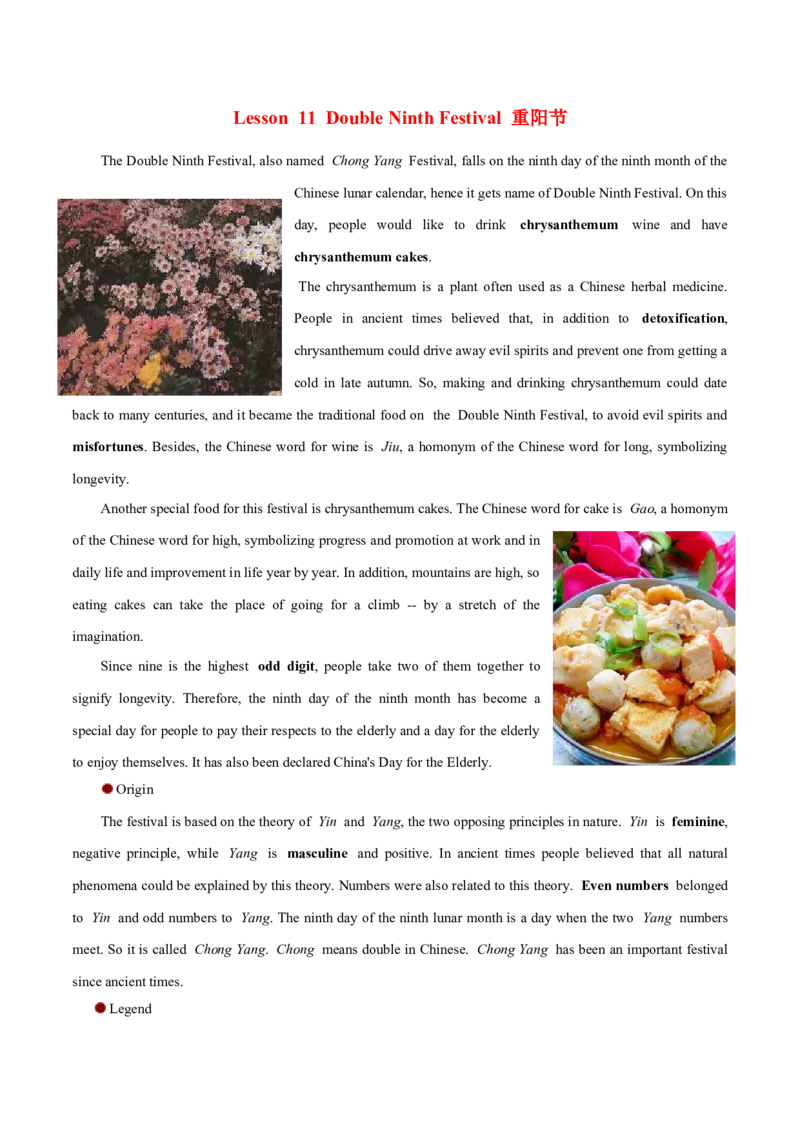
day, people would like to drink chrysanthemum wine and have
chrysanthemum cakes.
The chrysanthemum is a plant often used as a Chinese herbal medicine.
People in ancient times believed that, in addition to detoxification,
chrysanthemum could drive away evil spirits and prevent one from getting a
cold in late autumn. So, making and drinking chrysanthemum could date
back to many centuries, and it became the traditional food on the Double Ninth Festival, to avoid evil spirits and
misfortunes. Besides, the Chinese word for wine is Jiu, a homonym of the Chinese word for long, symbolizing
longevity.
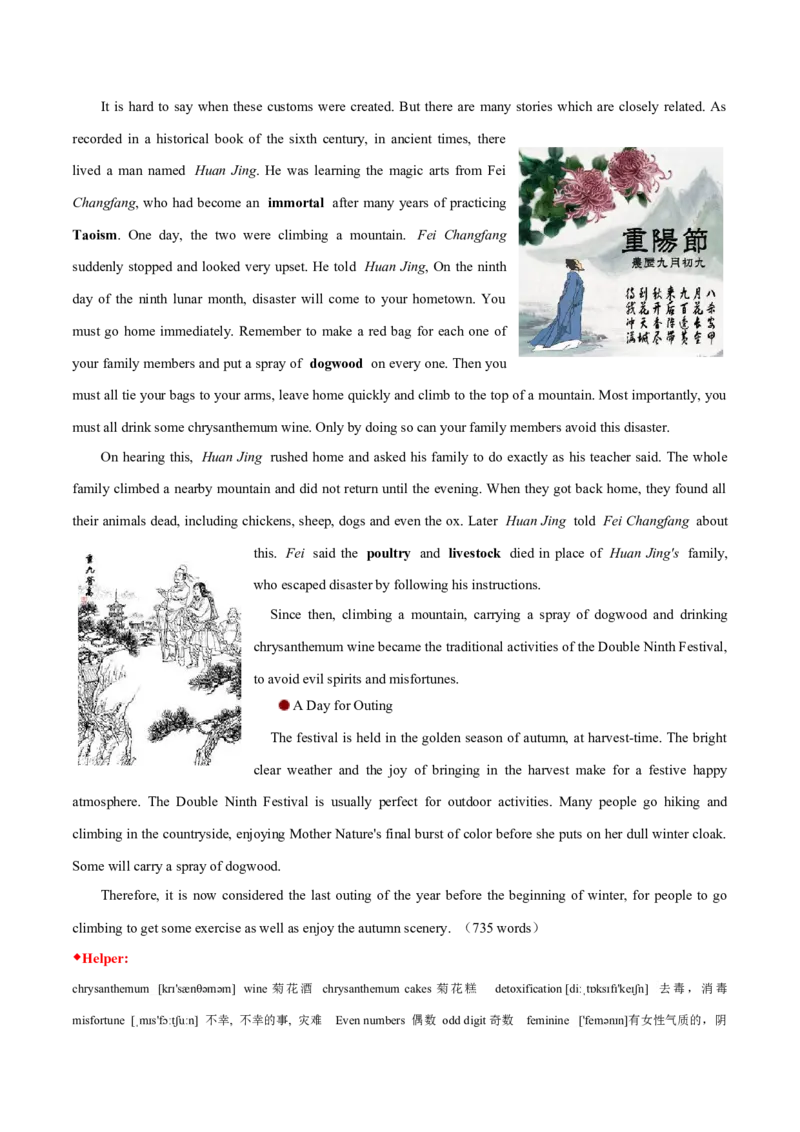
Another special food for this festival is chrysanthemum cakes. The Chinese word for cake is Gao, a homonym
of the Chinese word for high, symbolizing progress and promotion at work and in
daily life and improvement in life year by year. In addition, mountains are high, so
eating cakes can take the place of going for a climb -- by a stretch of the
imagination.
Since nine is the highest odd digit, people take two of them together to
signify longevity. Therefore, the ninth day of the ninth month has become a
special day for people to pay their respects to the elderly and a day for the elderly
to enjoy themselves. It has also been declared China's Day for the Elderly.
Origin
The festival is based on the theory of Yin and Yang, the two opposing principles in nature. Yin is feminine,
negative principle, while Yang is masculine and positive. In ancient times people believed that all natural
phenomena could be explained by this theory. Numbers were also related to this theory. Even numbers belonged
to Yin and odd numbers to Yang. The ninth day of the ninth lunar month is a day when the two Yang numbers
meet. So it is called Chong Yang. Chong means double in Chinese. Chong Yang has been an important festival
since ancient times.
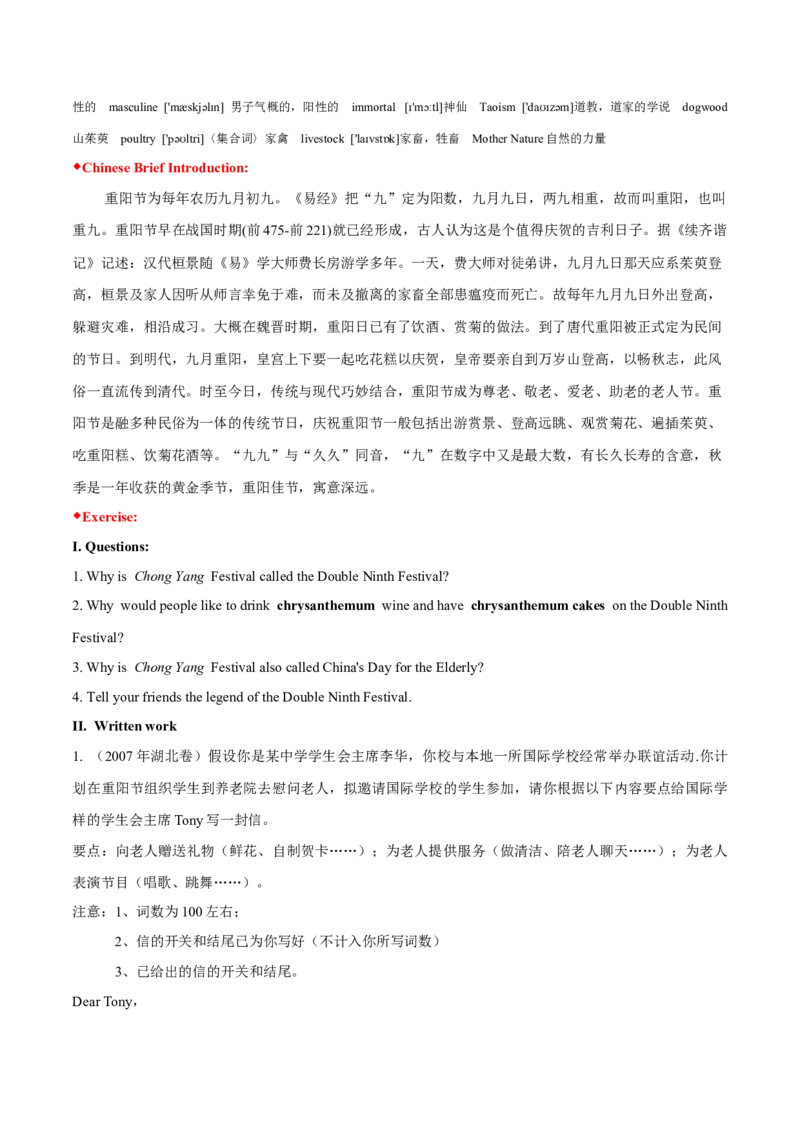
LegendIt is hard to say when these customs were created. But there are many stories which are closely related. As
recorded in a historical book of the sixth century, in ancient times, there
lived a man named Huan Jing. He was learning the magic arts from Fei
Changfang, who had become an immortal after many years of practicing
Taoism. One day, the two were climbing a mountain. Fei Changfang
suddenly stopped and looked very upset. He told Huan Jing, On the ninth
day of the ninth lunar month, disaster will come to your hometown. You
must go home immediately. Remember to make a red bag for each one of
your family members and put a spray of dogwood on every one. Then you
must all tie your bags to your arms, leave home quickly and climb to the top of a mountain. Most importantly, you
must all drink some chrysanthemum wine. Only by doing so can your family members avoid this disaster.
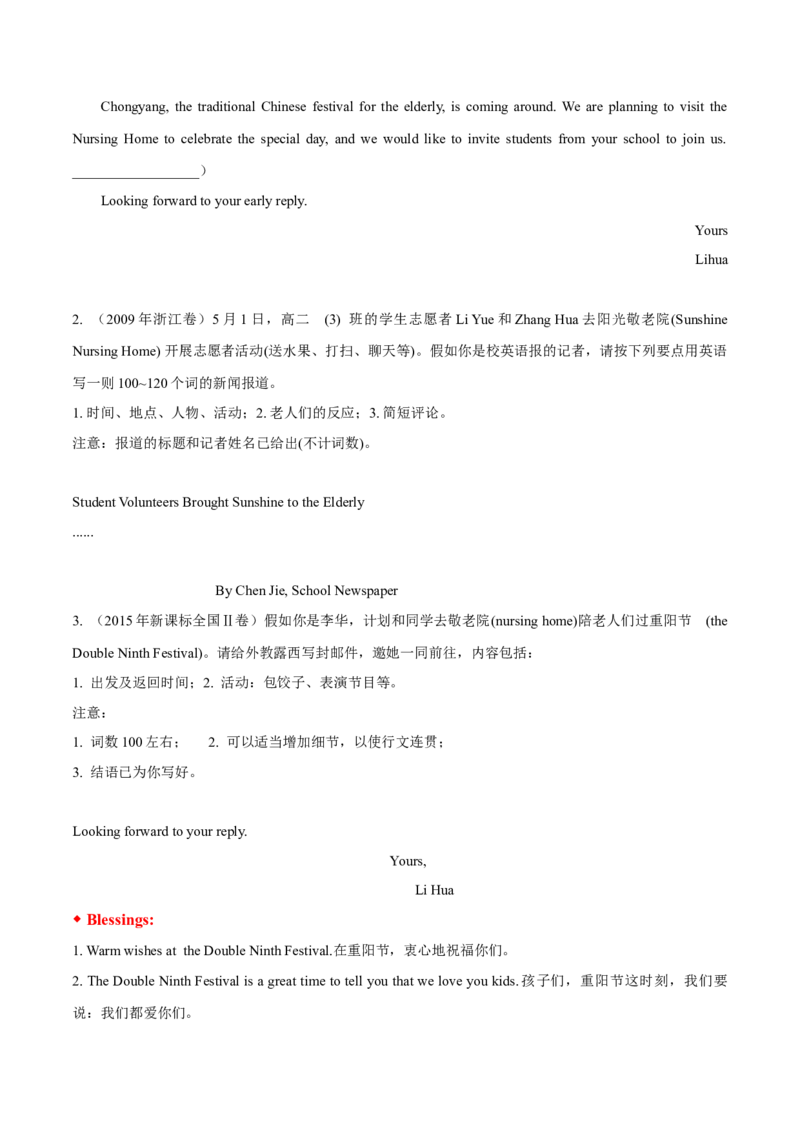
On hearing this, Huan Jing rushed home and asked his family to do exactly as his teacher said. The whole
family climbed a nearby mountain and did not return until the evening. When they got back home, they found all
their animals dead, including chickens, sheep, dogs and even the ox. Later Huan Jing told Fei Changfang about
this. Fei said the poultry and livestock died in place of Huan Jing's family,
who escaped disaster by following his instructions.
Since then, climbing a mountain, carrying a spray of dogwood and drinking
chrysanthemum wine became the traditional activities of the Double Ninth Festival,
to avoid evil spirits and misfortunes.
A Day for Outing
The festival is held in the golden season of autumn, at harvest-time. The bright
clear weather and the joy of bringing in the harvest make for a festive happy
atmosphere. The Double Ninth Festival is usually perfect for outdoor activities. Many people go hiking and
climbing in the countryside, enjoying Mother Nature's final burst of color before she puts on her dull winter cloak.
Some will carry a spray of dogwood.
Therefore, it is now considered the last outing of the year before the beginning of winter, for people to go
climbing to get some exercise as well as enjoy the autumn scenery. (735 words)
◆Helper:
chrysanthemum [krɪ'sænθəməm] wine 菊花酒 chrysanthemum cakes 菊花糕 detoxification [diːˌtɒksɪfɪ'keɪʃn] 去毒,消毒
misfortune [ˌmɪs'fɔːtʃuːn] 不幸, 不幸的事, 灾难 Even numbers 偶数 odd digit奇数 feminine ['femənɪn]有女性气质的,阴性的 masculine ['mæskjəlɪn] 男子气概的,阳性的 immortal [ɪ'mɔːtl]神仙 Taoism ['daʊɪzəm]道教,道家的学说 dogwood
山茱萸 poultry ['pəʊltri]〈集合词〉家禽 livestock ['laɪvstɒk]家畜,牲畜 Mother Nature自然的力量
◆Chinese Brief Introduction:
重阳节为每年农历九月初九。《易经》把“九”定为阳数,九月九日,两九相重,故而叫重阳,也叫
重九。重阳节早在战国时期(前475-前221)就已经形成,古人认为这是个值得庆贺的吉利日子。据《续齐谐
记》记述:汉代桓景随《易》学大师费长房游学多年。一天,费大师对徒弟讲,九月九日那天应系茱萸登
高,桓景及家人因听从师言幸免于难,而未及撤离的家畜全部患瘟疫而死亡。故每年九月九日外出登高,
躲避灾难,相沿成习。大概在魏晋时期,重阳日已有了饮酒、赏菊的做法。到了唐代重阳被正式定为民间
的节日。到明代,九月重阳,皇宫上下要一起吃花糕以庆贺,皇帝要亲自到万岁山登高,以畅秋志,此风
俗一直流传到清代。时至今日,传统与现代巧妙结合,重阳节成为尊老、敬老、爱老、助老的老人节。重
阳节是融多种民俗为一体的传统节日,庆祝重阳节一般包括出游赏景、登高远眺、观赏菊花、遍插茱萸、
吃重阳糕、饮菊花酒等。“九九”与“久久”同音,“九”在数字中又是最大数,有长久长寿的含意,秋
季是一年收获的黄金季节,重阳佳节,寓意深远。
◆Exercise:
I. Questions:
1. Why is Chong Yang Festival called the Double Ninth Festival?
2. Why would people like to drink chrysanthemum wine and have chrysanthemum cakes on the Double Ninth
Festival?
3. Why is Chong Yang Festival also called China's Day for the Elderly?
4. Tell your friends the legend of the Double Ninth Festival.
II. Written work
1. (2007年湖北卷)假设你是某中学学生会主席李华,你校与本地一所国际学校经常举办联谊活动.你计
划在重阳节组织学生到养老院去慰问老人,拟邀请国际学校的学生参加,请你根据以下内容要点给国际学
样的学生会主席Tony写一封信。
要点:向老人赠送礼物(鲜花、自制贺卡……);为老人提供服务(做清洁、陪老人聊天……);为老人
表演节目(唱歌、跳舞……)。
注意:1、词数为100左右;
2、信的开关和结尾已为你写好(不计入你所写词数)
3、已给出的信的开关和结尾。
Dear Tony,Chongyang, the traditional Chinese festival for the elderly, is coming around. We are planning to visit the
Nursing Home to celebrate the special day, and we would like to invite students from your school to join us.
__________________)
Looking forward to your early reply.
Yours
Lihua
2. (2009年浙江卷)5月1日,高二 (3) 班的学生志愿者Li Yue和Zhang Hua去阳光敬老院(Sunshine
Nursing Home) 开展志愿者活动(送水果、打扫、聊天等)。假如你是校英语报的记者,请按下列要点用英语
写一则100~120个词的新闻报道。
1. 时间、地点、人物、活动;2. 老人们的反应;3. 简短评论。
注意:报道的标题和记者姓名已给出(不计词数)。
Student Volunteers Brought Sunshine to the Elderly
......
By Chen Jie, School Newspaper
3. (2015年新课标全国Ⅱ卷)假如你是李华,计划和同学去敬老院(nursing home)陪老人们过重阳节 (the
Double Ninth Festival)。请给外教露西写封邮件,邀她一同前往,内容包括:
1. 出发及返回时间;2. 活动:包饺子、表演节目等。
注意:
1. 词数100左右; 2. 可以适当增加细节,以使行文连贯;
3. 结语已为你写好。
Looking forward to your reply.
Yours,
Li Hua
◆ Blessings:
1. Warm wishes at the Double Ninth Festival.在重阳节,衷心地祝福你们。
2. The Double Ninth Festival is a great time to tell you that we love you kids.孩子们,重阳节这时刻,我们要
说:我们都爱你们。3. The Double Ninth Festival is the best holiday of the year. 重阳节是一年中最好的节日。
4. The Double Ninth Festival just won't be the same without you.没有你,重阳节就不会一样了。
5. It will be sad not to see you during the holiday when families get together.家人团聚的节日里,不能看到你,
我会感到难过。
6. I wish a happy Double Ninth Festival 祝重阳节快乐!
7. I wish my parents happy Double Ninth Festival 祝父母重阳节快乐!
8. I wish grandpa happy Double Ninth Festival 祝爷爷重阳节快乐!Lesson 12 Laba Festival 腊八节
Laba is celebrated on the eighth day of the last lunar month, referring to the traditional start of celebrations for
the Chinese New Year. "La" in Chinese means the 12th lunar month and "ba" means eight.
Legend about the origin of this festivity is plentiful. One maintains that over
3,000 years ago sacrificial ceremonies were held in the twelfth lunar month when
people offered up their prey to the gods of heaven and earth. The Chinese characters
for the hunt and the twelfth month (lie [liè] 猎and la [là] 腊 ) were interchangeable
then, and ever since la has been used to refer to both. Since the festival was held on
the eighth day of the last month, people later added the number eighth (ba in Chinese),
giving us the current laba.
Buddhism was well accepted in the areas inhabited Han Chinese, who believed that Sakyamuni, the first
Buddha and founder of the religion, attained enlightenment on 12/8. Sutras were chanted in the temples and rice
porridge with beans, nuts and dried fruit was prepared for the Buddha. With time
the custom extended, especially in rural areas where peasants would pray for a
plentiful harvest in this way.
There is, however, another touching story. When Sakyamuni was on his way
into the high mountains in his quest for understanding and enlightenment, he grew
tired and hungry. Exhausted from days of walking, he passed into
unconsciousness by a river in India. A shepherdess found him there and fed him
her lunch—porridge made with beans and rice. With such nourishment he was able to continue his journey. After
six years of strict discipline, he finally realized his dream of full enlightenment on the eighth day of the twelfth
lunar month. Ever since, monks have prepared rice porridge on the eve ad held a ceremony the following day,
during which they chant the sutras and offer porridge to Buddha. Thus, the tradition of eating laba porridge was
based in religion, though with time the food itself became a popular winter dish especially in cold northern China.
Laba porridge is made with local specialties such as ginkgo fruits, water chestnuts, chestnuts, lotus seeds
and red beans in addition to the rice. Actually eight ingredients are used, cooked with sugar to make the porridge
wonderfully sweet. Northerners prefer to use glutinous rice, red beans, dates, lotus seeds, dried longan pulp,
walnuts, pine nuts and other dried fruits in their porridge; southerners like a salty porridge prepared with rice,
soybeans, peanuts, broad beans, taro, water chestnuts, walnuts, vegetables and diced meat. Some people like toadd cinnamon and other condiments to inject flavor. Controlling the heat is of great importance in the outcome.
At the start, the flame must be high, but the fire is then turned down to let the porridge simmer until it begins to
smell delicious. The process is time-consuming but not difficult.
Laba porridge is not only easy to prepare, but also a nutritious winter food because it contains amino acids,
protein and other vitamins people need. Cooked nuts and dried fruit are good for smoothing nerves, nourishing
one’s heart and vitality, and strengthening the spleen. Perhaps that is why it is also called babao (Eight Treasure)
porridge. (533 words)
Helper:
Festivity [fes'tiviti, fes'tivəti] n. 欢宴 sacrificial [sækri'fiʃəl, sækrə'fiʃəl] 献祭的, 牺牲的 Buddhism ['budizəm] n. 佛教
Sakyamuni ['sɑ:kjə.muni] n. 释迦牟尼(佛教创始人)inhabited [in'hæbitid] adj. 有人居住的 prey n. 猎物
enlightenment n. 启蒙,【佛教】 开悟,顿悟 Sutras佛经 chant [tʃɑ:nt] v. 吟唱, 诵扬, 叫喊 longan龙眼 ginkgo
['giŋkəu] 银杏 chestnut ['tʃes.nʌt] n. 栗子, 栗树 water chestnuts [植]菱角, 荸荠 lotus seed 莲子 taro ['tɑ:rəu] n. 芋头
longan pulp桂圆肉 pine nuts 松子 dice[dais] v将…切成丁 longan pulp 龙眼肉 Sakyamuni 释迦牟尼 spleen[spli:n] n.
脾 sutra n. [佛教]经;经典 walnut n. 胡桃 water chestnut n. 欧菱,荠 glutinous ['glu:tinəs] adj. 粘性的, 胶状的
glutinous rice糯米 broad beans 蚕豆soybeans大豆 cinnamon ['sinəmən] n. 肉桂,肉桂皮 condiment ['kɔndimənt, 'kɔndəmənt]
n. 调味品 simmer ['simə] v炖, 煨 ingredient 配料,成分 amino acid ['æminəu] 氨基酸 protein ['prəuti:n, 'prəuti:in] n.
蛋白质 vitality [vai'tæliti, vai'tæləti] n. 活力
May all beings be free from suffering and attain enlightenment soon! 愿所有众生从痛苦中解脱出来并且早日成佛!
◆Chinese Brief Introduction:
腊八节,俗称“腊八”,是指农历腊月(十二月)初八这一天。腊八节是用来祭祀祖先和神灵,祈求
丰收和吉祥的节日。相传释伽牟尼成佛之前,绝欲苦行,饿昏倒地。一牧羊女以杂粮掺以野果,用清泉煮
粥将其救醒。释伽牟尼在菩提树下苦思,终在十二月八日得道成佛。从此佛门定此日为“佛成道日”,诵
经纪念,相沿成节。到了明清,敬神供佛更是取代祭祀祖灵、欢庆丰收和驱疫禳灾,而成为腊八节的主旋
律。其节俗主要是熬煮、赠送、品尝腊八粥,并举行庆丰家实。同时许多人家自此拉开春节的序慕,忙于
杀年猪、打豆腐、胶制风鱼腊肉,采购年货,“年”的气氛逐渐浓厚。在中国,有腊八节喝腊八粥、泡腊
八蒜的习俗。
◆ Exercises:
Answer the following questions?
I. Questions:
1. When is Laba held?2. Tell your friend a legend about the origin of Laba.
3. What’s the reason why Laba porridge a nutritious winter food?
II. Written work
现在许多年轻人都热衷于过诸如“情人节”、“愚人节”、“圣诞节”之类的洋节,但也有许多人对
此持反对态度。请结合下表内容谈谈你的看法。
你的
支持者的看法 反对者的看法
看法
1. 显得愚蠢
1. 显得时尚
2. 是一种文化入侵
2. 可以学习外国文化 …….
3. 会淡化对传统节日
3. 借此扩大交接圈
的感情
注意:
1. 文章必须包括表中的全部内容。
2. 词数:120左右。文章开头已写好,不计入总词数。
3. 参考词汇:入侵—invasion;传统的—traditional
Is it right for young people to celebrate foreign festivals such as Valentine’s Day, April Fools’ Day and
Christmas Day? ________________
◆ Blessings:
1. Send you a coat:peace is in the front, the back is happiness, luck is collar, wish is sleeve, happiness is a
button, pocket full of warmth, put it on, let it be with you every day! The Laba festival!
送你一件外套,前面是平安,后面是幸福,吉祥是领子,如意是袖子,快活是扣子,口袋里满是温
暖,穿上吧,让它相伴你的每一天!腊八节快活!
2. I click on the spring to see your smile, I copied your smiling face paste in my heart, I download my thoughts
to save it forever, I open my mobile phone to send you the most sincere blessing: I wish the Laba festival!
我点击全部春天看到了你的笑容,我复制了你笑容粘贴在我的心间,我下载我的思念把它另存为永
远,我打开我的手机给你送上最真诚的祝福:祝腊八节快活!
3. No matter on the side of the road, sea, sky, good luck always be with you. Whether past, present, future,
always give you the warm care, may you be the happiest man. Happy, good luck!
不管在路边,海边,天边,好运一直陪在你身边。无论是过去,现在,将来,一直给你最暖的关心,
愿你成为世界上最开心最幸福的人。笑口常开,好运常在!Suggested Answers
11. Double Ninth Festival
II. Written work
1. We have planned several activities. When we get there, present them with flowers and self-made cards to
show our respect and love. Then we will do some cleaning including sweeping the yard, mopping the floor and
wiping the windows. As some old people feel lonely, we may chat with them about their old days, changes of our
city, or anything they are interested in. We may also give them some performances such as singing, dancing.
I am sure we will both gain a better understanding of the elderly in China. If you have any suggestions, please
let us know.
2. Student Volumteers Broutht Sunshine to the Elderly
On May Day, Li Yue and Zhang Hua, students from Class Three, Grade Two, went to Sunshine Nursing Home
and did some voluntary work. Upon their arrival, Li Yue and Zhang Hua were warmly welcomed, and respectfully,
they presented the elderly with flowers and fruits. Then, they started working at once, cleaning the windows and
sweeping the floor. Everything done, they sat in the yard chatting with the elderly people.
When it was time for the volunteers to leave, the elderly people thanked them for their kindness. They said it
was such a beautiful day that they would remember it forever.
Li Yue and Zhang Hua were very happy. What they did has brought joy to others and enriched their own lives.
By Chen Jie, School Nwespaper
3. Dear Lucy,
I'd like to invite you to join us for a visit to the nearby nursing home next Saturday for the Double Ninth
Festival. It is the day for the elderly in our culture. We'll go and make dumplings and cakes with the elderly people
there. We'll also spend some fun time together singing, dancing and playing games, which we hope will make them
happy. We should come back around 4 o'clock in the afternoon. If you are able to come with us, please let us know
and we'll wait for you at the school gate at 9 in the morning.
Looking forward to your reply.
Yours,Li Hua
12.Laba Festival: Laba Rice Porridge Festival
II. Written work
Is it right for young people to celebrate foreign festivals such as Valentine’s Day, April Fools’ Day and
Christmas Day? Some people say yes. They think that celebrating foreign festivals is a fashionable activity. They
help people not only to make more friends but also to gain more knowledge about foreign culture.
Others, however, think not. They say that it’s foolish for Chinese people to celebrate foreign festivals, which
will greatly affect people’s feelings on our own traditional festivals. Some people even consider it as a cultural
invasion.
As for me, I don’t think that foreign festivals are very bad things. In fact, the world is becoming “smaller”—
people all over the world are becoming a big family. On the other hand, I also think that we should pay more
attention to our own traditional festivals, because they are part of the root of our Chinese culture.